Anxiety disorders are highly prevalent and negatively impact both mental and physical health across the developmental life span. An epidemiological review reported prevalence rates of anxiety disorders, in which symptoms cause ongoing distress and interfere with normal life activities, to be between 6.1% and 14.8% in children aged 2 through 8 years, and 10.3% to 12.2% in adolescents aged 13 through 18 years across studies (Costello, Egger, Copeland, Erkanli, & Angold, Reference Costello, Egger, Copeland, Erkanli, Angold, Silverman and Field2011). Anxiety symptoms include both physiological arousal and cognitive–emotional dimensions, which may affect physical and psychological well-being even without meeting diagnostic criteria for a given anxiety disorder. The widespread prevalence of anxiety in childhood and its detrimental long-term effects on psychological and physical health suggest reciprocal relations with underlying physiological mechanisms involving the body's stress-response and arousal systems (Asbrand, Blechert, Nitschke, Tuschen-Caffier, & Schmitz, Reference Asbrand, Blechert, Nitschke, Tuschen-Caffier and Schmitz2016; Chen, Raine, Soyfer, & Granger, Reference Chen, Raine, Soyfer and Granger2015).
From a developmental psychobiological perspective, the transition to middle school and high school is a critical period during which adolescents experience increased stress and emerging psychiatric symptoms (Kessler et al., Reference Kessler, Berglund, Demler, Jin, Merikangas and Walters2005; Shirtcliff & Essex, Reference Shirtcliff and Essex2008). It also corresponds to a period of pubertal transition, which may involve increased stress in response to physiological changes. Understanding the nature and sequence of the relationship between anxiety symptoms and dysregulation of the hypothalamus–pituitary–adrenal (HPA) axis may disentangle transactional processes in which anxiety symptoms interact with and shape underlying neuroendocrine processes across this critical developmental period to inform both prevention and treatment, as well as understanding of the onset of stress-related disorders (Lupien et al., Reference Lupien, Ouellet-Morin, Trepanier, Juster, Marin, Francois and Durand2013).
Dimensions of Anxiety Symptoms
Anxiety is a universal experience and an important emotion that has genetic (Minelli & Maffioletti, Reference Minelli, Maffioletti and Roman2014), biological (Newman, Llera, Erickson, Przeworski, & Castonguay, Reference Newman, Llera, Erickson, Przeworski and Castonguay2013), and environmental bases (Rapee, Reference Rapee2012). Typically, it functions as an aspect of the biological warning system that helps individuals to anticipate and avoid potential threat. However, anxiety becomes abnormal when it is excessive in severity and duration, occurs in situations known to be harmless, or emerges spontaneously without apparent provocations, resulting in chronic arousal of the stress-response system (Dieleman et al., Reference Dieleman, Huizink, Tulen, Utens, Creemers, van der Ende and Verhulst2015).
Anxiety consists of physiological or somatic symptoms (e.g., stomachaches, heart palpitations, sweating, shakiness, nausea, and shortness of breath) that are associated with aspects of autonomic arousal, experienced by the individual in response to stress or threats. In addition, anxiety also consists of a cognitive–emotional or “anxious–apprehension” (e.g., fear, worry, concerns, unease, and dread) dimension (Sharp, Miller, & Heller, Reference Sharp, Miller and Heller2015). These two symptom dimensions are hypothesized to reflect different facets of anxiety and are associated with unique patterns of underlying brain activity (Burdwood et al., Reference Burdwood, Infantolino, Crocker, Spielberg, Banich, Miller and Heller2016). Similarly, these anxiety dimensions can be examined in relation to the HPA axis and diurnal cortisol rhythm from a dimensional approach (Sharp et al., Reference Sharp, Miller and Heller2015). However, how physiological symptoms and cognitive–emotional symptoms may differentially relate to the HPA axis functioning and diurnal cortisol rhythm in children and adolescents remains unclear to date.
HPA Axis and Diurnal Cortisol
The HPA axis is the primary mammalian system regulating stress response and arousal processes. Any short- or long-term psychological or physical experiences can threaten the homeostasis (e.g., internal balance) and strain the underlying systems (de Kloet, Joels, & Holsboer, Reference de Kloet, Joels and Holsboer2005). Chronic strain imposed on the HPA axis have detrimental effects on both long-term physical and psychological health (Lovallo, Reference Lovallo2015). Circulating cortisol is present in the body at resting basal levels and follows a circadian diurnal rhythm during the day. Basal levels of cortisol are highest in the mornings shortly after awakening when a surge in cortisol initiates waking activities and prepares the body for the demands of the day (Klimes-Dougan, Hastings, Granger, Usher, & Zahn-Waxler, Reference Klimes-Dougan, Hastings, Granger, Usher and Zahn-Waxler2001). Following this cortisol awakening response (CAR), typically occurring between 30 and 40 min postawakening, cortisol levels gradually decline throughout the day to lower evening levels when activity is diminished (Edwards, Clow, Evans, & Hucklebridge, Reference Edwards, Clow, Evans and Hucklebridge2001; Kirschbaum & Hellhammer, Reference Kirschbaum and Hellhammer1994). Optimal diurnal cortisol rhythm impacts children's immune functioning (Turner-Cobb, Rixon, & Jessop, Reference Turner-Cobb, Rixon and Jessop2011), sleep (Zeiders, Doane, & Adam, Reference Zeiders, Doane and Adam2011), mental and physical health (Essex et al., Reference Essex, Shirtcliff, Burk, Ruttle, Klein, Slattery and Armstrong2011), and learning and memory (Keller, El-Sheikh, Vaughn, & Granger, Reference Keller, El-Sheikh, Vaughn and Granger2010).
Diurnal cortisol can become dysregulated when the HPA axis is overreactive or hypersensitive to stress (hypercortisolism), and/or showing signs of “wear and tear” and downregulation in response to chronic strain or cumulative stress loads over time (hypocortisolism; Fries, Hesse, Hellhammer, & Hellhammer, Reference Fries, Hesse, Hellhammer and Hellhammer2005; Juster, McEwen, & Lupien, Reference Juster, McEwen and Lupien2010). Although acute stressors or threats are often associated with temporary oversecretion, a blunting of the HPA axis has been observed after chronic strain or overarousal as the system tries to adapt and modulate in response to the strain, and may be indicative of more serious chronic dysregulation in children and adolescents (Dieleman et al., Reference Dieleman, Huizink, Tulen, Utens, Creemers, van der Ende and Verhulst2015). Early life adversity, chronic risk factors and stress, including lower socioeconomic status, income levels, maternal education, parenting, trauma, and abuse have all been found to be associated with the dysregulation of the HPA axis and diurnal cortisol, although showing inconsistent patterns of results in relation to hypercortisolism or hypocortisolism (Stroud, Chen, Doane, & Granger, Reference Stroud, Chen, Doane and Granger2016; Vliegenthart et al., Reference Vliegenthart, Noppe, van Rossum, Koper, Raat and van den Akker2016).
In addition, individuals’ subjective experiences of cognitive–emotional and physiological symptoms can reciprocally influence underlying biological processes in a bidirectional manner (Hastings et al., Reference Hastings, Shirtcliff, Klimes-Dougan, Allison, Derose, Kendziora and Zahn-Waxler2011). The experience of chronic psychological symptoms over time could also result in prolonged distress for the individual, and in turn alter the optimal functioning of the HPA axis and diurnal cortisol rhythm, and aspects of the fear circuitry (Dieleman et al., Reference Dieleman, Huizink, Tulen, Utens, Creemers, van der Ende and Verhulst2015; McTeague & Lang, Reference McTeague and Lang2012). At present, it is not clear which problem anticipates the other, or whether there is an ongoing transactional relation between specific anxiety symptom dimensions and dysregulation of the underlying HPA axis.
Anxiety and Dysregulation in Diurnal Cortisol Rhythm
More specifically, concurrent and longitudinal associations between children's and adolescents’ internalizing problems (which include anxiety symptoms) and the disruption of diurnal cortisol rhythms has been reported in numerous studies (e.g., Dietrich et al., Reference Dietrich, Ormel, Buitelaar, Verhulst, Hoekstra and Hartman2013; Ruttle, Armstrong, Klein, & Essex, Reference Ruttle, Armstrong, Klein and Essex2014). Furthermore, depression is strongly associated with disruptions of the HPA axis functioning (Doane et al., Reference Doane, Mineka, Zinbarg, Craske, Griffith and Adam2013). Given that anxiety is comorbid with and often precedes depression, it is hypothesized that anxiety symptoms may play a role in the sensitization of the underlying HPA axis to later stress (Ruttle et al., Reference Ruttle, Armstrong, Klein and Essex2014).
A review of the current literature shows inconclusive findings with some researchers reporting no or weak HPA axis abnormalities in children with anxiety symptoms (Dietrich et al., Reference Dietrich, Ormel, Buitelaar, Verhulst, Hoekstra and Hartman2013), while others have found that children with anxiety disorders exhibited significantly lower nighttime cortisol compared to depressed and healthy controls (Feder et al., Reference Feder, Coplan, Goetz, Mathew, Pine, Dahl and Weissman2004). In contrast, other studies have reported that adolescents with anxiety disorders exhibited elevated cortisol levels (Forbes et al., Reference Forbes, Williamson, Ryan, Birmaher, Axelson and Dahl2006). A limited number of prospective studies to date have explored the developmental relations between psychological symptoms and diurnal cortisol rhythm in early childhood and across the transition into adolescence showing conflicting results of blunting (Shirtcliff & Essex, Reference Shirtcliff and Essex2008) and high/sustained cortisol elevations (Laurent, Gilliam, Wright, & Fisher, Reference Laurent, Gilliam, Wright and Fisher2015).
These inconsistencies and contradictory findings in relation to anxiety and diurnal cortisol may be explained in part by differences in physiological symptoms versus cognitive–emotional symptoms (McTeague & Lang, Reference McTeague and Lang2012). Cognitive–emotional symptoms are relatively enduring, and capture individual differences in how one perceives the world and the general tendency for an individual to respond anxiously under duress to cues in his or her environment. In contrast, physiological symptoms (e.g., increased heart rate, muscle tension, dizziness, nausea, and abdominal pain) are more transitory, occur in direct response to threatening stimuli, and endure for only a short duration following the termination or removal of the threat (Hodges, Reference Hodges, Zuckerman and Spielberger2015). Previous research has found that physiological symptoms are more prevalent in younger children than in adolescents, while cognitive–emotional symptoms of anxiety are endorsed more by girls than by boys (Gullone, King, & Ollendick, Reference Gullone, King and Ollendick2001), which suggests differential influences and developmental trajectories of these two dimensions. Other studies, albeit from the adult literature, have also explored the relations between physiological symptoms and cognitive–emotional symptoms in relation to both stress response and the activation of the immune system supporting the view that chronic experience of anxiety symptoms may impact the underlying biological and neurological systems (Dietrich et al., Reference Dietrich, Ormel, Buitelaar, Verhulst, Hoekstra and Hartman2013). To date, it remains unclear how and in what direction physiological symptoms and the cognitive–emotional dimension differentially relate to dysregulation of diurnal cortisol rhythms.
The Current Study
Current research shows an association between the experience of anxiety symptoms and diurnal cortisol rhythms in children and adolescents. However, the exact nature and sequence of this relation remain poorly understood especially spanning from childhood to adolescence. In addition, studies have shown that cognitive–emotional versus physiological symptoms are distinct and relate differently to various health outcomes. However, this relation has not been examined specifically in relation to diurnal cortisol dysregulation. It is important to disentangle the developmental associations between anxiety symptoms and diurnal cortisol rhythms in children and adolescents given that anxiety is a precursor to many other serious psychological and physical health problems in adulthood (Roy-Byrne et al., Reference Roy-Byrne, Davidson, Kessler, Asmundson, Goodwin, Kubzansky and Laden2008).
To address these limitations and clarify the inconsistencies in the literature, the goals of the current study were (a) to examine how cognitive–emotional versus physiological symptoms differentially relate to the dysregulation in diurnal cortisol rhythm concurrently and longitudinally; (b) to understand the nature of the relationship between dimensions of anxiety symptoms and dyregulation in cortisol rhythm as being either hypercortisolism or hypocortisolism; and (c) to examine the sequence of the relationship between anxiety dimensions and patterns of dysregulation in diurnal cortisol over time, clarifying whether anxiety symptoms in childhood predict changes in diurnal cortisol rhythms in adolescence, or, conversely, whether a dysregulated diurnal cortisol rhythm in childhood predicts later anxiety symptoms. Although the focus of the current study is on understanding the developmental psychobiology of anxiety symptom dimensions, given the comorbidity between anxiety and depression reported in the literature (Schleider, Krause, & Gillham, Reference Schleider, Krause and Gillham2014), children and adolescents’ depressive symptoms were also included and controlled for in all analyses.
A multilevel, two-wave cross-panel design with repeated assessments of both anxiety symptoms and diurnal cortisol over 3 years was used to address these issues. We hypothesized that concurrent anxiety symptoms would be associated with hypercortisolism in childhood and adolescence. Over time, however, the experience of chronic anxiety symptoms would strain the HPA axis, leading to downregulation. We therefore expected that chronic and persistent anxiety symptoms would be associated with hypocortisolism (blunting) of the diurnal cortisol rhythm 3 years later in adolescence.
Because physiological symptoms have been found to be more transient and indicative of immediate and short-term autonomic arousal processes closely tied to the fear/threat response circuitry, we further hypothesized that those physiological symptoms, specifically, would predict concurrent overreactivity of cortisol at each wave of data collection. In contrast, the cognitive–emotional dimension of anxiety would predict hypocortisolism 3 years later because of its stability over time as a “traitlike” construct characterizing the individual's propensity to respond anxiously to real or perceived threats. As such, cognitive–emotional anxiety symptoms may be more enduring over time, reflecting maladaptive cognitive appraisals of situations as being stressful even in the absence of threats, which in turn lead to chronic strain on the stress-response system to result in hypocortisolism.
Method
Description of sample: Concordia Longitudinal Risk Project (CLRP)
Participants in the current study were participants in the CLRP, a multigenerational longitudinal study of families from disadvantaged backgrounds beginning in 1976. The project began with the screening of a large community-based sample and the selection of over 1,700 French-speaking families and their children attending Grades 1 (age 6–7), 4 (age 9–10), or 7 (age 12–13) from 22 public schools serving economically disadvantaged neighborhoods in Montreal, Quebec, Canada. Ledingham (Reference Ledingham1981) and Schwartzman, Ledingham, and Serbin (Reference Schwartzman, Ledingham and Serbin1985) provided detailed description of the original sample population and procedures. Subsets of these participants have been followed up and screened approximately every 3 years on various observational, interview-based, health, education, and social functioning measures (see Serbin et al., Reference Serbin, Cooperman, Peters, Lehoux, Stack and Schwartzman1998).
Study participants
Participants in the current study were the offspring of original participants in the CLRP. The data analyzed was collected as part of a larger ongoing study with approval from the Institutional Review Board of Concordia University. Participating families were French speaking from primarily French–Canadian backgrounds, with fewer than 5% from Latin American, Haitian, or other ethnic backgrounds. Demographic variables including age, children's sex, income, and maternal education levels were controlled in all the analyses and found to be statistically nonsignificant in terms of both main effects and interactions with the predictors in preliminary analyses.
Although 120 participants consented to the saliva sampling procedure, only those who were able to provide sufficient saliva to assay for cortisol (minimum 4 samples per day across 2 days, were included in the present analyses (n = 77 at Wave 1; n = 56 at Wave 2). These samples included the awakening value (first sample) and CAR (second sample taken at 30 min after awakening). Out of the 77 participants at Wave 1, 31 were male and 46 were female (M age = 10.79, SD age = 0.88), and at Wave 2, 26 were male and 30 were female (M age = 13.79, SD age = 1.22). The participants who completed the salivary samples did not differ from those who did not complete the procedures in terms of family income, maternal education, neighborhood disadvantage, or welfare enrollment (analyses of representativeness within the sample; all ps > .10).
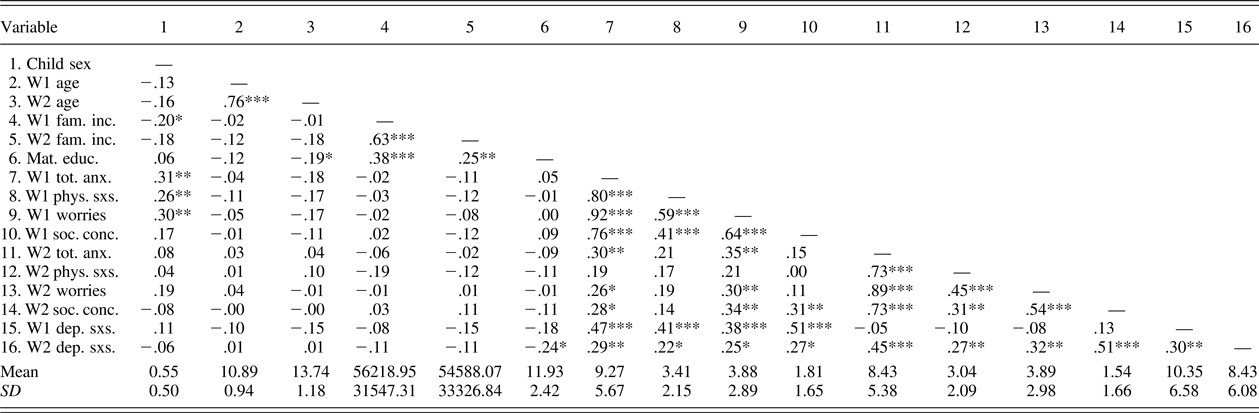
In the current sample, the average income of the participating families was $56,218.95 at Wave 1, which is below the reported Canadian national ($66,550) and Quebec ($61,780) median income levels for that period (Statistics Canada, 2013). Although the original CLRP sample is a biased or risk sample in terms of the original participant selection process, many of the indicators of risk (e.g., income, socioeconomic status, and maternal education attainment) were controlled for and found to be nonsignificant predictors in the current analyses. Table 1 shows means, standard deviations, and Pearson correlations of demographic (control variables) and symptom measures (predictors).
Descriptive statistics and Pearson correlations for all predictor variables at W1 and W2

Note: For child's sex, 0 = male, 1 = female. W1, Wave 1; W2, Wave 2; fam. inc., family income in Canadian dollars; tot. anx., total anxiety symptoms; phys. sxs., physiological symptoms; soc. conc., social concerns symptoms; dep. sxs., depressive symptoms. *p < .05. **p < .01. ***p < .001.
Procedure
Data were collected in two waves spaced approximately 3 years apart for each child. The first data collections took place between 2002 and 2005 (Wave 1) and the second collection 3 years later, between 2005 and 2008 (Wave 2). Informed written consents were obtained from participants and their parents or legal guardians prior to their participation in the study. Participants received a small honorarium for their time and involvement.
Salivary cortisol sampling
Diurnal cortisol was assessed noninvasively using saliva samples, which reflect the plasma concentration of the non–protein-bound active portion of cortisol (Kirschbaum & Hellhammer, Reference Kirschbaum and Hellhammer1994). At Waves 1 and 2, participants were instructed to provide saliva samples on 2 consecutive days using salivettes at specified target times throughout each day (i.e., upon awakening, 30 min postawakening, followed by every 2 hr until bedtime). They were asked to refrain from eating within the 30 min prior to each sampling. Participants were instructed to remove the cotton swab from a plastic vial, and chew on it for 30–45 s, until it was saturated with saliva, before placing it back in the vial, touching it as little as possible. Samples were kept frozen until they were assayed for total amount of cortisol at the Douglas Hospital Research Laboratories in Montreal. Cortisol was assessed in duplicate with a salivary enzyme immunoassay kit (Salimetrics, State College, PA). The detection limit of the assay (ED80) was 0.01 μg/dl and the mean intra-assay variability coefficients were 16.3% at Wave 1 and 10.4% at Wave 2. The interassay variability coefficients were acceptable at less than 15% at both time points (Schultheiss & Stanton, Reference Schultheiss, Stanton, Harmon-Jones and Beer2009). In order to normalize the distributions, raw cortisol values were log-transformed and the remaining outlying scores were winsorized to within 3 SD of the mean. Participants also completed daily diaries on each of the 2 days of sampling recording actual times of saliva sampling, mood, stress, health, food consumption (including time of eating), exercise, morning awakening, and bedtime. Medication intake was also recorded, with 17.2% of the participants at Wave 1 and 11.2% at Wave 2 reporting taking medications during the 2-day collection period. Medications reported included allergy medications, acetaminophen, antibiotics, and Ritalin.
Symptom measures
At Waves 1 and 2, children completed self-report measures of anxiety symptoms. Because of the comorbidity and associations reported in the literature between anxiety and depression, the current study also included a measure of depressive symptoms to control for its possible confounding effects along with all other relevant control variables (see Table 1 for the Pearson correlations between anxiety and depressive symptoms).
All measures in the current study were administered in French. Translated versions of English measures were created through a back-translation process when published French-language versions were not available. Back-translated measures used in the current study included the Revised Children's Manifest Anxiety Scale (RCMAS; Reynolds & Richmond, Reference Reynolds and Richmond1985; Turgeon & Chartrand, Reference Turgeon and Chartrand2003) and the Children's Depression Inventory (CDI; Kovacs, Reference Kovacs1985; Mack & Moor, Reference Mack and Moor1982).
Anxiety symptoms
Participants completed the self-reported 37-item RCMAS (Reynolds & Richmond, Reference Reynolds and Richmond1985) at Waves 1 and 2, which assessed the level and nature of their anxiety symptoms. The RCMAS yields a total anxiety summary score, in addition to three subscale scores in specific domains of worry/oversensitivity (e.g., “I am afraid of a lot of things”), social concerns/concentration (e.g., “I worry about what other people think about me”), and physiological/somatic symptoms (e.g., “Often I feel sick in the stomach”). Overall raw scores of 19 and above (T scores >60) are indicative of children who are experiencing clinically significant levels of anxiety (Stallard, Velleman, Langsford, & Baldwin, Reference Stallard, Velleman, Langsford and Baldwin2001). In the current sample, only 2.6% of the children at Wave 1 and 2.9% at Wave 2 had scores of above 19 (range of raw scores between 0 to 25; see Table 1 for means and standard deviations). Relative to the normative sample according to sex and age of the children, the anxiety scores of the current sample of participants reflected nonclinical levels of anxiety symptoms generalizable to beyond only clinical or borderline/subclinical samples (Gerard & Reynolds, Reference Gerard, Reynolds and Maruish2004).
Recent normative studies examining the psychometric properties of the RCMAS in various samples of children and adolescents reported high internal consistency for its total score in addition to each of its subscales in diverse samples (Turgeon & Chartrand, Reference Turgeon and Chartrand2003; Varela & Biggs, Reference Varela and Biggs2006). In the current study, the Cronbach αs for total anxiety ranged from 0.84 at Wave 1 to 0.83 at Wave 2, indicating strong internal consistency. The αreliabilities for specific subscales of worry/oversensitivity (Wave 1 α = 0.78; Wave 2 α = 0.82), physiological/somatic symptoms (Wave 1 α = 0.61; Wave 2 α = 0.60), and social concerns/concentration (Wave 1 α = 0.61; Wave 2 α = 0.68) also indicate overall satisfactory internal consistency across administrations.
Depressive symptoms
The CDI (Kovacs, Reference Kovacs1985) is a 27-item self-report scale suitable for assessing depressive symptoms in children aged 7 to 17. Depressive symptoms are controlled for in the current analyses as a possible confounding variable given its comorbidity with anxiety symptoms. Each item consists of three self-report statements graded in severity from 0 (least severe) to 2 (most severe). Children are asked to indicate which statement best matched how they have been feeling in the past 2 weeks (e.g., 0 = I am sad once in a while; 1 = I am sad many times; 2 = I am sad all the time). Total scores of 19 and above on the CDI (T scores ≥ 65) indicate clinically significant levels of depression (Masip, Amador-Campos, Gómez-Benito, & del Barrio Gándara, Reference Masip, Amador-Campos, Gómez-Benito and del Barrio Gándara2010). In the current study, 7.9% of the children at Wave 1 and 6.0% at Wave 2 scored within the clinical range in the current sample (see Table 1 for means and standard deviations). Depressive symptoms scores, in terms of means and standard deviations, within the current sample are comparable to those reported in community samples (Masip et al., Reference Masip, Amador-Campos, Gómez-Benito and del Barrio Gándara2010). Recent studies have reported the CDI as a reliable and valid measure across different cultural samples as well, validating its use for screening purposes and in comparison to structured interviews. (Cole & Martin, Reference Cole and Martin2005; Matthey & Petrovski, Reference Matthey and Petrovski2002; Timbremont, Braet, & Dreessen, Reference Timbremont, Braet and Dreessen2004). In the current study, the Cronbach αs of total CDI scores ranged from 0.81 at Wave 1 to 0.83 at Wave 2 across the two administrations, indicating strong internal consistency.
Data analytic plan
Data in the current study were analyzed using hierarchical linear modeling (HLM), Version 7.01 (Bryk & Raudenbush, Reference Bryk and Raudenbush1992; Raudenbush, Bryk, & Congdon, Reference Raudenbush, Bryk and Congdon2004). Longitudinal multilevel models captured not only how variables change over time but also how those changes are associated with between-persons and within-person differences. They are ideal when the assumption of independence may be violated as in the case of repeated measures from the same individual over time. HLM models change over time in outcome variable by estimating a curve for each individual. Each curve conveys information about an individual's baseline (i.e., the intercept), and his or her change across time (i.e., the slope) while taking into consideration other between-person contextual factors that may serve as additional explanatory variables and/or confounds (Shirtcliff & Essex, Reference Shirtcliff and Essex2008).
HLM is also well suited to capture the strong diurnal slope of repeated measures of cortisol even within smaller sample sizes, since it is capable of estimating a curve based on the available data values present while extrapolating other missing data points based on this curve to maximize degrees of freedom (Hruschka, Kohrt, & Worthman, Reference Hruschka, Kohrt and Worthman2005).
Missing data at the two waves was due to participants not successfully completing the salivary sampling procedure, contamination of samples during storage, and/or insufficient amount of saliva available for assays. Missing data for all other non–cortisol-related variables were estimated using multiple imputation strategies. Regarding the issue of power and adequate sample size, simulation studies examining the question of sufficient sample size for accurate estimation of multilevel modeling have shown that sample size equalling 50 or above tended to be associated with unbiased estimates of the highest level standard errors (Maas & Hox, Reference Maas and Hox2005).
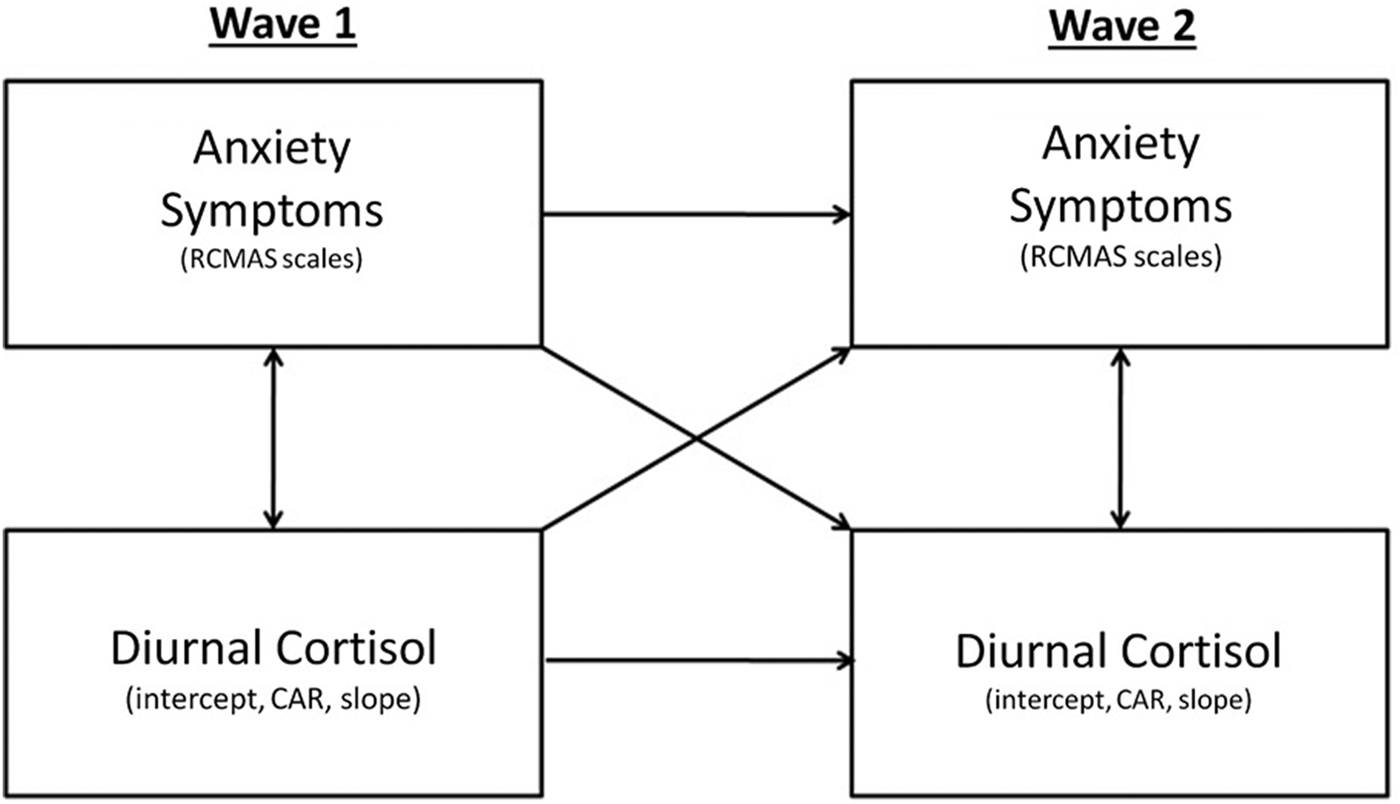
Three-level hierarchical models were constructed to examine how dimensions of anxiety symptoms predicted changes in both the intercept and diurnal cortisol slopes, concurrently and longitudinally across 3 years. The statistical design conceptually resembled that of a traditional cross-panel balanced design best suited to examine bidirectional relations between variables to infer the sequence and directionality of the effects. Given the complexity of the data involving multiple repeated measurements of diurnal cortisol within the same individual across two waves, in addition to the nonlinear diurnal rhythms, a cross-panel equivalent was tested using HLM (see Figure 1).
Cross-panel design exploring the sequence and directionality of the relationship between anxiety symptoms and diurnal cortisol rhythms over 3 years.

Model specification
Three-level hierarchical linear models partitioning within-the-day (i.e., diurnal), day-to-day (i.e., across 2 days), and between-individual (i.e., individual differences in anxiety symptoms) sources of diurnal cortisol variability were used to test our hypotheses. Four random intercept and slope models were specified in the current study to examine the concurrent associations between dimensions of anxiety symptoms and diurnal cortisol at Wave 1 and Wave 2, and their longitudinal sequence and associations over time. A series of steps were followed for model specifications in the current study (Bryk & Raudenbush, Reference Bryk and Raudenbush1992). An unconditional random intercept model was constructed with only the outcome variable (log-transformed diurnal cortisol) entered to examine whether there is significant variability in cortisol to be explained at each of the levels. Results showed significant within- (p < .01) and between-person effects (p < .01) on cortisol variability that remain to be further explored. We then proceeded with the addition of theoretically relevant predictor variables at each of the three levels to further explain diurnal cortisol variation.
Level 1 specification included “time since waking” (TSW) as a within-the-day predictor capturing the diurnal rhythm of cortisol variation. The intercept reflects the overall baseline level of cortisol immediately upon awakening for each person. The models also included both quadratic (TSW2) and cubic (TSW3) functions of TSW to allow for the examination of curvature in individual slopes across the day. An additional variable representing the CAR was also included as a within-person predictor of cortisol variability, specifying actual cortisol samples collected at 30 min postawakening. Additional predictors included daily subjective ratings of mood, stress, health, food intake, and exercise, which were all statistically nonsignificant predictors of diurnal cortisol intercept or slopes (p > .10), and were removed from the models to preserve parsimony.
Level 2 captured day-to-day variability in cortisol intercept and the diurnal slopes across the 2 consecutive days of cortisol sampling, with individual's report of medication usage on each day of cortisol sampling (1 = medication; 0 = no medication) entered as a predictor. No statistically significant associations between medication use and cortisol variability were found (p > .10).
Level 3 specification captured between-persons variations in diurnal cortisol intercepts and slopes. Control variables of age, sex (0 = male, 1 = female), maternal education, and income were first entered into all models. No significant main effects were found in relation to these variables (p > .10). Next, depressive symptoms were added as a control variable. Including depression in the models did not change any of the existing statistical significant associations between anxiety symptom dimensions and diurnal cortisol. In the current analyses, children's depressive symptoms were not significantly associated with any concurrent or longitudinal changes in diurnal cortisol intercepts or slopes once children's anxiety symptoms were entered into the model as a between-persons predictor.
Results
Concurrent associations: Physiological symptoms predicted hypercortisolism
At Wave 1, a three-level hierarchical linear model separated within-the-day (n = 1,259 samples; total df = 1,259), day-to-day (n =150 days; total df = 150), and between-persons (N = 77; total df = 77) sources of diurnal cortisol variability. Time since waking in terms of its linear slope (p < .000), quadratic function (p < 0.05), and CAR (p < .000) were significant predictors of diurnal cortisol variability. At Level 2, there was substantial variability in cortisol intercept levels across the 2 days, χ2 (72) = 336.55, p < .001. At Level 3, cortisol intercept levels varied between individuals, χ2 (74) = 169.01, p < .001, and the slopes varied linearly (TSW), χ2 (74) = 126.59, p < .001; quadratically (TSW2), χ2 = 123.86, p < .001; and cubically (TSW3), χ2 (74) = 122.01, p < .001, suggesting that each individual had his or her own diurnal slope and the cortisol variability was significant different from one person to the next. At Wave 1, 64.2% of the cortisol variability was explained by individual's diurnal rhythm (i.e., within-the-day fluctuations), while day-to-day fluctuations accounted for 9.4% of the total variance in cortisol. Furthermore, 26.4% of the cortisol variability was still left to be accounted for by between-individual fluctuations in dimensions of anxiety symptoms, after controlling for sex, age, income, medications, and depressive symptoms.
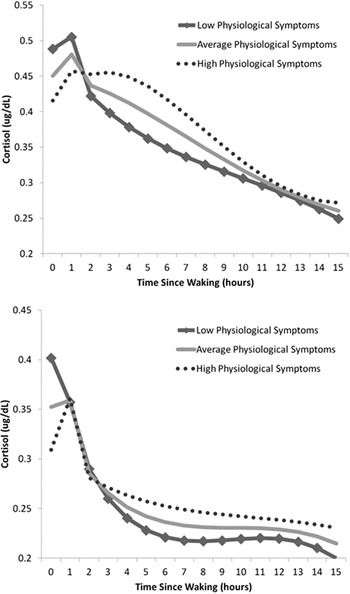
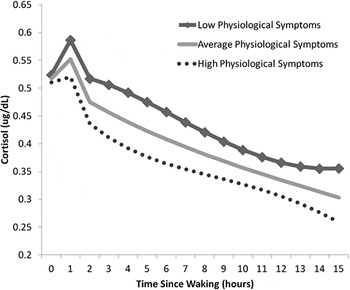
Concurrently at Wave 1, children who reported higher total anxiety symptoms had lower morning cortisol intercept (β = –0.0109, t = –2.36, p < .05) but hypercortisolism over the day, with larger increases in CAR, followed by a moderate decline in cortisol levels during the day (linear: β = 0.0098, t = 2.90, p < .01; quadratic curvature: β = –0.0012, t = –2.13, p < .05). Compared to children with low to average overall anxiety symptoms, those with higher anxiety showed a disrupted diurnal cortisol rhythm that remained elevated and blunted a few hours after awakening. More specifically, higher physiological symptoms were associated with dysregulated cortisol that remained high and elevated throughout the day (linear trend: β = 0.0236, t = 2.77, p < .01; quadratic trend: β = –0.0032, t = –2.25, p < .05; see Figure 2a).
Concurrent associations showing (top panel) Wave 1 and (bottom panel) Wave 2 physiological symptoms and diurnal cortisol rhythms.

At Wave 2, a similar model separated within-the-day (n = 652 samples; total df = 652), day-to-day (n = 112 days; total df =112), and between-individual (N = 56; total df = 56) sources of cortisol variability. All time-related variables were found to be significant predictors of variability in cortisol (ps < .001). At Level 2, the model at Wave 2 did not show substantial variability in cortisol intercept levels between the 2 days. At Level 3, cortisol intercept levels varied across individuals, χ2 (52) = 112.58, p < .001, and the slopes varied linearly, χ2 (52) = 95.57, p < .001; quadratically, χ2 (52) = 93.18, p = .001; and cubically, χ2 (52) = 89.08, p = .001. Within-the-day fluctuations accounted for 81.7% of the total variance, and between-individual fluctuations accounted for 18.3% of the total variance in cortisol levels.
Concurrently at Wave 2, higher physiological symptoms were also concurrently associated with lower morning cortisol intercept (β = –0.0224, t = –3.31, p < .05), again showing hypercortisolism (linear slope: β = 0.0126, t = 2.90, p < .01) that remained elevated throughout the day compared to those who reported low to average levels of physiological symptoms (see Figure 2b). These results further showed that physiological symptoms were concurrently associated with hypercortisolism both in childhood and in adolescence. In contrast, cognitive–emotional symptoms of anxiety (worry and social concerns dimensions) were not found to be statistically significant concurrent predictors of diurnal cortisol at Wave 1 or 2.
Longitudinal associations: Wave 1 cognitive–emotional anxiety symptoms predict Wave 2 hypocortisolism
Additional models examined the longitudinal predictions and directionality of the relation between diurnal cortisol and children's dimensions of anxiety symptoms. We examined how Wave 1 anxiety dimensions predicted Wave 2 diurnal cortisol intercept and slope by specifying Wave 2 cortisol as the outcome variable while entering Wave 1 anxiety symptoms as between-person predictors. All time-related variables were found to be significant predictors of variability in cortisol (ps < .05). At Level 3, cortisol intercept varied across individuals, χ2 (36) = 86.52, p < .001, and the slopes varied linearly, χ2 (36) = 65.46, p < .01; quadratically, χ2 (36) = 62.68, p < .01; and cubically, χ2 (36) = 59.18, p < .01. Day-to-day fluctuations accounted for 12.5% of the total variance in level of cortisol, within-the-day fluctuations accounted for 45.7% of the total variance, and between-individual fluctuations accounted for 41.8% of the total variance in cortisol levels. Over time, between-individual differences may be better able to capture the more stable aspects of the diurnal rhythm in cortisol above and beyond cotemporaneous within-the-day variations, which are less stable as longitudinal predictors of cortisol variability over time.
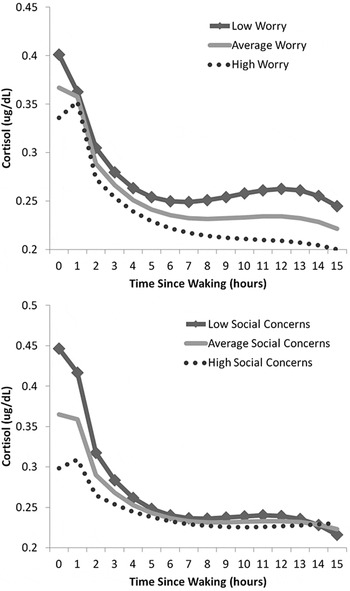
Longitudinal results showed that youths who had more cognitive–emotional anxiety symptoms, specifically, higher worries/oversensitivity at Wave 1, had lower morning cortisol intercept 3 years later (ß = –1.0023, t = –19.85, p < .001). They also had more dysregulated diurnal slope across the day, showing larger increases in the CAR, followed by a steep and rapid decline in cortisol than compared to children with low to average levels of worry/oversensitivity (see Figure 3a).
Longitudinal associations between Wave 1 cognitive-emotional anxiety dimensions (top panel: worries and oversensitivity; bottom panel: social concerns) and Wave 2 dysregulated diurnal cortisol 3 years later.

Furthermore, significant effects of linear, SD = 0.0952; χ2 (34) = 63.88, p < .01; quadratic, SD = 0.0132; χ2 (34) = 61.75, p < .01; and cubic, SD = 0.0005; χ2 (34) = 59.34, p < .01, slopes were found showing that cognitive–emotional anxiety symptoms of worry/oversensitivity at Wave 1 predicted random variations in within-person diurnal slopes 3 years later at Wave 2. In contrast, physiological symptoms at Wave 1 did not predict significant effects on diurnal cortisol slopes at Wave 2.
Similarly, youths with higher social concerns or worries, which capture another facet of the cognitive–emotional symptom dimension of anxiety at Wave 1 also had lower morning cortisol and overall blunting of the diurnal cortisol rhythm 3 years later (β = –1.0081, t = –20.31, p < .001). They showed hypocortisolism compared to those with low to average social concerns/worries. Individuals with higher social concerns had levels of cortisol that remained elevated during the day following CAR, showing a more blunted slope (linear trend: β = –0.0218, t = –1.82, p < .08). Individuals varied in terms of the linear, SD = 0.0893; χ2 (34) = 60.63, p < .01, quadratic, SD = 0.0125; χ2 (34) = 58.96, p < .01, and cubic, SD = 0.0005; χ2 (34) = 55.95, p = .10, bends of their cortisol slopes in a random intercept and slope model (see Figure 3b).
Longitudinal associations: Wave 1 diurnal cortisol associated with Wave 2 physiological symptoms
Finally, we examined whether Wave 1 diurnal cortisol would in turn predict Wave 2 anxiety symptoms (following the procedure in Shirtcliffe & Essex, Reference Shirtcliff and Essex2008). All time-related variables were significant predictors of cortisol variability (ps < .05). Cortisol intercept varied across individuals, χ2 (52) = 122.21, p < .001. Day-to-day fluctuations accounted for 8.5% of the total variance, within-the-day fluctuations accounted for 50.4% of the total variance, and between-individual fluctuations accounted for 41.1% of the total variance in cortisol levels.
Longitudinally, children with lower morning cortisol intercept at Wave 1 showed the highest levels of physiological symptoms at Wave 2 (β = –0.6703, t = –18.21, p < .01) after controlling for depressive symptoms and physiological symptoms at Wave 1 (i.e., baseline levels). Children with a less reactive and steep CAR at Wave 1 had higher physiological symptoms 3 years later (see Figure 4).
Longitudinal associations between Wave 1 diurnal cortisol and Wave 2 physiological symptoms.

Significant random effects of linear, SD = 0.0681; χ2 (52) = 70.98, p < .05, and quadratic, SD = 0.0103; χ2 (52) = 69.66, p < .05, bends were found indicating individual variations in diurnal slopes across time (individual differences) in relation to their own levels of physiological symptoms.
Summary of results
The current study examined the nature and sequence of the associations between dimensions of anxiety symptoms and diurnal cortisol dysregulation: both concurrently and over a 3-year period from childhood to adolescence. Results supported our hypotheses by showing that physiological symptoms were associated with hypercortisolism that remained elevated throughout the day concurrently in childhood (Wave 1) and adolescence (Wave 2). Longitudinal results supported the hypothesis that cognitive–emotional symptoms of anxiety, specifically, worry–oversensitivity and social concerns, symptoms at Wave 1 predicted hypocortisolism and lower overall morning cortisol intercept 3 years later at Wave 2. Finally, dysregulation in diurnal cortisol rhythm in childhood (i.e., lower overall morning cortisol and less reactive CAR) at Wave 1 was associated with higher reported physiological symptoms 3 years later at Wave 2.
Discussion
The current study examined the nature and directionality of the relationship between physiological symptoms and cognitive–emotional dimensions of anxiety and the underlying HPA axis, specifically, diurnal cortisol rhythms from childhood through early adolescence. Using a longitudinal cross-lagged design incorporating multilevel modeling, the present study examined the following questions: how do physiological and cognitive–emotional symptoms of anxiety differentially relate to diurnal cortisol rhythms concurrently and longitudinally? What is the exact nature of the relationship between children's anxiety symptom dimensions and diurnal cortisol rhythms concurrently and over several years? What is the sequence of the relationship between anxiety symptom dimensions and possible diurnal cortisol dysregulation over 3 years?
Regarding the first question, a unique contribution of the current study is the finding that physiological symptoms had stronger concurrent associations with diurnal cortisol and predicted hypercortisolism than cognitive–emotional dimensions of anxiety. However, physiological symptoms in childhood did not predict long-term effects on diurnal cortisol rhythms 3 years later in adolescence. In contrast, cognitive–emotional dimensions of anxiety, specifically, worries and social concerns, were predictive of long-term associations with diurnal cortisol 3 years later and reflected hypocortisolism. These results suggest that there may be differential associations between anxiety symptoms dimensions and the underlying HPA functioning, complementing the existing research showing differences in regional brain activity and neural mechanisms in relation to these two anxiety symptom dimensions (Sharp et al., Reference Sharp, Miller and Heller2015). To our knowledge, the current results are the first to explicitly examine how dimensions of anxiety symptoms relate concurrently and longitudinally to diurnal cortisol rhythms in children and adolescents.
One way to understand this difference is that physiological symptoms tend to be situation or stressor dependent, directly related to the physiological arousal mechanisms and processes, and typically do not persist after the removal of the threat or perceived threat (Forgays, Sosnowski, & Wrześniewski, Reference Forgays, Sosnowski and Wrześniewski1992). These physiological symptoms are more closely associated with fight-or-flight responses, which are typically short-term activation of the autonomic system and fear circuitry. Although physiological symptoms typically are short term in duration, individual differences in cognitive appraisals may shape how individuals interpret these physical symptoms. Maladaptive or catastrophic cognitive appraisals could in turn intensify the experience of the physiological symptoms and lead to the experience of increased worries and concerns (cognitive–emotional symptoms of anxiety) over time. This is consistent with the perseverative cognition hypothesis (Brosschot, Gerin, & Thayer, Reference Brosschot, Gerin and Thayer2006; Brosschot, Verkuil, & Thayer, Reference Brosschot, Verkuil and Thayer2010), which examines the moderating associations between worry and ruminations, and health consequences in response to the experience of stressors. In addition to stressful events experienced within our daily lives, sustained cognitive representations or appraisals about these stressful events may relate to prolonged physiological arousal.
In contrast, cognitive–emotional symptoms of worry or social concerns are more pervasive and consist of cognitive appraisals that are related to the perceived coping capacities of the individual in response to objective and perceived stress or threats (Lazarus, Reference Lazarus1993). These cognitive–emotional symptoms of anxiety may be more enduring, and lead individuals to experience chronic hypervigilance and apprehension even in the absence of threat or stressor (Adam, Reference Adam2006; Eysenck, Reference Eysenck1997). They also tend to be more stable and long term, shaping how the individual perceives and responds to stress in his or her environment. Over time, cognitive–emotional symptoms of anxiety are often described as being uncontrollable and inescapable, similar to how individuals often perceive and define chronic stresses that strain the HPA axis resulting in long-term dysregulation and downregulation (Aguilera, Reference Aguilera, Murphy and Gainer2015).
Regarding the question of the exact nature of the relationship between anxiety symptoms and diurnal cortisol rhythm, results from the current study showed evidence of both hypercortisolism and hypocortisolism in relation to anxiety symptoms dimensions. Specifically, concurrent results from hierarchical linear modeling showed that higher overall levels of anxiety, in particular, physiological symptoms, were associated with lower overall morning levels of cortisol, a steeper cortisol awakening rise and elevated diurnal cortisol levels (hypercortisolism) throughout the day in comparison to individuals with lower levels of physiological symptoms in childhood and in adolescence. However, longitudinally, higher self-reported cognitive–emotional symptoms of worry and social concerns dimensions of anxiety in childhood predicted a more blunted diurnal cortisol profile (hypocortisolism) 3 years later in adolescence. Children who reported the most worries or social concerns had lower overall cortisol levels in the morning and over the course of the day 3 years later, with less curvature in their diurnal slopes when compared to those with lower levels of cognitive–emotional symptoms of anxiety.
Theories of HPA axis and stress reactivity emphasized the detrimental effects of overactivation (hypercortisolism) of the stress-response system (Selye, Reference Selye2013). However, more recent research has increasingly called attention to the presence of low cortisol or hypocortisolism especially in childhood and adolescence as an important biomarker of dysregulation of the HPA axis functioning, challenging and refining previous assumptions of how the HPA axis functions (Gunnar & Vazquez, Reference Gunnar and Vazquez2001). In the current study, evidence of both hypercortisolism and hypocortisolism was found, further illustrating the complex and reciprocal interactions between the biological and psychological aspects of anxiety and the stress-response system.
Furthermore, the evidence of hypocortisolism and hypercortisolism in relation to self-reported levels of anxiety symptoms may be situated within the allostatic theory proposed by Miller, Chen, and Zhou (Reference Miller, Chen and Zhou2007). Exposure to stress or threats (actual or perceived) may initially activate the autonomic nervous system and the HPA axis to release cortisol. However, after prolonged exposure to chronic strain (resulting in persistently elevated cortisol levels), the HPA axis shows signs of “wear-and-tear” and downregulates, resulting in hypocortisolism or blunting of the diurnal cortisol rhythm over time. Initially, physiological symptoms may act as a direct and immediate response to threats and activate the stress-response system. Because these physiological symptoms typically abate with the end of the stressor or threat, they may not show persistent associations with cortisol activity in the long term. However, for some individuals, what remain are the cognitive–emotional anxiety symptoms closely linked to cognitive appraisals that may be chronically activated in the evaluation of daily hassles and situations as being stressful (Lazarus, Reference Lazarus1993). When these cognitive–emotional anxiety symptoms become chronic, unabated, and disproportional to the threat or stress encountered as they tend to be for individuals with anxiety disorders, they may in turn strain the underlying HPA axis and stress-response system, leading to a dysregulated diurnal cortisol in the manner of hypocortisolism over time (Sharp et al., Reference Sharp, Miller and Heller2015).
Regarding the question of the sequence and directionality of the relationship between anxiety symptoms and diurnal cortisol rhythm, the current study found support for a bidirectional and transactional associations between the two. We cannot conclude from the current findings whether anxiety symptoms cause dysregulation in diurnal cortisol rhythm, or if preexisting dysregulation in the HPA axis makes individuals more vulnerable to experiencing anxiety symptoms later on. However, the current results showed a transactional relation in that higher anxiety symptoms predicted overall lower and blunted cortisol rhythm over time, but a dysregulated diurnal cortisol in childhood was also associated with higher physiological symptoms later in adolescence. It is unclear if and to what extent potential disruptions in the HPA axis in childhood was actually making children sick (i.e., increased physical illnesses), which could exacerbate the experience of somatic symptoms (e.g., nausea, dizziness, and stomachaches) that overlap to a certain degree with physiological symptoms. Future longitudinal examinations of the link between cortisol, anxiety symptoms, and physical health would clarify this issue.
In addition, the focus of the current study was on the developmental psychobiology of anxiety from a symptom-dimension approach, specifically in relation to the HPA axis and diurnal cortisol rhythms. Controlled in all our analyses are individuals’ depressive symptoms. In the current set of analyses, children's depressive symptoms did not significantly predict cortisol variations once anxiety symptoms were accounted for. The significant statistical associations between anxiety symptom dimensions and diurnal cortisol rhythm remained even after including depressive symptoms in the models as a control variable. There have been extensive studies showing the linkage between stress, elevated cortisol levels, and major depression. Given the associations between depressive and anxiety symptoms, their comorbidity as well as the theory that anxiety symptoms tend to precede later onset of depression by possibly sensitising the HPA axis, future studies may examine both facets in more detail in a larger sample of children and adolescents. The specific question of whether increased anxiety symptoms may actually contribute to later development of comorbid depression by directly influencing the functioning of the HPA axis is an important issue to explore in future studies.
Using a multilevel hierarchical modeling design, while incorporating a two waves cross-lagged design incorporating repeated measures of both anxiety symptoms and cortisol over several years, the current study attempted to answer the question of under “what circumstances, for whom, and when under versus overactivation” of the HPA axis is most likely in children and adolescents (Badanes, Watamura, & Hankin, Reference Badanes, Watamura and Hankin2011). While the current study has strengths in its methodological design and a unique contribution to the understanding of the relation between dimensions of anxiety and diurnal cortisol rhythm, it is not without limitations. First, additional waves of assessments would have been ideal to address the question of sequence and directionality of the relationship between anxiety symptoms and cortisol over the unfolding of development. Second, although having two time points of repeated assessment combined with multilevel modeling of the data enhanced the power and interpretation of our results, our current sample size was small, limiting the extent of the interpretation and generalizability of the findings. Given the limited sample size, it was not feasible to analyze specific gender effects by separating the sample by sex. However, in all the models, children's sex was controlled for and interactions with predictors did not show significant gender effects in the present study.
Third, the current study solely focused on the HPA axis and cortisol in relation to anxiety symptom dimensions. However, the endocrine system has a multitude of interconnections with many other hormones and biological systems such as the immune system, which is also implicated in stress response (Marceau et al., Reference Marceau, Ruttle, Shirtcliff, Hastings, Klimes-Dougan and Zahn-Waxler2013). It is very likely that there are other correlated biological markers that work in tandem with the HPA axis and cortisol, which were not included in the current study. To gain a comprehensive understanding of the psychobiology of anxiety, it would be ideal for future studies to integrate multiple biomarkers that are associated with anxiety and stress.
Fourth, the current studies also lacked a measure of additional environmental stressors and daily hassles, which also relate to anxiety symptoms. The experience of anxiety symptoms may be a “proxy” or emotional response to other contextual stressors not accounted for in the current design.
Fifth, although participants recorded the time of day associated with each of their saliva samples using a written log, and this was modeled in all the analyses, we did not have an objective (i.e., electronic) measure of the sampling times. More specifically, we cannot confirm whether the first sample taken is immediately upon awakening. Post hoc analyses revealed that 70% of the participants did comply with our instructions and took their second saliva sample 20 to 30 min postawakening. The potential noncompliance with sampling times specified would explain the lack of a CAR dynamic rise observed in some of our results, and consequently affect the data quality in relation to CAR.
Sixth, although age of the participants was controlled, and was also examined for possible moderating effects in all models and analyses, the current study did not include a measure of pubertal status. It is possible that the same-aged participants were in different stages of pubertal development. Although some researchers have noted that age may be a suitable proxy for puberty status (Stroud et al., Reference Stroud, Foster, Papandonatos, Handwerger, Granger, Kivlighan and Niaura2009), others have shown the importance of valid measurement of pubertal status and pubertal timing (i.e., Tanner stages) in the study of the developmental trajectory of the onset of internalizing disorders, notably, depression in adolescents (Angold, Costello, & Worthman, Reference Angold, Costello and Worthman1998). Pubertal stage and related hormonal measures could be included in future follow-up studies to examine more specifically the role of puberty, including possible interactions between cortisol and sex hormones (Netherton, Goodyer, Tamplin, & Herbert, Reference Netherton, Goodyer, Tamplin and Herbert2004).
Seventh and finally, given that the original CLRP participants constituted a community-based risk sample with exposure to environmental stress (in terms of lower income, socioeconomic status, and maternal educational levels), the current results may be limited somewhat in terms of generalizability to either clinical or more representative population-based samples. In the current study, specific sociodemographic risk factors were controlled statistically, and found to have nonsignificant main effects or interactions with the main predictors of interest. However, in other types of samples, such risk factors could play a different role within the transactional processes described here. It should also be noted that the anxiety and depression symptom scores of the current sample were comparable to the normative data reported in the literature for large-scale community samples and at-risk (i.e., elevated symptoms/low income) groups. However, other different results could emerge if more of the participants were in the “clinical range.” Understanding these processes within both “clinical” and broader “representative” samples (in terms of family disadvantage) is an important direction for future research.
In conclusion, the results of this study demonstrate the nature of the relationship between anxiety symptom dimensions and diurnal cortisol rhythms across the transition between childhood and early adolescence. The hierarchical multileveling approach and the cross-lagged design allowed for a closer examination of the transactional associations of anxiety symptoms and diurnal cortisol variation over several years. Clinical implications of the results include the importance of distinguishing cognitive–emotional and physiological symptoms in the prevention and treatment of anxiety problems in young children, given the differential associations of these dimensions with the underlying stress-response system. Comprehensive assessment of anxiety symptom dimensions is warranted, especially in the context of primary health care interventions to ensure proper diagnosis and treatment. Children's anxiety symptoms are often associated with medically unexplained physical symptoms, or diagnosed as functional somatic symptoms by primary care physicians and pediatricians (Campo, Reference Campo2012). An accurate understanding of anxiety symptoms, including both physiological and cognitive–emotional symptoms, and their specific associations with underlying biological systems, will allow for appropriate interventions and follow-up services in primary care health care settings. In terms of both psychological and somatic problems, psychologists have an important role to play in children's primary care. Early assessment, prevention, and intervention for anxiety problems in children and adolescents may help prevent more serious psychological and physical health issues later in adolescence and adulthood.