Introduction
Cochlear implantation is an effective therapy for patients with severe-to-profound sensorineural hearing loss. However, because of the high medical costs or concerns about surgical risks, most patients choose unilateral cochlear implantation. This limits patients’ hearing improvement, as they still suffer from listening difficulties in their daily lives, such as sound localisation and speech comprehension in a noisy environment.Reference Almeida, Martins, Costa, Costa and Martinho de Carvalho1 Binaural hearing, such as that achieved with bilateral cochlear implantation and binaural-bimodal hearing devices (ipsilateral cochlear implant and contralateral hearing aid), is superior to unilateral hearing.Reference van Zon, Smulders, Stegeman, Ramakers, Kraaijenga and Koenraads2 The reasons are as follows. First, the squelch effect can separate speech from background noise because the interaural time and intensity difference can improve the auditory cortical integration and amplify the acoustic signal.Reference Guevara, Grech, Gahide and Gallego3 Second, the binaural summation effect enhances the sensitivity to differentiate the frequency and intensity, so that both ears hear sounds more clearly and perceive speech better.Reference Hoppe, Hocke and Digeser4 Third, binaural listening can effectively prevent the head shadow effect that leads to an unfavourable signal-to-noise ratio (i.e. the inability to distinguish sound signals in ambient noise for monaural hearing patients).Reference Guevara, Grech, Gahide and Gallego3
The advantages of binaural-bimodal hearing devices and bilateral cochlear implantation are obvious. Nevertheless, for patients with binaural severe-to-profound sensorineural hearing loss, it can be difficult to decide whether to continue wearing the contralateral hearing aid or to pursue a second cochlear implant after unilateral cochlear implantation. Unfortunately, studies proving which implantation is more advantageous are insufficient. In order to make up for this deficiency, this study analysed the audiological and clinical outcomes of children with severe-to-profound sensorineural hearing loss managed with different intervention modes.
Inner-ear malformation is one of the leading causes of congenital sensorineural deafness. However, whether patients with inner-ear malformation can benefit from cochlear implantation is controversial.Reference Sennaroglu5 Furthermore, most previous studies excluded patients with inner-ear malformation when analysing the outcomes of cochlear implantation. Therefore, the rehabilitation effect for patients with inner-ear malformation is also considered in our research, to help inform a reasonable clinical intervention plan.
Our primary hypothesis is that binaural listening is more advantageous than monaural listening, and that binaural-bimodal hearing devices and bilateral cochlear implantation are advantageous in terms of hearing thresholds and qualitative outcomes (assessed using locally translated versions of relevant questionnaires). Our secondary hypothesis is that most patients with inner-ear malformations are suitable candidates for cochlear implantation.
Materials and methods
Study design and participants
A total of 261 patients (142 females and 119 males) who underwent cochlear implantation at Lanzhou University Second Hospital, from January 2015 to July 2018, were included in the study. At the time of experimentation, each implanted ear was fitted with an internationally recognised cochlear implant sound processor: Nucleus Freedom, Nucleus 24 or Nucleus CI422 (Cochlear, Sydney, Australia); Med-El Sonata (Innsbruck, Austria); or the HiRes 90K (Advanced Bionics, Valencia, California, USA). The subjects’ hearing aid was a unified hearing aid funded by national or provincial projects.
Inclusion criteria were as follows: (1) aged 12 years or younger; (2) severe-to-profound sensorineural hearing loss in both ears; (3) the patients’ guardians had the correct understanding and expectations of cochlear implantation; (4) bimodal subjects had worn a hearing aid for more than 6 months after surgery; and (5) bilateral cochlear implantation listeners had undergone simultaneous bilateral cochlear implantation.
Exclusion criteria were as follows: (1) children with autism, mental retardation, cerebral palsy or other diseases; and (2) two cochlear implantation procedures performed in the same ear.
The subjects were divided into 3 groups: 78 unilateral cochlear implantation subjects (mean age at implantation = 42.9 ± 27.3 months), 67 binaural-bimodal hearing device subjects (mean age at implantation = 47.2 ± 26.3 months) and 116 bilateral cochlear implantation subjects (mean age at implantation = 39.2 ± 22.3 months). The patients were allocated to various intervention groups based on the comprehensive consideration of the surgeon and the patient's preference. During the 24-month follow up, trained professionals completed subjective audiometry and objective questionnaire evaluations.
These three intervention groups were further divided into two subgroups: an inner-ear malformation group and a control group. The inner-ear malformations included: an enlarged vestibular aqueduct, the incomplete partition of the cochlea (including incomplete partition type II, also known as Mondini malformation), semicircular canal abnormalities, cochlear hypoplasia (including cochlear hypoplasia type III), common cavity deformity and internal auditory canal abnormalities.
Aided sound-field thresholds
The study was conducted in a sound-treated booth, in which the listener sat 1 m away from the loudspeaker. The loudspeakers were placed directly in front of the unilateral cochlear implantation subjects. For the binaural-bimodal hearing device and bilateral cochlear implantation groups, loudspeakers were located on the left and right sides of each child, at 45 degrees from the median sagittal position of the patient. Warble tone was used as the test signal. The aided sound-field thresholds were tested at 0.5, 1, 2 and 4 kHz. The hearing threshold data are expressed in decibels hearing level (dB HL). The lower the hearing level, the better the auditory performance.
The children were tested under different hearing conditions: (1) monaural, with only the cochlear implant switched on (unilateral listeners); (2) binaural, with bilateral cochlear implants switched on; and (3) bimodal, with both the cochlear implant and hearing aid switched on (bimodal listeners).
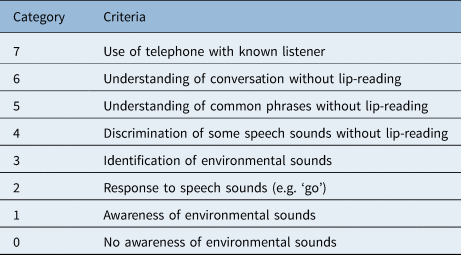
Categories of Auditory Performance
The Categories of Auditory Performance scale is shown in Table 1. This scale was developed by Archbold et al. and reflects patients’ auditory ability in their daily lives. It is easy to use and applicable to a wide age range from infants to adults.Reference Nikolopoulos, Archbold and Gregory6 It is divided into eight levels, from 0 to 7, and parents can intuitively grade their children based on the child's behavioural response to all external sounds.
Categories of Auditory Performance scale

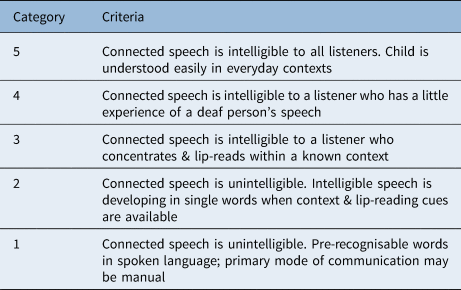
Speech Intelligibility Rating
The Speech Intelligibility Rating index shown in Table 2 is a reliable and practical questionnaire developed by Allen for evaluating deaf children's verbal ability in daily life.Reference Liu, Jiao, Ji, Wang, Zhao and Li7 Divided into five levels, it is easy to understand, and can help parents establish reasonable expectations without being limited by the child's age or level of language development.
Speech Intelligibility Rating index

Meaningful Auditory Integration Scales
The Meaningful Auditory Integration Scale was devised by Robbins et al. to assess children's listening skills.Reference Robbins, Renshaw and Berry8 It consists of 10 questions that assess a patient's initial adaptation to using the hearing aid or cochlear implant for more complex hearing, such as identifying emotions from a speaker's tone of voice. Each question is scored from 0 to 4 (never, rarely, occasionally, frequently and always).
Osberger et al. revised the Meaningful Auditory Integration Scale according to the characteristics of infants, and proposed the Infant-Toddler Meaningful Auditory Integration Scale.Reference Osberger, Geier, Zimmerman-Phillips and Barker9 The Infant-Toddler Meaningful Auditory Integration Scale is scored in the same way as the Meaningful Auditory Integration Scale and is used to evaluate infants’ listening ability.
Meaningful Use of Speech Scale
The Meaningful Use of Speech Scale, developed by Robbins and Osberger, is used to evaluate the verbal ability of deaf children in the social environment.Reference Osberger, Geier, Zimmerman-Phillips and Barker9 It consists of 10 questions covering 3 areas: vocalisation, social skills and communication skills. Each question is also scored from 0 to 4. The higher the score, the stronger the speech production ability.
Statistical analysis
IBM™ SPSS Statistics software, version 22.0, was used for data analyses. The aided hearing thresholds of three groups at four frequencies were assessed using descriptive statistics and multi-way analysis of variance (ANOVA). A post-hoc multiple comparisons test was subsequently used to determine whether there were any interactions. The data of the four questionnaires were analysed by one-way ANOVA. If the difference between the three groups was statistically significant, a post-hoc multiple comparisons test was conducted. The differences between the two subgroups were compared using a t-test. A p-value of less than 0.05 was considered statistically significant. OriginPro 9 software (OriginLab, Northampton, Massachusetts, USA) was used for graphing.
Results
Aided sound-field threshold results
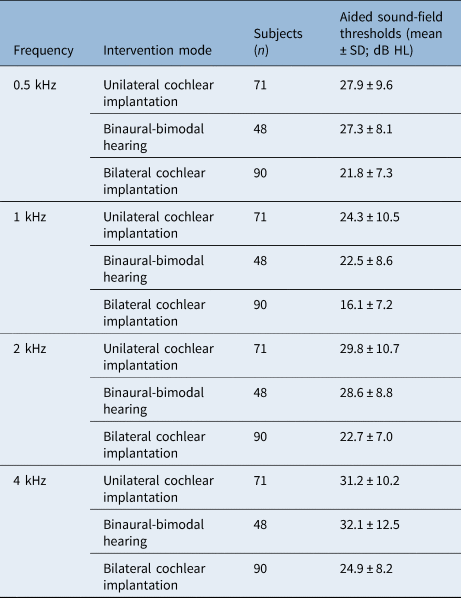
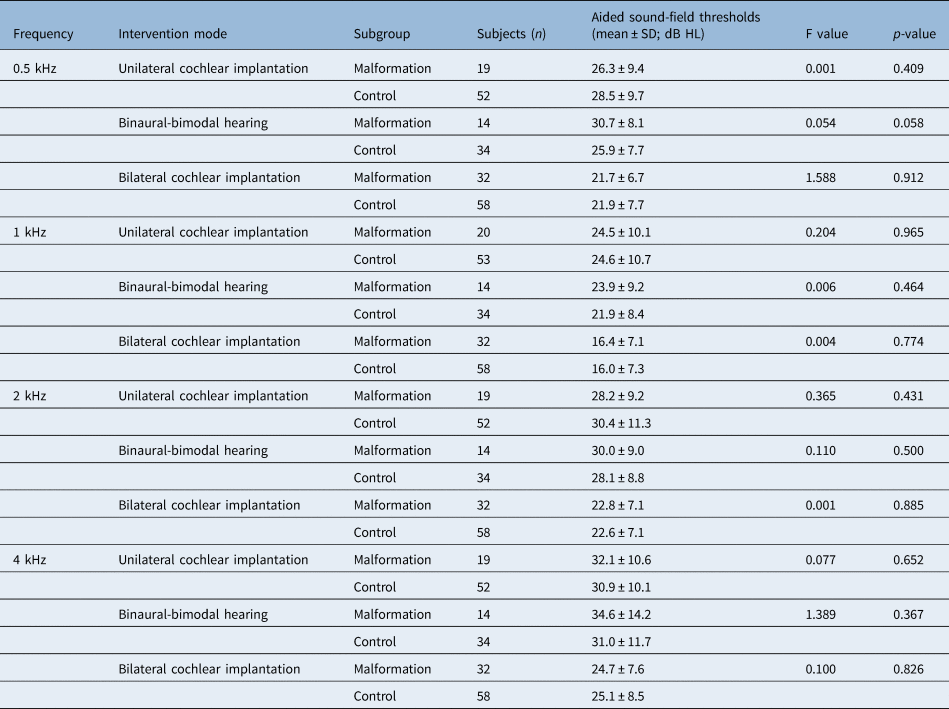
Table 3 shows the aided sound-field thresholds for the three modes of intervention at four frequencies. The frequency was taken as the intra-subject variable, and the mode was taken as the inter-subject variable. Statistical analysis revealed significant differences in frequency (F = 122.108, p < 0.001) and intervention mode (F = 17.339, p < 0.001), but there was no significant interaction (F = 1.507, p = 0.173). The lower the hearing level, the better the listening effect.
Aided sound-field thresholds

SD = standard deviation
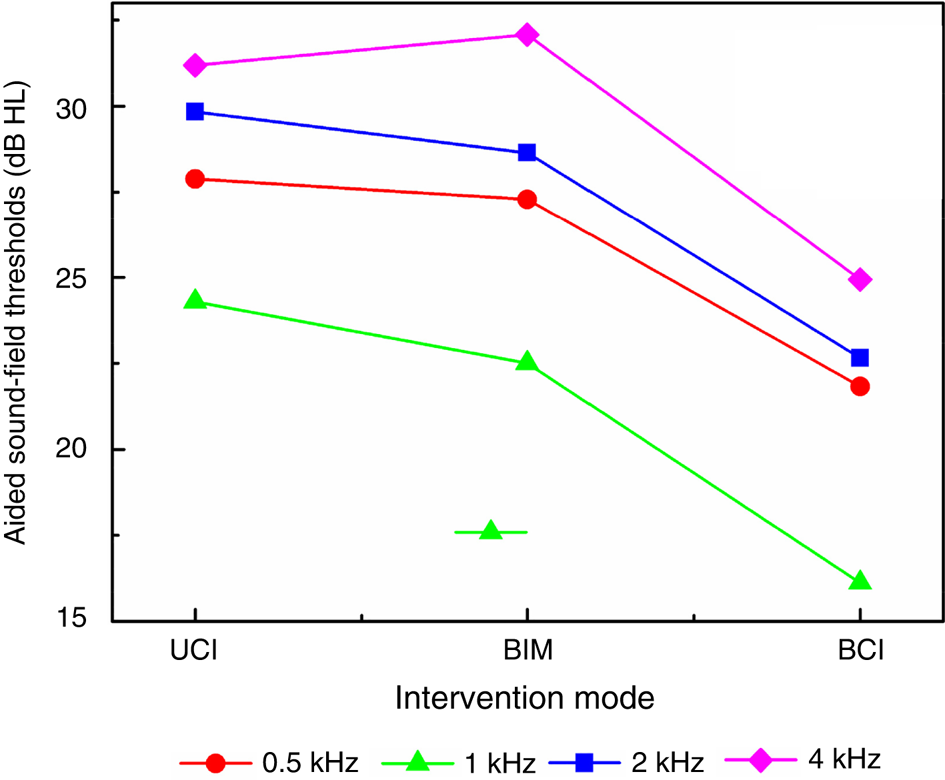
As shown in Figure 1, the aided sound-field thresholds at 0.5, 1 and 2 kHz were lowest for bilateral cochlear implantation followed by binaural-bimodal hearing devices, and were highest for unilateral cochlear implantation; at 4 kHz, the thresholds were lowest for bilateral cochlear implantation followed by unilateral cochlear implantation, and were highest for binaural-bimodal hearing devices. For the three intervention groups, aided sound-field thresholds were lowest for 1 kHz, followed by 0.5 kHz and 2 kHz, and were highest for 4 kHz. It can be concluded that the bilateral cochlear implantation group had the best hearing at 1 kHz, while the binaural-bimodal hearing devices group had the worst hearing at 4 kHz. A post-hoc multiple comparisons test showed that bilateral cochlear implantation patients outperformed both unilateral cochlear implantation patients and those with binaural-bimodal hearing devices, and the result was statistically significant (p < 0.001). As shown in Table 4, there was no statistically significant difference between the malformation and control subgroups.
Aided sound-field thresholds for the three intervention modes (unilateral cochlear implantation (UCI), binaural-bimodal hearing (BIM) and bilateral cochlear implantation (BCI)) at four frequencies.

Differences in aided sound-field thresholds between malformation and control subgroups

SD = standard deviation
Questionnaire results
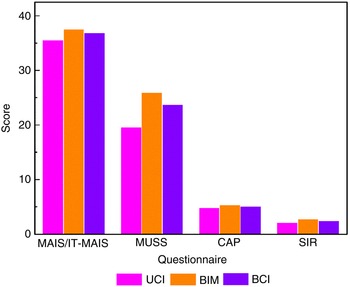
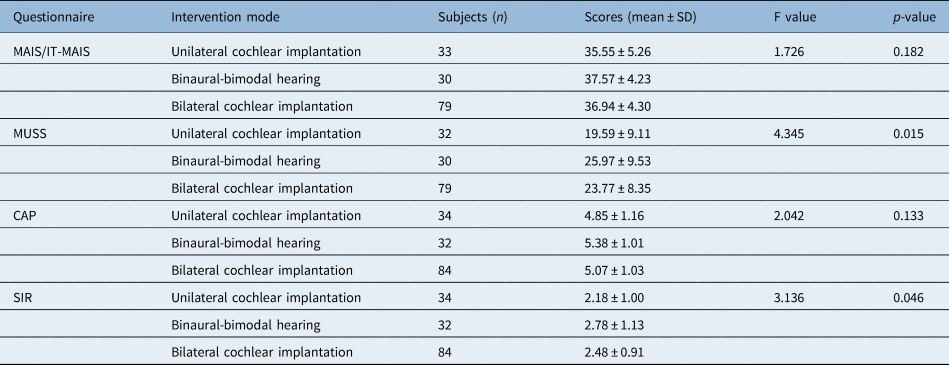
Figure 2 shows the questionnaire results. Overall scores were highest for binaural-bimodal hearing devices, followed by bilateral cochlear implantation, and were lowest for unilateral cochlear implantation, based on all mean Meaningful Auditory Integration Scale or Infant-Toddler Meaningful Auditory Integration Scale, Meaningful Use of Speech Scale, Categories of Auditory Performance, and Speech Intelligibility Rating scores. The details are shown in Table 5.
Questionnaire scores for each of the three intervention modes (unilateral cochlear implantation (UCI), binaural-bimodal hearing (BIM) and bilateral cochlear implantation (BCI)). MAIS/IT-MAIS = Meaningful Auditory Integration Scale / Infant-Toddler Meaningful Auditory Integration Scale; MUSS = Meaningful Use of Speech Scale; CAP = Categories of Auditory Performance scale; SIR = Speech Intelligibility Rating test

Differences in questionnaire scores between intervention groups

SD = standard deviation; MAIS/IT-MAIS = Meaningful Auditory Integration Scale / Infant-Toddler Meaningful Auditory Integration Scale; MUSS = Meaningful Use of Speech Scale; CAP = Categories of Auditory Performance scale; SIR = Speech Intelligibility Rating test
Significant differences were found among the three intervention mode groups with regard to the Meaningful Use of Speech Scale scores (F = 4.345, p = 0.015) and the Speech Intelligibility Rating scores (F = 3.136, p = 0.046), but there were no significant differences in the Categories of Auditory Performance scores (F = 2.042, p = 0.133) or the Meaningful Auditory Integration Scale or Infant-Toddler Meaningful Auditory Integration Scale scores (F = 1.726, p = 0.182). Post-hoc analyses showed a significant difference between unilateral cochlear implantation and binaural-bimodal hearing devices in terms of the Meaningful Use of Speech Scale score (p = 0.014); this score was 6.37 higher for binaural-bimodal hearing devices than for unilateral cochlear implantation (95 per cent confidence interval (CI) = 1.08–11.66). Post-hoc analyses showed a significant difference between unilateral cochlear implantation and binaural-bimodal hearing devices in terms of the Speech Intelligibility Rating score (p = 0.035); this score was 0.61 higher for binaural-bimodal hearing devices than for unilateral cochlear implantation (95 per cent CI = 0.03–1.18).
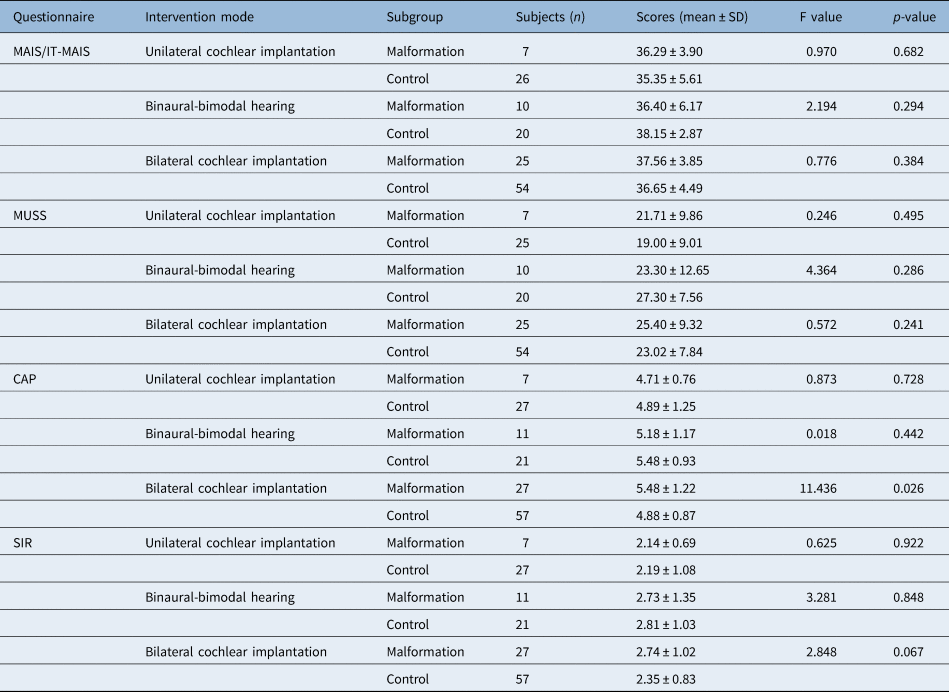
As Table 6 shows, there were no statistical differences between the malformation and control subgroups, except for the Categories of Auditory Performance score in the bilateral cochlear implantation group, whereby the malformation subgroup was actually better than the non-malformation (control) subgroup (F = 11.436, p = 0.026).
Differences in questionnaire scores between malformation and control subgroups

SD = standard deviation; MAIS/IT-MAIS = Meaningful Auditory Integration Scale / Infant-Toddler Meaningful Auditory Integration Scale; MUSS = Meaningful Use of Speech Scale; CAP = Categories of Auditory Performance scale; SIR = Speech Intelligibility Rating test
Discussion
Most researchers believe that binaural listening is better than monaural listening, but no consensus has been reached on the merits of the two binaural listening modes (using binaural-bimodal hearing devices or bilateral cochlear implants), which poses difficulties in choosing between these binaural interventions. Ideally, this decision should be based on a dataset of actual hearing performance for patients using binaural-bimodal hearing devices and bilateral cochlear implantation, but no such dataset is available. Moreover, it is not easy to decide whether to carry out surgical procedures in clinical practice when the inner ear is malformed. These issues motivated us to investigate which modes would yield better results retrospectively.
Aided sound-field thresholds interpretation
We found no statistical differences between the aided sound-field thresholds of binaural-bimodal hearing device patients versus unilateral cochlear implantation subjects. The results for binaural-bimodal hearing devices were highly variable; some patients benefited more than others, and some patients might even experience interference with the integration of electric and acoustic input, or with variable dynamic ranges between ears.Reference Crew, Galvin, Landsberger and Fu10,Reference Blamey, Dooley, James and Parisi11
The aided sound-field thresholds for bilateral cochlear implantation were significantly better than those for unilateral cochlear implantation. Similarly, previous research has shown that bilateral cochlear implantation better improves hearing thresholds, compared with unilateral cochlear implantation.Reference Fitzgerald, Kan and Goupell12
The difference in hearing thresholds is mainly caused by the binaural summation effect. Our study findings verified this, and led us to conclude that bilateral cochlear implantation is superior to binaural-bimodal hearing devices in terms of the listening effect.
Existing studies mainly focused on the comparison between binaural-bimodal hearing devices and bilateral cochlear implantation in terms of speech recognition rates and questionnaire assessments, but few compared the aided sound-field thresholds. Xu et al. found no significant differences in auditory thresholds between binaural-bimodal hearing devices and bilateral cochlear implantation,Reference Xu, Feng, Li and Jiang13 which is inconsistent with our study findings.
When comparing the post-operative rehabilitation effects of unilateral and binaural hearing, most studies required the bilateral cochlear implantation or binaural-bimodal hearing device patients to turn off one side of the hearing aid devices to represent unilateral hearing, and to turn on both sides to represent bilateral hearing. This practice cannot reflect the actual effect of unilateral cochlear implantation, because patients with binaural listening are accustomed to using bilaterally implanted hearing or bimodal hearing in their daily life. In contrast, the contralateral ear of the unilateral cochlear implantation group we selected had no interference from hearing aid or cochlea, and our sample size was larger than in previous studies. Therefore, our conclusion is more convincing.
Moreover, most studies do not reflect well the real differences between binaural-bimodal hearing device and bilateral cochlear implantation patients, because they are based on the fact that binaural-bimodal hearing device patients may turn to contralateral cochlear implantation when the benefits of a mode are limited. In our study, the binaural-bimodal hearing device group and the bilateral cochlear implantation group were two independent groups; the bilateral implant patients underwent simultaneous bilateral cochlear implantation initially, rather than turning to a second implant later on. Therefore, this research can better reflect the group difference.
Questionnaire results interpretation
Zhong and Qiu found that the binaural-bimodal hearing device patients’ scores for the Categories of Auditory Performance and Meaningful Auditory Integration Scale were higher than those of individuals with a unilateral cochlear implant, and the difference was statistically significant.Reference Zhong and Qiu14 This study also showed that the binaural-bimodal hearing device patients’ scores for the Categories of Auditory Performance and Meaningful Auditory Integration Scale were higher than those of unilateral cochlear implantation patients; however, the difference was not statistically significant.
The Meaningful Use of Speech Scale scores (which were highest for binaural-bimodal hearing devices and lowest for unilateral cochlear implantation) and the Speech Intelligibility Rating scores (which were highest for binaural-bimodal hearing devices and lowest for unilateral cochlear implantation) were statistically different between the groups. In other words, binaural-bimodal hearing devices were superior to unilateral cochlear implantation in terms of verbal ability in daily life.
Although most studies found that binaural-bimodal hearing devices outperformed unilateral cochlear implantation, the findings for individual subjects vary, with some children showing evident advantages and others not.Reference Litovsky, Johnstone, Godar, Agrawal, Parkinson and Peters15 Some studies have suggested that inadequate pre-cochlear implantation hearing experience and the lack of residual hearing on the non-implant side may lead to the failure of binaural-bimodal hearing device advantage in patients. Others have suggested that the variation is caused by poor adjustment of the two ears’ devices.Reference Tyler, Parkinson, Wilson, Witt, Preece and Noble16
Scherf et al. illustrated that, three years after the implantation of a second cochlear implant in unilateral cochlear implantation patients, the total number of children with high Categories of Auditory Performance scores increased significantly, and a considerable number of children achieved oral communication.Reference Scherf, van Deun, van Wieringen, Wouters, Desloovere and Dhooge17 At the same time, the Speech Intelligibility Rating score was higher two to three years after bilateral cochlear implantation.Reference Scherf, van Deun, van Wieringen, Wouters, Desloovere and Dhooge17 A lot of evidence has shown that bilateral cochlear implantation subjects performed better than unilateral cochlear implantation subjects in terms of speech perception in silence and noise, and that the bilateral advantage persisted over time.Reference Reeder, Firszt, Cadieux and Strube18
To date, few studies have compared binaural-bimodal hearing devices with bilateral cochlear implantation. Our research found that the aided sound-field thresholds for bilateral cochlear implantation were better than those for binaural-bimodal hearing devices, but questionnaire scores for bilateral cochlear implantation and binaural-bimodal hearing devices showed no statistical significance, supporting our primary hypothesis. The reasons may be as follows. First, Chinese syllables are different from Western languages, including finals, initials and tones. Tones affect one's understanding of semantics, and tone recognition rates affect patients’ auditory, speech perception and understanding abilities. The hearing aid is more helpful for compensation of low-frequency information, and can better retain the fine structure of low-frequency information as well as the time information of sound. Therefore, binaural-bimodal hearing devices are more advantageous for the recognition rates of tones.Reference Li, Ye, Wang, Bai and Zhu19 Second, most scholars believe that hearing improves substantially one year after cochlear implantation, and the improvement continues to different degrees, until five years after surgery, while speech function begins to improve three months after the operation and increases rapidly over a period of one to three years.Reference Sun, Qiu, Liu, Yu and Tong20 Our study only tracked patients two years after surgery, during which the benefits of bilateral cochlear implantation might not have been fully realised.
At present, the three groups of children are still in the speech development stage. As the children get older and rehabilitation training time is prolonged, the unilateral hearing ability should improve, but it will be difficult to compensate for the gains from binaural listening effect through simple learning. Specifically, under an environment with a high signal-to-noise ratio, bilateral cochlear implantation patients evidently benefit from the squelch effect, and the head shadow effect fades. Our study showed that bilateral cochlear implantation is associated with lower aided hearing thresholds; this implies that bilateral cochlear implantation is superior to binaural-bimodal hearing devices in terms of hearing, and children's language development is closely related to hearing. Therefore, we speculate that as the development of the auditory advantage of bilateral cochlear implantation requires longer bilateral listening experience, the superiority of bilateral cochlear implantation in the questionnaire results may be even more significant after long-term follow up.
Effect of inner-ear malformation in children
Some studies have reported that the outcomes of patients with severe inner-ear malformations were not as good in those with mild abnormalities,Reference Demir, Cesur, Sahin, Binnetoglu, Ciprut and Batman21 but other studies found no significant difference in outcomes between patients with severe and mild abnormalities.Reference Catli, Uckan and Olgun22 Our study showed that unilateral cochlear implantation, binaural-bimodal hearing device and bilateral cochlear implantation patients performed well in children with and without inner-ear malformations. This finding supports our secondary hypothesis.
It is suggested that cochlear implantation can be used for children with inner-ear malformation, and the rehabilitation effect is similar to that for deaf children with radiologically normal ears after formal rehabilitation training. The reason may be that effective social speech recognition only requires part of the brain's neural network, and the children included may have the minimum number of spiral ganglion cells to achieve effective social speech recognition.
With increasingly advanced cochlear implantation technology, the indications for surgery have also expanded. Cochlear implantation has a positive effect on most patients with an inner-ear malformation, which is one of the most important causes of congenital sensorineural deafness. Before the operation, a thorough evaluation is needed; an appropriate surgical approach and electrode array should be selected.
Limitations
There are many other confounding factors in our study that may have affected the results, such as the type of electrode implanted, the education level of the guardian, the age of the listener, and the aetiology of the deafness. In addition, we should add more objective tests in future research to balance the subjective factors, in order to obtain more reliable information on the effectiveness of rehabilitation.
• Clinical selection of binaural-bimodal hearing devices or bilateral cochlear implantation after unilateral cochlear implantation is challenging for surgeons
• The effect of rehabilitation in patients with inner-ear malformation is controversial
• Bilateral cochlear implantation is associated with the best aided sound-field thresholds, while binaural-bimodal hearing devices allow better verbal ability in daily life
• Long-term advantages of bilateral cochlear implantation should be anticipated
• Auditory and verbal skills of children with inner-ear malformation develop similarly to those of deaf children with radiologically normal ears
Conclusion
There is clear evidence that binaural hearing is more beneficial to patients with severe-to-profound hearing loss than monaural hearing. Rarely has any evidence shown clinicians recommending bilateral cochlear implantation or binaural-bimodal hearing devices to patients. A second cochlear implant should be considered if the patient does not benefit from binaural-bimodal hearing devices or they express a great preference for a second cochlear implant. More emphasis could be placed on the individual's functional needs, as well as the trade-off between the benefits gained from implantation and the loss of low-frequency cues by the hearing aid. Longer-term follow up is needed to provide more clinical evidence. More objective evaluations should be added in future research to obtain more reliable information, and to balance objectivity and subjectivity.
Acknowledgement
This work was financially supported by the National Natural Science Foundation of China (grant number: 81570926).
Competing interests
None declared