Implications
This study suggests that pastoralists apply common, detailed and combined traditional ecological knowledge (TEK) about soils, forages and livestock characteristics to make their herding decisions. Pastoralists’ TEK about soils, forages and livestock can guide land use planning. This information can be valuable in the buffer zone of the W Biosphere Reserve, in order to select suitable grazing lands and the season for herding, and improve current grazing land with high quality grasses (i.e. Andropogon gayanus) and tree leguminous forages (i.e. Khaya senegalensis).
Introduction
Pastoralists move their livestock between territories in order to find fresh pastures on which to graze. Well-known pastoralist populations in Africa include Touareg, Fulbe (or Fulani) and Maasai (Barfield, Reference Barfield1993). Through many years of experience in their environment, pastoralists have developed extensive knowledge that guides a sustainable use and management of their surrounding resources (Blench, Reference Blench2001). Such knowledge, referred to as TEK, is defined as the cumulative body of knowledge, practices and beliefs regarding the relations of living things to their environment, that evolves by adaptive processes, and is handed down through generations (Berkes et al., Reference Berkes, Colding and Folke2000). TEK transmission occurs mostly between individuals of different generations but within kin-based groups (Lozada et al., Reference Lozada, Ladio and Weigandt2006). It is currently acknowledged that TEK is essential to preserve pastoralism and its cultural heritage (Ayantunde et al., Reference Ayantunde, Williams, Udo, Fernández-Rivera, Hiernaux and van Keulen2011). Moreover, policies and interventions related to range and grassland use could benefit from understanding the pastoralists’ TEK (Fratkin and Mearns, Reference Fratkin and Mearns2003).
At present, pastoralists’ culture and lifestyle are threatened and consequently also their TEK (Thornton, Reference Thornton2010). One key challenge for pastoralists is the loss and fragmentation of pastoral lands, watering points and livestock routes (Reid et al., Reference Reid, Thornton and Kruska2004), due to increased competition for land by, among others, increased land use for cropping (Ayantunde et al., Reference Ayantunde, de Leeuw, Turner and Said2008). This is the case, for example, inside and especially in the periphery of the Biosphere Reserve of W in Benin Republic (WBR). In this region, an ongoing trend of land use change from a natural land cover (not a man-made vegetation) of forest and savannah into cropland is observed. The population growth (4.3% per year) and the associated rising demand for food crops, and governmental support to cotton cultivation are the underlying causes for the expansion of cropland (Tamou, Reference Tamou2017). The scarce grazing lands outside the WBR is triggering pastoralists to graze inside the WBR (Bouché et al., Reference Bouché, Aboudou, Amadou, Amahowe, Djibey, Halilou-Malam-Garba, Hassane, Hebie, Kougnati and Makadassou2012; Tamou, Reference Tamou2017), which is thought to degrade grazing resources, endanger wildlife and threaten income from ecotourism (Brockington and Homewood, Reference Brockington and Homewood2001). On the other hand, pastoralists are also increasing cropping activities to cope with the loss of grazing lands and secure their pastoral activity and household (Tamou, Reference Tamou2017). The complex interaction between crop expansion, presence of WBR and the way it is governed, the lack of institutional support to pastoralists, and the increasing shift of pastoralists’ lifestyle into one of settled crop farmers is rising competing claims on land among users (i.e. pastoralists, crop farmers and park authorities) (Tamou, Reference Tamou2017). The pressures on pastoral production systems could negatively affect TEK in pastoral communities. In addition, it is observed that the young generation abandons pastoral life and migrates to cities (Ayantunde et al., Reference Ayantunde, Williams, Udo, Fernández-Rivera, Hiernaux and van Keulen2011). As a consequence, TEK may not be handed down from one generation to the other and may get lost in time.
In pastoral systems, herding can be defined as livestock husbandry, that is feeding and taking care of animals (Schareika, Reference Schareika2003) or as moving of livestock for grazing (Ayantunde et al., Reference Ayantunde, Fernández-Rivera, Hiernaux and Tabo2000; van Driel, Reference van Driel2002; Butt, Reference Butt2015). Both definitions overlap, but considering the essential role of mobility in the pastoral systems (Niamir-Fuller, Reference Niamir-Fuller1999), the latter definition of herding was adopted in the present study. In Africa, some studies reported decision-making in herding related to TEK on forages and grazing landscapes of the Wodaabe pastoralists in Southern Niger (Schareika, Reference Schareika2003), the Fulani pastoralists in Burkina Faso (Krohmer, Reference Krohmer2010) and the Turkana pastoralists in Eastern Africa (McCabe, Reference McCabe2004). Those studies suggest that pastoralists account for forages and landscapes to take decisions about herding and grazing. However, integrative studies about herding decisions related to TEK about soils, forages and livestock characteristics are lacking. Moreover, TEK is a source of adaptive practices (Berkes et al., Reference Berkes, Colding and Folke2000; Fernández-Giménez and Fillat Estaque, Reference Fernández-Giménez and Fillat Estaque2012) and context-specific and dynamic due to its intimate relation with the local environment (Fernández-Giménez and Fillat Estaque, Reference Fernández-Giménez and Fillat Estaque2012). Understanding how TEK about soils, forages and livestock characteristics are integrated in herding decisions, could give insights into how pastoralists use natural resources and deal with the ongoing loss of grazing lands in and in the periphery of the WBR. Such understanding can also promote sound and cultural-based resource conservation of the WBR, for example sustainable land use planning and grassland conservation. Since it is unknown what the TEK about soils and forages is among pastoralists around the WBR and whether or not the TEK is still handed down from old to young generations, the study presented here had the following objectives: (i) to inventorise and assess how pastoralists characterise and value soils and forages in their environment, (ii) to analyse how soil, forage and livestock characteristics relate to herding decisions and (iii) to determine whether TEK underlying herding decisions differs across generations.
Material and methods
Study area
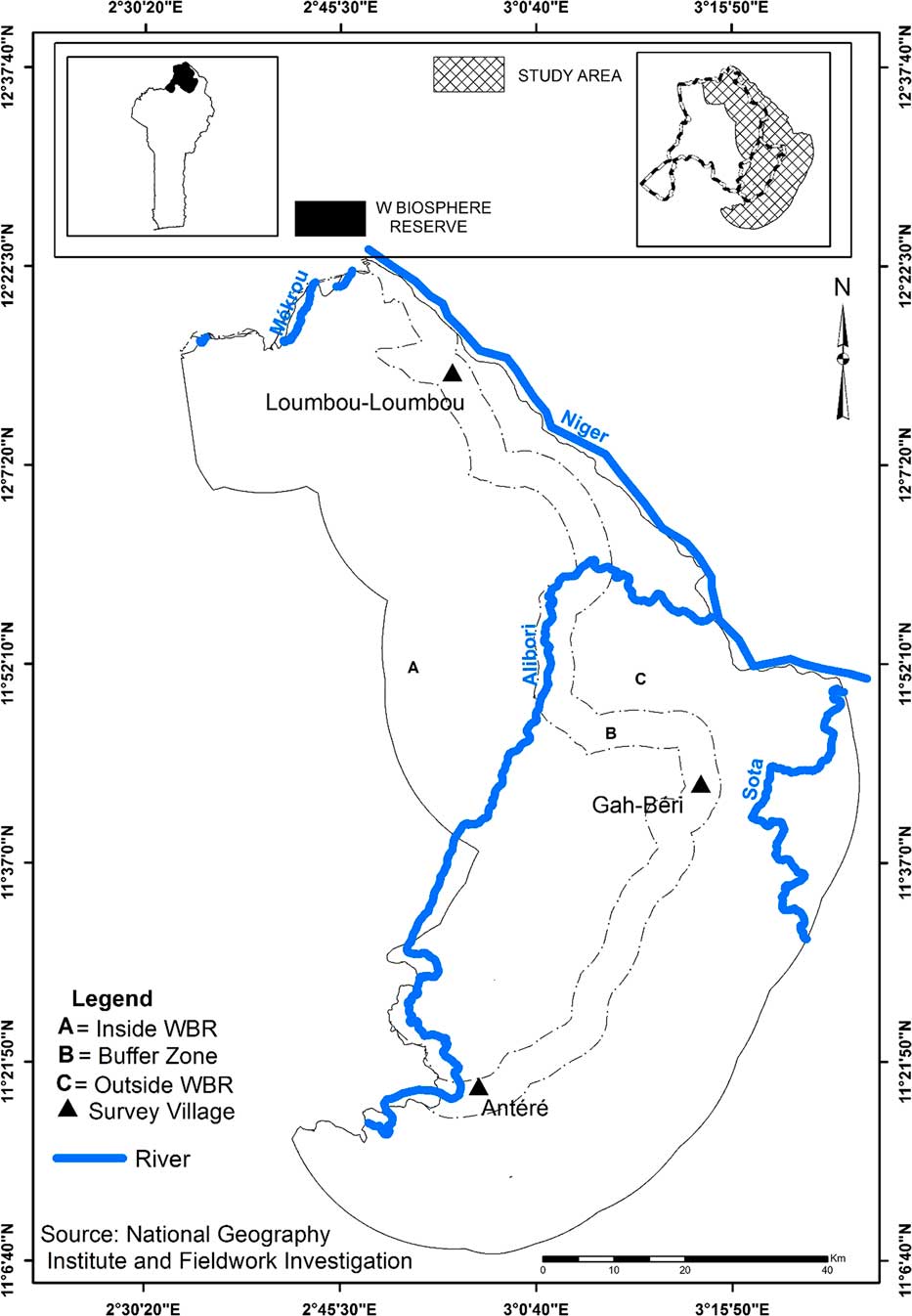
The present study was carried out in the WBR (former National Park of W), in North Benin (Figure 1). The WBR (11° 26′ to 12° 26′ N and 2° 17′ to 3° 05′ E) comprises about 56% of the W Transboundary Biosphere Reserve located in the countries of Benin, Niger and Burkina Faso, and covers about 5632 km2. The vegetation of the WBR consists of tree, shrub and woodland savannah, gallery forest and wetland. This vegetation allows the presence of several wildlife species, such as lions, cheetahs, elephants, buffaloes, waterbucks, monkeys and birds.
The W Biosphere Reserve (WBR) in Benin (small inset map left-top corner), the study area relative to the Beninese section of the WBR (small inset map right-top corner) and the study area. Village Antéré is in the southern agro-ecological zone, village Gah-Béri is in the mid agro-ecological zone and village Loumbou-Loumbou is in the northern agro-ecological zone.

The regional water supply comes from the Niger River and its tributaries Alibori, Mekrou and Sota watercourses. The climate of the WBR is characterised by two main seasons: a rainy season from mid-May to October, with an average minimum daily temperature of 12°C, an average maximum daily temperature of 25°C and precipitation ranging from 700 to 1000 mm; and a dry season from November to mid-May, with an average minimum daily temperature of 30°C, an average maximum daily temperature of 40°C and hardly any precipitation (Billand et al., Reference Billand, De Visscher, Kidjo, Compaore, Boureima, Morel, Camara, Czesnik and Ahoyo Adjovi2005). During the first part of the dry season, from November to February, a dry dusty wind blows through the North of Benin, also referred to as harmattan, which boosts the drying process of natural pasture. The harmattan facilitates burning of dried pasture, either from prescribed early fire used to reduce fuel accumulation or from late bush fire.
In Benin, five districts border the WBR, with a total of 759 300 inhabitants of which 23% are Fulbe (INSAE, 2016), and the main economic activities in these districts are crop farming and livestock production. The WBR and its surrounding land are located in the so-called agro-pastoral contact zone in West Africa (van Driel, Reference van Driel2002), indicating that land is suitable for crop farming and livestock farming, enabling competition for land (Tamou, Reference Tamou2017). Crop farmers get their main income from production of cereals (maize, sorghum, millet, rice), roots and tubers (yam, cassava, potato and sweet potato), legumes (groundnut, beans, soybean and bambara bean), vegetables (tomato, pepper, okra, pumpkin) and cotton, and possess oxen for ploughing. They belong to the following ethnic groups: Baatonu, Dendi, Monkole and Goumantche. In contrast, pastoralists obtain their main income from livestock and livestock products, and belong to the Fulbe ethnic group. The Fulbe pastoralists are dwellers of the districts surrounding the WBR and are known to organise and supply livestock markets where crop farmers buy draught animals and butchers can buy animals to slaughter. Pastoralists from the area usually move their animals on short distance during the wet season and cover long distances southward during the dry season. The area is also frequently visited by pastoralists coming from the bordering countries Burkina Faso, Niger and Nigeria, during the dry season (Tamou, Reference Tamou2002). Usually, most of these pastoralists go back to their home countries at the beginning of the wet season.
Fulbe are very connected to their grazing lands (through their animals) and they considered TEK about herding as essential (Boesen et al., Reference Boesen, Hardung and Kuba1998). In pastoral production system, TEK is produced and learnt by doing, that is by being involved in moving and herding livestock. At birth, a pastoralist child is endowed with an animal. When growing up, under the authority of the chief of household, the child starts doing small scale herding activities such as tethering and herding calves not far away from the homestead. Gradually, the young pastoralist will accompany senior pastoralists (usually a family member, such as father or older brother) in herding longer distances, up to transhumance. At that stage, learning occurs through contacts with other herdsmen, other herds and other landscapes. Since animals are considered God’s gifts (Boesen et al., Reference Boesen, Hardung and Kuba1998), young pastoralist should acquire knowledge and skills in herding to properly take care of animals.
In the present study, three agro-ecological zones were distinguished (Table 1): the Sudanian zone in the south, the Sahelo-Sudanian zone in the north and the intermediate zone in between the north and south regions (Houessou et al., Reference Houessou, Teka, Imorou, Lykke and Sinsin2013). Average rainfall ranged from 1000 mm/year in the south to 700 mm/year in the north. Selection of the three agro-ecological zones was done to cover possible variation of pastoralists’ TEK about herding across the study area. In each agro-ecological zone, one village and two adjacent hamlets were selected to conduct the study. Selection of villages was done according to following criteria: (i) being representative of the zone (in terms of climatic conditions and land uses), (ii) being close to the border of the WBR and (iii) representing ethnic diversity in the area (i.e. co-existence of Fulbe community and other ethnic groups) (Tamou et al., Reference Tamou2016). Hence, nine communities were selected for data collection in the present study. The first author was introduced to Fulbe pastoralists’ leaders by field officers of the livestock service of the Ministry of Agriculture in each of the villages and hamlets. Research objectives and methodologies were discussed with these pastoralists’ leaders and their permission to conduct the study was obtained.
Basic characteristics of the agro-ecological zones

WBR=W in Benin Republic.
* Sorghum, millet, rice and vegetable are the crop of the food crop-based farming.
Data collection
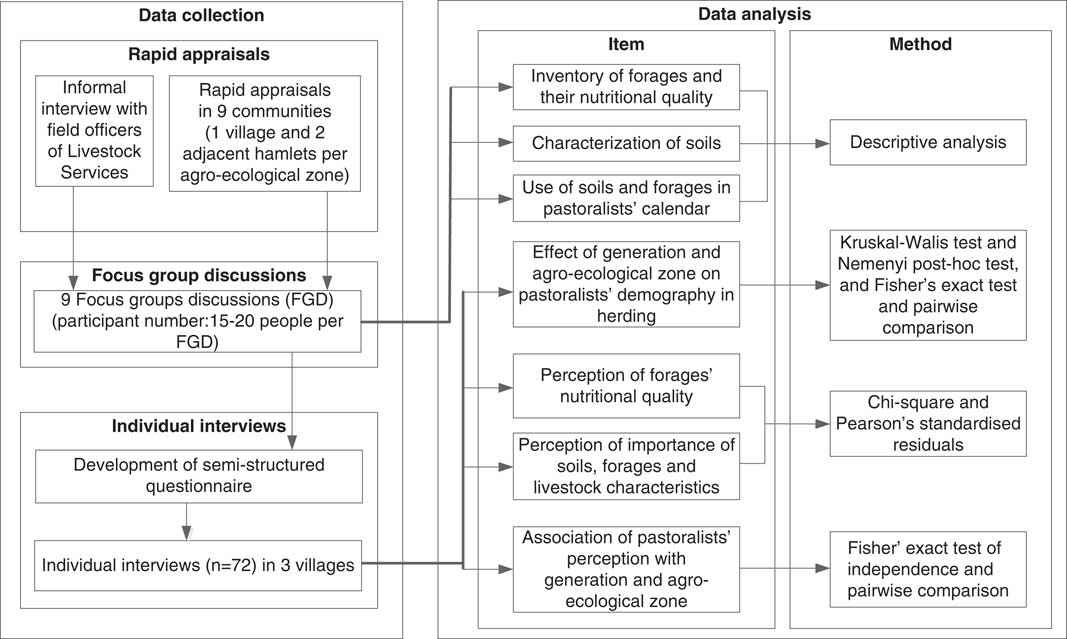
Data were collected between November 2014 and April 2015. Information was derived from three sources: (i) rapid appraisals, (ii) focus group discussions (FGDs) and (iii) individual interviews (Figure 2).
Framework for data collection and data analysis (adapted from Oteros Rozas et al. (Reference Oteros Rozas, Ontillera-Sánchez, Sanosa, Gómez-Baggethun, Reyes-García and González2013)).

Rapid appraisals
Informal interviews about pastoralists’ herding knowledge were held with five field officers of the livestock services working around the WBR. The first author also collected information from rapid appraisals (Chambers, Reference Chambers1994), during field visits to the nine communities selected for data collection. On the basis of these rapid appraisals items about pastoralists’ herding knowledge were identified that would be discussed in the focus groups.
Focus group discussion
FGDs were held in each of the nine selected communities. The number of participants ranged from 15 to 20 people per focus group. Participants were all men because herding is an activity exclusively done by men in Fulbe communities (Schareika, Reference Schareika1998; van Driel, Reference van Driel2002). Participants were most of the time elders who were members of the village or hamlet council, and were all cattle keepers. The objective of the FGDs were: to introduce the study, to include pastoralists in the study design, and to have FGDs (McLafferty, Reference McLafferty2004) with them about TEK underlying herding decisions. In addition, the FGDs were used to select relevant age classes to study the generation effect on TEK underlying herding decisions and to develop a semi-structured questionnaire for the individual interviews. The first author facilitated the discussions in French which was then translated into the local language (Fulfulde) by a trained interpreter. Focus group discussions lasted from 1.5 to 2 h and were audio recorded. The analysis of the FGDs (methodology described in Data analysis section) enabled the selection of the dimensions (described hereunder) and items within dimensions to be further discussed in the individual interviews. Dimensions and items were discussed and selected together with pastoralists’ representatives.
Relevant age classes for assessing traditional knowledge about herding
During FGDs, pastoralists agreed that three generations were of relevance (between brackets their Fulfulde name) for study of traditional knowledge of pastoralists’ herding: the young (Alwasibey) generation (18 to 30 years old), the mid (Dotibey) generation (40 to 60 years old) and the old (Nahebey) generation (>60 years old).
Selection of dimensions in the questionnaire for individual interviews
(1) Soils: participants of the FGDs distinguished soil types on the basis of relevant characteristics as perceived by them. The participants of the FGDs were asked to make their own list of criteria and to classify soils according to these criteria. We used the soil names chosen by the pastoralists in their own Fulfulde language.
In addition, pastoralists mentioned positive and negative factors influencing the quality of soils for forage growth (and consequently for herding) which we included in the questionnaires for individual interviews.
(2) Forages: participants of the FGDs were asked to list the most important grass and leguminous tree forage species for herding, involving cattle; to indicate the nutritional quality of the most important forage species; to provide the seasonal availability of the various forages; and to establish links between forages and soils. The seasonal variability reflected pastoralists’ calendar, which consists of five periods that is, Seyto, Dungu, Yaawol, Dabuney and Tchendwe. From the inventory of grass and leguminous tree forage species, pastoralists selected four grasses and three leguminous tree forages which they perceived as the most important in regard to herding decisions. Despite the first author was already familiar with vegetation of the study area, a specimen of each plant (whole grass plant or tree leaf for tree) and a camera picture were send to a botanist for confirmation.
(3) Herding decisions: participants of the FGDs listed elements, criteria and weighing of criteria for deciding where and when to herd their livestock. Pastoralists considered soil, forage and livestock characteristics as the most important elements underlying herding decisions. We refer to livestock characteristics as both livestock’s condition (e.g. shininess of livestock coat) and livestock’s behaviour (e.g. being impatient).
Individual interviews
Based on the outcomes of the FGDs, we developed a semi-structured questionnaire with four sections. The first section assessed the demographic parameters related to herding, such as age of herders, and the length of experience in herding. The second section assessed the interviewees’ perception of quality of soils by asking them to mention the best and the worst soil for herding. They were also asked to mention the most important positive factor and the most important negative factor determining quality of soils for forage growth. In the third section, interviewees were asked to score the nutritional quality of the forages important for herding decisions. Interviewees scored the forage species by a three-point scale (low, medium or high) regarding the contribution of forages’ nutritional quality to animal production objectives. In the fourth section, interviewees were asked to rank soil, forage and livestock characteristics, in terms of their importance for herding decisions.
Individual interviews were conducted with 24 interviewees (eight per age group) in each of the three villages (hence not in the hamlets) by means of the questionnaire. Interviewees were selected using the snowball technique starting with participants of the FGDs. The inclusion criterion for the interview was that the interviewee should have past or present experience in herding. The interview was held in each interviewee’s household. Individual interviews lasted between 45 min and 1 h. The first author asked the questions in French and a trained interpreter translated the questions into the local language.
Data analysis
Data analysis consisted of a descriptive analysis of information obtained from FGDs and a statistical analysis of data obtained from the individual interviews (Figure 2).
Focus group discussions
The discussions were summarised and the general patterns of the discussions were categorised (Pope and Mays, Reference Pope and Mays1995). These general patterns were then synthesised into an inventory of soils and their characteristics, an inventory of forages and their quality, and a calendar of use of soils and forages.
Analysis of data of individual interviews
Age, age at the start of herding, actual experience in herding, potential experience in herding and ratio of actual and potential experience in herding were first tested for normal distribution. Since these parameters were not normally distributed, the Kruskal–Wallis test was used to test for effects of generation and agro-ecological zone on demography of herding. In case of significant effect, the Nemenyi post hoc test (with χ2 approximation) was used to test for differences between means. The Fisher’s exact test was used to test for association between generation or agro-ecological zone and number of interviewees still herding (active herders) or not. In case of an association, a post hoc analysis based on pairwise comparison was performed to determine different groups (Mangiafico, Reference Mangiafico2016).
We combined χ2 and Pearson’s standardised residuals, to analyse pastoralists’ perception, within each of the four production objectives of grasses, and within each of the four production objectives of tree leguminous forages, separately. Within production objectives, we, first, used χ2 to check for significant associations between the number of interviewees and the score. We then calculated Pearson’s standardised residual, which is the deviation of the observed number of interviewees for a given score from its expected value (Agresti, Reference Agresti2007), which is
 $${\rm Residual}\,{\equals}\,{{\left( {0{\minus}E} \right)} \mathord{\left/ {\vphantom {{\left( {0{\minus}E} \right)} {\sqrt E }}} \right. \kern-\nulldelimiterspace} {\sqrt E }}$$
Where 0 is the observed number of interviewees, and E the expected number of interviewees.
Pearson’s residuals of more than +3 and lower than −3 were considered significant (Agresti, Reference Agresti2007), that is indicating that there was a high level of agreement among pastoralists.
To analyse the importance of soil, forage and livestock characteristics for herding decisions we used the same procedure. Here, Pearson’s standardised residual is the deviation of the observed number of interviewees for a given rank from its expected value.
We used Fisher’s exact test to test for associations between generation and agro-ecological zone with regard to (i) quality of soils for herding, and positive and negative factors influencing such quality, (ii) perception of nutritional quality of forages and (iii) perception of importance of soil, forage and livestock characteristics for herding decisions. In case of an association, a post hoc analysis based on pairwise comparisons was performed (using the function ‘pairwiseNominalIndependence’ from the package ‘rcompanion’) to determine different groups (Mangiafico, Reference Mangiafico2016).
All statistical analyses were done in R 3.3.1 (R Core Team, 2016).
Results
Inventory of forages and their qualities
In the FGDs with pastoralists, the following 10 grasses were mentioned (between brackets their Fulfulde name): A. gayanus (Ranyerey, Seynorey or Kibia), L. ledermannii (Nardi), Andropogon pseudapricus (Seokorey), Hyparrhenia involucrata (Jokuru), Pennisetum spp. (Buludey), Diheteropogon hagerupii (Garabaal), Echinochloa stagnina (Burugu), Telepogon elegans (Bolagoril), Brachiaria stigmatisata (Paguri) and Tephrosia pedicellata (Dumbaru). The grasses that pastoralists considered most important for herding decisions were A. gayanus and L. ledermannii (perennials), and A. pseudapricus and H. involucrata (annuals). Reasons mentioned for selection of these grass species were that the perennials were dominant in the core area of the WBR, whereas the annuals where dominant everywhere in the study area. Andropogon gayanus and L. ledermannii were also considered as having good nutritional quality.
Pastoralists mentioned the following leguminous tree forages: Afzelia africana (Warangnanhi), Pterocarpus erinaceus (Banuhi), K. senegalensis (Kayi), Balanites aegyptica, Acacia spp. (Giajey), Ficus spp. (Huiki) and Azadirachta indica (Neemu). The following species were considered most important for herding decisions: A. africana, P. erinaceus and K. senegalensis, because they were the most harvested by pastoralists and offered to livestock in the dry period. The grasses and leguminous tree forages considered important for herding decisions were selected for inclusion in the individual interviews.
Pastoralists reported the following nutritional qualities of forages: contribution to milk production (milk), meat production (meat), favouring short calving interval, favouring livestock health (health), favouring livestock strength (strength), favouring livestock satiety, and favouring faecal production. From this list, the following qualities were considered most important by FGDs and were selected for the individual interviews: milk, meat, health and strength. Milk and meat are important since they are sources of food (especially protein with high nutritional quality) and income. Health is important since some forages were considered to enhance the health status of the animals, and strength is important since pastoralists perceived that some forages support strength and endurance in walking. This helps livestock to remain strong, especially in the dry period, and during long walks in search of good forages.
Characterisation of soils
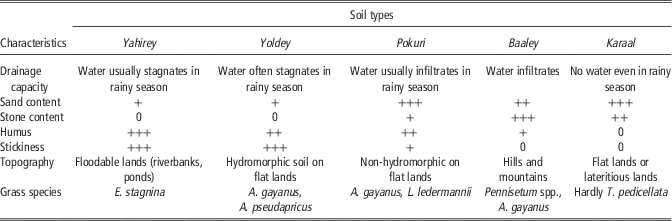
Pastoralists mentioned the five following soils: Yahirey, Yoldey, Pokuri, Baaley and Karaal, which were common in all three agro-ecological zones. Depending on the agro-ecological zone, pastoralists reported different names for similar soils. It was agreed to use the names reported above since they were understood in each of the agro-ecological zones. Table 2 presents the main characteristics of these soils. Water drainage capacity (determining whether water stagnates resulting in land with puddles referred to as wetland or whether water infiltrates), sand and stone content of soil, humus (organic matter content, called Taaki in Fulfulde, which was associated with the ability of a soil to produce forage of good quality), and soil stickiness (which is negatively associated with ease of cattle movement on soils) were characterising soil typology. We found that soil typology followed a toposequence, from riverbank to high altitude. Different forage species dominate the different soil types.
Characteristics of soil types distinguished by Fulbe pastoralists in and around the WBR in Benin Republic

0=absent; +=low; ++=medium; +++=high.
Source: Focus group discussions in pastoralists’ communities.
Use of soils and forages in the pastoralists’ calendar
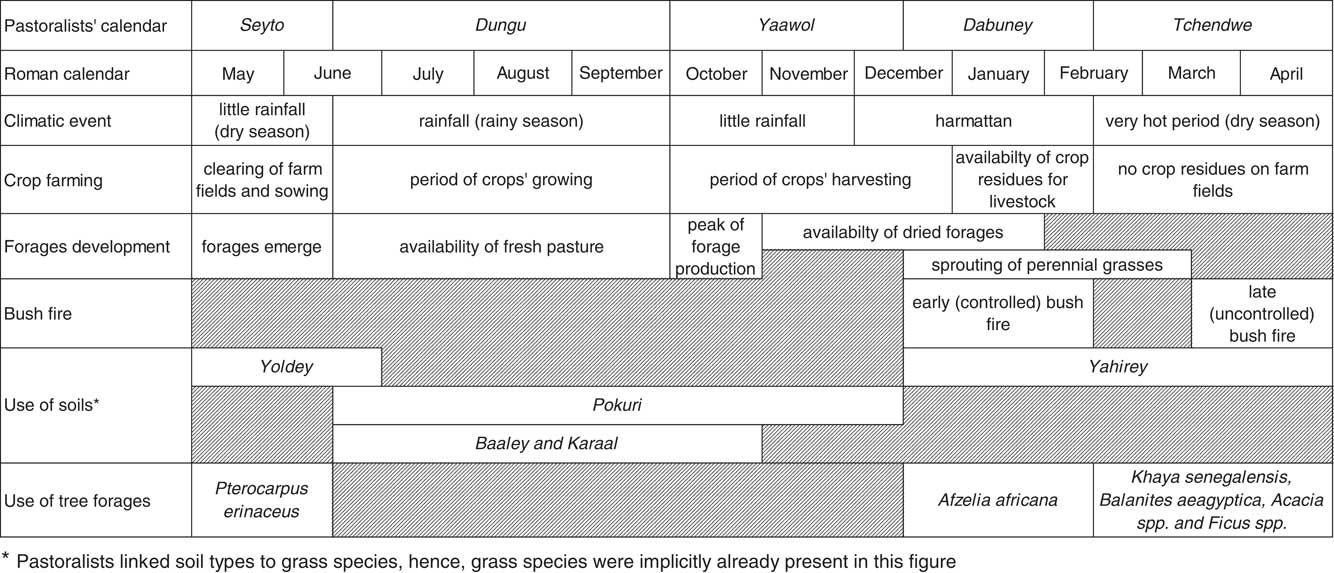
Figure 3 presents the use of soils and of leguminous tree forages in pastoralists’ calendar. The calendar was similar for all agro-ecological zones. The period of the year in which each soil is preferred depends on soil moisture which in turn relates to the drainage capacity of the soil. In the rainy season, the soils Yahirey and Yoldey are too wet and pastoralists avoid herding on these soils. Pastoralists reported that livestock on very wet soils do not eat well because they are bothered by tsetse flies, which are abundant on such soils during the rainy season. Consequently, livestock may get sick and produce less milk. Others reported that on wet soils, livestock get sick more often because of a snail, which is abundant in humid lands, and which transmits a disease. Hence, in the rainy season livestock graze on soils such as Pokuri and Baaley which are less wet (i.e. they have good moisture content but without standing water) and where forages are available. In the dry season, the soil Yahirey and Yoldey are preferred for grazing because they have forage and no standing water, whereas forages are too dry, if available at all, on Pokuri and Baaley.
Use of soils and leguminous tree forages during pastoralists’ calendar.

In the dry period, when herbaceous forages are scarce, pastoralists harvest leguminous tree forages as a supplement to feed their livestock. In the pastoralists’ calendar, the dry season consists of Dabuney, Tchendwe and Seyto. Harvesting of leguminous tree forage depends on the availability of young and fresh leaves. Nowadays, because of logging, crop farming and overharvesting, these leguminous tree forages have become scarce. Therefore, other trees such as B. aegyptiaca, Acacia spp., Ficus spp. and A. indica are harvested during the dry season, although their quality is perceived as lower than that of A. Africana and K. senegalensis.
After crop harvesting, at the onset of the dry season, crop residues are available and can be used according to verbal contracts between crop farmers and pastoralists. So, throughout the pastoralists’ calendar, pastoralists adapt their herding according to soil moisture, and the availability of forages, tree forages and other resources, such as crop residues.
Effect of generation and agro-ecological zones on herding demographics
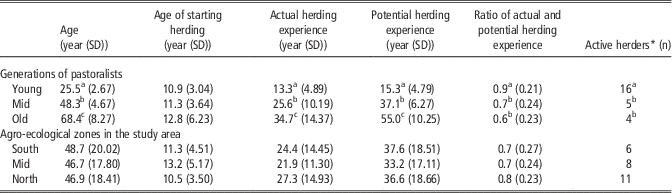
Table 3 presents pastoralists’ demographic parameters related to herding. Generation had no effect on age at the start of herding. As expected more young (67%) than mid and old (19%) pastoralists were still active in herding. Actual herding experience was a fraction of 0.9, 0.7 and 0.6 of the potential herding experience (i.e. the difference between present age and age at start of herding) for young, mid and old generation, respectively. This indicates that the young spent a considerable time of their life herding.
Demographic parameters related to herding across generations of pastoralists and agro-ecological zones in the study area

a,b,cDifferent superscripts within a column indicate significant differences among generations (P<0.001).
* Significant association between generation and number of active herders (Fisher’s exact P<0.05).
Agro-ecological zone had no effect on demographic parameters of herding.
Perception of quality of soils
Regarding classification of soils, 40 out of the 72 interviewees mentioned that Pokuri was the best soil for herding. They explained this choice by the fact it does not get too wet due to its high rate of water infiltration and that there are good forages present on this soil. In contrast, 49 out of 72 interviewees mentioned that Kaaral was the worst soil, because usually no forage grows on it, or if any, forages are in seldom tufts and of very poor quality.
Regarding soil factors of importance for forage growth, humus (52 out of 72 interviewees) and moisture (18 out of 72 interviewees) were the most positive factors. Moisture was defined as the water availability for forage growth and should be distinguished from standing water on the soils, which is a negative soil characteristic (see Table 2). Other positive factors were looseness of soils allowing forages to establish easily, and the absence of stagnating water. Overstocking and soil compaction (due to overstocking, resting and walking, making it difficult for forages to establish) were considered the most negative factors for forage growth, in both quality and quantity. Uncontrolled bush fire (in the dry period) was also mentioned as a negative factor for forage growth because it burns forages’ seeds and it destroys soils.
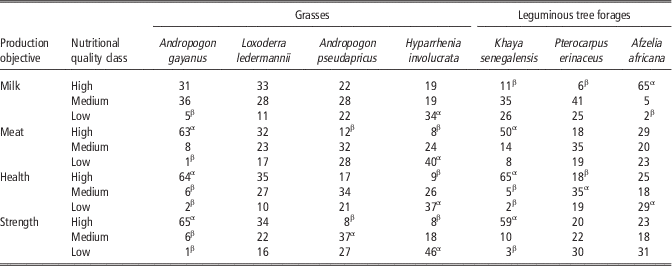
Perception of the nutritional quality of forages
Table 4 presents pastoralists’ perception of the nutritional quality of the forages. Regarding grasses, pastoralists had a shared (as indicated by Pearson’s residual values of higher than +3 or lower than −3) perception about their nutritional qualities. Andropogon gayanus was perceived as being of high quality for meat, health and strength. Andropogon pseudapricus was perceived as being of medium quality for strength; and that H. involucrata as being of low nutritional quality for milk, meat, health and strength. Pastoralists’ perception of the nutritional quality of L. ledermannii was scattered. Pastoralists perceived perennials (A. gayanus and L. ledermannii) of higher quality than the annuals (A. pseudapricus and H. involucrata). Pastoralists reported that after grazing A. gayanus, livestock’s coat is always shining, which is a sign of health. During resting, livestock have deep breathing, which is a sign that they are well fed and healthy. In contrast after grazing poor forages, such as H. involucrata, livestock will have shallow breathing, which is a sign that they are not well fed, according to the interviewees.
Pastoralists’ perception of nutritional quality of important forages species (number of interviewees scoring in quality class within production objectives)

α,βNumbers with superscript α and β indicate Pearson’s standardised residuals more than +3 and less than −3, respectively.
Regarding leguminous tree forages, K. senegalensis was perceived as being of high quality for meat, health and strength. Pterocarpus erinaceus was perceived as being of medium quality for health and A. africana was perceived as being of high quality for milk, and of low quality for health. Pastoralists explained the low quality for health by the fact that when livestock eat too much leaves of this forage, they are not healthy and they even produce less milk during the next season (wet season, with much fresh forages). Other pastoralists mentioned that livestock bleeds from their shoulders, which they considered as unhealthy.
Importance of soil, forage and livestock characteristics for herding decisions
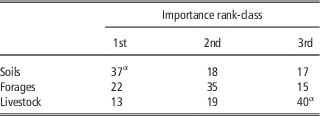
Table 5 presents the importance of soils, forages and livestock characteristics for herding decisions. Soils ranked first, forages second and livestock ranked third regarding pastoralists’ perception of the importance of these characteristics for herding decisions.
Ranking of soils, forages and livestock with regard to importance for herding decisions (number of interviewees within importance rank-class)

αNumber with superscript α indicate Pearson’s standardised residuals more than +3.
Association of pastoralists’ perception with generation and agro-ecological zone
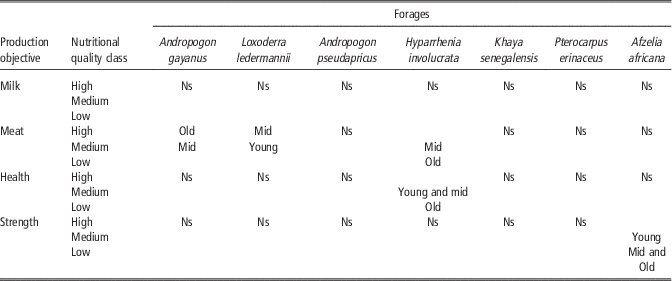
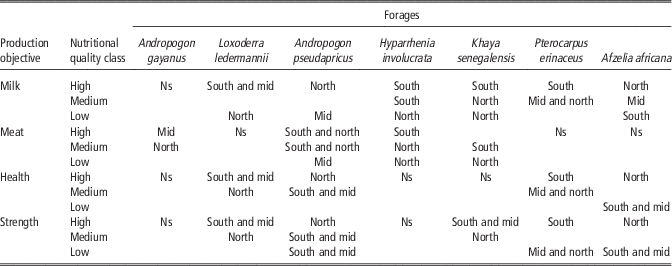
Table 6 presents the associations between generation and perception of the nutritional quality of forages.
Effect of generation (young, mid and old) on pastoralists’ perception of forage quality for the production objectives milk, meat, health and strength

If generation effect is significant, then it is indicated in which nutritional quality class the majority of the generation scored.
Ns=not significant (P>0.05), indicates no generation effect.
In some cases there was a difference between generations with regard to perception of quality of forages for a production objective. The old generation scored H. involucrata (for meat and health) and A. africana (for strength) lower than the young and mid generation, whereas they scored A. gayanus and L. ledermannii higher than the mid generation for meat.
There was no association between generations and perception of best soil, worst soil and negative factors for soil quality, and ranking of importance of soil and livestock characteristics for herding decisions. However, the young generation considered humus content as most important while the mid generation considered moisture content most important regarding soil quality for forage production. In addition, the young generation ranked forage characteristics second whereas the mid generation ranked forage characteristics first with regard to importance for herding decisions.
Table 7 presents the associations between pastoralists of the three agro-ecological zones and perception of the nutritional quality of forages. Differences with regard to perception of forages between agro-ecological zones are consistent in the sense that for at least two production objectives (milk and strength, mainly) L. ledermannii, H. involucrata, K. senegalensis and P. erinaceus are perceived as being of lower quality in the north than in the mid and south zones, whereas A. pseudapricus and A. africana were perceived as being of higher quality (for milk, health and strength) in the north than in southern agro-ecological zones.
Effect of agro-ecological zone (south, mid and north) on pastoralists’ perception of forage quality for the production objectives milk, meat, health and strength

If effect of agro-ecological zone is significant, then it is indicated in which nutritional quality class the majority of the generation scored.
Ns=not significant (P>0.05), indicates no generation effect.
With regard to perception of best and worst soils and soil characteristics affecting forage production the only difference found was that pastoralists from the south perceived moisture as the most positive soil parameter whereas those from the north instead perceived humus as being most important. There was no association between agro-ecological zone and perception of importance of soil, forage and livestock characteristics.
Discussion
The present study aimed to improve our understanding of pastoralists’ TEK related to their herding decisions.
Results show that pastoralists have a common and detailed understanding of soil, forage and livestock characteristics, and their herding decisions are based on TEK they have acquired about these characteristics. Forage species are differentially appreciated by pastoralists in northern and southern agro-ecological zones: A. pseudapricus is more appreciated in the north since it is more abundant there and consequently more important for grazing than in the south. In addition A. africana is considered the best tree leguminous forage for milk production in all regions, but it has been affected by logging. In the south good alternatives are available (e.g. A. gayanus, L. ledermannii) while this is not the case in the north. This could explain why herders in the north attribute more quality to A. africana than in the south. The TEK underlying herding decisions do not differ much between generations. This could be explained by the early involvement of young pastoralists in herding. In the following paragraphs, we discuss pastoralists’ TEK about soils, forages and livestock characteristics and the integration of such knowledge in making herding decisions.
Traditional knowledge about soils, forages and livestock characteristics
Results show that pastoralists have common and detailed understanding of the soils. The criteria they mentioned for valuing and classifying soils imply that they classify a whole grazing landscape and not only the soil. Their soil classification is based on topography, the forage availability and the risk of disease vectors. Pastoralists’ soil classification based on topography is consistent with Oba and Kaitira (Reference Oba and Kaitira2006) and Fernández-Giménez and Fillat Estaque (Reference Fernández-Giménez and Fillat Estaque2012). Although pastoralists used a detailed calendar based on climatic condition and topography of their grazing lands, our results about preference of soil types did not align with those in Fernández-Giménez and Fillat Estaque (Reference Fernández-Giménez and Fillat Estaque2012). In the present study pastoralists considered mountain and hill pastures of poor quality whereas those pastures were perceived as of high quality for the Pyrenean pastoralists due to abundance of forages. Our results also differ from those of Wario et al. (Reference Wario, Roba and Kaufmann2015), who observed that Borana pastoralists of Ethiopia used mountain and hill pastures during dry periods. This is because here they find sprouting grasses as a fresh forages during the dry period. Different generations in different agro-ecological zones have a highly similar perception of positive and negative factors associated with soil suitability for forage production such as humus and moisture. Moreover, overstocking is clearly recognised as a negative factor for forage production, hence for herding. This implies that pastoralists are aware of the potential negative effects of excessive herding on grassland productivity and grassland degradation. This perception of grazing, however, contradicts that of Mongolian pastoralists for whom heavy grazing promotes the dominance of the ‘narrow plants’ of high nutritional quality for their livestock (Kakinuma et al., Reference Kakinuma, Sasaki, Jamsran, Okuro and Takeuchi2014).
Our results also show that pastoralists have a common and detailed TEK about the nutritional qualities of forages. The fact that pastoralists valued A. gayanus (perennial grass) more than A. pseudapricus and H. involucrata (two annual grasses) is consistent with Buldgen and Dieng (Reference Buldgen and Dieng1997) in Senegal and Obulbiga and Kaboré-Zoungrana (Reference Obulbiga and Kaboré-Zoungrana2007) in Burkina Faso. This indicates that besides knowledge about forage species and grassland dynamics (Gaoue and Ticktin, Reference Gaoue and Ticktin2009; Kgosikoma et al., Reference Kgosikoma, Mojeremane and Harvie2012; Oba, Reference Oba2012), pastoralists know about the nutritional qualities of these forages and even attribute a quality according to a production objective. For instance, quality of leguminous tree forages for milk mentioned by pastoralists was correlated with their content of CP as reported in Ouédraogo-Koné et al. (Reference Ouédraogo-Koné, Kaboré-Zoungrana and Ledin2008) in Burkina Faso. Fernández-Giménez and Fillat Estaque (Reference Fernández-Giménez and Fillat Estaque2012) reported that pastoralists in the Pyrenees recognised plants of high biomass but of low nutritional benefits to animals. Different scoring for forages in terms of nutritional value was observed in Austria, where farmers classified forages as ‘good’ or ‘bad fodder’, ‘functional fodder’ and ‘fodder medicine’ (Vogl et al., Reference Vogl, Vogl-Lukasser and Walkenhorst2016).
Pastoralists linked quality of soils and forages to livestock health and to livestock behaviour. Soils of good quality are linked to soils without standing water with limited risk of contracting diseases, such as trypanosomiasis, for which the tsetse fly is the vector (Simo and Rayaisse, Reference Simo and Rayaisse2015), and animal fascioliasis, for which the snail Lymnea natalensis is the vector (Youssao and Assogba, Reference Youssao and Assogba2002). This is consistent with Wario et al. (Reference Wario, Roba and Kaufmann2015) who reported that Borana pastoralists in Ethiopia associated the presence of ectoparasites with pasture classification and use. However, while soil wetness is associated with disease in the present study, Borona pastoralists positively related wetness to vegetation and forage types, as well as to quantity and quality of forage over time (Wario et al., Reference Wario, Roba and Kaufmann2015). Consumption of sufficient forages of good quality is linked to the shininess of the cattle’s coats and to their way of breathing (respiration rate) during resting. Shininess of cattle’s coat is used as an indicator of animal welfare, suggesting that pastoralists’ TEK is consistent with scientific findings. Though there is no scientific support for the relation between consumption of sufficient forages and livestock respiration rate during resting, respiration rate is widely used to measure heat stress of cattle in animal welfare (Gaughan and Mader, Reference Gaughan and Mader2014; Tresoldi et al., Reference Tresoldi, Schütz and Tucker2016). Livestock’s condition and livestock’s behaviour were reported in Fernández-Giménez and Fillat Estaque (Reference Fernández-Giménez and Fillat Estaque2012) as indicators to assess pastures conditions and quality and hence, important in herding decisions. Similarly, Tianshan pastoralists in the Gobi desert distinguished lambing and calving pasture and other pasture which implies that they combine pasture characteristics with physiological and physical requirement of lambs and calves (Liao et al., Reference Liao, Morreale, Kassam, Sullivan and Fei2014).
Integration of traditional ecological knowledge regarding soil, forage and livestock characteristics underlying herding decisions
Results showed that pastoralists agree that soils rank first, forages second and livestock third. Therefore, in herding decisions, pastoralists look first at soil characteristics, that is they consider whether it is too wet or not. If the soil is not too wet, the next stage of the decision-making is to assess the presence of good forages. If good forages are available, then livestock is used mainly to decide whether herding should continue or not, since in practice, pastoralists look at the livestock’s characteristics during and after grazing: dull coats, and livestock being impatient after a night’s rest (restless behaviour) to resume herding are signs that their feed demands are potentially not met by the grazing. Such restless behaviour might be similar to the high motivation of limited-fed heifers to access feedstuff because of a lack of gut fill or an unsatisfied behavioural need to forage (Greter et al., Reference Greter, Miller-Cushon, McBride, Widowski, Duffield and DeVries2015). This finding suggests that, in decision-making in herding, pastoralists use a holistic approach, which combines soil, vegetation and livestock characteristics, beyond the livestock–vegetation relationship used by ecologists in assessing grassland quality (Roba and Oba, Reference Roba and Oba2009). Our finding suggests that soils with abundance of good pasture but being too wet, may force pastoralists to herd on soils with lower availability and quality of forage. In other words, grazing areas with abundance of forage, may be less desired by pastoralists due to the absence of specific species, such as the ‘narrow plants’ of high nutritional value found in highly grazed sites of Mongolian pasture (Kakinuma et al., Reference Kakinuma, Sasaki, Jamsran, Okuro and Takeuchi2014). Our results are consistent with the three set of indicators used by the Pyrenean pastoralists to assess pastures quality and condition (Fernández-Giménez and Fillat Estaque, Reference Fernández-Giménez and Fillat Estaque2012), that is soil, vegetation and animals. However, our findings contradict those of Fernández-Giménez and Fillat Estaque (Reference Fernández-Giménez and Fillat Estaque2012) in the sense that grazing land is characterised on slope, landform and accessibility rather than soil wetness as perceived in the present study. The discrepancy may be explained by the fact that grazing lands in the Pyrenees are in mountainous areas, with a completely different topography and climatology than the one in the area of the present study.
Limitations of this study
Participants of individual interviews were selected using the snowball technique and we interviewed only those willing to share their opinion with us, starting from participants of the FGDs. In doing so, the results of the interviews may have missed possible valuable information from people not willing to share their opinion and people out from the network of interviewees. In the context of the present study, however, sampling through this technique seemed the most suitable one, since pastoralists are hard to meet, because they are living in fear, and consequently reluctant to discuss with researchers.
Herding decisions can be influenced by social factors that have not been considered in the present study, such as accessibility to pastures (Schareika, Reference Schareika2003; Moritz et al., Reference Moritz, Handa, Chen and Xiao2015), distance from home (Coppolillo, Reference Coppolillo2000), fear of livestock being predated by wildlife (Tshering and Thinley, Reference Tshering and Thinley2017) facility for livestock mobility (McCabe, Reference McCabe2004; Ayantunde et al., Reference Ayantunde, de Leeuw, Turner and Said2008), communal or individual land tenure system (Galvin, Reference Galvin2008) and social alliance (Bassett and Turner, Reference Bassett and Turner2007). The contextualisation of the area under study (in previous sections) reveals the ongoing trends in land use change and the raising conflicts among land users that may have influence on herding decisions. The focus of the present study, however, was to understand the decision-making of pastoralists on herding based on TEK, and specifically about the role of soil, forage and livestock characteristics. It can be argued that, in pastoral systems, soil, forages and livestock characteristics are only biophysical factors on which herding decisions are based whereas social factors may be ‘underlying’ herding decisions to a much higher extent.
Acknowledgements
The research was funded by the Netherlands University Foundation for International Cooperation (NUFFIC) of the Netherlands (grant NFP-PhD 322/2012) and the Animal Production System group of Wageningen University. C.T. thank Fokje Steenstra for assistance with the statistical analyses and Laura Webb for providing comments on an early version of this manuscript.