1 Introduction
The comprehensibility of the law (legal texts) has been the subject of a long-standing discourse in the legal literature and an important element in access to justice. It seems to be a predominantly grammatical problem and has a close connection with the style of law. The starting point is that laymen have trouble understanding legal (official) language, often referred to as ‘legalese’ (Melinkoff, Reference Melinkoff1963) and sometimes as ‘strange style’ (Benson, Reference Benson1984) because of its verbosity, complexities and vagueness, and it is the duty of governments and lawyers to make legal language understandable – to eliminate this strange style. At least this is what the various ‘plain-legal-language movements’ suggest all around the world. Their proposed solutions are mostly grammatical simplifications. But, while plain-language statutes have been on the agenda for decades in every civilised country, laws still become more and more complicated. The ‘over-complicatedness’ of legal language stubbornly remains.
In this paper, I argue that comprehensibility has more aspects beyond the linguistic or stylistic one. Sometimes it is the linguistically simplest texts that raise the most serious comprehensibility problems. They are also those that are explained most frequently, for example, on ‘law simply’ websites. I argue, therefore, that, for a proper understanding of the comprehensibility problem, the pragmatics of the law should also be taken into consideration. The underlying idea is very simple (actually commonplace in pragmatics): in practical situations in which we ‘do things with words’, comprehension means the successful use of language. My main claim is that comprehensibility is not a purely linguistic or stylistic problem. Even in the case of ‘traditional’ comprehensibility situations (in the so-called processual contexts), it is clear that it is not solely complicated language that hinders understanding. And the more we widen the scope of our observations to other, lesser-discussed pragmatic settings (compliance and problem-solving situations), the less determinative are the narrowly defined linguistic factors (i.e. syntax, wording, etc.).
To support my argument, I will refer in this paper to two empirical (partly computer-based) research studies. The first was carried out in 2016–2017 by Veronika Vincze and a team of Hungarian lawyers and linguists on a larger corpus of Hungarian legal and ordinary-language texts in the framework of a broader study on the ‘linguistic prerequisites of access to justice’ (Vincze, Reference Vincze, Szabó and Vinnai2018). The second was performed on a smaller corpus by myself and a computer linguist colleague on mixed Hungarian legal texts.
The structure of this paper is as follows. In the first part, I will provide some conceptual and historical background to the comprehensibility problem, by first defining some concepts that I will be using in the paper, then by putting the comprehensibility problem into a historical context. I will also refer to the EU's efforts in the consumer-protection field (Council Directive 93/13/EEC of 5 April 1993 on unfair terms in consumer contracts; Directive 2011/83/EU on consumer rights).
In the second part, I will describe two empirical research studies. The first provides quantitative evidence that, from a lexical and syntactic point of view, the difference between ‘complicated’ legal texts and ‘plain’ ordinary ones is not so great as to explain, in itself, the comprehensibility problem. The text of the most important codes is linguistically simple: this is not the primary barrier to understanding. The second experiment provides evidence for this from another perspective, further confirming that the problem of understanding legal texts stems, at least in part, from the pragmatics of law.
In the third part, I will draw some conclusions based on the previous observations. I argue that the comprehensibility problem cannot be eliminated from the law, because of its ontological and epistemological character.
2 Understanding comprehensibility in law
2.1 Concepts and definitions
Before I start my argumentation, I would like to make some clarifying remarks on the concepts I will be using.
By ‘comprehensibility’, I refer to the peculiarity of easily understandable verbal or written texts. It always comprises a subjective element, so it presupposes a certain level of literacy on the part of the receiver. Moreover, there could be huge social differences within society itself (class, educational, etc.) (Charrow and Charrow, Reference Charrow and Charrow1979, p. 1321; Curtotti et al., Reference Curtotti, Weibel, McCreath, Ceynowa, Frug and Bruce2015, pp. 26–38) that influence how a person understands a text in general. For the sake of clarity, I will exclude this variable from this paper and, although I am aware of the theoretical drawbacks, I will take an ‘average citizen’ as a starting point – that is, someone who can read and understand shorter texts and has some knowledge of government and institutions, the functions of government and the tasks of officials. He/she is aware of the function of different official texts: what a decision of an authority or a judgment means or that laws govern a modern state and that these laws are applied and followed by official institutions.
Second, I distinguish between two closely related, but still distinct, concepts that have a great impact on the topic I discuss here. This is a distinction often used by authors writing about law and language: ‘ordinary language’ and ‘plain language’. Their relationship is unique. They are not the same; moreover, plain law and plain language do not necessarily go together (Galdia, Reference Galdia2014, p. 245). ‘Plain legal’ is a controlled (nearly artificial) language and, the plainer it is, the further away it moves from the ‘ordinary’. To put this into another context, while ‘legalese’ (the oft-condemned poor style) and ‘plain legal’ are opposites on a stylistic spectrum, ordinary language is not, I believe, a different style, but rather a different linguistic register. (For the definition of ‘register’, see below.) Further, many authors emphasise that legal language is a part of ordinary language (Tiersma and Solan, Reference Tiersma, Solan, Tiersma and Solan2012, p. 4). Consequently, as in the case of style, we might distinguish between two definitions of ordinary language: ‘ordinary’ in a narrow sense means a language that is used in everyday communication, namely in everyday situations. In this sense, legal language is different from ordinary language because it is used in legal situations: during legally relevant or official processes. In a broad sense, however, ordinary language is the opposite of ‘technical’, ‘scientific’ or ‘artificial’ language, such as the formal language of logic or the technical language of certain professions. In this sense, the language of the law is part of ordinary language, with some special features (see Mattila, Reference Mattila2006).
Third, in this paper, I will distinguish between two meanings of ‘complexity’. Besides the linguistic level of vocabulary and syntax, such as foreign words, long sentences or truncated passive voice, there is another level, which we can refer to as ‘semantic’ or ‘pragmatic’ complexity. In this case, the difficulty is not the text itself, but rather in the understanding (application) of the text in a particular situation. This happens when we understand the words or even the entire sentences but still do not understand the ‘whole’, in the sense that we do not know what the consequence of the text is. This happens in legal situations very often. I will come back to this later.
Fourth, when we are talking about the comprehensibility of ‘legal texts’, there are three notions that are often used: language, register and style. Sometimes it seems that these terms are interchangeable (Biber, Reference Biber1995). The concept of registers has been developed by sociolinguistics: it denotes use-related varieties of a language – uses that are different in different social settings (see e.g. Halliday et al., Reference Halliday, McIntosh and Strevens1964; Biber, Reference Biber1995). For example, according to the ISO/TR 20694:2018[en], standard ‘legal’ is a distinct register, while, in other cases – as in this paper – ‘legal’ refers to a ‘language’ (‘legal language’). Style also has different meanings. In a broad sense, ‘legalese’ is often characterised as a certain type of (poor) style (Benson, Reference Benson1984) and ‘plain language’ means that we eliminate every element of ‘high style’ from the text – that is, we make a change between two ‘styles’. On the other hand, ‘style’ often refers to one aspect of legalese besides the vocabulary, syntactic features and organisation (of the text): a sort of pompous, verbose tone. In this paper, I will use ‘register’ in the broadest sense: legal language is a part of an ‘official’ or ‘formal’ language register. ‘Language’ lies within this: there are different languages, such as the language of the law and the language of ceremonies. Finally, within legal language, there are different ‘styles’: ‘legalese’ is one style, while ‘plain’ is another, but still a part of legal language and the formal register. One of the points of this paper is that comprehensibility beyond a certain point cannot be achieved by simply changing the style, or even by changing the language. Sometimes a register change is necessary.
2.2 Plain-legal-language movements
The comprehensibility of the law (statutes, judgments, other official documents) became an issue with the emergence of modernity and a simple, plain style in the law has been on the agenda since the Enlightenment (Bentham, Reference Bentham1823, pp. 68–69; Mattila, Reference Mattila2006, p. 96; Strouhal, Reference Strouhal and Öhlinger1986; Tiersma, Reference Tiersma1999). In its current form, the need for ‘ordinary citizens’ to understand legal texts emerged during the Enlightenment, when ‘ordinary citizens’ entered the historical stage. Since then, it has been an ongoing complaint that legal texts and legal jargon cause problems for the average citizen.
The most grandiose projet was Napoleon's Code Civil – the primary example of a code written in plain language that anyone can understand. In a letter written to Balzac, Stendhal admitted that he read at least three pages of the Napoleon's code to put him in the right stylistic frame of mind for working on The Charterhouse of Parma (Kornstein, Reference Kornstein2010, p. 83). Napoleon had a strong conviction that the ultimate reason behind law's complexity is lawyers’ own interests. According to the famous story, he exclaimed that his code was ‘lost’ when, in 1805, Jacques de Malville published his ‘Reasoned Analysis’ – the first legal commentary on the code (Merryman and Pérez-Perdomo, Reference Merryman and Pérez-Perdomo2007 p. 59).
Law might have become more understandable and accessible with the publication of the great Civil Codes, but certainly not sufficiently so: from time to time, new movements have promoted the idea of understandable law. In my country – Hungary – alone, there have been three waves of ‘legal-language-simplification’ movements over the past 50 years (NET No. 14/1973 (VI.7) resolution (1973) (Presidium of Hungary) resolution on the Policy of Application of Law (A jogalkalmazás jogpolitikai irányelvei); Act IX of 1987; Handó, Reference Handó2017).
The most influential recent, and in many respects still active, language-simplification effort is the Plain English Movement in the US (Adler, Reference Adler, Tiersma and Solan2012; Alterman, Reference Alterman1987; Benson, Reference Benson1984; Benson and Kessler, Reference Benson and Kessler1987; Charrow and Charrow, Reference Charrow and Charrow1979; Melinkoff, Reference Melinkoff1963; Kimble, Reference Kimble1994; Reference Kimble2006; Stark, Reference Stark1994; Schiess, Reference Schiess2003; Wydick, Reference Wydick1978; Reference Wydick2005). It started with the seminal book by David Melinkoff (Reference Melinkoff1963), The Language of the Law, which revealed many linguistic ‘monsters’ in American legal jargon, referred to as ‘legalese’. Melinkoff distinguished between two properties of the language of the law: its ‘characteristics’, such as frequently used common words with uncommon meanings, and frequently used Latin words and phrases; and its ‘mannerisms’, namely its pompous and verbose wording.
At the beginning of the 1970s, various special legal documents were caught in the cross hairs of the movement: complicated insurance policies and other – sometimes abusive – consumer contracts and general terms (Wydick, Reference Wydick1978 p. 728; Executive order No. 12044, Memorandum of 1 June 1998, by President Jimmy Carter, 43 Federal Register 43, 12661 (1978)). Jury instructions were also frequently analysed (Charrow and Charrow, Reference Charrow and Charrow1979; Charrow, Reference Charrow1987; Wilcox, Reference Wilcox1986; Elwork et al., Reference Elwork, Alfini and Sales1982). The movement sometimes generated fierce debates (see e.g. Crump, Reference Crump2002; Stark, Reference Stark1994) but slowly became a sort of mainstream effort in common-law countries, although its goals seem to have shifted (e.g. more emphasis has recently been placed on ethnic and other minorities; Jensen, Reference Jensen2010).
The main context of ‘comprehensible law’ in EU law is found in consumer protection. The EU recurrently codifies the requirement for ‘plain and intelligible language’ in consumer contracts: first in 1993 in the Unfair Terms in Consumer Contracts Directive (Directive 93/13/EEC, Articles 4 and 5) and then in the Directive on Consumer Rights (Directive 2011/83/EU, Articles 5 and 6) when declaring that ‘clear and comprehensible information’ should be given by the trader.
Regardless of when and where these efforts have been active, two main ideas behind them have remained stable, as follows.
First, they all understand the comprehensibility problem as primarily a linguistic, more particularly a syntactic and semantic (stylistic) question and therefore one that can be solved by a lexical and grammatical simplification of legal language. If we manage to eliminate surplus words, use verbs instead of nominalisations, prefer the active voice, use shorter sentences, arrange words carefully (Wydick, Reference Wydick2005), avoid ‘archaic and inflated’ vocabulary and poor organisation (Kimble, Reference Kimble2006), etc., the law will become comprehensible.
The paper by Charrow and Charrow (Reference Charrow and Charrow1979) on jury instructions and Benson and Kessler's study (Reference Benson and Kessler1987) on appellate briefs reinforce this impression. They both prove, with carefully executed psycholinguistic experiments, that even a very minor linguistic change can dramatically improve comprehensibility. The experiments produced some clear results: nominalisations, prepositional phrases – especially ‘as to’ — misplaced phrases, ‘whiz’ phenomena (the lack of ‘which is’), double negatives and long lists of words (redundant words in legal texts) all clearly worsen comprehensibility, while modal verbs (‘should’, ‘must’) improve it. Embeddings always reduce comprehension. The type of embedding has a greater effect on comprehensibility than the mere number of them. So-called central embeddings are particularly prone to reducing comprehensibility.
Second, legalese is a result of lawyers’ deliberate activity. This argument has many manifestations. Its rawest form is Bentham's, who stated that verbosity is the result of lawyers’ attempts to exclude the average citizen with overcomplicated language (Bentham, Reference Bentham1823). Mattila puts this in a slightly more moderate form, saying that legal language increases the feeling of ‘team spirit’ by distancing it from laymen and, at the same time, increasing group cohesion (Mattila, Reference Mattila2006, p. 52). Related to this point, the lack of comprehensibility is mainly present (or becomes acute) when there is an unequal (processual) relationship between the ordinary citizen and an authority/big organisation.
These arguments have, however, also generated lively debates and the opposing camp has put forward three basic arguments.
The first, and most widely used, argument is formulated in the form of a paradox: clarity and accuracy in certain situations, and especially in legislative drafting, can be only employed at each other's expense. The more precise you want to be in law, the more complex the language will be: ‘Selecting one rather than the other will result in very different consequences’ (Stark, Reference Stark1994, p. 207).
The second argument is that a distinction should be made between different text types in law: this has been elaborated in its most developed form by David Crump (Reference Crump2002). He argues that the comprehensibility problem is different in the case of two types of legal documents: persuasion and preservation documents. Persuasion documents should persuade the reader as quickly as possible and therefore should be written in plain language. The function of preservation documents is entirely different. They are filed away until needed and are not read routinely:
‘The key characteristic of these papers is that their texts likely will be picked apart by adversaries. Preservation documents need to be written with this possibility in mind, and they do not require quick comprehension so much as ultimate completeness and accuracy. … The objective is not to amuse, entertain, or inform, but to resolve as yet unripe disputes in an uncertain future.’ (Crump, Reference Crump2002, pp. 717, 726)
As Crump notes, preservation documents are drafted in such a way that drafters use past documents and examples, and thus ‘leverage the experience of the past’ (Crump, Reference Crump2002, p. 725). They are not created from scratch: the wording represents the wisdom that has been distilled from past experience. In this respect, special legal terms very often describe a special set of circumstances or set of rights and duties. Nearly all legal institutions operate in this way, from ‘trusts’ to ‘loan contracts’, from ‘privacy agreements’ to ‘warranties’. They are short descriptions of complicated legal situations. Making these terms understandable would mean ‘diluting’ these ‘concentrated’ terms and the consequence would sometimes be a rather lengthy explanation, which will be even less comprehensible than the original.
This is true for the texts of laws as well as for texts of general terms and conditions of big organisations, and in a certain respect also for individual contracts. The primary function of preservation documents is regulation, which requires a forward-looking attitude and, in most cases, abstract and/or general wording. On the contrary, persuasion documents are typically used in legal processes – when a problem, a conflict or a breach of the law is at issue. Ironically (and this further complicates the comprehensibility problem), during these procedures, the main task is very often the interpretation of preservation documents.
This distinction has also been explicated in a slightly different form: most legal documents are intended primarily for lawyers and not for the general public. Consequently, if these documents start to explain themselves, this would be a mistake in functional terms. ‘It is not the function of a legislative text to explain the law,’ says Bennion (Reference Bennion2007, p. 63), since this is exactly what lawyers are for. Legislative texts should be clear for the legal community and not for the general public.
Although Crump's distinction might be debated on several points (Schiess, Reference Schiess2003), it still helpfully illustrates the more general point that ultimately the comprehensibility of a text hinges on pragmatics. Legal language is layered and, as law has many functions, the language of the law adapts itself to these functions.
The third, more general argument against plain legal language is presented in several forms and developed, for example, by Stark (Reference Stark1994). It says that the problem with the plain-language movements is a theoretical one and connected to the representational theory of language: ‘The plain language school and the advocates of clarity also seem to accept the representational theory of language: that every unit of language reflects and expresses a real entity in a one-to-one relationship’ (Stark, Reference Stark1994, p. 211).
Though this statement seems to be exaggerated, we can formulate it in a different way, saying that the meaning of the legal terms cannot be fixed and explained once and for all. Meaning is generated within the legal community, but always changing in particular language games, also played by the same community. The problem is that this language should be used by others as well. I will return to this argument in the last section.
2.3 Where do the plain-language movements miss the point?
Over time, plain-language movements attracted many criticisms. Although I would not put it in such a radical form as Bennion, namely that the plain-legal movement ‘was always a misconceived and hopeless project, and it has failed’ (Bennion, Reference Bennion2007, p. 63), it certainly has not eliminated the comprehensibility problem entirely.
Some interesting doubts were already raised in the literature on ‘readability’ (Bruce et al., Reference Bruce, Rubin and Starr1981) and in the Charrow and Charrow (Reference Charrow and Charrow1979) paper. For example, there is a widely held notion that long sentences worsen understanding, but this was not confirmed by their psycholinguistic study. Also, the effect of technical terms has proven to be very controversial because some are understandable, while others are not. The passive voice in itself does not worsen comprehensibility (although, if the passive is truncated, i.e. there is no subject, and/or it is in a subordinate clause, then comprehensibility drops dramatically). Numbering can help, but not in every case. And so on. In short, it seems that, apart from some clear-cut cases, very many others are controversial. We might say that the effect of language simplifications on comprehensibility is not a simple linear interdependence.
What is more important is that the movement's first presupposition (that plain legal is a pure question of vocabulary and syntax) seems to be false. This means that the success of linguistic simplification is limited to certain legal situations and, in other situations, it will not help at all. There are many such situations and later I will propose to distinguish three basic types.
However, I do not want to argue here that comprehensibility has nothing to do with linguistics. If someone does not understand the words of a text, there is no chance they will understand the text itself. But what happens if someone understands the words, even the whole sentence, and still the ‘whole’ remains unclear, especially if the ‘what should I do next’ problem is not solved, as very frequently occurs? What if there is nothing wrong grammatically, but there is still a problem with comprehensibility?
This problem can be helpfully illustrated by a recent judgment by the Court of the EU (Judgment C–26/13, 2013, Court of Justice of the European Union (Árpád Kásler, Hajnalka Káslerné Rábai v. OTP Jelzálogbank Zrt)). The judgment concerned a foreign currency (fx) loan.Footnote 1 In this case, the court expressed its doubts that comprehensibility is a simple linguistic question:
‘[T]he exact purport of that requirement [that the loan contract should be written in comprehensible terms] remains uncertain. It could be understood as meaning that all contractual terms must be linguistically and grammatically intelligible. However, it could also mean, in a wider sense, that the economic reasons for using the term and its relationship with the other contractual terms must be clear and intelligible to the consumer.’ (p. 33, emphasis added)
Then the court argues for the latter:
‘The requirement of transparency of contractual terms laid down by Directive 93/13 cannot therefore be reduced merely to their being formally and grammatically intelligible.’ (p. 71)
‘[T]he requirement that a contractual term must be drafted in plain intelligible language is to be understood as requiring not only that the relevant term should be grammatically intelligible to the consumer, but also that the contract should set out transparently the specific functioning of the mechanism of conversion for the foreign currency to which the relevant term refers and the relationship between that mechanism and that provided for by other contractual terms relating to the advance of the loan, so that that consumer is in a position to evaluate, on the basis of clear, intelligible criteria, the economic consequences for him which derive from it.’ (p. 75, emphasis added)
There is something above and beyond grammatical comprehensibility – a functional understanding: understanding not only the text, but the practical consequences of the text. I will elaborate on this argument in the third section, but first I will describe two empirical research studies that (1) prove my thesis that the comprehensibility problem is not primarily a grammatical question and (2) that, for a thorough understanding of the comprehensibility problem, the pragmatics of law should be taken into consideration.
3 Two empirical research studies
In this section, I will describe two research studies. The first proves that, from a vocabulary and syntactical point of view, there is no significant difference between ‘legal’ and ‘ordinary’ texts. The second, small-scale experiment suggests that ‘complicated statutory’ and ‘simple explanatory’ texts on the very same legal topic have the same vocabulary and that what the explanatory texts rather do is demonstrate the meaning of the text by giving an example, creating a to-do list or putting the legal amendments into an everyday context – that is, they change not just the style, but the register as well.
3.1 The Miskolc Legal Corpus
To prove that the linguistic element is somewhat exaggerated in the comprehensibility discourse, I refer to a research study by a group of lawyers and linguists in Miskolc, Hungary, led by Veronika Vincze (Reference Vincze, Szabó and Vinnai2018). They analysed a corpus of Hungarian legal texts, comprising 2,386,902 words in six categories. These included two types of statutory texts (codices and other statutes), judicial decisions, transcripts of police interviews and court hearings, legal textbooks and excerpts from chats in legal fora. These six ‘genres’ were compared with a corpus of ordinary language (Szeged Treebank – Csendes et al., Reference Csendes, Csirik, Gyimóthy, Kocsor and Matoušek2005) comprising business news, newspaper articles, school essays, literature texts and a mixture of professional texts (IT and law).
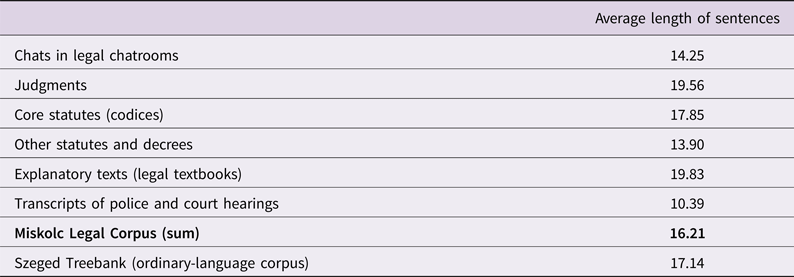
Here, I do not intend to summarise the whole research project, but simply to refer to certain results. As I mentioned earlier, one of the most important assumptions of the plain movements is that legal language differs from ordinary language. One of the most spectacular signs of this is that the average length of sentences is longer in legal than in ordinary language (see Table 1).
Average length of sentences in Miskolc Legal Corpus

The table indicates that only sentences from legal textbooks and from official explanations are longer than the average sentence produced in ‘ordinary language’. The corpus of codices contains sentences of almost exactly the same length as those in the ordinary-language corpus, while the texts of statutes contain sentences of an even shorter average length.
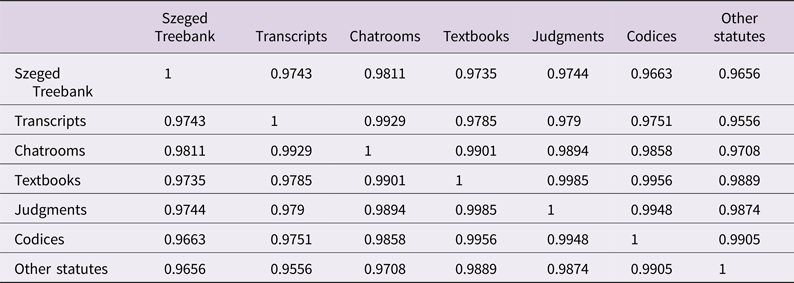
Furthermore, certain syntactic structures (namely twenty-six syntactic dependenciesFootnote 2 – Vincze, Reference Vincze, Szabó and Vinnai2018, p. 16) were measured in the different corpora and then their distance was expressed in a Kendall's tau.Footnote 3 Table 2 represents the distance between the sub-corpora, based on these syntactic structures.
Syntactic distances between different sub-corpora of Miskolc Legal Corpus, and ordinary language expressed in Kendall value
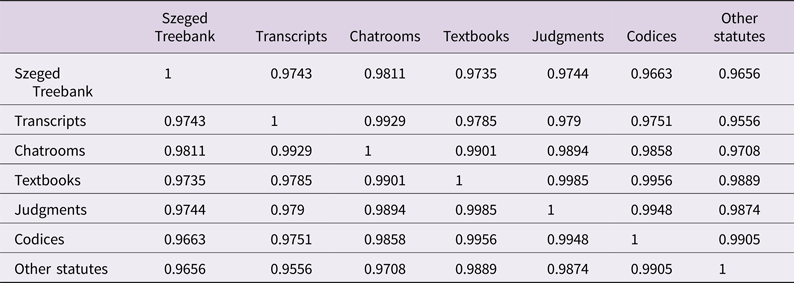
The figures show that there is no spectacular distance between different text types, at least in the Hungarian language. Especially, there is no great difference between ordinary language and legal genres in syntactic aspects where legal is said to be incomprehensible. Moreover, sometimes there is a greater difference between different legal genres than between ordinary language and legal genres (e.g. there is a 0.9811 Kendall value between legal chat-room texts and ordinary language, while there is a greater difference between, for example, statutes and transcripts (0.9556) or legal chat-room texts and statute texts (0.9708)).
3.2 Explanatory texts on the Internet
The aim of the above-mentioned research was to compare legal genres and ordinary language in general. I also carried out a limited empirical research on smaller samples, where I compared three types of texts – statutory texts, ‘official explanations’ and ‘non-official explanations’ – in nine legal fields. The idea behind this research was the following. As websites providing legal information to lay people are becoming more important nowadays and these are supposedly more comprehensible than the original statutory texts that regulate the particular field, comparing these text types (both qualitatively by reading them and quantitatively by measuring certain parameters) would help to answer the question of why some legal(ly relevant) texts are more comprehensible than others.
My starting point was my belief that the Internet gives us great possibilities for understanding. On the one hand, we have an excellent tool to better understand ‘plain style’, but also to make a clear difference between ‘plain’ language and ‘ordinary language’. In the past, the experiments conducted were mainly live ones, using paraphrase tasks (Charrow and Charrow, Reference Charrow and Charrow1979). However, these information-based websites and services present a possibility to compare text corpora. By analysing traditional elements of the sites, their vocabulary and syntax, by corpus linguistics methods,Footnote 4 as well as their non-linguistic features such as their functional design, user interfaces or customer feedback, we can acquire a deeper understanding of the problem of the (in)comprehensibility of legal language on a broader scale. Moreover, we are also able to analyse and compare different legal fields, different situations and different legal resources, and can easily conduct longitudinal analysis as well. We can analyse texts with Big Data methods, using, for example, network analysis or vector-space models (see e.g. Berry, Reference Berry2004). In short, these new possibilities open a new frontier in research into the pragmatics of law.
However, these research studies have limited ambition. For example, in psycholinguistic studies, researchers take a legal text and then test its comprehensibility by paraphrase testing.Footnote 5 Following this, they repeat the process, changing the text and running the test again, etc. I approached the comprehensibility problem from the opposite perspective. In this research, I first selected popular and therefore supposedly understandable texts Footnote 6 on the Internet for nine typical legal problems, then analysed the difference between these texts and the official ones by simple corpus linguistic means. My goal was to find out what makes these texts more comprehensible than the official ones.
I identified nine ordinary, everyday legal situations: ‘car accident’, ‘defamation’, ‘dismissal’, ‘lost documents’, ‘missing person’, ‘real-estate purchase’, ‘medical malpractice’, ‘public utility debt’ and ‘concluding an employment contract’. I ‘googled’ some core words and tried more combinations with other words offered by the autocomplete algorithm (including ‘I caused a car accident’ and ‘I suffered a car accident’, etc.). There were some differences between the different combinations of words on the results list, so I took those sites that featured among the first ten hits in all search-result lists, ignoring the paid advertisements. Then I collected three types of documents from all nine topics: the text of the relevant law(s) governing the field (law text), some popular explanations from the top of the result lists (lay explanation) and questions and answers from popular and widely used chatrooms (lay q&a). Overall, there were thirty texts (three or four texts per topic) and I selected a sub-corpus of thirty ordinary texts from the previously mentioned Szeged Treebank.
First, we analysed the lexicon of the corpus by a simple text-mining method which means, in principle, that we collected the words of the corpus and then gave greater weight to the more important words.Footnote 7 We then ‘asked’ the computer to group the texts into piles: into two (ordinary-legal), three (legal, lay and ordinary) and nine (legal domain) groups.Footnote 8 Our hypothesis was that, if there is a difference between ‘hardcore’ legal, ‘understandable’ legal and ‘ordinary’ language lexicons, it could be measured statistically.
This did not happen. The algorithm was unable to dissociate the text types on the basis of the lexicon. For example, in the case of the two-pile clustering, it put fifty-nine texts into one group and one into the other. The nine-element clustering was more successful, but the algorithm grouped the documents more or less as per topic – which means that the vocabulary of the topic (domain) is more determinative than the text features – that is, whether the text is an understandable (‘lay’) one or a complicated (‘professional’) one (Ződi, Reference Ződi, Szabó and Vinnai2018, pp. 248–249).
3.3 Conclusions from the research and qualitative remarks
After considering these studies, the question is: what is it that makes a legal text more comprehensible than another? What are the peculiarities of ‘plain legal’ or rather ‘popular legal’ style, if it is not simply a matter of rephrasing the legal jargon, shortening the sentences, changing the passive voice to active and so on? Why are the sites analysed so popular and why do Google results lists prove that they are more understandable than the official law texts? We can also formulate this question in the following way: what did these sites do to the official texts to make them understandable?
In order to solve this ‘mystery’, I systematically read the thirty websites mentioned above. In what follows, I offer some observations.Footnote 9 The first important finding was that the sites did not contain artificially simplified, ‘controlled’ plain-legal-language texts, but were rather very close to the ordinary-language ‘style’. For example, on websites explaining defamation, the defamatory sentences are written in their original form and the attached explanation also uses words and phrases that are used in everyday situations.Footnote 10
The second finding was that all of the texts are problem- (situation-) and not ‘legal resource’-oriented texts. By this, I mean that their starting point was always a real-life ‘story’. The situation they describe is never extreme, but rather a typical – though imaginary – and realistic one. A ‘typical case’ in this respect always means an ‘easy’ case – an easy example without complications. They never deal with or describe extreme or legally debated (hard) cases. The texts offer their solutions to already fixed factual situations: they not only find the relevant legal texts, but they also offer a certain factual context.
‘Problem-centredness’ also means that these sites gather the otherwise scattered legal information on the problem. This is because even the simplest legal problem is affected (i.e. regulated) by several legal texts or at least several amendments to the same text. These explanations present these scattered texts together. I will return to this point later.
Furthermore, they very often inform the reader not only about the legal, but also about other aspects of the problem. For example, a site that contained an ‘after an accident’ checklist advises readers to take photos after the accident. Or they offer (printable) step-by-step checklists in .pdf format. These lists are sometimes similar to user manuals or assembly guides for technical devices.
Although, syntactically, these texts are simple, the vocabulary they use is not very different from the lexicon of the official laws and decrees. An important difference is, however, that the legal vocabulary is always embedded into an informal linguistic environment. Sometimes they try to follow the patterns of ordinary language by using, for example, a question-and-answer structure, everyday idioms, an example or even an illustrative quote from an imaginary conversation. In other words, they package the ‘hard’ content of law into a ‘soft’ wrapping of ordinary language. These ornaments sometimes seem unnecessary but these are exactly the things that ‘back-translate’ the original real-life case from the legal jargon to ordinary language. Clearly, this register change is not limited to the law alone: the ISO/TR 20694 standardFootnote 11 declares that, in medicine, ‘there is a need to understand clearly the difference between technical communication between professionals on the one hand, and clear and simple communication for public health campaigns on the other’; this can be described as a register change.
In short, the grammatical differences between ordinary and legal language, ‘everyday texts’ and ‘legal texts’ are not so significant that they could serve as a basis for a plausible explanation for the comprehensibility problem. The answer to the vagueness of legal language lies elsewhere.
4 The limits of plain law
4.1 The importance of pragmatics
At the end of the first section, I discussed the main criticisms of the plain-legal movements. Continuing that line of thought here, I want to argue that, if we want to understand the comprehensibility problem in depth, we should take into consideration the situations – the contexts – in which the understanding and the application of the law actually takes places. In other words, we should consider pragmatics.
This is not an original idea. Authors dealing with the general question of ‘readibility’ already signalled a whole range of doubts (DuBay, Reference DuBay2004; Bruce et al., Reference Bruce, Rubin and Starr1981; Selzer, Reference Selzer1981). As I indicated in the first section, many opponents of the plain-legal movements have put forward a similar argument. Bennion's argument that law is a profession and, as such, should primarily be clear for lawyers (Bennion, Reference Bennion2007, p. 63.), Crump's argument that we should make a distinction between legal text types (Crump, Reference Crump2002, p. 717), Stark's argument against the representational theory of meaning in law (Stark, Reference Stark1994, p. 211) and the reasoning of the Court of Justice of the EU that intelligibility is not a grammatical notion but has a close connection to the ‘functioning’ of contractual amendments all point at the importance of pragmatics.
Having said that, I propose here to distinguish between three types of legal contexts where understanding means different kinds of efforts for the recipient. In these ‘legal situations’, understanding has different meanings and consequences.
A good point of departure is that there are many situations in which we do things with words (Austin, Reference Austin1975) and law is only one of these. We do not read or listen to legal texts just for fun. We do it because we have a further practical goal: we want to achieve something with the text. The understanding of the text is merely an in-between phase in the chain of actions – a tool in a process aiming towards a further goal: in general, social control. On the contrary, when we are involved in the process of understanding a novel, a poem or a news site, etc., we do not (necessarily) have this further goal. While we read novels to entertain us or news portals to be informed, apart from certain extreme situations, we must understand legal texts because we are in a situation in which law is applied.
This makes legal understanding complex. ‘(L)aw is complex, not only linguistically, [but] because it is a social discursive practice that is rooted in the deep structure of society’ (Galdia, Reference Galdia2014, p. 246). Law does not just have to be understood; it also has to have an effect. Speech acts must be successfully performed and produce the required result.
This is not a unique feature of the law alone. Other practical activities also have this feature and, similarly, in other practical situations, if texts are not understood well, the result will be defective or the goal will not be reached. We only need to consider a guide used to assemble something or a manual for a technical device or the landing checklist used by pilots as examples. In law, this practical result or goal could be to solve an everyday problem that has a legal element or to become compliant with a law by fulfilling certain obligations. We are confronted with legal texts because the law is all around us: we use it, or others use it, and this has an influence on us. When we read laws, we probably have a problem that should be solved or we must comply with the rules. We want to sell or buy a house, our flight was cancelled and we need information about the compensation available, we are in danger of dismissal at our workplace, we were involved in a car accident, someone wrote nasty things about us on Facebook, we should fill out and submit our tax declaration, or comply with environmental or safety rules. These situations could be very different, just as the legal texts that we use. One of the sources of misunderstandings and debates around the comprehensibility problem is that these different situations and text types are rarely taken into consideration. A further source of problems, connected to the first one, is that, in many cases, a legal text is only one from the toolset we use for solving problems.
For example, the problem of the clarity of statutes and legal resources in general is quite different from the comprehensibility of the legal documents of courts and officials or the comprehensibility of the whole legal process. When someone enters into a business transaction or is involved in an everyday situation that involves legal consequences, like a car accident or the purchase of real estate, normally she has to understand the law without official help. There are some situations in which parties are in an unequal position – in terms of information, legal knowledge and bargaining power. For example, when a huge bank or an insurance company and a customer enter into a transaction that is based on the general terms and conditions of the institution, this inequality might involve further difficulties. Sometimes, the ‘case’ itself is almost missing, such as when we must comply with the rules permanently. In short, ‘comprehensibility problems’ are very different, since the texts that should be understood and the pragmatics they involve are also different.
4.2 Three pragmatic settings of understanding law
The Plain English Movement's insights were valid but mainly relevant for certain – though very important – processual situations. I propose two further groups of practical situations where the comprehensibility problem seems to be quite different: besides ‘process’, I distinguish ‘problem-solving’ and ‘compliance’ situations.
‘Problem-solving’ means a situation where either something (wrong) has happened or there is a legitimate need that should be fulfilled in ‘legal ways’. Sometimes this is called simply an ‘everyday legal problem’. This is the case that is mentioned in Gadamer's famous book: ‘(t)he jurist understands the meaning of the law from the present case and for the sake of the present case’ (Gadamer, Reference Gadamer2004, p. 322). Understanding is always connected to a particular life problem that has a legal relevance. This could be an accident, the sale of a house or something similar.
From the viewpoint of understanding legal texts, these situations have three closely interconnected features. The first is that, in these situations, the use of legal texts is always reactive: it occurs after the problem or the factual situation has emerged. Second, in these situations, there is no pre-selected legal text, so the first task is to find the relevant legal texts governing the situation. Finally, in these situations, understanding means not only understanding the text, but construing, formulating and interpreting the factual situation – the problem itself – as well. One must understand the facts, and not just a text, and must do these two things in reference to each other. Therefore, the whole process will become a legal hermeneutic circle (Fikentscher, Reference Fikentscher1977, p. 198).
Problem-solving is the kind of setting that has been radically affected by the Internet (Curtotti and McCreath, Reference Curtotti and McCreath2013). ‘Law-easily’ types of brochures and ‘ask the lawyer’ sections existed before the Internet but these were peripheral phenomena in legal texts and in the law itself. Now, however, concerning the most frequent typical cases, this genre is mushrooming and it surely deserves more attention. This was the background for my research, too.
If we compare this with the understanding in first, ‘process’-type situations, we see a great difference. ‘Most of the encounters that ordinary people have with the law are language events: interactions with lawyers and with the police, whether in the street, a car, or the courtroom’ (Tiersma and Solan, Reference Tiersma, Solan, Tiersma and Solan2012, p. 5). In these cases, the layperson is in a legally regulated process and typically pre-made texts are given to her. The power and control over the situation are distributed unequally. The layperson should understand these given texts in the context of the process. This could be an oft-analysed jury instruction or any other text during a court case or a police procedure, but could also include situations of contracting with a bank or a damage-compensation process with an insurance company. Since there is an inequality in bargaining power between the big organisation and the layperson who is the subject of the procedure, understanding has a unique importance because we are not able to change the terms that have a serious impact on us. It is no surprise that the literature on this particular topic of comprehensibility deals mainly with these situations.
Finally, there is the third type of situations, which I refer to as ‘compliance’, where non-lawyers encounter legal texts. In this setting, there is no preceding problem or need, and there is also no process in which texts are provided. In these situations, understanding and following the legal rules are part of the normal course of events: we are obliged to follow law consciously. Here, the application of the law is proactive. Although, in the everyday sense, we comply with rules (including criminal laws) without any further concern, by ‘compliance situations’, I mean situations in which one should make an extra effort to retrieve and to understand legal texts in order to comply with them. A typical everyday compliance situation is when we submit a tax declaration. Here, we have no ‘problem’ in the sense that we are looking for a legal solution to a factual situation. In these cases, the governing law is quite clear – the task is to perform some additional tasks, namely reporting, documentation or aligning with formal rules. Compliance is a rather rare phenomenon for ‘ordinary citizens’ but very frequent in business, and its importance in modern legal systems is growing. Since it affects small enterprises or even individuals, the problem of comprehensibility of these norms is also growing. (For a recent example, see the GDPR – General Data Protection Regulation – of the EU (Regulation (EU) 2016/679, General Data Protection Regulation).)
4.3 The limits of understandable law
Mattila calls understandable law a Utopia (Mattila, Reference Mattila2006, p. 99). He argues, following the arguments of von Polenz (Reference Polenz1991), that there are four interrelated reasons behind this. The first is the force of tradition. Ordinary language is changing more rapidly than legal language. The second ‘lies in ensuring the authority of justice’ (Mattila, Reference Mattila2006, p. 99): legal language is the means of exercising power, deciding conflicts, forcing people to do or not to do things. Legal language is primarily a tool to really get things done. Third, legal certainty or foreseeability requires the ‘freezing’ of the meaning of words, precise definitions, etc. – something that can make understanding harder. Finally, it is the complexity of society itself – in which law is only a regulatory tool, reflecting the internal logic and lexicon of certain social subsystems – that makes legal language complex and non-comprehensible.
4.3.1 The systemic and interpretative character of law
I offer here two reasons that partly overlap with the two mentioned above, but approach the problem from a different angle: both have a close connection to the structure of modern law. The first is what we might call the systemic and interpretative character of modern law, and the second is the growing importance of technical rules.
Let us start again with the fact that (sometimes as a consequence of the efforts of ‘plain’ movements) many legal resources, text of laws and decrees, etc. are simply not complicated linguistically (syntactically or in their vocabulary), but the average citizen still has difficulties in applying it to her case: this is the hermeneutic situation I have already mentioned.
Laypersons – including, for example, the future IT managers I teach – often think that the law is a complete collection of solutions to everyday situations, like an FAQ page of a service provider's website or the troubleshooting section in a manual. The solution to a problem is ‘somewhere there’ in that huge legal corpus, in a one-problem–one-text–one-solution form, whether the corpus be a collection of judicial decisions or the text of legal codes. The task is simply to find it somehow.
Lawyers know that this is illusory. The texts of legal sources are not organised around everyday problems – they follow a different logic. If we take the structure of a Civil Code, it very often starts with general provisions, followed by separate units on the law relating to persons, to property and to contracts, etc. It is consistently organised in such a way that it begins with general provisions and moves on to specific rules (e.g. rules for a certain type of contract). The texts of legal sources are mainly organised around theoretical legal ‘fields’ and try to avoid redundancies. Therefore, even for a very simple contractual problem, the answer will lie in many places. The rules dictating who can enter into a contractual relationship are regulated in the ‘law of persons’ section where the provisions of ‘legal capacity’ are laid down. Then, the general rules for contracts are in the introductory part of the ‘law of contracts’, while the specific rules for – for example – a loan contract are in the specific part of the contract-law section and it might also happen that there are rules outside the Civil Code in a special statute on loan contracts. Finally, there could be some rules relating to consumer protection in EU norms and in domestic consumer-protection regulations. Or take another example. One is involved in a car accident: there are the rules of the traffic code, rules of the penal law (criminal code), rules of obligatory third-party insurance and rules for the whole procedure, including the usage of forms, and so on. And, even if the texts are found, circumstances are fixed and proper interpretation is in place, the question still remains: What follows from all these rules? What should I do? Where should I go? What should I write down, fill out, submit? Who should I inform, call? And so on.
The research I conducted with explanatory texts on the Internet proves this. In most of the cases, the main point of these explanations was not ‘translating’ complicated legal language into something more simple and understandable, but rather simply collecting the scattered legal provisions governing the particular (typical) problem, or giving a checklist of actions following from different legal provisions, or a list of concrete addresses and practical information that is not included in the text of the statutes, complemented by real-life examples, phrased in everyday language register. To be sure, sometimes we can find ‘translations’ too, namely ordinary-language explanations of technical legal terms such as defamation, ‘serious injury’ or ‘serious breach’ of an employment contract. These are lengthy ordinary-language descriptions of how lawyers understand the particular concept: in these explanatory texts, the ‘concentrated’ legal concept is ‘dissolved’ into ordinary language.
Even if we suppose that all of the texts are collected in these cases, or there is a legal system where some of the problems are regulated in a casuistic XII Table Law,Footnote 12 in a one-problem–one-text–one-solution form, two major problems still remain. First, a minor change in the circumstances, the facts or the interpretation of the facts can result in dramatic changes in the legal outcome. If the loan was taken out by a private person, the legal situation becomes entirely different than if it was taken out by a company or a private entrepreneur. If someone was injured in a car accident, the outcome or even the legal texts regulating the whole event will be different from a minor car crash when no one was hurt.
Second, even if the set of texts and the circumstances of the case are fixed and known, to reveal the concrete meaning of words and terms – sometimes general words or terms – in the legal environment requires a special kind of knowledge. This is not simply interpretation, but judicial interpretation: anyone who wants to define the exact rights and obligations (and therefore answer the question ‘what should I do in this situation?’) should be familiar with institutional practices or, to put it more simply, how lawyers use that particular word or concept. Even the meanings of words like ‘loan’ or ‘accident’, ‘consumer’ and ‘damage’ are special in the legal environment.
4.3.2 The growing importance of technical rules
On top of the general problem arising from the systemic and interpretational character of law, modern law regulates very heterogeneous spheres of life. If we take a look at modern legal systems, we will see that a huge part of them involves what might be called ‘technical rules’. (For readability of technical rules, see DuBay (Reference DuBay2004).) In this context, I call those rules ‘technical’, which a few decades ago were the rules of certain professions. Sometimes, these rules are also called ‘regulatory’ or ‘compliance’ rules. I mentioned above that the third type of situation where law is applied are situations of compliance. Here, a continuous alignment to the law is required. Typically, these activities are dangerous in one sense or another, and individuals and companies who are engaged in these activities must follow these technical rules, such as compulsory limits and quantities or risk management and preventive measures.
Consider rules relating to health, safety and the environment, the compliance required of financial institutions or tax rules. Here, my hypothesis is that it is simply impossible to draft clear and plain rules, because the person or company who is engaged in these activities must primarily understand the logic of that particular activity. Relations, institutions and practices are so complicated in these domains that it is very hard to draft them in ‘ordinary language’ or even in ‘plain language’.
In these spheres, rules are rarely applied by laypersons or even by lawyers. Compliance managers, accountants, health-and-safety officers and so on are bound to learn and follow these rules. However, there are some situations in which ordinary citizens are also required to do so, as in the case of tax rules or when the owner of a small enterprise must follow food-safety rules. This is also partly the case when a layperson enters into a loan contract where she has to understand interest rates and risk probabilities. That is the reason why the proliferation of technical professional rules has a growing importance in comprehensibility discourse. This is likely to become the most pressing question within a few decades.
A further difficulty is that these technical rules are a field where computers and algorithmisation play an increasingly important role. In these technical fields, rules are sometimes drafted with the precise intention that they be used and applied, at least partly, by machines. This is a relatively new development. For example, the three rates of VAT, including a 27 percent rate – the recent Hungarian main rate – could hardly be counted and declared in everyday transactions without machines. The same goes for all the rules that regulate the information that should be reported online by online cash registers.Footnote 13 These rules are simply not created in such a way that anyone besides the programmers and the machines should and could understand them. And, although we can say that these rules are not relevant to the ordinary citizen, some of them still severely influence our life.
The fact that technical rules cannot be simplified is even admitted by the promoters of plain English (Kimble, Reference Kimble1994, p. 54). The main argument, however, is that the proportion of these technical expressions in legal documents is very low, at less than 3 percent. This might be true for certain legal documents, but is certainly not true for others, such as for loan contracts or insurance policies. Another important point concerns how we measure this ratio. If we simply count the words and then count the ‘technical’ ones among them, I think we miss the point. The problem of technical rules cannot simply be reduced to the ratio of technical terms within texts. Very often, a whole sentence or a paragraph revolves around or rests on a certain technical expression, such as in the case of general terms or insurance policies. If we label all sentences that are based on a technical concept as ‘technical’, then this proportion would be likely to increase radically.
5 Conclusions
The comprehensibility of legal texts seems to be a predominantly linguistic problem, often conceptualised as a stylistic one. This is how the plain-language movements frame it, too. I have argued in this paper that comprehensibility is a more complex issue in law. Even in the case of ‘traditional’ comprehensibility situations (in the so-called processual contexts), it is clear that it is not solely complicated language that hinders understanding. And the more we widen the scope of our observations to other, less discussed pragmatic settings, such as compliance and problem-solving situations, the less determinative the narrowly defined linguistic factors, such as syntax and vocabulary, become. The plain-language movement's insights are relevant, but mainly valid for certain – though important – processual situations.
To support my argument, I referred to two empirical research studies. Both suggest that linguistically comprehensible and non-comprehensible legal texts often do not show much difference. The difference lies elsewhere: comprehensible texts are comprehensible because they show the ‘use’ of the text in a particular situation or give practical hints, checklists and advice.
Even if we solve the linguistic problems, there are two non-grammatical reasons that will always remain, both closely connected to the deep structure of modern law. The first is what we might call the systemic and interpretative character of law. On the one hand, the texts of legal sources are not organised around everyday problems – they follow a different logic, while laypersons think in a problem-oriented way. On the other hand, law manipulates the meaning of terms – one can understand the words but still not understand the ‘whole’. The second structural reason is the growing importance of technical rules. As law slowly takes the regulatory task from professional norms, it also absorbs its terminologies, with all the special meanings of the particular professional community behind them. With the growing importance of compliance rules, the emphasis of the comprehensibility problem will shift to this field.
In sum, comprehensibility is not a purely linguistic or not even a stylistic problem. Rephrasing legal texts or changing the style of laws, contracts, general terms or other legal documents may help comprehensibility, but will not solve the problem entirely. Very often, we have to change the language register too, and rephrase the explanation in ordinary language.
Acknowledgements
Many thanks to György Márk Kis for performing the empirical part of the research.