Protecting childhood and recognizing the legal status of children are advances that have acquired historical relevance throughout the twentieth century and that have substantiated a global phenomenon, especially since the approval of the International Convention on the Rights of the Child (UNCRC) in 1989. In Spain, family fostering, and specifically kinship foster care has always existed as an informal resource of family organization; it was thanks to this general impulse that this practice was finally recognized as a child protection measure.
In fact, in Spain there has been a rapid transition, developing, in only a couple of decades, from a system based on charity to become a child protection system (del Valle, Bravo, & López, 2009). One of the most significant changes in this transition affected the legal incorporation of family fostering as a protection measure in the Law 21/87, which was later expanded in the Fundamental Act 1/96 regarding the Legal Protection of Minors.
This work focuses on fostering within the extended family, that is to say, the child lives with his/her own relatives. This kind of family fostering is the most frequent type found in Spain, since it represents approximately 80% of the total number of family fostering placements (del Valle & Bravo, 2003; del Valle, López, Montserrat, & Bravo, 2008; Jiménez & Palacios, Reference Jiménez and Palacios2008). Many of these cases (almost two thirds) were already taking place when the professionals from child services became aware of their existence; in other words, the children were, in fact, in a foster home (Palacios & Jiménez, Reference Palacios and Jiménez2009).
Nevertheless, despite being one of the increasingly more visible and utilized types of fostering, there is still a great deal to learn about the internal operation of the extended foster families. The interest and concern in fostering with relatives is growing; this is reflected in the number of studies focusing on this type of foster family and in their comparison with other foster placements and/or child protection measures (Amorós & Palacios, Reference Amorós and Palacios2004; Amorós, Palacios, Fuentes, León, & Mesas, Reference Amorós, Palacios, Fuentes, León and Mesas2003; Bernedo, Fuentes, & Fernández, Reference Bernedo, Fuentes and Fernández2008; Brown, Cohon, & Wheeler, Reference Brown, Cohon and Wheeler2002; Cuddeback, Reference Cuddeback2004; del Valle, Álvarez-Baz, & Bravo, 2002; del Valle et al., 2008; Farmer & Moyers, Reference Farmer and Moyers2008; Geen & Berrick, Reference Geen and Berrick2002; Goodman & Silverstein, Reference Goodman and Silverstein2001; Hunt, Waterhouse, & Lutman, Reference Hunt, Waterhouse and Lutman2008; Jiménez & Palacios, Reference Jiménez and Palacios2008; Jiménez & Zavala, Reference Jiménez and Zavala2011; López, del Valle, Montserrat, & Bravo, Reference López, del Valle, Montserrat and Bravo2011; Minkler & Fuller‐Thomson, Reference Minkler and Fuller-Thomson1999; Molero, Moral, Albiñana, Sabater, & Sospedra, Reference Molero, Moral, Albiñana, Sabater and Sospedra2007; Montserrat, Reference Montserrat2006, Reference Montserrat2008; Muñoz, Jiménez, & León, Reference Muñoz, Jiménez and León2010; Musil, Reference Musil1998; O’Brien, Reference O’Brien, Kelly and Gilligan2000; Pinazo & Ferrero, Reference Pinazo and Ferrero2003; Sánchez, Reference Sánchez2000; Villalba, Reference Villalba2002).
Research into parental stress in kinship foster families is extremely limited and, in general, so are studies into the parental behavior of foster carers (Linares, Montalto, Rosbruch, & Li, Reference Linares, Montalto, Rosbruch and Li2006). In Spain, data from previous studies (Jiménez & Palacios, Reference Jiménez and Palacios2008) indicate that the level of parental stress in these families falls within the normal range. However, this same study also shows that kinship carers experience greater levels of stress than other types of foster families, especially when the highest part of the distribution of stress scores is found when the extended foster families tend to be over represented.
In other countries, some studies also coincide in that the foster relatives experience higher levels of parental stress than the general population (Kelley, Reference Kelley1993; Musil, Reference Musil1998). In this line, Abidin (Reference Abidin1990) found that 37% of the foster grandparents were above the 80 percent mark that establishes the limit of the scores within the clinical range on the Parental Stress Index (PSI).
In the scientific literature, sources of stress that affect foster carers have been identified. Some of these include deterioration of physical health, social isolation and financial implications (Janicki, McCallion, Grant-Griffin, & Kolomer, Reference Janicki, McCallion, Grant-Griffin and Kolomer2000). In the case of grandparents, the high levels of psychological stress are related with a worsening of their health and aging, as indicated by Burton (Reference Burton1992) and Villalba (Reference Villalba2002),. Emick and Hayslip (Reference Emick and Hayslip1999) found that grandparents showing higher levels of parental stress had lower levels of physical, social and mental health, with inverse correlations being found between stress and mental health. In another research study (Kelley, Whitley, Sipe, & Yorker, Reference Kelley, Whitley, Sipe and Yorker2000), the availability of financial resources, the health status and, to a lesser degree, social support were identified as determinants of parental stress among kinship foster carers.
But in addition to the above, the profile of adversity these children suffer prior to fostering could also have an influence on parental stress, although these authors have not found any work that relates parental stress with these prior experiences of adversity in kinship foster families. Many of these children who are fostered by their relatives experienced abuse prior to the foster placement, with a high percentage of prenatal abuse (Jiménez & Palacios, Reference Jiménez and Palacios2008; Palacios & Jiménez, Reference Palacios and Jiménez2009; Woodworth, Reference Woodworth1996). Likewise, these same children have a history of low birth weight, neonatal abstinence syndrome, chronic illnesses and/or attachment dysfunctions, learning delays and psychological problems, which appear frequently (Jiménez & Palacios, Reference Jiménez and Palacios2008). Within the scope of adoption, there are certain studies, specifically the study by Mainemer, Gilman, and Ames (Reference Mainemer, Gilman and Ames1998), which have shown that adverse experiences of the children prior to the adoption, such as difficult institutionalizations and prolonged stays in Rumanian orphanages, are closely related with a high level of stress in adoptive parents. Another example is the research by McCarty, Waterman, Burge, and Edelstein (Reference McCarty, Waterman, Burge and Edelstein1999), which showed that 13% of the sample of adoptive parents of children with prenatal exposure to substances had PSI scores in the clinically significant range.
Although there are no in-depth studies on the subject, some research relates the level of integration and the relationship established between the foster child and members of the foster family with the stress levels that the foster family may experience (Fuentes & Bernedo, Reference Fuentes and Bernedo2009; Jiménez & Palacios, Reference Jiménez and Palacios2008).
In addition, the fact that foster children and adolescents frequently have psychological and behavioral problems (Armsden, Pecora, Payne, & Szatkiewicz, Reference Armsden, Pecora, Payne and Szatkiewicz2000; Bernedo et al., Reference Bernedo, Fuentes and Fernández2008; Jiménez & Palacios, Reference Jiménez and Palacios2008; Lindsey, Reference Lindsey2001; Pinazo & Ferrero, Reference Pinazo and Ferrero2003; Vanderfaeillie, Van Holen, Trogh, & Andries, Reference Vanderfaeillie, Van Holen, Trogh and Andries2012) must be taken into consideration. Despite there being extremely limited research relating child behavioral problems and levels of stress in foster families, some recent studies—such as Jiménez and Palacios (Reference Jiménez and Palacios2008)—show that those foster carers who perceived less behavioral problems in foster children and assessed them as “with more social abilities and competences” had lower stress scores than those who were in the opposite situation. Other research conducted outside Spain, such as the work by Janicki et al. (Reference Janicki, McCallion, Grant-Griffin and Kolomer2000), Van Holen, Vanderfaeillie, and Haarsma (Reference Van Holen, Vanderfaeillie, Haarsma, Cananli, Vecchiato and Whittaker2008) and Vanderfaeillie et al. (Reference Vanderfaeillie, Van Holen, Trogh and Andries2012) points out that foster children often have behavioral or emotional problems that negatively influence the levels of stress in foster carers.
Some of these last authors (Van Holen et al., Reference Van Holen, Vanderfaeillie, Haarsma, Cananli, Vecchiato and Whittaker2008), in their Dutch sample, did not find significant differences between the problems presented by the children fostered in other families and those fostered within their own extended family, contrary to the Spanish data (Jiménez & Palacios, Reference Jiménez and Palacios2008) in which a significantly higher total score of problems was observed in children in non-relative foster care than in those fostered in their own extended family. In the regression analysis carried out in the study by Van Holen et al. (Reference Van Holen, Vanderfaeillie, Haarsma, Cananli, Vecchiato and Whittaker2008) to predict the family stress in foster carers, child behavioral problems were included in a significant way. The authors concluded that the high levels of family stress are mainly explained by a higher rate of behavioral problems in foster children. Other research into adoption and stress (Judge, Reference Judge2003; Mainemer et al., Reference Mainemer, Gilman and Ames1998; McGlone, Santos, Kazama, Fong, & Mueller, Reference McGlone, Santos, Kazama, Fong and Mueller2002; McRoy, Lynch, Chanmugam, Madden, & Ayers-López, Reference McRoy, Lynch, Chanmugam, Madden, Ayers-López, Wrobel and Neil2009) has highlighted similar aspects, with child behavioral problems being the variable that is most closely related to the levels of parental stress, in such that the parents of children with more problems show highest levels of stress. Furthermore, children’s behavioral problems have typically been included in the regression analyses to explore the stress factors in adoptive parents, being this variable the one that often offers more relevant explanations in the variance of the different regression models (Judge, Reference Judge2003; Mainemer et al., Reference Mainemer, Gilman and Ames1998; McGlone et al., Reference McGlone, Santos, Kazama, Fong and Mueller2002).
With this background, this article seeks to: a) learn about parental stress in the kinship foster sample studied; b) differentiate the various levels of stress found in foster carers; c) explore the relationship between total stress and the different levels identified in foster carers and key variables present firstly in the children (their initial adversity profile, their adaptation and development during foster care, and the current presence of behavioral and emotional problems within the context of family and school), secondly in the relationships between children and their foster families (the relationships of the foster children with the main care provider and other relatives), and finally in some important family and foster careaspects (economic needs, extent of their social support network and the state of health of the main carer); and d) to develop a predictive model of parental stress in kinship foster families.
Based on the objectives detailed above and the bibliographical review, the following hypotheses have been formulated: a) it is expected that the average stress reached by the foster families will fall within the normal range of PSI-SF; b) that these scores for stress will have the necessary variability to be able to differentiate the various stress levels in the sample studied; c) that stress in foster carers, and especially in the group of those with high stress-levels, will be significantly related with the key variables of children, family relationships and foster carers, enumerated in the objectives; d) that some of these variables studied, with particular emphasis on behavioral and emotional problems of the children, will predict parental stress in the kinship foster families studied.
Method
The data presented in this article is part of a broader study carried out in the province of Seville, Spain, in which kinship foster families were analyzed, paying particular attention to foster children and adolescents.
Participants
A total of 116 foster families and foster children took part in this study. With regard to foster families, 47.1% were the grandparents of the child, while 43.6% were aunts and uncles. The family structure consisted mainly of two carers, except for 25.9% which were single parent families. Somewhat more than half of the foster carers (55.2%) needed economic aid, despite having quite an extended informal support network (M = 11.15; SD = 5.61). The health of the main foster carers was good in 68.1% of the sample, while 31.9% suffered a variety of problems. The average number of children fostered per family was 1.4; therefore, these families fostered a total of 163 children. At the time of the study, the ages of the children ranged between 4 and 11 years (M = 8.6; SD = 2.10), with the average age being 1.7 years, when they first went into the foster home. With regard to the gender of the participating children, the distribution was balanced (48.7% girls and 51.3% boys), with only one child per family being assessed for this study. It must be highlighted that this is not part of a sample group, but rather the entire population of families and children in the province of Seville involved in this type of protective measure and this age group, at the time of the study.
Instruments
Various instruments were applied, which are briefly described below:
Interview about fostering.
An adapted version of a semi-structured interview used in previous research was applied (Jiménez & Palacios, Reference Jiménez and Palacios2008). From this interview, the socio-demographical variables explored in this work were extracted, as well as the initial adversity index components and other variables, such as: the children’s initial adaptation, child adaptation over the fostering, relationship with the main foster carer, relationship with other relatives, relationship with other children in the family, need for economic support, extent of the social support network and health of the main foster carer.
Parenting Stress Index (PSI-SF) (Abidin, Reference Abidin1990).
This was administered to those foster children up to 11 years of age. The short form of the instrument was applied, which included 36 items. It allows a total stress score to be extracted, distinguishing between those sources of stress most linked with the child’s characteristics, others most closely related to the foster carers and, lastly, those associated with the environment and stressful life events. Regarding the reliability analysis, this demonstrates a good internal consistency (α = .92).
Parental Acceptance-Rejection Questionnaire (PARQ) (Rohner, Reference Rohner2004; Rohner, Saavedra, & Granum, Reference Rohner, Saavedra and Granum1978).
This instrument, applied to the foster carers, allows for their perception of the behavior and the relationship they have with the foster child to be detected. It consists of 60 items organized into four sub-scales: warmth/affection, hostility/aggression, indifference/negligence and undifferentiated rejection. Low total scores indicate greater perceived affection and love, while high total scores indicate a greater perceived rejection. The standardized Cronbach´s alpha coefficient obtained in this questionnaire was .94.
Strengths and Difficulties Questionnaire (SDQ) (Goodman, Reference Goodman1999).
This instrument explores the psychological and behavioral adjustment of children by assessing their foster carers and teachers, thus allowing for possible behavioral and social-emotional problems in the foster children to be detected. It includes 25 items distributed into 5 scales (emotional symptoms, behavioral problems, hyperactivity, problems with friends and pro-social behavior) with 5 items for each. The Cronbach´s alpha coefficient obtained for total difficulties in this questionnaire was .72.
Procedure
Thanks to the collaboration of the Servicio de Protección de Menores [Child Protective Service] in Seville, the authors were able to contact the families and, with prior consent, visit them in their homes. During this visit, the researchers administered the various evaluation instruments (interviews and questionnaires) to the child’s foster carer. Questionnaires were also applied to teachers to obtain data about their perception of emotional and behavioral problems of the same children. The information collected during the visit was coded and introduced into a specifically created database. The statistical analyses performed consisted of descriptive statistics and frequencies, analyzes of variances, with their corresponding post-hoc analyses, bivariate and partial correlations, and multiple lineal regressions.
Results
Firstly, the total score obtained for parental stress in the foster carers included in this study was, M = 66.7 and SD = 21.6. This is within the normal range of the test, which is M = 71 and SD = 15.4 (Abidin, Reference Abidin1995).
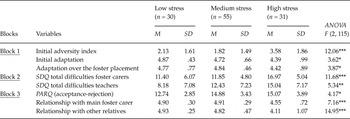
To better understand the relationship between the levels of parental stress in these foster carers and the different variables of the study, the distribution of the PSI scores were divide into three categories, depending on the level of stress presented (see Table 1). The first of the categories, “high stress,” was established by taking 75 percent as a cut-off point. Therefore, the subjects located above that threshold were experiencing high stress levels. The second category, “medium stress,” was established as being between 26 and 74 percent. Finally, the last category, “low stress,” was established using 25 percent as the cut-off point.
Scores for the three levels of parental stress in foster carers

The following step was to explore any relationships between the various differentiated stress levels in the foster carers and the other variables considered in this work. The variables to be compared were grouped, depending on their contents, into three blocks: In the first block, the relationship between the parental stress and its different levels and the profile of adversity, initial adaptation and the adaptation of the children over the placement, was analyzed. To evaluate the profile of adversity an ad hoc cumulative risk index was created, made up of 12 risk variables prior to fostering, such as the existence or not of abuse records, previous fostering placements, problems during the children’s gestation, prematurity, neonatal syndrome, viral diseases, chronic diseases, disabilities, psychological dysfunctions, delays in development, behavioral problems and learning problems. All these were coded as dichotomic variables, being scored with 0 or 1 point, depending on their absence or presence. The average reached was 2.37 (SD = 1.78). Nevertheless, despite the fact that the extreme risk score in this index could have reached 12 points, none of the subjects obtained this score; being 7 points the maximum score reached.
To measure the initial adaptation and development of the children in foster care, the answers provided by the main foster carers in the interview were used. This is based on a Likert-type scale, going from 1 (very unsatisfactory) to 5 (very satisfactory).
The second block of variables has to do with the current presence of behavioral and emotional problems in foster children, both within the family and at school. These aspects were evaluated starting with the total difficulties scores from the application of the SDQ instrument extracted from the evaluation by teachers and foster carers (see Table 2).
Differences between the parental stress levels groups in the three blocks of variables

Note:
* p < .05; ** p < .01; *** p ≤ .001
Finally, in the third block of contents, the relationship between the foster family and the foster children was explored. These contents were measured using the information provided by the foster carers when answering questions in the administered interview (evaluation of the relationship with the main foster carer and with other relatives), based on Likert-type scales from 1 (very unsatisfactory) to 5 (very satisfactory). The total score obtained in the Parental Acceptance-Rejection Questionnaire (PARQ) completed by the foster carers was also considered (see Table 2).
Regarding the first block of contents, the index of initial adversity determined that differences found were only significant for the high stress group. The post hoc analysis performed with the Tukey HDS test confirmed the supposition of the equality of variances with the Levene F. The high stress group presented the highest initial adversity average in the children with a difference of 1.45 (p < .002) in relation to those of low stress and 1.76 when compared with the medium stress group (p < .001), who’s scores were clearly lower (Table 2). In the case of the initial adaptation of the children, the post hoc analysis—this time by means of the Games-Howell test, as the homogeneity of variances were not assumed with the Levene F—showed that the differences of −.48 were statistically significant only between the low stress group and the high stress group (p < .05). Regarding development in the foster home, the Games-Howell test—given that the homogeneity of variances was not assumed—only revealed as significant the difference of averages of −.42 between the medium and high stress groups (p < .05).
With regard to the second block of contents, the post hoc analysis performed using the Tukey HDS test indicates that the children’s behavioral and emotional problems, according to their foster carers, are significantly higher in the high stress group (located in the clinical range of SDQ) with a difference of 5.57 (p < .001) when compared to the low stress group and of 5.11 when compared with those from the medium stress group (p < .001); significant differences of 6.86 are also found in relation to the evaluation carried out by the teachers, but only between the high and low stress groups (p < .005).
Lastly, in the third block of contents, the post hoc analyses again highlighted significant differences regarding the high stress group. Thus, in connection with the parental acceptance-rejection measured with the PARQ, the Tukey HDS test highlighted a single significant difference of 2.33 points between the low and high stress groups (p < .05); while, using the Games-Howell test, the relationships with the main foster carer and with other relatives were significantly less satisfactory in the high stress group, differing from those of low (−.35, p < .05 and −.83, p < .001, respectively) and medium stress (−.36, p < .05 and −.71, p < .005, respectively).
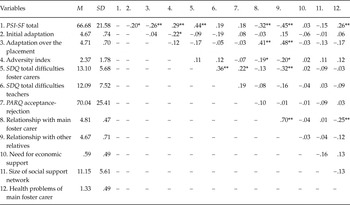
Starting from the previous analysis based on the stress levels of care providers and their relationships with the three blocks of contents studied, an analysis of correlations between the total score of parental stress in foster carers and the different variables analyzed previously was carried out (Table 3). Furthermore, the total stress score was related with other variables, quoted in the literature as associated with the parental stress, seeking to compare these results with prior research, such as that by Kelley et al. (Reference Kelley, Whitley, Sipe and Yorker2000). The three new variables, extracted from the interview with the foster carers, are: the number of people in the social support network, a quantitative variable with a range of between 4 and 17; the need for economic support and the health of the main foster carer, measured using an scale with three values (Table 3).
Means, standard deviations and bivariate and partial correlations (in the relation with parental stress) of the main variables of family functioning and adaptation and adjustment of the foster children

Note:
* p < .05; ** p < .01
With regard to parental stress, the effect of the children’s current age was controlled in the analysis of the relationships with the different variables studied, by means of partial correlations. Having discarded the possible influence of the child’s age, it was important to note the negative correlations with the child’s initial adaptation, with their adaptation over the placement and, with higher coefficients, the relationship with the main foster carer and with other relatives. Parental stress also correlated positively with the initial adversity index, the health of the main foster carer and, with the highest coefficient, the presence of behavioral and emotional problems evaluated by foster carers (see Table 3).
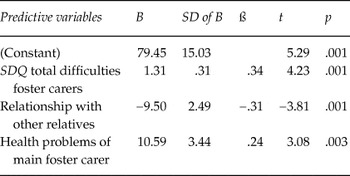
Considering the significant relationships obtained in the correlations matrix, a multiple lineal regression model was created to analyze the variables that predict parental stress in these kinship foster families, following the successive step method. (Table 4)
Regression model for the total score of parental stress in foster carers (PSI-SF), N = 112

For the regression analysis, all those showing significant relationships with parental stress were proven as possible independent variables, after controlling for the possible effect of the children’s current age. The regression equation included three steps, and in this order, the following variables: the total score for difficulties in the foster children (SDQ), the child’s relationship with other members of the family and the health of the main carer. The coefficient to determine the model (R 2 = .355) indicates that taken together, the three independent variables included in the analysis explain 35.5% of the variance for the dependent variable “parental stress.” The regression model was statistically significant, F (3, 112) = 19.979, p < .001. Looking at the data in Table 4, depending on the sign of the Beta values, the level of parental stress in foster carers rose as the behavioral and emotional problems of children increased, as the relationship between the foster children and other members of the family became more unsatisfactory and as the health of the main foster carer worsened. Therefore, it can be concluded that the analyses demonstrate that the main predictor for stress in foster carers studied is the current presence of behavioral and emotional problems in foster children, followed closely by the relationship with other members of the family. All this without forgetting the importance of the main foster carer’s health problems.
Discussion and Conclusions
Among the main contributions of this work, the analysis of the relationships and the determinants of parental stress in the kinship foster carers are two important aspects. This study not only focuses on the socio-demographic dimension, an aspect which is well studied in other research, but it also contemplates the psycho-social dimension. This study sheds light on the main variables involved in the dynamics of parental stress and on family functioning in this type of population, providing evidence of great interest for both the research and intervention fields.
In summary, and looking at the first objective proposed, it can be said that the stress scores of foster carers in the sample are within the range of normal scores (Abidin, Reference Abidin1990), and they are similar to those observed in other types of foster families (Jiménez & Palacios, Reference Jiménez and Palacios2008). Likewise, and in connection with the objective of distinguishing the various levels of stress in foster carers, the data herein shows that there is one group with a high stress level, which presents a clearly differentiated negative profile. This supports the hypothesis that foster carers who are relatives are not an homogeneous group but rather, on the contrary, they have different characteristics and they could constitute groups with different profiles and needs.
This study also shows that the highest stress levels are related to all of the variables studied in the three blocks of contents analyzed. Thus, the results indicate that parental stress is related to the profile of adversity prior to the foster placement; this data is similar to the findings of Mainemer et al. (Reference Mainemer, Gilman and Ames1998) and McCarty et al. (Reference McCarty, Waterman, Burge and Edelstein1999) with adoptive families. Our data also coincide with the result of different studies in foster care and adoption in Spain and in other countries that point out the relationship between parental stress and the child’s adaptation during fostering, as well as with the current presence of difficulties and problems in foster children, both from the perspective of the foster carers and of teachers (Janicki et al., Reference Janicki, McCallion, Grant-Griffin and Kolomer2000; Jiménez & Palacios, Reference Jiménez and Palacios2008; Judge, Reference Judge2003; Mainemer et al., Reference Mainemer, Gilman and Ames1998; McGlone et al., Reference McGlone, Santos, Kazama, Fong and Mueller2002; McRoy et al., Reference McRoy, Lynch, Chanmugam, Madden, Ayers-López, Wrobel and Neil2009; Van Holen et al., Reference Van Holen, Vanderfaeillie, Haarsma, Cananli, Vecchiato and Whittaker2008; Vanderfaeillie et al., Reference Vanderfaeillie, Van Holen, Trogh and Andries2012). Moreover, the level of stress in foster carers is also related to the relationship that these children maintain with the foster carers and with other members of the family—coinciding with previous results (Jiménez & Palacios, Reference Jiménez and Palacios2008)—and to the health of the main foster carer, data similar to the findings of other researchers (Burton, Reference Burton1992; Emick & Hayslip, Reference Emick and Hayslip1999; Janicki et al., Reference Janicki, McCallion, Grant-Griffin and Kolomer2000; Kelley et al., Reference Kelley, Whitley, Sipe and Yorker2000; Villalba, Reference Villalba2002). However, in this study and contrary to other findings (Janicki et al., Reference Janicki, McCallion, Grant-Griffin and Kolomer2000; Kelley et al., Reference Kelley, Whitley, Sipe and Yorker2000), the economic needs and the size of the social support network do not appear to be related with the stress levels of foster carers, partly due to the lack of variability in our sample in these areas. The fact that most of the families in this study are characterized by situations of social disadvantage and by being users of social aid programsmust be taken into consideration.
With regard to the results found in predicting parental stress, one of the principal conclusions is that the behavioral and social-emotional problems found in foster children is the variable that best predicts the stress of foster carers, thus coinciding with the results found in previous research, both in the area of fostering (Van Holen et al., Reference Van Holen, Vanderfaeillie, Haarsma, Cananli, Vecchiato and Whittaker2008) and adoption (Judge, Reference Judge2003; Mainemer et al., Reference Mainemer, Gilman and Ames1998; McGlone et al., Reference McGlone, Santos, Kazama, Fong and Mueller2002). In this regard, it is interesting to point out that a significant relationship with total stress scores is not found with behavioral and emotional problems, as assessed by the teachers of these children, but as assessed by the foster carers themselves (Jiménez & Palacios, Reference Jiménez and Palacios2008). In other words, perhaps it is not the children who are objectively more problematic who cause more stress, but those who are perceived as more problematic by their foster carers.
The second variable in this regression model that predicts parental stress scores is the evaluation of the relationships the foster children have with other members of the family as seen by the foster carers. The results obtained confirm that the better these relationships are, the lower the parental stress level. In many cases, relatives help the grandparents in the educational role, especially, when they are sick or have other problem (Burnette, Reference Burnette1999; Villalba, Reference Villalba2002). In fact, these foster carers report that they do have help from other relatives and friends when they are sick, need money and/or have other difficulties (Bernedo & Fuentes, Reference Bernedo and Fuentes2010). When this source of family support diminishes or is negative, it appears that conflicts and tensions leading to stress can be generated.
One aspect into fostering in connection with parental stress that research has underlined (Emick & Hayslip, Reference Emick and Hayslip1996; Kelley et al., Reference Kelley, Whitley, Sipe and Yorker2000; Sánchez, Reference Sánchez2000) and the results of which are confirmed in this research, is the presence of physical health problems in foster carers. Thus, in this research, the health of the main foster carer is another predictive variable, to a more limited extent, for the stress level. Therefore, the more health problems (serious or incapacitating) there are, the higher the levels of parental stress. In this sense, the results of this study coincide with other research into family fostering and adoption, where the health of the main care provider is related with parental stress (Abidin, Reference Abidin1990; Burton, Reference Burton1992; Kelley, Reference Kelley1993).
Thus, it can be concluded, as do other authors in the area of adoption (Palacios & Sánchez-Sandoval, Reference Palacios and Sánchez-Sandoval2006; Viana & Welsh, Reference Viana and Welsh2010), that parental stress within these kinship foster families is multi-determined by the interaction of both characteristics of the children, and of the foster carers and the relationships between the foster families and the foster children.
The present study has certain limitations. These include the geographical area of the sample being limited to the province of Seville, despite the fact that the entire population within this area has been contemplated. Secondly, most of the information extracted comes from the foster carers themselves; therefore, it reflects their perception.
Lastly, the results also have practical implications with regards to any intervention with these families and these children. It is fundamental to insist on the prevention of situations of adversity, especially those related with child abuse and to start the fostering procedure as quickly as possible, to facilitate the adaptation of the child. Obviously, the current level of economic and social support for these families must be maintained or even increased. Likewise, the data highlights the need for professional teams to assess the parental overload and stress foster carers may suffer to then elaborate specific intervention plans, designed for those families with higher stress levels, and that focus on coping with this stress and handling the children’s problems. In relation to the educational task on behalf of foster carers, one possible proposal would focus on providing training in parenting and support skills (especially of an emotional and informative nature) to help children of the high stress group who exhibit major problems and difficulties, as has been shown.