During the 1970s, several Latin American music genres occupied the European music scene, and Italy was no exception. Groups of Latin American musicians filled artistic, social, and political events, urban spaces, and the music industry with their sounds, awakening unprecedented enthusiasm as well as inevitable feelings of boredom and even of rejection.Footnote 1 This wave of interest towards the music of the subcontinent was one of the many facets of the attraction that Latin America exerted at the time on the public opinions of European countries. In the eyes of the Europeans, the region had become a social and political laboratory in full development and a growing cultural field. At this juncture, between the 1960s and 1970s, a thriving myth about Latin American, which also included the ‘discovery’ of Hispano-American literature, was formed.Footnote 2 In music, this Latin American myth had its icons in Andean music and the so-called protest song.
Within this frame, in this article I will focus on different phases of the reception of a multiple ‘Andean sound complex’Footnote 3 by a community of numerous Italian amateur groups reproducing Latin American – and especially Andean – repertoires and styles.Footnote 4 In particular, I will explore the period between 1973, when Chilean exiled musicians arrived in Italy, and 1996, when the Italian band Trencito de los Andes published Sortilège des Andes, a disc that proposed a conscious and original approach to Andean music.
‘Andean music’ is a problematic, complex, and polysemic concept, which in many cases concerns imagined representations of the Andes, rather than specific local musical and cultural realities. This imagined dimension is not only present in the European representation of Latin America, but was also promoted by the Latin Americans themselves, who have strategically adapted it to both national and transnational discourses. Throughout the second half of the last century, a network of musical representations of ‘the Andean’ was formed, where different aspects – local, regional, national, and translocal – interacted in multiple ways.Footnote 5
Specifically in the European context of the 1960s onwards, ‘Andean music’ generally means an urban and cosmopolitan product, which has a fairly indirect relationship with the traditional musical heritage of the Andes region and its aesthetics, although it often claimed to perform these traditions for international audiences. A well-known example of this was the European vogue of the ‘Indian flutes’ by several French-based bands – such as Los Incas and Los Calchakis – that flourished between the late 1950s and the 1970s.Footnote 6 Their members were Latin American (but generally not Andean) and European urban musicians, and their music was actually a fusion of folk and popular elements from different cultural backgrounds (indigenous, mestizo and criollo) adapted to the aesthetic standards (intonation, textures, and timbres) of Western popular music, as well as a presentational character in performance, in which solo roles of some native aerophones, such as the quena (notched flute) or the sicus (panpipes), were emphasized. The output was a cosmopolitan music that, although featuring a moderately exotic flavour of otherness, was far away from the aesthetics of native Andean cultures, which instead prefer a dense, high-pitched and beating sound, and non-Western tunings. Contrastingly, in Andean native contexts, the participatory function prevails, and the aerophones are generally used in single-instrumental consorts.
Moreover, rhythms, melodies, and instrumental timbres of Andean origin were some of the most recognizable stylistic features of the Nueva Canción Chilena, a musical movement born in the mid-1960s and aiming for a leftist-oriented social change. In their early stages, Chilean ensembles such as Quilapayún and Inti-Illimani were strongly influenced by the French-Andean cosmopolitan model. For those Chilean groups, however, Andean music represented only a part of a larger Latin American repertoire of social song in which Andean instruments, repertoires, and rhythms were often merged. In this context ‘the sound rapidly took on profound cultural meaning. The survival of the music of the pre-Hispanic people through the colonial era and beyond symbolised for Inti-Illimani and others the modern Latin American struggle for genuine self-determination.’Footnote 7 After the military coup in 1973 the exiled musicians of the Nueva Canción actively contributed to extend and consolidate the popularity of the Andean music in the countries where the Chilean diaspora settled. Inti-Illimani lived their fifteen years exile in Italy, where they became one of the strongest musical and political icons of the time.Footnote 8
The ‘Andean’ musical presence in Italy previous to 1973 was weak. During the 1950s, Italian-Peruvian singer Jia Thamoa performed as a local ‘double’ of Ima Sumac, and Edmundo P. Zaldivar's song ‘El Humahuaqueño’ was a hit (in Italy as in the rest of Europe). Originally conceived as an Andean-inspired carnavalito, the numerous Italian covers acquired mostly a distinctly tropical flavour, resembling mambo and baião. In the 1960s, records and live performances of French-based Andean ensembles, such as Los Incas and Los Calchakis, began to circulate timidly. However, Andean music was not yet conceived as a distinct musical genre in Italy.Footnote 9
As a consequence of the spread of the Nueva Canción in Italy after 1973, a music community of several dozen musical ensembles arose throughout the country,Footnote 10 when the enthusiasm provoked by the Chilean and Andean music drove numerous young people to form amateur groups in order to reproduce those repertoires and styles. I call this community ‘Italian Groups of Chilean/Andean Music’ (IGCAM). Despite having been quite a marginal reality in the Italian music scene of the time, without major repercussions from a commercial point of view, IGCAM groups deserve attention for several reasons. They are not only part of the Italian historical and social framework, but also a practical example of the internationalism of the 1970s, as well as of a contemporary general interest towards folk music and protest song. In addition, they could be represented as a transnational extension, or a ‘sympathetic diaspora’,Footnote 11 of the significant Latin American folk revival of the last decades of the twentieth century. As already mentioned, a considerable part of the Nueva Canción lived in European exile in a constant dialogue with its new local audiences. The IGCAM, with their performative strategies, their repertoires, and the oral memory of their members, provides us with a privileged observatory of the aesthetic and ethical-political factors that interacted when Europeans adapted the Latin American models in their own musical practices, representing a ‘mirror’ of the Nueva Canción.
The Italian Groups of Chilean/Andean Music
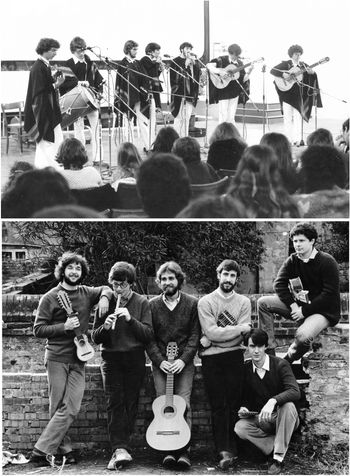
Some photos from the 1970s show young Italians with thick hair and beards, sometimes even covered with ponchos and holding Latin American folk instruments such as charango, quena, sicu, bombo, the Venezuelan cuatro, and the Colombian tiple (Figures 1 and 2).
With and without the canonical poncho: the Cantolibre ensemble from Venice, in the early 1980s. Photos from the archive of Cantolibre – Stefano Gavagnin.

From a visual point of view, they differ very little from their senior Latin American colleagues. Their names – a significant trait of perceived identity – in many cases allude to native Andean cultures, such as Aymara and Quechua words like Jacha Uru (‘the big day’), Yawar Mallku (‘condor blood’), and Runa simi (‘man's mouth’, i.e. the Quechua language). Others allude to the Chilean democratic cause, such as Grupo Allende, or to topics and iconic artists of the Nueva Canción movement: Canto Libre (‘free song’, at least three different groups had this same name, inspired by the title of an emblematic LP by Víctor Jara), Grupo Musical Violeta Parra, Charagua (a Bolivian toponym, but also the title of a well-known piece by Jara), Lonquén (a town in Chile, connected to Jara's biography), and so on. However, just as some of them never wore the poncho, there have also been Italian-named groups, such as Suono Popolare (‘Popular Sound’), whereas Cordigliera (‘cordillera’) wrote the Spanish word in the Italian form, revealing a mestizo character. Finally, there were also original inventions, such as Agricantus, a Latin neologism (combining the words cantus and agri, literally meaning ‘the song of the field’) that merged the symbolic image of a rural world with the awareness of a common linguistic and cultural Latin root, shared by the Hispanic and the Italian world.
The musicians I interviewed, both Italian and Latin American, remember in many cases that the IGCAM also established close personal relationships with numerous Chilean exiled musicians, including the already famous bands Inti-Illimani and Quilapayún, and other less illustrious but equally effective Latin American musical and cultural brokers. They all facilitated the transfer of specific performative skills in playing the popular and folk(loric) styles that the Italians were learning.
The Italian bands, whose members had often grown up in participatory contexts of prevailing leftist orientation, actively engaged in solidarity campaigns with the Latin American countries oppressed by military dictatorships. They generally played the role of cheaper and more accessible substitutes of the ‘original’ Latin American bands, helping to increase the circulation of Andean and Chilean music in Italy, especially in live performance contexts. Some of those young musicians of the 1970s and 1980s continued to perform – and in some cases to deepen – Latin American musical genres up to the present, even after the Italian audience started to lose enthusiasm. This loyalty points to the existence of an ‘elective community’, made up of cross-cultural affinity groups, whose members share strong links with some Latin American contexts. That bond was propitiated by and built through musical practice, but often also extended to other areas of each person's life: paths of work and study, family and emotional ties, and so on.
‘They fell like meteorites’
In the mid-1970s, two brothers from Rome, Felice and Raffaele Clemente, barely teenagers, founded Los Sikuris, an Andean group that years later would become the Trencito de los Andes, a quite famous band in the global field of Andean music. In a text from 1990, Felice Clemente refers to that beginning, recalling the sensation of disorientation in which they moved, as young rookies totally bewitched by the Andean sound, but lacking any compass to sail confidently across that vast and unfamiliar ‘archipelago’:
As for the vague sense of the term ‘Andean music’, they [Los Sikuris] had no more reference than the discs of the famous Inti-Illimani, who – in full correspondence with their time – arranged and distorted to their taste some traditional themes, with the intent to recreate the native folklore according to Western musical schemes and in such a way as to make the strident and mysterious sonorities of the Indians appreciable also to the ear of the layman.Footnote 12
At that stage, for the nascent ensemble of Roman teenagers, as well as for the vast majority of Italian fans of the time, ‘the only masters were Inti [-Illimani], and the protest music of the Chilean exile was included in the great family of the “Andean music”’.Footnote 13 But the horizon widened:
For those newbies, ‘Andean music’ was also the issue of groups such as Los Calchakis, Los Incas, etc … [It was i]mported from the Parisian universe, more emancipated and cosmopolitan, but also more romantic and affected. The titles spoke for themselves: ‘Misterios de los Andes’ [Mysteries of the Andes], ‘Cae la noche, sopla el viento’ [Night falls, the wind blows], and the inevitable Condor pasa even in the soup [i.e. everywhere], including the version of Simon & Garfunkel, that sounded to the ears of our heroes as the last ridiculous conquest desire of the Americans …. Briefly, the most altered and inaccurate facts fell like meteorites, disorderly.Footnote 14
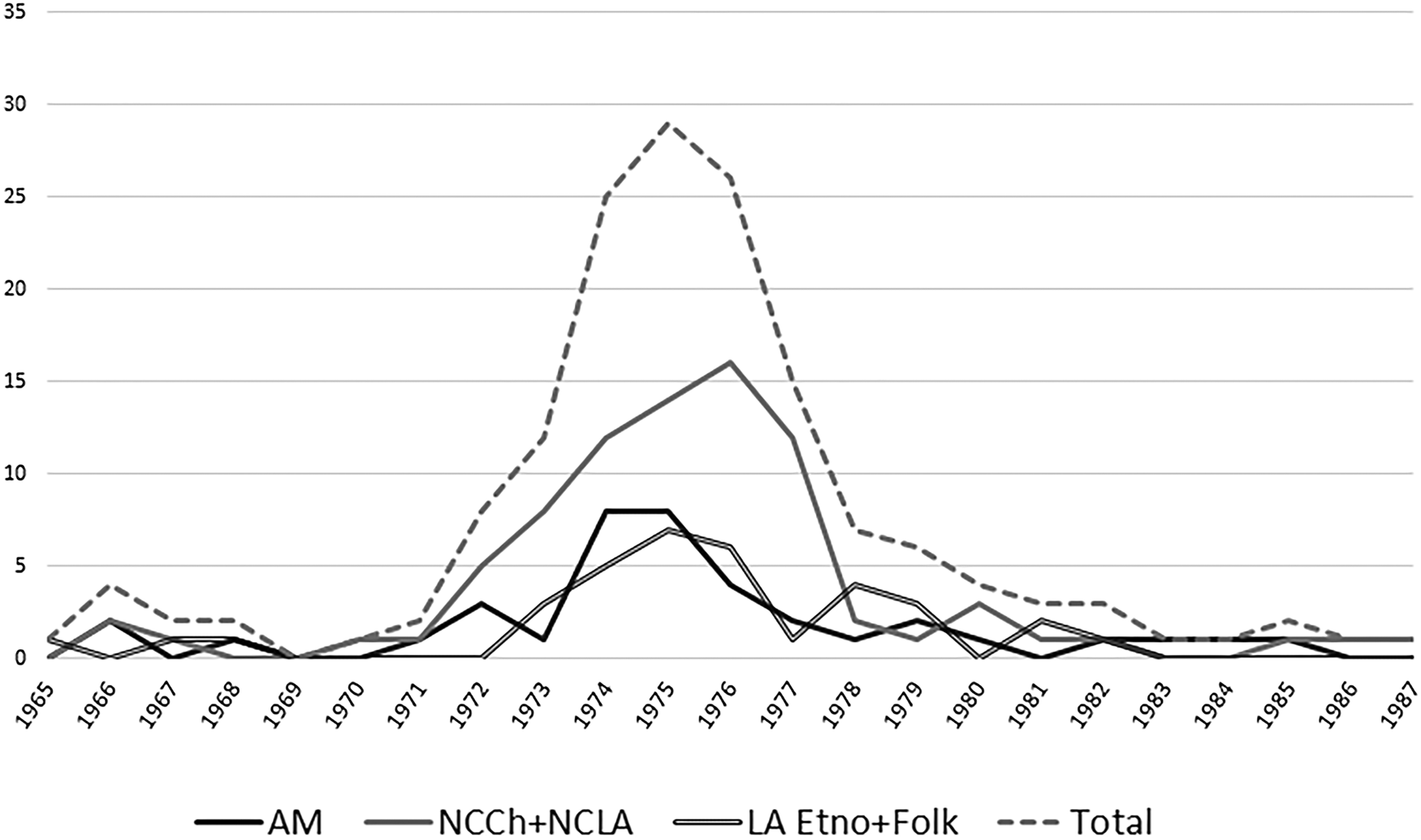
As mentioned earlier, like Felice Clemente, many other Italian listeners of the time had their earliest contact with Latin American folk precisely through Chilean exile groups; therefore the ‘Chilean’ and the ‘Andean’ blended in an overlapping reception of these musics along with their corresponding narratives. Indeed, the Chilean ensembles acted as a ‘Trojan horse’, strongly installing Andean music within Italian listening sensibilities. In fact, Inti-Illimani's albums, such as the two issues titled Canto de pueblos andinos (Song of Andean Peoples) and dedicated to the folk(loric) and popular repertoire of the highlands, occupied the top segment of the rankings in the second half of the 1970s.Footnote 15 Consequently, their massive success opened the doors to other kinds of Andean music, notably the ‘French’ one (i.e., Los Calchakis). The same dynamic is clearly reflected in the number of albums of these genres published in Italy between the 1960s and the 1980s: in Figure 3, the lines corresponding to Nueva Canción, Latin American New Song, and Andean music are almost parallel, but the Nueva Canción represents the largest share.
LP albums published in Italy between 1965 and 1987, concerning Andean music, Latin American New Song, and folk music genres. Based on a corpus of about 150 albums surveyed by the author in both physical and digital archives.

The ‘meteor shower’ that caused so much disorientation among the Italian fans was not as much about differences in musical style between the different currents as it was about the clash of their narratives. From the point of view of their relationship with Andean musical sources, both sides fall into the same aesthetic field, which Turino calls ‘cosmopolitan’ and ‘modernist’.Footnote 16 However, beyond certain differences in style, the ‘Chilean’ and ‘French-Andean’ currents diverge basically in the imagination they evoked, proposing two different representations of authenticity. In the first, Andean people are represented as part of the contemporary Latin American social complex and authenticity has a utopian social, political, and ‘ethical’ foundation. In the second, the imagination evokes the Native-Incaic ancestry, in the name of an ethnic-exotic flavoured authenticity. This difference can be perceived in all aspects of their discourse, such as the iconography and liner notes on the album covers and the press reviews.
Faced with this clash of narratives (which was somehow noticed by some critics and attentive listeners) most Italian audiences lacked adequate knowledge to develop a critical thinking.Footnote 17 Those musical artefacts were fragments that referred to an unknown reality, and were also fictional texts, not corresponding to any concrete or site-specific folklore. Only the active collaboration of the listeners could turn those fragmentary images into an organic landscape, filling gaps, resolving contradictions, and constructing a meaningful map, although often far from reality.Footnote 18 For example, many listeners believed that instruments such as the Colombian tiple, the Venezuelan cuatro, and the Andean quena and charango ‘had played together since the mists of time’,Footnote 19 just because the typical arrangements of Inti-Illimani and Quilapayún mixed instruments and sounds from different Latin American origins, in line with their pan-Latin American cultural project.
Reassembling the music maps
Some other examples of this ‘active collaboration’ of listeners emerge from the current memory of IGCAM musicians. Thus, Girolamo Garofalo, former member of Alcantara from Palermo (1975–1980) and today an ethnomusicologist and university researcher, recalls his different perception of Inti-Illimani and Los Calchakis:
[Los Calchakis] had fascinated me as ‘music archaeologists’. … It meant that they played, in my opinion, something that no longer existed. [Their performances] brought me back in time, more than geographically, that is to the Andes. … Their mystification was in having proposed something ‘stronger’, with slightly more archaic, more ethnic, more peculiar, or less ‘white’ sounds. They projected that sounds over time, in illo tempore …. This was the way I received them. And so I was fine. For me, however, the contemporaneity of the Andean music of today was ‘Sikuriada’, ‘Lamento del indio’.Footnote 20 Inti-Illimani photographed the real truth of Andean music today. So, what Inti-Illimani proposed was true enough music from the point of view of ethnicity. What Los Calchakis proposed, for me, was musical archaeology. I imagined that they had found objects in archaeological sites. I had no idea, but this was my perception.Footnote 21
The young Garofalo therefore resolved the conflict of narratives between Inti-Illimani and Calchakis by recognizing a synchronic ‘truth’ in the former and a diachronic one in the latter. By interviewing other musicians of these bands it emerges, albeit with different nuances and personal variations, that Los Calchakis were mostly perceived as ‘purely folk’ interpreters, while the Inti-Illimani were recognized as having a more articulated and complex nature, since they combined folklore with politics and with more advanced musical research.
The repertoires of the Italian groups themselves represent a mirror of these reception dynamics. On the one hand, they constitute attempts to recompose an unknown landscape through few and confusing clues coming from different sources. Each concert programme is not only a mirror of the musical knowledge of Italian fans, but also a space for a negotiation between distinctly different musical narratives. On the other hand, in these repertoires one can recognize the formation of an ‘Italian taste’ towards Andean music. A comparison between the concert schedule of eight Italian ensemblesFootnote 22 between the mid-1970s and the beginning of the 1980s shows how their main source was without a doubt the discography of the leading groups of Nueva Canción (Inti-Illimani and Quilapayún), while others Andean sources (Los Calchakis, above all) were much less present. However, within that Chilean discography, the Italian ensembles were inclined towards its folk and instrumental side – which means above all what they understood by Andean or Andean-sounding – rather than towards the songwriting tradition. Consequently, the percentage of ‘Andean music’ in the repertoires of these Italian bands was much higher than in those of Inti-Illimani and Quilapayún themselves.
In summary, the ‘specialized’ listening represented by the IGCAM was able to perceive a diversity that could concern politics, contents, cultural approach, and a certain level of aesthetic elaboration, but this was not enough to undermine the unity of the overall picture. Thanks to the complicity of the Nueva Canción's cosmopolitan pan-Latin Americanism, which flattened the Latin American musical geography, and thanks to the simultaneous and sudden arrival of Latin American records belonging to different eras, all that music was, for Italian listeners, ‘Andean’ in any case.
The ‘autochthonous’ turn
The transition between the 1970s and 1980s marked a profound change in Europe's political and social climate. In Italy, events such as the ending of the ‘Movement of 1977’ and the escalation of terrorism, which culminated with the kidnapping and assassination of statesman Aldo Moro in 1978, marked the end of the long wave of the 1968 movement and its instances of social regeneration. Both in Italy and in Europe, in this climate of ideological ebb, Chile's dictatorship was no longer a core issue and consequently the interest in Chilean musical expressions diminished too. This trend is clearly reflected in the press of the time:
In Europe, where most of the exiles have fled, moral and political tension has perhaps fallen to its lowest level. No more demonstrations of solidarity in the squares, no more strikes in ports against military ships. Even the music, the Inti Illimani, the songs of Violeta Parra, fell precipitously in the popularity ratings.Footnote 23
In the consumption of Latin American popular music, the rise of salsa represented the return of a tropical sensibility to the scene, as in the 1950s. As far as Andean music is concerned, this period is characterized by the entrance of the ensembles of the so-called autóctona (native) current, which came from Bolivia, Ecuador, and Peru. Their more ‘authentic’ approach, intended to rescue native rural expressions within the folk revival field, including the use of a wider and less standardized instrumentation, sometimes with non-Western tuning. New for Europe was use of the traditional tropas – instrumental consorts of aerophones.Footnote 24 Their music, compared to the previous cosmopolitan styles, was charged with a greater formal alterity, although it was still a remake of the indigenous rural folklore. The most prominent bands of this current in the European scene were the Bolivian Los Ruphay and Bolivia Manta, and the Ecuadorian Ñanda Mañachi.
In Italy, the autóctona wave did not have the same massive repercussion as the ‘Chilean’ one, taking up a narrower space within the thriving rise of the world music industry. Instead, in the following years, Andean music was frequently performed in Italian urban spaces as a street show, as in all Western countries and Japan. This trend was accompanied by an evident loss of prestige of Andean music, which became, in the effective metaphor of a Bolivian musician, ‘the Chinese food of ethnic music’: a tasty but cheap food of little value.Footnote 25 Ultimately, the new wave of Andean musicians – although so visible in the daily urban landscape – did not erase the Chilean and leftist stereotype forged in the 1970s, which was set aside but never completely removed.
However, for a part of the Italian fandom, the combination of the Chilean decline and the discovery of the autóctona style meant a radical change. Already between 1976 and 1977 some IGCAM musicians from Milan and Turin discovered the existence of an Andean musical ‘third way’, besides the Chilean ‘politician’ and the French ‘archaeological-commercial’ one. The Turin musician Angelo Palma, for example, attended a concert by Ruphay and for him, he says, ‘another world opened up’, understanding that Andean music is not only ‘the static nature on stage of Inti-Illimani and Quilapayún …. Those rhythms are danced, there are colored dresses, ponchos, chullos [Andean woollen caps], the way of playing is more animated, the singing is different, the quena is played in the third octave’.Footnote 26
As Felice and Raffaele Clemente report, they heard about the autóctona music between 1978 and 1979 and listened to the recordings of Ruphay and Bolivia Manta. That experience, which took place when they were only 15 and 14 years old, respectively, determined their decision to make Andean music a profession for life and is therefore the generating nucleus of all the subsequent research and compositional experience carried out by the Trencito de los Andes, later Il Laboratorio delle Uova Quadre (The Laboratory of the Square Eggs), and up to the present.Footnote 27
After those casual listenings, ‘initiatory’ and discovery journeys followed, as well as personal acquaintances with Andean musicians who were closer to indigenous cultures than the already known cosmopolitan Chileans and Argentines. Sometimes Italian musicians accompanied those Andean musicians in street music practice, and this was an important occasion for the transmission of performative skills. The landscape of Andean music came to include a wider ‘archipelago’ of artists in addition to Los Ruphay, Bolivia Manta, and Ñanda Mañachi; these new musicians included among others Wara, Khonlaya, Charijayac, Luzmila Carpio, Enrique Males, and Conjunto Indígena de Peguche. If, until that time, the new discoveries had simply contributed to expand the repertoires, from then on, they demolished the ‘ecumenical’ and cosmopolitan paradigm that had held up to that moment. For many fans, the arrival of the ‘autochthonous’ sound and its Indianist narratives – that claimed against the political and cultural subordination of indigenous peoples towards the Creole and Mestizo national elites – meant that the music of the Chilean exiles no longer represented ‘authenticity’.
The lost unity
The breakdown of the unitary paradigm that had affected the ‘Andean sound’ during the 1970s is reflected in the recordings, including both covers and original compositions, of Italian bands between the 1980s and 1990s. Those discs show the achievement of a degree of maturity and artistic creativity that exceeds the ‘cover-duplicate’ of the cosmopolitan repertoire that had prevailed up to that time.
The discovery of the ‘autochthonous’ generates a double stance inside the Italian groups. Certain musicians undertook research and apprenticeship within those styles, which they considered to be more authentic – even if more demanding than the cosmopolitan ones, because they were governed by an alien aesthetic. However, other musicians did not consider that way compatible with their own Italian-European and Western identity.
In the first recordings of the Trencito de los Andes (e.g., the double LP Yawar fiesta, in 1984, and Expreso transandino, in 1990), a documentary attempt at ethnographic revival merged into the pan-Andean gaze inherited from a Chilean and a cosmopolitan approach. Hence, the same ensemble was able to carefully perform specific local styles coming from the whole Andean transnational plateau as well as the cosmopolitan sound that was already popular in the scene. As a consequence, their Andean sound extended to instruments and orchestral structures that were unusual for cosmopolitan Andean music: the indigenous tropas of the many families of Andean aerophones (e.g., sicus, moceños, choquelas, tarkas) and conjuntos mestizos, which included harps, violins, bandurrias, guitars, different types of charangos, saxes, and clarinets.
In its following discography, the Trencito de los Andes continued to explore different local styles, both through an ‘ethnographic’ documentary re-proposal of localized musical practices and through original composition. This led the ensemble to the creation of conceptual albums such as La scoperta di Colombo (1991), Hermano residente (1992), and Zig Zag (1993). The latter, a double album entirely dedicated to a personal recreation of Ecuadorian musical styles, experienced a remarkable success in Ecuador, where some of its songs, composed by Raffaele and Felice Clemente, have become part of the local ‘folklore’.Footnote 28
However, other recordings of the 1980s show different, and in some ways even opposite, choices. On the one hand, the albums Mediterraneo (1983), by the Venetian Cantolibre, and Meteore (1986), by Cordigliera from Cremona, are witnesses to an effort to find a personal way of composition or arrangement that combines instruments and stylistic features typical of the Nueva Canción with others derived from Italian and Mediterranean folk practices, and with erudite music or progressive rock, which were part of the musical background of many young musicians, especially in the leftist political arena.Footnote 29 This trend was certainly favoured by the example of Chilean groups such as Inti-Illimani and Quilapayún, who integrated influences of European musical genres in their music composed during the exile, such as Horacio Salinas's ‘El mercado Testaccio’ and ‘Danza di Cala Luna’, in which the musical director of the Inti-Illimani pays homage to Italian folk and popular music. In the productions of Cantolibre and Cordigliera, the Andean sound survives in its Chilean version, that is, with a few instruments selected from the vast Andean organology – essentially the quena, the sicu, and the urban charango – ‘normalized’ in Western intonation and integrated into a cosmopolitan ‘orchestra’. Despite the progressive loss of their ‘native’ flavour, for the Nueva Canción musicians those few selected instruments performed the function of metonymy of Native American cultures. However, in the sound experiments of the Italian groups, the attention is focused on timbre itself, which dilutes its residual symbolic value.
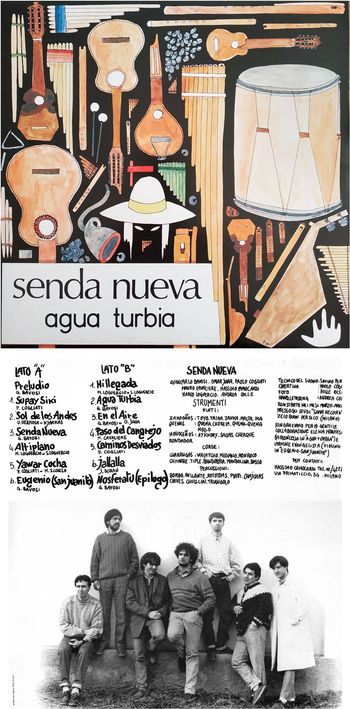
On the other hand, the only two recordings of the Milanese group Senda Nueva illustrate the group's change of orientation. In their 1987 LP Agua Turbia (Figures 4 and 5Footnote 30), mainly formed of original compositions, the band still seeks to balance the musical influences of Nueva Canción and those of the modern-indigenous Andean movements. Nevertheless, in the following cassette, Senda Nueva, produced just one year later, it is the second influence which definitely prevails. And the panorama is quite diverse; while group such as Apurímac, from Lecco, adhered to the Bolivia Manta model, other bands, Runa Simi in Florence or the Umami in Turin, looked for a balance between the two feuds. On the other hand, the Chiloe ensemble from Rome remained significantly more tied to the model of the Nueva Canción and, in part, also to that of the cosmopolitan French-Andean music.
Senda Nueva, LP Agua Turbia, 1987. Front and back cover. Cover design: Paolo Cogliati.

Finally, the search for a personal language, more connected to the Italian identity, led others to different and more radical choices. The Sicilian group Agricantus soon came to believe that performing Latin American music would shortly confine them to a fictitious and crystallized identity, condemning them to remain a ‘copy’ of someone else. Therefore, they oriented themselves towards musical expressions of Sicilian and Mediterranean folklore, creating their own musical style and soon becoming a leading group in the field of Mediterranean ethno-fusion. They kept the ethical and poetic lesson of Nueva Canción but not the rhythms or the instruments; the Andean sound, after a transitory phase of coexistence with the Mediterranean one, was eventually set aside.
Solving the jigsaw puzzle: Sortilège des Andes
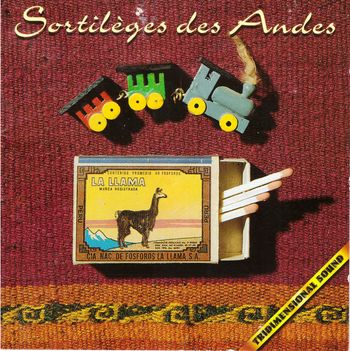
In 1996, the Clemente brothers recorded with Trencito de los Andes a concept album originally conceived as a comparison between a selection of pieces from the cosmopolitan Andean music style – among others, ‘El condor pasa’, ‘Ecos del cerro’, ‘Dos sikuris’, and ‘Fiesta de San Benito’ – and their ‘sources’, or their more ‘autochthonous’ versions, mostly extracted from a vast Andean discography but sometimes also from field recordings. The result was a kaleidoscope of different possible ‘andinities’, entitled Sortilége des Andes (Figure 6). In this compact disc, which followed nine previous Trencito's record productions dedicated to different facets of the Andean musical world, Felice and Raffaele Clemente settled their debt with the cosmopolitan style that had captivated them at first. In spite of criticism and awareness of its fictional nature, the Roman brothers seem to still have a great affection for it.
Trencito de los Andes, CD Sortilège des Andes, 1996. Front cover. Design by Felice M. Clemente.

As Clemente told me in an interview, their intention when making this CD was at first to compare the best-known songs of Andean music ‘for export’ with their ‘native’ versions to demonstrate the superiority of the latter. However, throughout the production they realized that the reality was very different:
These two faces – the ethnic and authentic one, so to speak, and the sweetened and exported one – … were not at all in competition: they were merely two aspects of the same much larger entity, which contained them both. This is the discovery that recording gave us and therefore, from that moment on, we no longer denied one Andean music in favor of another. … So ultimately Andean music is all of this. And that's okay: it's a complex entity.Footnote 31
This CD is therefore conceived as a sequence of musical ‘traps’ capable of materializing the elusive entity of the Andean music, usually hidden behind multiple masks. The comparison between them can create magical moments in which the ‘spirit of a musicality that persists and pervades all versions’Footnote 32 emerges.
Although the disc refers above all to the ‘French’ promotional context, allusions to the Italian one, dominated by the presence of Nueva Canción, could clearly not be missing. It contains the huayno ‘Papel de plata’, a very popular piece from Inti-Illimani's Canto de pueblos andinos. The Clemente brothers choose to compare that Chilean-cosmopolitan version with a theme of rural folklore that they heard on the island of Taquile, in the heart of Lake Titicaca, during a local fiesta, and then with a well-known version in Bolivia: the huayno of the popular charanguista from North Potosí, Bony Alberto Terán.
The same tune is thus proposed in three different versions (cosmopolitan, ‘autochthonous’, popular-regional) producing a refractive effect: the music is the same and it is not, but it is always an ontologically Andean artefact. The three parts seem to be inspired by a criterion of extreme fidelity to their respective sources, but the track also contains some compositional interventions by the Clemente brothers that create an almost imperceptible, but crucial bridge between the cosmopolitan and the ‘autochthonous’, blending the borders. Precisely to the most ‘indigenous’ part of the track, the version from Taquile, a text in Quechua language created by the Italian interpreters themselves can be heard. In this way, they create a game of mirrors that ends up deliberately ‘falsifying’ the exact moment of the supposed maximum native ‘authenticity’.
The liner notes in the CD booklet not only contain information on the Andean musical geography, but also interact as an extra-diegetic comment that dissolves the mimesis of the musical document, as when Felice writes about the vocal interpreter of ‘Papel de plata’: ‘He sings: Mauro Argiolas, gentlemen, not Horacio or José, but an Italian of Sardinian origin, born in 1964, irreducible lover of the Inti. He sings like they do, more than they do, indeed, like all of them put together; the fact is that since childhood he wallowed among their records.’Footnote 33 Sometimes, they introduce a storytelling in which the musicians of Trencito themselves are present as characters, with their memories and their affective world:
Here, a window opens behind us, on the left; from the window you can hear Raffaele's guitar arpeggiating: he remembers the fiesta, the island, the sicuris, the lake; all this reminds us of the guitar and the emotion, the nostalgia of the memory, is imprinted in the harmony of the arpeggio, and this happens while the party is still going on in front of us.Footnote 34
Sometimes narration and description give way to judgements. Still talking about ‘Papel de plata’, they express an affectionate point of view towards the Andean music proposed in Italy by Inti-Illimani in an era that already seemed very distant: ‘Graceful is our Italian-Andean music; mysterious, cut to size on our dreams; dated dreams, dormant, but not forgotten.’ The song is ultimately presented as a sound echo of past Italy, perceived as better, supportive, and tolerant.
Finally, the device created in Sortilège des Andes shows a range of horizons and knowledge that would be inconceivable in the ‘maps’ of the 1970s. At the same time, it reveals a ‘philological’ attitude – insofar as it is interested in reconstructing a ‘truth’ of the musical text – very different from that of most other groups, in both the Italian and the European context.
In the perspective I adopted here, the CD by the Clemente brothers is a response to the chaos, to the ‘meteor shower’ that hit them at the beginning. A response that, instead of completely rejecting the previous ‘ecumenical’ and holistic vision of the Andean musical world, tried to bring order to the confused European reception of the 1970s–1980s. In this sense, Sortilège des Andes is also a map, a reassembly of the Andean jigsaw, but much more informed, evolved, and sophisticated than the previous ones.Footnote 35
IGCAMS as a ‘third space’
The productions of the other Italian musicians linked to the Chilean/Andean models, made from the 1980s onwards, also offer personal representations of Andean musical culture, even if in less explicit and structured ways than those used by the Clemente brothers. It is a varied range of works, which should be examined to obtain a concrete panorama of the Andean and Latin American imagination of the IGCAM community – something that exceeds the limits of this article.
I think that the greatest interest in those musical productions – which have rarely exceeded the scope of self-production and self-promotion – lies in the fact that they are the exact result of the interaction between the statements produced by Latin American musicians and the different narrative identities of Italian musicians. The issue of identity is crucial for the IGCAM. For many group members, Chilean/Andean music was ‘their own’, since many young Italian musicians had their first contact with musical practice through it. Therefore, they found themselves in the oxymoronic condition of identifying with the music that had conquered them precisely because of its sonic alterity. The problem of conquering an artistic autonomy within this ambiguous identity framework had to arise soon.
The various paths mentioned previously, taken from the common source of Chilean/Andean inspiration, are therefore legible as different solutions in the quest for autonomy within a dialogue with their models. In fact, in some cases the latter are elaborated and adapted to the new context; in others, instead, they are treated as objects to investigate and learn from. Lastly, they are sometimes put aside, after drawing an ethical and poetic lesson transferable to new contexts. Despite the differences, the IGCAM still recognize the foundational value of the ‘Chilean’ imprint of the ‘Andean sound’ in their paths. This imprint is one of the main traits of these musicians’ belonging to the virtual community of the Italian-Andean ‘sympathetic diaspora’, which then appears like a ‘third space’ (according to Homi Bhabha), a border and cross-cultural space of mediation and experimentation of hybrid identities.Footnote 36
Finally, we must not forget that within this border and hybrid space, not only are the tensions of groups of different amplitude drawn, but also the personal trajectories of individuals for whom an interest in Latin America meant a deep turn in their lives. Many of them define their own personal identity mirroring themselves in a Latin American Other, both Chilean and Andean. Their musical militancy in the IGCAM has forged long-term friendships, which led them to continue playing together after four decades. In many cases this infatuation has also led them to establish deep ties with Latin America, both culturally and personally, forming families with Latin American people, or even establishing their residence in a Latin American country.
It may seem banal to say that music is a fundamental tool of people's social life. But for the musicians I have spoken about, nothing in their life has been less banal than their Latin American musical experience.