Introduction
Language undergoes several changes with aging, the main difficulties being “word finding” in spontaneous speech, remembering proper names, and the more frequent occurrence of the “tip of the tongue phenomenon,” all of which represent difficulties in recovering lexical items (Burke and Shafto, Reference Burke and Shafto2004). Patients with mild cognitive impairment (MCI) have poor performance in tasks involving lexical-semantic processing as word definition and contextualization, semantic inhibition (Bélanger and Belleville, Reference Bélanger and Belleville2009), naming, lexical decision, and semantic priming (Duong et al., Reference Duong, Whitehead, Hanratty and Chertkow2006).
Verbal fluency (VF) tasks allow the identification of lexico-semantic impairment (disorders of lexical access), deficits in semantic and working memories, as well as executive dysfunction. VF tasks are embedded in most cognitive screening instruments and neuropsychological evaluations, and a variety of categories have been employed (Roth et al., Reference Roth1986; Bayles and Tomoeda, Reference Bayles and Tomoeda1993).
The use of multiple semantic categories is said to increase the accuracy in assessing pre-clinical dementia (Nutter-Upham et al., Reference Nutter-Upham2008). It has also been suggested that the analysis of performance at specific time intervals might improve the accuracy of VF tasks, an assumption is based on the premise that the generation of items relies on an initial semi-automatic retrieval of lexical items, followed by a subsequent stage in which there is greater cognitive demand (Cunje et al., Reference Cunje, Molloy, Standish and Lewis2007, Weakley et al., Reference Weakley, Schmitter-Edgecombe and Anderson2013, López-Higes et al., Reference López-Higes, Prados, Del Rio, Galindo-Fuentes, Reinoso and Lozano-Ibáñez2014).
Recently, the National Institute on Aging and the Alzheimer Association (NIA-AA) has revised the clinical criteria regarding Alzheimer's disease (AD) diagnosis and biomarkers of the underlying amyloid and tau pathophysiological processes were incorporated (McKhann et al., Reference McKhann2011). This has promoted an effort to establish whether such biomarkers could serve as predictors of cognitive decline in populations at risk (such as MCI) (Eckerström et al., Reference Eckerström2016).
A search on PubMed and LILACS databases using the terms “VF” and “MCI” returned 127 papers, back to 2004. From these, only 19 addressed performance of MCI patients in VF tasks as the primary outcome. Seventeen studies focused on semantic categories (animal plus other category, such as fruits (n = 3), vegetables (n = 1), means of transportation (n = 1), tools (n = 1), proper names (n = 1), and supermarket items (n = 1)). Eleven studies addressed phonemic fluency combined to a semantic category, and two addressed phonemic fluency alone. The inclusion of the terms “cerebrospinal fluid” (CSF) and “biomarkers” returned two additional papers, one of these addressing an interaction between VF and CSF biomarkers level in a MCI population.
The aim of this study was to address the following questions: which VF task, among the most commonly embedded in neuropsychological batteries best discriminates MCI from cognitively healthy participants? Does the analysis of partial score (cumulative intervals of 15 sec) increase the accuracy for the differentiation of MCI and cognitively healthy participants? Is there any correlation between levels of CSF biomarkers for AD (Aβ42, P-Tau, and T-tau) and performance in VF tasks in the MCI group?
Methods
Participants
We studied 67 individuals, all Brazilian Portuguese native speakers, recruited from a cohort of older adults who are regularly followed-up at a psychogeriatric clinic of a university hospital. Participants were recruited from community sources (community centers, newspaper, and radio ads), when a study on memory and aging was advertised. The sample also included participants spontaneously seeking medical attention related to cognitive complaints, or who were referred from other hospital units for assessment of suspected cognitive decline. The study comprised 37 participants in the control group (i.e. no evidence of cognitive or functional impairment) and 30 patients in the MCI group, of both genders, aged 60 years or above, with a minimum of eight years of education. The diagnosis of MCI was based on Petersen's criteria (Petersen, Reference Petersen2011), which can be summarized as follows: (i) report of cognitive impairment by the patient usually corroborated by an informant; (ii) objective evidence of cognitive impairment for age; (ii) largely preserved functional abilities; (iv) not demented. Clinical diagnoses were established at consensus meetings, taking into account all clinical and laboratorial information gathered by a multidisciplinary team, including physicians (psychiatrists, a geriatrician, and a neurologist), neuropsychologists, physical therapists, speech therapists, occupational therapists, and gerontologists.
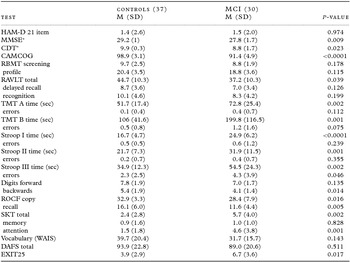
Initial assessment was performed by psychiatrists and a neurologist through a clinical interview encompassing history taking, physical examinations, and cognitive evaluation using the Cognitive Test Cambridge (CAMCOG) (Roth et al., Reference Roth1986). Neuropsychological assessments were performed by trained neuropsychologists and the full protocol is displayed in Appendix, and the cognitive status of participants was defined by their performance on this set of tests, where VF tasks are not included. All participants underwent blood tests (complete blood count, blood chemistry, thyroid function, blood–lipid profile, folic acid and vitamin B12 dosage, syphilis test), and neuroimaging (structural magnetic resonance imaging) studies, in order to exclude metabolic and vascular etiologies for MCI.
Exclusion criteria for both groups were: history or evidence of neurological and/or psychiatric conditions that might interfere with cognitive abilities (including depression); uncompensated systemic diseases; use of medications at doses that might interfere with cognitive performance, and that had been introduced or whose dose had been modified in the past two weeks; history of language deficit due to brain injury (stroke, head trauma, tumors, or other neurological diseases); history of learning disabilities (dyslexia, dysgraphia, or successive grade repetition).
A sub-sample of 23 controls and 19 MCI patients had their CSF biomarkers levels determined by participating in a study designed to determine the concentrations of biomarkers that predicted the conversion from MCI to dementia conducted by our group (Forlenza et al., Reference Forlenza2015).
All individuals participating in the study were informed about its objectives and procedures and signed a consent form. The local Ethics Committee approved the study.
Procedures
Assessment of handedness was performed using the Edinburgh test (Oldfield, Reference Oldfield1971). For the semantic VF tasks (animal, fruits, and means of transportation), individuals were asked to give all items that came to mind in the requested category in 60 sec. The scores corresponded to the total number of generated items. For the phonemic VF task, individuals were asked to say all words beginning with the letters F, A, S that came to mind, in 60 sec for each letter. The score was given by the sum of all words retrieved for the three letters, excluding neologisms, proper names, numbers, and words with suffixes. For the verb (action) fluency task, individuals were asked to give all verbs in the infinitive form they could remember in 60 sec. The score was given by the total number of verbs correctly generated, excluding any conjugated verbal form.
The main author (R.M.M.), a speech therapist that did not participate in the individuals’ primary diagnosis, applied all VF tests in a separate visit within 2–3 months from diagnostic neuropsychological evaluation. Participants were recruited for a single session to perform all VF tests, and they were not submitted to any other neuropsychological evaluation during the same day. The order of administration of tests for all participants was as follows: animal, fruits, means of transportation, FAS, and verbs. The session was recorded using the software Garage Band and the generated files were automatically saved on the computer in WAV format, and then transcribed for analysis.
CSF biomarkers analysis
CSF samples were obtained by lumbar puncture in the L3/L4 or L4/L5 intervertebral space, with a 23-gauge needle and using polypropylene tubes, in the morning period without fasting. CSF samples (12–15 mL) were centrifuged at 3,200g for 10 min at 4 °C, split into 0.5-mL aliquots in cryotubes (Sarstedt), and immediately frozen and stored at −80 °C until analysis, without being thawed and refrozen. CSF concentrations of the 42 amino acid-long Aβ1–42, Total-tau (T-tau), and 181 Thr-phospho-tau (P-tau) were determined in duplicates with the INNO-BIA AlzBio3 assay (Innogenetics, Ghent, Belgium), a multiplex microsphere-based xMAP platform that allows the simultaneous analysis of the three biomarkers. After pre-wetting the filter plate with a wash buffer, a suspension of microsphere carrying the corresponding capturing antibodies (AT120, AT270, and 4D7A3 for T-tau, P-tau, and Ab1–42, respectively) was added to the plate. A mixture of biotinylated detection monoclonal antibodies, designed to detect specifically one of the capturing antibodies (HT7 for T-tau and P-tau and 3D6 for Aβ1–42), and 75 mL of CSF or standards were added to the plate and incubated overnight in the dark. Next, the plate was washed and a detection conjugate (phycoerythrin-labeled streptavidin) was added and incubated for 1 h at room temperature. The plate was washed and after the addition of a reading solution (phosphate buffer saline) the assay was analyzed on a Luminex 100IS platform (Luminex, Austin, TX, USA). Standard curves were constructed for each biomarker using a sigmoidal curve fitting method, and the mean fluorescence values for the duplicate CSF samples were used to determine the concentration of Aβ1–42, T-tau, and P-tau.
Statistical analysis
A descriptive analysis of the variables of interest (mean, standard deviation, minimum, and maximum values) was performed. Intergroup comparison of performance on all tasks of VF was performed using the Student t-test for independent samples, considering the Gaussian distribution of data. Comparison of the distribution of frequency for categorical variables (sex and handedness) was performed using the χ 2 test. Groups were compared in terms of overall performance (raw scores on tasks of VF), and cumulative scores (distribution of responses in cumulative time intervals: 15, 30, 45, and 60 sec). The association between age, educational level, and Aβ42, P-tau, T-tau, and Aβ42/P-tau levels, and performance in VF tasks for the MCI group was tested using Pearson's correlation test.
Cut-off scores that best differentiated MCI form controls were determined by receiver operator characteristics (ROC) curve analysis, with the respective sensitivities and specificities. Areas under the ROC curve (AUC) were compared using DeLong's method, to determine which VF category was the most accurate in discriminating between groups. Logistic regression using “group” as the dependent variable, and the five fluency categories as independent variables was performed in the whole sample to test whether a combination of two or more VF categories might improve diagnostic accuracy; also, logistic regression using “group” as the dependent variable, and the five fluency categories plus Aβ42, P-tau, T-tau, and Aβ42/P-tau levels as independent variables was performed in the sub-sample of 42 participants in which CSF biomarkers were available to test if the addition of CSF biomarkers might change diagnostic accuracy.
All statistical analyses were performed using the SPSS for Windows® 20.0 and a significance level of 0.05 was adopted.
Results
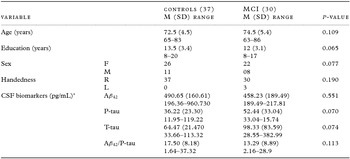
Performance of control and MCI groups on neuropsychological and functional assessment is displayed as Appendix. Table 1 displays demographic variables for both groups. There were no significant differences between controls and MCI patients regarding age, educational level, CSF biomarkers levels, sex, and handedness distribution.
Demographic and CSF data of the sample

Notes: M: mean; SD: standard-deviation; F: female; M: male; R: right; L: left; *n = 23 for controls and 19 for MCI.
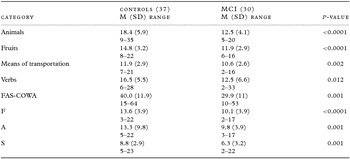
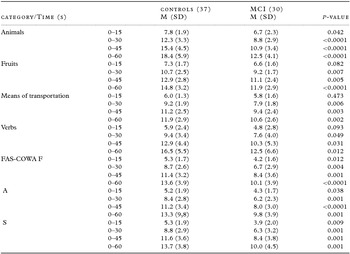
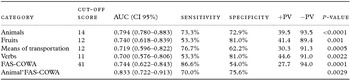
In all VF tasks the MCI group performed significantly worse than the control group. The same is true for all cumulative time intervals, except for the interval 0–15 sec for fruits, means of transportation, and verbs (Tables 2 and 3). Cut-off scores (with the respective sensitivities and specificities) that best differentiated controls from MCI patients are shown in Table 4. AUC values for all VF tasks remained between 0.7 and 0.8, with animal fluency showing the highest value (0.794). Pairwise comparison of AUCs did not show significant differences in accuracy for any VF category. Logistic regression analysis showed that animal fluency associated to FAS-COWA was the best model to discriminate controls from MCI (AUC ROC: 0.833; sensitivity: 70.0%, specificity: 75.6%, accuracy: 73.3%, p = 0.0029).
Performance of MCI and control groups on VF tasks

Notes: M: mean; SD: standard deviation; FAS-COWA-FAS controlled oral word association.
Performance of MCI and control groups on VF tasks: cumulative distribution of responses at 15s intervals

Notes: M: mean; SD: standard deviation; FAS-COWA-FAS controlled oral word association.
Cut-off scores, sensitivity, and specificity for the differentiation between controls and MCI in VF tasks

Notes: AUC: area under the curve; CI: confidence interval; PV: predictive value; FAS-COWA-FAS controlled oral word association.
Out of the 19 MCI patients who had their CSF biomarkers levels determined, 11 (57.9%) had abnormal Aβ42, 8 (42.1%) had abnormal p-tau, 9 (47.3%) had abnormal T-tau, 8 (42.1%) had abnormal Aβ42/P-tau ratios, and 13 (68.4%) had two abnormal biomarkers levels (in relation to cut-off scores that best differentiated AD from controls determined in our laboratory, as follows: Aβ42 < 416.0 pg/mL; p-Tau > 36.1 pg/mL; T-tau > 76.7 pg/mL; Aβ42/P-tau ratio < 9.53) (Forlenza et al., Reference Forlenza2015).
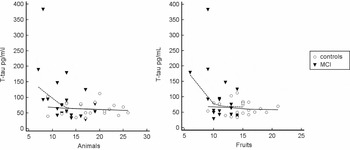
There was a moderate positive correlation between education and performance on FAS (r = 0.328, p = 0.042) and verbs (r = 0.456, p = 0.004) fluency in the control group; there was no correlation between education and performance on tasks of VF in the MCI group. Age did not correlate with performance in any of the VF categories on both groups. In the MCI group, there was a significant negative correlation between T-tau levels and animal fluency (r = −0.4,856, p = 0.035), and a trend for negative correlation between T-tau levels and fruit fluency (r = −0.4,429, p = 0.057); Aβ42, P-tau, and Aβ42/P-tau levels did not correlate with performance in VF tasks (all p values > 0.05) (Figure 1). Logistic regression analysis in the sub-sample in which CSF biomarkers were available did not include any of the CSF biomarkers in the final model.
Correlation between verbal fluency (animal and fruits) and T-tau levels for controls and MCI.

Discussion
VF tasks are widely used in cognitive screening batteries and neuropsychological evaluations, being accurate, swift and straightforward to administer, as well as adequate as follow-up measures of cognitive performance (Henry and Crawford, Reference Henry and Crawford2004). Their ability to measure lexical-semantic impairment, working memory deficits, and executive dysfunction renders these tasks very suitable as a measure of cognitive impairment of various etiologies. However, their accuracy in the detection of MCI, and whether a specific VF category is better suited for this diagnosis is still a matter of investigation.
Most studies published to date show that MCI patients present intermediate scores relative to that exhibited by age and education-matched healthy elderly and AD patients. Recent studies have tried to determine category-specific deficits in MCI subtypes as compared to normal elderly and AD. The literature reports conflicting results regarding performance of MCI patients in VF tasks according to category: either a worse performance on semantic fluency tasks or similar impairment in both semantic and phonemic fluencies (Weakley et al., Reference Weakley, Schmitter-Edgecombe and Anderson2013).
In the current study, MCI patients performed poorer than controls in all VF tasks. For animal fluency, the most frequently studied category, our results reproduce those described in several studies in different languages (Cunje et al., Reference Cunje, Molloy, Standish and Lewis2007; Clark et al., Reference Clark, Gatz, Zheng, Chen, McCleary and Mack2009; Kawano et al., Reference Kawano, Umegaki, Suzuki, Yamamoto, Mogi and Iguchi2010; Malek-Ahmadi et al., Reference Malek-Ahmadi, Small and Raj2011; Delgado-Derio et al., Reference Delgado-Derio, Guerrero Bonnet, Troncoso Ponce and Araneda Yanez2012; Eppig et al., Reference Eppig, Wambach, Nieves, Price and Lamar2012; López-Higes et al., Reference López-Higes, Prados, Del Rio, Galindo-Fuentes, Reinoso and Lozano-Ibáñez2014), including a previous study by our group (Radanovic et al., Reference Radanovic2009).
Regarding phonemic fluency, we found one study in which the three letters (F, A, S) were assessed separately in an English native speaking MCI population (Clark et al., Reference Clark2014) as we performed in our work. Interestingly, in both studies the mean total scores were very similar (29.0±11.4, and 29.9±11.0, respectively), and the same holds true for “F” scores (10.0±4.5, and 10.1±3.9, respectively) and “A” scores (8.1±3.9, and 9.8±3.9, respectively). However, our patients present lower “S” scores (11.0±4.6, and 6.3±3.2, respectively), which favors the hypothesis that “S” is not a suitable letter for Portuguese native speakers as the sound /s/ in the beginning of a word may orthographically correspond to either “S” or “C” (before “e” and “i”), and this may pose and additional burden on the task, especially for those less educated.
We found two studies addressing fruits fluency in MCI (Muangpaisan et al., Reference Muangpaisan, Intalapaporn and Assantachai2010; Radanovic et al., Reference Radanovic2009, the latter also from our group), in which the mean scores approached our results (13.1±4.1, and 12.8±3.6, respectively) In the study by Muangpaisan et al. (Reference Muangpaisan, Intalapaporn and Assantachai2010), patients had a lower level of education (mean: 6.7±3.2 years) than ours.
“Means of transportation” is a semantic category used in an instrument specifically designed to assess dementia, the Arizona Battery for Communication Disorders in Dementia (ABCD) (Bayles and Tomoeda, Reference Bayles and Tomoeda1993). The authors did not discuss the rationale behind the choice of this category in their original publication, and we can only speculate that they intended to use an alternative category that suffered less influence of variables, such as gender, occupation, etc, (animal fluency is used as a “rehearsal” task in this battery). We found only one study (Clark et al., Reference Clark2014) that presents the category “vehicles” and “boats” separately in a cohort of MCI patients, while in our study the category includes all forms of aquatic, terrestrial, and aerial means of transportation, according to the original description by Bayles and Tomoeda (Reference Bayles and Tomoeda1993).
Four studies examined verb fluency (Östberg et al., Reference Ostberg, Ferneaus, Hellstrom, Bogdanovic and Wahlund2005, Reference Ostberg, Crinelli, Danielsson, Wahlund, Bogdanovic and Fernaeus2007; Nutter-Upham et al., Reference Nutter-Upham2008; Clark et al., Reference Clark2014). The interest in this category is due to the fact that there are descriptions of this category being more sensitive to detect MCI (Östberg et al., Reference Ostberg, Ferneaus, Hellstrom, Bogdanovic and Wahlund2005). Östberg et al. (Reference Ostberg, Crinelli, Danielsson, Wahlund, Bogdanovic and Fernaeus2007) correlated hypoperfusion in temporal lobe and lower-educational levels to poorer performance in the action fluency task, whereas hypoperfusion in the temporo-occipital region and older age correlated with poorer performance on a semantic VF task.
The analysis of the performance of individuals taking into account the scores as a function of cumulative time intervals has been suggested as a means to improve sensitivities from VF tasks, and to allow a better discrimination between normal elderly and MCI patients. This assumption is based on the premise that, in word generation tasks, there is a semi-automatic process of nouns retrieval in the initial stage, followed by a terminal stage in which the cognitive demand is higher (Cunje et al., Reference Cunje, Molloy, Standish and Lewis2007). We observed that in the animal and phonemic fluencies there was a consistent pattern in which the MCI group performed poorer throughout the task. Regarding fruits and means of transportation fluencies, there was no difference between controls and MCI in the first 15 sec, but the differences were significant throughout the remaining time. In verb fluency, such differences appear only in the second-half of the task. Nevertheless, the MCI group performed poorer than controls, and the number of words generated decreased progressively across time in all categories in both groups (raw data not shown). These results are in agreement with those reported by Cunje et al. (Reference Cunje, Molloy, Standish and Lewis2007), López-Higes et al. (Reference López-Higes, Prados, Del Rio, Galindo-Fuentes, Reinoso and Lozano-Ibáñez2014), Östberg et al. (Reference Ostberg, Ferneaus, Hellstrom, Bogdanovic and Wahlund2005), and Weakley et al. (Reference Weakley, Schmitter-Edgecombe and Anderson2013).
Muangpaisan et al. (Reference Muangpaisan, Intalapaporn and Assantachai2010) reported a cut-off score of 14 for animal and 15 for fruits fluency, with accuracies of 0.62 (sensitivity: 83%; specificity: 42%) and 0.69 (sensitivity: 67%; specificity: 62%), respectively, in a less educated population (mean level of education around 6.5 years). In our sample, accuracy was slightly better for animal fluency with the same cut-off score (0.79) with lower sensitivity (73.3%), and higher specificity (72.9%); fruits fluency also provided a better accuracy (0.74), but we observed lower sensitivity (53.3%) and higher specificity (81%), with a cut-off score of 12. In the same study, the authors assessed phonemic fluency as well, but the use of Thai letters (Koh and Soh) prevented us from making further comparisons with our results. Radanovic et al. (Reference Radanovic2009), found cut-off scores of 18 and 13 for animal and fruits fluency, respectively, in a sample of patients with similar levels of education; the accuracy in differentiating controls from MCI was 0.66 (sensitivity: 60%; specificity: 60%) for animal fluency, and 0.71 (sensitivity: 62%; specificity: 78%) for fruits fluency. In the current study, we obtained better accuracy for animal fluency, and similar accuracy for fruits fluency. Teng et al. (Reference Teng2013) described accuracies for animal and FAS fluencies that are very similar to those found in our study (0.79 and 0.72, respectively, with no reference as to sensitivities and specificities). In our sample, animal fluency was slightly superior to the other categories in the discrimination of the two groups, although the difference did not reach statistical significance.
In our sample, age did not influence the performance of individuals. We did not find any studies comparing MCI patients’ performance across age groups in VF tasks. Education had influence on the performance of healthy individuals in phonemic and verbs fluency. This influence was not found for the MCI group. Two studies report higher educational level as favoring better scores on semantic and phonemic VF tasks in controls and MCI patients (Radanovic et al., Reference Radanovic2009; Kawano et al., Reference Kawano, Umegaki, Suzuki, Yamamoto, Mogi and Iguchi2010). Our group had a minimal educational level of eight years, thus rendering the effects of formal education on language tasks less prominent.
We found a significant negative correlation between T-tau levels and performance in animal fluency plus a trend for a negative correlation for fruit fluency in the MCI group. Rolstad et al. (Reference Rolstad, Berg, Bjerke, Johansson, Zetterberg and Wallin2013) reported a significant impact of T-tau abnormalities in VF tasks in MCI (6%, r = −0.20), although the impact of Aβ42 changes was stronger (13%, r = 0.34). In our sample, almost 50% of MCI patients had at least one abnormal CSF biomarker (either reduced levels of Aβ42 or Aβ42/p-tau ratios, or elevated levels of p-tau and T-tau); 68.4% MCI patients had at least two of the mentioned abnormalities combined. The remaining patients presented biomarkers concentrations within the normal range. Such findings probably reflect the heterogeneity of populations diagnosed as MCI, which comprise “converters” and “non-converters.” Moreover, although evidence in the literature points to the usefulness of CSF biomarkers in predicting conversion from MCI to dementia, it has been suggested that the correlation between CSF biomarkers level and cognitive performance may be non-linear (Williams et al., Reference Williams2011).
In conclusion, our goal was to perform a clinical-focused study that could contribute to a better understanding of the pattern of performance of MCI patients in VF tasks. We found that animal fluency alone followed by the combination of animal fluency and FAS-COWA was slightly superior in discriminating controls from MCI patients. We could also observe a time-dependent declining pattern in the generation of items, which probably reflects the greater cognitive demand (especially attentional and executive) needed for the process of lexical retrieval in the final stages of the task (Weakley et al., Reference Weakley, Schmitter-Edgecombe and Anderson2013). Analysis of cumulative scores may be helpful only for fruits, means of transportation, and verbs fluency; in animal fluency and FAS, differences are already evident after the first 15 sec of testing. A concern that is always present in longitudinal assessments is the possibility that patients may develop a “learning effect” on tasks, which would lead to underestimation of cognitive decline over time (Cooper et al., Reference Cooper, Lacritz, Weiner, Rosenberg and Cullum2004). Our work suggests that, to a certain extent, a patient may be subjected to different cognitive batteries using different VF categories, without necessarily precluding the assumption of cognitive stability or decline in a clinical context.
In our sample, T-tau levels were correlated to animal fluency, and presented a trend for correlation with fruits fluency. CSF biomarkers levels did not contribute to improve diagnostic accuracy in the sub-sample of participants in which they were available. The small number of CSF samples precluded further statistical analyses, and we deem this study of CSF-clinical correlations as exploratory.
A limitation of our study is the small number of participants in the MCI group that not allow the sub-division of patients according to MCI subtypes (amnestic, non-amnestic, and multiple domains). Another limitation is that we did not include the “supermarket items” category of VF, which is also frequently used in clinical practice. Finally, as regarding correlation between CSF biomarkers and performance in VF tasks longitudinal studies are by far best suited to determine the predictive values of biomarkers for cognitive decline.
Conflict of interest
None.
Description of authors’ roles
Roberta M. Mirandez was responsible for acquisition and interpretation of data. Ivan Aprahamian was responsible for acquisition of data. Leda L. Talib was responsible for CSF analysis. Orestes V. Forlenza was responsible for intellectual contributions to the study, supervision of data collection, and final manuscript revision. Marcia Radanovic was responsible for study design, acquisition and interpretation of data, statistical analysis, and manuscript preparation.
Acknowledgments
This study received funding from Coordenação de Aperfeiçoamento de Pessoal de Nível Superior (CAPES), Fundação de Amparo à Pesquisa do Estado de São Paulo (FAPESP) (grant 09/52825-8), Conselho Nacional de Pesquisa e Desenvolvimento Científico (CNPq, grant 466625/2014-6), and Associação Beneficente Alzira Denise Hertzog da Silva. We would like to thank the team members of the LIM-27, the post graduate program in Psychiatry, the School of Medicine, University of Sao Paulo, and the elderly who voluntarily participated in this study.
Performance of MCI and control groups on neuropsychological and functional tests