

For then will I turn to the people a pure language, that they may all call upon the name of the lord, to serve him with one consent.
——Zeph. 3:9 (KJV)The “olive and mango” problem, as one Philippine Bible translator put it to me, is the old but enduring problematic of language equivalency within Bible translation. How does one translate olive, mentioned throughout the Bible, in cultural settings in which there are no olives? Does one leave the term untranslated and maintain fidelity to the original biblical texts, or does one find a similar object concept and indexical modality in the target language but one that is unmentioned in the source texts? For the indigenous Mangyan groups on the island of Mindoro in the Philippines, unsurprisingly the lexical item “olive” and the tree itself have little in the way of denotational or connotational value, unlike its material and symbolic role in biblical societies.Footnote 1 Should one then view the Bible not as a text bound by the specificities of its language but rather as a repository of sacred meaning that reaches beyond language?
This dilemma in perpetuum for translators has long assumed an oppositional nature and has been variously designated as the difference between literalism and context, formal and meaning, faithful and interpretive, and for Philippine SIL International translators, formal and dynamic equivalence (Nida Reference Nida1964; Carson Reference Carson, Scorgie, Strauss and Voth Zondervan2009).Footnote 2 While a number of translation theories have sought to undo such an oppositional framing (such as Skopos theory and relevance theory), the dilemma nevertheless stubbornly remains. Whether one’s fidelity should be to the most literal rendering of the source text into the target language, or whether one should try to capture a more contextualized linguistic form and “meaning,” is an ever-present tension in translation. Of course, an attempt at a denotational correspondence comes with the underlying expectation of a certain symmetry between the source and target languages and stands in contrast to translation projects that attend to the complex and multiple indexical modalities that form a broader semiotic rendering of the text. In Bible translation, as I argue in this article, the matter of maintaining fidelity to the source text—the Bible—while at the same time producing a translation that meaningfully resonates with the reader assumes a rendering of much larger import than in usual text translations. Because of the sacredness accorded to the Bible, its meaningfulness is not always judged to exist solely in the intelligibility of the text itself; thus the semiotic relationship between author, text, and meaning are duly complicated. Which approach to translation should be privileged depends therefore on nothing less than the role one assigns to the underlying relationship between language and God. For Christian translators the question becomes, Does God have a language, or is he forever mediated by it?Footnote 3
In this article I discuss the practices of SIL International Bible translation on the island of Mindoro in the Philippines.Footnote 4 Twice a year, approximately ten Christian members of three ethnolinguistically distinct Mangyan groups travel from the mountains to the lowlands of Mindoro where for a month they work with an equal number of Christian linguists, translators, and missionaries to translate the Bible into the Hanunoo, Western Tawbuid, and Eastern Tawbuid languages.Footnote 5 In the first part of the article I examine the struggles Christian translators face in their work and discuss how the practice of translation reveals underlying sets of Christian ideologies regarding the commensurability of linguistic forms that move far beyond claims of vernacular and grammatical correctness. I argue that the source-to-target directionality in Bible translation is complicated both by the day-to-day practices of translation and the underlying questions concerning the authorship of the Bible itself. The theopneustic aspect of the Bible as source-text and the determinations of the degree to which the actual linguistic forms in the scriptures are divinely inspired often play out as an irresolvable problem for translators.Footnote 6 To this end, I discuss the means through which the Holy Spirit is taken as an essential mediator between the fallible work of Christian translators and the Bible as a language-instantiated form of God’s presence. It is this role that the Holy Spirit occupies as language mediator that reconstitutes how language is seen to communicate the universality of the Holy Word.
In the second part of the article, I take up these engagements with the universality of divine meaning and the discrete nature of language difference through a discussion of “generic” language. In particular, I focus on the use of denotationally generic terms as a translative and ideological tool. I propose that rather than viewing claims of generic language as presupposing that there exists language merely stripped of specificity, the generic can instead be seen as a site in which multiple and often conflicting claims of universality and purity are at play. Moreover, the concept of generic language may be seen as implicated in ideas of text circulation and conversion. I look at how for Christians the unique form of divine (co)authorship of the Bible leads to an intertextual and semiotic break between the translative process as evidenced by the workshop and how that text is subsequently taken up by the intended readers, in this case by Mangyan Christians. Although translators often express their goal as one of recension and of rendering a text that is linguistically and socially embedded within the “target” (or receptor) culture, their translation work is also an attempt to purify and dislocate the biblical text from any and all cultural specificity, thus enabling it to exist and circulate as a universal text. Ultimately, I argue that the use of generic language by translators is an earthly attempt to mirror, and indeed enable, the universality and circulation of the Holy Spirit’s inspiration in language. In this manner, I suggest more broadly that the concept of generic language has been neglected by language analysts as an ideological site of interest and its role in how people conceptualize the scaling of specificity in meaning.
Translating Christianity
Anthropologists have long sought to locate projects of translation in a wider set of social and intertextual practices, with the work of Benjamin (Reference Benjamin1968) and Bakhtin (Reference Bakhtin and Holquist1981, Reference Bakhtin and McGee1986) serving as important cornerstones of the literature. Additionally, there have been moves both toward and away from viewing social forms and practices of sociality in terms of translation itself (Clifford Reference Clifford1982; Asad Reference Asad, Clifford and Marcus1986; Callon Reference Callon and Law1986; Latour Reference Latour1993, Reference Latour1997). Because the work of Bible translation has so often occurred within settings of Christian missionization and colonialism, it has been to those settings that scholars have looked in order to elucidate the broader complexities of translation practices (e.g., Jolly Reference Jolly and van der Veer1996; Keane Reference Keane2007; Hanks Reference Hanks2010). While we may view these translation practices intrinsic to Christian missionary work as embedded in large-scale projects of social and religious change, perhaps the most fruitful aspect of this literature has been a focus on how translation practices themselves have effected change in the target languages and cultures (Rafael Reference Rafael1988; Brodwin Reference Brodwin2003; Schieffelin Reference Schieffelin, Makihara and Schieffelin2007). For example, Tomlinson has shown how Methodist translators were responsible for shifts in the meaning of mana. As he notes, “Besides nominalizing ‘mana’ in the Bible, Methodist missionaries reconfigured people’s imaginations about the invisible world, placing Jehovah atop the pantheon of gods and displacing ancestral spirits into the realm of ‘devils’ and ‘demons.’ In doing so, they rendered the invisible sources of earthly power both more remote and potentially more dangerous. Missionaries, in short, reshaped ideas about the potential for effective human action” (Tomlinson Reference Tomlinson2006, 179). Likewise, Schieffelin has argued that, unlike the structured and fixed nature of certain missionary-dictated Christian practices in Bosavi, the practices of Bible translation were instead “unstable [and] heteroglossic” and resulted in “hybridized, translocated, and dislocated language forms and practices” that substantially transformed local vernaculars (Reference Schieffelin, Makihara and Schieffelin2007, 140, 145). As this literature shows, whatever the specific theories of translation at play, Christian translation practices engage ideologies of language as both prescription and proscription (Rafael Reference Rafael1988; Keane Reference Keane1997). Additionally, there is the important though understudied facet of how the practice, or indeed event, of Bible translation itself is taken up in the receptor cultures (Rutherford Reference Rutherford and Cannell2006; Handman Reference Handman2010). Throughout this literature we find the irresolution between ideas of universality intrinsic to Christian doctrine coupled with the missionary need to work through vernaculars foregrounded in the work of Bible translation. And it is in this tension between the vernacular and the universals of Christianity that we see a distinct discourse related to the purity of language emerge.
The Workshop
The Bible translation workshop in Calapan, Oriental Mindoro, was funded primarily by SIL International and Wycliffe Translations and took place in this town because the Overseas Missionary Fellowship (OMF), a nondenominational Protestant missionary organization, is located there. The headquarters of the Philippine (and Southeast Asian) OMF was established in Calapan in the 1950s, in a large American-style house built on a hill overlooking the ocean. While the OMF is now considerably smaller than in its heyday in the late 1960s, the house in Calapan remains the primary center of the OMF’s work in Mindoro. Moreover, the earlier success of the OMF is evident, as a large number of Mangyan people living in the mountains on the north side of the island (where Calapan is located) have been Christianized along Baptist and evangelical lines. The OMF missionaries were some of the first to begin translations of a Christian literature into Mangyan languages (Davis Reference Davis1998), and by the 1970s New Testament translations had begun.
With Western-style gardens, a fully staffed kitchen serving Euro-American food (freshly baked whole wheat bread, milk, butter, honey, and black tea—items difficult to find in most parts of the Philippines), and a library whose books range from Christian literature and linguistic work on Filipino languages to John Grisham novels, there is a colonial, missionary feel to the OMF grounds. Aside from being the OMF headquarters, the house is something of a bed and breakfast for Christian pastors and missionaries traveling across the island. The OMF provided housing for translators in the main house and a smaller house on the grounds; the workshop itself was held in a nearby Mangyan school (whose dormitory housed the Mangyan translators) built by the OMF in the 1970s and 1980s.Footnote 7
The Bible workshop was headed by a Wycliffe translator named Samuel. From Minnesota and in his sixties, Samuel was remarkably energetic in every activity he engaged in and over the course of a day would spend time sitting with each translation group. Having lived in the Philippines over thirty years, he had worked as a Bible translator his entire adult life with SIL and Wycliffe. Married to a Filipina, Marianne (also a translator), Samuel spoke over six Philippine languages and was the only translator at the workshop who had near fluent Hebrew and Greek. In this regard, he directed all three translations, both ideologically and practically (he often cast the final decision on word choice, for instance). An American couple in their fifties, Louis and Annie (both PhDs in linguistics and professional Bible translators, although not officially affiliated with SIL or Wycliffe), worked on the Eastern Tawbuid and Hanunoo translations. Arthur, an English missionary (formerly with the OMF) who with had lived over a decade among the Taubuid groups in Occidental Mindoro, also joined the workshop. Though no longer a missionary, Arthur was the only English speaker fluent in Western Tawbuid.
A typical day began with a group breakfast in the OMF house, after which everyone proceeded to the workshop at the Mangyan school, some walking, some cycling, and some riding in tricycles. Those in tricycles would carry the eight large SIL laptops. The laptops were laid out along the three long tables and benches that each group huddled about, shaded by a concrete awning. Before any translation would begin, the group would say some prayers and sing some Christian songs. Prayers and songs would switch between Tagalog and Mangyan. During these prayers, the Holy Spirit would be called upon for guidance in the day’s work, to lead them in translating best the word of God.Footnote 8 Translation would begin at 8:00 a.m. sharp, with a break for lunch, finishing at 5:00 p.m. This was the routine six days a week; on Saturdays, translation finished at 1:00 p.m.
Mediating Fidelity
I focus on some typical aspects of the translation practices that took place while working on the Hanunoo texts to show how the problem of fidelity was ever-present. While SIL translators in general aim for dynamic or functional rather than literal or formal translations, nevertheless matters of fidelity consistently arise. During the workshop, Annie, one of the American translators, worked with Cora, a young Hanunoo woman in her early twenties. While Cora grew up in a Hanunoo village, she received her schooling in the lowlands of Oriental Mindoro, was fluent in Tagalog and Hanunoo, and had a reasonable grasp of English. As with the other languages, the New Testament in Hanunoo had been completed, and the translators were working on the Old Testament. Over the course of four years, five people had drafted twenty-eight of the Old Testament books. Ten books had been drafted in the late 1980s, but it was agreed by all that these were so badly done that they needed to be redrafted entirely. Annie herself was competent in Tagalog, but had little if any Hanunoo.
Annie and Cora sat together at one of the long tables, each using a laptop running the SIL Paratext software. This software enables one to simultaneously view a verse in numerous Bible editions, as well as displaying the original Hebrew and Greek together with a gloss in English.Footnote 9, Footnote 10, Footnote 11 The actual Hanunoo draft contained notes and suggested revisions by different translators who had previously worked on the text. Each translator had their own favorite translation to which they often referred. Annie favored the New Living Translation (NLT), although she noted that it is far from a literal translation, and its use for her was limited to broadly informing her translation work rather than providing any semantic specificities.
Annie had the Hanunoo verses organized vertically on the screen, along with two Tagalog translations, the Ilonggo, three literal English translations (formal equivalence) and three meaning-based (dynamic or functional equivalence) translations, and some explanatory notes, but no Hebrew or Greek. Cora’s screen had a similar screen setup, although the Tagalog translations were understandably more prominent than the English. Everyone at the workshop agreed that the Hanunoo was by far the easiest to translate (after the Tagalog). The draft was good, the Hanunoo translators were more practiced, and as a result they often sped through a book of the Bible in perhaps one or two days. The Eastern Tawbuid men working as translators were not nearly as proficient with English or Tagalog as their Hanunoo counterparts, nor were they comfortable with the process of translation overall. As a result, the Eastern Tawbuid translation process was much slower: even with five people working together, it could take up to an entire month to complete some basic edits to a book, sometimes with as few as six or seven verses taking up an entire day.
On this day, Annie and Cora began with Proverbs 21 and looked at the Hanunoo draft already entered into Paratext software:
The king’s heart is in the hand of the Lord like channels of water; he turns it wherever he wants.
(Prov. 21:1, NET)Hanunoo draft:

Annie looked to Cora, who read it silently and then read the English and Tagalog versions (AMB and ASND). Cora looked back to the Hanunoo and nodded that it was good and that there was no need for any changes. Prov. 21:1 was easy, with Cora making no suggestions to alter the draft. If Annie was unsure, she would usually ask Cora to translate the verse into Tagalog, and if Annie agreed that the Tagalog aligned with her view of the verse, they would move on to the next. Neither Annie nor Cora was a native Tagalog speaker. However, if Annie saw that Cora was entirely certain of the Hanunoo, she would often move on to the next verse without asking for a rendering in Tagalog. It is important to note here is that while Cora had good conversational English, she herself tended to look to the Tagalog translations on the screen without paying too much attention to the English versions, unlike Annie, who would do the opposite:
All of a person’s ways seem right in his own opinion, but the Lord evaluates the motives.
(Prov. 21.2, NET)Hanunoo draft:Footnote 12

When Cora translated this into Tagalog for Annie, Annie was unhappy with pag-isipun. Annie would have easily recognized the root isip from Tagalog, and she would have understood it as being close to pagisipan (contemplation) and pag-iisip (the mind). She stopped Cora and they began looking to the English, Hilagaynon (Ilonggo), and Tagalog translations. Cora recalled that the verse was very similar to Prov. 16:2, and they looked back to that also: “Mahimu mag-isip kita hustu yi gid ti tanan nita pagbuwatun, dapat ti panginuun lang ti makahatul nu unu gid kanta pagkaibgan.” Here pag-isipun was not used for what was the same Hebrew term, but instead pagkaibgan, again very similar to the Tagalog word for “friendship,” pagkakaibigan (however in older Tagalog, the root kaibigan was also connected to meanings associated with “inclination”). The Hiligaynon (Ilonggo) translation previously completed by Samuel and his team used motibo, which could be more easily glossed as motivation. As one can see from the English and Tagalog translations (see n. 10), heart and the Tagalog equivalent puso are commonly used. But as the Hanunoo see no metaphorical connection between heart and moral integrity, they chose to take a more “literal” stance in this case. But Annie did not view this simply in matters literal and figurative. She also viewed the stripping away of the heart trope as moving toward a position of the generic. That is, the trope in this context was understood as added specificity. I will return to this later, but one can see even here how the concept of generic is not only at play, but for purposes other than ones of (non)specificity. In this instance the generic became synonymous with “literal.” In the end Cora and Annie decided on pagkaibgan (friendship).
Some thirty minutes later, Annie found herself frustrated with a passage and had difficulty explaining to Cora her issue with the subject/object perspective.
The appetite of the wicked desires evil; his neighbor is shown no favor in his eyes. (Prov. 21:10, NET)
Hanunoo draft:

The problem here for Annie was the difference in perspective between different translations. This was important to her. For her, there was an essential difference between, for example, the CEV (“Evil people want to do wrong, even to their friends”) and the KJV (“The soul of the wicked desireth evil: his neighbour findeth no favour in his eyes”). Was the verse to be understood from the perspective of the wicked/evil people, or from the neighbor? Annie wanted the verse to emphasize the point that the neighbor shall receive, in a general manner, no pity from the evil person, and not that the evil person, as in the CEV, desires to do evil upon his neighbor. However, Cora was not sure what she meant. Annie admitted that the English translations were somewhat evenly split on the matter of perspective here, but warned of the appearance of an equal ratio. Often, she noted, even new translations will follow older versions, so the decision might only have been made once. In this sense, she said, there is an element of the game “telephone” or “herd mentality” about Bible translation. Thus, it can often look like there are more versions than there really are. After trying to explain to Cora the differences in her opinions of the various texts, Cora suggested:

But Annie again found problematic the direction inherent to “sa kay kapirihin,” which locates the evil person (daut tawu) as the subject. Cora again had trouble understanding her.
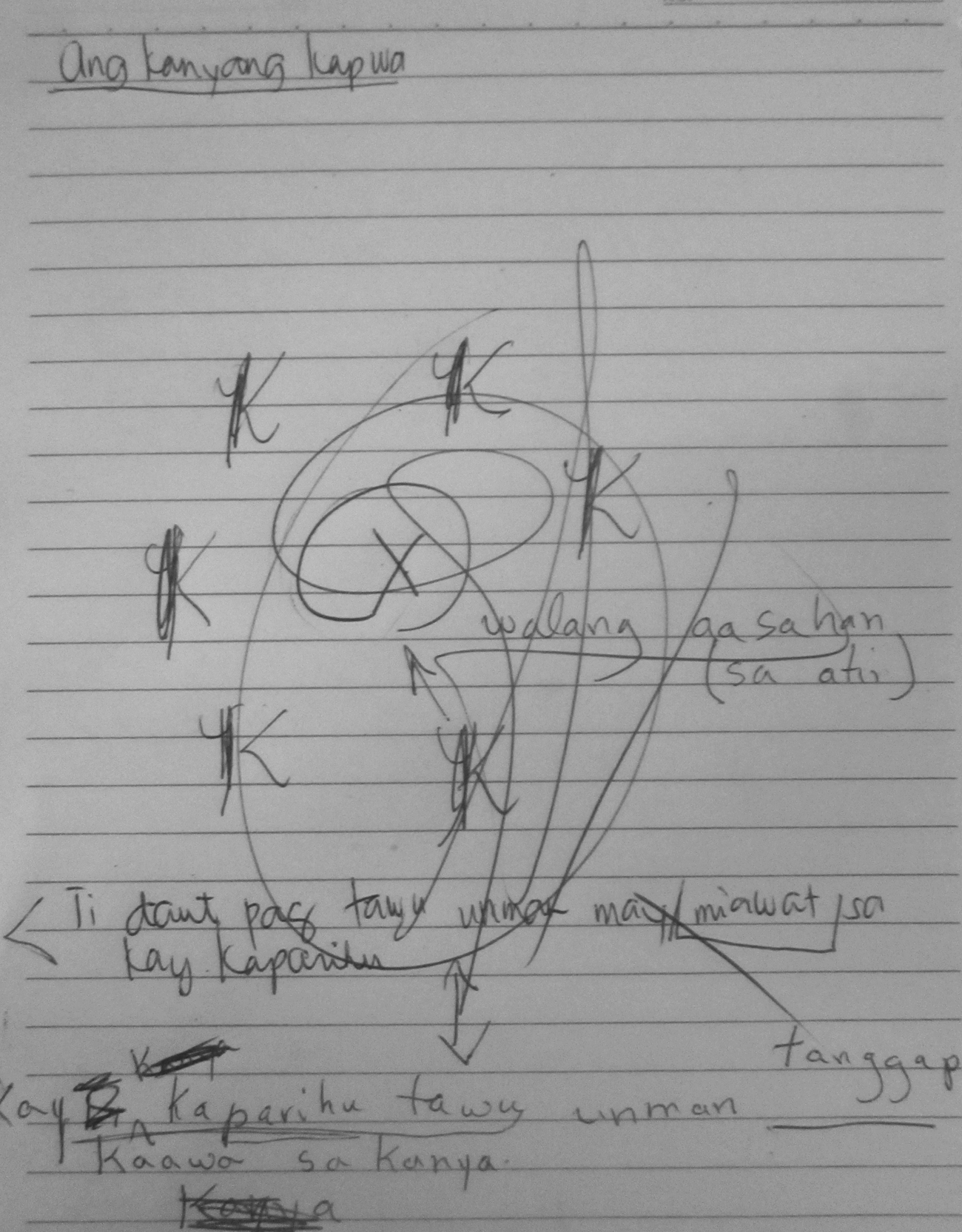
On a note pad Annie drew Ks (for kapwa ‘neighbor/other’) and an X (for the evil doer), explaining to Cora the directionality she wanted in the sentence. One can see in figure 1 that at the top is written “Ang Kanyang Kapwa,” which is itself a difficult term to translate, as the common term for “neighbor” in Tagalog, kapitbahay, is more literal in its meaning, signifying “next-house.” “Walang aasahan (sa ati)” might be best glossed as “not to expect (they).” Again, one can see Annie’s attempt to shift the perspective. Likewise, Annie wrote out “Kay [she inserted “kanya” later but subsequently removed it] kaparihu tawu unman _________ kaawa sa kanya.” Annie then suggested tanggap (to receive) for the blank space, to which Cora replied that it was the same. Annie disagreed, but it was to no avail, and Cora once again repeated “ti daut tawu unman may miawat sa kay kapirihin,” maintaining the evil doer as the subject focus. And thus, after twenty minutes, the original draft suggestion remained in place and they moved on to the next verse.
Translation notes, between Annie and Cora (photograph taken by the author)
We can see in the interaction between Annie and Cora how there is an opposition in translative fidelity: Annie’s fidelity to the biblical text, and Cora’s fidelity to the Hanunoo language. Indeed this opposition is repeated again and again throughout all the translations at the workshop. While this maps easily enough onto a source-to-target type of translative mediation, I suggest here that these fidelities (to biblical text exegesis and language)—and indeed source and target themselves—instead are a cover for a far more complex and competing set of ideas concerning translation. Among these are universal, generic, and pure forms of language, commensurability of linguistic forms (in these cases lexical and semantic, but also grammatical forms such as parallelism), and perhaps the more overarching issue of biblical authorship and inspiration. Cora was concerned throughout with an idea of “natural” Hanunoo language. Of course this is unsurprising; her participation in the workshop was itself undertaken to make sure that the text read and sounded right.
Yet even when the overarching goal was to achieve a vernacular Bible, the translation practices often presented conflicting ideologies of fidelity and naturalness. Cora’s sense of “natural” language was only applicable to the extent that it did not contradict fidelity to the biblical text. In Annie’s discussions concerning fidelity to the original intention of the scriptures, she would often speak of the universality of a biblical language, even as she sought to transform that universality into specific vernaculars. On one level this was obviously a conflict. But it also speaks to the nature of the divinely inspired word and to the view of the Bible as having a communicative universality outside its specific vernacular instantiations (Rutherford Reference Rutherford and Cannell2006; Handman Reference Handman2010). That is, the biblical meaning is universal in that it transcends cultural specificity. While this line of thought is most often pursued by Christians in terms of the universality of Christian practice, it is also an issue that shines a light on the translative nature of biblical language itself.
Purity of Language
One problem of translation often revolves around the nature of the “original” biblical texts, the autographa. If these were (co)authored by God, or divinely inspired, are translations similarly so? This raises a central concern of the Biblical text, and indeed it is this role of a divine presence that separates the author-to-text relationship of the Bible from most other texts. If the Bible is a sacred and divine text, can that sacredness be lost in translation across different languages, or does a divine inspiration remain intact? In addressing this problematic, the Chicago Statement on Biblical Inerrancy (International Council on Biblical Inerrancy 1978) has become a foundational document for North American Evangelical Christian views on the role of divine inspiration in the writing of the Bible (Allert Reference Allert, Porter and Hess1999), one that many Philippine Protestant groups, including those working as translators in Mindoro, also accept. Emanating from heated debates and discord among evangelical Christians in the 1960s and 1970s, the Chicago Statement was designed to be the preeminent and unifying expression among Christians believing in the inerrancy of the Bible. However, the document itself, in discussing the inerrancy of the scriptures, tackles the matter of language and form in an interesting manner:
So history must be treated as history, poetry as poetry, hyperbole and metaphor as hyperbole and metaphor, generalization and approximation as what they are, and so forth. Differences between literary conventions in Bible times and in ours must also be observed. … Scripture is inerrant, not in the sense of being absolutely precise by modern standards, but in the sense of making good its claims and achieving that measure of focused truth at which its authors aimed. . . . Although Holy Scripture is nowhere culture-bound in the sense that its teaching lacks universal validity, it is sometimes culturally conditioned by the customs and conventional views of a particular period, so that the application of its principles today calls for a different sort of action. (International Council on Biblical Inerrancy 1978, 295)
This “different sort of action” for the translators in Mindoro is in keeping with their view of “dynamic equivalence,” a theory of translation most famously associated with Eugene Nida (Reference Nida1964, Reference Nida2002). In this theory of translation they view their work as applying scriptural meaning into another language, which no doubt muddies the view of what scriptural language itself entails. Indeed, while viewed in the context of the debates concerning biblical inerrancy in the 1970s, the Chicago Statement clarifies much, it is another matter entirely when the actual practice of translation is tackled. The Chicago Statement notes that “no translation is or can be perfect, and all translations are an additional step away from the autographa” but also notes that “no serious translation of Holy Scripture will so destroy its meaning as to render it unable to make its reader ‘wise for salvation through faith in Christ Jesus’ (2 Tim. 3:15)” (International Council on Biblical Inerrancy 1978, 296). Are we then to assume that every translation destroys at least some meaning? This is a matter that many Christians, including the translators in Mindoro, felt ambiguous about. While many Christians agree that translations are not inerrant, at the same time they do not view a translated Bible as a mistranslation. Rather, Bible translation is viewed as an ongoing project that attempts to align language most closely with God’s inspiration, or indeed God’s language. In this manner it is always a project in becoming, never achieving. The language of translation approaches but never becomes God.
While the problem of equivalency between languages is indeed true of all translation projects (thus the ubiquity of statements such as “Well, one really ought to read Thomas Mann in the original German”), the issue of equivalency, and commensurability, of linguistic forms becomes an altogether different matter when the author-to-text relationship is divinely inspired. For what emerged during the Bible translation in Mindoro, was not only the search for equivalency between languages, or indeed meaning, but the attempt to find equivalency of the authorial relationship to the text. How does one carry over the indexical relationship (both of contiguity and causation) of the Holy Spirit’s divine inspiration or (co)authorship into the translated text? The relationship between meaning and the language of the divinely inspired text, in this case the autographa, can never be fully transposed into another linguistic context. It is much more than a problem of denotational or connotational equivalency.
For the Bible translators in Calapan, there was a difference in what was determined to be equivalency and in what might be described as commensurability. While they aimed for equivalency of translation between source and target languages, this was not to say that they saw the original biblical language in the texts as commensurable to the Mangyan languages (or English, or French, etc.), as that was the inerrant language of God. The original languages of the autographa were inspired, while the Mangyan Bible texts were not, nor could any translation be. In this sense, as we have seen, equivalency entails something of a decoupling of the idea of language from meaning, in this case of scriptural language from scriptural meaning. At the same time, however, the translators, as Christians, saw their work as being led by the Holy Spirit. To have and to pray to the Holy Spirit to guide them in their work was more particular than looking for divine guidance in one’s daily activities. To translate the Bible was taken to be not only the “work of God” in a general sense but specifically the actual work of God. There were no qualms of whether one should translate the Bible, only qualms regarding the efficacy of the correct translative choices. Unlike in missionary work, where any number of questions regarding the very nature of evangelism may arise—Should one be working to convert this particular person or group? How should one describe God and one’s own faith? What evangelistic strategies might best succeed to convert a potential proselyte? Indeed, what does true conversion mean?—there were far fewer contingencies to face in translation. In Calapan, there was a certain clarity at hand. There was no doubt that they should be translating the Bible. The Holy Spirit was called upon not so much to care for the translators as to explicitly direct the linguistic choices they made.
Thus, in ways similar and dissimilar to the writing of the original texts, the Holy Spirit was present in the translation, guiding them in their rendering of the Bible into Mangyan languages. At the same time, the actual rendered language was not, as noted, inerrant. To this end, the work of translation itself was inspired, even if the language was not. This bifurcation between the divine inspiration involved in the work of translation and the result of that work in many ways replicates the division between the universality of biblical meaning and the specificity of language. For Arthur and the other Mindoro translators, ultimately the predicament of Bible translation lay in this dependence on the inherent limitations and specificity of language to elicit the universality of the Holy Spirit and indeed to communicate the divine (meaning) through the earthly (language). The presence of the Holy Spirit in the work of translation aided the production and circulation of the transcendent meaning of the Bible but at the same time highlighted the confines and particularity of language. As I will discuss, it is into this space between linguistic specificity and the universality of divine meaning that the generic and concerns of circulation come to prominence.
Searching for Equivalence
Five years ago a translation committee had been formed to agree on the approach to the Old Testament translation. This committee, consisting of the publishers, the translators, and the Christian elders from Hanunoo tribes, agreed on the tone and style as well as some explicit issues that inevitably arise in each translationm such as the use of Yahweh, Jehovah, and the word lord capitalized, the inclusion or exclusion of the Deuterocanonical for Catholic worship (excluded in these translations), and whether to attempt a more poetic and rhyming rendition of the Psalms. For these versions of the Bible, they chose a more vernacular rendering. All of this was consistent with SIL approaches to Bible translation. While dynamic and formal equivalency were the terms most often discussed by Arthur, the head translator, and the other translators, as Courtney Handman has noted, the cornerstone of the SIL translation methodology is the concept of “heart language” (Reference Handman, Makihara and Schieffelin2007). This concept captures well both the approach to translation and the desired end product. “Heart language” refers not only to the native first language of a person but also to the manner in which the Bible and God’s word should be communicated to a person.Footnote 14 Over lunch one afternoon, Arthur spoke to the translators of wanting the Bible to be for the Mangyan what the Bible was for its original readers. In effect, this was his argument for moving away from a formal or literal translation. He was “pro-mango,” as it were, and saw little point in producing a translation that was in a native language but still not meaningful in that native culture. At the same time, he was wary of diluting the inspired word of God and felt constrained in how far he could shift such indexical modalities across languages.
Indeed, while it had been agreed by the committee that these translations (Hanunoo, Eastern and Western Tawbuid) should be original translations (i.e., from the original Hebrew and Greek), in practice they aimed to have a text, in terms of form and style, that fell somewhere between the NIV and Today’s English Version (TEV), otherwise known as the Good News Bible. However, there was some confusion over the original nature of the translations. Some translators at the workshop claimed they were undertaking original translations, while others informed me that the first drafts were translated from Tagalog (for Eastern and Western Tawbuid) or from Hiligaynon or Ilonggo (for Hanunoo). The difference in thinking here, I suspect, was a difference in definition of what an “original” or “new” translation entailed. It seems that a number of the translators, particularly Samuel, had been involved in a new translation into Hiligaynon and Tagalog and that these were the bases for the Mangyan translations. Thus Samuel saw the Mangyan translations as a continuation of those first translations. This mediation between multiple languages, both in terms of this issue concerning originality and the SIL Paratext software, obscures not only the directionality that underlies the translation process from source-to-target but also how the languages of the autographa are comparable to the language of translation.
Commensurability and Meaning
As noted, for SIL and the other translators at the Calapan translation workshop, the work of Eugene Nida (Reference Nida and Brower[1959] 1966, Reference Nida1964, Reference Nida1975, Reference Nida2002) and his theory of “dynamic equivalence” were important; Nida’s theory, however, was not one to which they felt obliged to adhere. Throughout their work in Calapan, the translators articulated a view of texts as objects that attain meaning most fundamentally through their relationship to the broader culture and language in which they exist; they would have agreed with Nida’s view that “translating consists in producing in the receptor language the closest natural equivalent to the message of the source language, first in meaning and secondly in style” (Reference Nida1975).Footnote 15 At the same time, the translators felt a deep reticence in straying too far away from the scriptures. In Nida’s formulation, instead of a formal lexical and semantic mapping of texts from source to target languages, translators seek to focus on the reception of the meaning in the target language. Underlying this view of language and translation is an assumption of some communicative universality of the biblical message. Nida himself wrote often of the universality of biblical meaning, in particular paying attention to, in his view, universal concepts such as God, prayer, saint, patience, forgiveness, and so forth, which he believed could cut across linguistic divides if pursued through the right semantic and indexical domains (Reference Nida and Brower[1959] 1966, Reference Nida and Russell Taber1982). It is the problematic of language (and its inherent nonuniversality), not one necessarily of message, that in this theory of translation assumes prominence. Similar to the view of the Chicago Statement, this problematic is dealt with as well as possible, producing translations that are viewed as faithful (to meaning/message) if nevertheless ultimately errant (or at least not inerrant). As Meyer has pointed out, “Although [Nida] is aware of the fact that meaning might be changed through translation, his purpose is to achieve translations that mirror the original meaning as closely as possible. For him, transformation of meaning is a problem that should be reduced to a minimum, rather than an unavoidable to be studied” (Reference Meyer1999, 80).
This approach to translation entailed the mapping of concepts (or of meaning rather than form) (Nida Reference Nida2002) that are intrinsically extractable from the source texts and communicable across cultures. But, as the translators were the first to admit, such a project is inordinately difficult to achieve. This is visible even on a lexical plane. For example, in the draft of the Tagalog (ASND) Ps. 71:3, the issue arose as to how to translate command[ment]. The draft contained “niloob,” but “ipag-utos” and “ginusto” were also suggested. While the terms might very well be glossed as “commanded” or “commandment,” the difficulty was that ipag-gusto has connotations of a more military-style order, whereas the translators preferred a broader view of command and commandment that they believed was the intention in the Hebrew. Or, for Ps. 71:10, the matter of “whispering” was discussed and proved problematic. The draft contained “nag-uusap-usap,” which may be glossed as to talk or discuss. As one of the translators noted, “we should use whisper [nagbubulungan] but in Tagalog it doesn’t have … whispering in English can be associated with being poetic and secretive, but not in Tagalog.”
In the Eastern Tawbuid translation, it is possible to see that even single lexical items raise much broader issues of a semiotic nature concerning not only translation but also the indexical properties of lexical items as related to basic religious stances. In this reckoning of translation, the translators remained oddly neutral in their stance toward their own language and the target language. Not only were source and target languages taken to be necessarily equivalent (admittedly with problems), but the translative process was seen to be inherently intermediate and productive of no new semiotic form. But this was not necessarily the case. For example, in the translation of Ps. 34:7 in Eastern Tawbuid, the term for “fear” became a somewhat problematic term. The lexical item for fear in Eastern Tawbuid is limu, but Arthur did not wish to use this word because it has not only been commonly employed in the broad sense of fear (as we would understand it in English), but it was also used to mean fear of spirits prior to their conversion to Christianity. Arthur did not want the same term that had been applied to animistic spirits to now be applied to God, and so they searched for another term. In the end, Arthur argued for fagsugun, which would be better glossed as “respect.” But the three native speakers from the Taubuid village that were also working on the text with Arthur had no problem with limu. To this end, there was more than the matter of language equivalency at play. It was the production of a religious stance, in this case, the desire to make Christianity distinct, even in its language, from other religious spheres. Arthur’s concern here was not only how the Bible would be read, in terms of a reader-text relationship, but also how the Bible as text/religious artifact would be situated within a broader social milieu. This then is also a matter of circulation and of the translators’ conceptualizing of the social domains through which the Bible would travel. The concern for circulation, and what Lee and LiPuma (Reference Lee and LiPuma2002, 192) have called the “interpretive communities” that define the boundaries and nature of such domains of circulation, is deeply connected to the goal of replicating the universality of the divine biblical message.
If the specificity of language differences, coupled with the possible errancy of a translated text, ultimately works against the goal of biblical universality, the translators at times looked to countering these obstacles through two interconnected means: (1) the employment of generic language and (2) the effacement of the translator/translation in the text. This goal of having the translator exist as a neutral and ultimately effaced intermediate in translation corresponds to the matter of circulation. While the translators were well aware of the narrowness of readership that these translations would garner, the ability of circulation and the universality of the text they were producing were ever-present concerns. It was often for this reason that the translators turned to the concept of generic language.
The Specific Generic
The one who wanders from the way of wisdom will end up in the company of the departed. (Prov. 21:16, NET)
Hanunoo draft:Footnote 16

Here is an example of where the metaphor was stripped away and replaced by what many of the translators termed a more “generic” language. So where, for example, the KJV (“The man that wandereth out of the way of understanding”) and the NET (“The one who wanders from the way of wisdom”) include the trope of wandering away from wisdom, this was not included in the Hanunoo (though Samuel’s Tagalog translation [ASND] did include the figurative use of wandering). As Arthur, a translator for the Western Tawbuid text, noted when discussing the translation of Ps. 32:6, “To be faithful to King David, or to be faithful to Tawbuid, it’s always a tension. If I’m fully faithful to King David, I’ll just give them the Hebrew, but if it reads like a newspaper it’s probably missing something that King David wanted to convey … it’s never ending, that tension.” Examples abound, for instance, in the Tagalog translation of Prov. 107:9, where “hungry” was replaced with “desire.”Footnote 17 This was also framed by Samuel as making explicit what was implicit in the text. Thus for the famous “camel through the eye of a needle” passage (Matt. 19:24), they used the term for “animal.” Here then the generic is aligned with the explicit, unlike earlier when it was aligned with the literal.Footnote 18
But what exactly is meant by generic, particularly in terms of language? It is a concept that is employed by language speakers in everyday usage, but in this way it is surprisingly neglected in anthropology and is perhaps most often associated with language development and the concepts of subordinate and superordinate prototype categories in linguistics (Carlson and Pelletier Reference Carlson and Jeffry Pelletier1995; Croft Reference Croft and Cruse2004; Leslie Reference Leslie2007; Mannheim and Gelman Reference Manheim and Gelman2013). In this manner the generic is taken to be the basic category onto which other levels of specificity are applied (Croft Reference Croft and Cruse2004).Footnote 19
Outside of linguistics, two of the more interesting anthropological employments of the term are Moore’s (Reference Moore2003) discussion of brand genericide and Féherváry’s (Reference Féherváry2013) recent examination of generics as related to socialist and post-Soviet materiality. For Moore, the generic is the decoupling of object and specificity, in this case between product (material and otherwise) and originating brand producer. Similarly, Féherváry notes that the generic label on consumer goods, as commonly understood, “simply identifies a product, conveying nothing more than its use value … it offers no contextualization of the item beyond its existence on the store self” (Féherváry Reference Féherváry2013, 117). And yet, for both Moore and Féherváry, the inclusion of the generic within semiotic contexts does not stop there. The generic will always convey, in its material instantiation, much more than nonspecificity. But even in terms of the common understanding of generic, there are obviously two ways to view it. On the one hand, we can see the generic as being without specificity (food over fruit, fruit over apple, apple over Braeburn, with each less generic than the previous). On the other hand, however, we can understand the generic as encompassing subsets of specificity (apple includes not only Fuji, but Braeburn, Jonagold, and Honeycrisp as well). In this way, the generic can be seen as either including or excluding specificity. As I argue here, it is the inclusion, or better the “enabling,” of specificity within the generic that propels the Bible translators to employ such language.
In a similar vein, Marilyn Strathern (Reference Strathern2014), in a discussion of relationality, focuses on the role of generic kinship concepts and terms. Viewing generics as abstracted types employed both for purposes of inclusiveness and opacity that may give recognition without specificity, she notes there is nothing inherently vague about generics: “Generics are rather more than metaphorical extensions of ideas calling out for concrete expression” (14). With regard to the Mindoro Bible translation, the generic was employed for purposes beyond nonspecificity. As already noted, the generic was viewed both in terms of literalness and explicitness (e.g., “removing a metaphor”). At the same time, however, the translators often spoke of the generic in terms of the breadth of specificity, in that they viewed the generic as encompassing a wide range of interpretations rather than excluding them. Thus the generic was viewed not so much as a compromise between different exegetical renderings as it was a form that enabled the reader to interpret God’s words themselves. In this manner, the generic does not exclude specificity but encourages multiple specificities and points to a translation that is inclusive.
Instead of being an overarching set, including all specificities of type, or indeed the negation of specificity, I suggest here that for the translators the generic assumes a correlation with the concept of universality. For it is often specificity that hinders both the linguistic and material circulation of the Bible. Without specificity, the generic Bible is viewed by the translators as purified of potential problems of meaning and rendering the biblical message in the target heart language. And, importantly for potential circulation, the use of generic language in the Bible mitigates the risk of multiple interpretations, as such a Bible will not stand in positions of contrast to other possible translations. For example, one concern for thetranslators in Mindoro was that, while their Bible would be the only translation available in each Mangyan language, a Mangyan pastor who read Tagalog might find discrepancies between the two. They wished to avoid any contradiction with other versions, especially in settings where Christians were unacquainted with a world of multiple and differing Bibles. While it is true that “mango” or some other local fruit might correlate better to the biblical meaning they intended to impart to the reader, it would be limited both in its circulation and its intertextual position relative to other biblical translations.Footnote 20 In a somewhat similar manner, and aligning the generic with matters of circulation, Cory Hayden (Reference Hayden2007), discussing generic pharmaceuticals in Mexico, notes how projects of circulation are inevitably married to concepts of the domains through which they are intended to move. In terms of conceptualizing the generic, Hayden’s emphasis on similarity and copying in the debranding of patents likewise shares in many ways the Bible translators’ conceptualizing of the generic as reaching (or replicating) a “universal” meaning, or at least a domain in which the universal may be semiotically located.
Conclusion
Through this process, the generic was at times seen to enable better circulation of the Bible. It is of note that the translative process, while always directed toward an in-practice reading of the text, relates to matters of language mediation differently than the presumed reader of the final text. For in its most common uses in Mindoro, the Bible itself is rarely seen to be a translation at all. It is simply the material instantiation of the Bible. In a similar manner, when one places one’s hand on a Bible in a US courtroom and swears upon it, one is swearing not on an intrinsically erring translation, but simply on the Word of God. Matters of mediation are not included in the semiotic relationship established between the translated word and God; rather, the relationship is collapsed, and a single instantiation remains. Thus we may view the work of the translators as a project that is dependent on certain ideologies of the mediation of language, but one that the reader experiences little of. Of course this is by no means a ubiquitous outcome. As Handman (Reference Handman2010) has recently argued, among the Guhu-Samane in Papua, New Guinea, not only was the work of SIL translators foregrounded in religious practice there, but it was taken up and often continues to be viewed as a transformative event in their experience of Christianity. Similarly, Rutherford has noted how the translated Bible has been foregrounded in Biak social practices, becoming a material site in which concepts of foreignness are mediated, and how “imported words [of the translated Bible] seemingly could serve as ‘proof,’ the mark of a confrontation in an alien realm” (Reference Rutherford and Cannell2006). However, among the Mangyan, the target readership of these Bibles, there appeared no such transformative purpose placed on the translations of the New Testament that are already in circulation. Rather the translative process is effaced in the anticipated domains of circulation. As a result, the Bible produced in Mindoro tends to avoid in-text details of other translations, such as cross-references, exegesis, or concordances.
In practices of Bible hermeneutics and exegesis (Radmacher and Preus Reference Radmacher and Preus1984; McLean Reference McLean2012) common to the Christian translators and on display in the workshop, I suggest that the generic (especially as related to vernacular forms), because it is seen to be less mediated through linguistic specificity, is enacted as a gloss for universality, thus aligning with the intentionality of the Holy Spirit. The generic, in its circulation, achieves in an earthly form what the Holy Spirit does divinely—a universality of meaning that reaches beyond the specificities of particular languages. In other words, the transduction (Silverstein Reference Silverstein, Rubel and Rosman2003; Keane Reference Keane2013) of a semiotic modality does not carry with it the traces of that transduction.Footnote 21 Rather it becomes an instantiation of the original. Thus we see a break between the rendering of the Bible in Mangyan languages and the circulation and use of those texts. Due in large part to the unique authorship of the Bible, the target language in this context becomes for all intents and purposes the source language, as the translation is inherently the objectified and instantiated word of God. A straight line, in denotational and exegetical terms, links the reader to the inspired word of God. In this scenario, the source text and the ideologies contained within it (divine authorship) cannot but be translated without God’s guidance.
But I argue that it is not simply a matter of materiality overwhelming the practices of production but rather the claims to universality intrinsic to the practice of translation itself; it is the effacement of translation aided by the employment of generics. Unlike with other texts, I suggest that the process of translating the Bible is not one of clear semiotic transduction, the mapping of one language (within certain forms of cultural and semiotic modalities) onto another (with commensurable but different forms of cultural and semiotic modalities). Within the pursuit of dynamic and functional equivalent translationsm we see that the idea of “language as a repository of culture” is rampant; however, it is only truly ever seen to be the case on the side of the target language. The relationship between the original biblical texts and their original contexts (the source) is unique when viewed through the Christian lens of authorship-to-text. For many Christians, the Bible is distinct from the cultural milieu in which it was written. The Bible, as Word, might be instantiated in language, but there is nothing cultural about it. It is God’s word. Somewhat paradoxically, while “language as repository of culture” might exist as a stated goal of translation, the employment of generic language is as much about the purification of the biblical text as it is about transducing entire semiotic modalities.
For Christian translators, such as Cora and Annie, the Bible is located differently as a translated text artifact. While the translation of the Bible into Mangyan languages is produced through ideologies of denotational explication (even with an eye to other in-context semiotic modalities), these translators also assume a certain author-to-text relationship that is unique, one that is concerned instead with the purification of language. In this sense, the employment of generic forms of language achieves both. It may be seen as the purification of language, removing God’s word of local and cultural specificity. For in the end, the generic is seen by the translators to both enable the translation and circulation of semiotic modalities while at the same time achieving a divinely universal text, even if it is generic.



