The last half millennium witnessed a massive sea change in the relationship between labor and the environment in Egypt. From the time of the Ottoman Empire's conquest of Egypt in 1517 until the end of the eighteenth century, Egypt's rural cultivators worked to maintain irrigation and other environmental manipulation technologies through small-scale repair and infrastructure projects.Footnote 1 Most often, a few or a dozen workers devoted a few days to repairing canals, waterwheels, sluice gates, and embankments that helped to provide water to their local communities. They lived at home during these repairs, were often paid, and generally managed this work on their own. At the turn of the nineteenth century, this system of coordinated localized work began to change.Footnote 2 Soon rural labor exploded beyond the local. Massive numbers of peasant workers were forcibly moved great distances to repair irrigation and other infrastructural works that did not serve their families or villages. The close connection between local peoples and their environments was no longer the driving force behind the rural manipulation projects that had for millennia made Egypt one of the most lucrative and productive agricultural zones in all of Eurasia and Africa.Footnote 3 Abstract notions of resource extraction, commercialization, and state-building came to control the relationship between rural labor and the environment.
The reasons behind this fundamental transformation in Egypt's labor regime were political. Beginning around 1750 and extending until today, Egyptian politics has been dominated by a concentrated group of rural (and, more recently, urban) elites with deep connections to Egypt's rulers.Footnote 4 A small group of people control economic resources in Egypt and have used this control to “develop” the country along lines that benefit themselves and their crony partners. This system first began in the second half of the eighteenth century and was the primary factor that changed how farmers, the overwhelming majority of Egyptians, interacted with environmental resources.
Situating these shifting human relationships with the environment in the middle of the eighteenth century flies in the face of most stories about Egypt's transition to modernity—a transition effected, we are told, either by the French invasion of Egypt, the genius of Mehmet ‘Ali (Egypt's Ottoman governor general from 1805 to 1847), or the sprouting roots of European-defined enlightenment long buried in Egyptian earth.Footnote 5 The general consensus that emerges from all sides within this contested historiographic field is that the political and economic changes that impacted labor, and most other forms of politics, economics, and social formations in Egypt, originated around 1800. In truth they began earlier. The following mid-eighteenth-century story of the emergence and effects of large-scale public works projects indeed provides evidence that the kinds of centralized administrative structures that are usually only associated with the early nineteenth-century state of Mehmet ‘Ali actually began decades before. This serves as an important corrective to the periodization of the last five hundred years of Egyptian history.
The Russo-Ottoman wars of the last half of the eighteenth century, the expanding corporatization of the Ottoman military, and inflationary pressures on the Ottoman economy all contributed to the realignment of power in various Ottoman provinces at the end of the eighteenth century.Footnote 6 In Egypt, the manifestation of these political and economic developments was the expanding power of provincial governors. Unlike the classical system of Ottoman governance whereby imperial officials were rotated between various positions, often in different locations, to prevent them from gaining any sort of localized power, at the end of the eighteenth century a series of Ottoman governors in Egypt monopolized power for decades and succeeded in carving out for themselves and their associates a space of autonomy from the empire.Footnote 7 They withheld tax revenue, seized resources, and eventually created their own military forces. The most prominent of these governors were ‘Alī Bey al-Kabīr and Muḥammad Bey Abū al-Dhahab.Footnote 8 In the 1760s and 1770s, they seized wide tracts of land and used these properties to raise revenues to pay soldiers and to patronize political and economic partners in the province and elsewhere in the empire. These provincial elites reached the height of their power in the 1770s when they led several invasions of Ottoman territory in Greater Syria.Footnote 9 They held territory for a few years before being pushed back to Egypt. As part of this growing autonomy of Egypt from the rest of the empire, several important Mamlūk families in Egypt assembled large estates that included farms, pious endowments, and other fixed properties.Footnote 10 The Ottomans had treated Egypt as one big tax farm for about two and a half centuries. At the end of the eighteenth century, various interests wanted slices of this very big pie.
One of the primary results of these political and economic plays for more power in Egypt was the concentration of labor and environmental resources in just a few wealthy hands. This process of resource concentration was helped along by demographic shifts related to climate and disease that reduced human and animal populations in the countryside.Footnote 11 Emigration from the countryside to cities, the abandonment of farms, and the outright seizure of property allowed for the creation of large hierarchical estates that began producing agricultural commodities in commercial quantities for increasingly globalizing markets. As these estates grew in size, extraction efficiency, and productivity, their demands for increased and different kinds of labor grew in lockstep. Devoting more land and more resources to the production of more food (and increasingly more nonconsumable goods) for a widening market meant more labor. Thus as part of this process of emergent commercial agriculture, estate holders undertook increasingly larger and more labor-intensive infrastructural manipulation projects on their land.Footnote 12 This shift from partially marketized subsistence to intensive commercial agriculture was therefore the key factor that transformed Egypt's labor regime in the decades before 1800. And because labor was a dynamic and capacious social phenomenon linked to politics and economics, tracking changes in the history of labor in Egypt in the second half of the eighteenth century helps to shift our focus away from the early nineteenth century as the temporal locus of epochal change.
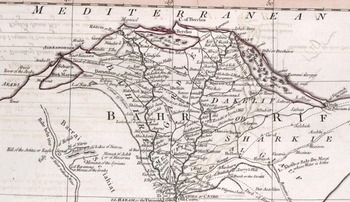
Egyptian Delta. Jean Baptiste Bourguignon d'Anville, Egypt: Called in the Country Missir (London, 1765). Printed with permission from Beinecke Rare Book and Manuscript Library, Yale University.

To fully understand the complex connections between political and economic changes on the one hand and the relationships between rural labor and the environment on the other, I will first sketch a picture of rural environmental manipulation projects in the early modern period to show their small-scale nature, local control over them, and their relatively light touch on the environment. I will then show how such projects and the character of work on them fundamentally changed before and continuing through the turn of the nineteenth century. Forced labor, large-scale and deleterious environmental exploitation, extractive economics, and population movements came to characterize the relationship between work and the environment in rural Egypt in the nineteenth and twentieth centuries. Furthermore, the consequences of these changes from the second half of the eighteenth century are still with us. Thus, to understand the history of labor, politics, economics, and the environment in Egypt over the last two centuries we must understand the fundamentally transformative shifts that occurred at the turn of the nineteenth century.Footnote 13
Let's Work!
Rural labor was usually a small-scale affair in early modern Ottoman Egypt. Groups of up to a few dozen peasants worked to repair irrigation and other infrastructural works in and around their villages. Their labor benefited themselves and their families directly. This work was very often initiated by rural cultivators who came to one of the Ottoman Empire's courts in Egypt—the most immediate presence of the empire in the province—to complain about a canal or embankment.Footnote 14 Imperial functionaries would then undertake an inspection of this repair request to determine whether or not it warranted the empire's financial resources. If it did, local peasants would then invest their sweat equity to implement the repairs. This coordinated localism ensured that the empire's rural infrastructure was efficiently and quickly maintained. Local communities provided the labor and expertise the imperial bureaucracy relied upon to maintain water flowing in Egypt; the empire provided the cash.
Although the vast majority of these repair jobs were of a small scale and very local nature, their consequences were clearly imperial. The proper function of irrigation features, even in the remotest areas of rural Egypt, was of deep imperial concern since the food these waterworks helped to grow fed people all over the Ottoman Empire. The labor of a very small number of Egyptian peasants (and nonhuman animals) on minor dikes and canals in the Egyptian countryside thus connected them to peoples and locales at great distances from themselves.Footnote 15 Their labor was, in other words, part of an Ottoman imperial economy spread across the Middle East, southeastern Europe, and North Africa. Tied together through the work of environmental resource management, the empire needed peasants, and peasants needed the empire.
Laborers performed many different tasks in rural Ottoman Egypt. In the early modern period, they were most often identified as “people of the village” (ahālī al-nāḥiya) or “those who benefit from its (for example, a particular irrigation feature's or road's) use” (man yasta‘īnunuhu bihi). As these phrases suggest, the most salient feature of human labor between roughly 1500 and 1750 was its extremely localized and small-scale character. “People of the village” worked to repair irrigation features and other structures that directly benefited themselves, their families, and their agricultural lands.Footnote 16 Their incentive and desire to work stemmed from their vested interests in the proper function of the irrigation features on which they so profoundly relied.
Perhaps the most common category of laborer on irrigation projects in Ottoman Egypt were ditch diggers.Footnote 17 These men cleared excess mud, dirt, branches, and leaves that often collected in canals and along embankments. They were also charged with clearing some of the mud and silt that collected along the shallow bottoms of canals; this rich dirt was then often put toward reinforcing embankments or fertilizing fields. Other collective categories of workers were also responsible for dredging canals and making sure dirt was properly used in the reinforcement of embankments.Footnote 18 Repair and construction projects also needed able bodies to act as lifters and carriers to move all sorts of items: building materials to worksites and dirt and garbage away from them.Footnote 19
A group known literally as “possessors of discernment” or simply “those of knowledge, expertise, and experience” were also regularly involved in irrigation projects.Footnote 20 These were older men who did not do a great deal of manual labor per se but who served a rather more advisory and directive role in these projects. Given their years in the countryside, they understood the specific topography and geography of worksites and knew what areas needed the most attention. Their experience endowed them with sophisticated local knowledge about the irrigation works of a particular area, thus making them important sources of local expertise for the Ottoman state. As was often repeated in repair cases, all of these laborers, whatever their title or role in maintenance and repair work, were to labor “day and night” until “maximum irrigation was fully achieved.”Footnote 21
In 1652, these and other classes of laborers were employed in the work of opening canals that fed off of the “sea” formed by the waters of the major canal of al-Baḥr al-Ṣaghīr in the subprovince of al-Manṣūra in the northeast Delta.Footnote 22 As was customary, all of the men used in the project were expressly ordered to be acquired from villages directly impacted by this set of canals. Likewise, in another case from 1707 about the reinforcement of al-Baḥr al-Ṣaghīr's embankments, Ottoman officials ordered the extraction of beasts of burden, peasants, and those with experience from villages near the canal to clean and repair the waterway.Footnote 23 In contrast to what would come later, local labor in the early modern centuries was frequently compensated, sometimes in cash, but more often in kind. To repair a dike in the village of Mīt ‘Āfiyya in the subprovince of al-Gharbiyya, for example, the head of this village was instructed to collect nine men for the job and to provide each with provisions and shelter for the one night the work required.Footnote 24 Even though this was a very small amount of work—only one night—the nine men were compensated for their labor, which, again, went toward the betterment of their own community. In another case from the subprovince of al-Gharbiyya, twelve men charged with dredging 1150 qaṣaba (4.6 km) of a canal were provided with food and shelter for the one evening they worked.Footnote 25 Of the necessity and morality of these early modern wages, the respected eighteenth-century Egyptian imam Muḥammad ibn Sālim al-Ḥifnāwī wrote, “The worker who brings his task to completion deserves the fee for his labor.”Footnote 26
As the foregoing examples, and thousands of others show, a primary component of the established system of early modern rural infrastructural labor was the use of local workers of all kinds. These workers, moreover, were very often afforded some sort of compensation. Diggers, reinforcers, heavy lifters, and local experts were collectively employed as the most efficacious and efficient means of preserving and protecting Egypt's irrigation works, the lifelines of its ecological wealth. Thus, a primary principle undergirding the logic of rural labor in the early modern period was that those who lived near irrigation works, used them, relied upon them, and benefited most from them were also responsible for their upkeep and repair. For both the Ottoman state and its rural subjects, this devolution of authority to local communities was the most effective, expedient, and indeed easiest way of maintaining complex infrastructure.
Of course, not all work in the early modern period was voluntary and paid. Corvée (forced labor) certainly existed.Footnote 27 Between the sixteenth and the middle of the eighteenth century, corvées were only employed on a small minority of lands—those known as ūsya. This was land that had once been part of a tax farm (iltizām) but that had been given over to the personal management and control of a tax farmer (multazim), usually because the land had fallen into disuse and was therefore deemed of negligible tax potential.Footnote 28 Ūsya land was hence tax-exempt and functioned more or less as the private property of tax farmers. At the end of the eighteenth century, the high-water mark for this kind of land, ūsya made up only 10 percent of all of Egypt's arable land and was confined mostly to the Delta and Middle Egypt.Footnote 29 Thus, only a tenth of early modern Egypt's fields were open to corvée. Moreover, when compared to what would come later, these corvées consisted of relatively simple tasks—clearing mud from canals, plowing, or bringing in crops.
One of the best descriptions of early modern corvée comes from the pen of Yūsuf al-Shirbīnī. Composed in the seventeenth century, al-Shirbīnī's text is a satirical and often bawdy portrait of the countryside consisting of forty-seven lines of poetry supposedly written by an Egyptian peasant, followed by al-Shirbīnī's extensive commentary on the verse. Of corvée, he writes,
This occurs when activities that require it, such as the excavations of [pits for] waterwheels, the gathering of crops, and the digging of canals, take place. The corvée is found only in those multazims’ villages that include ūsya land … The multazim sends oxen, timber, plows, and whatever else is needed and appoints an agent to take charge of it and prepares a place for the timber and animals belonging to it … He also delegates someone to spend money on the upkeep of the animals, etc., and to keep careful accounts … In some villages the corvée applies to a number of men, fixed by household, for example. Thus they say, “From such and such a household one man is to go, and from such and such two” according to the quota set for them in the distant or more recent past.Footnote 30
al-Shirbīnī continues on to explain that laborers were, as we saw above, almost exclusively “people in the village.”Footnote 31 Moreover, he devotes great energy to explaining the etymology of the word used for corvée in the early modern period—al-‘auna. This word is derived from an Arabic root related to help or assistance and is important to note since it suggests something of the cooperative and even nonviolent nature of this brand of early modern labor.Footnote 32 In the nineteenth century, both the nature of corvée and the words used to signify it would change drastically. In explaining the use of the word al-‘auna for the early modern practice, al-Shirbīnī writes,
The ‘auna (sic) … is so called because it derives from mu‘āwana (“helping one another”) because it consists of a group who go out to help one another in the multazim's work and so on. Or it may be that it is the name for a group that cooperates in doing something, which is why they say “They fucked So-and-so last night as a group [‘auna (sic)],” i.e., they all cooperated in fucking him at one go in the byre or the granary … Or it is from mā‘ūn, a name for the big storage jar.Footnote 33
His raunchy mockery of classic Arab grammarians aside, al-Shirbīnī's point is clear—corvée was a cooperative activity of shared labor and interest. Local laborers helped one another to improve their collective local situation of environmental resource management.
So as not to romanticize this kind of labor—there was, of course, nothing romantic about it—al-Shirbīnī notes that many peasants attempted to escape from corvées. He offers the following verse: “And on the day when the corvée descends on the people in the village/Umm Waṭīf hides me in the oven.”Footnote 34 Corvée on ūsya land was, moreover, hereditary. “A person subject to the corvée cannot be released from it, and if he dies they impose it on his son and so on. It is a great tribulation for the peasants.”Footnote 35
For millennia before the Ottomans ever set foot in Egypt, Egyptians had, of course, been forced to work. Although there were some commonalities over time, the nature of this labor was specific to each period of Egyptian history. In the early modern period, the Ottoman imperial system created a network of coordinated localism in which tax farmers, village elders, and very often peasants themselves participated in managing the labor needed to keep canals flowing and food growing. This system was the result of an understanding that the best way to oversee the ecological complexities and specificities of thousands of villages throughout Egypt was to allow locals to control canals, sluice gates, and fields. As long as they paid taxes, acquiesced to imperial demands, and kept food flowing out of Egypt, local peasants were afforded an amount of autonomy over their land, water, and labor.
You Work!
All of this would begin to change in the second half of the eighteenth century. As part of their schemes to increase and then maintain their autonomy from the Ottoman Empire, Egyptian elites began undertaking larger and ever more complex repair and infrastructure manipulation projects. To show how these infrastructural efforts reflected fundamental changes in the use and conceptualization of labor and the environment in Egypt, I will concentrate on three large-scale building projects in the period from the middle of the eighteenth century to the beginning of the nineteenth. These three construction ventures track the exponential growth in the magnitude and intensity of labor-utilization in Egypt. Indeed, in contrast to the earlier concept of al-‘auna, forced labor at the turn of the nineteenth century came to be identified almost exclusively as al-sukhra (or al-taskhīr), deriving from an Arabic root for words related to derision, subservience, servitude, and exploitation.Footnote 36 Projects grew bigger and bigger, used more and more workers from further and further away, and became increasingly violent and exacting in their use of human laborers. Labor became alienated from person and place. These changes to Egypt's labor regime in the decades before 1800 show that forms of administrative centralization and invasive state authority began before the reign of Mehmet ‘Ali, and they help to set the stage for the subsequent history of labor's relationship to the Egyptian environment in the nineteenth and twentieth centuries.
The repair of a grain storage facility in Rosetta in 1747 offers a particularly good example of the beginnings of this changing labor regime, pointing to how repair work in the middle of the eighteenth century was becoming larger and more complex.Footnote 37 Grain storage facilities were crucial institutions for the management of Egypt's ecological wealth. Egypt was the most agriculturally productive and lucrative province of the Ottoman Empire.Footnote 38 Indeed, throughout its history, Egypt's ecology was perhaps the primary reason for its geopolitical importance. To get food out of Egypt, the Ottomans, like other political powers, relied on a series of storage facilities in Egypt's Mediterranean and Red Sea port cities to collect and house grain to prepare it for shipping.Footnote 39 If human and animal labor helped harness the Nile's water to irrigate land to grow food, grain storage facilities allowed this caloric sustenance to find stomachs in North Africa, the Middle East, Anatolia, and southeastern Europe.Footnote 40 The supply chain from Nile to stomach passed through these institutions. Economic and political change in Egypt almost always involved transformations in both food supplies and the irrigation system that sustained them. To this point, the enormous amounts of labor, money, bureaucratic energy, and managerial acumen put toward organizing work on grain storage facilities at the end of the eighteenth century was part and parcel of the political and economic machinations of elites for power in this period.
The grain storage depot repaired in Rosetta was part of the pious endowment (waqf) complex of a man named Ibrāhīm Aghā. It was in very bad shape in 1747. The vaulted arches of some of the storage rooms on the southern side of the facility were broken; parts of its southern wall had collapsed; the walls, roofs, and long wooden roof supports of some of the upper stories needed reinforcement; and associated storage areas, a coffeehouse, and a group of taverns—all of which served the facility's patrons—also had to be fixed.
These many complex and labor-intensive repairs were carried out by a few hundred workers using a wide variety of materials. Both these men and the materials they used were carefully counted, organized, and assigned to various sections of the project. After an introductory paragraph explaining the necessary repairs, setting the length of the period of work, and naming those responsible for overseeing it, this very long repair case goes on to enumerate in list form (as in an expense sheet) all the materials and kinds of labor needed, along with their attendant costs. The building supplies included plaster, tiles, lime, nails, red brick, stones, and fourteen different varieties of wood.Footnote 41
The hundreds of laborers needed for this repair work were to devote eighty-four days to the project. The written form of this case—itself an important innovation in this period—underlies the bureaucratic conceptualization of the workforce needed for the repair job. The case consists of a daily entry for each of the eighty-four days of labor allotted for the project. Each entry is first labeled with the date and day of the week. Listed underneath this top row of information are the kinds of laborers employed for that day (stone lifters, builders, wood carriers, masons, and so on) along with the number of workers from each category.Footnote 42 Below that is the total cost for that type of laborer on that day. On Saturday, December 31, 1746, for example, one engineer, seven masons, sixteen unspecified kinds of workers, one carpenter, three water carriers, and three other individuals were used.Footnote 43 In addition, each entry records the amount of coffee allotted for that day's work. Coffee and water were the only forms of sustenance provided these men.Footnote 44 The last bit of information in each of these daily entries is the total cost of men and materials for that day's work. So on the same day in December 1746, the one engineer cost 17 niṣf faḍḍa (para), the seven masons 98 niṣf faḍḍa, the sixteen workers 113 niṣf faḍḍa, the carpenter 14 niṣf faḍḍa, the three water carriers 17 niṣf faḍḍa, and the three other individuals 10 niṣf faḍḍa.Footnote 45 Paying out another 4 niṣf faḍḍa for coffee, the total cost of labor for that day was thus 273 niṣf faḍḍa. The price for each of these classes of laborer remained fairly consistent throughout the eighty-four-day period of work.
Most of the workers employed in this grain storage depot reconstruction were brought to the worksite from elsewhere.Footnote 46 There were those who transported materials from quite far away—workers from Cairo who sailed to Rosetta with building supplies and lumberjacks from outside of Egypt who brought wood to the city, for example. The majority of the workers, though, were forcibly moved from villages near Rosetta. No explicit mention is made of their lodgings, so presumably none were afforded them. Perhaps some workers constructed temporary accommodations on their own; perhaps some others were able to sleep in their homes provided they reported to work at a certain hour each morning. Whatever the case may have been, the total cost of labor on this project was 16,278 niṣf faḍḍa, nearly 29 percent of the total of 56,290 niṣf faḍḍa spent on the repairs.
The scale of the repairs evidenced in this case starkly differentiates it from the kinds of early modern construction jobs discussed previously. Instead of a few workers, hundreds were used. Instead of a day or two of work, this job took nearly three months. Workers were moved significant distances away from their families to work on a project that held little direct benefit for themselves. They were not paid for their work and were given only coffee to sustain their bodies. What is perhaps most striking about this case of grain supply management is its casting of peasant labor on the pages of the court's register. Workers were very carefully counted, organized, and assigned to work tasks on each of this job's eighty-four days. Their provisions were allotted in precise quantities, and the costs of all these expenses were dutifully calculated. In scale, level of detail, and wrenching human effects, this case and others like it thus represented the beginnings of new conceptualizations of labor and bureaucracy in the middle of the eighteenth century. Laborers were plugged into an emerging bureaucratic structure in which they existed as parts of categories of abstract workers, groups whose actions were now scheduled, arranged, and micromanaged by an administrative mentality of charts and metrics. Workers literally became numbers on a page.
At the end of the eighteenth century, then, labor was no longer characterized by the extreme locality of the early modern period, workers were generally not paid, and projects were demanding much more labor. With this amplification in scale and complexity came both a proportional increase in the hardship and suffering experienced by laborers and ever greater deleterious effects on those environments being manipulated to produce more. These consequences on humans and environments come through most clearly in the period's many large canal projects. One of the most important of these was the repair of the canal of Banī Kalb in the southern subprovince of Manfalūṭ in 1808.Footnote 47 Work on this canal lasted seventy-nine days, from Thursday, May 5, 1808, to Friday, July 21, 1808, and required 33,412 worker days (the overall number of individual work slots required during the seventy-nine days; there was, of course, some worker turnover from day to day, but how much is impossible to calculate). On any given day, 260 to 560 men were put to work; the average daily number of workers over the seventy-nine-day period was 424. The sheer enormity of these numbers already suggests that this repair work was clearly of a very different sort than anything that had come before it—certainly orders of magnitude larger than the smaller projects of the sixteenth and seventeenth centuries and undoubtedly even more gargantuan than the kind of repair work undertaken on the grain depot in Rosetta in 1747. Like this case, however, the (presumably) thousands of workers used in Manfalūṭ in 1808 were very precisely organized, measured, and enumerated. Every individual peasant laborer was counted (but not named) on each day of work. Laborers were fed but were not paid beyond that.
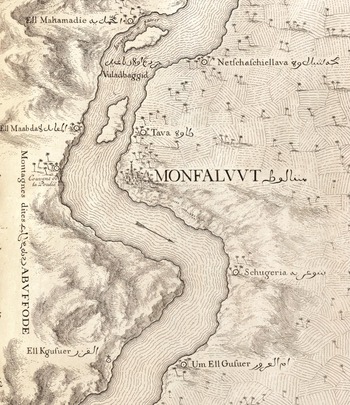
Manfalūṭ. Frederik Ludvig Norden, Voyage d'Égypte et de Nubie, par Frederic Louis Norden, ouvrage enrichi de cartes & de figures dessinées sur les lieux, par l'auteur même, 2 vols. (Copenhagen, 1755), 2: planche 80. Printed with permission from Beinecke Rare Book and Manuscript Library, Yale University.

There were no breaks during the seventy-nine days of work on the canal.Footnote 48 Although there is no clear indication of the waterway's dimensions, the length of the work period and the number of workers enumerated suggests an undeniably large project. The scale of this environmental manipulation was thus much more interventionist and ecologically transformative than that of earlier canal repair cases. The location and timing of this labor is also noteworthy. The two and a half months required for the project were spread over May, June, and July in Manfalūṭ, a southern Egyptian town where summer temperatures regularly surpassed 100 degrees Fahrenheit.Footnote 49 Taking place in one of the hottest locations in Egypt during the hottest season of the year, work on this project was no doubt grueling; and although there is no specific mention of any worker deaths or injuries, based on similar repair jobs, we can safely assume that some of the thousands of men in this case sustained injuries or died.Footnote 50 Likewise, there is no information about how all these workers were brought to the canal. Perhaps some came without resistance, but certainly the majority had to be brought by force to the worksite. These laborers, in other words, clearly experienced some amount of hardship during their work.
As in the previous case from Rosetta, here, too, the bureaucratic positioning and casting of workers in the written record of this repair job took the form of a chart enumerating the daily amount of labor used in the repair. For each of the seventy-nine entries, first the day of the week and then the date are listed. Underneath this information, the total number of workers for that day is specified. There is no other information given. The 33,412 worker days were not further delineated into classes of laborers as they had been in the Rosetta repairs. All were simply referred to as nafar (an individual man). The mass of humanity that toiled, sweat, and felt pain during this canal project had again become an empty set of numbers on a page—large numbers to say the least but numbers still. This process of turning a group of individual men (anfār, pl. of nafar) into numbers, of course, involved a great deal of force, social rupture, and violence.Footnote 51 These thousands of workers in early nineteenth-century Manfalūṭ thus functioned as “fictitious facts-on-paper” with no other identity than that of being from among al-anfār.Footnote 52 No other information is given about their origins or lives. Where were their home villages? How were they brought to work on the project? What did they do after finishing a day's work? How and where did they live while working? As numbers on a page, these workers were first stripped of their subjective identity and then recast as parts of an abstract and faceless category—that of “laborer.”
In the period of this enormous project in Manfalūṭ, it was clear enough to Egypt's majority of rural cultivators that the world around them, and the place of their labor in that world, was radically changing. After a few decades of increasingly harsh and labor-intensive projects like the one in Manfalūṭ in 1808, peasants looked to the growing state bureaucracy of Mehmet ‘Ali—Egypt's Ottoman governor general from 1805 to 1847 and the most successful of the period's provincial leaders seeking autonomy from the empire—to be their savior from the brutality and raw greed of rural elites. As we saw in Manfalūṭ, by the early nineteenth century it had become
customary for the tax farmer or his deputy to have the peasants summoned by the watchman on the evening before the morning they were needed. Those peasants who failed to appear on some pretext or another, the watchman or the supervisor dragged forth with abuse, curses and a sound beating. This was called forced labor or corvée. The peasants had grown accustomed to this; indeed they considered it to be a legitimate duty.Footnote 53
In 1812, Mehmet ‘Ali issued a decree legalizing his personal seizure of all of Egypt's tax farms, essentially making him Egypt's only sanctioned tax farmer.Footnote 54 Peasants took this as a promising sign that the power of the conniving and cruel tax farmer would now finally be checked. This expectation is what allowed a group of peasants in May 1814 to respond to a local tax farmer's demands of labor from them with the following statement: “Find someone else! I am busy with my own work! There is nothing left for you in this country! Your days are over, and we have become the pasha's [Mehmet ‘Ali's] peasants.”Footnote 55 Only a few years earlier, it would have been unthinkable for the peasants of Manfalūṭ to express such a sentiment to the rural elites who forced them to work. Still, any expectations that Mehmet ‘Ali would be a less greedy and brutal tax farmer than his predecessors were soon buried in the dirt of the largest environmental manipulation project Egypt had ever seen, the rebuilding of the Maḥmūdiyya Canal.
This canal reconstruction project embodied the multitude of transformations that had been wrought in Egypt's rural labor regime between the middle of the eighteenth century and the beginning of nineteenth. In this period, Alexandria, Egypt's second city, was not connected to the Nile valley via waterway.Footnote 56 To reach the port city from Cairo, ships had to sail down the Nile to the Mediterranean and then hug the coast west, an arduous and often dangerous undertaking.Footnote 57 The idea of connecting this hub of Mediterranean trade and commerce to Egypt's waterway network was thus a very obvious one, and there had indeed been various attempts since antiquity to construct such a canal.Footnote 58 Moreover, a freshwater conduit to Alexandria from the Nile was also desirable as a source of what proved to be all-too-often scarce drinking water for the city's residents.Footnote 59 At the end of the 1810s, Mehmet ‘Ali took to reviving earlier attempts to connect the Nile's Rosetta branch to Alexandria. His version of the canal would be named the Maḥmūdiyya Canal, after Ottoman Sultan Mahmud II (r. 1808–1839).Footnote 60
Not only was the Maḥmūdiyya the largest canal building project ever undertaken in Egypt to that point, but it was also one of the most deadly. Estimates for the canal's corvée labor range between 315,000 and 360,000 individuals.Footnote 61 To put this number in perspective, consider that the population of Cairo in 1821 was 218,560 and that that of Egypt as a whole was around 4.5 million in 1800 and 5 million in 1830.Footnote 62 Thus, more men than the total population of Cairo were forcibly moved to work on the Maḥmūdiyya Canal. Perhaps more shockingly, nearly a third of these workers—100,000 people—died during the canal's construction.Footnote 63 This was two percent of Egypt's overall population. The equivalent number of relative fatalities in the United States today would be 6 million people.
Accounts of the canal construction work make obvious why so many people died. The Egyptian chronicler al-Jabartī, a contemporary of the project, offers the following description of labor on the canal in August 1819:
He [Mehmet ‘Ali] ordered the governors of the rural districts to assemble the peasants for work, and this command was executed. They were roped together and delivered by boats, thus missing the cultivation of sorghum, which is their sustenance. This time they suffered hardship over and above what they had originally suffered. Many died from cold and fatigue. Dirt from the excavation was dumped on every peasant who fell, even if he were still alive. When the peasants had been sent back to their villages for the harvest, money was demanded from them plus a camel-load of straw for every faddān, and a kayl each of wheat and beans. They had to sell their grain at a low price but at a full measure. No sooner had they done this than they were called back to work on the canal in order to drain the extremely saline water which continued to spring from the ground. The first time they had suffered from extreme cold; now, from extreme heat and scarcity of potable water.Footnote 64
This was a new world of labor utilization.Footnote 65
In addition to its tens of thousands of deadly outcomes, the massive environmental engineering project that was the Maḥmūdiyya Canal had many other consequences as well. In a kind of infrastructural ripple effect, a whole series of other irrigation features had to be constructed or repaired in the vicinity of the canal to support its 80 km. Many basins were dug at various points along its length; there were numerous areas that needed to be reinforced with strong embankments; the lake at the canal's end was to have three new embankments built around it to go along with repairs to the six already there; numerous dams and bridges were also needed; and a series of levees and dams had to be constructed along the Mediterranean coast to the north to protect the canal and its precious sweet water from sea-surge flooding.Footnote 66 Proof of just how massive an undertaking all this was, the construction of the canal and its supporting irrigation works was the primary reason behind the establishment of the Egyptian School of Engineering in the fall of 1816.Footnote 67 Almost all of the school's early graduates worked on the Maḥmūdiyya project.Footnote 68 The financial costs of all of this were obviously enormous, as both cash and building supplies were diverted to the construction work.Footnote 69 And the wrenching demographic human costs of the project went beyond even the corvée's gargantuan number of more than 300,000 workers, since these men often came to the canal site with their families.
The environmental impacts of the construction work were also many. One of the main goals of the canal was to provide sweet drinking water for the people of Alexandria. The canal's repair, however, actually increased salinization levels in both the canal's water and the soil around it.Footnote 70 Much of the canal ran through land that had once been under the Mediterranean, and there were therefore high levels of salt already in the soil. Digging a few meters down into the earth helped to release these salts, which were then carried and distributed throughout the canal's waters. Moreover, because of the inadequate packing of various embankment walls along the canal's length, salty water regularly spilled out of the waterway onto otherwise fertile soil. Water was also lost to the canal's subsurface because of seepage through its bottom and walls. Losing salty water through the walls of the Maḥmūdiyya not only made the canal more shallow, but it also contributed to increasing salinity levels in nearby soil. A related problem was siltation. Loosely-packed walls, a weak current, and windy conditions caused the canal to silt up very quickly, making the passage of ships through its shallow waters exceptionally tricky.Footnote 71 Indeed, throughout the early 1820s ships frequently wrecked and ran aground in the canal.Footnote 72
The most significant aspect of the Maḥmūdiyya project for the subsequent history of public works and the environment in Egypt was the state imagination it embodied and reflected. In the face of such enormous costs in resources, human lives, and environmental destruction, it was only the imagination of what a canal or dam would do for Egypt that could sustain and justify such work. This imagination permeates the correspondence between Mehmet ‘Ali and Mahmud II about the canal.Footnote 73 The Maḥmūdiyya would protect Alexandria from food and water shortages, helping to make the city a vital center of commerce around the Mediterranean.Footnote 74 This new Alexandria—along, of course, with its pleasant climate and general agreeability—would attract merchants, intellectuals, and others to settle in the city. Indeed, Ottoman governors would soon make it—not Cairo—their seat of power. Thus the Maḥmūdiyya, the sultan went on to say, would change the entire meaning of Egypt itself. Instead of the word Mısır (the proper name for Egypt in Turkish) signifying the city of Cairo, a common convention, it would come to mean Alexandria.Footnote 75 The Maḥmūdiyya would thus make Alexandria Egypt's first city and capital. As it comes through in this correspondence then, public works had the power literally to redefine both the imagination and material reality of Egypt.
The Temples of Modern Egypt
The enormous social, economic, political, and environmental effects of the shifts in Egypt's labor regime that culminated in the Maḥmūdiyya project shaped Egypt for the next two centuries. Roughly every fifty years since the middle of the eighteenth century and projects like the massive 1747 repair of the grain storage facility in Rosetta, various Egyptian governments—regardless of their purported political bent, whether khedival, colonial, socialist, nationalist, neoliberal, or otherwise—have undertaken an enormous public works scheme that, like the Maḥmūdiyya project in the early nineteenth century, was meant to change both the imagination and reality of Egypt. The Suez Canal (1850s and 1860s),Footnote 76 the first Aswan Dam (1890s),Footnote 77 the Aswan High Dam (1950s and 1960s),Footnote 78 and the recent Toshka SchemeFootnote 79 are only the most prominent of these, but there are dozens of others of less fame but that had no less of an impact on Egypt's workers and environment.
The commonalities of these projects are striking. Each embodied the imagined potential of public works—and usually of water—to change both the environmental and political landscape of Egypt. In each case, Egypt was to become something radically different after the completion of a canal or dam. Another common feature of these projects was their failure. While they did in some ways meet their original intentions, their huge human, economic, and environmental costs usually far outweighed their returns. We already discussed the Maḥmūdiyya's human, ecological, and other costs. Suez exploded Egypt's foreign debt and was a contributing factor to its colonization at the end of the nineteenth century.Footnote 80 The political, economic, human, and environmental price tag of the Aswan High Dam was likewise enormous: the destruction of much of historic Nubia, increased reliance on chemical fertilizers to overcome salinization, shrinkage of the Nile Delta, over-mining of the adjacent granite hills, and massive water losses due to evaporation from Lake Nasser (to name only the most obvious problems).Footnote 81 The failure of the recent Toshka scheme demonstrates that Egyptian governments have yet to grasp—or, perhaps more accurately and troublesome, have yet to be concerned about—the colossal ecological and human costs of such massive environmental engineering ventures.Footnote 82 What is more—and this is perhaps the most nefarious result of these projects—all of these canals and dams further alienated Egyptian peasants from their lands, their labor, and the environments their families had cultivated for generations. As these projects grew exponentially in size and complexity from the Maḥmūdiyya to Toshka, bulldozers came to replace pickaxes and shovels; multinational companies replaced local village leaders; foreign laborers replaced Egyptian ones; and peasants’ knowledge and experience of canals, embankments, and soils were deemed increasingly less important for the management and harnessing of natural resources.
Thus, as political and economic power concentrated in fewer and fewer hands beginning in the second half of the eighteenth century, Egypt's peasant laborers became increasingly separated from their environments, accustomed means of work, and social forms and norms.Footnote 83 The creation and maintenance of an autonomous, centralized, and powerful state has been the primary objective of political power in Egypt since the late eighteenth century.Footnote 84 One of the consequences of this model of governance is the increasing distance between those making decisions and the impacts of those decisions. As I have tried to show in this article, the accelerating divergence between the governing and governed, embodied here, perhaps unexpectedly, in the transition from Ottoman imperial rule to a centralized Egyptian state apparatus, increased the deleterious, unforeseen, and costly effects of faraway political decisions on local peoples and environments. Older forms of labor practice and the intimate localized knowledge of thousands of village environments were gathered up, monopolized, transformed, and largely misconstrued by a modernizing, centralizing state to be put toward new massive environmental manipulation schemes. Thus the history of Egypt over the last half millennium shows how environmental labor became a primary site of contestation over, and indeed a functional key to, political and economic power.
While certainly an enormous bureaucratic structure in its own right, a model of political belonging like that of the Ottoman imperial system of environmental resource management afforded Egyptian peasants autonomy and space to control irrigation and ecology in their own local environments. This system was not a function of the largesse of the imperial state, but rather developed as a kind of negotiated settlement between the Ottomans and their peasant subjects reflecting their collective understanding that local control was the most efficient and effective means to govern natural resources and landscapes in Egypt. Such a form of government is now largely lost to us. It is, however, perhaps making a comeback. Environmentalists, government agencies, various nongovernmental organizations, and many other entities and individuals now stress the importance of local control and autonomy over natural resource management and environmental stewardship. Without romanticizing the local above all else, most today seem to agree that one size clearly cannot fit all. In contrast to what has dominated in Egypt since the turn of the nineteenth century, the Ottoman model of labor and natural resource management, like the programs of many environmental advocates today, recognized the importance and autonomy of local environmental knowledge, expertise, and work.Footnote 85 While, of course, we cannot somehow return to an Ottoman schema of labor and environmental resource management, we should recognize that other models beyond our world exist and that they might even be better.