Introduction
The predicted increase in the number of people with dementia, owing to a rapidly aging population (Alzheimer's Society, 2007), has led to concerns about whether the current provision of health and social care will cope with such an increased future demand (Macdonald and Cooper, Reference Macdonald and Cooper2007). In the U.K., policy stresses the need for autonomy and self care in the management of long-term conditions (Commission for Healthcare Audit and Inspection, 2006; Department of Health, 2006a). Assistive (or enabling) technologies provide one possible solution to promote independence as people grow older (Department of Health, 2006b). A range of devices to facilitate disease monitoring (telehealth) and enhance personal safety (telecare) already exist, particularly for people with cognitive impairment (see, for example, the information available at www.atdementia.org.uk), but their potential is still underutilized, especially in the U.K. (Audit Commission, 2004; House of Lords Select Committee on Science and Technology, 2005). In dementia care, it has been suggested that the development of such technologies, like any other aspect of care, requires a holistic, person-centered approach with users involved from the outset (Faife, Reference Faife2006). To date, older people, especially those with dementia, have rarely been involved in technology development so that user acceptability has tended to be assessed via proxy report (Robinson et al., Reference Robinson2006; Robinson et al., Reference Robinson2007b), although examples of collaborative working are now being reported (Evans et al., Reference Evans, Orpwood, Adlam, Chadd and Self2007).
In dementia, wandering is one behavior that causes considerable carer distress and may lead to earlier institutionalization (Balestreri et al., Reference Balestreri, Grossberg and Grossberg2000). However, even in the early stages of dementia, people worry about the risk of getting lost whilst trying to maintain their independence (Robinson et al., Reference Robinson2007a). Electronic tracking devices have been developed to promote safe walking for people with dementia but represent a surveillance approach rather than promoting a person-centered ethos to enhance autonomy (Robinson et al., Reference Robinson2007a). The aims of this project were twofold: (i) to create acceptable and effective prototype technologies to facilitate independence in people with dementia through user-centered, participatory design methods; and (ii) to use technology to facilitate mutual communication between the person with dementia and their families, instead of fostering an attitude of surveillance, and thus allow them to Keep in Touch Everyday (KITE).
Methods
The overarching aim of participatory design is to include the users of technology within the design process so that designers can gain unique insights into the ways in which the proposed technologies will be used and the challenges that might limit their use. Such methods have been used successfully with older people (Newell and Gregor, Reference Newell and Gregor2000; Eisma et al., Reference Eisma, Dickinson, Goodman, Syme, Tiwari and Newell2004; Massimi et al., Reference Massimi, Baecker and Wu2007), with people with dementia (Savitch and Zaphris, Reference Savitch and Zaphris2004; Hawkey et al., Reference Hawkey, Inkpen, Rockwood, McAllister and Slonim2005; Hanson et al., Reference Hanson, Magnusson, Arvidsson, Claesson, Keady and Nolan2007) and also with people with amnesia (Wu et al., Reference Wu, Richards and Baecker2004). This project comprised three stages:
• Scoping stage: to explore the experience of getting “out and about” from the perspectives of people with dementia and their family supporters and to consider the role of technology in facilitating their independence (i.e. a needs analysis).
• Participatory design workshops: to identify the aspects of functionality and design features preferred by people with dementia in future devices through scenario work and artifact analysis.
• Prototype development: to create technology prototypes, which allow people with dementia to keep in touch with their families, through a process of user feedback and refinement.
Scoping stage
The empirical phase of the scoping study involved eliciting the views of people with dementia on getting out and about, and of family carers who have experience of caring for someone with dementia (either presently or in the past). People with dementia are one of the most excluded groups in research (Wilkinson, Reference Wilkinson and Wilkinson2002). The emphasis here was placed on attempting to explore meanings, beliefs and values through the eyes of people with dementia from their distinct perspectives; for this reason, qualitative methods were considered the most appropriate. Focus groups were chosen as the primary method of data collection in this phase (Barbour and Kitzinger, Reference Barbour and Kitzinger1999). The strengths and weaknesses of such methods within qualitative research have also been well documented (Kidd and Parshall, Reference Kidd and Parshall2000; Bloor et al., Reference Bloor, Frandland, Thomas and Robson2001). However, using this method to explore the views and experiences of people with dementia has received less attention (Bamford and Bruce, Reference Bamford, Bruce and Wilkinson2002). In general, the recommended number of participants per focus group is between eight and ten (Kitzinger, Reference Kitzinger1995); it was evident from our previous research, however, that with people with dementia a smaller number of participants per group worked well (Robinson et al., Reference Robinson2007a).
Participants were recruited from voluntary organizations (Alzheimer's Society and Dementia Care Partnership) in northern areas of the U.K. The only inclusion criteria were that the participants must have dementia and be living independently in the community, either alone or with carers. The group discussions (facilitated by KB) were held in familiar surroundings within the community to ensure a sense of continuity and familiarity for the participants. The topic guide, developed in previous research (Robinson et al., Reference Robinson2007a), focused on questions about “getting out and about” and used visual prompts when asking questions concerning technology in supporting “safe walking.” The discussions, each lasting approximately 1 hour, were digitally recorded, fully transcribed and anonymized. This study adopted an inductive approach to data collection, using the constant comparative method (Glaser, Reference Glaser1965) and deviant case analysis. The texts were read and reread to identify broad and conceptually distinct coding categories relating to the research aims of the study. Coding and data collection were carried out concurrently so that emerging themes could be explored further in subsequent discussions.
Participatory design workshops
Participants from the scoping stage were invited to participate in the next stage of design workshops along with their family carers. Additional participants were also recruited to make up for any losses through drop out. The aim of these workshops was to identify the preferred aspects (design and functionality) of future technologies to enable people with dementia to maintain their independence. Our methods were theoretically informed by previous studies involving older people in participatory design (Gregor et al., Reference Gregor, Newell and Zajicek2002; Eisma et al., Reference Eisma, Dickinson, Goodman, Syme, Tiwari and Newell2004; Wu et al., Reference Wu, Richards and Baecker2004; Reference Wu, Baecker and Richards2005; Massimi et al., Reference Massimi, Baecker and Wu2007), whereby a needs analysis (scoping stage) was followed by scenario work and artifact analysis. Scenario work involved users running through best-, normal- and worst-case scenarios the features they would want a device to have to support them in these scenarios, followed by examination of existing technologies and exploration of their views on these (artifact analysis). The process of the workshops was also influenced by participatory design studies involving people with dementia (Savitch and Zaphris, Reference Savitch and Zaphris2004), with the workshops held in a familiar environment (Hawkey et al., Reference Hawkey, Inkpen, Rockwood, McAllister and Slonim2005) and in the presence of Alzheimer's Society staff (Hanson et al., Reference Hanson, Magnusson, Arvidsson, Claesson, Keady and Nolan2007).
Participants were first presented with the list of priorities that emerged from the scoping stage for discussion. They were then asked to consider (i) scenarios faced by people with dementia when they were out and about (developed from participant experiences in the scoping stage), and (ii) how technology might help them in these specific situations. The facilitator (SL) then showed participants a range of existing devices and sought their views. The devices were used to develop a dialogue around what the person would be happy to carry and the features they liked/disliked. The issue of privacy around the use of location technologies was explored at this juncture. During this stage we sought volunteers who would be enthusiastic and willing to participate in the next stage of prototype development. Two people with dementia, and one of their carers, volunteered to participate.
Prototype development stage
The two people with dementia involved in this stage of the project were a woman living alone, who was still driving (subsequently referred to as the Driver), and a man who enjoyed running (subsequently referred to as the Runner) and his wife, who was his main carer. They participated in four meetings which aimed to elicit feedback on emerging designs and prototypes. The important concepts emerging from the earlier stages allowed the designers (PL, SL, DJ) to develop paper prototypes which were presented to the users in the first development meeting to gain their opinions. During subsequent meetings working prototypes were created and an ongoing process of feedback and subsequent refinement of the prototypes ensued until the final design meeting, when physical assembly of the prototypes was completed.
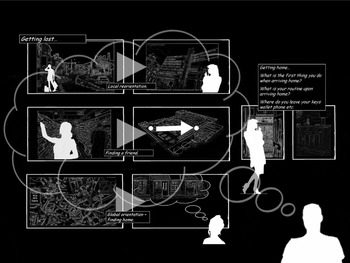
In addition to eliciting users' views on the design, the medium of storyboarding (Figure 1) was employed to explore how best to ensure the devices became fully integrated into the individual's routine.
Sample storyboard from Stage 3.

The storyboarding process allowed for an in-depth exploration of users' routines in order to identify, for example, possible recharging locations within the home to ensure users would remember to take their devices with them on leaving and put the device on to charge on their return.
Results
Scoping stage: Five focus groups were carried out (n = 25 participants; 10 people with dementia (PWD), 11 carers and 4 Alzheimer's Society volunteers). Two groups comprised people with dementia only, two groups' carers only, and the last group included a mix of both.
Perspectives of the person with dementia
People with mild to moderate dementia experience considerable independence, enjoying a variety of activities both on their own and with their families. These included walking, running and driving, and highlight how people with dementia try to carry on with their usual activities.
“I just take my time, sometimes stop for a cup of tea, and I'm probably away and that for two hours, and then come back.” (PWD, male)
“But B likes jogging and walking and walking the dog . . . that's his route of mobility apart from when I'm not there, you know, when I'm home.” (Wife of PWD)
However, concerns included getting lost, a loss of confidence with curtailment of usual activities, and carer anxiety.
“Walks, yeah, I used to walk for miles, but my family don't want me to go away far, you know, . . . they're frightened, but I'm not, I'm not.” (PWD, male)
“It's like a fear of getting lost . . . I want to do it, I just can't do it.” (PWD, female)
Although some participants spoke about their anxieties of getting out and about, there were others who highlighted how they overcame the feeling of being unsure.
“If you go the wrong way [in the car] you just have to turn around and just back out.” (PWD, male)
The carer's perspective
Many participating carers recounted occasions when they didn't know where the person they cared for was. In some cases this led to a change of routine, often with curtailment of their relative's activities (i.e. ensuring that doors were locked and keys removed).
“It was a bitter cold night, so now I lock the door at night and take the key out so he can't get out.” (Carer, female)
Invariably, the person with dementia headed back to their home, but the delay caused carers considerable distress.
Participants' views on existing technology
Participants talked about the use of identity cards if they were unsure where they were and needed to ask for help. Existing technology (mobile phones, identity cards) were used intermittently. Potential barriers to using technology included the challenge of incorporating technology into their everyday lives and whether or not they remembered to take the device with them. Another barrier was the weight and size of any device. If it was perceived to constrain the activities of the person in any way then it was unlikely to be used.
“Put it [mobile phone] in his pocket, and he's got zip pockets, but the weight bothers him so he will take his mobile out and leave it in the house.” (Wife of PWD)
However, some forms of technology were not ethically acceptable to some people with dementia, as in the case quoted below where the person felt being “tagged or tracked” would take her freedom away.
“Because it makes you feel like your freedom is taken away from you, and if somebody sees you have a card or something, they think well, I'm stupid you know.” (PWD, female)
Participants suggested areas for improvement, for example two-way communications, flexibility of function as the illness progresses, and something to “guide” them home when walking or driving. They felt that future devices should integrate easily into their daily routine; however, attention was needed to size, weight and visibility to reduce stigmatization. The desire for the device to be discreet also emerged, perhaps by being disguised as an everyday object.
“Something quite discreet, you know where you could just quietly talk to it . . . And it wouldn't be so obvious would it because they are things that people are using a lot in cars now.” (PWD, female)
Participatory design workshops
Five workshops were held. Owing to some participants declining to be involved in this stage, two new groups were recruited. Two workshops were with people with dementia only (n = 8), one with carers only (n = 7) and two were mixed groups (4 PWD, 3 carers); each participant attended a single workshop. A major theme emerging from the workshops was the realization that technology had the potential to address a wide range of issues, but that a single piece of technology could not hope to meet all possible requirements. A number of possible roles for technology to facilitate the independence of people with dementia were identified:
• to allow them to help themselves without having to turn to others;
• to allow them to talk to someone else should they become lost and feel unable to help themselves;
• to provide a panic button so that help comes automatically should they be unable to explain to anyone where they are and/or where they need to get to.
In addition, the workshops revealed that solutions should ideally be tailored to individual need. At this stage, one key area of concern was discovering why a mobile telephone (one of the technologies presented) was not used when the priorities identified from the scoping stage seemed to be met by such a readily available device. It emerged that although many older people had mobile telephones, they didn't routinely keep them switched on and so could not rely on them in emergencies. Unsurprisingly, many participants raised the issue of simplicity, finding mobile telephones too awkward to use, as they had never used them before their illness. Another concern was forgetting the phone and forgetting to charge it. Thus, it was essential that the device be integrated into the user's daily routine. In contrast, the simple and attractive external design of an iPod nano was unanimously considered aesthetically pleasing, the only concern was it was so small, it might be lost. The concept of having the technology disguised as an everyday object was again highlighted. Most participants were not unduly concerned about whether or not their movements were tracked as long as the information was sent to someone they chose. A few participants, however, were reluctant to carry any device of any kind.
Prototype development stage
Based on the results from the two earlier stages, it appeared key to the success of the project that any new devices should be disguised as every day objects which would easily integrate into the user's daily routine. After a review of existing devices by the project team, it was apparent that none would fulfill this criterion.
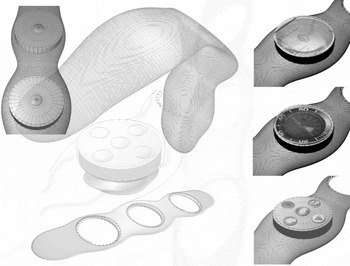
The initial designs presented were an electronic reminder system for the Driver, incorporating Global Positioning System (GPS) tracking; and something very similar to a runner's watch for the Runner, which could act as a pedometer (to monitor running distance) as well as having GPS features built into it (Figure 2). Unfortunately, the Runner did not want to wear a second watch. Placing the device inside his running shoe was an option; however, he had several pairs of running shoes and so this idea was dismissed. The Runner did have a mobile phone but found it too heavy to carry during running. The idea of an armband was thus agreed upon.
Runner: concept design.

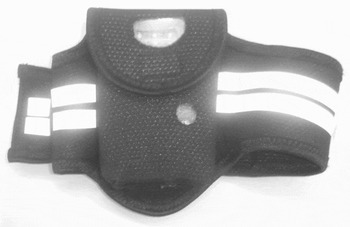
For the Driver, it was decided not to embed a device in her car. She wished to have the device always with her so that she could also use it whilst walking or on public transport. Having discovered that the Driver frequently used a notebook to aid her daily activities, her device was modified to resemble a physical notebook with the device built into it. In the final meeting, participants were presented with their individual completed prototypes (Figure 3), asked their opinions and if they would agree to trial the devices for a short period of time. The Driver's book measured 13 cm × 4.6 cm × 10 cm; the Runner's device was 9.5 cm × 7.4 cm × 3.5 cm on an armband 6.5 cm wide.
Runner: final device.

Technology requirements
It became clear during the initial development that the project devices would require some form of tracking technology. Review of existing technologies for locating people revealed that a combination of both GPS and Global coMmunication System (GMS) technologies should be used. Conveniently, as GPS signal drops off in built-up areas GSM signal strength often increases, making accurate location more likely. Also, should the GSM chip be unable to receive a signal (not uncommon in built-up areas), the system can still locate the device through use of the GSM signal via a web-based service.
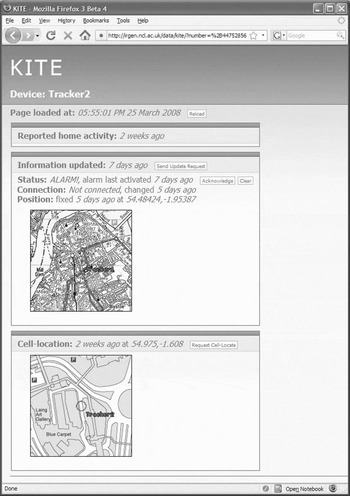
The technology system we produced incorporated shared aspects of GPS and GMS. It is a chip-set encased in silicone, with a single button for emergency signals and LEDs to signal if the device is switched on or sending an alarm. The device continuously reports the location of the user to a central web-server which, when interrogated, will transmit the last known location for the device to a mobile phone or computer (Figure 4). If someone with dementia becomes concerned or feels they are lost, they can trigger the device to send a message by pressing their panic button. The message will go, via the server, to the mobile phone of their carer, who will be alerted by a text message linking them to a map showing the most recent location for the device. The carer is also able to identify the location of the person with dementia at any time. This was achieved through collaboration with existing local telecare solutions (Tynetec, see www.tynetec.co.uk).
KITE Interface Screen Shot: Location.

Device appearance and user feedback
The Runner and his wife commented initially on the large size of their device. However, overall he liked the look of the device (see Figure 3) and agreed to trial it on a run. Unfortunately the device slipped down his arm whether he wore it next to his skin or over clothing; this seemed to be related to its weight. Aside from this, the design and functionality of the device worked well for him. The Runner's wife was concerned about the nature of information fed back to her. She felt that the phone-based map would be difficult to follow whilst driving and suggested it should report a postcode location which could then be put into her GPS system.
Similarly, the Driver's initial reaction was that the notepad was too large; it did not fit into the small bag she usually carried or in her coat pockets. The Driver was worried that the panic button on the device might be too easy to press although, following explanation of the safeguards, she became less concerned. She also felt that having her address and telephone number printed inside the device was beneficial, and could actually help her to re-orientate herself if she were to become confused. Despite her concerns about the size, she liked the concept and the style of the device.
Discussion
In this study prototypes for two technologies (armband and electronic notepad) to facilitate independence for individuals with dementia were developed. Although these were both highly individualized, the devices incorporated characteristics and aspects of functionality that were identified as extremely important to the larger forum of participants in the earlier stages of the project. These included the device being disguised as an everyday object, the ability to have two way communications with carers and to be located should they become lost or confused. A key aspect for both prototypes was size; ongoing work has already produced a smaller prototype chip which could be housed in a much smaller exterior casing. Despite the size of the objects, the users gave positive feedback. However, we must acknowledge that longer-term evaluation is required to ascertain whether the devices would be used regularly and become truly integrated into daily life.
This study has confirmed previous research that people with dementia are enthusiastic about technology design; facilitating factors include the use of a “known environment” (Hawkey et al., Reference Hawkey, Inkpen, Rockwood, McAllister and Slonim2005) and the presence of familiar faces, i.e. people experienced in working with people with dementia (Hanson et al., Reference Hanson, Magnusson, Arvidsson, Claesson, Keady and Nolan2007). Although the devices were built for specific individuals, their development adhered to principles developed from the involvement of larger groups of older people, in particular those with dementia, in participatory design techniques (Newell and Gregor, Reference Newell and Gregor2000; Wu et al., Reference Wu, Richards and Baecker2004). Although not an issue in our study, previous inclusive design projects with people with dementia have observed that they may become distressed if a prototype does not work. Also, some projects have involved family carers in the initial stages prior to involving the person with dementia (Orpwood et al., Reference Orpwood, Gibbs, Adlam, Faulkner and Meegahawatte2005), which may be related to the stage of illness reached by the participants with dementia.
We need to explore how mass customization techniques can be used to develop and deliver personalized devices, which can be quickly configured and locally manufactured, with all the functional elements essential for an individual device (Childs et al., Reference Childs, Dalgarno and McKay2006). In addition, the focus of this project has largely been on the development of the devices; further work is required both to ensure their effectiveness in a variety of geographical locations and to develop a truly user-friendly interface for the carers to ensure they understand the information being received.
In terms of the potential for commercialization of such mobile Location Based Services (LBS), it is predicted that revenue will reach $13.3 billion worldwide by 2013 (ABI Research, 2008). The accelerated development of LBS technologies suggests that the time is right for the development of specific market solutions, such as the location and safety of people with dementia and older people in general. By combining rapidly developing technology with a user-centered design approach companies have a real commercial opportunity to create next generation technologies which meet the needs of our aging populations. More importantly, from a community care perspective, there is a greater chance that such new technologies will be used by older people and not left on the bedside table; although about £10 billion is currently spent on social care equipment in the U.K., it is thought that many of these aids and devices remain unused (Audit Commission, 2000).
By including people with dementia and their caregivers in the technology development process from conception through to conclusion, we have created devices that address individual need but which still have some technical limitations (e.g. making the technology sufficiently small to fit into an acceptably sized casing). People with mild to moderate dementia are eminently capable of providing valuable feedback in the design of such technologies, and we trust that this study encourages their greater involvement in future. The value of such novel technological approaches to facilitate autonomy in our aging populations should be further encouraged (Evans et al., Reference Evans, Orpwood, Adlam, Chadd and Self2007) in view of the impending crisis in long-term care provision and our need to explore alternative, innovative solutions to the challenges of future social care provision (Wanless, Reference Wanless2006).
Conflict of interest
None
Description of authors' roles
The project was conceived by LR and PO. KB conducted the scoping stage of the project and was responsible for data collection and analysis; SL, DJ and PO were responsible for the design workshops and prototype development of the assistive technologies. All authors contributed to the writing of this paper.
Acknowledgments
We offer our grateful thanks to all the study participants for their time and enthusiastic input, and we thank in particular the Alzheimer's Society and the Dementia Care Partnership. In terms of design and technical expertise, we are extremely grateful to Tony Platten from Tynetec Limited for technical assistance, Cas Ladha (electronics design), Martyn Dade-Robertson (design), Barbara Romanis-Watson (pattern making) and Alex Antonopoulou (graphic design), and to Catherine Brennand for administrative expertise. We also thank Caroline Findlay and Stuart Colmer, Centre for Excellence and Life Sciences (CELS), Newcastle upon Tyne for their project management expertise.
This project was funded by the Centre for Excellence and Life Sciences (CELS), Newcastle upon Tyne.