1. Introduction
Particle-laden flows are seen widely in nature and industrial processes, such as suspensions (Brandt & Coletti Reference Brandt and Coletti2022), weather forecasting (Li et al. Reference Li, Lim, Berk, Abraham, Heisel, Guala, Coletti and Hong2022) and deep-sea mining (James, Mingotti & Woods Reference James, Mingotti and Woods2022). To investigate these complicated multi-phase flows, it is crucial to gain insight into the dynamics at the particle scale so as to interpret the rheological properties and establish dispersed two-phase flow models (Tsai Reference Tsai2022). Here, the particles refer to granules, droplets or bubbles, which have either negligible or finite inertia and a length scale much larger than a micrometre. In particular, suspended particles in a linear shear flow serves as a flow model for the study of microscopic behaviour of very dilute particulate flows, and has been a longstanding topic of research.
It is known that distinct particles experience very different dynamic processes in shear flows. For example, rigid particles rotate in linear shear flows, and the rotation dynamics is characterised by the shear rate  $\dot {\gamma }$ and the aspect ratio
 $\lambda$ of the particle (Leal Reference Leal1980; Voth & Soldati Reference Voth and Soldati2017). In particular, an analytical solution of the particle rotation was provided by Jeffery (Reference Jeffery1922) for ellipsoidal particles, with the assumptions that inertia of both the fluid and particle are negligible, and that the axis of rotation is one of the principal axes of the ellipsoid and also parallel to the vorticity of the shear flow (Cox & Mason Reference Cox and Mason1971). The rotation period
 $t_R$ and the orientation angle
 $\theta$ of ellipsoidal particles can be correlated to
 $\dot {\gamma }$ and
 $\lambda$ by
 \begin{equation}
t_R=2{\rm \pi}{\dot{\gamma}}^{{-}1}(\lambda+\lambda^{{-}1}),\quad
\theta(t)=\arctan\big(\lambda^{{-}1}\tan(\dot{\gamma}t/(\lambda+\lambda^{{-}1}))\big).
\end{equation}
Although Jeffery's theory was obtained for ellipsoidal particles (three-dimensional, 3-D), it was found to be independent of the scale of the ellipsoid in the vorticity direction (Zettner & Yoda Reference Zettner and Yoda2001). Moreover, (1.1a,b) have been shown to give a good prediction of the rotation period for elliptical cylinders (two-dimensional, 2-D) with finite inertia, e.g. in experiments (Zettner & Yoda Reference Zettner and Yoda2001) and numerical simulations (Aidun, Lu & Ding Reference Aidun, Lu and Ding1998; Ding & Aidun Reference Ding and Aidun2000; Li, Ye & Liu Reference Li, Ye and Liu2016). Later, Jeffery's theory was extended to the rotation prediction of slender particles by introducing an effective shape ratio (Cox Reference Cox1971). Different leading-order corrections of finite inertia effect to  $t_R$ of a neutrally buoyant ellipsoid were also proposed (Mao & Alexeev Reference Mao and Alexeev2014; Dabade, Marath & Subramanian Reference Dabade, Marath and Subramanian2016; Marath & Subramanian Reference Marath and Subramanian2017). By contrast, droplets/bubbles deform in linear shear flows, and end up resting in steady flows or breaking up when viscous force exerted by the surrounding fluid dominates surface tension (Stone Reference Stone1994). The dynamics of droplets in shear is characterised by droplet deformation, resulting from the competition among viscous shear, inertia and surface tension (Singh & Sarkar Reference Singh and Sarkar2011; Singeetham, Chaithanya & Thampi Reference Singeetham, Chaithanya and Thampi2021; Yi et al. Reference Yi, Wang, van Vuren, Lohse, Risso, Toschi and Sun2022). More specifically, the deformation of a droplet with finite inertia was shown to be linearly dependent on the viscous force arising from the surrounding fluid, for both 2-D (Yue et al. Reference Yue, Feng, Liu and Shen2004; Hu & Adams Reference Hu and Adams2007; Luo, Hu & Adams Reference Luo, Hu and Adams2015) and 3-D (Taylor Reference Taylor1932; Liu et al. Reference Liu, Ng, Chong, Lohse and Verzicco2021) droplets with small deformations.
More complicated dispersed phases, such as Janus drops, have attracted the attention of researchers, due mainly to their wide applications, e.g. biomedicine (Hao et al. Reference Hao, Du, He, Yang, Wang, Liu and Wang2022), drug delivery (Song et al. Reference Song, Chao, Zhang and Shum2021) and material science (Wei et al. Reference Wei, Jeong, Collings and Todh2022). Here, Janus droplets refer to compound drops consisting of two component droplets (of different fluids) in contact. Fluid motion for Janus drops with ‘ideal’ shape (spherical with a flat, internal interface separating the two droplets of equal size) has been analysed theoretically in the absence of inertia and in the limit of non-deformable interfaces (Shklyaev et al. Reference Shklyaev, Ivantsov, Díaz-Maldonado and Córdova-Figueroa2013). The Janus drops were found to behave as a simple fluid drop or as a solid body with broken fore and aft symmetry (Díaz-Maldonado & Córdova-Figueroa Reference Díaz-Maldonado and Córdova-Figueroa2015). Moreover, recent simulations indicated that Janus drops in shear may experience periodical rotation and deformation at the same time, after being formed from the collision between two equal-sized immiscible droplets (Liu & Park Reference Liu and Park2022). However, flow mechanisms about the dynamics of rotating Janus drops in shear remain unclear, e.g. the coupling between drop deformation and rotation, and the effect of finite inertia on the drop deformation. More importantly, a unified prediction of the rotation period of solid particles and Janus drops has not been explored yet.
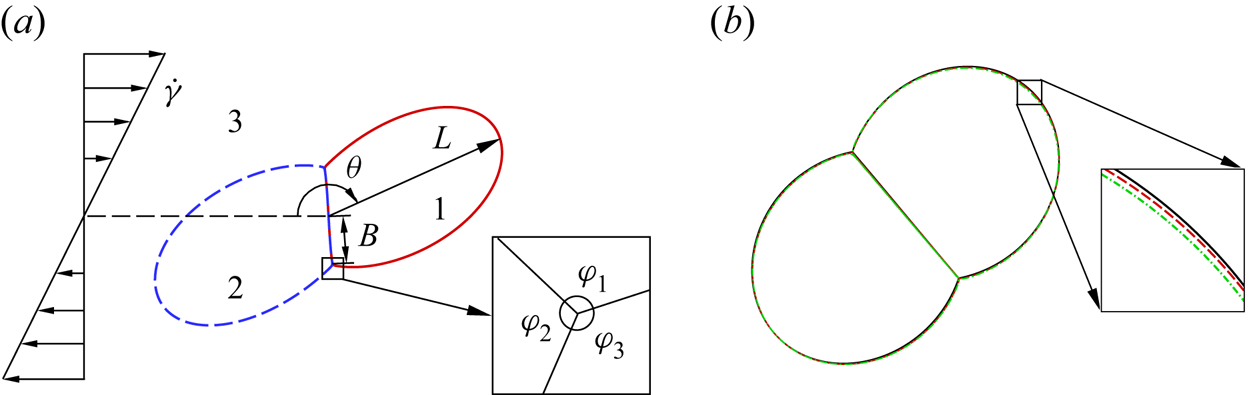
In this work, the dynamics of 2-D Janus drops in shear flow is studied numerically using a ternary fluid diffuse interface method (Zhang et al. Reference Zhang, Ding, Gao and Wu2016). For simplification of the flow problems, we focus on only the Janus drops that have two component droplets with equal size and the same viscosities and surface tensions, as shown in figure 1(a). As a result, the deformation of Janus drops is expected to be rotationally symmetric. A new deformation parameter is proposed to describe the deformation pattern of rotating Janus drops, and different rotation behaviours of Janus drops with small and large deformation are investigated. The correlation among the shear rate, deformation parameter and rotation period of Janus drops is analysed based on the numerical results. Consequently, we establish a theoretical model for rotating Janus drops in a manner similar to that for elliptic rigid particles.
(a) A sketch of a Janus drop in shear flow where  $\varphi_i$ is the interfacial angle of fluid
 $i$ at the triple-phase line where the ternary fluids meet. (b) Convergence study with respect to the most elongated drop with
 $Re=0.2$ and
 $Ca=0.05$. Different curves denote the numerical results with different mesh resolutions:
 $h/R = 0.02$ (dash-dotted), 0.01 (dashed) and 0.005 (solid), respectively. The inset shows a zoomed-in view of the interface.

2. Problem statement and numerical methods
2.1. Problem statement
We consider a 2-D neutrally buoyant Janus drop (with density  $\rho$) in shear flow (figure 1a). The Janus drop consists of two immiscible droplets
 $1$ and
 $2$ of equal size
 ${\rm \pi} R^2$, where
 $R$ is the effective radius of the droplets. The Janus drop is located in the middle of two flat plates that move in opposite directions, and is surrounded by fluid
 $3$ in a domain measuring
 $12R\times 12R$. The initial flow field is
 ${\boldsymbol {U}}_0 = ((y-6)\dot {\gamma }R, 0)$. The two droplets have the same viscosity
 $\mu _1$, and fluid
 $3$ has viscosity
 $\mu _3$. The surface tension coefficient between fluids
 $i$ and
 $j$ is denoted by
 $\sigma _{ij}$. In the present study, we assume
 $\sigma _{13}=\sigma _{23}$, and vary the value of
 $\sigma _{12}$ to get different equilibrium shapes of Janus drops. The geometry parameters of Janus drops are shown in figure 1, including the length of the Janus drop,
 $L$, and the length of the internal interface,
 $B$. The orientation angle
 $\theta$ is defined as the angle at which the horizontal intersects the line connecting the centres of the two component droplets. Initially, the Janus drop assumes an equilibrium shape, and the corresponding geometry parameters are
 $L_0$ and
 $B_0$, which can be obtained analytically from
 $\sigma _{12}/\sigma _{13}$ and the volume
 $2{\rm \pi} R^2$, e.g.
 $L_0=1.672R$ and
 $B_0=0.966R$ for
 $\sigma _{12}=\sigma _{13}$. Details of calculation of
 $L_0$ and
 $B_0$ can be found in Appendix A. The dynamics can be described by two dimensionless parameters: capillary number
 $Ca=\mu _3 \dot {\gamma } R/ \sigma _{13}$, and Reynolds number
 $Re=\rho \dot {\gamma } R^2 / \mu _3$. The ranges of dimensionless parameters investigated in this work are
 $0.01\le Ca\le 0.8$ and
 $0.1\le Re\le 2$. Unless stated otherwise,
 $\mu _1=\mu _3$ and
 $\sigma _{12}=\sigma _{13}$ are used in the present study.
2.2. Numerical methods
A ternary fluid diffuse interface method is used to track the interface evolution (Zhang et al. Reference Zhang, Ding, Gao and Wu2016). The interfaces are represented by volume fractions of the fluids,  $\boldsymbol {C}=(C_1, C_2)$, where
 $C_i$ represents the volume fraction of the
 $i$th fluid, and
 $C_1+C_2+C_3=1$. Time evolution of
 ${\boldsymbol {C}}$ is governed by the dimensionless Cahn–Hilliard equation,
 \begin{equation} \frac{\partial \boldsymbol{C}}{\partial t}+\boldsymbol{\nabla} \boldsymbol{\cdot}({\boldsymbol{u C}})=\frac{1}{Pe}\,\nabla^2 (\varPsi-C_1C_2C_3), \end{equation}
where  $\boldsymbol {u}$ is the flow velocity; the chemical potential
 $\varPsi =(\psi _1, \psi _2)$ is defined as
 \begin{equation} \psi_i=C_i^{3}-1.5C_i^{2}+0.5 C_i- Cn^{2}\nabla^2 C_i,\quad i=1, 2, \end{equation}
where the Cahn number  $Cn$ represents a dimensionless measure of the thickness of the diffuse interfaces (Ding, Spelt & Shu Reference Ding, Spelt and Shu2007). The Cahn number is set to
 $Cn=0.7h/R$, so that both a relatively narrow diffuse interface and a well-resolved surface tension can be achieved in simulations, where
 $h$ is the mesh size. The Péclet number
 $Pe$ represents the relative significance of convective fluxes to the diffusive fluxes. The diffuse interface model approaches the sharp interface limit with the vanishing of
 $Cn$ for
 $Pe \sim Cn^{-1}$ (Magaletti et al. Reference Magaletti, Picano, Chinappi, Marino and Casciola2013), thus
 $Pe = 1/Cn$ is adopted in the present study. The motion of fluids is governed by the Navier–Stokes equations and the continuity equation. Details about numerical implementation can be found in Zhang et al. (Reference Zhang, Ding, Gao and Wu2016). The boundary conditions are: no-slip condition at the upper and bottom boundaries with a constant speed
 $6\dot {\gamma } R$ but in the opposite direction; and periodic condition at the left and right boundaries. The method has been verified quantitatively previously, e.g. compound drop impacting onto a flat plate (Liu et al. Reference Liu, Zhang, Gao, Lu and Ding2018) and configuration transition of sessile compound drops (Zhang et al. Reference Zhang, Gao, Li and Ding2021). The convergence of numerical results with mesh refinement (
 $h = 0.02R$,
 $0.01R$ and
 $0.005R$) is also checked (figure 1b), thus
 $h = 0.01R$ is used in the simulations hereafter.
3. Results and discussion
3.1. Flow regimes of Janus drops in shear flow
Figure 2 shows numerical results of Janus drops and a pure drop in shear flows at  $Re=0.2$, with respect to velocity vectors and interface shapes. Two flow regimes can be identified, namely rotation and breakup, according to the morphology of the Janus drops. In the rotation regime, the drop rotates periodically, accompanied with continuous drop deformation (cf.
 $Ca=0.07$ and
 $0.35$ in figures 2a and 2b, respectively). At relatively small
 $Ca$ (
 $=0.07$), a vortex persists inside the rotating Janus drop, with rotation period
 $t_R\approx 15.8 \dot {\gamma }^{-1}$; at a relatively larger
 $Ca$ (
 $=0.35$), the Janus drop experiences more significant deformation and a longer rotation period (
 $t_R\approx 42.8 \dot {\gamma }^{-1}$). The flow features are also different: only one vortex when the drop is squeezed the most, which also corresponds to the moment of fast rotation; moreover, we can see one vortex contained in each component droplet at the maximum elongation, which implies that the Janus drop rotates very slowly at this moment. As shown in the supplementary movies available at https://doi.org/10.1017/jfm.2023.963, the rotation dynamics of the Janus drop at
 $Ca=0.35$ is more closely coupled with its deformation than that at
 $Ca=0.07$. When
 $Ca$ is increased further (e.g.
 $Ca=0.40$), the Janus drop could elongate continuously and end up with the separation of the two component droplets (see figure 2c), i.e. the breakup regime. It is noteworthy that the behaviour of Janus drops in shear is remarkably different from that of pure drops. For example, a pure drop (of the same size as the Janus drop,
 $2{\rm \pi} R^2$) at
 $Ca=0.07$ is elongated by shear flow, and moreover, its eventual shape does not change with time (see figure 2d).
Dynamics of Janus drops and a pure drop in shear flow at  $Re=0.2$. (a) Rotating Janus drop at
 ${Ca=0.07}$. The snapshots from (a i–a iv) correspond to times
 $\dot {\gamma }t = 5.4, 10.3, 13.3, 18.2$, respectively.(b) Rotating Janus drop at
 $Ca=0.35$. The snapshots are
 $\dot {\gamma }t=11.3, 24.7, 32.7, 46.1$ for (b i–b iv), respectively. (c) Breakup of Janus drops at
 $Ca=0.40$. The snapshots correspond to
 $\dot {\gamma }t=8.0$ and
 $30.9$, respectively.(d) Deformed pure drop (of size
 $2{\rm \pi} R^2$) in shear flow at
 $Ca=0.07$. The reference velocity is shown in (a i).

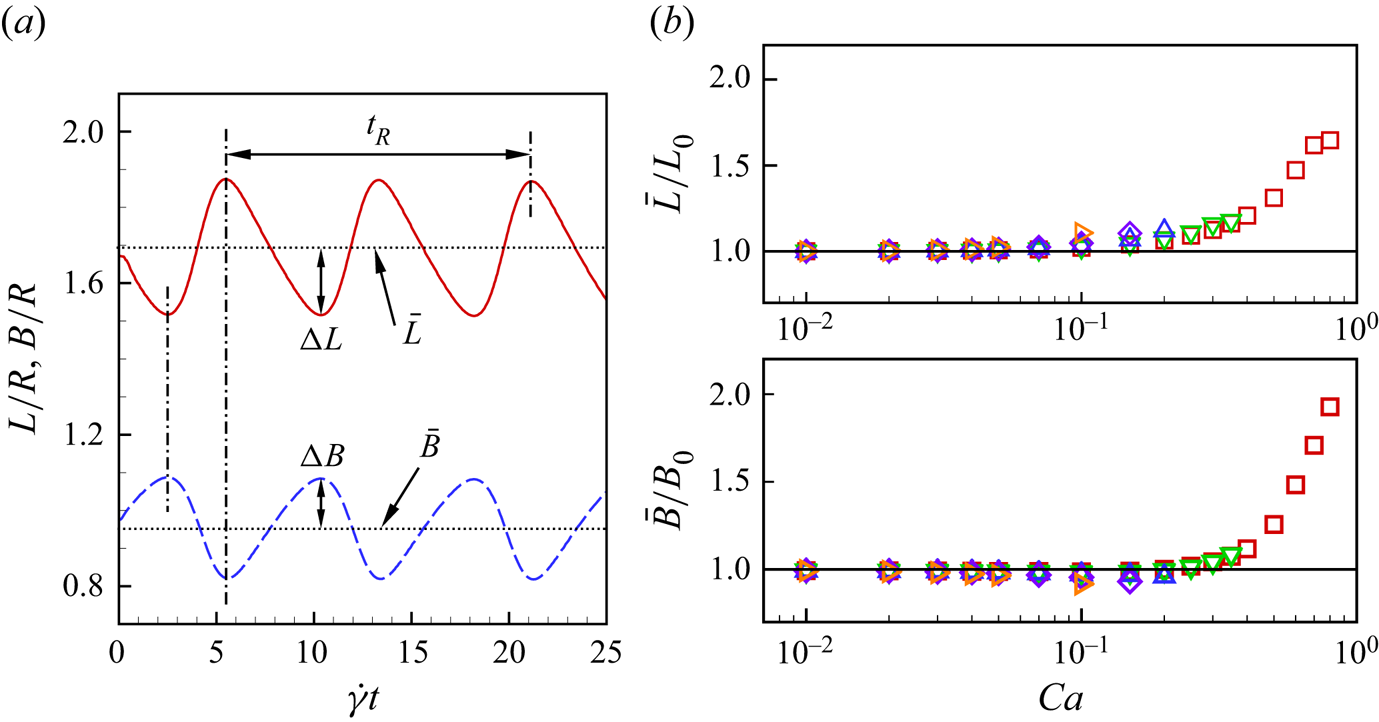
Figure 3(a) shows the dynamics of a rotating Janus drop at  $Re=0.2$ and
 $Ca=0.07$, with respect to the evolution of
 $L$ and
 $B$. We can see that
 $L$ and
 $B$ evolve in an anti-phase manner, which means that the maximum value of
 $L$ (
 $B$) and the minimum value of
 $B$ (
 $L$) occur at the same time. The deformation dynamics of the Janus drop is shown in figure 3(b), with respect to the averaged values (
 $\bar {L}$ and
 $\bar {B}$) of the geometry parameters as a function of
 $Ca$ for different
 $Re$. We find
 $\bar {L} \approx L_0$ and
 $\bar {B}\approx B_0$ at small
 $Ca$ (e.g.
 $Ca<0.1$), and
 $\bar {L}>L_0$ and
 $\bar {B}>B_0$ at relatively large
 $Ca$. Herein, we refer to the former as linear deformation, and the latter as nonlinear deformation.
(a) Temporal evolution of  $L$ and
 $B$ at
 $Re=0.2$ and
 $Ca=0.07$. (b) Numerical results for
 $\bar {L}$ and
 $\bar {B}$ for different
 $Re$: 0.1 (
 $\square$), 0.2 (
 $\triangledown$), 0.5 (
 $\vartriangle$), 1.0 (
 $\diamond$) and 2.0 (
 $\triangleright$).

In order to assess quantitatively the deformation and rotation of Janus drops, we define a new deformation parameter,
 \begin{equation} D=\frac{B_0L-L_0B}{B_0L+L_0B}. \end{equation}
It is straightforward to get  $D=0$ for a Janus drop at equilibrium such that the maximum value of
 $D$,
 $D_{max}$, occurs at the maximum elongation of the Janus drop and yields
 \begin{equation} D_{max}=\frac{(\bar{L}+\Delta L)B_0-(\bar{B}-\Delta B)L_0}{(\bar{L}+\Delta L)B_0+(\bar{B}-\Delta B)L_0}. \end{equation}
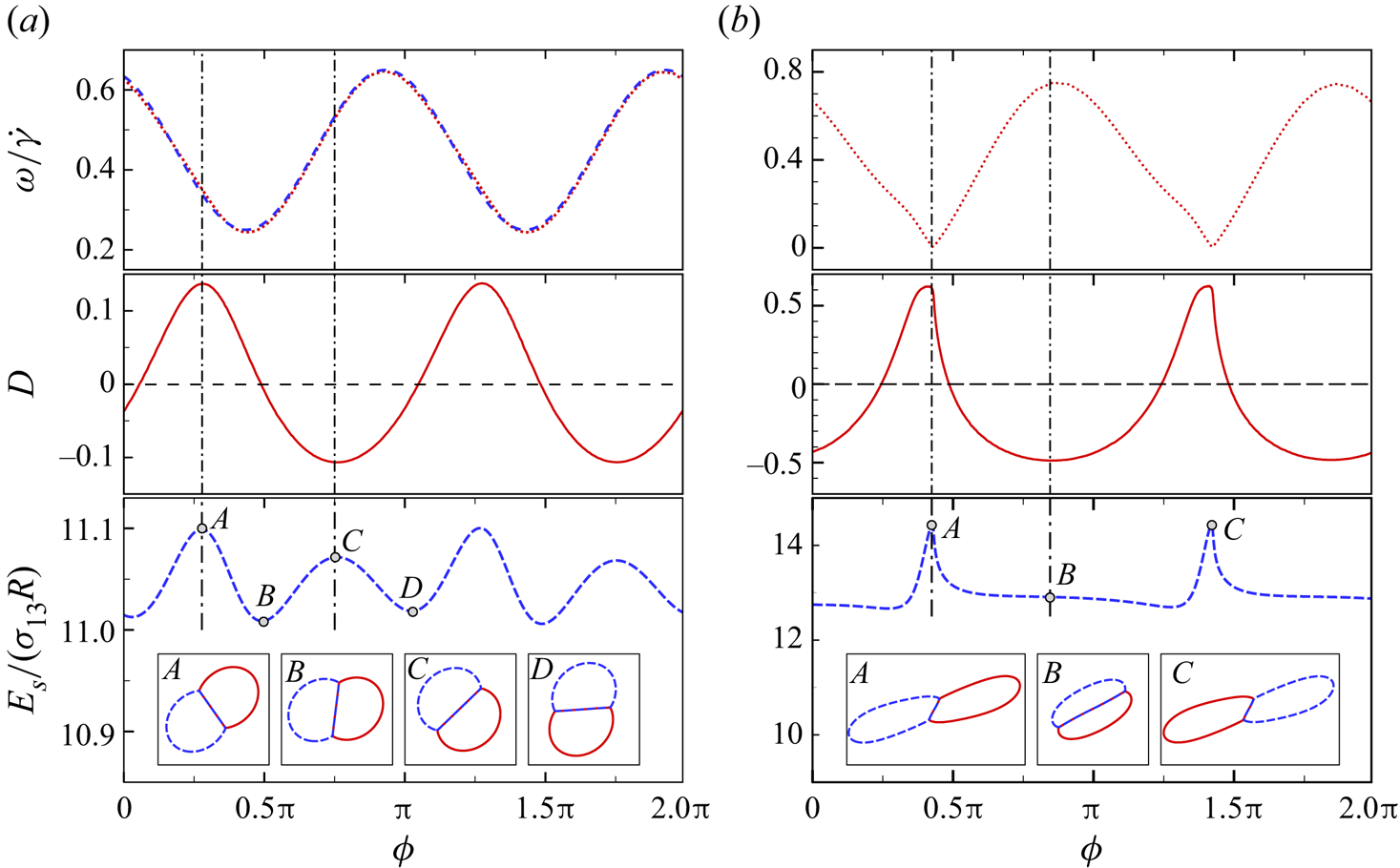
Figure 4 presents the variation of  $D$, the rotation velocity
 $\omega$ (
 $=\text {d} \theta /\text {d}t$) and the surface energy
 $E_s$ of Janus drops in one rotation period with respect to the phase
 $\phi$ at
 $Re=0.2$ and different
 $Ca$, including typical cases of drops with linear deformation (
 $Ca=0.07$) and nonlinear deformation (
 $Ca=0.35$). Here,
 $E_s=\int _{S}\sigma \,{\rm d}l$, where
 $S$ is the area of the drop surface; because
 $\sigma _{12}=\sigma _{13}=\sigma _{23}$ in this case,
 $E_s$ is determined solely by the total area of the drop surface. Several observations can be made about figure 4. First, the variation of
 $\omega$ for drops with linear deformation is close to a harmonic function, and has a noticeable phase difference from
 $D$. By contrast, the variation of
 $\omega$ for drops with nonlinear deformation deviates significantly from harmonic functions, and appears to synchronize with the change of
 $D$. In particular,
 $\omega$ reaches its peak value at the smallest
 $D$, and reaches its lowest value (close to zero) at the largest
 $D$ (namely
 $D_{max}$). Second, the occurrence of
 $D_{max}$ coincides with the apex of
 $E_s$. However, the smallest
 $D$ corresponds not to the lowest
 $E_s$, but to the second peak of
 $E_s$. Note that the lowest
 $E_s$ corresponds to
 $D\approx 0$. From the observations above, we can see that the rotation of Janus drops is coupled with drop deformation, and the coupling is strengthened with increasing
 $Ca$. Third, the compression process (
 $D<0$) is longer than the elongation one (
 $D>0$). This tendency is intensified in the regime of nonlinear deformation.
Variation of  $\omega$,
 $D$ and
 $E_s$ as functions of phase
 $\phi$ (
 $=\theta -{\rm \pi} /2$) in one rotation period, with
 $Re=0.2$ and two different
 $Ca$: (a)
 $Ca=0.07$ and (b)
 $Ca=0.35$. The variation of
 $\omega$ (dotted line) is close to a harmonic function (dashed line). The insets show snapshots of the interfacial shapes of the Janus drops at the extreme points of
 $E_S$.

3.2. Deformation of rotating Janus drops
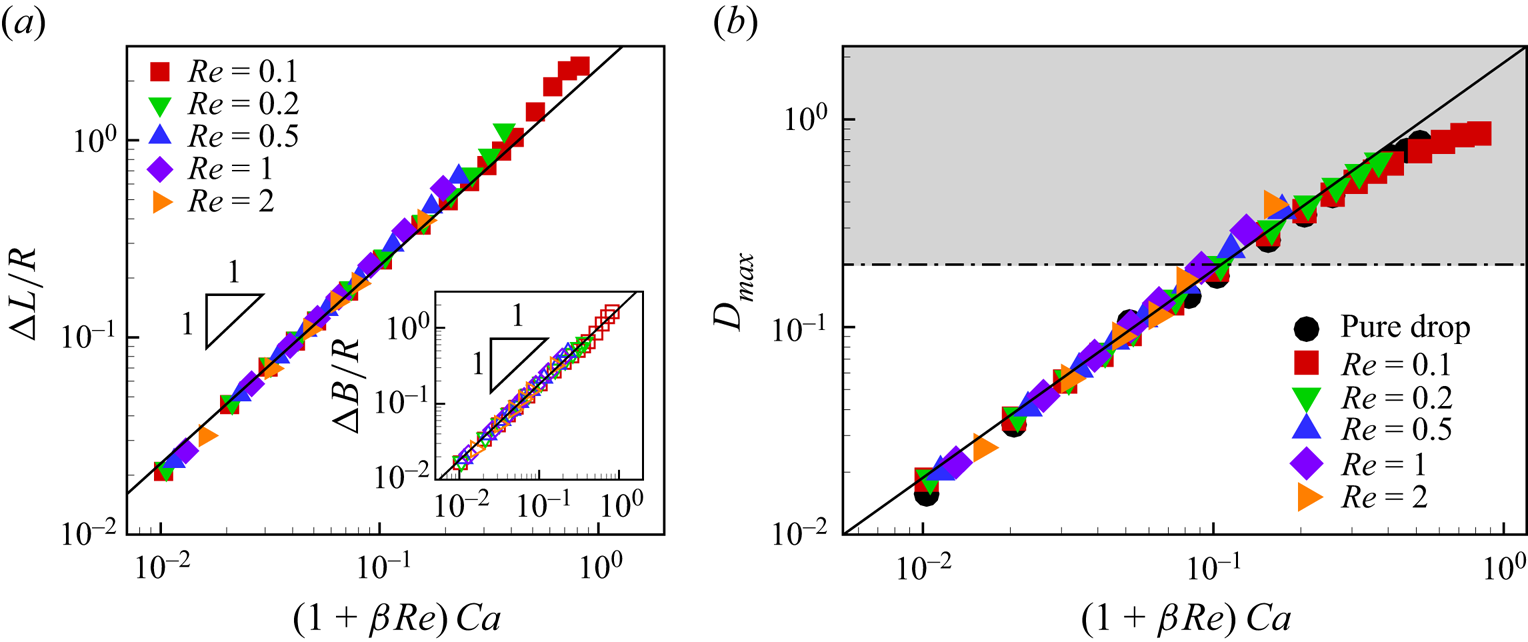
Deformation of Janus drops reflects the balance between viscous shear, interfacial tension and drop inertia. Figure 5(a) shows that  $\Delta L$ of all rotating Janus drops can be correlated with
 $Re$ and
 $Ca$ by
 \begin{equation} \frac{\Delta L}{R} \propto (1+\beta\,Re)\,Ca, \end{equation}
where  $\beta =0.3$ is a fitting parameter. Similarly,
 $\Delta B/R$ is found to have the same proportionality as in (3.3); see the inset of figure 5(a). Moreover, the value of
 $\beta$ (
 $=0.3$) is also the same for
 $\Delta B$.
(a) Variation of  $\Delta L$ as a function of
 $(1+\beta \,Re)\,Ca$ on a log-log scale. Variation of
 $\Delta B$ is shown in the inset. Different symbols indicate various Reynolds numbers
 $Re$:
 $0.1$ (
 $\square$), 0.2 (
 $\triangledown$), 0.5 (
 $\triangle$), 1.0 (
 $\lozenge$) and 2.0 (
 $\triangleright$). (b)
 $D_{max}$ as a function of
 $(1+\beta \,Re)\,Ca$. The solid line represents the (3.5) with
 $\beta =0.3$.

To understand the correlation between  $\Delta L$,
 $Re$ and
 $Ca$ in (3.3), we model the deformation of Janus drops by a one-dimensional mass–spring system. In this system, the viscosity and inertia of the drop play the roles of the damping elements and the mass, and the surface tension plays the role of the spring. Given the deviation of a Janus drop from its original shape as
 $L(t)-\bar {L}$, the scales of inertia, viscous damping and surface tension of the Janus drop can be written as
 $\rho R^3\ddot {L}$,
 $\mu R \dot {L}$ and
 $\sigma (L-\bar {L})$, respectively. Therefore, the mass–spring system can be expressed as
 \begin{equation} \rho R^3\ddot{L}+\mu R \dot{L} +\sigma (L-\bar{L}) \sim \mu R^2\dot{\gamma}+\rho R^4\dot{\gamma}^2, \end{equation}
where the two terms on the right-hand side represent the effects of viscous stress and pressure exerted by the surrounding fluid, respectively. Note that  $\ddot {L}$ has scale
 $\Delta L/t_R^2$ and
 $t_R \gg \dot {\gamma }^{-1}$. Therefore, the effect of drop inertia (
 $\sim \rho R^3\, \Delta L\,t_R^{-2}\ll \rho R^3\,\Delta L\,\dot {\gamma }^2$) is comparatively negligible. In addition, when the Janus drops are most elongated, we have
 $\dot {L}=0$ and
 $L-\bar {L}=\Delta L$ (by definition). Consequently, at this particular moment, (3.4) can be simplified in dimensionless form as
 $\Delta L/R \sim Ca+Re\,Ca$. We note that on the right-hand side of (3.4), the difference in the effective action area between the viscous stress and the pressure is not taken into account. If considering this geometry effect further, then we have
 $\Delta L/R \propto (1+\beta \,Re)\,Ca$, where
 $\beta$ is a geometry factor related to the shape of Janus drops. The value of
 $\beta$ is more or less a constant as indicated by the numerical results (see figure 5a).
Figure 5(b) shows the numerical results of  $D_{max}$ as a function of
 $(1+\beta \,Re)\,Ca$ on a log-log scale, including those of pure drops at
 $Re=0.1$. The results of stationary pure drops and rotating Janus drops at the maximum elongation collapse onto a single curve. Moreover,
 $D_{max}$ is proportional to
 $(1+\beta \,Re)\,Ca$ for
 $D_{max}\le 0.2$. This can be explained by simplifying the maximum value of
 $D$ for Janus drops with linear deformation (denoted by
 $D_{max}^{L}$). Because of
 $\bar {L}\approx L_0$,
 $\bar {B}\approx B_0$ and
 $|B_0\,\Delta L-L_0\,\Delta B|\ll 2L_0B_0$ (which can be derived from
 $D_{max}\ll 1$), we can obtain
 $D_{max}^{L}\approx (\Delta L/L_0+\Delta B/B_0)/2$. Given the correlation of
 $\Delta L$ and
 $\Delta B$ with
 $Re$ and
 $Ca$, we can obtain directly
 \begin{equation} D_{max}^{L} \propto (1+\beta\,Re)\,Ca. \end{equation}
Rotating Janus drops can thus be classified quantitatively according to the value of  $D_{max}$, i.e.
 $D_{max}\le 0.2$ for linear deformation, and
 $D_{max}>0.2$ for nonlinear deformation. More precisely, the linear dependence of
 $D_{max}$ on
 $Re$ and
 $Ca$ holds for
 $(1+0.3\,Re)\,Ca \le 0.1$ in the present study. We note that the linear relation in (3.5) is also found to be valid for Janus drops with different initial shapes (by changing
 $\sigma _{12}/\sigma _{13}$), in the case of small deformations.
3.3. Coupling between rotation period and drop deformation
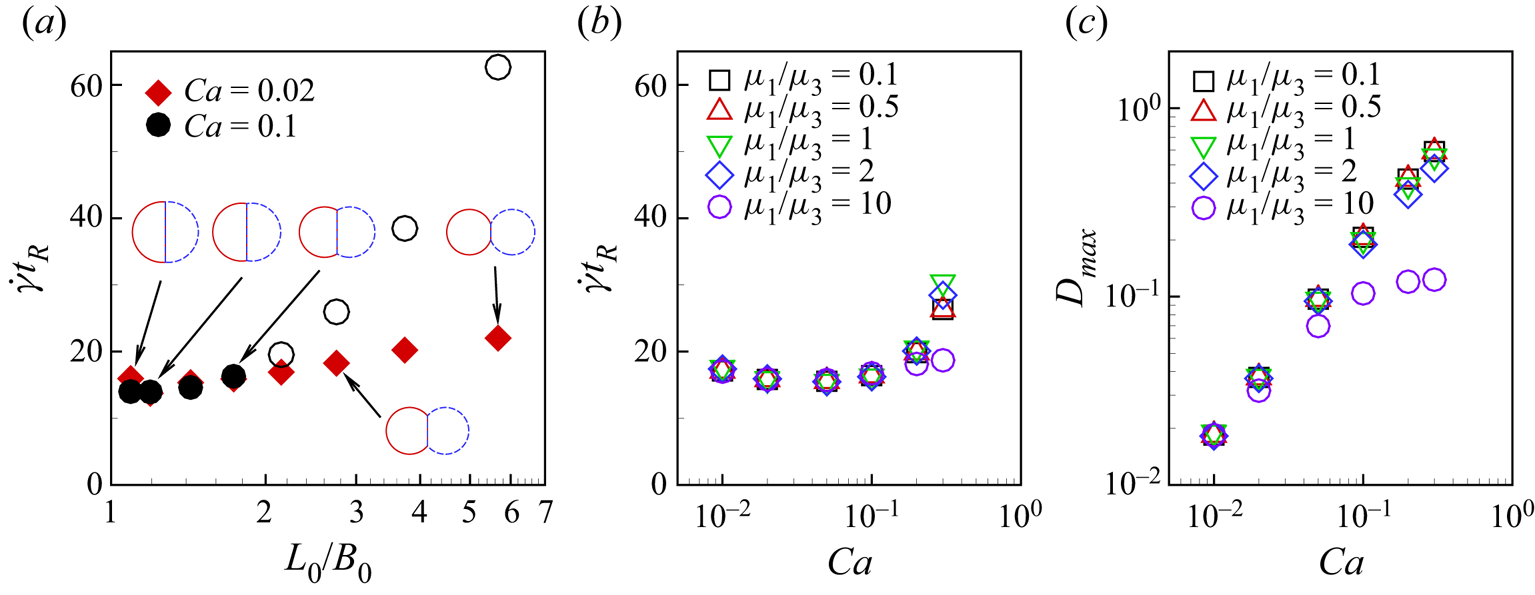
Figure 6(a) shows the variation of  $t_R$ for Janus drops at
 $Re=0.2$ with different equilibrium shape (measured by
 $L_0/B_0$). For Janus drops with linear deformation (e.g.
 $Ca=0.02$),
 $t_R$ increases only slowly with
 $L_0/B_0$, which is very different from the effect of aspect ratio of particles on
 $t_R$, as given in (1.1a,b). By contrast, a quick increase of
 $t_R$ with
 $L_0/B_0$ is observed for those with nonlinear deformation (e.g.
 $Ca=0.1$ and
 $L_0/B_0>2$). Therefore, for Janus drops, the change of aspect ratio due to drop deformation determines the rotation period, rather than the equilibrium shape of the drop. Figures 6(b) and 6(c) show the variation of
 $t_R$ and
 $D_{max}$ for Janus drops with different viscosity. At low
 $Ca$ (
 $<0.1$),
 $t_R$ and
 $D_{max}$ maintain more or less the same value, although the viscosity of Janus drops undergoes a change of two orders in magnitude. At relatively high
 $Ca$ (
 $>0.1$), the Janus drop with higher viscosity (e.g.
 $\mu _1/\mu _3=10$) can resist the shear flow with less deformation, leading to an insignificant increase of
 $D_{max}$ (and
 $t_R$) with
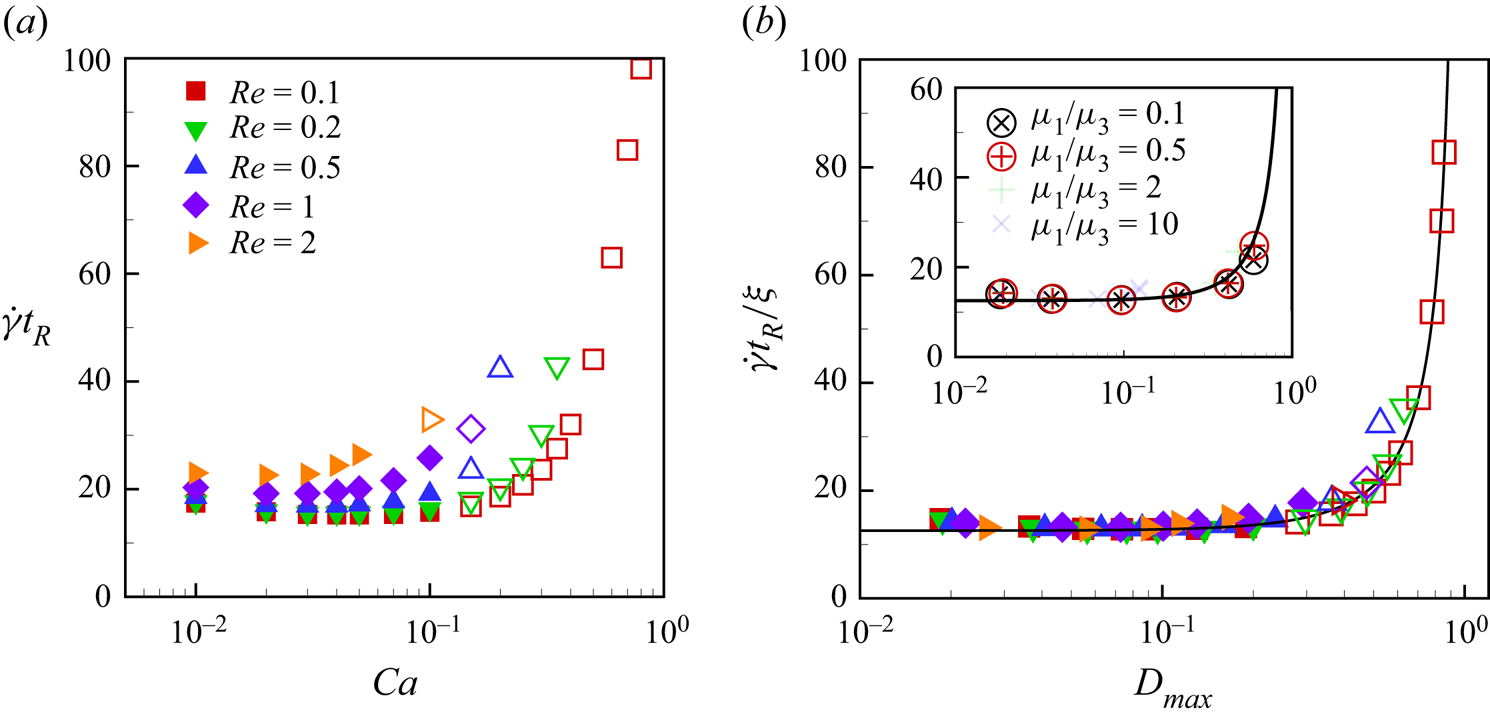
 $Ca$. Figure 7(a) shows the variation of
 $t_R$ with
 $Ca$ at different
 $Re$. At the same
 $Re$,
 $t_R$ maintains an approximately constant value at low
 $Ca$, and increases rapidly with
 $Ca$ at relatively large
 $Ca$ (i.e. for drops with nonlinear deformation).
(a) Variation of  $t_R$ for Janus drops with different
 $L_0/B_0$ at
 $Re=0.2$ and
 $\mu _1/\mu _3=1$. The empty symbols represent the nonlinear deformation, and the filled symbols represent the linear deformation. Variation of (b)
 $t_R$ and (c)
 $D_{max}$ at
 $Re=0.2$ for
 $L_0/B_0$ (
 $=1.732$) and various
 $\mu _1/\mu _3$: 0.1 (
 $\square$), 0.5 (
 $\triangle$), 1 (
 $\triangledown$), 2 (
 $\lozenge$) and 10 (
 $\bigcirc$).

(a) Rotating period as a function of  $Ca$, with
 $\mu _1=\mu _3$ and various
 $Re$. (b) The comparison of
 $t_R$ between numerical results in (a) and theoretical prediction of (3.8) (denoted by the solid line). The inset shows the results for different
 $\mu _1/\mu _3$ with
 $Re=0.2$. In (a,b), the filled and empty symbols denote the cases
 $D_{max}\le 0.2$ and
 $D_{max}>0.2$, respectively.

The rotation of Janus drops is similar to that of particles, except for flow slip at the interfaces and deformable shape. The slip effect at the drop interface can be approximated by a corrected shear rate  $\dot {\gamma }/\xi$, where the correction is
 $\xi \ge 1$. Based on theoretical analysis of
 $t_R$ of a fluid sphere and a spherical particle in shear flow at
 $Re=0$, Bartok & Mason (Reference Bartok and Mason1958) obtained
 $\xi =2/\sqrt {3}$ for the fluid sphere with matched viscosity, which is adopted in the present study. To take the effect of finite inertia further into account,
 $\xi$ can be approximated to the first order of
 $Re$ by
 \begin{equation} \xi\approx\frac{2}{\sqrt{3}}+\frac{\text{d}\xi}{\text{d}Re}\,Re. \end{equation}
The deformations of rotating Janus drops are characterised by the maximum elongation. An effective aspect ratio of Janus drops,  $\lambda _J$, is thus defined by the geometry parameters of Janus drops at that moment:
 \begin{equation} \lambda_J=\frac{(\bar{B}-\Delta B)L_0}{(\bar{L}+\Delta L)B_0}=\frac{1-D_{max}}{1+D_{max}}. \end{equation}
In this aspect ratio model, it is straightforward to have  $\lambda _J=1$ for Janus drops at equilibrium (i.e.
 $D_{max}=0$) regardless of their differences in shape, which reflects the dominant effect of drop deformation on the rotation period.
Jeffery's theory (1.1a,b) was shown to be applicable to elliptical cylinders (Ding & Aidun Reference Ding and Aidun2000; Zettner & Yoda Reference Zettner and Yoda2001). Following the spirit of Jeffery's theory, the rotation period of 2-D Janus drops can be obtained by introducing a corrected  $\dot {\gamma }$ and an effective aspect ratio
 $\lambda _J$. That is,
 \begin{equation} t_R\dot{\gamma}=2{\rm \pi}\xi(\lambda_J+\lambda_J^{{-}1})=4{\rm \pi}\xi\,\frac{1+D_{max}^2}{1-D_{max}^2}. \end{equation}
Figure 7(b) shows the variation of  $t_R\dot {\gamma }/\xi$ as a function of
 $D_{max}$. Numerical results for Janus drops agree well with the theoretical prediction with a fitting of
 $\text {d}\xi /\text {d}Re=0.3$. Because (3.8) is consistent with the calculation of
 $t_R$ in (1.1a,b), the rotation period of particles and Janus drops can be predicted in a unified manner.
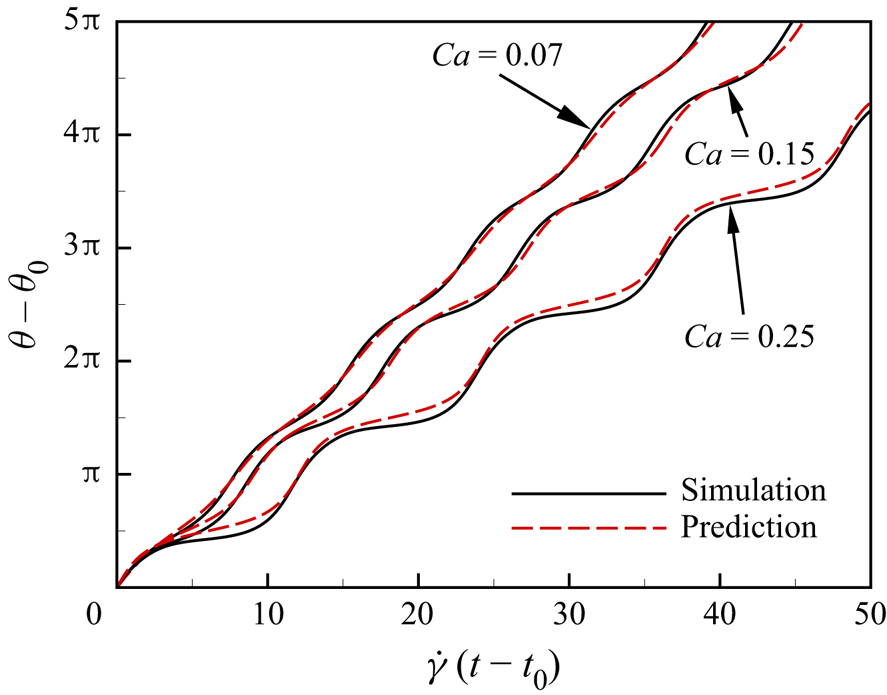
Similarly, we can obtain the theoretical prediction of  $\theta$:
 \begin{equation} \theta-\theta_0=\arctan\left(\frac{1+D_{max}}{1-D_{max}}\tan\left(\frac{\dot{\gamma}(t-t_0)}{2\xi}\,\frac{1-D_{max}^2}{1+D_{max}^2}\right)\right), \end{equation}
where an initial value  $\theta _0$ (
 $={\rm \pi} /2$) and the corresponding time
 $t_0$ are introduced to avoid the start-up effect in numerical simulations. Figure 8 shows the time variation of
 $\theta$ of rotating Janus drops at
 $Re=0.2$ and different
 $Ca$. The numerical results agree well with the theoretical prediction for drops with linear deformation (
 $Ca=0.07$), but deviate from it slightly for drops with nonlinear deformation (
 $Ca=0.15$ and
 $0.25$), owing to the synchronization of rotation velocity
 $\omega$ with drop deformation.
Comparison between the results of simulation and (3.9) of  $\theta -\theta _0$ as a function of
 $\dot {\gamma }(t-t_0)$ at
 $Re=0.2$ and various
 $Ca$.

4. Conclusion
We simulate the dynamics of a 2-D Janus drop in shear flows, with a focus on the deformation, rotation and their coupling. A new deformation parameter is proposed to describe the deformation of the Janus drop. Two flow regimes, i.e. linear deformation and nonlinear deformation, are identified according to the maximum value of  $D$,
 $D_{max}$. In the regime of linear deformation (
 $D_{max}\le 0.2$), the time variation of the rotation velocity
 $\omega$ of the Janus drop is a harmonic function, and has a noticeable phase difference from that of
 $D$; moreover,
 $D_{max}$ is proportional to
 $(1+\beta \,Re)\,Ca$, which can be interpreted by a mass–spring model. In the regime of nonlinear deformation (
 $D_{max}> 0.2$), the rotation velocity of the Janus drop is synchronized with
 $D$, showing a close coupling between the deformation and rotation. In addition, we find that the rotation period
 $t_R$ of a Janus drop is more sensitive to the deformation than to the aspect ratio of drop at equilibrium, and that the effect of the viscosity of the Janus drop on
 $t_R$ is also related to the drop deformation. In order to compare with the rotation of elliptic particles, we take the effect of a slip condition at the interface and drop deformation into account, by introducing a corrected shear rate
 $\dot {\gamma }/\xi$ and an aspect ratio of drop deformation
 $\lambda _J$. Then a rotation model for Janus drops is established based on the Jeffery's theory for rigid particles. This rotation model gives an excellent prediction of our numerical results within the parameter ranges
 $0.1 \le Re \le 2$ and
 $0.01\le Ca \le 0.8$, which includes the range of linear and nonlinear deformations, and is before the onset of breakup of Janus drops.
In the present study, we consider the dynamics of only 2-D Janus drops in shear flow. For 3-D Janus drops, it is reasonable to expect that they would display similar dynamic behaviours to 2-D ones, such as rotation and breakup, if the inner interface is parallel to the vorticity of the shear flow; otherwise, one may wonder if they move on a trajectory similar to Jeffery's orbits observed for ellipsoidal particles, probably accompanied with drop deformation. This will be our future research topic.
Supplementary movies
Supplementary movies are available at https://doi.org/10.1017/jfm.2023.963.
Funding
We are grateful for the support of the National Natural Science Foundation of China (grant nos 11932019, 12293002, 12388101).
Declaration of interests
The authors report no conflict of interest.
Appendix A. Calculation of  $L_0$ and $B_0$ for Janus drops at equilibrium


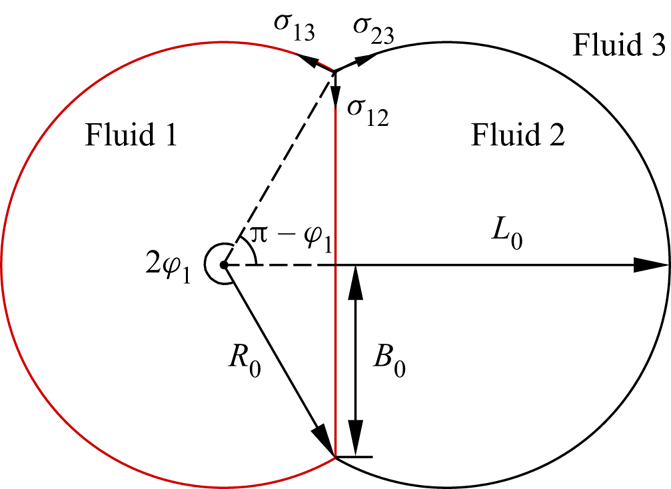
The shape of Janus drops at equilibrium is determined by the drop size and the surface tensions. Figure 9 shows a sketch of the interface shape of a 2-D Janus drop at equilibrium. Considering the balance of surface tensions at the triple-phase line where the ternary fluids meet, we have (Zhang et al. Reference Zhang, Ding, Gao and Wu2016)
 \begin{equation} \frac{\sin\varphi_1}{\sigma_{23}}=\frac{\sin\varphi_2}{\sigma_{13}}=\frac{\sin\varphi_3}{\sigma_{12}}, \end{equation}
where  $\varphi _i$ represents the interfacial angle of fluid
 $i$ (as shown in figure 1a), and clearly,
 $\varphi _1+\varphi _2+\varphi _3=2{\rm \pi}$. In the present study, we consider only
 $\sigma _{13}=\sigma _{23}$, thereby leading to
 $\varphi _1=\varphi _2=\arccos (-\sigma _{12}/(2\sigma _{13}))$ and
 $\varphi _3=2{\rm \pi} -2\varphi _1$.
Sketch of a 2-D Janus drop at equilibrium.

At equilibrium, the shape of the component droplets assumes a circular segment. Because the two droplets have equal size, the area of the circular segment yields  $(\varphi _1-\sin \varphi _1\cos \varphi _1)R_0^2={\rm \pi} R^2$, where
 $R_0$ is the radius of the circular segment. Therefore,
 $R_0$ can be expressed as
 \begin{equation} R_0=R\sqrt{\frac{\rm \pi}{\varphi_1-\sin\varphi_1\cos\varphi_1}}. \end{equation}
Geometrically, we have  $L_0=R_0(1-\cos \varphi _1)$ and
 $B_0=R_0\sin \varphi _1$. Thus
 $L_0$ and
 $B_0$ can be calculated by
 \begin{equation} L_0=R(1-\cos\varphi_1)\sqrt{\frac{\rm \pi}{\varphi_1-\sin\varphi_1\cos\varphi_1}},\quad B_0=R\sin\varphi_1\sqrt{\frac{\rm \pi}{\varphi_1-\sin\varphi_1\cos\varphi_1}}. \end{equation}