INTRODUCTION
Prionalpheus Banner & Banner, Reference Banner and Banner1960 is an uncommon and rarely reported alpheid genus with seven species, which taken together were previously only known from 26 specimens (Alvarez et al., Reference Alvarez, Camacho and Villalobos1996; Anker, Reference Anker2010). The main diagnostic features of Prionalpheus are the presence of an acuminate rostrum; absence of orbital teeth; eyes more or less concealed in dorsal view, visible in frontal view; chelipeds (= first pereiopods) of equal shape and size, carried extended with the dactylus in a lateral or dorsolateral position, without snapping mechanism on the fingers; biunguiculate dactylus on ambulatory pereiopods; sixth abdominal segment with an articulated plate; diaeresis of uropods with two or more strong teeth proximal to distolateral spine; absence of mastigobranchs; and very asymmetrical mandibles, without palp and molar process, and with long teeth on the incisor process of the left mandible (Banner & Banner, Reference Banner and Banner1960, Reference Banner and Banner1971; Miya, Reference Miya1980; Bruce, Reference Bruce and Morton1990; Martínez-Iglesias & Carvacho, Reference Martínez-Iglesias and Carvacho1991; Alvarez et al., Reference Alvarez, Camacho and Villalobos1996; Anker, Reference Anker2010). Although these asymmetrical mandibles are unique within Alpheidae, their function remains unknown. It seems certain that this generic synapomorphy is related to a specialized, as yet unknown food source. Curiously, the majority of records of Prionalpheus are from crevices in coral rubble and spaces under coral heads in shallow water, a common alpheid habitat, indicating a rather non-specialized ecology. No symbiotic associations are presently known in Prionalpheus.
The genus as a whole is nearly pantropical, with five species in the Indo-Pacific (Banner & Banner, Reference Banner and Banner1960, Reference Banner and Banner1971; Bruce, Reference Bruce and Morton1990; Anker, Reference Anker2010) and one species each in the western Atlantic (Martínez-Iglesias & Carvacho, Reference Martínez-Iglesias and Carvacho1991) and the eastern Pacific (Alvarez et al., Reference Alvarez, Camacho and Villalobos1996). Most species are only known from a few specimens, for some only their respective type material, although one species, Prionalpheus triarticulatus Banner & Banner, Reference Banner and Banner1960, seems to be relatively widespread in the western Pacific, occurring in Fiji, Australia, Japan and French Polynesia (Anker, Reference Anker2010).
The single known Atlantic species, Prionalpheus gomezi Martínez-Iglesias & Carvacho, Reference Martínez-Iglesias and Carvacho1991, was described on the basis of a single, incomplete male specimen (lacking first and third pereiopods) collected in the Juan García reef system in the Gulf of Batabanó (Cuba) at a depth of 10 m. Despite extensive recent collections made across the wider Caribbean area, no further specimens have been reported upon, until now. Here we document several recently collected specimens and complement the original description of P. gomezi. The diagnostic colour pattern of this species, briefly described by Martínez-Iglesias & Carvacho (Reference Martínez-Iglesias and Carvacho1991), is illustrated for the first time.
Material used in this study is deposited in the collections of the Oxford University Museum of Natural History, Oxford, the United Kingdom (OUMNH) and the Muséum National d'Histoire Naturelle, Paris, France (MNHN). Carapace length (CL, in mm) was measured from the tip of the rostrum to the posterior margin of the carapace; total length (TL, in mm) was measured from the tip of the rostrum to the posterior margin of the telson.
RESULTS
SYSTEMATICS
Family ALPHEIDAE Rinesque, 1815
Genus Prionalpheus Banner & Banner, Reference Banner and Banner1960
Prionalpheus gomezi Martínez-Iglesias & Carvacho, Reference Martínez-Iglesias and Carvacho1991
(Figures 1–2)
Prionalpheus gomezi Martínez-Iglesias & Carvacho, Reference Martínez-Iglesias and Carvacho1991: 85–87; figures 1–2; Martínez-Iglesias et al., 1996: 34 (reference to original record).
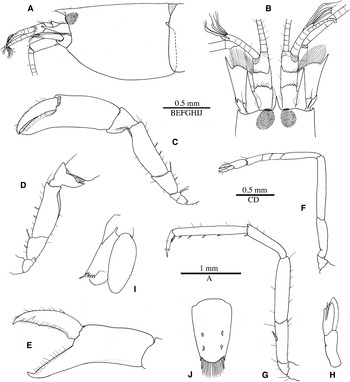
Prionalpheus gomezi Martínez-Iglesias & Carvacho, Reference Martínez-Iglesias and Carvacho1991, male (carapace length 1.9) from Honduras (OUMNH.ZC. 2007-20-0102): (A) cephalothorax and anterior appendages, lateral; (B) cephalothorax, frontal region, dorsal; (C) left cheliped, lateral; (D) same, mesial; (E) same, chela, lateral; (F) left second pereiopod, lateral; (G) left third pereiopod; (H) left second pleopod, mesial; (I) left uropod, dorsal; (J) telson, dorsal.

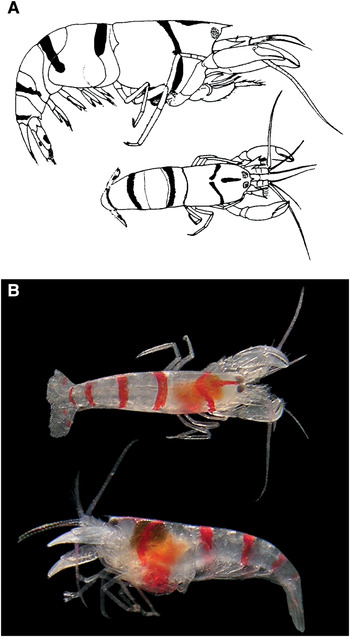
Prionalpheus gomezi Martínez-Iglesias & Carvacho, Reference Martínez-Iglesias and Carvacho1991: (A) habitus of male from Guadeloupe (MNHN-Na 15674), lateral and dorsal views, dark bands illustrate colour pattern; (B) male from Utila, Honduras (OUMNH.ZC. 2007-20-0102), dorsal and lateral views.

MATERIAL EXAMINED
Honduras: 1 male (CL 1.9, TL 4.9), OUMNH.ZC. 2007-20-0102, reef in front of Coral View Hotel, depth 1 m, rubble crevices, 16°05.326′N 86°54.652′W, leg. A. Anker & S. De Grave, 6 July 2007 (photo voucher). Belize: 1 male (CL 1.8, TL 5.0), OUMNH.ZC. 2009-01-0037, patch reef, north-eastern side of Carrie Bow Cay, depth 0.5–1.0 m, from rubble, 16°48.346′N 88°04.928′W, leg. S. De Grave, D. Felder, et al. 21 February 2009. Guadeloupe: 1 male (CL not measured, TL ~5.0), MNHN-Na 15674, Guadeloupe, Grand Cul de Sac, shallow flat with coral rubble, 1–2 m, leg. F. Fasquel, 2000.
DIAGNOSIS
Carapace glabrous, not setose; rostrum acute, at least three times longer than wide at base, not reaching distal margin of first article of antennular peduncle; orbital teeth absent; pterygostomial margin bluntly protruding; telson broad proximally, smoothly tapering distally, with two pairs of short, stout spines on dorsal surface; posterior margin broadly rounded, with two spines at each angle, mesial much longer than lateral; eyes completely covered by orbital hoods, anterior-most portion visible in lateral view, corneas juxtaposed or at small distance from each other; antennular peduncle with stylocerite acuminate, overreaching distal margin of second article, latter as long as wide; antenna with basicerite bearing sharp distoventral tooth; scaphocerite ovate, with broad blade and strong distolateral tooth, latter reaching far beyond blade and slightly beyond end of antennular peduncle; left mandible with incisor process bearing five large teeth distally, most dorsal tooth acuminate, slightly curved, most ventral tooth blunt, intermediate teeth acuminate, subtriangular; right mandible with incisor process bearing one strong dorsal tooth and small irregular teeth distally; remaining mouthparts typical for genus; third maxilliped with penultimate article bearing small spines on distoventral margin; chelipeds equal in size, symmetrical in shape, carried extended with dactylus in dorsolateral position; ischium with one slender distodorsal spine; merus with several slender spines on dorsal margin; carpus cup-shaped; chela smooth, rather slender, length–width ratio of palm more than 2.0; fingers slightly shorter than palm, not gaping, with cutting edges mostly smooth, except for one small tooth at mid-length of dactylus; second pereiopod with four articles, first article equal to sum of remaining three articles; third pereiopod slender, ischium with spine on ventrolateral surface, merus about four times as long as wide; carpus 0.7 length of merus, with small distoventral spinule; propodus with five or so small spines on ventral margin; dactylus slender, biunguiculate, about 0.3 length of propodus; fourth pereiopod similar to third; fifth pereiopod with ischium armed with small spine on ventrolateral surface; propodus with setal brush; dactylus biunguiculate; male pleopod with appendix masculina furnished with distal setae, slightly surpassing appendix interna; uropod with bifid lateral tooth, diaeresis on exopod with three or four sharp teeth adjacent to strong distolateral spine; gill-exopod formula: 5 pleurobranchs (P1–5), 0 arthrobranch, 0 podobranch, 0 mastigobranchs, 0 setobranchs, 3 exopods (Mxp1–3).
SIZE
The holotype was stated to have a CL of 1.8 cm (Martínez-Iglesias & Carvacho, Reference Martínez-Iglesias and Carvacho1991). However, all present specimens are ostensibly smaller, with a CL range of 1.8–1.9 mm, and a TL 5 mm or less. In view of the numerical similarity between both sets of carapace lengths, it is assumed that the measurement of the holotype is in error, and should be 1.8 mm CL instead.
COLOUR PATTERN
Body semitransparent; each abdominal somite with a broad transverse red band at posterior margin; carapace with single transverse red band, dorsolaterally displaced posteriorly (somewhat V-shaped when seen dorsally), narrow longitudinal red band present dorsally, running from between the eyes to the transverse band; uropodal exopods and endopods each with single red patch; appendages, including chelipeds, hyaline-whitish or transparent; brownish hepatopancreas visible through the carapace (Figure 2).
DISTRIBUTION
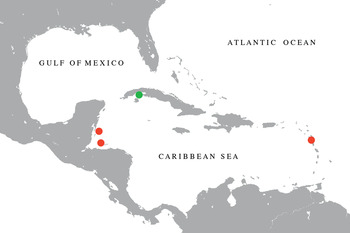
Caribbean Sea, currently only known from four localities: Gulf of Batabanó, Cuba; Carrie Bow Cay, Belize; Utila, Honduras; and Grand Cul de Sac, Guadeloupe (Figure 3).
Presently known distribution of Prionalpheus gomezi Martínez-Iglesias & Carvacho, Reference Martínez-Iglesias and Carvacho1991; type locality indicated by green circle, new records by red circles.

ECOLOGY
The holotype was collected on a rubble field (‘plaine abrasive’) amidst corals and pebbles, at a depth of 10 m (Martínez-Iglesias & Carvacho, Reference Martínez-Iglesias and Carvacho1991). The specimens from Belize, Honduras and Guadeloupe were collected in shallower water (0.5–2.0 m), but in similar habitat, i.e. strewn rubble on the upper part of the reef.
REMARKS
The present material agrees reasonably well with the description of the incomplete holotype of Prionalpheus gomezi (Martínez-Iglesias & Carvacho Reference Martínez-Iglesias and Carvacho1991). However, a few significant differences were noted, for instance, in the position of the eyes, the shape of the scaphocerite, and the proportions of the second pereiopod. In the holotype, the eyes appear to be juxtaposed (Martínez-Iglesias & Carvacho Reference Martínez-Iglesias and Carvacho1991, figure 2), whilst in the current specimens, they are separated (Figure 1A). In the holotype, the scaphocerite blade has been illustrated as strongly convex anteriorly (Martínez-Iglesias & Carvacho Reference Martínez-Iglesias and Carvacho1991, figure 2); in contrast, in the current specimens, the anterior margin of the scaphocerite blade is not or very slightly convex (Figure 1A). Lastly, the second pereiopod appears to be slightly stouter in the holotype (Martínez-Iglesias & Carvacho Reference Martínez-Iglesias and Carvacho1991, figure 10) compared to that of the current specimens (Figure 1F). All these discrepancies are tentatively attributed to inaccuracies in Martínez-Iglesias & Carvacho's (1991) figures, which were likely made without the aid of a camera lucida. The number of acute teeth on the uropodal diaeresis seems to vary between three (Martínez-Iglesias & Carvacho, Reference Martínez-Iglesias and Carvacho1991, figure 12) and four (Figure 1I).
The previously unknown chelipeds of P. gomezi (Figure 1C–E) appear to be fairly typical for Prionalpheus by their similar size and symmetry, a very characteristic shape of the chela, and the presence of dorsal spines on the ischia and meri (Banner & Banner, Reference Banner and Banner1960, Reference Banner and Banner1971; Miya Reference Miya1980; Bruce, Reference Bruce and Morton1990). Similarly, the third pereiopod (missing in the holotype) is very typical for the genus (Figure 1G), ending in a distinctly biunguiculate dactylus (Banner & Banner, Reference Banner and Banner1971; Miya, Reference Miya1980; Bruce, Reference Bruce and Morton1990). The red-banded colour pattern of P. gomezi (Figure 2) is very different from the non-banded colour of Prionalpheus triarticulatus and Prionalpheus cf. brachytomeus (Anker, Reference Anker2010); the colour pattern of other species of the genus remains unknown. In fact, the arrangement of red bands on the carapace and abdomen of P. gomezi appears to be unique within the entire family Alpheidae (A. Anker, personal observation).
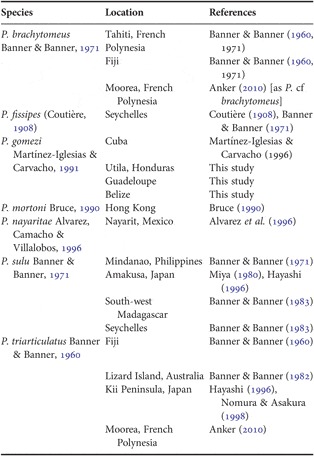
The present records are indicative that P. gomezi is likely widespread in the Caribbean Sea and that the current paucity of records appears to be more linked to its small size and possibly special microhabitat. This rarity of records applies to nearly all species in the genus (Table 1), with three species known only from their respective holotypes, a situation that also applied to P. gomezi before the present study. A most peculiar situation is the supposed loss of both earlier specimens of P. brachytomeus (discussed in Anker, Reference Anker2010), making the single specimen from Moorea tentatively assigned to this species by Anker (Reference Anker2010) the only known specimen. To facilitate future study of the genus Prionalpheus, an updated key to the seven presently known species is offered.
Literature records of Prionalpheus Banner & Banner, Reference Banner and Banner1960.

KEY TO THE SPECIES OF PRIONALPHEUS BANNER & BANNER, 1960
Abbreviations used: EP, East Pacific; IWP, Indo-West Pacific; WA, West Atlantic.
-
1. Carpus of second pereiopod with 5 articles………2
-
— Carpus of second pereiopods with less than 5 articles………3
-
-
2. Pterygostomial angle blunt, uropodal diaeresis with 2 strong teeth [EP]………P. nayaritae
-
— Pterygostomial angle acute, uropodal diaeresis with 2 poorly developed teeth [IWP]………P. fissipes
-
-
3. Carpus of second pereiopod with 3 articles………4
-
— Carpus of second pereiopod with 4 articles………5
-
-
4. Cheliped dactylus equal to half of palm length [IWP]………P. mortoni
-
— Cheliped dactylus equal to palm length [IWP]………P. triarticulatus
-
-
5. Ischium of fourth and fifth pereiopod with ventrolateral spine [WA]………P. gomezi
-
— Ischium of fourth and fifth pereiopod without ventrolateral spine………6
-
-
6. Corneas of eyes closely spaced together [IWP]………P. brachytomeus
-
— Corneas of eyes clearly separated [IWP]………P. sulu
-
ACKNOWLEDGEMENTS
Fieldwork in Honduras was carried out under the auspices of Operation Wallacea through the offices of its director, Dr T. Coles. Fieldwork in Belize was organized by D.L. Felder and in part supported by the Smithsonian Caribbean Coral Reef Ecosystems (CCRE) Program. Frédéric Fasquel (France) collected an additional specimen in Guadeloupe. The first author's taxonomic research was supported by CAPES (Coordenação de Aperfeiçoamento de Pessoal de Nível Superior) of the Brazilian Government.