

Introduction
Forced swimming tests (FST) are widely employed with regard to exercise in rats and have revealed the occurrence of similar organic responses in humans to exerciseReference Gobatto, Mello, Sibuya, Azevedo, Santos and Kokubum1–Reference Gobatto, Manchado-Gobatto, Carneiro, de Araujo and dos Reis3.
During the FST, animals swim by vertical propulsion, and loads may be attached to their bodyReference Gobatto, Manchado-Gobatto, Carneiro, de Araujo and dos Reis3 or tailReference Miller and Darrow4 to make it more difficult for them to stay on the surface of the water. In addition, the added weights can reduce the time to exhaustion. Despite the acceptance of this test in both the classicalReference Miller and Darrow4 and current literatureReference Gobatto, Manchado-Gobatto, Carneiro, de Araujo and dos Reis3, such a methodology may lack precision if it ignores the animal's body density (BD). This can be an issue in intervention-based studies that may modify the rat's body compositionReference Scheer, Dorst, Codie and Soule5. It is evident that less dense animals have an intrinsic advantage in facilitating floatability, and therefore less dense animals require less effort to stay afloat than more dense animals.
Booth et al. Reference Booth, Laye and Spangenburg6 noted the importance of establishing standards for studies that employ exercise and/or exercise training as an experimental intervention. Such standards are needed to permit a clear, consistent and appropriate evaluation of data by both investigators and readers.
To ensure that the intensity of exercise in our swimming protocols was accurate, we used the blood lactate concentration levels of rats as a physiological marker of effortReference Gobatto, Mello, Sibuya, Azevedo, Santos and Kokubum1–Reference Gobatto, Manchado-Gobatto, Carneiro, de Araujo and dos Reis3. However, the influence of BD on an animal's capacity to sustain work is still unknown. Thus, the main focus of this study was to investigate the impact of BD on the determination of maximal lactate steady-state (MLSS) workload. The influence of growth on BD was evaluated using two groups of rats of differing ages.
Materials and methods
All experiments involving animals were performed in accordance with the specific Brazilian resolutions on Bioethics in Experiments with Animals (law project no. 93/08, approved 9 September 2008). These resolutions are in agreement with the guidelines for research involving animals, which were determined by the American Society of Physiology and the European Convention for the protection of vertebrate animals used for experimental and other scientific purposes.
Animals
Ten young adult (90 days old) and 16 adult (120 days old) male Rattus norvegicus albinus (Wistar lineage) were provided by the central vivarium at the State University of Sao Paulo, Botucatu campus. Throughout the experiment, the animals were maintained indoors in collective polyethylene cages (maximum of five rats per cage), at the environmental temperature of 25°C.- An inverted photoperiod (light/dark) of 12/12 h was used. The animals received commercial chow for rodents (Labina-Purina®) and water ad libitum.
Swimming tests were preceded by adaptation of the individual rats to the water environment. This entailed 3 weeks of adaptation sessions (5 min day− 1, 5 days week− 1) and initially consisted of keeping the animals in shallow water at 31°C, as adapted from Harri and KuuselaReference Harri and Kuusela7. Daily gradual increases in depth were implemented until the animals were unable to stand on or make contact with the tank bottom. It appears that adaptation reduces learned factors, improving the reliability of experimental measuresReference McArdle and Montoye8. The animals were divided into two experimental groups: G90 and G120, with animals of 90 and 120 days of age, respectively.
BD determination
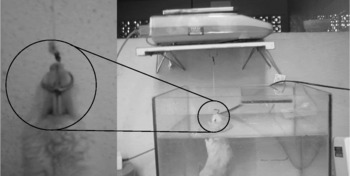
The underwater weighing device comprised an acquisition data system (a computer with HyperTerminal in Windows XP®) and an accuracy scale (BellMark 5000®) for the capture of data at a frequency of 9600 bits s− 1. A glass aquarium (35 cm long × 35 cm wide × 50 cm high) and an animal support system were used (Fig. 1).
Underwater weighing device

In an attempt to reduce stress and avoid movement while measuring hydrostatic weight (HW), the rats were sedated by intraperitoneal injection. This solution contained 7 mg ketamine and 1 mg xylazine for each 100 g of body weight (BW). If necessary, half of the dose of ketamine was administered to maintain an appropriate level of decreased motion. First, the sedated rats' bodies were submerged in the water and gently shaken to remove trapped air bubbles in the coat. Then, using a ring connected to the accuracy scale, the rats were suspended by their incisor teeth (Fig. 1).
The rats' noses were always kept out of the water, both to allow them to breathe and to measure HW under the specific conditions to which the animals were subjected in the swimming protocols (Fig. 1). For each animal, 30 s of weighing values were captured by the acquisition data device, this mode being considered as the animal's HW. When there was more than one mode, the mean value was used. This procedure was used to reduce the impact of the animal's breathing on HW.
The equation for body volume (BV) determination in humansReference Behnke and Wilmore9, which was adapted for the animal model, is presented below. BV is the ratio between the difference in BW and HW and the water density (WD), which was 0.9922 g cm− 3 at room temperature and atmospheric pressure:

The BD of the animals was obtained by the ratio between BW and BV:

MLSS test
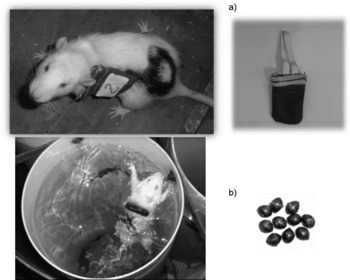
Apnoea of over 10 s was an accepted parameter for exhaustionReference Scheer, Dorst, Codie and Soule5, Reference McArdle and Montoye8. Tests were performed 24 h after BD determination, consisting of 3–5 days of constant effort testing once per day, until 25 min of exercise or exhaustion were reached. The workload was equivalent to 3–7% of the rat's BW (%BW) and consisted of lead weights placed inside small cloth bags attached to the animal's thorax (Fig. 2). Often, exhaustion was reached before the rats had performed 25 min of exercise when the intensity of effort exceeded individual MLSS, and blood samples were collected immediately after exhaustion, as defined below, but only the MLSS values are reported in the Results section. Exercise workloads were chosen randomly and never repeated for the same ratReference Gobatto, Mello, Sibuya, Azevedo, Santos and Kokubum1, Reference Gobatto, Manchado-Gobatto, Carneiro, de Araujo and dos Reis3.
Workload and backpack: (a) cloth bag and (b) lead weights

The rats swam individuallyReference Wilber and Hunn10, Reference Wilber11 in cylindrical tanks (20 cm diameter × 120 cm depth), which were sufficiently deep to prevent jumping behaviour during the swimming test. The tanks were filled with water at a constant temperature (25°C)Reference Harri and Kuusela7. The rats could not touch the bottom or hang on to the sides, and were supervised during the entire swimming period. Occasionally, the rats submerged at the bottom for several seconds, evidently seeking a means of escape. By careful observation, it was not difficult to determine when submersion was due to exhaustion and when it was due to other factorsReference Miller and Darrow4.
Blood samples of 25 μl were collected for lactate measurement by a small puncture at the distal end of the tail during rest at 10, 15, 20 and 25 min of the test. The samples were collected in heparinized capillary tubes and transferred to a 1.5 ml microcentrifuge tube containing 400 μl of trichloroacetic acid (4%) for posterior spectrophotometer enzymatic assayReference Engel and Jones12.
Thus, the individual MLSS workload (MLSSw) was defined as the highest constant effort associated with the highest blood lactate concentration in which the rate of blood lactate increase was equal to that of its removal, with a variation of less than 1 mmol l− 1 between 10 and 25 min of exerciseReference Gobatto, Mello, Sibuya, Azevedo, Santos and Kokubum1, Reference Billat, Sirvent, Py and Koralsztein13, Reference Mader and Heck14.
Workload reproducibility
Certain precautions were taken to ensure that the workload was reproducible. The rats were always subjected to the swimming exercise wearing a small cloth bag of the same size and made with the same synthetic fabric (Fig. 2a), which is permeable and does not retain water. All weights were made of the same lead material (Fig. 2b), with an average density of 11.1169 (g cm− 3) and a linear relationship between underwater weight and dry weight (r 2 = 1.00).
Measurement of the impact of BD on workload
Hydrostatic weight is a biological parameter that is BD dependent and represents the swimming effort that the rat must maintain to keep itself on the surface of the water without any kind of workload, as demonstrated in the following equation:

Therefore, determining the HW is equivalent to quantifying the individual effort of staying on the surface. Furthermore, the rat's total effort is a combination of individual MLSSw (described above) and HW (MLSSw+HW).
Statistical analyses
Statistical analyses were performed with the software Statistica 7.0 (StatSoft®). All variables had a normal distribution (Shapiro–Wilk test) and are presented as means ± standard deviations. The variance tests among the body parameters, including the individual effort to maintain position at the water surface (HW), workload (MLSSw, MLSSw+HW) and blood lactate concentration in the MLSS, were calculated with Student's t-tests for independent samples. To verify the correlation among the variables, Pearson's correlation analysis was used.
Results
Somatic parameters increased significantly with ageing (Table 1).
BW, BV and BD values

Values significantly different: *G90 (P < 0.001); #G90 (P < 0.005).
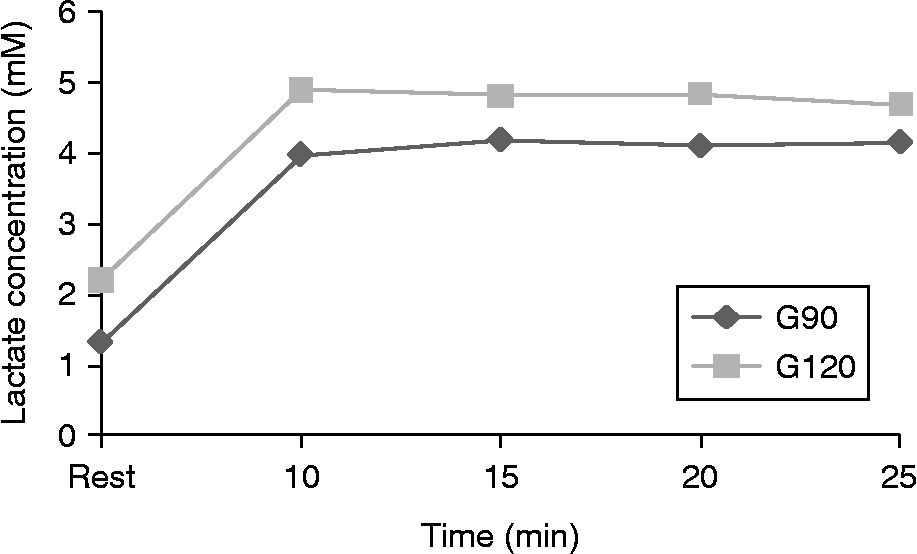
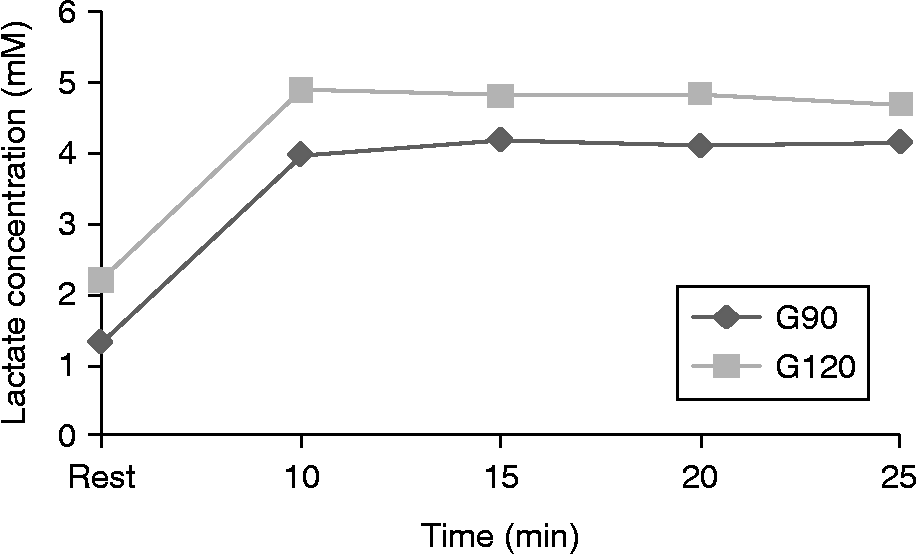
Mean MLSS blood concentration values were 4.11 ± 0.96 and 4.81 ± 1.49 mmol l− 1 for G90 and G120, respectively. There was no significant difference between the groups (Fig. 3).
MLSS blood concentration (mM) during rest and at 10, 15, 20 and 25 min of exercise for G90 and G120
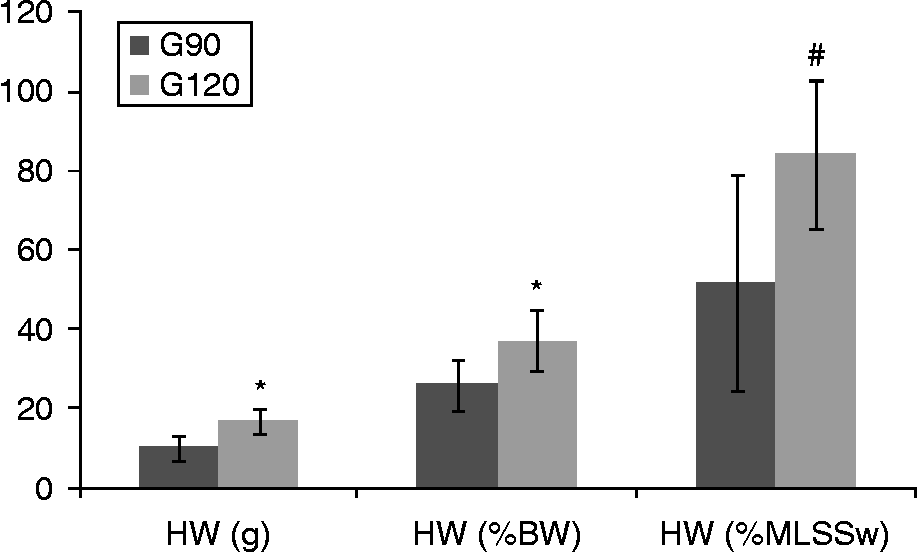
HW values represent the individual's effort to remain at the surface. These values were significantly higher for G120 (Table 2 and Fig. 4).
HW expressed as absolute weight (g), %BW and %MLSSw values

Values significantly different: *G90 (P < 0.001); #G90 (P < 0.005).
HW expressed as absolute weight (g), %BW and %MLSSw. Values significantly different: *G90 (P < 0.001); #G90 (P < 0.005). Values expressed as %BW were multiplied by a constant value of 10 for better visualization
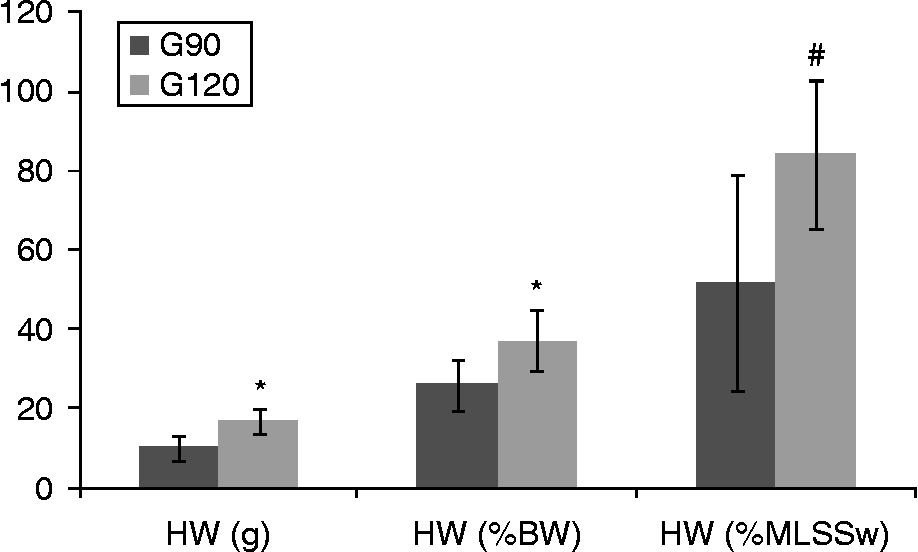
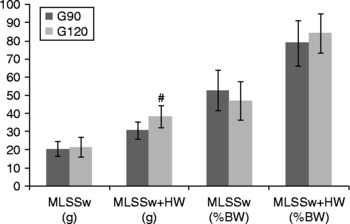
The G120 group demonstrated higher absolute effort than the G90 group only when the individual effort to maintain position at the water surface was considered. However, when MLSSw was expressed as %BW, there was no significant difference between the groups in both situations (Table 3 and Fig. 5).
MLSSw and MLSSw+HW expressed as absolute weight (g) and %BW

Values significantly different: #G90 (P < 0.005).
MLSSw and MLSSw+HW expressed as absolute weight (g) and %BW. Values significantly different: #G90 (P < 0.005). Values expressed as %BW were multiplied by a constant value of 10 for better visualization

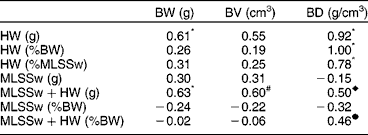
Values of Pearson's correlation among the somatic parameters and HW, MLSSw and MLSSw+HW are presented in Table 4.
Pearson's correlation values among BW, BV, BD and HW expressed as the absolute weight (g), %BW and %MLSSw, MLSSw and MLSSw+HW expressed as the absolute weight (g) and %BW
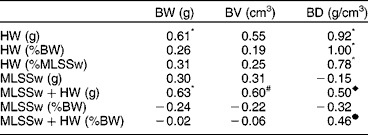
Values were significantly correlated: *(P < 0.001); #(P < 0.005); ♦(P < 0.01); ●(P < 0.05).
Discussion
The aim of this study was to examine whether BD plays a significant role in an animal's capacity to sustain a workload in the MLSS test. Wistar rats of two different ages were evaluated to determine whether the morphological changes caused by the ageing process affect BD and performance in the MLSS test within this age range.
Due to the rapid growth of the animals, significant differences among the groups for BW, BV and BD were found (Table 1), and the G90 group presented significantly lower values than the older group for all somatic parameters.
Between the ages, HW had a higher proportional increase than BW, and the G120 group required significantly more individual effort to maintain position at the water surface than the G90 group with regard to absolute weight (P < 0.001), %BW (P < 0.001) and %MLSSw (P < 0.005) (Table 2 and Fig. 4), which demonstrates the impact of BD on an animal's capacity to sustain a workload within this age range. Absolute MLSSw was not significantly different between the two ages (Table 3 and Fig. 5), but when the individual effort to maintain position at the water surface was considered (MLSSw+HW), the G120 group showed significantly higher values than the G90 group (P < 0.005).
When the absolute workload sustained by a small rat does not represent the same effort as that for a larger oneReference Scheer, Dorst, Codie and Soule5, researchers should recognize that these data are relative. Thus, the classic literature suggests that BW-based extrapolation has often been used to compute potential workload and equate animals of varying sizesReference Dawson and Horvath15. This principle can explain why the significant differences found between the groups for MLSSw+HW, expressed as absolute values, were not found for the same variable expressed as %BW (Table 3 and Fig. 5).
McArdle and MontoyeReference McArdle and Montoye8 showed that the maximum swimming time for the same workload, based on %BW, is negatively correlated (r = − 0.49) with BW. Furthermore, they surmised that, as an animal increases in size, its ability to swim at a steady %BW is not maintained proportionately. However, Scheer et al. Reference Scheer, Dorst, Codie and Soule5 proposed a method of BD homogenization using brass weights attached to the thorax with elastic bands, to bring the specific gravity within the same range and reduce the variation in physical capacity surmised among rats in a test of fitness for exhaust-inducing work. Furthermore, after BD homogenization, a small positive correlation between specific gravity and duration of swimming was observed. A similar average correlation between BD and MLSSw+HW, expressed as absolute and relative to %BW (r = 0.50 and 0.46, P < 0.05, respectively), was found in the present study (Table 4).
Blood lactate measurement is a precise and dependable tool for determining the metabolic characteristics of exercise, and the MLSS test is considered the gold standard for aerobic capacity evaluation in humansReference Gobatto, Mello, Sibuya, Azevedo, Santos and Kokubum1. Thus, instead of using the classical test for exhaustionReference Scheer, Dorst, Codie and Soule5, Reference McArdle and Montoye8, in this study, the MLSS test, which was adapted for swimming rats, was used.
Gobatto et al. Reference Gobatto, Mello, Sibuya, Azevedo, Santos and Kokubum1 observed a mean MLSS blood concentration of 5.5 mmol l− 1 in swimming rats by using a 20-min swim time protocol and a collective shallow swimming tank. In this study, the mean results of the MLSS concentrations were 4.11 and 4.81 mmol l− 1 for the G90 and G120 groups, respectively. These data were obtained with a 25 min protocol performed in an individual, deep swimming tank. The differences between the two studies indicate that the MLSS concentration is protocol dependent, and further studies are required to investigate this difference. In addition, the large standard deviation values found in this study for individual MLSSw and concentration in both ages highlight the need to perform individual evaluations of the aerobic capacity of the rats.
Rats of higher density need to sustain a higher HW. Therefore, without considering the individual effort required to maintain position at the water surface (HW), it is possible to underestimate the aerobic capacity of G120 rats compared with G90 rats. Our results show the significant impact of BD on workload determination in the MLSS test adapted to swimming rats within this age range.
Acknowledgements
This study was supported by the Sao Paulo State Research Support Foundation (FAPESP) Proc. 06/61189-0, 08/03445-5, 11/08284-2, 04/01205-6, 06/58411-2. The authors gratefully acknowledge José Roberto Rodrigues da Silva, Eduardo Custódio, Clarice Yoshiko Sibuya and Prof. Dra. Maria Alice Rostom de Mello (all from the State University of São Paulo ‘Júlio de Mesquita Filho’, Rio Claro campus, São Paulo state, Brazil) and Prof. René Brenzikofer (Physical Education Faculty, State University of Campinas, Campinas campus, São Paulo state, Brazil) for their technical assistance. The authors would like to acknowledge the animals used in this study and highlight the importance of animal experimentation in advancing scientific knowledge.