Introduction
Multifunctional agriculture (MFA) extends the concept of agricultural production beyond commodities, encompassing additional benefits in social, economic and ecological termsReference Boody, Vondracek, Andow, Krinke, Westra, Zimmerman and Welle 1 . One promising form of MFA is rotational grazing (RG)Reference Winsten, Kerchner, Richardson, Lichau and Hyman 2 , a livestock production system that rotates cattle on a scale of hours to days among multiple small pastures. RG dairy farming has been shown to be profitable at relatively small scales and low capital costsReference Kriegl and Frank 3 . However, broad evaluations of the multifunctionality of RG dairy farms—i.e., the quantity and quality of ecosystem services provided by these farms—have been limited in scale and scope. To help fill this gap, we examined the effect of RG dairy farming on stream-channel characteristics in small dairy farms (herds of ≤300 milk cows) in the Eastern and Midwestern USA.
RG may beneficially affect stream channels through increased pasture area, reduced animal density on pasturesReference Kauffman, Krueger and Vavra 4 , Reference Scrimgeour and Kendall 5 , and less allocation of land to annual crop and forage cultivation. Annual crop production increases erosion of fine soil particles caused by direct exposure to rain and runoff even with minimum tillageReference Razavian 6 . Tilled fields are especially prone to erosion prior to germination and sprouting in springReference Waters 7 . Forage production, although less intensive than row crops, exposes disturbed soils to erosion during forage establishment and after harvest. RG pastures along stream channels have been found to reduce runoff, stream bank erosion, sediment delivery and nutrient inputs, compared to riparian pastures along stream channels on confinement dairy (CD) farms, which tend to use pastures for animal resting areas rather than for nutritionReference Olness, Smith, Rhoades and Mensel 8 – Reference Raymond and Vondracek 19 . Moreover, RG systems may feature extensive implementation of additional management practices that protect streams, such as fencing to exclude animals from streams and vegetative buffer strips along streams, which may result in increased substrate size and reduced sediment depth, embeddedness and bank erosionReference Wang, Lyons and Kanehl 20 .
Previous studies of the effects of RG on streams in North America focused on the riparian area along reaches that were grazed, rather than examining effects of grazing operations—and accompanying land-use patterns—at whole-farm scales. We were particularly interested in making a close and holistic examination of land use and land cover in a representative sample of RG farms, to more fully assess the value of RG for soil and water conservation. Such close examination is needed since self-described RG dairy farms use a wide range of management practicesReference Lyon, Bell, Gratton and Jackson 21 .
Also, previous studies have addressed a limited geographic range. To help fill these knowledge gaps, we examined stream conditions and whole-farm land-use patterns across a broader geographic range than previous studies. Previous work has emphasized catchments in the Driftless Area Ecoregion (Iowa, Minnesota and Wisconsin)Reference Paine and Ribic 12 , Reference Magner, Vondracek and Brooks 15 , but others have examined catchments in different regionsReference Zaimes, Schultz and Isenhart 16 , Reference Zaimes, Schultz and Isenhart 17 . Olness et al.Reference Olness, Smith, Rhoades and Mensel 8 evaluated grazing in four rangeland catchments in central Oklahoma, and Bishop et al.Reference Bishop, Hively, Stedinger, Rafferty, Lojpersberger and Bloomfield 13 studied a paired catchment on a single farm in upstate New York. Haan et al.Reference Haan, Russell, Powers, Kovar and Benning 14 evaluated several pastures in the same catchment in Iowa. In addition to the limited spatial scale of these evaluations, many of the streams flow through karst topography.
Our goal was to evaluate stream-channel characteristics on small dairy farms that used either RG or CD production methods. Our study design incorporated a broad geographic scale that encompassed differences in substrate type, hydrology and shape of streams, reflecting regional climate and geology, as previous evaluations have provided limited insights into such regional effects. Specifically, we (1) compared channel characteristics on RG and CD farms in New York, Pennsylvania and Wisconsin, USA, on first- to third-order streams; and (2) examined land use on these farms that may affect stream-channel characteristics. We examined on-farm land use in riparian areas 50 m wide along both sides of stream reaches, a scale most often investigated, which can have a profound influence on channel morphologyReference Quinn, Cooper, Davis-Colley, Rutherford and Williamson 22 – Reference Sweeney, Bott, Jackson, Kaplan, Newbold, Standley, Hession and Horwitz 27 . We examined farms across a broad geographical range because stream-channel characteristics are affected by management and land-use decisions made at regional scalesReference Boody, Vondracek, Andow, Krinke, Westra, Zimmerman and Welle 1 , Reference Kuhnle, Bingner, Foster and Grissinger 28 – Reference Wilcock and McDowell 35 . Consequently, the effect of RG on hydrology and stream-channel characteristics may vary regionally because of different management practices and interactions with regional climate and geology.
Study Region and Sampling
We assessed stream-channel characteristics associated with dairy farms in three states of the USA: New York, Pennsylvania and Wisconsin. In each state, we selected a study region comprised of counties with relatively high levels of dairy production, and obtained dairy producer address lists for each region from the US Department of Agriculture. We mailed invitations to participate in the study to 684 farm families. Based on the initial willingness to participate and responses on basic farm characteristics such as acreage, size of herd and mode of production (RG and CD), we purposively selected a subset of self-reporting RG and CD farms with herds of ≤300 milk cows (which characterize the vast majority of dairy producers) and contacted these farmers by phone to confirm their participation. All RG farms had been practicing RG for at least 5 years; additional details of sampling are reported in Nelson et al.Reference Nelson, Brummel, Jordan and Manson 36 .
We spent approximately 1 day on each selected farm, interviewing farmers, as well as sampling physical characteristics of streams, bird biodiversity and land use (additional information on project methods is available inReference Raymond and Vondracek 19 ). In total, we examined stream characteristics on 37 farms. This is a subset of the total project sample of 53 dairy farms. We did not collect stream information for certain farms, as 11 farms did not have streams, and channel datasets were incomplete for five other farms, e.g., due to sampling interrupted by thunderstorms. We gathered these data in May through August 2009. All counties had a high density of dairy production but differed in the physical landscape and cultural history. In Wisconsin, the study region in Clarke County is a relatively flat agricultural landscape; there was essentially no RG in the county until 15 years ago; there are now dozens of grazing operations in the county. The Pennsylvania region in Berks, Lancaster, Lebanon and York counties features rolling hills, river valleys and wooded areas. Many of these counties include communities of Amish and Mennonite farmers. In New York, the study region in Cortland, Madison and Tompkins counties is very hilly, characterized by wooded ridge tops and with streams in valleys.
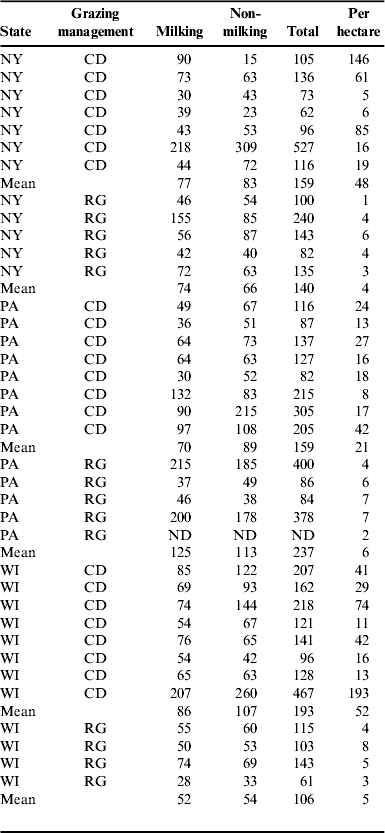
We categorized each farm as CD or RG, after determining cow diets used in each operation. On CD farms, cows may engage in occasional grazing, e.g., in pastures used as resting and exercise areas, but this grazing provides only a very minor part of the herd's nutrition; rather CD cows were typically fed hay or corn silage, grains and/or total mixed rations in a barn and, if pastured, were not moved between different paddocks. In contrast, all grazing farms provided substantial fractions of the milking herds’ total nutrition from pasture, e.g., kept on pasture during the grazing season, and, during structured interviews, the farmers discussed grazing operations as central to cow nutrition and described actively managing pasture soils and/or vegetation for grazing. Herd size and stocking rate for each study farm are tabulated in Appendix I.
Stream-channel characteristics
As noted, we examined stream characteristics and related attributes on 37 farms. Study streams were small, primarily first- (16) and second-order (14) systems, but there were seven third-order streams: three in New York, one in Pennsylvania and three in Wisconsin. All but one of the third-order streams were ≤10 m wetted width. None of the streams appeared to be channelized in aerial photographs. We selected stream reaches that had a minimum length of 150 m to a maximum of 390 m where the length of a reach was 35 times the mean wetted width of the streamReference Simonson, Lyons and Kanehl 37 . Only one-third of the study reaches passed through a pasture; of these, seven pastures were RG and five were CD. Other stream reaches were adjacent to other land-use types, e.g., wooded areas; of these, 18 were CD and seven were RG. In all cases the study reach was at or near (∼100 m) the downstream boundary of the farm property. In total, we examined streams on 37 dairy farms: 12 (5 RG and 7 CD) in New York, 13 (5 RG and 8 CD) in Pennsylvania and 12 (4 RG and 8 CD) in Wisconsin.
Eleven variables were used to quantify the stream channels: bank erosion, bedded sediment, canopy cover, the coefficient of variation (CV) of depth, CV of width, the 50th and 84th percentile (D50 and D84) of the size of 200 particles on the streambed, embeddedness, habitat, Pfankuch stability index (PSIReference Pfankuch 38 ) and soil compaction. Bank erosion, bedded sediment, D50, D84, embeddedness, PSI and soil compaction are related to sediment delivery and physical integrity of streamsReference Asmus, Magner, Vondracek and Perry 39 . CV of depth, CV of width and habitat 40 are the measures of habitat diversity and may be affected by extensive grazingReference Williamson, Smith and Quinn 41 , and are associated with aquatic invertebrate and fish biotic integrityReference Quinn, Cooper, Davis-Colley, Rutherford and Williamson 22 , Reference Quinn and Hickey 42 . Canopy cover is a measure of trees and shrubs in the riparian area, and is a surrogate for shading, which moderates water temperatureReference Quinn, Cooper, Davis-Colley, Rutherford and Williamson 22 .
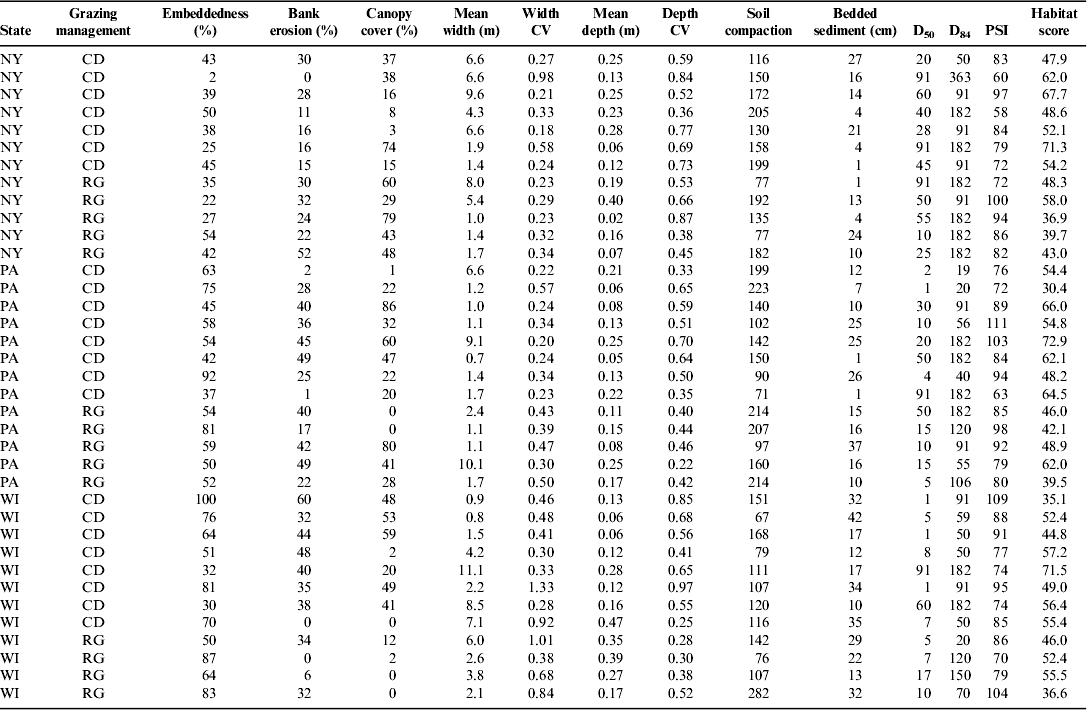
Each of these stream-channel characteristics were measured or visually estimated in each study reach, along ten equally spaced transects unless otherwise noted. Wetted width was measured perpendicular to flow at each transect. Water depth was measured five times along each transect with a calibrated wading rod. The amount of fine particles in the streambed was visually estimated as embeddedness for ten rocks/particles along each transect: 0% (completely free of sediment), 25% (the bottom embedded in sediment), 50% (half embedded), 75% (all but top embedded) or 100% (completely covered). Soil compaction was measured 1 m upland from the top of each bank for each transect, with a Dickey John soil compaction tester with a probe length of 76 cm and a pressure range from 0 to 1465 kg cm−2. Bank erosion was visually estimated as the percent exposed soil on the streambank in an area 1 m wide on each side of a transect from the water surface to the top of the streambank. Canopy cover was estimated to the nearest 10% at each transect as the amount of shade on the stream surface with the sun directly above. Particle size for 200 particles in the streambed was estimated by conducting a Wolman Pebble CountReference Bevenger and King 43 following a zigzag pattern. We determined the depth of penetration of a 2.5 m copper rod into the streambed (bedded sediment) along transects in pools using a modified approach of Lisle and HiltonReference Lisle and Hilton 44 and Walser and BartReference Walser and Bart 45 as described in Magner et al.Reference Magner, Vondracek and Brooks 15 . We calculated the mean for each variable for each stream reach, except for particle size, for which we calculated D50 and D84 of the 200 pebbles. The CV was calculated for width (CV of width) and depth (CV of depth) measurements. Two qualitative indices, the PSI and habitat score, were generated for each reach. PSI is a measure of bank stability and ranges from 38 to 150, with low scores indicating higher stability. The habitat score with a maximum of 100 is modified from the Ohio Qualitative Habitat Evaluation IndexReference Rankin 46 and provides an overall assessment of habitat quality. Selected stream attributes for each study farm are tabulated in Appendix II.
Land cover
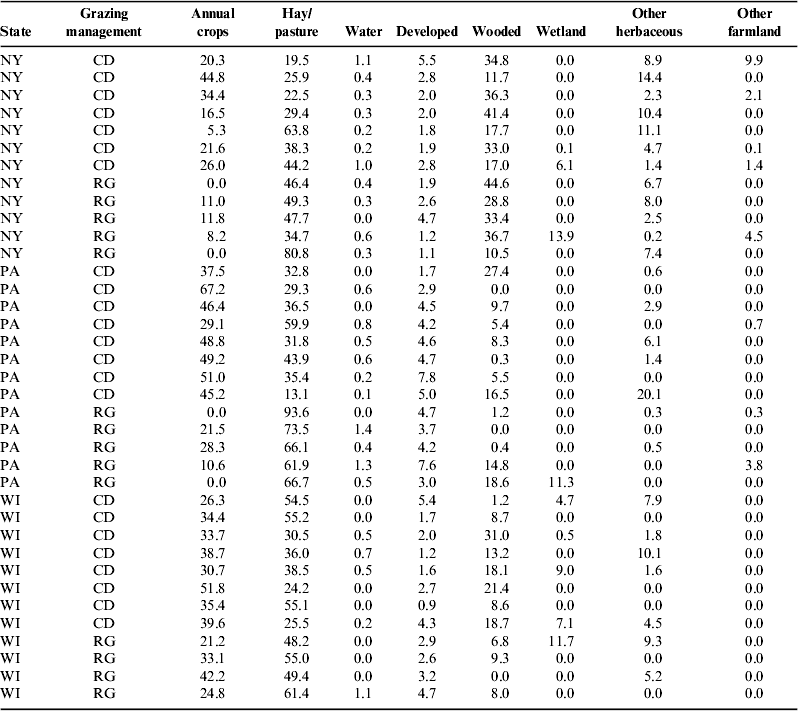
Land use/land cover was evaluated on two spatial scales: a 50 m wide riparian area along the study reach, and the entire area of the farm. Land use in the riparian area was determined from the US Geological Survey National Hydrography Dataset. We used the 2009 US Department of Agriculture's National Agriculture Statistics Service (NASS) Cropland Data Layer to quantify the percentage of each land cover in the riparian area and for the entire farm prior to analysis. Land cover was calculated at the scale of 3136 m2 pixels corresponding to the minimum mapping unit of the NASS data. Land-use categories were grouped into the following: row crops, pasture (includes grassland), hay (includes alfalfa), wooded (includes shrubs), water, wetland and developed (includes urban areas, farmsteads and roads: impervious surfaces). All land-use designations from spatial databases were ground-truthed during our on-farm visits and corrected as necessary. Selected land-cover information is tabulated for each study farm in Appendix III.
Data Analyses
We examined whether stream-channel characteristics and land cover at the farm scale were similar for farm type with multi-response permutation procedures (MRPP) in PC-ORD version 5Reference McCune and Mefford 47 , using the Sorensen (Bray–Curtis) distance measure and the n/sum(n) weighting method for groups. At the 50 m riparian scale, we compared only three land cover types (pasture, row crops and hay/alfalfa) with MRPP using a Euclidean distance measure. These cover types were used at this scale because they are well-studied relative to riparian areas and are indicative of grazing systems. Comparisons using farm type as the grouping variable were performed across and within states. Prior to analysis, soil compaction, D50, D84, PSI and Habitat were log transformed and the percent canopy cover and percent embeddedness were arcsine-square root transformed prior to non-metric multidimensional scaling (NMS) analysis.
Comparisons for stream-channel characteristics, riparian land use and land cover across states by farm type were evaluated with Kruskal–Wallis rank sum tests in R 48 . Comparisons of stream-channel characteristics and land cover within states by farm type were evaluated with Mann–Whitney U-tests in R. Statistical analyses were considered significant after Bonferroni correction for analyses across all sites, specifically, for all comparisons across states for RG and CD farms (P=0.017), for stream characteristics within states between farm types (P=0.005), for riparian buffer land use (P=0.17) and for farm-scale comparisons (P=0.007).
We used NMS with PC-ORD version 5Reference McCune and Grace 49 to ordinate stream-channel characteristics and land use and evaluate how farm types were distributed within the ordinations. NMS is well suited to ecological data that are non-normal and avoids the assumption of linear relationships between variablesReference McCune and Grace 49 . We report the proportion of variance represented by each axis, which is based on the r 2 between the distance in ordination space and the distance in the original space. Distance matrices were calculated using Sorensen (Bray–Curtis) distance measures. A random starting point was used and 50 runs were performed with random and real data. Six dimensions were considered and the number was reduced through iteration to optimize the stress of the final configuration. A final stress <10 indicates little risk in making inferences from the solution of the ordination, whereas interpretation with a final stress may be misleading as values near 20 for an ordinationReference Clarke 50 . As for the MRPP, only three land covers were evaluated for the 50 m riparian area. Stream-channel characteristics and land-cover variables were correlated with the axes of the ordination and correlation coefficients ≥r=0.5 were considered significant.
Results
Effect of rotational grazing and confinement dairy on channel characteristics
Taken as a whole, stream-channel characteristics were different neither between farm types across states (A=0.001, P=0.350), nor between farm types in any state (multivariate MRPP test: New York A=0.016, P=0.286; Pennsylvania A=0.012, P=0.303; Wisconsin A=0.034, P=0.176). There were also no differences in stream characteristics across states (A=0.037, P=0.056). No stream-channel characteristics differed between RG and CD based on the univariate Mann–Whitney U-tests after Bonferroni correction (Table 1), thus there was no indication that RG affected stream channels, relative to CD. However, CV of width on RG farms was significantly different among states (Table 1). In addition, there was clear distinction neither between RG and CD farms across states nor within states in an NMS ordination (Fig. 1).
NMS ordinations of 11 stream-channel characteristics for study sites in New York, Pennsylvania and Wisconsin. The NMS produced a two-dimensional solution. Variables included along the axes were correlated (r>0.5) with the ordination axes. Variance explained was 66% for axis 1 and 28% for axis 2; final stress=10.195, instability <0.00001 for 48 iterations.

Mean (±1 SD) for 11 stream-channel characteristics for 37 stream reaches across New York, Pennsylvania and Wisconsin. Comparisons within states based on Mann–Whitney U-test. Comparisons across states based on Kruskal–Wallis rank sum tests. A significant P-value after a Bonferroni correction is P=0.005 for the Mann–Whitney U-tests and P=0.017 for Kruskal–Wallis rank sum tests.

Land cover in 50 m riparian areas
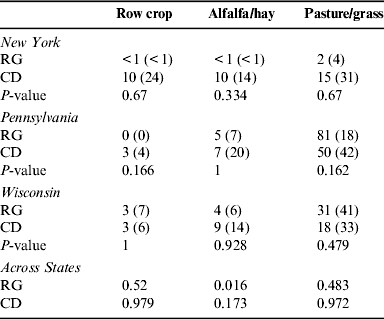
Riparian land cover in the 50 m riparian area was not different between farm types across states (multivariate MRPP test of farm type effect: New York A=0.045, P=0.112; Pennsylvania A=0.060, P=0.132; Wisconsin A=−0.043, P=0.683) and Mann–Whitney U-tests. Within farm types, land-use patterns were largely consistent among states, except for the percentage of land in alfalfa/hay for RG farms; however, little land was devoted to this land use in each state (Table 2). In addition, there was clear distinction neither between RG and CD farms across states nor within states in an NMS ordination (Fig. 2).
NMS ordination of three categories of land cover on study farms in New York, Pennsylvania and Wisconsin. The NMS produced a two-dimensional solution. Variables included along each axis were correlated (r>0.5) with the ordination axes. Variance explained was 65% for axis 1 and 25% for axis 2; final stress=9.391 and instability <0.00001 for 44 iterations.

Mean percentage (±1 SD) for three land covers for the 50 m riparian area across New York, Pennsylvania and Wisconsin. Comparisons within states are based on Mann–Whitney U-tests. Comparisons across states are based on Kruskal–Wallis rank sum tests. A significant P-value after a Bonferroni correction is P=0.017 for the Mann–Whitney U-tests and for Kruskal–Wallis rank sum tests.

We found that a substantial number of farms of both types allocated land within the 50 m riparian area to continuously grazed pasture, although the sample size is too small for statistical testing. In New York, two RG farms allocated an average of 3.5 ha (±0.18 SE) per farm to these pastures, whereas three CD farms allocated 3.1 ha (±0.35); corresponding farm numbers and means for Pennsylvania were three RG farms with 5.2 ha (±0.10), and five CD farms with 6.5 ha (±0.08), and for Wisconsin, there were four RG farms with 5.7 ha (±0.32) and three CD farms with 7.6 ha (±0.63). Thus, across states, farm types were similar in allocation of riparian area to continuous grazing, which may expose streams to higher rates of sediment and nutrient loading in comparison to rotational grazing.
Land cover on farms and catchments
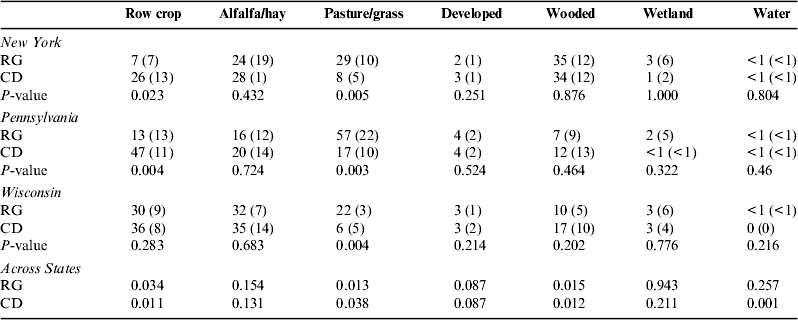
As expected, land cover on farms was significantly different between farm types in all three states; (multivariate MRPP test of farm type effect: New York A=0.13, P=0.008; Pennsylvania A=0.241, P<0.001: Wisconsin A=0.117, P=0.013), likely reflecting differences in stocking density between farm types, as well as other management factors. Pasture areas on CD farms had a significantly higher average stocking density [19.5 animal units ha−1; 1 animal unit=450 kg; P≤0.005 (Kruskal–Wallis test)] than RG farms (4 animal units ha−1). The percentage of row crops was significantly higher on CD farms in Pennsylvania, whereas the percentage of pasture/grassland was significantly higher on RG farms than on CD farms in all states (Mann–Whitney U-tests; Table 3). Within each state, we verified that RG and CD farms were situated in comparable catchments in terms of land-cover patterns. Catchments were delineated with ArcHydro Tools in ArcView v 9.1 and included only that part of the catchment upstream of sample reaches. In all states, there was no difference between farm types in land cover in catchments (multivariate MRPP test of farm-type effect: New York A=0.013, P=0.304; Pennsylvania A=−0.035, P=0.786; Wisconsin A=−0.01, P=0.464).
Mean percentage (±1 SD) for seven land covers on farms across New York, Pennsylvania, and Wisconsin. Comparisons within states are based on Mann–Whitney U-tests. Comparisons across states are based on Kruskal–Wallis rank sum tests. A significant P-value after a Bonferroni correction is P=0.007 for the Mann–Whitney U-tests and P=0.017 for Kruskal–Wallis rank sum tests.

Land cover on study farms was significantly different across states for RG farms (A=0.263, P<0.001) and CD farms (A=0.136, P<0.001) based on MRPP analyses. Thus, within each farm type, we found that land-use patterns differed geographically. Across RG farms, Pennsylvania had more pasture/grassland than New York and Wisconsin (P=0.013); and New York had a higher percentage of wooded cover than Pennsylvania or Wisconsin (P=0.015) based on a Kruskal–Wallis analysis (Table 3). Across CD farms, Pennsylvania had more row crop (P=0.011); New York had a higher percentage of wooded cover (P=0.012); and the percentage of wetlands was different (P=0.001), although absolute percentages of wetlands were low across states. In New York, the high percentages of wooded cover on farms of both types may have limited the effect of farm type on stream quality, as the wooded areas may buffer streams from effects of grazing management. These differences were apparent in an NMS ordination where RG farms tended to be spatially separated from CD farms in each state and RG farms were spatially separated from CD farms among states (Fig. 3).
NMS ordination of seven categories of land cover on study farms in New York, Pennsylvania and Wisconsin. The NMS produced a three-dimensional solution, but only the first two axes are presented. Variables included along each axis were correlated (r>0.5) with the ordination axes. Variance explained was 55% for axis 1 and 24% for axis 2; final stress=5.891 and instability <0.00001 for 120 iterations.

Stream-channel characteristics were also not different within farm types across states (RG: A=0.051, P=0.161 and CD: A=0.015, P=0.276) based on MRPP analyses nor were there differences in stream characteristics observed within states between RG and CD farms (Table 1). Only CV of width (P=0.013) was significantly different among states, based on a Kruskal–Wallis rank sum test (Table 1).
Overview
Taken together, our findings indicated that the physical integrity of stream-channel characteristics was similar in RG and CD farms in this sample of 37 farms in three contrasting regions in the Eastern and Midwestern USA. Our findings, therefore, provide a perspective on stream-quality effects of RG that differs from some previous studies. Previous analyses focused on RG pasture effects on adjacent streambank and stream conditions, whereas our study has examined the effects of RG farms as entire operations. These prior studies found that RG pastures in riparian zones can have beneficial effects, compared to CD pastures, on a variety of attributes of adjacent streams and streambanks. Beneficial effects included reduced stream bank erosion, sediment input and embeddednessReference Olness, Smith, Rhoades and Mensel 8 , Reference Sovell, Vondracek, Frost and Mumford 10 , Reference Weigel, Lyons, Paine, Dodson and Undersander 11 , Reference Bishop, Hively, Stedinger, Rafferty, Lojpersberger and Bloomfield 13 , Reference Raymond and Vondracek 19 , Reference Lyons, Thimble and Paine 25 , reduced soil compaction and improved bank stabilityReference Magner, Vondracek and Brooks 15 , Reference Raymond and Vondracek 19 , reduced bank erosionReference Zaimes, Schultz and Isenhart 17 and reduced sediment delivery to streamsReference Haan, Russell, Powers, Kovar and Benning 14 . Moreover, RG pastures have been associated with higher levels of stream biotic integrityReference Karr and Chu 51 , evidently related to differences in stream-channel characteristics in comparison to CD pasturesReference Weigel, Lyons, Paine, Dodson and Undersander 11 , Reference Braccia and Voshell 52 .
However, a smaller number of previous studies have not found any beneficial effects of RG in comparison to CD in riparian areas. Zaimes et al.Reference Zaimes, Schultz and Isenhart 16 did not find significant differences among the three grazing practices (intensive rotational pastures, rotational pastures and continuous pastures), which were attributed to recent conversion of study sites to RG practices. Webber et al.Reference Webber, Mickelson, Ahmed, Russell, Powers, Schultz and Kovar 53 did not find consistent differences in erosion rates for RG and CD pastures; RG pastures were not found to lower NO3-N leaching compared to CDReference Owens, Barker, Loerch, Shipitalo, Bonta and Sulc 54 and RG pastures had only slightly lower erosion rates than CD farmsReference Nellesen, Kovar, Haan and Russell 18 . Finally, Lyons et al.Reference Lyons, Weigel, Paine and Undersander 9 and Wang et al.Reference Wang, Lyons and Kanehl 20 found no differences for fish biotic integrity, and no differences in biotic integrity of aquatic macroinvertebrates were found at RG and CD sitesReference Magner, Vondracek and Brooks 15 , Reference Raymond and Vondracek 19 .
As noted, our study builds on previous work by providing a broader perspective on the effects of RG on stream conditions. Rather than focusing on riparian pasture effects per se, we examined stream reaches at the downstream edge of each farm site and on the entire area of each farm. We were particularly concerned to observe details of land-use, land-cover and management practices in areas that strongly affect water resources, such as riparian zones, and to observe these among the ‘rank and file’ of RG operations. These operations have been shown to vary broadly in grazing management practicesReference Lyon, Bell, Gratton and Jackson 21 ; clearly, assessments of the conservation value of RG need to consider such variation in RG practices. Moreover, we examined stream conditions and whole-farm land-use patterns across a broader geographic range than previous studies, which have generally focused on one or a few catchments within a particular region, typically a US state.
We found that RG and CD farms in our sample differed in land use. RG operations allocated more land to pastures that often have beneficial effects on adjacent stream reaches. Increased pasture area in both riparian and upland portions of farm landscapes, reduced stocking density and reduced soil compaction and streambank erosion have been demonstrated to affect stream channelsReference Kauffman, Krueger and Vavra 4 , Reference Scrimgeour and Kendall 5 , Reference Trimble and Mendel 55 . Although not focused on RG or CD farms, Kuhnle et al.Reference Kuhnle, Bingner, Foster and Grissinger 28 found fine sediment and sand decreased over 60% in a stream over a 9-year period, during which the percentage of pasture or idle land increased and cultivated land decreased, because stream discharge had decreased, potentially because of increased infiltration.
However, the broad differences in land use and land cover in our study did not lead to broad or consistent differences in stream-channel quality. We found that RG was not consistently associated with increased physical integrity of streams and streambanksReference Asmus, Magner, Vondracek and Perry 39 at the whole-farm level. For example, we did not find positive effects of RG on attributes such as reduced bank erosion and streamside soil compaction.
A number of factors may underlie our finding that RG farms do not have consistent beneficial effects relative to CD, when evaluated at the whole-farm level. First, the effect of a dairy operation on stream quality will likely depend on the details of land use and land cover in the areas of a farm that have the strongest hydrological connections to streams (i.e., areas with relatively high potential for runoff of water, sediment, nutrients and microorganisms from uplands to streamReference Galzki, Birr and Mulla 56 ). Indeed, land cover in riparian areas along study streams was not statistically different between RG and CD farms within states, primarily because of high variance within farm types. Importantly, both farm types had similar incidences of continuously grazed pasture in riparian areas. Such pastures, in the riparian zone, may produce substantial sediment and nutrient inputs to streamsReference Zaimes, Schultz and Isenhart 16 , potentially negating beneficial effects of rotationally grazed pastures in other parts of RG farms. Second, there was a wide range of implementation approaches to rotational grazing, and these may differ in significant details of management practice, such as the size and location of continuous pastures or the management of riparian areas and other critical landscape areas that have disproportionate effects on water resources. Notably, we did not observe the differences in streambank condition reported in other studies.
Previous studies that observed the beneficial effects of RG on streams adjacent to pastures may have focused on well-managed RG farms, with less sampling of the wide range of RG management approaches that we encountered in our study. We observed a number of instances of management practices on RG farms that may have reduced beneficial effects of these operations on streams, including the continuous pasture in riparian areas noted above. These continuous pasture areas are typically occupied by juvenile and non-lactating cowsReference Sanderson, Feldmann, Schmidt and Taube 57 , and these intensively used areas could have contributed sediment and nutrients to streams, counteracting positive effects of other RG pastures. Similarly, interviews with farmers revealed that grazing on RG farms in New York occurred in wooded areas (Jordan et al., unpublished data). This management practice could have effects on stream quality, as such forested sites are certainly subject to erosionReference Wynn and Mostaghimi 58 . Grazing in wooded riparian areas, as practiced in New York, may have increased soil compaction and increased erosion in these areasReference Trimble and Mendel 55 , Reference Belsky, Matzke and Uselman 59 . Such deviations from the ideals of RG practice may have strong effects on streams that are disproportionate to the total area used for such practices. In contrast, streams along pasture had threefold higher fine sediment in the streambed than along reaches with native forest in New ZealandReference Quinn, Cooper, Davis-Colley, Rutherford and Williamson 22 .
Of course, local-scale effects of isolated RG farms on stream-channel characteristics may have been overridden by the effects of land use and land cover on the catchment scale. A 10% increase in upland agriculture and urban land relative to reference conditions represented a threshold for reduced surface water qualityReference Zampella, Procopio, Lathrop and Dow 60 . Habitat quality and fish biotic integrity decreased significantly when agricultural land use exceeded 50% in catchments in WisconsinReference Wang, Lyons, Kanehl and Gatti 61 . In such catchments, implementation of RG on scattered individual farms may not improve stream-channel characteristics. Analogously, Goetz et al.Reference Goetz, Wright, Smith, Zinecker and Schaub 62 suggested that riparian buffers—as provided by well-managed RG pastures in riparian areas—cannot alone protect a stream from degradation in areas where impervious cover exceeds 10% or forest cover is <60%. Such supervening catchment effects may have been especially forceful in Pennsylvania and Wisconsin, where all studied catchments were located in agricultural landscapes with considerable cultivation of annual row crops, and delivery of soil, nutrients and runoff from these fields may have been the predominant factor in determining stream conditions in this study. Landscapes with row crops in riparian areas have streams that are vulnerable to increased sedimentation, bank erosion and nutrient loadingReference Razavian 6 , Reference Kuhnle, Bingner, Foster and Grissinger 28 , Reference Haase and Nolte 63 , Reference Stewart, Wang, Lyons, Horwatich and Bannerman 64 . Conversely, according to Goetz et al.Reference Goetz, Wright, Smith, Zinecker and Schaub 62 a stream health rating of excellent required at least 65% tree cover in the riparian zone.
Summary and Conclusions
The ability of an isolated RG operation to beneficially affect stream-channel conditions may vary considerably as a function of catchment-scale land use, edaphic, topographic and hydrological factors, time since implementation of RG, and biophysical attributes of streams. Moreover, RG is being practiced in substantially different landscapes across the Eastern and Midwestern USA. Study farms in Wisconsin had the highest percentage of row crops in the catchments, which may have contributed more sediment to the streams as indicated by higher embeddedness, bedded sediment and smaller particles in the streambed than the other states, because fine soils require vegetative cover to prevent erosion. More broadly, we observed significant among-state differences in land cover across farms that may have also contributed to the lack of association between RG and channel characteristics. Variation in stream channels among states may have been related to ecoregion and geomorphologyReference Zaimes, Schultz and Isenhart 17 , Reference Long and Medina 65 ; streams in New York were deep and narrow, often with bedrock substrate, whereas streams in Wisconsin were often shallow with finer particles in the streambed, and streams in Pennsylvania were intermediate and spanned a greater range of values.
Previous studies suggest that RG can have substantial benefits on stream quality, but to realize these benefits in practice it may be crucial to improve the quality of RG management with respect to water resources, to focus management attention particularly on critical landscape areasReference Galzki, Birr and Mulla 56 , Reference Zaimes and Schultz 66 , such as riparian areas where practices, such as continuous grazing, may undermine the effect of sound upland management. Indeed, we would contend that RG cannot be assumed to be a water-quality best-management practice without careful attention to details of land cover and management practice, particular in critical landscape areas with disproportionate effects on water resources. Therefore, enhancement of technical and management support for RG farmers from extension services and conservation agencies may be critical to realizing the potential conservation value of RG. Moreover, we suggest that RG cannot serve as a stand-alone management practice to protect stream integrity, rather, it should be viewed as one of a suite of options that could be jointly deployed on a catchment basisReference Boody, Vondracek, Andow, Krinke, Westra, Zimmerman and Welle 1 , Reference Russelle, Entz and Franzluebbers 67 . Thus, RG could be included as part of a landscape management plan that reduces the effect of land use throughout a catchment and is sensitive to local geography, ecology, culture and livelihoods. Finally, clustering of RG operations, i.e., the occurrence of high densities of well-managed RG farms in a catchment may lead to improved water quality, particularly when the siting of such farms is guided by watershed scale modeling of land-use/land-cover effects on water qualityReference Wilson, Dalzell, Mulla, Porter and Dogwiler 68 . Such clustering appears to be happening in certain geographic areasReference Lewis, Barham and Robinson 69 and may provide social and economic benefits as well as aggregating water quality benefits and, thus, justifying public subsidy and cost-sharing investment in RG operations.
Acknowledgements
This project was funded by National Science Foundation Grant 0709613, from the Coupled Human-Natural Systems Program. We thank S. Graves, A. Nessley, K. Clower and the researchers and field crew that contributed information, biophysical, social and geographic, that made our analysis possible, and S. Manson and J. Immich for GIS analyses. The Minnesota Cooperative Fish and Wildlife Research Unit are jointly sponsored by the US Geological Survey, the University of Minnesota, the Minnesota Department of Natural Resources, the Wildlife Management Institute and the US Fish and Wildlife Service. The use of trade names or products does not constitute endorsement by the US Government.
Selected attributes of dairy farms included in this study.

Selected stream-channel attributes of streams associated with dairy farms included in this study.

Selected land-use and land-cover attributes of dairy farms included in this study.