It is said that trade follows a nation's flag. It is equally true that trade likewise follows the investment of a nation's capital; indeed, this is the sesame that opens the door of trade.Footnote 1
John Hays Hammond, 1913Reflecting on the impact of the Great War, United States Geological Survey director George Otis Smith wrote in 1920, “The U-boat threat taught us that certain minerals, even the names of which were unfamiliar to most citizens, were in fact ‘key’ commodities without which basic industries could not operate.”Footnote 2 Mining engineers, policy makers, and economists concurred. A year later, world-renowned American mining engineer John Hays Hammond and Cornell economist and international monetary expert Jeremiah Whipple Jenks authored a broad-ranging study of the great issues facing American society following World War I. While recognizing the abundance of some domestic natural resources available to American industry, Hammond and Jenks warned that in case of scarce minerals for which there were few or no domestic sources, “There is little likelihood that we shall be self-sufficient.” They counseled adoption of natural resource policies that ensured a steady flow of minerals to American manufacturers in peacetime and provided a measure of national security “as a matter of self-defense or national preparedness in case of the recurrence of conditions like those existing in the Great War.”Footnote 3
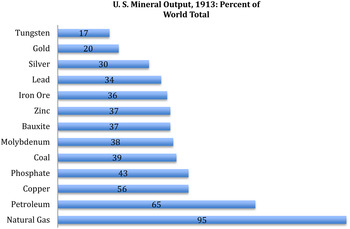
Jenks, Smith, and Hammond's widely held concern with raw materials access after WW I contrasts markedly with the belief held by earlier generations of Americans that the nation's abundant natural resources made it uniquely self-sufficient. Writing at the turn of the century, former Assistant Secretary of the Treasury Frank Vanderlip described “American soil and minerals” as “eternal”: “The resources of no other great power are for one moment to be compared with them … We have hardly comprehended the inevitable advantages which those resources give us,” Vanderlip argued.Footnote 4 Vanderlip's widely shared confidence in the defining nature of American abundance persisted well into the twentieth century. For much of American history, the domestic availability of natural resources and the development of manufacturing went hand in hand. A rich mineral stock, fertile soils, abundant waterways, vast timber resources, and a diverse climate were key factors that had contributed mightily to American economic growth. U.S. economic development depended, of course, on the availability of capital and labor but, as economic historian Gavin Wright argued, before WW I the United States “was uniquely situated” as the “world's leading producer” of a number of natural resources—including copper, coal, zinc, iron ore, lead, and other minerals—all of which lay “at the core of industrial technology” (see Figure 1).Footnote 5
From Gavin Wright, “The Origins of American Industrial Success, 1879–1940,” American Economic Review 80 (Sept. 1990): 661.

The picture of U.S. resource abundance was not entirely sanguine. Indeed, concerns about the need to conserve the nation's resources could be heard in Theodore Roosevelt's administration. But it was the Mexican Revolution and WW I that ruptured American leaders' belief in the perpetual availability of U.S. natural resources. During this period, the United States confronted shortages of minerals critical to the war effort and experienced threats and seizures of direct investment capital in Mexico. One important result of these conflicts was a renewed effort—particularly by those with experience in the mining industry abroad—to create new institutions and develop new strategies to resolve international economic disputes and to ensure a steady flow of raw materials to fuel American industry. An examination of the career of mining engineer John Hays Hammond and his associates reveals the increasing importance of extractive industries abroad to the larger story of efforts to safeguard U.S. access to world markets, which, for an earlier generation of Americans, had mainly concerned the export of primary goods and later that of manufactured goods.
Previous work on late nineteenth- and early twentieth-century U.S. political economy by historians beginning with William Appleman Williams and continuing in the work of Martin Sklar, Thomas McCormick, and others has emphasized the efforts of policy makers such as Charles Conant and Jenks in the late nineteenth century to solve the overproduction and oversavings problems in American manufacturing by opening up markets abroad and exporting investment capital.Footnote 6 Conant recognized that U.S. economic expansion abroad required “radical changes” in U.S. capitalists' strategic planning. He offered a stark policy choice between policy stasis (which would effectively promote accelerating class conflict), redistribution to reduce the glut of capital held by the investor class (which would effectively surrender to socialism), and exporting surplus capital through foreign direct investment. Only the latter would successfully address the economically ruinous and socially disruptive boom-and-bust cycle. If the United States did not work to ensure that U.S. capital could be employed abroad, Conant argued, it would “continue the needless duplication of existing means of production and communication, with the glut of unconsumed products, the convulsions followed by trade stagnation, and the steadily declining return upon investments.”Footnote 7
Conant's argument captured the attention of his contemporaries and later historians. Yet insufficient attention has been paid to how the involvement of Americans working for U.S. and non-U.S. companies in extractive industries outside of the United States actually reshaped the nation's political economy.Footnote 8 Indeed, there is an important story to be told concerning raw material importation—which increased as an overall proportion of imports from 8 percent in 1850 to 33 percent in 1900.Footnote 9 And there is a particular story to be told concerning U.S. direct investment in mining enterprises abroad, which best estimates suggest increased dramatically from $134 million in 1897 to $720 million in 1914; this increase dwarfed U.S. direct foreign investment in other sectors (i.e., railroads, utilities, petroleum, agriculture, and manufacturing) and constituted more than a quarter of overall U.S. direct foreign investment.Footnote 10 Filling in this vital narrative can make an essential contribution to the ongoing recovery of the history of the U.S. and world capitalism in the era of rapid industrialization and, as well, to our understanding of how gaining access to these resources structured the development of economic and foreign policy making during the ensuing decades and transformed the structure and capacities of the U.S. state. (The latter—i.e., the state capacity question—will be reserved for detailed treatment in a separate article).
This article examines the rise and work of mining engineer John Hays Hammond and the mining engineers, geologists, and capitalists with whom he worked.Footnote 11 Historians have addressed in some detail Herbert Hoover's career as a mining engineer.Footnote 12 But in April 1908, when the Washington Post described “not quite the foremost man in the world,” but “surely the foremost mining engineer,” and went on to suggest, “many capable observers believe that the engineers as a class will exercise a large influence in governmental affairs in the future,” they were referring to Hammond, not Hoover who had yet to make his fortune and had only once had his career (briefly) mentioned in the pages of the Post.Footnote 13
Hammond's remarkable and controversial career as a mining engineer helps to account for the dramatic increase in foreign direct investment in mining enterprises, and it demonstrates how recognition of new needs, formation of new scientific knowledge, and the actual scouting out of sources for needed material emerged as central activities of mining engineers and the mining industry. This article reveals ways that a segment of the investor class (both U.S. and, in some cases, British) depended upon members of the emerging professional middle class of university-trained experts for collaboration—and even inspiration—regarding possible sources of remunerative investment.Footnote 14 The early search for raw materials abroad opens up a chapter in the history of U.S. capitalism in which mining engineers like Hammond encouraged and facilitated a new phase of export of redundant U.S. capital and manufactured goods in a direction where investment would be secure, labor recruitable, and profits attractive and subject to repatriation.Footnote 15
Important work by historians—Sven Beckert and William Cronon prominently among them—has shown that major challenges to established patterns of economic activity, including wars, inventions, and population movements, have shifted the flows of investment established in earlier moments of capitalist expansion. Beckert's Monied Metropolis: New York City and the Consolidation of the American Bourgeoisie, 1850–1896 describes how after the Civil War, New York City's merchant capitalists and bankers redirected a key component of their capital investment from purchasing and moving raw cotton through the New York port for export to England to moving both imported and domestically-produced finished goods into the rapidly expanding U.S. interior.Footnote 16 William Cronon's majestic Nature's Metropolis: Chicago and the Great West details how crucial collaborations by local investors and developers were to the emergence of Chicago, and not to other contenders, as the beneficiary of outside investment by New York capitalists in making Chicago the key transit point for shipment of grain, meat, and lumber into national and international markets.Footnote 17 Other studies, exemplary among them William Leach's Land of Desire: Merchants, Power, and the Rise of a New American Culture shows how the rise of department stores depended upon vital collaborations with investors such as John Wanamaker and Marshall Field by inventors (the elevator), architects (new building designs), managers, and advertisers, aiding capitalist expansion at the other, mass production end of the domestic and transnational U.S. capitalist transformation in the late nineteenth century.Footnote 18
By the turn of the century, Hammond worked to direct the flow of surplus capital and manufactured goods toward the pursuit of scarce resources buried in distant lands. To do so, he—working with a network of other mining engineers and geologists—located resources and established connections that supported the specific needs of extractive industries abroad. International mining efforts such as these involved the flow of capital, equipment, and labor from multiple nations, and this phenomenon in turn created a dizzying array of potential problems and conflicts. Historian David Pletcher has described mining engineers like Hammond as “professional optimists who must find favorable concessions abroad and money at home and somehow reconcile the demands of the individuals who could furnish these prerequisites.”Footnote 19 If worthwhile veins of coal or supplies of minerals could be located and access could be negotiated with local authorities, mining engineers often played a significant role in gaining financing for these risky endeavors and, at times, in leading efforts to build the infrastructure to move the rock or minerals to ports, where facilities also had to be constructed or overhauled. Thus they were an essential link between ready but cautious capital and profitable but undeveloped opportunity across the natural world.Footnote 20 As these engineers and the companies they represented expanded the scope of their efforts, they took into account lessons from the failures and successes of previous endeavors, thus storing up and building upon technical and situational knowledge.
Hammond remained committed to a two-pronged effort to promote American economic interests, more often than not at the expense of less-developed nations. Given the risks involved in investing outside U.S. borders, he had to understand—and to avoid or mitigate—any obstacles to the security of investment and repatriation of profits. As American mining engineers like Hammond, along with investors of capital, went to work on the natural resources of other countries, they argued that new markets would stimulate demand for a wide range of American manufactured goods related to mining and infrastructure development. Further distinguishing Hammond (and Hoover as well) from later experts and advocates of international trade was their belief that manufacturing jobs should remain in the United States, thereby supporting the purchasing power of American workers and fulfilling the desires of the emerging consumer society. They also argued that American minerals and raw materials should remain at home and be employed efficiently in American industry. In a patently outrageous double standard that echoed mercantilist thought and managed to violate notions of comparative advantage, they argued that the United States should extract as many natural resources from abroad as possible, but that it should keep all of its own natural resources at home and employed in domestic industry.Footnote 21
THE TRAINING OF A MINING ENGINEER
On May 3, 1926, a group of John Hays Hammond's friends celebrated his seventy-first birthday in the Grand Ballroom in New York's Waldorf Astoria Hotel. So prestigious were the gathered and the guest of honor that all major newspapers covered the event, with Time magazine placing Hammond's image on the cover of its May 10 edition. So widely dispersed were Hammond's admirers that the Waldorf Astoria gathering coincided with dinners held the same night in Hammond's honor in three other American cities and in London, Paris, Lisbon, Manila, and South Africa. Back at the Waldorf Astoria, Hammond received a bound volume that included more than ten thousand messages honoring his life's work that had been sent, Time reported, by “men in all walks of life—ambassadors, financers, politicians, scientists, admirals, artists.” Those who came to the event and those who wrote in admiration celebrated a man who “had lived a life as few men can or even could have lived.” He was, according to Time, the “most radically democratic millionaire.”Footnote 22
Born in San Francisco in 1855 to a well-connected and comfortable (though not wealthy) family, John Hays Hammond enjoyed an upbringing that mixed vigorous outdoor activities with a top-notch education. Though always a Californian, Hammond took pride in his family's Southern roots, which included veterans of the Mexican-American War and the Confederacy as well as the legendary Texas Ranger John Coffee Hays. Hammond's education began at Lincoln Public School in San Francisco, but, following his mother's passing when John was twelve years old, his father sent him first to boarding school in Oakland and then to a preparatory school at the recently founded University of California, Berkeley. In mid-1871, Hammond boarded the transcontinental railroad bound for New Haven, Connecticut, where he enrolled in Hopkins Grammar School to prepare for his eventual admission into Yale University in the fall 1873.Footnote 23 At Yale, Hammond made lifelong contacts with future political and economic leaders, including William Howard Taft and Frederick William Vanderbilt.Footnote 24
Even as an undergraduate, Hammond gravitated toward individuals who concerned themselves with the determinants of U.S. economic development. Recounting his experiences at Yale, Hammond described being drawn to political economy and to political economist Francis A. Walker, whom he remembered as “the teacher who influenced me most at Yale.” According to Hammond, Walker's “poise, breadth of view, and even his temperament made him an ideal for me. He developed my interest in broad questions of public policy. I worked hard in his courses and I have never lost this interest.”Footnote 25 It is revealing that Hammond chose Walker as his ideal. In 1873, Walker, who would later serve as president of M.I.T., joined the Sheffield Scientific School at Yale as a professor of economics and history. Having grown up in a family defined in some respects by the Civil War but having spent little time in the South, Hammond immediately admired Walker's experience as a “wounded, captured, imprisoned, and paroled” officer in the Union Army who eventually “achieved the rank of brevet brigadier general.”Footnote 26 Walker also brought a tradition of public service that Hammond respected and would later work to emulate. Following the war, Walker served in the Grant administration on the important Revenue Commission, which helped to fashion postwar fiscal and monetary policy and then as superintendent of census in 1870 and 1880, for which he gained international acclaim as a statistician.Footnote 27 Walker's innovative work as Superintendent of the Census would have a direct impact on Hammond's career.
To pursue a career as a professionally trained mining engineer in the 1870s was in many cases to embed oneself in an international network from the very beginning. Completing his undergraduate degree in 1876, Hammond came of age at a moment when, although mining engineering education in the United States was still in its infancy, mining companies and financers increasingly placed a premium on professionally and technically trained engineers. As a result, Hammond opted to continue his training at the Royal Mining Academy in Freiberg, Germany.Footnote 28 In attending Freiberg, Hammond followed in the footsteps of some of the most famous American mining engineers of the late nineteenth century, including a number who would help to shape the emerging profession, among them Eckley B. Coxe, Rossiter W. Raymond, and James D. Hague as well as Louis, Henry, and Alexis Janin.Footnote 29 He shared this formative experience of crossing the Atlantic to pursue graduate training with soon-to-be founding members of the modern university discipline of economics and of the American Economic Association, whose career then in many ways resembled that of the American Institute of Mining, Engineers (AIME) established in 1871.Footnote 30
After three years in Germany, Hammond returned to the United States credentialed by the most important institution of mining engineering and connected to a network of prominent mining men, but with little in the way of experience. In 1879, when he returned to California from Freiberg, George Hearst—a family friend, future senator, wildly successful mining investor, and, of course, father of William Randolph Hearst—somewhat reluctantly offered the young man a job. Shortly thereafter, Hammond faced an early crossroads in his career, one that forced him to choose between valuable experience in government service and a lucrative promotion. After months of hard work and modest compensation, Hammond mustered the courage to ask Hearst for a raise. Not only did Hearst dramatically increase Hammond's pay, he also offered him a significant promotion to superintendent of the Homestake mine in South Dakota. Almost simultaneously, the director of the newly created U.S. Geological Survey (USGS), Clarence King, offered Hammond a position with the USGS upon the recommendation of Hammond's fellow Freiberg graduate Gardner F. Williams.Footnote 31
That Hammond spurned Hearst's more lucrative offer and opted with no hesitation to take the government position speaks to the recognized importance of the USGS—almost from the moment of its inception—to the mining industry, mining engineers, and the nation. And it further underscores the larger trend in academia, government, and nonprofit organizations that increasingly plowed resources and energy into applied and basic research in the earth sciences.Footnote 32
From its creation in 1879, the USGS addressed a remarkably diverse set of issues of interest to the general public and the mining industry, operating in a way that both built on and transcended earlier state and local surveys and the four “great surveys” of the West by Ferdinand Hayden, Clarence King, George Wheeler, and John Wesley Powell.Footnote 33 Survey supporters saw in the new agency an opportunity to use geological investigation as a means of addressing not only diverse industries' demand for natural resources, but also the currency crisis that dominated the nation's politics during the last quarter of the nineteenth century. The financial panic of 1873, the ensuing five-year recession, and the emergence of the Greenback movement ensured that gold and silver production would remain public concerns.Footnote 34 When King took on the job of first director of the USGS he determined early on that the Survey would focus its energies on practical matters that addressed the concerns of the mining industry.Footnote 35 Though later administrations would shift the focus to varying degrees toward basic research, the USGS continued in part to serve the mining industry and thus to bring into a common frame the interests of investors and mining engineers.Footnote 36 As would happen frequently for those dealing with natural resource deposits as a public concern, USGS advocates wrestled with the often-fraught issue of federalism and with the constitutional limitations imposed by the commerce clause, which was held to restrict the national government from entering into direct engagement with a broad range of issues.
From the start, USGS leaders worked to expand the scope of their work. The original task of the USGS was limited to the survey of public lands west of the 100th meridian, but King worked closely with Walker to expand its purview to include the entire country and privately owned mines. Walker, who had been keen to increase the quality of census statistics, ordered the Census Office to collect a broad range of information on the mining industry, but he turned to the Geological Survey for a force of “expert special agents” to conduct these investigations while still on the USGS's payroll.Footnote 37 Hammond served as one of fewer than eighty “expert special agents” who were compensated by the Geological Survey but served as agents of the Walker-led Census.Footnote 38 The new agency provided an almost ideal opportunity to learn about the mining industry. As Clark Spence has argued, work on the survey provided young engineers with a potent combination of educational experience and a stamp of legitimacy that fellow engineers and mining companies clearly recognized.Footnote 39
The work provided Hammond with an opportunity to learn about the mining industry but, more importantly, it also established a close link between the mining engineers like Hammond and the USGS, one that persisted well into the twentieth century. In fact, Hammond's last act in this phase of his involvement with the USGS was to turn in his completed report to lead geologist George F. Becker, who not only provided decades of credible service to the Survey, but who also—as we will see—some fifteen years later came to Hammond's aid at a critical moment in South Africa. More generally, as the mining industry continued to develop, it asked more and more of the USGS, thus cultivating the growth of survey methods that located valuable resources.
ENABLING MINING ABROAD
When mining engineers pursued opportunities in extractive industries abroad, they took with them their expectations regarding the profitable exploitation of resources and the best methods for recruiting and managing available labor. Hammond's next opportunity came by way of the Janin family. In the nineteenth century, the Janin brothers—Louis, Henry, and Alexis Janin—along with Louis Janin's sons, emerged as the first family of American mining engineering.Footnote 40 Like Hammond, the three older brothers were all educated at Freiberg and gained international reputations as successful and capable mining engineers. In 1882, Hammond accepted a position as manager of Minas Nuevas, a silver-mining property near Alamos, Mexico, in Sonora. While both Louis and Henry Janin had invested in the property, it was Louis who offered Hammond the job.
Hammond spent the fifteen months from April 1882 to June 1883 in Sonora, where he encountered political, social, and economic turmoil while managing the Minas Nuevas. The Engineering and Mining Journal described Sonora as a region rife with “political troubles” compounded by violence perpetrated by Apaches, other native groups, and the many newcomers to Sonora seeking precious metals. In this turbulent space, Hammond encountered obstacles to investment of alien capital that sprang from cultural and political differences and (unsurprising and justified) animosity toward agents of foreign capital and governments long bent on ensuring that Latin America remained a region of “open veins.”Footnote 41 Dripping with condescension, the Journal regretted that Americans with their “pushing ways, have not shown that spirit of conciliation which true policy would dictate.” Blame also lay, the Journal lamented, with the Mexican character: “The Mexicans, through long inactivity and a lack of ambition, are slow and difficult to deal with, and it cannot be expected that their habits can be transformed by simple contact with their more energetic neighbors.”Footnote 42 Sonora in the 1880s was in the early stages of dramatic political and economic change that would transform the region from what historian Miguel Tinker Salas characterized as a “relative backwater of the Mexican republic” into “one of [its] most prosperous states.” This emerging prosperity—at least for the mining companies—rested in no small measure on American investment in Sonora mining, which by 1902 reached more than $27 million, considerably more than was funneled into other Northern Mexico states. Foreign governments, too, took notice. Germany, France, Spain, the United States, and Great Britain all established consular offices in Sonora to explore their own business opportunities.Footnote 43
While he failed to make his fortune in this early adventure in Sonora, Hammond quickly established himself as not only an engineer, but also an expert who could mediate disputes between groups of capitalists, thus helping to ensure the continued flow of capital between nations. For instance, six years after Hammond finished his work at Minas Nuevas, a group of British and American investors, contemplating purchasing the Mulatos gold mine in Sonora from Manuel and Lucadio Aguayo, sent Alexis Janin and another mining engineer to conduct an eight-week examination of the property. In September of 1889, following the investigation, Alvinza Hayward purchased the property on behalf of a group of British investors, including the Rothschild family, for a reported $1,575,000.Footnote 44 Janin would later claim that the report he submitted had been only cautiously optimistic about the mine and not an actual assessment of its value, but the Janin family imprint was indelibly linked to the sale of the property.Footnote 45 Shortly after the mine's sale, Alexis Janin's nephew Louis Janin Jr., who had served as an assayer during Alexis's investigation, published a detailed report in the pages of the Engineering and Mining Journal in which he predicted that the Mulatos mine “will become one of the most noted and best paying gold mines in North America.”Footnote 46 Janin got it wrong—the mine turned out to have been salted—and the ensuing legal and political struggle further underscored hazards of foreign direct investment in mining and extractive industry more generally, especially with multiple sovereignties involved.Footnote 47 The original terms of the sale required that the buyers come to the table with $700,000 in cash and then deposit the remaining funds in the San Francisco bank Wenceslao Loaiza, to be paid out in a series of installments. As suspicion increased among the British mine owners regarding a likely fraudulent assay, the buyers asked for an injunction “restraining Loaiza from disposing of the notes” and requesting that a receiver be appointed to take charge of the remaining funds. As the case moved closer to trial in the San Francisco Superior Court, the San Francisco Call captured nicely the complicated nature of the situation:
The case involves a peculiar question of jurisdiction. Both the real plaintiffs, the English companies, and the real defendants, the Aguayo Brothers, are subjects of and residents in foreign countries. The property in question is in a foreign country and the ground upon which the claim to jurisdiction is based is that the notes which are sought to be recovered are in this city.Footnote 48
With the mine failing to produce, Hammond took center stage in an effort to resolve what threatened to become an extremely costly international incident that pitted American financial institutions and British investors against Mexican landowners. The resolution of this situation required a new use of expert scientific testimony. The Diaz government asked Hammond to assess the merits of the new mine owners' case.Footnote 49 After a ten-day investigation, Hammond concluded that the ore bodies contained only a fraction of the gold per ton that had been reported in the initial examination. On the strength of Hammond's analysis, the Diaz government eventually intervened and forced the Aguayos to refund “nearly all of the money paid.”Footnote 50
But even more striking was the dependence of the movement of capital on advance agents such as Hammond. He spent the 1880s and early 1890s in the United States and abroad, deepening his ties to business, working as a consultant, engineer, and manager. In the fall of 1893, he and his family left for Johannesburg, South Africa. There, he worked briefly with the De Beers Consolidated Company until, only six months after his arrival, Cecil Rhodes, head of Consolidated Gold Fields, recognized Hammond's expertise in deep-level mining and hired him for the unprecedented sum of $75,000 per year and a share of the profits. This involved Hammond with a very costly, technologically advanced method of mining that extended mines thousands of feet deeper than had commonly been the practice in South Africa. Hammond had great success in evaluating and developing deep-level mines and the money was good, but he also warmed immediately to Rhodes, whom he came to admire. He wrote privately back to his father-in-law, Nathaniel Harris, in the United States that Rhodes was “the biggest man I ever met” and that the two of them had developed an uncommon level of trust. Hammond described how he would spend hundreds of thousands of dollars on mines and men without so much as a review by Rhodes of the investment strategy Hammond had carefully put together.Footnote 51
Getting financers to invest millions of dollars into actual mines in distant lands required more than just a warm and trusting friendship with Rhodes, and Hammond could thank a talented geologist—well known to him from his California days—for helping make the case. Footnote 52 In 1896, Hammond's firm hired USGS chief geologist Dr. George F. Becker to conduct an investigation of the gold fields in Transvaal. American and British newspapers and periodicals followed Becker's investigation and championed his credentials: “Professor Becker of the United States Geological Survey [is] known to the scientific world as one of the most distinguished geologists of the two continents,” praised The Cosmopolitan in a preface to a summary of his investigation, while failing to mention that the mining company was picking up the tab for his work. In his investigation, Becker confirmed Hammond's assessment that mining could be done at deeper levels and that the veins of gold were richer than had previously been estimated.Footnote 53 Successful efforts to extract precious resources from South Africa could benefit more than just Hammond and his British employers. Even at this early stage in his career, Hammond leveraged his work abroad to provide a potential market for American manufacturers. Just months after he arrived in South Africa, he described in a private letter to William J. Chalmers, president Fraser and Chalmers Company (a leading producer of mining equipment whose metallurgical equipment production facilities were based in Chicago), how he had successfully managed to adjust matters with his own company in a way that eliminated an exclusive contract with a British manufacturer of mining equipment and further opened the South African market to Chalmers's firm.Footnote 54
Hammond's close collaboration with Rhodes was not entirely unproblematic. Frustrated by the Boer government's unwillingness to let foreign capital exert unfettered power, Hammond, Rhodes, and others joined in an effort to overthrow the local government. The effort failed spectacularly and Hammond—after being arrested, imprisoned, and sentenced to death following a trial widely covered in the United States, Europe, and South Africa—eventually agreed to leave the South African Republic and pay a $100,000 fine.Footnote 55
Such trouble did little to dampen investors' interest in Hammond's expertise; in fact, it did the opposite.Footnote 56 He would spend the next three years headquartered in London, but traveling extensively for pleasure and as a consultant for various mining interests. In 1903, he entered an even more lucrative period in his career, when he took work in Mexico with the Guggenheim Exploration Company, which until that point had focused much of its investments in the mining industry on smelting rather than the more risky task of mining. Hammond was brought in for the hefty salary of $250,000 per year—making him, according to many reports, the highest paid salary man in the world—for five years to assess the Guggenheim properties and to expand its holdings of new mines. By now a savvy operator with the press, Hammond's reports made national and international news: the Washington Post referred to him as “the most famous mining engineer in the world.”Footnote 57 Oftentimes even the rumor that Hammond might have examined a property required public explanation by potential investors and mine owners.Footnote 58 When press coverage veered toward the unfavorable, “intimate friends” of Hammond could be counted on to anonymously but comprehensively rebut the unfavorable press coverage.Footnote 59 Now much more than just a mere mining engineer, Hammond's stock rose in academic circles. When the Academy of Political and Social Science convened in 1905 to discuss “The Settlement of Political Affairs in the Far East,” they asked Hammond to come and share his thoughts on U.S. relationships with China, Russia, Japan, and Korea, among other topics. In addition to discussing American commercial interests, Hammond warned that despite efforts to increase the mobility and bolster the Pacific fleet, the United States was “now vulnerable in the Pacific at Manila and Honolulu.”Footnote 60
Like Conant, Jenks, and others, Hammond spent years arguing for the necessity of increased trade to solve the overproduction problem at home. In the 1905 Annals piece, he looked longingly to Russian resources as an investment opportunity for American capital and a destination for American manufactured goods.Footnote 61 Five years later, he took matters into his own hands. In late 1910, he went to Siberia on behalf of American investors to develop mines and to cultivate a market for American manufacturers of mining machinery. He reported to the Engineering and Mining Journal, “I shall go to Siberia solely in the interest of American capital.” But investment in mining also meant, Hammond argued, an expansion of markets for manufactured goods: “This will mean the development of manufacturers, for where there are mines there must be mining machinery.”Footnote 62 A few years later, in a lengthy and wide-ranging testimony before the U.S. Commission on Industrial Relations in late January of 1915, Hammond argued that the United States was “rapidly approaching the limit—that is to say the point of saturation—in our domestic markets.” What to do about this crisis point in the history of American capitalism? For Hammond the answer was clear: “It is obvious, therefore, that we must either curtail the capacity of our factories, which would result in throwing out of employment millions of wage earners … or we must depend upon the exploitation of foreign markets for the relief of our congested home industries.”Footnote 63
NEW CONCERNS: SCARCITY IN THE LAND OF ABUNDANCE
In the early decades of the twentieth century, concern over resource scarcity and dependence on foreign sources eroded a long-standing confidence that an abundance of American resources at home and access to raw materials abroad ensured American economic security and independence. This trend had its roots in the last years of the Theodore Roosevelt administration, but it became close to a prevailing wisdom in light of the unrest surrounding the Mexican Revolution and WW I.Footnote 64 Instability abroad after 1910 put talent and capital at risk, but it also made clear American industry's deep dependence on foreign sources of certain key raw materials, for which there were limited or nonexistent supplies at home. Whether thinking about domestic resource scarcity at home or dependence on foreign supplies abroad, Hammond and others continued to function as advance agents of corporate expansion and as advocates for extending supply chains for raw materials that were neither abundant nor cheap in the homeland.
The WW I-era recognition of American dependence on foreign nations constituted an important shift in thinking away from two quite different turn-of-the century assessments of the relationship between raw materials and economic development. While some economists and policy makers, in this earlier period, continued to believe that American raw material independence was crucial, an alternative argument concerning international trade suggested that increased trade markedly diminished the importance of a native supply of raw materials. Both of these understandings were on display at the Fourteenth Annual Meeting of the American Economic Association in 1902. At this meeting Brooks Adams, the grandson and great-grandson of two presidents and son of railroad magnate Charles Francis Adams, gave a roundtable address concerning the recent expansion of foreign trade. Embracing a version of American exceptionalism, Adams argued that as a result of American ports, infrastructure, natural resources, and public policies, the nation “enjoys not the advantages of Nineveh or Syracuse, of Rome, of Lombardy, or of England separately, but of all combined.”Footnote 65 Adams's argument regarding the importance of natural resources to economic development reflected long-standing perceptions of American raw material independence. Economists and policy makers who participated in the roundtable following Adams address criticized this point of view. Economists John F. Crowell and E. R. A. Seligman joined Conant in arguing that improvements in transportation of goods combined with international trade rendered the advantages provided by abundant resources within a single country meaningless. According to Crowell, the fact that a nation did not have access to raw materials for making iron and steel did not prevent it from competing with those that did. “In securing raw materials,” Crowell argued, “international boundaries are imaginary lines.”Footnote 66
By the end of WW I, no one would make that argument. Understanding its revision requires analyzing the significance of the Mexican Revolution and WW I to perceptions of the roles of transnational trade and cross-border investment in the trajectory of U.S. corporate capitalism's later development. As stewards of American capital increasingly looked abroad for markets and investment opportunity, new questions arose concerning how to ensure capital safety. Hammond joined them in articulating a version of American sovereignty that demanded protection for investors. In December of 1913, dismayed at events unfolding in revolutionary Mexico, Hammond chastised the Wilson administration, and in particular Secretary of State William Jennings Bryan, for failing to intervene on behalf of American investors, who by the late Porfiriato dominated the Mexican mining industry.Footnote 67 In a speech at the Clark University Conference on Latin America, Hammond announced that he would not invest another cent abroad as long as the pacifist Bryan remained in the cabinet. Arguing for a more robust government role in protecting foreign investment, Hammond announced, “A nation that does not protect its citizens and investors is unworthy of the name nation.”Footnote 68 The Engineering and Mining Journal later provided a similar assessment, lamenting that with the fall of the Diaz government, the United States “should at once have stepped in and helped the country to an early adjustment and the needed reforms.”Footnote 69 Hammond's and the Journal’s understanding of U.S. sovereignty stood in marked contrast to the one President Wilson embraced as the crisis unfolded. Article 27 of the 1917 Mexican constitution gave direct ownership of the nation's natural resources to the Mexican government. When U.S. investors demanded that the Wilson administration do something to protect their investments abroad, Wilson's rebuff reflected a notion of sovereignty that envisioned sharply limited powers of the U.S. government abroad as it concerned the protection of direct investment.Footnote 70 He told WW I-era Secretary of the Navy and future ambassador to Mexico Josephus Daniels, “When an American elected to go into a country like Mexico and buy land and oil cheap because of conditions, he had no right to call upon the country he left to send in the Army to make his property more valuable.”Footnote 71
In 1914, as Europe descended into war and the effects of the Mexican Revolution continued to reverberate, Hammond looked to Latin America as a potentially safer venue for U.S. investment penetration and market for U.S. manufactures plagued by overproduction—provided the flag in new ways followed the dollar.Footnote 72 Toward that end, he joined efforts to promote the creation of a Pan American Supreme Court.Footnote 73 He explicitly tied the need to protect and expand U.S. investment abroad to the overproduction problem at home. For instance, in advocating the Pan American Court, he argued, “We have been fully occupied in satisfying the demands of our immense home market,” but we are “approaching rapidly what may be called the point of saturation in our home markets.”Footnote 74 Additionally, such an institution, Hammond argued, was a necessary precursor to further U.S. investment; otherwise potential investors would continue to be burdened with having to weigh not only the merits of specific investments, but also the potential costs of unanticipated economic, political, and social instability. American investors, he insisted, “must be assured of the encouragement and cooperation of our national administration and of the guarantee of the protection of their investments against discriminatory laws and confiscation.” The Pan American Court, as he envisioned it, would “investigate and decide disputes as to foreign investments in Latin America.” Led by eminent jurists from the United States and participating countries, it would “tend to insure the safety of North American investment in Central and South American enterprises” and “secure this capital for such enterprises at normally low interest charges.”Footnote 75
As in many other aspects of American life, U.S. involvement in WW I dramatically reshaped the discourse concerning the supply of natural resources. The war focused the nation's business and political leaders' attention on securing a ready supply of minerals and other natural resources needed in the war effort. Some of these had to be procured from foreign sources because domestic supplies were limited or nonexistent, among them platinum, nitrate, nickel, manganese, chrome, and potash.Footnote 76 By the end of the war, expanding America's access to minerals became both an industry priority and a national security concern. Long-time USGS director George Otis Smith spoke for many observers in the 1920s when he stressed, “The extraordinary demands of a war program awakened us from some of our dreams of self-sufficiency” in the supply of raw materials.Footnote 77
A good case in point concerned the scarcity of platinum, which emerged as a major bottleneck to expanding the nation's military capacity. Of all nations, the United States consumed far and away the largest amount of platinum, but it was not until 1938 that significant domestic deposits were discovered in Southwestern Alaska.Footnote 78 Hammond, who even in the late nineteenth century had looked to gain control of Russian platinum supplies, lamented that when it came to platinum (as well as nickel, tin and other minerals), “there is not much likelihood of our country being self-supporting.”Footnote 79 By 1918 the United States was using approximately 165,000 ounces of platinum in an average year, but producing only about 800 ounces.Footnote 80 In the WW I era, Russia's Ural Mountains furnished about 95 percent of the world's platinum, which was used in a range of consumer products including cars and jewelry. The world's dependence on Russia for platinum supplies was underscored by Lenin after the war: “In Russia we have wheat, flax, platinum, potash and many minerals of which the whole world stands in desperate need,” he told the New York World's Lincoln Eyre.Footnote 81 Journal of Industrial and Engineering Chemistry editor Charles H. Herty warned in June 1918, “Without platinum we can wage no war,” and the New York Times chimed in later that summer that the “American Army cannot fight without platinum.”Footnote 82
During the war, the demand for platinum rose significantly at the same time that Russian imports fell and German aggression threatened to monopolize the platinum supply. Chief Engineer J. E. Spurr of the Interior Department's War Minerals Relief Commission wrote in October 1918 that the United States produced a mere few hundred ounces of platinum annually—an amount, he concluded, that was “totally inadequate.”Footnote 83 The solution to the wartime problem rested on efforts to restore access to Russian platinum, increase imports from other sources, and recover domestic supplies of platinum by recycling jewelry and other consumer products. Herty argued for the necessity of a massive effort to shift platinum use away from civilian uses and toward military production, declaring at one point, “A Hoover is needed to conserve platinum lest our military program halt simply because our acid works cannot meet their demands.” Early in the summer of 1918, underlining the dependence of resource procurement on mining expertise, Congress enacted a measure empowering the Bureau of Mines to regulate the “sale, possession and use of platinum,” and in September, the War Industries Board (WIB) issued an order banning the purchase or sale of platinum, irridium, and palladium.Footnote 84 Though the price of platinum continued to climb, the military supply crisis abated. By November and with the coming of the armistice, government purchases had reached a level sufficient for the WIB and Ordinance Department of the Army to announce, “No more deposits of platinum will be received.”Footnote 85
A mix of recovery, coercion, and conservation allowed the United States to avert a crisis in wartime production caused by scarcity of platinum and other materials, but the war laid bare American manufacturers' and farmers' dependence on foreign sources of some crucial minerals and other raw materials. Reflecting on the war experience, USGS Director George Otis Smith wrote, “The U-boat threat taught us that certain minerals, even the names of which were unfamiliar to most citizens, were in fact ‘key’ commodities without which basic industries could not operate.”Footnote 86 WW I underscored the potential dangers of relying on other nations for natural resources and also encouraged efforts toward import substitution. As Smith would argue by mid-decade, platinum, phosphate, and other raw materials were unlike wheat or wool, whose production could be increased or decreased by any number of means or furnished by a range of regions or nations. Minerals, according to Smith, “can neither be made nor replaced by man's agency—they cannot be found or won unless they already exist, and once they are mined there is no renewal of supply.” “Thus it is,” Smith concluded, “that minerals can in a special sense place limitations upon a nation's independence.”Footnote 87
No group understood this problem better than individuals like Hammond who had decades of experience in foreign direct investment. In the years after the war, Hammond became one of the strongest advocates for a new set of natural resource policies aimed at conserving American resources and constructing multinational bodies to mediate conflicts (or, alternatively, to bully producing countries) that arose in the process of securing minerals abroad for domestic manufacturing and consumption.
CONCLUSION
As an exploration into the career of mining engineer John Hays Hammond amply illustrates, the adage that trade followed the flag might be augmented to incorporate the role that facilitators of foreign direct investment like Hammond played in shaping the export of U.S. capital in ventures that supported many branches of production. Facing declining profits and recurrent violent uprisings of labor, American capital could follow the engineers' lead and move overseas. When American talent and capital went abroad, they had the effect of stimulating demand for American-made manufactured goods, and the minerals mined abroad would in turn supplement the still significant domestic supply of natural resources to power American industry at home. With an eye on labor unrest at home, Hammond argued that direct investment abroad should focus on extractive industries, not manufacturing. In taking this position, he followed a pattern that historian Mira Wilkins has identified in the outlook of engineer-turned-politician Herbert Hoover who counseled that U.S. factories in foreign lands would “give employment to alien labor, export technology, and assist other nations' economies” and that “such plants would be competitive with U.S. exports and should not be encouraged.”Footnote 88
As noted at the start of this account, Hammond's achievements and those of others like him also contributed to the continual transformation of the leading uses of investment capital, in light of signal events that altered sources of demand and opportunities for profit. As with New York merchants in the Civil War Era, entrepreneurs active in the rise of Chicago as “nature's metropolis,” and founders of the first great department stores redirected investment toward the main chance, so owners of capital from the 1880s forward took advantage of new sources of raw materials opened to them for investment by the mediating activities of advance agents like Hammond.
Moreover, just as supply chains from afar in the late twentieth century supported vast amounts of domestic consumption of consumers' goods, in the late nineteenth and early twentieth centuries, Hammond collaborated with holders of redundant capital in exporting dollars to develop sources for supplies of producers' goods. And just as capital could become “redundant” in the United States then only as a consequence of a radically unequal distribution of income and wealth, its investment abroad often yielded a surplus to those investors at the expense of the primary producers of imported raw materials. Hammond was thus not only an indispensable facilitator of overseas resource procurement; he was also an essential collaborator in the early development of what would ultimately become settled patterns of uneven development across “advanced” and “less-developed” economies that continue in the present to contribute to profound inequalities in incomes, wealth, and life chances across the globe.