1. Introduction
Astrophysical objects, such as white dwarfs, magnetars, neutron stars, etc., are composed of a fourth state of matter and exist in extremely dense conditions, where the typical value of number density in the interior (Chabrier, Douchin & Potekhin Reference Chabrier, Douchin and Potekhin2002; Manfredi Reference Manfredi2005; Shaikh & Shukla Reference Shaikh and Shukla2007; Wu et al.
Reference Wu, Ren, Cao and Chu2008; Ren et al.
Reference Ren, Wu, Cao and Chu2009; Salimullah et al.
Reference Salimullah, Jamil, Shah and Murtaza2009) of these stars approaches to, or becomes greater than, the value
 $10^{36}~\text{m}^{-3}$
. Quantum mechanical effects are taken into account when the de-Broglie wavelength associated with the plasma particles is comparable to or greater than the interparticle distance
 $(d=n^{(0)-1/3})$
i.e.
 ${\it\lambda}_{B}\gtrsim d$
, where
 $n^{(0)}$
is the plasma number density. As a result, the plasma particles obey quantum statistical distributions such as the Fermi–Dirac or the Chandrasekhar degeneracy pressure law. The linear and nonlinear plasma oscillations in a dense plasma can be useful to understand the collective phenomena in plasma-based nanotechnology and astrophysical environments, e.g. ultra-small electronic devices (Markowich, Ringhofer & Schmeiser Reference Markowich, Ringhofer and Schmeiser1990), metallic thin films and nano-structures (Crouseilles, Hervieux & Manfredi Reference Crouseilles, Hervieux and Manfredi2008), quantum free electron lasers and X-ray sources (Serbeto et al.
Reference Serbeto, Mendonca, Tsui and Bonifacio2008), nano-plasmonics (Stockman Reference Stockman2011) as well as white dwarfs, neutron stars, magnetars etc. It is important to note that quantum degenerate particles become relativistic when the condition
 ${\it\epsilon}_{Fj}\gtrsim m_{j}c^{2}$
is satisfied, where
 ${\it\epsilon}_{Fj}$
is the Fermi energy,
 $m_{j}$
is the rest mass of degenerate species and
 $c$
is the speed of light in vacuum. Hence in such a situation, the equation of state may be appropriately described by the Chandrasekhar equation of state. Mathematically, Chandrasekhar (Reference Chandrasekhar1935a
,Reference Chandrasekhar
b
) has explained the equation of state for degenerate interstellar compact objects in both limits, namely, the non-relativistic (NR) case i.e.
 $P_{jNR}\propto n_{j}^{5/3}$
and the ultra-relativistic (UR) case i.e.
 $P_{jUR}\propto n_{j}^{4/3}$
, where
 $P_{jNR}$
and
 $P_{jUR}$
stand for the Chandrasekhar pressures in the NR and UR cases, respectively, and
 $n_{j}$
is the number density of
 $j$
th species (
 $j=e$
for electrons,
 $i$
for ions). It is straightforward to see that the degenerate pressure arises due to the combined effects of Pauli’s exclusion (Wolfgang Ernst Pauli, 1925) and Heisenberg’s Uncertainty (Werner Heisenberg, 1927) principles, and depends only on the Fermion number density without any dependence on temperature. The significance of the Chandrasekhar pressure law has been recognized in plasma perturbations (Chandrasekhar Reference Chandrasekhar1931a
,Reference Chandrasekhar
b
, Reference Chandrasekhar1935a
,Reference Chandrasekhar
b
; Koester & Chanmugam Reference Koester and Chanmugam1990; García-Berro et al.
Reference García-Berro, Torres, Althaus, Renedo, Lorén-Aguilar, Córsico, Rohrmann, Salaris and Isern2010) in superdense objects.
Envelope solitons are the nonlinear structures which are analytically obtained by solving the nonlinear Schrödinger (NLS) equation. Since, the nonlinearity compensates the wave dispersion, envelope solitons propagate in a nonlinear and dispersive medium without deformation of structure. The envelope excitations are modulationally unstable when
 $P/Q>0$
and stable for
 $P/Q<0$
, where
 $P$
and
 $Q$
are the wave dispersion and nonlinearity coefficients, respectively. Modulationally unstable solitons having large amplitude at the envelope centre are termed bright solitons. However, when the wave amplitude reaches zero (finite) at the centre, the nonlinear structure become modulationally stable against the external perturbations and are called dark (grey) solitons. Many authors have focused their attention on the formation of envelope solitons in various plasmas (Kourakis & Shukla Reference Kourakis and Shukla2004; Shukla, Eliasson & Stenflo Reference Shukla, Eliasson and Stenflo2011; Mc Kerr, Kourakis & Hass Reference Mc Kerr, Kourakis and Hass2014; Misra Reference Misra2014). Besides the plasma medium, envelope solitons have also been investigated in a variety of physical systems such as water (Remoissenet Reference Remoissenet1999), Bose–Einstein condensates (Burger et al.
Reference Burger, Bongs, Dettmer, Ertmer and Sengstock1999), optical fibre (Lonngren & Scott Reference Lonngren and Scott1978), magnetic films (Agrawal Reference Agrawal1995), etc. The existence of envelope solitons have also been confirmed in different laboratory experiments (Kalinikos, Scott & Patton Reference Kalinikos, Scott and Patton2000; Scott et al.
Reference Scott, Kostylev, Kalinikos and Patton2005; Chabchoub et al.
Reference Chabchoub, Kimmoun, Branger, Hoffmann, Proment, Onorato and Akhmediev2013).
Magnetosonic waves have been extensively studied due to their potential applications in space and fusion plasmas (Adlam & Allen Reference Adlam and Allen1958; Kakutani & Ono Reference Kakutani and Ono1969) in view of particle acceleration and heating. To study magnetosonic waves in dense astrophysical plasmas, a quantum magnetohydrodynamic (QMHD) model (Mushtaq & Vladimirov Reference Mushtaq and Vladimirov2010; Hussain, Mushtaq & Mahmood Reference Hussain, Mushtaq and Mahmood2013; Wang, Lü & Eliasson Reference Wang, Lü and Eliasson2013a ) has been introduced, which is an extension of the magnetohydrodynamic (MHD) model, taking into account the quantum corrections, namely, the quantum Bohm potential, the quantum degenerate Fermi pressure and the spin magnetization of the degenerate plasma species. The quantum Bohm potential arises due to diffraction of the wave functions associated with the plasma species and can be useful to study the quantum tunnelling effect.
In this manuscript, we present the nonlinear properties of magnetosonic dark and grey solitons in a semi relativistic degenerate magnetoplasma. For this purpose, we solve the fluid and Maxwell’s equations together and obtain a set of equations for a one-fluid QMHD model involving the nonlinear evolution of the wave envelope in semi relativistic plasmas. By using the reductive perturbation technique, a nonlinear Schrödinger equation is obtained, which admits modulationally stable excitations, e.g. dark/grey solitons for
 $P/Q<0$
. Numerically, it is shown that the wave characteristics of dark/grey solitons are strongly influenced by the relativistic degeneracy pressure law and quantum Bohm potential effect.
The manuscript is organized in the following fashion: § 2 presents the fluid and Maxwell’s equations describing the dynamics of magnetosonic dark/grey solitons in semi relativistic degenerate plasmas. A reductive perturbation technique is employed to obtain a nonlinear Schrödinger equation which leads to modulationally stable excitations in a semi relativistic dense magnetoplasma. Numerical results are discussed in § 3 and summarized in § 4.
2. Governing equations and model
We are interested in the formation and propagation of weakly magnetosonic envelope solitons in an astrophysical relativistic dense magnetoplasma. For this purpose, we solve the fluid and Maxwell’s equations together and obtain a set of equations describing the dynamics of the amplitude modulated waves. The inertialess electrons are assumed to be relativistic and degenerate, while the singly ionized positive ions are taken as classical, dynamic and magnetized. At equilibrium, the charge neutrality condition demands
 $n_{e}^{(0)}\approx n_{i}^{(0)}$
, where
 $n_{i}^{(0)}$
(
 $n_{e}^{(0)}$
) is the equilibrium ion (electron) number density. Such a dense plasma is subjected to a magnetic field along the
 $z$
-direction, i.e.
 $\boldsymbol{B}=(0,0,B^{(0)}+B)$
, where
 $B^{(0)}(B)$
is the external ambient (perturbed) magnetic field. Wave oscillations however propagate along the
 $x$
-axis
 $[\text{i.e. }\boldsymbol{{\rm\nabla}}=(\partial _{x},0,0)]$
. For nonlinear analysis, we employ the reductive perturbation technique to obtain an NLS equation and investigate the properties of the magnetosonic dark and grey solitons in a relativistic dense quantum plasma.
For relativistic and degenerate electrons, the degeneracy pressure law may be expressed (Chandrasekhar Reference Chandrasekhar1935a ,Reference Chandrasekhar b ) as:
 $$\begin{eqnarray}P_{eR}=\frac{{\rm\pi}m_{e}^{4}c^{5}}{3h^{3}}\{{\it\eta}_{e}(2{\it\eta}_{e}^{2}-3)({\it\eta}_{e}^{2}+1)^{1/2}+3\sinh ^{-1}({\it\eta}_{e})\},\end{eqnarray}$$
where
 ${\it\eta}_{e}$
is the normalized relativity parameter,
 $m_{e}$
is the electron mass and
 $h$
is Planck’s constant. Expanding (2.1) in a Taylor series around an equilibrium density
 $n_{e}^{(0)}$
, we obtain (Masood & Eliasson Reference Masood and Eliasson2011) the following expression
 $$\begin{eqnarray}P_{eR}=P_{e}^{(0)}+\left(\frac{\partial P_{eR}}{\partial n_{e}}\right)_{n_{e}=n_{e}^{(0)}}{\it\delta}n_{e}+\frac{1}{2!}\left(\frac{\partial ^{2}P_{eR}}{\partial n_{e}^{2}}\right)_{n_{e}=n_{e}^{(0)}}{\it\delta}n_{e}^{2}+\frac{1}{3!}\left(\frac{\partial ^{3}P_{eR}}{\partial n_{e}^{3}}\right)_{n_{e}=n_{e}^{(0)}}{\it\delta}n_{e}^{3},\end{eqnarray}$$
or
 $$\begin{eqnarray}P_{eR}\simeq P_{e}^{(0)}+\frac{2{\it\epsilon}_{Fe}}{3{\it\gamma}_{e0}}{\it\delta}n_{e}+\frac{({\it\eta}_{e0}^{2}+2){\it\epsilon}_{Fe}}{9n_{e}^{(0)}{\it\gamma}_{e0}^{3}}{\it\delta}n_{e}^{2}-\frac{(2{\it\eta}_{e0}^{4}+7{\it\eta}_{e0}^{2}+2){\it\epsilon}_{Fe}}{81n_{e}^{(0)2}{\it\gamma}_{e0}^{5}}{\it\delta}n_{e}^{3},\end{eqnarray}$$
where
 $P_{e}^{(0)}$
is the equilibrium pressure and
 ${\it\delta}n_{e}$
represents all the perturbations to the number densities (viz.,
 ${\it\delta}n_{e}={\it\varepsilon}n_{e}^{(1)}+{\it\varepsilon}^{2}n_{e}^{(2)}+\cdots \,$
),
 ${\it\gamma}_{e0}=(1+{\it\eta}_{e0}^{2})^{1/2}$
is the relativistic factor for electrons,
 ${\it\eta}_{e0}~(=p_{e}^{(0)}/m_{j}c)$
is the relativity parameter,
 $p_{e}^{(0)}=(3h^{3}n_{e}^{(0)}/8{\it\pi})^{1/3}$
is the electron Fermi momentum and
 ${\it\epsilon}_{Fe}~[=(3h^{3}n_{e}^{(0)}/8{\it\pi})^{2/3}/2m_{e}]$
is the electron Fermi energy. For the NR case, we assume
 ${\it\eta}_{e0}\ll 1$
and consequently (2.3) is reduced to
 $$\begin{eqnarray}P_{eNR}\simeq P_{e}^{(0)}+\frac{2{\it\epsilon}_{Fe}}{3}{\it\delta}n_{e}+\frac{2}{9}\frac{{\it\epsilon}_{Fe}}{n_{e}^{(0)}}{\it\delta}n_{e}^{2}-\frac{2}{81}\frac{{\it\epsilon}_{Fe}}{n_{e}^{(0)2}}{\it\delta}n_{e}^{3}.\end{eqnarray}$$
For UR case, viz.,
 ${\it\eta}_{e0}\gg 1$
, we obtain from (2.3) as
 $$\begin{eqnarray}P_{eUR}\simeq P_{e}^{(0)}+\frac{2{\it\epsilon}_{Fe}}{3{\it\eta}_{e0}}{\it\delta}n_{e}+\frac{{\it\epsilon}_{Fe}}{9{\it\eta}_{e0}n_{e}^{(0)}}{\it\delta}n_{e}^{2}-\frac{2}{81}\frac{{\it\epsilon}_{Fe}}{{\it\eta}_{e0}n_{e}^{(0)2}}{\it\delta}n_{e}^{3}.\end{eqnarray}$$
It is important to note that we have incorporated a third-order expansion of the Taylor series to study the envelope excitations. The nonlinear dynamics of the magnetoacoustic waves in a degenerate magnetoplasma with relativistic electrons is governed by the following quantum magnetohydrodynamic equations (Haas Reference Haas2005):
 $$\begin{eqnarray}\displaystyle & \displaystyle \frac{\partial n_{i}}{\partial t}+\boldsymbol{{\rm\nabla}}\boldsymbol{\cdot }n_{i}\boldsymbol{v}_{i}=0, & \displaystyle\end{eqnarray}$$
 $$\begin{eqnarray}\displaystyle & \displaystyle \frac{\partial \boldsymbol{v}_{i}}{\partial t}+(\boldsymbol{v}_{i}\boldsymbol{\cdot }\boldsymbol{{\rm\nabla}})\boldsymbol{v}_{i}=\frac{e}{m_{i}}\{\boldsymbol{E}+(\boldsymbol{v}_{i}\times \boldsymbol{B})\}, & \displaystyle\end{eqnarray}$$
 $$\begin{eqnarray}\displaystyle & \displaystyle 0=-e\{\boldsymbol{E}+(\boldsymbol{v}_{e}\times \boldsymbol{B})\}-\frac{\boldsymbol{{\rm\nabla}}P_{eR}}{n_{e}}+\frac{\hbar^{2}}{2m_{e}}\boldsymbol{{\rm\nabla}}\left(\frac{{\rm\nabla}^{2}\sqrt{n_{e}}}{\sqrt{n_{e}}}\right), & \displaystyle\end{eqnarray}$$
 $$\begin{eqnarray}\displaystyle & \displaystyle \boldsymbol{{\rm\nabla}}\times \boldsymbol{E}=-\frac{\partial \boldsymbol{B}}{\partial t}, & \displaystyle\end{eqnarray}$$
 $$\begin{eqnarray}\boldsymbol{{\rm\nabla}}\times \boldsymbol{B}={\it\mu}_{0}\boldsymbol{J},\end{eqnarray}$$
where
 $\boldsymbol{J}~(=\sum _{j=e,i}q_{j}n_{j}\boldsymbol{v}_{j})$
is the plasma current density,
 $q_{j}=e(-e)$
represents the ionic (electronic) charge,
 $\boldsymbol{v}_{i}(\boldsymbol{v}_{e})$
is the ionic (electronic) fluid velocity,
 $m_{i}$
is the ionic mass and
 $\hbar~(=h/2{\it\pi})$
, is the reduced Planck’s constant. In order to derive the governing equations involving a one-fluid QMHD model, we combine (2.8) and (2.10) to obtain
 $$\begin{eqnarray}\boldsymbol{E}=-\left(\boldsymbol{v}_{i}-\frac{\boldsymbol{{\rm\nabla}}\times \boldsymbol{B}}{{\it\mu}_{0}en_{e}}\right)\times \boldsymbol{B}-\frac{\boldsymbol{{\rm\nabla}}P_{eR}}{en_{e}}+\frac{\hbar^{2}}{2em_{e}}\boldsymbol{{\rm\nabla}}\left(\frac{{\rm\nabla}^{2}\sqrt{n_{e}}}{\sqrt{n_{e}}}\right).\end{eqnarray}$$
Inserting (2.11) into (2.7) and (2.9), we have
 $$\begin{eqnarray}\frac{\partial \boldsymbol{v}_{i}}{\partial t}+(\boldsymbol{v}_{i}\boldsymbol{\cdot }\boldsymbol{{\rm\nabla}})\boldsymbol{v}_{i}=\frac{(\boldsymbol{{\rm\nabla}}\times \boldsymbol{B})\times \boldsymbol{B}}{{\it\mu}_{0}m_{i}n_{i}}-\frac{1}{m_{i}n_{i}}\boldsymbol{{\rm\nabla}}P_{eR}+\frac{n_{e}\hbar^{2}}{2m_{i}m_{e}n_{i}}\boldsymbol{{\rm\nabla}}\left(\frac{{\rm\nabla}^{2}\sqrt{n_{e}}}{\sqrt{n_{e}}}\right),\end{eqnarray}$$
and
 $$\begin{eqnarray}\frac{\partial \boldsymbol{B}}{\partial t}=\boldsymbol{{\rm\nabla}}\times \left[\boldsymbol{v}_{i}\times \boldsymbol{B}-\frac{(\boldsymbol{{\rm\nabla}}\times \boldsymbol{B})\times \boldsymbol{B}}{{\it\mu}_{0}en_{e}}+\frac{\boldsymbol{{\rm\nabla}}P_{eR}}{en_{e}}-\frac{\hbar^{2}}{2em_{e}}\boldsymbol{{\rm\nabla}}\left(\frac{{\rm\nabla}^{2}\sqrt{n_{e}}}{\sqrt{n_{e}}}\right)\right].\end{eqnarray}$$
It is important to note that the charge neutrality condition
 $(n_{e}\approx n_{i}=n)$
is imposed in the set of (2.6), (2.12) and (2.13) by assuming that the perturbation scale length,
 $({\it\lambda})$
, associated with the magnetosonic wave is larger than the characteristic scale length,
 $({\it\lambda}_{Fe})$
being termed the plasma approximation (Chen Reference Chen1983). The magnetosonic waves propagate along the
 $x$
-axis and are perpendicular to the magnetic field
 $\boldsymbol{B}(x,t)$
in the
 $z$
direction, therefore (2.6), (2.12) and (2.13) can be normalized in a one-dimensional form as:
 $$\begin{eqnarray}\displaystyle & \displaystyle \frac{\partial \bar{n}}{\partial \bar{t}}+\frac{\partial \bar{n}\bar{u}}{\partial \bar{x}}=0, & \displaystyle\end{eqnarray}$$
 $$\begin{eqnarray}\displaystyle & \displaystyle \frac{\partial \bar{u}}{\partial \bar{t}}+\bar{u}\frac{\partial \bar{u}}{\partial \bar{x}}+\frac{C_{A}^{2}}{C_{s}^{2}}\frac{\bar{B}}{\bar{n}}\frac{\partial \bar{B}}{\partial \bar{x}}+\frac{1}{\bar{n}}{\it\alpha}\frac{\partial {\it\delta}\bar{n}}{\partial \bar{x}}+\frac{1}{\bar{n}}{\it\beta}\frac{\partial {\it\delta}\bar{n}^{2}}{\partial \bar{x}}-\frac{1}{\bar{n}}{\it\vartheta}\frac{\partial {\it\delta}\bar{n}^{3}}{\partial \bar{x}}-\frac{m_{i}H^{2}}{2m_{e}}\frac{\partial }{\partial \bar{x}}\left({\displaystyle \frac{{\displaystyle \frac{\partial ^{2}}{\partial \bar{x}^{2}}}\sqrt{\bar{n}}}{\sqrt{\bar{n}}}}\right)=0, & \displaystyle \nonumber\\ \displaystyle & & \displaystyle\end{eqnarray}$$
 $$\begin{eqnarray}\frac{\partial \bar{B}}{\partial \bar{t}}+\frac{\partial (\bar{u}\bar{B})}{\partial \bar{x}}=0.\end{eqnarray}$$
with
 $$\begin{eqnarray}{\it\alpha}=\frac{2{\it\epsilon}_{Fe}}{3{\it\gamma}_{e0}m_{e}c^{2}},\quad {\it\beta}=\frac{({\it\eta}_{e0}^{2}+2){\it\epsilon}_{Fe}}{9{\it\gamma}_{e0}^{3}m_{e}c^{2}}\quad \text{and}\quad {\it\vartheta}=\frac{(2{\it\eta}_{e0}^{4}+7{\it\eta}_{e0}^{2}+2){\it\epsilon}_{Fe}}{81{\it\gamma}_{e0}^{5}m_{e}c^{2}}.\end{eqnarray}$$
In obtaining (2.14)–(2.16), we have used the normalizations:
 $\bar{x}\rightarrow x{\it\omega}_{pi}/C_{s}$
,
 $\bar{t}\rightarrow t{\it\omega}_{pi}$
,
 $\bar{B}\rightarrow B/B^{(0)}$
,
 $\bar{u}\rightarrow v_{ix}/C_{s}$
and
 $n\rightarrow n/n^{(0)}$
. Other parameters, such as the ion-plasma frequency, the ion-sound speed, ion-Alfvén speed and quantum parameter are given, respectively, by
 ${\it\omega}_{pi}=(e^{2}n^{(0)}/{\it\varepsilon}_{0}m_{i})^{1/2}$
,
 $C_{_{s}}=c(m_{e}/m_{_{i}})^{1/2}$
,
 $C_{A}=B^{(0)}/({\it\mu}_{0}m_{_{i}}n^{(0)})^{1/2}$
and
 $H=\hbar{\it\omega}_{pi}/m_{e}c^{2}$
.
(Note that (2.14)–(2.16) are, the limiting case of the QMHD equations used in Ref. (Wang et al.
Reference Wang, Lü and Eliasson2013a
) for investigating the modulational instability in a Fermi–Dirac Pauli plasma.) To proceed further, we drop the bar
 $(-)$
notation from the physical variables for simplicity and introduce the following stretched coordinates (Asano, Taniuti & Yajima Reference Asano, Taniuti and Yajima1969; Taniuti & Yajima Reference Taniuti and Yajima1969; Kawahara Reference Kawahara1973; Sabry et al.
Reference Sabry, Moslem, Shukla and Saleem2009)
 $$\begin{eqnarray}{\it\zeta}={\it\varepsilon}(x-V_{g}t)\quad \text{and}\quad {\it\tau}={\it\varepsilon}^{2}t,\end{eqnarray}$$
where
 ${\it\varepsilon}\ll 1$
is a small dimensionless parameter and
 $V_{g}$
is the envelope group speed. A generalized state vector
 $\boldsymbol{S}$
representing the physical variables of (2.14)–(2.16), can be written as,
 $$\begin{eqnarray}\boldsymbol{S}=\boldsymbol{S}_{0}+\mathop{\sum }_{m=1}^{\infty }{\it\varepsilon}^{m}\mathop{\sum }_{l=-\infty }^{\infty }\boldsymbol{S}_{l}^{(m)}({\it\zeta},{\it\tau})\exp (\text{i}l{\it\Theta}),\end{eqnarray}$$
where
 $$\begin{eqnarray}\displaystyle & \displaystyle \boldsymbol{S}_{l}^{(m)}=[n_{l}^{(m)}~u_{l}^{(m)}~B_{l}^{(m)}]^{\text{T}} & \displaystyle\end{eqnarray}$$
 $$\begin{eqnarray}\displaystyle & \displaystyle \boldsymbol{S}_{l}^{(0)}=[1~0~1]^{\text{T}}\quad \text{and}\quad {\it\Theta}=kx-{\it\omega}t, & \displaystyle\end{eqnarray}$$
where
 $\boldsymbol{S}_{l}^{(0)}$
stands for the equilibrium state of the variables and
 $k({\it\omega})$
denotes the carrier wavenumber (frequency). The quantity
 $\boldsymbol{S}_{l}^{(m)}$
must be real and can be taken as
 $\boldsymbol{S}_{-l}^{(m)}=\boldsymbol{S}_{l}^{(m)\ast }$
, where the asterisk designates the complex conjugate.
Plugging (2.18) and (2.19) into (2.14)–(2.16), we find the first harmonic perturbations (i.e.
 $m=1$
and
 $l=1$
) of the ion number density and velocity in terms of
 $B_{1}^{(1)}$
as,
 $$\begin{eqnarray}n_{1}^{(1)}=B_{1}^{(1)},\quad u_{1}^{(1)}=\left(\frac{{\it\omega}}{k}\right)B_{1}^{(1)},\end{eqnarray}$$
and
 $$\begin{eqnarray}\frac{{\it\omega}^{2}}{k^{2}}={\it\alpha}+\frac{C_{A}^{2}}{C_{s}^{2}}+\frac{m_{i}H^{2}k^{2}}{4m_{e}}.\end{eqnarray}$$
Equation (2.23) shows a linear dispersion relation for the fast magnetoacoustic waves in a semi relativistic degenerate magnetoplasma. It is clear that the wave dispersion is significantly modified by the relativistic parameter
 ${\it\eta}_{e0}$
and the quantum Bohm potential through the parameters
 ${\it\alpha}$
and
 $H$
. If we restore the dimensions, then (2.23) can be expressed
 $$\begin{eqnarray}\frac{{\it\omega}^{2}}{k^{2}}=C_{A}^{2}+\frac{2{\it\epsilon}_{Fe}}{3m_{i}(1+{\it\eta}_{e0}^{2})^{1/2}}+\frac{\hbar^{2}k^{2}}{4m_{e}m_{i}}\end{eqnarray}$$
For
 ${\it\eta}_{e0}\ll 1$
, (2.24) gives a dispersion of the form
 ${\it\omega}=k(C_{A}^{2}+2{\it\epsilon}_{Fe}/3m_{i}+\hbar^{2}k^{2}/4m_{e}m_{i})^{1/2}$
in the NR case. However, for the UR case, we assume
 ${\it\eta}_{e0}\gg 1$
and as a result, (2.24) may be written
 ${\it\omega}=k(C_{A}^{2}+2{\it\epsilon}_{Fe}/3m_{i}{\it\eta}_{e0}+\hbar^{2}k^{2}/4m_{e}m_{i})^{1/2}$
. By neglecting the quantum parameter
 $H=0$
and replacing the electron Fermi energy by its thermal energy
 ${\it\epsilon}_{Fe}\rightarrow K_{B}T_{e}$
, the Fermi sound speed approaches a classical sound speed, i.e.
 $C_{sF}~(=2{\it\epsilon}_{Fe}/3m_{i}(1+{\it\eta}_{e0}^{2})^{1/2})\rightarrow C_{s}$
, and hence our result (2.24) agrees with the classical result by ignoring the displacement current term in Faraday’s law for low-frequency waves (Chen Reference Chen1983).
The first harmonic perturbations in the second-order approximation, i.e.
 $m=2$
and
 $l=1$
, are given by:
 $$\begin{eqnarray}n_{1}^{(2)}=B_{1}^{(2)},\end{eqnarray}$$
and
 $$\begin{eqnarray}u_{1}^{(2)}=\left(\frac{{\it\omega}}{k}\right)B_{1}^{(2)}+\frac{\text{i}({\it\omega}-kV_{g})}{k^{2}}\frac{\partial B_{1}^{(1)}}{\partial {\it\zeta}}.\end{eqnarray}$$
Maintaining the compatibility condition, the group velocity is
 $$\begin{eqnarray}V_{g}=\frac{\partial {\it\omega}}{\partial k}\equiv \frac{k}{{\it\omega}}\left({\it\alpha}+\frac{C_{A}^{2}}{C_{s}^{2}}+\frac{m_{i}H^{2}k^{2}}{2m_{e}}\right).\end{eqnarray}$$
The group velocity strongly depends upon the relativistic and quantum Bohm potential effects.
The second harmonic mode
 $(l=2)$
in the second-order approximation
 $(m=2)$
can be determined by collecting the higher order terms of the perturbation series in (2.14)–(2.16), as
 $$\begin{eqnarray}\displaystyle & \displaystyle n_{2}^{(2)}=B_{2}^{(2)}, & \displaystyle\end{eqnarray}$$
 $$\begin{eqnarray}\displaystyle & \displaystyle B_{2}^{(2)}=A_{1}(B_{1}^{(1)})^{2}, & \displaystyle\end{eqnarray}$$
 $$\begin{eqnarray}u_{2}^{(2)}=A_{2}(B_{1}^{(1)})^{2},\end{eqnarray}$$
with dimentionless coefficients
 $$\begin{eqnarray}A_{1}=\frac{2m_{e}}{3m_{i}H^{2}k^{2}}\left(\frac{m_{i}H^{2}k^{2}}{2m_{e}}-2{\it\beta}-\frac{C_{A}^{2}}{C_{s}^{2}}-2\frac{{\it\omega}^{2}}{k^{2}}\right),\end{eqnarray}$$
and
 $$\begin{eqnarray}A_{2}=\left(\frac{{\it\omega}}{k}\right)(A_{1}-1),\end{eqnarray}$$
Equations (2.28)–(2.30) infer that the above harmonic perturbations are due to the nonlinear self-interactions of the carrier waves. Similarly, nonlinear self-interactions of the carrier envelope may initiate the generation of zeroth harmonics. Thus, to determine the strength of such harmonic modes, we take
 $(l=0)$
in the second-order
 $(m=2)$
expansion of (2.14)–(2.16) to obtain
 $$\begin{eqnarray}\displaystyle & \displaystyle n_{0}^{(2)}=B_{0}^{(2)}, & \displaystyle\end{eqnarray}$$
 $$\begin{eqnarray}\displaystyle & \displaystyle B_{0}^{(2)}=A_{3}|B_{1}^{(1)}|^{2}, & \displaystyle\end{eqnarray}$$
 $$\begin{eqnarray}u_{0}^{(2)}=A_{4}|B_{1}^{(1)}|^{2},\end{eqnarray}$$
with
 $$\begin{eqnarray}\displaystyle & \displaystyle A_{3}=\frac{1}{{\it\chi}}\left(-\frac{m_{i}H^{2}k^{2}}{4m_{e}}-2{\it\beta}-\frac{C_{A}^{2}}{C_{s}^{2}}-\frac{{\it\omega}V_{g}}{k}-\frac{{\it\omega}^{2}}{k^{2}}\right), & \displaystyle\end{eqnarray}$$
 $$\begin{eqnarray}\displaystyle & \displaystyle A_{4}=V_{g}A_{3}-2\frac{{\it\omega}}{k}, & \displaystyle\end{eqnarray}$$
 $$\begin{eqnarray}{\it\chi}=\frac{{\it\omega}^{2}}{k^{2}}-\frac{m_{i}H^{2}k^{2}}{4m_{e}}-V_{g}^{2}.\end{eqnarray}$$
The first harmonic perturbation of the third order can be determined by taking
 $m=3$
and
 $l=1$
in (2.14)–(2.16), which yields a set of equations containing the second- and third-order perturbed quantities, namely,
 $n_{1}^{(2)}$
,
 $B_{1}^{(2)}$
,
 $u_{1}^{(2)}$
,
 $n_{1}^{(3)}$
,
 $B_{1}^{(3)}$
and
 $u_{1}^{(3)}$
after some mathematical manipulation we arrive at the nonlinear Schrödinger (NLS) equation, which describes the nonlinear evolution of the quantum magnetosonic envelope solitons, as
 $$\begin{eqnarray}\text{i}\frac{\partial B}{\partial {\it\tau}}+\frac{1}{2}P\frac{\partial ^{2}B}{\partial {\it\zeta}^{2}}+Q|B|^{2}B=0.\end{eqnarray}$$
For simplicity, we have assumed
 $B_{1}^{(1)}\equiv B$
. The dispersion and nonlinearity coefficients, respectively, can be expressed in the following way
 $$\begin{eqnarray}P=\frac{3m_{i}H^{2}k^{2}}{4m_{e}{\it\omega}}-\frac{{\it\omega}^{2}-2k{\it\omega}V_{g}+k^{2}V_{g}^{2}}{k^{2}{\it\omega}},\end{eqnarray}$$
and
 $$\begin{eqnarray}Q=-\frac{1}{2{\it\omega}}\{(A_{1}+A_{3})L_{1}+L_{2}\}-k(A_{2}+A_{4})+\frac{m_{i}H^{2}k^{4}A_{1}}{4m_{e}{\it\omega}},\end{eqnarray}$$
where
 $$\begin{eqnarray}L_{1}={\it\omega}^{2}-{\it\alpha}k^{2}+2{\it\beta}k^{2}-\frac{m_{i}H^{2}k^{4}}{4m_{e}},\end{eqnarray}$$
and
 $$\begin{eqnarray}L_{2}={\it\alpha}k^{2}-2{\it\beta}k^{2}-3{\it\vartheta}k^{2}+\frac{m_{i}H^{2}k^{4}}{2m_{e}}.\end{eqnarray}$$
It is important to mention that by taking double derivatives of (2.23), one must satisfy the condition that
 $P=\partial ^{2}{\it\omega}/\partial k^{2}\equiv \partial V_{g}/\partial k$
, where
 $V_{g}$
is given by (2.27).
2.1. Modulationally stable waves
Various localized solutions of the nonlinear Schrödinger equation (2.39) describe the nonlinear envelope excitations in plasmas. The stability/instability analysis in Ref (Amin, Morfill & Shukla Reference Amin, Morfill and Shukla1998; Bains, Tribeche & Gill Reference Bains, Tribeche and Gill2011; Kourakis, Mc kerr and Rahman Reference Kourakis, Mc kerr and Rahman2013) reveals that envelope solitons are modulationally stable and these are termed dark/grey envelope solitons when the condition
 $P/Q<0$
holds. A wave solution of the form
 $B=\sqrt{{\it\rho}({\it\zeta},{\it\tau})}\exp (\text{i}{\it\theta}({\it\zeta},{\it\tau}))$
describes these stable excitations, where
 ${\it\rho}$
and
 ${\it\theta}$
denote the wave amplitude and phase. The analytical expression for a dark soliton, as discussed in Fedele & Schamel (Reference Fedele and Schamel2002), Fedele, Schamel & Shukla (Reference Fedele, Schamel and Shukla2002), is given by
 $$\begin{eqnarray}{\it\rho}={\it\rho}_{0d}\tanh ^{2}\left(\frac{{\it\zeta}-u_{0}{\it\tau}}{W_{d}}\right)\end{eqnarray}$$
where
 $$\begin{eqnarray}{\it\theta}=\frac{1}{2P}\left\{u_{0}{\it\zeta}-\left(\frac{u_{0}^{2}}{2}-2PQ{\it\rho}_{0d}\right){\it\tau}\right\},\end{eqnarray}$$
 $W_{d}=\sqrt{2|P/Q|/{\it\rho}_{0d}}$
and
 ${\it\rho}_{0d}$
show the pulse width and constant amplitude of the dark soliton. Note that the above form of solution represents the propagation of a negative wave density (hole) having soliton speed
 $u_{0}$
. The amplitude modulation of carrier waves may also lead to the generation of grey solitons with
 $P/Q<0$
, given (Fedele & Schamel Reference Fedele and Schamel2002; Fedele et al.
Reference Fedele, Schamel and Shukla2002) by the following solution.
 $$\begin{eqnarray}{\it\rho}={\it\rho}_{0g}\left\{1-a^{2}\text{sech}^{2}\left(\frac{{\it\zeta}-u_{0}{\it\tau}}{W_{g}}\right)\right\}.\end{eqnarray}$$
Here, in case of a grey envelope soliton
 ${\it\theta}=1/2P\{v_{0}{\it\zeta}-(v_{0}^{2}/2-2PQ{\it\rho}_{0g}){\it\tau}+{\it\theta}_{0}\}-S\sin ^{-1}((a\tanh (({\it\zeta}-u_{0}{\it\tau})/W_{g}))/([1-a^{2}\sec h^{2}(({\it\zeta}-u_{0}{\it\tau})/W_{g})]^{1/2}))$
,
 $S=\text{sign}\,P\times \text{sign}(u_{0}-v_{0})$
,
 ${\it\theta}_{0}$
is a constant phase, the pulse width becomes
 $W_{g}=(1/a)\sqrt{2|P/Q|/{\it\rho}_{0g}}$
,
 $a$
is a dimensionless parameter representing the modulation depth, i.e.
 $(0<a<1)$
and
 $a^{2}=1+1/2PQ{\it\rho}_{0g}(u_{0}^{2}-v_{0}^{2})\leqslant 1$
. Furthermore,
 $v_{0}$
is an independent constant for which
 $v_{0}-\sqrt{2PQ{\it\rho}_{0g}}\leqslant u_{0}\leqslant v_{0}+\sqrt{2PQ{\it\rho}_{0g}}$
, holds.
3. Results and discussion
For numerical illustration, we investigate the effects of degeneracy pressure and quantum Bohm potential on the profiles of small amplitude magnetosonic dark/grey solitons in a semi relativistic collisionless dense magnetoplasma. As astrophysical objects, for example white dwarf, magnetars and neutron stars contain a dense plasma (Mahmood, Sadiq & Haque Reference Mahmood, Sadiq and Haque2013) of number density range
 $n^{(0)}=(10^{36}{-}10^{40})~\text{m}^{-3}$
and magnetic field strength
 $B_{z}^{(0)}=(10^{7}{-}10^{10})$
T, we therefore choose
 $n^{(0)}=(10^{36}{-}10^{37})~\text{m}^{-3}$
and
 $B_{z}^{(0)}=10^{8}$
T, for our numerical analysis. By taking the values of number density
 $n^{(0)}=10^{36}~\text{m}^{-3}$
, and
 $n^{(0)}=10^{37}~\text{m}^{-3}$
, with
 $B^{(0)}=10^{8}$
T, one can compute other plasma parameters such as the ratio of Alfvén-to-acoustic speed
 $C_{A}/C_{s}=0.31$
, 0.09 relativistic parameter
 ${\it\eta}_{e0}=1.19$
, 2.5 quantum parameter
 $H=0.0016$
, 0.005 the ratio of dispersion to nonlinearity coefficients
 $P/Q=-5\times 10^{-5}$
and
 $-$
0.001 at the normalized wavenumber
 $k=1$
. As the electron Fermi energy at these number densities (
 ${\it\epsilon}_{Fe}=5.8\times 10^{-14}$
and
 $2.7\times 10^{-13}$
J) exceeds the electron rest mass energy, the relativistic effects of the degenerate electrons cannot be ignored and as a result, the Chandrasekhar degeneracy pressure law becomes applicable. It is also worth mentioning that the Chandrasekhar degeneracy pressure is specifically derived for a spherical geometry which also represents the relativistic effects associated with a degenerate fluid (electrons). Thus, our model describes a three-dimensional plasma system in which the magnetosonic wave propagates in one dimension along the
 $x$
-axis (Rahman et al.
Reference Rahman, Mc Kerr, El-Taibany, Kourakis and Qamar2015). Furthermore, we have included the third order in the Chandrasekhar pressure (2.3) by using Taylor expansion to investigate the envelope solitons. Because the NLS equation is based on the third-order expansion of the perturbations. Moreover, the effect of the spin magnetization energy at magnetic field strength
 $B^{(0)}=10^{8}$
T becomes very small compared to the electron Fermi energy. Therefore, the spin effects are neglected in the present analysis when
 ${\it\mu}_{B}B^{(0)}\ll {\it\epsilon}_{Fe}$
holds, where
 ${\it\mu}_{B}$
is the Bohr magneton. The plasma parameters, namely
 ${\it\omega}$
,
 $k$
,
 $V_{g}$
,
 $P$
and
 $Q$
etc., are dimensionless. For clarity, we will from this point associate a bar
 $(-)$
sign to the corresponding parameters.
To examine the impact of the relativistic effect and the associated quantum Bohm potential for degenerate electrons, we plot the normalized
 $\bar{{\it\omega}}{-}\bar{k}$
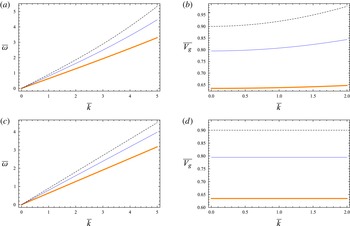
relation of the magnetosonic waves and solve (2.23) numerically in figure 1(a). The variation of the number density
 $n^{(0)}=10^{36}~\text{m}^{-3}$
(solid curve),
 $n^{(0)}=5\times 10^{36}~\text{m}^{-3}$
(thin curve) and
 $n^{(0)}=10^{37}~\text{m}^{-3}$
(dashed curve) with fixed magnetic field strength
 $B^{(0)}=10^{8}$
T, increase the relativistic and quantum parameters which leads to a modification to the angular wave frequency as a function of the (normalized) wavenumber. Figure 1(b) represents the modification due to density variations on the group velocity
 $(\bar{V}_{g})$
associated with modulated magnetosonic waves. Moreover, taking the quantum parameter
 $H=0$
, the wave dispersion is significantly affected and as a result, the wave frequency (group velocity) varies linearly (remains constant) with respect to
 $\bar{k}$
see figure 1(c,d).
The normalized angular frequency
 $\bar{{\it\omega}}~(={\it\omega}/{\it\omega}_{pi})$
and group velocity
 $\bar{V}_{g}~(=V_{g}/C_{s})$
of magnetosonic waves are plotted against the carrier wavenumber
 $\bar{k}~(=kC_{s}/{\it\omega}_{pi})$
in (a) and (b), respectively, with variations in relativistic and quantum diffraction parameters as,
 ${\it\eta}_{e0}=1.19$
,
 $H=0.001$
(solid line),
 ${\it\eta}_{e0}=2.04$
,
 $H=0.003$
(thin line),
 ${\it\eta}_{e0}=2.5$
and
 $H=$
 $0.005$
(dashed line). The same physical quantities are plotted in (c) and (d) for
 $H=0$
.

To proceed further, we analyse the stability/instability criteria for envelope magnetosonic solitons in a semi relativistic degenerate plasma with different plasma parameters. For this, we have plotted the dispersion
 $(\bar{P})$
and nonlinearity
 $(\bar{Q})$
coefficients, as well as their ratio
 $(\bar{P}/\bar{Q})$
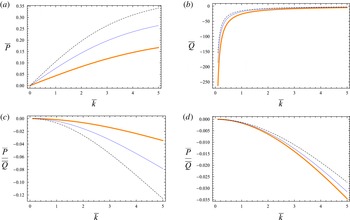
in figure 2. Note that the coefficient
 $\bar{P}$
always bears a positive sign, whereas
 $\bar{Q}$
is negative, hence the condition
 $\bar{P}/\bar{Q}<0$
holds. Such a system is favourable for modulationally stable waves, e.g. dark and grey solitons. Since the relativistic, and quantum parameters lead to an enhancement of the ratio
 $(\bar{P}/\bar{Q})$
, it physically affects the spatial extent of the envelope solitons (as discussed in the latter paragraph). Equations (2.40) and (2.41) also infer that the coefficients
 $\bar{P}$
and
 $\bar{Q}$
depend on the strength of the external magnetic field, which in turn affects the ratio
 $\bar{P}/\bar{Q}$
, as shown in figure 2(d). It may be noticed that the magnetic field strength effectively decreases the magnitude of
 $P/Q$
ratio at large wavenumber and consequently, reduces the width of the envelope solitons. It has been confirmed analytically that, even if it is assumed
 $H=0$
(which is not valid in this model), all of the terms on the left-hand side in (2.29) are cancelled out making
 $(B_{1}^{(1)})^{2}=0$
, as obtained earlier by Wang et al. (Reference Wang, Li, Dai, Chen and Zhang2013b
) (see (2.17)). However, this will lead to (2.39) with second-order secular terms in the form
 $B_{2}^{(2)}$
whose analytical solution is not possible. Consequently, in our present investigations, we cannot take
 $H=0$
.
The normalized dispersion
 $(\bar{P})$
, nonlinearity
 $(\bar{Q})$
coefficients and ratio
 $(\bar{P}/\bar{Q})$
are depicted in (a), (b) and (c), respectively, versus the wavenumber
 $(\bar{k})$
for
 ${\it\eta}_{e0}=2.5$
,
 $H=0.005$
(solid line),
 ${\it\eta}_{e0}=3.2$
,
 $H=0.007$
(thin line),
 ${\it\eta}_{e0}=3.7$
and
 $H=0.009$
(dashed line) and (d) taking
 ${\it\eta}_{e0}=2.5$
,
 $H=0.005$
,
 $\bar{P}/\bar{Q}$
is plotted for
 $B^{(0)}=10^{8}$
T (solid line)
 $B^{(0)}=2\times 10^{8}$
T (thin line)
 $B^{(0)}=3\times 10^{8}$
T (dashed line).

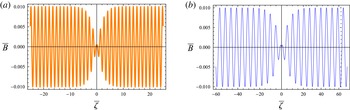
Figure 3(a) depicts the real part of the solution
 $\bar{B}=\sqrt{\bar{{\it\rho}}}\exp (\text{i}{\it\theta})$
using (2.44), showing the propagation of a dark soliton in a normalized spatial coordinate
 $\bar{{\it\zeta}}$
. A dark soliton is a zero amplitude (void) region at
 $\bar{{\it\zeta}}=0$
with a non-zero amplitude on both sides of
 $\bar{{\it\zeta}}=0$
forming a uniform structure travelling in a nonlinear, dispersive medium. The profile of a dark (as well as grey) soliton exhibits rapid oscillations of the carrier wave inside a wave packet. Figure 3(b) shows the above solution for higher values of the relativistic and quantum parameters viz.,
 ${\it\eta}_{e0}=4.4$
and
 $H=0.01$
. It can be seen that the increase in relativistic and quantum parameters cause an enhancement in the width of the dark soliton because the dispersion to nonlinearity
 $\bar{P}/\bar{Q}$
ratio is affected (as discussed earlier).
The profile of a dark soliton is shown in normalized spatial coordinates
 $\bar{{\it\zeta}}({\it\zeta}{\it\omega}_{pi}/C_{s})$
for (a)
 ${\it\eta}_{e0}=2.5$
,
 $H=0.005$
and (b)
 ${\it\eta}_{e0}=4.4$
,
 $H=0.01$
.

A grey envelope soliton may also be observed in the modulationally stable regime when
 $\bar{P}/\bar{Q}<0$
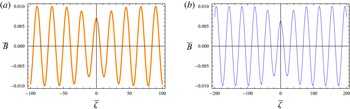
. The profile of a grey soliton is shown in figure 4(a). Note that the grey soliton is excited with a locally reduced and non-zero wave amplitude in a semi relativistic dense plasma. The intensification of the relativistic and quantum parameters affects the grey soliton in a similar fashion to the dark soliton (see figure 4
b). Recall that the
 $\bar{P}/\bar{Q}$
ratio reduces when the magnetic field strength is increased. Finally, it is concluded that the magnetic field strength is favourable for the formation of narrower envelope dark/grey solitons in a relativistically degenerate plasma.
The profile of a grey soliton is plotted versus the spatial coordinate
 $(\bar{{\it\zeta}})$
for (a)
 ${\it\eta}_{e0}=4.4$
,
 $H=0.011$
and (b)
 ${\it\eta}_{e0}=5.5$
,
 $H=0.016$
.

4. Summary
To summarize, we have presented the propagation characteristics of small amplitude quantum magnetosonic dark/grey envelope solitons in a semi relativistic degenerate collisionless magnetoplasma whose constituents are relativistically degenerate electrons and inertial and non-degenerate cold ions. Employing the one-fluid QMHD equations and the reductive perturbation technique, we have obtained an NLS equation, which admits modulationally stable waves under the condition
 $\bar{P}/\bar{Q}<0$
, where
 $\bar{P}$
and
 $\bar{Q}$
represent the dispersion and nonlinearity coefficients associated with the NLS equation. The solutions of the NLS equation show modulationally stable excitations, namely, dark/grey solitons. It is deduced that the electron relativistic degeneracy and quantum diffraction parameters significantly affect the dispersion-to-nonlinearity ratio
 $(\bar{P}/\bar{Q})$
and hence lead to an increase in the spatial width of the envelope soliton. However, the impact of the magnetic field strength has the opposite effect on envelope solitons. Our results are important for understanding the formation and propagation characteristics of magnetosonic dark and grey solitons in a semi relativistic degenerate plasma, e.g. white dwarf, magnetars and neutron stars, where the relativistic degeneracy pressure plays an important role in stabilization.
Acknowledgement
One of the authors M. I. is thankful to the University of Malakand, Chakdara Dir (Lower) for granting the study leave to pursue his Ph.D. studies at Quaid-i-Azam University, Islamabad, Pakistan. This work is partially supported by the University Research Fund (URF, project 2015–2016) of Quaid-i-Azam University, Islamabad, Pakistan.