Reference is a fundamental aspect of language that allows us to refer to entities in the surrounding word. In English, the interpretation of an ambiguous pronoun is guided by the first-mention or order-of-mention bias (Arnold, Eisenband, Brown-Schmidt, & Trueswell, Reference Arnold, Eisenband, Brown-Schmidt and Trueswell2000). The first-mention bias refers to a prevalent effect where pronouns are interpreted as referring to the character mentioned first in the previous sentence. In English, for example, given a sentence such as (1), individuals are more likely to interpret the pronoun she as referring to Sarah, rather than Jane.
(1) Sarah went for a walk with Jane. After a mile, she was very tired.
The first-mention bias can be overridden when additional information is provided, including when social–communicative cues such as looking or looking-and-pointing at a referent are used (e.g., Nappa & Arnold, Reference Nappa and Arnold2014). Social–communicative cues are gestures that have been shown to be important in communication, when the interpretation of ambiguous referential information is required (e.g., Goodrich Smith & Hudson Kam, Reference Goodrich Smith and Hudson Kam2012; Obermeier, Dolk, & Gunter, Reference Obermeier, Dolk and Gunter2012). Social–communicative cues in conversation are known to provide information about the speaker’s intentions and require that the listener takes the speaker’s perspective into account (e.g., Nappa & Arnold, Reference Nappa and Arnold2014).
In a number of studies, it has been demonstrated that bilinguals are more sensitive to cues present in the communicative context. A bilingual advantage over monolinguals has been found in different communicative and social domains, including understanding other people’s linguistic perspectives (e.g., Yow & Markman, Reference Yow and Markman2011a, Reference Yow and Markman2015) more effective communication (e.g., Fan, Liberman, Keysar, & Kinzler Reference Fan, Liberman, Keysar and Kinzler2015; Genesee, Tucker, & Lambert, Reference Genesee, Tucker and Lambert1975; Liberman, Woodard, Keysar, & Kinzler Reference Liberman, Woodward, Keysar and Kinzler2017), and social flexibility (Ikizer & Ramirez-Esparza, Reference Ikizer and Ramírez-Esparza2018). Some of the previous studies propose that the advantage observed in bilinguals is the result of precocious sociolinguistic awareness. According to this research, because bilinguals monitor other people’s language usage from a young age, this practice may enhance social relationships, communicative goals, and consideration of other people’s perspectives (e.g., Fan et al., Reference Fan, Liberman, Keysar and Kinzler2015; Genesee, Boivin, & Nicoladis, Reference Genesee, Boivin and Nicoladis1996; Genesee, Nicoladis, & Paradis, Reference Genesee, Nicoladis and Paradis1995). Furthermore, while most of the studies have focused on bilingual children, research on adults is more limited (Ikizer & Ramirez-Esparza, Reference Ikizer and Ramírez-Esparza2018; Rubio-Fernández & Glucksberg, Reference Rubio-Fernández and Glucksberg2012; Ryskin, Brown-Schmidt, Canseco-Gonzalez, Yiu, & Nguyen, Reference Ryskin, Brown-Schmidt, Canseco-Gonzalez, Yiu and Nguyen2014).
Previous research on the use of the first-mention bias in second language (L2) speakers has demonstrated that the bias is used successfully by bilinguals even at the intermediate level of proficiency in the L2 (e.g., Contemori, Asiri, & Perea Irigoyen, Reference Contemori, Asiri and Perea Irigoyen2019; Contemori & Dussias, Reference Contemori and Dussiasin press; Cunnings, Fotiadou, & Tsimpli, Reference Cunnings, Fotiadou and Tsimpli2016). However, no previous study has analyzed how adult bilinguals integrate social–communicative cues when interpreting referring expressions with ambiguous references. In the present study, we aim at contributing to fill this gap, by investigating how adult Spanish–English bilinguals comprehend social–communicative cues, such as looking and looking-and-pointing, when they interpret ambiguous referring expressions in English (i.e., pronouns he and she) in comparison to monolingual adults.
In the first experiment, we present a condition in which a native speaker of English uses the social–communicative cues. In Experiments 2 and 3, the speaker using the cues is a non-native speaker of English. We test the hypothesis that bilingual adults experience a more accurate interpretation of social cues in the environment (Ikizer & Ramirez-Esparza, Reference Ikizer and Ramírez-Esparza2018). According to this account, we expect that bilinguals may be more prone to rely on the social–communicative cues than discourse constraints (i.e., the first-mention bias) when they listen to both native speech and foreign-accented speech in comparison to monolinguals. In contrast, monolinguals may decrease their reliance on non-native speaker’s speech, under the assumption that non-native speakers may be considered less credible than native speakers (e.g., Lev-Ari, Reference Lev-Ari, Mishra, Srinivasan and Huettig2015a, Reference Lev-Ari2015b; Lev-Ari & Keysar, Reference Lev-Ari and Keysar2012).
Interpretation of referring expressions and social–communicative cues
Research focusing on the comprehension of referring expressions has provided evidence that the felicitous interpretation of pronouns is based on the interaction of a number of factors that determine their accessibility, including semantic, syntactic, lexical, and discourse structural information (e.g., Kaiser, Reference Kaiser2011; Kaiser & Trueswell, Reference Kaiser and Trueswell2008). For native speakers of English, we know that listeners prefer to resolve ambiguous pronouns to the first-mentioned character in the previous sentence, which is also known as the first-mention bias (e.g., Arnold et al., Reference Arnold, Eisenband, Brown-Schmidt and Trueswell2000). As a crucial part of communication, the use of social–communicative cues aids listeners in identifying referents in conversation (e.g., Goodrich Smith & Hudson Kam, Reference Goodrich Smith and Hudson Kam2012; Nappa & Arnold, Reference Nappa and Arnold2014; Obermeier et al., Reference Obermeier, Dolk and Gunter2012). Particularly relevant for the purpose of our study is the research by Nappa and Arnold (Reference Nappa and Arnold2014). Nappa and Arnold investigated the comprehension of ambiguous pronouns in native speakers of English, demonstrating that listeners actively integrate social–communicative cues like looking or looking-and-pointing at one of the referents to interpret ambiguous pronouns. In their experiment, participants watched short videos in which a native speaker of English presented two toy characters of the same gender, as illustrated in Example (2). The short story was followed by a sentence containing an ambiguous pronoun, as shown in (3). The actress in the videos either looked or looked and pointed to one of three locations: (a) the first referent mentioned in the previous sentence (NP1, Puppy), (b) a neutral location (the object placed in the middle, the pizza slice), or (c) the second-mentioned referent (NP2, Panda Bear).
(2) This story is about Puppy and Panda Bear. Puppy is having some pizza with Panda Bear.
(3) He wants the pepperoni slice.
After watching the videos, participants answered a comprehension question that identified the referent of the ambiguous pronoun. The results showed that participants were more likely to select the first-mentioned character in the previous sentence (NP1) to interpret the baseline neutral condition, consistently with the first-mention bias. The strong preference for the first-mentioned entity was modulated by the looking and looking-and-pointing cues. When the speaker in the videos looked or looked and pointed to the NP1, the preference for a NP1 interpretation increased significantly. Conversely, when the speaker looked or looked and pointed to the NP2, participants chose the NP2 interpretation significantly more than in the NP1 and neutral locations. In Nappa and Arnold (Reference Nappa and Arnold2014), these findings and the results of two additional experiments demonstrated that intentionality is a crucial aspect of pronoun interpretation. Participants established reference based on the first-mention bias and overrode the bias when they identified the intentions of the speaker, as demonstrated by the integration of reference when resolving ambiguous pronouns. Therefore, not only the discourse context contributes to pronoun resolution but also social–communicative cues directing the listener’s attention are important to identify referents in conversation.
As an important part of communication, it is crucial to investigate different populations to understand how individuals with different language experience interpret social–communicative cues, as in the case of monolinguals and bilinguals (see, e.g., Arnold, Strangmann, Hwang, Zerkle, & Nappa, Reference Arnold, Strangmann, Hwang, Zerkle and Nappa2018, on the role of individual differences in the interpretation of pronouns combined with gestures). In addition, social–communicative cues can be used in a number of different contexts, and it is important to understand how their interpretation is modulated by the use of the speaker, such as when the speaker has different degrees of language competence. In the present study, we use a similar design as Nappa and Arnold (Reference Nappa and Arnold2014) to investigate the relationship between social–communicative gestures and the interpretation of discourse information in monolingual and bilingual speakers.
The majority of current research that focuses on bilingualism has examined the production of gestures (e.g., Gullberg & McCafferty, Reference Gullberg and McCafferty2008, for a review), while the comprehension of gestures has not yet been explored in adult bilinguals (for bilingual children: e.g., Yow, Reference Yow2015). In particular, we analyze the ability of monolinguals and bilinguals to successfully integrate extralinguistic cues used by either a native or a non-native speaker. In the following sections we introduce the comprehension of foreign-accented speech; we then present some background literature on the interpretation of referring expressions and integration of social–communicative cues in bilinguals.
Comprehension of foreign-accented speech in monolinguals
Non-native speech can be difficult to understand, due to its variability in rhythm and intonation (e.g., Reinisch & Weber, Reference Reinisch and Weber2012). Although a non-native accent may determine reduced intelligibility, it has been shown that listeners can adapt quickly and efficiently to foreign-accented speech and listeners show similar accuracy in foreign-accented speech comprehension as they do for native speech (Cristia et al., Reference Cristia, Seidl, Vaughn, Schmale, Bradlow and Floccia2012). However, previous studies have also reported that because non-native speakers have inferior linguistic competence, they can be considered less reliable communicators than native speakers (e.g., Foucart, Santamaria-Garcia, & Hartsuiker, Reference Foucart, Santamaria-Garcia and Hartsuiker2019; Lev-Ari, Reference Lev-Ari, Mishra, Srinivasan and Huettig2015a, Reference Lev-Ari2015b; Lev-Ari & Keysar, Reference Lev-Ari and Keysar2012).
For example, in a study by Lev-Ari and Keysar (Reference Lev-Ari and Keysar2012), participants had to review a transcript of a story after listening to it. In the transcript, some words presented in the audio were replaced with words of related meaning. The results demonstrated that participants detected more word changes after listening to a native speaker than after listening to a non-native speaker reading the same story. The study shows that listeners build a less detailed linguistic representation when they are presented with non-native speech (see also Lev-Ari Reference Lev-Ari, Mishra, Srinivasan and Huettig2015a, Reference Lev-Ari2015b).
In a recent study by Foucart et al. (Reference Foucart, Santamaria-Garcia and Hartsuiker2019), event-related potentials and pupillometry were used to investigate if short exposure to foreign-accented speech can have an impact on how the speaker is perceived. The results of the study indicated that a speaker with a non-native accent is considered less reliable than a native speaker, in situations in which the non-native speaker has high and low social status.
In addition, previous studies that investigated the effects of foreign-accented speech on comprehension have shown that pragmatic inferences can be affected by the accentedness of the speaker (Caffarra, Michell, & Martin, Reference Caffarra, Michell and Martin2018; Fairchild & Papafragou, Reference Fairchild and Papafragou2017). For instance, Caffarra et al. (Reference Caffarra, Michell and Martin2018) have shown that foreign accent can reduce listeners’ computation of pragmatic inferences, as in the case of the interpretation of figurative meanings in ironic utterances (see also Fairchild & Papafragou, Reference Fairchild and Papafragou2017, on how pragmatic inferences can be adjusted based on the speaker’s accent).
Thus, while listeners may quickly adapt to foreign-accented speech during comprehension, existing studies suggest that they may also consider the non-native speaker a less successful communicator. As a result, native speakers of English may rely differently on the cues used by either a native speaker or a non-native speaker during speech comprehension.
Integration of social–communicative cues in bilinguals
The study of comprehension of foreign-accented speech and the integration of contextual cues is also interesting in the case of bilingual individuals. We know that bilingual children are more sensitive to cues present in the communicative context than monolingual children, and they can use them more efficiently to interpret the intent of the speaker (e.g., Hung, Patrycia, & Yow, Reference Hung, Patrycia and Yow2015; Yow, Reference Yow2015; Yow & Markman, Reference Yow and Markman2011b; Yow et al., Reference Yow, Li, Lam, Gliga, Chong, Kwek and Broekman2017). For example, Yow (Reference Yow2015) investigated whether children were able to use co-referential localizing gestures and order-of-mention in pronoun resolution, and whether growing up in a bilingual environment could impact children’s sensitivity to communicative gestures to resolve ambiguous pronouns. Yow (Reference Yow2015) found that bilingual children were overall more accurate than monolinguals, choosing more often the first-mentioned character when a gesture was consistent with the first-mentioned character than when a gesture was consistent with the second-mentioned character. The results demonstrated that early bilingualism improves children’s ability to infer a speaker’s referential intent from nonverbal cues. Yow concluded that children growing up in a bilingual environment resolve communicative challenges by frequently monitoring the context and using the verbal and nonverbal cues available, to better understand the speaker’s intent.
Further support for this hypothesis is provided by a recent research on bilingual adults, demonstrating that bilinguals show an advantage in social flexibility over monolinguals (Ikizer & Ramirez-Esparza, Reference Ikizer and Ramírez-Esparza2018). Ikizer and Ramirez-Esparza (Reference Ikizer and Ramírez-Esparza2018) defined social flexibility as easily switching and adapting to different social environments and accurate identification of social cues. Ikizer and Ramirez-Esparza investigated social flexibility in a large group of adult bilinguals and monolinguals, by using an emotional intelligence questionnaire and a social interaction scale. Controlling for sociodemographic variables such as age and education, bilinguals scored significantly higher on the emotional intelligence questionnaire, demonstrating more social flexibility than monolinguals.
Aims and predictions
Overall, previous research suggests that bilingualism favors understanding of referential intent in childhood and increases the ability to switch between social environments and read social cues in adulthood. In the present study, we ask if bilinguals’ enhanced ability to use social cues extends into adulthood (Rubio-Fernández & Glucksberg, Reference Rubio-Fernández and Glucksberg2012).
In addition, based on the studies analyzing how listeners evaluate the credibility of non-native speakers (e.g., Foucart et al., Reference Foucart, Santamaria-Garcia and Hartsuiker2019; Lev-Ari, Reference Lev-Ari, Mishra, Srinivasan and Huettig2015a, Reference Lev-Ari2015b; Lev-Ari & Keysar, Reference Lev-Ari and Keysar2012), we aim at understanding how individuals with a monolingual and bilingual background interpret the extralinguistic information that is provided by a non-native speaker to resolve linguistic ambiguity.
To this aim, we analyze monolingual and bilinguals’ use of social–communicative cues (looking and looking-and-pointing) during referential interpretation (i.e., ambiguous pronouns), by using an experimental design similar to Nappa and Arnold’s (Reference Nappa and Arnold2014), in which participants watch short videos. The actress in the videos uses either the looking or the looking-and-pointing cue, which have been shown to have an impact on the listener’s referential interpretation from a young age in bilinguals (e.g., Yow, Reference Yow2015). We then test if the two cues are weighted differently by monolinguals and bilinguals (i.e., if the two groups rely on the strength of the two cues to a different extent). In addition, in a set of three experiments, we manipulate the context in which the cues are used, by changing the speaker in the videos. In Experiment 1, a native speaker of English uses the social–communicative cues when producing an ambiguous pronoun, as in Nappa and Arnold (Reference Nappa and Arnold2014). In Experiments 2 and 3, the same experimental design is used but two non-native speakers of English use the same social–communicative cues while speaking English. Because non-native speakers have inferior linguistic competence, monolingual listeners may rely less on foreign-accented speech (e.g., Foucart et al., Reference Foucart, Santamaria-Garcia and Hartsuiker2019; Lev-Ari, Reference Lev-Ari, Mishra, Srinivasan and Huettig2015a, Reference Lev-Ari2015b; Lev-Ari & Keysar, Reference Lev-Ari and Keysar2012). Thus, the perception of the non-native speaker as a less successful communicator could determine less consistent reliance on the speakers’ gestures to pronoun interpretation.
For bilingual adults, we may expect different results compared to the monolinguals. If bilinguals have an enhanced sensitivity to the social and communicative context as observed in bilingual children (e.g., Hung et al., Reference Hung, Patrycia and Yow2015; Yow, Reference Yow2015; Yow et al., Reference Yow, Li, Lam, Gliga, Chong, Kwek and Broekman2017; Yow & Markman, Reference Yow and Markman2011b), they may be more tuned to the contextual cues. Bilingual adults may weigh the social–communicative cues more heavily when listening to native speech, as a result of greater sociolinguistic awareness. In the foreign-accented speech condition, it is unclear whether bilinguals may consider a non-native speaker as a reliable communicator or not. To our knowledge, this is the first study that investigates this question.
Thus, we may expect that both the monolingual and bilingual linguistic experience may have an impact on the interpretation of social–communicative cues, based on the expected language proficiency of the speaker.
Experiment 1
Experiment 1 examined listeners’ interpretation of ambiguous pronouns in cases in which social–communicative cues are provided by a native English-speaker. The experiment is a baseline test to assess the strength of the first-mention bias to pronoun interpretation when a combination of extralinguistic cues is used (looking and looking-and-pointing). Based on Nappa and Arnold (Reference Nappa and Arnold2014), we expect an effect of social–communicative cues on the resolution of ambiguous pronouns in monolinguals. Both cues are expected to boost NP1 interpretations, with the looking-and-pointing gesture providing a stronger cue than the looking-only condition, as in Nappa and Arnold (Reference Nappa and Arnold2014). If bilingual adults experience greater sociolinguistic awareness than monolingual adults, they should weigh the social–communicative cues more heavily than monolingual participants in Experiment 1. Alternatively, if the monolingual and bilingual groups perform similarly on the task, the results would indicate that bilinguals do not show stronger reliance on the extralinguistic cues due to enhanced sociolinguistic awareness.
Method
Participants
The participants for Experiment 1 were 25 monolingual native speakers of English and 41 Spanish–English bilinguals.
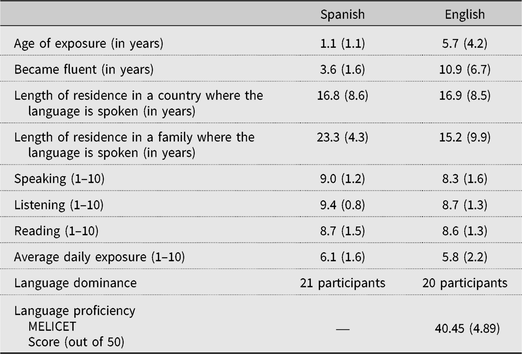
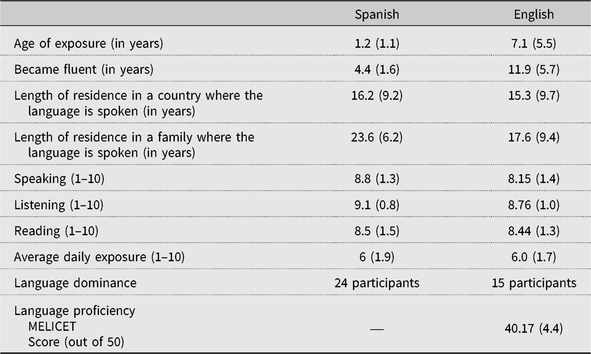
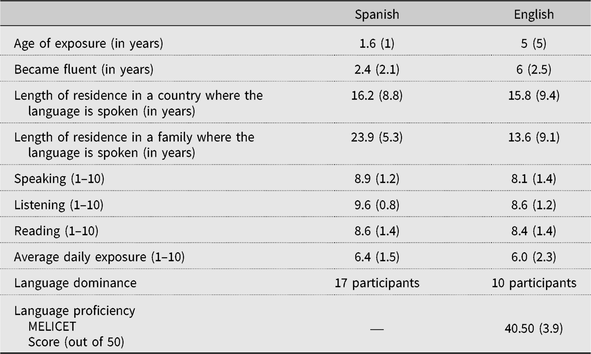
Twenty-five monolingual native speakers of English were recruited at the University of Texas at El Paso (M = 24 years; range = 18–37; SD = 5). El Paso is a bilingual community on the border between Mexico and the United States. Therefore, monolingual speakers living in the area have some exposure to Spanish. We ensured that the monolingual participants did not have any childhood exposure to Spanish, and did not indicate being fluent in a second language. Twenty of the 25 monolingual participants were LatinosFootnote 1 and 5 were Caucasian. Bilingual participants were recruited at the same University (M = 23 years; range: 18–43; SD: 5). Based on order of acquisition, the first language of the bilingual participants is Spanish and their second language is English. Bilingual participants completed a Language History Questionnaire (Marian, Blumenfeld, & Kaushanskaya, Reference Marian, Blumenfeld and Kaushanskaya2007) prior to testing. A summary of the language questionnaire is shown in Table 1.
Experiment 1: Bilingual participants’ information: Mean (SD)

Participants’ proficiency in English was measured with a section of the Michigan English Language Institute College English Text (MELICET).Footnote 2 The MELICET consists of 50 multiple-choice questions, divided into grammar and cloze questions. Only participants who scored at least 30 out of 50 were invited to participate, to ensure that participants had intermediate-high proficiency in English. The results of the grammar test are presented in Table 1.Footnote 3 All bilingual participants were Latinos.
Materials
One hundred and forty-four videos were created in which the actress was a native-English-speaking female. In each video the actress was sitting at a table and placed two toy plush animal characters on each side of the table, and a toy object in the middle of the table. The woman presented the two toy characters and told a simple story, as shown in (4)–(6).
Twenty-four stories were manipulated to create a total of six conditions. The same stimuli structure was used as in Nappa and Arnold (Reference Nappa and Arnold2014). In each story, either two female characters (Minnie and Daisy) or two male characters (Donald and Mickey) were introduced, as illustrated in (4). After the characters were presented, a second sentence introduced a context in which an action occurs, as in (5). Finally, a third sentence introduced an ambiguous pronoun, as illustrated in (6). The grammatical role of each of the four characters in the introductory sentence (subject vs. object) was counterbalanced across items.
(4) This story is about Donald and Mickey. This is Donald and this is Mickey.
(5) Donald is having a drink with Mickey.
(6) He wants some milk.
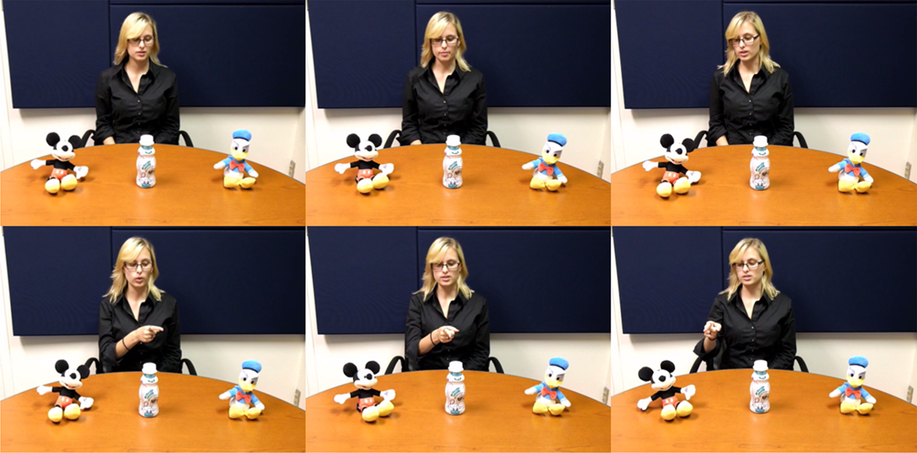
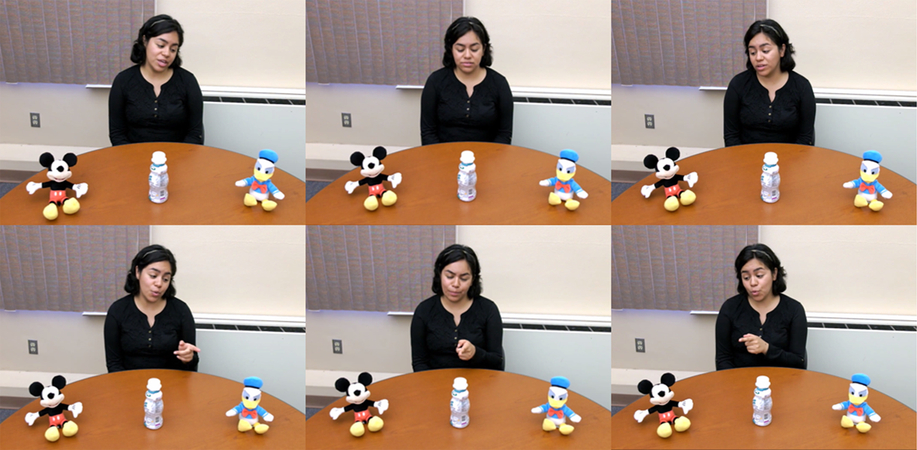
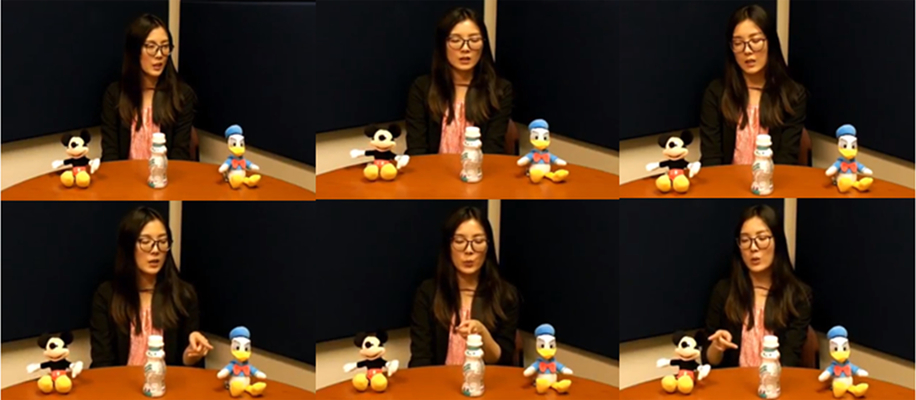
In the six conditions, a social–communicative cue (looking or looking-and-pointing) was provided either to the NP1 (first noun phrase: Donald), the NP2 (second noun phrase: Mickey), or a neutral location (the object placed in the middle, the milk in [6]), as shown in Figure 1. The cue was produced as the speaker uttered the ambiguous pronoun. The videos were distributed across six lists.
Experiment 1: Looking-only and looking-and-pointing conditions to the three locations. From left to right, top row: looking cue to NP1 (first-mentioned character in preceding sentence); neutral looking cue (to a central location); and looking cue to NP2 (second-mentioned character in preceding sentence). From left to right, bottom row: looking-and-pointing cue to NP1 (first-mentioned character in preceding sentence); neutral looking-and-pointing cue (to a central location); and looking-and-pointing cue to NP2 (second-mentioned character in preceding sentence).

In addition, the task included 34 filler videos, 2 practice videos, and 1 instructional video. In half of the filler videos, a female and a male character were presented, and the story contained a gender unambiguous pronoun, as shown in (7). The other half of the fillers videos contained stories with same-gender characters and a NP instead of an ambiguous pronoun in the second sentence, as shown in (8).
(7) Mickey and Daisy are playing with toys. She wants the helicopter.
(8) Minnie is taking pictures with Daisy. Minnie wants the camera.
After watching each video, participants answered a comprehension question about the interpretation of the ambiguous pronoun (e.g., “Who wants the milk?”), and rated the plausibility of the story (i.e., “How plausible is the story from 1–10?”). In addition, a memory question was presented that asked about the location of the characters on the screen (e.g., “Who was on the left/right side of the screen?”). Memory questions and plausibility rates were used to distract the participants’ attention from the purpose of the experiment. Each of the two question types had two possible answers (Donald and Mickey in examples [4]–[6]). The experiment was constructed as a Qualtrics survey.
Procedure and coding
Participants were instructed to watch short videos and answer questions about the videos. They were told that a subset of the videos would be later selected and used for an experiment with children. Each session lasted from 45 min to 1 hr. Participants were tested in a sound-attenuated room.
The responses to the questions that identified the referent of the ambiguous pronoun in the experimental conditions were analyzed. We used a multilevel linear model to analyze the number of NP2 responses coded as 1 and 0, using glmer (lme4 library; Bates & Sarkar, Reference Bates and Sarkar2007). The factors manipulated are cue type with two levels (looking-only and looking-and-pointing), cue location with three levels (NP1, neutral, and NP2), and group as a two-level factor (monolinguals vs. bilinguals). The factors cue type and group were contrast-coded and the factor cue location was two-contrasts coded, treating the neutral condition as baseline. Interactions were also included in the model.
For all the analyses in the paper, we report the significant best fitting models. Following a backward stepwise elimination procedure, the likelihood ratio test was used to compare simpler models that differ in only one degree of freedom from the maximally complex model.
Experiment 1: Results
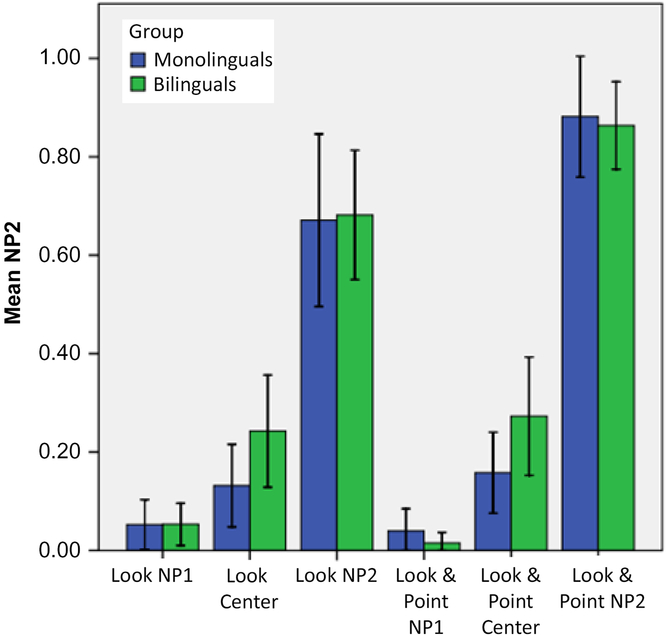
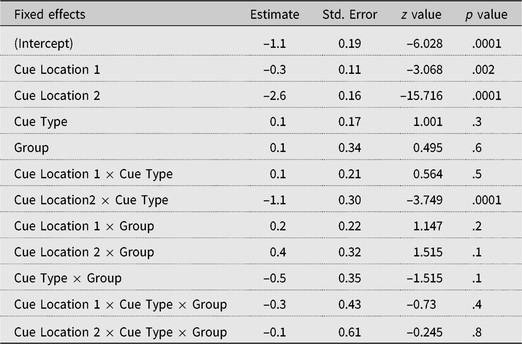
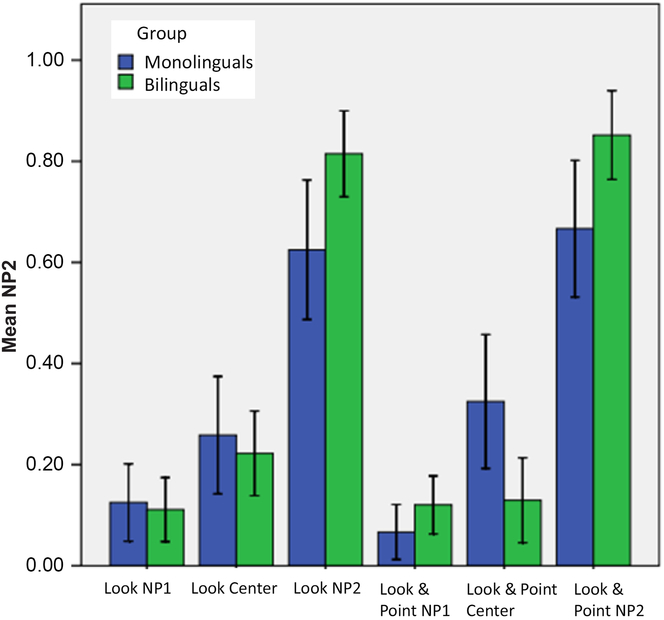
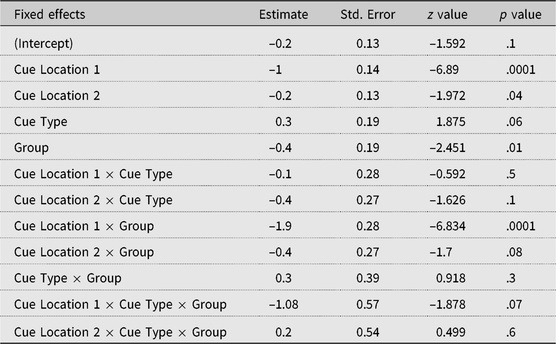
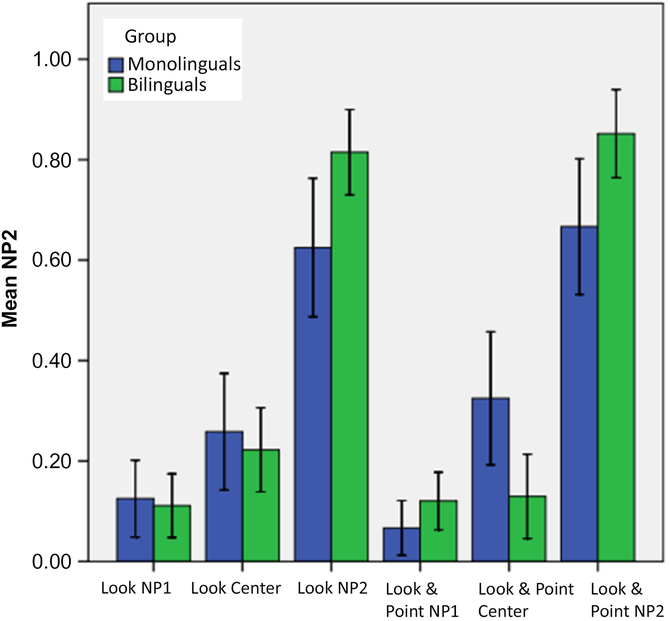
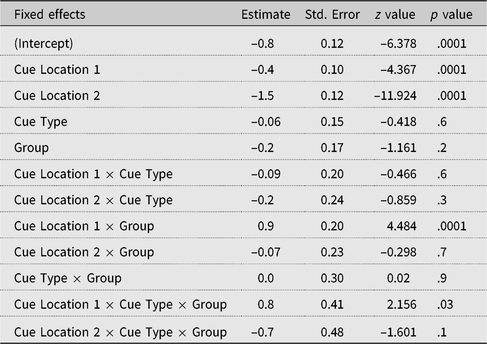
In Figure 2, we show the proportion of NP2 interpretations given by the participants in the six conditions comparing the monolingual group and the bilingual group. The results of the full model are presented in Table 2.
Experiment 1: Proportion of NP2 responses in the six conditions (monolinguals = 25; bilinguals = 41). Error bars represent 95% confidence intervals.

Experiment 1: Full model statistics

Note: The random effect structure includes by-subject and by-item random intercepts and by-subject and by-item random slopes for the effects of cue location context and cue type.
The analysis revealed a significant effect of cue location, indicating significantly more NP2 responses for the neutral location compared to the NP1 location, and more NP2 responses for the NP2 location compared to the neutral location.
A significant interaction between cue type and cue location also emerged from the analysis. We conducted post hoc comparisons to follow up on the Cue Type × Cue Location interaction and we adjusted the p values using the Bonferroni correction. We used generalized linear mixed-effects models to analyze the number of NP2 choices. Post hoc comparisons showed a significant difference between the looking-only and looking-and-pointing conditions when the cue is directed to the NP2 (Estimate = 1.6, SD = 0.52, z = 3.129, p < .003), but not when it is directed to the neutral location (Estimate = 0.3, SD = 0.37, z = 0.888, p = .7). The effect suggests that participants chose the NP2 significantly less when a looking cue was directed to the NP2, compared to the looking-and-pointing cue, indicating that looking-and-pointing is a stronger cue to override the first-mention bias in comparison to the looking cue.
In addition, we compared the two groups’ performance on the three cue locations to chance, by using a one-sample t test against a chance level accuracy (50%). The analysis revealed that both monolinguals and bilinguals choose the NP1 above chance when the cue was directed to the NP1: monolinguals, t (24) = 16.143, p < .0001; bilinguals, t (40) = 15.371, p < .0001, or to the neutral location: monolinguals, t (24) = 9.846, p < .0001; bilinguals, t (40) = 8.498, p < .0001. Similarly, both groups chose the NP2 above chance level when the NP2 was cued: monolinguals, t (24) = 10.210, p < .0001; bilinguals, t (40) = 11.091, p < .0001.
Interim discussion
Experiment 1 replicates results from Nappa and Arnold (Reference Nappa and Arnold2014), showing that listeners choose NP1 interpretations when a cue is directed either to the NP1 or a neutral location, consistent with the first-mention bias. Participants override the first-mention bias when the speaker looks or looks-and-points to the NP2. In our study looking-and-pointing is a stronger social–communicative cue than looking-only, as demonstrated by the Cue Type × Cue Location interaction. The replication of Nappa and Arnold’s results with monolinguals suggests that our task adaptation was similar to the task in the original study.
The results showed that bilinguals did not differ from monolinguals in the interpretation of ambiguous pronouns when social–communicative cues are used by a native speaker of English. This result is not in line with the initial hypothesis that bilinguals weigh the extralinguistic cues more heavily than monolinguals. The lack of a difference between the two groups suggests that bilinguals evaluate the extralinguistic cues comparably to monolingual individuals. Thus, our results indicate that the advantage observed in bilingual children evaluating the referential context does not extend to adulthood (e.g., Yow, Reference Yow2015).
In Experiment 2, we explore if monolingual and bilingual individuals integrate extralinguistic cues to the same extent when the person using the looking and looking-and-pointing cue is a non-native speaker of English.
Experiment 2
In Experiment 2, we use the same design as in Experiment 1, in which a speaker utters English sentences. The only difference is that we substituted the actress in the videos with a non-native speaker of English. The experiment assesses the strength of the first-mention bias to pronoun interpretation when the same combination of social–communicative cues (looking-only and looking-and-pointing) is used by a Hispanic speaker whose first language is Spanish.
We predict that the non-native condition may require more demands from the listener in terms of attention and reliance on contextual cues, given the fact that the non-native speaker is expected to be less proficient than a native English speaker. In addition, as demonstrated by research in sociolinguistic and social psychology, non-native speech can have an effect on the attitudes and evaluations of the listener (e.g., Fuertes, Gottdiener, Martin, Gilbert, & Giles, Reference Fuertes, Gottdiener, Martin, Gilbert and Giles2012; Giles & Billings, Reference Giles, Billings, Davies and Elder2004; Kinzler, Shutts, DeJesus, & Spelke, Reference Kinzler, Shutts, DeJesus and Spelke2009). Thus, we may expect that the non-native speaker is evaluated as a less reliable communicator. As a result, participants may not use the extralinguistic cues provided by the non-native speaker as consistently as in Experiment 1.
It is an open question whether the monolingual participants will differ from bilinguals in the use of the extralinguistic cues. It is possible that the language experience of the bilinguals may lead to a more accurate understanding of the speaker’s intent based on the speaker’s language proficiency in comparison to monolinguals. In this case, a speaker who is considered less reliable based on the accentedness of the speech by monolingual participants may be evaluated equally as good a communicator as a native speaker by the bilingual group. In this case scenario, we would expect less reliance on extralinguistic cues in the monolingual participants in comparison to bilinguals and similar reliance on the cues in the bilingual participants as observed in Experiment 1.
Method
Participants
Twenty-five English monolingual speakers were students recruited at the University of Texas at El Paso (M = 20 years; range = 18–31; SD = 3). El Paso is a Spanish–English bilingual community, and English monolinguals are frequently exposed to English non-native speech. Twenty monolingual speakers were Latinos, 2 were African American, and 2 were Caucasian.
A group of 39 bilinguals who participated were students at the same university (M = 26 years; range: 20–42; SD: 5). Bilinguals’ first language was Spanish and the second language was English. Bilinguals completed a Language History Questionnaire (Marian et al., Reference Marian, Blumenfeld and Kaushanskaya2007) and a MELICET prior to testing. As in Experiment 1, only participants that scored at least 30 out of 50 were invited to participate. A summary of the language questionnaire and MELICET scores is presented in Table 3.
Experiment 2: Bilingual participants’ information: Mean (SD)

Materials
The materials were the same as in Experiment 1. The only difference is that the speaker in the videos is a female non-native speaker of English, who speaks with a recognizable foreign-accent (see Figure 3). The speaker is of Hispanic origin and speaks Spanish as a first language (L1) and English as L2.
Experiment 2: Looking-only and looking-and-pointing conditions to the three locations. From left to right, top row: looking cue to NP1 (first-mentioned character in preceding sentence); neutral looking cue (to a central location); and looking cue to NP2 (second-mentioned character in preceding sentence). From left to right, bottom row: looking-and-pointing cue to NP1 (first-mentioned character in preceding sentence); neutral looking-and-pointing cue (to a central location); and looking-and-pointing cue to NP2 (second-mentioned character in preceding sentence).

Procedure and coding
The procedure and coding were identical as in Experiment 1.
Results: Experiment 2
In Figure 4, we show the proportion of NP2 interpretations given by the participants in the non-native speaker condition, comparing monolinguals and bilinguals. The fixed effects in the model included cue type (looking-only vs. looking-and-pointing), cue location (NP1, neutral, or NP2), and group (monolinguals vs. bilinguals), together with all interactions. The factors cue type and group were contrast-coded and the factor cue location was two-contrasts coded, treating the neutral condition as baseline. The results of the full model are presented in Table 4.
Experiment 2: Proportion of NP2 responses in the six conditions (monolinguals = 25; bilinguals = 39). Error bars represent 95% confidence intervals.

Experiment 2: Full model statistics

Note: The random effect structure includes by-subject and by-item random intercepts and by-subject and by-item random slopes.
The analysis revealed significant effects of group and cue location, and a significant interaction between group and cue location. In addition, an effect of cue type and a three-way interaction between cue location, cue type, and group approached significance.
We conducted post hoc comparisons to follow up on the Group × Cue Location interaction, by using generalized linear mixed-effects models and adjusting the p values based on the Bonferroni correction.
The analysis revealed that bilingual participants produced significantly more NP2 choices than monolinguals when a NP2 location was cued (Estimate = –0.4, SD = 0.07, z = –6.103, p < .0002). No difference between the two groups was found in the neutral condition location (Estimate = –0.1, SD = 0.36, z = –0.465, p = .6).
To explore the hypothesis that monolinguals were not using the cues correctly compared to the bilinguals, we compared the two groups’ performance on the three cue locations to chance, by using a one-sample t test against a chance level accuracy (50%). The analysis revealed that both monolinguals and bilinguals choose the NP1 above chance when the cue was directed to the NP1: monolinguals, t (24) = 17.675, p < .0001; bilinguals, t (38) = 15.735, p < .0001, or to the neutral location: monolinguals, t (24) = 4.370, p < .0001; bilinguals, t (38) = 5.492, p < .0001. Similarly, both groups chose the NP2 above chance level when the NP2 was cued: monolinguals, t (24) = 6.050, p < .0001; bilinguals, t (38) = 12.091, p < .0001.
We also measured participants’ accuracy on the memory questions and correlated them with the use of cues in the comprehension task, to explore the possibility that participants may have used the cues differently if they were not paying attention to the visual scene. Correlational analyses were conducted using Pearson’s correlation coefficients. Participants’ accuracy on the memory question was at ceiling, and we did not find correlations between the memory questions and any of the conditions (all ps >.1).
Interim discussion
The results of Experiment 2 reveal a difference between the interpretations of the monolingual and bilingual participants. As shown by the Cue Location × Group interaction, bilinguals produced significantly more NP2 responses than the monolinguals when a cue was directed to the second-mentioned referent. This result indicates that bilinguals used the two social–communicative cues more strongly to override the first-mention bias in comparison to the monolingual group.
We examined the possibility that the race of the participant may have had an impact on the interpretations of the social–communicative cues (e.g., DeJesus, Dautel, Hwang, Park, & Kinzler, Reference DeJesus, Dautel, Hwang, Park and Kinzler2017; Kinzler & Dautel, Reference Kinzler and Dautel2012, for the influence of race on children’s reasoning about language, nationality, and social categories). However, according to the University of Texas at El Paso’s demographics, about 80% of the university’s population is ethnically Hispanic or Latino, and the majority of our monolingual and bilingual participants belong to this ethnic group. Due to a lack of diversity in our sample of monolinguals and bilinguals, race was not considered as a potential factor in the analysis of our results.
Notice that the results of Experiment 2 do not provide any information about participants’ overall comprehension of the stories. Thus, we cannot exclude that the intelligibility of the foreign-accented speech may have influenced participants’ responses. For instance, our bilingual participants are speakers of Spanish (L1) and are therefore more familiar with the speaker’s accent than monolingual participants. A familiarity effect may have boosted bilinguals’ comprehension, and consequently their interpretation of the extralinguistic cues. Conversely, performance of monolingual participants may have been impacted by poor comprehension of foreign-accented speech, which could explain why monolinguals relied less on the extralinguistic cues used by the non-native speaker in the videos. To address this possible interpretation of our results, we conducted another experiment (Experiment 3), in which the speaker in the videos is a non-native speaker of English whose L1 is Mandarin Chinese. Mandarin Chinese is a language that is unfamiliar to the monolingual English speakers and the bilinguals recruited in the Spanish–English bilingual community. In addition, in Experiment 3 participants answered questions about the general intelligibility of the speaker in the videos.
Finally, another aspect that may have influenced the participants’ responses in Experiment 2 is attitudes toward foreign-accented speech. We know that the listener’s attitudes and evaluations can be affected by the presence of a foreign accent in speech comprehension (e.g., Fuertes et al., Reference Fuertes, Gottdiener, Martin, Gilbert and Giles2012, for a meta-analysis). It is possible that the monolinguals in Experiment 2 may have had stronger attitudes toward non-native speech than bilinguals, and therefore may have considered the speaker a less reliable communicator. To explore the contribution of attitudes on the observed results, in Experiment 3 we added questions about participants’ attitudes toward foreign-accented speech to the Qualtrics survey.
Experiment 3
Experiment 3 tested monolinguals and bilinguals’ interpretation of ambiguous pronouns in a context in which a non-native speaker of English whose L1 is Mandarin Chinese produces the looking-only and looking-and-pointing gestures. The reason to choose Mandarin Chinese is to avoid a language familiarity effect (i.e., the foreign-accent is less familiar to the monolinguals and bilinguals recruited in the Spanish–English bilingual community).
In Experiment 3, participants answered questions about the general intelligibility of the speaker, to ensure that they had a good understanding of the foreign-accented speech presented in the videos. In addition, participants answered questions about their attitudes toward foreign-accented speech.
Method
Participants
Twenty-four English monolingual speakers were students recruited at the University of Texas at El Paso (M = 23 years; range = 18–36; SD = 4); that is, they live in a bilingual community and are frequently exposed to non-native speech. Twenty-one participants were Latinos and 3 were Caucasian.
A group of 27 bilinguals who participated were students at the same university (M = 22 years; range: 19–42; SD: 5). Bilingual participants completed a Language History Questionnaire (Marian et al., Reference Marian, Blumenfeld and Kaushanskaya2007) and a MELICET prior to testing. As in Experiments 1 and 2, only participants who scored at least 30 out of 50 were invited to participate. A summary of the language questionnaire measures and MELICET scores is shown in Table 5. All bilingual participants were Latinos.
Experiment 3. Bilingual participants’ information: Mean (SD)

Materials
The materials are the same as in Experiments 1 and 2. The only difference is that the speaker in the videos is a female non-native speaker of English, who speaks with a recognizable foreign accent (see Figure 5). The speaker is of Asian origin and speaks Mandarin Chinese as a L1 and English as a L2.
Experiment 3: Looking-only and looking-and-pointing to the three locations. From left to right, top row: looking cue to NP1 (first-mentioned character in preceding sentence); neutral looking cue (to a central location); and looking cue to NP2 (second-mentioned character in preceding sentence). From left to right, bottom row: looking-and-pointing cue to NP1 (first-mentioned character in preceding sentence); neutral looking-and-pointing cue (to a central location); and looking-and-pointing cue to NP2 (second-mentioned character in preceding sentence).

At the end of the survey, participants answered three questions about general comprehension and intelligibility of the speaker in the videos, as shown in (9)–(11), and four questions about attitudes toward foreign-accented speech, as illustrated in (12)–(15).
(9) How much of the stories were you able to understand?
(out of 100)
(10) The girl’s speech was understandable.
(1–5: 1 = not at all; 2 = a little; 3 = somewhat; 4 = very; 5 = very much)
(11) Do you think that the speaker was an effective and reliable communicator?
(1–5: 1 = not at all; 2 = a little; 3 = somewhat; 4 = very; 5 = very much)
(12) When I hear someone speak with an accent that is different from my own, I expect to have difficulty understanding them.
(scale 1–10: 1 = do not agree at all; 10 = agree completely)
(13) I would work well in a professional or school environment with a person who speaks with a foreign accent.
(scale 1–10: 1 = do not agree at all; 10 = agree completely)
(14) I think that the USA should be an English-monolingual country.
(scale 1–10: 1 = do not agree at all; 10 = agree completely)
(15) When I hear a speaker of another language speaking English, I want to hear it accurately spoken.
(scale 1–10: 1 = do not agree at all; 10 = agree completely)
Procedure and coding
The procedure and coding were identical as in Experiments 1 and 2.
Results: Experiment 3
In Figure 6, we show the proportion of NP2 interpretations given by the monolingual and bilingual participants. The fixed effects in the model included cue type (looking-only vs. looking-and-pointing), cue location (NP1, neutral, or NP2), and group (monolinguals vs. bilinguals) as main effects, together with all interactions. The factors cue type and group were contrast-coded and the factor cue location was two-contrasts coded, treating the neutral condition as baseline. The results of the full model are presented in Table 6.
Experiment 3: Proportion of NP2 responses in the six conditions (monolinguals = 24; bilinguals = 27). Error bars represent 95% confidence intervals.

Experiment 3: Full model statistics

Note: The random effect structure includes by-subject and by-item random intercepts and by-subject and by-item random slopes.
The analysis revealed a significant effect of cue location, a significant interaction between group and cue location, and a significant three-way interaction between group, cue type, and cue location.
We used post hoc comparisons to follow up the three-way interaction, using the Bonferroni correction. The comparisons showed differences that approached significance in two of the conditions. Bilinguals chose the NP2 interpretation more often than the monolinguals when the speaker looked at the NP2 (Estimate = –1.2, SD = 0.5, z = –2.366, p < .07) and looked and pointed to the NP2 (Estimate = –0.8, SD = 0.13, z = –2.451, p < .07). In addition, monolinguals gave more NP2 interpretations when the speaker looked and pointed to a neutral location (Estimate = 1.9, SD = 0.8, z = 2.381, p < .06).
As in Experiment 2, we explored the possibility that monolinguals may not have used the cues correctly in comparison to bilinguals. Thus, we compared the two groups’ performance on the three cue locations to chance, by using a one-sample t test against a chance-level accuracy (50%). The analysis revealed that both monolinguals and bilinguals choose the NP1 above chance when the cue was directed to the NP1: monolinguals, t (23) = 18.231, p < .0001; bilinguals, t (26) = 20.028, p < .0001, or to the neutral location: monolinguals, t (23) = 3.618, p < .001; bilinguals, t (26) = 10.451, p < .0001. Similarly, both groups chose the NP2 above chance level when the NP2 was cued: monolinguals, t (23) = 2.362, p < .025; bilinguals, t (26) = 9.420, p < .0001.
In addition, we measured participants’ accuracy on the memory questions and correlated their accuracy with the use of cues in the comprehension task. Participants’ accuracy on the memory question was at ceiling, and we did not find correlations with any of the conditions (all ps >.1).
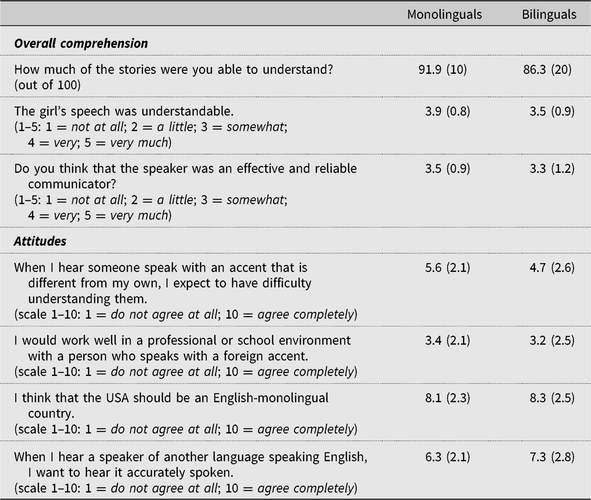
Finally, we analyzed the self-reported measures to understand if there is any difference in the comprehension and attitudes toward foreign-accented speech. The average scores and SD on each of the measures are illustrated in Table 7. We calculated a composite score for general comprehension and for attitudes toward foreign-accented speech.
Mean and SD for the comprehension and attitudes measure in monolinguals and bilinguals

The two composite scores were analyzed using group as a main factor (monolinguals vs. bilinguals). No main effect of group emerged either for the general comprehension score (Estimate = –0.3, SD = 0.21, z = –0.754, p = .3) or for attitudes toward foreign-accented speech (Estimate = –0.1, SD = 0.24, z = –0.853, p = .4), indicating that monolinguals scores on the self-reported measures were comparable to those of bilingual participants.
Interim discussion
In Experiment 3, we found that bilinguals gave more NP2 interpretations when the non-native speaker looks or looks-and-points to the NP2 location, showing a tendency to rely more strongly on the extralinguistic cue to override the first-mentioned bias than the monolinguals. The results are consistent with the findings in Experiment 2. While in Experiment 2 the effects observed in the post hoc comparisons were fully significant, in Experiment 3 they only approached significance.
The results of Experiment 3 exclude that the interpretation of the extralinguistic cues may be due to participants’ reduced intelligibility of the non-native speaker’s speech. Even if we did not test comprehension of foreign-accented speech objectively, both monolinguals and bilinguals indicate similar comprehension of the stories, and score the intelligibility of the speaker comparably.
We did not find a significant difference in language attitudes between monolinguals and bilinguals. However, as pointed out by an anonymous reviewer, this result may be influenced by the use of a self-report measure of language attitude. Notice that previous studies have shown that listeners have a tendency to disfavor non-native accents (e.g., Kinzler & Dautel, Reference Kinzler and Dautel2012; Kinzler et al., Reference Kinzler, Shutts, DeJesus and Spelke2009) and while self-report measures of language attitude are widely used in sociolinguistic research, they may not capture implicit biases (e.g., Pantos & Perkins, Reference Pantos and Perkins2013). We will come back to this result in the final discussion.
Comparison between Experiments 1, 2, and 3
Even though our experimental manipulation was not conducted between participants, a comparison of monolingual participants recruited in the three experiments was conducted. We used a model including age and self-reported language measures collected with a Language History Questionnaire and age of exposure to English, age when became fluent in English, length of residence in the USA, length of residence in an English-speaking family, speaking proficiency, listening proficiency, reading proficiency, and average daily exposure as main factors. The model revealed no main effect for any of the factors (all ps >.1), suggesting that the three monolingual groups are comparable in terms of age and language background.
The same result is found by comparing the bilinguals tested in the three experiments. For bilinguals, a model was conducted including age, MELICET scores, and self-reported language measures. The model revealed no main effect for any of the factors (all ps > .1), indicating that bilingual participants across the three experiments are similar in terms of age, English proficiency, and language background.
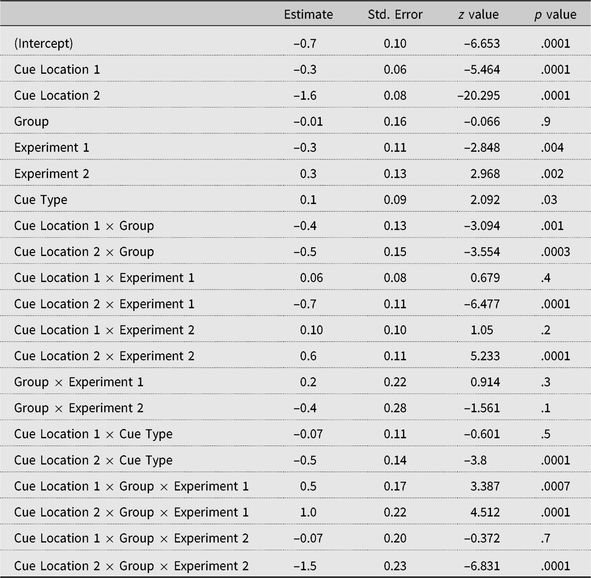
We compared the results of the three experiments, by using a multilevel linear model to analyze the number of NP2 choices using glmer (lme4 library; Bates & Sarkar, Reference Bates and Sarkar2007). The fixed effects in the model included cue type (looking-only vs. looking-and-pointing), cue location (NP1, neutral, or NP2), experiment (native speaker, Hispanic speaker, or Asian speaker), and group (monolinguals vs. bilinguals) as main effects, together with all interactions. The factors cue type and group were contrast-coded. The factor cue location and experiment were two-contrasts coded, treating the neutral condition as baseline for cue location and Experiment 1 as baseline for experiment. We removed the four-way interaction, resulting in a significantly better fitting model than the full model. The results of the model are presented in Table 8.
Comparison of Experiments 1, 2, and 3: Full model statistics

Note: The random effect structure includes by-subject and by-item random intercepts and by-subject and by-item random slopes for the effects of cue location, cue type, and experiment.
The analysis revealed main effects of cue type, cue location, and experiment, and significant interactions between group and cue location, cue type and cue location, and cue location and experiment. Finally, the model revealed a significant three-way interaction between group, experiment, and cue location.
We used post hoc comparisons to follow up on the three-way interaction, using the Bonferroni correction. When we compared monolinguals who participated in Experiments 1 and 2, we found more NP2 choices for the NP1 location (Estimate = 0.48, SD = 0.03, z = 12.43, p = .0006) in Experiment 2 compared to Experiment 1 and significantly fewer NP2 completions for the NP2 location in Experiment 2 compared to Experiment 1 (NP2 location: Estimate = –0.32, SD = 0.10, z = –2.992, p = .002). This result indicates that when the speaker is a Hispanic non-native speaker of English, monolinguals tend to violate the first-mention bias more often when a cue is directed to the NP1, in comparison to the condition in which the speaker is a native speaker of English. Similarly, monolinguals tend to override the first-mention bias less often in the non-native condition when a cue is directed to the NP2. No other effect was significant in the comparisons.
Final discussion and conclusion
The results of Experiment 1 showed that both monolingual and bilingual adults use social–communicative cues such as looking or looking-and-pointing at a referent to a similar extent, when the speaker is a native speaker of English. As a contribution to the study of social–communicative cues and how they aid to pronoun resolution, we show that language experience (i.e., being a monolingual or a bilingual) does not impact the integration of the cues and the discourse context information, when the speaker is a native speaker of the language.
Bilingual children and adults’ performance have been found to have superior sociolinguistic awareness in comparison to monolinguals (Comeau, Genesee, & Mendelson, Reference Comeau, Genesee and Mendelson2007; Genesee et al., Reference Genesee, Boivin and Nicoladis1996). However, in our results the lack of a difference between monolingual and bilingual adults demonstrates that the ability to utilize the looking-only and looking-and-pointing cues is not driven by a superior ability to accurately read social cues in bilingual adults, resulting from more enhanced sociolinguistic awareness.
We also showed that when the language competence of the speaker is manipulated (native vs. non-native), the communicative context is interpreted differently by monolinguals and bilinguals. As shown in Experiment 2, we found a greater use of these cues to override the first-mentioned bias in bilinguals when the speaker is a non-native speaker of English. The results of Experiment 3 confirmed a similar pattern of interpretation as in Experiment 2.
The results demonstrate that monolingual listeners rely less on the attention-directing cues provided by a non-native speaker in comparison to the same cues being used by a native speaker. The effect observed in monolingual participants is in line with previous studies demonstrating that because non-native speakers have inferior linguistic competence, they may be considered less reliable communicators than native speakers (e.g., Lev-Ari, Reference Lev-Ari, Mishra, Srinivasan and Huettig2015a, Reference Lev-Ari2015b; Lev-Ari & Keysar, Reference Lev-Ari and Keysar2012). In comparison to the monolingual analysis, the results of the three bilingual groups demonstrate no consistent differences between the interpretation of ambiguous pronouns when extralinguistic cues are provided either by a native (Experiment 1) or a non-native speaker (Experiments 2 and 3).
The effects observed in the data may be the result of two main factors. On the one hand, the bilinguals may be more prone to override the first-mention bias than monolinguals based on the specific communicative context. More specifically, bilinguals may be more inclined to take into account the speaker’s intent consistently across different speakers, and independently of their language competence. On the other hand, monolinguals seem to have a tendency to rely on the social–communicative cues less strongly than bilinguals in a non-native speaking situation. Differently than bilinguals, monolinguals’ use of the social–communicative cues seems to be more context dependent and influenced by the native versus non-native speaker manipulation.
Note that, although bilingual and monolingual participants did not differ in their in the attitudes questionnaires in Experiment 3, we cannot exclude that explicit questions about language attitudes may have underestimated (monolingual) participants’ biases toward foreign-accented speech. Future studies should address this limitation by using implicit measures of language attitudes tapping into listeners’ immediate reactions, which are known to be distinct mental processes of language attitudes (e.g., Pantos & Perkins, Reference Pantos and Perkins2013).
In addition, as the actresses who participated in the videos had a different L1 and cultural background, we cannot exclude that expressivity may have impacted the observed results. Note that in the comparison between the three experiments, we found a decrease in reliance on the extralinguistic cues in the monolinguals when the speaker is a Hispanic non-native speaker (Experiment 2) in comparison to the native speaker condition (Experiment 1). Yet, no significant differences were found when comparing the amount of NP2 choices in monolingual participants in Experiments 1 (native speaker) and 3 (Asian speaker).
In addition to differences in expressivity, we cannot exclude that the videos may have contained subtle prosodic cues. During the preparation of the video stimuli, we asked the actresses to utter the sentences with neutral prosody. However, if prosodic cues were present in the non-native speaker videos and conflicted with the use of the gestures, (monolingual) participants may have been more inclined to consider the non-native actresses as less reliable speakers. Future studies should manipulate factors like expressivity and prosody experimentally to evaluate how visual and perceptual cues influence comprehenders’ interpretations.
Our results also have broad implications for communication. Language can be ambiguous, and to achieve effective communication it is necessary to integrate numerous sources of information, including contextual background information, pragmatic cues like the social context, social–communicative cues, and the perspective of a speaking partner. When an individual fails to integrate these different types of information, miscommunication can arise (e.g., Keysar, Barr, Balin, & Brauner, Reference Keysar, Barr, Balin and Brauner2000; Keysar & Henly, Reference Keysar and Henly2002). Here we show that linguistic experience may influence the interpretation of ambiguous language in adulthood when the social context is manipulated (native vs. non-native speakers). More specifically, monolinguals show lower sensitivity to the speaker’s intent when lower language proficiency of the speaker is expected.
Acknowledgments
This research was supported in part by a University Research Institute Grant from the University of Texas at El Paso to the first author.