The Mongol Invasion of Syria
Hülegü’s campaign had, by 1260, changed the political complexion of Syria drastically. The various ruling Ayyūbid princes had been killed, had fled, or had joined up with the invaders. In addition to these local forces, the Mongol invasion was supported by detachments sent by other local subject princes, including Het‘um I, king of the Armenians, and Bohemond VI, prince of Antioch and Tripoli, the northern Frankish states in the Levant.
Since the arrival of the First Crusade, and the formation of the principality of Antioch, the Franks and the Armenians of the region had had close, if not always peaceful, relations. After the foundation at the end of the Twelfth Century of a unified Armenian kingdom based in Cilicia and the surrounding Taurus mountains, the Armenian kings had attempted to dominate the affairs of their Frankish neighbour. By 1260 relations were amicable; Prince Bohemond VI was King Het‘um I's son-in-law; and in the previous year Het‘um had intervened on behalf of Bohemond in his dispute with the nobles of the county of Tripoli.Footnote 2 It may well be that Armenian influence played a role in persuading Bohemond, much to the disgust of his Frankish cousins in Palestine, to enter Hülegü’s service.Footnote 3 King Het‘um had accepted Mongol suzerainty himself some years previously. He had learnt of the grisly atrocities inflicted on the Armenian heartlands to the north, as with all touched by Chinggis Khan's great campaign of 1219–21, and by the Mongol army left behind in northern Persia.Footnote 4 When this latter army marched against Anatolia Het‘um was quick to seek terms. At the battle of Köse Dagh in 1243, the Mongols defeated the Seljuk Sultan of Rum Kay-Khusraw II, Het‘um's probable overlord; by betraying the Sultan's fugitive mother and sister to the Mongols Het‘um was able to buy peace, and obtain Mongol overlordship.Footnote 5 This arrangement was reinforced when Het‘um sent his brother the Constable Smbat to the Great Khan, Güyüg, in Qaraqorum. When Güyüg was succeeded by his cousin Möngke in 1251, King Het‘um himself set out for the qaghan’s ordo, to reconfirm his protected, subject status. He stayed with Möngke for fifty days, and for part of his return journey westward he accompanied the enormous army gathered by the qaghan’s brother, Hülegü, on its way to Persia, Iraq and Syria. This army sacked Baghdad in 1258 and subsequently the last caliph himself was killed, ending the ʿAbbāsid Caliphate. The following year they moved into Syria, taking the city of Damascus in March 1260.
By the summer of 1260, the Mongol force in Syria was much reduced in size. Because of the heat, the lack of grazing available, and because of unwelcome news from the Far East, its leader, Hülegü, and much of his army had withdrawn northwards. Hülegü left behind as his governor his experienced general, Kitbugha, who was, like Hülegü’s wife Doquz Khatun, a Christian. Further south, the new rulers in Egypt, the Mamluk soldiers, had, after a decade of squabbling, managed to patch up their differences. Having humiliated and executed the Mongol emissaries sent to demand submission, the Mamluk Sultan Qutuz prepared to march northwards. His route would cross territory controlled by the Franks. The Frankish authorities in Acre faced a dilemma: throw in their lot with the Mongols, as Bohemond had done, and oppose the Mamluks; or make some sort of accommodation with Qutuz. Although the Mongols had only recently struck a blow at the heart of the Sunnī Muslim establishment, and had destroyed Muslim-ruled states all the way to Central Asia, the Franks of Acre had no reason to believe that the Mongols only targeted Muslims. Memories were still fresh of the appalling destruction meted out in central Europe in the 1240s. Frankish embassies sent to the Mongols after this had been rebuffed with threats and demands for submission; even during the Mongol occupation of Syria the Frankish-held town of Sidon had been sacked.Footnote 6 The Franks in Acre chose not to obstruct the Mamluk army, allowing it free passage.
On September 3, 1260, at ʿAyn Jālūt in northern Palestine, the Mamluk and Mongol armies met. The result was unprecedented: defeat for the Mongols, with their commander, Kitbugha, found dead on the field. Syria was now opened up for Mamluk occupation: a new imperial power was established in the region. For their part Hülegü and his successors, the Ilkhans, repeatedly sought to regain Syria.Footnote 7 After ʿAyn Jālūt Hülegü and his successors made extensive overtures to the Crusading powers of Western Europe, seeking potential allies against the Mamluks, which contrasted greatly with the earlier demands for submission sent by Mongol princes. The Armenians of Cilicia assumed a significant role in this diplomacy, often presenting themselves as vital intermediaries between the Franks and the IlkhansFootnote 8 and they did indeed continue to contribute to Ilkhanid invasions of Syria, at times with success – albeit only ever transitory.Footnote 9 The Ilkhans offered the Armenian kingdom a measure of protection, and the kings did make some initial gains under Ilkhanid patronage. They were, however, marked out by the Mamluks for revenge, along with other Mongol adherents. Syrian collaborators were executed; Antioch was destroyed in 1268; the Armenian kingdom, terrorised by raids and threatened raids, was forced into paying enormous tribute.Footnote 10 But in 1260, this was in the future.
The Mongols at Hṙomkla
In this pivotal year, 1260, a Gospel Book, now in the Armenian Patriarchate in Jerusalem, was completed at the fortress of Hṙomkla, the headquarters of the Armenian Catholicos, Kostandin I, perched high above the Euphrates.Footnote 11 The name of the artist who produced the volume, T‘oros Rōslin, is recorded in its colophon; and this is not his only surviving work. Seven signed manuscripts survive, dated between 1256 and 1268, and at least another one, and some fragments, have also been confidently attributed to him, or to his atelier. He worked mainly at Hṙomkla, and his surviving works were all commissioned for members of the royal family or that of the catholicos.Footnote 12 T‘oros Rōslin has been described as a “skilled and imaginative artist”, and “one of the most creative artists of the Middle Ages”.Footnote 13 In comparison with his predecessors his compositions have greater liveliness and sense of drama, through “slight variations from the traditional iconographic scheme”; Der Nersessian states that “the main difference resides in the emotional content” of the work.Footnote 14 While certainly working within the Near Eastern and Armenian tradition, he was capable of great originality in terms of compositional design.Footnote 15 This was not merely originality for its own sake, but reflects close reading and interpretation of the relevant Biblical texts.Footnote 16 In terms of choice of subject he reveals greater ambition than his immediate predecessors in Hṙomkla, who seem to have limited Gospel Book figural miniatures to the Evangelist portraits which served as frontispieces to the four Gospels. Nevertheless, while earlier Armenian artists included illustrations of episodes of the life of Christ, T‘oros Rōslin revived the practice in a novel way. While the major scenes he depicts generally relate to the traditional Twelve Feasts, they are usually attached in the volume to the relevant text, rather than being arranged according to their chronological order in the liturgical year.Footnote 17
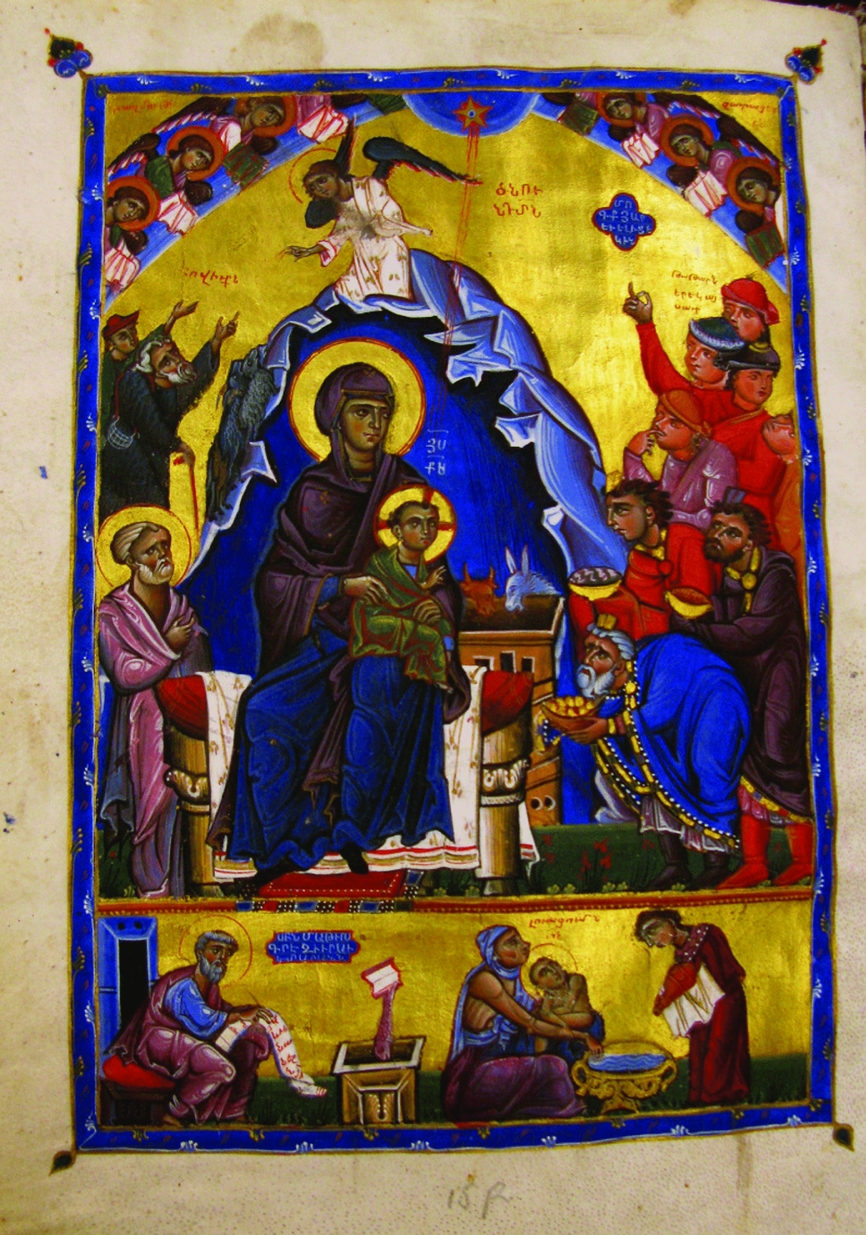
Some evidence of iconographic innovation can also be seen in the Evangelist portraits themselves. While Der Nersessian suggests that T‘oros Rōslin's Evangelist portraits in general reveal “great sensitivity and originality”, they generally conform to standard iconographic types.Footnote 18 The 1260 Gospel Book now in Jerusalem, however, deviates dramatically from the norm. The frontispiece to the Gospel of Matthew depicts not a simple portrait of the Evangelist but rather an image of the Nativity and Adoration, with Matthew himself relegated to a corner, in a compartment introduced beneath the main scene.Footnote 19 (See Fig. 1) This is not the first Gospel Book where we can see this conflation of the Nativity with the portrait of Matthew. A cluster of Byzantine manuscripts from Constantinople, produced in the early Komnenian period (late eleventh to mid-twelfth century) also display this feature. In these examples, however, all four Evangelist portraits are combined with scenes connected with the relevant author; the intention seems to have been to provide an illustration of the feast when the specific Gospel Book was read in the course of the liturgical year.Footnote 20 In this case a different explanation must be found: in this 1260 work all the other Evangelists are presented conventionally, with full-page portraits.Footnote 21
T‘oros Rōslin, frontispiece to the Gospel of Matthew, Gospel book copied for Catholicos Kostandin I, Hṙomkla, 1260, Jerusalem, Arm. Patr. 251, fol. 15v. Photograph courtesy of Claude Mutafian.

The main scene in this miniature, depicting the Nativity, is given a title near the top, just beneath the blue sphere representing the Divine Presence: “The Birth of the Lord”.Footnote 22 Its composition is, however, rather different from conventional accounts of the Nativity. If we compare this picture with other near-contemporary versions of the scene, some remarkable differences stand out. In the standard Near Eastern pattern, followed elsewhere by T‘oros Rōslin, the Virgin is shown reclining, the Magi and the shepherds frame the centre, the washing takes place at the bottom, and Joseph sits reflecting in the corner.Footnote 23 For this particular 1260 Gospel book, however, the artist has radically diverged from the tradition. The shepherds are relegated to the upper left, with their sheep merging into the mountain doubling as the canopy behind the Holy Family. The scene of “the Washing of the Lord” has been moved to the lower compartment, balancing the image of the Evangelist. In addition, the Virgin and Child are more upright in posture, and Joseph stands beside them.Footnote 24 The model followed in this image is more akin to the stand-alone Adoration image than that of the Nativity.Footnote 25 In this 1260 Nativity/Adoration, the Three Magi are given more space than in a standard representation of the Nativity, and their role in the scene is accentuated.
This radical repositioning and reorganisation of the composition seems to emphasise its particular importance within the whole work. It should be noted that in this Gospel Book the only full-page panel illustrations are of the canon tables and the Evangelists – and this Nativity/Adoration. Furthermore, within the image itself the role of the Three Magi is stressed – indeed, in the blue quatrefoil, and thus standing out more than the central Nativity title, the image has a second title, in capitals: “the Magi came from the East”.Footnote 26 The Magi themselves are depicted conventionally, as representatives of three ages of man: one more elderly, with a full beard, presenting his gift; the second, middle-aged and more tidily-bearded; and the third, youthful and beardless. This tradition “emphasises the fact that revelation is given to men independently of their years and worldly experience”.Footnote 27 The most remarkable feature of the whole composition, however, is the retinue that accompanies the Magi. Sirarpie Der Nersessian, in her short description of this image, calls attention to this interesting feature, though she does not see it as especially significant.
Whether or not Rōslin was familiar with the apocryphal Infancy Gospels, mentioning the large company of soldiers that accompanied the kings, he would naturally have assumed that they would not have come from a distant land without a bodyguard.Footnote 28
This may seem, perhaps, too conservative an explanation. For one thing, T‘oros was quite capable of painting this scene without this ‘bodyguard’ – this is the only surviving example of his depiction of this scene in which he includes it – though in an illustration of a different episode, the departure of the Magi, in another Gospel Book from 1262, he does indeed depict the Magi accompanied by a bodyguard, if one of a rather different and much more explicitly military character.Footnote 29 The introduction of this retinue in this Nativity has disrupted the composition: in order to balance it, the artist has had to rearrange the shepherds, or, possibly to introduce them –their gestures seem to echo that on the other side. Introducing such a novel element as this retinue would not, surely, have come naturally, and may have had greater intended resonance.
It is worth looking in more detail at these five men. A label clearly identifies them: they are T‘at‘ar, Mongol. Again, for Der Nersessian, it was logical that T‘oros Rōslin should represent these men “with the facial type and costume of the oriental people best known to him, namely the Mongols, the allies of the king of Cilicia”.Footnote 30 This may, of course, be the case. On the other hand, the entourage in the 1262 Gospel Book's illustration of the departure of the Magi does not consist of Mongols, but rather helmeted soldiers carrying banners: Der Nersessian concludes that “here he has visualised the scene as an event taking place in his own time and his own country”.Footnote 31 This would suggest that, contrary to Der Nersessian's earlier judgement, there was indeed something noteworthy about the choice of Mongols to accompany the Magi in this Nativity image. Furthermore, it should be noted that King Het‘um was not so much the ally of the Mongols as their subject, as is indicated explicitly in the Gospel Book's colophon, where it is stated that it was completed at the time of “the tyranny of the great prince called Manku [Möngke] and the world-conqueror Hołayun [Hülegü] his brother”.Footnote 32 The Mongol princes are named, appropriately, before mention is made of King Het‘um. This notice certainly highlights also the importance of the Mongols at the time and place in which this Nativity was painted, which may suggest that the image, or rather the presence within it of these Mongols, should be interpreted as having some considerable significance.
In the Nativity image, the Tatar retinue of the Magi are by no means uniformly depicted: one expresses amazement, his finger on his lips, looking on the Holy scene; others look up at the star that has led them, shining down on the infant; one, wearing a black cap with gold trim, pointing up to the star (or is it the quatrefoil with the title?), seems to be calling his companions’ attention to it – or, possibly, explaining it to them.Footnote 33 In contrast to the labels of all the other elements in the picture, which are straightforward, and merely descriptive, the label identifying these as Mongol, however, as an original feature, follows no established pattern, and presents something of a mystery: Թաթարն / երեկ այ / սաւր – T‘at‘arn/erek ay/sawr. This can be translated as “the Tatar came today”.Footnote 34 Bezalel Narkiss suggests that the “inscription seemed appropriate to Thoros, as he probably associated ‘the Magi who came from the East’, the inscription on the left, with the Mongol Tatars”.Footnote 35 As we have seen, however, this is the only one of his works where this association is evident. Claude Mutafian is surely correct to see something of greater significance in this text, asking whether this singular arriving Tatar could have been Hülegü, tentatively identifying the Tatar in the image distinguished by his black and gold cap and pointing up at the escutcheon indicating “the Magi who came from the East” as a portrait of the Ilkhan himself.Footnote 36 It is entirely possible that Hülegü may have visited Hṙomkla. The Syriac ecclesiastic and chronicler, Bar Hebraeus, tells us that, on Hülegü’s advance into Syria in late 1259, he ordered pontoon bridges to be constructed across the Euphrates at Melitene, Hṙomkla, al-Bīra (near ancient Belkis-Zeugma), and, much farther to the south, Qarqīsiyya (ancient Circesium).Footnote 37 The completion of this Gospel book in the following year, 1260, is attested to in the colophon, which of course refers to Möngke and Hülegü.Footnote 38 This image could then conceivably commemorate a meeting between catholicos and Ilkhan. It may also be that in Hṙomkla this encounter was anticipated as being symbolic of a decisive shift in the region, likely to be to the benefit of the Christian communities – and especially the Armenians, loyal subjects of the Great Qaghan.Footnote 39
Certainly it is clear that Mongol, and then Ilkhanid, imperial culture was to have a notable effect on artistic production in Armenian Cilicia. For example, by the 1280s at least Chinese motifs were being integrated into Armenian manuscript illustrations, both in a merely decorative and in a meaningful way, and this may even pre-date evidence for such influence in works from the Islamic Near East. It is likely that this influence came both directly from works, such as silks, originating in the Far East, and from works created for the Ilkhans in Persia, such as have been found at the palace complex at Takht-i Sulaymān. It may even be that Chinese models, mediated through the Mongol court, contributed to a stylistic change in painting within the Armenian kingdom in Cilicia in the late thirteenth century as well as the introduction of new motifs.Footnote 40 It is also possible that this Mongol influence eventually had an effect beyond the field of high status manuscript illustration: it may be that fabrics produced in Cilicia consciously sought to mimic more Oriental style.Footnote 41 T‘oros Rōslin's 1260 Nativity, however, seems to be the only surviving example of the depiction of identifiably Mongol figures depicted in Armenian religious art at this time.Footnote 42
A Mongol Magus at St Catherine's, Mount Sinai
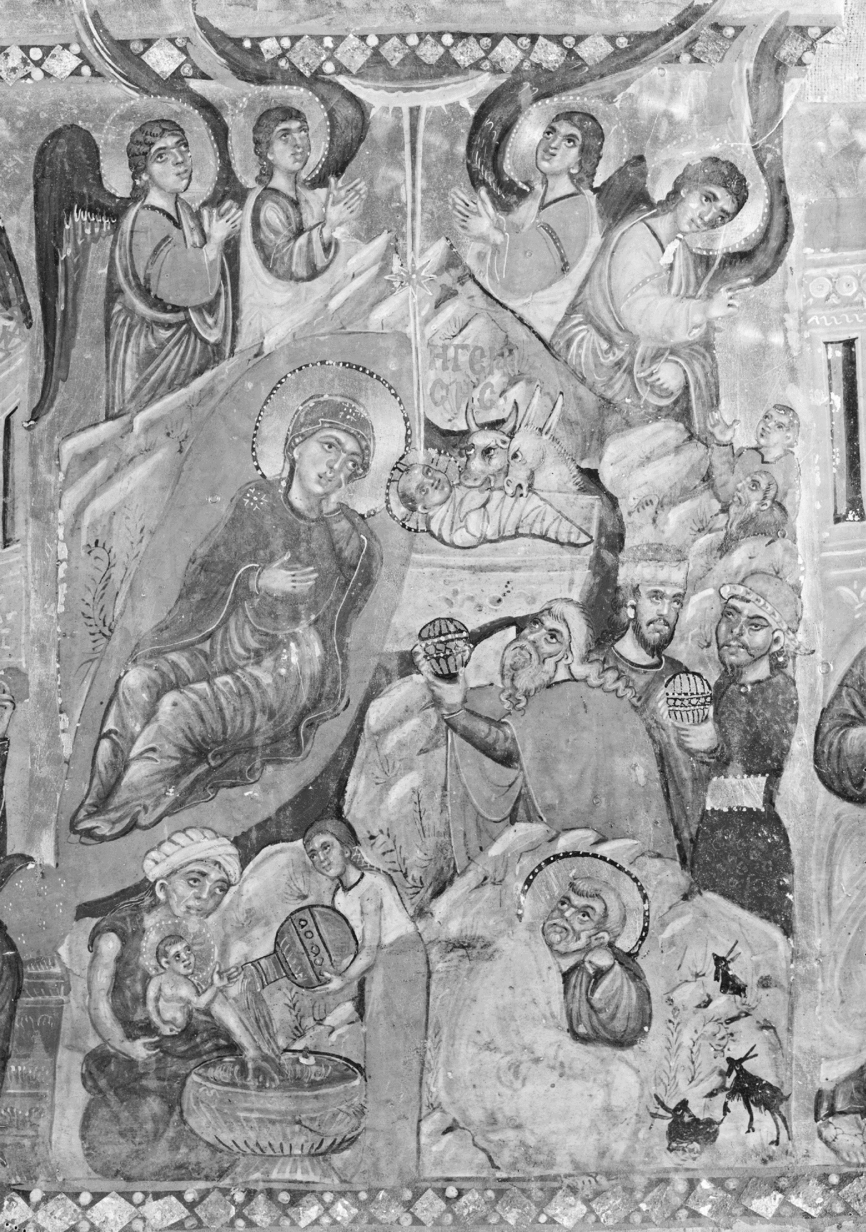
Perhaps more comparable with the 1260 Nativity by T‘oros Rōslin is a second image, recently also dated to 1260. It too, remarkably, is a combined Nativity and Adoration. This is an icon from St Catherine's, Mount Sinai, one of the scenes painted on an Iconostasis Beam, made apparently to sit on top of the screen in a chapel, perhaps the special Frankish chapel in the monastic complex; it is generally thought to have been produced in St Catherine's.Footnote 43 (See Fig. 2) Kurt Weitzmann compares the style of the painting with a Venetian work from the 1290s, and proposes a Venetian or Venetian-trained artist, although the rather more solid figures, and some iconographic details suggest to him a slightly earlier date: roughly 1250 to 1275.Footnote 44 More recently, however, Jaroslav Folda attributes the work to a “Crusader . . . artist working in a Veneto-Byzantine Crusader style”, relating it to work thought to originate in Acre in the 1250s.Footnote 45 Many of the scenes depicted on the beam follow the standard Byzantine iconographic model, but this one, of the Nativity and Adoration, demonstrates some novel iconographic choices. Overall this version is closer in layout to the standard Nativity, with the Virgin shown reclining. Angels fill the sky, and one announces the event to the shepherds, at the right; as in the Book of Isaiah, the calf and ass recognise the Lord in the centre; below, Joseph sits, and there is the scene of the washing. Into this, the star shining from the visible part of the Heavenly sphere has led the three Magi from the east, that is, the right.
Scene of the Nativity and the Adoration of the Three Magi, from the ‘Iconostasis Beam of the Twelve Feasts’, St Catherine's, Mount Sinai. Published through the courtesy of the Michigan-Princeton-Alexandria Expeditions to Mount Sinai; inventory number 1744 in the Sinai Archive at the University of Michigan.

These Magi are far from conventionally depicted, however. Normally, apart from the difference in ages and facial hair, the Magi are not distinguished from each other – in illustrations in the Latin West they are generally all crown-wearing kings; in the Byzantine world they wear vaguely Oriental costume befitting their origins.Footnote 46 With the Sinai icon, one's attention is immediately drawn by the third magus, who, according to Weitzmann, “with a drooping mustache, sparse beard, slit eyes, and strange headgear is obviously a Mongol”.Footnote 47 Weitzmann puts this into the context of papal and French royal missions to the Mongols, but more specifically identifies this magus as the Mongol general Kitbugha, who was “a Nestorian Christian who claimed to be a descendant of one of the three Magi”,Footnote 48 and who moreover had demonstrated his favour to the Christians in the course of the sack of Baghdad and the occupation of Syria. The second Magus is also unconventionally distinct: he is a ‘Westerner’, with a black pointed beard and an ermine fur cap. Weitzmann suggests that this was intended as a portrait as well, of a ‘Crusader’, but the numerous possibilities preclude an attempt at identification. Nevertheless, Weitzmann concludes, with Kitbugha and this Frank side-by-side – they are even turned towards each other – “the Nativity picture becomes an expression of the oecumenical hopes of the Pope, St Louis, and all the Crusaders that an alliance with the Mongols would be a first step toward making Christianity the world religion”.Footnote 49
For Folda the icon is less a reflection of such a grand objective than a commemoration of a specific event.Footnote 50 He accepts the identification of Kitbugha as the third Magus, observing that “he has the Mongol physiognomy and wears a characteristic Mongol cap”, and noting that he “was said to be descended from one of the three Wise Men from the East”.Footnote 51 He also identifies the other two Magi. The second, in ‘Italianate’ costume, is identified as Bohemond VI, prince of Antioch-Tripoli. Folda refers to the ultimately ‘Italian’ ancestry of the princely house of Antioch, by which he may intend the foundation of the principality by the southern Italian Norman Bohemond of Taranto. Even if this may seem to be a little far-fetched, it is clear that the princes in the mid-thirteenth century certainly had a close relationship with Italy. Bohemond VI's mother, Lucy, was of the family of the counts of Segni (and therefore a relative of Pope Innocent III and two other thirteenth-century popes); her brother, a bishop of Tripoli, was notorious among local Franks for his immoderate favouring of Italians, and this fed the simmering conflict between the prince and the barons of Tripoli.Footnote 52 Whether Italianate costume reflects Norman ancestry, contemporary political alignment, or just local fashion, there are other reasons why Bohemond VI might be depicted next to Kitbugha. Bohemond, of course, was the Frankish prince who supported Hülegü’s invasion of Syria in 1260. Bohemond's participation, moreover, had been encouraged by the neighbouring Christian king, his own father-in-law, Het‘um I of the Armenians – and this is the figure Folda sees depicted as the most senior of the three Magi. Het‘um was indeed about 45 at this time – not, perhaps, as old as the Magus illustrated, but, Folda assumes, probably the senior in age of the three identified figures. While this figure is the most conventionally depicted, Folda points out that other depictions of Het‘umians show them in cloaks of a similar red to that worn by this figure.
Folda goes further than this mere identification. He seeks to relate the image to a passage in the ‘Templar of Tyre’ section of the Gestes des Chiprois, describing the triumphal entry of the Mongol army into Damascus in 1260, in which Kitbugha was accompanied by Het‘um I and Bohemond VI. Bohemond, we are told, desecrated several mosques, and converted one back into a church.
The king of Armenia and the prince of Antioch joined the Tartar host and were at the taking of Damascus. When Damascus fell, the prince – out of contempt for the Saracens, to shame them – had a most lovely church purified and censed. This church was from the time of the Greek Christians, from the time when Heraclius had had Damascus fortified; the Saracens had worshipped Muhammad in it, but it was originally the church of the Greeks. He had Frankish mass sung within it, and had its bells rung. And in other Mohammedan mosques, where the Saracens worshipped, he had pack-horses and donkeys stabled, and splashed wine on the walls and smeared them with pork, both salt and fresh. And where he commanded his men to commit one act of defilement, they did ten.Footnote 53
This passage was, of course, written some decades later; not all commentators are willing to accept the ‘Templar of Tyre’ at face value here. While, for example, contemporary Arabic accounts from Syria mention the resentment of Damascus's Muslim population at the ostentatious joy shown by their Christian fellow-citizens at the Mongol occupation, the acts of desecration of mosques are not recorded, as one would certainly expect them to be. The Arabic sources are not restrained, for example, in detailing the atrocities, such as the burning of the Great Mosque, inflicted on Aleppo by the Armenian king in the course of this invasion; there seems no reason why they would neglect the opportunity to recount such events in Damascus.Footnote 54 One contemporary Arabic writer, Ibn ʿAbd al-Ẓāhir, goes so far as to provide an account of Bohemond of Antioch-Tripoli's activities in alliance with Hülegü, as an explanation for the decision of Baybars to launch an expedition against him in 1268; but there is no mention of this desecration in Damascus.Footnote 55 It should also be pointed out that, while they present the conquest of Aleppo as violent and destructive, contemporary Armenian sources suggest that the occupation of Damascus by Hülegü was peaceful; it is not even clear whether King Het‘um still remained with the Mongol army as far as Damascus.Footnote 56 Modern scholars have not always been willing to accept the version of events at Damascus provided in the Gestes des Chiprois. For example, Peter Jackson states that while Bohemond may well have been present at the Mongol entry into Damascus, the story of his actions there as recorded by the ‘Templar of Tyre’ is “demonstrably apocryphal”.Footnote 57
For Folda, however, this passage in the Gestes des Chiprois explains this icon of the Nativity and Three Magi. This iconostasis beam was, Folda proposes, commissioned by Prince Bohemond for his new, or newly restored, church in Damascus:
perhaps the wood for the beam was sent to Sinai from Tripoli at Bohemond's directive . . . However it was effected, the commission was duly carried out in mid-1260, with the special imagery indicated to commemorate the triumphal entry of Kitbuqa, Hetoum and Bohemond.Footnote 58
“Unfortunately”, Folda continues, the battle of ʿAyn Jālūt intervened; with Kitbugha's death and the Mamluk victory, “the dream of Christianity conquering the Near East, retaking the Holy City of Jerusalem, and making Christianity the dominant world religion through a Crusader alliance with the Mongols and the Armenians was now definitively over”.Footnote 59 This icon of the Three Magi remains as testimony to the hopes held in this brief interlude for such an alliance. Folda concludes by exclaiming:
What a vivid illustration of the vicissitudes of history that an iconostasis beam, apparently commissioned to decorate the sanctuary of a Christian church in Damascus could never reach its intended destination and instead remained in the monastery where it was painted, its original purpose apparently unrecognized for centuries!Footnote 60
Folda's thesis does, however, present certain problems. For one thing, one might argue that the “dream of . . . a Crusader alliance with the Mongols and the Armenians”, far from “definitively over”, was only just beginning to be dreamt seriously. More specifically, does this Mongol have to be Kitbugha, rather than, say, Hülegü? The former may famously have been a Christian, of sorts, but his master developed a reputation for favouring Christians, at least among Christians, and as we have seen has indeed been identified as the subject of Christian religious art elsewhere. Obviously if we accept that the icon commemorates the triumphal entry to Damascus as described by the ‘Templar of Tyre’, then Kitbugha would seem to be the better candidate; in addition, of course, Folda notes that he “was said to be descended from one of the three Wise Men”; or, as Weitzmann puts it, Kitbugha “claimed to be a descendant of one of the three Magi”. This would certainly make him a suitable candidate for depiction as one of the Magi, but whether or not this was actually the contemporary belief is uncertain. Both Weitzmann and Folda cite Runciman's History of the Crusades for this information; and his source is a single text, written in France in 1307.Footnote 61 This text will be discussed below, but as with the passage from the Gestes des Chiprois it may represent the tradition of a later period, and a different geopolitical context. Furthermore, Folda's assumption about Kitbugha's age – the youngest Magus – is without foundation. Although Folda has stated that Kitbugha's age is unknown,Footnote 62 we can get an impression of it from contemporary Syrian Arabic sources. For example, al-Yūnīnī, a Syrian eyewitness to Kitbugha's activities, provides a rather horrified description of him, and reports that he “was an old man, reaching back to the time of Chinggis Khan”; this would suggest he was in his fifties at least in 1260.Footnote 63
While the interpretation of the image is not entirely dependent on the passage from the Gestes des Chiprois – Weitzmann does not mention it – there is a whiff of circularity about its use. On the one hand, the text supports, or even suggests, the interpretation of the icon; on the other hand, the icon reinforces the veracity of the text. As Folda states,
the passage in the Templar of Tyre is accurate and this painting . . . provides us with complementary evidence to verify the accuracy of that report. Here we have “documented evidence” from both an artistic work and a historical text to corroborate the record of an important event and to help us to understand the meaning of a remarkable image.Footnote 64
This is fine – but only if one accepts the interpretation of the icon in the first place, independently of the Templar's text. Similarly, the dating of the iconostasis beam, while initially based on comparisons of style, is reinforced and made precise by this interpretation of this image; yet the relationship to the historical events was initially proposed by the dating. It should also be noted that the dating proposed by Weitzmann and Folda is not universally accepted. Valentino Pace, for example, states that it “is absolutely inconceivable” that work in this style could have been produced “at this early date of mid-Duecento”; he dates the beam “at the earliest, to the very end of the thirteenth century or, much more likely, the fourteenth”.Footnote 65 Folda argues against Pace in part because of the “relationship of this imagery with these historical developments”, suggesting that if it must indeed be accepted as later work, it must then be a copy of a lost original.Footnote 66 This, however, seems to neglect the fact that it was the dating that initially suggested the parallel with the account of the Gestes des Chiprois. In fact a later date, as Pace proposes, would make a relationship between the icon and the text more likely rather than less, as both would then reflect a tradition that had developed some time after 1260 – albeit one with a limited basis in actuality. At the same time, it could be argued that the inclusion of the Mongol figure alongside the Frank might be more representative of this later period, when the Ilkhans and Latins were actively working together in opposition to the Mamluk Sultanate. Certainly, if one does not tie the image to 1260, there does not appear to be any necessity to connect it either to Kitbugha or to the capture of Damascus in that year.
There is a further complicating factor affecting the interpretation of this image. There is, as Barbara Zeitler has pointed out, no hard evidence that ties the beam's place of manufacture to Mount Sinai. Other icons in the monastery's collection originated elsewhere – for example, on Cyprus.Footnote 67 Even the confessional identity of the artist, or their patron, may be unclear. While there are some iconographic elements that might imply that the beam was produced by and for Latin-rite Christians, Zeitler suggests that on their own these are not conclusive proof of the identity of either patron or artist, and might instead be indicative of the complex cultural milieu of the eastern Mediterranean region in the thirteenth century.Footnote 68 The icon should perhaps be interpreted in this more general light. It may well be that the icon does not so much record and commemorate a specific event, but rather reflects a general direction of policy, or an aspiration of a more symbolic kind, for Believers of the Near East, the West and the Far East to be seen worshipping together before Christ. Perhaps Weitzmann was not so far off the point when he suggested that the icon represents hopes for a Mongol alliance, or a general ecumenical motivation – without, however, constraining it to a particular episode or event. Whatever the date of composition, or the identity of artist and patron, one might see this icon as evidence of the hopes invested in the region for the possibilities of Mongol intervention, or for their eventual conversion to Christianity.
The Mongols, the Armenians, and the Magi
A key factor linking the Armenian Gospel Book and the Sinai icon is the presence of Mongols relating to the Magi. In both cases this has been explained – for Der Nersessian it is a matter of coincidence; for Folda, and Weitzmann, it is because of Kitbugha's supposed Magian ancestry. Nevertheless, this association may be worth further consideration.
The irruption of the Mongols was frequently seen as a sign of impending apocalypse, in Latin, Armenian and other traditions, but this association with the Three Wise Men has a different, more optimistic flavour, perhaps echoing the early rumours about the imminent arrival of Prester John, or a Christian ‘King David’. There were rumours that the attack on central Europe in 1241 was a campaign aimed at reaching the relics of the Three Kings in Cologne. The name given to the land of the Three Kings, ‘Tarse’, could become elided with the name Tatars – so the Mongols were, occasionally, called ‘Tarsenses’.Footnote 69 The name recurs in the fourteenth-century English poem, The King of Tars, which appears to have nothing to do with Mongols, but which seems to have grown out of Latin tales of the Mongols and their alleged or hoped-for conversion to Christianity. Significantly, the Armenians often play a key mediating role in these tales – specifically, an Armenian princess is often the catalyst for the conversion of the Mongol king and the Christian reconquest of the Holy Land.Footnote 70
Armenian writing on the Mongols, however, does not make the association between Mongols and Magi. Grigor Aknerts‘i, for example, traces the Mongols back to the descendents of Hagar mingled with the people of Gog.Footnote 71 For him, as with other accounts of the origins of the Mongol empire, Chinggis Khan's call for unification was divinely inspired; but the barbarous people he describes are not the descendants of the Magi.Footnote 72 There are, however, exceptions to this rule: a letter written in 1248 in Samarkand by the Constable Smbat to his sisters and their Frankish Cypriot husbands, King Henry I and John of Ibelin, count of Jaffa, and passed by them to King Louis IX of France (on the island on crusade), and to the pope; and the Flor des estoires de la terre d'Orient of Het‘um (or ‘Hayton’) of Korykos.Footnote 73 Smbat refers to the wide dispersal of the Mongols, following their conquests:
Some of them [Mongols] were in India, others in the land of Chata [i.e., ‘Cathay’], others in the land of Russia, and others in the countries of Chascat and of Tanghat which is the land from which the Three Kings came to Bethlehem to worship the Lord Jesus at his birth. You should know that Christ's power has been, and still is, great: the people of that country are Christians, and the whole of the land of Chata believes in the Three Kings. I myself have been in their churches and have seen paintings of Jesus Christ and of the Three Kings, one offering gold, another incense, and the third myrrh. It is through those Three Kings that they believe in Christ, and through them that the Khan and all his men have now become Christians. They have their churches in front of their gates, and sound their bells and beat their tablets, with the result that those who go to visit their lord the Khan have first to visit the church and salute the Lord Jesus Christ and only then go and salute their lord the Khan, whether they are Christians or Saracens, and those who disapprove of this [do it] willy-nilly.Footnote 74
Hayton makes several references to the Three Kings in the Flor des estoires. At the beginning of Book I, when describing the lands of the Orient, he describes, bordering Cathay, the ‘Kingdom of Tharse’:
There are three provinces in the kingdom of Tharse, and the lords of these provinces are called kings, and they have a script and a language for each, and these people are called Jougour [Uighur]; and they have always been idolaters and they still are today, except for the nation of those 3 kings who came to worship at the nativity of Our Lord Jesus Christ, guided by the star. And there are still great lords among the Tartars of the lineage of these kings, who firmly believe in the faith of Jesus Christ.Footnote 75
Later on, when describing Hülegü’s occupation of Syria, he mentions on separate occasions how both Doquz Khatun and Kitbugha were “of the lineage of the 3 kings of the Orient who had come to Bethlehem to worship at the nativity of Our Lord”.Footnote 76 The context for these pronouncements is Doquz Khatun's patronage of Christian churches in Baghdad, and then Kitbugha's endeavour to recover the Holy Land, in which he was distracted by an unfortunate incident involving the sacking of Frankish Sidon – an incident Hayton works hard to explain away.Footnote 77
This, of course, is the source for Kitbugha's descent, used by Weitzmann and Folda via Runciman's History of the Crusades. The Flor des estoires is a remarkable text, and deserves much more attention; but its account of events a half-century before its composition should not, perhaps, always be accepted uncritically as accurate.Footnote 78 It seems in these passages concerning Kitbugha and Doquz Khatun as if Hayton was attempting to explain the existence of senior Mongols who were Christians by attaching them to the story of the Three Kings. Similarly, while Hayton's ‘kingdom of Tharse’ may have some origin in the Uighur-ruled lands of the Tarim basin, that this appears in a work produced in France might suggest that it reflects a Frankish tradition, rather than Armenian insight. Similarly, Smbat's letter is a long attempt at ameliorating the unexpectedly hostile communication of the Qaghan Güyüg, and justifying the Armenian submission to this threatening empire; feeding his Frankish cousins stories that they might have been primed to accept was part of his method. Rather as the Mongols sought to tell the Franks what they thought the Franks wanted to hear about their confessional proclivities, here we have Armenians doing the same thing.Footnote 79 That the two Armenian writers who refer to the Mongols in this way are writing for a clearly non-Armenian audience is significant; especially revealing is the terminology they use – not ‘Magi’, but ‘Three Kings’: using Frankish terminology, not Near Eastern, to make the point clear to the Franks.
The putative origin of the Three Kings in the land of “Tharse” as described by Smbat and Het‘um does not seem to help us explain the appearance of the Mongol Magus alongside Latin and Near Eastern ones on the Sinai icon, as, of course, in this version all three kings were from Central Asia. Nevertheless, written accounts such as these reflect the symbiosis of the stories of ‘Prester John’ and of the Three Kings. The phrase used by Hayton in his descriptions of both Doquz Khatun and Kitbugha seems almost to echo Otto of Freising's account of Prester John – the first mention of this individual in Western Europe: “it is said that he is a lineal descendant of the Magi, of whom mention is made in the Gospel, . . . who came to adore Christ in his manger”.Footnote 80 As Western European knowledge of the lands encompassed by the Mongol Empire increased, and their confidence in the imminent arrival of a Central Asian ‘Prester John’ correspondingly declined, this figure was sought elsewhere, specifically in the Christian lands of east Africa, south of Egypt.Footnote 81 It is at this time that we see the arrival of the black, African Magus in Western European art; and at this point, of course, in the fourteenth century, the Three Kings come to be seen as representatives of three different continents.Footnote 82 It does not seem likely that this is what is being depicted with the Mongol and Frankish Magi at Sinai. Nevertheless it would, perhaps, be worth considering whether, if the Mongol Magus here is intended to depict a specific individual, that individual could be ‘Prester John’ himself, whose long-awaited arrival was anticipated to ameliorate the experience of the Christian population of the region.Footnote 83
Conclusions: The Coming of the Tatars
This aggregation of the ‘Three Kings’, their land of ‘Tharse’, Prester John and the ‘Tartars’ seems to be more a feature of Latin response to the Mongols than of Armenian. Nevertheless, it should perhaps be borne in mind that the letter of the Constable Smbat, which makes some of these associations, pre-dates this 1260 Gospel book by a decade, and given the close relationship between Hṙomkla, and its scriptorium, and the Het‘umians, it may not be too far-fetched to posit that T‘oros Rōslin had some awareness of this story. The association of the Magi and the Mongols in the Nativity image, however, seems to represent something different. While, as we have seen, Der Nersessian saw T‘oros Rōslin's decision to grant the Magi a bodyguard, and to make this Mongol in appearance, as simple, logical decisions made in the composition of this Nativity,Footnote 84 it seems possible that the reverse of this process is more accurate. The artist's intention was rather to include an image of the Mongols in this work, and the most logical place for them to appear was alongside the other visitors from the East, the Magi. T‘oros then promoted this powerfully revised image to the frontispiece of the Gospel of Matthew, in order to stress further its originality and significance. The question remains, however, of why the decision was made to depict the Mongols in the first place.
The inscription identifying the entourage of the Magi – “the Tatar came today” – could, as we have seen, suggest that the miniature was intended to celebrate a specific event. That this event should have provided the motive for such a dramatic break from an artistic convention sanctioned by centuries of tradition seems extraordinary. It might have been more seemly, for example, for the event to have been recorded in a donor portrait.Footnote 85 The image, of course, is primarily a Nativity: the most important ‘arrival’ is that of the Saviour – Christ, rather than Hülegü. More than merely commemorating a passing moment, T‘oros Rōslin seems to be seeking to incorporate this new and threatening presence, the Mongols, into the Christian cosmos. This gets to the heart of the overall significance of the image, in design and context. The unconventional and prominent positioning of this image within the whole work – usurping the frontispiece from Matthew; the only narrative scene in this work – compels the viewer to pay it extra attention; the unconventional composition emphasises the Magi, and especially their Tatar retinue, its most novel and dramatic feature.
It may have been the case that the enthusiasm felt by the Armenian élite for the Tatar yoke was rather less than untrammelled – at least initially, when there are hints in the sources that certain consequences of the relationship had to be accepted through gritted teeth.Footnote 86 The presence of these Tatars in this image may simply reflect a political alignment which was becoming accepted and may even have seemed promising. While the works of the constable Smbat and Het‘um of Koṙykos sought to justify and promote the Armenian alignment on the side of the Mongols for a Frankish audience, this work, clearly, was for internal consumption, and suggests serious resolution. The image reveals and illuminates the aspirations of the Catholicos at Hṙomkla for the Mongol alignment, stressing the hopes invested in the relationship. It demonstrates a – perhaps desperate – optimism that the Mongols will prove to be beneficent patrons, and that the word of God and his servants may be spread though their agency. The Mongol alignment may have been imposed on the Armenians by force of circumstance, but perhaps one should be careful not to underestimate the depth of the emotional commitment made by the Armenian élite to its possibilities, foremost being the conversion of these Tatars themselves. Alongside the Sinai icon, T‘oros Rōslin's extraordinary image may, perhaps, allow us an insight into the aspirations and hopes of the Christian communities in the Near East faced with the tumultuous arrival of the Mongol hordes.