INTRODUCTION
Diagnostic assessment should be an important part of the initial encounters with acute patients referred to an acute psychiatric facility. Some patients arrive with an obvious diagnostic entity such as a schizophrenic disorder, a bipolar mania or clear personality disorder traits. However, even these patients, often known to the facility in question, may suffer from comorbid disorders. The doctor on duty often relies on his or her clinical judgment, and may consider using psychometric tests only when the initial diagnostic assumptions fail to understand the condition of the patient properly (Berg & Iversen, Reference Berg and Iversen2009). Comorbidity with substance abuse may be a strain on the aptness of the clinician. The seminal study of Regier et al. (1990) documented the high frequency of comorbid mental illness and substance abuse. Substance abusers who relapse more often have a comorbid depression or other mental disorder (Landheim et al., Reference Landheim, Bakken and Vaglum2006). Better use of psychometric tests of coping could change the fate of substance abusers after inpatient stays (Andersen & Berg, Reference Andersen and Berg2001; Berg & Andersen, Reference Berg and Andersen2001). If so, it could be important to use psychometric tests as part of a comprehensive assessment at entry to an acute psychiatric facility. In an earlier study from the same facility substance abuse screening was done both in blood and urine on 65 patients admitted with psychosis (Helseth et al., Reference Helseth, Lykke-Enger, Aamo and Johnsen2005). Only one patient had a positive urine test not revealed on interview, thus the authors concluded that a standardized interview (Addiction Severity Index – ASI) gave reliable information on substance use before entry. Both schizophrenia and bipolar disorder may, however, remain undiagnosed in substance abusers. However, this group of persons would not frequently be referred to an acute psychiatry facility, but rather to a drug abuse facility. On the other hand, persons under the influence of opiates and stimulating agents may very well mimic the symptomatology of vivid hallucinations in schizophrenia or schizo-affective disorder. These persons would present at the emergency psychiatric facility.
We had the opportunity to use the alcohol abuse (AUDIT) and drug abuse (DUDIT) tests in an acute facility in order to investigate the rate of stated alcohol and drug abuse among admitted patients. We also compared scores on these tests with substance abuse diagnoses stated in medical records.
Material and method
Blakstad Hospital has a catchment area with 160,000 inhabitants. The acute wards have 36 beds and collaborate with facilities for long term treatment and community based services. Patients are referred for treatment after being examined by an external medical doctor, and may be referred voluntarily or sectioned according to the Law of Psychiatric Treatment.
Seventy-four patients were recruited for the study. They were 18 to 50 years of age. All were among acutely admitted patients. Patients with an acute psychotic condition, confused patients and patients with imminent suicidal risk or acute stress disorder were excluded if they were not able to sign a written consent. This written consent was obtained during the index stay for all participating patients and after signing, an interview could be performed.
Diagnoses were grouped according to main groups in the International Classification of diseases version 10 (ICD-10). F10–19 substance abuse, F20–29 psychotic disorders, F30–39 affective disorders and other diagnoses. The groups contained 9, 18, 34 and 13 patients, respectively. The primary and secondary diagnoses were recorded by the author (JEB) from the hospital medical records after patients were discharged. The medical record diagnoses were compared to the AUDIT and DUDIT test results above and below the cut-off to calculate sensitivity and specificity of the tests.
Diagnostic tools
AUDIT (Alcohol Use Disorders Identification Test) is an older test developed as a joint effort by researchers from many countries. The aim of the test was to detect abusers of alcohol independent of language and culture (Saunders et al., Reference Saunders, Aasland, Babor, Fuente and Grant1993). The test is easy to perform in a non specialized setting. A cut-off was set at <8.0 in men and <6.0 in women. The effectiveness of the AUDIT as a test in different ethnic groups was studied by Frank et al. (2008). In young people attending a sexually transmitted disease clinic, the AUDIT test performed best at a cut-off of 9 giving a sensitivity of 0.94 and specificity of 0.79 (Cook et al., Reference Cook, Chung, Kelly and Clark2005).
DUDIT (Drug Use Disorders Identification Test) has a maximum score of 44 and comprises 11 questions which correspond to the items of the AUDIT. A cut-off was set at <2.0 (Berman et al., Reference Berman, Bergman, Palmstierna and Schlyter2005; Cruce & Öjehagen, Reference Cruce and Öjehagen2007).
Statistics
The analysis was performed in the statistical package SPSS version 17 and comparisons were made by t-tests, ANOVA, and logistic regression as applicable. The level of significance was set at 0.05.
RESULTS
Significant differences were found between the diagnostic groups in the following ways:
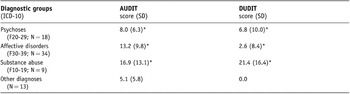
Mean AUDIT value was lower in patients with psychotic disorders than with affective disorders, p=0.05. Mean values were higher on AUDIT for patients with substance abuse disorders compared to psychotic disorders (p<0.05; see Table 1).
Mean values on AUDIT and DUDIT scales for 74 patients admitted to an acute psychiatry facility (diagnostic groups are according to International Classification of Diseases, version 10)

*In the pathological range, i.e. above cut-off for AUDIT and DUDIT scales
Mean values on DUDIT were significantly different for patients with psychotic disorders compared to other diagnoses (p = 0.04). Comparing substance abuse patients with other diagnoses showed that the latter group had normal levels whereas the former had pathological levels (AUDIT p = 0.04 and DUDIT p < 0.01).
All 74 patients had a recorded primary diagnosis. Thirty-three patients (44.6%) had no secondary diagnosis. Seventeen (23.0%) of the 74 patients had a second diagnosis of substance abuse at end of stay. Of the 18 patients with a psychotic primary diagnosis, six (33.3%) had a substance abuse secondary diagnosis.
The AUDIT questionnaire indicated scores above cut-off for seven (38.9%) of 18 patients with a psychotic disorder, 18 (52.9%) of 34 with an affective disorder, six (66.7%) of nine with a substance abuse diagnosis and three (23.1%) out of 13 with other diagnoses (see Table 2). The sensitivity and specificity of the AUDIT test in this sample were calculated as 0.67 and 0.57, respectively.
Number (%) scoring above cut-off levels for AUDIT and DUDIT according to diagnostic groups among 74 acutely admitted patients to a resident psychiatric facility

The DUDIT questionnaire indicated scores above cut-off for six (33.3%) of 18 patients with a psychotic disorder, four (11.8%) of 34 with an affective disorder, seven (77.8%) of nine with a substance abuse diagnosis and none of the patients with other diagnoses. The sensitivity and specificity of the DUDIT test in this sample were calculated as 0.78 and 0.13, respectively.
Patients with psychotic disorders (7 women and 11 men) had a mean elevated level (indicating alcohol abuse) on AUDIT. The mean level was 8, which is pathological for women, and on the cut-off level for men (see Table 1). The mean score on DUDIT, indicating drug abuse, was 6.8, which is clearly elevated.
Patients with affective disorders had mean pathological levels for both AUDIT (13.2) and DUDIT (2.6).
Patients with substance abuse as their main diagnosis had pathological levels for both AUDIT (16.9) and DUDIT (21.4).
The other patients had normal mean values for AUDIT and DUDIT.
The patients with a main diagnosis of substance abuse at discharge did not all score above cut-off level on either AUDIT or DUDIT.
Mean values on AUDIT were different between patients with affective disorders compared to other diagnoses, with p < 0.01.
Patients with psychotic disorders as main diagnosis were compared with all the other patients. No significant differences could be found for the AUDIT or DUDIT tests (by ANOVA).
DISCUSSION
Patients with a psychotic disorder scored above cut-off on AUDIT in fewer cases than patients with affective disorders, 38.9% versus 52.9%. On the DUDIT test the results were opposite, patients with a psychotic disorder scoring higher than patients with an affective disorder, 33.3% versus 11.8%.
The presence of substance abuse in acutely referred patients to a psychiatric facility is under-communicated in medical record file diagnoses, as indicated by the low sensitivity and specificity of AUDIT and DUDIT. Alcohol abuse was easier to recognize and diagnose than drug abuse. This is especially so for patients with affective disorder, less so for psychotic disorder patients. Drug urine testing and answers to the ASI were equally effective in revealing substance use prior to admission in the study of Helseth et al. (2005). A selected group of patients, those with a psychosis, may have contributed to this result. The study had no reference to diagnosis at discharge of the patients, except for the selection of only psychotic patients for the study. A weakness of the study is the small sample size. The repeatability of the findings may thus not conform to the numbers indicated here, but the direction would be comparable. Few other studies were found on this specific topic, despite the prevalence of substance abuse among acutely admitted patients to psychiatric beds.
The patients with a main diagnosis of substance abuse at discharge in the present study did not all score above cut-off level on AUDIT and DUDIT. One third (33.3%) of the patients with a psychotic primary diagnosis had a stated secondary substance abuse diagnosis. In 38.9%, an elevated AUDIT score was found. Thus the reliability of the AUDIT and DUDIT questionnaires seems to be slightly lower than that of the ASI questionnaire, as found by Helseth et al. (2005). Nine out of 74 patients (12.2%) had a primary substance abuse diagnosis, whereas 17 (23.0%) had a secondary diagnosis of substance abuse. The patients with affective disorders had an elevated score on AUDIT in 52.9% of cases and on the DUDIT in 11.8% of cases, far lower than in comorbidity studies (Regier et al. Reference Regier, Farmer, Rae, Locke, Keith, Judd and Goodwin1990; Robertson et al., Reference Robertson, Little, Smith and Ritson1989). This must, however, be interpreted with caution as the patients were referred to a psychiatric facility, presuming the presence of a mental disorder. The diagnostic accuracy may thus be higher for the psychiatric conditions proper, and exceed the accuracy in stating degree of substance use or abuse. The results of the present study may underscore this as the patients reveal higher levels on the AUDIT and DUDIT tests than would be expected from the primary diagnoses.
There may be reluctance in clinicians in an acute psychiatric facility when a discharge diagnosis is chosen. Whereas a diagnosis of depression or schizophrenia may be considered a permanent one, a substance abuse condition may more often be classified as a temporary problem, and thus not a proper ICD–10 diagnostic item. Using the same cut-off score in AUDIT as in the present paper, Carey et al. (2003) found in India that only 10% of a psychiatric sample exceeded the cut-off, and 77% of the patients who were identified as high risk on the AUDIT did not receive an additional alcohol use disorder diagnosis at discharge.
The patients with a psychotic disorder scored higher on the DUDIT scale than patients with affective disorders, but lower on the AUDIT scale. This may be in accordance with the observation that patients with psychosis, especially schizophrenia do not choose alcohol as a substance for abuse if for instance hashish or amphetamines are available. When compared to all other patients, the patients with psychotic disorders did not score significantly differently. The crude nature of this comparison is the probable reason for this, and the observation that the other diagnostic groups scored respectively higher or lower than patients with psychotic disorders (see Table 1).
The discrepancies found in the present study between diagnostic confirmation of substance abuse and the scores on the AUDIT and DUDIT tests indicate that such tests may improve diagnostic accuracy. On the other hand, the fact that some patients with an overt substance abuse main diagnosis did not report this on the AUDIT and DUDIT scales, underscores the need for several inputs to diagnostic assessments in acute psychiatry. Even the development of a special scale, the Substance Abuse Subtle Screening Inventory (SASSI) did not reveal substance abuse with a high degree of validity regardless of respondent honesty or motivation (Feldstein & Miller, Reference Feldstein and Miller2007).
It is tempting to suggest that better treatment of exacerbations in severe mental illness would emanate after routine checking by way of psychometric tests or drug serum and urine tests of concomitant substance or alcohol use. The presence of substance use problems is important information both for the doctor on duty and those in the future. Henceforth, the existence of knowledge of such problems should also be underscored in the diagnosis list at discharge.