Introduction
Self-blame and associated feelings, such as guilt and self-worthlessness, play a key role in cognitive (Abramson, Seligman, & Teasdale, Reference Abramson, Seligman and Teasdale1978; Beck, Rush, Shaw, & Emery, Reference Beck, Rush, Shaw and Emery1979), as well as psychodynamic models of major depressive disorder (MDD) vulnerability (Freud, Reference Freud1917). This is supported by findings of persistent biases towards blaming oneself relative to others in MDD even on remission of symptoms with no overall increase in negative emotions when controlling for the direction of blame (Green, Moll, Deakin, Hulleman, & Zahn, Reference Green, Moll, Deakin, Hulleman and Zahn2013a; Zahn et al., Reference Zahn, Lythe, Gethin, Green, Deakin, Workman and Moll2015). Understanding the neurocognitive basis of self-blaming emotions as vulnerability factors for MDD is important for elucidating the link between psychosocial and biological factors predisposing to MDD.
As recently reviewed (Zahn, De Oliveira-Souza, & Moll, Reference Zahn, De Oliveira-Souza and Moll2020), the most reproducible neural correlate of individual differences in proneness to self-blaming emotions such as guilt is a higher subgenual cingulate cortex (SCC) activation for guilt v. other-directed anger (Zahn, Moll, et al., Reference Zahn, Moll, Paiva, Garrido, Krueger, Huey and Grafman2009). This was true of guilt-prone individuals irrespective of whether they had a history of MDD or not (Green, Lambon Ralph, Moll, Deakin, & Zahn, Reference Green, Lambon Ralph, Moll, Deakin and Zahn2012). SCC activation was also higher in remitted MDD patients when they made decisions to anonymously donate to charity, which could be driven by anticipated guilt (Pulcu et al., Reference Pulcu, Zahn, Moll, Trotter, Thomas, Juhasz and Elliott2014). Consistent activation for guilt in the SCC across individuals was, however, found in some studies (Basile et al., Reference Basile, Mancini, Macaluso, Caltagirone, Frackowiak and Bozzali2011; Morey et al., Reference Morey, McCarthy, Selgrade, Seth, Nasser and LaBar2012), but not others (Zahn, de Oliveira-Souza, Bramati, Garrido, & Moll, Reference Zahn, de Oliveira-Souza, Bramati, Garrido and Moll2009), (Green et al., Reference Green, Lambon Ralph, Moll, Deakin and Zahn2012; Zahn, Moll, et al., Reference Zahn, Moll, Paiva, Garrido, Krueger, Huey and Grafman2009). One reason for finding consistent group effects in the SCC could have been the modelling of guilt-intensity at the trial-by-trial level in one of these studies (Morey et al., Reference Morey, McCarthy, Selgrade, Seth, Nasser and LaBar2012). This may have led to similar results as our approach of modelling individual differences in guilt-frequency to reveal SCC activation (Green et al., Reference Green, Lambon Ralph, Moll, Deakin and Zahn2012; Zahn, Moll, et al., Reference Zahn, Moll, Paiva, Garrido, Krueger, Huey and Grafman2009). We have previously interpreted these results as indicating a selective role for the SCC in self-blaming emotions (Green et al., Reference Green, Lambon Ralph, Moll, Deakin and Zahn2012; Zahn, de Oliveira-Souza, et al., Reference Zahn, de Oliveira-Souza, Bramati, Garrido and Moll2009; Zahn, Moll, et al., Reference Zahn, Moll, Paiva, Garrido, Krueger, Huey and Grafman2009) and interpreted our finding of SCC activation only in guilt-prone individuals due to higher guilt-selective effect sizes in those individuals rather than a categorical difference between those who are prone to self-blame v. those who are not. The alternative explanation of a true lack of self-blame-selective activation in the SCC in a large proportion of people would challenge our previous interpretation by calling into question whether the SCC is associated with self-blame-selective representations. The aim of this study was to examine the latter possibility and to investigate whether individual differences in internal v. external-evaluation dependence of self-blaming emotions may explain individual differences in SCC activation.
The literature on self-blaming emotions has primarily focussed on the distinction between depressogenic forms of self-blaming emotions entailing the causal attribution to one's characterological faults (Janoff-Bulman, Reference Janoff-Bulman1979) and thus hopelessness and helplessness (Abramson et al., Reference Abramson, Seligman and Teasdale1978), e.g. overgeneral guilt (O'Connor, Berry, Weiss, & Gilbert, Reference O'Connor, Berry, Weiss and Gilbert2002), shame (Tangney, Wagner, & Gramzow, Reference Tangney, Wagner and Gramzow1992), self-disgust/hate (O'Connor et al., Reference O'Connor, Berry, Weiss and Gilbert2002; Zahn et al., Reference Zahn, Lythe, Gethin, Green, Deakin, Workman and Moll2015; Zahn et al., Reference Zahn, Lythe, Gethin, Green, Deakin, Young and Moll2015) v. adaptive forms entailing self-blame for a specific behaviour, such as differentiated guilt associated with reparative action (Tangney et al., Reference Tangney, Wagner and Gramzow1992). Despite entailing related constructs, ‘autonomy’ and ‘sociotropy’ dimensions of MDD vulnerability have evolved in a largely separate literature and have been validated as being independent of general negative affect (Robins et al., Reference Robins, Ladd, Welkowitz, Blaney, Diaz and Kutcher1994). Beck observed that differences in strivings for being accepted by others (sociotropy) or achievement and self-control (autonomy) render individuals vulnerable to developing depression in response to different types of life events (Clark, Steer, Beck, & Ross, Reference Clark, Steer, Beck and Ross1995). Sociotropic individuals were thought to typically develop depression after social resource threats, whereas autonomic individuals were deemed more susceptible to threats to their independence (Clark et al., Reference Clark, Steer, Beck and Ross1995) (i.e. the sense of self-agency). This hypothesis was based on the psychoanalytical literature (Balint, Reference Balint1959) and Bowlby's concepts of subtyping depression vulnerability (Robins et al., Reference Robins, Ladd, Welkowitz, Blaney, Diaz and Kutcher1994) on the basis of ‘anxious attachment’ v. ‘compulsive self-reliance’ (Bowlby, Reference Bowlby1977) as ways of responding to early attachment threat or loss.
Bowlby's attachment theory discusses the survival benefits of balancing alternating ‘attachment behaviour’ (i.e. seeking protection by parents) with ‘exploratory behaviour’ (i.e. developing autonomy) in young offspring across social species (Bowlby, Reference Bowlby1977). Developing autonomy from a secure attachment base (Bowlby, Reference Bowlby1977) entails developing a healthy sense of agency that attributes blame for specific actions. In contrast, overgeneralised characterological attributions of the causal agency to oneself for negative events were postulated by the revised learned helplessness model to render individuals vulnerable to excessive self-blaming emotions, low self-worth and MDD (Abramson et al., Reference Abramson, Seligman and Teasdale1978).
Here, we sought to stratify participants with and without a history of MDD according to their proneness to adaptive forms of self-blaming emotions, such as differentiated guilt linked to reparative actions (Tangney et al., Reference Tangney, Wagner and Gramzow1992), and overgeneralised self-blaming emotions we predicted to be associated with internal evaluation (autonomy), such as overgeneralised guilt (O'Connor et al., Reference O'Connor, Berry, Weiss and Gilbert2002) and self-hate/disgust (Green et al., Reference Green, Moll, Deakin, Hulleman and Zahn2013a), as well as those we predicted to be more strongly linked to external evaluation (sociotropy), such as shame (Higgins, Reference Higgins1987). We hypothesised that (1) SCC activation in response to self-blaming-emotion-evoking stimuli is higher in individuals who are prone to self-blaming emotions, in particular, self-hate and guilt as these are thought to rely more on internalised moral norms (Higgins, Reference Higgins1987) and hence a stronger attribution of agency to oneself compared with shame, a feeling linked to external evaluation and uncontrollable factors (Higgins, Reference Higgins1987). This is based on previous evidence for the hypothesis that activation in ventromedial frontal subregions is associated with emotional stimuli that require representing social agency (Zahn, Moll, et al., Reference Zahn, Moll, Paiva, Garrido, Krueger, Huey and Grafman2009). We further hypothesised that (2) SCC activation is higher in individuals with remitted MDD who are known to have a largely heightened vulnerability to developing depressive episodes compared with control participants (Eaton et al., Reference Eaton, Shao, Nestadt, Lee, Bienvenu and Zandi2008). The latter hypothesis was based on the extensive literature on the importance of SCC activation in MDD (Ebert & Ebmeier, Reference Ebert and Ebmeier1996; Price & Drevets, Reference Price and Drevets2010; Ressler & Mayberg, Reference Ressler and Mayberg2007; Siegle, Carter, & Thase, Reference Siegle, Carter and Thase2006), particularly in familial forms (Drevets, Ongur, & Price, Reference Drevets, Ongur and Price1998) which are associated with guilt-proneness (Leckman et al., Reference Leckman, Caruso, Prusoff, Weissman, Merikangas and Pauls1984), despite our previous failure to find differences between remitted MDD and control participants in a smaller independent sample (Green et al., Reference Green, Lambon Ralph, Moll, Deakin and Zahn2012). To investigate these hypotheses, we used standard scales of proneness to self-blaming emotions (O'Connor et al., Reference O'Connor, Berry, Weiss and Gilbert2002; Tangney & Dearing, Reference Tangney and Dearing2000) and their link with strivings for autonomy and sociotropy (Robins et al., Reference Robins, Ladd, Welkowitz, Blaney, Diaz and Kutcher1994) rather than ratings of stimuli also used during the fMRI scan as in some of our previous studies (Green et al., Reference Green, Lambon Ralph, Moll, Deakin and Zahn2012; Zahn, Moll, et al., Reference Zahn, Moll, Paiva, Garrido, Krueger, Huey and Grafman2009).
Method
Participants
Participants were recruited as part of the UK Medical Research Council-funded ‘Development of Cognitive and Imaging Biomarkers Predicting Risk of Self-Blaming Bias and Recurrence in Major Depression’ project (Lythe et al., Reference Lythe, Moll, Gethin, Workman, Green, Lambon Ralph and Zahn2015). In total, 109 (70 patients with remitted MDD and 39 control) participants were included in the fMRI data analysis for the current study (see online Supplementary Tables 1 & 2 for exclusion reasons) which was approved by the South Manchester National Health Service Research Ethics Committee. Questionnaire measures for individual variability analyses were incomplete for three MDD patients, leaving n = 67 MDD and n = 39 control participants for this part of our analysis. All participants gave written informed consent and received compensation for time and travel costs. This investigation of fMRI activation data at baseline has not previously been reported, but data were collected as part of a longitudinal study, examining whether self-blame-selective alterations in anterior temporal fMRI connectivity predict subsequent recurrence of depression (see Lythe et al., Reference Lythe, Moll, Gethin, Workman, Green, Lambon Ralph and Zahn2015).
We included people with a diagnosis of MDD in remission for at least 6 months according to the Structured Clinical Interview for DSM-IV-TR (First, Spitzer, Gibbon, & Williams, Reference First, Spitzer, Gibbon and Williams2002) [online Supplementary Table 4, with high inter-rater reliability as reported in (Lythe et al., Reference Lythe, Moll, Gethin, Workman, Green, Lambon Ralph and Zahn2015)] and a current Montgomery Asberg Depression Scale (Montgomery & Åsberg) score <10. Exclusion criteria were current Axis-I disorders including a history of alcohol or substance abuse and past comorbid Axis-I disorders that were the likely cause of depressive symptoms (online Supplementary Table 1 & 2). The control group had no current or past Axis-I diagnoses, and no first-degree history of MDD, bipolar disorder or schizophrenia. Both the MDD and Control groups were psychotropic medication-free, right-handed, native English speakers, with normal or corrected-to-normal vision.
Questionnaire measures
All employed questionnaires have previously been validated and found to show high internal consistency in relevant samples (O'Connor et al., Reference O'Connor, Berry, Weiss and Gilbert2002; O'Connor, Berry, Weiss, Bush, & Sampson, Reference O'Connor, Berry, Weiss, Bush and Sampson1997; Robins et al., Reference Robins, Ladd, Welkowitz, Blaney, Diaz and Kutcher1994; Tangney et al., Reference Tangney, Wagner and Gramzow1992; Tangney & Dearing, Reference Tangney and Dearing2000; Tangney, Stuewig, & Mashek, Reference Tangney, Stuewig and Mashek2007) and this also pertains to the constructs of ‘autonomy’ and ‘sociotropy’ with a recent meta-analysis combining data from 90 studies and 30 372 participants (Yang & Girgus, Reference Yang and Girgus2019) using either the Personal Style Inventory employed here or the Sociotropy Autonomy Scale (Clark & Beck, Reference Clark and Beck1991). We computerised these paper-based questionnaires with Excel Macros. We used the Interpersonal Guilt Questionnaire [IGQ-67,(O'Connor et al., Reference O'Connor, Berry, Weiss, Bush and Sampson1997)], which includes four subscales: omnipotent responsibility guilt, which arises from exaggerated feelings of responsibility for the wellbeing and happiness of others; survivor guilt, where one feels bad for being better off than others; separation guilt, arising from the fear of harming another by pursuing one's own goals; and self-hate. The Test of Self-Conscious Affect [TOSCA, (Tangney & Dearing, Reference Tangney and Dearing2000)] was used to measure shame, adaptive guilt, detachment/unconcern and externalisation of blame. Participants completed the Personal Style Inventory – Revised Edition [PSI-II, (Robins et al., Reference Robins, Ladd, Welkowitz, Blaney, Diaz and Kutcher1994)] to obtain measures of sociotropy and autonomy. The sociotropy scale comprises three subscales: ‘concern about what people think’, ‘dependency’ and ‘pleasing others’. The autonomy scale also consists of three subscales: ‘self-criticism’, ‘need for control’ and ‘defensive separation’.
fMRI paradigm
As in our previous independent study (Green et al., Reference Green, Lambon Ralph, Moll, Deakin and Zahn2012), participants saw sentences containing social concepts (e.g. ‘stingy’, ‘impatient’) describing actions counter to socio-moral values, in either negative or negated positive form. The agent was either the participant [self-agency condition (n = 90)] or their best friend [other-agency condition (n = 90)]. For example, (participant's name) does act stingily towards (best friend's name). Self- and other-agency conditions contained the same social concepts. Participants were required to report how unpleasant they would feel (‘mildly’ or ‘very’) via a button press within 5 s, followed by a jittered inter-trial interval with a mean duration of 4 s. A low-level visual perception baseline condition (null condition) asked the participant to observe rows of asterisks arranged in the same way as the verbal stimuli but required no response (n = 90) and was pseudo-randomly interspersed across three runs, the order of which was counterbalanced across participants (details of the fMRI task have previously been reported in Lythe et al. (Reference Lythe, Moll, Gethin, Workman, Green, Lambon Ralph and Zahn2015), see Supplementary Methods).
After the scanning session, participants rated the degree of unpleasantness on a 7-point Likert scale (1 = not unpleasant, 7 = extremely unpleasant) associated with each stimulus. In addition, they were asked to ‘choose the feeling that they would feel most strongly’ from different self- and other-blaming emotions as previously reported (Zahn et al., Reference Zahn, Lythe, Gethin, Green, Deakin, Workman and Moll2015). Self-blaming and other-blaming emotion trials for the fMRI analysis were defined as those that were perceived as highly unpleasant (those rated post-scanning at individual median or above) in the respective self- and other-agency conditions. In addition, participants were asked to ‘choose the feeling that they would feel most strongly’ from different self-blaming and other-blaming emotions and the results of this ‘Value-Related Moral Sentiment Task’ have been previously reported (Zahn et al., Reference Zahn, Lythe, Gethin, Green, Deakin, Workman and Moll2015) to show selective associations of self-blaming emotions with the self-agency and other-blaming emotions with the other-agency conditions.
Image acquisition
An fMRI protocol optimised for the detection of ventral brain regions was used as described previously (Green et al., Reference Green, Lambon Ralph, Moll, Deakin and Zahn2012). T2*-weighted echo-planar images (three runs of 405 volumes with five dummy scans, Repetition Time = 2000 ms) and T1-weighted, magnetisation-prepared, rapid-acquisition gradient-echo structural images were acquired on an MRI scanner (3 T Achieva, Philips, see Supplementary Methods).
Behavioural data analysis
Analyses were carried out in SPSS20 (http://www.ibm.com/software/analytics/spss/) at α = 0.05, two-tailed. To reduce the questionnaire variables into uncorrelated factors we used principal components analysis (PCA) with VARIMAX rotation. For the number of factors considered, Eigenvalues >1, Scree plot and interpretability were taken into account. Item loadings with values greater than 0.58 were used to describe the components. Reliable factors were determined as those with at least three loadings above 0.80, or four or more loadings above 0.60 as recommended by Stevens (Stevens, Reference Stevens2009), who points out that those factors are most reliable which have many variable loadings.
Image analysis
Functional images were realigned, unwarped, coregistered to the participant's T1-weighted images, and normalised using the default resulting voxel size of 2 × 2 × 2 mm to the SPM template using nonlinear transformation parameters derived during segmentation of the T1-weighted image, before a smoothing kernel of 6 mm full-width-at-half-maximum was applied (http://www.fil.ion.ucl.ac.uk/spm8/). We used SPM8 rather than SPM12 to keep our analysis comparable with our previous paper describing functional connectivity results in this sample (Lythe et al., Reference Lythe, Moll, Gethin, Workman, Green, Lambon Ralph and Zahn2015).
At the individual level, Blood-Oxygenation-Level-Dependent (BOLD) effects were modelled for self-agency and other-agency conditions and modelling high (median or above across trials for the individual) and low (below median across trials for individual) degrees of unpleasantness of the trials in each condition. Null events and movement parameters (i.e. six parameters describing movement by rotation and translation in three dimensions each) were also included as covariates for the three runs in addition to the established unwarping and realignment algorithms recommended for task-based fMRI in SPM (Andersson, Hutton, Ashburner, Turner, & Friston, Reference Andersson, Hutton, Ashburner, Turner and Friston2001). Root mean squares of the movement parameters did not differ between the two groups for both translation (MDD: 0.33 ± .18; CONTROL: 0.35 ± .18; t(107) = −0.54, p = 0.59) and rotation (MDD: 0.01 ± .00; CONTROL: 0.01 ± .00; t(107) = .66, p = 0.51).
We modelled the temporal and spatial derivatives of the haemodynamic response function. All analyses were inclusively masked with a grey matter mask as previously described (Green et al., Reference Green, Lambon Ralph, Moll, Deakin and Zahn2012). At the second level, we used a factorial model with two factors: Group (MDD v. Control) and condition (Self- v. Other-Blame). F-contrasts for main effects of group, condition and their interaction were displayed at p = 0.005 (uncorrected voxel-level) and then corrected for family-wise-error (FWE) at the voxel-level at p = 0.05 over our a priori SCC ROI [MNI coordinates: −4, 23, −5; 6 mm sphere, as used for an independent previous sample (Green et al., Reference Green, Lambon Ralph, Moll, Deakin and Zahn2012)] and the volume of the whole brain. This a priori ROI was previously derived from averaging SCC coordinates across studies linking this region with self-blame and although its peak is slightly left lateralised, the ROI is bilateral. To determine which conditions gave rise to the identified interaction effect and to correlate with behavioural measures, we used MarsBaR (Brett, Anton, Valabregue, & Poline, Reference Brett, Anton, Valabregue and Poline2002) to extract the SCC cluster average regression coefficients in each condition (Self- and Other-Blame) v. the low-level baseline for each participant and examined these further in SPSS20. The exact anatomical labelling of the peak coordinate was determined by using the MNI to Talairach transform by Brett and identifying the anatomical label in axial, coronal and sagittal sections of the original Talairach atlas in its printed version (Talairach & Tournoux, Reference Talairach and Tournoux1988).
Results
Demographic and clinical data
There were no significant differences between Remitted MDD and Control groups in age, years of education and sex (t < −1.33, p > 0.19, online Supplementary Table 3). Scores on the Beck Depression Inventory [BDI; (Beck, Steer, & Carbin, Reference Beck, Steer and Carbin1988)] and Montgomery Asberg Depression Rating Scale [MADRS, (Montgomery & Åsberg, Reference Montgomery and Åsberg1979)] were slightly elevated in the Remitted MDD group compared with the Control group, although mean scores for both groups fell below the threshold for mild depressive symptoms (online Supplementary Table 3). In addition, Global Assessment of Functioning scale [GAF; (First et al., Reference First, Spitzer, Gibbon and Williams2002)] scores were slightly lower in the Remitted MDD group compared with the Control group, although mean scores for both groups suggested absent or minimal symptoms and good levels of social functioning (online Supplementary Table 3). Groups did not differ on the percentage of trials included in the self- and other-blaming emotion conditions, unpleasantness ratings, or response times during fMRI acquisition (t < 1.57, p > 0.12, online Supplementary Table 5).
Principal component analysis
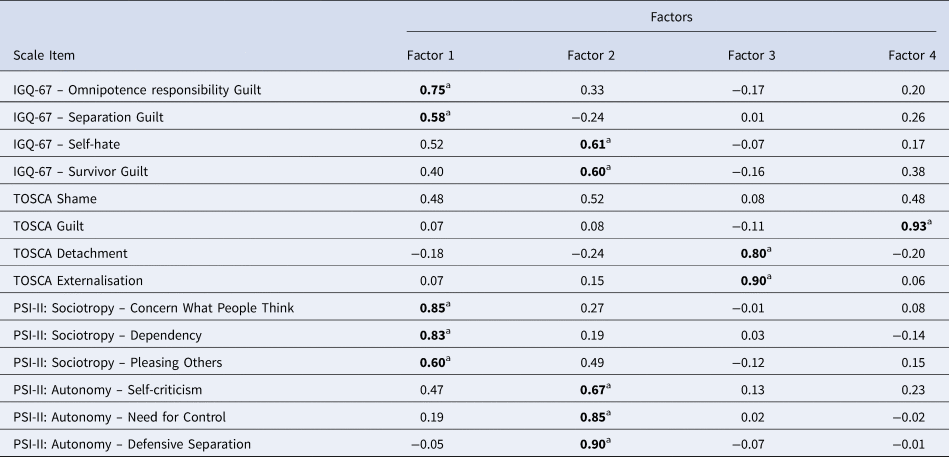
Based on Eigenvalues >1, Screeplot and clinical interpretation, a four-factor solution resulted from the principal component analysis and explained 73.78% of the total variance (Table 1). The first factor represented sociotropy/dependency with high loadings on all sociotropy subscales and on omnipotent responsibility and separation guilt. The second factor captured an autonomy/self-criticism factor, with high loadings on all the autonomy subscales, and on self-hate and survivor guilt. The third factor comprised detachment/unconcern and externalisation from the TOSCA. The fourth factor mainly captured guilt from the TOSCA questionnaire and was labelled as ‘adaptive guilt’, because of the operationalisation of guilt on the TOSCA as a non-depressogenic behavioural form of self-blame linked to reparative actions. Only the first two factors were considered as reliable based on the number and loading of the components within each of the factors (Stevens, Reference Stevens2009). For our further correlations with fMRI results, we therefore used the two reliable factors and the TOSCA guilt score which was deemed more reliable than the adaptive guilt factor score.
Rotated factor values showing loadings of each component
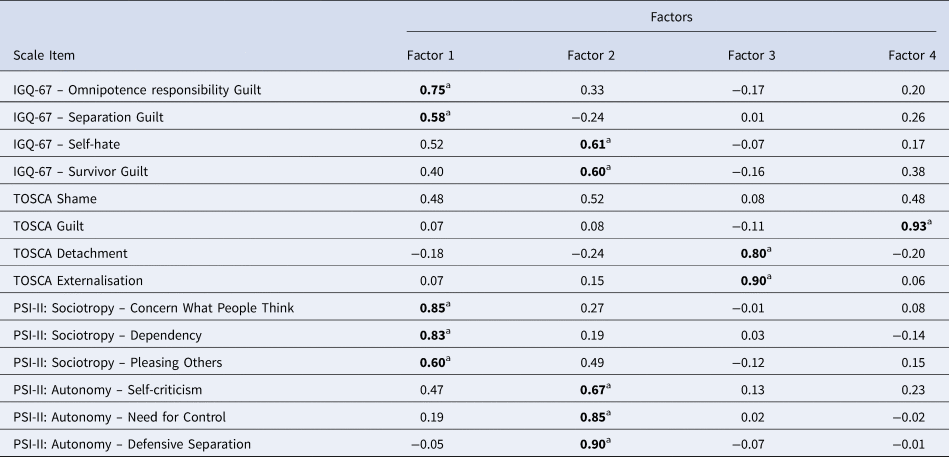
IGQ, Interpersonal Guilt Questionnaire; PSI II, Personal Style Inventory Revised Edition; TOSCA, Test of Self-Conscious Affect.
a Factor loadings above threshold (>0.58). Principal Components Analysis using VARIMAX rotation. n = 106 (n = 39 control and n = 67 MDD) were included in this analysis. Principal components analyses are designed to derive uncorrelated factor components which explain the variance contained in the set of variables (Stevens, Reference Stevens2009).
Remitted MDD patients exhibited higher sociotropy/dependency and autonomy/self-criticism factor scores compared with the Control group (Table 2). There were no between-group differences for factors 3 (detachment/externalisation) and 4 (adaptive guilt).
Group comparisons on factors derived from principal components analysis

Data for two MDD participants were missing for the Interpersonal Guilt Questionnaire (IGQ-67) and Test of Self-Conscious Affect (TOSCA), and data for three MDD participants were missing for the Personal Style Inventory (PSI-II).
a Significant at p = 0.05 threshold, 2-tailed. Means and standard deviations are reported (M ± s.d.).
fMRI results
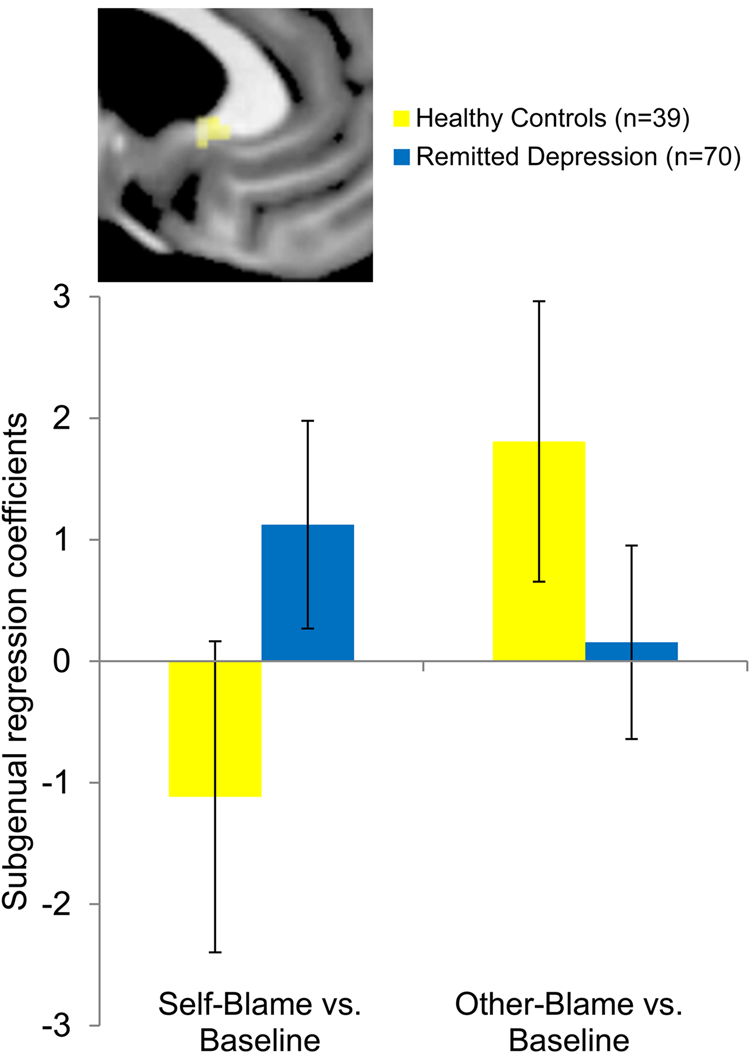
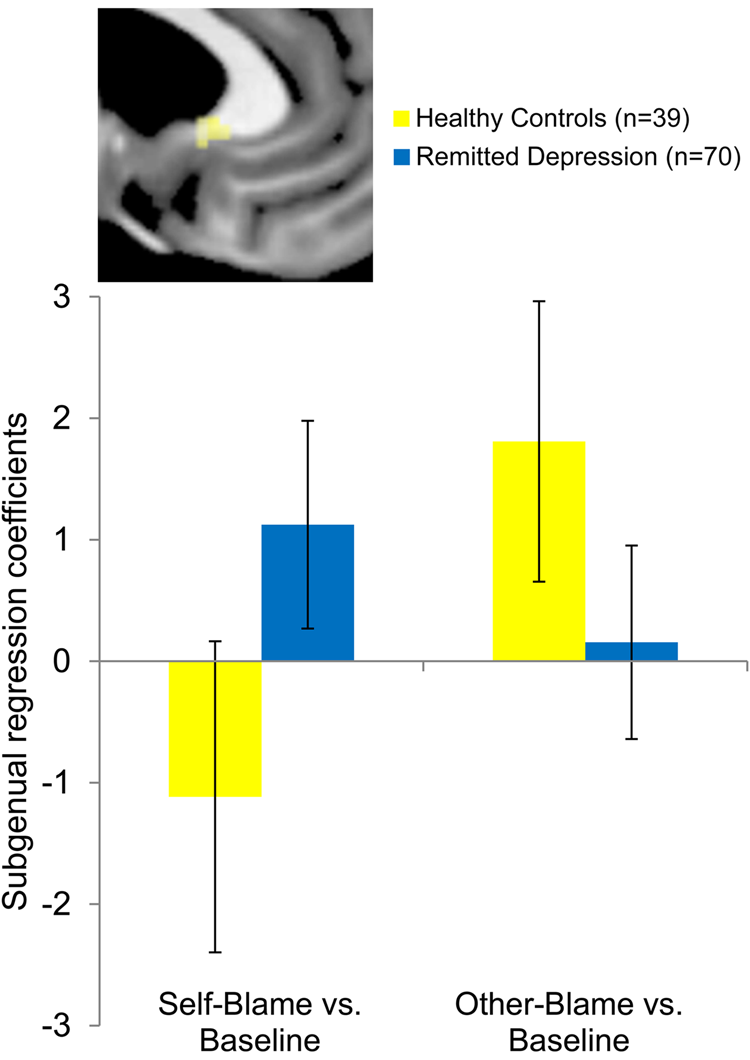
A significant interaction effect between group (Remitted MDD v. Control) and condition (self- v. other-blaming) was observed in the right SCC (Fig. 1, Table 3) and confirmed for the extracted cluster averages in this region [F(1107) = 7.65, p = 0.007], with no main effect of agency [F(1107) = 2.15, p = 0.15] or group [F(1107) = .03, p = 0.86]. This interaction effect was due to higher SCC signal for self-blame in the Remitted MDD group (M = 1.05, s.d. = 7.08) relative to other-blame (M = 0.16, s.d. = 6.61), resulting in a positive difference for self-blame v. other-blame (M = 0.89, s.d. = 5.74, t = 1.29, df = 69, p = 0.20) in the Remitted MDD group, whilst the Control group showed the reverse pattern of lower SCC signal for self-blame (M = −1.05, s.d. = 8.03) relative to other-blame (M = 1.82, s.d. = 7.18) resulting in a negative difference for self- v. other-blame (M = −2.87, s.d. = 8.38, t = −2.14, df = 38, p = 0.04). The interaction effect results from the significant differences between the groups on these self-blame v. other-blame differences (t = −2.77,df = 107, p = 0.007, mean difference = −3.76, standard error = 1.36). There were no significant main effects or interactions outside the SCC in our whole brain analysis.
A cropped section through the right SCC area (BA24) showing an interaction effect between group (MDD v. Control) and condition (self- v. other-blaming) is displayed using MRIcron (http://people.cas.sc.edu/rorden/mricron/install.html) at an uncorrected voxel-level threshold of p = 0.005, with no cluster-size threshold. The activation survived voxel-based familywise error-correction at p = 0.05 over our a priori SCC region of interest previously published in an independent sample (Green et al., Reference Green, Lambon Ralph, Moll, Deakin and Zahn2012). As can be seen from the bar charts displaying extracted regression coefficient cluster averages and standard errors, this interaction was due to higher SCC signal for self-blame in the MDD group compared with the Control group and lower SCC signal for other-blame in the MDD group compared with the Control group. There were no main effects of group or condition in the SCC. SCC: subgenual cingulate cortex.
Factorial model for fMRI activation in remitted MDD and Control group

a Using our a priori subgenual cingulate region of interest [6 mm radius sphere around centre coordinate: MNI x = −4, y = 23, z = −5 (Green et al., Reference Green, Lambon Ralph, Moll, Deakin and Zahn2012)] for multiple comparison correction. There were no main effects of agency or group in this region. No voxels survived voxel-based FWE-correction over the whole brain at p = 0.05 for main effects or interactions. FWE, familywise error; MNI, Montreal Neurological Institute. Talairach coordinates for the MNI peak were derived using Brett's MNItoTAL formula (Talairach x = 6, y = 21, z = −3) and referenced in the printed Talairach atlas (Talairach & Tournoux, Reference Talairach and Tournoux1988). Please note that although our a priori ROI's peak is in the left hemisphere, it includes the right SCC as well and interestingly, only a right hemispheric peak coordinate survived multiple comparison correction in this analysis.
Across the whole sample, SCC activity during self- v. other-blame was significantly predicted by a linear regression model which included the two reliable factors and the adaptive guilt measure from the TOSCA (Table 4). Interestingly, this prediction was solely driven by autonomy/self-criticism factor scores, and adaptive guilt, with no effect of sociotropy/dependency factor scores (Table 4). To avoid circular analyses, we did not primarily consider group here, because the extracted SCC activation cluster means were already biased by the SPM analysis to find the voxels showing a maximal group × condition interaction. Unsurprisingly, the effects for autonomy/self-criticism on SCC activation disappeared when covarying group (β = 0.10, t = 0.82, p = 0.42), because of higher scores on this factor in the MDD group as reported above, with the effects of adaptive guilt remaining (β = 0.25, t = 2.7, p = 0.009).
Individual differences in proneness to self-blame predict SCC activation

Cluster averages for the fMRI activation for self- v. other-blame were extracted for each individual and used as an outcome variable in a linear regression model in SPSS n = 106 (n = 39 control and n = 67 MDD). As predictor variables in this model, we used the identified two reliable principal components from our factor analysis of standard questionnaire measures of proneness to self-blaming emotions and whether people are more prone to blame themselves when evaluating themselves (autonomy) or when being evaluated by others (sociotropy), as well as the adaptive guilt measure from the TOSCA questionnaire. To avoid circular analyses, we did not primarily consider group here, because the extracted SCC activation cluster means were already biased by the SPM analysis to find the voxels showing a maximal group × condition interaction. Importantly, the factor analysis of questionnaire measures was independent of the fMRI analysis. * = significant at p = 0.05, ** = significant at p = 0.01. Please note that all predictor variables were modelled together and that betas therefore reflect partial effects adjusted for the other predictors in the model. As per the design, the Autonomy and Sociotropy factors were uncorrelated (Pearson's r = 0) and adaptive guilt as measured on the TOSCA showed no correlation with autonomy or sociotropy factors (r < 0.08, p < 0.43, n = 106).
The SCC activation coefficients for self- v. other-blame in the MDD group did not correlate with the number of previous MDEs (Spearman's ρ = −0.02, p = 0.89), or measures of residual symptoms: BDI scores (ρ = −0.12, p = 0.31), GAF scores (ρ = 0.15, p = 0.21), or MADRS scores (ρ = −0.29, p = 0.20). There were also no correlations between the SCC coefficients for self- v. other-blame in the MDD group for rated unpleasantness or negative affectivity as measured on the Positive and Negative Affect scale (Supplementary results, (Watson, Clark, & Tellegen, Reference Watson, Clark and Tellegen1988)).
Discussion
Our results confirm our predictions of higher self-blame-selective SCC activation in individuals with remitted MDD and those who are prone to self-blaming emotions. As expected (Green et al., Reference Green, Lambon Ralph, Moll, Deakin and Zahn2012; Zahn, Moll, et al., Reference Zahn, Moll, Paiva, Garrido, Krueger, Huey and Grafman2009), SCC activation was not associated with unpleasantness of the stimuli or standard measures of negative affectivity (Watson et al., Reference Watson, Clark and Tellegen1988) shown to be highly associated with ‘neuroticism’ (Clark, Watson, & Mineka, Reference Clark, Watson and Mineka1994), and can thus not be attributed to negative emotionality overall. Overall, individuals whose self-blaming tendencies were related to internal evaluation and striving for self-agency (i.e. adaptive guilt and maladaptive autonomy) displayed higher levels of self-blame-selective SCC activation, whereas external evaluation-related self-blame (sociotropy) showed no such relationship. Intriguingly, healthy control individuals exhibited a reversed SCC response, namely its selective activation to other-blaming relative to self-blaming emotions.
Our factor analysis was in keeping with previous validation work (Robins et al., Reference Robins, Ladd, Welkowitz, Blaney, Diaz and Kutcher1994; Yang & Girgus, Reference Yang and Girgus2019) that autonomy and sociotropy load onto different components and that adaptive guilt as operationalised by the TOSCA separates from all other measures (Green, Moll, Deakin, Hulleman, & Zahn, Reference Green, Moll, Deakin, Hulleman and Zahn2013a; Tangney et al., Reference Tangney, Wagner and Gramzow1992). As predicted, self-hate, designed to be unrelated to concern for others (O'Connor et al., Reference O'Connor, Berry, Weiss and Gilbert2002), loaded onto the same factor as autonomy measures. Contrary to our predictions, shame did not show the expected stronger associations with sociotropy rather than autonomy. This may be due to the operationalisation of shame on the TOSCA as a characterological form of self-blame associated with feeling like hiding without specifying the external evaluation aspects of shame (Green et al., Reference Green, Moll, Deakin, Hulleman and Zahn2013a). As expected, our MDD group showed higher factor scores for both sociotropy and autonomy factors which is in keeping with their postulated role in MDD vulnerability (Clark et al., Reference Clark, Steer, Beck and Ross1995; Robins et al., Reference Robins, Ladd, Welkowitz, Blaney, Diaz and Kutcher1994) whilst adaptive guilt was comparable between groups.
Confirming the predictions of our first hypothesis, we found that self-blame-selective SCC activation was higher in self-blame-prone individuals across diagnostic groups, in particular its internal evaluation-related forms such as self-hate and striving for autonomy. This is in keeping with the hypothesis that SCC activations in the detected anterior sector (BA24) may be related to social agency attributions in the context of self-blame (Zahn, Moll, et al., Reference Zahn, Moll, Paiva, Garrido, Krueger, Huey and Grafman2009). It is also consistent with the reproducible evidence on SCC activations in guilt-prone individuals without (Green et al., Reference Green, Lambon Ralph, Moll, Deakin and Zahn2012; Zahn, Moll, et al., Reference Zahn, Moll, Paiva, Garrido, Krueger, Huey and Grafman2009) or with a history of MDD (Green et al., Reference Green, Lambon Ralph, Moll, Deakin and Zahn2012).
Confirming the predictions of our second hypothesis, self-blame-selective SCC activation was higher in the remitted MDD v. Control group suggesting its role in MDD vulnerability. This is in keeping with the extensive literature on abnormalities in SCC activation in current MDD, which has been complicated by considerable variability in findings possibly related to loss of grey matter volume (Drevets, Reference Drevets1998) as well as SCC hyperactivity being stronger in familial v. non-familial MDD (Drevets et al., Reference Drevets, Ongur and Price1998). The localisation of SCC abnormalities reported in MDD varies; our finding of a BA24 activation is adjacent to, but outside the posterior subgenual cortex (BA25) used for deep brain stimulation (Mayberg et al., Reference Mayberg, Lozano, Voon, McNeely, Seminowicz, Hamani and Kennedy2005) and it is likely that posterior and anterior sectors of the subgenual region are functionally specialised (Zahn et al., Reference Zahn, De Oliveira-Souza and Moll2020). Some authors prefer using the term ‘subcallosal cingulate’ (Hamani et al., Reference Hamani, Mayberg, Stone, Laxton, Haber and Lozano2011), although Brodmann called his area 25: ‘Area Subgenualis’ (Judas, Cepanec, & Sedmak, Reference Judas, Cepanec and Sedmak2012). Despite these variations in terminology we follow Hamnani et al., to suggest treating ‘subcallosal’ and ‘subgenual’ as synonymous. It remains to be investigated whether the anterior subgenual cingulate regions (BA24/32) code for causal social agency contexts is due to their closer connection with pregenual anterior cingulate representations shown to correlate with subjective feelings of motor agency (Marchesotti et al., Reference Marchesotti, Martuzzi, Schurger, Blefari, del Millán, Bleuler and Blanke2017) and emerging evidence for functional subdivisions between pregenual and subgenual areas in social learning (Lockwood & Wittmann, Reference Lockwood and Wittmann2018).
Despite demonstrating higher self-blame-selective SCC activation in our MDD group relative to the Control group, we found no association with other indicators of MDD vulnerability, such as the number of previous episodes, or prospective recurrence risk [reported previously (Lythe et al., Reference Lythe, Moll, Gethin, Workman, Green, Lambon Ralph and Zahn2015)]. Further, we showed that self-blame-selective SCC activation was not associated with residual symptoms which indicates it is not directly comparable to SCC hyperactivity found in studies of symptomatic MDD (Drevets, Reference Drevets1998). These findings are most parsimoniously explained by assuming an association of self-blame-selective SCC activation with primary vulnerability factors for MDD, such as a tendency to internalise blame that may be adaptive and lead to prosocial behaviour (Tangney et al., Reference Tangney, Wagner and Gramzow1992) but could interact with other factors such as specific life events to trigger overgeneralised forms of self-blame such as self-hate. We have previously shown that self-hate correlates with self-blame-selective abnormalities in functional connectivity between the SCC and the right anterior temporal cortex in MDD (Green et al., Reference Green, Lambon Ralph, Moll, Deakin and Zahn2012) reflecting a lack of conceptual-emotional integration as a source of overgeneralisation (Green et al., Reference Green, Lambon Ralph, Moll, Zakrzewski, Deakin, Grafman and Zahn2013). This is in keeping with the notion that differentiated interpretations of social behaviour require integration of conceptual information about the social meaning of a situation as represented in the right superior anterior temporal lobe (Pobric, Lambon Ralph, & Zahn, Reference Pobric, Lambon Ralph and Zahn2016; Skipper, Ross, & Olson, Reference Skipper, Ross and Olson2011; Zahn et al., Reference Zahn, Moll, Krueger, Huey, Garrido and Grafman2007; Zahn et al., Reference Zahn, Green, Beaumont, Burns, Moll, Caine and Ralph2017) with agency-context-related information in the SCC (Green et al., Reference Green, Ralph, Moll, Stamatakis, Grafman and Zahn2010).
The intriguing finding of other-blame-selective activation of the SCC in control participants necessitates a re-interpretation of our previous findings on the functional role of the SCC and its importance for self-blaming emotions. This result shows that failures in previous studies to detect SCC activation in response to self-blaming emotions without modelling individual differences in proneness to such emotions (Green et al., Reference Green, Lambon Ralph, Moll, Deakin and Zahn2012; Moll et al., Reference Moll, de Oliveira-Souza, Garrido, Bramati, Caparelli-Daquer, Paiva and Grafman2007; Zahn, de Oliveira-Souza, et al., Reference Zahn, de Oliveira-Souza, Bramati, Garrido and Moll2009; Zahn, Moll, et al., Reference Zahn, Moll, Paiva, Garrido, Krueger, Huey and Grafman2009) were likely due to the fact that the SCC's role in self-blaming emotions is not selective for the self as previously asserted (Zahn, Moll, et al., Reference Zahn, Moll, Paiva, Garrido, Krueger, Huey and Grafman2009), but that it is equally important for other-blame-related emotions such as anger/indignation towards others. This is because one would be unlikely to find a functional specialisation of a brain region in one part of the population and the opposite function in another part of the population. To explain the individual differences in the direction of selectivity for either self- or other-blame in the SCC's response, it is most likely that shared cognitive/emotional components that are required for both self- and other-blame are recruited to varying degrees in different individuals depending on the context of self- v. other-agency.
Given that medial frontal activations were shown to increase when judging life events that had been more frequently encountered (Krueger et al., Reference Krueger, McCabe, Moll, Kriegeskorte, Zahn, Strenziok and Grafman2007), it is reasonable to assume that personal familiarity with blame attributions in either self- or other-agency contexts leads to more extended representations in the anterior SCC which are specific to agency context (self v. other). Based on the evidence on the externalisation of blame as a protective factor for self-esteem and against MDD in healthy populations (Mezulis, Abramson, Hyde, & Hankin, Reference Mezulis, Abramson, Hyde and Hankin2004), we speculate that their other-blame-selective SCC activation reflects their stronger familiarity with blame externalisation rather than internalisation compared with the MDD group. In contrast, people with MDD are more familiar with internalising blame to themselves as evidenced by persistent self-blaming biases (Green et al., Reference Green, Moll, Deakin, Hulleman and Zahn2013a; Zahn et al., Reference Zahn, Lythe, Gethin, Green, Deakin, Workman and Moll2015). This interpretation would also account for reproducible associations of proneness to self-blaming emotions with SCC activation as discussed above and is compatible with reduced SCC activation in psychopathy (Decety, Skelly, & Kiehl, Reference Decety, Skelly and Kiehl2013; Harenski & Hamann, Reference Harenski and Hamann2006) which entails a lack of guilt (Hare, Reference Hare2003).
On a more cautionary note, the following limitations of our study need to be discussed: to avoid multiple comparisons this study did not examine other regions of interest such as the frontopolar cortex which is the most reproducible region consistently activated for guilt across subjects (Moll et al., Reference Moll, de Oliveira-Souza, Garrido, Bramati, Caparelli-Daquer, Paiva and Grafman2007; Zahn, Moll, et al., Reference Zahn, Moll, Paiva, Garrido, Krueger, Huey and Grafman2009), (Basile et al., Reference Basile, Mancini, Macaluso, Caltagirone, Frackowiak and Bozzali2011; Kédia, Berthoz, Wessa, Hilton, & Martinot, Reference Kédia, Berthoz, Wessa, Hilton and Martinot2008; Morey et al., Reference Morey, McCarthy, Selgrade, Seth, Nasser and LaBar2012; Seara-Cardoso et al., Reference Seara-Cardoso, Sebastian, McCrory, Foulkes, Buon, Roiser and Viding2016; Takahashi et al., Reference Takahashi, Yahata, Koeda, Matsuda, Asai and Okubo2004) but is unlikely to be related to blame as it is also reproducibly found in fMRI studies of compassion (Immordino-Yang, McColl, Damasio, & Damasio, Reference Immordino-Yang, McColl, Damasio and Damasio2009), (Moll et al., Reference Moll, de Oliveira-Souza, Garrido, Bramati, Caparelli-Daquer, Paiva and Grafman2007), (Fehse, Silveira, Elvers, & Blautzik, Reference Fehse, Silveira, Elvers and Blautzik2015; Kédia et al., Reference Kédia, Berthoz, Wessa, Hilton and Martinot2008), which does not entail blame, compared against equally unpleasant and complex emotions. The non-selective activation of the frontopolar cortex for prosocial feelings requiring the anticipation of complex consequences of actions/events such as compassion and guilt is in keeping with impairments in guilt and compassion (Moll et al., Reference Moll, Zahn, de Oliveira-Souza, Bramati, Krueger, Tura and Grafman2011) as well as selective impairments in the knowledge of long-term consequences of social behaviour in neurodegenerative lesions of the frontopolar cortex (Zahn et al., Reference Zahn, Green, Beaumont, Burns, Moll, Caine and Ralph2017). It is also important to note that this study deliberately focussed on people with MDD as their main diagnosis who were fully remitted and so our results may not generalise to patients with chronic MDD and co-morbid anxiety disorders.
Conclusions
Despite confirming the prediction of SCC activation in self-blame-prone individuals and those with remitted MDD, our results suggest that SCC activation is associated with blame irrespective of direction rather than selective for the self as previously argued. We speculate that patients with remitted MDD and those prone to self-blame have a more extended representation of blame-related information in the SCC in the context of self- v. other-agency with the opposite pattern occurring in healthy controls at low MDD risk which could explain these findings. These SCC representations may relate to the causal agency which would explain higher self-blame-selective SCC signal in individuals striving for autonomy. Future studies in people at familial risk of MDD prior to their first episode are needed to confirm our interpretation that self-blame-selective SCC activation is associated with primary vulnerability to MDD, and may interact with other factors, such as life events, to result in overgeneralised self-blame that was previously associated with changes in SCC functional connectivity rather than activation (Green et al., Reference Green, Lambon Ralph, Moll, Deakin and Zahn2012).
Supplementary material
The supplementary material for this article can be found at https://doi.org/10.1017/S0033291720003372.
Acknowledgements
We are grateful to the participants for volunteering their time for this study. This study was funded by an MRC Clinician Scientist Fellowship to RZ (G0902304). RZ was partly funded by the National Institute for Health Research (NIHR) Biomedical Research Centre at South London and Maudsley NHS Foundation Trust and King's College London and by a NARSAD Independent Investigator Grant (24715) from the Brain & Behavior Research Foundation. The views expressed are those of the authors and not necessarily those of the NHS, the NIHR, or the Department of Health. J.M. was supported by the LABS-D'Or Hospital Network, Rio de Janeiro, Brazil. J.A.G.Conflict of interest
There are no relevant conflicts of interest relating to the contents of this article.