Introduction
In Sweden it is estimated that the number of people over the age of 65 will double before 2060 (Statistics Sweden 2015a). This has led to serious concerns among policy makers as to whether the current labour force can adequately meet the future care needs of people reaching advanced old age (Macdonald and Cooper Reference Macdonald and Cooper2007; National Board of Health & Welfare Sweden (NBHWS) 2015). In combination with financial constraints on public service budgets, older people with long-standing chronic conditions are increasingly becoming dependent on the support of their families (Eurocarers 2015; European Union (EU) 2014). Despite the fact that family members in Sweden face no legal demands to take on carer roles for relatives (NBHWS 2014), it can be seen that three-quarters of all care of older people is given informally (NBHWS 2012).
The term ‘carer’ refers to a person, such as a spouse, who provides sustained, unpaid care to a person (care-taker) requiring support (cf. Arber and Ginn Reference Arber and Ginn1990). Being a carer is a complex experience that develops over time. On a daily basis it may include providing practical help with, for example, instrumental activities of daily living such as supervision, social stimulation and companionship, help with contacting authorities, financial support and assistance, and even personal care (NBHWS 2012). These are activities that often have a deep impact on the cared-for person, but also on the carer's own everyday life and understanding of self. As the process of becoming a carer involves a life change caused by another person's illness or disability, caring activities should thus be seen as an identity-forming practice (Montgomery and Kosloski Reference Montgomery and Kosloski2009, Reference Montgomery, Kosloski, Talley and Montgomery2013).
At both EU and Member State levels, policy makers and researchers have recognised the need to develop more effective carer-support interventions (Carretero Reference Carretero2015; Carretero et al. Reference Carretero, Stewart, Centeno, Barbabella, Schmidt, Lamontagne-Godwin and Lamura2012; Erlingsson, Magnusson and Hanson Reference Erlingsson, Magnusson and Hanson2012; Eurocarers 2015; Swedish National Audit Office 2014). In combination with the rapid technological developments in recent decades, it is not surprising that new ways of supporting carers have emerged through different social networking sites (SNS). SNS is here perceived as Web-based services that enable individuals to construct a profile within a bounded system and in which they can share a connection with others within that system (Nef et al. Reference Nef, Ganea, Müri and Mosimann2013). The internet and different SNS have become part of a new self-help culture in which family (informal) carers can learn about illnesses associated with ageing, gain support and discuss their experiences with others in similar life situations (Boots et al. Reference Boots, de Vugt, van Knippenberg, Kempen and Verhey2014). What we are observing is the emergence of e-support services and opportunities to use SNS within the health domain in order to support carers.
Background
As online social interaction has grown rapidly, online research has also become increasingly popular. Online communities encourage sensitive content to be expressed, without compromising confidentiality, and facilitate long-term, in-depth discussions (Saba and McCormick Reference Saba and McCormick2001; Smith and Stewart Reference Smith and Stewart2012). This is evident in several studies. Adler and Adler (Reference Adler and Adler2011), for example, focused on the cyberworlds of self-injurers, discussing how people who, although they may be isolated while away from the keyboard, have constructed a myriad of online communities, enabling them to interact with others who, like themselves, feel isolated or on the margins of society (see also Adler and Adler Reference Adler and Adler2005; Lynch Reference Lynch2010). Yu et al. (Reference Yu, Mccammon, Ellison and Langa2016) also concluded in a study comprising a representative sample of Americans older than 50 that SNS use contributes to increased feelings of connectedness as people age (see also Johnson and Ambrose Reference Johnson and Ambrose2006; Pew Research Center 2014).
In relation to internet-based support for carers, in 2011 the EU Commission initiated the CARICT study (ICT-based solutions for care-givers – assessing their impact on the sustainability of long-term care in an ageing Europe). This study used a mapping analysis to highlight the existence of a wide variety of e-support services that range from assistive to robot technologies, and include telecare, online services and social networking, among others (Carretero et al. Reference Carretero, Stewart, Centeno, Barbabella, Schmidt, Lamontagne-Godwin and Lamura2012). Perkins and LaMartin (Reference Perkins and LaMartin2012) acknowledged that social engagement often tends to decrease with age, and the internet may help to broaden opportunities for carers to provide support to one another. Studies also reveal, however, that although an increasing number of people are getting online, adults over 65 years of age still make up a relatively small percentage of those adopting SNS (Norval et al. Reference Norval, Arnott, Hine and Hanson2011; see also Statistics Sweden 2015b).
As stated by Austrom et al. (Reference Austrom, Geros, Hemmerlein, McGuire, Gao, Brown and Callahan2015), it is well documented that providing intensive amounts of care may have negative consequences on carers’ health, including high levels of stress, depression, physical symptoms and psycho-social problems. This is especially the case among older spousal carers. Indeed, across all ethnic groups spouses provide care for more hours and perform more tasks than other family members (Friedemann and Buckwalter Reference Friedemann and Buckwalter2014; Marks, Lambert and Choi Reference Marks, Lambert and Choi2002). They are also the group of carers who tend to be most reluctant to hire professional helpers or use community services, especially if they are women (Friedemann and Buckwalter Reference Friedemann and Buckwalter2014).
In a literature review on internet-based intervention studies for carers, Boots et al. (2014: 338) concluded that the most commonly addressed topics included discussions on self-efficacy, stress/burden, depressive symptoms, coping, social contact/support, knowledge, utilisation of health services and general (mental) health (see also Chien and Lee Reference Chien and Lee2008). Basically, scholars have focused on the ways in which participation in different kinds of online health-care communities can be understood as a complement to the services and treatments facilitated by the health-care system. Less developed, however, are studies concerning the identities and relationships being developed through such various SNS.
Research on the development of carer identities is relevant for different reasons. Firstly, and seemingly rather contradictory, this kind of research is called for due to the fact that many carers do not actually identify or see themselves as carers. Dobrof and Ebenstein (Reference Dobrof and Ebenstein2003) revealed that caring practices influence carers’ health and wellbeing. However, as carers commonly understand caring as a natural part of an ongoing relationship, they tend not to reach out for support and help until there is a real crisis situation (Nolan, Grant and Keady Reference Nolan, Grant and Keady1996). Secondly, although becoming a carer profoundly changes the day-to-day life of a spouse or significant other, research on carer identities in general is scarce (Eifert et al. Reference Eifert, Adams, Dudleuy and Perko2015). To the best of our knowledge, there is a dearth of research focusing on online carer identities.
Purpose and research questions
The purpose of this qualitative and netnographically informed study is to describe how older carers conceptualise and understand their identity as carers on a Swedish online social forum. A social forum here refers to a virtual meeting place in which individuals can discuss different topics, in this case their everyday lives as a carer, among other things. The social forum for carers, which is in focus, was developed within an EU Seventh Framework Programme-funded project called INNOVAGE (Social Innovations Promoting Active and Healthy Ageing), in which two of the authors participated. Addressing the purpose of the study, three central themes emerged in the analysis of the data (for further details, see the section on research design and methodology). These themes can be summarised as answering the following three research questions:
• Research question 1: In what ways do the carers present themselves online as carers, and what meanings are attached to their care-giving practices?
• Research question 2: What kinds of social support and relationships develop within the online social forum?
• Research question 3: How is the identity as carer discussed and contextualised in relation to formal carers and the Swedish health and social care systems?
The article is structured as follows. First, we present the theoretical framework for the study. Then we explain our method and methodology. The Findings section consists of three parts in which the above-mentioned research questions are systematically addressed. In the Discussion section, the results are summarised in a more condensed and theoretical manner, thus explicitly addressing the overall purpose of the study.
Theoretical framework
This study adopts a constructionist approach. We are interested in the inter-subjective ways in which particular identities are being created, in social interaction/communication with others (spouses, friends, other carers and professionals) and by the doing of things such as care-giving, labour, sport, etc. This can occur both online and away from the keyboard. Montgomery and Kosloski (Reference Montgomery, Kosloski, Talley and Montgomery2013) have theorised this in terms of a dynamic process through which the carer identity gradually develops, as the carer engages in particular activities and subsequently ascribes meaning to these activities while discussing them with others. The identity as a carer is, however, not only to be seen as inter-subjective but also intra-subjective. As a carer role is acquired and care-giving practices conducted, the provider of care also experiences a change in his or her own identity over time, a process that can be described as an identity trajectory.
In our understanding of the concept of identity in the context of online social interaction, we agree with Turkle (Reference Turkle1995) who suggests that the use of internet communications brings not only the opportunity to perform an alternative identity but also to create the basis for an alternative lifestyle (see also Andreasson and Johansson Reference Andreasson and Johansson2016; Giles Reference Giles2006). In this respect, we employed a multi-dimensional interpretation of the identity concept. Firstly, we suggest that narratives presented online can be seen as markers of identity. Secondly, however, we also recognise that community members, due to their potential anonymity and the absence of face-to-face interaction, may assume a customised presentation of self, perhaps constructed/performed to bring social support and recognition within the community.
Obviously, identity positions cannot be understood in total isolation or as something being negotiated only between, for example, two carers in an online forum. Identity as a carer must also be perceived as a result of a historical process influenced by a variety of discursive ideas about, for example, ageing, health, marriage and even death. Discourses are here perceived as something individuals carry within them, in the form of internalised knowledge (Elsrud Reference Elsrud2004). Consequently, the individual is considered to be unconditionally tied to the regulative ideas constituted within these systems of meaning, guiding not just their way of speaking but also their social practices and perceptions of reality (Foucault Reference Foucault1988). In other words, discourses do not only affect people's way of thinking but also what they experience, their perception and practices (see also Foucault Reference Foucault1972; van Dijk Reference van Dijk1997). At the same time, as discourses house different and sometimes also contradictory meanings, the individual is perceived as being able to question, and sometimes even contribute, to the creation of new and different possibilities for action, within the discourses. In summary, the way people describe themselves and the meanings they attach to their particular life situation are in this study simultaneously understood as personalised narratives of identity and as discursive testimonials (Giddens Reference Giddens1986).
Research design and methodology
A netnographic study design
In the study we employed a netnographic study design, focusing on ‘written accounts resulting from fieldwork studying the cultures and communities that emerge from online computer-mediated or internet-based communications’ (Kozinets Reference Kozinets2010: 58). As we see it, netnography is an inclusive collection of methods through which the researcher in different ways tries to capture and to some extent participate in the online everyday life of others. Our methodological intention has been to gather empirical material that both empirically and theoretically can capture the online identity acquired when becoming a carer and the significance of an online community in this context. Consequently, although netnography differs from conventional ethnography, for example in its use of internet communications and that it excludes face-to-face interaction, it nevertheless bears many similarities with ethnography as well as anthropology (Hine Reference Hine2000; Hooley, Marriott and Wellens Reference Hooley, Marriott and Wellens2012). Social media, such as different online social forums and communities, are, for example, commonly thematised to attract and target specific groups of people and can thus be viewed as embedded in specific socio-cultural and national contexts (Orgad Reference Orgad2006). Kozinets explains:
The way in which technology and culture interact is a complex dance – an interweaving and intertwining. This element of technocultural change is present in our public spaces, our workplaces, our homes, our relationships, and our bodies – each institutional element intermixed with every other one. Technology constantly shapes and reshapes our bodies, our places, and our identities, and is shaped to our needs as well. (Kozinets Reference Kozinets2010: 22)
Influenced by the words of Kozinets, in this study we have focused on discussions posted on a social forum for carers, taking the perspective that they can be viewed as cultural manifestations of how a particular identity, such as being a carer, is conceptualised and understood online (see Porter Reference Porter1997).
Recruitment and informed consent
The study derives from the EU-funded INNOVAGE project, which among other things aimed at developing and testing a Web platform for carers across 27 EU Member States. This Web platform was developed and initially tested in Italy, Germany and Sweden, and detailed information on the intervention, preliminary results and implementation are published elsewhere (Barbabella et al. Reference Barbabella, Poli, Andréasson, Salzmann, Papa, Hanson, Efthymiou, Döhner, Lancioni, Civerchia and Lamura2016; Lamura et al. Reference Lamura, Poli, Yghemonos and Barbabellain press). The Web platform is now publicly available as part of the Eurocarers website (http://eurocarers.org/InformCare). The present study focuses on the Swedish social forum that was situated on the Swedish section of the Web platform.
When initiating the INNOVAGE project and Web platform, potential participants for the study were recruited by exploiting the existing networks and contacts of the Swedish Family Care Competence Centre. Contacts were also found via the Swedish Dementia Association and Carers Sweden. In addition, contact was made with two of the largest employers in a town in the south-east of Sweden where the research group is situated, in order to inform co-workers and potential carers about the project. In a second selection stage, existing participants were also able to assist by providing new contacts. Thus, the sample can be described as a strategically and respondent-driven snowball-sampling (Fangen Reference Fangen2005; Salganik and Heckathorn Reference Salganik and Heckathorn2004).
In the process of gaining consent from participants, the first author (FA) initially sent an information letter regarding the project to carers showing an interest in the study as well as a printed informed consent form to sign. A total of 44 people (ten men, 34 women; mean age 64.7) were recruited and completed the informed consent form. Participants recruited for the study represented a variety of carer experiences, and they spent, according to their personal estimations, an average of 31.5 hours per week caring for a spouse (30), parent (11) or other relative (three). The sample included mostly retired spouses with higher formal education. A majority of the carers rated their confidence in using the internet as high. When participants joined the Swedish pilot study, they gained access to the social forum in which they could discuss issues related to them as carers. The participants used the social forum at different levels; some published postings actively during the entire data collection period (April 2014 to June 2015), while others mostly logged in and took part in the discussions (passive use). Overall, older (female) spousal carers were more active on the social forum over time (rated medium-high use), but they also represented a larger participating group of carers (for further details regarding the sample, see Barbabella et al. Reference Barbabella, Poli, Andréasson, Salzmann, Papa, Hanson, Efthymiou, Döhner, Lancioni, Civerchia and Lamura2016).
The forum was moderated by FA, who sought to create an inclusive and open social climate, foster stimulating discussions and facilitate emotional as well as technical support and information exchange on the forum. Guidelines for moderation were developed in the INNOVAGE project and followed for the Swedish context. Taking the perspective that the social forum was intended as a virtual place for carers to express their opinions, thoughts and experiences, her participation can mainly be described as monitoring and supporting.
Data analysis and ethical considerations
Within netnography data collection does not happen in isolation from data analysis (Kozinets Reference Kozinets2010: 95). Therefore, in the selection of excerpts we have aimed to capture narratives in which carer experiences are discussed dynamically within the social forum, and subsequently how these discussions can be understood in terms of online carer identity constructions and conceptualisations.
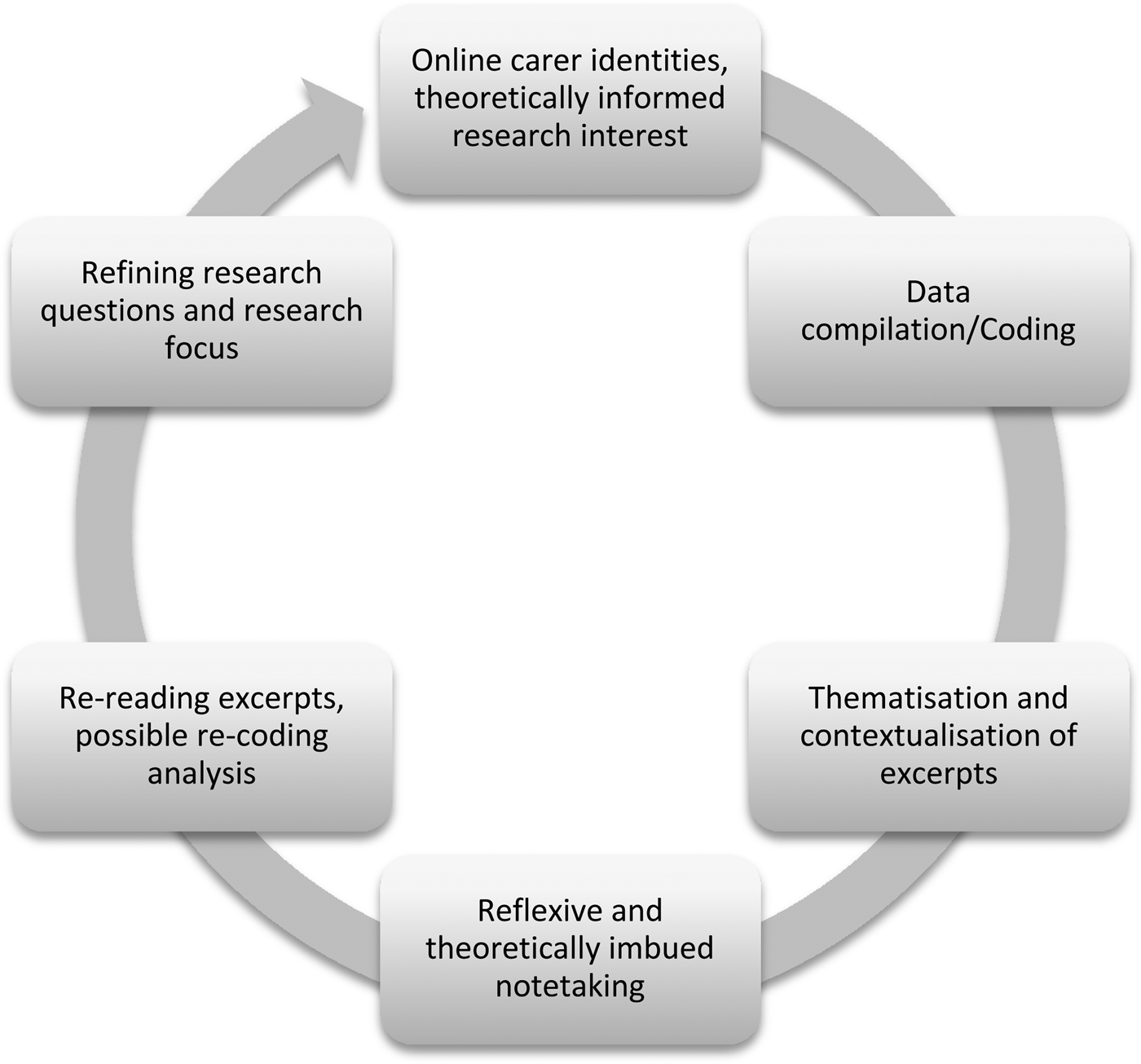
Our analysis and interpretation of data were derived from verbatim transcripts of postings presented on the social forum. These transcripts were read repeatedly and coded into themes that both responded to the more theoretical imbued purpose of the study (online carer identities) and at the same time could capture the subjective empirical meanings being expressed regarding being a carer (cf. Aspers Reference Aspers2007). The themes that emerged in the coding process concerned: (a) descriptions of being a carer and the meanings attached to this practice, (b) the significance/impact of the social forum within participant carers’ everyday lives, and (c) how the participants reflected upon their care-giving practices in relation to formal care-giving. The coding analysis was conducted manually and initiated inductively. We created three separate Word documents, each compiling excerpts that addressed our themes. Gradually developing our understanding of the data and the emerging focus of attention in our themes, we could refine our research questions (Kozinets Reference Kozinets2010: 119). We made theoretically imbued notes during this process. We aimed to identify shared understandings and similar phrases, abstracting their meanings in order to be able to contextualise the excerpts in each theme and also further developing our theoretical toolbox (Aspers Reference Aspers2007). Then we re-read the excerpts in each document again, attempting to check and refine our understanding of the data as well as our theoretical framework and existing body of knowledge. Through this circular process and constant movements between empirical data, on the one hand, and theoretical and analytical tools, on the other hand, we sought narratives that in a nuanced way could respond to the purpose of the study (Kozinets Reference Kozinets2010; see also Bowler Reference Bowler2010; Fangen Reference Fangen2005). The data analysis process is summarised in Figure 1.
Visualisation of the data analysis process.

Using material published on the internet calls for some ethical considerations. The social forum is part of a Web platform, which only registered users can access. This means that no unauthorised person can access the discussions. Nevertheless, this does not of course give us the right to use the excerpts as we please. When selecting excerpts we have been careful not to use the most sensitive material presented but only those aspects of the discussions that are relevant for our research questions. The excerpts are originally in Swedish and have subsequently been translated into English. In order to avoid any unforeseen link between an excerpt and an individual, all names of places and people have been anonymised in the translation process. Formal ethical approval to carry out the study was secured from the Regional Ethical Review Board of the University of Linköping (Dnr 2013/470-31).
Findings
The text in this section is structured into three sub-sections, systematically exploring and addressing the research questions of the study. The three different aspects of carers’ conceptualisation and understanding of their identity as carers somewhat overlap of course, but they mainly form the structure of the findings presented here, as well as the main purpose of the study, which will be explicitly addressed in the Discussion section.
Presenting oneself as a carer
After being introduced to the Web platform within the INNOVAGE project, the Swedish participants soon came to focus on the social forum, which became a virtual place in which they could discuss different aspects of everyday life as carers. Below, one participant explained her view on caring activities.
My reflection on being a carer is that we do not only contribute with our capabilities, we also have needs. Unfortunately, they are not so easy to satisfy. With our capabilities we do not only provide care. Personally, I also take care of the home, the household, the garden, finances. I'm responsible for agreements concerning electricity, telephone and other things. Then there are renovation requirements, possible trips and of course contacts with the health and social care system. You probably recognise yourselves in the description. How do we satisfy our own needs of stimulation; socially, culturally, emotionally? … When I think about the forthcoming week, I usually think of different things that I'd like to do, but most often I fail to find time to realise my ideas. (Karin, 69 years old, spousal carer)
Karin gives us a glimpse of the complexity of being a carer and the practical consequences that often follow from such a commitment. She tries to make a distinction between herself as a carer and who she is as a person (when not care-giving). In an analysis on identity constructions such a distinction is, of course, difficult to do, as identities are constituted through the doing of things. Conducting caring activities is thus to some extent, and by definition, identity forming. Nevertheless, what Karin is approaching in her narrative is the fact that she is and wants to be recognised as doing more than ‘just’ caring. This kind of argument is evident in many postings presented. Another informant puts it as follows: ‘being alone in a companionship is probably the worst’ (Siri, 69 years old, spousal carer).
The paradox is here constituted in between a sense of, on the one hand, being in charge of practical arrangements in a household and the care-taker's health and, on the other hand, feelings of being overwhelmed by and restricted by the same commitments (Friedemann and Buckwalter Reference Friedemann and Buckwalter2014). This naturally raises both practical and existential questions.
I think that you're sometimes considered to be a maid. It's the same message as Socialism. ‘To each according to his needs, from each according to his ability.’ Unfortunately, I have great capabilities, but my husband has so very great needs! I don't think that this is right! Surely, I must be entitled to have some small zone of my own. Why shouldn't I be able to wish for a beautiful home, like other women? Thousands of diaper packages, wheelchairs, potties of pee and protective pads, this I can deal with. But when you're also required to have the patience of an angel – then I really think it becomes too much … I would say that I've been assigned a role or a position that constantly requires selflessness. I actually shared these thoughts with two carer advocates in the municipality, and they both responded, telling me, ‘well the main thing is that it's good for Bengt!’ This view of our marriage grieves me terribly! (Margareta, 72 years old, spousal carer)
A majority of the carers using the forum were women that had been caring for a considerable period of time, a mean of 3.3 years and sometimes up to 20 years, initially for parents and later their husband/wife, and they were also high-intensity carers. Feelings of obligatory responsibilities, loneliness and a sacrificial stance are evident in many of these narratives. The identity of being a carer is also presented as something that ‘goes without saying’. In the above excerpt, the expressed emotions are connected firstly to thoughts about living an independent life and to a sense of freedom, thus aspects of great relevance when constructing an autonomous sense of self-worth and identity. Secondly, the narrative is related to the institution of marriage and the meanings/obligations that are attached to one's understanding of being a ‘decent/responsible’ spouse. For Margareta, the meaning of being a carer is clearly connected to feelings of being forced into quite traditional gender configurations and perceived ‘duties’ within the institution of marriage. This finding resonates with Montgomery and Kosloski's (Reference Montgomery and Kosloski2013: 133) research that suggests that the two most consistently reported factors that carers associate with higher levels of stress are gender and living arrangements. A participant sums this up in the following way: ‘Well, when you get married the priest says, for better or worse, and I guess the time had come for worse’ (Birgitta, 73 years old, spousal carer).
The narratives presented within the social forum go in diverse directions. Expectations and hopes are intertwined with disappointments, pride is mixed with fear, and thoughts about responsibilities are discussed both in terms of self-worth and self-neglect. In this regard, the discussions being presented are filled with markers of identity. The institution of marriage is, for example, also often called upon, and the participants indicated that they felt diminished and their personal value reduced by the burden of responsibility they carried as they struggled to be a good and respectable wife/husband (cf. Skeggs Reference Skeggs1997). One informant describes this in terms of ‘living in a shadow land, unnatural for one's age’, suggesting that being a carer may reduce one's sense of autonomy and control over one's life to such extent that the carer feels as though they have become a person that lives in the shadow of the older person receiving care. The carers’ home, social life and needs are adapted to fit the needs of the cared-for person. Thus, the carer identity to some extent comes to manifest an invisible self. This is not least the case when the identity of the carer becomes associated and attached to conceptual moral obligations expressed within a marital- and gender-divide discourse. Heward, Gough and Molineux (Reference Heward, Gough and Molineux2011) have described this as a process in which previous identities gradually fade away and are lost due to caring responsibilities (see also Eifert et al. Reference Eifert, Adams, Dudleuy and Perko2015). Based on our research results, however, a more accurate description is that while these former identities do become invisible, they are not lost or totally eroded; rather, it is often the case that others fail to recognise/see these former identities. Consequently, what we have here is incongruence between what could be described as intra-subjective and inter-subjective aspects of an acquired identity (Montgomery and Kosloski Reference Montgomery, Kosloski, Talley and Montgomery2013).
Although the carer identity clearly comes with some challenges, it is important to emphasise that carers also find it emotionally rewarding. In the next section we will focus on how the carers can counter feelings of self-neglect through online social relationships.
Finding social support and developing carer relationships within the social forum
One concern that is often raised by critics regarding the promotion of Web-based social support for older people and carers, as opposed to face-to-face interaction, is that it may contribute to sustaining social isolation. For participants in this study, however, this concern is rarely expressed and mentioned. Further, when discussing the online forum, participants tended to emphasise that a Web-based support group is more flexible compared to traditional carer support, which, participants suggested, offered limited flexibility and accessibility (see also Carretero Reference Carretero2015). Online support is, however, not discussed in terms of replacement but rather as a complement to traditional, offline services. Several participants described gaining access to the social forum as something of a relief, and a way to establish new social relationships. Liza (68 years old, spousal carer), for example, explained, ‘I have felt that my experiences are worth something, that I am not only an old lady in my seventies who should just sit and be quiet’.
The social forum seemingly offers a supportive context in which participants are able to discuss different predicaments in life. In many narratives, as in Liza's above, it is also to some extent understood as a means of stepping out of life in the shadows. Within the online community her sense of self could be interpreted as becoming less ‘invisible’ (as discussed in the previous section). In a rather powerful way this excerpt thus points to the importance of social recognition as a means of countering negative experiences attached to the carer identity.
In the discussions emerging from various postings, it becomes obvious that the social forum facilitated not only a ‘place’ for recognition but also a possibility for making new acquaintances. Annie, for example, explained that she found it hard to understand some of the technical details, and another participant, Eric (carer for his father), decided to support and guide her. She explained:
I was caring for my husband who was ill and Eric was caring for his father. We were communicating via the forum and then the chat, mostly about how the municipalities helped us in our situations as carers at that time. Now, a year afterwards, Eric has lost his father and I have lost my husband … The grief is heavy for us both. Eric has been a support to me and has, with his computer skills, helped me so much. Already last year he explained a lot of things to me that I didn't understand. Now it has really helped me. Eric has helped me learn how to blog. I've found a new interest. (Annie, 73 years old, spousal carer)
Firstly, Annie's description highlights that an online social forum can be an effective aid for reducing feelings of social isolation. Secondly, her narrative also shows how participation in an online group can be understood in terms of learning and learning processes. The social forum can in this sense be seen as a community of practice, which is ‘an aggregate of people who come together around a mutual engagement in an endeavour’ (Eckert and McConnell-Ginet Reference Eckert and McConnell-Ginet1992: 464). Becoming a member of a community of practice thus implies that ways of doing things develop successively within the community. Put differently, community members learn from one another and discuss their experiences, which can contribute to changing not only their conception of caring but also their understanding of themselves and what they can do (Hanson, Magnusson and Sennemark Reference Hanson, Magnusson and Sennemark2011; Sennemark Reference Sennemark2010).
Furthermore, these social processes of learning and the ongoing process of carer identity construction on the social forum obviously do not occur in a ‘no man's land’. On the contrary, these processes are inevitably interwoven within a larger system of relationships with, for example, contacts within the municipalities, lawmakers, administrators and representatives of the social care system. Being a part of an online community of practice thus implies that the carer can become part of a social process in which relationships are reshaped, enabling the individual to assume new positions in the larger relational systems.
Contextualising the carer identity in relation to formal carers and the Swedish health and social care system
When introducing themselves, the carers, to some extent, are bound by the prerequisites and practicalities attached to their caring responsibilities. Consequently, they are not only presenting themselves on the social forum, but also the care recipient and her or his medical status, diagnosis and so forth. Elsa explains how the organisation and structure of her everyday life manifests itself:
I'm a carer for my husband Karl who has dementia. He got the diagnosis 2002 and it has been several dazing situations since. He has frontal lobe dementia and I believe this form of dementia is ‘easier’ than many other forms … Karl has very structured daily routines, after the newspaper in the morning there is breakfast, after that he wants to read the newspaper, and after a coffee break he wants to do some crosswords. Yeah, I really mean crosswords, but not the most difficult ones. Also, after breakfast it's important that I facilitate some bags and packages for him. He likes to cut these in small pieces. That's his job. Twice a week home care come and relieve me so that I can run some errands if needed. But actually, there have been some disputes, and even worse, in the contact with home care and home health care, but you shouldn't give up. (Elsa, 82 years, spousal carer)
Elsa's husband has not been outside the apartment for over a year for fear of getting ‘moved’ to a nursing home. As a consequence, Elsa has learned how to tackle his dementia and how to create an environment in which he feels comfortable and safe. At the same time she has to balance this with her own wishes and what works for her. Thus, over time she has developed different strategies in order to make life as smooth as possible. For example, Karl usually has the sound turned up high when watching television, and Elsa knows that he will not turn it down if she asks him to. Instead she initially sits down in the doorway of the room where the television is located, and as Karl enjoys her company he successively turns the volume down in order to make her move closer towards the sofa. This is, of course, a rather simplistic practicality, but nevertheless it shows how Elsa has developed a way to communicate with her husband so that he is granted the ability to decide and be in control. She has gained this knowledge through trial and error over a significant period of time. Also, in listening to Elsa's narrative it becomes obvious that the carer practicalities described constitute a rather rigid framework for her own identity-forming practices.
In the narratives we examined there are several descriptions concerning the development of first-hand knowledge concerning caring and the complexities of being a carer. This knowledge is a mix of practical, medical, social and behavioural information concerning the cared-for person. This knowledge is also of importance when in contact with representatives of the health-care system and municipality. Although some participants expressed that their expertise as carers has been recognised in the eyes of such professionals, several expressed that they have felt that their first-hand knowledge is dismissed.
Concerning the Needs Assessors in the municipality, I often think that they've been working for too long. They use standardised phrases when talking to you, like for example ‘You have to think about yourself’. I hate that phrase. Sometimes there isn't enough room for that. I think the Needs Assessors have to listen to what the carer needs and wishes for. Listen, listen and see if it's possible. Every carer has different needs. I have sent letters to newspapers, met politicians but without any results. Eventually you give up, as you get so exhausted with your own situation at home … When I sent letters to my municipality I received the following answer: How nice that you can take care of your husband and we will look over our routines. Then it is, blah, blah, blah and so it continues. (Annie, 73 years old, spousal carer)
What is being described here is something of a collision between two different systems of expertise and understanding of caring. Annie is a knowledgeable carer who often tries to get her voice heard, and she is well informed about her husband's social and medical needs. However, in their encounters with professionals she and several other participants expressed that their knowledge is seldom taken into account. One participant even expressed this in terms of experiencing a system that tries to manipulate the carer. Representatives for the health-care system and municipalities are here thought to acknowledge the efforts made by the carer on a personal level, emphasising that the carer ‘is doing a great job’ and ‘should try to get some personal time also’, thus on one level being compassionate. Less acknowledged by these representatives, however, is the actual expertise that the carer possesses. As a result, some participants have decided to try to manage without any help from the municipality whatsoever.
I also abstained from the municipal home care. I couldn't adapt to their routines. It was easier to do everything myself. I've had an eye on everything that concerns my husband's illness and I've been to all medical visits. I've arranged the shift of the health-care centre, organised an escort so we could do some excursions, arranged a green card to the dentist. Anything to get as good a life quality as possible. It's hard to always be on the ball but it's necessary. (Emma, 73 years old, spousal carer)
The problem of balancing support and freedom has been discussed by Lévesque et al. (Reference Lévesque, Ducharme, Caron, Hanson., Magnusson, Nolan and Nolan2010) who highlighted the benefits of operationalising the relationship between carers and practitioners, making it into a partnership process. For example, they revealed that carers were more often than not used to having services suggested to them by practitioners, and that they were more likely to reject the help offered if they did not participate in the decision-making process. Many of the participants had extensive experience of being carers and thus comprehensive first-hand knowledge of caring. The need to be recognised as a knowledgeable alternative to professional care, rather than a supportive complement, is emphasised in many postings. Participants suggest that the resources of carers should be taken seriously and that health and social care professionals should be encouraged to respect carers’ knowledge and expertise, and work with them as partners (Eurocarers 2015; Hanson, Magnusson and Nolan Reference Hanson, Magnusson and Nolan2008; Nolan, Grant and Keady Reference Nolan, Grant and Keady1996).
Discussion
Studying online carer identities can offer direction for health educators and interventions seeking to increase support service utilisation by carers (Eifert et al. Reference Eifert, Adams, Dudleuy and Perko2015: 366). In this study, we have not focused on the specificity of being a carer, but instead we have tried to paint a broader picture of how the process of becoming and being a carer comes to influence and affect the carer's understanding of self. Specifically, we have examined how carers conceptualise and understand their identity as carers in an online social forum for carers of older people. Previous research suggests that there is a need for multiple support services to serve the diversity of needs and preferences expressed by carers, as well as theoretical models on how to understand the development of a carer identity (Montgomery and Kosloski Reference Montgomery, Kosloski, Talley and Montgomery2013). The results in this study are largely in accordance with similar studies on the development of offline carer identities. This study adds to existing research and offers an original contribution to knowledge with respect to the ways in which online interaction and SNS may be used as flexible and emancipatory means for carers of older people to socially negotiate their understanding and doing of caring activities as an online identity-forming practice. Given the technical ‘revolution’ in recent decades, it is surprising that so little attention has been directed towards the construction and conceptualisation of online carer identities, and the possibilities that SNS facilitate when it comes to socially negotiating life as a carer.
Becoming and being a carer can, of course, be manifest in different ways. For some participants the responsibilities of being a carer arose due to older relatives’, such as parents’, deteriorating health. In these cases, most often being a carer was understood as one part of life, which could be shared with professionals, siblings and others. For others, however, the carer experience arose quite suddenly, when a life partner became ill and as a consequence required long-term care. In this study, the presence (or absence) of recognition of one's capacity, knowledge and life situation is found at the very core of the carer identity as it is constructed and conceptualised in the social forum. Online communication with other carers is here perceived as a way to be recognised and feel empowered. It is a process through which an invisible self is recognised, at least to some extent.
On a societal level it is reasonable to argue that the work and commitment of carers represents a significant contribution, one which reduces societal costs for health care. Carers currently carry out the bulk of all help, support and care of frail older people in Sweden (NBHWS 2012). The transition of responsibilities highlighted in the narratives presented in this study is nevertheless not always recognised in Swedish society. As a consequence, the carers’ sense of self-worth is somewhat diminished and degraded in relation to professionals (formal carers), and the authority of the Swedish social care system. This illustrates not only the importance of including the concept of identity when understanding carers’ everyday life, but also the need for a well-developed health and social care system in which care professionals and carers can meet as equals (SOU 2016). The results of this study thus support previous research suggesting that there is a need for cultural change within health and social care systems and for practices to recognise and support carers’ contributions, and to improve co-operation between carers and the formal sector (Eurocarers 2015). There is also a need for future research regarding the consequences of increasingly transferring the responsibilities for health and social care from the formal sector to individuals, and a need for further research to examine the ways SNS can be used as links between these different positions. Although this study is largely exploratory in nature and limited to the narratives of a few, nevertheless the results illustrate the importance of further research focusing on the intersection between carers’ (online) everyday life and a controlled public health and social care system on a structural as well as an individual level.
Acknowledgements
The research leading to these results has received funding from the EU's Seventh Framework Programme for Research and Technological Development (FP7/2007-2013) under the grant agreement number 306058 (HEALTH-F3-2012-306058) related to the INNOVAGE project. The authors would like to thank the other members of the research team of the INNOVAGE Work Package 3 involved in the multi-country study: Giovanni Lamura (principal investigator) (INRCA), Francesco Barbabella (INRCA and Linnaeus University), Francesca Centola (Eurocarers), Hanneli Döhner (Eurocarers and wir pflegen), Areti Efthymiou (Eurocarers and Cyprus University of Technology), Frank Goodwin (Eurocarers), Cristina Lancioni (INRCA), Roberta Papa (INRCA), Arianna Poli (INRCA and Linköping University), Benjamin Salzmann (INRCA and wir pflegen) and Stecy Yghemonos (Eurocarers). The authors would also like to thank Lennart Magnusson at the Swedish Family Care Competence Centre and Linnaeus University who assisted with the ethical approval concerning the Swedish pilot study.