Significant outcomes
Clinical conditions associated with mitochondrial disorders are frequent in schizophrenia.
Schizophrenia patients presented high levels of severe fatigue.
Seizures, severe fatigue and diabetes were frequent in a significant number of subjects with a schizophrenia diagnosis.
Limitations
The present study was conducted with a relatively small number of cases.
The possibility of bias due to confounding effects and unmeasured confounders cannot be dismissed.
These results need replication in a larger group of patients with more specific diagnostic tests.
Introduction
Schizophrenia is a chronic and severe mental disorder affecting approximately 1% of the worldwide population and is characterised by symptoms that include delusions, hallucinations, trouble with thinking and concentration and lack of motivation. Evidence suggests that it is a complex disease, with genetic and environmental factors acting together in a complex process to bring about schizophrenia (Davis et al., Reference Davis, Eyre, Jacka, Dodd, Dean, McEwen, Debnath, McGrath, Maes, Amminger, McGorry, Pantelis and Berk2016). However, the underlying causal mechanisms remain unknown, and, at present, schizophrenia is diagnosed based on a codified nosology of symptoms (American Psychiatric Association, 2013). Research has pointed out a number of pathophysiological mechanisms. For example, several lines of evidence suggest mitochondrial dysfunction in schizophrenia, including deficits in complex I, deficits in bioenergetic metabolism and a reduced number of mitochondria in post-mortem brain samples; for a review, see Konradi and Öngür (Reference Konradi and Öngür2017) and Roberts (Reference Roberts2017). Mitochondria are the primary source of energy, and given that the brain has very high metabolic requirements, it is highly sensitive to mitochondrial dysfunction. Interestingly, a new coherent theory for neuropsychiatric disorders suggests that psychiatric symptoms may be the result of a milder bioenergetic defect produced by mitochondrial dysfunction (Wallace, Reference Wallace2017). Remarkably, psychiatric symptoms were reported to be present in subjects who were later diagnosed with a mitochondrial disorder (Rosebush et al., Reference Rosebush, Anglin, Rasmussen and Mazurek2017). Mitochondrial disorders are a clinically heterogeneous group of disorders that arise as a result of dysfunction of the mitochondrial respiratory chain. They can be caused by the mutation of genes encoded by either nuclear DNA or mitochondrial DNA (mtDNA). While some mitochondrial disorders affect only a single organ, many involve multiple organ systems and often present with prominent neurologic and myopathic features (Chinnery, Reference Chinnery, Adam, Ardinger, Pagon, Wallace, Bean, Stephens and Amemiya2014). Recently, we reported that specific conditions commonly associated with mitochondrial disorders (CAMDs) are more frequent in individuals with autism spectrum disorder and intellectual disability than in control subjects (Valiente-Pallejà et al., Reference Valiente-Pallejà, Torrell, Muntané, Cortés, Martínez-Leal, Abasolo, Alonso, Vilella and Martorell2018). To date, however, no study has examined the presence of CAMDs in patients with schizophrenia, which is the objective of this study.
Material and methods
This is a cross-sectional study conducted in adult patients with schizophrenia and healthy controls. All participants were over 18 years old. Informed written consent was obtained from participants after a complete description of the study was provided in accordance with the revised Helsinki Declaration. Ethical approval was obtained from the local ethics committee.
Participants
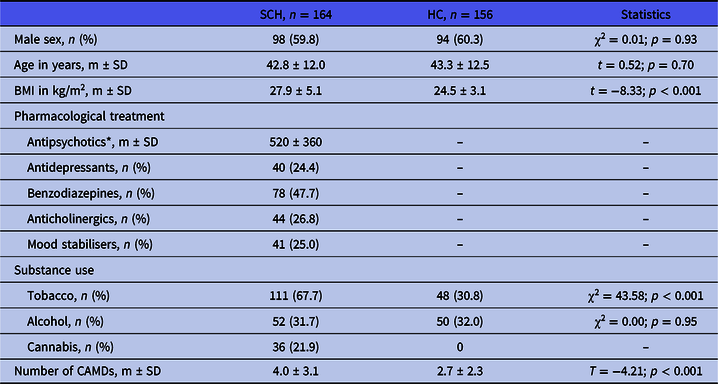
The sample consisted of 164 unrelated patients with schizophrenia (Diagnostic and statistical manual of mental disorders (4th ed., Text Revision) criteria) who visited the Hospital Universitari Institut Pere Mata in Reus, Catalonia, Spain, and 156 control subjects from the same geographical region, all of Caucasian origin. The exclusion criteria were as follows: for patients, drug abuse, and for control subjects, drug abuse and personal or first-degree familial antecedents of affective or psychotic disorders. The characteristics of the study subjects are presented in Table 1.
Characteristics of the participants

SCH, patients with schizophrenia; HC, healthy controls; n, number of cases; m, mean; SD, standard deviation; BMI, body mass index; CAMDs, conditions associated with mitochondrial disorders.
* Antipsychotic drug doses converted into chlorpromazine equivalents in mg/day.
Clinical assessments
Both groups of subjects completed, via a direct interview with a trained psychiatrist, a previously used questionnaire regarding the CAMDs that covers the following categories: headache, bowel function, soft tissues and fatigue, the nervous system, ears and eyes, the endocrine system and the heart and blood vessels (Verge et al., Reference Verge, Alonso, Miralles, Valero, Vilella, Boles and Martorell2012; Valiente-Pallejà et al., Reference Valiente-Pallejà, Torrell, Muntané, Cortés, Martínez-Leal, Abasolo, Alonso, Vilella and Martorell2018).
Data analyses
Chi-square tests were used to compare the presence of CAMDs between patients with schizophrenia and control subjects. Characteristics of participants were compared by chi-square test or t test depending on the nature of the variable. We used the Mann−Whitney U non-parametric test to identify whether the body mass index (BMI) differed between individuals with and without diabetes, as the number of individuals presenting diabetes was ≤12. The significance level was set at p < 0.05. Data were processed using IBM SPSS Statistics for Windows, Version 23.0 (IBM Corp., Armonk, NY).
Results
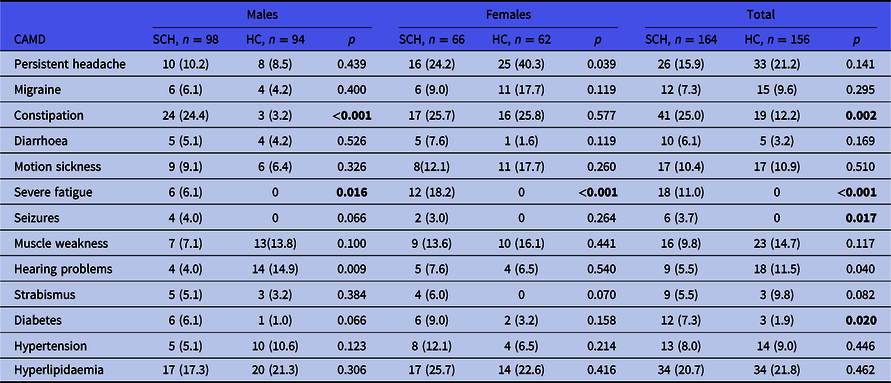
The present study found that severe fatigue, seizures, diabetes and constipation were significantly more frequent in patients with schizophrenia than in control subjects. The frequencies of the CAMDs and comparisons between the two groups are shown in Table 2. When the sample was stratified by gender, severe fatigue and constipation were more frequent among the male patients, but only severe fatigue was more frequent in the female patients compared to the male and female controls, respectively. No control subjects presented severe fatigue; however, it was present in 6% and 18% of the male and female patients, respectively.
Comparison of the CAMDs frequencies between patients with schizophrenia and controls

CAMDs, conditions associated with mitochondrial disorders; SCH, patients with schizophrenia; HC, healthy controls; n, number of cases.
The CAMDs data are shown as the number of subjects, n, and (%). Conditions with a significantly higher frequency in patients with schizophrenia than in control subjects are noted in boldface.
Table 2 shows that seizures were more frequent in patients with schizophrenia, especially in male patients, than in control individuals. Four of the six patients with seizures experienced onset in childhood and the other two in early adulthood. Regarding the patients with seizures in early childhood, two presented absence seizures continuing to this day and the other two had generalised seizures. Regarding these last two patients, one had been treated with antiepileptic drugs until the age of 18, suggesting that this remission in adulthood was compatible with a diagnosis of childhood epilepsy, while the seizures in the other patient continued into adulthood. Regarding the two patients with seizure onset in adulthood, in one of them, the first seizures coincided with a cranioencephalic trauma at the age of 18 and was ongoing. The other patient presented some generalised seizure episodes that coincided with the introduction of clozapine treatment; however, with antiepileptic usage, the seizures stopped. Remarkably, three of these six patients with seizures presented their first psychotic symptoms between the age of 13 and 16 after being diagnosed with generalised seizures, and another patient presented initial psychotic symptoms at the age of 8, while absence seizures first appeared at 9.
Table 2 also shows that diabetes was more frequently present in patients with schizophrenia than in control individuals. The diabetes cases among both patients and controls were all type 2 diabetes. We investigated whether diabetes status was associated with BMI and found that in the patient group, BMI was higher in those who presented with diabetes than in those who did not, with the difference reaching marginal significance (32.5 ± 7.3 and 27.4 ± 5.1, respectively, p = 0.059). This situation was not observed in the control group, where the mean BMI was almost the same in subjects presenting with and without diabetes (24.6 ± 1.2 and 24.5 ± 3.2, respectively, p = 0.821). However, in the combined sample, diabetes status was significantly associated with BMI, with higher mean values in individuals with diabetes (30.4 ± 7.1 and 25.2 ± 4.0, p = 0.026).
It is noteworthy that the total number of CAMDs was higher in patients with schizophrenia than in healthy controls (4.0 ± 3.1 and 2.7 ± 2.3, respectively, p < 0.001). Moreover, no significant differences were observed in the antipsychotic treatment (in equivalent doses of chlorpromazine) between subjects presenting and non-presenting, respectively, the following CAMDs: constipation (574 ± 398 and 486 ± 364, p = 0.22), severe fatigue (523 ± 370 and 520 ± 382, p = 0.99), seizures (630 ± 369 and 515 ± 380, p = 0.31), and diabetes (684 ± 425 and 499 ± 368, p = 0.11). In addition, the number of patients taking antidepressants, benzodiazepines, mood stabilisers or anticholinergics was not different between those presenting and non-presenting these conditions.
Discussion
Schizophrenia is frequently associated with other common medical conditions, including cardiovascular diseases, metabolic disorders, substance use disorders, infectious diseases and neurologic disorders (Nasrallah, Reference Nasrallah2005). These comorbidities may be related to the fact that people with a schizophrenia diagnosis die 15–20 years earlier than individuals from the general population (Crump et al., Reference Crump, Winkleby, Sundquist and Sundquist2013; Laursen et al., Reference Laursen, Nordentoft and Mortensen2014). The present study was focused on the analysis of CAMDs and identified that constipation, severe fatigue, seizures and diabetes were more frequently present in patients with schizophrenia than in healthy controls. Research in these fields is scarce; however, in a recent study, the prevalence of constipation in schizophrenia was reported to be 31%, which is higher than the 25% prevalence reported in our study (Virtanen et al., Reference Virtanen, Eskelinen, Sailas and Suvisaari2017). Constipation is a frequent gastrointestinal manifestation of mitochondrial disorders and has been related to gastrointestinal dysmotility due to respiratory chain defects (Finsterer & Frank, Reference Finsterer and Frank2017). Moreover, antipsychotic-related constipation is a common and serious adverse effect, especially for people receiving clozapine but also for patients receiving other antipsychotic drugs (De Hert et al., Reference De Hert, Hudyana, Dockx, Bernagie, Sweers, Tack, Leucht and Peuskens2011). Constipation was first described with typical antipsychotics mainly in association with the use of anticholinergic agents, and currently, the suggested mechanism whereby it occurs is gastrointestinal hypomotility. Specifically, this has been proposed for clozapine, as it is a multireceptorial atypical antipsychotic that has a high affinity for muscarinic cholinergic receptors, acting as an antagonistic agent (Every-Palmer & Newton-Howes, 2017). Remarkably, in addition to clozapine, most other antipsychotics inhibited muscarinic receptors in a mouse model (Obara et al., Reference Obara, Horiguchi, Shimada, Ikarashi, Yamaki, Matsuo, Yoshio and Tanaka2019). Nevertheless, the specific mechanism and the prevalence of antipsychotic-related constipation are poorly understood (Every-Palmer et al., Reference Every-Palmer, Inns, Grant and Ellis2019).
Regarding severe fatigue, we identified that 6% of the male patients and 18% of the female patients exhibited this condition, while no control subjects reported symptoms related to severe fatigue, which may be in accordance with the clinically significant levels of fatigue previously reported in 60% of patients with schizophrenia (Waters et al., Reference Waters, Naik and Rock2013). We have previously reported the presence of severe fatigue in 7% of the mothers and 1% of the fathers of patients with schizophrenia in a study, suggesting mitochondrial inheritance in schizophrenia (Verge et al., Reference Verge, Alonso, Miralles, Valero, Vilella, Boles and Martorell2012) and, more recently, mtDNA depletion in a three-member family with psychosis and chronic fatigue syndrome (Torrell et al., Reference Torrell, Alonso, Garrabou, Mulet, Catalán, Valiente-Pallejà, Carreño-Gago, García-Arumí, Montaña, Vilella and Martorell2017). Fatigue is a common symptom of many clinical conditions or treatment side effects that range in severity from mild to incapacitating; however, it can also be a natural result of lifestyle factors, such as lack of exercise or poor diet (Rosenthal et al., Reference Rosenthal, Majeroni, Pretorius and Malik2008). There are several metabolic pathways, most of which are located in the mitochondria, that are critical for brain and muscular functions affecting mental functions, such as cognitive and psychological processes, and physical activity. The brain, unlike muscle, is always highly metabolically active, as it consumes approximately 3.5 ml O2 per minute and 100 g of tissue, while resting muscle consumes only 1 ml O2 per minute and 100 g of tissue (Tardy et al., Reference Tardy, Pouteau, Marquez, Yilmaz and Scholey2020). Therefore, the capacity for oxygen consumption of the brain may be a mechanism explaining why we identified that patients with schizophrenia present severe fatigue but not muscle weakness.
As with chronic fatigue, seizures were not present in any control subject but were significantly present in patients. Seizures are the most common central nervous system abnormalities present in mitochondrial disorders, and mitochondrial dysfunction has been proposed as the underlying common mechanism between epilepsy and schizophrenia (Pieczenik & Neustadt, Reference Pieczenik and Neustadt2007). The complex relationship between epilepsy and psychotic disorders has been pointed out. Some studies reported that individuals with schizophrenia have a two- to threefold increased risk of developing epilepsy, with an incidence rate of 7 per 1000 person-years (Agrawal & Mula, Reference Agrawal and Mula2019). Therefore, patients with schizophrenia are more likely than healthy individuals to have epilepsy, and strong evidence of clustering of the association between epilepsy and psychosis within families has been reported. Psychosis is present in 2–7% of people with epilepsy (Maguire et al., Reference Maguire, Singh and Marson2018), and patients with epilepsy have an almost eightfold increased risk of psychosis. The prevalence of psychosis is higher in temporal lobe epilepsy (Hüfner et al., Reference Hüfner, Frajo-Apor and Hofer2015), with a prevalence range between 10% and 15% (Maguire et al., Reference Maguire, Singh and Marson2018). Interestingly, antipsychotics, particularly clozapine, decrease the seizure threshold, and this should be taken into account in medication plans in order to prevent seizures in predisposed patients (Hüfner et al., Reference Hüfner, Frajo-Apor and Hofer2015). However, some antiepileptic medications may worsen psychosis (Maguire et al., Reference Maguire, Singh and Marson2018). The relationship between epilepsy and psychosis is multifaceted and probably related to a wide range of different mechanisms. It can be highlighted, for example, that neuroimaging studies in schizophrenia have shown abnormalities in brain networks overlapping those involved in temporal lobe epilepsy, particularly in the amygdala and the hippocampus (Agrawal & Mula, Reference Agrawal and Mula2019).
Regarding type 2 diabetes, this is known to be two- to threefold more common in individuals with schizophrenia than in the general population, though it is the most common metabolic disease in the world today. Interestingly, it is also the most frequently described endocrine disturbance in mitochondrial diseases (Chow et al., Reference Chow, Rahman, Achermann, Dattani and Rahman2017); and because of the central role mitochondria play in β cells by sensing glucose and mediating the suppression of insulin secretion, it has been recently proposed that both mitochondrial structure and dysfunction are directly involved in the pathogenesis of type 2 diabetes by contributing to β-cell functioning (Las et al., Reference Las, Oliveira and Shirihai2020). Mitochondrial dysfunction has also been noted in diabetic cardiomyopathy as a result of obesity-induced insulin resistance and type 2 diabetes (Makrecka-Kuka et al., Reference Makrecka-Kuka, Liepinsh, Murray, Lemieux, Dambrova, Tepp, Puurand, Käämbre, Han, de Goede, O’Brien, Turan, Tuncay, Olgar, Rolo, Palmeira, Boardman, Wüst and Larsen2019). High BMI scores were observed in the patients with schizophrenia who participated in the present study, which may be related to poor diet, sedentary lifestyle, low socioeconomic status and antipsychotic medication. Antipsychotic medication directly affects insulin sensitivity and indirectly causes weight gain (Suvisaari et al., Reference Suvisaari, Keinänen, Eskelinen and Mantere2016). However, it is important to highlight that the underlying characteristics of the disease, particularly the negative symptoms, may also contribute to metabolic alterations. In fact, an increased prevalence of metabolic syndrome has been observed in first episode and drug-naive psychosis, suggesting that pleiotropic factors contributing to both schizophrenia and metabolic alterations may be involved (Castillo et al., Reference Castillo, Rojo, Henriquez-Henriquez, Silva, Maturana, Villar, Fuentes and Gaspar2016).
Some of the conditions investigated are well known to present gender differences in prevalence in the general population, that is, headache, migraine and constipation are more frequent in females, and hypertension is more frequent in males, similar to the gender differences observed in the present study. It is also worth mentioning that the higher presence of constipation, severe fatigue, diabetes and seizures in patients with schizophrenia may be related to antipsychotic treatment. Therefore, we evaluated whether psychopharmacological treatment had an association with the presence of the CAMDs that we identified more frequently in patients than in healthy controls. No significant differences were observed in the antipsychotic doses between subjects presenting and non-presenting the conditions. Similarly, we did not observe that patients taking antidepressants, benzodiazepines, mood stabilisers or anticholinergics exhibited more CAMDs than patients not taking each of these pharmacological treatments. Finally, other conditions, such as hypertension and hypercholesterolaemia, that may be related to antipsychotic treatment were not more frequent in patients with schizophrenia than in the control subjects in the present study. Therefore, even though we cannot rule out that pharmacological treatment is involved in the development of medical comorbidities in schizophrenia, our results suggest that the high presence of severe fatigue, seizures, constipation and diabetes in patients with schizophrenia is not associated with pharmacological treatment.
Several factors may contribute to the high comorbidity of many physical and mental conditions in schizophrenia, including the severity of schizophrenia itself, lack of physical activity, diet, substance use and antipsychotic treatment. On the other hand, several molecular mechanisms other than mitochondrial dysfunction may be responsible for the comorbidities observed in schizophrenia, including gut microbiota, disturbed prenatal renin–angiotensin system function, abnormalities in maternofoetal endocrine exchange or prenatal undernutrition-related epigenetic regulation of gene expression (Dieset et al., Reference Dieset, Andreassen and Haukvik2016; Nguyen et al., Reference Nguyen, Kosciolek, Eyler, Knight and Jeste2018). These biological pathways interact with each other and with a variety of environmental risk factors and may be involved in neurotransmitter, inflammatory, endothelial and hormonal abnormalities that are present in schizophrenia. All these disease mechanisms may also converge in mitochondria and are consistent with the increasingly prevalent view that schizophrenia is a systemic disorder (Dieset et al., Reference Dieset, Andreassen and Haukvik2016; Nguyen et al., Reference Nguyen, Kosciolek, Eyler, Knight and Jeste2018).
In summary, we identified specific CAMDs with a high frequency in patients with schizophrenia, supporting the hypothesis that multi-systemic mitochondrial dysfunction may be an underlying mechanism involved in schizophrenia and CAMDs. This should be investigated in future studies, in addition to whether mitochondrial disorders are underdiagnosed in patients with schizophrenia, as has been suggested.
Acknowledgements
We express gratitude to the individuals who dedicated their time to participate in the study.
Author contributions
LM designed, planned and supervised the study. YA and EV were responsible for collecting data from patients and controls, respectively. YA, AV-P and BV directly interviewed the participants. YA and AV-P performed the statistical analyses and wrote the first draft. All authors revised the final version and approved it for submission.
Financial support
This work was supported by the Spanish Ministry of Science and Innovation, Instituto de Salud Carlos III, Madrid, Spain (grants PI12/01885 and PI18/00514) and co-financed by European Regional Development Funds from the European Commission.
Conflict of interest
None.
Ethical standards
The authors assert that all procedures contributing to this work comply with the ethical standards of the relevant national and institutional committees on human experimentation and with the Helsinki declaration of 1975, as revised in 2008.