

Introduction
In the last two decades, an increasing stream of studies has analyzed interpreter-mediated communication from an interactionist and dialogue-based perspective (see, among many others, Knapp-Potthoff & Knapp Reference Knapp-Potthoff, Karlfried, Knapp-Potthoff and Potthoff1987; Carr, Roberts, Doufour, & Steyn Reference Carr, Roberts, Doufour and Steyn1997; Wadensjö Reference Wadensjö1998; Metzger Reference Metzger1999; Bolden Reference Bolden2000; Davidson Reference Davidson2000, Reference Davidson2001, Reference Davidson2002; Roy Reference Roy2000; Mason Reference Mason2001; Traverso Reference Traverso2003; Angelelli Reference Angelelli2004a, Reference Angelelli2004b; Banfi, Gavioli, Guardiano & Vedovelli Reference Banfi, Gavioli, Guardiano and Vedovelli2006; Pöchhacker & Schlesinger Reference Pöchhacker and Schlesinger2007; Gavioli Reference Gavioli2009). Research has demonstrated that interpreter-mediated interaction is influenced by a complex interplay of social, cultural, and interactional factors, shaping and constraining the communicative actions of the participants.
Few of these contributions, however, have devoted attention to the bodily resources used in managing and coordinating interaction, such as gaze, gesture, posture, body movement, object manipulation, proxemics, and spatial arrangement. Notable exceptions include works by: Apfelbaum (Reference Apfelbaum, Brock and Hartung1998) on the rhythmic synchronization of interpreter-mediated interaction, on the basis of the interpreter's projection of next turns; Roy (Reference Roy2000) on sign language interpreting; Ticca (Reference Ticca2008, Reference Ticca, Goicoechea and Vázquez2010) on the influence of nonverbal signals on the behavior of ad-hoc interpreters; and Wadensjö (Reference Wadensjö and Mason2001) on interpreters' proxemics during joint narratives in psycotherapeutic sessions.
Such a scarcity of research may be partly due to the delicacy of the interactional settings being studied—for example, healthcare, courtrooms, pedagogy, police stations, and immigration offices—all of which pose serious problems in obtaining permission to videotape and study such data. Still, the contrast with the amount of research on multimodal interaction, both in everyday and in institutional settings, remains striking.Footnote 1
Nevertheless, interpreter-mediated communication can benefit from multimodal analysis inasmuch as, by its own nature, it is a multiparty interaction, involving a complex participation format that is likely to be managed multimodally, rather than merely verbally. In addition, it takes place in a multilingual environment, in which the asymmetrical access of the participants to each other's language limits the amount of verbal communication they are able to employ.
Healthcare interaction, which constitutes the subject of this contribution, has been studied extensively in its multimodal dimension, dating back to Christian Heath's pioneering achievements in the early ‘80s, and is now a firmly established field for research (see, among many others, Heath Reference Heath, Atkinson and Heritage1984a, Reference Heath1984b, Reference Heath, Heritage and Maynard2006; Psathas Reference Psathas and Psathas1990; Frankel Reference Frankel, Fisher and Todd1993; Modaff Reference Modaff, Glenn, LeBaron and Mandelbaum2003). Moreover, many studies (Heath Reference Heath1986; Robinson Reference Robinson1998; Robinson & Stivers Reference Robinson and Stivers2001; Greatbach Reference Greatbach, Heritage and Maynard2006; Frers Reference Frers2009) show that, while interacting with the patients, doctors fulfill several tasks (speaking, reading, writing prescriptions, reporting data on the computer, etc.) through an interplay of verbal and nonverbal resources (gesture, body posture, gaze, and object manipulation).
The presence of an interpreter adds some interesting variables, since, in such a situation, doctors are faced with additional tasks: they are obliged to rely on the interpreter and, consequently, must yield part of their interactional power and share responsibilities for the management of the interaction; they may not retain control on extended parts of the conversation with the patient; and they need to manage a complex interactional space, which involves different languages being spoken, constantly changing participation formats being negotiated, and several actions being performed simultaneously.
This study analyzes a corpus of doctor-patient interactions, video-recorded in an Italian primary care center and involving a professional interpreter. It focuses specifically on doctors’ behavior during episodes in which the patient and the interpreter engage in dyadic conversations in a foreign language, namely Chinese, and consequently open a new line of action, cutting the doctor off from active participation in the interaction. The aim of this contribution is to examine the strategies used by the doctors in managing the interaction, and to show that, in order to achieve a thorough understanding of the dynamics involved in interpreter-mediated communication, the analysis needs to include not only its verbal level, but also its numerous and intertwined layers of multimodal communicative resources.
Data
Data were collected in 2006–2007 in a primary care center in Forlì, Italy.Footnote 2 The corpus consists of nineteen visits involving Italian doctors and foreign patients of different nationalities, ethnicities, and native languages (Chinese, Eastern European, Romani, and African); in nine of the visits, the patients are not able to speak Italian, and thus the presence of an interpreter is required. For this contribution, six visits, lasting a total of ca. 1 hour 46 minutes, were chosen, mainly on the basis of their uniformity in regard to the participants' number, roles, and native language. Three are obstetric or gynecological consultations involving three different doctors, and three are pediatric consultations, each with the same doctor, together with a nurse.Footnote 3 Each consultation involves a different patient, but all of them are Chinese and have very limited or no competence in Italian. None of the doctors has any command of Chinese.
The interpreter is the same in all visits: an Italian woman, about thirty-years-old, with formal training in Chinese; she works in the primary care center on a regular basis, acting not only as a translator, but also as an intercultural mediator, for example, facilitating access to the Italian medical service, helping with the administrative practices, and providing explanations about cultural differences that may hinder communication with foreign patients.
The interactions were recorded using two video cameras (one for the doctor, one for the interpreter and the patient) and, on some occasions, an audio recorder placed on the doctor's desk. The researchers were not present in the room during the visits.Footnote 4
Data analysis: Dyadic interactions
Opening a dyadic interaction
Works by Wadensjö (Reference Wadensjö1998), Mason (Reference Mason1999), Meyer (Reference Meyer and Mason2001), Davidson (Reference Davidson2002), Amato (Reference Amato, Banfi, Gavioli, Guardiano and Vedovelli2006), Amato & Gavioli (Reference Amato, Gavioli, Bosisio, Cambiaghi, Piemontese and Santulli2008), and Ticca (Reference Ticca, Goicoechea and Vázquez2010) have amply demonstrated that interpreter-mediated interaction does not always follow a triadic pattern (i.e. with the interpreters regularly and methodically translating each of the doctors' and the patients' turns immediately after they have been uttered), but often assumes dyadic configurations, where the interaction involves just two of the three participants.
Our data, too, show a frequent alternation of the two kinds: segments of fluent triadic interaction alternate with dyadic conversations between the interpreter and the patient, or between the interpreter and the doctor.
Excerpt (1), which takes place during the initial phase (anamnesis) of an obstetric visit with a new mother, shows a case of smooth triadic interaction, with the interpreter giving a literal and systematic rendition of each turn from Italian to Chinese or vice versa.Footnote 5
(1) Obstetric visit 1: Triadic interaction

Turn allocation is unproblematic: each turn uttered by the doctor and by the patient is immediately translated by the interpreter, who operates as the hinge of the whole communicative process (see, in line 11, the doctor's reference to the patient using the third person,Footnote 6 which shows that her communicative axis is entirely oriented towards the interpreter). This regular configuration is often broken up. Dyadic interactions between interpreters and patients, our focus in this study, can be opened for several reasons: for example, solving practical problems (e.g. fixing the next appointment, giving the patient explanations about the Italian healthcare system); asking for additional information; giving or asking advice about the treatment recommended by the doctor; expanding a turn in order to clarify what the doctor said; or starting “small talk” about mundane and private topics.
The common trait in all of these situations is that the interpreter breaks the triadic participation frame and increases the scope of her contributions beyond the mere and literal translation of the doctor's words, acting on her own initiatives, that is, not by following doctor's requests or instructions.
Excerpt (2) shows how, immediately after excerpt (1), the interpreter exploits a pause in the conversation (line 15) to start a brief side-sequence, in which she interacts dyadically with the patient: in lines 16–19, she asks questions to confirm what the patient had previously said, and then (line 20) reports to the doctor the patient's answer.
(2) Obstetric visit 1: Dyadic interaction
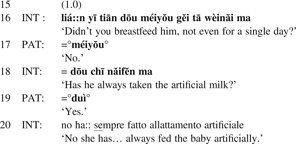
The duration of the dyadic interactions may vary considerably, ranging from a few seconds, as in excerpt (2), to several minutes.
Excerpt (3) takes place during a post-birth control visit. In the previous turns, the doctor asked whether the patient uses, or plans to use, any kind of contraceptive. In line 1, the interpreter is reporting the patient's answer.
(3) Obstetric visit 2: Dyadic interaction

The dyadic sequence starts in line 13; the interpreter intervenes before the turn uttered by the doctor in line 12 has come to its full completion, as shown by the suspended intonation and by the in-breath that announces a continuation (line 12).
In lines 13–39, the interpreter interacts in Chinese with the patient for approximately 40 seconds, during which she gives explanations and advice about the various contraceptive methodologies, far beyond what the doctor has actually said. Apparently, the doctor authorizes this long interaction, without trying to interfere; during the whole conversation, she works with the desktop computer, looking at the screen or at some papers on the desk. At the end of the interaction (line 40), the interpreter does not translate immediately, but waits for an explicit request by the doctor, which comes after a long pause (lines 40–41).
Such sequences are commonly found in the corpus; the doctors' verbal and nonverbal behavior during interactions of this kind is analyzed in the next section.
Sustaining a dyadic interaction
Excerpts (4), (5), and (6) show fragments from one of the longest dyadic interactions in the corpus. The interaction takes place during a routine visit with a Chinese woman in her sixth month of pregnancy. In the first lines of excerpt (4), the gynecologist is giving some recommendations about weight and food.
(4) Obstetric visit 3: Opening a dyadic interaction

Lines 8–16 mark the beginning of an unusually lengthy dyadic interaction, lasting continuously for almost four minutes (from 8:13.00 to 12:09.00 on the camera counter), during which the doctor seems to make no attempt to intervene, at least verbally, nor to elicit a translation of what is going on. Moreover, in lines 14–16, the interpreter seems to assume the role of a doctor, censoring the patient's answer and giving her dietary advice. In the subsequent conversation, these features are consistently maintained: the interpreter talks about medical subjects in a competent and professional fashion, and the doctor does not seem intentioned to interrupt the ongoing interaction and to retrieve her role.
The turns that followed (not transcribed) go through different topics: after a discussion about diet, the patient asks a question about her own weight, to which the interpreter answers without consulting the doctor; then, the patient expresses some concerns about the date of her birth, and the interpreter reassures her; finally, the patient asks advice about a medical problem (uterus fibroma), and again the interpreter answers on her own initiative. From this entire conversation, only the last section, regarding the fibroma, is thoroughly reported and discussed with the doctor, whereas the other sections are not reported, or reported summarily.
It is also significant that the doctor does not take a turn during the whole dyadic interaction, even when a transition relevance point (TRP) is available. Excerpt (5) shows how a long pause in the conversation apparently goes unnoticed, providing the occasion for a reprise of the dyadic interaction. The conversation between the interpreter and the patient has already been going on for almost one minute. In the previous turns, the patient has expressed concern about her weight.
(5) Obstetric visit 3: Missed TRP

At line 62, a TRP occurs: the interpreter and the patient stop talking for two seconds, providing an occasion for the doctor to request translation; instead, she starts typing on the keyboard, just uttering a filler, at very low volume (line 63). This situation offers an opportunity for the patient to open a new topic and continue the dyadic interaction with the interpreter (line 64).
Excerpt (6) shows how, after almost four minutes, the doctor finally asks for a translation (line 167).
(6) Obstetric visit 3: Closing a dyadic interaction

What is remarkable is that, both in excerpt (3) and in excerpts (4), (5), and (6), the doctors allow long interactions between the interpreter and the patient to take place without interrupting them, engaging instead in other parallel activities, and do not even seem particularly keen on being informed about their content when the interactions come to an end.
In other words, two independent lines of action take place simultaneously: that of the doctor and that of the interpreter and the patient. The analysis of the verbal dimension does not show any sign of contact between them.
Retrieving information: Spontaneous translation vs. doctor's requests
When a dyadic sequence comes to an end, the doctor has to face two issues: to recognize its completion and restore contact with the interpreter in order to obtain a translation. This section explores how the doctor achieves both tasks.
The retrieval of information after a dyadic sequence can follow two basic modalities: a self-initiated translation by the interpreter, or a request by the doctor. Self-initiated translation seems to be the default way for managing the closure of the sequence, since, in the great majority of cases, the interpreter starts the translation without being requested and without showing any hesitation or sign of interactional trouble.Footnote 7
Excerpt (7) shows an example of self-initiated translation, which immediately precedes the interaction in excerpt (3). In lines 1–6, the patient and the interpreter are discussing pros and cons of different contraceptive methods. In line 6, the interpreter interrupts her own turn in Chinese and switches to Italian in order to report the content of the conversation (lines 7–9).
(7) Obstetric visit 2: Self-initiated translation

These instances contrast with the ones observed in excerpt (3) (line 37) and excerpt (6) (line 167), where the interpreter does not translate immediately after the end of the dyadic interaction, and the doctor needs to formulate an explicit request in order to obtain a translation.
The next section outlines some factors that may account for these differences in the interpreter's behavior.
Negotiating transition relevance points through multimodal resources
A common feature among the episodes where the interpreter does not translate spontaneously is the lack of mutual bodily orientation, and particularly of mutual gaze, between the doctor and the interpreter in potential TRPs.
Several contributions (from Kendon's (1967) groundbreaking studies on gaze to more recent research, such as Goodwin Reference Goodwin1980, Reference Goodwin1981; Heath Reference Heath1986; Robinson Reference Robinson1998; Lerner Reference Lerner2003; Rossano Reference Rossano2005, Reference Rossano2006; Rossano, Brown, & Levinson Reference Rossano, Brown, Stephen and Sidnell2009) show that mutual gaze plays a central role in establishing involvement and in coordinating the joint actions of the interactants. In particular, focusing one's gaze directly on another participant's face is usually interpreted as a display of availability, a pre-initial display of the participant's readiness to interact, or as a display of recipiency, a communicative action intended to elicit a response by the recipient (Heath Reference Heath1986:33).
Excerpt (8) shows the final section of a dyadic interaction, taken from the same obstetric visit examined in excerpt (3). In the previous turns, the patient has expressed some concerns about breastfeeding, and the interpreter has reminded her about her next appointment with the pediatrician.Footnote 8
(8) Obstetric visit 2: Request for translation

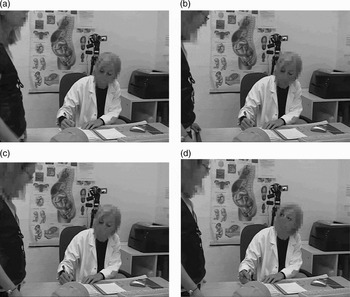
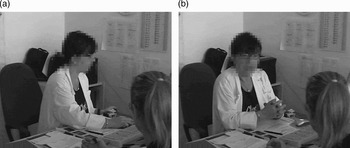
In lines 3–6 (from 8:53.42 to 8:54.70), the interpreter is gazing at the patient, while the doctor is gazing at the desk, writing in the patient's file (Figure 1a). Immediately after her own last turn in Chinese (line 5) and during the patient's turn in line 6, the interpreter turns her gaze towards the doctor, who instead keeps on writing in a file on the desk. The interpreter's gaze reaches the doctor at 8:55.09 (line 6) and rests on her for more than one second. It is a likely TRP for the beginning of the translation, but at this point the doctor keeps gazing at the desk, establishing no gaze contact (Figure 1b). In addition, the doctor's bodily orientation is entirely directed towards the activity of writing, showing no physical alignment with the interpreter.
Achieving mutual alignment in a TRP.

The interpreter does not start to translate because the doctor shows no sign of recipiency or alignment, and instead displays engagement in another parallel action, namely writing. The doctor's request for translation starts immediately after the closure of the dyadic interaction, which the doctor is probably able to recognize due to the pause between lines 6 and 7 (from 8:55.09 to 8:56.30), only filled by the patient's inhaling.
When the doctor starts asking che ha detto ‘what did she say’ (line 7), her own gaze is still on the desk (Figure 1c) and reaches the interpreter only at the end of the turn; at the same time, she detaches the pen from the sheet of paper, signaling a pause in the action of writing. Immediately after the mutual gaze has been achieved and the writing has been interrupted, the interpreter starts inhaling to take her turn (line 8; Figure 1d).
The doctor's gaze shift can be seen as an embodiment of her shifting from an activity (writing) to another (aligning with the interpreter in order to obtain translation). Actually, the activity of writing is not completely interrupted, but rather temporarily suspended, as the doctor's body position in Fig. 1d shows. Her head is turned towards the interpreter, while her torso is still oriented towards the desk; in addition, her right hand is detached from the table, while her left hand still holds the sheet of paper she was writing on. The position can be defined a “body torque” (Schegloff Reference Schegloff1998), signaling that the doctor is still contemporarily engaged in two parallel activities, but one of them (writing) has been put on standby.
In other words, the lack of immediate translation in a TRP is due to the lack of mutual bodily alignment between the interpreter and the doctor, which in turn is due to the doctor's displayed involvement in a parallel activity. The translation starts only after the doctor has made a request and signaled, by her physical orientation, that the activity of writing is now put in a temporary standby.
The analysis of participants' embodied behavior adds to our understanding of the mechanism through which the closure of the dyadic sequence and the transition from one activity to another is cooperatively managed and negotiated by the doctor and interpreter.
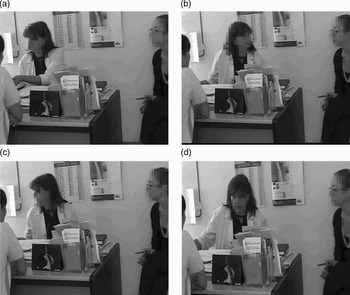
This kind of interactional multimodal dynamics also explains what actually happens in excerpt (5), line 61, where the doctor leaves a TRP empty, and is apparently not interested in requesting a translation. Observing the multimodal behavior of the interactants, a different explanation of the doctor's behavior can be suggested. Excerpt (9) shows a fragment of excerpt (5), with multimodal annotations added.
(9) Obstetric visit 3: Missed TRP, with multimodal annotations
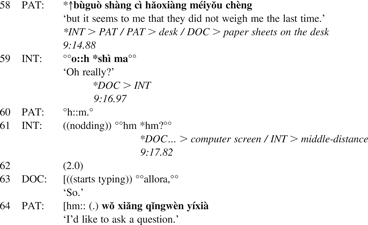
Here, too, the doctor is engaged in another activity (tidying the desk) during the dyadic interaction between the interpreter and the patient. In line 58, the interpreter is gazing at the patient, while the patient looks at the file on the desk; meanwhile, the doctor is gazing at the papers she is tidying up (Figure 2a). During the interpreter's turn in line 59, the doctor shifts her gaze toward the interpreter, and keeps it on the interpreter's face for almost one second (lines 60–61; Figure 2b). The interpreter does not show any sign of recipiency, and shifts her gaze to a “middle-distance” position (Heath Reference Heath1986:108).Footnote 9 Eventually, the doctor looks back at the computer (Figure 2c), and then engages in another activity, typing on the keyboard (Figure 2d). This situation leaves a free slot for the patient to initiate her turn in line 64, which opens a new dyadic interaction.
Missed TRP.

The TRP in line 62 does not go unnoticed because of a lack of interest or attention by the doctor, but rather is missed due to the lack of mutual gaze with the interpreter. It is only after having tried to achieve mutual gaze, and failed, that the doctor engages in a new activity (typing on the keyboard).
Multimodal analysis also provides new insight into instances of apparently “spontaneous” translation by the interpreter, as excerpt (10) shows. At the beginning of the interaction, the interpreter is trying to find out the name of the pediatrician chosen by the patient; meanwhile, the doctor is printing some documents.
(10) Obstetric visit 2: Eliciting translation through gaze
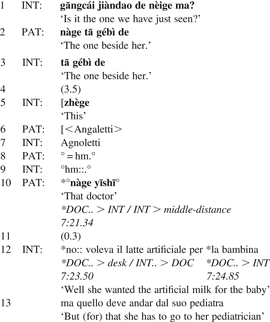
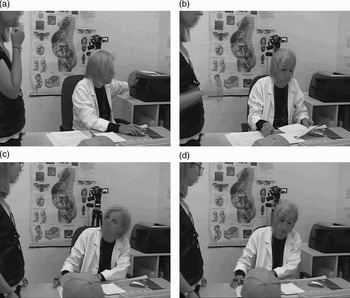
During the 3.5 second pause in line 4, the doctor takes a sheet of paper out of the printer and puts it on the desk (Figures 3a,b), then (line 10) turns her gaze towards the interpreter (Figure 3c). The doctor probably perceived the conclusive intonation in the “hm” uttered in line 9 and correctly interpreted it as the end of the sequence. The doctor keeps her own gaze oriented towards the interpreter for 2.2 seconds, while the interpreter utters the turn in line 10, and then turns it back to the desk (Figure 3d). The interpreter notices the gaze shift and treats it as a request, since she immediately provides a translation (line 12); as soon as the interpreter starts to talk, the doctor shifts her gaze back to the interpreter's face.
Eliciting translation through gaze.

In other words, what may appear as an interpreter-initiated translation is, actually, elicited by doctor's gaze.
This section has shown that gaze contact and bodily alignment are important means to signal availability to interact, and are used to display participants' interpretations of the ongoing activity. Such alignment is achieved through a delicate timing of mutual actions at sequence boundaries, often occurring within tenths of a second spans.Footnote 10 The lack of mutual gaze and/or bodily coordination between the interpreter and the doctor (e.g. due to a mistiming in gaze alignment or to the doctor's involvement in another parallel activity) may explain why, in certain cases, the interpreter does not start a translation, or the doctor does not ask for it.
Applying such an analysis to mediated interaction can shed some light on interactive phenomena, such as doctors' and interpreters' co-construction of the mediated healthcare encounter, that may be misinterpreted if analyzed only in their verbal dimension.
Doctors' interventions in dyadic interactions
In all of the examples examined until now, the doctors never intrude in the dyadic interactions, preferring instead to wait for the conversation to come spontaneously to an end, before taking the turn again. Yet, there are cases in which the doctor interrupts, temporarily or permanently, a sequence of dyadic conversation between the interpreter and the patient.
An example is shown in excerpt (11), taken from the initial phase of an obstetric visit. In the first lines of the excerpt, the patient is signing the form of informed consent, while the doctor is gazing at the computer and using the mouse.
(11) Obstetric visit 3: Detecting and fixing a problem during a dyadic sequence

In line 4, a problem occurs: the patient is not able to write her own name in Latin characters. In lines 6–10, the patient and the interpreter search for the patient's medical card in order to check the correct spelling of the patient's name. This implies a series of body and gaze movement, including opening a folded sheet (line 6), looking on the desk (line 7), and putting the interpreter's hand directly in front of the doctor (lines 9–11). In lines 11–15, the doctor asks for an account of the problem and hands the medical card to the interpreter.
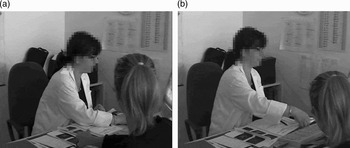
The doctor is not gazing at the other two participants, yet she notices the movements. Interestingly, she reacts as soon as the interpreter positions her hand on the desk (line 12; Figure 4a). This action can be interpreted as a trespassing of the imaginary line that separates her own space from the doctor's space. In this sense, the interpreter's action and the doctor's reaction co-construct the relevance of the space for the ongoing interaction, and allow the doctor to detect such a behavior as a clue to a problem of some kind. This co-construction is preliminary to the request for information in line 12.
Action shift without posture shift.

Line 12 is interesting in that the doctor introduces her turn with sì? ‘yes?,’ as if it were an answer to a request, although no explicit request has been formulated: the doctor treats the interpreter's activity (searching on the desk) as a request for help, or at least as a problem the doctor is in charge of solving. Such behavior demonstrates that, even during dyadic interactions, the doctor is always responsible for the resolution of interactional or practical problems.
Another interesting feature is that, during the whole episode, the doctor does not gaze directly at the interpreter or at the patient; her body is oriented towards the computer (Figure 4a). Even when, after line 14, she rapidly stretches out her right arm to give the medical card to the interpreter, she does not look at her face (Figure 4b). Nonetheless, she is able to detect a problem and offer help, showing that her attention is not entirely focused on the computer.
The shift of doctor's attention from the computer to the interpreter, as well as the concurrent shift from writing to handing the medical card, happens with little or no bodily reorientation: the doctor's gaze remains on the computer (Figure 4a), or moves slightly towards the desk (Figure 4b), while her torso remains oriented toward the computer, signaling that the primary focus of her attention is still the computer. Nevertheless, she is able to follow the ongoing interaction, to detect a problem, and to fix it, mobilizing several multimodal resources, including gaze, posture, space, object manipulation, and talk.
Excerpt (12) shows an instance of the doctor interrupting a dyadic interaction in order to start a new activity. The episode occurs a few minutes after the interaction in excerpt (11). Just before the first turns, the doctor opens an envelope containing the patient's results of a pap smear. In line 1, the doctor opens the patient's file on the computer.
(12) Obstetric visit 3: Interrupting a dyadic sequence and starting a new activity

The activity of working on the computer, initiated and announced by the doctor in lines 1–4, creates an interactional gap, which the patient employs to ask the interpreter some information about the pap smear. For more than half a minute (lines 6–41), two parallel actions take place: while the doctor is on the computer, the patient informs the interpreter about a previous gynecological problem (vaginal discharge).
Eventually, the doctor produces some tokens announcing the end of her current activity (lines 37 and 40), and then (line 42) initiates a thoroughly new activity (questioning and history-taking). The dyadic interaction between the interpreter and the patient comes to an abrupt stop, and the doctor does not show any interest in asking for a translation (actually, the information provided by the patient will be translated later on the interpreter's initiative). Figures 5a and 5b show that, in line 42, the doctor also dramatically changes her own body orientation, shifting from a computer-oriented (Fig. 5a) to an interpreter-oriented position (Fig. 5b).
Complete shift in action and in posture.

In this case, instead of waiting for the closure of the interaction, or simply providing help in fixing a problem, the doctor imposes her agenda and changes the course of the interaction, interrupting the ongoing interaction between the interpreter and the patient. This change of orientation is embodied through the change in body position and gaze direction.
This episode is interesting because it is the only instance of interruption of a dyadic sequence found in the corpus. This behavior is due to the fact that, here, the actual visit has not begun yet; thus, the doctor probably interprets the conversation as not related to any previous recognizable activity. In other words, the interruption is also an assessment of the ongoing action as “nonrelevant” for the purposes of the visit. It shows how the simultaneous use of verbal and nonverbal resources allows the doctor to manipulate the course of the interaction and to signal her own orientation towards it.
Conclusions
Although the existence of extended dyadic sequences is a well-established notion in the literature about interpreter-mediated interaction, such sequences have never been examined in their multimodal dimension. Our analysis shows that talk is only one layer within a complex, integrated, and coordinated system of linguistic, material, and bodily resources, meant to fulfill several functions: for example, signaling involvement in a course of actions, negotiating and regaining the floor, preparing and announcing subsequent actions, indexing participants' roles and responsibilities, and displaying participants' interpretation of the ongoing interaction.
Moreover, this study complements existing contributions (Apfelbaum Reference Apfelbaum, Brock and Hartung1998; Wadensjö Reference Wadensjö and Mason2001; Ticca Reference Ticca2008, Reference Ticca, Goicoechea and Vázquez2010), focused primarily on interpreters' multimodal behavior and their role in the the management of participation, in the delivery of information, in the co-construction of understanding and misunderstanding, and so on. In our data, doctors' ability in mobilizing and coordinating multimodal communication proves very effective in making the interactional space more permeable, even in a situation where no direct participation would be expected.
Data analysis has demonstrated that doctors are often able to monitor interpreters' and patients' interaction and to retain a certain degree of control over it, even when the analysis of their merely verbal behavior would not show any sign of direct participation. The amount of interactional work that the doctors actually “delegate” to the interpreter is often more limited than what may appear, and their apparent lack of participation is, in many cases, more a byproduct of the interactional machinery than the result of actual disengagement. What may look like disengagement, if analyzed by a merely verbal perspective, reveals a richness of nonverbal practices, employed in order to remain in touch with conversations happening in a completely unknown language. Multimodal analysis also provides some insight into the actual development of certain courses of action, showing that verbal initiation is often times preceded and prepared by nonverbal signals.
Multimodal resources, such as gaze, gesture, body posture, object manipulation, and spatial arrangement, allow the doctors to modulate their participation, achieve mutual alignment with the interpreter, display constant attention to the multiple lines of actions taking place simultaneously, and show their orientation towards their interactional value.
It is also worth noticing that, in our data, doctors interact with a professional interpreter with whom they have both a long-term acquaintance and, probably, an established set of working practices. This situation is likely to enhance doctors' trust and make them more inclined to take over control of the interaction and to treat the interpreter as an empowered, fully-fledged participant. Interestingly, Ticca's (2008, 2010) analysis of nonprofessional interpreting in rural Mayan-speaking communities in Yucatan reveals a very different interactional role of the interpreters, who need to gain floor by competing with the doctor in order to provide translation, thus mobilizing a different set of multimodal practices, including gaze and body orientation. To have more similar fieldwork at our disposal would allow us to shed some light on the role played by multimodality in shaping the inner dynamics of interpreter-mediated interaction.
Another comparison can be drawn with research on non-interpreter-mediated doctor-patient interaction. Many studies (Heath Reference Heath, Atkinson and Heritage1984a,Reference Heathb; Robinson Reference Robinson1998; Robinson & Stivers Reference Robinson and Stivers2001; Modaff Reference Modaff, Glenn, LeBaron and Mandelbaum2003; Frers Reference Frers2009) have explored the role of gaze, body movement, spatial arrangement, and object manipulation, in order to display recipiency, coordinate verbal and nonverbal activities, collaboratively achieve activity transitions, and produce locally situated meaning.
Interpreter-mediated interaction has doctors facing similar tasks, in addition to regaining the floor after a dyadic interaction, retrieving information, coordinating competing lines of action, negotiating the initiation and closure of sequences, and managing a more complex participation format, with different roles and responsibilities potentially assigned to each of the participants. To do that, a whole set of more sophisticated strategies is required, many of which entail the careful and coordinated manipulation of several semiotic resources, such as those outlined in this study.
Appendix: Transcription conventions
Data are transcribed according to the conventions developed by Gail Jefferson (Reference Jefferson and Lerner2004) and commonly used in Conversation Analysis. Turns in Chinese are in bold; turns in Italians are not. Chinese is transcribed in Latin characters, according to the conventions of the Pinyin system. Participants are identified as DOC (doctor), PAT (patient), and INT (interpreter).
- (1.5)
pause (in seconds and tenths of seconds)
- (.)
micro-pause (shorter than 0.2 seconds)
- ↑
sudden rise in pitch
- ↓
sudden drop in pitch
- .
descending intonation
- ?
ascending intonation (not necessarily interrogative)
- ,
suspended intonation
- -
abrupt interruption of talk
- =
latching with previous utterance
- °text°
quiet volume
- °°text°°
very quiet volume
- text
emphasis
- >text<
faster pace of speech
- <text>
slower pace of speech
- [
start of overlapping talk
- ((text))
description of nonverbal activity
- (text)
unclear or dubious words
- ( )
unintelligible
- (2-3 syll)
unintelligible (with approximate number of syllables pronounced)
- :::
elongation of a sound
- h
out-breath
- .h
in-breath
- hmh
laughter
- tsk
tongue click
Multimodal annotations:
- DOC > INT
participant gazing/being gazed at (e.g. DOC gazes at INT)
- DOC…….. > INT
gaze movement (e.g. DOC moves gaze towards INT)
- 
body movement
- * 
synchronization of the multimodal annotations with the corresponding stretch of talk
- 3:27.54
time on the camera counter (set below the corresponding stretch of talk or multimodal annotation)