1. Introduction
There have been several hypotheses proposed for the analysis of development of tense-aspectual meanings in L2 (second language) acquisition spanning a range of explanatory phenomena covering semantic, discursive, cognitive and syntactic factors. The most researched hypothesis so far has been the Lexical Aspect Hypothesis (LAH). The main claim advanced by the LAH is that “first and second language learners will initially be influenced by the inherent semantic aspect of verbs or predicates in the acquisition of tense and aspect markers associated with or affixed to these verbs” (Andersen & Shirai, Reference Andersen and Shirai1994, p. 133; see also Andersen, Reference Andersen and Meisel1986, Reference Andersen, Huebner and Ferguson1991; Robison, Reference Robison1990). That is, the use of past tense inflectional markers reaffirms primarily the lexical aspectual value of the verb phrase, and secondarily conveys information about tense or grammatical aspect. A second hypothesis, the Discourse Hypothesis (DH), predicts that “learners use emerging verbal morphology to distinguish foreground from background in narratives” (Bardovi-Harlig, Reference Bardovi-Harlig, Tarone, Gass and Cohen1994, p. 43). Thus, both the LAH and the DH claim that learners start out marking past tense with the inflectional endings that are semantically associated with lexical aspect or grounding (i.e., prototypical choices), and that they gradually incorporate non-prototypical choices as their experience with the L2 increases (e.g., Andersen, Reference Andersen, Giacalone-Ramat and Vedovelli1994; Tracy, Reference Tracy2007).Footnote 1 Several L2 empirical studies have provided evidence in support of the claim proposed by the LAH (e.g., Bardovi-Harlig, Reference Bardovi-Harlig1992a; Camps, Reference Camps2002, Reference Camps2005; Collins, Reference Collins2002, Reference Collins2004; Comajoan, Reference Comajoan2001, Reference Comajoan2006; Hasbún, Reference Hasbún1995; Salaberry, Reference Salaberry1998; Shirai & Kurono, Reference Shirai and Kurono1998) and the DH (e.g., Bardovi-Harlig, Reference Bardovi-Harlig, Bouton and Kachru1992b, Reference Bardovi-Harlig1995; Comajoan, Reference Comajoan2001, Reference Comajoan2005; Giacalone-Ramat, Reference Giacalone-Ramat2002; Housen, Reference Housen, Vet and Vetters1994, Reference Housen2002; López-Ortega, Reference López-Ortega2000; Noyau, Reference Noyau and Dechert1990).Footnote 2 However, fewer empirical studies have compared the relative validity of the claims of the LAH and the DH (exceptions are, e.g., Bardovi-Harlig, Reference Bardovi-Harlig, Robinson and Jungheim1998; Comajoan, Reference Comajoan2001, Reference Comajoan2005; Comajoan & Pérez Saldanya, Reference Comajoan, Pérez Saldanya and Eddington2005; Güell, Reference Güell1998; Lafford; Reference Lafford1996; López-Ortega, Reference López-Ortega2000).
In the present paper I analyze empirical evidence to compare the relative effect of inherent lexical aspect and discursive grounding on the use of L2 Spanish Preterit (PRET) and Imperfect (IMP). The analysis of data will lead to two main conclusions. First, both lexical aspect and grounding have an increasing effect on past tense marking as learners gain more experience with the target language. Instead of a decrease in the association of lexical aspect and grounding with past tense marking – as proposed by the LAH and the DH, respectively – learners constantly move towards prototypical associations as their knowledge of the language increases. Second, lexical aspect and grounding are in a hierarchical relationship in which grounding is the factor that most closely approximates the representation of aspect (see Smith, Reference Smith1997). That is, grounding conveys a broader perspective than lexical aspect about the aspectual meaning of a text.
The paper is organized as follows. In the next section, I present a brief description of the representation of tense and aspect in Spanish and English, and I discuss some of the challenges posed by the acquisition of the aspectual meanings conveyed by Preterit-Imperfect in L2 Spanish. In the third section, I review the constructs of lexical aspect and narrative grounding as possible predictors of the development of tense-aspectual knowledge in the L2. In section 4, I briefly review some of the empirical evidence about the LAH and the DH. In section 5, I describe the findings of a study based on the analysis of responses to a written 40-item discourse-based forced-choice task among 286 English-speaking learners of Spanish. Finally in section 6, I discuss the outcome of the present study in the context of the theoretical claims about the explanatory value of lexical aspect and narrative grounding as determinants of past tense marking in L2 Spanish among L1 English speakers.
2. Tense and aspect marking in Spanish
Comrie (Reference Comrie1976) argues that aspect is concerned with situation-internal time (focus on internal temporal constituency), whereas tense is relative to situation-external time (focus on points on the timeline). From this perspective, aspect – unlike tense – is not a deictic category because it is not relative to the time of the utterance. Some theorists, however, define both tense and aspect in deictic terms (e.g., Doiz-Bienzobas, Reference Doiz-Bienzobas1995; Klein, Reference Klein1994). Klein, for instance, proposes that any given utterance is composed of a non-finite component and a finite component. The former represents a selective description of a situation generally associated with a predicate and its arguments and even adverbials (i.e., lexical content), whereas the latter refers to the time for which the claim about the situation has been made (i.e., morphosyntactic marking). This time is labeled Topic Time. Thus, to define aspect, we can ask questions such as: Is the Topic Time going to comprise the whole event, thus making it bounded (perfective)? Or, alternatively, will the selected Topic Time be defined by an unbounded description of the same event (imperfective)?
For instance, in sentence (1a) Topic Time is located after the completion of the event of eating an apple, thus the event is bounded. In contrast, in sentence (1b), Topic Time occurs sometime after the first bite, but before the last bite that completes the event of eating the apple; thus the event is unbounded.
- (1)
a. Julián comió (pret) una manzana. [bounded]
“Julián ate an apple.”
b. Julián comía (imp) una manzana. [unbounded]
“Julián ate/was eating an apple.”
2.1 Spanish Preterit and Imperfect: Boundedness
In Spanish, aspectual contrasts are obligatorily marked in past tense only. Thus, past tense inflectional morphology indicates both tense (past) and aspect (perfective or imperfective): The Preterit encodes perfective aspect and past tense, whereas the Imperfect encodes imperfective aspect and, in most cases,Footnote 3 past tense, as the examples (1a, b) above show. In its most prototypical use, the Preterit encodes boundedness (i.e., closure of an event) and the Imperfect encodes unboundedness (cf. Depraetre, Reference Depraetre1995). The aspectual distinction of boundedness marked with Preterit and Imperfect in Spanish may possibly be conveyed with the contrast of the Simple Past and the Past Progressive in English as shown in the translation of (2).
(2) Julián comía (imp) una manzana, cuando llegó (pret) Lucas.
“Julián was eating an apple, when Lucas arrived.”
This association between English Past Progressive and the Spanish Progressive is, however, misleading. First, the Spanish Imperfect covers a broader range of aspectual notions than the Progressive in English. Note that the example above is only useful to translate cases in which the Imperfect describes an action in progress that is being contrasted with another event. In turn, to convey the meaning of habituality that Spanish expresses with the use of the Imperfect, English lexicalizes habitual aspect in the past with the use of verbs such as would or used to, as sentences (3a, b) show. As is additionally shown in (3b), Spanish also has a periphrastic option equivalent to English used to that is used to convey habituality, the so-called defective verb soler.
(3)

b. Cuando era (imp) niño, Julián solía (imp) comer manzanas todos los días.
“When Julián was a child, he would eat/used to eat/ate apples every day.”

Second, the Imperfect can be freely used with any lexical aspectual class, whereas the Past Progressive in English is not prototypically used with stative verbs. Notice that in the following example the meaning contrast conveyed by the Preterit-Imperfect with the stative verb estar “to be” is not as easy to translate into English:
(4) Ayer estuve (pret)/estaba (imp) deprimida.
“Yesterday I was depressed.”
In general, the Simple Past in English corresponds to the Spanish Preterit when the verbs are eventive (non-stative):
(5) Lucas fue (pret) a la universidad.
“Lucas went to campus.”
(6) Julián construyó (pret) un barco.
“Julián built a boat.”
The aspectual meaning of the use of the English Simple Past with statives is equivalent to the use of Spanish Imperfect with statives. That is, in both cases the state may or may not have reached an end (Montrul & Salaberry, Reference Montrul, Salaberry, Lafford and Salaberry2003).
- (7)
a. Lucas estaba (imp) enfermo y todavía lo está.
“Lucas was sick and he still is (sick).”
b. Lucas estaba (imp) enfermo, pero ya no lo está más.
“Lucas was sick, but not anymore.”
On the other hand, because the English Simple Past is regarded as a tense rather than as an aspectual marker, it conveys the meaning of perfectivity (i.e., boundedness) in a pragmatically “cancelable way” (e.g., Ziegeler, Reference Ziegeler2007). Thus, sentences (8a, b) show that the state of being sick may still be going on at speech time. In Spanish, in contrast, the aspectual perfective meaning is not pragmatic but rather grammatical, thus it cannot be pragmatically canceled as shown by (8a) (based on examples from Montrul & Salaberry, Reference Montrul, Salaberry, Lafford and Salaberry2003).
- (8)
a. *Lucas estuvo (pret) enfermo y todavía lo está.
“Lucas was sick, and he still is sick.”
b. Lucas estuvo (pret) enfermo, pero ya no lo está más.
“Lucas was sick, but he is no longer sick.”
In English, the “discontinuity of the past state is only pragmatically implied, which can be cancelled by an added qualification” (Ziegeler, Reference Ziegeler2007, p. 1021). With eventive verbs in English, such as in (9), however, such cancellation cannot occur because the reference to the completed event is grammatically encoded. Thus, the cancellation of an already completed telic event is ungrammatical in both English and Spanish.
(9) *Lucas completó el manuscrito y todavía lo está completando.
“*Lucas finished the manuscript and he is still finishing it.”
As also noted by Ziegeler (Reference Ziegeler2007, p. 1023), English does not have two representational meanings associated with the Simple Past (i.e., aspectual and tense meanings), but rather “one prototypical use that is likely to have related to its historical development (perfectivity), and . . . any non-prototypical uses are extensions via pragmatic inferencing (past temporality)”.
2.2 Spanish Preterit and Imperfect: More than boundedness
The range of meanings conveyed by the contrastive use of the Preterit-Imperfect in Spanish is broader than the simple distinction according to boundedness presented above. The Preterit and Imperfect may also convey more specific aspectual contrasts such as habituality versus iterativity, genericity versus specificity, and property versus actual occurrence (e.g., Doiz-Bienzobas, Reference Doiz-Bienzobas1995; Montrul & Salaberry, Reference Montrul, Salaberry, Lafford and Salaberry2003; Pérez-Leroux, Cuza, Majzlanova & Sánchez-Naranjo, Reference Pérez-Leroux, Cuza, Majzlanova and Sánchez-Naranjo2007; Slabakova & Montrul, Reference Slabakova and Montrul2003, Reference Slabakova and Montrul2007). The analysis of these additional phenomena is beyond the scope of this paper, but I will describe one example to substantiate the claim about the overall differences between languages.
In Spanish, the distinct notions of habituality and iterativity are contrasted through grammatical means: habituality is conveyed with the use of the Imperfect (10), whereas iterativity is conveyed with the use of the Preterit (11). In contrast, in English, habituality may be formally conveyed with periphrases such as used to and would, but it can also be represented with the Simple Past, as in (10). Iterativity, on the other hand, is normally represented in English with the Simple Past Tense only, as shown in sentence (11).
(10) Cuando era (imp) niño, jugaba al fútbol. [habitual]
“When I was a child, I played/used to play soccer.”
(11) Por años, jugué (pret) al fútbol. [iterative]
“For years, I played soccer.”
In sum, although both Spanish and English mark aspectual distinctions, the acquisition of Spanish past tense marking among English speakers is challenging because the morphosyntactic marking of aspectual contrasts in English is not equivalent to the use of the Spanish Preterit-Imperfect in Spanish.
3. Learning to mark past tense aspect in L2 Spanish
3.1 Lexical aspect
Most definitions of aspectual meanings postulate a division of aspectual phenomena into two levels that we can define as (inherent) lexical aspect and grammatical aspect proper. For instance, Smith (Reference Smith1997, p. 2) explicitly states that “[t]he aspectual meaning of a sentence results from interaction between two independent aspectual components, situation type and viewpoint”.Footnote 4 The concept of a division of verbal predicates into lexical aspectual classes (or situation types per Smith's label) is well established in the literature (e.g., Dowty, Reference Dowty1986; Smith, Reference Smith1997; Tenny Reference Tenny1994; Vendler, Reference Vendler1967; Verkuyl, Reference Verkuyl1989, Reference Verkuyl1993). The following descriptions of verbal categories follow Comrie's (Reference Comrie1976) revision of Vendler's constructs:
• States: no input of energy, undifferentiated period (e.g., to be, to have, to want)
• Activities: arbitrary beginning and end point (process), successive stages (e.g., to run, to walk, to breathe)
• Accomplishments: durative and inherent end point (e.g., to write a novel, to build a house, to make a chair)
• Achievements: inherent end point, but no duration (punctual) (e.g., to notice something/someone, to realize something, to reach the peak)
It is important to note that the classification of lexical aspectual classes based on the inherent semantic meaning of the verbal predicate alone is an oversimplification. There are other components associated with the verbal predicate that contribute to the aspectual interpretation of verb classes. Verkuyl (Reference Verkuyl1972) was the first to explicitly argue that verb complements had an effect on the characterization of verb classes, and that aspect is compositional. At a minimum, most researchers agree on the important effect of internal arguments (objects), many also agree on the role played by external arguments (subjects), and some even consider the role of adjuncts (adverbials) (e.g., Olsen, Reference Olsen1997) as contributing to the determination of lexical aspectual classes.
It is also relevant to note that several researchers argue for a more streamlined classification of lexical aspectual classes according to three categories. Thus, while some continue to uphold Vendler's four lexical aspectual classes (e.g., Michaelis, Reference Michaelis2004; Rothstein, Reference Rothstein2004), others have reduced Vendler's four-way classification into a tripartite distinction by collapsing accomplishments and achievements into a single category of telic events (e.g., de Swart, Reference de Swart1998; Dowty, Reference Dowty1986; Filip, Reference Filip1999; Klein, Reference Klein1994; Tenny, Reference Tenny1994; Verkuyl, Reference Verkuyl1993). In fact, even empirical data from L2 acquisition studies show that durativity is not a relevant semantic factor (e.g., Bardovi-Harlig & Bergström, Reference Bardovi-Harlig and Bergström1996; Collins, Reference Collins2002). Collins, in particular, reports that her L2 English data (gathered among L1 French speakers) did not reveal any “significant differences between accomplishments and achievements in the use of simple past” (p. 82). In the study reported here, I will rely on the three-way classification of lexical aspectual classes that considers both accomplishments and achievements as part of a single class of telic events.
3.2 Grounding
The textual structure of discourse has also been regarded as a powerful predictor of the use of aspectual distinctions across languages (e.g., Givón, Reference Givón and Hopper1982; Hopper, Reference Hopper1982; Reinhart, Reference Reinhart1984; Vet & Vetters, Reference Vet and Vetters1994; Wallace, Reference Wallace and Hopper1982). In this respect, what most researchers have identified is that eventualities can be differentially emphasized according to various textual contrasts. Wallace (Reference Wallace and Hopper1982), for instance, argues that the contrast of figure and ground in textual structure is part of an innate, universal, perceptual distinction. And Hopper (Reference Hopper1982, p. 16) argues that the nature of aspectual distinctions in languages like French (or Spanish for that matter) cannot be characterized by semantics in a consistent way; the adequate reference may only come from a global discourse function.
Reinhart (Reference Reinhart1984) lists the temporal and textual criteria that mark the notion of foreground: narrativity (only textual/narrative units can serve as foreground), punctuality (punctual events serve more easily as foreground), and completeness (completed events serve more easily as foreground). Bardovi-Harlig (Reference Bardovi-Harlig1995) also considers the feature of “newness” (new information is more relevant for the foreground). Bardovi-Harlig explains further that the foreground is functionally simple (it moves the narrative forward), whereas the background is functionally complex. The background may recount sequential events on a time line distinct from the one used for the main event in focus, or that they are not in sequence with the foregrounded events as they are used to provide information about descriptions, motivation, evaluation, etc. For our purpose, we note that the perfective–imperfective aspectual distinction is directly associated with the marking of foregrounded and backgrounded material in a narrative respectively. This tight association between a narrative functional device and grammatical form becomes a good “rule of thumb”, so to speak, for learners.Footnote 5
3.3 Lexical aspect and grounding on a continuum of aspectual meanings
Several researchers have proposed – directly or indirectly – that the effects of lexical aspect and grounding are, in fact, two manifestations of a single construct: a continuum of aspectual meanings (e.g., Andersen, Reference Andersen2002; Comajoan & Pérez Saldanya, Reference Comajoan, Pérez Saldanya and Eddington2005; Doiz-Bienzobas, Reference Doiz-Bienzobas1995; Salaberry, Reference Salaberry2008). For instance, Comajoan and Pérez Saldanya (Reference Comajoan, Pérez Saldanya and Eddington2005, p. 47) propose that telicity, foreground, perfectivity on the one hand; and atelicity, background, and imperfectivity, on the other hand, should be regarded as “two bundles of prototypical features, whereas the combination of features from one and the other would be considered nonprototypical”. That is, whenever the aspectual meanings conveyed by lexical aspect and grounding coincide (e.g., telic verbs in the foreground), we obtain a prototypical selection of grammatical marking (i.e., Preterit). In contrast, when the aspectual meaning conveyed by narrative grounding does not match the aspectual semantic features of lexical aspect (e.g., non-dynamic verbs in the foreground), we obtain a non-prototypical choice of grammatical marking (i.e., Preterit).
The fact that the information provided by both lexical aspect and grounding are necessary to determine the aspectual meaning of the verbal predicate (e.g., prototypical or not) leaves unanswered the question of a possible hierarchical relationship between lexical aspect and grounding in which the former may be embedded in the latter (i.e., sentence level within text level). In this respect, Andersen (Reference Andersen2002, p. 99) argues that Smith's (Reference Smith1997) situation aspect contains “a number of contributing factors to what I prefer to call interpreted aspect, that is the interpretation a conversational participant or hearer gets or takes from the overall content of a speaker's discourse”. For instance, Andersen explains that adverbial expressions (e.g., all the time, all summer long, last Sunday) “have a wider scope beyond the clause and sentence” (p. 99). In other words, our construal of the aspectual meaning of a verb will be constrained or expanded by the temporal meaning contributed by the above-mentioned adverbials (i.e. Andersen's interpreted aspect). Once we incorporate the role of adverbials, it is clear that our definition of aspect is rather broad. The identification of the properties that help us conceptualize a given verb in terms of grounding must be a broadly contextualized process.
3.4 Hierarchical ordering of lexical aspect and grounding
The most pertinent evidence to substantiate the claim that the definition of aspect needs to be broadly contextualized comes, ironically, from studies that have used decontextualized sentences as prompts to assess the informants’ selections of grammatical markers. In those studies, native speakers seem to rely on the use of some level of broadly contextualized information, even if the latter is not explicitly mentioned. For instance, Coppieters (Reference Coppieters1987) compared the language competence of native and near-native speakers of French with regards to the use of Passé Composé (PC) and Imparfait (IMPF) with decontextualized sentences of the following type:
- (14)
a. J'ai très souvent mangé (pc).
“I ate very often.”
b. Je mangeais (impf) très souvent.
“I would eat very often.”
Coppieters judged the results of his test sentences on the basis of homogeneity of responses only, because both sentences above are grammatically valid (as is the case in the equivalent translations in Spanish as well). Given the fact that native speakers were more homogeneous than non-native speakers in their responses, Coppieters claimed that the Passé Composé and Imparfait
do carry some information; but, by and large that same information can readily be extracted from the context, and does not need to be explicitly expressed through grammatical means. In such circumstances, it may be difficult (particularly one whose native language does not formally mark the category or distinction in question) to separate contextual from grammatical information. (Coppieters, Reference Coppieters1987, p. 567; emphasis added)
The distinction that Coppieters made between contextual and grammatical information conveyed by tense-aspectual morphemes in French has been described by Binnick (Reference Binnick1991) as a distinction between contextually-determined uses (i.e., in the context of a larger piece of discourse) and invariant meanings (e.g., iterativity, boundedness, genericity) of the perfective–imperfective distinction. Following Binnick's claim, Doiz-Bienzobas (Reference Doiz-Bienzobas1995, p. 29) argues that the “contextual uses of the imperfect and the Preterit are instantiations of their general [invariant] meanings”. For instance, in sentence (15), the verb llegar “to arrive” conveys the invariant meaning of boundedness in its default value (bounded as opposed to unbounded). In contrast, the same verb used in sentence (16) acquires a distinct contextualized meaning (i.e., habituality) that shifts the default meaning of a bounded eventuality to an unbounded one.
(15) El tren llegó tarde (pret).
“The train arrived.”
(16) Cuando era (imp) niño, el tren llegaba (imp) tarde.
“When I was a child, the train arrived late.”
In sum, narrative grounding includes a broader range of information about aspectual meanings than lexical aspect (i.e., text level as opposed to verb-phrase or sentence level). Furthermore, L2 learners may differ in their use of tense-aspectual markers from native speakers due to factors associated with the learners’ limited access to information about contextualized uses of aspectual morphology (cf. Coppieters heterogeneity of responses).
4. Comparative studies of the LAH and the DH
Few studies have explicitly compared the predictions of the LAH and the DH. Part of the reason for the dearth of contrastive studies is that, as Bardovi-Harlig (Reference Bardovi-Harlig, Tarone, Gass and Cohen1994, p. 286) states, the predictions of each approach “may be too fine-grained for a study of interlanguage”. More specifically, the criteria used to distinguish foreground versus background information overlaps with some of the principled criteria that serve to classify verb phrases into different lexical aspectual classes. For instance, foregrounded events are determined by temporal criteria that include reference to punctuality and completeness. Thus, the events in the foregrounded parts of a narrative are punctual (as opposed to durative or iterated) and dynamic (as opposed to stative). The opposite is the case for backgrounded eventualities: they are non-dynamic (states) or durative (atelic events).
One of the few studies that purposefully set out to compare the predictions of the LAH and the DH on the use of Spanish Preterit and Imperfect is Lafford's (Reference Lafford1996), who analyzed oral retells of a seven-minute silent video (The Sorcerer's Apprentice from Disney). The data were collected from thirteen L2 Spanish students from three different levels of intermediate proficiency (Intermediate-low, Intermediate-mid- and Intermediate-high based on the ACTFL-OPI scale). There were no cases of telic verbs in the background of the narratives for the Intermediate-low and Intermediate-mid learners and very few tokens among the Intermediate-high learners. Moreover, in the foreground of the narrative, the Imperfect was not used whereas the Preterit was used across all verb types. Lafford concluded that her data provided evidence in favor of the strong version of the DH: both atelic and telic verbs were marked with the Preterit in the foreground section of an oral narrative. That is, grounding overrides telicity (at least in the foreground). Another study that specifically compared the effect of lexical aspect and grounding on the use of L2 Spanish past tense in the same data set was López-Ortega (Reference López-Ortega2000). Her analysis was based on narratives collected through personal interviews with four Arabic/French speakers learning Spanish in Spain. López-Ortega concluded that the LAH and the DH are “necessary and complementary frameworks of analysis”. More importantly, in apparent contrast with the findings from Lafford, López-Ortega tentatively concluded that “lexical aspect may play a relevant role in overriding other temporal reference and discourse principles occasionally when the three (grammatical aspect, lexical aspect, and grounding) do not agree with native distributions” (p. 499).
Finally, Comajoan and Pérez Saldanya (Reference Comajoan, Pérez Saldanya and Eddington2005) specifically reviewed the empirical evidence from Comajoan's (Reference Comajoan2001) dissertation to ascertain whether the LAH or the DH would be a more encompassing hypothesis. The analysis was based on L2 Catalan longitudinal data collected from six L1 English speakers who already had “extensive knowledge of other Romance languages” (p. 47).Footnote 6 Comajoan and Pérez Saldanya concluded that in the prototypical combinations, the perfective form (a periphrastic past in Catalan) in the foreground was used appropriately within a range of 97–100% across lexical aspectual classes. On the other hand, the Imperfect forms in the background were used appropriately 92–97%, except for achievements (73%). Interestingly, however, there was not a clear outcome in favor of either lexical aspect or grounding. For instance, the highest level of past tense use with states occurred both in the foreground and the background, thus negating the categorical role of grounding as an explanatory factor (though not necessarily ruling it out). On the other hand, states were marked with the perfective form at approximately the same level as other lexical aspectual classes, thus contradicting the claim about lexical aspectual class as a categorical determinant of past tense use.
The relatively few studies on the possible relative influence of lexical aspect or grounding do not allow us to gather any categorical conclusions. Thus, several researchers have advocated a more substantive empirically-based comparative analysis of the claims of the LAH and the DH. Bardovi-Harlig (Reference Bardovi-Harlig2000, pp. 335–336), for instance, stated that “the investigation of either one alone provides only a partial picture of interlanguage tense–aspect use” because the influence of lexical aspect interacts with narrative structure. Slabakova (Reference Slabakova2002, p.186) also called for the type of comparative analysis of the claims of the LAH and the DH as conducted on the acquisition of L2 English by Bardovi-Harlig (Reference Bardovi-Harlig, Robinson and Jungheim1998). Finally, Comajoan (Reference Comajoan2005, p. 73) explicitly stated that “further research needs to isolate morphology use from discourse grounding in L2 and investigate more specifically their relationship”. Given the lack of sufficient evidence on the comparative effect of lexical aspect and discursive grounding on the use of L2 past tense marking, the present study sets out to compare the effect of both factors on the use of Spanish Preterit and Imperfect.
5. The present study
5.1 Hypotheses
Following previous studies, the present one is based on the assumption that lexical aspect and narrative grounding are two distinct types of semantic information that underlie the selection and use of past tense markers in Spanish. Thus, the following research hypotheses guide the present study:
1. Based on the claim of the LAH, lexical aspect will be directly associated with the choice of past tense marker. At one end of the spectrum of lexical aspect, states tend to be marked with the Imperfect, whereas at the other end, telic events tend to be marked with the Preterit.
2. Based on the claim of the DH, grounding will be directly associated with the choice of past tense marker. Foregrounded events are marked with the Preterit and backgrounded events are marked with the Imperfect.
3. Based on the claims of both the LAH and the DH, both lexical aspect and grounding will have the highest degree of association with past tense marking during the beginning stages of development. Furthermore, the association between lexical aspect and grounding with the use of Preterit and Imperfect will gradually decrease as proficiency in the L2 increases.
4. Based on theoretical reasons (i.e., grounding is correlated with the broad meaning of viewpoint aspect) and empirical findings (i.e., Coppieters, Reference Coppieters1987; García & vanPutte, Reference García and vanPutte1988; Lafford, Reference Lafford1996), grounding – as a determinant of the use of Preterit and Imperfect in L2 Spanish – will be more difficult than lexical aspect for learners to incorporate into their developing system.
5.2 Participants
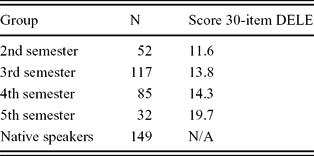
The participants in the study were divided into five groups according to their level of proficiency in Spanish: four groups of learners (286 English-speaking learners of Spanish) and one group of 149 monolingual native speakers of Spanish. The learners were all college-level students enrolled in Spanish language courses at a major public research university in the US. The classification of the learners’ level of proficiency according to their course placement is justified for two reasons. First, all students entering the normal sequence of courses take a placement test (Wisconsin Test), ensuring a minimum level of homogeneity within and across levels. Second, immediately before the study took place all students enrolled in Spanish language courses took a diagnostic test based on an adapted version of the DELE (Diploma de Español como Lengua Extranjera).Footnote 7 The distribution of scores according to course level for all students registered in Spanish is summarized in Table 1.Footnote 8
Distribution of participants according to proficiency in Spanish.
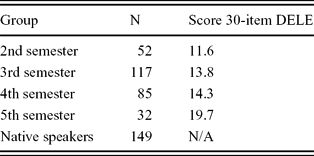
Although only an indirect indication of level of proficiency for the participants in the study, the scores confirm a minimum level of separation between levels of proficiency.Footnote 9 The native speakers represented two different regional varieties (54 from Mexico and 95 from Uruguay), but there were no statistically significant differences between their responses. All native speakers completed the task in their home country. Both native speakers and students participated voluntarily in the experiment.
5.3 Methodology
The data on the use of past tense marking in L2 Spanish were collected with the use of a written 40-item discourse-based forced-choice task (Appendix A). The text used in the present study was a modified version of a native speaker's narrative of a cartoon produced by a popular cartoonist (Lavado, Reference Lavado1986). All participants received both the narrative and the cartoon. The modifications of the narrative were mostly restricted to vocabulary items that might have impeded the understanding of the text by the less proficient learners. Other changes were made to maintain a good balance of verbs according to the different classes of grounding and lexical aspect whenever possible. The advantages (and limitations) of a controlled test for the collection of data on tense-aspect marking are discussed in detail in Bardovi-Harlig (Reference Bardovi-Harlig2000).Footnote 10 For the purpose of this study, the selected testing instrument was justified because the control over the distribution of classes of lexical aspect and levels of grounding is necessary for a comparative analysis. Moreover, the larger data set collected through a controlled task allows for the use of more powerful statistical tests than the ones used in previous studies (i.e., repeated measures ANOVA as opposed to Chi Square).
The 40 verbs selected as the measure for the dependent variable were classified according to lexical aspectual class and grounding. The classification was first done by the author, and later sent to three additional raters who were asked to confirm or modify the author's categorization. All four raters were native speakers of Spanish and had extensive experience with the classifications of lexical aspect and grounding. All raters were asked to make their judgments about lexical aspect on the operational tests devised by Hasbún (Reference Hasbún1995) and Shirai (Reference Shirai1991), and for grounding they used the criteria set forth by Reinhart (Reference Reinhart1984) as described in Bardovi-Harlig (Reference Bardovi-Harlig2000). Sample tests are listed in Appendix B.Footnote 11 The cases that created discrepancies were re-classified by the author so that at least three out of the four raters (including the author) were in agreement.Footnote 12
The tests used to classify lexical aspect have been used in numerous previous studies; thus, for reasons of space I will not discuss them in further detail. However, given that not many studies have used tests of narrative grounding, I will provide a brief description of the application of these tests to the first paragraph of the story excerpted below. (Foregrounded text is flushed right; see Appendix A for the English translation. The main verbs are in bold and numbered in the order presented in the passage.)
First, we note that the outcome of the combined classification of all raters determines that the verb phrases 1, 7 and 8 are part of the foreground of the story, whereas 2–6 and 9–11 are part of the background of the narrative (text flushed left). In effect, the eventualities represented by verb phrases 1, 7 and 8 serve to advance the plot line of the main story (“I went (to visit) the house, I saw something, I remembered something”). These three events move the story forward and are, in essence, the basic information needed to understand the rest of the story. At the same time, all three events comply with the conditions of punctuality and completeness: visiting, seeing and remembering are neither ongoing nor durative events. In contrast, verb phrases 2–6 as well as 9–11 provide a narrative flashback to the time of the main character's childhood. This flashback effectively breaks the story line with the addition of non-chronological eventualities. These non-chronological events are either habitual (non-punctual), or simply descriptive in nature.
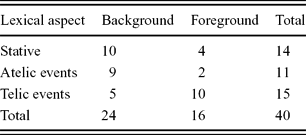
The distribution of lexical aspectual classes according to grounding is summarized in Table 2. Note that the proportion of background clauses to foreground clauses is higher than in typical simple-plot fictional narratives analyzed in previous studies. The higher proportion of backgrounded clauses is probably due to two factors: (i) the content of the story itself in which the main character remembers several events from his childhood, and (ii) the fact that the narrator was asked to play the role of the main character (a personalized story according to Bardovi-Harlig, Reference Bardovi-Harlig2000).
Target verbs classified according to lexical aspectual classes and grounding.
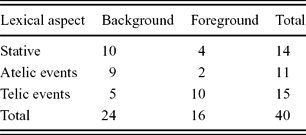
On the other hand, in terms of lexical aspectual classes, there is a slightly higher proportion allocated to the two ends of the continuum of lexical semantics (i.e., states and telic events). With regards to the distribution of lexical aspectual classes according to grounding, there are two important factors to consider in the analysis. First, there is an inverse distribution of the two ends of the continuum of lexical aspect (i.e., states and telic events) according to grounding: 10 telic events versus four states in the foreground as opposed to five telic events and 10 states in the background. This distribution is, however, typical of most narratives, a factor that is also confirmed by the apparent overlap of the predictions made by the LAH and the DH. Second, the distribution of activity verb types is lopsided to the extent that most activity verbs show up in the background of the narrative (nine cases) as opposed to the foreground (two cases).
With regard to the relative distribution of specific verb types within each lexical aspectual class, two of the most frequently used statives represented almost two thirds of the verbs in that class. That is out of 14 states, seven corresponded to the verb ser “to be”, three to the verb estar “to be”, two to querer “to want” and there was also one example each of the verbs haber “to be (existential)” and tener “to have”. Within the class of telics, there was a more even distribution: there were three instances of the verb ir “to go”, and two each of the verbs atar “to tie” and ver “to see”. The remaining nine telic verbs were all represented by different verb types.
6. Results
The number of tokens collected for the present study comprised 16,915 responses from 435 participants. There were 485 empty cells that represented selections not made by the participants (representing less than 3% of the total number of responses). Furthermore, the empty cells were evenly distributed according to level of native speakers and non-native speakers, lexical aspectual class and grounding. For instance, even the most obvious candidate for a special type of patterning of the empty cells (i.e., native versus non-native speakers) was not apparent: 404 empty cells corresponded to choices made by non-native speakers, whereas 81 empty cells corresponded to choices made by native speakers. Given that even native speakers left some options unselected, it is logical to conclude that the limited number of empty cells (3%) was very likely associated with an instrument effect (e.g., participants may have missed an option while reading the text) and not necessarily due to the effect of any of the independent variables.
The experimental design of the study was based on a repeated measures analysis with a between-subjects factor (level of proficiency) and a 3 × 2 factorial design for the within-subject analysis (3 lexical aspectual classes × 2 levels of narrative grounding). The three lexical aspectual classes were states, atelic events and telic events. The two levels of grounding corresponded to foreground and background. The dependent variable was represented by the selection of past tense marker as measured on a continuous scale from 0 (Preterit) to 1 (Imperfect). All analyses were run using the statistical package SPSS 14.0. Table 3 presents the average scores for each one of the 40 items in the test for each one of the levels of proficiency.
Mean scores for all proficiency groups (from 2nd to 5th semester of instruction plus native speakers) according to grounding and lexical aspect (0 = Preterit, 1 = Imperfect).

Note: Both states and activities are atelic.
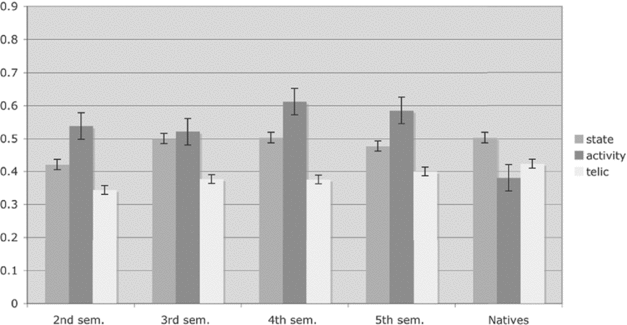
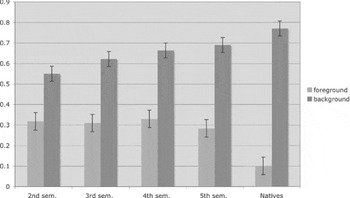
Mauchly's test of sphericity of the within subject factors determined that there is no violation of sphericity for aspect (0.218).Footnote 13 Grounding was not affected by sphericity given that it has only one degree of freedom. The interaction of aspect and grounding, however, violates the sphericity assumption (0.042), thus requiring the application of the Greenhouse-Geysser correction, which rendered an adjusted degrees of freedom of 1.970 for lexical aspect, 1.939 for the interaction of aspect and grounding, and 7.756 for the interaction of type, ground and level. For the between-subject factors, the results of the ANOVA with repeated measures did not reveal a significant main effect for level of proficiency [F(4, 199) = 2.268, p = .063].Footnote 14 On the other hand, the analysis of the results of the within-subject factors revealed significant main effects for lexical aspect [F(1.970, 392) = 39.007, p = .000] and grounding [F(1, 199) = 381.946, p = .000]. More importantly, the analysis revealed significant two way interaction effects between aspect and level [F(7.880, 392) = 10.887, p = .000], grounding and level [F(4, 199) = 30.536, p = .000], and aspect and grounding [F(1.939, 385.847) = 21.653, p = .000], and also three-way interaction effects between level, aspect and grounding [F(7.756, 385.847) = 6.505, p = .000]. Even though there are no significant differences across proficiency levels in the between-subject analysis, there are interaction effects of proficiency level in association with the two main independent variables in the within-subject analysis. Thus, we conclude that the various proficiency groups have different patterns of performance with reference to the variables of lexical aspect and grounding. Figures 1 and 2 below show the mean scores for the effect of lexical aspect and grounding, respectively. In both figures the effect of the independent variables (lexical aspect and grounding) are separated according to level of proficiency.
Distribution of scores according to lexical aspect by level of proficiency.

Distribution of scores according to grounding by level of proficiency.

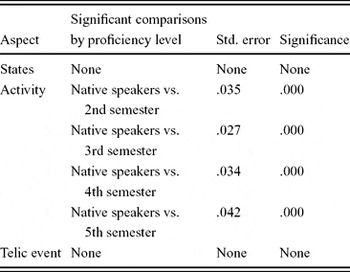
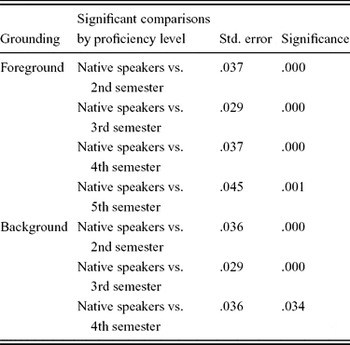
The interaction effects were further decomposed. A summary of the statistically significant comparisons for the interaction effects of level and aspect and level and grounding is presented in Tables 4 and 5, respectively.
Two-way significant interaction effects by lexical aspect decomposed.

Two-way significant interaction effects by grounding decomposed.

For the interaction between aspect and level (Table 4), the only significant difference is given by the contrast between the native speakers and all groups of learners in association with activities only. That is, native speakers categorically preferred the use of the perfective form, whereas learners were more likely to use the imperfective form. There are no significant differences across groups for the analysis of grammatical marking with states or telic events. In contrast, the analysis of the interaction between grounding and level (Table 5) shows a statistically significant difference between native speakers compared to all groups of learners in association with the use of grammatical markers of past tense in the foreground of the narrative, and also a statistically significant difference between native speakers and all learners but the ones in the 5th semester in association with the use of grammatical markers of past tense in the background of the narrative. That is, native speakers were more likely to use the Preterit in the foreground and the Imperfect in the background. In sum, of the two independent variables (aspect and grounding), it appears that grounding is the one that more clearly distinguishes the performance of native speakers compared to learners.
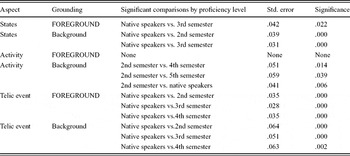
A summary of the analysis of the statistically significant comparisons present in the three-way interaction effect is presented in Table 6 below. The clearest pattern of statistically significant differences is associated with telic events: both in the foreground and the background of the narrative, native speakers differ in their use of past tense from learners from 2nd, 3rd and 4th semesters. That is, both native speakers and 5th semester learners are more likely than 2nd, 3rd and 4th semester learners to use the perfective form in the foreground and, concurrently, the imperfective form in the background.
Three-way significant interaction effects decomposed.

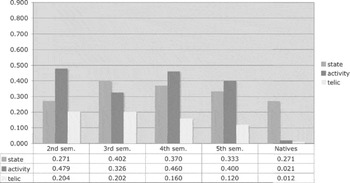
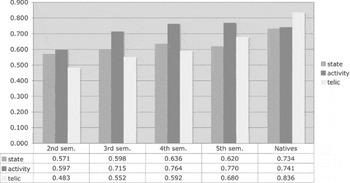
The next clearest pattern of statistically significant results is associated with activities in the background in which case there is a statistically significant difference between 2nd semester learners and the 4th and 5th semester students as well as the native speakers. That is, 2nd semester learners are more likely than other groups (except for 3rd semester students) to use the perfective form with activities in the background of the narrative. Figures 3 and 4 show the effects of lexical aspectual classes for each level of grounding separately.
Distribution of scores (FOREGROUND) with interaction effects.

Distribution of scores (BACKGROUND) with interaction effects.

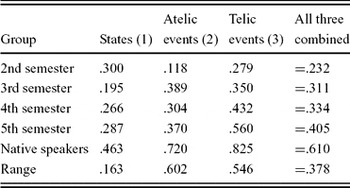
To further analyze the effect of grounding across the various groups, Table 7 below shows the differential scores (means) between foreground and background for each lexical aspectual class separately and for all three lexical aspectual classes combined for all groups of subjects.
Differential scores for verb type according to grounding (background scores – foreground scores).

As the differential score increases, the association of grammatical marker (Preterit or Imperfect) with grounding (Foreground or Background) becomes more important. Concomitantly, as the gap between foreground and background becomes smaller, we conclude that the distinction according to grounding is less relevant for the selection of past tense marker. Table 7 shows that the differential scores of the dependent variable according to grounding were categorically marked among native speakers (or at least much more so than any other learner group). This is especially true for non-states: for atelic events the gap between 2nd semester learners and native speakers was 0.602 and for telic events the gap between 2nd semester learners and native speakers was 0.546 (both measured on a 1.0 range). For states, the range in differences is minimal: 0.163, although still higher for native speakers than for any other group of learners. Furthermore, the analysis also shows a fairly constant increase in the differential scores as proficiency and experience with the language increases. That is, there is a clear developmental pattern.
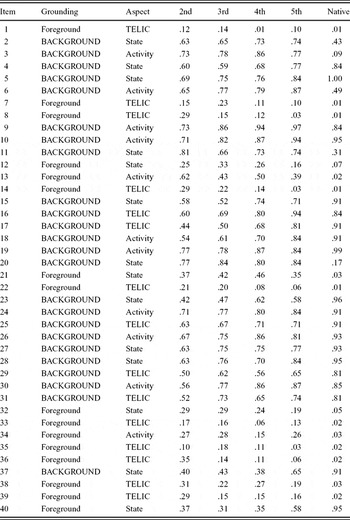
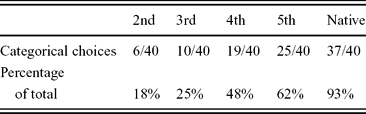
A final analysis of the data was conducted on the means for each separate item of the total of 40 that comprised the narrative. The analysis by item is useful to understand whether specific groups were more categorical than others in their choices of Preterit and Imperfect. That is, the more categorical the answer for a specific group is, the more homogenous their responses are (cf. Coppieters, Reference Coppieters1987). For instance, if two different groups had each an average of 0.5 (in between Imperfect and Preterit) for the selections assigned to two separate items, there is a continuum of possible combinations of two scores that can produce the average of 0.5. In one hypothetical case, the average of 0.5 can represent two equal scores of 0.5 (a tendency to be ambivalent about the selections of Preterit-Imperfect). In another hypothetical scenario, however, the average of 0.5 may be the result of the combination of two categorically opposite selections (0 and 1). For the purpose of identifying categorical selections, the average scores of 0.8 or higher (categorical selection of Imperfect) and 0.2 or lower (categorical selection of Preterit) for all 40 items across groups were counted. Table 8 presents the number of items below 0.2 or above 0.8 for all groups of learners along with the percentage of categorical choices for the total of 40 items included in the narrative.
Categorical selection of Preterit-Imperfect by proficiency in Spanish.
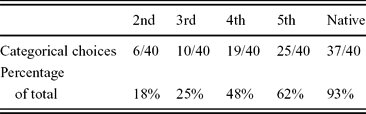
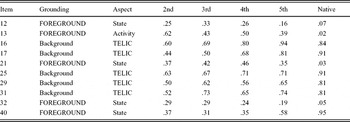
There is a gradual transition towards more categorical choices of Preterit and Imperfect as experience/proficiency in the L2 increases (from 18% for second semester learners up to 93% for native speakers). Not surprisingly, the group of native speakers was by far the one that was most homogeneous in their responses, whereas non-native speakers were more ambivalent about their selections (cf. Coppieters, Reference Coppieters1987).Footnote 15 Following the previous finding, the average scores by item were also analyzed to identify possible non-prototypical choices of combinations of lexical aspect and grounding (e.g., states in the foreground, telic events in the background). In this case, if we consider the concept of telicity only (telic events as opposed to atelic events and states), there are 10 items in which we have a non-prototypical pairing of lexical aspect and grounding; see Tables 9 and 10.
Distribution of mean scores in non-prototypical uses for all groups according to proficiency in Spanish.

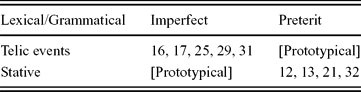
Distribution of Preterit-Imperfect in non-prototypical uses for native speakers.
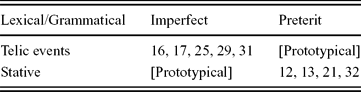
Note that all of the telic events that native speakers categorically marked with the Imperfect (items 16, 17, 25, 29 and 31) were also part of backgrounded clauses in the narrative (non-prototypical).Footnote 16 In contrast, except for the case of items 16 and 17 among 5th semester learners, non-native speakers do not show a categorical marking of telic events with the Imperfect. Conversely, all of the atelic events that native speakers categorically marked with the Preterit (items 12, 13, 21 and 32) were part of the foregrounded clauses in the narrative (also non-prototypical). The only exception to the latter trend was provided by item 40, in which the lexical aspect of the stative prevailed and led to the use of the Imperfect. In contrast, by and large, non-native speakers do not categorically mark statives with the perfective form. In sum, native speakers’ selections of non-prototypical choices tend to be affected by grounding. Thus, grounding is the factor that overrides the effect of lexical aspect to mark situations non-prototypically.
7. Discussion
The analysis of data presented in the previous section leads to the following conclusions. First, we provide an affirmative answer to the questions posed by both research hypotheses 1 and 2: both lexical aspect and grounding are directly associated with the choice of past tense marker across all levels of proficiency in Spanish. Furthermore, we provide a negative answer to research question 3: lexical aspect and grounding do not reach their highest degree of association with past tense marking during the beginning stages of development. On the contrary, the association between lexical aspect and grounding with the use of Preterit and Imperfect gradually increases as proficiency in the L2 increases. Finally, research question 4 is answered positively, as the data show that grounding is the construct that most clearly distinguishes learners from native speakers. Whereas the answers to research questions 1 and 2 reaffirm previous findings, the answers to research questions 3 and 4 contradict previous proposals and, thus, they constitute the more interesting findings of the present study.
With reference to question 3, the effect of either lexical aspect or narrative grounding on the dependent variable (i.e., Preterit or Imperfect) does not have a noticeable effect in the comparison of subjects grouped according to proficiency in Spanish (from 2nd semester to native speakers). Thus, all learners are aware of the biases associated with specific types of verbs (as defined by lexical aspect) and grounding (as defined by foreground and background) for the selection of past tense marking in Spanish. In principle, these findings seem to provide empirical support for the LAH and the DH: the use of Spanish Preterit and Imperfect is associated with lexical aspect and grounding. This conclusion, however, is unwarranted to the extent that these data show that neither the effect of lexical aspect nor the effect of grounding is restricted to the beginning stages of acquisition.
In fact, the statistically significant interactions between, on the one hand, level of proficiency and grounding, and, on the other hand, level of proficiency and lexical aspect reveal that the pattern of use of the information provided by lexical aspect and grounding is not the same across the groupings of subjects represented in this study. Indeed, Figure 1 shows that as language competence (given by level) goes up, the use of the Preterit in association with the telic events increases, whereas the use of the Imperfect in association with states also increases. Similarly, Figure 2 shows that as proficiency increases, the use of the Preterit in association with the foreground of the narrative increases, whereas the use of the Imperfect in association with the background of the narrative also increases. Interestingly, previous studies had provided preliminary evidence of this trend. By and large, the studies that proposed an initial stage of development represented by a default past tense marker are in consonance with the findings of the present study (e.g., Lubbers-Quesada, Reference Lubbers-Quesada1999; Salaberry, Reference Salaberry1999, Reference Salaberry2002, Reference Salaberry2003; Wiberg, Reference Wiberg1996). In fact, even data from some studies that do not explicitly advocate a default past tense marker substantiate this position as well (e.g., Camps, Reference Camps2002, Reference Camps2005; Güell, Reference Güell1998; Pérez-Leroux et al., Reference Pérez-Leroux, Cuza, Majzlanova and Sánchez-Naranjo2007).Footnote 17
In fact, Andersen (Reference Andersen2002, p. 92) pointed out that “learners increase the strength of association of a particular meaning and distribution of a gram [grammatical form] each time another token is encountered”. Furthermore, Shirai (Reference Shirai, Williams, VanPatten, Rott and Overstreet2004, p. 103) argued that “in cross-sectional studies involving production data, the prototypical association becomes stronger as the learner's proficiency increases”. How can we theoretically account for this clear contradiction with the basic claim advanced by the LAH and the DH? Shirai suggested that “the increasing association is the result of developing form–meaning mapping based on L2 input, which is biased in the direction predicted by the . . . Distributional Bias Hypothesis” (p. 103). In fact, Tracy's (Reference Tracy2007) analysis of a corpus of Spanish native speakers’ written and oral data shows that many verbs are clearly biased towards the Preterit or Imperfect approximately 70% of the time. For instance, she argues that when the verb estar “to be” is used with adjectives (e.g., estar enamorado “to be in love”), it is typically marked with the Imperfect. In contrast, when it is used with prepositional phrases and/or specific time references (e.g., estar con un amigo “to be with a friend”), it tends to be used with the Preterit. The argument about distributional biases raises the distinct probability that it is not only semantics per se, but also particular frequencies and patterning of input data that guide L2 learners towards an ever-increasing native-like competence. This is a claim that, although compatible with the LAH (as pointed out by Andersen, Reference Andersen2002), does bring up questions about the possibility that to a great extent the effect of lexical aspectual classes on past tense marking is actually, indirectly, the effect of distributional biases (i.e., a cognitive factor as opposed to a strictly linguistic one).
With reference to hypothesis 4, the findings of the present study reveal that the construct of grounding (rather than lexical aspect) is the one that most systematically distinguishes learners from native speakers (with the single exception of the data from the background of the narrative among 5th semester students). In contrast, the only statistically significant pattern of interaction between native speakers and learners with regard to the effect of lexical aspect is the one associated with activities (atelic events), which, in effect, is the least informative category of the continuum of lexical aspectual classes.Footnote 18 The conclusion that grounding is the more significant factor of the two is further substantiated by the statistically significant three-way interactions when both grounding and lexical aspect are analyzed concurrently. Thus, given the paucity of research on the potential effect of lexical aspect versus grounding on the use of past tense morphology among L2 learners, the answer to the questions posed by hypothesis 4 proves to be the most revealing of the questions posed in the present study.
The clearest pattern that serves to distinguish native from non-native speakers is associated with telic events in both the foreground and the background of the narrative. Interestingly, native speakers are the most categorical in marking telic events with the Preterit in the foreground (a prototypical choice), at the same time that they categorically mark telic events with the Imperfect in the background (a non-prototypical choice). The only exception to this trend is the group of 5th semester learners who pattern in their selections with native speakers. The least proficient learners are not yet marking telic verbal predicates with grammatical markers in association with grounding as much as they mark them in association with lexical aspect. In fact, the same trend is also representative of the selection of past tense markers associated with states (although not statistically significant as the association with telic events). That is, native speakers (as well as 4th and 5th semester students) mark states with the Preterit in the foreground (a non-prototypical choice), at the same time that they tend to mark states with the Imperfect in the background (a prototypical choice). In sum, native speakers’ choices tend to be more consistently affected by grounding (both foreground and background) than the learners’ choices.
Why would lexical aspect have a stronger effect than narrative grounding on the responses of L2 learners? As discussed in previous sections, narrative grounding represents, by definition, a factor that includes a rather broader level of contextualization than lexical aspect. In principle, the more expansive horizon of contextual elements that needs to be considered to make selections of Preterit-Imperfect according to grounding brings about a more challenging task for L2 learners (cf. Coppieters, Reference Coppieters1987; García & vanPutte, Reference García and vanPutte1988). The challenge is predicated on the additional elements introduced by a large contextual framework that may modify the use of prototypical choices. Indeed, Andersen (Reference Andersen2002, p. 92; emphasis added) proposed that
it may be that all learners, whether of first or second languages, must begin with prototypical associations and then gradually expand their repertoires as the demands of more complex discourse require, including less prototypical constructions
Non-prototypical choices are most likely to be found in more (rather than less) contextualized environments. In fact, the analysis of categorical choices (Tables 8–10) revealed that native speakers’ selections of non-prototypical choices are determined by the factor of grounding, but not lexical aspect. In other words, grounding is the factor that overrides the effect of lexical aspect to mark situations non-prototypically. In sum, lexical aspectual classes (and distributional biases) lead learners to use morphosyntactic markers of Spanish past tense in association with prototypical meanings. For non-prototypical choices to be identified and marked morphologically, a broad level of contextualization (inherently linked with narrative grounding) needs to be taken into account.
Finally, I note that the analysis of categorical choices of past tense marking made by native speakers and learners (Table 8) introduces yet another factor of theoretical importance. That is, whereas native speakers make clear choices of Preterit or Imperfect (93% of verbs are categorically marked with either morphological marker), non-native speakers seem to be ambivalent about the right choice (from a minimum of 18% to a maximum of 62%). This finding replicates the results from Coppieters (Reference Coppieters1987) and further substantiates his argument that the acquisition of knowledge about tense-aspectual morphology represents a challenging task for L2 learners, a component of the L2 perhaps never acquired completely. On the other hand, it is important to note that there is a gradual increase in categorical choices in the data from 2nd semester (18%), to 3rd semester (25%) to 4th semester (48%) and, finally to 5th semester (62%). Thus, in principle, learners move towards making similar selections made by native speakers on the basis of a broader aspectual context. It is open to question whether this gradual improvement will be asymptotic in nature.
In conclusion, the present study substantiates the claim advanced by both the LAH and the DH that lexical aspect and grounding have an effect at some point on the development of past tense aspectual marking in L2 Spanish among L1 English speakers (see Robison, Reference Robison1990). On the other hand, the present findings contradict the basic tenet of the lexical aspect hypothesis and the discourse hypothesis to the extent that the role of lexical aspect and grounding actually increases with proficiency in the L2. Finally, the most important finding of the present study is that grounding was the more challenging of the two levels of representation of aspectual meanings. In sum, the results empirically substantiate the need to include the role of contexts wider than the verb-phrase level and the sentence level to define the representational knowledge of tense-aspectual contrasts. That is, the decision about which past tense form to use in Spanish (i.e., Preterit or Imperfect) is associated with a global (contextualized) understanding of the situation to be represented in linguistic terms.
Appendix A. Narrative text of Quino's cartoon
The structure of the narrative has been classified according to grounding for the purpose of this paper: flushed left is text describing backgrounded events and flushed right is text describing foregrounded events. Participants received the text all flushed left. All verbs are numbered consecutively and they are bolded. Participants received the text with all sentences flushed left (irrespective of grounding) and the verbs were not bolded (but they were numbered consecutively).
This is a narrative of the cartoon. Please underline or circle the correct option for each verb.
Approximate translated version follows below. The Preterit and Imperfect options in the original have been translated with the past tense marker in English, given that this is the most accurate translation of the original.
Yesterday [I] 1 (went) to visit my granfather's old house. [It] 2 (was) the house where [I] 3 (spent) a lot of time having fun as a kid. The house 4 (was) abandoned, but [it] still 5 (had) many memories of the times when [I] 6 (visited) my grandfather. Upon entering [I] 7 (saw) the rocking chair and [I] immediately 8 (remembered) the times when my grandfather 9 (rocked me) and my mother 10 (drank) tea. [That] 11 (was) a wonderful time.
At that precise moment, [I] 12 (wanted) to see the rest of the house. So, [I] 13 (continued) walking around the house and [I] 14 (saw) a cart. [It] 15 (was) the little cart to which [I] 16 (tied) my grandfather. He 17 (played) the role of the horse and he 18 (carried) me around the house, while my father 19 (read) the newspaper. Ah! [Those] 20 (were) the best years of my childhood.
Then [I] 21 (wanted) to explore more and [I] 22 (went) to the attic in which [there] 23 (were) the Indian custom and a bow and arrows. When [I] 24 (visited) my grandfather [I] 25 (put on) the Indian custom and [I] 26 (played) with my gandfather. He 27 (was) my prisoner and I 28 (was) an Indian armed with bow and arrows. [I] 29 (tied) him to a column in the attic and [we] 30 (played) for hours and hours until [it] 31 (got) dark.
32 [It] (was) at that precise moment that [I] 33 (realized) that the last time [I] 34 (played) with him, [I] 35(forgot) to untie him! [I] 36 (went) looking for him where [it] 37 (was) that column. [I] 38 (climbed) the stairs in a hurry, and then [I] 39 (found) my grandfather. How horrible! There [it] 40 (was) the skeleton of my grandfather tied to the column.
Appendix B. Tests used to determine lexical aspect and grounding categories
Tests of lexical aspect
These tests were based on questioning the verbal predicate of the clause/sentence according to the features of dynamicity and telicity.
Dynamicity (dynamic versus non-dynamic):
Does the predicate have a habitual interpretation in simple present tense?
If the answer is affirmative, the verb was classified as non-stative.
Telicity (entailment test):
If we stop in the middle of V-ing, have we done the act of V?
If the answer is affirmative, the verb is classified as atelic.
Tests of narrative grounding
The tests to determine grounding were based on the identification of the foregrounded elements of a sentence.
The foreground was defined by
1. chronological order: clauses that are part of the main plot line of the story and that are chronologically ordered (as opposed to flashbacks, simultaneous actions),
2. punctuality: clauses that are punctual (as opposed to habitual events), and
3. completeness: clauses that are completed (as opposed to ongoing events).