Implications
The usual low efficiency of protein utilisation by ruminants may be improved by protecting high-quality proteins from ruminal degradation with the additional benefit of reducing nitrogen emissions to the environment. Protective treatments, based on protein denaturation by the combined use of acid solutions and heat, have shown promising results. In addition to their effects on the supply of total and specific amino acids, effects on rumen functions derived by the use of these treated feeds must be studied, as well as the interest of using different acid types in relation to nutritional efficiency and economic costs.
Introduction
Extensive diet protein degradation by ruminal microorganisms is usually associated with high ruminal losses of ammonia, but also with reductions of microbial protein synthesis efficiency (National Research Council (NRC), 2001). This extensive protein degradation has a negative impact on the animal energy balance by the necessary conversion of lost ammonia into urea. This inefficiency is important in productive ruminants, which need diets with high concentrations of CP, supplied mainly by protein concentrates. Inefficiency is increased when high degradable concentrates such as sunflower (Helianthus annuus) meal (SFM) are used because of conversion of feed amino acids (AAs) into compounds such as nucleic bases or amino sugars that are not used for protein synthesis. Protection of SFM proteins through their denaturation, with the combination of acid solutions and heat, has provided promising results using an in vitro system (Arroyo et al., Reference Arroyo, González, Muñoz, Alvir, Rodríguez, Ibañez and del Castillo2011). However, in vivo studies to test the efficiency of the protective treatments in relation to the supply of total and specific AAs are necessary to confirm the interest of these treatments. In addition, the possible effects associated with the used acid or those derived from the inclusion of acid-treated meals in the diet are also of interest.
The aim of this study was to determine the effects of treatments with malic acid or orthophosphoric acid solutions and heat on the rumen degradation and the intestinal digestion of SFM. The effects of including in the diet these treated meals on the liquid and particle transit, the composition of rumen contents and ruminal fermentation were also tested.
Material and methods
SFM treatments, animals and feeding
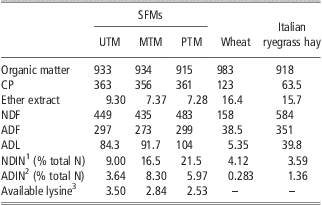
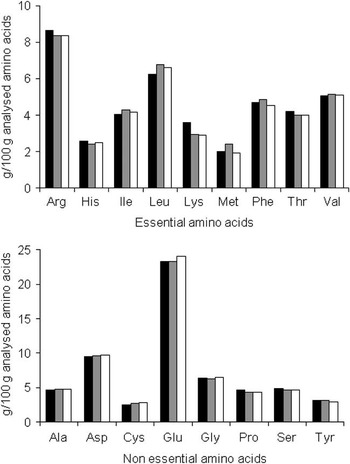
A sample of local commercial semi-dehulled, solvent-extracted SFM provided by an oil extraction plant was treated with solutions (400 ml/kg) of malic acid (1 M; 134.1 g/l) or orthophosphoric acid (0.67 M; 65.3 g/l) with resulting measured densities of 1.045 and 1.028 g/ml, respectively. Doses were established according to Arroyo et al. (Reference Arroyo, González, Muñoz, Alvir, Rodríguez, Ibañez and del Castillo2011). Acid solutions were sprayed on SFM in a concrete mixer using a sprayer previously tared. The spraying concluded when the weight loss of the crusher reached the dose to apply, calculated on the basis of the above-indicated density. Next, the meal was allowed to rest during one hour before drying it in a forced-air oven for 6 h at 150°C, stirring the material every 30 min. Diets were isoproteic and included 40% Italian ryegrass (Lolium multiflorum) hay and 60% concentrate. The concentrate contained wheat grain (between 78.2% and 78.9%), SFM, minerals and vitamins (1.087; calcium carbonate: 0.33%; sodium chloride: 0.42%; premix of vitamins and trace minerals: 0.33%). In the control diet, only untreated SFM (UTM) was used (20%), whereas untreated and treated SFM in a ratio of around 40 : 60 were used in diets with malic (MTM) or orthophosphoric (PTM) acid-treated meals. The chemical composition of these meals and of the wheat and Italian ryegrass hay is shown in Table 1. The concentrations of total analysed AAs (TAA) were 44.9, 45.1 and 43.7 g AA-N/kg DM in UTM, MTM and PTM, respectively, which represent 77.4%, 79.2% and 75.7% of the total feed nitrogen. The AA profiles were very similar among all meals (Figure 1). The main exception was a reduced lysine content in MTM (16.3%) and in PTM (20.5%). Diets contained about 127, 363 and 194 g/kg of dry matter (DM) of CP, NDF and ADF, respectively. The DM intake level was fixed at 75 g/kg BW0.75 and the diet was distributed in six equal meals (every 4 h), starting at 0900 h. Three wethers (BW = 76.3 ± 3.79 kg) fitted with rumen cannulae (inside diameter 60 mm) and T-type cannulae (inside diameter 12 mm) in the proximal duodenum were randomly allocated to the above diets in a 3 × 3 Latin-square design. Wethers were housed in individual pens and handled according to the animal care principles as published in the Spanish Royal Decree 1201/2005 (Boletín Oficial Estado (BOE), 1995).
Chemical composition (g/kg of DM) of UTM, MTM, PTM and wheat and Italian ryegrass hay
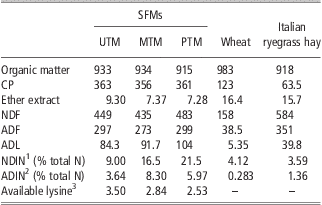
DM = dry matter; UTM = untreated SFM; MTM = malic acid-treated SFM; PTM = orthophosphoric acid-treated SFM; SFM = sunflower meal.
1NDIN: insoluble N in neutral-detergent solution.
2ADIN: insoluble N in acid-detergent solution.
3g/100 g of CP.
Amino acid composition (g per 100 g of analysed amino acids) of untreated ( $$$$), malic acid-treated (
 $$$$) and orthophosphoric acid-treated (
 $$$$) sunflower meals.

Experimental procedures
The experimental schedule of each period included successively: 10 days of diet adaptation, SFM particle transit study (days 11 to 14), rumen fluid sampling (day 14) and ruminal nylon-bag incubations (days 15 to 19); finally, the rumen was emptied the next morning at the end of incubations. From day 11 to the rumen emptying, ruminal microorganisms were labelled by a continuous infusion of ammonium sulphate (30 mg 15N per day, 98 atoms %) to correct microbial contamination of in situ results. This solution also included Li-Cr-EDTA (at a dose of 30 mg of Cr/day) in the last 2 days of infusion to determine the rumen dilution rate as the ratio between the Cr-infusion rate (g/h) and the total Cr content in the rumen (g). Then, after a 10-day resting period to eliminate the 15N enrichment of digesta, the intestinal digestion was studied.
The UTM was washed through the laundering cycle of an automatic washer in order to eliminate the soluble components (Udén et al., Reference Udén, Colucci and Van Soest1980) and marked by immersion in a solution of YbCl3 (10 mg Yb/g of feed) as described by González et al. (Reference González, Rodríguez, Andrés and Alvir1998). A pulse dose (40 g) of labelled SFM was fed to each animal 15 min before the 0900 h meal and totally consumed before this time. A total of 23 samples were obtained through the duodenal cannulae, the first sample before supplying the marker and the remainder between 1.5 and 84 h afterwards. These samples were oven-dried at 105°C for 48 h, milled to pass a 1 mm screen and analysed for Yb. The pattern of Yb concentrations in the duodenal digesta over time was described for each animal by fitting to the model of Grovum and Williams (Reference Grovum and Williams1973). In agreement with Ellis et al. (Reference Ellis, Wylie and Matis1979) and González et al. (Reference González, Ouarti, Rodríguez and Alvir2006), primary and secondary rate constants of this model were assumed to be the rate of passage of particles from the reticulo-rumen (kp) and the rate of comminution and mixing of particles (kc) in these compartments, respectively. The kc and kp rates obtained for this meal were used with in situ results for all tested SFMs.
Samples of rumen fluid (about 30 ml) were collected hourly in the interval between 0900 and 1300 h meals to determine rumen pH and ammonia and volatile fatty acid concentrations. These samples were pooled in equal volumes for each wether and conserved and analysed as indicated in Rodríguez et al. (Reference Rodríguez, González, Alvir and Caballero2008).
Nylon bags with a pore size of 46 μm and 11 × 7 cm (inner dimensions) were filled with ∼3 g (air-dry basis) of the different SFM samples (ground to pass a 2 mm screen). In each experimental period, bags (n = 24) filled with the SFM sample representative of each diet were incubated in the rumen of the respective wether during 2, 4, 8, 16, 24 and 48 h. Two series of incubations with duplicate bags were completed for each meal and wether. For each incubation, all bags were placed simultaneously in the rumen just before the wethers were offered their first meal in the morning. After collecting from the rumen, the bags were washed with tap water and stored at −20°C. After thawing, the bags were washed 3 times for 5 min in a turbine washing machine (Jata 580; JATA, Abadiano, Bizkaia, Spain). The same washing procedure was applied for two series of two bags to obtain the zero hours value. For each animal and incubation time, one bag of each incubation series was oven-dried for 48 h at 80°C and analysed for DM and N to establish degradation kinetics. The other bag was stored at −20°C, freeze-dried and used to generate composite samples representative of the rumen undegraded DM outflow for each wether. These samples were used to determine microbial corrected values of BP and intestinal effective digestibility (IED) of DM, CP and AA.
The rumen was manually emptied (just before the 0900 h meal), weighed and homogenised with an electrical whisk at low revolutions. During the homogenisation, samples were obtained with a tablespoon to isolate solid associated bacteria and to determine its chemical composition, the proportions of liquid and solid phases and the dilution rate. Bacteria isolates were lyophilised and analysed for DM, N, 15N/N and AA. Bacteria isolation and results are described in González et al. (Reference González, Arroyo, Ouarti, Guevara-González, Rodríguez, Alvir, Moya and Piquer2012).
To determine the IED of DM, CP and AA, eight sub-samples of about 200 mg of each composite sample were put into mobile nylon bags with an approximately round shape (∅ ≈ 3 cm). These bags were inserted randomly through the duodenal cannulae of the respective wether at a rate of one bag every 15 min and recovered from the faeces. Then, they were conditioned, stored, washed, dried and weighed as described above and pooled before N, 15N/N and AA analysis. The 15N/N ratio was used to correct the residual contamination due to adherent rumen microorganisms.
Calculations
Degradation kinetics of DM or CP were fitted for each animal with the exponential model of Ørskov and McDonald (Reference Ørskov and McDonald1979):
 $$d\, = \,a\, + \,b\left( {1\:{\rm{ - }}\:{{e}^{{\rm{ - }}{{k}_d}t}} } \right)$$
In this model, constants ‘a’ and ‘b’ represent, respectively, the soluble fraction and the non-soluble but degradable component, which disappears at a constant fractional rate, kd, per unit time. The undegradable fraction (r) was estimated as 1 − (a + b).
The by-pass (BP) of DM or CP was estimated using kp and kc by the equation established by Arroyo and González (Reference Arroyo and González2011):
 $$B{{P}_{c,p}}\, = \,r\, + ,b\frac{{{{k}_p}{{k}_c}}}{{\left( {{{k}_d}\, + \,{{k}_p}} \right)\left( {{{k}_d}\, + \,{{k}_c}} \right)}}$$
To obtain composite samples representative of BP DM, the freeze-dried residues of both series of incubations of each animal were pooled in equal quantities for each incubation time. Then, these residues were mixed in pre-determined proportions, which were calculated considering that residues at 0, 2, 4, 8, 16, 24 and 48 h of incubation were representative of the chemical composition of the feed rumen outflow up to times of 1, 3, 6, 12, 20, 36 and 60 h, respectively. The rumen outflow of feed DM (∅) at these last times was established as indicated by Arroyo and González (Reference Arroyo and González2011):
 $$\openup 3pt{ {{{\rm{Ø }}}_{until\,t}}\, = & \,r\left( {1{\rm{ - }}\frac{{{{k}_c}{{e}^{{\rm{ - }}{{k}_p}t}} {\rm{ - }}{{k}_p}{{e}^{{\rm{ - }}{{k}_c}t}} }}{{{{k}_c}{\rm{ - }}{{k}_p}}}} \right) \cr & \; + b\frac{{{{k}_p}{{k}_c}}}{{\left( {{{k}_d}\, + \,{{k}_p}} \right)\left( {{{k}_d}\, + \,{{k}_c}} \right)}} \cr \times \left( {1{\rm{ - }}\frac{{\left( {{{k}_d}\, + \,{{k}_c}} \right){{e}^{{\rm{ - }}\left( {{{k}_d}\, + \,{{k}_p}} \right)t}} {\rm{ - }}\left( {{{k}_d}\, + \,{{k}_p}} \right){{e}^{{\rm{ - }}\left( {{{k}_d}\, + \,{{k}_c}} \right)t}} }}{{{{k}_c}\,{\rm{ - }}\,{{k}_p}}}} \right) $$
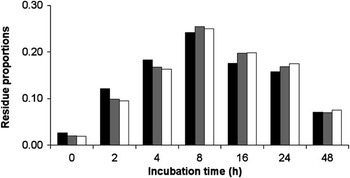
Finally, the weight proportion of each residue in the composite sample was determined from the flow proportion in each interval. The proportions resulting from the application of this process to present data are provided in Figure 2. The BP fractions were determined with this method as indicated by González et al. (Reference González, Ouarti, Rodríguez and Centeno2009) from the concentrations of the tested fraction in the composite samples (X) and whole feed (Y) and the value of BP DM obtained by the integration method:
 $$BP\,{\rm{ = }}\,X\,\times \,BP\;{\rm{of}}\;DM{\rm{/}}Y$$
Weighting proportions of ruminal incubated residues to composite representative by-pass samples of untreated ( $$$$), malic acid-treated (
 $$$$) and orthophosphoric acid-treated (
 $$$$) sunflower meals.

In accordance with these same authors, the IED of any fraction was determined from the value of IED of DM, calculated as the mean of DM disappearance from the bags, and the concentrations of this fraction in the composite sample (X) and in the intestinal incubated residues (Z):
 $$IED\,{\rm{ = }}\,{\rm{1}}\,{\rm{ - }}\,{\rm{[}}Z\,\times \,{\rm{(1}}\,{\rm{ - }}\,IED\,{\rm{of}}\,DM{\rm{)/}}X{\rm{]}}$$
Microbial correction of both BP and IED values was performed for DM, CP and AA as indicated by González et al. (Reference González, Ouarti, Rodríguez and Centeno2009).
Chemical analyses
Procedures of the Association of Official Analytical Chemists (AOAC, 2000) were used to analyse feed samples by triplicate for DM (method 934.01), ash (method 967.05), ether extract (method 920.39) and CP (6.25 × Dumas N, method 968.06) using for this last analysis a Leco FP-528 combustion analyzer (Leco Corp., St. Joseph, MI, USA). An Ankom fibre analysis system (Model 220, Ankom Technology Corp., Macedon, NY, USA) was used to determine in sequence NDF (Van Soest et al., Reference Van Soest, Robertson and Lewis1991), ADF and ADL (Robertson and Van Soest, Reference Robertson and Van Soest1981). Analyses of NDF were performed with α-amylase but without sodium sulphite. NDF and ADF were expressed inclusive of residual ash. The insoluble nitrogen in neutral-detergent (NDIN) and in acid-detergent (ADIN) solutions was determined by N analysis of the NDF and ADF residues, respectively. Six replicates of ADF analyses were performed because these last residues were analysed for ADL and ADIN. Available lysine in meals was estimated in triplicate using the o-phthaldialdehyde assay performed as described by Goodno et al. (Reference Goodno, Swaisgood and Catignani1981). The extracted proteins were obtained by adding 0.1 M borate buffer pH 9.5, stirring for 90 min, and centrifuging at 10.200 × g at room temperature for 5 min. Ruminal or intestinal incubated residues were also analysed for N by the Dumas method. Samples of duodenal contents collected for transit studies were analysed for Yb by atomic absorption spectrometry, as described by González et al. (Reference González, Rodríguez, Andrés and Alvir1998). This same procedure was also used to determine Cr concentrations in rumen contents. AAs were analysed in duplicate in feeds, incubated residues and bacteria after acid hydrolysis using norleucine as internal standard. Thus, the study did not include tryptophan. This hydrolysis was preceded by an oxidation with performic acid to obtain methionine and cysteine values. These analyses were carried out using ion exchange chromatography and ninhydrin derivation with an AA auto-analyzer (Biochrom 30; Biochrom Ltd, Cambridge, UK). Nitrogen isotopic proportions were analysed by mass spectrometry (VG Prism II, IRMS linked in series to a Dumas-style Carlo Erba EA 1108 N analyzer, Milan, Italy).
Statistical methods
The different kinetics associated with the used models were fitted using non-linear regression models. Effects of treatments (t), wethers (w) and experimental periods (p) were studied by analyses of variance using a Latin-square design (yijk = μ + ti + wj + pk + εijk) for results of (i) liquid and particle transit, (ii) ruminal contents and fermentation parameters, (iii) non-corrected values of degradation parameters of DM and CP obtained by mathematical integration, (iv) microbial contamination of composite samples and (v) microbial corrected BP and IED of AA. Non-microbial corrected BP of CP obtained using mathematical integration or composite samples were compared by analysis of variance considering the method (m) and wethers in the model (yij=μ + mi + wj + εij). Results of BP, IED and the intestinal digested fraction of DM and CP obtained using composite samples were studied by analyses of variance with a split-plot arrangement of treatments (yijk=μ + ti + wj + ck + ti × ck + ti × wj + εijk). In this design, the treatment was the whole-plot, which was tested against the wether × treatment interaction as error term, and microbial correction (c) and its interaction with treatment were the sub-plot treatments. All means were examined by orthogonal contrasts for the effects of the treatment (untreated v. treated) and of the acid used (malic acid v. orthophosphoric acid). Differences in relation to the AA profile of the intact feed of the metabolisable protein were analysed by t test of the differences between both. Effects were declared significant at P < 0.05. All the statistical analyses were performed using the version 6.12 of SAS Institute (1990).
Results
Ruminal fermentation and digesta kinetics
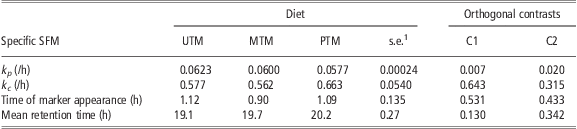
The inclusion of acid-treated meals in the diet did not alter the ruminal fermentation parameters (pH and ammonia and total volatile fatty acid concentrations) or the rumen dilution rate (Supplementary Table S1). In addition, no important differences were shown for the rumen contents and their chemical composition among diets (see also Supplementary Table S1). This inclusion led to a moderate decrease in the kp rate of SFM particles. A similar decrease was shown using orthophosphoric acid v. malic acid. On the contrary, no effects were shown for kc, the first time of marker appearance or the total mean retention time in the forestomachs (Table 2).
Transit up to the duodenum of untreated sunflower meal particles in tested diets
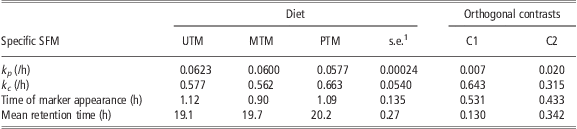
SFM = sunflower meal; UTM = untreated SFM; MTM = malic acid-treated SFM; PTM = orthophosphoric acid-treated SFM; C1 = UTM v. MTM and PTM; C2 = MTM v. PTM; kp = rumen particulate passage rate; kc = rate of comminution and mixing of particles; Mean retention time = (1/k 1) + (1/k 2) + T.
1n = 3.
In situ studies
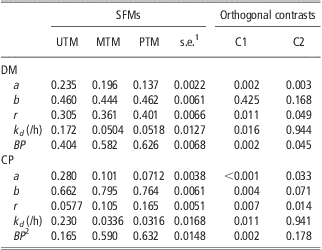
Treatments of SFM were associated with reductions and increases in its soluble and undegradable DM fractions, respectively, although both effects were higher using orthophosphoric acid than using malic acid (Table 3). In addition, both treatments led to a high reduction of kd (about 70%), irrespective of the acid. As a consequence, treatments increased the apparent BP of DM. These increases were higher in PTM than in MTM (55.0% v. 44.1%).
Effects of protective treatments on apparent rumen degradation kinetics and ruminal BP of DM and CP of SFM (values are expressed as proportions)
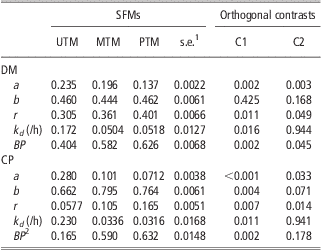
BP = by-pass; DM = dry matter; SFM = sunflower meal; UTM = untreated SFM; MTM = malic acid-treated SFM; PTM = orthophosphoric acid-treated SFM; C1 = UTM v. MTM and PTM; C2 = MTM v. PTM. a, b, and r represent soluble, non-soluble degradable and undegradable fractions, respectively; kd = fractional degradation rate of fraction b.
1n = 3.
2Values from composite sample method and comparison: UTM: 0.154 (s.e.1 = 0.0026; P = 0.090); MTM: 0.556 (s.e.1 = 0.0334; P = 0.516); PTM: 0.564 (s.e.1 = 0.0113; P = 0.051).
The behaviour of CP degradation with the treatments was similar to that shown for DM, although the effects were more pronounced (Table 3). In addition, the reduction of the a fraction was not only associated with an increase in the r fraction but also of the b fraction. The transfer from soluble CP to the b fraction as a consequence of the treatment was 75% and 50%, in MTM and PTM, respectively. Treatments reduced by 7 times the kd value of CP, irrespective of the tested acid. The global effect of all these changes was a large increase in the BP fraction, irrespective of the acid. Differences in CP BP between the mathematical integration and the composite sample methods were not significant, although a tendency (P = 0.051) to be lower with the last cited method was shown for PTM (Table 3).
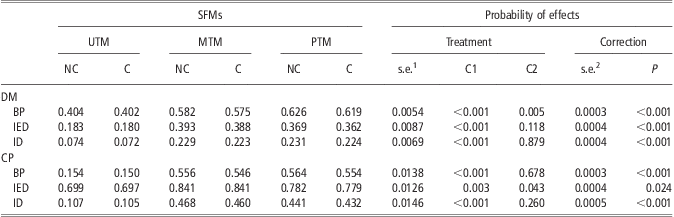
The microbial contamination in composite samples increased with protective treatments irrespective of the acid for DM, whereas for CP no effects were detected. Thus, the mean values for UTM, MTM and PTM were, respectively, 0.549%, 1.18% and 1.14% of DM (n = 3; s.e. = 0.109; P = 0.010) and 2.08%, 1.77% and 1.62% of CP (n = 3; s.e. = 0.264; P = 0.304).
In agreement with the results derived from mathematical integration, DM BP obtained from composite samples showed an increase with treatments, which was higher in PTM than in MTM (Table 4). Protective treatments also increased the IED of DM irrespective of the acid (108% as average; Table 4). As a result, treatments increased the intestinal digested DM by 211%, without effects between acids. The lack of correction of microbial contamination implied overevaluations in the DM BP and also in its IED, because digestion in the intestine eliminated the adherent bacteria by 94.2%, 89.5% and 98.3% in UTM, MTM and PTM residues, respectively. However, all these variations were low because of the low microbial contamination. The BP of CP increased greatly (265% on average of corrected and uncorrected values) with treatments irrespective of the acid (Table 4). Treatments also increased the IED of CP, but this increase was higher in MTM (20.0%) than in PTM (11.8%). The resultant effects for intestinal digested CP showed a large increase (4.25 times) irrespective of the acid-treatment. In a similar way, for DM, the overevaluations of all these parameters were low because of the low microbial contamination of the undegraded composite samples.
Effects of protective treatments and correction of microbial contamination on in situ estimates of BP, IED and ID of SFM (values are expressed as proportions)
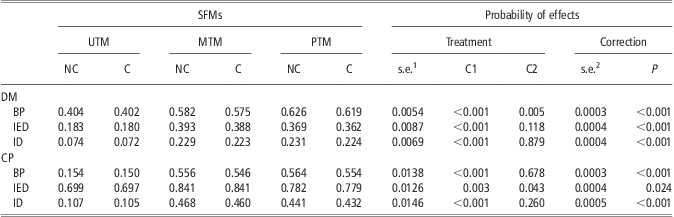
BP = by-pass; IED = intestinal effective digestibility; ID = intestinal digested fractions; SFM = sunflower meal; UTM = untreated SFM; MTM = malic acid-treated SFM; PTM = orthophosphoric acid-treated SFM; DM = dry matter; NC and C = no corrected and corrected by the microbial contamination; C1 and C2 = probability of the orthogonal contrasts; C1 = UTM v. MTM and PTM; C2 = MTM v. PTM.
1n = 6.
2n = 9.
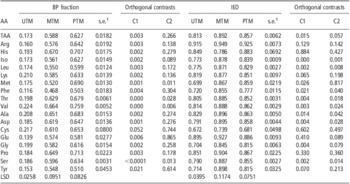
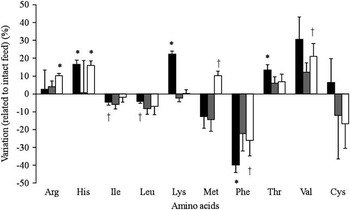
Treatments increased by 3.51 times on average the BP of TAA (Table 5). Similar effects were shown for all AA, although for cysteine this effect was only shown at P = 0.052. Higher increases in BP were shown using orthophosphoric acid than using malic acid in some AA. Phenylalanine provided the minimum BP in all meals, whereas valine showed the maximum value except in MTM in which this maximum was provided by histidine; however, the value observed for valine was close to that of histidine in this meal. Protective treatments also increased by 7.56%, as a mean, the IED of TAA (Table 5). This same effect was shown in ten AA and as tendency in two additional ones. Using orthophosphoric acid led to lower IED values than malic acid in eight AA and as a tendency in two others (lysine, P = 0.065 and tyrosine, P = 0.070) and in TAA (P = 0.057). Arginine was the most digestible AA in the intestine, whereas cysteine showed the lowest IED in all meals. Differences between individual AA and TAA within each meal can be appreciated from LSD values provided in Table 5. The digestive process led to changes for some essential AA in the metabolisable protein profile (Figure 3); both protective treatments reduced the magnitude of these variations.
Effects of protective treatments on BP and IED of SFM AAs

BP = by-pass; IED = intestinal effective digestibility; AAs = amino acids; TAA = total AA; UTM = untreated SFM; MTM = malic acid-treated SFM; PTM = orthophosphoric acid-treated SFM; C1 = UTM v. MTM and PTM; C2 = MTM v. PTM; LSD = least significant difference among AAs.
1n = 3.
Variations of the essential amino acid plus cysteine profile of metabolisable protein of untreated ( $$$$) malic acid-treated (
 $$$$) and orthophosphoric acid-treated (
 $$$$) sunflower meals (% on the intact feed; values obtained using particle comminution (kc) and passage (kp) ruminal rates and corrected by microbial contamination in the rumen). †P < 0.1; *P < 0.05.

Discussion
Ruminal fermentation and digesta kinetics
The similar values of pH, total volatile fatty acid concentration, fermentation pattern, composition of rumen contents and rumen dilution among diets support the fact that the inclusion of treated meals in the diet had no negative effects on ruminal digestion. Opposed effects of protection on ammonia generation and fixation in microbial synthesis (owing to the reduced fermentation of treated meals) may be in the origin of the similar ammonia concentration in the rumen fluid among diets. In addition, it should be considered that the reduction of degradable CP with protective treatments only affected 7.88% of the diet CP.
Differences between treatments for kp of UTM particles cannot be easily explained, although these differences were moderate; in addition, the low s.e. recorded contributed to these effects. In this way, González et al. (Reference González, Michalet-Doreau and Poncet1987) showed a direct relationship between kp and kd rates by varying the intake level and the diet forage to concentrate ratio. In addition, Rodríguez et al. (Reference Rodríguez, González, Alvir and Caballero2008) showed this same relationship in different concentrates by varying the intake level. The reason for this relationship, which may contribute to the observed differences, may be a consequence of both degradation and transit processes acting simultaneously on the dynamic of particles and on the activity and growth of microorganisms in the reticulo-rumen.
In situ studies
Digestive estimates are conditioned by considering the rate of comminution and mixing of particles (kc) in the reticulo-rumen through its influence on the site of digestion, because the time proportion associated with this rate on the total residence time in these compartments is always relevant (9.13% as mean of the three diets); however, its final effect varied with the degradation extent. Thus, not considering kc overestimated the apparent BP of CP by 23.6% in UTM (Arroyo and González, Reference Arroyo and González2011), whereas the overestimation (calculated in a similar manner to the last cited work) was only 4.2% in treated meals. No corrected CP BP estimates obtained with both used methods were close, which agrees with previous comparative studies (González et al., Reference González, Ouarti, Rodríguez and Centeno2009; Arroyo and González, Reference Arroyo and González2011). Therefore, as indicated in the last cited work, to use composite samples representative of the feed rumen outflow allows simplifying the in situ methodology of protein valuation studies conceived in terms of effective values, as well as a simpler correction of the ruminal microbial contamination.
The lack of correction for microbial contamination in the rumen led to low overestimations of BP and IED of both DM and CP. Even for the intestinal digested CP, which accumulated the errors occurred at ruminal and intestinal levels, they are lower than 2%. These low effects are a consequence of the low contamination, which agrees with previous results for SFM (Rodríguez and González, Reference Rodríguez and González2006), especially when animals are fed at high intake levels (Rodríguez et al., Reference Rodríguez, González, Alvir and Caballero2008), as in our experiment.
The reduction of the ruminal digestibility of DM of SFM with the protective treatments was mainly a consequence of the reduced degradation of proteins. Thus, the reduction of fermented CP represented 84.9% and 68.0% of the reduction of ruminally digested DM in MTM and PTM, respectively. Therefore, feed components other than proteins should also be affected by these treatments. Condensation reactions between carbohydrates and proteins resulting from thermal treatments of humid feeds may lead to Maillard reactions, which agrees with the increased r fraction of DM shown with both acids.
The large increase in the CP BP with protective treatments was mainly a consequence of the conversion of soluble to insoluble protein and of the large decrease in the degradation rate of this last fraction, although the augmentation of the r fraction also contributed to this effect. This last increase agrees with the augmentation of the NDIN and ADIN proportions and they may be indicative of Maillard condensations. Additional evidence of these reactions is provided by the reductions in available lysine in MTM (18.9%) and PTM (27.7%), as well as by those previously indicated in the lysine analysed in these meals. The higher values of both ADIN and r in PTM than in MTM may be associated perhaps with a higher moisture level before being dried, as heat effects depend on humidity (Van Soest, Reference Van Soest1994). Therefore, at the normality used, the treatment with orthophosphoric acid incorporated 5.7% more water than using malic acid (385.1 v. 364.3 ml of water/kg of feed). Nevertheless, a specific acid effect cannot be discarded. Treatment efficiency was not only due to the increase in the CP BP, but also of its IED. This last increase should be a consequence of a passive decrease in the proportions of indigestible compounds in the feed BP CP in spite of the increased r fraction. Therefore, the ratios for CP between r and BP were 35.0%, 17.8% and 26.1% for UTM, MTM and PTM, respectively. Thus, the lower values of IED of CP recorded for orthophosphoric acid than for malic acid may be associated with its higher impact on the increase in the r fraction and therefore of indigestible nitrogenous compounds in the intestine. González et al. (Reference González, Sanchez and Alvir1999) also showed increases in IED of CP, with the increase in the CP BP when comparing SFMs resulting from different industrial processes.
The large increased supply of intestinal digested CP from treated meals can also be associated with a decrease in the microbial protein synthesis in the rumen derived from these meals because of their reduced fermentation. However, this loss may be partially compensated by a higher microbial efficiency due to the reduction of the proportion of CP in the fermented organic matter (NRC, 2001).
The better results for the r fractions and IED of CP for malic acid than for orthophosphoric acid support a higher interest in the first acid. In addition, benefits for the ruminal fermentation pattern may also be expected with the inclusion of malate in the diet (Martin and Streeter, Reference Martin and Streeter1995; Callaway and Martin, Reference Callaway and Martin1996; Carro et al., Reference Carro, López, Valdés and Ovejero1999), although no such effects were detected in this work. The moderate dose of malate incorporated in the diet (0.38%) could be insufficient to attain these effects. In this way, a reduction of the acetic acid/propionic acid ratio (from 4.56 to 3.27) was shown in a later experiment (non-published data) using a diet with a similar forage to concentrate ratio but with a higher level of treated meals at this same dose, that provided 1.09% of malate in the diet.
AA availability
The increases in the BP of TAA with protective treatments agree with those shown for CP, although the treatment efficacy varied among AA. Some relationship between this efficacy and the resistance to degradation of AA in UTM seems to exist. Thus, coefficients of correlation between these increases and BP of AA of this meal were 0.315 (P = 0.020) with MTM and 0.466 (P < 0.001) with PTM. This behaviour may be explained considering that AA showing higher BP values in UTM would be included in higher proportions in more resistant proteins, which reinforces the treatment protection effects. Differences in degradation and/or intestinal digestibility among AA change the metabolisable protein profile. The resistance to degradation of an AA may be negatively or positively affected by its polar or hydrophobic character, respectively, as well as by its content on the different feed proteins (González et al., Reference González, Ouarti, Rodríguez and Centeno2009). In this way, there are large differences in AA composition between almond and hull sunflower proteins. Lysine, cysteine and threonine contents are higher and those of methionine, and isoleucine are lower in hulls than in almond proteins (Redshaw et al., Reference Redshaw, Flicker, Fontaine, Heimbeck and Hess2010). Sunflower hulls are rich in cell wall proteins with a high content in some specific AA (Showalter, Reference Showalter1993), which would be degraded in a lower extent and poorly digested in the small intestine. As a consequence of the important degradation reduction, the proportions of hull proteins in the BP protein would be lower in treated meals than in UTM. This may explain the opposite variations of metabolisable lysine or cysteine with the digestion process.
The low IED values observed in UTM for sulphur-containing AA reduce one of the nutritive advantages of this meal, although the low degradability of cysteine compensates this fact partially. In feeds, cysteine is mainly present as cystine and the di-sulphur bond gives it a high resistance to degradation (Mahadevan et al., Reference Mahadevan, Erfle and Sauer1980). A low intestinal digestibility of cysteine has been observed in other feeds in earlier results (González et al., Reference González, Ouarti, Rodríguez and Centeno2009). Results for 16 h rumen incubated residues corrected for microbial contamination using diaminopimelic acid as a marker also showed a low intestinal digestibility of cysteine in SFM (Erasmus et al., Reference Erasmus, Botha and Cruywagen1994). The negative effects of the low intestinal digestibility of sulphur-containing AA may be corrected with the protective treatments. Thus, the concentrations of metabolisable methionine and cysteine (g/kg feed DM) were, respectively, 0.81 and 1.17 in UTM, 3.60 and 4.16 in MTM and 3.67 and 3.94 in PTM. Therefore, treatments increased as mean these contents by 4.5 and 3.5 times for methionine and cysteine, respectively. Concentrations of metabolisable lysine (g/kg feed DM) were 2.01, 5.01 and 5.01 in UTM, MTM and PTM, respectively. Therefore, its increase with protective treatments was only 2.5 times. This lower effect was mainly a consequence of lysine losses with the heat treatment.
Conclusions
The tested protective treatments decrease the fermentation in the reticulo-rumen and increase the intestinal digestibility of treated meals, without negative effects on the diet ruminal use. These treatments increase largely the supply of metabolisable essential AA mainly because of a large increase in their BP fraction, but also because of a moderate increase in their intestinal digestibility. The supply of metabolisable sulphur-containing AA (main positive characteristic of sunflower protein) is improved by the protective treatments, whereas effects on the metabolisable lysine supply are more limited partly because of available lysine losses by the heat treatments. Therefore, the use of these treated meals in combination with rich lysine protein concentrates is still of great interest in balancing the metabolisable protein profile. Correction for microbial contamination of nylon bags was of limited importance in this study.
Acknowledgements
This work has been supported by the CICYT-funded Projects AGL 2001-3662 and AGL 2006-08300. Analyses of 15N isotope ratios were performed at the Servicio Interdepartamental de Investigación, Universidad Autónoma de Madrid, Spain.
Supplementary materials
For supplementary material referred to in this article, please visit http://dx.doi.org/doi:10.1017/S1751731112001292