Introduction
Omega-3 (N-3) and omega-6 (N-6) polyunsaturated fatty acids (PUFA) essential nutrients involved in a range of physiological functions, from modulating inflammatory cascades to maintaining cell membrane fluidity.Reference Wiktorowska-Owczarek, Bereziska and Nowak 1 Maternal intake of PUFA is particularly important during pregnancy, as these nutrients are critical to development of the fetal neurological and immune systems.Reference Van Vlies, Hogenkamp and Fear 2 Additionally, maternal PUFA intake may also have long-lasting impacts on offspring body composition and metabolic healthReference Muhlhausler and Ailhaud 3 – Reference Mennitti, Oliveira and Morais 5 – a notion that has gained interest in recent years, in parallel with increasing popularity of the Developmental Origins of Health and Disease hypothesis, which posits that environmental exposures during sensitive windows of development (e.g., the in utero period) exerts a stronger influence on future health than other life stages.Reference Wadhwa, Buss, Entringer, Swanson and Ph 6 Rodent models have demonstrated that offspring born to dams fed a diet high in N-3 PUFA had lower fat mass and leptin levels than those whose mothers were fed a diet rich in N-6 PUFA.Reference Korotkova, Gabrielsson, Lönn, Hanson and Strandvik 7 , Reference Korotkova, Gabrielsson and Holma 8 In addition, rebalancing the N-6:N-3 ratio (e.g., increasing N-3 and decreasing N-6) in the diet of pregnant dams reduced maternal inflammation and yielded more favorable metabolic outcomes in offspring, including lower body and liver adiposity, and better glycemic regulation.Reference Heerwagen, Stewart, de la Houssaye, Janssen and Friedman 9 These findings could be explained, in part, by the opposing actions of the two PUFA families, and the fact that they compete for the same enzymes in their metabolism.Reference Schmitz and Ecker 10 Specifically, some N-6 PUFA, like arachidonic acid (AA), are pro-inflammatory and promote maturation and differentiation of adipocytes, whereas N-3 PUFA, like eicosapentaenoic acid (EPA), block this process through their anti-inflammatory and anti-adipogenic eicosanoids.Reference Madsen, Petersen and Kristiansen 11 Accordingly, it is hypothesized that higher maternal intake of N-3 PUFA during pregnancy will be protective against offspring obesity risk, whereas greater intake of N-6 PUFA will lead to greater risk of obesity and related metabolic conditions.Reference Mennitti, Oliveira and Morais 5 , Reference Ailhaud and Guesnet 12
So far, evidence in human populations is limited to a few studies conducted in Western nations. In Project Viva, a Boston-area pre-birth cohort, Donahue et al.Reference Donahue, Rifas-Shiman and Gold 13 found that higher intake of N-3 PUFA during mid-pregnancy was associated with lower offspring obesity risk, as well as lower leptin levels at 3 years of age. Subsequently, De Vries et al.Reference De Vries, Gielen and Rizopoulos 14 found no relationship between maternal plasma levels of N-3 PUFA during pregnancy and offspring adiposity at age 7 years among mother–child pairs in the Maastricht Essential Fatty Acid Birth (MEFAB) cohort in the Netherlands. However, higher maternal plasma N-6 dihomo-gamma-linolenic acid (DGLA) in MEFAB was associated with higher offspring body mass index (BMI), waist circumference (WC), skinfold thickness and leptin levels.Reference De Vries, Gielen and Rizopoulos 14 In another analysis of mothers and children in the Netherlands (Generation R, a pre-birth cohort in Rotterdam), Vidakovic et al.Reference Vidakovic, Santos and Williams 15 examined associations of maternal plasma concentrations of N-3 and N-6 PUFA during mid-pregnancy with offspring adiposity at 1.5, 6 and 24 months of age and detected positive, negative and null associations at each of the time-points, respectively. In addition, the researchers reported that a higher N-6:N-3 ratio corresponded with lower offspring central adiposity at 1.5 months of age.Reference Vidakovic, Santos and Williams 15 In a recently published study of 3807 Finnish mother–child pairs, Hakola et al.Reference Hakola, Takkinen and Niinistö 16 detected a U-shaped association of maternal intake of N-6:N-3 during late pregnancy with obesity risk in girls at age 2–7 years (i.e., females in the lowest and highest quartiles of N-6:N-3 had the greatest odds of obesity). On the other hand, this ratio was unrelated to obesity risk in boys. Taken together, the scant and inconsistent literature emphasizes the need for additional studies in more diverse populations.
In the present study, we examined associations of trimester-specific maternal intake of N-3 and N-6 PUFA, as well as the N-6:N-3 ratio with offspring adiposity, linear growth and biomarkers of metabolic risk among mother–child pairs in Mexico, a low- to middle-income country where rates of child and adolescent overweight/obesity have increased markedly over the last three decades. 17 We hypothesize that higher maternal intake of N-3, lower intake of N-6 and a lower N-6:N-3 ratio of intake during pregnancy will each be associated with lower offspring adiposity and metabolic risk, and greater attained height during peripuberty.
Materials and methods
Study population
This study used data from the Early Life Exposures in Mexico to Environmental Toxicants (ELEMENT) project recruited between 1997 and 2004. We recruited eligible pregnant women who attended three hospitals that served a low- to middle-income population in Mexico City. The mothers were interviewed by trained research staff, and information on dietary intake and sociodemographic characteristics were collected at up to three times (median of 13.0, 24.7 and/or 37.0 weeks gestation for first, second and third trimester, respectively) during pregnancy.
In 2010, we re-contacted a subset of 250 offspring, who were then between 8 and 14 years of age, for participation in follow-up studies based on the availability of archived biospecimens. At this visit, hereafter referred to as the ‘peripubertal visit,’ the children provided an 8-h fasting blood sample, participated in anthropometric assessments (weight, height, skinfold thicknesses) and completed an interviewed-based questionnaire. The present study includes 236 mother–child pairs for whom we had at least one assessment of the mother’s diet during pregnancy (e.g., data on diet during at least one trimester), and for whom we had data on anthropometry (weight, height or skinfold thicknesses) or any of the metabolic biomarkers of interest (fasting glucose, C-peptide, leptin or lipid profile) from the children during peripuberty.
Exposure: maternal N-3, N-6 and N-6:N-3 during pregnancy
Maternal intake of N-3 alpha-linolenic acid (ALA), EPA and docosahexaenoic acid (DHA), and N-6 linoleic acid (LA) and AA as well as N-6:N-3 ratio, as indicated by AA:EPA+DHA, were quantified via a validated semi-quantitative food frequency questionnaire (FFQ) administered during each trimester of pregnancy.Reference Hernández-Avila, Romieu and Parra 18 We derived nutrient content of 104 commonly eaten Mexican foods based on a Dietary Survey of the Mexican National Institute of Nutrition in 1983. The food composition tables from the United States Department of Agriculture (USDA) and the Mexican National Institute of Nutrition and Medical Sciences Salvador Zubirán were used to derive nutrient content of each food item. To calculate daily intake of the specific PUFA of interest, we multiplied PUFA content from each food item by the reported frequency of intake. PUFA content from all food items were summed up and converted to g/day. To account for potential confounding by caloric intake, we adjusted each PUFA for trimester-specific total energy intake using the residuals method.Reference Willett 19
Outcomes: adiposity, linear growth and metabolic risk during peripuberty
Anthropometric assessment
Trained research staff measured the children’s weight (kg) on a digital scale (BAME Mod 420; Catálogo Médico), height (cm) using a calibrated stadiometer (BAME Mod 420; Catálogo Médico). We used these values to calculate BMI, and height z-score using the age- and sex-specific World Health Organization (WHO) growth reference for children 5–19 years.Reference De Onis, Onyango and Borghi 20 We used a non-stretchable tape (QM2000; QuickMedical) to measure the children’s WC (cm). The subscapular (SS) and triceps (TR) skinfold thicknesses (mm) were measured with biannually calibrated skinfold calipers (Lange; Beta Technology). For the analysis, we calculated the sum (SS+TR) and the ratio (SS/TR) of the skinfolds. All the measurements were measured in duplicate and the average was taken for the analysis, as we have previously done.Reference Perng, Fernandez and Peterson 21
Metabolic risk biomarkers
At the peripubertal visit, we collected 8-h fasting blood from the antecubital vein. We processed the blood within 24 h, separated the sample into serum, plasma and DNA, and stored the aliquots at −80°C until time of analysis. For this study, we used fasting serum to assay biomarkers of glycemia (fasting insulin, C-peptide, leptin) and lipid profile [serum total cholesterol, triglycerides (TGs), high-density lipoprotein (HDL), low-density lipoprotein (LDL)]. We measured fasting serum glucose by automated enzymatic assay (Cobas Mira Plus, Diamond Diagnostics, Holliston, MA, USA), and leptin levels were quantified using radioimmunoassay (Millipore, Merck Co., Burlington, MA, USA). Serum C-peptide, a marker of insulin function that is secreted in quantities equal to insulin from pancreatic β-cells,Reference Bonser, Garcia-Webb and Harrison 22 was quantified using an automated chemiluminescence immunoassay (Immulite 1000, Siemens Medical Solutions, Tarrytown, NY, USA). We used a biochemical analyzer (Cobas Mira Plus, Roche Diagnostics, Basel, Switzerland) to measure serum total cholesterol, TGs and HDL. The measurements were then used to estimate LDL as: total cholesterol−HDL−(TGs/5).Reference Friedewald, Levy and Fredrickson 23
We also obtained two measurements of systolic and diastolic blood pressure per child. The children were in a seated position, and research assistants used an appropriate sized cuff on his/her upper right arm, and an automated ambulatory blood pressure monitor (Spacelabs, Snoqualmie, WA, USA). After blood pressure assessment on the right arm, we repeated the procedure on the left arm after a 3-min resting period. Because the intraclass correlation (ICC) between the measurements was high (ICCSBP=0.95; ICCDBP=0.89), we used the average of the five measurements in the analysis, as previously done in this population.Reference Perng, Fernandez and Peterson 21
In addition to examining individual biomarkers, we also calculated a metabolic syndrome risk z-score (MetS z-score) modified from one proposed by Viitasalo et al.Reference Viitasalo, Lakka and Laaksonen 24 and previously used in this populationReference Perng, Hector and Song 25 as an indicator of metabolic risk. We took the average of five age- and sex-specific z-score for fasting glucose, fasting C-peptide (in lieu of fasting insulin), WC, TG/HDL ratio and the average of SBP and DBP. The MetS z-score provides an integrated view of metabolic risk based on the natural clustering of metabolic risk factors.Reference Shi, Goodson and Hartman 26
Covariates
At enrollment, women completed an interviewer-administered questionnaire that provided information on sociodemographic characteristics such as age, education level, parity and smoking habits. Research staff collected information on child age, weekly hours of moderate-to-vigorous physical activity, and TV viewing time.Reference Hernández, Gortmaker, Colditz, Peterson and Laird 27 , Reference Hernández, Gortmaker, Laird, Colditz and Parra-Cabrera 28 A trained pediatrician assessed pubertal status based on the Tanner stages of sexual maturation for development of genitals in boys, breasts in girls and pubic hair in both.Reference Chavarro, Watkins and Afeiche 29 The stages range from 1 to 5, where stage 1 indicates no sexual maturation and stage 5 indicates full sexual maturation. For the present analysis, we considered the children to be pubertal if Tanner stage was >1 for genital or pubic hair development in boys, or for breast or pubic hair development in girls.Reference Marshall and Tanner 30
Statistical analysis
First, we examined the distribution of BMI z-score, height z-score and MetS z-score across categories of sociodemographic and maternal characteristics to identify potential confounders to the relationship between maternal PUFA intake and offspring health. In conjunction with our a priori knowledge of determinants of child health, this step informed our selection of covariates for multivariable analysis.
Next, we examined the association of quartiles of maternal N-3 and N-6 PUFA intake with the offspring outcomes to assess for non-linear relationships. The associations were generally linear and monotonic, so we evaluated maternal PUFA intake continuously to maximize power. To make the estimates more meaningful, we scaled intake if each PUFA to 1 s.d. In the models, the independent variable of interest was intake of each PUFA during each trimester, and the outcomes were the indicators of offspring adiposity, height z-score, and the metabolic biomarkers. In multivariable analyses, we adjusted for mother’s education and parity, and child’s sex, age and pubertal status. Because height is a key component of BMI, we further examined associations for the adiposity outcomes after accounting for height z-score. For all models, we assessed for effect modification by sex and pubertal status via a formal test for statistical interaction. There was no evidence of effect modification by either variable (all P-interaction >0.20), thus we pooled results for all children.
In addition to the main analyses, we carried out some post hoc analyses to gain insight into potential mechanisms underlying our findings. First, we examined the association of PUFA with birthweight, birth length and gestational age to gain insight into whether the associations with the anthropometric outcomes during peripuberty were due to tracking of birth size. For models where birthweight and birth length were the outcomes, we adjusted for mother’s education, gestational age, and parity, and child’s sex. For models where gestational age was the outcome, we adjusted for mother’s education and parity, and child’s sex. We also examined Spearman correlations between PUFA intake with intake of foods queried in the FFQ, separately by trimester, to gain insight into sources of foods that contribute to dietary PUFA in this population.
Finally, we carried out sensitivity analyses. Specifically, we examined the impact of including covariates that were associated with the outcomes in bivariate analysis and known determinants of metabolic health – namely, maternal smoking habits during pregnancy and marital status, and child’s physical activity levels and TV viewing time. Additionally, because intake of PUFA may be correlated, we adjusted each PUFA for all others during each trimester to ascertain the independent effect of each PUFA.
All distributions met standard assumptions for linear regression. The distribution of TGs was somewhat left skewed, but when we re-ran our analyses using the natural log-transformed version of the variable, the direction, magnitude and significance of the estimates were very similar; thus, we present the untransformed values for ease of interpretation and comparability across outcomes. The analysis was performed using SAS 9.4 (Cary, NC, USA).
Results
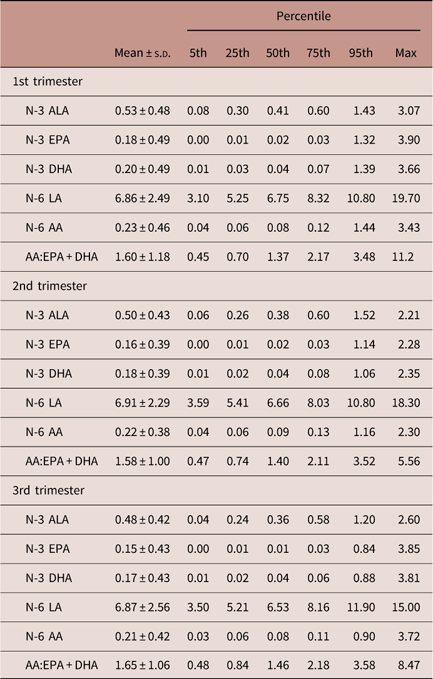
Median age of the participants was 10.3 years (range: 8.1–14.7 years); 47.0% (n=236) were boys. Table 1 shows the mean±s.d., as well as percentiles of total energy-adjusted maternal fatty acid intake (g/day) during each trimester of pregnancy.
Distribution of total energy-adjusted intake of omega-3 (N-3) and omega-6 (N-6) polyunsaturated fatty acids (g/day) during pregnancy among 236 Early Life Exposures in Mexico to Environmental Toxicants (ELEMENT) mothers

ALA, α-linolenic acid; EPA, eicosapentaenoic acid; DHA, docosahexaenoic acid; LA, linoleic acid; AA, arachidonic acid.
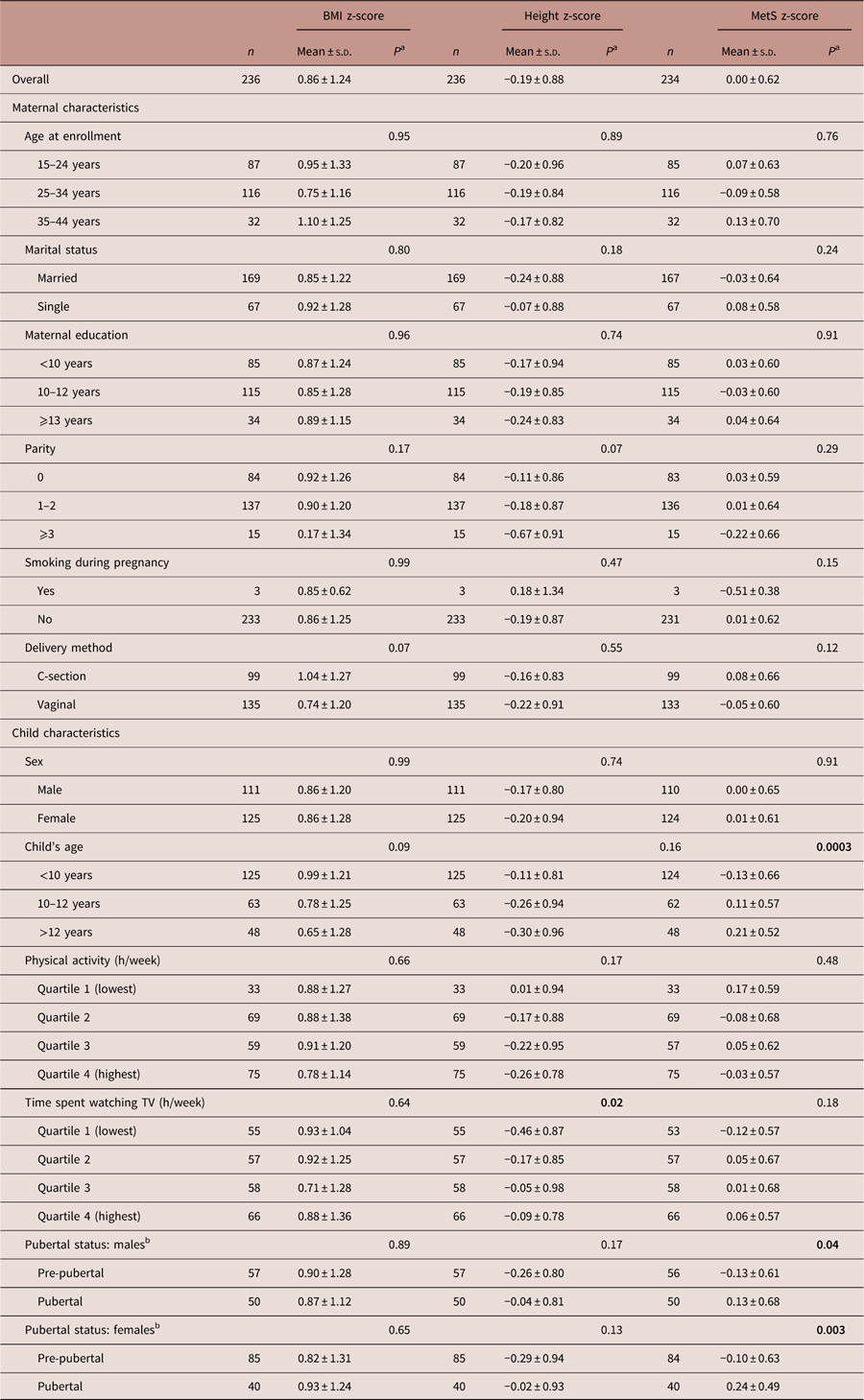
In bivariate analysis (Table 2), we found that older children had lower BMI z-score, but higher MetS z-score. Additionally, boys and girls who were classified as pubertal exhibited higher MetS z-scores than those who were pre-pubertal. For example, in comparison with pre-pubertal boys, those who had attained puberty had 0.32 (95% CI: 0.08, 0.56) higher MetS z-score. Likewise, pubertal girls had 0.35 (95% CI: 0.12, 0.58) higher MetS z-score than their pre-pubertal counterparts. We detected a positive relationship between time spent watching TV and height z-score (P-trend=0.02).
Distribution of body mass index (BMI) z-score, height z-score and metabolic risk phenotype risk z-score [metabolic syndrome risk z-score (MetS z-score)] across characteristics of 236 Early Life Exposures in Mexico to Environmental Toxicants (ELEMENT) mother–child pairs

a Represents a test for linear trend where an ordinal indicator is entered into the model as continuous variable, with the exception of binary variables (Wald test).
b Puberty was defined as Tanner stage 3–5 (v. 1–2) for breast (girls), testicular (boys) and pubic hair (both) development.Bold values are statistically significant at P<0.05.
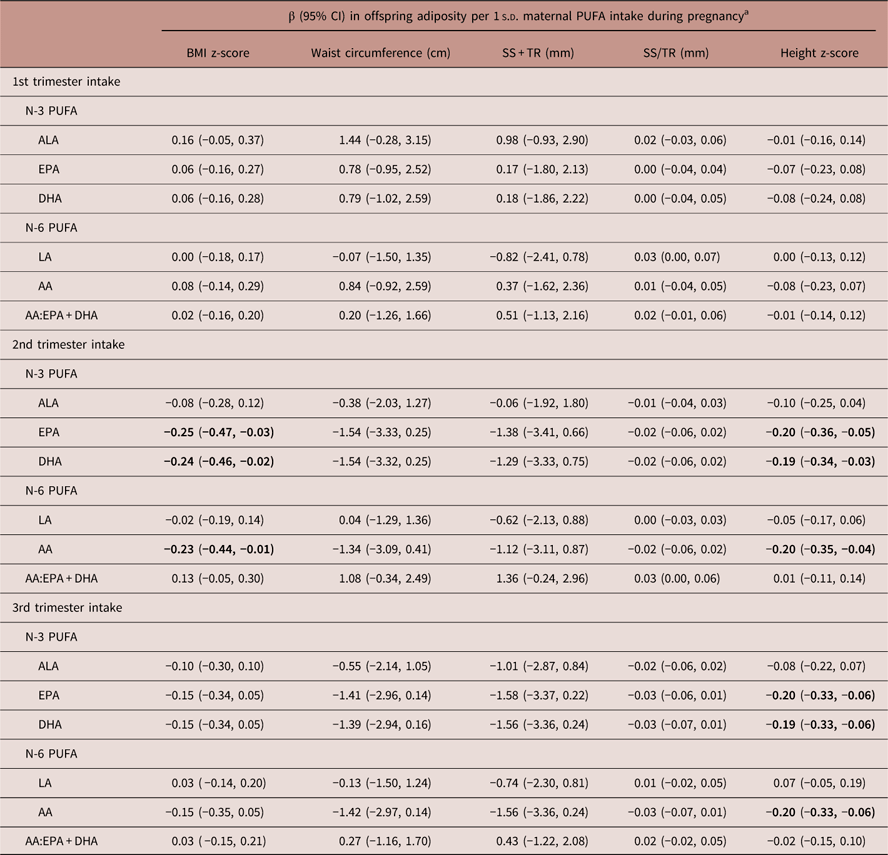
In multivariable analysis (Table 3), we did not find any associations of first trimester PUFA intake with the offspring outcomes. However, during the second trimester, each 1-s.d. increment in maternal EPA intake corresponded with 0.25 (95% CI: 0.03, 0.47) units lower offspring BMI z-score during peripuberty after accounting for maternal education and parity, and child’s age, sex and pubertal status. Likewise, each 1-s.d. increment in maternal DHA and AA intake during the second trimester was related to 0.24 (95% CI: 0.02, 0.46) and 0.23 (95% CI: 0.01, 0.44) units lower offspring BMI z-score, respectively. We noted similar, albeit non-significant, associations with WC, SS+TR and SS/TR (Table 3). Second and third trimester EPA, DHA and AA intake were each inversely associated with offspring height z-score (Table 3).
Associations between maternal polyunsaturated fatty acids (PUFA) intake and offspring adiposity and height z-score during prepuberty

CI, confidence interval; BMI, body mass index; SS, subscapular; TR, triceps skinfold thicknesses; N-3, omega 3; N-6, omega 6; ALA, α-linolenic acid; EPA, eicosapentaenoic acid; DHA, docosahexaenoic acid; LA, linoleic acid; AA, arachidonic acid.
a Estimates are adjusted for mother’s education and parity, and child’s age, sex and pubertal status.Bold values are statistically significant at P<0.05.
To gain insight into whether the inverse associations of maternal PUFA intake with offspring BMI z-score reflected reduced adiposity or slower linear growth, we further included height z-score as a covariate in all models where BMI z-score was the outcome. Doing so attenuated the estimates toward the null. For example, the estimate for the relationship between second trimester EPA intake and offspring BMI z-score was attenuated to approximately two-thirds of its previous magnitude [−0.25 (95% CI: −0.47, −0.03) v. −0.16 (95% CI: −0.37, 0.05)]. Similarly, the estimates for second trimester intake of DHA and AA were attenuated to −0.16 (95% CI: −0.37, 0.06) and −0.14 (95% CI: −0.34, 0.07), respectively. Together, these results suggest that the associations are driven by slower linear growth rather than accrual of adiposity.
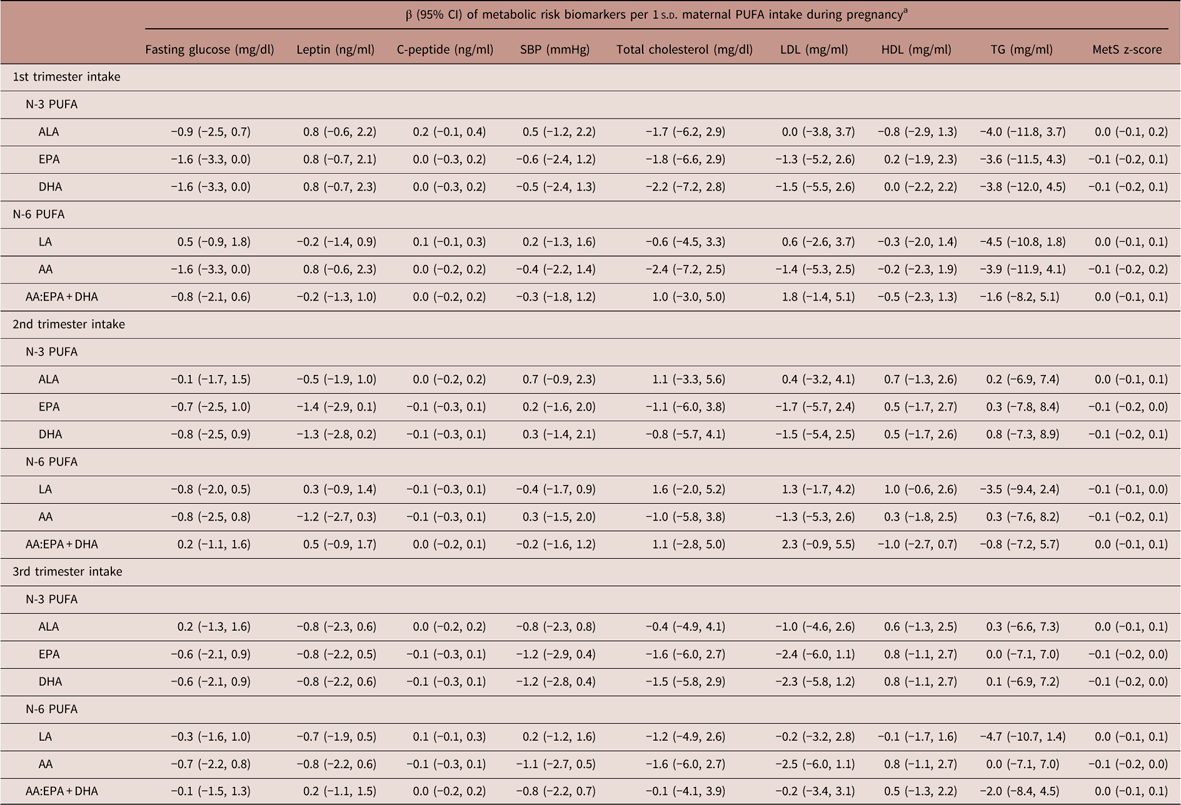
On the other hand, maternal PUFA intake was not related to any of the individual metabolic risk biomarkers or MetS z-score (Table 4).
Associations between maternal polyunsaturated fatty acid (PUFA) intake and different metabolic risk biomarkers during peripuberty

CI, confidence interval; SBP, systolic blood pressure; LDL, low-density lipoprotein; HDL, high-density lipoprotein; TG, triglycerides; MetS z-score, metabolic syndrome risk z-score; N-3, omega 3; N-6, omega 6; ALA, α-linolenic acid; EPA, eicosapentaenoic acid; DHA, docosahexaenoic acid; LA, linoleic acid; AA, arachidonic acid.
a Estimates are adjusted for child’s age, child’s sex, mother’s education, parity and puberty status.
When we examined associations of maternal PUFA intake with indicators of fetal growth (birthweight, birth length) and gestation length (gestational weeks at birth), we found that second trimester intake of EPA, DHA and AA were each negatively associated with birthweight and birth length, but was unrelated to gestation length (Supplementary Table S1). For example, each 1-s.d. increment in second trimester maternal EPA intake was associated with 0.07 (95% CI: 0.02, 0.12) kg lower birthweight, and 0.34 (95% CI: 0.10, 0.59) cm lower birth length after accounting for maternal education, gestational age, and parity, and child’s sex. We observed similar associations for DHA and AA and noted that the size of the estimates was consistently larger for birth length than birthweight.
Supplementary Table S2 shows Spearman correlations between each PUFA and intake of foods derived from the FFQ. Second trimester intake of EPA and DHA were each moderately correlated with seafood intake, and weakly and negatively correlated with animal and dairy products.
In sensitivity analyses, inclusion maternal smoking habits during pregnancy and marital status, and child’s physical activity levels and TV viewing time did not change our results. Similarly, adjusting the PUFA for one another did not change the direction, magnitude or precision of the results; thus, we did not include these variables in the final models (data not shown; available upon request).
Discussion
In this prospective investigation of 236 mother–child pairs in Mexico, we explored the relations of trimester-specific maternal intake of N-3 and N-6 PUFA with offspring adiposity and metabolic health during peripuberty (age 8–14 years). We found that higher second trimester intake of EPA, DHA and AA were each associated with lower attained BMI and height z-score during peripuberty. Accounting for height z-score in multivariable models attenuated the relationship between each of the PUFA and BMI z-score, suggesting that the observed associations are driven by an effect of slower linear growth rather than lower adiposity. On the other hand, maternal PUFA intake during pregnancy was not related to any of the offspring metabolic biomarkers.
Given that we observed consistent inverse associations of maternal second trimester PUFA intake with offspring height at 8–14 years, as well as with length at birth, we speculate that our findings reflect an impact of intrauterine PUFA exposure on size at birth, which is known to track across the life course.Reference Eide, Øyen and Skjærven 31 One potential mechanism is that PUFA may directly impact fetal growth and, accordingly, birth size. In a study of 583 pregnant Danish women, Carlsen et al.Reference Carlsen, Pedersen and Bønnelykke 32 examined whole-blood fatty acid composition at 24 weeks of gestation in relation to ultra-sound assessments of fetal growth and detected negative associations of N-3 DHA, as well as total N-3 and N-6, with femur length. The author speculated that the unexpected results could be due to the capacity of PUFA – N-6, in particular – to interfere with bone formation and mineralization.Reference Watkins 33 Although some animal studies suggest that N-3 PUFA can promote calcium absorption which could increase bone density and growth,Reference Lau, Cohen, Ward and Ma 34 , Reference Koren, Simsa-Maziel, Shahar, Schwartz and Monsonego-Ornan 35 human studies have failed to show a protective effect of N-3 PUFA on bone health.Reference Salari, Rezaie, Larijani and Abdollahi 36
Another set of explanations relate to the fact that nutrients are not consumed in isolation, but rather, in combination with other nutrients and contaminants. In ELEMENT, the primary source of PUFA is canned tuna and school shark, both of which contain environmental toxicants like mercury.Reference Basu, Tutino and Zhang 37 , Reference Cantoral, Batis and Basu 38 Thus, our findings could be driven by the negative impact of toxicants on fetal growth. In a Spanish mother–child cohort, Murcia et al.Reference Murcia, Ballester, Enning and Iniguez 39 showed that higher cord blood mercury, while not associated with gestation length, was related to lower offspring head circumference, birthweight and birth length. Given that inter-individual variability in size at birth, including birth length, tracks into later life,Reference Eide, Øyen and Skjærven 31 in utero exposure to environmental contaminants that restrict fetal growth may also lead to lower attained height later in life. It is also possible that our findings stem from the inverse correlation between intake of PUFA and intake of animal and dairy products during the second trimester. Given that animal-based foods contain key nutrients for fetal growth and development (e.g., protein, calcium, iron and zincReference Hyde, Brennan-Olsen, Wark, Hosking and Pasco 40 – Reference Borazjani, Angali and Kulkarni 42 ), our observed associations may be due to lower maternal intake of animal-based food, which have been previously related to higher to fetal growth and size at birth,Reference Lise Brantsæter, Olafsdottir, Forsum, Olsen and Thorsdottir 43 rather than higher intake of PUFA. The fact that we detected associations with second and third trimester, but not first trimester, is likely related to the fact that mid-pregnancy is a critical period for linear growth since peak length gain velocity occurs by 20 weeks.Reference Tanner 44
Of note, a recent randomized-controlled trial of N-3 PUFA supplementation in 208 healthy women in the Netherlands (the ‘INFAT study’) found that higher N-3 and N-6 PUFA in maternal red blood cells during the third trimester was associated with higher birthweight and birth length.Reference Much, Brunner and Vollhardt 45 The discrepancy in findings reported in this study v. those of the present analysis could be attributable to the different methods of assessing maternal PUFA status (maternal red blood cell levels in INFAT v. dietary intake in ELEMENT), and differences in study design and settings (INFAT was a controlled feeding study where women were supplemented with N-3 in the form of a fish oil pill, which is less susceptible to contamination by toxicants than consumption of PUFA from the types of fish consumed by women in ELEMENT).
We did not find any associations of maternal PUFA intake with metabolic risk. One reason for this could be that the relationship between early PUFA exposure and metabolic disturbances may be obscured by transient metabolic changes that occur during adolescence (e.g., a decrease in lipids,Reference Labarthe, Nichaman, Harrist, Grunbaum and Dai 46 , Reference Dai, Fulton and Harrist 47 puberty-associated insulin resistanceReference Goran and Gower 48 ). Future investigations examining these association beyond puberty are warranted.
Strengths and limitations
Our study had several strengths. First, we examined trimester-specific associations of maternal PUFA intake as a proxy for in utero PUFA exposure with the offspring outcomes, which is important given the rapid changes in fetal growth and development throughout gestation. Second, we were able to examine associations of maternal PUFA intake with multiple biomarkers of metabolic risk (fasting glucose, C-peptide, leptin, lipid profile), which is a key improvement upon the current literature given that with the exception of leptin, there have not been any studies assessing the influence of intrauterine PUFA exposure on biomarkers of metabolic risk. Finally, we assessed outcomes in offspring during peripuberty (whereas existing studies have focused on infancy and early childhood) which may be a sensitive period for the development of metabolic disease risk.Reference Lee 49
Our study also has several limitations. First, maternal dietary intake was assessed by an FFQ, which is subject to recall bias. However, FFQs accurately assess long-term dietary intake and rank individuals within a population based on their dietary intake, both of which are directly relevant to diet-disease relationships.Reference Willett 19 Moreover, we adjusted the PUFA for total energy intake, which lowers random within-person variation and improves the precision of estimates.Reference Willett 19 Second, because we only had a single measurement of anthropometry for each child during the peripubertal research visit, it is possible that the observed relationships with attained BMI and height could be due to residual confounding by age, especially given potential inter-individual variability in timing of peak height velocity – a hallmark of growth that occurs during the age range of the study population.Reference Tanner 44 Third, the relatively small sample size may have limited our ability to detect significant associations. Fourth, because this study took place in urban Mexican adolescents, these results may not be generalizable to populations of different geographic or ethnic origins.
Conclusion
We found that higher second trimester maternal intake of EPA, DHA and AA were each related to lower offspring BMI and height z-score at 8–14 years. However, because adjustment for height z-score in models where BMI z-score was the outcome attenuated the estimates of association, our results may reflect an effect of slower linear growth rather than lower adiposity. These findings are likely mediated through slower fetal growth (length gain, in particular) and could be due to the capacity of PUFA to interfere with bone mineralization and growth during gestation, the potential effects of toxicants consumed with PUFA-containing foods, or a lack of consumption of foods containing key nutrients for in utero growth in this population. Additional studies are needed in other populations to confirm our findings and elucidate mechanisms.
Acknowledgments
The authors thank the mothers and children who participated in the Early Life Exposures in Mexico to Environmental Toxicants (ELEMENT) project and the American British Cowdray Hospital for the use of its research facilities.
Financial Support
This work was supported by the following grants: P01ES022844 and T32ES007062 from the National Institute for Environmental Health Sciences (NIEHS); and RD83543601 from the US Environmental Protection Agency (US EPA). This study was also supported and partially funded by the National Institute of Public Health/Ministry of Health of Mexico.
Conflicts of Interest
None.
Ethical Standards
The authors assert that all procedures contributing to this work comply with the ethical standards of the relevant national guidelines on human experimentation and with the Helsinki Declaration of 1975, as revised in 2008, and has been approved by the institutional committees of the Mexico National Institute of Public Health (INSP) and the University of Michigan (UM). The authors assert that all procedures contributing to this work comply with the ethical standards and has been approved by the institutional committee (INSP ethical approval number is CI-599 and UM IRB is HUM00034344).
Supplementary materials
To view supplementary material for this article, please visit https://doi.org/10.1017/S2040174418000193