Background
Specialization in both Emergency Medicine (EM) and out-of-hospital Emergency Medical Services (EMS) is relatively new practice in many parts of Africa. A recent survey found that 30% of African countries reported active EMS programs, with only nine percent of the total population in Africa currently utilizing these services.Reference Mould-Millman, Dixon and Sefa 1 Botswana has recently had significant growth of its own EMS program. Botswana’s first public EMS was initiated in 2012 in response to a Ministry of Health and Wellness (MOHW; Gaborone, Botswana) task force finding high rates of morbidity and mortality associated with road traffic accidents (RTAs) and other out-of-hospital emergencies, especially for pediatric patients.Reference Laba 2 Since then, the nation-wide program has developed into several EMS centers with over 100 providers, serving a population of over two million people. A few years after its inception, the EMS workforce was primarily comprised of nurses and emergency medical technicians (EMTs), most of whom received limited training in Basic Life Support (BLS) while serving as first responders.Reference Laba 2 Despite this training, the MOHW identified significant deficiencies in the EMS resuscitation of adult and pediatric patients and requested external expertise and educational training for continued EMS development.Reference Laba 2
Simulation-based training programs offer health care providers an effective way of developing clinical knowledge, procedural skills, teamwork, and communication. Simulations also provide an opportunity to reproduce and practice high-risk scenarios in a safe environment. Several studies have demonstrated that simulation-based training can improve prehospital providers’ assessment and clinical management skills, especially for low-frequency and high-risk situations.Reference Abelsson, Rystedt, Suserud and Lindwall 3 – Reference Shah, Carey and Rapp 5 The objective of this study was to utilize epidemiologic data from EMS responses and provider-based assessments to define the educational needs of Botswana MOHW EMS providers to guide subsequent development of a locally relevant, simulation-based adult and pediatric curriculum.
Methods
Study Design and Setting
This was a mixed methods study utilizing a combination of qualitative methods (focus groups, semi-structured interviews, and anonymous surveys) and quantitative methods (ambulance equipment inventory and chart reviews) to conduct an educational needs assessment for providers in the Botswana MOHW EMS system. This system is a single-tiered system staffed by a combination of EMTs and nurses and, at the time of the beginning of the study, was comprised of six EMS centers across the country with approximately 100 EMS providers serving a population of two million people. The institutional review boards of Baylor College of Medicine (Houston, Texas USA) and the Botswana MOHW approved this study.
Qualitative Data Collection
Two investigators (NWG, AAK) conducted informal interviews with representatives from the MOHW leadership. During the interviews, the representatives identified perceived gaps in knowledge and potential areas for improvement. The MOHW clarified standing protocols by which they expect EMS providers to act. They also shared thoughts on system issues which might contribute to the EMS providers’ current practices.
Informal interviews were conducted with a convenience sample of EMS providers of various levels of experience at the end of their shift at the largest MOHW EMS station (based in the capital city of Gaborone) and with medical providers at the Accident and Emergency Department at Princess Marina Hospital (the main referral hospital in Gaborone, Botswana), when a co-investigator was available. The themes of the focus group questions included assessing their overall perceptions of EMS training, knowledge gaps, and potential areas of improvement within the EMS program. Meeting notes were recorded on paper, and the findings were used to help guide content development for the simulation training. Given that EM and EMS were new to Botswana, there was not a cohort of experts from which to perform a Delphi-type study. Instead, an attempt was made to interpret possible educational opportunities and needs from subjects who had some basic exposure to EMS, as well as from EMS and EM leaders in Botswana. In addition, the same group of MOHW EMS providers completed adult and pediatric Likert scale surveys (Appendix 1; available online only). There were two parts to an adult- and pediatric-based survey. The first was based on the 10 most common adult and pediatric response calls, as documented and recorded in the Gaborone EMS logbook. Participants ranked their level of importance in needing additional training on these response calls. The second part of the survey assessed the need for additional training for common adult and pediatric procedures. Prior to distribution of both surveys, the investigators reviewed the content for face validity and modified it accordingly. These procedures were based on a review of available EMS equipment and procedures performed in the field, as reported by Gaborone EMS staff in above-mentioned focus group meetings. Participants were also given the opportunity to free-text additional response calls or procedures that they felt were applicable and not included in the survey.
The investigators created a list of all supplies and equipment available to the EMS providers (Appendix 2; available online only) based on an inventory list and inspections of both BLS and Advanced Life Support (ALS) ambulances at the Gaborone EMS base. This was done to ensure that the simulation curriculum developed would use the equipment that the providers in the EMS system actually have available for patient care.
Quantitative Data Collection
Investigators also reviewed a convenience sample of retrospective data from approximately 1,500 prehospital response calls from August 2013 through December 2014, noted in the written logbooks at the Gaborone EMS station. This date range was determined based on the expected start date for the training (September 2015). Data prior to August 2013 were not used due to limited availability of records and low response call volume in the first year of the EMS program. Investigators utilized the International Organization for Standardization (ISO; Geneva, Switzerland) week date system to organize the call-ins to the EMS station. The ISO system defines a representative number for ordinal weeks of the year in the Gregorian calendar. The reviewed calls represent the 12 months of a calendar year. Since several of the logbooks were missing, a period of more than 12 months was reviewed to ensure a representative sample was obtained for an entire, non-consecutive calendar year. Five consecutive days of the week were chosen per month, starting with ISO week number five (ie, the fifth week of the year 2014) and advancing each week on a four-week (average 30-day) rotation. The data consist of a representative sample that includes weekdays, weekends, and holidays, as well as the beginning, middle, and end of the months.
Information collected from the EMS logbooks included date of the call, age and sex of the patient, reason(s) for the call as documented by the provider, triage level, drop-off location, and whether the patient was transported. No personal identifying data were abstracted. Data were analyzed by using SAS 9.4 (SAS Institute; Cary, North Carolina USA). Data were presented as median with interquartile range for the variable age and as a frequency for categorical variables.
Results
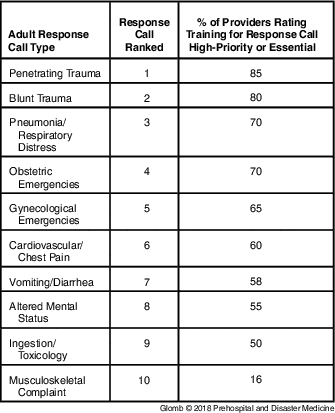
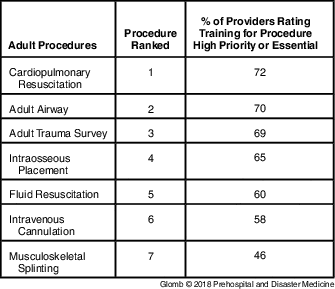
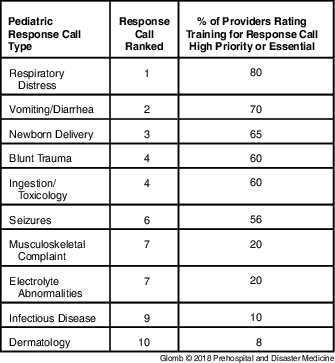
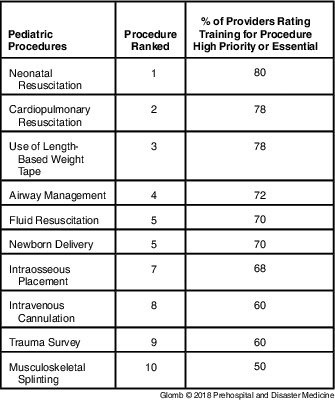
Learning opportunities for adult and pediatric response calls were identified in surveys distributed to a group of 18 EMS providers in Gaborone. Survey participants were staff members of the Botswana MOHW EMS. All 18 participants who were approached provided consent to voluntarily complete the survey during the time of change of shift. All participants who were asked to participate in the survey completed it. For adult response calls, providers prioritized trauma, respiratory distress, obstetric/gynecological emergencies, and cardiovascular/chest pain (Table 1a). The survey for adult procedures prioritized cardiopulmonary resuscitation, airway management, trauma evaluation, intraosseous placement, and fluid resuscitation (Table 1b). Prioritized pediatric response calls included respiratory distress, vomiting/diarrhea, newborn delivery, trauma, and ingestions (Table 2a). Pediatric procedures were prioritized with additional training requested for neonatal resuscitation, cardiopulmonary resuscitation, utilization of a length-based weight tool, airway management, and fluid resuscitation (Table 2b). Participants free-texted response calls not listed that they felt warranted training. These included burn injuries, psychiatric/suicidal ideation, and traumatic brain injury. Free-texted procedures needing training included defibrillation, rapid sequence intubation, and extraction from a vehicle.
Survey Results - Priority for Training Adult Response Calls

Note: Additional requests for adult response call training free-texted by prehospital staff included Burn Injuries, Psychiatric/Suicidal Ideation, and Traumatic Brain Injury.
Survey Results - Priority for Training Adult Procedures

Note: Additional requests for adult procedural training free-texted by prehospital staff included Defibrillation, Rapid Sequence Intubation, and Extraction from Vehicle.
Survey Results - Priority for Training Pediatric Response Calls
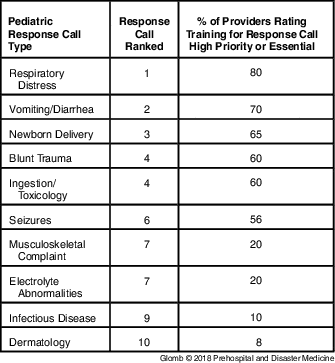
Note: Additional requests for pediatric response call training free-texted by prehospital staff included Burn Injuries and Traumatic Brain Injury.
Survey Results - Priority for Training Pediatric Procedures

Note: Additional requests for pediatric procedural training free-texted by prehospital staff included Rapid Sequence Intubation.
During both the informal interviews with EMS leadership and focus group discussions with EMS providers, participants reported significant gaps in EMS training. A majority of providers had participated in a one-time BLS training and International Trauma Life Support (ITLS) training. There was no other prehospital training or continuing education available to Botswana prehospital providers at that time. A majority of the MOHW prehospital staff had limited to no formal training in prehospital care and they prioritized the need for more training for the management of adult and pediatric patients. For the adults, they identified trauma, respiratory, obstetric/gynecological, gastrointestinal, and altered mental status as the conditions for which they desired further training. They identified trauma, respiratory emergencies, seizures, newborn deliveries, and toxic ingestions as the pediatric conditions for which they desired additional training.
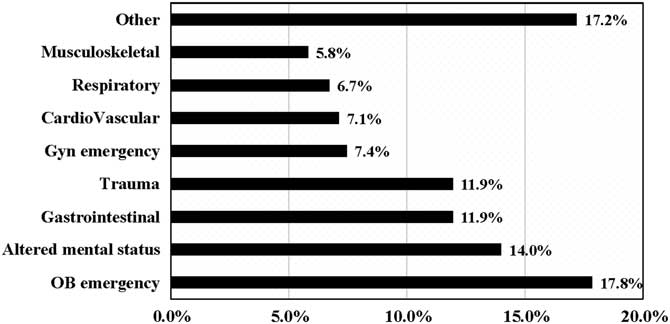
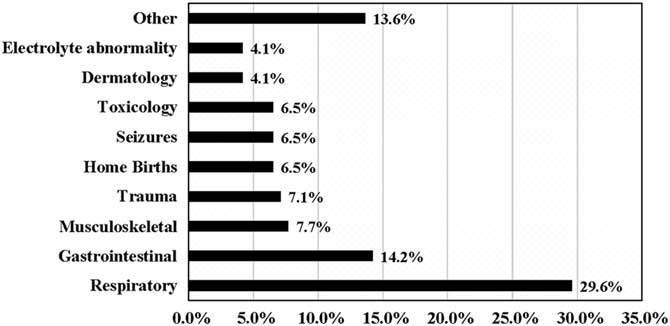
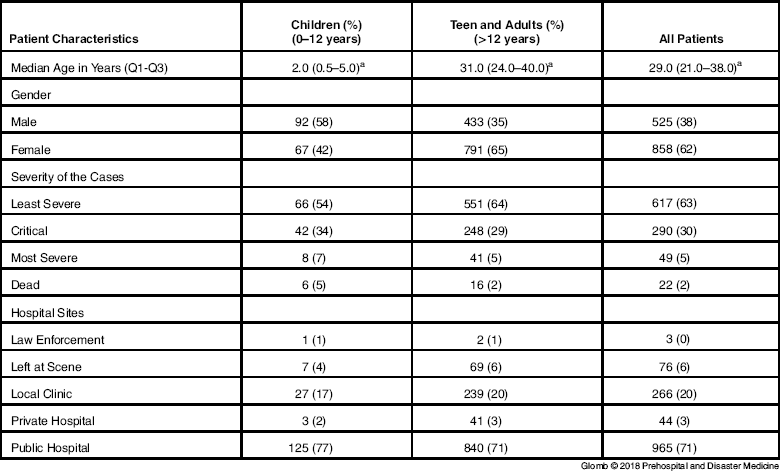
There were 1,506 response calls included for analysis during the study period. The most frequent adult response calls were for obstetric/gynecological emergencies (25%), trauma (18%), altered mental status (14%), gastrointestinal emergencies (12%), cardiovascular emergencies (7%), and respiratory emergencies (7%; Figure 1). Multiple low-frequency response calls including urologic, headaches, ear nose and throat, renal, dermatologic, infectious disease, dental, and social concerns were categorized as “Other” and comprised approximately 17% of all response calls. The most common pediatric response calls were for respiratory distress (30%), trauma/musculoskeletal injuries (15%), gastrointestinal complaints/dehydration (14%), newborn delivery (7%), seizures (7%), toxic ingestion (7%), dermatologic emergencies (4%), and electrolyte abnormalities (4%; Figure 2). Low-frequency response calls including foreign body, ear nose and throat, fever, headache, and social concerns were categorized as “Other.” This comprised approximately 14% of all pediatric response calls. Pediatric patients represented 12% of all response calls in Gaborone. The mean age of pediatric patients was two years, and the highest EMS system utilization was by females (62%; Table 3). Approximately 35% of patients were categorized as “critical” or “most severe,” and a vast majority of patients were delivered to the public hospital by EMS versus other clinical settings (Table 3). The results of the surveys, the gaps identified from the interviews, and the results for most frequent response calls were used to develop a simulation-based curriculum for the EMS system.
Emergency Medical Services Logbook – Chief Complaint for Adults (12+ Years) in Year 2014.

Emergency Medical Services Logbook – Chief Complaints for Children (0–12 Years) in Year 2014.

Characteristics of Pediatric and Adult Patients from Response Calls: Gaborone Emergency Medical Services Logbook 2014

a Inter-quartile range.
Discussion
The most common adult and pediatric prehospital chief complaints in Botswana, a middle-income country, were identified as part of a needs assessment to prioritize training needs. The most common causes of EMS transport in this study were similar to findings from a recent survey of EMS programs in Africa that assessed the leading causes of EMS transport. In order of decreasing frequency, these causes were injury, obstetric, respiratory, cardiovascular, and gastrointestinal complaints.Reference Mould-Millman, Dixon and Sefa 1 Similar trends have been reported in other studies.Reference Mould-Millman, Oteng and Zakariah 6 , Reference de Ramirez, Dull and Carle 7 For adults, the World Health Organization (WHO; Geneva, Switzerland) notes the most common causes of death in sub-Saharan Africa in 2015 were ischemic heart disease, stroke, unintentional injuries, and maternal conditions, 8 consistent with the findings in this study. The most common pediatric transports in this study also overlapped with many of the most common causes of death in children in sub-Saharan Africa in 2015, which include pneumonia, intrapartum causes, diarrhea, and injury. 8 Some areas where the findings diverged from those causes of death included malaria, which is not endemic in the majority of Botswana, and delayed causes of neonatal death from sepsis or complications of prematurity, interventions for which are outside of the short time frame of EMS care. 9
Trauma was a high-priority educational need for both patient age categories in the study, and this may be due to the disproportionately high mortality rates from RTAs in Africa relative to other parts of the world. Sixteen percent of the world’s RTA deaths occur in this region, even though the area accounts for only two percent of the world’s motor vehicles. 10 Although there are likely many factors contributing to this, improved training on trauma care for EMS providers may help to address this disparity.
The EMS participants evaluated their training needs through informal focus group discussions and by completing a Likert scale survey. They prioritized their desire for training in response calls they frequently encounter. Their adult training needs closely matched the high-frequency response calls seen in Gaborone, with the exception of altered mental status. The results of the pediatric training needs mirrored the epidemiology of what prehospital providers see with pediatric response calls. Although low in frequency, the free-texted response calls (burn injuries, psychiatric/suicidal ideation, and traumatic brain injury) pose opportunities for future foci of trainings.
Limitations
Results from the surveys may have been biased, since they were only reviewed by the investigators for face validity and did not undergo a more rigorous validation process. Results from the informal interviews and surveys may have also been limited due to the inexperience of those working in emergency care in Botswana at the time of the assessment and the relative novelty of EMS in Botswana at that time. Conducting a Delphi-type study was not feasible due to the limited number of EMS experts within Botswana. There were also limitations in the date range from which data could be extracted from the record books since the EMS program started in 2012. There may be limited generalizability in stating that these results are reflective of the educational needs of EMS systems in lower-income and rural areas of sub-Saharan African as the data from this study reflect transport in an urban area of a middle-income country. However, since there was similarity between the educational priorities identified from the results of this study and the leading causes of EMS transports and death in other countries in sub-Saharan Africa, it is possible that these data may also be used to direct curriculum development in other similar settings. Another limitation of the study is the reliance on retrospective review of hand-written logbooks, which may be prone to having missing data. In addition, qualitative feedback was only gathered from pioneering EMS personnel in the capital city Gaborone, so the type of feedback received regarding educational needs may not be reflective of the EMS personnel in the entire country.
Conclusion
This study evaluated the most common chief complaints for calls to the Botswana MOHW EMS program. The EMS provider perceived training needs overlapped with the most common chief complaints, which also included common causes of death in this geographic region. The data collected in this needs assessment were used to direct the development and implementation of a locally relevant, simulation-based training program for EMS providers in Botswana.
Acknowledgments
All authors listed above provided assistance or support in this study and provided assistance with manuscript preparation.
Supplementary Material
To view supplementary material for this article, please visit https://doi.org/10.1017/S1049023X18001024