INTRODUCTION
Developing and maintaining an advantage over competitors has become increasingly difficult in today's competitive, volatile markets. High rates of competition offer greater choice and power to consumers. As Bendixen and Abratt (Reference Bendixen and Abratt2007) and Borna and Stears (Reference Borna and Stears1998) point out, the increased attention being paid to consumers is indicative of a positive power shift triggered by greater competition and the effects of globalization. In this context market orientation (MO) (Kohli & Jaworski, Reference Kohli and Jaworski1990; Narver & Slater, Reference Narver and Slater1990) plays an important role. It establishes cultural norms and behaviours that focus on assessing and acting on customers’ needs and anticipating and responding to competitors’ actions.
The key aim of MO is absolute customer satisfaction, not only with regard to the use of the product itself but to the externalities generated by firms in producing and delivering products (Mohr, Webb, & Harris, Reference Mohr, Webb and Harris2001; Crittenden, Crittenden, Ferrell, Ferrell, & Pinney, Reference Crittenden, Crittenden, Ferrell, Ferrell and Pinney2011; Hult, Reference Hult2011). In this sense, as Devinney (Reference Devinney2009) highlighted, the company's ability to recognize customer concerns may lead to business success: ‘corporations with more acceptable practices within a society may have more satisfied customers, more satisfied employees, more satisfied owners and hence would last longer and thrive in more adverse circumstances’ (p. 48). Therefore, acceptable practices such as those under the corporate social responsibility (CSR) banner, represent a high-profile notion that has strategic importance for many companies (Kotler & Lee, Reference Kotler and Lee2004; Porter & Kramer, Reference Porter and Kramer2006; Bondy, Matten, & Moon, Reference Bondy, Matten and Moon2008; Babiak, Reference Babiak2010; Huang, Reference Huang2010; Hult, Reference Hult2011; Brik, Rettab, & Mellahi, Reference Brik, Rettab and Mellahi2011). By dedicating ever-increasing efforts towards activities such as cash donations, in kind-contributions and cause marketing, companies are acting on the premise that CSR is not only the ‘right thing to do’ but also the ‘smart thing to do’ (Mohr, Webb, & Harris, Reference Mohr, Webb and Harris2001; Smith, Reference Smith2003; Frynas, Reference Frynas2008).
Managers should be aware of both the positive and negative externalities generated by their firm, as the overall corporate reputation depends on this (Bendixen & Abratt, Reference Bendixen and Abratt2007; Bondy, Matten, & Moon, Reference Bondy, Matten and Moon2008). Companies adept at addressing consumers’ expectations, and focusing on customers’ satisfaction and well-being, stand to reap greater rewards in the long run (Helfert, Ritter, & Walter, Reference Helfert, Ritter and Walter2002). Hence, consumers and their expectations become a key reference point for any firm (Borna & Stears, Reference Borna and Stears1998).
Many companies are genuinely aware of their social responsibility and the externalities they generate (Aguilera, Rupp, Williams, & Ganapathi, Reference Aguilera, Rupp, Williams and Ganapathi2007). However, Crane (Reference Crane2000) argues that, on occasions, firms act out of what is termed a ‘self-interest ethic’, channelling all efforts towards projecting the appropriate image through communicating their respect for the environment or highlighting their cause-related activities rather than exhibiting authentic concern for consumer needs and interests, and behaving ethically. Therefore, consumers may view some CSR activities as being opportunistic, which can cause CSR to backfire and may lead to consumer boycotts (Smith, Reference Smith2003; Greyser, Reference Greyser2009). As Luo and Bhattacharya (Reference Luo and Bhattacharya2006) comment, it is also possible that firms with limited strategic direction are likely to invest in less influential CSR activities that require less effort (e.g., cash donations). On the other hand, firms that are effective strategic thinkers implement smarter CSR strategies that are relatively idiosyncratic and therefore generate more long-term benefits. However, more evidence is needed on these ideas with authors such as Brik, Rettab, and Mellahi Reference Brik, Rettab and Mellahi(2011), Hult (Reference Hult2011), Frynas (Reference Frynas2008), Qu (2007) and Luo and Bhattacharya (Reference Luo and Bhattacharya2006) calling for a further investigation of possible explanations regarding (a) the links between MO and CSR and (b) the observed returns of CSR depending on the attitudes and characteristics of firms. In addition, Pirithiviraj and Kajendra (2010) and Berens, van Riel, and van Bruggen (Reference Berens, van Riel and van Bruggen2005) call for research which analyses different contexts, industries, types of companies and products. Devinney (Reference Devinney2009) and Bondy, Matten, and Moon (Reference Bondy, Matten and Moon2008) recognize that there is little knowledge about how CSR activities are influenced by the context in which stakeholders (e.g., managers, consumers and investors) find themselves. Devinney (Reference Devinney2009) also highlights that only a few longitudinal studies exist that analyze the causal links between a firm's specific CSR activities and the outcomes that can influence performance (e.g., impact on customers and demands, cost, productivity, efficiency, image, survival, intangibles).
Taking all of these research gaps into account and using the Spanish construction and real-estate sector as a context, this paper aims to complement the CSR literature by (a) identifying the drivers of CSR activities and, in particular, the potential links between MO and CSR, (b) analyzing the implications for firm–customer links and (c) discussing implications for the management of CSR activities in firms. In the following section, the CSR concept is discussed and the literature on the linkage between MO and CSR is explored. The third section contains the results of a longitudinal study of the CSR activities within the Spanish construction and real-estate sector. Implications and conclusions are provided in the last sections of the paper.
CSR AND MO
CSR
Bowen's (Reference Bowen1953) early work defined CSR as being the obligations of business people to develop policies, decisions and actions based on values and benefits to society. More recently, CSR has been defined as the company's activities and status related to its perceived societal or stakeholder obligations (Sen & Bhattacharya, Reference Sen and Bhattacharya2001; Luo & Bhattacharya, Reference Luo and Bhattacharya2006; Frynas, Reference Frynas2008). CSR is also understood to relate to an obligation on firms to be responsible for the environment and their stakeholders in a manner that goes beyond financial and legal goals (Huang, Reference Huang2010).
In defining CSR, many researchers make reference to the framework proposed by Carroll (Reference Carroll1998) that presents four dimensions of CSR: economic, legal, ethical and philanthropic. Each dimension can be examined in relation to the various stakeholders of the firm: owners, customers, employees, the community and society at large (Mohr, Webb, & Harris, Reference Mohr, Webb and Harris2001).
However, Devinney (Reference Devinney2009) highlighted that the definition of CSR has itself been malleable (p. 45), for example, ‘to those with a more corporatist orientation, CSR includes activities such as mandated environmental and occupational health as well as safety practices but excludes claims by outside stakeholders on the profits of the firm; to those with a more expansive viewpoint, CSR involves corporations acting on behalf of the disadvantaged and the demands of broad sections of the society’.
In any case, CSR activities may reflect the organization's attitude and behaviour with respect to its perceived societal obligations (Bondy, Matten, & Moon, Reference Bondy, Matten and Moon2008; Babiak, Reference Babiak2010). Although they are often unrelated to the company's abilities to produce goods and services (Brown & Dacin, Reference Brown and Dacin1997) global literature suggests that CSR actions may help to create a reputation that a firm is reliable and honest (Brik, Rettab, & Mellahi, Reference Brik, Rettab and Mellahi2011). Consumers may avoid buying products from companies that harm society and may actively seek out alternative products from companies that help society and demonstrate socially responsible actions (Mohr, Webb, & Harris, Reference Mohr, Webb and Harris2001). CSR may therefore be a strategic asset for firms (Mohr & Sarin, Reference Mohr and Sarin2009).
MO
The concept of MO is rooted in the works of Narver and Slater (Reference Narver and Slater1990) and Kohli and Jaworski (Reference Kohli and Jaworski1990). Narver and Slater (Reference Narver and Slater1990) conceptualize MO as an organizational culture made up of three core dimensions: (a) customer orientation – understanding target customers in order to generate sustainable higher value for them – for which customer needs, desires and present/potential perceptions must be identified; (b) competitor orientation – understanding and becoming familiar with the value alternatives in order to create the competitive advantage needed to guarantee long-term sustainability; (c) inter-functional coordination – required in order for information to flow effectively (formally or informally) and reach responsible parties.
The behavioural approach proposed by Kohli and Jaworski (Reference Kohli and Jaworski1990) revolves around (a) market information gathering or intelligence generation on customers, competitors and other agents; (b) dissemination of intelligence throughout the organization; and (c) responsiveness, requiring effective inter-functional coordination.
The approaches do not conflict but are complementary, as Gao and Bradley (Reference Gao and Bradley2007), Helfert, Ritter, and Walter (Reference Helfert, Ritter and Walter2002), and Cadogan & Diamontopoulos (Reference Cadogan and Diamontopoulos1995) have acknowledged. Both perspectives have conceptual and operational overlaps in nearly all dimensions. Specifically, Gounaris, Avlonitis, and Papastathopoulou (Reference Gounaris, Avlonitis and Papastathopoulou2004) highlight that MO represents the implementation of the marketing concept and it is a cultural orientation with behavioural implications since it focuses on organizational efforts, on understanding the market and on developing strategies in response to market opportunities or threats.
In recent years, for example, the MO approach has enabled many firms to understand their customers better and also their social responsibility concerns. Hence, the case can be made that market-oriented activities foster a newfound awareness of social concerns and awaken a sense of corporate responsibility in firms. Companies become interested not only in consumption needs but in their customers’ social concerns as well. As a result, firms develop socially responsible behaviours that society in general, and consumers in particular, value and which have a positive impact on company image and performance (Mohr, Webb, & Harris, Reference Mohr, Webb and Harris2001; Ferrell, Gonzalez-Padron, Hult, & Maignan, Reference Ferrell, Gonzalez-Padron, Hult and Maignan2010; Nikolaeva & Bicho, Reference Nikolaeva and Bicho2011; Brik, Rettab, & Mellahi, Reference Brik, Rettab and Mellahi2011). This idea may anticipate links between MO and CSR.
Potential link between MO and CSR
The work of Mohr and Sarin (Reference Mohr and Sarin2009) suggests that there are potential links between MO and CSR. These authors highlight that CSR is one of the emerging areas in marketing theory and practice. Firms have a responsibility to serve society's larger needs and therefore marketers should manage the linkages between economic success and social justice (e.g., Qu, 2007; Pirithiviraj & Kajendra, 2010; Crittenden et al., Reference Crittenden, Crittenden, Ferrell, Ferrell and Pinney2011; Hult, Reference Hult2011; Brik, Rettab, & Mellahi, Reference Brik, Rettab and Mellahi2011). Customer satisfaction is one of the key aspects in the marketing arena. Firms must provide value to their customers by identifying and fulfilling the needs and expectations of their customers (Pirithiviraj & Kajendra, 2010). Awareness of social issues has increased in society and customers have become socially sensitive (Ferrell et al., Reference Ferrell, Gonzalez-Padron, Hult and Maignan2010). As a consequence, customers have social expectations and expect firms to contribute to social activities (Maignan, Reference Maignan2001). Marketers must therefore broaden the marketing concept beyond current customers and competitors to include present and future consumer and societal needs (Ferrell et al., Reference Ferrell, Gonzalez-Padron, Hult and Maignan2010).
Firms may need to achieve a good reputation based on CSR before customers become interested in their products (Hult, Reference Hult2011). Customers are more and more interested in the fairness and transparency of a company and on the environmental impact of their products (Ferrell et al., Reference Ferrell, Gonzalez-Padron, Hult and Maignan2010). Market-oriented firms are likely to be in a privileged position and seek to understand customers’ expressed and latent needs and develop superior solutions to those needs in order to add value to their customers (Mohr & Sarin, Reference Mohr and Sarin2009; Ferrell et al., Reference Ferrell, Gonzalez-Padron, Hult and Maignan2010; Crittenden et al., Reference Crittenden, Crittenden, Ferrell, Ferrell and Pinney2011). Market-oriented firms are therefore more likely to be among the first to appreciate that CSR activities are more and more important for customers and as a result are more likely to act in accordance with the bases of CSR (Qu, 2007). Market-oriented cultures encourage firms to develop activities associated with CSR (Maignan, Ferrell, & Hult, Reference Maignan, Ferrell and Hult1999).
Overall, market-oriented firms are strategically aligned with market needs and expectations (e.g., social issues) as well as with the interest of multiple stakeholders and therefore these firms are concerned about social responsibility-type issues involving economic, environmental and social dimensions (Hult, Reference Hult2011). In any case, a firm needs to identify what a market really values and address this better than the competition. Links between MO and CSR may be intuitively suggested, as market-oriented firms are likely to address the needs of customers who have social concerns (e.g., Ferrell et al., Reference Ferrell, Gonzalez-Padron, Hult and Maignan2010; Hult, Reference Hult2011).
The value of CSR
The works of Luo and Bhattacharya (Reference Luo and Bhattacharya2006) and Berens, van Riel, and van Bruggen (Reference Berens, van Riel and van Bruggen2005) explicitly propose that CSR is a driver of customer satisfaction and therefore profitability. As Mohr, Webb, and Harris (Reference Mohr, Webb and Harris2001) comment, the key is doing business in a way that maintains or improves both the customers’ and society's well-being. Arguments supporting positive links between CSR and customer satisfaction propose that people are more likely to be satisfied by products from socially responsible firms (Daub & Ergenzinger, Reference Daub and Ergenzinger2005), because a strong record of CSR creates a favourable context that positively boosts consumers’ evaluations of and attitudes towards the firm (Sen & Bhattacharya, Reference Sen and Bhattacharya2001; Gürhan-Canli & Batra, Reference Gürhan-Canli and Batra2004) and contributes to greater customer loyalty, positive word-of-mouth and, sometimes, the customer's willingness to pay (Homburg, Koschate, & Hoyer, Reference Homburg, Koschate and Hoyer2005). Consumers’ cognitive associations with a company can therefore be both a strategic asset and a source of sustainable competitive advantage (Brown & Dacin, Reference Brown and Dacin1997).
This may explain why many firms focus on environmental friendliness, commitment to diversity in recruitment and human resource policies, community involvement, sponsorship of cultural activities or corporate philanthropy. Other companies increase their visibility in their support of social causes through cause-related marketing (Brown & Dacin, Reference Brown and Dacin1997).
Based on the above arguments, many companies have developed large advertising campaigns promoting their good works in order to build a positive image (Mohr, Webb, & Harris, Reference Mohr, Webb and Harris2001; Greyser, Reference Greyser2009; Worcester, Reference Worcester2009; Blumrodt, Desbordes, & Bodin, Reference Blumrodt, Desbordes and Bodin2010). When the market perceives a fit between CSR activities and the product/corporate brand (e.g., type of action) the impact of CSR on income increases (Roberts & Dowling, Reference Roberts and Dowling2002; Berens, van Riel, & van Bruggen, Reference Berens, van Riel and van Bruggen2005). The work of Handelman and Arnold (Reference Handelman and Arnold1999) established that there is a minimum acceptable level of socially oriented marketing actions, below which the effectiveness of a firm's activities are hindered significantly. But sometimes CSR actually reduces customer satisfaction levels, in firms where it is viewed by customers as simply being opportunistic behaviour (Mohr, Webb, & Harris, Reference Mohr, Webb and Harris2001).
Therefore, as most of the papers referenced in this section suggest, more research is needed into (a) the MO–CSR interaction and (b) firm attitudes and behaviours with regards the implementation of CSR activities.
EMPIRICAL STUDY
The research objectives
The main objective of the study was to determine the extent to which firms are genuinely concerned about CSR and explore the drivers that result in firms implementing CSR-related activities. As part of this, the research had the following sub-objectives:
1. To understand what is perceived as being CSR.
2. To explore the rationale for adopting CSR activities.
3. To examine linkages between customer expectations, market conditions and the marketing orientation of organizations with regards the adoption of specific CSR activities.
The research was undertaken in the Spanish construction and real-estate sector, a sector going through major market challenges and therefore providing a good context for the study. Characteristics of the industry are shown in Appendix 1.
Case design
As an analytical tool, case studies are increasingly common in business research. They have been used to analyze very diverse phenomena including ethical and CSR issues (e.g., Cambra, Hart, & Polo, Reference Cambra, Hart and Polo2008; Maon, Lindgreen, & Swaen, Reference Maon, Lindgreen and Swaen2009), and are well suited to the initial research questions posed here. Information was analyzed by a qualitative interpretative research methodology (see, e.g., the work of Jamali, Safieddine, & Rabbath, Reference Jamali, Safieddine and Rabbath2008).
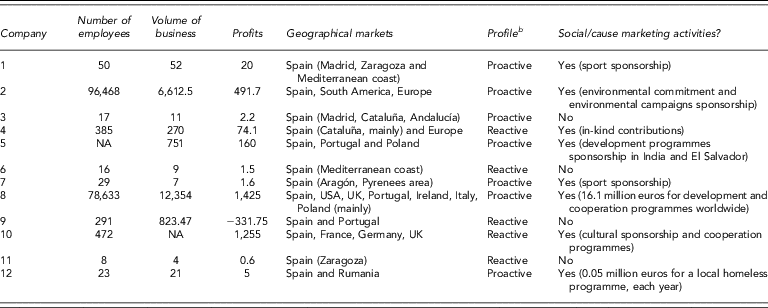
The present study is designed according to what Yin (Reference Yin1994) refers to as the multi-case research model. Twelve firms from the Spanish construction and real-estate industry were analyzed, considering both their attention to customers and their implementation, if so, of CSR activities. More details about the procedure are included in the following subsections. Key characteristics of these companies can be observed in Table 1. Numbers replace company names to ensure anonymity.
Companies’ main characteristicsFootnote a

Note. a Volume of business and profits are expressed in millions of euros.
b Profile is based on the results of the data analysis.
Following Yin's recommendations (Reference Yin1994), internal validity was guaranteed by triangulating the data – in other words, using various sources of information (i.e., semi-structured interviews, direct observation, analysis of internal documents, secondary data). External validity was tested in accordance with the principles of analytic generalization and replicability, while reliability was ensured by establishing an initial protocol for procedure and elaborating a full database. Such measures were complemented by a review of conclusions carried out by company managers and external evaluators. More robust results were achieved by examining a number of independent cases (in the same sector) rather than limiting the study to a single case. Additional cases were examined until the theoretical saturation point was achieved (12 cases); that is, the stage at which new data no longer added significantly to results (Strauss & Corbin, Reference Strauss and Corbin1998).
Procedure
For the present study, the organizational characteristics of a set of firms were analyzed, including factors such as size, structure, ownership, accounting data and experience. Heterogeneity was a key objective here in order to ensure the representativeness of the conclusions. A set of firms in the Spanish context was established: big, medium and small size; national and international markets; family and non-family firms. At the outset, managers were contacted to discuss research objectives and establish a functional timetable aimed at keeping disruption of daily activity to a minimum. The first informal company visits identified the key informants (George & Torger, Reference George and Torger1982; Kumar, Stern, & Anderson, Reference Kumar, Stern and Anderson1993) who would participate in a series of personal interviews: the Managing Director (sometimes also the owner) and/or the Chief Marketing Officer who, depending on company size and structure, may act as the Managing Director.
Primary information was obtained, principally from 15 semi-structured, in-depth interviews with managers in February and March 2007. No conclusions were drawn until early 2008. A second set of interviews was developed between May and July 2009. This temporal framework allowed the researchers to analyze the processes of structural re-adjustment from a positive cycle (started in 1998) to a big-crisis period (happened by the end of 2007). During all of this period the researchers were allowed to visit the firms’ headquarters and develop further informal interviews with employees, as well as analyze business plans, financial information and customer feedback, adding a longitudinal dimension to the study. The following aspects served as a guideline for analysis:
• General information about the firm; interviewees experience and position.
• The firm's CSR policy and its marketing strategy.
• Organizational strategies for identifying and analyzing customer needs/concerns as well as monitoring the activities of competitors
• The potential influence on business performance.
• Opinions about industry trends.
Interviews lasted ∼1 hr each, and were recorded and transcribed (quotes reported in this article are literal translations from the Spanish). A short guide for the interviews was developed as reference:
1. How do you define CSR?
2. Does your firm develop CSR activities?
3. If so, who or what is behind those activities?
4. How did the market value such activities?
5. Are CSR initiatives influenced by the economic environment?
6. What are the implications?
Additional information was obtained through direct observation in sales and marketing departments. The research team was present in some departmental meetings where marketing and CSR activities were discussed. Notes from these meetings contributed to strengthen information collected through in-depth interviews. A variety of internal and external documents, press articles and web pages were used to develop a complete database, allowing for data triangulation. All information was analyzed using QSR NVivo qualitative data analysis software. The utility of specialized software for analyzing qualitative data has already been discussed and supported by authors such as Sinkovics, Penz, and Ghauri (Reference Sinkovics, Penz and Ghauri2005) or Maclaran and Catterall (Reference Maclaran and Catterall2002) among others. All of the research team members developed individual analysis of the database and coding systems. Analysis of the cases was developed into sets of three firms, grouped by similarities of characteristics (size and markets, mainly). Common patterns were then identified between sets. This procedure is related to replicability and analytic generalization. After these individual tasks, meetings took place involving all of the research team and then early conclusions were discussed. As a result of this interaction only one common coding system was finally defined. This strategy allowed assumptions to be triangulated as well as building-up validity, reliability and objectivity. For example, the research of Mohr, Webb, and Harris (Reference Mohr, Webb and Harris2001) followed the same strategy.
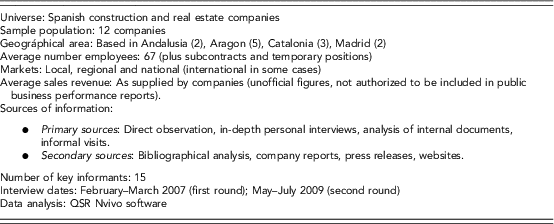
Notes from each interview session, as well as the related ideas extracted from the database, were sent to key informants for subsequent discussion. After a period of reflection for both researchers and interviewees a schedule for subsequent meetings was established. Following this exchange, informants were provided with a brief summary of the main conclusions and asked for their opinion regarding the ideas they contained. This technique of sending interview notes/conclusions to key informants for feedback is proposed by Miles and Huberman (Reference Miles and Huberman1994) and Yin (Reference Yin1994), among others. As a consequence of such interaction valuable insight on the initial research was obtained, enabling erroneous interpretations to be corrected. Notes and preliminary conclusions were also reviewed by the full research team, in an attempt to reduce bias as much as possible. Table 2 shows the main characteristics of the fieldwork.
Fieldwork – technical specifications
RESULTS
During the process of information analysis and coding the research team worked with both theoretical (a priori variables, based on literature review) and induced variables (as a result of the data analysis). Table 1 shows the firms’ profiles, based on information obtained from firms and ‘demographic’ codes. The research focused specifically on corporate community investment (Porter & Kramer, Reference Porter and Kramer2006) as an indicator of CSR activities because it can be objectively observed. This concept proposes the alignment of the firm's objectives with the environmental and societal needs of the community. Examples of corporate community investments may be sponsorship, patronage, cash donations or social/cause marketing (Varadarajan & Menon, Reference Varadarajan and Menon1988; Carringer, Reference Carringer1994; Pringle & Thompson, Reference Pringle and Thompson1999).
The final coding structure and variable definitions were the result of the content analysis. Some of the most representative reflections, taken verbatim from the interviews, serve as scaffolding for the discussion of the findings. More data are available in the complete database.
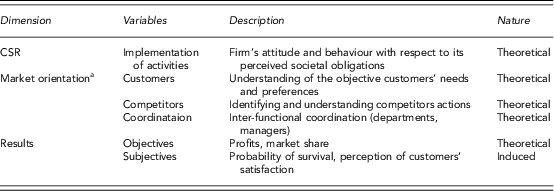
Key variables
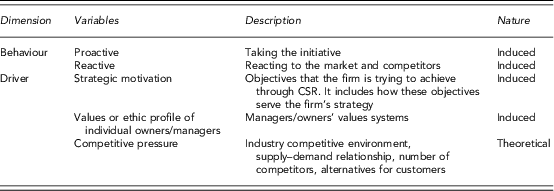
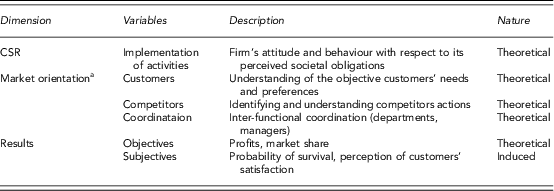
An initial analysis of data enabled the establishment of a set of key variables, most of these related to the literature review. These variables and their definitions are shown in Table 3.
Structural variables
Note. aDuring the data analysis the cultural approach of MO seemed to be more adequate than the behavioural proposal.
CSR = corporate social responsibility; MO = market orientation.
Why do firms adopt MO? Do firms present different behavioural profiles?
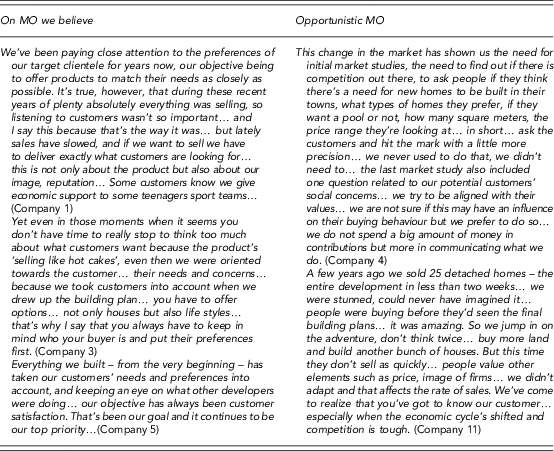
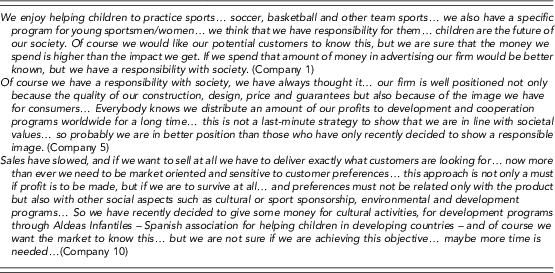
In-depth analysis suggests that concern for customers is increasingly prevalent. In fact, it seems a number of companies have always gone out of their way to identify and analyze customers’ needs as a first step in defining product profiles. For this set of companies, values of shareholders and/or managers seem to be key for implementing MO. Other companies, however, recognize that they have shown little concern for customers until very recently. In this case, market structure, the economic cycle and the competitive pressure seem to be the drivers of MO. Table 4 reproduces some examples of ideas provided by managers.
Why do firms adopt mo? Some examples
Note. MO = market orientation.
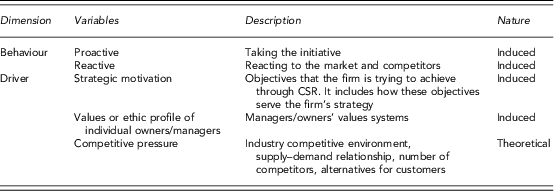
Some statements similar to those included above suggested different patterns in behaviour and recommended new variables, which are included in Table 4. In-depth analysis of the evidence seems to propose two groups: proactive firms (1, 2, 3, 5, 7, 8 and 12) and reactive firms (4, 6, 9, 10 and 11). This supports the notion that increased competitive pressure raises interest in analyzing customer needs and preferences and matches with ideas proposed by authors such as Atuahene-Gima, Slater, and Olson (Reference Atuahene-Gima, Slater and Olson2005) or Narver, Slater, and MacLachlan (Reference Narver, Slater and MacLachlan2004), among others. These authors state that reactive firms address the expressed needs of customers and think in terms of short-term profits while proactive firms address the latent needs of the market, anticipate decisions and future trends, and create opportunities for providing value in the future (Table 5).
Patterns of behaviour
Note. CSR = corporate social responsibility.
Links between MO and CSR
The data also suggested linkages between MO and social responsibility issues. However, once again there were two groups: proactive firms undertaking CSR (1, 2, 5, 7, 8 and 12) and those that were more reactive (4 and 10). Firms 6 and 11 recognized that they were thinking about implementing some CSR activities to develop a better image but they had not started yet. Firm 9 used to spend some money in development projects in South America but, because of the firm's negative results, managers decided to suspend this activity and this was implicitly recognized as reactive and non-altruistic behaviour.
Various marketing campaigns by different companies (e.g., Companies 7 and 12 at the local level; Companies 1, 2, 4 and 10 at the national level; and Companies 5 and 8 at international level) exhibit concern not only for the particular characteristics of product use/consumption but also far broader societal concerns. As can be observed in Table 1, three are related to sport sponsorship, which may be considered to be advertising more than CSR. But analyzing the type of sponsorship (young sportsmen/women or amateurs teams) this would suggest a form of social responsibility. And five are related to social development, cooperation or the environment. Table 6 reproduces some verbatims as examples of the above ideas.
Links between mo and csr; some examples
Note. CSR = corporate social responsibility; MO = market orientation.
Based on the interviews, it is evident that those firms who were pioneers in implementing MO (proactive and market-driven firms) in this sector have been operating social responsibility activities for a long time and, based on their managers’ opinions, they have already developed an image which is in line with society's concerns. From the managers’ perception, they are getting better results than competitors, so reactive firms are starting to imitate their social responsibility activities and their marketing orientation strategy. Such strategies related to CSR may influence how consumers think about a company but they may provide consumers with very little information about the actual products that the real-estate companies produce. However, those firms exhibiting concern for their customers, driven by a better understanding of demand, tend to enjoy good competitive positioning and positive business performance (e.g., survival, profits).
Additional perceptions
Finally, through the entire database, there was a need to examine if company size impacts on drivers of CSR. The data suggest that size does not appear to affect the firm's propensity to undertake CSR activities, although it does seem to be a factor boosting concern for customers. These ideas match with comments made by Orlitzky (Reference Orlitzky2001). The fact that CSR can be understood as a way of doing business gives rise to closer links between a firm's marketing activities and their overall organizational philosophy, mission and objectives, as well as turning a spotlight on owner and administrator profiles. The data also suggest, however, that the greater a company's concern for customers and their general interest in the environment, the greater the probability of responding effectively to customers’ needs and expectations, hence fostering growth. That is, the bigger the firm the greater the concern for customers – even if this concern is merely the result of the firm's view of customers as a growth-prompting factor. These findings are based on the data included in Table 1 and scrutiny of relationship between size, structure and performance variables.
The data seem to confirm that, regardless of the underlying motivation behind a company's demonstration of concern for customers, be it genuine or purely egoist, the core objective is short- or long-term profit. In others, it has more to do with a sense of responsibility with customers and society. In yet a third set of cases, it is born of a need to adapt to the market, to adopt the rules of the game for the mere purpose of survival (depending on the industry evolution).
DISCUSSION AND IMPLICATIONS FOR MANAGEMENT
As Devinney (Reference Devinney2009: 46) comments, the traditional viewpoint of socially responsible behaviours derives from the belief that firms receive an implicit and broad moral sanction and reward from the market and society and hence are required by that sanction to operate within the economic, legal, political and social norms of that society.
CSR activities appear to be linked, fundamentally, to (a) the structure of the shareholders and managers’ values and (b) the competition and market criteria. They reflect the commitment of firms to be responsible for the environment and for their stakeholders. Our research seems to indicate that drivers of CSR may be different because sometimes CSR initiatives are adopted as a response to shareholders proposals or as a response to external pressures (e.g., industry competitors, market share). Nevertheless, concern may be reinforced by an organization's focus on the ethical issues that are important for customers, owners and managers.
This research suggests that proactive and traditionally market-oriented firms develop better market positions than reactive firms: proactive firms are able not only to diagnose current needs or expectations of the market but also to anticipate future trends. Therefore this result positions this research in line with ideas proposed by Atuahene-Gima, Slater, and Olson (Reference Atuahene-Gima, Slater and Olson2005), Narver, Slater, and MacLachlan (Reference Narver, Slater and MacLachlan2004) or Day (Reference Day1994).
The enormous amount of competitive pressure on firms today has increasingly made the customer a force to be reckoned with, regardless of the market or sector in question. In order to satisfy customers, firms will have to first identify their needs – not only their product/service needs but, more and more, their social concerns as well. As Mohr and Sarin (Reference Mohr and Sarin2009) highlight, what the customer thinks, believes and wants, at any time, must be accepted by firms as impacting on their objectives and therefore firms must make big efforts to get answers from the market. Only in this way will companies be in a position to develop a positive brand image, adapt products to their environment and hence create and deliver more value than their competitors. This may reinforce the view that there are links between MO and CSR (Qu, 2007; Pirithiviraj & Kajendra, 2010; Hult, Reference Hult2011; Brik, Rettab, & Mellahi, Reference Brik, Rettab and Mellahi2011). Indeed, companies should realize that CSR initiatives can represent a robust public relations strategy, particularly in the current market environment in which stakeholders may have strong social concerns (Luo & Bhattacharya, Reference Luo and Bhattacharya2006; Frynas, Reference Frynas2008; Blumrodt, Desbordes, & Bodin, Reference Blumrodt, Desbordes and Bodin2010). Therefore, CSR activities may help capture customers’ favourable attention.
This research suggests that firms are able to increase customer satisfaction by implementing socially responsible activities, which in turn leads to positive, financial and non-financial (e.g., profits, survival, reputation) outcomes. Those firms which pay more attention to their customers and develop CSR initiatives seem to have a better market position than those who do not, as socially responsible firms may receive a more favourable corporate evaluation from consumers. These actions must be integrated fully with the traditional economic-oriented marketing actions undertaken at a strategic level.
However, this research also suggests that, under certain conditions, firms are not always able to benefit from CSR actions. When firms are reactive and the market perceives there to be opportunistic behaviours, CSR may reduce market returns. The data also indicate that proactive firms with experience and tradition in satisfying customers’ needs and CSR wants are more likely to obtain positive returns. Firms will be guided by their ethical conscience and should follow the interests of society. Therefore, managers should understand that a misalignment of CSR with internal factors and market perceptions can be detrimental and lead to a decrease in income. Social responsibility can be considered truly a top priority only after managers have committed resources and have demonstrated their willingness to trade off other priorities for social responsibility. This research also indicates that firms with more customer-accepted practices have more satisfied stakeholders (e.g., customers, employees, owners) and hence last longer and thrive in more adverse circumstances (e.g., survival).
Differences about the efficacy of CSR may exist and therefore the debate is still open. The key question may be related to the definition of what ‘social’ and ‘responsibility’ mean. Whatever the case is, the research suggests that firms that implement the MO construct are in a better position to identify demand and analyze the competition. Proactive approaches are more appropriate than reactive ones. As a result of orienting activity towards the market, an increasing number of companies are experiencing a growing concern for social issues. This suggests that socially responsible behaviours need not be incompatible with value creation. A healthy balance between purely economic objectives and social concerns can be reached.
As societies mature, a gradual increase occurs in the interest in social issues. This may explain the growing number of companies exhibiting a genuine interest in customers and explicitly adhering to CSR activities and ethical norms. It is generally accepted that such behaviours have short and long-term positive effects that contribute to boosting performance and overall company value. This may manifest itself as customer willingness to pay more for certain products (Homburg, Koschate, & Hoyer, Reference Homburg, Koschate and Hoyer2005), for example, or higher customer fidelity (Helfert, Ritter, & Walter, Reference Helfert, Ritter and Walter2002).
Frequently, companies expect society to appreciate their efforts under the assumption that such behaviours will convey a positive message to customers and enhance corporate reputation (Bendixen & Abratt, Reference Bendixen and Abratt2007; Greyser, Reference Greyser2009; Worcester, Reference Worcester2009; Blumrodt, Desbordes, & Bodin, Reference Blumrodt, Desbordes and Bodin2010; Ferrell et al., Reference Ferrell, Gonzalez-Padron, Hult and Maignan2010). To this end, behaviour consistent with customers’ concerns strengthens corporate reputation, except in those cases where the market perceives opportunistic behaviours, as Devinney (Reference Devinney2009) and Bartkus and Glassman (Reference Bartkus and Glassman2008) already commented.
Better competitive positioning may well be linked to an (a) MO and (b) CSR activities, and CSR may be an effective marketing tool today and in the future as authors such as Luo and Bhattacharya (Reference Luo and Bhattacharya2006) or Berens, van Riel, and van Bruggen (Reference Berens, van Riel and van Bruggen2005) also suggest.
Despite the relevance of the conclusions and the richness of the implications for professional practice and management, the following limitations are worthy of mention. This study is only based on the specificities of 12 firms in the Spanish construction and real-estate industry. This sector suffered significant readjustment during the period of this research, so some biases may arise. The cultural dimension (Spain) may also create issues when researchers attempt to operationalize a definition of CSR that reveals when a firm is or is not socially, ethically or politically responsible, or acting in accordance with conflicting and confusing norms of a society. However, this may be considered one of the inherent limitations of case study methodology. As to the study being limited to a 12-company sample population, this is due to the fact that theoretical saturation was reached at 12 (Strauss & Corbin, Reference Strauss and Corbin1998). Moreover, the study's longitudinal approach facilitates an analysis of conjectural change in the phenomenon of reference.
CONCLUSIONS
This research demonstrates that managers think that CSR activities may be highly valued by consumers. The data suggest that, for the sector analyzed, two types of firms exist: those firms that are traditionally market and CSR oriented (proactive) and those that are more reactive and opportunistic. Proactive firms seem to be better prepared for times of both strong and weak demand than are reactive firms (which seem to analyze customers’ needs and preferences only when demand decreases). Links between MO and CSR have also been suggested.
However, more research is needed to get more robust conclusions. Proposals for future lines of research include repeating the study in different sectors and cultural/geographical contexts. The objective would be to enrich findings and broaden the scope by including new factors in the discussion (i.e., cultural issues). Furthermore, it would be interesting to look into the adoption processes of organizations that have not yet implemented the CSR concept. Lastly, studies which approach the problem from the customer's perspective would be interesting as well, with a focus on the customers’ assessment of the degree of CSR in firms and distinguishing between those organizations that adopt CSR freely and those that do so in reaction to competitive and/or legal pressures; in other words, to determine the extent to which CSR leads to higher/lower levels of customer satisfaction and analyze the possible repercussions of such perceptions on corporate reputation.
Acknowledgements
The authors wish to show their gratitude for comments received from reviewers and from the former editor, Prof. Charmine Hartel. The authors also wish to express their gratitude for the financial support received from the Ministry of Science and Technology of Spain (ECO2011-23027) and from the Aragón Regional Government through the Generés (S09) and Fondo Social Europeo.
APPENDIX 1: THE INDUSTRY
Changes in the Spanish construction and real-estate industry have traditionally followed a cyclical pattern. In 1986, following a decade-long recession, the housing market entered a period of expansion, which lasted until 1991. Yet, in 1992, the advent of a new recession in the Spanish economy triggered a crisis in the real-estate market. Sales fell considerably and residential real estate lost some of the over-inflated value it had accumulated in previous boom years. Based on data from the INE (Spanish National Statistics Institute) we can summarize the evolution of the industry. In 1998, a number of factors converged (e.g., a 4.5% increase in GDP, dropping interest rates, a growing population and compliance with the Maastricht Treaty benchmarks for inclusion in the European Union) creating an economic and social framework that led to an unprecedented new boom cycle. By late 2007, however, most indicators predicted the onslaught of yet another real-estate slump due to oversupply, diving demand, tougher lending conditions and soaring prices. By early 2008, the number of unsold new homes had reached 650,000.
Thus, the Spanish real-estate sector has undergone a very difficult and, according to many experts, necessary adjustment period, shifting from a seller's market to a buyer's market. Many firms are facing a notable drop in sales volume or, in the best case scenario, a plateau in their sales. Many others in the sector will go out of business altogether. We have to consider that most of the firms integrated both construction and real state activities, so problem in commercialization are affecting to the whole supply chain.