By 1890, a growing number of opera critics, vocal instructors, performers and enthusiasts of late Romantic opera were concerned that a crisis was once again overtaking French operatic performance.Footnote 1 Many publicly lamented that few singers of either sex remained who could tackle the Opéra’s programmed repertoire or maintain their voices in a professional setting for sustained periods of time. Such anxieties concerning French operatic training had periodically been voiced throughout the century. What differentiated this new perceived crisis is that it developed alongside ever-growing interest from both scientists and musicians in the mechanism of the voice and the physiology of the larynx. Indeed, by the late nineteenth century, laryngology was emerging as a promising new field of medical research, bringing with it an increased awareness and knowledge of vocal health. In medical journals and books on the topics, physiologists and physicians argued that a failure to promote good vocal hygiene grounded in a physiological understanding of the voice was partly to blame for the floundering of French operatic performance. For these writers, the key to strengthening voices partly rested on embedding new medical knowledge into vocal pedagogy.
Fearing for the future of French opera, many demanded that the Paris Conservatoire – an establishment renowned for its conservatism – institute pedagogical reforms.Footnote 2 In 1892, director Ambroise Thomas responded by offering a course specifically geared towards the teaching of vocal health by a medical professional: the physician Achille Gouguenheim (1839–1901). By the 1890s, Gouguenheim had become a leading figure in the burgeoning field of laryngology. As director of medical service at the Lariboisière hospital (which held one of the few throat clinics at the time), co-editor of the Annales des maladies de l’oreille et du larynx and author of numerous books on the topic, Gouguenheim was certainly an obvious choice. Since the early 1870s, he had also held the post of physician to the Conservatoire. In 1892, however, laryngology remained a fairly new subject, which at that point had only been taught at the Paris medical faculty for two years.
While there is no evidence that Gouguenheim’s position as a lecturer at the Conservatoire was renewed after 1892, the published content of his course can nevertheless serve to complicate our understanding of fin-de-siècle French operatic vocal training and of the factors – especially medical – that informed a singer’s early development at this time. Drawing on contemporary medical journals, the writings of music critics and archival documents, the following discussion explores the tensions that existed in late nineteenth-century musical training in relation to medical developments and research on the physiology of the voice. We also review Gouguenheim’s instructional efforts and argue that the seemingly benign and objective topics of his lectures on vocal health and hygiene in fact constituted fairly proscriptive statements concerning living arrangements, activities, clothing and behaviours deemed acceptable for students of the Conservatoire. Thus in Gouguenheim’s lessons, laryngology became not just a way to improve voices, but also an instrument for reinforcing class-based sensitivities directly into training practices, thereby using science to define who should and should not be considered a French artist.
Singing corpses and breaking voices
Until the invention of the laryngoscope in the mid-nineteenth century, studies on the physiology of the voice were mostly limited to external observations and experiments on cadavers. In the eighteenth century, physician Antoine Ferrein argued – based on experiments with the larynges of corpses – that the human voice was produced as air emitted from the lungs vibrated through what he newly termed the ‘vocal cords’. The publication of Ferrein’s De la formation de la voix de l’homme in 1741 popularised his analogy that the larynx functioned in a manner similar to a reed instrument rather than a flute, as his predecessor, and physician to the king, Claude Dodart, had claimed.Footnote 3 The physiology of the larynx continued to absorb scientists, partly because of general interest in its afflictions – most prominently the croup, glottal edema and chronic laryngeal consumption – and partly because of curiosity regarding the mechanisms by which the voice – both spoken and sung – was produced.Footnote 4 Numerous observations on the topic were published in the years following Ferrein’s work, including those of physiologist François Magendie, who experimented on dogs to elucidate the mechanism by which sound is produced through the larynx, and physician Francesco Bennati, who accompanied his own findings on the physiology of the voice and certain ailments of the throat with his notes on professional singers and orators he had himself treated in his role as physician at the Théâtre Italien.Footnote 5 The topic continued to attract the attention of scientists, and in 1835 the Académie launched a competition to encourage the study of the sound-producing mechanism in humans and animals (with a focus on the voice in humans and mammals after 1838).Footnote 6 The competition inspired a number of publications on the topic, including the Physiologie de la voix et du chant (1841), in which physician Félix Despiney described numerous observations and experiments on the larynges of living animals and human cadavers. In an effort to understand how sound was produced, Despiney had extracted larynges out of corpses and blown air into them to make them sing. Singing corpses were also heard in Berlin where Johannes Peter Müller experimented with both dead human larynges and artificial larynges made of rubber to produce similar sounds.Footnote 7
A watershed moment occurred around mid-century when improvements in mirrors, artificial lighting and work by a number of pioneers, including Manuel García, Ludwig Türck and Johann Nepomuk Czermak, brought about the development of the laryngoscope, an instrument that at last allowed physicians to observe the throat. Providing a means to study afflictions of the voice like never before, the laryngoscope encouraged the opening of private throat clinics in the 1860s. In 1874 the Lariboisière hospital, in the 10th arrondissement of Paris, was the first public institution to open a laryngology clinic.Footnote 8 It was also at Lariboisière that the first French journal on the topic, the Annales des maladies de l’oreille et du larynx, was created in 1875. By 1880, a second journal of laryngology appeared, the Revue mensuelle de laryngologie, d’otologie et de rhinologie. Finally, a French society of laryngology, otology and rhinology was founded in 1885 and began to publish its own journal the following year.Footnote 9
This, then, was the medical background against which debates over the decline of quality in French operatic performance began to take place. As the century wore on, the Conservatoire – feeder institution for the Paris Opéra – trained fewer students, and many up-and-coming singers faced shorter careers. Such problems obviously had many causes, connected with the rapidly changing nature of operatic institutions and the increasingly pressurised commercial world of leisure and entertainment more generally.Footnote 10 Scientific knowledge, however, would now play its part in finding a solution.
Scientists connected to the musical community at this time found themselves addressing vocal pedagogues who clearly lacked scientific knowledge. In 1855, for example, physician Louis Mandl lamented the approach promoted in the Conservatoire’s Méthode de chant du Conservatoire de musique (1804), which stated that, when singing, one should flatten the stomach while breathing in. In the pages of the Gazette médicale, he wrote:
This deplorable doctrine has been adopted by a good number of professors and can without hesitation be considered the cause of the loss of a great many voices. To flatten the stomach is to prevent the normal lowering of the diaphragm, to force breathing to become shallow [claviculaire] as soon as it is deep. Thus one cannot summon enough strength to fight against this fatal principle as soon as one sees it featured in an official method.Footnote 11
In his later years, Mandl would continue to write of his discomfort with certain breathing techniques encouraged in France and argued, like many others, for the superiority of former Italian methods of vocal pedagogy: ‘Voices were protected better and for much longer in the old Italian school, led by Rubini, Porpora, etc. than in our modern schools, which teach or at least allow shallow breathing.’Footnote 12
By 1864, with the deregulation of theatres sanctioned by Napoleon III, the financial support and sustainability of opera houses throughout the nation became more precarious.Footnote 13 In the last decades of the nineteenth century, therefore, French dramatic singing faced multiple problems. Many performers, out of necessity, found themselves abandoning the idea of positions with professional, state-funded opera houses for more lucrative and populist positions singing in café-concerts or operetta companies. At times, students must have found the rewards of dedicating themselves to the development of serious operatic technique questionable at best. Moreover, contemporary high operatic repertoire, where it could be financially supported, had never before been so taxing. Steven Huebner has shown that grand operas remained the primary fare of the late nineteenth-century Paris Opéra as the best route to securing financial support following deregulation.Footnote 14 Indeed, Huebner argues that wealthy subscribers pressured the Opéra to perform grand operas even after the genre fell out of vogue with the general public towards the end of the century. And doctors like Mandl criticised the ‘music of the barricades’ – a veiled reference to grand opera’s heavy-handed political content – as that which ‘ruined the most powerful of voices’, warning the students of the Conservatoire of the importance of protecting themselves from the ‘fatigue associated with the performance of certain modern music’.Footnote 15
The Opéra’s repertorial selection became so problematic that in 1891 the government mandated that the institution modernise its repertoire, introduce more recent works, and become more accessible in general or risk losing its already limited government subsidies.Footnote 16 The Opéra thus began to increase its programming of Wagner’s works, which were potentially still more taxing than those of grand opera but more financially lucrative.Footnote 17 After 1890, Wagner’s works or those of the French wagnéristes became the most commonly performed at the Opéra. The decision to increase Wagnerian repertoire only exacerbated demands on singers and spelled vocal ruin for many a young performer. It is no surprise, then, that this pitting of artistic uncertainty and administrative manoeuvring against a lack of adequate training coincided with appeals within the medical–musical community for pedagogical reforms at the Paris Conservatoire.
Laryngology, vocal pedagogy and La Voix parlée et chantée
By the 1880s, concerns over vocal health were frequently voiced even in more general medical journals.Footnote 18 In Le Progrès médical, L’Union médical, and La Gazette hebdomadaire de médecine et de chirurgie, physicians and vocal pedagogues published on myriad issues, including the best ways to promote vocal health through ventilating or warming opera houses and the effects of fire on the singing apparatus.Footnote 19 In 1890, scientists collectively marvelled over findings drawn from the dissection of Spanish singer Julian Gayarré’s vocal chords – describing the construction of his vocal organs in detail and questioning whether his exceptional abilities resulted from a naturally gifted larynx or phenomenal training.Footnote 20 These studies echoed efforts in the 1840s to explain Gilbert-Louis Duprez’s vocal prowess in medical terms, although by the late nineteenth century the discussion had grown significantly more technical.Footnote 21 By this time, it was widely accepted that laryngology was the key both to unlocking the mysteries behind and mastering the use of the vocal apparatus.Footnote 22
Perhaps the richest resource for observing the interaction of medical and musical communities was the periodical La Voix parlée et chantée: Anatomie, physiologie, pathologie, hygiène et éducation. Founded in 1890 by Arthur Chervin, then director of the Institute for Speech Impediments and physician at the Opéra, La Voix parlée et chantée published pieces from a variety of perspectives, including the medical, pedagogical, aesthetic and administrative.Footnote 23 Authors considered the causes and treatments for aphasia, oral paralysis, semi-deafness, or stutters among other conditions afflicting vocal organs. Elsewhere in the journal one finds detailed discussions of the vocal anatomy – including one intriguing piece on the effect of oophorectomy on women’s voices.Footnote 24 Articles on acoustics, phonetics and vocal pedagogy appeared alongside texts veering into the realm of the bizarre, including discussions of musical obsessions or the ability of birds to be ventriloquists.Footnote 25
Contributors ran the gamut from medical professionals, such as Gouguenheim himself, to the director of the Académie des Beaux-Arts, Gustave Larroumet, and established composers, including Camille Saint-Saëns.Footnote 26 Because of its period of publication and the content of its articles, La Voix parlée et chantée therefore serves as a locus for fleshing out a certain set of reactions to anxieties about opera performance at the time.
In the journal’s first edition, a review of Italian physician J. Nuvoli’s recently published book on vocal health commended his complaint that ‘many singers become great singers, without having the slightest understanding of the science behind the organ that made them famous’.Footnote 27 Nuvoli advocated for each singer to have personalised guidance concerning the use and health of her or his vocal organs.Footnote 28 This sentiment was echoed in the same edition, though in more focused terms, by a Dr Baussand, who complained that French women’s voices in particular needed reshaping after the deformities caused by grand opera. He went so far as to expound that proper singing technique was the only way to overcome the disastrous state of affairs modernity imposed upon singers. He wrote:
all the defects that we have just enumerated do not result solely from the poor education of singers, from their love of screaming so as to dominate the orchestra and to make those in the audience [who are] impressed primarily by extraordinary feats and the strength of lungs applaud … [They also result from] the exaggerated grandeur of certain theaters … [and] the manner in which modern composers write all the vocal roles beneath the natural placement of the voice … all these things have largely contributed to the decadence of the voice.Footnote 29
A year later, Dr S.-W. Langmaid wrote of the long-term damage caused by certain signing techniques, including the forced flattening of the tongue during singing promoted by some instructors.Footnote 30 The issue of how to address the lack of properly trained voices focused on professors’ abilities and undermined the value of their knowledge acquired through practice. These critiques injected a combative element into laryngological lobbying, and professors who felt highly threatened and justifiably sceptical of its efficacy rebuffed the ‘objective’ findings privileged by the medical-professional community. By 1896, the director of the Académie des Beaux-Arts, Gustave Larroumet, would characterise the situation of vocal health as a ‘severe’ problem without a straightforward solution.Footnote 31
In an article in La Voix parlée from 1891, Amédée Landely Hettich openly criticised the Paris Conservatoire, characterising it as a place where training actually damaged a singer’s physical body. In addition, he advocated vehemently for the reopening of the Conservatoire’s boarding house (the internat), even if populated by both sexes, arguing that proper training required proper lodging and supervision as well as financial support of a kind to discourage students agreeing to performances in inappropriate locations such as improperly heated salons, smoke-filled cabarets and the like.Footnote 32 Cries such as Landely’s harkened back to the days of the early nineteenth century when the Conservatoire offered boarding free of charge to students from the provinces, including twelve spots for men and six spots for women. Unfortunately, the women’s boarding house had been open for only five years (from 1822 to 1827) before the Conservatoire director at the time, Luigi Cherubini, shut it down, likely because of low enrolments, but also amid public accusations that women’s behaviour within the facility was immoral.Footnote 33 Such rumours notwithstanding, however, these spaces made it possible for many lower- and middle-class students from the provinces to attend the Conservatoire, suggesting a short-lived openness to class diversity that did not continue towards the end of the century.Footnote 34 By the second half of the nineteenth century, the influx of music students from the provinces to Paris continued to cause a housing crisis, most notably among the lower classes, and coincided with concerns for women singers’ safety and personal hygiene as well as their need for properly ventilated facilities within the highly industrialised capital.Footnote 35
Questions concerning vocal health and living conditions therefore became highly intertwined in fin-de-siècle Paris, and Gouguenheim himself would stress the importance of hygienic living conditions at length in his lectures. The question of whether or not to reopen the internat as a means to solve recruitment and training concerns divided both those serving on appointed committees investigating the possibility of Conservatoire reforms and those lobbying from outside.Footnote 36 But with medical knowledge appearing to many to be the best way to protect against potential illnesses and environmental damage awaiting singers who lived within the city’s boundaries, medical–musical professionals lobbied for incorporating scientific as opposed to practical knowledge into vocal pedagogy. The seductive potential of this innovative approach won out, and in 1892, Conservatoire director Ambroise Thomas authorised a course on vocal health to be taught by Gouguenheim.
Gouguenheim at the Paris Conservatoire
By the time of his appointment as a lecturer, Gouguenheim had served as the Conservatoire’s physician for almost twenty years. In 1885, he co-authored the Physiologie de la voix et du chant: Hygiène du chanteur with then-promising medical student and future pioneer of otolaryngology Marcel Lermoyez (1858–1929).Footnote 37 The book, dedicated to Thomas, was well received and fundamental to Gouguenheim’s subsequent ascent through the medical ranks. Just two years later, in 1887, he was asked to replace Achille Adrien Proust (father of Marcel) as director of medical services at the Lariboisière hospital. There, Gouguenheim worked tirelessly to grow and modernise the laryngology clinic and train a generation of interns who would later follow in his footsteps.Footnote 38
Gouguenheim was not the first physician associated with the Conservatoire, nor was he the first to teach there. In 1872, Mandl, then also physician to the institution, had begun a series of lectures on vocal health with mixed results. While the course had been judged useful by the administration, personal correspondence from the period reveals that the course had been poorly attended.Footnote 39 In 1874, Mandl suggested the course become mandatory, a request Thomas denied, citing the already demanding schedules required of young singers and the added need for many of them to earn a living outside of classes:
Musical studies absorb a great deal of our students’ time and it is already difficult for us to acquire a satisfactory assiduity from these young people almost all of whom require a means of subsistence. What is more, and following recent improvements introduced into the instruction at our School, the relatively modest resources of the current Conservatoire budget would not allow for the expenses related to the creation of an official course on Vocal Health, which would doubtless be of some use, but which cannot be considered essential.Footnote 40
In this letter, Thomas’s acknowledgement of students’ socio-economic situations further highlights the support required for many who attended the Conservatoire. Ultimately, despite Thomas refusing to make the course a requirement, Mandl continued to teach it unpaid until 1876, the year he published his lessons in Hygiène de la voix parlée ou chantée.Footnote 41
By 1892, perhaps because of increasing calls for reform and also perhaps because of the allure of a medical approach, it appears that Thomas had warmed once more to the idea of offering a course on vocal health. Thomas thus offered Gouguenheim six hundred francs to teach a class that would introduce ‘the structure and mechanism of the wonderful and delicate instrument that produces the voice, the physical means that help it fill and perfect this function, and finally the precautions that [students] must take, above all, not to allow the collapse of such a precious organ’.Footnote 42 The course would present the physiology of the three apparatuses necessary to singing – that related to breathing, to vibration (the larynx) and to resonance (the pharynx, nose and mouth) – to non-scientists and provide concrete advice on how to nurture and maintain one’s vocal health. Thus, in the form of medical advice, Gouguenheim demarcated living arrangements, activities, clothing and behaviours proper for a student of the prestigious Conservatoire and expected of future respectable French artists.
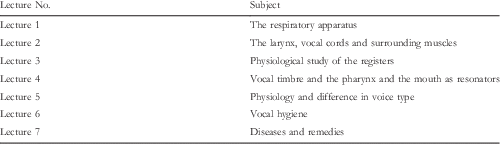
At four in the afternoon on 27 February 1892, the first of what would be seven lessons began with Gouguenheim focusing on the respiratory apparatus and the importance of good breathing for a singer (see Table 1).Footnote 43
The subjects of Gouguenheim’s seven lectures

Gouguenheim warned women particularly of the dangers of a tight corset, which could encourage incorrect breathing and lead to excessive stress on the larynx and pharynx as well as overcompensation of the muscles in the throat.Footnote 44 Subsequent lessons focused on the physiology of the larynx and attempted to provide some anatomical context for head and chest voice, registers and tone. By his sixth lesson, Gouguenheim turned to vocal hygiene, defining it to include all the precautions necessary to preserve and fortify the organs of the voice.Footnote 45 Starting with good breathing, the importance of posture, and the need to protect those specific muscles necessary for the professional singer, Gouguenheim suggested students walk and follow a basic gymnastics routine, lifting their arms up and down using weights, increasing the resistance with time. Additional exercises, including fencing to strengthen the muscles of the chest and the clavicle (even for women), and swimming in the public heated pools of the city, were also strongly recommended. As an excellent complement to gymnastics and sports, he recommended hydrotherapy as well.Footnote 46
Gouguenheim firmly discouraged students from working in cabarets or café-concerts. Singers were to take particular care of their singing instrument by refusing to perform in excessively hot rooms, which could provide them with some financial gain but at too great a cost to their vocal health. He warned students to avoid rooms filled with tobacco or coal fumes or crowded venues because they were filled with carbonic acid from expired air. Dusty and dirty rooms were also to be avoided when performing as dust brought with it diseases and microbes.Footnote 47 Here again, Gouguenheim relied on medical explanations to describe accepted norms of behaviours and steer the course of the students’ career ambitions.
Like others, Gouguenheim insisted singers be careful about where they lived, stressing that their rooms should never be humid or cold. He also suggested they avoid ground floor and poorly lit rooms. Lodgings situated higher up provided good exposure and fresh air when windows were open. He advocated apartments heated by chimneys that brought air from the outside. Wood or charcoal were not ideal but could be used to heat, while coal should always be avoided. His additional recommendations for living quarters included: the use of only pure and odourless oils as sources of light, the exclusion of flowers (especially violets) from the bedroom, and the avoidance of sleeping too closely to washrooms because the smells of ammonia would sting the throat and eyes.Footnote 48 The relative emphasis Gouguenheim devoted to the question of personal lodging suggests that the material realities of life in the French capital appear to have been of great concern for singers’ longevity.
On clothing, Gouguenheim recommended wool or silk to absorb perspiration and prevent cold. This suggestion was particularly important at the theatre, where women should cover themselves quickly post-performance because the dangers of insufficient or humid clothing caused many of the colds he treated in his clinic.Footnote 49 He encouraged singers to eat lightly before performing and avoid food known to produce gas or bad breath. He warned them against drinking too much coffee, which would increase their heartbeat and shorten their breath, and – unlike some others at the time – recommended against alcohol and tobacco, which he saw as potentially damaging to the singing voice.Footnote 50
Finally, Gouguenheim dedicated his last lecture to diseases and remedies, discussing afflictions of the throat as well as those of the body that could have an impact on the singing apparatus. He encouraged singers to keep silent when sick, drink linden tree tea, fumigate using eucalyptus or fir buds, and gargle with boric acid while waiting for the doctor.Footnote 51 Gouguenheim particularly emphasised the health and hygiene of the nasal cavities, suggesting singers clean their noses every morning and night by taking half a litre of lukewarm water, raising it above the head, and irrigating the nose through the use a rubber tube. After waiting ten to fifteen minutes, students were then to blow and empty their noses of all mucus.Footnote 52 Gouguenheim ended this final lesson by expressing his desire to renew the lecturing experiment again the following year, the next time with more demonstrations, more illustrations and perhaps even more than seven lessons.Footnote 53
Gouguenheim’s lectures had myriad implications for the field of French vocal training. On the one hand, his effort to switch from privileging practical to scientific expertise meant pedagogical practices no longer had to be constructed in terms of competing nationalistic traditions. In contrast to Mandl’s attack on the ‘music of the barricades’ and promotion of the method of the old Italian school two decades earlier, Gouguenheim’s lessons were devoid of nationalistic references. On the other hand, the lessons can be seen as redefining medicine as a means to reinforce class-based policies for French artists. Gouguenheim’s recommendations dictated where singers could perform and thereby censured certain repertoire, performance venues and audience–performer interactions. By restricting where singers could live and what sort of physical activities they should perform, Gouguenheim also privileged a certain type of singer who, either through independent wealth or scholarship support, could live in acceptable lodgings and take advantage of specific leisure activities. As such, Gouguenheim’s lessons certainly resonated with and reinforced larger contemporary concerns over public health in Paris, concerns connected to notions of class-based inequality. In this way, medicine became a mechanism to circumscribe carefully who could and who could not be called a French artist.
La voix parlée et chantée published all seven of Gouguenheim’s lectures, leading to further discussion on the topic. An article in the journal from 1894 suggests that word of his efforts at the Conservatoire had impressed Henry Holbrook-Curtis (1856–1920), laryngologist of the Metropolitan Opera in New York and corresponding member of the Société française de laryngologie, rinologie et otologie. In his 1894 essay, Holbrook-Curtis wrote that French musical training post-1890 was becoming increasingly sophisticated, the explanation for which rested on the fact that ‘the influences related to the production of sound and the physiology of the voice made possible by the progress of laryngoscopie, are increasingly better understood’.Footnote 54 Holbrook-Curtis’s article contains a technically complex account of the relationship between vocal timbre and laryngological science. It seems plausible that his own writings, and his praising of the recent increase in sophisticated techniques at the Conservatoire, were partially informed by the institution’s embedding of science into its required training practices.
Conclusion
The openness towards medical knowledge seems to have been supported and promoted by a generation that itself was facing the anxieties of the fin de siècle. Those musicians willing to explore the musical implications of Wagner and his followers also seemed to be those who were willing to explore the links between the scientific and the performative. But this generation’s openness did not last and the evidence suggests that as tensions leading to the First World War began to mount, so too did a distrust of the value of physiological explanations and proscriptions for singing prowess.
Indeed, on 3 March 1911, a letter from the director of the Conservatoire, then composer Gabriel Fauré (1845–1924), to the under-secretary of the Minister des Beaux-Arts reveals that requests for the Conservatoire to run a ‘vocal course’ had again reached the director. This time the proposal for the organisation and structure of the course came from Messieurs Melchissédec and Frossard, and they offered to teach the class free of charge so long as it was required of all vocal students. Melchissédec and Frossard emphasised in their proposal that the course would be entirely scientific and not artistic.Footnote 55
Fauré’s brusque response reminded the under-secretary that a similar proposal, written by a Dr Glover, had recently been brought before the Conservatoire’s upper administration (Conseil supérieur – Section des études musicales) and had been ‘unanimously decided against’ [his emphasis]. Indeed, Fauré elaborated that the council was opposed to the creation of any sort of ‘scientific’ course, including any sort of class on such topics as the physiology of the voice, phonation and vocal health among others. The reasoning: instruction at the Conservatoire had to be and had to remain ‘purely artistic’.Footnote 56 Fauré underscored that the instruction of students at the Conservatoire continued to be guided by ‘eminent artists’ who each employed ‘various methods’ none of which ‘had yet been proven by the experiences of these artists to be the only or best one’.Footnote 57 Fauré also scathingly accused Messieurs Melchissédec and Frossard of simply using the Conservatoire as a means to sanction their approach, especially given their refusal of payment for the class. In perhaps the most telling statement of the letter, Fauré closed by unequivocally stating to the minister:
Our School, by the very name it carries, does not have as its goal to launch or make known innovations or novel inventions: it exists to preserve methods recognised as the best and which produce the best results. The success of the students who leave our vocal classes to join the ranks of lyrical companies in our national theatres, themselves designed to produce the best content and almost exclusively comprising singers from our Conservatoire, proves that our methods are not insufficient.Footnote 58
Fauré’s response reveals that where scientific knowledge had previously appeared to hold the keys to innovation, it now seemed to be viewed with suspicion or outright hostility. In line with shifting aesthetic ideals throughout France, the Conservatoire began to reassert a sense of French artistry, which in this context meant privileging knowledge gleaned through experience and artistic expression.
What little traction Gouguenheim and his teachings may have gained in the latter part of the nineteenth century seems to have had little staying power in what Katherine Bergeron has compellingly shown was the ‘politically, scientifically, and aesthetically shifting climate of Third Republic France’.Footnote 59 Our work suggests that additional shifts in aesthetic positionings during the Belle Époque can be attributed to the years directly preceding the new century and those directly preceding the First World War. Indeed, the evidence presented here supports Bergeron’s trenchant argument that during the early years of the twentieth century French vocal music became the focal point for many political and aesthetic changes. Fauré counted himself among the reformers, someone brought on board to clear house at the Conservatoire and shepherd in a new, innovative and artistically centred pedagogy. As early as 1905, directly after assuming the position of director of the Conservatoire, Fauré had responded to concerns about French vocal training by publicly declaring ‘Voice teachers should change their ways … To make “true artists” of France’s future singers, vocal training would have to go beyond technique, and beyond the opera house.’Footnote 60 By 1911, Gouguenheim and the teaching of laryngologists no longer belonged in this rapidly changing environment.
The content of La voix parlée et chantée, too, witnessed the dissolution of a once promising marriage between physiologists and artists following 1900. The artistic community either ceased or was prevented from publishing in the journal’s pages, and the text became increasingly medicalised and technical. In 1903 Chervin published a final edition, explaining that he no longer had the time to devote to his periodical.Footnote 61 What had a decade ago been a fruitful and thriving exchange now appeared to have fallen fallow. By the eve of the First World War, the two camps had clearly parted ways, a reality likely reflective of a new, politically inflected mode of operatic performance evident in Pelléas et Mélisande, which no longer courted the timbral qualities called for by Wagner or the wagnéristes.Footnote 62
Gougenheim’s lectures, then, remain a touchstone moment for understanding in greater specificity and nuance the practical anxieties and concerns of vocalists who needed to make a career for themselves in a fin-de-siècle world. Though in certain instances somewhat technical, these lectures were primarily designed for a generalist audience, not so much as lessons in anatomy but in the practicalities of a certain moment in time. Gouguenheim’s instructions are at times remarkably prescient; and indeed, though the Paris Conservatoire may have abandoned his lecture format after 1900, many of the insights offered by laryngologists such as those found in La voix parlée et chantée and captured in Gouguenheim’s lessons continue to inform vocal pedagogy to this day. Larygnology’s apparent distancing of itself from the operatic after 1900 was likely a byproduct of the growing hostility towards influences viewed by the French as Teutonic in the years leading up to the First World War, not to mention a growing sense of professional legitimacy and disciplinarity for the field of laryngology itself. Overall, the evidence presented here reveals a specific, though fleeting symbiotic moment in operatic and medical history, precipitated by the anxieties of the fin de siècle and swayed by the compelling weight of nascent knowledge of vocal pathologies.