Introduction
Most of the human impacts on the aquatic environment affect the health of the resident fish fauna, eventually causing disease and associated mortalities (Poulin, Reference Poulin1992). Parasites usually exist in equilibrium with their hosts as a survival strategy (Bush et al., Reference Bush, Fernandez, Esch and Seed2001). However, in instances where the hosts are overcrowded, such as in aquaria and fish farms, parasitic diseases can spread very rapidly and cause gross mortalities (Paperna, Reference Paperna1996). This is not usually the case in the wild, natural aquatic environment unless it is disturbed by human interference such as pollution, which can alter the natural distribution of parasite communities and infracommunities (Bush et al., Reference Bush, Fernandez, Esch and Seed2001). The relative abundance of endo- and ectoparasites of fish in a particular aquatic system can be used as an indicator of environmental stress (Avenant-Oldewage, Reference Avenant-Oldewage2001). Ectoparasites, for instance, are more in contact with water; if they are sensitive to a pollutant, there will be fewer ectoparasites than endoparasites in a polluted system, while the converse is also true (Avenant-Oldewage, Reference Avenant-Oldewage2001).
Virtually, all free-living organisms are hosts to parasites, and parasitism, in its broadest sense, is considered to be the most common lifestyle on Earth (Price, Reference Price1980). Thus, healthy ecosystems can be hardly considered disease free. The fact that parasites possess complex life cycles makes them extremely valuable information units about environmental conditions, because their presence/absence tells us a great deal about not only their host ecology but also food web interactions, biodiversity and environmental stress (Overstreet, Reference Overstreet1997; Marcogliese, Reference Marcogliese2003, Reference Marcogliese2004). Combining different species based on shared patterns of transmission provides a potentially more powerful indicator of prevailing environmental conditions. Hudson et al. (Reference Hudson, Dobson and Lafferty2006) argue that many ecological factors affecting fish parasite life cycles and the complexity of aquatic food webs are important in determining ecosystem health, while Blanar et al. (Reference Blanar, Munkittrick, Houlahan, MacLatchy and Marcogliese2009) investigated associations and responses of specific fish-parasitic taxa to different contaminants to come up with a quantitative approach that will be important in studying parasite–host–pollution interactions.
Each parasite species reflects the presence of different organisms that participate in its life cycle; together, all these parasite species in a host reflect the presence of a plethora of host organisms and trophic interactions in the environment (Marcogliese, Reference Marcogliese2003). Thus, parasites potentially may be used as surrogate indicators of species diversity and ecosystem diversity, two of the three important levels of biodiversity cited in the Rio Convention on Biological diversity (Marcogliese, Reference Marcogliese2003). Given that pollution may have impacts on populations and communities of organisms, and thus on food web structure, parasites may be used as natural biological tags of ecosystem health. The species composition of parasite communities is clearly impacted by environmental stress, and species richness tends to decrease under degraded conditions.
Numerous investigators have examined the effects of environmental stress on single species of parasites in temperate aquatic systems (Khan & Thulin, Reference Khan and Thulin1991; Overstreet, Reference Overstreet, Couch and Fourne1993; MacKenzie et al., Reference MacKenzie, Williams, Williams, McVicar and Sidall1995; Williams & Mackenzie, Reference Williams and Mackenzie2003; Marcogliese, Reference Marcogliese2004; Sures, Reference Sures2004), despite the fact that it is difficult to predict the direction of effects of pollution impacts on parasite communities. Most studies document changes in some aspect of the parasite fauna, and it is clear that pollution has effects on parasite populations and communities and is, however, often associated with a reduction in species richness of parasites (Marcogliese, Reference Marcogliese2004).
This study intended to establish the relationship between metazoan parasites and pollution levels in the catchment. The specific objectives of this study were to determine the biodiversity of metazoan parasite communities of Clarias gariepinus in the Upper Manyame catchment and to compare the diversity and distribution of metazoan parasite fauna along defined pollution gradients in the Upper Manyame catchment and assess the suitability of using parasites as predictors of environmental change.
Materials and methods
Study area
The upper Manyame River catchment extends over an area of 2227 km2 and most of Harare and its dormitory town of Chitungwiza (established in the 1970s) lie within the catchment (Magadza, Reference Magadza and Moyo1997). About 10% of the catchment comprises urban developments, while 90% is rural, comprising commercial farmland and communal land (Magadza, Reference Magadza and Moyo1997). The Nyatsime, Manyame and Mukuvisi rivers in the catchment were selected for this study (fig. 1). The three rivers display a gradient in pollution as most of the urban and industrial run-off finds its way into them before draining into Lake Chivero. The city of Harare, with a population of about 3 million people, lies within the catchment and all its domestic and industrial effluents eventually flow into the lake. The lake has been eutrophic since the 1960s (Marshall, Reference Marshall, Matiza and Crafter1994, Reference Marshall and Moyo1997) with serious water quality problems that have led to fish kills in the lake and its feeder tributaries, Nyatsime, Marimba and Manyame (Magadza, Reference Magadza and Moyo1997; Marshall, Reference Marshall and Moyo1997; Moyo, Reference Moyo and Moyo1997).
The Upper Manyame cachment system (Zimbabwe) showing the location of sampling sites on the Manyame (Man), Mukuvisi (Muk) and Nyatsime (Nya) rivers.

The Mukuvisi River is severely polluted by poorly treated sewage effluent and industrial discharge (Moyo & Worster, Reference Moyo, Worster and Moyo1997; Staneva, Reference Staneva and Moyo1997; Zaranyika, Reference Zaranyika and Moyo1997). The Nyatsime and Manyame rivers above Lake Chivero are also severely polluted by sewage effluent from Chitungwiza. Lack of resources to upgrade sewage treatment works, lack of funding to water quality management and research, overcrowding, bureaucracy and poor management of wetlands have led to the eutrophication of the lake and its feeder tributaries (Magadza, Reference Magadza and Moyo1997, Reference Magadza2003). Much of the work on aquatic pollution in the Upper Manyame catchment has focused on the analysis of physicochemical conditions of water (Marshall & Falconer, Reference Marshall and Falconer1973; Mathuthu et al., Reference Mathuthu, Zaranyika and Jonnalagadda1993, Reference Mathuthu, Mwanga, Simoro and Moyo1997; Jarawaza, Reference Jarawaza and Moyo1997; Magadza, Reference Magadza and Moyo1997, Reference Magadza2003; Zaranyika, Reference Zaranyika and Moyo1997). The effect on the biota has generally been overlooked with the exception of isolated studies by Moyo & Worster (Reference Moyo, Worster and Moyo1997), Moyo & Phiri (Reference Moyo and Phiri2002) and Gratwicke et al. (Reference Gratwicke, Marshall and Nhiwatiwa2003).
Fish and parasite collection
Fish were collected over a 3-month period (October–December 2006) using a Smith-Root VI electrofisher powered by a Honda generator producing 750 V DC, although the output varied according to the conductivity of the water. A seine net was used at the confluence of the Manyame River into Lake Chivero. The body surface, fins and buccal cavity of each fish caught were immediately examined for ectoparasites. Ectoparasitic crustaceans from the external surfaces were kept alive in dam water and were then transported to the laboratory for further parasitological examination. In the laboratory, the standard and total lengths (mm), mass (g) and sex of each fish were recorded. The fish were kept in aerated tanks and examined within 12 h after sampling.
The gills were dissected and examined for ectoparasites, of which the crustaceans were cleared in lactic acid and preserved in 70% alcohol. Monogeneans were fixed with Malmberg's solution (ammonium picrate glycerine) before being preserved in 70% alcohol. Portions of the muscles, viscera and the gastrointestinal tract were dissected and examined for internal parasites. Cestodes were relaxed in saline solution, fixed in a hot alcohol–formol–acetic acid (AFA) solution and preserved in 70% alcohol. Encysted digeneans were first excysted, fixed in hot AFA and preserved in 70% alcohol. Nematodes were fixed in glacial acetic acid until they died and stretched, then preserved in 70% alcohol. They were then cleared and mounted in lactophenol. Cestodes and digeneans were stained in aqueous acetocarmine solution.
Surface water temperature and dissolved oxygen content were measured using a HACH oxygen meter; conductivity, using a WTW conductivity meter and pH using a HACH pH meter. Subsurface water samples were collected in 1-litre plastic containers rinsed in deionized water. The samples were taken to the laboratory where they were frozen and analysed for the following micronutrients: reactive phosphate, total phosphorus, total nitrogen and nitrate.
Data analysis
Parasite prevalence, mean intensities and abundance were measured and calculated as defined by Bush et al. (Reference Bush, Fernandez, Esch and Seed2001). Shannon's diversity index (H′) was calculated as a measure of community diversity (Magurran, Reference Magurran1988) and the terms ‘diversity’ and ‘diverse’ are used to reflect the values of this diversity index. Species richness refers to the number of species. Infracommunity refers to the community of parasite species in a host individual, component community richness was defined as the number of species present in a sample from a single locality (Sousa, Reference Sousa1994). Hierarchical cluster analysis was used to assess the similarities among (1) parasite component communities of the different sites and (2) sampling sites based on the physicochemical variables.
Principal component analysis (PCA) was performed to determine the pattern of distribution of parasite species among the sites. All infection data were normalized with log (x+1) transformations to achieve homoscedasticity or linearity. Environmental data were also log (x+1) transformed to suit the multivariate analysis techniques used. All physical variables were standardized to zero mean and unit variance to make them dimensionless. Results were considered significant at the 95% level (P < 0.05). Ordination was done using CANOCO version 4 (Ter Braak & Smilauer, Reference Ter Braak and Smilauer1998), and STATISTICA version 7 (STATSOFT Inc., Tulsa, Oklahoma, USA) was used for correlation, regression and correspondence analysis.
Results
Water quality
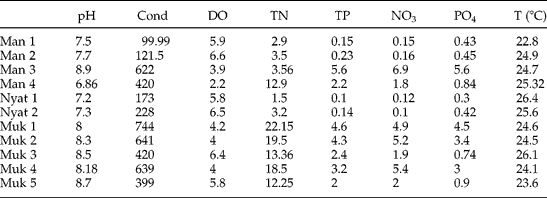
The water temperature varied with the time of sampling, ranging from 22.8 to 26.4°C. Dissolved oxygen levels were high at Mukuvisi 3 (6.4 mg/l), Manyame 2 (6.6 mg/l) and Nyatsime 2 (6.5 mg/l), and lowest at Manyame 4 (2.2 mg/l) and Mukuvisi sites 2 and 4 (4 mg/l). Conductivity readings were higher (420–744 μS/cm) than those of the rural sites (100–228 μS/cm). Water pH was neutral to slightly alkaline (range 6.86–8.9) at all the sampling sites. Within the Manyame system, all the nutrients were quite low in the rural sites and higher downstream towards the lake. All the Mukuvisi sites had high levels of nutrients (table 1). The heavily impacted sites in terms of increased level of nitrates, phosphates, conductivity and reduced dissolved oxygen content levels included all the Mukuvisi sites and Manyame sites 3 and 4, while the rural sites (Manyame/Nyatsime) remained comparatively unimpacted (table 1).
Physicochemical parameters of water samples from the sampling localities on the Manyame (Man), Mukuvisi (Muk) and Nyatsime (Nya) rivers.
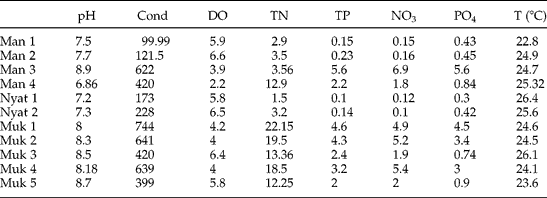
Cond, conductivity; DO, dissolved oxygen content; TN, total nitrogen; TP, total phosphate, NO3, nitrate; PO4, phosphate. With the exception of pH (no unit) and temperature (°C), all parameters are in mg/l.
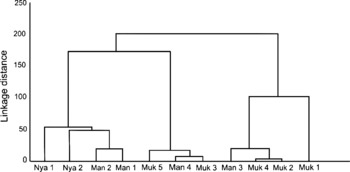
Cluster analysis to group sites according to similarities in physicochemical variables showed three distinct clusters (fig. 2). The four rural sites were clustered together because they belong to the same rural catchment and had similar physicochemical variables of low levels of macronutrients and conductivity (fig. 2). These sites are located in the upper reaches of the catchment, which is still pristine. There was evidence of increasing pollution as the rivers progress towards the lake (Manyame 4).
Cluster analysis showing similarity among 11 sites based on physicochemical variables. Man, Manyame; Muk, Mukuvisi; Nya, Nyatsime.

Species composition, diversity and distribution
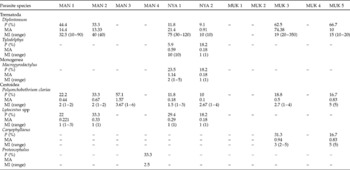
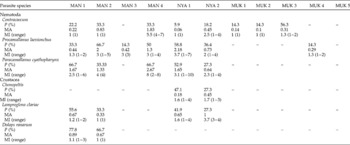
A total of 72 catfish out of the 110 catfish caught were infected with parasites. Thirteen species of metazoan parasites were encountered in total from 72 infected fish collected from the three rivers in this survey (tables 2 and 3). The endoparasites included two digenean metacercariae (Tylodelphys sp. and Diplostomum sp.); four adult cestodes (Proteocephalus sp., Polyonchobothrium clarias, Caryophyllaeus sp. and Lytocestus sp.); three nematode species (larval Contracaecum, adult Paracamallanus cyathopharynx and adult Procamallanus laevionchus). The four ectoparasite species encountered include three crustaceans, Chonopeltis sp. and Dolops ranarum (Branchiura), Lamproglena clariae (Copepoda), and a monogenean (Macrogyrodactylus clarii). One ectoparasite, L. clariae, was found at all the rural sites, while M. clarii, Chonopeltis sp. and the cestode, Lytocestus, were found only at the Nyatsime rural sites. Dolops ranarum only occurred at Manyame rural sites.
Prevalence (P), mean abundance (MA), intensity (range) and mean intensity (MI) of platyhelminth parasites of Clarias gariepinus in the upper Manyame catchment.

MAN, Manyame River; NYA, Nyatsime River; MUK, Mukuvisi River.
Prevalence (P), mean abundance (MA), intensity (range) and mean intensity (MI) of nematodes and crustaceans of Clarias gariepinus in the Upper Manyame catchment.

MAN, Manyame River; NYA, Nyatsime River; MUK, Mukuvisi River.
Parasites were identified as much as possible to species level, but where this was not possible, they were identified to genus level. With reference to a diagnostic compendium by Avenant-Oldewage & Knight (Reference Avenant-Oldewage and Knight1994), we propose that our Chonopeltis sp. could tentatively be Chonopeltis fryeri (Van As, 1986), based on morphological similarity. This is one of the only 2 out of 13 Chonopeltis species that infest C. gariepinus in Africa (the other being C. inermis (Thiele, 1900)). If confirmed, our record of this species would be the first in the Zambezi system, since it is only recorded from the Limpopo system to date (Avenant-Oldewage & Knight, Reference Avenant-Oldewage and Knight1994). What we refer to as Proteocephalus sp. could actually be the new cestode genus and species, Barsonella lafoni (de Chambrier et al., Reference de Chambrier, Scholz, Beletew and Mariaux2009), which all along we have been misidentifying (M. Barson, unpublished MPhil thesis, University of Zimbabwe). It certainly differs from the only confirmed proteocephalid species infecting C. gariepinus in southern Africa, Proteocephalus glanduligerus (Janicki, 1928) (Mashego, Reference Mashego2001; Barson & Avenant-Oldewage, Reference Barson and Avenant-Oldewage2006; Scholz et al., Reference Scholz, de Chambrier, Beletew and Mahmoud2009), but, for the purposes of this paper, we retain the use of Proteocephalus pending further diagnosis. Caryophyllid cestodes (Caryophyllaeus sp. and Lytocestus sp.) were also difficult to speciate and a more detailed taxonomic study is ongoing to resolve these peculiarities.
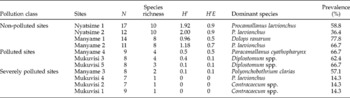
Parasite species richness decreased as pollution levels increased (table 4). The non-polluted sites had higher species diversity (8–10), dominated by P. laevionchus and D. ranarum, while the polluted sites had lower species diversity (3–4) and dominated by Diplostomum sp. and P. cyathopharynx. The lowest species diversity (2–1) was found in the severely polluted sites, and P. laevionchus and Contracaecum sp. larvae occurred at these sites in very low abundances. The unpolluted sites had the highest diversity (H′ = 0.96–2.00) because they had more unique species. The polluted sites had lower diversity (H′ = 0.1–0.5) indicating that there were no parasites in catfish from severely polluted sites. Evenness (H′E) was highest at Nyatsime sites 1 and 2, suggesting an evenly distributed and an assorted assemblage.
Diversity measures of metazoan parasite component communities in Clarias gariepinus along a pollution gradient.

N represents the number of fish hosts collected from each site, H′ represents the Shannon diversity index, and H′E represents Shannon's equitability or evenness.
Most species were of intermediate abundance as reflected by the lower prevalence of the constituent species (tables 2–4). The H′E for the other two unpolluted sites (Manyame 1 and 2) had slightly decreased showing that there were taxa that occurred more frequently than others, and in these two sites D. ranarum and P. laevionchus outnumbered the other species (tables 2–4). There was no heterogeneity of species in the polluted sites (H′E = 0.1–0.5) and severely polluted sites (H′E = 0), as demonstrated by the occurrence of rare species such as Proteocephalus sp. and Caryophyllaeus sp., respectively (table 4).
The species that are evidently associated with the pristine sites are the ectoparasites (D. ranarum, Chonopeltis sp., M. clarii and L. clariae; tables 2–4). The cammalanids, P. laevionchus and P. cyathopharynx, seem to be sensitive to organic pollution as their abundances decrease with increase in organic pollution (tables 3 and 4). Most cestodes and digeneans (P. clarias, Proteocephalus sp., Caryophyllaeus sp. and Diplostomum sp. with the exception of Lytocestus sp. and Tylodelphys sp.) seem to be very tolerant to organic pollution as they are associated with the polluted sites (tables 2 and 4). Paracamallanus cyathopharynx was not encountered in the Mukuvisi River as well as Manyame 3, showing that it is highly sensitive to organic pollution. Although larval Contracaeum occurred at most sites, its prevalences decreased considerably with increasing pollution levels (table 4).
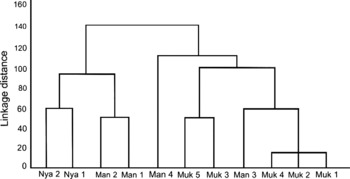
The four unpolluted rural sites possessed metazoan communities with a greater level of similarity because they had a more varied assemblage of parasite species than the polluted sites (fig. 4). The severely polluted sites also possessed more similar metazoan communities because they had a more impoverished parasitic fauna than the polluted sites (fig. 4). This pattern of similarity also appears to be caused by the patterns of the physicochemical variable measurements obtained (fig. 3).
Cluster analysis showing the patterns of similarity in metazoan parasite communities of test sites in the catchment. Man, Manyame; Muk, Mukuvisi; Nya, Nyatsime.

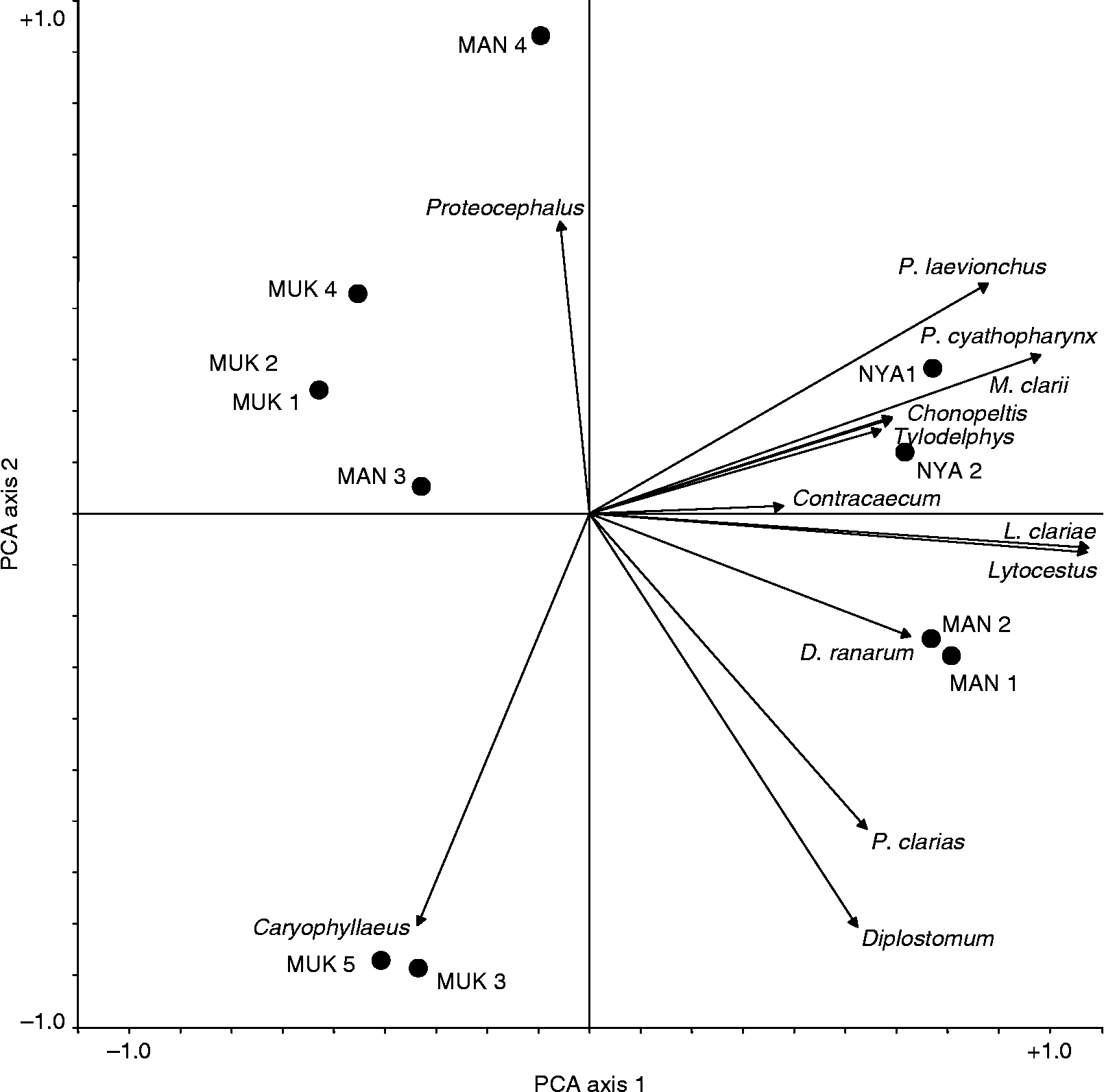
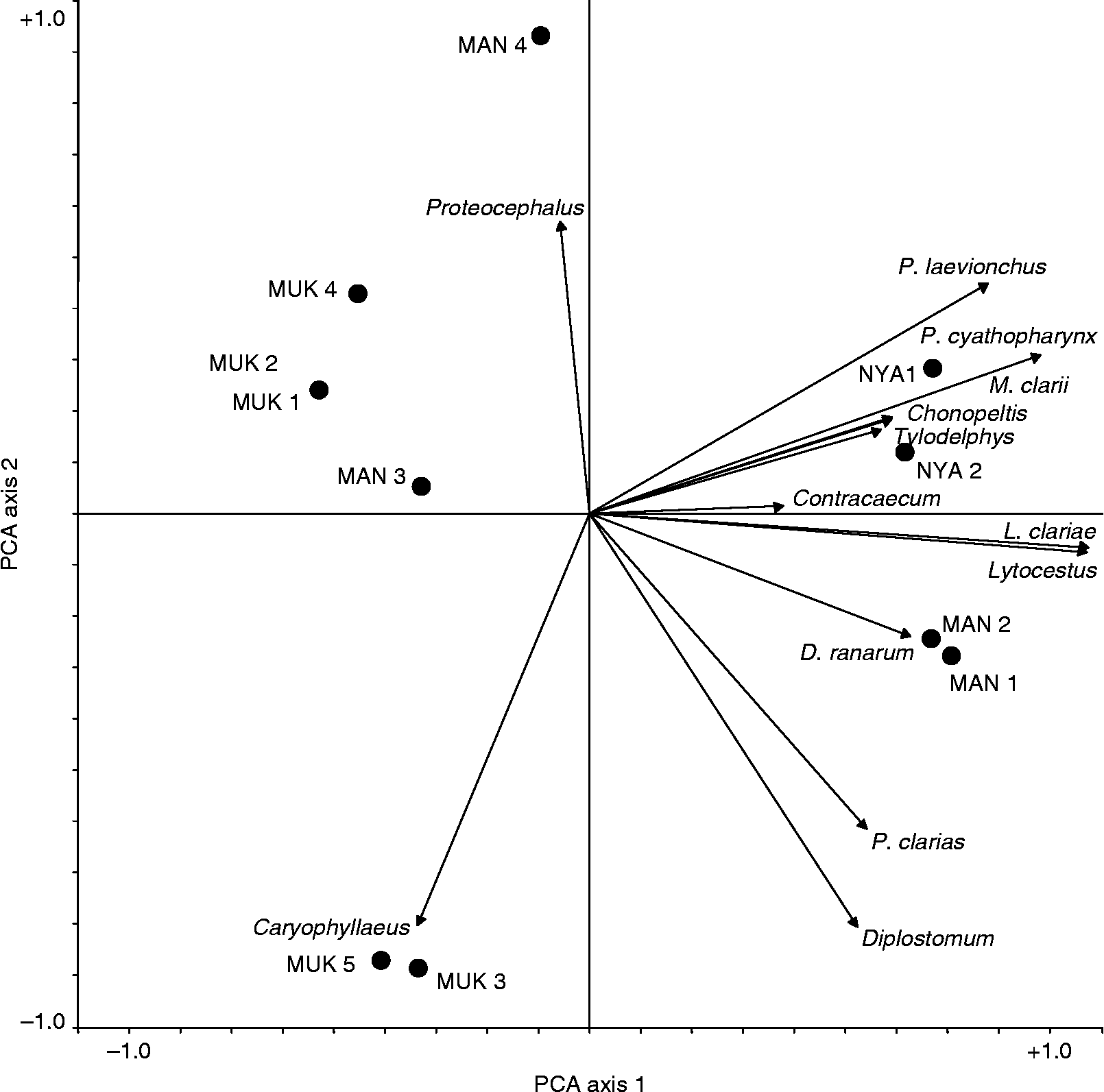
The eigenvalue for the first axis was 0.5, contributing 50.3% of the variance; while the eigenvalue for the second axis was 0.2, contributing 19% of the variance (fig. 4). The PCA plot shows that Diplostomum sp. and P. clarias are strongly correlated with the first axis and are more wide-spread and dominant species among both polluted and unpolluted sites (Nyatsime 1 and 2; Manyame 1 and 2; fig. 4). The distribution of Proteocephalus sp. was limited to Manyame 4, a lacustrine and polluted environment, while Caryophyllaeus sp. was limited to Mukuvisi sites 3 and 5 (polluted sites). The four rural sites are strongly associated with most parasite species. Although Contracaecum is weakly correlated with the unpolluted sites, it was a less abundant species (tables 3 and 4; fig. 4). The severely polluted sites (Manyame 3, Mukuvisi 1, 2 and 4) do not demonstrate any close association with any of the parasite species.
Principal components analysis (PCA) ordination showing parasite species distribution based on prevalence among sites. MAN, Manyame; MUK, Mukuvisi; NYA, Nyatsime.
Discussion
Water quality
The higher conductivity at Mukuvisi 5 (Pension Farm) and Manyame 3 (Beatrice Road Bridge) may be attributed to sewage effluent saturating the two systems, while the slight decrease in conductivity downstream could be a sign that the ions were precipitating out and settling on the riverbed. The high levels at the Mukuvisi sites may be due to waste that both the formal (Graniteside) and informal industries (Mbare) deposit in the river. In 1970, the conductivity was around 164 μS/cm (Mitchell & Marshall, Reference Mitchell and Marshall1974). Increased urbanization and poorly treated effluent discharged into the river are implicated in the observed rise in conductivity. From the cluster analysis, it can be concluded that Mukuvisi 3, 5 and Manyame 4 are polluted, while Mukuvisi 1, 2, 4 and Manyame 3 are severely polluted as shown by the high levels of macronutrients and conductivity (fig. 2).
The study shows that a considerably high portion of the fluctuation in the parasite prevalence and diversity was related to change in the physicochemical parameters, particularly nitrates, phosphates and conductivity that increased downstream of the cities of Chitungwiza and Harare, while oxygen levels dropped significantly. It is clear that these three tributaries of Lake Chivero contribute the bulk of the nutrient loading to the lake as they flow through heavily industrialized and densely populated areas on their way to the lake. The Manyame River carries all the effluent from neighbouring Chitungwiza. The recent large-scale deaths of fish in Lake Chivero indicate a stressed ecosystem due to pollution (Moyo, Reference Moyo and Moyo1997).
The major drainage system of the rural Manyame and Nyatsime catchments is dominated by commercial and communal farmlands. The area appears to be an ideal locality for rich natural communities of fishes and their parasites based on the assumptions that the waters are relatively uncontaminated; consequently, the rural sites had a flourishing parasitic fauna, while the stressed sites had depauperate fauna.
Species composition, diversity and distribution
Clarias gariepinus hosted high metazoan species richness, comprising 13 species reported. The richest and most diverse metazoan communities were found in the unpolluted sites, while the metazoan communities of the polluted and severely polluted sites were depauperate assemblages with low levels of species richness and diversity and relatively low abundance of most of the constituent species. The study shows that a considerable amount of the fluctuation in the parasite prevalence and diversity was attributed to change in the levels of nutrients, dissolved oxygen and conductivity. Polluted water may also act directly on intermediate hosts and definitive hosts. The results are consistent with the findings of Sulgotowska & Styczynska-Jurewicz (Reference Sulgostowska and Styczynska-Jurewicz1987) who recorded a reduction in species richness from 12 to 4 due to municipal and industrial sewage.
Chonopeltis sp., D. ranarum, M. clarii, L. clariae, P. laevionchus and the cestodes (caryophyllids, proteocephalids and Polyonchobothrium) are all autogenic, i.e. they reach maturity in fish. The two digenean taxa reported in this study, Tylodelphys and Diplostomum, were found in their metacercarial (encysted larval) stage, while Contracaecum spp. were found in the juvenile stages, indicating these are allogenic species that reach adult form in other vertebrates such as fish-eating birds. In Zimbabwe, the helminth fauna of piscivorous birds has been recorded by Beverly-Burton (Reference Beverly-Burton1963), Mettrick (Reference Mettrick1967), Barson & Marshall (Reference Barson and Marshall2004) and Barson et al. (Reference Barson, Bray, Ollevier and Huyse2008).
The eutrophic nature of Lake Chivero and the Mukuvisi River contributed to the observed helminth community of C. gariepinus at the polluted sites only. Caryophyllaeus sp. and Proteocephalus sp. exhibited distinct distributions in which the former was secluded to Mukuvisi sites 3 and 5, while the latter occurred at Manyame 4 (confluence with the lake). The first intermediate hosts of caryophyllid cestodes are oligochaetes (Tubificidae), particularly Tubifex and allied genera (Paperna, Reference Paperna1996). These worms are prevalent in the Mukuvisi River and Lake Chivero (Moyo & Phiri, Reference Moyo and Phiri2002) and can tolerate organic pollution since they feed on organic particles (Weisberg et al., Reference Weisberg, Morin, Ross, M and Hirshfield1986). Kostarev (Reference Kostarev1980) found high numbers of Caryophyllaeus laticeps, and he attributed this to increased oligochaete populations where household sewage was discharged in reservoirs.
First intermediate hosts of segmented tapeworms such as the proteocephalids are copepods. In Proteocephalus, a second larval stage (plerocercoid) develops in fish species that are non-compatible as definitive hosts (Paperna, Reference Paperna1996). The increased abundance of these intermediate hosts results in part from the sewage outflows and reflects organic enrichment of the sediments, providing excellent habitat for the oligochaete and copepod alternate hosts (Weisberg et al., Reference Weisberg, Morin, Ross, M and Hirshfield1986; Sibley et al., Reference Sibley, Dixon and Barton2000). Data from this study corroborate previous records of increased abundance of tubificid oligochaetes (Moyo & Worster, Reference Moyo, Worster and Moyo1997; Moyo & Phiri, Reference Moyo and Phiri2002) in the Mukuvisi River. Some freshwater studies have suggested a positive relationship between eutrophication and fish parasitism (Hartman & Numann, Reference Hartman and Numann1977; Beer & German, Reference Beer and German1993; Lafferty & Kuris, Reference Lafferty and Kuris1999). Eutrophication often raises parasitism because the associated increased productivity can increase the abundance of intermediate hosts (Lafferty & Kuris, Reference Lafferty and Kuris1999), as was observed in the Manyame catchment for Caryophyllaeus and Proteocephalus sp.
In terms of prevalence Diplostomum sp. and P. clarias exhibit a high ecological invasiveness, occurring at polluted and unpolluted sites. Cone et al. (Reference Cone, Marcogliese and Watt1993) and Marcogliese & Cone (Reference Marcogliese and Cone1996) discovered digeneans to be absent or rare in American eels, and concluded that it was the fish intermediate host and not the parasite that is sensitive to acidification. Acidification impacts most strongly on populations of digeneans. The pH levels in the catchment were found to be within the acceptable range of 6.5–8.5 except for two sites (Mukuvisi 5 and Manyame 3) where Diplostomum sp. occurred. The presence of suitable gastropod intermediate hosts is also important in the transmission of digenean parasites (Paperna, Reference Paperna1996). It has nevertheless been shown that some gastropods are extremely sensitive to pollution and were killed on exposure to the polluted Manyame and Mukuvisi sites (B. Masola, personal communication).
Kostarev (Reference Kostarev1980) found a rise in numbers of Diplostomum in sites where industrial effluent was discharged into reservoirs and he attributed this to increased bird populations attracted by dying fish. Massive fish deaths frequently recorded in the Manyame catchment could partly explain the widespread distribution of Diplostomum. However, the other digenean, Tylodelphys sp., was isolated to the Nyatsime sites, possibly indicating the influence of water quality. Galli et al. (Reference Galli, Crosa, Bertoglio, Mariniello, Ortis and Amelio2001), however, found no effect of pollution on the prevalence, abundance and mean intensity of Tylodelphys clavata.
Polyonchobothrium clarias can withstand harsh conditions, as it has been found in the gall bladder. Wabuke-Bunoti (Reference Wabuke-Bunoti1980) was the first to report the invasion of the host gall bladder by P. clarias. All other environmental conditions being equal, the levels of P. clarias infections under organically enriched conditions remained high, as shown by the high prevalence at Manyame 3, a heavily polluted site. Among the four cestode species encountered in this study, three proliferated in polluted water, with only one exception (Lytocestus).
Most nematode parasites of C. gariepinus were highly sensitive to pollution since they only thrived at unpolluted sites. The presence of the nematodes in the polluted sites is made possible by their possession of a cuticle, which enables them to withstand the harsh conditions. Although Contracaecum occurred at eight of the 11 sites, it was less abundant, as characterized by low prevalence. Further studies should address the identification of parasite life stages that are more sensitive to pollutants.
Fish-eating birds also play an important role in the transmission of allogenic parasites (those that do not mature in fish), so their presence is also an important determinant. In our polluted system, fish-eating birds (cormorants, herons, fish eagles, kingfishers and darters) are abundant at Lake Chivero, the ultimate sink of all the pollutants from the rivers. Contracaecum has been found to be highly prevalent in both the catfish and the birds (see Barson, Reference Barson2004; Barson & Marshall, Reference Barson and Marshall2004). Larvae might actually survive high pollution load by being encapsulated in a tough sheath inside the body cavity of the fish, and high prevalence in birds could be attributed to easy access to prey in the lake. Along the rivers, however, these birds are very rare to see, and this could also have contributed to the low prevalence observed in the fish.
While the level of water pollution can influence aquatic endoparasites both directly and indirectly by acting on their intermediate hosts, ectoparasites may be more sensitive to contaminants that might reduce their survival and reproduction rates (Khan & Thulin, Reference Khan and Thulin1991). Ectoparasites are just as exposed to the environment as their host, such that poor water quality will be expected to adversely affect their diversity to a greater extent than it would endoparasites.
The ectoparasitic crustaceans (L. clariae, D. ranarum and Chonopeltis sp.) and the monogenean (M. clarii) were totally absent at polluted sites, a trend also observed by Zharikova (Reference Zharikova1993). Although these parasites do not require intermediate hosts for completing their life cycles, the results suggest a direct effect of water quality on the parasites. In particular, the abundance of crustacean parasites varies with different environmental conditions and decrease considerably in polluted areas (Kuperman, Reference Kuperman1991). For example, Galli et al. (Reference Galli, Crosa, Bertoglio, Mariniello, Ortis and Amelio2001) provided evidence of the susceptibility of Lamproglena pulchella (von Nordmann 1832) to poor water quality. Overstreet & Thulin (Reference Overstreet and Thulin1991) found that the prevalence of the copepods Achtheres percarum and Caligulus lacustris on perch (Perca fluviatilis) increased with the distance from the point of effluent discharge, while no parasites were found on fish at the closest location to the effluent discharge. Chonopeltis was also absent in the unpolluted Manyame sites (1 and 2), but there is no immediate reason to explain this discrepancy, since this was also the first time this parasite was recorded in the system and its local distribution range has not yet been determined.
Only one monogenean, M. clarii, was found in this study only at the unpolluted sites. Similarly, Kostarev (Reference Kostarev1980) found that industrial waste discharge into two reservoirs had the effect of reducing the number of species of monogeneans. Overstreet & Howse (Reference Overstreet and Howse1977) found the prevalence and intensity of the monogenean, Macrovalvitrematoides micropogoni, on the Atlantic croaker, Micropogonias undulatus, to increase with decreasing pollution. The monogenean might be sensitive to high levels of conductivity, nutrients and hypoxia. Ectoparasitic monogeneans have been found to be generally sensitive to pollution in southern Africa (Avenant-Oldewage, Reference Avenant-Oldewage2001). The exposed state of the soft-bodied adult and the delicate, short-lived, free-swimming oncomiracidium may render this parasite and others like it susceptible to harsh environmental conditions (MacKenzie et al., Reference MacKenzie, Williams, Williams, McVicar and Sidall1995).
In conclusion, the results of this study indicate that the sewage effluent from Firle and Chitungwiza sewage works affects the metazoan parasite assemblage of C. gariepinus in the catchment. This study demonstrates that parasite species composition and richness in catfish communities are influenced by local environmental factors such as conductivity, nutrients and dissolved oxygen, and that parasite assemblages may be good indicators of environmental stress because they reflect the presence of many different types of organisms, based on the variety of complex life cycles displayed by the different parasite taxa.
Acknowledgements
The study was funded by the Flemish Interuniversity Council (VLIR-UOS) in a collaboration between the University of Zimbabwe (UZ) and KU Leuven (Belgium). We would like to express our appreciation of the kind assistance of Brian Marshall, Tamuka Nhiwatiwa, Lightone Marufu, Cleopas Chinheya and Wilbert Kadye, as well as the UZ technical staff.