Introduction
A growing body of research suggests that the first language (L1) is susceptible to change upon acquisition of a second language (L2) in adulthood, a process generally referred to as L1 attrition (Schmid & Köpke, Reference Schmid, Köpke, Köpke, Schmid, Keijzer and Dostert2007). The term ‘L1 attrition’ (henceforth ‘attrition’) characterises a structural change in a previously acquired L1 within an individual, rather than a societal shift (Köpke & Schmid, Reference Köpke, Schmid, Schmid, Köpke, Keijzer and Weilemar2004). Attrition is often studied in the context of long term immigration, where the acquisition of an L2 occurs concurrently with decreased exposure to the L1 (see Sancier & Fowler, Reference Sancier and Fowler1997; and Chang, Reference Chang2012 for research on the short term impact of L2 acquisition on an L1). Attrition is differentiated from other processes which might affect the native language, such as incomplete acquisition or heritage language development, by age of onset of L2 learning: those who undergo attrition are post-adolescence bilinguals (Schmid, Reference Schmid2011). Where not otherwise indicated, the focus of this article is on speakers who were monolingual in their L1 until they reached adolescence. The research is therefore interesting because findings from this study which indicate phonological attrition in the native speech of the late bilinguals suggest a restructuring of the L1 grammar outside of a proposed critical period (Lenneberg, Reference Lenneberg1969), thereby challenging the understanding that native language grammar has reached a state of stabilisation after childhood.
While attrition has been investigated in the domains of morphosyntax, semantics and the lexicon, less is known about the attrition of speech. A prevailing assumption is that underlying L1 phonological representations are invariable in post-pubescent L2 learners because once the L1 phonological system has stabilised, it is thought to become “impervious to loss” (Schmid, Reference Schmid2011, p. 49). To date, no study has “found any indication of even the most minor restructuring of the [L1] phonological system” (Köpke & Schmid, Reference Köpke, Schmid, Schmid, Köpke, Keijzer and Weilemar2004, p. 4), although this is largely because no such study has been undertaken which examines restructuring of a phonemic contrast, such that a distinctive contrast would undergo attrition. As will be outlined in more detail, the current study sets out to investigate whether a phonemic contrast in the native speech of native Albanian speakers living in London undergoes phonological attrition upon acquisition of Standard Southern British English (SSBE), a language in which these same sounds are allophones. As such, the current research focuses on the restructuring of phonological categories, investigating whether an L1 phonemic contrast can be suppressed under influence from L2 allophonic variation.
Previous research into phonetic attrition
Previous research into phonetic attrition (i.e., the attrition of speech sounds with no potential impairment of a distinctive contrast) has generally revealed that native speech is malleable upon L2 acquisition, although interpersonal variation in the extent of phonetic attrition occurs.
Although not specifically termed phonetic attrition, an early study by Flege showed that in native American-English speakers immersed in a French environment, and in native French speakers immersed in an American-English environment, voice onset time (VOT) of /t/ productions in English and French were what he referred to as “merged” (Flege, Reference Flege1987, p. 51), becoming intermediate to the target language norms (English has longer VOT values than French). Flege explained these findings through his Speech Learning Model (SLM) which, as will be discussed, predicts that late bilinguals assimilate similar sounds in their L1 and L2 due to perceptual equivalence classification of such sounds.
Similar findings were obtained by Major (Reference Major1992) in his seminal study of five native American-English speakers who acquired Brazilian-Portuguese in adulthood. Even though his subjects reported personal and professional reasons to maintain English in Brazil, he observed that all bilinguals exhibited some phonetic attrition in their L1 realisation of VOT (becoming shorter and therefore more Portuguese-like). However, attrition was not consistently observed in all of the bilinguals. One subject performed outside of the monolingual norms in both English and Portuguese, whilst another, at least in formal speech, performed within the monolingual norms of both languages. Merging between the L1 and L2 appeared to not be the inevitable outcome of phonetic attrition, since sociolinguistic factors, i.e., degree of formality, also contributed to the extent of phonetic attrition. The present study also elicited formal speech, as did Flege (Reference Flege1987) and all of the other studies described hereafter, thus building on similar elicitation methods – although potentially, in a more relaxed natural environment, more attrition could be elicited.
Phonetic attrition was also investigated in the speech of a monozygotic twin who moved from the Netherlands to the United Kingdom in early adulthood (Mayr, Price & Mennen, Reference Mayr, Price and Mennen2012) as compared to her sister who remained in their country of birth. Again, the findings from the formal elicitation task revealed that MZ (who lived in the United Kingdom) realized Dutch voiceless plosives with VOT values which were longer than the native Dutch norm of her twin sister, but not as long as the aspirated plosives of English. In addition, MZ's monophthongs and diphthongs followed a general trend towards more open realisations compared to her twin sister's vowel realisations, and, as a result, Mayr et al. (Reference Mayr, Price and Mennen2012) suggest that an overall restructuring of the L1 phonetic system occurred, rather than attrition targeting individual sounds locally; however, once again, no phonemic contrast was lost in this process of attrition.
In addition to such segmental changes in the L1, it has also been shown that L1 prosody is susceptible to attrition. Mennen (Reference Mennen2004) found that four out of five subjects were not only unable to realise Greek tonal alignment according to monolingual norms in the formal sentence reading task, they also showed a change in their native Dutch tonal alignment patterns. Likewise, attrition was observed in the alignment of the prenuclear rise in German native speakers with Canadian-English as an L2 (de Leeuw, Mennen & Scobbie, Reference de Leeuw, Mennen and Scobbie2012) in a formal sentence reading task. Here again, interpersonal variation was evidenced: two bilinguals performed clearly within the earlier English monolingual norm in their German, while one bilingual evidenced no phonetic attrition.
Most relevant to the current research into phonological attrition of the voiced lateral approximants in Albanian native speech, though, is a study into phonetic attrition of the voiced lateral approximant in German native speakers who acquired English post adolescence in Canada (de Leeuw, Mennen & Scobbie, Reference de Leeuw, Mennen and Scobbie2013). Standard German /l/ is light, characterised by a high F2 and a low F1 frequency, whereas standard Canadian English /l/ is dark, characterised by a high F1 and low F2 frequency. In de Leeuw et al. (Reference de Leeuw, Mennen and Scobbie2013), the late German–English bilinguals exhibited a significantly higher F1 frequency in their German than the matched monolingual group in Germany and the male subjects exhibited a lowered F2 frequency in the German voiced lateral approximant, thus indicating a darkening of the German lateral realisation, i.e., phonetic attrition because no phonemic contrast was suppressed. Variation across participants was also revealed in the formal word reading task: one male participant produced the German lateral completely within the English monolingual norm whilst two female participants produced the German lateral entirely within the German monolingual norm. In line with the previously discussed studies, the findings suggest that phonetic attrition is not necessary inevitable for all late bilinguals.
Crucially, neither de Leeuw et al. (Reference de Leeuw, Mennen and Scobbie2013), nor any of the other aforementioned phonetic studies, indicate the loss or reduction in a phonemic contrast in the L1. Accordingly, one might claim that such findings into phonetic attrition reveal merely superficial changes to the L1 system, rather than underlying representational changes. A study on word-final obstruent voicing in Russian, a language characterized by neutralization of the voicing distinction in final position, indicated that native Russian speakers living in the United States who had knowledge of English (which maintains a voicing contrast) devoiced word-final obstruents in Russian to a lesser extent than monolingual native speakers of Russian (Dmitrieva, Jongman & Sereno, Reference Dmitrieva, Jongman and Sereno2010). Specifically, Russian speakers with English language experience made a contrast in the duration of the preceding vowel and the duration of voicing into closure or frication, suggesting an effect of L2 English learning on their L1 pronunciation. On the one hand, the results from this word elicitation reading task could be interpreted as phonological attrition, as they address the suspension of an allophonic rule of coda devoicing; however, in contrast to the current study, the research did not investigate the suspension of a phonemic contrast which serves to contrast meaning in minimal pairs. Accordingly, in the Russian–English bilinguals in the United States, there was no contrastive ambiguity which could have arisen as a result of the suspension of the allophonic devoicing rule. In the present study, if the contrastive distribution in Albanian native speech is replaced by complementary distribution, ambiguity in meaning arises, i.e., phonological attrition.
The Speech Learning Model
The focus of the Speech Learning Model (SLM) is on ultimate attainment in L2 acquisition, “so work carried out within its framework focuses on bilinguals who have spoken their L2 for many years, not beginners” (Flege, Reference Flege and Strange1995, p. 238). Crucial to studies in attrition, the SLM posits that “phonic elements making up the L1 sound system and the phonic elements comprising the L2 system (either newly established categories, or adaptations of L1 categories) exist in a ‘common phonological space’, and so will mutually influence one another” (Flege, Reference Flege, Cole and Hualde2007, p. 358), either through the process of assimilation or dissimilation (Flege, Reference Flege, Cole and Hualde2007). The model therefore explicitly states that it is possible for the L2 to influence the L1, rather than only the L1 influencing the L2, and it is therefore particularly useful when investigating attrition.
With regard to phonetic category assimilation, the SLM proposes that merging will occur when “the L2 learner continues indefinitely to judge the instances of an L2 category to be instances of an L1 category” (Flege, Reference Flege, Cole and Hualde2007, p. 359). This was the case in the previously discussed French–English bilinguals (Flege, Reference Flege1987), who demonstrated “that learning an L2 influenced how the bilinguals produced /t/ in their L1 (French or English)” (Flege, Reference Flege, Cole and Hualde2007, p. 359). The bilinguals’ newly formed assimilated category representation for /t/ “may have reflected the properties of the French /t/s and English /t/s they had heard, so that it differed from the phonetic category representations of both English and French monolinguals” (p. 359).
Alternatively, category dissimulation occurs because “bilinguals strive to maintain phonetic contrast between all of the elements in their L1 / L2 phonetic space, just as monolinguals strive to maintain phonetic contrast among the elements making up their L1 phonetic space” (Flege, Schirru & MacKay, Reference Flege, Schirru and MacKay2003, p. 470). In line with the prediction of dissimilation, in the previously discussed prosodic study by de Leeuw et al. (Reference de Leeuw, Mennen and Scobbie2012), it was reported that two females out of ten native German speakers who were long-term residents in Canada “overshot” the monolingual German norm with respect to the tonal alignment of the pre-nuclear rise. As already explained, in German, both the start and end of the prenuclear rise occur later than in English (Atterer & Ladd, Reference Atterer and Ladd2004); in “overshooting” the German monolingual norm, the alignment at the end of the rise occurred even later in their German productions than the already late German alignment, and was thus more dissimilar from both the German norm and the English norm (see Flege & Eefting, Reference Flege and Eefting1987, who report similar dissimilation effects). Thus, it appears, according to the SLM, that both dissimilation and assimilation may be the outcome of phonetic attrition.
The notion of similarity, and whether it promotes dissimilation or assimilation, is also intrinsic to Best's Perceptual Assimilation Model (PAM) (Best, Reference Best and Strange1995, Reference Best2003). Best (Reference Best2003) compares the complex gestures of speech with the temporally layered movements of a dance (“sequenced movements of feet, of legs, of whole body; movement across the stage, etc.”) (2003, p. 615). Different assimilation patterns are possible which predict the degree of difficulty in the perception of an L2 contrast (see also Escudero & Boersma, Reference Escudero and Boersma2002, on multiple category assimilation). However, the focus of PAM is on how “experience with the native language influences adults’ perception of non-native speech” (1995, p. 171) rather than on the effects L2 acquisition might have on the L1, which is why the SLM is particularly productive for the present research.
The SLM predicts language interaction in the bilingual's L1 and L2 to be dependent largely upon language input, i.e., whether the input is predominantly from the L1 or L2. We examined a particular point of the SLM in more detail, which states that “[s]ounds in the L1 and L2 are related perceptually to one another at a position-sensitive allophonic level, rather than at a more abstract phonemic level” (Flege, Reference Flege and Strange1995, p. 239): the general prediction was that the complementary distribution of SSBE would be transferred to the contrastive distribution in the native Albanian speech.
Voiced lateral approximants in Albanian and SSBE
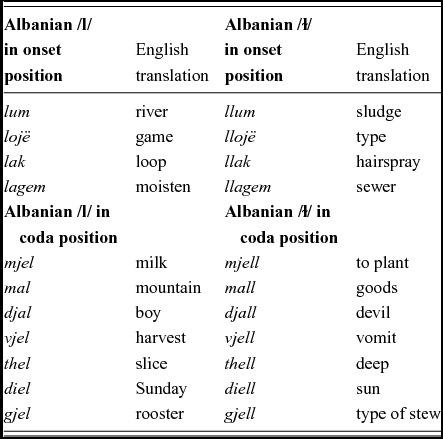
In Albanian, both the light and dark voiced lateral approximants, /l/ and /ɫ/ respectively, occur in both onset and coda position in minimal pairs (Camaj, Reference Camaj1984; Ladefoged & Maddieson, Reference Ladefoged and Maddieson2007). Orthographically, light /l/ is represented as <l> and dark /ɫ/ is represented as <ll>. For example, light /l/ and dark /ɫ/ occur in contrastive distribution in onset position in the words lum (=river, /lum/) and llum (=sludge, /ɫum/) and in coda position in the words mal (=mountain, /mɑl/) and mall (=goods, /mɑɫ/).
Usually, in SSBE, light [l] occurs in onset position and dark [ɫ] occurs in coda position (Wells, Reference Wells1982), e.g., leap [liːp] versus peel [piːɫ]. Although the light-dark dichotomy is not apparent across all varieties of English (Ladefoged & Maddieson, Reference Ladefoged and Maddieson2007; Wells, Reference Wells1982), the late bilinguals of this study acquired SSBE in London, where allophonic variation is generally maintained (Johnson & Britain, Reference Johnson and Britain2007; Lawson, Stuart-Smith & Scobbie, Reference Lawson, Stuart-Smith, Scobbie, Paolo and Yaeger-Dror2010; Wells, Reference Wells1982), hence it was expected that there was potential for the complementary distribution of SSBE to be acquired in the L2 of the late bilinguals, which might in turn have impacted their Albanian. Notably, attrition effects may have been influenced by a process of vocalisation, which the dark lateral is undergoing in some varieties of British English, particularly in London; however, as the vocalised /l/, which only occurs in coda position, is velar, and therefore dark, these vocalisation effects would have, if anything, compounded the darkening of the Albanian lateral approximant in coda position.
With regard to the acoustic correlates of the light and dark gestures, the F2 frequency is by and large considered to be the main acoustic cue in measuring the variation of the light and dark lateral approximants (Thomas, Reference Thomas2010). Specifically, the F2 frequency is high for the light lateral (between 1500–2000 Hz in men) and low for the dark lateral (between 800–1200 Hz in men); this is because F2 frequency “is particularly sensitive to variations in tongue dorsum height and fronting” which is the cue for the darkness distinction (Recasens, Reference Recasens2012, p. 369). Additional research suggests that in Albanian male speech production, the light lateral has an average F2 frequency of around 1550 Hz, and the dark lateral has an average F2 frequency of around 950 Hz (Dodi, Reference Dodi1970). However, the secondary constriction in the oral cavity, or lack thereof, also impacts F1 frequency (Recasens, Reference Recasens2004). If the constriction is made toward the back half of the oral cavity, F1 frequency will increase, whereas if a constriction occurs toward the front half of the oral cavity, F1 frequency will decrease (Neppert, Reference Neppert1999; Recasens, Reference Recasens2004).
Accordingly, the main objective of this research was to investigate whether the late L1 Albanian–L2 SSBE bilinguals produced a lighter lateral approximant for Albanian /ɫ/ in onset position, and a darker lateral approximant for Albanian /l/ in coda position, thereby transferring the complementary distribution of SSBE to their native Albanian speech.
It should be emphasised here that very few investigations have examined Albanian phonology and phonetics, but in extant Albanian grammars no suggestion is made that the lateral phonemic contrast has a lower functional load than any other Albanian phonemic contrast (Bevington, Reference Bevington1974; Camaj, Reference Camaj1984). Preliminary findings from a forthcoming corpus analysis of the Langenscheidt Handwörterbuch of Albanian (Buchholz, Fiedler, Uhlisch & Klosi, Reference Buchholz, Fiedler, Uhlisch and Klosi1999) indicate that 53 minimal pairs exist for the /l/ - /ɫ/ contrast, in comparison to 49 minimal pairs existing for the /l/ - /r/ contrast, not including inflected forms, and that, furthermore, Albanian native speakers perceptually distinguish between /l/ and /ɫ/ in nonsense words (Müller, Reference Müller2015), and that even three year olds perceive this difference (Müller & Kapia, Reference Müller and Kapia2016). It appears that this is a relatively robust contrast; however, further research may reveal that differences in functional load influence phonological attrition. For example, one might expect phonemes which have a high functional load to be less likely to undergo attrition than phonemes which have a low functional load. Although future research is necessary, the /l/ - /ɫ/ contrast is considered to be a functional component of Albanian phonology, and we interpret findings from our study which reveal phonological attrition in this contrast to indeed indicate a restructuring of a functional component of the L1 Albanian grammar.
Methodology
Participants
A total of 15 participants were examined for the study: 10 native Albanian speakers who acquired SSBE as an L2, and 5 Albanian monolinguals who reported that they did not speak any other languages aside from Albanian. The monolinguals were considered to provide an accurate representation of the L1 system prior to the onset of L2 acquisition (Seliger, Reference Seliger1996). Due to practical constraints, they were recorded in London, where they were on holiday. Their stay in London prior to the recording ranged between 5 days and 1 month, and they self-assessed to have either no or next to no proficiency in English.
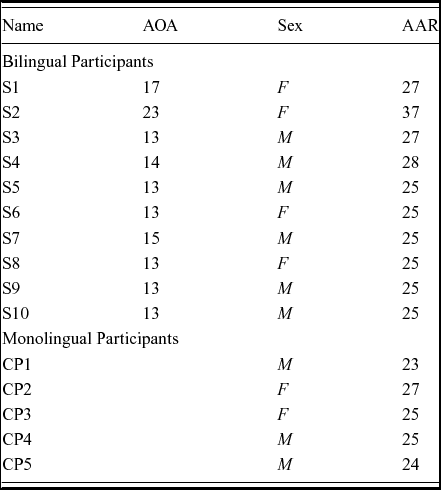
A questionnaire, largely based on the Max Planck Institute for Psycholinguistics online language background questionnaire for multilinguals (Gullberg & Indefrey, Reference Gullberg and Indefrey2003), was used to assess language history, age of arrival to London, and different aspects of language use. However, given the small number of bilinguals, these variables did not undergo a statistical analysis. As the Albanian dialects of Gheg and Tosk do not vary with respect to the lateral approximants (Camaj, Reference Camaj1984); it was not necessary to assess for regional background in the language background questionnaire. The bilinguals reported that their knowledge of English was at most rudimentary prior to their move to London; hence their age of arrival (see Table 1) was considered to be their onset of L2 acquisition (AoA). They acquired their L2 from adolescence onwards (average AoA 14.7 years of age, min=13, max=23), and related research indicates that laterals are fully acquired by the age of six (Khattab, Reference Khattab2002; Sander, Reference Sander1972), so we argue that the bilinguals in this study had fully acquired the /l/ - /ɫ/ contrast at AoA. As such, we consider a neutralisation of this phonemic contrast in the Albanian bilinguals to indeed be indicative of phonological attrition rather than incomplete acquisition.
Details of bilingual and monolingual participants: AoA (age of L2 acquisition), sex and AAR (age at recording).

Data collection procedure
Recordings were carried out in a quiet room at Queen Mary University of London (part of the QMUL Phonetics Laboratory). Participants were shown flash cards which contained one word per card. Eleven minimal pairs were elicited (see following section), as well as 28 distractor words, which were included to prevent the participants from realising the objective of the study. They were requested to read at a natural pace, and each word was read once. The recording session lasted approximately four minutes, thereafter the language background questionnaire was filled in with the assistance of the second author, who also conducted the recordings. Each recording was conducted using Pro Tools LE 7 software on a Macintosh OS X computer. Throughout the session, the interviewer encouraged an Albanian monolingual environment with no code switching (Grosjean, Reference Grosjean1998). Although English would not have been completely deactivated (Costa, Hernández, Costa-Faidella & Sebastián-Gallés, Reference Costa, Hernández, Costa-Faidella and Sebastián-Gallés2009), this elicitation procedure was intended to reduce cross-linguistic interferences. Therefore, an Albanian only environment meant that if the bilinguals failed to make a categorical distinction between the Albanian laterals, there were stronger grounds to argue that they had evidenced attrition.
Target words
A total of eleven Albanian minimal pairs which exploit the /l/ - /ɫ/ contrast were selected for the study (see Table 2). These words were chosen because they were all either monosyllabic or disyllabic and only contained other sounds which were common in both the Albanian and English sound inventories, i.e., there were no other sounds in the words which might have been challenging for the participants, and thus potentially increased the difficulty of their production of the lateral sounds. Furthermore, we considered the meaning of the words to be basic, and thus we did not predict complications to arise as a result of misunderstandings when the subjects read the words. Each participant therefore read 22 words (i.e., 320 words), with an average of 1.5 tokens discarded per person, largely due to the participants not being familiar with the word gjell (type of stew). The Albanian laterals in onset position were followed by front and back vowels, whereas the Albanian laterals in coda position were preceded only by front vowels. This was not thought to affect the results of the study because both the monolingual and bilingual groups were presented the same words. There were more coda minimal pairs than onset minimal pairs in our study because more coda minimal pairs fit the above criteria, although in preliminary Albanian research by Müller (forthcoming), seven coda and nine onset minimal pairs have been found. Rather than reduce the amount of words to balance the amount in each position, the decision was made to include as many words as possible bearing our selection criteria in mind (i.e., sounds common in both Albanian and English inventories, basic definitions).
List of minimal pairs used in the study.

Impressionistic analysis
Before F1 and F2 frequencies were instrumentally measured in each word, all recordings were impressionistically rated by the five monolinguals. For this impressionistic analysis, the monolinguals assessed whether the bilinguals sounded “native” or “non-native” in their L1, i.e., a binary assessment. This process was carried out in the same room and the minimal pair tokens were played over a head-set. The judges were presented each word orthographically, so that they would know what they were meant to hear, e.g., for lum a light lateral and for llum a dark lateral. The monolingual judges could replay the recordings before they rated each token and an average rating was computed for each speaker. Since the entire word was played to the monolinguals, it is important to note that other segments in the word, as well as potentially prosody, may have influenced this impressionistic analysis.
Annotation
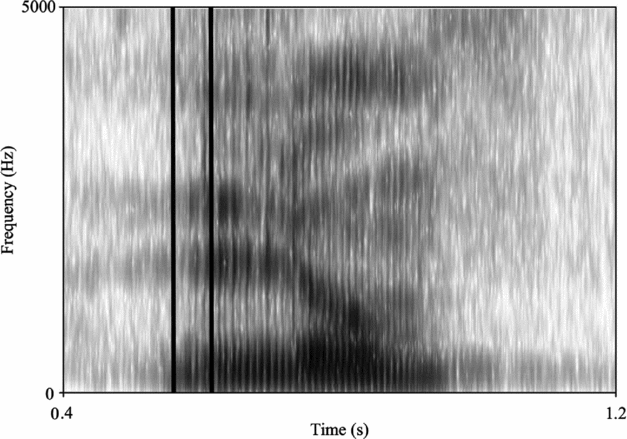
Once the impressionistic analysis had been undertaken, an acoustic analysis of the laterals was performed to examine whether any impressionistically observed foreign accented speech might have been apparent in the acoustic signal. For the Albanian laterals in onset position, the onset of the word was annotated using Praat software (Boersma & Weenink, Reference Boersma and Weenink2010). The insertion of the initial marker was decided through observing the onset of an increase in intensity in the spectrogram, and the commencing of regular periodic intervals (as in de Leeuw et al., Reference de Leeuw, Mennen and Scobbie2013). Thereafter, a second marker was inserted 40 milliseconds (ms) after this first marker which is where the F1 and F2 frequencies were measured in the onset, and could be considered to be a point at which the lateral had achieved a purported steady-state without being impacted by the following vowel. The offset of the lateral was not delineated because a categorical distinction between the preceding lateral and the following vowel based on the acoustic signal in natural speech is problematic due to the transitional phase between the lateral and vowel, which is continuous, rather than abrupt. The challenge for the annotation of /l/ was that consistent criteria, which can be applied not merely across speakers but also across languages, were necessary. For example, it would not have been possible to define the lateral on the basis of F2 frequency because in some tokens F2 frequency was high, whilst in others it was low. Although Stevens (2003) mentions that a general characteristic of laterals is a high F3 frequency, this was not observed in all tokens and could not be used as a standard point of measurement. Given that speakers had ample time to produce each word, individual segments were relatively long in duration, in comparison to faster speech. Although examining a different language, this methodology corresponds to the study by Lavoie (Reference Lavoie2001) on American English speech, in which segments in words were measured for duration, which found that in stressed position (which in isolated production, our tokens certainly were), /l/ had an average duration of 70ms, coinciding within our own point of measurement. Of the 22 target words, 18 were monosyllabic content words, whilst four were disyllabic content words; however, although very little is known about prosody in Albanian, “it may be said that in general the stress lies on the penultimate syllable” of disyllabic words (Camaj, Reference Camaj1984, p. 8). For this reason, the 40ms duration was determined in order to ensure that the measurement was taken safely within the lateral, where it had achieved a purported steady-state without having to artificially delineate the lateral from the vowel.
In coda position, a similar process was undertaken, and a marker was initially inserted at the end of the word through observing the drop of intensity in the spectrogram and the ceasing of regular periodic phonation (as in de Leeuw et al., Reference de Leeuw, Mennen and Scobbie2013). Thereafter, another marker was inserted 40ms before the end marker. It was here, 40ms before the end of the word, where the F1 and F2 frequencies were measured in coda position without having to artificially delineate the lateral from the vowel, as above. Again, at this point the measurements of the lateral were considered to be within a purported steady-state within the lateral.
Measuring F1 and F2 frequencies
A semi-automatic formant frequency extraction process allowed for visual and auditory cross-validation within each token, ensuring that the automatically extracted F1 and F2 frequencies were indeed plausible. Particularly in the case of /ɫ/, in which F1 and F2 are close together, Praat's automatic formant extraction process often results in F3 being reported as F2. In such cases, the Praat settings were adjusted for the individual token. The specific command used to extract formants in Praat was Sound: To Formant (burg). This command uses linear predictive coding (LPC) to determine the contour of formants which is based on equations which predict the amplitude of the waveform at any particular moment in time on the basis of what occurred beforehand (Hayward, Reference Hayward2000). The particular Burg algorithm implemented by this command in Praat is that of Press, Teukolsky, Vetterling, and Flannery (Reference Press, Teukolsky, Vetterling and Flannery1992).
Hypotheses
The general prediction of this study was that the complementary distribution of SSBE would be transferred to the contrastive distribution in the native Albanian speech in line with the SLM that “[s]ounds in the L1 and L2 are related perceptually to one another at a position-sensitive allophonic level, rather than at a more abstract phonemic level” (Flege, Reference Flege and Strange1995, p. 239). We hypothesised the following.
-
1. In the Albanian native speech of the bilinguals the dark lateral phoneme in onset position, i.e., onset-/ɫ/, will become light, and the light lateral phoneme in coda position, i.e., coda-/l/, will become dark.
-
2. No changes will occur in the Albanian native speech of the bilinguals in the light lateral phoneme in onset position, i.e., onset-/l/, nor in the dark lateral phoneme in coda position, i.e., coda-/ɫ/, because these phonemes already adhere to the expectations of the allophonic distribution in SSBE.
Results
Impressionistic results
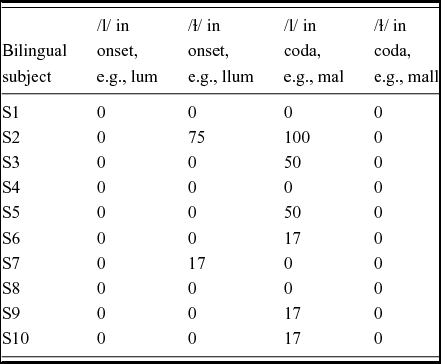
The results from the impressionistic analysis are presented in Table 3. With regard to the hypothesis that (1) in the Albanian native speech onset-/ɫ/ would become light, and coda-/l/ would become dark, it is particularly salient that only onset-/ɫ/ tokens, e.g., llum, and coda-/l/, e.g., mal, were considered to be non-native productions, suggesting that the SSBE allophonic distribution impacted the production of these laterals.
Percentage of tokens rated to be non-native by the monolingual control participants

In Subject 2, 75% of her onset-/ɫ/ tokens, and 100% of her coda-/l/ tokens were rated to be non-native productions. In subjects 3 and 5, 50% of coda-/l/ tokens were rated to be non-native productions, whilst in subjects 6, 9 and 10, 17% of their coda-/l/ tokens were rated to be non-native productions. In Subject 7, 17% of onset-/ɫ/ tokens were also rated to be non-native productions.
These impressionistic findings to a certain extent verified Hypothesis (1) in that tokens with onset-/ɫ/ and coda-/l/ appeared to be more likely to be rated as non-native productions, i.e., to have potentially undergone phonological attrition. However, this impressionistic analysis did not reveal whether onset-/ɫ/ actually became lighter, nor whether coda-/l/ actually because darker; it just revealed that words comprising these segments were more likely to be rated as non-native productions.
In contrast, and substantiating Hypothesis (2), that onset-/l/ and coda-/ɫ/ would remain stable, it was indeed the case that all of these tokens were rated to be native-like productions, such that it appears that, as expected, they did not undergo phonological attrition.
Moreover, it was apparent that subjects 1, 4 and 8 were never perceived to produce non-native speech by the monolingual listeners, suggesting that they underwent no phonological attrition. Accordingly, they contrasted starkly with subject 2, who revealed the most phonological attrition, and with subjects 3 and 5 for whom 50% of coda-/l/ tokens were rated to be non-native.
Acoustic results
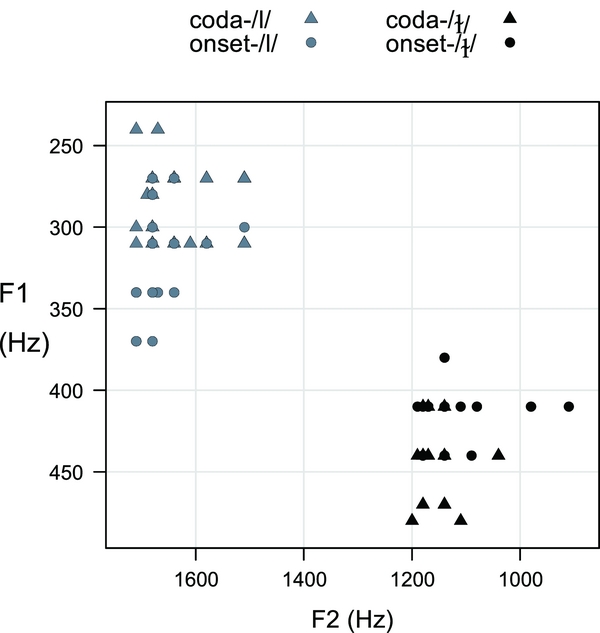
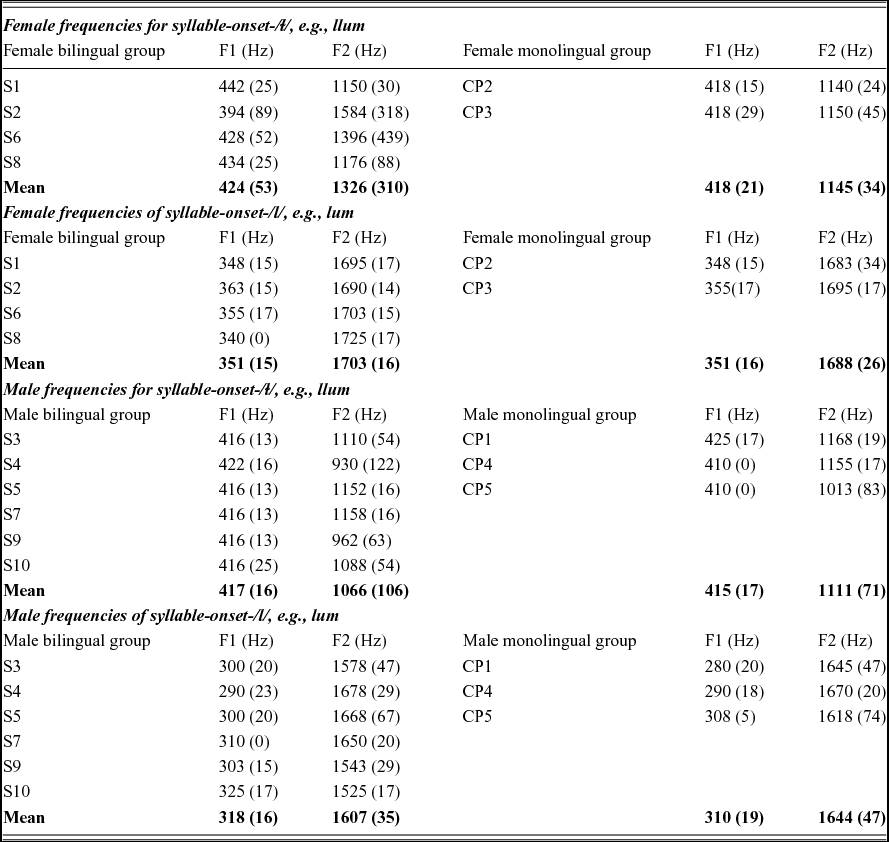
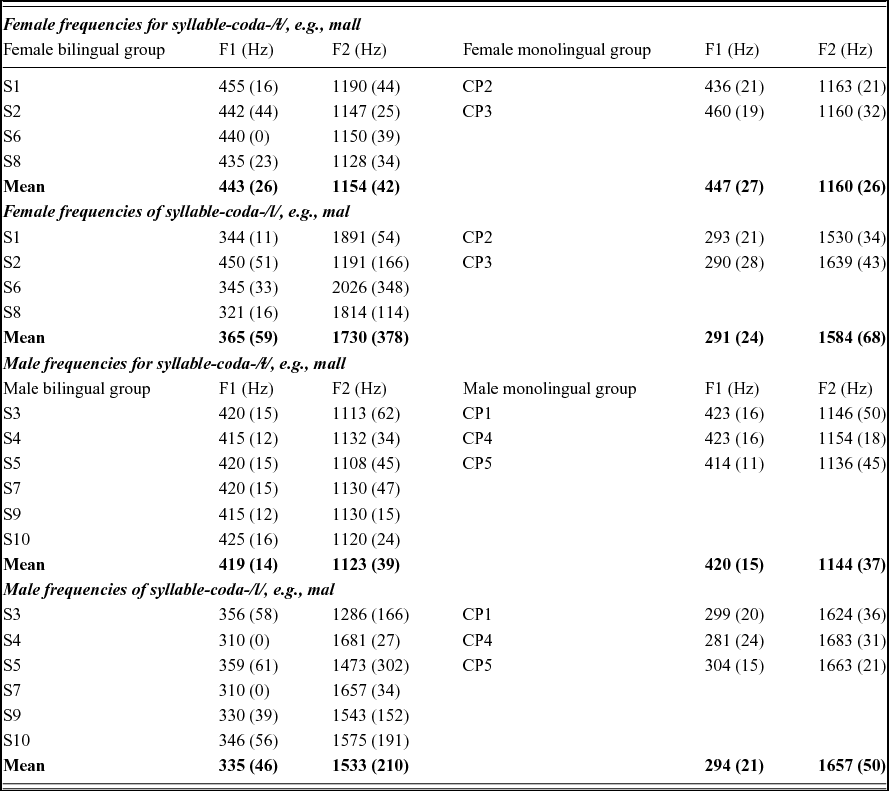
In order to compare the voiced lateral productions of the bilinguals with the monolinguals (see Appendix for values of all bilinguals and monolinguals), the raw formant values in their F1 × F2 space were observed. In Figure 3, the distribution for the monolingual's light and dark lateral phonemes are displayed in both onset and coda position, in order to initially compare these values with those of the bilinguals. As displayed, there was a complete separation of /l/ and /ɫ/ for the monolinguals, such that regardless of onset versus coda position, F1 frequency was lower for /l/ than for /ɫ/ and F2 frequency was higher for /l/ than for /ɫ/.
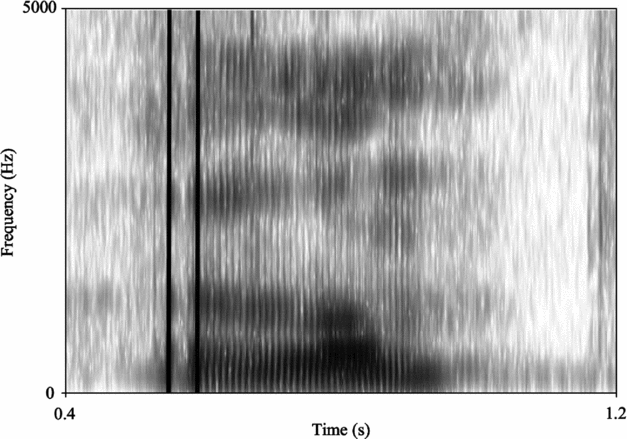
Annotated image of light lateral in lum.

Annotated image of dark lateral in llum.

Scatterplot of phonemic contrast of Albanian monolinguals in light and dark laterals.

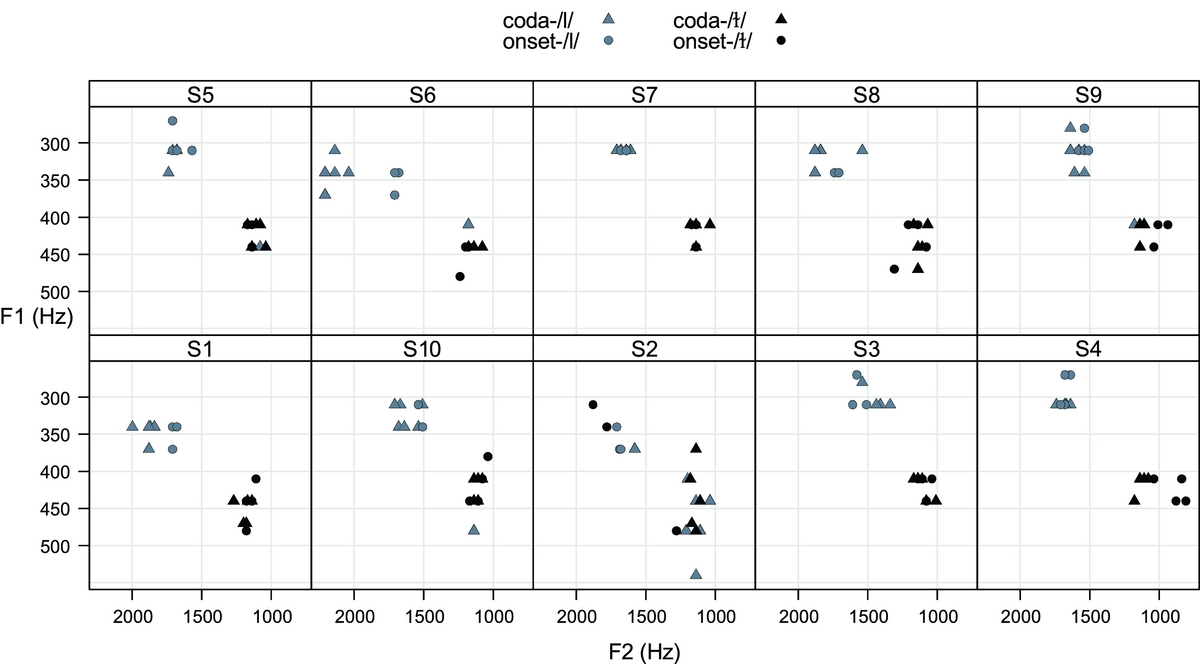
Thereafter, the raw formant values in their F1 × F2 space were observed in the bilinguals (Figure 4). Expectedly, in line with the impressionistic analysis, the bilingual subjects 1, 4, and 8 patterned relatively similarly to the monolingual speakers with a clear separation of the light and dark laterals in both onset and coda position. Similarly substantiating the impressionistic results, the bilingual subjects 2, 3, and 5 showed evidence of merging in some tokens such that coda-/l/ was in the /ɫ/ space (i.e., grey triangles appear in the bottom right of the F1 × F2 plane). Moreover, and similarly in line with the impressionistic analysis, subject 2 produced tokens of onset-/ɫ/ in the /l/ space (i.e., black circles in the F1 × F2 plane).
Scatterplots of individual phonological attrition in Albanian-English bilinguals in light and dark laterals.

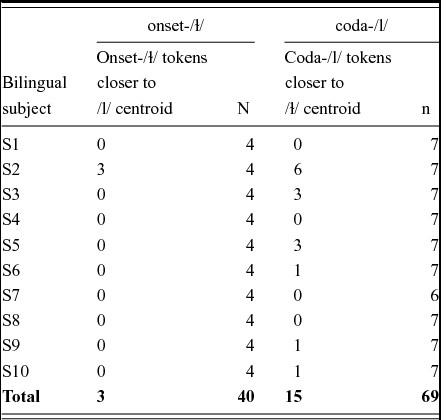
To examine individual tokens more closely, the Euclidean distances of the laterals between the onset-/l/ and coda-/ɫ/ centroids were calculated in their two-dimensional F1 × F2 space (Harrington, 2010, pp. 196–198). This was done separately for each bilingual in his or her Albanian, and for each lateral token to the centroid of onset-/l/ and to the centroid of coda-/ɫ/. The centroid of onset-/l/ and centroid of coda-/ɫ/ were chosen as targets given that the phonemes in these positions appeared to be most stable. Productions deviant from the Albanian contrastive distribution were identified as occurring whenever a given lateral in the participant's F1 × F2 space was closer to the other centroid, e.g., when a particular /l/ token was closer to the same speaker's /ɫ/ centroid than to that speaker's /l/ centroid; and when a particular /ɫ/ token was closer to the same speaker's /l/ centroid than to that speaker's /ɫ/ centroid. For lateral approximants produced according to the Albanian contrastive distributional norms, the bilinguals’ production was expected to be closer to the same category centroid (i.e., an /l/ token in both onset and coda position would be closer to the centroid of onset-/l/ than to the centroid of coda-/ɫ/; and an /ɫ/ token in both onset and coda position would be closer to the centroid of coda-/ɫ/ than to the centroid of onset-/l/). Any /ɫ/ tokens which were closer to the /l/ centroid, or /l/ tokens which were closer to the /ɫ/-centroid, were interpreted as evidence of merging of these phonemes in the production of that particular token, such that the phonemic contrast was ostensibly lost in L1 production for that particular token, but not necessarily across the board for that speaker. Note however that this analysis revealed extreme movement, and would not have detected subtle changes within the phonemes.
As evident from Table 4, and compatibly with the data in Figure 4, in the bilinguals, 15/69 (21.7%) of the coda-/l/ productions were closer to the /ɫ/ centroid whilst 3/40 (7.5%) of the onset-/ɫ/ productions were closer to the /l/ centroid in the bilinguals. More generally, 18/109, or 16.5%, of the lateral productions produced by the bilinguals were produced within the centroid of the alternative phoneme. Specifically, Subject 2 produced 6/7 of her coda-/l/ tokens closer to the /ɫ/ centroid than to the /l/ centroid, and 3/4 of her onset-/ɫ/ tokens closer to the /l/ centroid than to the /ɫ/ centroid. Subjects 3 and 5 produced three coda-/l/ tokens closer to /ɫ/ centroid, and subjects 6, 9, and 10 each produced one coda-/l/ token closer to /ɫ/ centroid. This pattern did not occur in the monolinguals.
Distribution of merging, shown for each bilingual for onset-/ɫ/ and coda-/l/

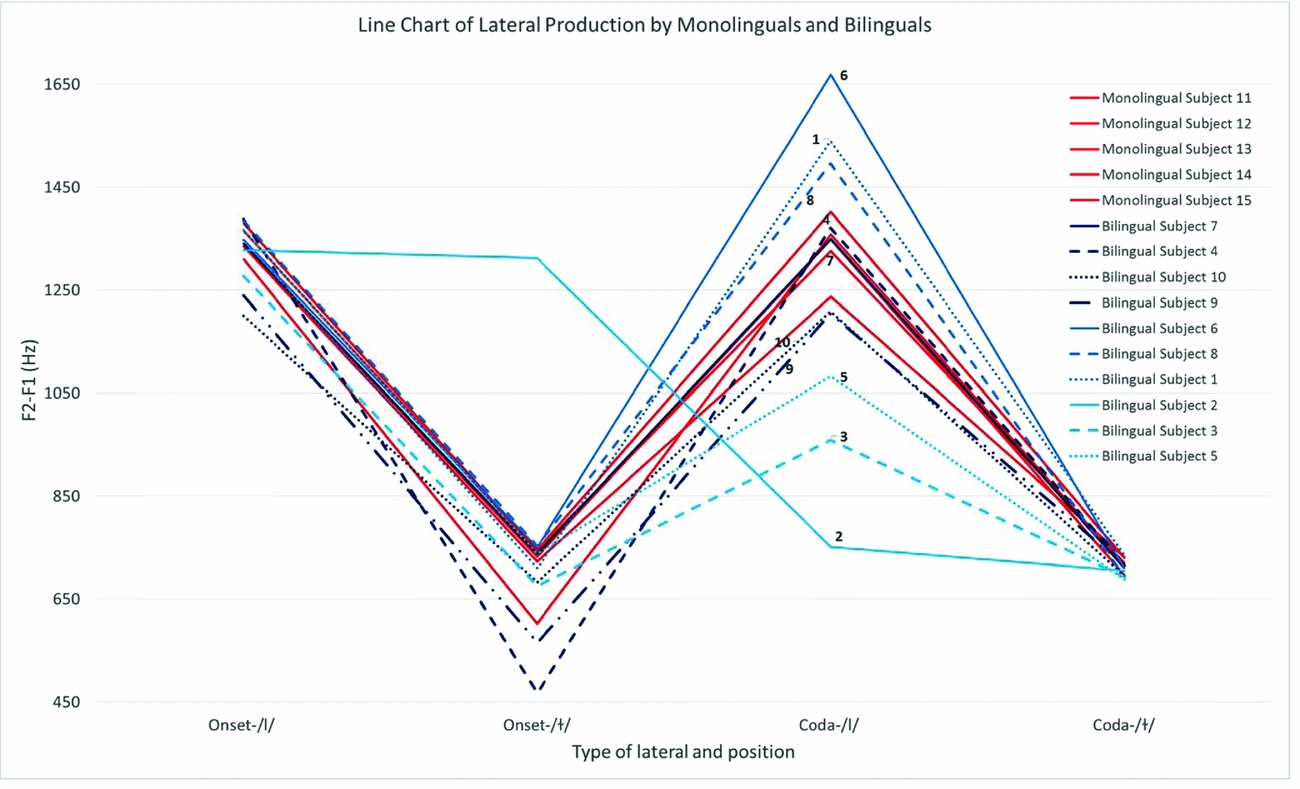
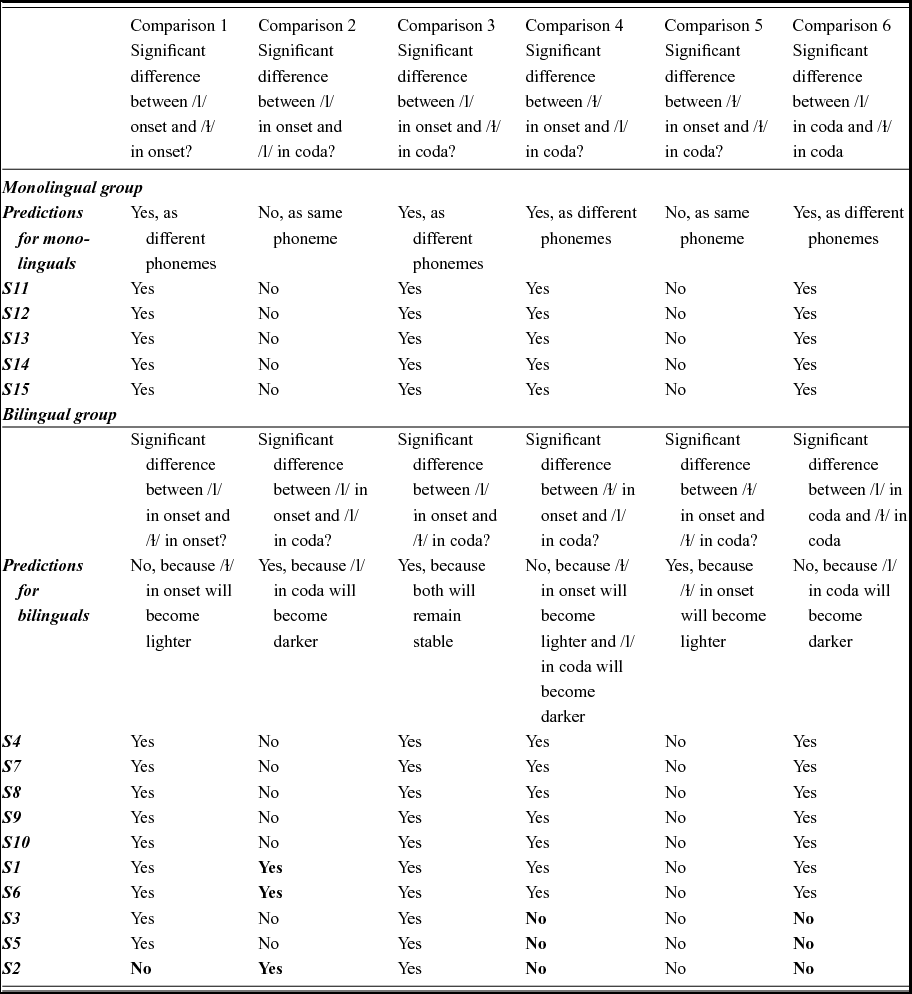
As a next step, a sequence of repeated measures ANOVAs were conducted at the individual level to examine whether there were significant differences between onset-/l/, onset-/ɫ/, coda-/l/, and coda-/ɫ/. For these comparisons, F2 minus F1 (F2-F1) was used, which has previously been successfully implemented to quantify variation in laterals, having an advantage of normalising individual vocal tract differences (Carter, Reference Carter2002; Kirkham, Reference Kirkham2016; Lehiste, Reference Lehiste1962; Nance, Reference Nance2014; Sproat & Fujimura, Reference Sproat and Fujimura1993). A lower F2-F1 value indicates a darker production, whilst a higher value indicates a lighter production. The individual F2-F1 measures are displayed in the line graph in Figure 5; and the results from the individual repeated measures ANOVAs are displayed in Table 5, where predictions for the repeated measures ANOVAs are also made. In all of the monolinguals, and all of the bilinguals save subject 5, the repeated measures ANOVAs implemented with a Greenhouse-Geisser correction achieved significance. However, as reported in the table, this significance was driven by different factors in the bilinguals than in the monolinguals. Post hoc tests (see Table 5), were implemented using the Bonferroni correction. In observing both the line graph (Figure 5) and the results from the repeated measures ANOVAs (Table 5), it is initially apparent that the monolinguals performed as a uniform group, with significant differences between light /l/ and dark /ɫ/ in both onset and coda position. Moreover, there was never a difference between onset and coda-/l/, nor between onset and coda-/ɫ/.
Line chart of individual phonological attrition, comparing Albanian monolinguals with Albanian- English bilinguals.

Light and dark lateral F2-F1 comparisons for each monolingual and bilingual subject, using repeated measures ANOVA's.

In contrast, the bilinguals did not perform uniformly. Subjects 4, 7, 8, 9 and 10 performed in the same way as the monolinguals. Of these bilinguals, only subjects 4 and 8 had evidenced no phonological attrition in either the impressionistic analysis or the Euclidean distance analysis. This suggested that the tokens which were detected in subjects 7, 9, and 10 in the impressionistic analysis and the Euclidean distance analysis were not enough to affect the results from the repeated measures ANOVAs as, overall, these bilinguals still produced distinctions between their light /l/ and dark /ɫ/ in both onset and coda position in the same way as the monolinguals.
Subjects 1 and 6 evidenced a significant difference between onset-/l/ and coda-/l/, in contrast to the monolinguals. However, this was not, as predicted, due to coda-/l/ becoming darker, but rather, surprisingly, to coda-/l/ becoming even lighter than onset-/l/. Otherwise, subjects 1 and 6 performed similarly to the monolinguals. It is nonetheless noteworthy, however, that although in the impressionistic analysis, this appeared to not be detected by the monolinguals in subject 1, this might have been detected in subject 6, as some of her coda-/l/ tokens were perceived to be non-native. Moreover, as the Euclidean distance analysis revealed that one coda-/l/ token was closer to the /ɫ/ centroid in subject 6, it appeared that this subject produced her coda-/l/ tokens highly variably.
Similar to the monolinguals, subjects 3 and 5 did not evidence a significant difference between onset-/l/ and coda-/l/, although, descriptively, it appeared in Figure 5 that their coda-/l/ was darker than onset-/l/. It is also noteworthy to emphasise that the repeated measures ANOVA for subject 5 only approached significance (F(1.027, 3.082) = 8.073, p = 0.058). However, in contrast to the monolinguals, subject 3 did not reveal a significant difference between onset-/ɫ/ and coda-/l/, which was due to the darkening of coda-/l/, and a similar trend was observed in subject 5. Moreover, in contrast to the monolinguals, subject 3 did not reveal a significant difference between coda-/l/ and coda-/ɫ/, again caused by the darkening of coda-/l/, which subject 5 also displayed.
Subject 2 revealed the most phonological attrition in the repeated measures ANOVA. Similar to subjects 3 and 5, and in contrast to the monolinguals, subject 2 did not reveal a significant difference between coda-/l/ and coda-/ɫ/. Again, this was caused by the darkening of coda-/l/. Moreover, and again in contrast to the monolinguals, she did not reveal a significant difference between onset-/l/ and onset-/ɫ/, caused by a lightening of onset-/ɫ/, nor did she reveal a significant difference between onset-/ɫ/ and coda-/l/. However, in contrast to the predictions for the bilinguals, and similarly to the monolinguals, she did not evidence a significant difference between onset-/ɫ/ and coda-/ɫ/, i.e., although onset-/ɫ/ appeared to have lightened (Figure 5), it had not ostensibly lightened enough to reveal a significant difference in this analysis.
To summarize the findings from the individual repeated measures ANOVAs, five of the bilinguals performed similarly to the monolinguals, but five performed differently from the monolinguals. Similar to the findings from the impressionistic analysis, the results from the repeated measures ANOVAs only partially substantiated Hypothesis (1) that in the Albanian native speech onset-/ɫ/ would become light, and coda-/l/ would become dark. In those bilinguals who performed differently to the monolinguals, coda-/l/ appeared to be more likely to darken (i.e., in subjects 2, 3 and 5), whilst there was less movement of onset-/ɫ/. However, in subject 2 onset-/ɫ/ did become lighter, and there was no significant difference between onset-/l/ and onset-/ɫ/. Moreover, and quite surprisingly, in addition to the darkening of coda-/l/ in subjects 2, 3, and 5, coda-/l/ surprisingly became lighter in subjects 1 and 6. Finally, Hypothesis (2) appeared to be substantiated as no changes occurred in the Albanian onset-/l/, nor in coda-/ɫ/, thereby adhering to the expectations of allophonic distribution in SSBE.
Discussion
The primary objective of this study was to investigate individual phonological attrition in Albanian native speakers who moved to London, where they acquired SSBE as an L2 in adolescence or adulthood. The findings build on previous research which has revealed phonetic attrition (de Leeuw et al., Reference de Leeuw, Mennen and Scobbie2012, Reference de Leeuw, Mennen and Scobbie2013; de Leeuw, Schmid & Mennen, Reference de Leeuw, Schmid and Mennen2010; Dmitrieva et al., Reference Dmitrieva, Jongman and Sereno2010; Flege, Reference Flege1987; Major, Reference Major1992; Mayr et al., Reference Mayr, Price and Mennen2012). To a certain extent, every phonetic change in L1 speech could be interpreted to impinge on a phonological distinction. However, our analysis investigated the suspension of a phonemic contrast which serves to contrast meaning in minimal pairs, as we examined whether the contrastive distribution in Albanian would be replaced by complementary distribution, which is present in the bilingual L2 of SSBE.
Firstly, it is important to emphasise that the bilingual subjects 4 and 8 performed in the same way as the monolinguals in all of the analysis steps. In the impressionistic analysis they were perceived to be native speakers in all of their tokens; in the Euclidean distance analysis, none of their onset-/ɫ/ tokens were closer to their /l/ centroid and none of their coda-/l/ tokens were closer to their /ɫ/ centroid. In their repeated measures ANOVAs, they performed in exactly the same way as the monolinguals and maintained a phonemic contrast between /l/ and /ɫ/ in onset and coda position. Thus it is safe to say that in this formal word elicitation task, these bilinguals evidenced no phonological attrition.
However, it is worth noting that in Major's study (Reference Major1992), more phonetic attrition was evidenced in less formal tasks, and that in all prior phonetic studies on attrition, only formal tasks have been used to elicit speech (e.g., de Leeuw et al., Reference de Leeuw, Mennen and Scobbie2012, 2013; Flege, Reference Flege1987; Mayr et al., Reference Mayr, Price and Mennen2012; Mennen, Reference Mennen2004). Thus, to build on the current research, it would be worth investigating whether more phonological attrition would be reported in an informal elicitation task, for which subjects are potentially less careful in their speech production.
Subjects 9 and 10 displayed traces of phonological attrition in this study. In the impressionistic analysis, 17% of their coda-/l/ tokens were perceived to be non-native like and in the Euclidean distance analysis, one of their coda-/l/ tokens was closer to their /ɫ/ centroid. This suggests that their coda-/l/ may have undergone some phonological attrition within individual tokens, although attrition was minimal. In the repeated measures ANOVAs, they performed like the monolinguals and appeared to maintain a phonemic contrast between /l/ and /ɫ/ in onset and coda position; however, it is again worth bearing in mind that a more informal task may have elicited more phonological attrition.
In the impressionistic analysis, 17% of subject 7’s onset-/ɫ/ tokens were perceived to the non-native like, although this was not backed up in the Euclidean distance analysis. We therefore suggest that the monolingual listeners in the impressionistic analysis had based their non-native like assessment on other factors, and not on lateral production. As such, with regard to our specific investigation into phonological attrition in the phonemic contrast of light /l/ and dark /ɫ/ in onset and coda position in Albanian native speech, we gather that subject 7 performed in the same way as subjects 4 and 8, and hence in a monolingual-like manner. In the repeated measures ANOVAs he maintained a phonemic contrast between /l/ and /ɫ/ in onset and coda position. Therefore, we suggest that three of the bilinguals (subjects 4, 7 and 8) in our investigation revealed no phonological attrition in this formal word-list elicitation task, whilst two (subjects 9 and 10) revealed minimal phonological attrition as evidenced by darkening of coda-/l/ at the individual token level.
Subjects 1 and 6 were surprising in that their coda-/l/ tokens appeared to undergo lightening, which caused a significant difference between onset-/l/ and coda-/l/, as coda-/l/ became even lighter. This lightening of coda-/l/ was not detected in subject 1 by the monolingual listeners in the impressionistic analysis, nor could it have been detected in the Euclidean distance analysis. Thus the overall lightening of coda-/l/ in subject 1 could have been a Type I error, and, had the monolingual group been larger, it would not have surfaced. Alternatively, it could also be that she evidenced phonological attrition through dissimilation, as “bilinguals strive to maintain phonetic contrast between all of the elements in their L1 / L2 phonetic space, just as monolinguals strive to maintain phonetic contrast among the elements making up their L1 phonetic space” (Flege et al., Reference Flege, Schirru and MacKay2003, p. 470), which would substantiate previous prosodic research (de Leeuw, et al., Reference de Leeuw, Mennen and Scobbie2012). Overall, subject 6 likewise “overshot” the monolingual norm of coda-/l/; however one of her coda-/l/ tokens was revealed to be closer to the /ɫ/ centroid in the Euclidean distance analysis. In the repeated measures ANOVAs, subjects 1 and 6 evidenced a significant difference between onset-/l/ and coda-/l/, in contrast to the monolinguals. However, again surprisingly, this was due to coda-/l/ becoming even lighter than onset-/l/. With regard to subject 6, it can therefore be concluded that she produced her coda-/l/ tokens variably, generally lightening coda-/l/ even more than the monolingual norm, but at times darkening coda-/l/.
Subjects 3 and 5 both evidenced phonological attrition. In the impressionistic analysis, 50% of their coda-/l/ tokens were perceived to be non-native like, whilst all of their other tokens were perceived to be native like, and in the Euclidean distance analysis, 3/7 of their coda-/l/ tokens were closer to their /ɫ/ centroid. They also did not perform like the monolinguals in the repeated measures ANOVAs in that their coda-/l/ underwent darkening such that there was no significant difference between onset-/ɫ/ and coda-/l/ nor between coda-/l/ and coda-/ɫ/, as a result of darkening of coda-/l/. Therefore, with regard to subjects 3 and 5, we summarise that phonological attrition was evidenced in the form of darkening of coda /l/, such that it ostensibly became the same as the dark /ɫ/. Again, future research could implement informal speech elicitation methods, which might render more attrition than as elicited through formal speech tasks.
Subject 2 evidenced the most phonological attrition. The impressionistic analysis verified these results in that 75% of her onset-/ɫ/ tokens and 100% of her coda-/l/ tokens were perceived to be non-native. The Euclidean distance analysis also revealed that 3/4 of her onset-/ɫ/ tokens were closer to her /l/ centroid, and 6/7 of her coda-/l/ tokens were closer to her /ɫ/ centroid. In addition, the repeated measures ANOVA revealed no significant difference between her onset-/ɫ/ and coda-/l/, nor between coda-/l/ and coda-/ɫ/, as a result of the lightening of onset-/ɫ/ and darkening of coda-/l/. Moreover, in contrast to the monolinguals, and uniquely in the bilinguals, the repeated measures ANOVA indicated that there was a significant difference between onset-/l/ and coda-/l/, driven by a darkening of coda-/l/ and that there was no significant difference between onset-/l/ and onset-/ɫ/, driven by a lightening of onset-/ɫ/. We therefore conclude that she fully suspended the Albanian phonemic contrast, instead replicating the allophonic variation expected of SSBE, with a light lateral consistently in onset position and a dark lateral consistently in coda position, i.e., onset-[l] and coda-[ɫ]. This finding is interpreted as a clear case of restructuring of a functional component of native L1 Albanian grammar.
In terms of our hypotheses, we predicted that the complementary distribution of SSBE would be transferred to the contrastive distribution in the native Albanian speech in line with the SLM which states that “[s]ounds in the L1 and L2 are related perceptually to one another at a position-sensitive allophonic level, rather than at a more abstract phonemic level” (Flege, Reference Flege and Strange1995, p. 239). To a certain extent, Hypothesis (1), which stated that in the Albanian native speech the dark lateral phoneme in onset position would become light, and the light lateral phoneme in coda position would become dark, was only partly verified, as a noteworthy finding from this investigation was that the difference in direction of change was not balanced. Instead, it appeared that coda-/l/ was more susceptible to attrition than onset-/ɫ/, although in subject 2 both onset-/ɫ/ and coda-/l/ were susceptible to attrition. The general tendency for coda-/l/ to be more prone to attrition may have been due to dark lateral realisations being wide-spread across the English speaking world, in particular in American English (Wells, Reference Wells1982), such that the bilinguals would have, overall, received more input from English varieties in which a dark lateral variant would be realised and thus the dark variant in onset position in Albanian would have less competition than the light variant in coda position. This would not align, however, with the finding that two female bilinguals, subjects 1 and 6, produced a lighter coda-/l/ than the monolinguals, i.e., “overshooting” the lightness of /l/ in coda position, which is typical of /l/ in Albanian coda (see also de Leeuw et al., Reference de Leeuw, Mennen and Scobbie2012; Flege & Eefting, Reference Flege and Eefting1987). It may also be that prosody played a role in influencing these asymmetrical changes, although, to our knowledge, there is no research on Albanian prosody, and predictions with regard to prosody could therefore not be made. It could also have been that vocalised-/l/ in coda position would have compounded the darkening effects of coda-/l/, but, again, this would not align with the dissimilation effects reported in subjects 1 and 6. It could also be that sociophonetic variation in English influenced the type of attrition observed in the bilinguals’ Albanian native speech if the bilinguals had learned particular varieties of English (i.e., those exhibiting a lightening of coda-/l/ potentially indexing themselves away from the dark vocalised-/l/ variety, also reflected in their Albanian). Vocalization in SSBE speakers may result in a segment that is actually no longer a lateral, and therefore might not be categorized by Albanian speakers as corresponding to either of the Albanian laterals but rather with another segment (such as /w/). If that were the case, then one would not expect the vocalized segments to have any effect on the pronunciation of Albanian laterals, however, what we see is that coda-/l/ was more prone to attrition, and thus, arguably, any vocalised laterals would have contributed to the observed attrition.
Alternatively, it may be that the coda position itself was more likely to undergo phonological attrition, which could align with some phonological theory which stipulates that consonants in coda position are “weak”. For example, Ségéral and Scheer (Reference Ségéral, Scheer, de Carvalho, Scheer and Ségéral2008) state that “Coda effects are very common, and everybody knows that they typically provoke lenition of the Coda consonants: all textbooks mention relevant evidence [. . .]” (p. 135) and “hence we do not expect to find a language where the same input experiences lenition in the strong position, but remains undamaged (or even strengthens) in [Coda position]” (p. 140). It may be that the lateral in coda position was more vulnerable to the effects of phonological attrition than in onset position, and that this was reflected in the destabilisation of the coda lateral, surfacing most frequently through darkening.
With regard to Hypothesis (2), that no changes would occur in the Albanian onset-/l/, nor in coda-/ɫ/, because these phonemes already adhere to the expectations of the allophonic distribution in SSBE, this was indeed the case. In all the bilinguals, onset-/l/ and coda-/ɫ/ remained stable. We consider this to be informative for research into phonological attrition, as these findings support the statement that “[s]ounds in the L1 and L2 are related perceptually to one another at a position-sensitive allophonic level, rather than at a more abstract phonemic level” (Flege, Reference Flege and Strange1995, p. 239). In relation to the SLM, the results from this study confirm that the functional role sounds have in the L1 and L2 of late sequential bilinguals appears to influence their attrition, or lack of attrition.
It may be that differences in degree of phonological attrition in the bilinguals were due to amount and type of Albanian language use. Anecdotally, many bilinguals reported that they continued to speak English even when in Albania, especially with younger siblings who were simultaneous bilinguals. Speculatively, this could mean that even bilinguals who used Albanian frequently may have been conversing with individuals who produced foreign-accented Albanian speech. Accordingly, language input would depend not only on the language itself, but also on whether the language had already become foreign-accented. Such an explanation would place input as the driving force behind phonological attrition, modulated by phonological constraints. Future studies may devote more attention to the quality of L1 use rather than overall quantity, in addition to various tasks including formal and informal methods. The differences in individual phonological attrition may also have been caused by age related differences between participants. However, this would run counter to the intuitive prediction that those who immigrated at an earlier age would be more likely to evidence phonological attrition, as subject 2, who exhibited the most phonological attrition, was also the oldest when she arrived in the UK at 23 years of age.
We emphasise that these findings should be viewed as a starting step and that more research in the area of phonological attrition is necessary. Nonetheless, the results build on previous research revealing phonetic attrition in late sequential bilinguals, and indicate that phonological attrition in native speech production is possible in late L2 acquisition, although not inevitable. Whether previously interpreted surface level modifications to L1 sounds in the form of phonetic attrition are indeed evidence of modifications to solely surface level realisations, or whether L1 phonemic representations are malleable – if such a difference is ordained in the first place – therefore becomes debatable. Future research into the attrition of the perception of phonemic contrasts may shed more light on the extent to which underlying representations are malleable (Tice & Woodley, Reference Tice and Woodley2012). Based on the present research, however, our findings indicate that at the level of speech production it is possible for a phonemic contrast in the L1 to become neutralised upon acquisition of a late acquired L2, as evidenced most clearly in subject 2, and supported by subjects 3 and 5. We would predict that this neutralisation process commences in coda position before spreading to onset position. Therefore, we deduce from our findings that phonological attrition is possible in late L2 acquisition, although certainly not inevitable.
It would be most useful for future research with more participants to build on the present research by moving beyond the question of whether phonetic and phonological attrition occur, and instead ask rather why some bilinguals, in some settings (i.e., formal versus informal settings), appear to be more prone to phonetic and phonological attrition, and why some sounds appear to be more likely to undergo attrition than other sounds. It does seem from these findings that in terms of phonology, restructuring of the native language grammar continues to be malleable outside of a proposed critical period, although the extent of malleability varies between different people, in different contexts, and for different sounds. Future research may also examine the link between perception and production, i.e., category mismatching (Best, Reference Best and Strange1995, Reference Best2003; Escudero & Boersma, Reference Escudero and Boersma2002; Flege, Reference Flege1987, Reference Flege and Strange1995; Flege et al., Reference Flege, Schirru and MacKay2003), and the extent to which native language speech perception undergoes attrition. Such large scale collaborative studies would help to improve our understanding of language development across the lifespan in monolinguals and bilinguals.
APPENDIX
Mean female and male formant frequency values for syllable onset-/ɫ/ and syllable onset-/l/. Standard deviations are given in brackets.

Mean female and male formant frequency values for syllable coda-/ɫ/ and syllable coda-/l/. Standard deviations are given in brackets.