Implications
Feeding high-grain diet to high-producing dairy animals leads to great risk of subacute ruminal acidosis (SARA). Grains steeped in some organic acids were proven to reduce rate of starch fermentation in the rumen. In this study, lactating dairy goats that were fed ground corn steeped in citric acid (CA) increased ruminal pH, reduced concentration of total volatile fatty acids (VFAs), and trend to increased milk fat yield. Furthermore, the CA treatment of corn also reduced blood concentration of haptoglobin and tumour necrosis factor (TNF). These results proved that the treatment with CA could be a nutritional strategy to reduce the risk of SARA in dairy goats fed high-corn diet.
Introduction
Corn is an important energy source in ruminant diet for its high-starch content. Although feeding high-starch corn meets the energy requirement of animals, it produces large quantity of fermentation acids (i.e. VFA) in the rumen following feed ingestion. The rapidly increased ruminal VFA from highly fermentable grains decrease ruminal pH, change ruminal microbial populations, and cause potentially SARA (Kleen et al., Reference Kleen, Hooijer, Rehage and Noordhuizen2003; Plaizier et al., Reference Plaizier, Krause, Gozho and McBride2008). The SARA is a main metabolic disorder in goats fed high-grain diet, and it can change gut microbial population, increase toxin transfer through the rumen epithelium and stimulate the inflammatory response (Huo et al., Reference Huo, Zhu and Mao2013; Klevenhusen et al., Reference Klevenhusen, Hollmann, Podstatzky-Lichtenstein, Krametter-Frötscher, Aschenbach and Zebeli2013; Metzler-Zebeli et al., Reference Metzler-Zebeli, Schmitz-Esser, Klevenhusen, Podstatzky-Lichtenstein, Wagner and Zebeli2013).
One of the nutritional strategies to alleviate SARA is to reduce the rate of starch digestion in the rumen. Several studies reported that feeding grains treated with organic acids such as lactic acid and tannic acid caused a reduction in rumen fermentation. Iqbal et al. (Reference Iqbal, Zebeli, Mazzolari, Bertoni, Dunn, Yang and Ametaj2009 and Reference Iqbal, Zebeli, Mazzolari, Dunn and Ametaj2012) found that feeding barley grain steeped in 0.5% lactic acid increased starch resistance to microbial fermentation, lowered ruminal concentration of VFA, lactic acid and lipopolysaccharide (LPS), maintained a higher ruminal pH, and enhanced milk fat content in dairy cows. Martínez et al. (Reference Martínez, Moyano, Díaz, Barroso and Alarcón2005) observed depressed in vitro ruminal degradability of tannic acid-treated barley. Citric acid is also an important organic acid, and has been widely used in human food preparation. Previous studies have shown that different starches steeped in a CA solution leads to a lower percentage of rapidly digestible starch and greater percentage of resistant starch (Shin et al., Reference Shin, Lee, Kim, Lee, Cheong, Chung, Baik, Park, Kim and Moon2007; Harder et al., Reference Harder, Khol‐Parisini and Zebeli2015b; Mei et al., Reference Mei, Zhou, Jin, Xu and Chen2015). In addition, CA can be rapidly fermented into acetate in the rumen (Russell and Van Soest, Reference Russell and Van Soest1984), and thus no CA would remain in the rumen. Feeding CA-treated barley modulated in vitro ruminal microbiota and increased the percentage of acetate (Harder et al., Reference Harder, Khol-Parisini, Metzler-Zebeli, Klevenhusen and Zebeli2015a) or increased fibre digestibility and rumen pH in Holstein calves (Kazemi-Bonchenari et al., Reference Kazemi-Bonchenari, Salem and López2017).
Corn is widely used as animal feed in China, for its highest starch compared with other feed grains. The amount of starch digestion in the rumen could be high due to high intake of corn-based diet. The digestibility of corn starch in the rumen is also high for the high moisture or highly processed corn. Therefore, SARA can be a common disorder in dairy goats fed high-corn diet (Huo et al., Reference Huo, Zhu and Mao2013; Liu et al., Reference Liu, Xu, Zhu and Mao2014). We hypothesized that feeding dairy goats with ground corn steeped in CA solution would reduce rate of starch digestion in the rumen, and thus improve ruminal pH and reduce the risk of SARA. The objective of this study was to investigate whether feeding CA-treated corn grain could be developed as a management strategy to reduce the incidence of SARA and improve milk production and immune response in dairy goats. The objective was addressed by evaluating the effects of CA-treated corn on ruminal pH and fermentation patterns, ruminal LPS concentration, inflammatory responses and milk production in dairy goats.
Material and methods
Animals, diets and experimental design
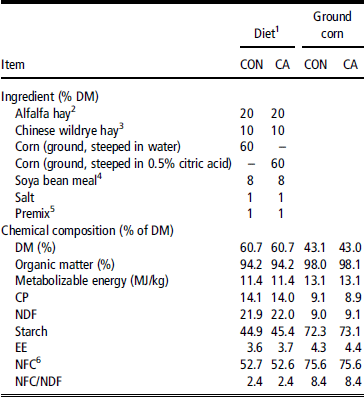
The experiment was carried out at the Experimental Farm of Yangzhou University, China. The experimental protocol was approved by the Animal Care and Use Committee of Yangzhou University. A total of 8 primiparous ruminally cannulated Saanen dairy goats (mean±SD, 32.5±3.16 kg of initial BW, 34.5±3.32 kg of end BW, 262±8 day in milk) were individually housed in slatted wood floor pens (1.7×2.8 m) with an automatic drinking bowl and feed chute. The temperature, humidity and hours of light during the experimental period were averaged, respectively, at about 15°C, 50~70% and 10 h/day. Goats were paired based on BW and milk yield, and randomly assigned to one of two dietary treatments according to a paired crossover design. Goats were offered a total mixed ration (TMR) comprised 30% hay and 70% concentrate mix including 60% corn and 10% protein, mineral and vitamin supplement (DM basis). The hay was chopped to 3 cm using a forage cutter. Corn was purchased from one source for entire experiment and ground through 5-mm screen. The ground corn was steeped in equal quantity (i.e. in a ratio of 1 : 1, wt/vol) of either water only as control (CON) or 0.5% CA solution. The use of 0.5% concentration of CA to treat corn grain was based on in vitro pilot experiment which indicated that 0.5% CA solution was sufficient to reduce DM disappearance and gas production after 24 h fermentation. Diet was formulated to exceed the recommendation of National Research Council (NRC) (2007) for goats weighing 40 kg and producing 0.5 kg milk daily (Table 1). Each experiment period was 21 days with the first 14 days for adaptation to new diet, 2 days for ruminal pH measurement, and 5 days for samples collection, and additional 14 days of washout period between the two periods. The TMR were prepared daily and fed twice at 0700 and 1900 h with equal amount of each feeding and animals had free access to water.
Ingredients and chemical composition of the experimental diet for dairy goats
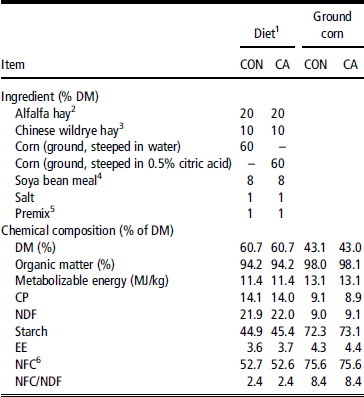
CA=citric acid; DM=dry matter; EE=ethanol extract; NFC=non-fibre carbohydrate.
1 Dairy goats fed diets contained ground corn steeped in water (CON) or in 0.5% CA for 48 h.
2 Composition was DM 90.2%, NDF 40.3%, starch 2.1, CP 18.5%.
3 Composition was DM 87.5%, NDF 73.1%, ADF 3.9%, starch 1.3%, CP 11.2%.
4 Composition was DM 89.1%, NDF 14.9%, starch 9.6%, CP 49.1%.
5 Contained 120 000 IU of vitamin A; 50 000 IU of vitamin D; 700 IU of vitamin E; 400 mg of Fe; 20 mg of Co; 650 mg of Cu; 1000 mg of Zn; 600 mg of Mn; 30 mg of Se; 45 mg of I; 450 mg of nicotinic acid.
6 NFC=100 – (% NDF+% CP+% EE+% ash).
Sampling and measurements
Feed offered and orts were recorded daily and samples of diets and orts were collected daily and pooled by goats and by period. The samples were dried at 55°C in a forced-air oven for 48 h and then ground through 1-mm screen using a Wiley mill (Thomas-Wiley, Philadelphia, PA, USA) for chemical analyses. Goats were milked twice daily at 0800 and 1800 h. Milk yield was recorded daily and milk samples were collected into a 50 ml vial on d 17, 19 and 21 of each experimental period.
Ruminal pH was continuously monitored for 48 h from days 15 to 16, using industrial electrodes (model S650-CDHF; Sensorex, Garden Grove, CA, USA), and a pH transmitter (3631; Jenco Instrument Inc., San Diego, CA, USA) to transfer the signal to a data logger (Penner et al., Reference Penner, Beauchemin and Mutsvangwa2006). The sensors were validated according to the manufacturer’s instructions. The electrodes were calibrated using pH 4.0 and pH 7.0 standards and suspended in the rumen using a cable which was anchored to the ruminal cannula plug. A 200 g weight was attached to ensure the electrode remained in the bottom of the rumen. Ruminal pH data were read every 5 s and averaged every 5 min, and summarized as mean, minimum, maximum and duration and area of ruminal pH<5.6, 5.8 and 6.0.
Ruminal liquid (15 ml) was collected from three sites in the rumen on days 18 and 21, every 2 h from 0700 to 1900 h via the ruminal cannula. The cannula (i.e. 62 mm) was made of polyamide and polyvinyl chloride (Bar Diamond, Parma, Italy). The samples were immediately squeezed through four layers of cheesecloth and divided into two parts. One part of the liquid was centrifuged at 10 000×g for 10 min at 4°C. One millilitre of the resulting supernatant was mixed with 0.2 ml 25% (wt/vol) HPO3 for VFA determination and another 1 ml was collected for lactic acid analysis. The second part of the ruminal liquid was boiled for 30 min and centrifuged at 20 000×g for 45 min at 4°C. The resulting supernatant was transferred into a 2.0 ml LPS-free tube using a 5 ml syringe with 0.22 μm filter for LPS analysis.
Blood samples from the jugular vein were collected before morning feeding on days 17 and 20 of each period. Approximately 5 ml of blood was collected into a vacuum tube with sodium heparin, centrifuged at 4°C for 15 min at 3000×g, and plasma was transferred into 2 ml LPS-free glass tubes. Another 5 ml blood was collected into a vacuum tube without additive, clotted at room temperature for 30 min, and then centrifuged at 3000×g for 15 min to obtain serum. Both plasma and serum were stored at −20°C for future analyses.
Chemical analyses
Feed and orts samples were analysed by following Association of Official Analytical Chemists (AOAC, 2005) for DM (method 930.15), ash (method 942.05), CP (method 990.03), ethanol extract (method 920.39) and starch (method 996.11). The method of Van Soest et al. (Reference Van Soest, Robertson and Lewis1991) was used for the analysis of NDF using a heat stable amylase and expressed inclusive of residual ash. Milk fat, protein and lactose were determined using a Milkoscan FT 120 (Foss Electric, Hillerød, Denmark). Concentration of ruminal VFA was determined by GC as described by Huo et al. (Reference Huo, Zhu and Mao2013). Briefly, samples filtered by a 0.45 μm filter, and then transferred into a capillary column GC (GC-14B, Shimadzu; film thickness of the capillary column, 30 m×0.32 mm×0.25 mm; column temperature, 110°C; injector temperature, 180°C; and detector temperature, 180°C). Concentration of ruminal lactic acid was analysed using colorimetric method as described by Huo et al. (Reference Huo, Zhu and Mao2013). Concentrations of ruminal, and hematic LPS were measured using Chromogenic End-point Tachypleus Amebocyte Lysate Assay Kit (Xiamen Horseshoes Crab Reagent Ltd., Xiamen, China) as described by Liu et al. (Reference Liu, Xu, Zhu and Mao2014) and Chang et al. (Reference Chang, Zhang, Xu, Jin, Seyfert, Shen and Zhuang2015) with the minimum detection concentration of 0.01 EU/ml. Serum was analyzed using commercial kits (R&D, Shanghai, China) for serum amyloid A (SAA; Goat SAA Elisa kit, E-178811), haptoglobin (Hp; Goat Hp Elisa kit, E-178402), toll-like receptor 4 (TLR-4; Goat TLR-4 Elisa kit, E-178900), LPS-binding protein (LBP; Goat LBP Elisa kit, E-180188), TNF (Goat TNF Elisa kit, E-77060) and interleukin-6 (IL-6; Goat IL-6 Elisa kit, E-70149). The detection ranges of the kits were 15 to 480 μg/ml, 0.3 to 12 μg/ml, 0.6 to 22 ng/ml, 0.2 to 8 μg/ml, 20 to 400 pg/ml, 7 to 150 pg/ml, respectively, for serum SAA, Hp, TLR-4, LBP, TNF and IL-6.
Statistical analyses
Data were analysed using the MIXED procedure of SAS (ver. 9.3; SAS Institute, Cary, NC, USA) for a crossover design. The mixed model included treatment as fixed effect, period and goats as random effect. Sampling day (or time within day) was considered as repeat measure for variables measured over time. For repeated measures, various covariance structures were tested with the final choice exhibiting the lowest value for Akaike’s information criteria. Differences between treatments were declared significant at P⩽0.05. Trends were discussed at 0.05<P⩽0.10.
Results
Ruminal pH and fermentation characteristics
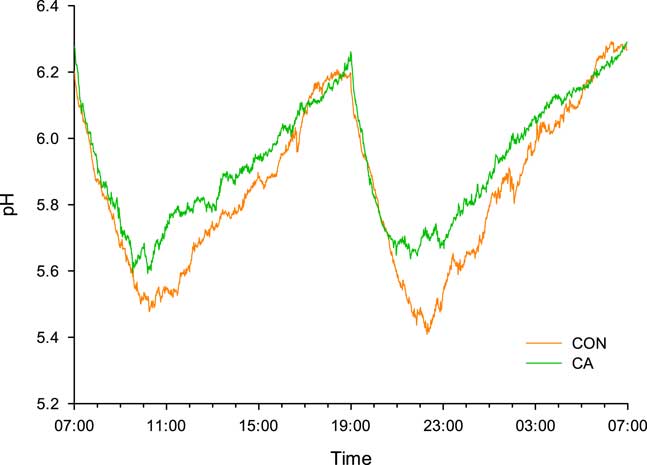
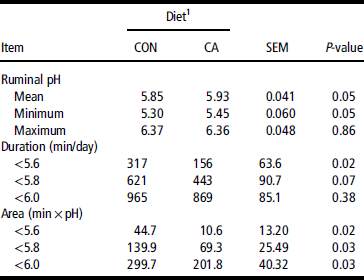
Ruminal pH declined continuously during the first 4 h after feeding to reach the lowest pH, and then climbed to the peak at the second feeding time (Figure 1). Though the pH curves declined at similar pattern between treatments, goats fed the CA diet had greater (P=0.05) minimum ruminal pH and mean ruminal pH without differing in maximum ruminal pH (Table 2). The treatment with CA showed no difference in the duration of ruminal pH<6.0, whereas it tended (P<0.10) to reduce the duration of ruminal pH<5.8 and decreased (P<0.01) the duration of ruminal pH<5.6. Goats fed CA diet had less (P<0.05) area of pH<5.6, 5.8 and 6.0.
Diurnal variation of ruminal pH of dairy goats fed diets contained ground corn steeped in water (CON) or in 0.5% citric acid (CA) with feeding time at 0700 and 1900 h.
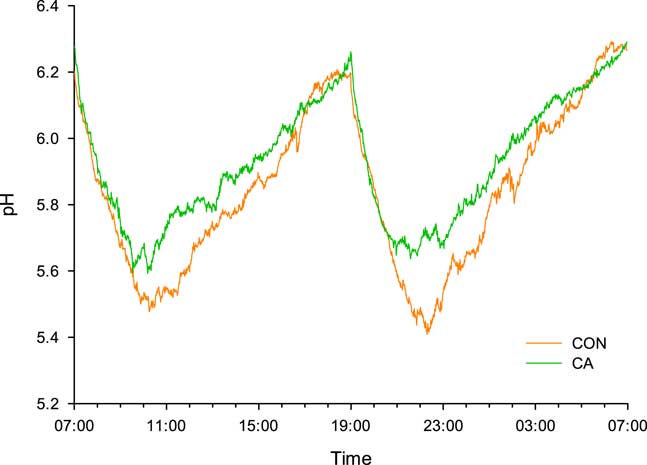
Effects of citric acid (CA) treatment of corn grain on ruminal pH profiles in dairy goats
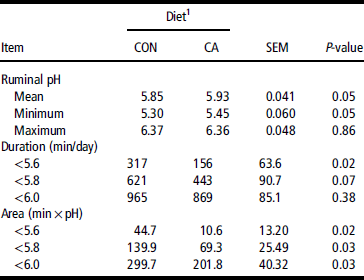
1 Dairy goats fed diets contained ground corn steeped in water (CON) or in 0.5% CA for 48 h.
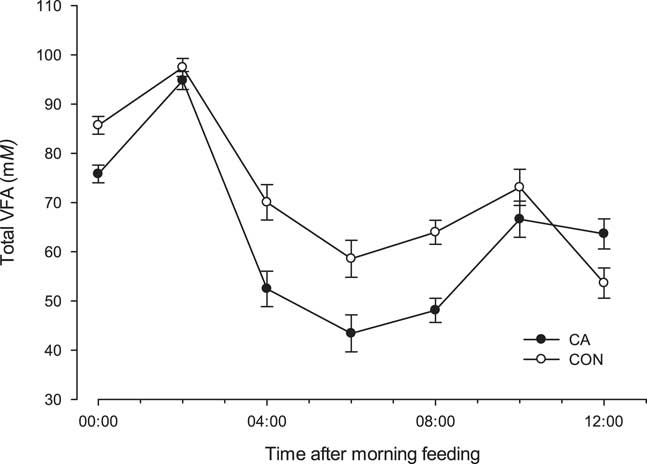
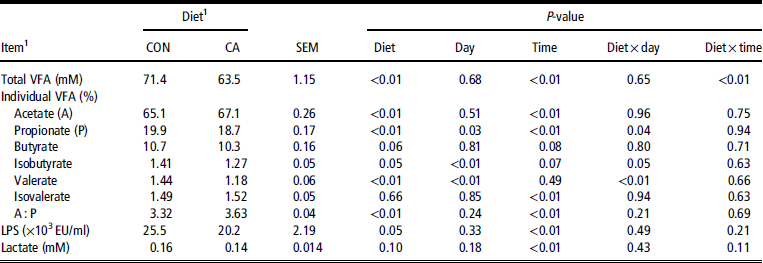
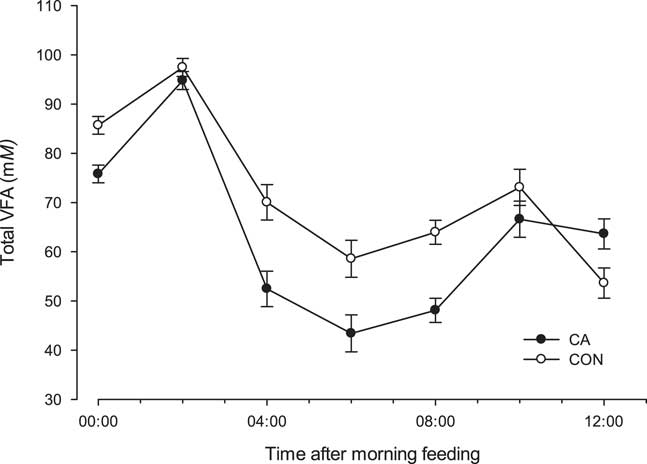
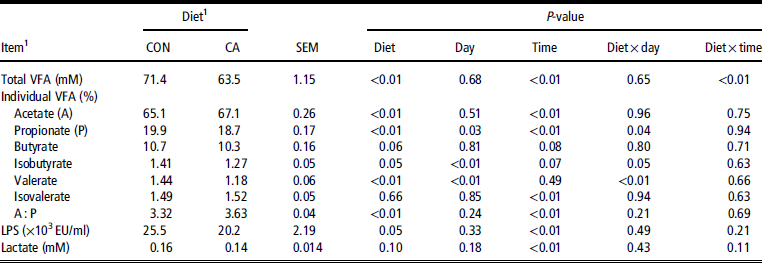
Total ruminal VFA concentrations are shown in (Figure 2 and Table 3. An interaction effect (P<0.01) between diet and sampling time was noticed in the concentration of both VFA and lactic acid (Figure 2). Goats fed CA diet showed greater (P<0.05) total VFA from 4 to 8 h after morning feeding. As expected, the concentration of ruminal total VFA was less (P<0.01) in goats fed CA diet. The concentration of total VFA reached the peak at 2 h after morning feeding, and then decreased. The molar percentage was greater (P<0.05) with acetate but lower (P<0.05) with propionate (Table 3). Sampling time showed significant (P<0.01) effects on the concentration of both acetate and propionate. Feeding CA diet tended (P<0.10) to decrease the concentration of lactic acid in the rumen, and varied with sampling time.
Diurnal variation of total volatile fatty acids (VFA) in the rumen fluid of dairy goats fed diets contained ground corn steeped in water (CON) or in 0.5% citric acid (CA) solution (mean±SEM; n=8).
Effects of citric acid (CA) treatment of corn grain on ruminal concentration of volatile fatty acids (VFA), lipopolysaccharide (LPS) and lactate in dairy goats
1 Dairy goats fed diets contained ground corn steeped in water (CON) or in 0.5% CA for 48 h.
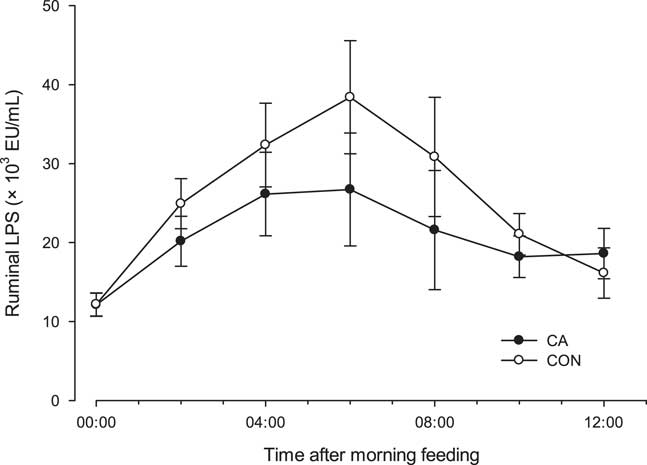
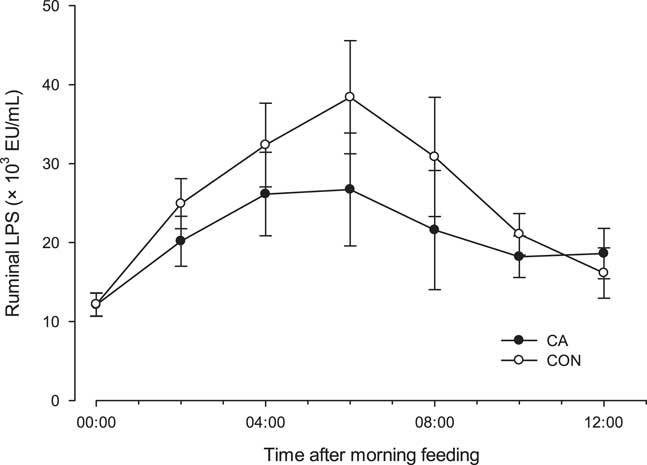
The diurnal variation of ruminal LPS is presented in Figure 3. Goats fed the CA diet had less (P<0.05) concentration of ruminal LPS compared with the goats fed control diet. Concentration of ruminal LPS increased rapidly after morning feeding peaking at 6 h after morning feeding. Ruminal LPS concentration was lower (P<0.05) at first than second sampling day.
Diurnal variation of ruminal lipopolysaccharide (LPS) of dairy goats fed diets contained ground corn steeped in water (CON) or in 0.5% citric acid (CA) solution (mean±SEM; n=8).
Dry matter intake, milk production and composition
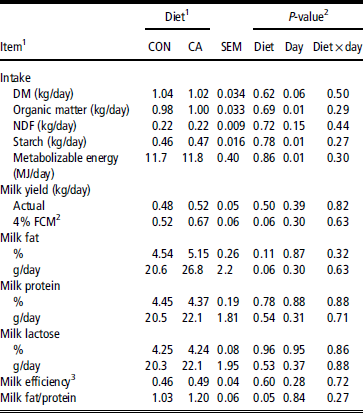
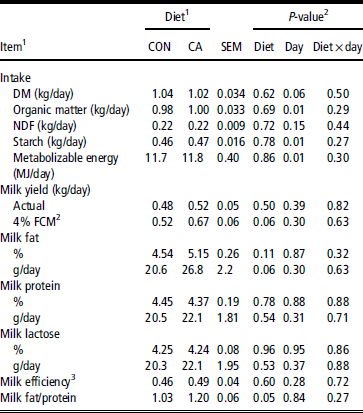
Dry matter intake (DMI), milk production and milk composition are presented in Table 4. The DMI did not differ, and no interaction was noticed between diet and sampling day. Actual milk yield, the yield and content of milk protein and milk lactose were affected neither by diet nor by sampling day. The milk fat yield tended (P<0.10) to be greater in goats fed CA diet than control, but no sampling day effect and no interaction between diet and sampling day were noticed. Similarly, yield of 4% fat-corrected milk (FCM) tended (P<0.10) to be greater with CA diet.
Effects of citric acid (CA) treatment of corn grain on feed intake, BW, milk yield and milk composition of dairy goats
1 Dairy goats fed diets contained ground corn steeped in water (CON) or in 0.5% citric acid (CA) for 48 h.
2 FCM=4% fat-corrected milk.
3 Milk efficiency=kg actual/kg DM intake.
Blood acute phase proteins, cytokines and lipopolysaccharide
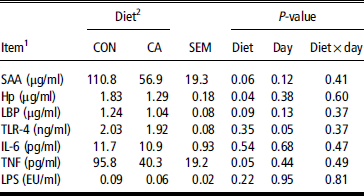
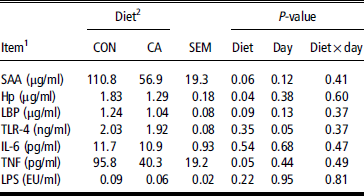
Blood concentration of acute phase proteins, cytokines and LPS were reported in Table 5. The concentration of serum Hp and TNF was less (P<0.05) in goats fed CA diet, and the concentration of SAA and LBP tended (P<0.10) to be less with CA diet, but the TLR-4 and IL-6 were not affected by the treatment. In addition, no effect of sampling day and no interaction between diet and sampling day were observed on the concentration of blood acute phase proteins and cytokines. Peripheral LPS was affected neither by diet nor by sampling day.
Effects of citric acid (CA) treatment of corn grain on the concentration of serum amyloid A (SAA), haptoglobin (Hp), lipopolysaccharide (LPS), LPS-binding protein (LBP), toll-like receptor-4 (TLR-4), interleukin-6 (IL-6) and tumour necrosis factor (TNF) in dairy goats
1 Data of blood indicators are averaged across two sampling days.
2 Dairy goats fed diets contained ground corn steeped in water (CON) or in 0.5% CA for 48 h.
Discussion
The present results confirmed our hypothesis that feeding ground corn treated with CA altered the ruminal fermentation patterns, improved the ruminal pH, and reduced the inflammatory response. The threshold of SARA for cattle is defined as duration of ruminal pH<5.6 for >180 min/day (Plaizier et al., Reference Plaizier, Krause, Gozho and McBride2008), though no threshold for goats is defined, the duration of ruminal pH<5.6 could also be a critical indicator to evaluate the risk of SARA in goats. In the present study, the duration of pH<5.6 was reduced by about 50% from 317 to 156 min/day, indicating that the feeding corn treated with CA is an effective technique to reduce the risk of SARA in dairy goats fed high-corn diet. The reduction of ruminal pH by feeding CA-treated corn observed in the present study is consistent with other reports. Kazemi-Bonchenari et al. (Reference Kazemi-Bonchenari, Salem and López2017) reported increased ruminal pH in Holstein calves fed with CA-treated barley grain compared with control. Similarly, Iqbal et al. (Reference Iqbal, Zebeli, Mazzolari, Bertoni, Dunn, Yang and Ametaj2009) also found that when barley grain steeped in 0.5% or 1% lactic acid was fed to late-lactating dairy cows, the duration of ruminal pH<5.8 was shorter. These results suggested that the starch digestion rate in the rumen might be decreased due to the treatment with CA.
The mechanism by which the treatment with CA reduces the digestion rate of ground corn is still not clear. One possible mechanism may be due to the fact that the treatment of CA increased ruminal resistant starch to microbial degradation. Ruminal resistant starch is not degraded by rumen bacteria, but it can be digested by pancreatic α-amylases in the small intestine. The variation of ruminal pH shown in this experiment indicated that the ruminal pH dropped in the same fashion after feeding, but goats fed CA diet had earlier and higher minimum ruminal pH which indicates that there would be less rapidly digestible starch in CA diet, suggesting that acid-treated ground corn reduced the rapidly digestible starch in the rumen. Mei et al. (Reference Mei, Zhou, Jin, Xu and Chen2015) demonstrated that treatment with CA reduced the fraction of rapidly digestible cassava starch from 80% to 16%. Shin et al. (Reference Shin, Lee, Kim, Lee, Cheong, Chung, Baik, Park, Kim and Moon2007) reported that the treatment with CA reduced the rapidly digestible starch from 74% to 46%. Iqbal et al. (Reference Iqbal, Zebeli, Mazzolari, Bertoni, Dunn, Yang and Ametaj2009) found that the steeped rolled barley in 0.5% lactic acid decreased the content of soluble starch from 19.9% to 8.4%. The decrease in rate of starch digestion due to CA treatment could be attributed to the increased fraction of resistant starch which is only partially digested in the rumen. Several studies reported that the treatment with CA increased the proportion of resistant starch (Xie and Liu, Reference Xie and Liu2004; Shin et al., Reference Shin, Lee, Kim, Lee, Cheong, Chung, Baik, Park, Kim and Moon2007; Mei et al., Reference Mei, Zhou, Jin, Xu and Chen2015).
Another possible mechanism by which feeding corn treated with CA improved ruminal pH due to reduced starch digestion rate may be explained by the fact that the CA may react with cell wall or gluten in ground corn thereby changing the structure, type, content or distribution of the surrounding matrix of starch granules (Martínez et al., Reference Martínez, Moyano, Díaz, Barroso and Alarcón2005). It is well known that the surrounding matrix prevents microbial enzyme access to the starch. Rooney and Pflugfelder (Reference Rooney and Pflugfelder1986) illustrated that the difference in starch digestibility between corn and sorghum was mainly related to the starch surrounding proteins and also confirmed that the surrounding matrix plays an important role in affecting starch digestion rate. Liao et al. (Reference Liao, Liu, Zhao, Cui, Yuan, Tang and Yang2010) and Qiu et al. (Reference Qiu, Sun, Cui and Zhao2013) indicated that treatment with CA affected the secondary and tertiary conformation of wheat gluten and increased gluten solubility and surface hydrophobicity. The changes of the physiochemical properties in gluten may lead to more protection of starch granules in corn. In fact, Martínez et al. (Reference Martínez, Moyano, Díaz, Barroso and Alarcón2005) found that ground barley steeped in tannic acid slowed down the degradation of barley. Those authors explained the reduction in starch digestion by the interaction of tannic acid with proteins and structural polysaccharides and suggested that the new created matrix constitute the endosperm cell matrix in which the granules were embedded.
Finally, the third possible mechanism by which the improvement of ruminal pH and reduction of lactate concentration could be a result of changes of ruminal microbial profiles since less concentration of lactic acid in goats fed CA diet was observed. Castillo et al. (Reference Castillo, Benedito, Méndez, Pereira, Lopez-Alonso, Miranda and Hernández2004) concluded in a review that some organic acid-like malate and fumarate can stimulate Selenomonas ruminantium to improve the lactate uptake efficiency. In agreement with our results, lower concentration of ruminal lactic acid and greater ruminal pH were also observed by Iqbal et al. (Reference Iqbal, Zebeli, Mazzolari, Bertoni, Dunn, Yang and Ametaj2009), who fed dairy cows with barley grain steeped in lactic acid.
The LPS is part of cell wall of gram-negative bacteria, and most starch utilizing bacteria are gram-negative. The shedding of LPS can be also associated with the digestion of starch. Khafipour et al. (Reference Khafipour, Krause and Plaizier2009) reported that dairy cows fed the low-starch diet had less ruminal LPS than cows fed high-starch diet (2.8 v. 11.2×10⁴ EU/ml). Similarly, with goats, Huo et al. (Reference Huo, Zhu and Mao2013) also found that with the decreased in the dietary proportion of corn from 50% to 25%, the concentration of ruminal LPS dropped from 35×103 to 21×103 EU/ml, respectively. In our study, the concentration of LPS decreased from 25.5×10³ to 20.2×10³ EU/ml in goats fed control v. CA diet, indicating that less starch was digested in the rumen due to feeding CA-treated corn.
The findings of greater concentration of LPS in the rumen than in the blood are consistent with previous studies in dairy cows (Li et al., Reference Li, Khafipour, Krause, Kroeker, Rodriguez-Lecompte, Gozho and Plaizier2012; Plaizier et al., Reference Plaizier, Li, Le Sciellour, Schurmann, Górka and Penner2014) or in dairy goats (Huo et al., Reference Huo, Zhu and Mao2013). In those studies, the LPS concentration in rumen content was up to 168×103 EU/ml, whereas the concentration of LPS in blood was below the detection limit of 0.05 EU/ml. The considerable lower concentration of blood LPS v. the rumen concentration of LPS could be due to high clearance rate of LPS by liver (Li et al., Reference Li, Khafipour, Krause, Kroeker, Rodriguez-Lecompte, Gozho and Plaizier2012). In addition, the gastrointestinal epithelial barrier can also prevent the LPS from transferring into peripheral blood (Plaizier et al., Reference Plaizier, Khafipour, Li, Gozho and Krause2012).
The concentration of Hp, SAA and TNF-α ranged, respectively, from 1.02 to 4.89 μg/ml, 41.1 to 322.4 μg/ml and 34.0 to 323.0 pg/ml, which are in agreement with literature findings in goats (Chang et al., Reference Chang, Zhang, Xu, Jin, Seyfert, Shen and Zhuang2015). The significant or trend of reduction in blood SAA, Hp and LBP by feeding CA diet is consistent with Iqbal et al. (Reference Iqbal, Zebeli, Mazzolari, Bertoni, Dunn, Yang and Ametaj2009) who reported that plasma Hp and SAA were decreased in dairy cows fed the lactic acid-treated barley. The decrease in blood acute phase proteins could be interpreted as improvement of the immune status of the animals. In the present study, the lower concentration of blood LBP, SAA and Hp in goats fed the CA diet appeared to be associated with the reduced ruminal LPS concentration in goats fed CA diet. In fact, the LPS is a strong pro-inflammation factor (Plaizier et al., Reference Plaizier, Khafipour, Li, Gozho and Krause2012) when transferred into blood. The LPS interacts with LBP to form the LPS–LBP complex. The complex binds with the membrane proteins CD 14, and TLR-4 to transfer the signal from extracellular to intracellular. Then pro-inflammatory cytokines like TNF and IL-6 are released (Plaizier et al., Reference Plaizier, Khafipour, Li, Gozho and Krause2012; Vaure and Liu, Reference Vaure and Liu2014). However, in current study, although the LPS is considered strong pro-inflammation factor associated with blood concentration of cytokine and acute phase proteins, the blood concentration of LBP appeared to be more correlated to the ruminal LPS concentration rather than its blood concentration. Li et al. (Reference Li, Khafipour, Krause, Kroeker, Rodriguez-Lecompte, Gozho and Plaizier2012) suggested that the endotoxemia can occur even the LPS is obviously low in peripheral blood because of the high clearance rate of LPS by the liver. Therefore, it suggests that the ruminal LPS could be better indicator than blood LPS to explain the inflammatory response. The LBP can not only transfer LPS but also magnify the signal of LPS by lowering the threshold concentration of LPS and enhancing the LPS-stimulated TNF gene expression (Martin et al., Reference Martin, Mathison, Tobias, Leturcq, Moriarty, Maunder and Ulevitch1992; Ceciliani et al., Reference Ceciliani, Ceron, Eckersall and Sauerwein2012). Therefore, the lower concentration of TNF could be explained by lower serum LBP in goats fed the CA diet. The TNF and IL-6 are two important pro-inflammatory cytokines, and they are able to induce the synthesis of SAA and Hp (Ceciliani et al., Reference Ceciliani, Ceron, Eckersall and Sauerwein2012). The SAA and Hp modulate innate immune reaction or reduce oxidative damage (Ceciliani et al., Reference Ceciliani, Ceron, Eckersall and Sauerwein2012). In this study, the lower concentration of blood SAA and Hp in goats fed CA diet appeared to be associated with improved ruminal pH status. Previous studies using dairy cows or goats showed lower blood concentration of SAA and Hp in healthy animals than in animals exhibiting SARA induced by high-grain diets (Huo et al., Reference Huo, Zhu and Mao2013; Khafipour et al., Reference Khafipour, Krause and Plaizier2009).
Conclusions
This study demonstrated that feeding ground corn steeped in 0.5% CA to late lactation dairy goats modulated the rumen fermentation patterns to more molar proportion of acetate, improved the ruminal pH status and trend of increased 4% FCM and the yield of milk fat. Feeding CA-treated corn also decreased the ruminal LPS, and the acute phase and immune responses, which could be beneficial to reduce energy consumption for maintaining immune activity. The improvement of ruminal pH and reduction in the risk of SARA suggests benefits in developing nutritional strategies by feeding CA-treated corn grain to improve productivity and health of dairy goats fed high-grain diet.
Acknowledgements
This research was funded by the National Natural Science Foundation of China (No. 31572429), the Top Talents Award Plan of Yangzhou University (2016), the China Special Fund for Agro-Scientific Research in the Public Interest ( Investigation on strategies of fattening and high quality meat productive techniques for herbivores based on resources of unconventional roughage in Southern China, No. 201303144) and the Priority Academic Program Development of Jiangsu Higher Education Institutions (PADA).
Declaration of interest
The authors declare they have no actual or potential conflict of interest that could inappropriately influence in this work.
Ethics statement
The experimental design and sampling procedures were approved by the Animal Care Committee of Yangzhou University.
Software and data repository resources
None.