Introduction
Depression is the most common mental disorder in the community. Globally, depression is estimated to be the fourth leading cause of loss of disability-adjusted life years (NCCMH, 2010). Depression accounts for decreased quality of life (Üstün et al. Reference Üstün, Ayuso-Mateos, Chatterji, Mathers and Murray2004) and is associated with increased mortality (Cuijpers & Smit, Reference Cuijpers and Smit2002). Depression is more frequent in patients with chronic health problems than in people with good physical health, according to National Institute of Health and Clinical Excellence (NICE) guidelines (NICE, 2009). Several studies have shown that depression is associated with individual chronic conditions including diabetes mellitus (DM), coronary heart disease (CHD) (Sullivan et al. Reference Sullivan, Simon, Spertus and Russo2002) and stroke (Hackett et al. Reference Hackett, Yapa, Parag and Anderson2005). Depression imposes a significant burden and cost on health-care services. Overall total costs including prescribed drugs, in-patient care, other National Health Service (NHS) services, supported accommodation and social services for depression in England in the year 2007 were estimated to be £1.7 billion (NCCMH, 2010).
Most individuals with clinical depression are managed in primary care (NCCMH, 2010), where an increasing proportion of patients are diagnosed with multiple morbidity (Uijen & van de Lisdonk, Reference Uijen and van de Lisdonk2008). Overall, about half of patients with chronic disease may have more than one morbidity (Hoffman et al. Reference Hoffman, Rice and Sung1996), although this proportion increases with age. The prevalence of depression may be increased in patients with multiple morbidity (Seeman et al. Reference Seeman, Guralnik, Kaplan, Knudsen and Cohen1989). However, few studies have considered depression across a range of single and multiple co-morbidities (Egede, Reference Egede2005, Reference Egede2007; Härter et al. Reference Härter, Baumeister, Reuter, Jacobi, Höfler, Bengel and Wittchen2007). The number of different conditions in a patient may have an effect on the prevalence of depression, but the frequency of depression may be associated with the nature of co-morbid conditions that are present. Depression and multiple morbidity are both associated with increased health-care use (Simon et al. Reference Simon, Vonkorff and Barlow1995; Westert et al. Reference Westert, Satariano, Schellevis and van den Bos2001; McCrone et al. Reference McCrone, Dhanasiri, Patel, Knapp and Lawton-Smith2008).
This research was part of a larger project to evaluate health economic outcomes of primary prevention interventions in primary care. In this paper we analyse the prevalence of depression, and health-care utilization and costs, in relation to common morbidities either singly or in combination. In addition to depression, four long-term conditions were selected for inclusion in the study: DM, CHD, stroke and colorectal cancer. This study aimed to investigate how the prevalence of depression is associated with the number of co-morbidities and the nature of co-morbid diagnoses. We also investigated how health-care utilization and costs are associated with depression in patients with DM, CHD, stroke and colorectal cancer either singly or in combination.
Method
A population-based cohort study was implemented using data from the UK General Practice Research Database (GPRD; www.gprd.com). The GPRD is a large database comprising the electronic patient records of approximately 6% of UK family practices with approximately 5 million currently active research quality patient records. The GPRD provides anonymized data for large population-based samples that are representative of the UK population. The validity of data in the GPRD has been studied extensively and a recent systematic review found that GPRD diagnoses have very high predictive value, with a median predictive value of 89% (range 24–100%) across diagnoses (Herrett et al. Reference Herrett, Thomas, Schoonen, Smeeth and Hall2010). We reported elsewhere detailed information on the coding of stroke and CHD in the GPRD (Gulliford et al. Reference Gulliford, Charlton, Ashworth, Rudd and Toschke2009; Bhattarai et al. Reference Bhattarai, Charlton, Rudisill and Gulliford2012).
Study design
A cohort that was broadly representative of the UK general population in terms of age, sex and geographic distribution was drawn, by random sampling, from all ‘up-to-standard’ family practices that were continuously contributing research quality data to the GPRD between 1 January 2004 and 30 October 2010. Up-to-standard family practices are the family practices providing data judged to be of research quality following assessment against quality standards. The data comprised a random sample of 300 020 participants, aged ≥ 30 years and registered at a GPRD-contributing practice during the study period. Participants younger than 30 years were not included because the diseases of interest are uncommon below age 30. There were 108 participants aged >100 years at sampling; these were excluded, leaving 299 912 for further analysis. Participants older than 100 years were not included because they were few in number and added little information to the analysis. All participants had a minimum 12 months of ‘up-to-standard’ follow-up calculated as the difference between the patient registration end date and registration start date.
Medical records in the GPRD are coded using READ codes and case definitions were formed using sets of READ codes to define each condition. Participants were identified as depressed if they had a READ code for depression recorded in the year of interest, or if they were ever diagnosed with depression and had a prescription for antidepressants recorded in the year of interest. Drugs included selective serotonin re-uptake inhibitors, tricyclic and related antidepressant drugs, monoamine uptake inhibitors and other antidepressant drugs. Four morbidities were considered in the study: DM, CHD, stroke and colorectal cancer. Participants were diagnosed with DM if a medical code for diabetes, including both type 1 and type 2 diabetes, was ever recorded, with the index date being the earlier of the first medical code or the first record for glucose-lowering medications. Participants were diagnosed with CHD, stroke or colorectal cancer if a medical diagnostic code was entered in their record. Participants without any of the conditions selected for study are referred to as being ‘At Risk’ of the conditions considered in this study. Colorectal cancer was considered to be independent of the other conditions and, as the least numerous condition, estimates were derived separately. This was because there were few cases and they could not be subdivided by morbidity category. States that represented all potential combinations of diabetes, stroke and CHD as single, dual or triple morbidities were considered.
Health-care costs were analysed from the UK NHS (health service provider) perspective and we did not take indirect costs (patient's or carer's time spent, loss of productivity, costs of travel, etc.) into account. We assessed the costs of health-care utilization by patients with different types and number of morbidities with and without depression. The cross-sectional analysis estimated mean costs per person per year for each condition or their combinations. We applied the unit costs in the year 2009 to the health-care utilization data taken from a GPRD cohort in the period 2005 to 2009.
Statistical analysis
Data from the cohort for the period 2005 to 2009 were analysed to estimate the prevalence of depression and the utilization of health care. All analyses were stratified by gender and 10-year age group and also by condition. The prevalence of depression was defined as the number of participants with depression in a particular year divided by the mid-year count of participants at risk in the same year. Health-care utilization was estimated from GPRD records. This comprised utilization of primary care, including family practice consultations, telephone consultations, home visits and emergency and out-of-hours consultations; secondary care, including hospital admissions, out-patient visits, day case visits and emergency visits; and all drug prescriptions issued. Utilization rates were based on person-time at risk. Health-care costs included utilization of primary and secondary care and prescription costs.
Estimates for the unit cost of health-service use were obtained from reference sources (Curtis, Reference Curtis2010). Unit costs were then applied to each category of health-care utilization to estimate health-care costs. The unit costs in primary care for general practitioner (GP) practice consultation, emergency or out-of-hours consultation, home visit and telephone consultation taken from the Personal Social Service Research Unit (PSSRU) publication Unit Costs of Health and Social Care 2009 (Curtis, Reference Curtis2010) were £35, £35, £117 and £21 respectively. The unit costs of secondary care for in-patient and out-patient episodes, day case visits and emergency visits, also taken from PSSRU (Curtis, Reference Curtis2010), were £493, £189, £143 and £110 respectively. The same unit costs for primary and secondary care were used for different age groups, gender and depression status. Prescription costs were obtained by linking each Multilex drug code record in the GPRD with the prescription cost obtained from the First DataBank Europe (FDBE) Multilex Drug Data File Database (www.firstdatabank.co.uk/8/multilex-drug-data-file); single pack prices were assumed.
Direct standardization was used to calculate age-standardized rates using the European Standard Population for reference. A Poisson regression model was used to estimate the prevalence of depression with the number of cases as the dependent variable and mid-year counts as offset. Models were fitted with either the type of morbidities or the number of morbidities as predictor, adjusting for age group and sex. Relative rate ratios were estimated. Direct standardization was carried out using the European Standard Population to determine the health-care utilization between depressed and non-depressed individuals across all morbidities. Age-standardized rates were evaluated in a linear regression model to estimate differences between groups. A two-part general linear model with a log link and gamma errors (Duan et al. Reference Duan, Manning, Morris and Newhouse1983; Dunn et al. Reference Dunn, Mirandola, Amaddeo and Tansella2003) was used to estimate the age- and gender-specific predicted mean costs in individuals with and without depression across the number of morbidities. The general linear model was evaluated using the Park test as a test of the null hypothesis of correct distributional form; this gave a χ2 value of 0.23 (p = 0.623). Values for the Akaike information criterion (AIC) were also compared between models. The pseudo-R 2 from the probit model was 0.16. All statistical analyses were performed using Stata 12 for Windows (Stata Corporation, USA).
Ethics
We used a fully anonymized data set from the GPRD; individual participant consent was not obtained. The research represents part of a study approved by the Independent Scientific Advisory Committee (ISAC) of the Medicines and Healthcare products Regulatory Agency (MHRA) (ISAC Protocol No. 09-085).
Results
Population studied
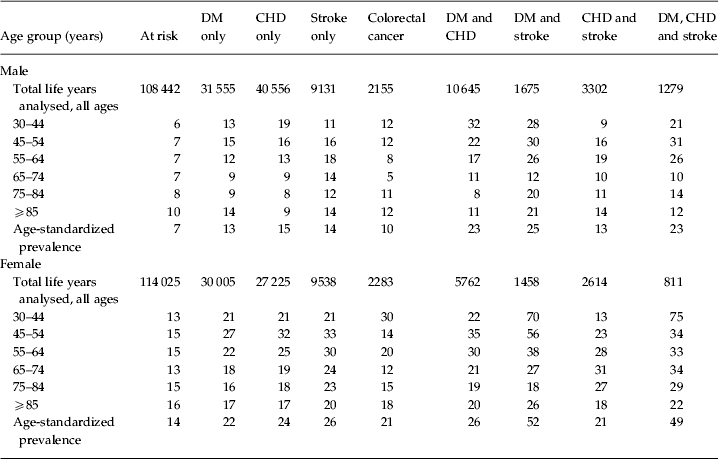
Data were analysed for a population of 299 912 participants (50% male) aged between 30 and 100 years at the date of sampling. The total number of life years analysed for each condition is shown in Table 1. Across all condition combinations there were 402 460 participant life years analysed.
Prevalence of depression by gender, age group and co-morbidity

DM, Type 2 diabetes mellitus; CHD, coronary heart disease.
Figures are prevalence rates as percentages, except where indicated.
Prevalence of depression
The prevalence of depression by gender, age group and co-morbidity is shown in Table 1. Women had a higher prevalence of depression, in comparison to men, across all age groups and morbidity categories. In comparison to those with no disease or with single morbidity, depression prevalence was higher in those with multiple morbidity. The prevalence of depression tended to show a slight increase with age in participants with no morbidity but depression was more frequent at younger ages among those with morbidity.
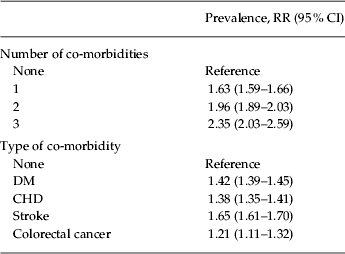
Table 2 shows the results of Poisson regression modelling of the prevalence of depression. After adjusting for age group and sex, participants having a single morbidity had a relative rate of depression that was 1.63 times higher than those without any disease. Those with dual and triple morbidities had relative rate ratios of 1.96 and 2.35 respectively compared with those without any disease. Considering the type of morbidity, depression was more prevalent in participants having any morbidity compared to participants with no disease. Relative rate ratios were broadly similar for each condition but were slightly higher for stroke and lower for colorectal cancer.
Association of number and type of co-morbidity with depression prevalence, adjusted for gender and age group
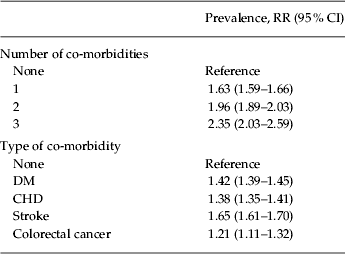
RR, Rate ratio; CI, confidence interval; DM, type 2 diabetes mellitus; CHD, coronary heart disease.
Health-care utilization
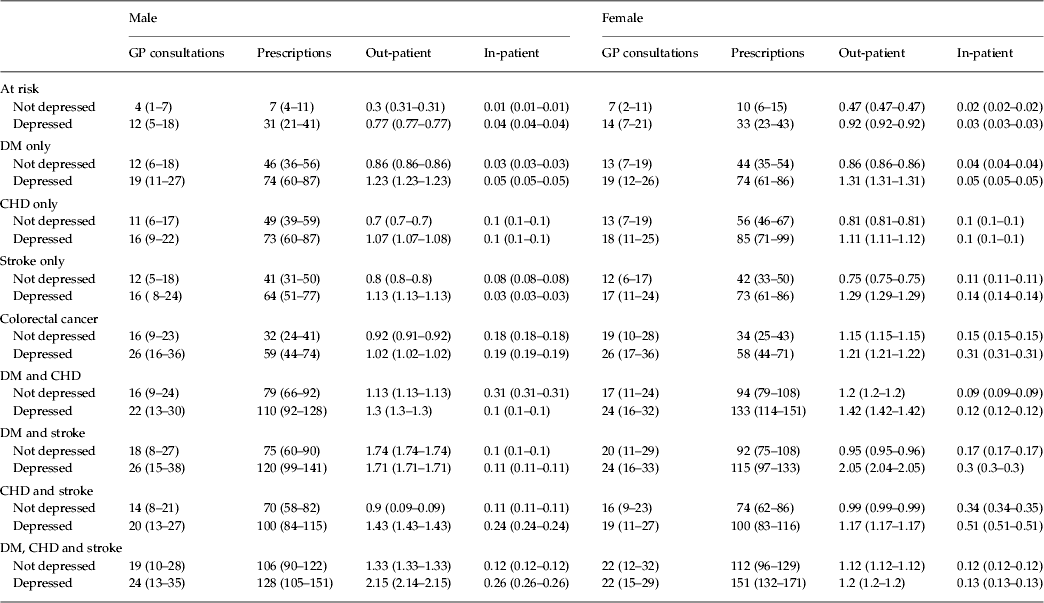
Table 3 presents age-standardized rates for health-care utilization including family practice consultations, drug prescription items, specialist attendances and hospital in-patient episodes. Rates were estimated by gender, depression status and morbidity. In participants without morbidity or depression, there were on average 4–7 family practice consultations per year, 7–10 drug prescription items and 0.30–0.47 specialist visits. In participants with depression but no morbidity, there were on average 12–14 family practice consultations, 31–33 drug prescriptions issued and 0.77–0.92 specialist visits per year. In participants with a single morbidity, health-care utilization was substantially higher, with between 11 and 19 family practice consultations per year, between 32 and 56 drug prescription items per year and between 0.70 and 1.15 specialist visits per year. In participants with depression, in addition to a single morbidity, health-care utilization was higher, with between 16 and 26 family practice consultations per year, between 58 and 85 drug prescription items per year and between 1.02 and 1.31 specialist visits per year. Health-care utilization by participants with multiple morbidities was higher still. In participants with three morbidities (diabetes, CHD and stroke), there were 19 family practice consultations per year in men and 22 in women, with 106 drug prescription items in men and 112 in women. When depression was also present, more drug prescription items and specialist visits were made. Hospital in-patient utilization rates estimated from GPRD data were generally low, but were higher in the presence of co-morbidity and depression.
Age-standardized rates per person-year for GP consultations, prescriptions, hospital out-patient and in-patient episodes
CHD, Coronary heart disease; DM, diabetes mellitus; GP, general practitioner.
Figures are numbers of events per person year. European Standard Population as reference. Figures in parentheses are 95% confidence intervals.
In a linear regression model, compared with participants with no morbidity, the mean difference in family practice consultations for participants with one condition was 7.4 [95% confidence interval (CI) 4.2–10.6] consultations per year (p < 0.001), two conditions 10.7 (95% CI 7.4–14.0, p < 0.001) and three conditions 12.6 (95% CI 8.5–16.7, p < 0.001). After adjusting for gender and number of morbidities, participants with depression had 5.8 (95% CI 3.9–7.7, p < 0.001) more consultations per year.
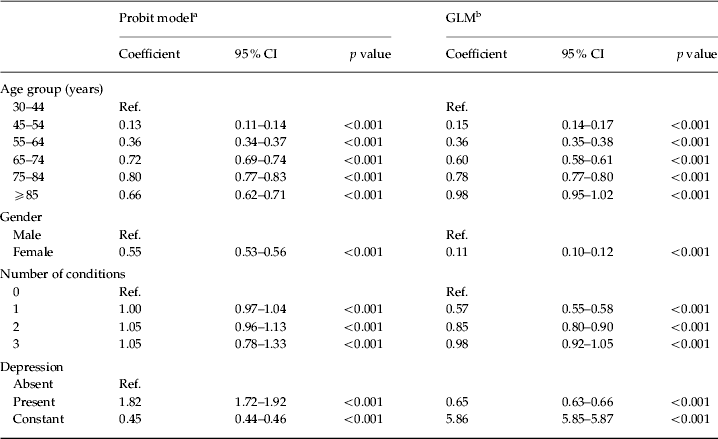
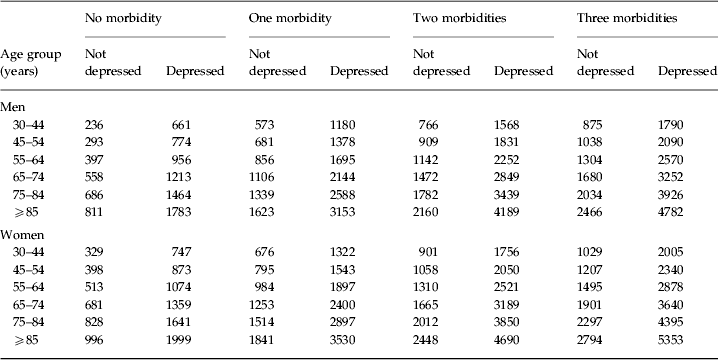
Table 4 presents coefficients and CIs from the two-part regression model. These values were used to estimate the predicted mean costs. Table 5 shows the predicted mean total health-care costs according to the number of morbidities, along with age, gender and depression status. The mean total health-care costs per participant per year increased with age and number of morbidities present. Depressed participants had higher costs than participants without depression. Compared to men, women showed higher costs across all age groups and number of conditions. In participants with no disease, the mean total health-care cost per participant per year ranged from £236 to £811 for men and from £329 to £996 for women. When depression was present in participants with no other morbidity, the mean total health-care cost per participant per year was between £661 and £1783 for men and between £747 and £1999 for women. When a single morbidity was present, the mean total health-care cost per participant per year was between £573 and £1623 for men and between £676 and £1841 for women, but when depression was also present, the mean total health-care cost per participant per year was between £1180 and £3153 for men and between £1322 and £3530 for women. When multiple morbidity was present, the mean total health-care cost was higher. For participants with three morbidities, the mean total health-care cost was in the range of £875–2466 for men and £1029–2794 for women without depression and in the range of £1790–4782 for men and £2005–5353 for women when depression was present. In the regression model, reported differences were all highly significant (p < 0.001).
Regression model for patient health-care costs
GLM, Generalized linear model; CI, confidence interval.
a Coefficient from a probit model used to estimate the probability of costs being >zero.
b Coefficient from a log-linear model, with gamma errors, to estimate associations of cost values that are >zero (see Dunn et al. Reference Dunn, Mirandola, Amaddeo and Tansella2003).
Number of morbidities and total health-care costs with and without depression
Figures are predicted mean costs per participant per year (UK £, 2009).
Discussion
Main findings
This study investigated the associations of depression, including prevalence and health-care utilization and costs, in patients with single and multiple morbidities. The frequency of depression was higher in participants with any of the four morbidities than in those without. Stroke was associated with a greater increase in depression prevalence, followed by DM, CHD and colorectal cancer respectively. However, larger increments in depression prevalence were observed when the number of co-morbid diagnoses increased. This effect seemed to be especially pronounced at younger ages and in women. Although both co-morbidity and depression are associated with increased health-care utilization, the presence of depression is associated with increased utilization of health care at any level of co-morbidity. The number of co-morbidities is strongly associated with both health-care utilization and costs.
Comparison with other studies
Previous studies (Anderson et al. Reference Anderson, Freedland, Clouse and Lustman2001; Spijkerman et al. Reference Spijkerman, de Jonge, van den Brink, Jansen, May, Crijns and Ormel2005; Ali et al. Reference Ali, Stone, Peters, Davies and Khunti2006) show that depression is increased in frequency in people with diabetes or CHD, with similar prevalence rates to those reported here. Several studies (e.g. Ciechanowski et al. Reference Ciechanowski, Katon and Russo2000; Sullivan et al. Reference Sullivan, Simon, Spertus and Russo2002) show higher health-care utilization in depressed patients with co-morbid conditions than in those who were not depressed. However, comparison of rates of depression across different types of morbidity and in participants with multiple morbidities from the same population sample is rare. There are also methodological differences from earlier studies, including the size and representativeness of the samples and the methods of diagnosis.
Strengths and limitations
This study was based on a large and representative population sample. We analysed the association of depression in terms of common, but multiple, co-morbidities using empirical data for clinical depression and health-care utilization at the individual patient level. We studied depression rates and health-care costs in conditions such as colorectal cancer and stroke on which studies are rare. However, only about two-thirds of people with depression may consult their GP (NCCMH, 2010) and among those who consult their GP, only a limited proportion are recognized as depressed (Kisley et al. Reference Kisley, Gater, Goldberg, Ustun and Sartorius1995).
We caution that results obtained from electronic health records may differ from epidemiological data from population surveys. For example, it is possible that the severity of clinically diagnosed cases differs from subclinical depression. There is evidence of a very high median predictive value of GPRD data across diagnoses (Herrett et al. Reference Herrett, Thomas, Schoonen, Smeeth and Hall2010). However, the individual predictive value of each diagnosis in this study may differ and we caution that GPRD data may not have reflected true disease cases. Our study was limited to patients with a physician-diagnosed depression and with a prescription for antidepressants and we may have missed depression cases diagnosed by other means of standardized clinical interviews. The NICE (2009) guidelines do not recommend antidepressant drugs as the first-line treatment for subthreshold to mild–moderate depression. Depression cases without prescription for antidepressants and with other treatment plans such as psychosocial and psychological interventions may not have been represented in our study. Furthermore, the repeat visits made to a GP for care of a long-term illness may offer many opportunities to make a diagnosis of depression, a form of surveillance bias. However, some evidence suggests that the presence of physical illness may complicate the assessment of depression, which may often be undiagnosed (NICE, 2009). There exists a possibility of under- or overestimation of depression in this study.
The sample included in our study was limited to primary care settings and the results may not be generalized to other settings such as specialist clinics. We also caution that, because unmeasured confounding may be present, this study does not establish that the increased health-care utilization and costs are directly caused by depression. This study only included health-care costs and may underestimate the overall costs of depression to society. Social care and informal care costs and productivity lost for both patients and carers, in addition to costs outside of the health system, such as criminal justice, education and housing, also contribute to the cost burden of depression and the co-morbid conditions included in this study (Knapp, Reference Knapp2003).
The conditions we have studied are not the only ones associated with depression. We could have studied a wider range of problems such as chronic lung diseases, musculoskeletal disorders and digestive disorders. However, this was beyond the scope of our research plan. Diabetes, CHD and stroke are associated with each other and the number of co-morbidities may be viewed as a process of disease progression with increasing severity of illness over time. Although co-morbidity is associated with increased psychiatric morbidity and psychological dysfunction (McDermut et al. Reference McDermut, Mattia and Zimmerman2001), we did not adjust for severity of illness while assessing the associations of depression prevalence. We acknowledge that, in our study, the number of co-morbidities may be a marker of the severity of physical illness. An increase in severity may be the reason for multiplicative effects on health-care utilization and costs in those with more than one disease condition. Future studies could evaluate the severity and number of co-morbidities.
Conclusions
This population-based study provides new insights into the relationship between depression, co-morbidity and health-care utilization. The present data suggest that the frequency of depression may be increased in several different co-morbid conditions, but the frequency of depression is particularly associated with the number of co-morbidities that are present in a population in which multiple morbidity is frequent. Although health-care utilization and costs are increased in each of the long-term conditions studied, the presence of depression is associated with increased health-care utilization at any level of co-morbidity. This raises the possibility that preventing or treating depression in people with chronic diseases might potentially reduce health-care costs. Depression in patients with major co-morbidities deserves further policy attention not only for the patient health implications but also for the contribution it makes to resource use in primary care.
Acknowledgements
This research was supported by the National Prevention Research Initiative (NPRI) phase 3 through the UK Medical Research Council (MRC). The MRC had no role in the study design, data analysis and interpretation of data including the manuscript preparation or review. The interpretation and conclusions in this study are those of the authors alone.
Declaration of Interest
None.