More than 90 000 disaster workers and volunteers participated in rescue, recovery, and cleanup activities at the site of the World Trade Center (WTC) towers in lower Manhattan in the aftermath of the September 11, 2001 (9/11) terrorist attacks. Firefighters, police officers, construction workers, remediation workers, and sanitation workers were among the many groups of workers who responded to the disaster. By the time cleanup and recovery activities at Ground Zero ended on May 30, 2002, workers had sifted through approximately 1.8 million tons of debris from the collapse of the 2 towers.
The collapse of the WTC resulted in the release of a variety of environmental toxicants. Among the many components from the collapsed buildings were pulverized concrete, including respirable silica dust, metal compounds, asbestos, polycyclic aromatic hydrocarbons, dioxins, and volatile organic compounds.Reference Lioy and Georgopoulos1Reference Lorber, Gibb, Grant, Pinto, Pleil and Cleverly2Reference Landrigan, Lioy and Thurston3 WTC disaster workers also were susceptible to inhalation hazards resulting from dust resuspension during cleanup efforts. Particulate material at the WTC contained gypsum and calcium carbonate, known to irritate the airways and eyes.Reference McGee, Chen and Cohen4
In the first 10 years after the WTC disaster, epidemiologic studies of disaster workers have been vital in understanding the health effects of exposures to these toxicants. To date, respiratory symptoms and diseases have been among the most examined health outcomes in studies of WTC disaster workers. Epidemiologic studies have reported on the new onset and worsening of lower and upper respiratory symptoms, “WTC cough,” and new-onset respiratory diseases such as asthma, reactive airways dysfunction syndrome (RADS), and parenchymal lung diseases.
This article summarizes the literature on respiratory health outcomes among WTC disaster workers, with 3 main goals: to review the existing evidence on risk factors for new-onset respiratory health outcomes among WTC disaster responders, to identify the methodological challenges associated with the study of disaster-related respiratory health outcomes, and to propose recommendations for future research.
EPIDEMIOLOGIC STUDIES
Early surveillance identified disaster workers as a high-risk population group among WTC-exposed persons. Studies of WTC disaster workers documented significant associations between WTC exposures, increased incidence of new-onset respiratory symptoms and diseases, and significant reductions in forced expiratory volume in 1 second (FEV1) and forced vital capacity (FVC). WTC responder programs, established to monitor health outcomes for up to 20 years post-9/11, have provided valuable insights into the mid-term (≥5 years after 9/11) respiratory health impact of WTC disaster work.
Studies of Early Respiratory Health Outcomes (<5 Years) After 9/11
The public health research response to the WTC disaster began soon after the collapse of the towers. Early studies of WTC disaster workers were characterized by surveillance of injuries and illnesses in the weeks after the disaster.Reference Berríos-Torres, Greenko, Phillips, Miller, Treadwell and Ikeda567 On September 14, 2001, the Centers for Disease Control and Prevention (CDC) began injury and illness surveillance at both temporary medical facilities and local emergency departments throughout New York City.Reference Berríos-Torres, Greenko, Phillips, Miller, Treadwell and Ikeda5 A review of medical records between September 11, 2001 and October 11, 2001 revealed that respiratory illnesses, comprising 16% of all of the reported injuries and illnesses, were the second leading cause of visits to medical facilities among workers who performed rescue and recovery work in the first month after the WTC disaster.Reference Berríos-Torres, Greenko, Phillips, Miller, Treadwell and Ikeda5
The Fire Department of New York (FDNY) along with the National Institute for Occupational Safety and Health (NIOSH) established the FDNY WTC Medical Monitoring and Treatment Program in October 2001.Reference Prezant, Weiden and Banauch8 Injuries and illnesses among FDNY rescue workers during the 11 months postdisaster were reported by FDNY physicians. Approximately 90% of the 10 116 FDNY rescue workers who were evaluated in the first 48 hours after the attacks reported an acute cough accompanied by nasal congestion, chest tightness, or a burning sensation in the chest. The incidence of new respiratory illness among FDNY rescue workers did not begin to decrease until February 2002.6
Prezant et al were the first investigators to document WTC cough and bronchial hyperreactivity, syndromes among FDNY firefighters that occurred after short-term exposures to WTC irritants.Reference Prezant, Weiden and Banauch8 They defined WTC cough as a persistent cough that was accompanied by respiratory symptoms so severe that FDNY physicians had to place workers complaining of the cough on medical leave for at least 4 consecutive weeks. By March 2002, 332 of 10 993 firefighters evaluated had been diagnosed as having WTC cough. WTC cough also was significantly related to an early arrival at Ground Zero.Reference Prezant, Weiden and Banauch8 After adjusting for age, smoking status, and the presence of airflow obstruction, researchers found a significant association between early arrival at the WTC site and bronchial hyperreactivity. In longitudinal studies of FDNY rescue workers up to 4 years after 9/11, FEV1 reduction, airway obstruction, persistent respiratory symptoms, and persistent bronchial hyperreactivity and RADS were significantly associated with early arrival and longer duration of work at the WTC site.Reference Webber, Gustave and Lee9Reference Banauch, Alleyne and Sanchez10Reference Banauch, Hall and Weiden11
Early studies of health outcomes among WTC disaster workers identified strong relations between WTC exposures, such as a presence in the building collapse dust cloud and early arrival at Ground Zero, and respiratory symptoms and diseases. The date of arrival at the WTC site was used as a surrogate for WTC exposure in studies of police first responders. Approximately 78% of 240 police officers from the New York Police Department's Emergency Service Unit reported new or worsening respiratory symptoms between September 11, 2001, and February 2002.Reference Salzman, Moosavy, Miskoff, Friedmann, Fried and Rosen12 Although spirometric abnormalities were observed in only 29% of these police officers, early date of arrival at the WTC site was significantly associated with abnormal spirometry. In a longitudinal study of 426 New York City police officers with no previous respiratory condition, work at Ground Zero was significantly associated with persistent cough, persistent shortness of breath, and persistent wheeze up to 19 months after the WTC disaster.Reference Buyantseva, Tulchinsky and Kapalka13
Similar associations between WTC exposures and new-onset respiratory symptoms were observed among ironworkers.Reference Skloot, Goldman and Fischler14 Skloot et al evaluated a total of 96 male ironworkers between October 2001 and February 2002 at the Mount Sinai-Irvin J. Selikoff Center for Occupational and Environmental Medicine. Among these ironworkers, being present at the WTC site in lower Manhattan on 9/11 was significantly associated with new-onset cough, dyspnea, and wheezing, after adjusting for the number of days worked at the WTC site, use of a respirator with a canister, and history of smoking. This study was one of the first to use oscillometric data to examine lung function among WTC disaster workers. More than half of the nonasthmatic ironworkers examined had elevated respiratory resistance, and oscillometric results indicated that use of a respirator with a canister was protective of large airways dysfunction.Reference Skloot, Goldman and Fischler14
In addition to first responders and ironworkers, cleanup and recovery workers also were exposed to potential respiratory toxicants during their disaster work. Tao et al conducted a cross-sectional study of 1327 cleanup workers from local labor unions and the New York City Department of Sanitation.Reference Tao, Massa, Ashwell, Davis, Schwab and Geyh15 The survey, which was self-administered approximately 20 months after the WTC disaster, included a modified version of the American Thoracic Society-Division of Lung Diseases-78 respiratory health questionnaire along with questions about WTC exposure, smoking history, and respirator use. Cleanup and recovery workers at the WTC site were 3 times more likely than workers who had never worked at the WTC site to report lower respiratory symptoms, after adjusting for confounders. Even among nontraditional responders such as cleanup workers, respiratory symptoms associated with WTC exposures were present almost 2 years after 9/11.
In 2002, NIOSH funded a medical screening program for WTC responders at 5 New York City metropolitan medical centers: Bellevue Hospital Center, City University of New York at Queens, Mount Sinai School of Medicine, State University of New York at Stony Brook, and University of Medicine and Dentistry of New Jersey. Five years after the WTC disaster, the WTC Responder Health Consortium published a study on a diverse group of disaster workers, including first responders, recovery and cleanup workers, and volunteers, who had participated in medical monitoring and received physical screening evaluations along with interviewer-administered exposure and medical questionnaires.Reference Herbert, Moline and Skloot16 For this study, a total of 9443 participating and responders were consented and examined between June 2002 and April 2004. Among workers who reported no history of respiratory illness or symptoms before the WTC disaster, 32% reported developing new lower respiratory symptoms and 44% reported developing new upper respiratory symptoms in the months before the physical examination. Being engulfed in the building collapse dust cloud and having an early date of arrival at Ground Zero were significantly associated with new or worsening respiratory symptoms. Early date of arrival at the WTC site also was significantly associated with low FVC.
The spectrum of new-onset respiratory diseases reported among WTC disaster workers after 9/11 included new diagnoses of asthma,Reference Wheeler, McKelvey and Thorpe17 interstitial lung diseases,Reference Wu, Gordon and Herbert18 acute eosinophilic pneumonia,Reference Rom, Weiden and Garcia19 and parenchymal lung diseases such as bronchiolitis obliterans with organizing pneumoniaReference Mann, Sha, Kline, Breuer and Miller20 and sarcoidosis.Reference Bowers, Hasni and Gruber21Reference Izbicki, Chavko and Banauch22Reference Crowley, Herbert and Moline23 New diagnoses of asthma were studied among a group of 25 748 disaster workers who enrolled in the WTC Health Registry and completed wave 1 interviews in 2003–2004. The 3-year incidence of newly diagnosed asthma after 9/11 among workers enrolled in the WTC Health Registry was 3.6%, 12 times higher than the expected incidence of 0.1%/y in the general adult population. Delays in the use of protective respiratory equipment such as masks and respirators were associated with an increased risk of asthma among workers who arrived at the WTC site on 9/11.Reference Wheeler, McKelvey and Thorpe17
De la Hoz et al reported on the incidence of airway disease among WTC Medical Monitoring and Treatment Program participants between 2003 and 2005.Reference de la Hoz, Shohet and Chasan24Reference de la Hoz, Shohet, Wisnivesky, Bienenfeld, Afilaka and Herbert25 Workers who arrived at the WTC site within the first 48 hours after the attacks were more likely than those who arrived later to develop lower airway disease.Reference de la Hoz, Shohet and Chasan24 A total of 136 workers were further evaluated for atopy using radioallergosorbent and skin prick testing.Reference de la Hoz, Shohet, Wisnivesky, Bienenfeld, Afilaka and Herbert25 Multivariate analyses revealed that atopy was significantly associated with WTC-related upper airway diagnoses, suggesting an irritant-induced mechanism for lower airway diseases and an atopic mechanism for upper airway diseases.Reference de la Hoz, Shohet, Wisnivesky, Bienenfeld, Afilaka and Herbert25
Mid-Term Studies of Respiratory Health Outcomes (≥5 Years) After 9/11
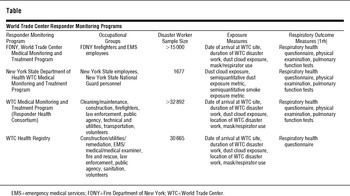
Immediately after the disaster, public health agencies including the CDC, the New York State Department of Health, and the New York City Department of Health and Mental Hygiene established research, medical monitoring, and treatment programs for workers exposed to the WTC disaster (Table). Several WTC monitoring programs, including the FDNY WTC Medical Monitoring and Treatment Program, the New York State Department of Health WTC Medical Monitoring Program, and the WTC Health Registry, have reported declines in measures of pulmonary function, persistence of respiratory symptoms, and newly diagnosed respiratory diseases among WTC disaster workers ≥5 years after 9/11.
World Trade Center Responder Monitoring Programs

FDNY WTC Medical Monitoring and Treatment Program studies have provided strong clinical evidence for persistent symptoms and accelerated declines in pulmonary function among FDNY rescue workers. Aldrich and colleagues examined the lung function of 12 781 WTC FDNY firefighters and emergency medical services workers who were hired before September 25, 2001, and had undergone spirometry at least once before September 11, 2001.Reference Aldrich, Gustave and Hall26 In the first year after the disaster, significant relations were noted between WTC exposures and FEV1 decline. By 2008, however, the relationships between FEV1 value and the date of arrival or the duration of work at the WTC site were not significant. Although associations between FEV1, as a measure of pulmonary function, and date of arrival or duration of work, as measures of WTC exposure, were no longer significant, exposed individuals experienced little recovery in FEV1 7 years after 9/11.Reference Aldrich, Gustave and Hall26Reference Weiden, Ferrier and Nolan27
Skloot et al conducted a longitudinal study of pulmonary function among WTC Medical Monitoring and Treatment Program participants who completed both baseline and follow-up examinations up to 6 years after the disaster.Reference Skloot, Schechter and Herbert28 More than one-third of the 3160 study participants had abnormal spirometry on at least 1 examination, with low FVC as the most common abnormality. The mean change in spirometry between examinations of these WTC disaster workers was not greater than the mean change expected in the general population; however, the 24% prevalence of spirometric abnormalities among participating workers who underwent a second examination was higher than the prevalence of abnormalities expected in the general population.Reference Skloot, Schechter and Herbert28
The New York State Department of Health WTC Medical Monitoring Program was established to follow the development of health outcomes among a cohort of WTC-exposed and WTC-unexposed state employees. New York State employees and New York State National Guard personnel who responded to the WTC disaster between September 11, 2001, and December 23, 2001, were offered medical monitoring and evaluation through the New York State Department of Health WTC Medical Monitoring Program.Reference Mauer, Cummings and Carlson29 Medical evaluations included clinical laboratory tests, physical examinations, and pulmonary function tests. The monitoring program recruited 578 New York State employees who responded to the WTC disaster (WTC-exposed) and a control group of 702 New York State employees who did not respond to the WTC disaster (WTC-unexposed).Reference Mauer, Herdt-Losavio and Carlson30 Study participants completed 4 annual waves of health and exposure surveys between 2003 and 2006.
Five years after 9/11, WTC-exposed New York State employees were significantly more likely than WTC-unexposed employees to report new or worsening respiratory symptoms.Reference Mauer, Cummings and Hoen31 Among WTC-exposed workers, exposure was characterized using a semiquantitative exposure assessment method for WTC-related dust and WTC-related smoke.Reference Herdt-Losavio, Mauer and Carlson32 After controlling for confounders such as sex, smoking history, and obesity, new-onset asthma after 9/11 was not found to be significantly associated with WTC exposures in this cohort of New York State employees.Reference Mauer, Cummings and Hoen31 With only 3 new-onset asthma cases expected in a 5-year follow-up of the 578 WTC-exposed workers, under the null hypothesis of no excess, this study was substantially underpowered to test the hypothesis of new-onset asthma.
Mauer and Cummings also measured respiratory function among New York State responders using an impulse oscillometry system technique.Reference Mauer and Cummings33 A total of 99 exposed and 149 unexposed study participants were evaluated between June and October 2007. Impulse oscillometry results indicated a significant difference in respiratory function between those who used a respirator with a canister and those who did not use a respirator with a canister.Reference Mauer and Cummings33 This finding was in agreement with the associations between the lack of protective respirator use and airways dysfunction observed in earlier studies of WTC ironworkers.
The WTC Health Registry was established by the New York City Department of Health and Mental Hygiene and CDC's Agency for Toxic Substances and Disease Registry to document and evaluate the long-term health consequences of the 9/11 terrorist attacks.Reference Farfel, DiGrande and Brackbill34 Study results of the WTC Health Registry's 2006-2008 follow-up survey indicated that incidence of self-reported newly diagnosed asthma after 9/11 peaked approximately 16 months after the terrorist attacks.Reference Brackbill, Hadler and DiGrande35 Five to seven years after the WTC disaster, however, newly diagnosed asthma among disaster workers remained significantly associated with WTC exposures.Reference Brackbill, Hadler and DiGrande35 These results differed from study results of new-onset asthma among workers reported by the New York State Department of Health WTC Medical Monitoring Program, which found no significant association. The differences between the 2 studies may have been due to differences in statistical power, exposure metrics, and study populations. The WTC Health Registry included a large, heterogeneous group of disaster workers who may have experienced a wider gradient of WTC exposures than responders in the New York State Department of Health WTC Medical Monitoring Program.
Among WTC disaster workers who experienced new-onset respiratory conditions after 9/11, mid-term studies have reported persistent respiratory symptoms and little to no recovery in pulmonary function. Longitudinal studies of WTC disaster workers suggest that the incidence of new-onset respiratory symptoms and diseases and the decline in pulmonary function stabilized within 3 years of exposure to the WTC disaster.
METHODOLOGICAL CHALLENGES
The unforeseen nature of the WTC disaster and the subsequent disaster-related exposures and respiratory health outcomes presented noteworthy epidemiologic challenges. Several methodological issues have arisen in studies of respiratory health outcomes among disaster workers, including study design, potential for selection bias, exposure assessment, and outcome ascertainment.
Study Design
To date, the majority of epidemiologic studies of respiratory health outcomes among WTC disaster workers has used a cross-sectional study design. Although appropriate for the assessment of acute health effects, cross-sectional studies present several limitations to studying the relationship between WTC exposures and respiratory health outcomes. In studies of respiratory symptoms, for example, the period prevalence of new-onset symptoms after 9/11 is often reported.Reference Webber, Gustave and Lee9Reference Herbert, Moline and Skloot16Reference Brackbill, Hadler and DiGrande35Reference Herbstman, Frank and Schwab36 The interpretation of prevalence data are subject to prevalence-incidence bias because prevalence measures reflect both the incidence and the duration of respiratory symptoms.Reference Greenland and Rothman37 In comparing prevalence of symptoms among high-exposed and low-exposed subjects, if average duration of symptoms among the high-exposed group differs from that among the low-exposed group, the prevalence ratio may give a biased estimate of the incidence ratio. Alternatively, the presentation of symptoms could be mitigated by therapeutic treatments.
Selection Bias
Selection bias can result when the relationship between exposure and disease among study participants is different from the relationship between exposure and disease among nonparticipants.Reference Rothman, Greenland and Lash38 As is the case with many voluntary studies, symptomatic and high-exposed workers may be more inclined than asymptomatic, low-exposed workers to participate in WTC disaster studies.Reference Murphy, Brackbill, Thalji, Dolan, Pulliam and Walker39Reference Savitz, Oxman and Metzger40 In an examination of participation rates in the WTC Health Registry, Murphy and colleagues estimated that approximately 34% of the eligible exposed disaster workers enrolled in the Registry.Reference Murphy, Brackbill, Thalji, Dolan, Pulliam and Walker39 Exposure information and symptom outcomes among workers who did not enroll in the Registry were unknown, and there were few data available to examine other enrollment characteristics such as demographic and socioeconomic factors. Studies of WTC disaster workers have been vulnerable to low response rates and differential participation by exposure and symptom status.Reference Tao, Massa, Ashwell, Davis, Schwab and Geyh15Reference Mauer, Cummings and Hoen31 Notable exceptions have been epidemiologic studies of FDNY employees that have reported participation rates as high as 85%.Reference Banauch, Hall and Weiden11
Selective participation is also a concern with WTC medical monitoring programs.Reference Herbert, Moline and Skloot16Reference Mauer, Cummings and Carlson29Reference Savitz, Oxman and Metzger40 Disaster workers who participate in these treatment programs are often recruited for follow-up epidemiologic studies. To the extent that potential participants may not have adequate access to medical care outside WTC treatment programs, those who are uninsured or underinsured may be more likely to participate, and those who are adequately insured may be more underrepresented in the study group. Studies of workers in medical monitoring programs have several strengths, including standardized examinations for pulmonary function, respiratory symptoms, and diseases.Reference Banauch, Hall and Weiden11Reference Skloot, Goldman and Fischler14Reference Mauer and Cummings33Reference Feldman, Baron and Bernard41 Despite the collection of detailed histories from each study participant, there are determinants of participation that are unknown or are not collected during baseline assessments.
Exposure Assessment
The collapse of the WTC towers exposed first responders, recovery workers, and cleanup workers to extraordinary amounts of dust, airborne particulates, and gases released from building fires. Analyses of the components of the settled dust collected from the vicinity of the WTC site indicated that WTC dust was composed of respiratory irritants such as highly alkaline particulate matter and glass fibers.Reference McGee, Chen and Cohen4Reference Lioy, Weisel and Millette42 Exposure assessments for epidemiologic studies of respiratory health outcomes have been limited substantially by the absence of environmental monitoring data in the days immediately after the WTC disaster. The air-monitoring station near the WTC site was destroyed on 9/11, and air sampling by NIOSH did not begin until September 18, 2001.43
The limited availability of environmental monitoring data has led to the use of crude, qualitative exposure assessments in epidemiologic studies of WTC disaster workers. Many epidemiologic studies of WTC disaster have relied on questionnaires to obtain information about exposures. Epidemiologic studies conducted in the years after the disaster used measures of WTC exposure such as the arrival date at the WTC site, the cumulative number of days worked at the WTC site, work location at the WTC site, job categories, and occupational group categories (Table).Reference Prezant, Weiden and Banauch8Reference Herbert, Moline and Skloot16Reference Wheeler, McKelvey and Thorpe17Reference Mauer, Cummings and Carlson29Reference Brackbill, Hadler and DiGrande35 These WTC exposures were self-reported and may have been subject to exposure misclassification. Exposure metrics also have been limited because of their inability to account for the complexity of airborne contaminants at the site and the variability of exposure patterns during the 9 months of rescue, recovery, and cleanup activities.
Several efforts have been made to incorporate objective measures of WTC exposures into epidemiologic studies of disaster workers. Herdt-Losavio et al developed a semiquantitative exposure assessment method for New York State workers who responded to the WTC disaster.Reference Herdt-Losavio, Mauer and Carlson32 An exposure algorithm for smoke and dust was developed using 2 data sources: a mailed questionnaire and Environmental Protection Agency air-monitoring data. The major limitation of this method, however, was the use of ambient air-monitoring data to assess individual-level exposures.
In one of the few studies of exposure monitoring among WTC disaster workers during cleanup activities, Geyh and colleagues conducted personal monitoring of 69 truck drivers for total dust, PM10, PM2.5, and volatile organic compounds.Reference Geyh, Chillrud and Williams44 Study results indicated that total dust concentrations were higher among drivers who were in the middle of the pile compared with drivers who were at the perimeter of the WTC site. To date, this study by Geyh et al is the only disaster worker study that has used personal air-monitoring data in WTC exposure assessment.
Ascertainment of Respiratory Health Outcomes
In many of the WTC disaster worker studies, respiratory health outcomes are self-reported by study participants.Reference Herbert, Moline and Skloot16Reference Mauer, Cummings and Carlson29Reference Farfel, DiGrande and Brackbill34Reference Brackbill, Hadler and DiGrande35 WTC disaster workers who participated in responder studies may have been more likely than study nonparticipants to report respiratory health outcomes if participation was motivated by poor health status. Several studies have tried to minimize the impact of outcome reporting bias by using reference groups from within the study cohort. Nevertheless, reporting bias could have a significant impact on measures of association if outcomes reporting behavior differed by exposure category. Verification through physical examinations and the review of medical records have been among the best methods to validate new-onset respiratory health outcomes among WTC disaster workers.Reference Aldrich, Gustave and Hall26Reference Skloot, Schechter and Herbert28 However, reliable, sensitive, and specific diagnostic tests may not be available for some diseases such as asthma, so self-report of physician diagnoses may be the best available outcome measure.
Disease misclassification is another potential source of bias in studies of WTC disaster workers. An example has been the debate about the diagnosis of RADS. Before 9/11, dust had never been documented as a cause of RADS, and Brooks and colleagues's definition of RADS was limited to an irritant gas, fume, or vapor exposure.Reference Brooks, Weiss and Bernstein45Reference Truncale, Brooks, Prezant, Banauch and Nemery46 Pulmonologists disagree on the association between WTC dust and debris exposure and RADS.Reference Truncale, Brooks, Prezant, Banauch and Nemery46 Some have argued that the high prevalence of RADS among WTC disaster workers may be a reflection of heightened awareness among physicians who treat WTC-exposed workers. An alternative explanation has been that other subtypes of irritant-induced asthma may be misclassified as RADS by physicians who treat WTC-exposed workers. A limitation of epidemiologic studies has been the absence of detailed exposure and medical histories that could clarify the relation between WTC exposures and RADS in WTC disaster workers.
Chronic bronchitis is another disease that is difficult to diagnose properly because of its overlap with other conditions such as chronic obstructive pulmonary disease (COPD), emphysema, and asthma.Reference Mannino47 The lack of a common and precise definition of chronic bronchitis can lead to bias in epidemiologic studies of chronic bronchitis. If the definition is too strict, then chronic bronchitis is underdiagnosed, and true outcomes are underestimated. If a definition of chronic bronchitis that includes COPD and emphysema is used, then cases of chronic bronchitis in a study population could be overestimated, resulting in biased study results.
Assessment of Potential Confounders and Effect Modifiers
The assessment of confounding in observational studies relies on identifying and obtaining proper measurements of potential confounders. Several WTC cohort studies have prospectively collected data on factors that could confound the relations between WTC exposures and new-onset respiratory health outcomes.Reference Mauer, Cummings and Hoen31Reference Farfel, DiGrande and Brackbill34 Psychological stress, for example, has been identified as a contributor to a range of chronic diseases, including respiratory diseases,Reference Cohen, Janicki-Deverts and Miller48 and many studies of WTC disaster workers acknowledge the potential impact of psychological stress on health outcomes.Reference Mauer, Cummings and Carlson29Reference Brackbill, Hadler and DiGrande35Reference Stellman, Smith and Katz49Reference Bills, Dodson and Stellman50Reference Niles, Webber and Gustave51 A longitudinal study by Niles et al examined comorbid trends in WTC cough and posttraumatic stress disorder (PTSD) symptoms among FDNY firefighters up to 4 years after 9/11. After adjusting for WTC exposures, PTSD symptoms present among firefighters at baseline examinations were associated with both diagnosis and symptomatology of WTC cough at follow-up examination. Similar associations among FDNY firefighters were observed between diagnosis and symptomatology of WTC cough at baseline and PTSD symptoms at follow-up.Reference Niles, Webber and Gustave51 In addition to psychological stress, observed associations may be explained by other unmeasured factors such as health-seeking behaviors or previous occupational exposures. Many WTC disaster workers continue to work in occupations that involve exposures to smoke, particulates, and metal dusts and fumes. Controlling for work histories has been difficult, and residual confounding may occur in studies of WTC disaster workers because of inadequately measured occupational factors.
CONCLUSIONS AND RECOMMENDATIONS FOR FUTURE RESEARCH
WTC responder monitoring programs have been established to conduct longitudinal follow-up studies of health outcomes among disaster workers. Future research on respiratory health outcomes among disaster workers includes the following key questions.
As monitoring programs continue to recruit for follow-up studies of health outcomes among WTC disaster workers, will participants differ from nonparticipants with regard to health status and health-related behaviors? Can studies of disaster workers effectively control for this potential selection bias? In the analysis phase of epidemiologic studies, bias from self-selected participation can be minimized through the use of internal reference groups only if good measures of relevant exposures are available. WTC responder programs can inform the study-design phase of future disaster research efforts by identifying the most effective strategies for recruiting and retaining representative samples of disaster workers.
How can future epidemiologic studies of disaster workers reduce misclassification of exposures and outcomes? Retrospective exposure assessments have been vital in characterizing the exposures associated with WTC disaster work, yet only 2 studies have included environmental monitoring data.Reference Herdt-Losavio, Mauer and Carlson32Reference Geyh, Chillrud and Williams44 Although rarely done to a degree that is scientifically adequate, actual measurements of potentially relevant exposures soon after a disaster occurs would resolve many of the validity problems of studies attempting to reconstruct exposures retrospectively. In the absence of adequate postdisaster exposure measurements, retrospective assessments that integrate available environmental monitoring and subjective questionnaire data may be the most effective framework for studying exposures among disaster workers. Statistical modeling of individual exposures, job-exposure matrices, and exposure-validation substudies using personal exposure monitoring on small, epidemiologically appropriate samples of subjects can be useful methods to reduce bias resulting from exposure misclassification. Because many epidemiologic studies continue to use self-reported questionnaires to assess respiratory symptoms and diseases, validation of outcome measures through clinical assessments, review of medical records, and objective diagnostic testing or, if possible, biomarker measurements will be essential in evaluating new-onset respiratory health outcomes.
What is the relationship between psychological distress and new-onset respiratory health outcomes among WTC disaster workers? After 9/11, WTC disaster workers were exposed to both respiratory irritants and psychological stressors. PTSD has been one of the most prevalent psychiatric disorders reported after the WTC disaster, and PTSD prevalence among disaster workers has been reported to be as high as 21.2%.Reference Perrin, DiGrande, Wheeler, Thorpe, Farfel and Brackbill52Reference Berninger, Webber and Cohen53 Prospective studies should examine the influence of trauma and psychological stress on the development and progression of respiratory health outcomes among WTC disaster workers.
Finally, what are the long-term respiratory health consequences associated with occupational exposure to the WTC disaster? Comprehensive surveillance should continue to document the progression and possible new onset of respiratory symptoms among WTC disaster workers in addition to their pulmonary responses to treatment and medications. Many WTC disaster worker studies have reported a high prevalence of coughing and shortness of breath, symptoms that are associated with COPD. Follow-up studies will be necessary to determine whether the new-onset respiratory symptoms observed among disaster workers will develop into chronic conditions such as COPD. Also, because COPD is a debilitating respiratory condition that has been shown to result in long-term disability, future studies should examine the new onset and course of COPD among WTC disaster workers, particularly among smokers and older workers.
The burden of respiratory symptoms and diseases among WTC disaster workers has been well documented in the decade after 9/11. Longitudinal studies will help clarify the relation between WTC exposures and new-onset respiratory health outcomes among WTC disaster workers. By identifying key risk factors for respiratory morbidity, epidemiologic studies of WTC disaster workers can guide treatment efforts and inform worker-safety efforts during future disaster response activities.
Author Disclosures: The author reports no conflicts of interest.