Learning relational terms such as verbs is crucial to language acquisition. Verbs allow us to describe relations between objects and participants (e.g., the boy is throwing the ball). Yet verbs are difficult to learn because a single event can include multiple relations and can be perceived in different ways (Gentner, Reference Gentner, Hirsh-Pasek and Golinkoff2006). For example, the same event can be construed as coming, going, walking and marching. In addition, languages differ in how they encode properties of events in their verbs (Talmy, Reference Talmy1985). English is classified as a “satellite-framed language” (S-language) that typically encodes a figure's manner of motion in the verb and path in a satellite prepositional phrase (e.g., Molly is running [manner] around the tree [prepositional phrase]). Manner of motion expresses how an action is performed (e.g., hopping, running and skipping) while path refers to the trajectory of an action with respect to a ground object (e.g., around, through and over). In contrast, languages such as Spanish are “verb-framed languages” (V-language) that often encode path in the main verb and manner outside of the verb, as an optional gerund (e.g., “Una mujer sale de la casa corriendo”: “A woman exits the house [running]”) (Slobin, Reference Slobin2001; Talmy, Reference Talmy2000). These typological differences between languages in the expression of motion may have consequences for the ways in which speakers conceptualize motion events when they talk about them (“Thinking for speaking”; Cadierno, Reference Cadierno, Achard and Neimeier2004; Reference Cadierno, Robinson and Ellis2008; Slobin, Reference Slobin, Gumperz and Levinson1996; Stam, Reference Stam2006). Therefore, just as learning a first language involves “thinking for speaking”, second language acquisition involves learning another way of thinking for speaking (Stam, Reference Stam2006).
Much verb construal research has focused on English speakers without exploring their second language knowledge (Dussias, Marful, Gerfen & Molina, Reference Dussias, Marful, Gerfen and Molina2010). More research is needed on bilingual speakers given that more than half of the world's population is bilingual (Grosjean, Reference Grosjean and Harris1992). This study examines how late Japanese bilinguals construe the meaning of novel verbs in Japanese and in English. The late bilinguals in the present study acquired English as their second language after puberty but are proficient enough to attend an American university that has a satellite campus in Japan where English is the language of instruction.
English and Japanese Monolingual Speakers’ Construal of Novel Verbs
Japanese has traditionally been categorized as a verb-framed language (Talmy, Reference Talmy1985; Reference Talmy1991). Maguire et al. (Reference Maguire, Hirsh-Pasek, Golinkoff, Imai, Haryu, Vanegas and Sanchez-Davis2010) investigated whether language typology influences verb construal among English and Japanese monolinguals by presenting a novel action accompanied by a novel verb. An animated starfish (called Starry) performed four different manners and paths in relation to a stationary ball that acted as a ground object. During the familiarization phase, participants saw Starry perform a novel action (e.g., spinning around the ball) paired with a novel verb (e.g., “Look, Starry's blicking”). At test, one side of the screen showed Starry performing the same manner seen during familiarization but now paired with a novel path (e.g., spinning past the ball); the other side displayed Starry performing a novel manner with the same path from familiariation (e.g., bowing around the ball). Then the experimenter asked participants to indicate, “Where is Starry blicking?” If participants perceived the novel verb to be naming the path of the action, they should point to the video of Starry performing the same path from familiarization paired with the novel manner (bowing around the ball). On the other hand, if participants interpreted the novel verb to refer to the manner of action, they should point to Starry performing the same manner shown in familiarization paired with the novel path (spinning past the ball). Results indicated that both English and Japanese speaking adults chose manner significantly more than chance. Additionally, there were no significant differences between English (69%) and Japanese (74%) monolingual speakers’ construal of novel verbs; both selected the manner alternative.
English speakers’ manner preference is not surprising as English is a manner-biased language. Since Japanese has traditionally been classified as a language that conflates path in the main verb (Talmy, Reference Talmy1991), such findings may appear contradictory. However, recent studies revealed that Japanese monolingual speakers produce constructions that are often associated with S-languages (e.g., yoji-nobotte (climbs-up) (Brown & Gullberg, Reference Brown and Gullberg2012; Reference Brown and Gullberg2013). In fact, Japanese has two ways of encoding manner in verbs that do not always conform to the average V-language. First, Japanese has many compound verbs that include both the path and manner of a motion event. Such compound verbs appear in a verb-verb matrix, in which the second verb is the main verb and the first verb is a subordinate verb (Allen, Ozyurek, Kita, Brown, Furman, Ishizuka & Fujii, Reference Allen, Özyürek, Kita, Brown, Furman and Ishizuka2007; Maguire et al., Reference Maguire, Hirsh-Pasek, Golinkoff, Imai, Haryu, Vanegas and Sanchez-Davis2010). For example, “He ran around the track” can be described in Japanese as “Kootei-o hashiri-mawatta”, which translates as (Kootei-o) track (hashiri-mawatta) ran + circled. In this example, “ran” is considered subordinate to the main verb (“circled”). This feature of Japanese verbs may partially explain the manner bias seen among Japanese monolingual speakers in the Maguire et al. (Reference Maguire, Hirsh-Pasek, Golinkoff, Imai, Haryu, Vanegas and Sanchez-Davis2010) study.
A second way in which Japanese encodes manner is with the use of mimetics, or words that imitate the sounds associated with the objects or actions to which they refer. For example, “bura-bura” means dangling, and “noshi-noshi” implies slow and heavy movement (Matsumoto, Reference Matsumoto1996). Mimetics are commonly used as either an adverb (e.g., guruguru (rotatingly) or as a verb placed in front of a light verb (e.g., doing, as in nobinobi (stretch) suru (do) which together means, ‘stretching‘) (Imai, Li, Haryu, Okada, Hirsh-Pasek, Golinkoff & Shigematsu, Reference Imai, Li, Haryu, Okada, Hirsh-Pasek, Golinkoff and Shigematsu2008; Kita, Reference Kita1997; Maguire et al., Reference Maguire, Hirsh-Pasek, Golinkoff, Imai, Haryu, Vanegas and Sanchez-Davis2010). Studies have shown that both young children and adults use mimetic verbs (Akita, Reference Akita and Takubo2007; Allen et al., Reference Allen, Özyürek, Kita, Brown, Furman and Ishizuka2007; Okada, Imai & Haryu, in prep) and that they express a variety of manners. Thus, Japanese not only encodes path information but also has a variety of ways to encode manner in verbs. This aspect of Japanese, a V-language, raises the question of whether language typologies such as S-versus V-languages should be thought of as strict dichotomies, as early interpretations of Talmy's (Reference Talmy1991) classification of language typologies suggested.
Indeed, there are several reasons why language typologies are not discrete dichotomies (Beavers, Reference Beavers2008; Matsumoto, Reference Matsumoto1996; Slobin, Reference Slobin2006). First, languages such as Chinese cannot be categorized as either an S- or V-language (Slobin, Reference Slobin, Stromqvist and Verhoeven2004). Chinese can be defined as an equipollently-framed language, where path and manner are often encoded simultaneously and with equal importance (Slobin, Reference Slobin, Stromqvist and Verhoeven2004). Second, V-languages such as Japanese and Korean that are historically influenced by Chinese have many ways of encoding manner in the main verb (Inagaki, Reference Inagaki2001). Thus, language typologies are better thought of as biases, perhaps falling on a continuum (Daller, Treffers-Daller & Furman, Reference Daller, Treffers-Daller and Furman2011; Inagaki, Reference Inagaki2001; Maguire et al., Reference Maguire, Hirsh-Pasek, Golinkoff, Imai, Haryu, Vanegas and Sanchez-Davis2010; Noguchi, Reference Noguchi2011). S-languages such as English with its heavy use of manner verbs would fall at one end of the spectrum. Other S- (e.g., Chinese) and V-languages (e.g., Turkish, Spanish and Greek) would fall further away from English on the spectrum, based on the smaller frequency with which they encode manner (Slobin, Reference Slobin, Stromqvist and Verhoeven2004). Thus, because Japanese has multiple ways of encoding manner in verbs, this feature may position Japanese closer to English on the language typology continuum in comparison to other V-languages such as Greek.
Verb Construal by Bilingual Speakers
How is second language acquisition different from first language acquisition? Monolingual children typically achieve excellent L1 mastery whereas late bilinguals are less likely to achieve the same level of L2 mastery. The difficulty that late bilinguals experience when acquiring a second language (Johnson & Newport, Reference Johnson and Newport1991) has partially to do with transfer between languages. Transfer has traditionally been understood to mean that the first language influences the acquisition and use of a second language (Gass & Selinker, Reference Gass and Selinker1992). However, recent studies have demonstrated that cross-linguistic influence can work both ways, from L1 to L2 and from L2 to L1 (Brown & Gullberg, Reference Brown and Gullberg2008; Reference Brown and Gullberg2013). Such studies often show “linguistic convergence” between the two linguistic systems (Brown & Gullberg, Reference Brown and Gullberg2008; Bylund, Reference Bylund2010; Dussias et al., Reference Dussias, Marful, Gerfen and Molina2010; Filipovic, Reference Filipovic2011; Pavlenko, Reference Pavlenko2011) such that the two languages come to be similar to one another (Muysken, Reference Muysken and Putz1997) in a way that they are not for monolingual speakers (Grosjean, Reference Grosjean1998). In other words, bilinguals display responses that fall in between the responses that monolingual speakers would show in their target languages (Pavlenko, Reference Pavlenko2011). For example, when Brown and Gullberg (Reference Brown and Gullberg2011) assessed late Japanese–English bilinguals’ production of path expressions in both their L1 and L2, they found that the bilinguals used more adverbials in their L2 (English) to describe path information than Japanese monolinguals but fewer than English monolinguals. In English, path is often described using adverbs or particles (e.g., the ball rolls down [particle]) whereas, in Japanese, path information is often encoded in verbs. Thus, the Japanese bilinguals occupied a middle position in their English production between the monolingual source (L1) and the monolingual English target (L2) (Brown & Gullberg, Reference Brown and Gullberg2011, p.85).
Although many bilingual verb construal studies suggest that the acquisition of a second language often results in linguistic convergence, the factors that influence linguistic convergence are not well understood (Pavlenko, Reference Pavlenko2011). Does linguistic convergence occur during the initial stages of L2 acquisition when bilinguals begin to diverge from their L1 and converge with their L2 (Hohenstein, Eisenberg & Naigles, Reference Hohenstein, Eisenberg and Naigles2006)? Or does it appear at later stages when the effect of L2 acquisition is relatively permanent (Ameel, Storms, Malt & Sloman, Reference Ameel, Storms, Malt and Sloman2005)? Yet another less studied factor is whether the particular combination of bilinguals’ L1 and L2 influences linguistic convergence.
Most existing L2 learning studies have examined two languages (e.g., German vs. Turkish, English vs. Spanish) that are on opposite extremes of the linguistic typological spectrum (Cadierno, Reference Cadierno, Robinson and Ellis2008; Daller et al., Reference Daller, Treffers-Daller and Furman2011) and find linguistic convergence. A study of event conceptualization showed that although Spanish–Swedish bilinguals resembled each of their monolingual counterparts, they also encoded more events in L2 Swedish narratives than monolingual Swedish speakers but fewer events in L1 Spanish narratives than monolingual Spanish speakers (Bylund, Reference Bylund2010). Only a handful of studies have examined the bi-directional cross-linguistic influence on event construal of two languages that are closer to one another on the linguistic typology spectrum (e.g., Japanese and English) (Brown & Gullberg, Reference Brown and Gullberg2008; Reference Brown and Gullberg2013). Since L2 acquisition can be affected by the L1 and vice versa (Cadierno, Reference Cadierno, Han and Cadierno2010), it is important to examine different combinations of L1 and L2.
Current Study
Here we examine two languages, Japanese and English, which encode some semantic components in similar and different ways. Recent studies found that Japanese monolinguals produce constructions with path and manner in a single clause which is often typical of speakers of S-languages (e.g., tobi-utsuru (fly to) (Brown & Gullberg, Reference Brown and Gullberg2012; Reference Brown and Gullberg2013). However, Japanese has many more path verbs than English (Noguchi, Reference Noguchi2011) and Japanese often encodes path in its verbs while English tends to encode path in prepositions. These languages served as ideal candidates for this study, as a) we had comparable English and Japanese monolingual data from the Maguire et al. (Reference Maguire, Hirsh-Pasek, Golinkoff, Imai, Haryu, Vanegas and Sanchez-Davis2010) study; b) there are relatively few studies on verb construal in Japanese; and c) only a small number of studies have examined two languages that are closer to one another on the linguistic typology spectrum (Slobin, Reference Slobin, Stromqvist and Verhoeven2004). This study aims to examine whether Japanese bilinguals respond in the same way as Japanese and English monolinguals when asked to construe the meaning of a novel verb in their L1 (Japanese) and L2 (English). We may expect Japanese bilinguals to display a manner preference that is similar to that of the English and Japanese monolingual speakers in the Maguire et al. (Reference Maguire, Hirsh-Pasek, Golinkoff, Imai, Haryu, Vanegas and Sanchez-Davis2010) study. Thus we predicted the majority of Japanese bilinguals to display a manner preference in both linguistic contexts (English and Japanese) like their monolingual counterparts.
Method
Participants
Japanese–English bilinguals
Fifteen Japanese–English bilinguals (L1 Japanese, L2 English) (mean age = 24-years-old; 8 females) recruited in a suburban area in the United States and an urban area in Japan formed the final sample. Nine participants were undergraduate students at an American university that has a satellite campus in Japan in which English is the language of instruction. Six participants were undergraduate students from Japan who were studying at an American university in the US. Thirteen out of fifteen (87%) participants had resided in the US for one to two years prior to the study. However, all participants reported that they primarily acquired their L2 through formal study of English in Japan. Participants reported that their average age of English acquisition was thirteen (range = 11 to 15 years of age). Bilinguals reported using English for 4 hours a day on average (range 1–10) and rated their overall second language proficiency (comprehension, speaking and writing) as 4.2 (range 2–5) on a 5-point scale on the Ultrecht Bilingual Language Exposure Calculator questionnaire (Unsworth, Reference Unsworth2011). Participants also reported their L2 proficiency by providing their Test of English as a Foreign Language (TOEFL) scores taken within the last 5 years. The TOEFL is a standardized test that assesses individuals’ ability to listen, read, speak and write in English at the university level. All students were required to take and to score somewhere between the intermediate to highly proficient range on the TOEFL (either Internet-Based Test or Computer-Based Test) to enroll in an English-speaking university. Converted into proportions, students’ TOEFL scores ranged from 74 to 100 percent (M = 83, SD = 8), placing all participants within the intermediate to highly proficient range, regardless of where they participated in the study (US or Japan). As there were no significant differences in TOEFL scores between participants that participated in the US (M = .78, SD = .06) and Japan (M = .82, SD = .06), these two groups were collapsed t(13) = 1.4, p > .05 .
English and Japanese Speakers in the Maguire et al. (Reference Maguire, Hirsh-Pasek, Golinkoff, Imai, Haryu, Vanegas and Sanchez-Davis2010) study
Both English (N = 35) and Japanese monolingual speakers (N = 23) were recruited from a suburban area of large cities in their respective countries (i.e., US and Japan). The Japanese speakers in the Maguire et al. (Reference Maguire, Hirsh-Pasek, Golinkoff, Imai, Haryu, Vanegas and Sanchez-Davis2010) were mothers of children coming into the lab for a different study. As a result, detailed information concerning their linguistic background was not collected. While the Japanese speakers were likely to have been taught English in secondary school given Japanese educational policy, it is unlikely that these participants would have been using English with any level of consistency at the time of testing. The Japanese bilinguals in our study, however, are proficient enough in English to function at an English-speaking university. Thus, we considered the Japanese monolingual speakers from the Maguire et al. (Reference Maguire, Hirsh-Pasek, Golinkoff, Imai, Haryu, Vanegas and Sanchez-Davis2010) study to provide a good basis for comparison with the bilingual speakers in our study.
Procedure in this study
Participants were tested individually by the same fully bilingual speaker. Participants sat in front of a computer monitor and the experimenter stood behind each participant to read the script and record their responses. We used the same script (for both Japanese and English) and the same animated stimuli used in Maguire et al. (Reference Maguire, Hirsh-Pasek, Golinkoff, Imai, Haryu, Vanegas and Sanchez-Davis2010). Prior to the experiment, the participant and experimenter engaged in small talk for approximately 5 minutes in the target language to orient the participant to that language. Participants completed a language questionnaire that assessed their proficiency in Japanese and English prior to the small talk (Unsworth, Reference Unsworth2011). Participants were told that these animated stimuli were originally from a study for children.
Design
The experimenter taught participants novel verbs paired with novel actions and assessed verb construal in each language (Japanese and English). The stimuli were presented in one language on one day and in the other language a week later. It is important to note that the participants were not aware that they would be tested in both languages. During the first session, the conversation and testing were all in one language and when they returned for the second session, it was all in another language. As a result, they were not aware that their bilingualism was a factor in the study until the second session when the experimenter spoke to the participants in a different language. Language order was counterbalanced across participants.
Maguire et al.'s (Reference Maguire, Hirsh-Pasek, Golinkoff, Imai, Haryu, Vanegas and Sanchez-Davis2010) stimuli were used: an animated starfish (Starry) performing actions in relation to a suspended ball that served as a ground object. Participants were familiarized to one verb paired with one action (e.g., the sentence “Look, Starry's blicking” accompanied with the action spinning around the ball) per session, never seeing the same action in both the English and Japanese sessions. For example, if participants saw Starry spinning around the ball in the English session, they were taught a different action, Starry twisting above the ball, in the Japanese session.
Each participant saw two different action-verb combinations, one presented on one day in English, and one presented on a different day in Japanese. Each session (English or Japanese) consisted of a single test trial, as we were concerned about practice effects and potential consecutive trials would have been difficult to interpret. Paths and manners were paired together (e.g., spinning around), resulting in 4 manners (spin, bow, twist and jumping jacks) and 4 paths (around, alongside, under and above). Spin differed from twist, as twist only involved Starry bending half of his body to the other side of his body and spin involved Starry circling his entire body from head to toe around the ball.
Participants were randomly assigned to one of two experimental conditions. In condition 1, participants were familiarized to Starry spinning around a ball (with English in session 1 or 2) and Starry twisting above a ball (with Japanese in session 1 or 2). Condition 2 consisted of Starry doing jumping jacks over a ball (with English) and Starry bowing around a ball (with Japanese). Each session of the experiment, including the warm-up when the experimenter made small talk with the participant in the target language and the time taken for participants to fill out the language questionnaire, lasted approximately 20 minutes.
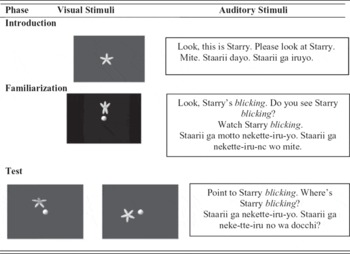
The video was shown in three phases: introduction, familiarization and test. The introductory phase presented Starry for 6 seconds first on one side of the screen and then on the other side. Participants heard: “Look, this is Starry. Please look at Starry.” The first side to appear was counterbalanced across subjects. Starry performed a novel manner (stretch) across a novel path (across from left to right) and neither action was presented again in the second session (English or Japanese).
The familiarization phase showed Starry performing a novel action paired (spinning around the ball) with a novel verb embedded in three sentences (“Look, Starry's blicking. Do you see Starry blicking? Watch Starry blicking.”). This phase consisted of a 6-second clip repeated four times. For each clip, the experimenter (standing behind the participant) introduced these 3 sentences containing the novel verb.
The test phase assessed how participants construed the novel verb. Participants saw a split-screen with Starry performing the same manner paired with a novel path (spinning alongside) on the one side of the screen and Starry performing a novel manner with the same path (bowing around) on the other side. The experimenter prompted participants to indicate which action corresponded to blicking (“Point to Starry blicking. Where's Starry blicking?”). If participants thought that blicking referred to the manner of motion, they should point to Starry performing the same manner shown during familiarization (e.g., spinning alongside). On the other hand, if participants thought that the novel verb corresponded to the path of motion, they should choose the action where Starry performed the same path from familiarization with a novel manner (e.g., bowing around) (Table 1).
Video and audio stimuli presented in English and in Japanese

Results
Comparing Japanese Bilinguals’ English Verb Construal to English Monolingual Speakers
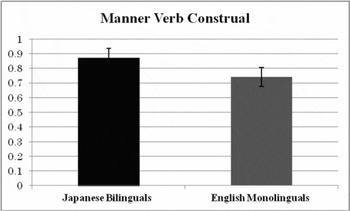
In Maguire et al. (Reference Maguire, Hirsh-Pasek, Golinkoff, Imai, Haryu, Vanegas and Sanchez-Davis2010), 74% of English monolingual speakers selected the event that preserved the manner of the original action, a response significantly different from chance. Eighty-seven percent of Japanese bilinguals selected the manner choice when they heard the stimuli in English (Figure 1). Bilinguals’ responses to the English stimuli were different from chance (p < .05). Because the present experiment involved one response per participant, a Kruskal-Wallis nonparametric test was conducted to compare the Japanese bilinguals’ response when they heard English stimuli to the English monolingual speakers. The analysis revealed no significant difference between Japanese bilinguals (M = 1.87, SD = .41) and English monolingual speakers (M = 1.74, SD = .44), χ 2 (1) = .92, p > .05, d = .31. That is, both English monolingual and Japanese bilingual speakers construed the novel verb as labeling the manner component when they heard the stimuli presented in English.
English stimuli: Percent with manner preference by speaker type

Comparing Japanese Bilinguals’ Verb Construal to Japanese Monolingual Speakers
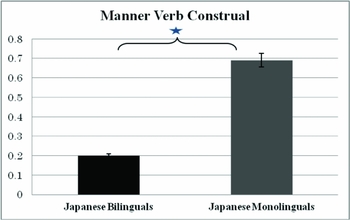
In Maguire et al. (Reference Maguire, Hirsh-Pasek, Golinkoff, Imai, Haryu, Vanegas and Sanchez-Davis2010), Japanese monolingual speakers construed the novel Japanese verb to be labeling the manner of the action 69% of the time, a response that differed significantly from chance. Eighty percent of Japanese bilinguals believed the novel verb to be labeling the path of the action when they heard the stimuli in Japanese (Figure 2). Japanese bilinguals selected path significantly more often than would be expected by chance (χ2 (1) = 5.4). Statistically significant differences between Japanese bilinguals (M = 1.2, SD = .41) and Japanese monolingual speakers (M = 1.7, SD = .47) emerged when the two groups’ verb construals were compared, χ2 (1) = 8.7, p < .005, d = 1.13. Thus, Japanese bilinguals were more likely to select path than the Japanese monolingual speakers.
Japanese stimuli: Percent with manner preference by speaker type

Discussion
This paper addresses how late bilinguals construe verbs in their L1 and L2. We asked this question because languages encode event components in different ways and we wished to see how native speakers of Japanese who are studying in English construed novel verbs in each of their languages. Our comparison case came from the work of Maguire et al. (Reference Maguire, Hirsh-Pasek, Golinkoff, Imai, Haryu, Vanegas and Sanchez-Davis2010). Maguire et al. (Reference Maguire, Hirsh-Pasek, Golinkoff, Imai, Haryu, Vanegas and Sanchez-Davis2010) demonstrated that English and Japanese monolingual speakers showed an equivalent manner bias when construing novel verbs although Japanese is known to be a path-biased language. Only a few studies have investigated a combination of languages that are similar in the way they encode semantic components in their relational terms (e.g., Turkish and Spanish) (Cadierno & Robinson, Reference Cadierno and Robinson2009; Cadierno & Ruiz, Reference Cadierno and Ruiz2006; Hasko, Reference Hasko2009; Vidaković, Reference Vidaković, Filipovic and Jaszczolt2012). The present study investigated how Japanese–English bilinguals who know two languages that share similar (manner bias) and different (path bias) lexicalization biases construe novel verbs in their target languages. Japanese is like English in how it encodes manner in verbs but differs from English in how it also has an abundance of path verbs.
When Japanese bilinguals’ performance to English stimuli was compared with that of English monolingual speakers, the Japanese bilinguals displayed approximately the same proportion of manner verb construal (80% manner preference) as the English monolingual speakers (74% manner preference). However, when comparing Japanese monolingual speakers’ and Japanese bilinguals’ verb construals, we found that bilinguals displayed a stronger path bias (80%) compared to Japanese monolingual speakers (69% manner preference). Thus, Japanese bilinguals displayed a manner bias like the English monolingual speakers when hearing the stimuli in English but a path bias when hearing the stimuli in Japanese. This latter pattern is unlike the performance of the Japanese monolingual speakers whose path bias was not as strong as that of the Japanese bilinguals.
Why might Japanese bilinguals show a stronger path preference when hearing the stimuli in Japanese while the Japanese monolingual speakers displayed a manner preference? There are two possible explanations. The first possible reason for the Japanese bilinguals’ contrasting construals of verbs in two languages is that this may be a pattern seen in bilinguals who are learning two languages that are similar in their tendency to highlight manner in verbs but differ in how they encode path. That is, although Japanese and English both tend to encode manner in verbs, path tends to be expressed in verbs in Japanese and in prepositions for English. Fluent bilinguals who use both languages regularly have both languages active and accessible when one language is being used (Bialystok, Reference Bialystok2009; Hernandez, Bates & Avila, Reference Hernandez, Bates and Avila1996; Kroll, Bobb & Wodniecka, Reference Kroll, Bobb and Wodniecka2006). The challenge facing the bilingual speaker is to select the form and meaning of the target language and not the alternate language. The bilinguals in the current study were proficient enough to attend an English-speaking university. Participants were using both languages on a regular basis. Thus, for our proficient bilinguals highlighting the differences between the two languages by adopting a path bias when hearing the stimuli in Japanese may have value in keeping the two languages distinct.
Another reason could be that the Japanese bilinguals noticed that the experiment was to be conducted in two different languages at the beginning of the second session. This may have led them to choose the construal opposite to what they chose in the first session. Thus, if they chose manner in the first session (English) they would choose path in the second session (Japanese). Because participants were not familiarized to two labels (English and Japanese) for the same action, this argument assumes that participants recognized the path or manner of the action and knew that picking one manner in session one meant that they should switch their responses with intention in session two. We think this is unlikely and tested this assumption by examining Japanese bilinguals’ verb construal pattern in both sessions.
Participants who heard English in the first session and Japanese in the second all chose manner (7 out of 7, or 100%) in the English session and five out of seven chose path in the Japanese session. Six out of eight bilinguals who heard Japanese first chose path and the same percent of participants chose manner in the English session. Participants were consistent in choosing path for the Japanese stimuli whether it came first (75%) or second (71%). Six out of eight or 75% of the participants who heard English second, chose manner. This is consistent with the group that heard English first as they selected manner 100% of the time. Thus, it seems unlikely that the experimental design would automatically lead the bilinguals to choose the opposite of what they originally chose.
Instead, we argue that perhaps bilinguals, learning two languages that are similar in how they encode manner and that diverge in how they encode path, display a path verb construal as an adaptive tool to contrast the two languages. Additional L2 studies that examine verb construal of two languages that share similar and different lexicalization biases (e.g., Chinese and Japanese) are necessary to further validate and investigate the generalizability of these findings. Speakers of Chinese and Japanese may be good candidates to test this hypothesis, as Chinese has been categorized as a manner-biased language like English. These findings suggest that there may well be interpenetration between L1 and L2 (Cadierno, Reference Cadierno, Robinson and Ellis2008) that have implications for foreign language instruction that has treated all bilinguals as if they learn a second language in the same way, regardless of the L1 and L2 (Weinreich, Reference Weinreich1953). That is, there is little attempt to individualize instruction based on students’ L1. Should these results prove generalizable to other similar languages, L2 instruction should explicitly address the question of how languages are similar and different in how they encode path and manner.
Conclusion
The field of second language acquisition has mainly focused on how the first language influences the second language. However, this study offers additional support for the idea that the L1 and L2 interact and that the particular combination of the bilinguals’ L1 and L2 matters. Learning English as a second language appears to have influenced Japanese bilinguals’ L1 verb construal. Japanese bilinguals displayed path verb construals, a pattern that is not seen with the Japanese monolingual speakers, and one that does not reflect language convergence.