Introduction
The Hesperempis genus group was first characterised by Sinclair and Cumming (Reference Sinclair and Cumming2006) as a flower-feeding lineage of Empididae sensu stricto (Diptera) that contains three genera, namely Dryodromia Rondani, Hesperempis Melander, and Melanderalus Özdikem and Başar (=Toreus Melander). At that time Dryodromia and Melanderalus were monotypic genera confined to Europe and New Mexico, respectively, and Hesperempis included only two species known from western North America. Sinclair (Reference Sinclair1995) removed Dryodromia from the empidid subfamily Clinocerinae and was the first to suggest a relationship with Hesperempis based primarily on reduced thoracic chaetotaxy, similar antennae, features of the male genitalia, and pollen feeding. More recently Shamshev (Reference Shamshev2007) described Hesperempis sibirica Shamshev from eastern Russia, expanding the geographic distribution of the genus to the Palaearctic Region.
We have been actively accumulating specimens of this poorly known group from both the Nearctic and Palaearctic regions, including several undescribed species. The purpose of this paper is to revise the entire genus group and provide an examination of the phylogenetic relationships and zoogeographic history of the included species.
Materials and methods
This study is based on material borrowed from or deposited in the following institutions: American Museum of Natural History, New York, United States of America (AMNH); Academy of Natural Sciences of Philadelphia, Philadelphia, United States of America (ANSP); California Academy of Sciences, San Francisco, United States of America (CAS); Crane Hollow Incorporated Collection, Laurelville, United States of America (CHIC); Canadian National Collection of Insects, Ottawa, Canada (CNC); University of Guelph Insect Collection, Guelph, Canada (DEBU); Essig Museum of Entomology, University of California, Berkeley, California, United States of America (EMEC); Utah State University Insect Collection, Logan, Utah, United States of America (EMUS); Kyushu University Museum, Fukuoka, Japan (KUMF); Lyman Entomological Museum, McGill University, Ste-Anne-de-Bellevue, Canada (LEM); Museo Zoologico La Specola, Firenze, Italy (MZUF); Royal British Columbia Museum, Victoria, Canada (RBCM); Royal Ontario Museum, Toronto, Canada (ROM); Spencer Entomological Museum, University of British Columbia, Vancouver, Canada (UBCZ); United States National Museum of Natural History, Washington, District of Columbia, United States of America (USNM); Museum of Zoology, Lund University, Lund, Sweden (UZIL); W.J. Turner Collection, Washington State University, Pullman, Washington, United States of America (WJTC); M.T. James Museum, Washington State University, Pullman, United States of America (WSU); Zoological Institute, Russian Academy of Sciences, St. Petersburg, Russia (ZIN); Museum für Naturkunde, Humboldt-Universität, Berlin, Germany (ZMHB); Zoological Museum, Moscow State University, Moscow, Russia (ZMMU).
Terms used for adult structures primarily follow those of Cumming and Wood (Reference Cumming and Wood2009), except for wing venation where the terms of Saigusa (Reference Saigusa2006) are used (Fig. 2E). In the system outlined by Saigusa (Reference Saigusa2006), the Diptera wing vein A1 (as used in McAlpine Reference McAlpine1981) is homologised with the Mecoptera CuP, and consequently CuA1 (of McAlpine Reference McAlpine1981) is termed M4, whereas CuA2 is CuA, the anal cell is cell cua and the anal vein (CuA2+A1) is CuA+CuP.
Male and female terminalia were macerated in 85% lactic acid heated in a microwave oven. Each microwave-heating interval comprised 15–30 seconds and was followed by a 1–2- minute cooling period during which macerated muscle tissue was removed with a fine probe. Terminalia were subsequently examined in glycerin on a depression slide.
Label data for examined holotypes, allotypes, lectotypes, and paralectotypes are cited vebatim. Labels are listed from top down with data from each label in quotation marks and separated by a semicolon. Lines on labels are delimited by a slash (/) and annotations are placed in curly brackets, i.e., {}. Label data for other specimens, including paratypes, are abridged and listed alphabetically.
Cladistic analysis
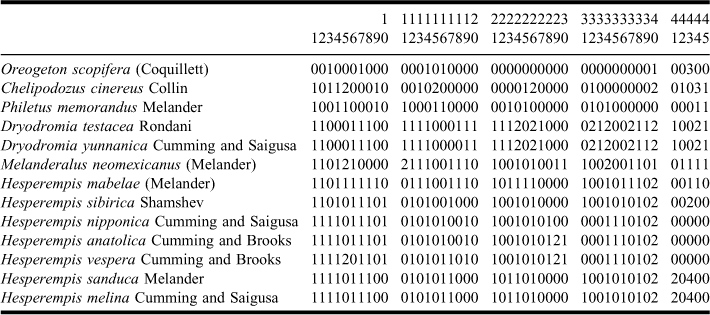
Forty-five characters were included in the cladistic analysis (Appendix 1). Characters were equally weighted and treated as unordered with multistate characters considered as nonadditive (except for progressive reduction in the anal lobe of the wing – character 26). Characters were scored for 10 ingroup taxa and three outgroup taxa (Appendix 2). The outgroups selected for the analysis were single exemplar species in the genera Oreogeton Schiner (Empidoidea incertae sedis), Chelipodozus Collin (Hemerodromiinae), and Philetus Melander (Empididae incertae sedis) based on the analysis of the Empidoidea by Sinclair and Cumming (Reference Sinclair and Cumming2006). The outgroups were used to test the monophyly of the ingroup and to root the tree, and were constrained to be paraphyletic in relation to the ingroup. The character state matrix was analysed using PAUP* Version 4.0b10 (Swofford Reference Swofford2002). A heuristic search using stepwise addition, random addition sequence of taxa and tree-bisection-reconnection branch swapping was conducted to find the most parsimonious trees. A single most parsimonious tree (Fig. 1) was obtained with length = 97, CI (consistency index) = 0.63, CI excluding uninformative characters = 0.62, RI (retention index) = 0.69, and RC (rescaled consistency index) = 0.43. Character state distributions were examined using the program MacClade 4 (Maddison and Maddison Reference Maddison and Maddison2001).
Single most parsimonious cladogram for the Hesperempis genus group produced by analysis of data in Appendix 2 (see text for explanation). Character distribution for uniquely derived states shown by black hash marks, for homoplasious states shown by grey hash marks.

Study of the male terminalia of the entire Hesperempis genus group (Appendix 1, characters 34–45) revealed that structures labelled as epandrial lobes in Sinclair and Cumming (Reference Sinclair and Cumming2006, fig. 272) are in fact surstylar lobes, with some species possessing both dorsal and ventral surstylar lobes (e.g., Fig. 7B). The matrix (Appendix 2) reflects this new interpretation in male genitalic homologies for the group. The genus group is also characterised by a hypandrium that is produced dorsoapically adjacent to the phallus. Although intimately associated, both structures are usually discernible. However, whenever the apex of the phallus and hypandrium are fused together, as occurs in certain species of Hesperempis, the compound structure is referred to as the intromittent organ.
The cladogram (Fig. 1) confirms the monophyly of the Hesperempis genus group with Dryodromia and Hesperempis indicated as sister genera. Melanderalus neomexicanus (Melander) is nested within Hesperempis as the sister group to H. mabelae (Melander), the type species of Hesperempis.
Taxonomy
Hesperempis genus group
Diagnosis. This genus group is characterised by the following features: small to medium sized (3.0–7.5 mm in body length) yellowish orange or grey flies, dulled by tomentum; males dichoptic, eyes bare; inner eye incision virtually absent; antennal stylus short, 1/4 to subequal length of postpedicel, cylindrical or slightly tapered, with three articles including terminal hyaline process (basal article sometimes difficult to discern) (Figs. 3A–3I); epipharyngeal blades immovable, partially fused together (except H. neomexicana); head and thoracic chaetotaxy inconspicuous, mostly with few short pale setae (Figs. 2A–2D, 3J); mesonotal setae mostly short with acrostichals and dorsocentrals arranged in irregular biserial rows on each side of scutum, postpronotum and notopleuron with one to two longer setae, scutellum with four to five pairs of longer setae, laterotergite with a few short setae; legs without prominent bristles; wing venation complete (for Eremoneura), including forked R4+5 (Figs. 2A, 2E); basal costal bristle absent; male terminalia (Figs. 4B, 5B, 6B, 7B, 8A, 9B, 11A, 12B, 13A, 15A) with hypandrium produced dorsoapically adjacent to phallus, postgonite absent, epandrium deeply emarginate with left and right lamella connected basally (except H. neomexicana) and bearing apical surstylus (often differentiated into dorsal and ventral lobes); female terminalia without acanthophorites, cercus short (about twice as long as basal width) (Figs. 4E, 5E, 6F, 7F, 8F, 9E, 11E), spermatheca spherical to ovoid and pigmented (Figs. 4D, 5D, 6D, 7D, 11C).
(A) Hesperempis mabelae (Melander) habitus, lateral view; (B) Hesperempis mabelae (Melander) male head, lateral view; (C) Hesperempis neomexicana (Melander) female head, lateral view with mouthparts separated; (D) Dryodromia yunnanica Cumming and Saigusa new species female head, lateral view; (E) Dryodromia testacea Rondani wing. Abbreviations: an lb, anal lobe; bm-m, basal medial crossvein; CuA, anterior branch of cubital vein; cua, anterior cubital (=anal) cell; CuP, posterior branch of cubital vein; dm, discal medial cell; dm-m, discal medial crossvein; M1, M2, M4, medial veins; R1, R2+3, R4, R5, radial veins; Sc, subcostal vein.
(A) Hesperempis anatolica Cumming and Brooks new species, female antenna; (B) Hesperempis sanduca Melander, female antenna; (C) Hesperempis melina Cumming and Saigusa new species, female antenna; (D) Hesperempis mabelae (Melander), male antenna; (E) Hesperempis vespera Cumming and Brooks new species, female antenna; (F) Hesperempis nipponica Cumming and Saigusa new species, male antenna; (G) Hesperempis neomexicana (Melander), female antenna; (H) Dryodromia testacea Rondani, female antenna; (I) Dryodromia yunnanica Cumming and Saigusa new species, female antenna; (J) Hesperempis vespera Cumming and Brooks new species, head, thorax, and base of abdomen, dorsal view (wings and halteres removed). Abbreviations: pped, postpedicel; styl, stylus.
Dryodromia testacea Rondani: (A) posterior portion of male abdomen, left lateral view; (B) male terminalia, left lateral view; (C) male terminalia, hypandrium and phallus, left lateral view; (D) female terminalia, left lateral view; (E) female terminalia, dorsal view. Abbreviations: cerc, cercus; epand, epandrium; goncx apod, gonocoxal apodeme; hypd, hypandrium; ph, phallus; spmth, spermatheca; st, sternite; tg, tergite; v sur, ventral surstylus.
Dryodromia yunnanica Cumming and Saigusa new species: (A) posterior portion of male abdomen, left lateral view; (B) male terminalia, left lateral view; (C) male terminalia, hypandrium and phallus, left lateral view; (D) female terminalia, left lateral view; (E) female terminalia, dorsal view. Abbreviations: cerc, cercus; dl lb, dorsolateral lobe; ej apod, ejaculatory apodeme; epand, epandrium; hypd, hypandrium; ph, phallus; st, sternite; tg, tergite; v sur, ventral surstylus.
Hesperempis anatolica Cumming and Brooks new species: (A) posterior portion of male abdomen, left lateral view; (B) male terminalia, left lateral view; (C) male terminalia, hypandrium and phallus, left lateral view; (D) female terminalia, spermatheca and duct; (E) female terminalia, left lateral view; (F) female terminalia, dorsal view. Abbreviations: cerc, cercus; epand, epandrium; goncx apod, gonocoxal apodeme; hypd, hypandrium; ph, phallus; st, sternite; tg, tergite; v sur, ventral surstylus.
Hesperempis mabelae (Melander): (A) posterior portion of male abdomen, left lateral view; (B) male terminalia, left lateral view; (C) male terminalia, hypandrium, and phallus, left lateral view; (D) female terminalia, spermatheca, and duct; (E) female terminalia, left lateral view; (F) female terminalia, dorsal view. Abbreviations: cerc, cercus; d sur, dorsal surstylus; ej apod, ejaculatory apodeme; epand, epandrium; goncx apod, gonocoxal apodeme; hypd, hypandrium; ph, phallus; st, sternite; tg, tergite; v sur, ventral surstylus.
Hesperempis melina Cumming and Saigusa new species: (A) male terminalia, left lateral view; (B) male terminalia, epandrium, surstylus (dorsal surstylus hatched), and cercus, left lateral view; (C) male terminalia, intromittent organ (phallus + hypandrial sheath), dorsal view; (D) male terminalia, hypandrium, and phallus, left lateral view; (E) female terminalia, left lateral view; (F) female terminalia, dorsal view. Abbreviations: cerc, cercus; d sur, dorsal surstylus; ej apod, ejaculatory apodeme; epand, epandrium; goncx apod, gonocoxal apodeme; hypd, hypandrium; int org, intromittent organ; ph, phallus; tg, tergite; v sur, ventral surstylus.
Hesperempis neomexicana (Melander): (A) posterior portion of male abdomen, left lateral view; (B) male terminalia, left lateral view; (C) male terminalia, hypandrium, and phallus, left lateral view; (D) female terminalia, left lateral view; (E) female terminalia, dorsal view. Abbreviations: cerc, cercus; d sur, dorsal surstylus; dl lb, dorsolateral lobe; epand, epandrium; goncx apod, gonocoxal apodeme; hypd, hypandrium; ph, phallus; st, sternite; tg, tergite; v sur, ventral surstylus.
Hesperempis nipponica Cumming and Saigusa new species: (A) posterior portion of male abdomen, dorsal view; (B) posterior portion of male abdomen, left lateral view. Abbreviations: hypd, hypandrium; st, sternite; tg, tergite.
Hesperempis nipponica Cumming and Saigusa new species: (A) male terminalia, left lateral view; (B) male terminalia, hypandrium, and phallus, left lateral view; (C) female terminalia, spermatheca, and duct; (D) female terminalia, left lateral view; (E) female terminalia, dorsal view. Abbreviations: cerc, cercus; epand, epandrium; goncx apod, gonocoxal apodeme; hypd, hypandrium; int org, intromittent organ; ph, phallus; tg, tergite; v sur, ventral surstylus.
Hesperempis sanduca Melander: (A) posterior portion of male abdomen, left lateral view; (B) male terminalia, left lateral view; (C) male terminalia, hypandrium, and phallus, left lateral view; (D) male terminalia, intromittent organ (phallus + hypandrial sheath), dorsal view; (E) male terminalia, epandrium, surstyli, and cerci, posterior view. Abbreviations: bac scl, bacilliform sclerite; cerc, cercus; d sur, dorsal surstylus; ej apod, ejaculatory apodeme; epand, epandrium; goncx apod, gonocoxal apodeme; hypd, hypandrium; int org, intromittent organ; ph, phallus; st, sternite; tg, tergite; v sur, ventral surstylus.
Hesperempis sibirica Shamshev: (A) male terminalia, left lateral view; (B) male terminalia, dorsal margin of epandrium and surstylus, left lateral view; (C) male terminalia, hypandrium, and phallus, left lateral view. Abbreviations: bac scl, bacilliform sclerite; cerc, cercus; d sur, dorsal surstylus; ej apod, ejaculatory apodeme; epand, epandrium; goncx apod, gonocoxal apodeme; hypd, hypandrium; ph, phallus; v sur, ventral surstylus.
Hesperempis vespera Cumming and Brooks new species: (A) posterior portion of male abdomen, dorsal view; (B) posterior portion of male abdomen, left lateral view. Abbreviations: epand, epandrium; hypd, hypandrium; st, sternite; tg, tergite.
Hesperempis vespera Cumming and Brooks new species: (A) male terminalia, left lateral view; (B) male terminalia, hypandrium, and phallus, left lateral view. Abbreviations: cerc, cercus; ej apod, ejaculatory apodeme; epand, epandrium; goncx apod, gonocoxal apodeme; hypd, hypandrium; ph, phallus; v sur, ventral surstylus.
Remarks. In their proposed classification of the Empidoidea, Sinclair and Cumming (Reference Sinclair and Cumming2006) assigned this group as incertae sedis within the Empididae. They indicated that it is a flower-feeding lineage that includes Dryodromia Rondani, Hesperempis Melander, and Melanderalus Özdikem and Başar (=Toreus Melander). Based on the results of the cladistics analysis (Fig. 1), we now believe that the group is best classified as two genera, Dryodromia and Hesperempis.
Genus DRYODROMIA Rondani
DRYODROMYA Rondani, Reference Rondani1856: 150. Incorrect original spelling, because later emendation by Loew (Reference Loew1862: 31) is in prevailing usage as indicated by O'Hara et al. (Reference O'Hara, Cerretti, Pape and Evenhuis2011: 76). Type species, Dryodromya testacea Rondani, by original designation.
DRIODROMYA Rondani, Reference Rondani1856: 209. Incorrect second original spelling, because later emendation by Loew (Reference Loew1862: 31) is in prevailing usage.
DRYODROMIA Rondani, Reference Rondani1856. Unjustified emendation by Loew (Reference Loew1862: 31) deemed justified, because name is in prevailing usage (see “Notes on synonymy” below).
DRYODROMYIA, Bigot, Reference Bigot1857: 558, incorrect subsequent spelling.
SYNAMPHOTERA Loew, Reference Loew1858: 453. Type species, Synamphotera pallida Loew [=Dryodromia testacea Rondani], by monotypy.
DRIODROMYIA, Verrall in Scudder, Reference Scudder1882: 114, incorrect subsequent spelling.
Notes on synonymy.Dryodromia was proposed by Loew (Reference Loew1862) as an unjustified emendation of Dryodromya Rondani, Reference Rondani1856. As indicated by O'Hara et al. (Reference O'Hara, Cerretti, Pape and Evenhuis2011) the spelling Dryodromia is in prevailing usage and therefore under Article 33.2.3.1 of the Fourth Edition of the International Commission on Zoological Nomenclature (1999) is considered a justified emendation attributed to the original author and date.
Diagnosis. The genus is characterised by the following features: small sized (3.25–4.25 mm in body length) yellowish orange flies; face including clypeus concave (Fig. 2D); antenna with postpedicel short and conical (Figs. 3H, 3I); stylus cylindrical, subequal to length of postpedicel; proboscis moderately long; palpus arched, moderately long (Fig. 2D); prosternum fused to proepisternum forming precoxal bridge; male midtibia near apex with small moveable inwardly directed appendage; wing with radial (auxiliary) crossvein present between R2+3 and R4, cell cua truncate apically with CuA perpendicular to CuA+CuP vein, pterostigma absent, anal lobe weakly developed (Fig. 2E); male terminalia with hypandrium prolonged as two dorsolateral lobes (Figs. 4C, 5C); gonocoxal apodeme present as small dorsal process; ejaculatory apodeme reduced, fused to base of phallus; apex of intromittent organ (phallus) bifilamentous; epandrium with vertically articulated ventral surstylus, dorsal surstylus absent; cercus prolonged (Figs. 4B, 5B); female abdomen with terminal segments exposed and nonretractable, tergite 10 absent, cerci fused together at base (Figs. 4D, 4E, 5D, 5E).
Remarks.Dryodromia includes two species, D. testacea Rondani from the southwestern Palaearctic Region (Fig. 16) and D. yunnanica Cumming and Saigusa new species from southwestern China (Fig. 17). Collin (Reference Collin1961, fig. 304) provides a habitus illustration of a D. testacea female
Known distribution of Dryodromia testacea Rondani.
Known distribution of Dryodromia yunnanica Cumming and Saigusa new species, Hesperempis melina Cumming and Saigusa new species, Hesperempis nipponica Cumming and Saigusa new species, and Hesperempis sibirica Shamshev.
Dryodromia testacea Rondani
Dryodromia testacea Rondani, Reference Rondani1856: 150 (as Dryodromya).
Synamphotera pallida Loew, Reference Loew1858: 455.
Diagnosis. This southwestern Palaearctic species is very similar to the Chinese species, D. yunnanica, except for differences in the male and female terminalia that are indicated in the key to species. The scutellar setae are also somewhat shorter in D. testacea.
Redescription. Male. Body length 3.25–4.0 mm. Head yellow, including palpus, mouthparts and base of antenna, apex of postpedicel and stylus orange to brownish orange (Fig. 3H). Ocellar triangle slightly projecting with short ocellar setae. Postvertical and postocular setae short; occiput with scattered setae on lower part. Proboscis moderately long; palpus three to four times as long as broad, directed forwards.
Thorax yellow to yellowish orange with four indistinct vittae on scutum, sometimes very difficult to discern; setation pale, inconspicuous. Prescutellar dorsocentral setae short. Postalar callus with two setae. Scutellum with short marginal setae, shorter than length of scutellum.
Legs pale yellow, with tarsomeres slightly darker towards apex in some specimens. Foretibia without anteroapical comb. Midtibial inwardly directed appendage bearing three to four short setae. Fifth tarsomere on all legs not flattened.
Wing (Fig. 2E) lightly yellowish infuscate with brownish yellow veins. Cell dm elongate, longer than basal cells, produced apically; dm-m crossvein concave; apex of vein M4 about 1¼ times length of dm-m crossvein; vein CuA+CuP long, reaching wing margin. Halter pale yellow.
Abdomen yellow, covered with scattered short pale setae.
Terminalia (Figs. 4A–4C) yellow, except apex of cercus and ventral surstylus brown, with short pale setulae. Hypandrium prolonged as two dorsolateral lobes, weakly curved anteriorly with truncate apex; posterior margin convex, not produced as a point; hypandrial setae present. Phallus without narrow medial posterior projection. Epandrium with tapered apical lobe above base of vertically articulated ventral surstylus; ventral surstylus with several short dark spine-like setae along length of outer surface. Cercus prolonged and broad basally, incised along posteroventral margin.
Female. Body length 3.5–4.0 mm. Similar to male. Cerci closely associated with, but not fused to tergite 8.
Type material.Dryodromia testacea Rondani, HOLOTYPE ♀ labelled: “2472”; {with drawer label above} “Phaidra {manuscript name}/ Rndn”; {with drawer label below} “testacea/ Rndn/ app. Pavia” (MZUF, images examined).
Synamphotera pallida Loew, LECTOTYPE ♂ (here designated) labelled: “10774”; {small lilac-coloured Loew collection label}; “LECTOTYPE/ Synamphotera pallida Loew/ des. Cumming, Brooks &/ Saigusa 2013” (ZMHB, species identity confirmed by curator J. Ziegler). PARALECTOTYPE ♂ labelled: “10774”; {small lilac-coloured Loew collection label}; “PARALECTOTYPE/ Synamphotera pallida Loew/ des. Cumming, Brooks &/ Saigusa 2013” (head missing) (ZMHB). PARALECTOTYPE ♂ labelled: “10774”; {small lilac-coloured Loew collection label}; “PARALECTOTYPE/ Synamphotera pallida Loew/ des. Cumming, Brooks &/ Saigusa 2013” (head, most of thorax, abdomen missing) (ZMHB).
Notes on types. Although Rondani (Reference Rondani1856) did not mention a type locality for D. testacea, his drawer label clearly indicates that the holotype was collected near Pavia in northern Italy. Loew (Reference Loew1858) based his description of S. pallida on four males collected from the Harz Mountains in Germany, but did not designate a holotype. Only three male syntypes of S. pallida are in the Loew collection in ZMHB and all are without locality labels. One specimen is slightly damaged, whereas the other two are badly damaged. In order to fix the identity of S. pallida Loew, the slightly damaged male is hearby designated as the lectotype and the badly damaged males are fixed as paralectotypes.
Other material examined. CZECH REPUBLIC: 1♂, Moravia mer. Pavlov, 19.v.1976 (CNC); 1♀, Dřevíč, along brook, 50.01°N 13.59°E, 1.v.1987, Barták (CNC); HUNGARY: 2♂ 2♀, Bakony Mts., Cuha-v., erdő, 17.v.1960, Mihályi (KUMF); POLAND: 1♂ 1♀, Charlottenbrunn, 5.34175 (USNM); SLOVAKIA: 1♂, centr., Kremnické phorie Mts., Turček env. 850 m, 24.vi.1979, sweeping over meadow, J. Rohaček (CNC).
Geographical distribution and seasonal occurrence (Fig. 16). Dryodromia testacea is primarily a European species, ranging from Britain to Denmark and Poland south to the Italian Alps and Macedonia, east to Azerbaijan (including Belgium, Croatia, Czech Republic, Georgia, Germany, Hungary, Romania, Slovakia, Slovenia, and Switzerland) (Lundbeck Reference Lundbeck1910; Collin Reference Collin1961; Caspers and Wagner Reference Caspers and Wagner1982; Grootaert Reference Grootaert1982; Chvála and Wagner Reference Chvála and Wagner1989; Niesiołowski Reference Niesiołowski1992; Horvat Reference Horvat1995; Shamshev Reference Shamshev1999; Stoch Reference Stoch2003; Chvála Reference Chvála2004, Falk and Crossley Reference Falk and Crossley2005; Chvála Reference Chvála2006; Shamshev and Kustov Reference Shamshev and Kustov2006). Although relatively widely distributed, this species is considered rare throughout its range (Chvála and Barták Reference Chvála and Barták2000; Meyer and Wagner Reference Meyer and Wagner2011). Adults have been collected from early May to late June.
Remarks. Falk and Crossley (Reference Falk and Crossley2005) indicate that this species is strongly associated with broad-leaf woodlands. Adults have been collected on the flowers of Sorbus Linnaeus (Rosaceae), Euonymus Linnaeus (Celastraceae), and Crataegus Linnaeus (Rosaceae) (Collin Reference Collin1961; Chandler Reference Chandler1978), and we have observed pollen grains in the gut of some males and females. Adults have also been recorded on the leaves of Cyclamen Linnaeus (Primulaceae) (Turis and Vidlička Reference Turis and Vidlička2013). Although Caspers and Wagner (Reference Caspers and Wagner1982) and Niesiołowski (Reference Niesiołowski1992) listed D. testacea as an aquatic empidid (probably in error), Hövemeyer (Reference Hövemeyer1998) and Hövemeyer and Schaurmann (Reference Hövemeyer and Schaurmann2003) recorded an adult from an emergence trap set over a dead beech (Fagus Linnaeus (Fagaceae)) stump and another from a trap set over branches in soil.
Dryodromia yunnanicaCumming and Saigusa new species
Diagnosis.Dryodromia yunnanica is most easily distinguished from D. testacea by the shape of the male cercus and hypandrium. The longer scutellar setae and female cercus fused with tergite 8 are also diagnostic for this species.
Description. Male. Body length 3.25–3.5 mm. Head (Fig. 2D) yellow, including palpus, mouthparts, and base of antenna, apex of postpedicel and stylus orange to brownish orange (Fig. 3I). Ocellar triangle slightly projecting with short ocellar setae. Postvertical and postocular setae short; occiput with scattered setae on lower part. Proboscis moderately long; palpus three to four times as long as broad, directed forwards.
Thorax yellow to yellowish orange with four pale reddish orange vittae on scutum, lateral vittae short (sometimes indistinct); setation pale, inconspicuous. Prescutellar dorsocentral setae short. Postalar callus with two setae. Scutellum with some long marginal setae, subequal to length of scutellum.
Legs pale yellow with fifth tarsomeres brown towards apex. Foretibia without anteroapical comb. Midtibial inwardly directed appendage bearing three to four short setae. Fifth tarsomere on all legs not flattened.
Wing nearly hyaline with yellow veins (R4 abbreviated in holotype, reaching wing margin in paratypes). Cell dm elongate, longer than basal cells, produced apically; dm-m crossvein concave; apex of vein M4 about 1¼ times length of dm-m crossvein; vein CuA+CuP long, reaching wing margin. Halter pale yellow.
Abdomen yellow, covered with scattered short pale setae.
Terminalia (Figs. 5A–5C) yellow, except apex of cercus and ventral surstylus brown, with short pale setulae. Hypandrium prolonged as two dorsolateral lobes, strongly curved anteriorly with tapered apex; posterior margin produced as a point; hypandrial setae present. Phallus with narrow medial posterior projection. Epandrium with truncate fluted apical lobe above base of vertically articulated ventral surstylus; ventral surstylus with several short dark spine-like setae near apex of outer surface. Cercus prolonged and slightly expanded basally, not incised along posteroventral margin.
Female. Body length 3.5–4.25 mm. Similar to male. Cerci apparently fused to tergite 8 (Fig. 5E).
Type material. HOLOTYPE ♂ from China labelled: “[Yunnan: Zhongdian]/ Tuomunan (3030–/3500 m) 42 km N of/ Qiaotou 9 June 1996/ T. SAIGUSA col.”; “HOLOTYPE ♂/ Dryodromia yunnanica/ Cumming & Saigusa” (KUMF). ALLOTYPE ♀ labelled: “[Yunnan: Zhongdian]/ Tuomunan (3030–3500 m)/ 42 km N of Qiaotou/ 9-12.vi.1996, Malaise/ T. SAIGUSA col.”; “ALLOTYPE ♀/ Dryodromia yunnanica/ Cumming & Saigusa” (KUMF). PARATYPES: CHINA: YUNNAN: 1♂, same data as holotype (CNC); 2♀, same data as allotype (KUMF); 1♀, same data as holotype except 11.vi.1996 (CNC); 1♂, Lijiang, Baishuihe (2950–3100 m), Yulongxueshan, 14.vi.1996, T. Saigusa (KUMF).
Geographical distribution and seasonal occurrence (Fig. 17). Dryodromia yunnanica is known only from northwest Yunnan, China. Adults have been collected during early to mid-June.
Etymology. The species name refers to the Yunnan distribution of this species.
Remarks. Pollen grains have been observed in the gut of males.
Genus HESPEREMPIS Melander
HESPEREMPIS Melander, Reference Melander1906: 377. Type species, Ragas mabelae Melander, by monotypy.
TOREUS Melander, Reference Melander1906: 376. Type species, Empis neomexicana Melander, by original designation. Preoccupied by Toreus Purcell, Reference Purcell1903 (Arachnida). New synonymy.
MELANDERALUS Özdikem and Başar, Reference Özdikem and Başar2010: 290. Type species, Empis neomexicana Melander, automatic. Replacement name for Toreus Melander, Reference Melander1906. New synonymy.
Notes on synonymy.Melanderalus was proposed by Özdikem and Başar (Reference Özdikem and Başar2010) as a replacement name for Toreus Melander, Reference Melander1906, because it is a junior homonym. These names are here synonymised with Hesperempis Melander, Reference Melander1906 based on the results of the cladistic analysis (Fig. 1) and in accordance with the First Reviser Principle under Article 24.2 of the Fourth Edition of the International Commission on Zoological Nomenclature (1999), in which we select Hesperempis as the senior synonym of Toreus.
Diagnosis. The genus is characterised by the following features: small to medium sized (3.0–7.5 mm in body length) yellowish orange or grey flies; face including clypeus flat, not depressed below eyes (Figs. 2B, 2C); antenna (Figs. 3A–3G) with postpedicel short and conical to lanceolate; stylus cylindrical or slightly tapered, 1/4 to 1/2 length of postpedicel; proboscis short or elongate; palpus straight (Fig. 2B) or arched and directed forwards (Fig. 2C), short to moderately long; prosternum usually isolated, not fused to proepisternum (fused in H. mabelae and H. neomexicana); male midtibia near apex without small inwardly directed appendage; wing without radial crossvein between R2+3 and R4, cell cua angled apically with CuA curved back towards CuA+CuP vein, pterostigma barely visible (distinct in H. neomexicana and males of H. vespera); anal lobe moderately developed (Fig. 2A); male terminalia (Figs. 6B, 7B, 8A, 9B, 11A, 12B, 13A, 15A) with hypandrium prolonged dorsoapically (as two dorsolateral lobes in H. neomexicana); gonocoxal apodeme projecting anteriorly as a process beyond hypandrium (confined to anteriormedial margin of hypandrium in H. mabelae and H. neomexicana); ejaculatory apodeme lever-like and articulated to base of phallus; apex of intromittent organ simple (phallus) or membraneous (phallus+hypandrium) (Figs. 6C, 7C, 8D, 9C, 11B, 12C, 13C, 15B); epandrium usually with dorsal and ventral surstylus (dorsal surstylus absent in H. anatolica, H. nipponica, and H. vespera); cercus usually short (prolonged in H. neomexicana); female abdomen with terminal segments gradually telescopic and partially retractable; tergite 10 divided and cerci separated medially (Figs. 6E, 6F, 7E, 7F, 8E, 8F, 9D, 9E, 11D, 11E).
Remarks.Hesperempis includes eight species, H. mabelae (Melander), H. neomexicana (Melander), H. sanduca Melander, H. anatolica Cumming and Brooks, and H. vespera Cumming and Brooks from the Nearctic Region (Figs. 18, 19), as well as H. sibirica Shamshev, H. melina Cumming and Saigusa, and H. nipponica Cumming and Saigusa from the Palaearctic Region (Fig. 17).
Known distribution of Hesperempis anatolica Cumming and Brooks new species and Hesperempis mabelae (Melander).
Known distribution of (A) Hesperempis sanduca Melander, (B) Hesperempis vespera Cumming and Brooks new species and Hesperempis neomexicana (Melander).
Hesperempis anatolica Cumming and Brooks new species
(Figs. 3A, 6, 18)
Diagnosis. This eastern Nearctic species is very similar to H. vespera from western North America. Both species are characterised by preabdominal modifications in the male, with tergite 5 bearing lengthened guard setae posterolaterally and tergite 6 having a raised setose dorsomedial dome. Hesperempis anatolica can be distinguished from H. vespera by its short conical postpedicel and cylindrical stylus (versus nearly lanceolate postpedicel and tapered stylus), as well as its more truncate hypandrial apex.
Description.Male. Body length 3.75–4.0 mm. Head primarily grey except palpus, mouthparts, and base of antenna yellow, apex of postpedicel and stylus brown to brownish yellow. Ocellar triangle prominent with latero-proclinate pair of ocellar setae long. Postvertical and postocular setae short; occiput with scattered setae on lower part. Antenna (see Fig. 3A) with postpedicel short and conical; stylus cylindrical, about 1/3 length of postpedicel. Proboscis short; palpus short, directed forwards.
Thorax yellow to yellowish orange, with pale inconspicuous setation. Prosternum isolated, not fused to proepisternum. Prescutellar dorsocentral setae longer than anterior dorsocentrals. Postalar callus with two setae. Scutellum with long marginal setae, longer than length of scutellum.
Legs pale yellow with extreme apex of hind tibia, hind tarsomeres 4 and 5 brownish yellow to brown. Foretibia without anteroapical comb. Fifth tarsomere on all legs not flattened.
Wing lightly yellowish infuscate with brownish yellow veins; pterostigma barely visible. Cell dm broad, barely longer than basal cells, apex triangular, hardly produced apically; dm-m crossvein oblique to barely concave; apex of vein M4 about twice length of dm-m crossvein; vein CuA+CuP long, reaching wing margin. Halter pale yellow.
Abdomen yellow, covered with scattered moderately long, pale setae. Tergite 5 expanded slightly in relation to tergite 6, with lengthened pale guard setae posterolaterally. Tergite 6 with raised setose dorsomedial dome. Sternite 8 elongate.
Terminalia (Figs. 6A–6C) yellow, except apex of ventral surstylus brown, with short pale setulae. Hypandrium prolonged dorsoapically, sheathing phallus except at apex, apex slightly enlarged and truncate with posterior emargination; gonocoxal apodeme projecting anteriorly as short process; hypandrial setae absent. Phallus curved dorsally at base, apex narrow and sclerotised; ejaculatory apodeme relatively small. Epandrium with digitiform weakly articulated, setose, ventral surstylus; dorsal surstylus absent. Cercus short and broad.
Female. Body length 3.75–4.0 mm. Similar to male, except abdominal tergite 5 without guard setae and tergite 6 without raised dorsomedial dome. Tergite 8 entire, with posterior margin shallowly emarginate (Fig. 6F).
Type material. HOLOTYPE ♂ labelled: “USA: KY: Whitely Co./ Cumberland Falls St. Pk./ 20 mi. W. Corbin 27.iv.(19)89/ J.M. Cumming, along river”; “HOLOTYPE ♂/ Hesperempis anatolica/ Cumming & Brooks” (CNC). ALLOTYPE ♀ from North Carolina, United States of America labelled: “NC: Watauga Co., Valle/ Crucis, Camp Broadstone/ 6 mi.W. Boone, 26.V.1999/ J.M. Cumming”; “ALLOTYPE ♀/ Hesperempis anatolica/ Cumming & Brooks” (CNC). PARATYPES: UNITED STATES OF AMERICA: GEORGIA: 1♀, Dawson Co., Amicalola Falls St. Pk. 18 mi. W Dahlonega, 25.iv.1989, J.M. Cumming, ex: along creek (CNC); 1♀, Rabun Co., Pine Mountain, 1400′, 15.v.1957, W.R.M. Mason (CNC); KENTUCKY: 1♀, Whitley Co., Cumberland Falls St. Pk. 20 mi. W Corbin, 27.iv.1989, J.M. Cumming, ex: sweep (CNC); NORTH CAROLINA: 1♂, Watauga Co., 9 mi. E. Boone, 25.v.1999, 3450′, M.E. Irwin, MT (CNC); 1♀, Big Witch Outlook, nr. Clingmans Dome, 4150′, 8.vi.1965, J.C. Chillcott (CNC); OHIO: 1♀, Hocking Co., Laurel Twp., Crane Hollow, 15-17.v.2003, G.A. Coovert, MT, GAC 2550 MT-D (CHIC).
Geographical distribution and seasonal occurrence (Fig. 18). Hesperempis anatolica is known from the eastern United State of America (i.e., Kentucky, North Carolina, and Georgia) north to Ohio. The Ohio locality is part of the Crane Hollow State Nature Preserve, a unique forested area surrounded by 30 m sandstone cliffs. The cool moist microclimate supports a diverse flora and fauna, which includes an unusual mix of northern boreal elements and southern Appalachian species (see Sinclair et al. Reference Sinclair, Brooks, Cumming and Coovert2011, p. 639, for more details on Crane Hollow). Adults of H. anatolica have been collected from mid-May to late June.
Etymology. From the Greek word anatolikos meaning eastern, in reference to the eastern Nearctic distribution of this species.
Remarks. Pollen grains have been observed in the gut of females.
Hesperempis mabelae (Melander)
Ragas mabelae Melander, Reference Melander1902: 277, fig. 98.
Hesperempis mabelae (Melander): Melander, Reference Melander1906: 377, habitus fig., fig. a.
Diagnosis. This relatively wide-ranging Nearctic species that exhibits variation in colouration (see below under “Remarks”) is characterised by a subtriangular postpedicel, incomplete CuA+CuP (anal) vein, and distinctive male terminalia.
Redescription. Male. Body length 3.5–5.0 mm. Head (Fig. 2B) primarily grey except palpus, mouthparts and base of antenna yellow to brown, postpedicel and stylus brownish yellow to dark brown with apex darker. Ocellar triangle prominent with latero-proclinate pair of ocellar setae short. Postvertical and postocular setae very short; occiput with scattered setae on lower part. Antenna (Fig. 3D) with postpedicel subtriangular; stylus cylindrical, about 1/2 length of postpedicel. Proboscis short; palpus moderately long, three to four times as long as broad, directed obliquely downwards.
Thorax grey with four black vittae on scutum, postalar callus yellow (Fig. 2A); some males brownish orange on prescutum, anepimeron and postnotum with brown vittae on scutum; setation short and pale. Prosternum fused to proepisternum forming precoxal bridge. Prescutellar dorsocentral setae short. Postalar callus with at least three setae. Scutellum with short marginal setae, shorter than or subequal to length of scutellum.
Legs (Fig. 2A) yellow with apices of fore and mid tarsus, apex of hind femur, hind tibia, and hind tarsus darker, brown to dark brown. Foretibia without anteroapical comb. Tarsomere 5 on all legs barely flattened.
Wing (Fig. 2A) nearly hyaline to very lightly infuscate with brown veins; pterostigma barely visible. Cell dm elongate, longer than basal cells, produced apically; dm-m crossvein concave; apex of vein M4 slightly longer than length of dm-m crossvein; vein CuA+CuP incomplete, not reaching wing margin. Halter pale yellow.
Abdomen (Fig. 2A) yellowish brown to dark brown or grey, covered with scattered short pale setae. Tergite 5 not expanded in relation to tergite 6, without guard setae posterolaterally. Tergite 6 without dorsomedial dome or dorsolateral carina. Sternite 8 not elongate.
Terminalia (Figs. 2A, 7A–7C) yellowish brown to grey, with short pale setulae. Hypandrium extended dorsoapically, sheathing phallus except at apex, apex widened; gonocoxal apodeme confined to anteriormedial margin of hypandrium, lacking process; hypandrial setae present. Phallus angled dorsally, apex lightly sclerotised with numerous spinules; ejaculatory apodeme large. Epandrium with dorsal and ventral surstylus; dorsal surstylus broad and unarticulated, devoid of setae; ventral surstylus pointed and articulated, setose. Cercus short and apically tapered.
Female. Body length 4.0–5.0 mm. Similar to male, except some females with thorax brownish orange and abdomen yellowish orange with vittae on scutum brown. Abdominal tergite 8 with anterior and posterior margin deeply emarginate (Fig. 7F).
Type material. Single male collected by J.M. Aldrich. HOLOTYPE ♂ labelled: “Moscow/ Idaho”; “TYPE/ No./ A.M.N.H. {red label}”; “♂/ Rh. mabelae/ TYPE Mel.”; “Am. Mus. Nat. Hist./ Dept. Invert. Zool./ No. 988” (AMNH, examined).
Other material examined. CANADA: ALBERTA: 1♀, Banff, 29.vi.1925, O. Bryant, 2♂ 1♀, same except 1.vii.1925, 1♀, same except 2.vii.1925, 4♂ 2♀, same except 4.vii.1925 (CAS); 1♀, Banff, Cascade Trail, 5000′, 10.vii.1968, H.J. Teskey (CNC); 2♂, Banff, Johnston Canyon, 4700′, 18.vii.1962, W.R.M. Mason, 3♂ 3♀, same except K.C. Herrmann, 1♂, same except E. Mason (CNC); 1♀, Banff-Jasper Hwy., 13 mi. from Banff, 4500′, vii.1955, R. Coyles (CNC); 3♀, Bilby, 8.vi.1924, O. Bryant, 2♀, same except 10.vi.1924, 5♂ 1♀, same except 15.vi.1924, 1♀, same except 19.vi.1924, 1♀, same except 22.vi.1924, 1♂, same except 30.vi.1924, 2♂, same except 1.vii.1924, 1♀, same except 4.vii.1924, 1♀, same except 16.vii.1924 (CAS); 1♂, Dunvegan, S. side of Peace River, 11-25.vii.1995, S. Boucher, PT in forest (CNC); 3♂, Edmonton, 5.vi.1925, O. Bryant, 2♀, same except 22.vi.1924 (CAS); 1♂, Edmonton, Kinsmen Park, 18.vii.1979, D. Williams (CNC); 8♂ 1♀, Edmonton, Univ. of Alberta Ecol. Res., 29.v-5.vi.1986, B.V. Brown, Malaise, spruce/aspen (CNC), 5♂ 2♀, same except 5-12.vi.1986; 1♀, Elkwater, 9.vi.1956, O. Peck, 2♂, same except 10.vi.1956 (CNC); 1♀, Grande Prairie, 11.vi.1961, A.R. Brooks (CNC); 1♂, Hailstone Butte, 50.2024°{N} 114.4498°{W}, 2073 m, alpine meadow, 14.vii.2010, A. MacLeod (LEM); 2♂, Hines Creek, 16.vi.1961, A.R. Brooks (CNC); 1♂, Jumpingpound Creek, 20 mi. W. Calgary, 28.vi.1962, W.R.M. Mason, 1♀, same except 11.vii.1962, K.C. Herrmann (CNC); 1♀, Kananaskis, Sheep River Prov. Park, 7 km W Sandy McNabb campgrd (50°38.9′N 114°37′W), swp open forest and field, 28.vii.2003, S. Boucher (LEM); 1♀, Kananaskis, 0.5 km S. Univ. Fld Stn, 51°02′{N} 115°02′{W}, 01.vii.2001, C. Borkent (RBCM); 1♀, Peace River, 18.vi.1961, A.R. Brooks (CNC); 15♂ 7♀, Peter Lougheed Prov. Pk., Grizzly Creek, N50°45.890′ W115°08.379′W, 9.vii.2012, B.J. Sinclair (CNC); 1♀, Rycroft, 21.vi.1961, A.R. Brooks (CNC); 4♂ 4♀, Seebe, Kananaskis Forest Experiment Station, 22.vi.1968, H.J. Teskey, 3♀, same except 3.vii.1968, 1♀, same except 18.vii.1968, 1♀, same except 24.vii.1968 (CNC); 1♂, Waterton, 6.vi.1962, W.R.M. Mason, 1♀, same except 24.vi.1923, H.L. Seamans (CNC); 1♂, {between Flatbush and Westlock} 14.vii.1993, P.H. Arnaud Jr., Field Note #00981(USNM); BRITISH COLUMBIA: 1♂, Alaska Highway Milepost DC-70 {40 km NW Fort St. John}, 27.vi.1978, P.H. Arnaud Jr. (USNM); 1♂, Atlin, 2200′, 4.vi.1955, H.J. Huckel, 1♂ 1♀, same except 11.vii.1955, 3♂ 1♀, same except 21.vii.1955, 1♀, same except 30.vii.1955, B.A. Gibbard (CNC); 1♂, Bear Lake Camp, Hart Highway, 72 km E. Prince George, 24.vi.1978, P.H. Arnaud Jr. (USNM); 1♂, Cariboo, Westwick L., 1.vi.1962, G.G.E. Scudder (UBCZ); 1♂, Chetwynd, 25.vi.1978, 615 m, P.H. Arnaud Jr. (USNM); 1♂, Chilcotin, 18.vi.1920, E.R. Buckell (CNC); 1♂, Clinton, 13.vi.1938, J.K. Jacob (CNC); 1♂, Kiskatinaw Provincial Park, Alaska Highway Milepost DC-20, 26.vi.1978, P.H. Arnaud Jr. (USNM); 7♂ 3♀, Kledo Creek Provincial Park, Alaska Highway Milepost DC-335, 28.vi.1978, P.H. Arnaud Jr. (USNM); 7♀, Kootenay NP, Daer-Pitts Aspen Control 2, 17.vi-2.vii.2000, Malaise, G. Gareau, 9♂ 3♀, same except 16-30.vii.2000, 2♂ 22♀, same except Aspen Burn 2, 25.vi-9.vii.2000, 8♂ 9♀, same except 9-23.vii.2000, 3♂ 5♀, same except Aspen Control 1, 2-16.vii.2000, 5♂ 26♀, same except Aspen Burn 1, 25.vi-9.vii.2000, collector not listed, 2♂ 4♀, same except 9-23.vii.2000, G. Gareau, 1♂, same except Aspen Burn 2, 5-21.viii.2000, pan trap, collector not listed; 1♂ 1♀, same except Control 1, 30.vii.-13.viii.2000 (CNC); 1♂, Kootenay NP, Dolly Varden Creek, 16.vii.1976, P.H. Arnaud Jr. (CAS); 1♀, Lac le Jeune, 27.vi.1973, H.J. Teskey (CNC); 9♀, Liard River Hot Springs, Alaska Highway, Rte. 97, mi. 496, 1500′, 9-10.vii.1959, R.E. Leech, 1♀, same except E.E. MacDougall (CNC); 1♂, Mount Robson, 22.vi.1947, H.R. Foxlee, 1♀, same except 26.vi.1947, 1♀, same except vi.1949, 1♂, same except 20.vi.1949, 1♂, same except 1.vi.1952, 1♂, same except 2.vi.1952, 1♂, same except 23.vi.1952 (CNC); 1♂, Mount Robson, 3.vii.1947, H.R. Foxlee, 1♀, same except 1.vi.1952 (KUMF); 1♂, Mount Robson, 14.v.1964, H.R. Foxlee, 1♀, same except 17.v.1969 (UBCZ); 1♂, Pink Mountain, 252 km S of Fort Nelson, Rte. 97, 12.vi-5.ix.1984, S. & J. Peck, intercept, aspen forest (CNC); 1♂, 37 km NE Pine Pass, 25.vi.1978, 615 m, P.H. Arnaud Jr. (USNM); MANITOBA: 1♂, 5 mi. SW Shilo, 28.v.1958, Floodplain Community nr. Tamarack Bog, J.F. McAlpine (CNC); 1♂, Soda Creek, 18.v.1950, G.J. Spencer (UBCZ); NORTHWEST TERRITORIES: 1♀, Norman Wells, 69.29204°{N}, 126.63725°{W}, 276 m, Repl.1 mesic, Malaise tp, 14-17.vi.2011, NBP field party (LEM); 1♂, Reindeer Depot, Mackenzie Delta, 10.vii.1948, J.R. Vockeroth (CNC); ONTARIO: 2♂, Sleeping Giant Provincial Park, Marie Louise Lake Campground, 48°21′47″N, 88°47′53″W, forest trail, yellow pans, 9-14.vii.2002, M. Buck, debu00223511 (DEBU); SASKATCHEWAN: 2♂ 1♀, Rockglen, 49°11′N, 105°56′W, 21.vi.1955, J.R. Vockeroth (CNC); 1♀, Uranium City, 20.vi.1962, J.G. Chillcott (CNC); YUKON TERRITORY: 1♀, 4 mi. E Carcross, Nares Lake, 60°10′N 134°38′W, sweep grasses and herbaceous vegetation in disturbed parking area, 30.vi.1997, T.A. Wheeler (LEM); 1♂, Congdon Creek Govt. Campground, Kluane Lake, sweep dry meadow, nr. lake, 20.vi.1997, T.A. Wheeler (LEM); 1♂ 2♀, Dawson City, Malaise, aspen, 13.vi.1985, S.A. Marshall (DEBU); 1♀, Dawson City, Bonanza Creek, 13.vi.1985, S.A. Marshall (DEBU); 6♂ 4♀, Dempster Jct., 40 km E Dawson, 19.vi.-25.viii.1984, S. & J. Peck, malaise, FIT, willow spruce forest (CNC); 1♀, Dempster Highway, km 194 at Engineer Creek Campground, 65°23′N 138°17′W, 3.viii.1980, #800137, ROM Field Party (ROM); 1♀, Kluane Lake, South End, 29.vi.1981, J.J. Robinson (UBCZ); 1♂, Lake Laberge, 31.v.1981, L. Vasington & S.G. Cannings (UBCZ); 1♂, Lone Tree Creek, 60°17′N 132°58′W, 28.vi.1981, C.S. Guppy (UBCZ); 1♂, Minto Landing Territorial Campground, Klondike Loop J-148, 4.vii.1978, P.H. Arnaud Jr. (USNM), 1♀, same except (CAS); 1♂ 1♀, Moose Creek 14 km NW Stewart Crossing, 18.vi-30.viii.1984, S. & J. Peck, malaise, FIT, stream Salix thicket (CNC); 1♀, Old Crow, 35 km WSW, 67°30′N 140°43′W, 975-1150′, 11.vii.1981, S.G. Cannings (UBCZ); 1♀, Rampart House, 13.vii.1951, J.E.H. Martin (CNC); 1♀, Tatchun River, 62°17′N 136°17′W, 26.vi.1982, S.G. Cannings & L. Vasington (UBCZ); 1♂, Whitehorse, 12.vi.1949, B. Hocking (CNC); UNITED STATES OF AMERICA: ALASKA: 4♀, Broad Pass, 14 mi. S Cantwell, Rte. 3, mi. 195 (CNC); 1♀, Denali (Mount McKinley) National Park & Preserve, McKinley Hotel, 5.vii.1964, W.C.F. (WJTC); 17♂ 3♀, Denali (Mount McKinley) National Park & Preserve, Horseshoe Lake, 14.vii.1978, 470 m, P.H. Arnaud Jr. (USNM); 1♀, Dry Creek Campground, Glenn Highway A-192, 3.viii.1978, P.H. Arnaud Jr. (CAS); 1♂ 1♀, Eagle River, 60 mi. NE Anchorage, 18.vi.1994 (KUMF); 2♂, Fairbanks, Norlite Campground, 21.vi.1996, P.H. Arnaud Jr. & M.M. Arnaud, Flight Trap, Collection 01518-A (USNM); 4♂ 11♀, Kenai Peninsula, Cooper Landing, Rte. 1, 25.vi-18.vii.1984, S. & J. Peck, malaise, FIT, poplar, spruce forest (CNC); 1♀, Matanuska Glacier Park Resort, Glenn Highway A-102, 30.vii.1978 P.H. Arnaud Jr. (USNM); 3♀, Moose Creek, mi. 54.6 of Glenn Hwy, 3.vi.1994, T. Saigusa, 12♂ 3♀, same except 4.vi.1994, 5♂ 2♀, same except 17.vi.1994 (KUMF); 1♀, Squirrel Creek Campground, Richardson Highway V-79.4, 31.vii.1978, P.H. Arnaud Jr. (CAS); 1♂ 7♀, Tok, 21.vi-15.viii.1984, S. & J. Peck, FIT (CNC); 2♂, 11 mi. S. Anderson Jct., Rte. 3, mi. 270, 23.vi.-11.viii.1984, S. & J. Peck, malaise, FIT, alder, poplar, spruce forest (CNC), 1♀, same except 22.vi.-11.viii.1984 (CNC); COLORADO: 1♂ 1♀, {Boulder Co.}, Nederland, Caribou, 10 000′, 18.vi.1961, C. Mann (CNC); 1♂, Boulder Co., Nederland, Mountain Research Station, 25.vii.1989, ex. Achillea millefolium, David W. Inouye (USNM), 1♀, same except 1.viii.1989, ex. Potentilla fruiticosa, 1♂, {Boulder Co.}, Nederland, Science Lodge, 9500′, 27.vi.1961, B.H. Poole (CNC); 1♂, Clear Creek Co., Chicago Creek, 8800′, 2.viii.1961, C.H. Mann (CNC); 2♂, Clear Creek Co., West Chicago Creek, 9800′, 11.viii.1961, S.M. Clark, 3♂, same except B.H. Poole (CNC); 15♂ 8♀, Doolittle Ranch, Mt. Evans, 9800′, 8.vii.1961, C.H. Mann, 3♂ 1♀, same except 9.vii.1961, 8♂ 4♀, same except 12.vii.1961, 5♂ 2♀, same except 15.vii.1961, 5♂ 7♀, same except 23.vii.1961, 2♀, same except 25.vii.1961, 5♂ 5♀, same except 27.vii.1961, 8♂ 4♀, same except 31.vii.1961, 4♀, same except 3.viii.1961, 6♂ 5♀, same except 23.vii.1961, B.H. Poole, 6♂ 3♀, same except 3.viii.1961, B.H. Poole, 5♂ 2♀, same except 8.viii.1961, B.H. Poole, 5♂ 2♀, same except 10.viii.1961, B.H. Poole, 10♂ 4♀, same except 22.vii.1961, J.G. Chillcott, 2♂, same except 23.vii.1961, J.G. Chillcott, 1♀, same except 8.vii.1961, S.M. Clark, 2♂, same except 23.vii.1961, 1♀, same except 3.viii.1961, 1♂, same except 17.vii.1961, W.R.M. Mason, 1♀, same except 25.vii.1961, W.R.M. Mason, 9♂ 5♀, same except 10 000′, 15.vii.1961, C.H. Mann, 18♂ 9♀, same except 10 000′, 17.vii.1961, C.H. Mann (CNC); 2♀, Echo Lake, Mt. Evans, 10 600′, 23.vii.1961, C.H. Mann, 3♂ 6♀, same except 25.vii.1961 (CNC); 4♂, Eldora, 2 mi. NW, 2.vii.1961, J.G. Chillcott (CNC); 2♂, Estes Park, 14.vii.1934, A.L. Melander (USNM); 1♂, Georgetown, 14.vii.1966, W. Boyle & R. Lalonde (LEM); 1♂, Grand Co., Fraser, 9500′, 7.vii.1961, B.H. Poole (CNC); 2♀, Grand Co., 2 mi. W Rollins Pass, 2438 m, 6.viii.1973, D.D. Wilder (CAS); 4♂, Gunnison Co., Gothie, 9500′, 30.vii.1961, J.G. Chillcott, 1♂, same except B.H. Poole (CNC); 1♀, Idaho Springs, 5 mi. SW, 8600′, 27.vii.1961, C.H. Mann (CNC); 3♂ 2♀, Loveland Pass, nr. Georgetown, W. slope 9850′, 28.vii.1961, B.H. Poole, 7♂ 5♀, same except 8.viii.1961, 1♂ 5♀, same except 8.viii.1961, C.H. Mann, 1♂, same except 8.viii.1961, J.G. Chillcott (CNC); 1♂ 1♀, Masonville, M.T. James (WSU); 1♂, Meeker, 8500′, 11.vii.1984, Ponderosa Prairie, H. Goulet (CNC); 1♀, Rio Grande Co., Beaver Creek, 10 000′, 21.vi.1972, Malaise, W.W. Wirth (USNM); 1♀, Rio Grande Co., Cross Creek, 10 000′, 25.vi.1972, Malaise, W.W. Wirth (USNM); 1♂, Rio Grande Co., South Fork, 8000′, 20.vi.1972, Malaise, W.W. Wirth (USNM); 1♂, Ward, 10 000′, 12.viii.1949, R.R. Dreisbach, R.K. Schwab (CNC); 1♂, W. Estes Park, 7800′, 6.vii.1956, R. & K. Dreisbach (CNC); IDAHO: 2♂, Craigmont, Craig Mountain, 8.vi.1918, A.L. Melander (USNM); 3♂ 5♀, Lake Waha, 9.vi.1918, A.L. Melander (USNM); 1♀, Latah Co., 3 mi. S. Helmer, 2600′, 11.vi.1984, ex. Amelanchier flowers, W.J. Turner (WJTC); 1♂, Latah Co., Lost Creek, 12 mi. ENE Potlatch, 2700′, 22.vi.1979, sweep, W.J. Turner, 1♀, same except 13.v.1980, ex. Amelanchier flowers (WJTC); 1♂, Latah Co., 6 mi. N. Moscow, 22.v.1971, W.J. Turner (WJTC); 1♂, Latah Co., Moscow Mt., N46°48′ W116°52′W, 12.vi.2011, B.J. Sinclair, conifer forest, CNC DIPTERA #163450 (CNC); 1♂, 1♀, Moscow Mountain, 8.vi.1921, A.L. Melander (USNM), 1♂, same except 4.vii.1911, C.F. Baker, 1♂, same except 25.vi.1920, R.C. Shannon (WSU); 2♂, Troy, 1.14.08, A.L. Melander (USNM); 3♂ 5♀, Waha, 30.v.1924, A.L. Melander (USNM); MONTANA: 2♂ 1♀, Gallatin Co., Gallatin Can., 28.vii.1923, A.L. Melander (USNM); 1♂, Glacier National Park, Grinnell Lake, 24.vii.1935, A.L. Melander (USNM); 1♂, Glacier Pk Sta {Glacier National Park}, 4800′, vii.1924, J.M. Aldrich (USNM); NEW MEXICO: 1♂, Taos, Hondo Canyon, 9000′, 15-24.vi.1960, Burks & Kinzer (USNM); 1♂, Taos, Wheeler Peak, 12 500′, 15-25.vi.1960, Burks & Kinzer (USNM); OREGON: 1♂, Union Co., Eagle Cap Wilderness Area, Boulder Park, 3.vii.1977, vegetation along trail, E.G. Davis (WJTC); SOUTH DAKOTA: 1♂, Lawrence Co. Spearfish Creek, 14.vi.1969, creek margin, W.W. Wirth (USNM); UTAH: 1♀, Grand Co., Lasal Mts., Warner Cp., 9500′, 21.vii.1968 (EMUS); 1♀, Grizzly Ridge Camp, 30 mi. N. Vernal, 8.vii.1961, 8400′, J.G. Chillcott (CNC); WASHINGTON: 1♂ 1♀, Asotin Co., Fields Spring State Park, 31.vi.1971, malaise trap dry ice, W.J. Turner (WJTC); 2 ♀, Asotin Co., 4 mi. S. Anatone, Fields Spring State Park, 3600 ft., 10.vi.1980, R.S. Zack (WSU), 1♂, same except 3500′–4000′, 7.vi.1973, W.J. Turner (USNM), 2♂ 1♀, same except (WJTC), 1♀, same except S. Berkenkamp (WJTC), 1♀, same except M. Jackson (WJTC), 1♀, same except 6-7.vi.1973, M. Wiebers (USNM), 2♂, same except 26.v.1974, ex. flowers of Ribes viscossium Pursh., W.J. Turner (WJTC), 3♀, same except 12-13.vi.1974, malaise trap with dry ice, W.J. Turner (WJTC); 1♂, Asotin Co., 4 mi. S. Anatone, 11.vi.1982, 3600′, sweep, W.J. Turner (WJTC); 2♀, Chelan Co., Squillchuck State Park, 9 mi. SE. Wenatchee, 17.vi.1973, W.J. Turner (WJTC); 1♀, 9 mi. W. Conconully, Salmon Meadows, 4500′, 5-7.viii.1975, malaise with dry ice, W.J. Turner (WJTC); 1♀, Klickitat Co., Brooks Memorial State Park, 12 mi. NE. Goldendale, 2700–3000′, 27.vi.1975 W.J. Turner (WJTC); 1♀, Pullman, 13.vi.1910 (WSU); WYOMING: 1♂, Cheyenne, 14.vii.1965, H.H. Knight (USNM).
Geographical distribution and seasonal occurrence (Fig. 18). Hesperempis mabelae is known from Kanai Peninsula in Alaska to the Mackenzie Delta in northwestern North America, south to northern New Mexico and east to the northwestern shore of Lake Superior in Ontario. Adults have been collected from mid-May to mid-August.
Remarks. Usually a mostly grey coloured species with four dark vittae on the scutum. Lighter coloured specimens of H. mabelae with brownish orange thoraces are usually females. Brownish orange colouration on the thoraces of males, when it occurs, is restricted to the prescutum, anepimeron, and postnotum.
Melander (Reference Melander1928) indicated that adults of H. mabelae are found “sparingly in the deep shade of fir forests, flying close to the ground”. Some adults have been collected on the flowers of Amelanchier Medikus (Rosaceae), Potentilla Linnaeus (Rosaceae), and Ribes Linnaeus (Grossulariaceae), and pollen grains have been observed in the gut of males and females. The third author (T.S.) collected many individuals (both sexes) of this species while sweeping blossoms of Ribes in a deciduous forest at Moose Creek, Alaska.
Hesperempis melina Cumming and Saigusa new species
(Figs. 3C, 8, 17)
Diagnosis. This yellowish orange Japanese species is characterised by its short conical postpedicel and male terminalia with a distinctive membraneous apex to the intromittent organ (i.e., fused phallus + hypandrium). It is most similar to the western Nearctic species H. sanduca, but has a more extensive membraneous apex of the intromittent organ.
Description. Male. Body length 3.5–3.75 mm. Head yellowish orange, including palpus, mouthparts, and antenna. Ocellar triangle prominent with latero-proclinate pair of ocellar setae long. Postvertical and postocular setae short; occiput with scattered setae on lower part. Antenna (Fig. 3C) with postpedicel short and conical; stylus cylindrical, about 1/3 length of postpedicel. Proboscis short; palpus short, directed forwards.
Thorax yellowish orange, with pale inconspicuous setation. Prosternum isolated, not fused to proepisternum. Prescutellar dorsocentral setae longer than anterior dorsocentrals. Postalar callus with three setae. Scutellum with long marginal setae, longer than length of scutellum.
Legs yellow with hind tarsomeres 4 and 5 brown to black. Foretibia with anteroapical comb. Tarsomere 5 on all legs slightly flattened.
Wing lightly yellowish infuscate with brownish yellow veins; pterostigma barely visible. Cell dm elongate, longer than basal cells, produced apically; dm-m crossvein concave; apex of vein M4 about 1½ times length of dm-m crossvein; vein CuA+CuP long, reaching wing margin. Halter yellow.
Abdomen yellowish orange, covered with scattered moderately long pale setae. Tergite 5 not expanded in relation to tergite 6, without guard setae posterolaterally. Tergite 6 without dorsomedial dome or dorsolateral carina. Sternite 8 not elongate.
Terminalia (Figs. 8A–8D) yellow except apex of intromittent organ dark brown, with short, pale setulae. Hypandrium prolonged dorsoapically, sheathing phallus basally, fused with it apically; gonocoxal apodeme projecting anteriorly as short process; hypandrial setae present. Phallus curved dorsally at base, with apex of intromittent organ (phallus + hypandrium) expanded and membraneous; membraneous apex extensive, about equal in length to internal apical sclerotised portion; ejaculatory apodeme large. Epandrium with dorsal and ventral surstylus; dorsal surstylus long tapered, vertically articulated lobe, devoid of setae; ventral surstylus short rounded, unarticulated process, with several long setae. Cercus short and broad.
Female. Body length 3.5–4.0 mm. Similar to male except fore and mid tarsi with tarsomeres slightly darker apically; hind tarsomeres 3–5 brown to black. Tergite 8 with anterior margin notched, posterior margin deeply emarginate (Fig. 8F).
Type material. HOLOTYPE ♂ labelled: “[JAPAN: Honshu]/ Karasawa 2500 m/ Hotakadake, Nagano/ July 9, 1962/ T. SAIGUSA col.”; “Hataka-/ Karasawa/ NAGANO/ 1963.vii.9/ T. SAIGUSA/ {underside of label} Acer ukurunduense {in Japanese}/ Acer sp./ flower of {in Japanese}”; “HOLOTYPE ♂/ Hesperempis melina/ Cumming & Saigusa” (KUMF). ALLOTYPE ♀ labelled: “[JAPAN: Honshu]/Karasawa 2500 m/ Hotakadake, Nagano/ July 10, 1962/ T. SAIGUSA col.”; “Hotaka-/ Karasawa/ NAGANO/ 1963.vii.10/ T. SAIGUSA/ {underside of label} flower of Acer ukurunduense {in Japanese}”; “ALLOTYPE ♀/ Hesperempis melina/ Cumming & Saigusa” (KUMF). PARATYPES: JAPAN: HONSHU: Yamanashi Prefecture: 1♀, Sudama, Kanayama 1400 m, 21.v.1969, K. Kanmiya (KUMF); 1♀, Hirogawara, 8.vi.1966, Akira Kato (KUMF), 1♂, same except 13.vi.1964 (CNC); Nagano Prefecture: 1♀, Hotakadake, Karasawa, 9.vi.1963, T. Saigusa (KUMF), 1♀, same except 10.vi.1963 (CNC).
Geographical distribution and seasonal occurrence (Fig. 17). Hesperempis melina is known from mountain and subalpine zones in the Prefectures of Nagano and Yamanashi in the Chubu region of the island of Honshu, Japan. Adults have been collected from late May to early July.
Etymology. From the Latin word melinus meaning honey coloured, in reference to the yellowish orange body colour of this species.
Remarks. The holotype male, allotype, and two female paratypes were collected while sweeping blossoms of Acer caudatum ukurunduense (Trautvetter and Mey) Murray (Sapindaceae) in the subalpine zone of Mt. Hotakadake, the type locality. Pollen grains have been observed in the gut of females.
Hesperempis neomexicana (Melander)
(Fig. 2C, 3G, 9, 19B)
Empis neomexicana Melander, Reference Melander1902: 352.
Toreus neomexicana (Melander): Melander, Reference Melander1906: 376, habitus fig., fig. a.
Toreus neomexicanus (Melander): Melander, Reference Melander1928: 133.
Melanderalus neomexicanus (Melander): Özdikem and Başar, Reference Özdikem and Başar2010: 290.
Hesperempis neomexicana (Melander) new combination.
Diagnosis. This western Nearctic species is characterised by its elongate proboscis, lanceolate postpedicel, and distinctive male terminalia with a ventrally curved phallus, hypandrial apex prolonged as two dorsolateral lobes and a long narrow cercus.
Redescription. Male. Body length 7.0 mm. Head (Fig. 2C) primarily grey except mouthparts brownish yellow and palpus pale yellow, antenna brown with apex of postpedicel, and stylus dark brown. Ocellar triangle prominent with latero-proclinate pair of ocellar setae short. Postvertical and postocular setae very short; occiput with scattered setae on lower part. Antenna (Fig. 3G) with postpedicel lanceolate; stylus cylindrical, about 2/5 length of postpedicel. Proboscis (Fig. 2C) long, about eight times as long as broad; palpus moderately long, three to four times as long as broad, directed forwards.
Thorax greyish brown with four dark brown vittae on scutum, postalar callus yellow; setation short and pale. Prosternum fused to proepisternum forming precoxal bridge. Prescutellar dorsocentral setae short. Postalar callus with three or four setae. Scutellum with short marginal setae, shorter than or subequal to length of scutellum.
Legs yellow with apices of fore and mid tarsus, apex of hind femur, hind tibia, and hind tarsus brown. Foretibia without anteroapical comb. Tarsomere 5 on all legs barely flattened.
Wing very lightly brownish infuscate with brown veins; pterostigma distinct. Cell dm moderately broad, slightly longer than basal cells, slightly produced apically; dm-m crossvein barely concave; apex of vein M4 about twice length of dm-m crossvein; vein CuA+CuP long, reaching wing margin, faint apically. Halter pale yellow.
Abdomen (Fig. 9A) brown, covered with scattered short pale setae. Tergite 5 not expanded in relation to tergite 6, without guard setae posterolaterally. Tergite 6 with weak setose dorsolateral carina. Sternite 8 elongate.
Terminalia (Figs. 9B, 9C) dark brown, with short pale setulae. Hypandrium prolonged as two dorsolateral lobes; gonocoxal apodeme confined to anteriormedial margin of hypandrium, lacking process; hypandrial setae present. Phallus curved ventrally, apex narrow and sclerotised; ejaculatory apodeme small. Epandrium with left and right lamella not connected basally, each lamella prolonged apically with dorsal and ventral surstylus; dorsal surstylus elongate and unarticulated, devoid of setae; ventral surstylus rounded and articulated, setose. Cercus long and narrow; hypoproct setose.
Female. Body length 6.5–7.5 mm. Similar to male, except thorax grey with four black vittae on scutum. Abdominal tergite 8 with posterior margin deeply emarginate (Fig. 9E).
Type material. The type series was collected by H.L. Viereck from the Las Vegas Range, New Mexico, United States of America. LECTOTYPE ♂ (here designated) labelled: “Las Vegas Range/ VI.28.02. N.M/ 11 000 ft.”; “TYPE/ Empis/ neomexicanus/ Mel.”; “ALMelander/ Collection/ 1961”; “LECTOTYPE/ Empis neomexicana Melander/ des. Cumming, Brooks &/ Saigusa 2013” (USNM, examined). PARALECTOTYPE ♀ labelled: “Top of Las/ Vegas Range/ ‘02NM”; “TYPE No./ 100.-”; “Empis/ neomexicana/ Type Mel.”; “PARALECTOTYPE/ Empis neomexicana Melander/ des. Cumming, Brooks &/ Saigusa 2013” (abdomen missing) (ANSP, examined).
Notes on types. Melander (Reference Melander1902) did not designate a holotype for Empis neomexicana. The type series includes a male and a female from the Las Vegas Range, New Mexico. The male is a complete somewhat faded specimen with the proboscis unnaturally extended from the subcranial cavity. Its abdomen has been removed, cleared and stored in a plastic microvial pinned below the rest of the specimen. In contrast, the female is missing its abdomen. In order to fix the identity of this species, the male is hearby designated as the lectotype, which fixes the female as a paralectotype.
Other material examined. CANADA: BRITISH COLUMBIA: 1♀, Kootenay National Park, Daer-Pitts Aspen Control 1, 2-16.vii.2000, Malaise, G. Gareau (CNC); UNITED STATES OF AMERICA: WASHINGTON: 1♀, Spokane Co., Mt. Spokane State Park, Bald Knob Campground, 4800–5200 ft., 9-10.vii.1975, malaise with dry ice, W.J. Turner (WJTC); 1♀, Valley Ford {Valleyford}, 19.vi.(19)19, A.L. Melander (USNM).
Geographical distribution and seasonal occurrence (Fig. 19B). Hesperempis neomexicana is known from southeastern British Columbia, south to northern New Mexico. Adults have been collected from late June until mid-July.
Remarks. Pollen grains have been observed within the proboscis of females.
Hesperempis nipponica Cumming and Saigusa new species
Diagnosis. This mostly grey Japanese species is characterised in the male by an expanded abdominal tergite 5 bearing squamiform guard setae posterolaterally and distinctive terminalia.
Description. Male. Body length 3.75–4.0 mm. Head primarily grey except palpus, mouthparts, and antenna yellow. Ocellar triangle prominent with latero-proclinate pair of ocellar setae long. Postvertical and postocular setae short; occiput with scattered setae on lower part. Antenna (Fig. 3F) with postpedicel short and conical; stylus cylindrical, about 1/3 length of postpedicel. Proboscis short; palpus short, directed forwards.
Thorax grey with four dark black vittae on scutum, postalar callus yellow; setation moderately short and pale. Prosternum isolated, not fused to proepisternum. Prescutellar dorsocentral setae longer than anterior dorsocentrals. Postalar callus with two setae. Scutellum with long marginal setae, longer than length of scutellum.
Legs yellow with apex of hind femur, hind tibia, hind tarsus brownish yellow. Foretibia without anteroapical comb. Tarsomere 5 on all legs barely flattened.
Wing lightly yellowish infuscate with brown veins; pterostigma barely visible. Cell dm moderately broad, slightly longer than basal cells, apex triangular, hardly produced apically; dm-m crossvein oblique to barely concave; apex of vein M4 about 1½ times length of dm-m crossvein; vein CuA+CuP long, reaching wing margin, faint apically. Halter pale yellow.
Abdomen (Fig. 10) mostly yellowish brown to brown, darker dorsally, covered with scattered moderately long pale setae. Tergite 5 distinctly expanded in relation to tergite 6, with squamiform guard setae posterolaterally. Tergite 6 without dorsomedial dome or dorsolateral carina. Sternite 8 not elongate.
Terminalia (Figs. 11A, 11B) yellowish brown, with short pale setulae. Hypandrium prolonged dorsoapically, sheathing phallus; gonocoxal apodeme projecting anteriorly as short process; hypandrial setae absent. Phallus curved dorsally at base, apex narrow and sclerotised with numerous spinules; ejaculatory apodeme small. Epandrium with digitiform weakly articulated, setose, ventral surstylus; dorsal surstylus absent. Cercus short and broadly expanded at apex.
Female. Body length 4.0 mm. Similar to male except abdominal tergite 5 not distinctly expanded in relation to tergite 6 and without squamiform guard setae. Tergite 8 entire, anterior margin emarginate, posterior margin straight (Fig. 11E).
Type material. HOLOTYPE ♂ from Japan labelled: “[Shikoku]/ Omogo-kei/ (Ehime)/{underside} 23.VI{crossed out}/ V.'67/ M. HONDA”; “HOLOTYPE ♂/ Hesperempis nipponica/ Cumming & Saigusa” (KUMF). ALLOTYPE ♀ from Japan labelled “[Shikoku]/Omogo-kei/ (Ehime)/ {underside} 23.V.'67/ MASAKO HONDA”; “ALLOTYPE ♀/ Hesperempis nipponica/ Cumming & Saigusa” (KUMF). PARATYPES: JAPAN: KYUSHU: Ōita Prefecture: 1♂, Mt. Sobosan, 9.vi.1978, Takahashi {also with hand written Japanese label} (CNC); SHIKOKU: Ehime Prefecture: 2♂, same data as Holotype (KUMF, CNC); Tokushima Prefecture: 1♂, Tsurugi, Tochikubodani, 7.v.1987, T. Saigusa (KUMF).
Geographical distribution and seasonal occurrence (Fig. 17). Hesperempis nipponica is known from deciduous mountain forests on the islands of Shikoku and Kyushu, Japan. Adults have been collected from late May to early June.
Etymology. The species name refers to the Japanese distribution of this species.
Remarks. Pollen grains have been observed in the gut of males and females.
Hesperempis sanduca Melander
Hesperempis sanduca Melander, Reference Melander1928: 111.
Diagnosis. This entirely yellow western Nearctic species is characterised by its short conical postpedicel bearing a cylindrical stylus and male terminalia with a distinctive membraneous apex to the intromittent organ (i.e., fused phallus + hypandrium). Hesperempis sanduca is very similar to the Japanese species H. melina, but has a less extensive membraneous intromittent organ apex.
Redescription. Male. Body length 3.0–3.5 mm. Head yellow, including palpus, mouthparts, and antenna. Ocellar triangle prominent with latero-proclinate pair of ocellar setae long. Postvertical and postocular setae short; occiput with scattered setae on lower part. Antenna (Fig. 3B) with postpedicel short and conical; stylus cylindrical, about 1/3 length of postpedicel. Proboscis short; palpus short, directed forwards.
Thorax yellow to yellowish orange, with pale inconspicuous setation. Prosternum isolated, not fused to proepisternum. Prescutellar dorsocentral setae longer than anterior dorsocentrals. Postalar callus with three setae. Scutellum with long marginal setae, longer than length of scutellum.
Legs pale yellow with hind tarsomeres 4 and 5 brown to black. Foretibia with anteroapical comb. Tarsomere 5 on all legs slightly flattened.
Wing lightly yellowish infuscate with brownish yellow veins; pterostigma barely visible. Cell dm elongate, longer than basal cells, produced apically; dm-m crossvein concave; apex of vein M4 about 1½ times length of dm-m crossvein; vein CuA+CuP long, reaching wing margin. Halter pale yellow.
Abdomen (Fig. 12A) yellow, covered with scattered moderately long pale setae. Tergite 5 not expanded in relation to tergite 6, without guard setae posterolaterally. Tergite 6 without dorsomedial dome or dorsolateral carina. Sternite 8 not elongate.
Terminalia (Figs. 12B–12E) yellow except apex of intromittent organ dark brown, with short pale setulae. Hypandrium prolonged dorsoapically, sheathing phallus basally, fused with it apically; gonocoxal apodeme projecting anteriorly as short process; hypandrial setae present. Phallus curved dorsally at base, with apex of intromittent organ (phallus + hypandrium) expanded and membraneous; membraneous apex restricted to less than half length of internal apical sclerotised portion; ejaculatory apodeme small. Epandrium with dorsal and ventral surstylus; dorsal surstylus long tapered, vertically articulated lobe, devoid of setae; ventral surstylus short rounded, unarticulated process, with several long setae. Cercus short and broad.
Female. Body length 3.0–3.5 mm. Similar to male except fore and mid tarsi with tarsomeres slightly darker apically; hind tarsomeres 3–5 brown to black. Tergite 8 with anterior margin notched, posterior margin deeply emarginate (see Figs. 8E, 8F).
Type material.HOLOTYPE ♂ from San Francisco, California, United States of America, labelled: “S. Francisco/ Cal. May/ Chas. Fuchs”; “TYPE/ Hesperempis/ sanduca/ Mel.”; “ALMelander/ Collection/ 1961” (USNM, examined). PARATYPE ♀ from Forest Grove, Oregon, v.20.{19}18, F.R. Cole (apparent paratype, but conspecific with H. vespera – see “Notes on types” below) (EMEC, examined).
Notes on types. In his description of H. sanduca, Melander (Reference Melander1928) listed the holotype male from San Francisco and a female paratype from Forest Grove Oregon, collected by F.R. Cole. The female paratype was not found in the Melander collections at the USNM, AMNH, or ANSP. However, a female specimen of H. vespera collected in Forest Grove by F.R. Cole was located at the EMEC. Although this specimen is not labelled as a paratype of H. sanduca and has a different collection date (20 May 1918 rather than 2 June as reported by Melander) we believe this female specimen is the paratype listed by Melander (see “Notes on types” under H. vespera Cumming and Brooks).
Other material examined. CANADA: BRITISH COLUMBIA: 2♀, Vancouver, 9.iv.1915, Sherman (USNM); UNITED STATES OF AMERICA: OREGON: 2♂, Benton Co., along Hwy. 34, 4 mi. W. Philomath, 21.vi.1977, D.D. Wilder (CAS); 2♂ 1♀, Benton Co., Alsea Falls Campground, 21.vi.1977, D.D. Wilder (CAS); 6♂, Benton Co., Siuslaw National Forest, Mary's Peak, 1.vii.1971, G. Steyskal (USNM); 1♂, Jackson Co., Grizzly Mt. Rd., 22.vi.1975, G.F. Knowlton & W.J. Hanson (EMUS); 1♂, Clackamas Co., Pioneer Toll Gate Campground, nr. Rhododendron, 1760′, 23.vi.1982, sweep, W.J. Turner (WJTC); WASHINGTON: 1♂, Asotin Co., 4 mi. S. Anatone, Fields Spring State Park, 3500–4000 ft., 12-13.vi.1974, malaise trap with dry ice, W.J. Turner (WJTC), 1♀, same except nr. Fields Spring State Park, 3600 ft., 19.vii.1984, malaise, W.J. Turner (WJTC); 1♂, Clallam Co., Olympic NP, 0.5 km NE Fairholm, roadside near entrance to Fairholm Campground, 48°04′12″N 123°55′7.5″W, el. 200 m, 24.vi.2005, C.J. Borkent, CJB05-26 (LEM).
Geographical distribution and seasonal occurrence (Fig. 19A). Hesperempis sanduca is known from southwestern British Columbia south through Washington and Oregon to San Francisco, California. In addition to the localities listed above, the species is also known from two males collected near Leavenworth, Washington on June 30th, 1984 by Roy Danielsson. These males are deposited in the Museum of Zoology in Lund, Sweden (UZIL) (I. Shamshev, personal communication). Adults of H. sanduca have been collected between April and mid-July.
Remarks. Pollen grains have been observed in the gut of males and females.
Hesperempis sibirica Shamshev
Hesperempis sibirica Shamshev, Reference Shamshev2007: 63, fig. 1.
Diagnosis. This entirely yellow eastern Palaearctic species is distinguished by its short conical postpedicel and distinctive male terminalia, characterised by a slender, dorsally curved and posteriorly arched phallus, flanked by a dosoapically prolonged hypandrium.
Redescription (based in part on Shamshev Reference Shamshev2007). Male. Body length ∼4.0 mm. Head yellow, including palpus, mouthparts, and antenna. Ocellar triangle prominent with latero-proclinate pair of ocellar setae somewhat short. Postvertical and postocular setae very short; occiput with scattered setae on lower part. Antenna with postpedicel short and conical; stylus cylindrical, about 1/3 length of postpedicel. Proboscis short; palpus short, directed forwards.
Thorax yellowish orange with two dull lateral vittae on scutum; setation pale, inconspicuous. Prosternum isolated, not fused to proepisternum. Prescutellar dorsocentral setae short. Postalar callus with three setae. Scutellum with long marginal setae, longer than length of scutellum.
Legs entirely yellow including hind tarsomeres. Foretibia with anteroapical comb. Tarsomere 5 on all legs slightly flattened.
Wing lightly yellowish infuscate with brownish yellow veins; pterostigma barely visible. Cell dm moderately broad, somewhat longer than basal cells, slightly produced apically; dm-m crossvein slightly concave; apex of vein M4 about 1½ times length of dm-m crossvein; vein CuA+CuP long, reaching wing margin. Halter yellow.
Abdomen yellow, covered with scattered short pale setae. Tergite 5 not expanded in relation to tergite 6, without guard setae posterolaterally. Tergite 6 without dorsomedial dome or dorsolateral carina. Sternite 8 not elongate.
Terminalia (Fig. 13) yellow, except dorsal margin of cercus and apex of ventral surstylus brown, with short pale setulae. Hypandrium prolonged dorsoapically, partially sheathing phallus basally and flanking it posteriorly, emarginate at apex; gonocoxal apodeme projecting anteriorly as broad process; hypandrial setae present. Phallus curved dorsally at base and posteriorly towards apex; apex narrow and weakly sclerotised with several spinules; ejaculatory apodeme large. Epandrium with dorsal and ventral surstylus; dorsal surstylus small, unarticulate process, with two short apical setae; ventral surstylus broad, barely articulated, setose process. Cercus short and broad, with tapered apex bearing numerous spinules along inner surface.
Female. Similar to male. Tergite 8 with posterior margin emarginate.
Type material. HOLOTYPE ♂ labelled: “{in Cyrillic} RUSSIA, zh.d.st. {abbreviation for “zheleznodorozhnaya stantsiya” = railway station} Dachnaya, 32 km S of Irkutsk/V. Richter, 20.VI.1971” (ZIN, examined by I. Shamshev). PARATYPE:RUSSIA: IRKUTSK: ♂, Padun, Irkut. obl. {= Irkutsk Province}, Monchadsky, 10.VII. {1}956; UV trap 22.00-23.00 (ZIN, examined macerated head and postabdomen).
Other material. RUSSIA: REPUBLIC OF ALTAI: 2♀, Central ALTAI, Ust’-Koksa env., Koksa river right bank, Katunskiy reserve, 24-25.vi.2007, O. Kosterin (ZMMU, examined by I. Shamshev); KHABAROVSK: 3♂, Shantar Islands, Okhotsk Sea, 22.vii.1913, leg. Soldatov (ZIN, examined by I. Shamshev).
Geographical distribution and seasonal occurrence (Fig. 17). Hesperempis sibirica is known from the Altai Mountains of central Russia east through Siberia to the Sea of Okhotsk. Adults have been collected between late June and late July.
Remarks. When Shamshev (Reference Shamshev2007) described this species, the female was unknown.
Hesperempis vespera Cumming and Brooks new species
Diagnosis. This western Nearctic species is most similar to H. anatolica from eastern North America. Hesperempis vespera can be distinguished from the former species by its nearly lanceolate postpedicel and tapered stylus (versus short conical postpedicel and cylindrical stylus), as well as its rounded bilobed hypandrial apex. Hesperempis vespera is the only mostly yellow to yellowish orange western Nearctic species with a grey head. However, some lighter coloured females of H. mabelae that are brownish orange with grey heads, could be confused with H. vespera. In addition to male genitalic differences, H. mabelae has a subtriangular postpedicel with a cylindrical stylus, an incomplete CuA+CuP (anal) vein (versus complete), and four vittae on the scutum unlike H. vespera, which has only two lateral vittae.
Description.Male. Body length 4.75–5.0 mm. Head (Fig. 3J) primarily grey except palpus, mouthparts, and base of antenna yellow, most of postpedicel and stylus brown. Ocellar triangle prominent with latero-proclinate pair of ocellar setae long. Postvertical and postocular setae short; occiput with scattered setae on lower part. Antenna (Fig. 3E) with postpedicel nearly lanceolate; stylus tapered apically, about 1/4 length of postpedicel. Proboscis short; palpus short, directed forwards.
Thorax (Fig. 3J) mostly yellow to yellowish orange, with two brownish black lateral vittae on scutum, scutellum mainly brownish black except margin, mediotergite brownish black; setation pale, inconspicuous. Prosternum isolated, not fused to proepisternum. Prescutellar dorsocentral setae longer than anterior dorsocentrals. Postalar callus with three setae. Scutellum with long marginal setae, longer than length of scutellum.
Legs pale yellow with extreme apices of fore and mid tarsomeres yellowish brown to brown, apex of hind femur yellowish brown, apices of hind tibia and hind tarsomeres brown to brownish black. Foretibia without anteroapical comb. Tarsomere 5 on all legs barely flattened.
Wing very lightly brownish infuscate with brown veins; pterostigma distinct. Cell dm broad, barely longer than basal cells, apex triangular, hardly produced apically; dm-m crossvein oblique to barely concave; apex of vein M4 about 1¼ times length of dm-m crossvein; vein CuA+CuP long, reaching wing margin. Halter pale yellow.
Abdomen (Fig. 14) mostly yellow, more brown dorsally, covered with scattered moderately long pale setae. Tergite 5 expanded slightly in relation to tergite 6, with lengthened pale guard setae posterolaterally. Tergite 6 with raised setose dorsomedial dome. Sternite 8 elongate.
Terminalia (Fig. 15) yellow, except apex of epandrium and ventral surstylus brown, with short pale setulae. Hypandrium prolonged dorsoapically, sheathing phallus except at apex, apex enlarged and bilobed (Fig. 14A); gonocoxal apodeme projecting anteriorly as short process; hypandrial setae absent. Phallus curved dorsally at base, apex narrow and sclerotised; ejaculatory apodeme large. Epandrium with digitiform, weakly articulated, setose, ventral surstylus; dorsal surstylus absent. Cercus short and broad.
Female. Body length 4.0–5.5 mm. Similar to male except vittae shorter, not extending anteriorly on scutum; scutellum mainly yellowish orange except for dark base; wing very lightly yellowish infuscate with brownish yellow veins, pterostigma barely visible; abdominal tergite 5 without guard setae; tergite 6 without raised dorsomedial dome. Tergite 8 entire, with posterior margin shallowly emarginate (see Figs. 6E, 6F).
Type material. HOLOTYPE ♂ labelled: “USA:OR:Multnomah Co./ Wahkeena Falls/45°34.54′N 122°07.68′W/ 7.vi.2009, I. Winkler”; “HOLOTYPE ♂/ Hesperempis vespera/Cumming & Brooks” (CNC). ALLOTYPE ♀ labelled: “Lily Pond, Alpine/ Lk., Marin Co./ CALIF. 1500’”; “V {–} VI.1970/ Mal. tr{ap}. D.D. Munroe”; “ALLOTYPE ♀/ Hesperempis vespera/ Cumming & Brooks” (CNC). PARATYPES: UNITED STATES OF AMERICA: CALIFORNIA: 1♂, Humboldt Co., 3 mi. N of Orick, Lost Man Creek picnic area, 3.vi.2009, K. Collins (CNC); OREGON: 1♀, Forest Grove, V-20-{19}18, F.R. Cole (EMEC); WASHINGTON: 1♀, Mt. Rainier National Park, West End Rd., 3 mi. N. jct. Hwy. 706 on Tahoma R., 2500 ft., 12.viii.1977, sweep, W.J. Turner (WJTC).
Notes on types. The female paratype of H. vespera from Forest Grove, Oregon is probably also the misidentified female paratype of H. sanduca listed by Melander (Reference Melander1928) (see “Notes on types” under that species).
Geographical distribution and seasonal occurrence (Fig. 19B). Hesperempis vespera is known from Washington south through Oregon to Marin County, California. Adults have been collected from May until mid-August.
Etymology. From the Latin word vesper meaning west, in reference to the western Nearctic distribution of this species.
Discussion
Sinclair and Cumming (Reference Sinclair and Cumming2006) classified the Hesperempis genus group as incertae sedis within their restricted concept of the Empididae. Although relationships within the family remain tentative, they considered the group along with Philetus, to be basal to the Empidinae + Hemerodromiinae (Sinclair and Cumming Reference Sinclair and Cumming2006, Tree 4). The outgroup exemplars used in the current study are inadequate to properly address this issue, however, the results suggest (with either the outgroup constrained or not constrained to be paraphyletic in the analysis) that the Hesperempis genus group is basal to the Empidinae + Hemerodromiinae (i.e., Chelipodozus) with Philetus being more closely related to the latter lineage (Fig. 1). The new interpretation of male genitalic homologies presented here for Hesperempis and Dryodromia, with the epandrial lobes of Sinclair and Cumming (Reference Sinclair and Cumming2006, fig. 272) now considered as surstyli (also present in Philetus), needs to be evaluated in future phylogenetic analyses of the Empididae and the basal lineages of Empidoidea.
Most adult Empidoidea have a pointed labrum with moveable epipharyngeal blades that are used together to impale and masticate prey. However, in a few flower-visiting empidoids such as the Hesperempis genus group, the labrum is truncate laterally and the epipharyngeal blades are nonfunctional (Sinclair and Cumming Reference Sinclair and Cumming2006). In both Dryodromia and Hesperempis, the blades are fused together medially and are largely immovable (see Krystoph Reference Krystoph1961, fig. 6; Sinclair and Cumming Reference Sinclair and Cumming2006, fig. 100). The observations recorded here, of whole pollen grains found in the gut of both males and females of most included species, correlated with mouthpart morphology, indicate that members of the group appear to be obligate pollen-feeders that are never predaceous. Although Hesperempis neomexicana has a more pointed labrum and potentially more mobile blades, whole pollen grains have also been observed within the proboscis of this species. This type of feeding is somewhat similar to that of the basal empidoid genus Iteaphila Zetterstedt (Sinclair and Cumming Reference Sinclair and Cumming2006), which lacks epipharyngeal blades and also ingests whole pollen grains. In contrast most other obligate pollen-feeding empidoid groups, such as the hybotid genus Anthalia Zetterstedt, possess functional blades and cut-up the pollen grains during feeding (Sinclair and Shamshev Reference Sinclair and Shamshev2012). More information on empidoid feeding correlated with mouthpart morphology, particularly for basal lineages in each of the families, will assist in determining whether predation as hypothesised by Daugeron (Reference Daugeron1997), or flower feeding, is ancestral in Empidoidea.
Our revised classification of the Hesperempis genus group is based in part on the cladistic analysis depicted in Figure 1. Although there is considerable homoplasy in the character matrix (Appendix 1 and 2), the group as a whole is evidently monophyletic on the basis of a number of synapomorphies, including antennal stylus shape (character 6.1), nonfunctional epipharyngeal blades (character 8.1), inconspicuous head and thoracic chaetotaxy (character 12.1), and the absence of postgonites in the male terminalia (character 38.1). Dryodromia is a well-defined genus characterised by numerous synapomorphies and appears to be the sister group to Hesperempis. With the addition of four new species and the inclusion of H. neomexicana, the concept of Hesperempis has by necessity expanded. The genus is characterised by several features including a flat face (character 4.1), wing with obtuse anal lobe (character 26.1), and male terminalia with a dorsoapically prolonged hypandrial apex that flanks the phallus (characters 34.1, 36.1).
Several groups of species are apparent in Hesperempis (Fig. 1). One of these groups, including H. nipponica, H. anatolica, and H. vespera, is united primarily on the basis of modifications of abdominal tergite 5 (character 28.1) and loss of hypandrial setae (character 35.1) in the male. Within this group, males of H. anatolica and H. vespera also possess a dorsomedial dome on abdominal tergite 6 (character 29.2) and an elongate sternite 8 (character 30.1), indicating they are sister species. Hesperempis sanduca and H. melina are also sister species, primarily on the basis of a shared membraneous intromittent organ apex (character 41.2) and a vertically articulated dorsal surstylus (43.4) in males. Although highly autapomorphic, H. neomexicana shares a number of features with H. mabelae, the type species of Hesperempis. Most notably both possess, a precoxal bridge (character 13.1), short scutellar setae (character 18.1), and male terminalia with reduced gonocoxal apodemes (character 37.1) and large unarticulated dorsal and fully articulated ventral surstyli (characters 43.1, 44.1). Hesperempis sibirica is weakly assigned as the sister to these latter species on the basis of short anterior ocellar setae and prescutellar dorsocentral setae (characters 3.0, 16.0).
The northern hemisphere distribution of the Hesperempis genus group coupled with its somewhat basal placement within the Empididae, suggests a Laurasian lineage of probable late Mesozoic age. There is also a pattern of multiple zoogeographic sister lineage connections between the Palaearctic and Nearctic regions (Fig. 1) that include a number of Asio-Nearctic disjunct distributions. These disjunct distributions are well documented in Diptera (Sinclair and Saigusa Reference Sinclair and Saigusa2002) and in Empidoidea in particular (Saigusa and Kato Reference Saigusa and Kato2002; Sinclair et al. Reference Sinclair, Brooks, Cumming and Coovert2011; Saigusa Reference Saigusa2012), and are usually considered the result of early to mid-tertiary vicariant events.
Acknowledgements
The authors thank Cheryl Barr (EMEC), Mathias Buck (DEBU), Robert Cannings (RBCM), Gary Coovert (CHIC), Douglas Currie (ROM), David Grimaldi (AMNH), Charles Griswold (CAS), Karen Needham (UBCZ), James Pitts (EMUS), William Turner (WJTC), Jason Weintraub (ANSP), Terry Wheeler (LEM), Norman Woodley (USNM), and Richard Zack (WSU) for access to or loan of specimens. Isaac Winkler (Wright State University, Dayton, Ohio, United States of America) and Kenneth Collins (Fullerton College, Fullerton, California, United States of America) generously donated males of Hesperempis vespera to the CNC. Authors are indebted to Igor Shamshev (ZIN) for supplying unpublished morphological and distributional data on Hesperempis sibirica specimens deposited in ZIN and ZMMU, and for loaning the head and terminalia of the male paratype. He also kindly sent distributional data associated with two specimens of Hesperempis sanduca located in UZIL. Christophe Daugeron (Muséum national d'Histoire naturelle, Paris, France) graciously provided photographic images of the holotype of Dryodromia testacea Rondani that he had borrowed from MZUF, and Joachim Ziegler (ZMHB) confirmed the identity of the type series of Synamphotera pallida Loew. The authors thank James O'Hara (CNC) for discussions on nomenclatural issues associated with Rondani names, and Bradley Sinclair (CNC) for reviewing the manuscript prior to submission. Frederic Beaulieu (CNC) kindly provided the French translation of the abstract. This research was partially supported by a grant from the United States National Science Foundation (Award No. 0842118).
Appendix 1. Characters and character state codings used in cladistic analysis
Head
1. Male eye contiguity. Holoptic (0); dichoptic (1).
2.Inner eye incision. Present (0); barely remnant of an incision, or absent (1).
3.Anterior ocellar setae (latero-proclinate pair). Short (0); long (1).
4. Face including clypeus. Concave, depressed below eyes (at least in male) (0); flat, level with eyes (1).
5. Postpedicel shape. Short conical (0); subtriangular (1); lanceolate (2).
6.Antenna beyond postpedicel (excluding apical receptor). Tapering (0); cylindrical or tubular (nearly parallel sided) (1).
7.Apex of labrum. Pointed, straight (0); truncate, rounded in lateral view (1).
8. Epipharyngeal blades. One or more pairs of lateral blades (0); blades immovable, partially fused (1).
9.Palpal orientation. Arched, directed forward (0); straight, projecting obliquely (1).
10. Palpal length. Long, three to four times as long as broad (0); short, approximately two times as long as broad (1).
11.Proboscis length (unretracted). Short, approximately as broad as long (0); moderately long, approximately three to four times as long as broad (1); elongate, approximately seven to nine times as long as broad (2).
Head and thorax
12.Vestiture. Conspicuous, with numerous long dark bristles (0); inconspicuous, with few short pale setae (1).
Thorax
13. Prosternum. Isolated from proepisternum (0); fused to proepisternum forming precoxal bridge (1).
14.Laterotergite vestiture. Bare (0); setose (1).
15. Acrostichal setae. Biserial (or multi-serial) (0); uniserial (1); absent (2).
16. Prescutellar dorsocentral setae. Short (0); longer than anterior dorsocentral setae (1).
17. Postalar vestiture. Setae 1–2 or absent (0); setae more numerous (1).
18.Scutellar setae. Some long (0); all short (1).
Legs
19. Foretibial anteroapical comb. Present (0); absent (1).
20. Male midtibial appendage. Absent (0); present (1).
Wing
21. Basal costal bristle. Present (0); absent (1).
22.Radial (auxiliary) crossvein. Absent (0); present (1).
23.Discal (dm) cell shape. Apex truncate to triangular, with dm-m crossvein oblique to barely curved (0); apex prolonged, with dm-m crossvein inwardly curved (1).
24.Shape of CuA. Recurved (0); slightly curved (1); truncate (2).
25.CuP+CuA termination. Complete, reaching wing margin (0); incomplete, ending before wing margin (1).
26.Anal lobe. Lobe acute to right angled, from alular incision to lobe apex (0); lobe obtuse, distinctly convex opposite cell cua (1); barely developed (2).
Abdomen
27.Female abdominal segments. Segments gradually telescopic with terminal segments partially retracted (0); terminal segments exposed, not retracted (1).
28. Male tergite 5. Not expanded in relation to tergite 6 and without guard setae posterolaterally (0); expanded in relation to tergite 6 and bearing guard setae posterolaterally (1).
29.Male tergite 6. Flat dorsally (0); with weak dorsolateral carina (1); with dorsomedial dome (2).
30. Male sternite 8. Broad (0); elongate (1).
Female terminalia
31. Tergite 8. Entire (0); posterior margin with deep membranous cleft (1).
32. Tergite 10. Divided medially (0); undivided (1); absent (2).
33. Cercus. Separated medially (0); fused at base (1).
Male terminalia
34. Apex of hypandrium. Not prolonged (0); prolonged dorsoapically (1); prolonged as two dorsolateral lobes (2).
35. Hypandrial setae. Present (0); absent (1).
36.Hypandrium and phallus connection. Separate (0); hypandrium sheathing phallus (1).
37. Gonocoxal apodeme. Projecting anteriorly as a process beyond hypandrium (0); confined to anteromedial margin of hypandrium, lacking process (1); reduced to small dorsal process (2).
38. Postgonites. Present (0); absent (1).
39.Ejaculatory apodeme. Lever-like and articulated to base of phallus (0); reduced and fused to base of phallus (1).
40.Shape of phallus. Straight (0); downwardly curved (1); upwardly curved at least at base (2).
41.Apex of intromittent organ. Simple (0); bifilamentous (1); membraneous (2).
42. Epandrial lamellae. With basal connection (0); without basal connection (1).
43.Dorsal surstylus. Absent (0); large unarticulated lobe (1); small unarticulated process (2); horizontally articulated (3); vertically articulated (4).
44.Ventral surstylus. Differentiated from epandrium, weakly or not articulated (0); fully articulated with epandrium (1); vertically articulated with epandrium (2); absent (3).
45. Cercus. Short (0); prolonged (1).
Character state matrix for cladistic analysis (characters 1–45).