Introduction
Crossbreeding with exotic breeds is a major driving force for livestock intensification in developing countries (Udo et al., Reference Udo, Aklilu, Phong, Bosma, Budisatria, Patil, Samdup and Bebe2011). Most studies on the impact of crossbreeding are focused on dairy cattle (Syrstad, Reference Syrstad1996; Kahi et al., Reference Kahi, Nitter, Thorpe and Gall2000; Samdup et al., Reference Samdup, Udo, Eilers, Ibrahim and van der Zijpp2010). Ideally, crossbreeding strategies have to match the production environment, of which the feed resources are a main determinant (Kahi et al., Reference Kahi, Nitter, Thorpe and Gall2000; Wollny, Reference Wollny2003). In practice, crossbreeding schemes are characterized by un-systematic use of exotic semen, irrespective of agro-ecological and socio-economic settings (Wollny, Reference Wollny2003).
In Indonesia, crossbreeding is widely applied for beef production. The high human population increase and increased purchasing power are major factors driving the rising demand for red meat from ruminants. In 2010 the human population was about 237 million (BPS, 2010). More than 50 percent of all cattle are kept on Java, the main island with 57 percent of the human population of Indonesia (Kementan, 2010). To satisfy the demand for meat, the government has been importing meat and live animals. Particularly in Java, from the 1980s onwards, the government has been promoting artificial insemination using exotic breeds from temperate regions, such as Simmental, Limousin, Aberdeen Angus and Hereford to improve the beef performance of the local cattle.
In Indonesia, farmers keep cattle not only for meat production, but also for financial security, manure for cropping, social status and draught power (Widi, Reference Widi2004). About 95 percent of cattle are in smallholder crop–livestock farmers’ hands, with fewer than five cattle per farm.
During the colonial period the Dutch administration introduced Ongole cattle from India to replace the indigenous Javanese cattle (Bos javanicus) (Barwegen, Reference Barwegen and Henley2004). The male and female Ongole cattle were bought from areas surrounding Madras. Ongole were considered more suitable for carrying the heavy loads for the sugar industry. Javanese farmers initially disliked the Ongole breed, because they could not work in forests like the Javanese cattle (Barwegen, Reference Barwegen and Henley2004). The pure Ongole was brought to Sumba Island and became the purebred Sumba-Ongole. In Java, the Sumba-Ongole were crossed with Javanese cattle and formed the Ongole-grade (in Indonesia called Peranakan Ongole, PO). Added to this, the Dutch administration introduced Ongole cattle in areas along a main concrete road, ‘Daendels road’, located along the south coast in Central Java; the Ongole has been developed and favoured by farmers in this area (Sudardjat and Pambudy, Reference Sudardjat and Pambudy2003). In the course of the twentieth century, Ongole became the prominent cattle breed in Java (Maule, Reference Maule1990).
Characteristics of Ongole cattle are: a big body, strong power, docile and a quiet temperament, good heat tolerance and ability to survive under restricted feed conditions (Maule, Reference Maule1990). This makes them good animals for draught power. Ongole cattle grow faster than Madura or Bali cattle. However, they are less fertile than the indigenous Javanese cattle (Barwegen, Reference Barwegen2002; Widi et al., Reference Widi, Abdurachman, Hartatik and Panjono.2006), and Madura and Bali cattle (Maule, Reference Maule1990). In 2003, the Ongole population was estimated at about 4.4 million. About 90 percent of them are on Java (Deptan, 2003). Their numbers are, however, rapidly decreasing, mainly because in the period 2006–2011, the percentages of semen from exotic and local breeds distributed by AI centres all around Indonesia were 85 and 15 percent, respectively (BIB, 2011). In Java, AI is the dominant breeding method for cows. About 85 percent female cattle in Java Island have been served with AI (Sudardjat and Pambudy, Reference Sudardjat and Pambudy2003).
The performance of breeds depends on environmental conditions and farming systems (Frisch and Vercoe, Reference Frisch and Vercoe1978). In Java, there are broadly speaking two agro-ecological zones, based on the altitude: the uplands and the lowlands; and based on the annual rainfall dry and wet subdivisions can be made. Each zone has a different topography, soil type, soil fertility and agro-climatic conditions. The result is a different cropping pattern, land use management, production potential and consequently variation in feed resources (Budisatria, Reference Budisatria2006). Crossbreeding is promoted and implemented throughout the country regardless of the different resources in the various agro-ecological zones and the different functions of cattle in the smallholder farming systems.
Central Java is one of the prominent areas in Indonesia with beef cattle. Crossbreds are already a major part of the cattle population, but also the original breeding areas of Ongole cattle are found here (Widi et al., Reference Widi, Yuwanta, Agus and Pertiwiningrum2008). In Central Java, feeding conditions are relatively good in the lowlands and Wet uplands, and poor in the Dry uplands (Sutresniwati, 2006).
Given the large utilization of crossbreds, irrespective of the different mixed farming conditions, we studied the relative performance of Ongole and crossbred cattle to address the question: is crossbreeding an appropriate breeding strategy in the different agro-ecological zones endowed with different feed resources?
Materials and methods
Study areas
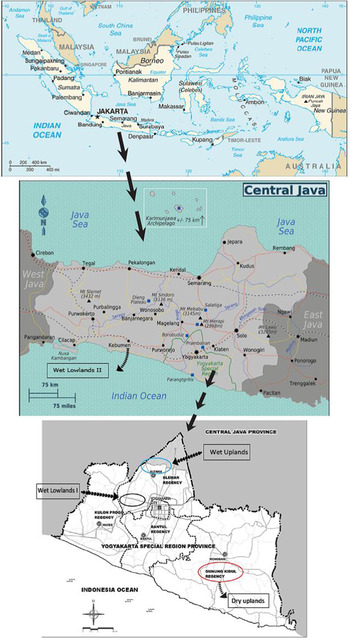
This study was conducted in Yogyakarta and Central Java Provinces, situated in the southern part of Central Java (Figure 1). Both provinces have large cattle numbers.
Map of Indonesia, Central Java and Yogyakarta Province (Source: Anonymous, 2007 and Pemda-DIY, 2005, cited by Budisatria, Reference Budisatria2006).

The study areas represented two agro-ecological zones, the lowlands and the uplands, with different rainfall patterns: Wet lowlands, Wet uplands and Dry uplands. Wet lowlands are found at less than 100 m above sea level (asl) and their annual rainfall ranges from 2 400 to 3 000 mm (BPS, 2009). Lowlands have fertile soils and are characterized by irrigated farming systems with paddy and maize as the main crops. Wet uplands are defined as areas above 500 m asl with annual rainfall ranging from 3 000 to 3 600 mm (BPS, 2009). This zone has fertile soils and is characterized by both irrigated and rain-fed farming systems, with paddy fields, horticulture and forest. Dry uplands are also situated above 500 m asl but have less fertile soils and low annual rainfall: 1 800–2 400 mm (BPS, 2009). This zone is characterized by rain-fed farming systems with cassava and dry land paddy as the main crops.
There are two rainfall seasons over the year. The wet season usually begins in September and lasts until about April. No grazing areas are available, as all land is used for cropping. The types of forages used include improved grasses, such as Napier and Elephant grasses, rice straw, maize straw, many kinds of tree leaves, cassava leaves and tree legumes. Native forages, such as weeds and grasses, are collected from farmers’ own fields and backyards, roadsides, riversides and forest edges. During the dry season, when forage sources are limited, farmers buy forages from other areas. The Dry uplands are relatively far away from the input markets, approximately 60 km, 1.5 h by truck.
For this study, Wet lowlands were divided into two areas, namely Wet lowlands I and II (Figure 1). In Wet lowlands I, located in Yogyakarta Province, crossbreeding is broadly applied in contrast to Wet lowlands II, located in Central Java, where crossbreeding is practiced less frequently. In this area, the local government allocated different locations for maintaining Ongole and for crossbreeding in order to maintain the Ongole in this zone, which is an original Ongole breeding area from colonial times onwards. In each zone, the farmers could be divided into Ongole and crossbred farmers, based on the breed of cattle they kept as breeding stock.
Before 1990, mostly Ongole cows were used for breeding; they were inseminated with Simmental or Limousin semen which resulted in F1 Simmental or Limousin crossbreds. From 1990 onwards the majority of F1 and F2 cows were inseminated using Simmental or Limousin semen, which resulted in F2 and F3 Simmental and Limousin crossbreds. Consequently, the number of Ongole cattle has been sharply decreasing since 1990 (Widi et al., Reference Widi, Yuwanta, Agus and Pertiwiningrum2008).
Data collection
Secondary data collection
Secondary data related to geographical situation of study areas, cattle population, distribution of semen and local implementation of national and local policies were collected from The Agricultural Department of Indonesia, Animal Husbandry Office of Yogyakarta Province and Central Java Province, government websites, publications and reports from institutes. Secondary data provided insight in the recent local situations.
Focus group discussions (FGDs) and farmers’ interviews
Participatory approaches started by conducting FGDs amongst farmers and the key persons such as head of farmers’ group and village elders in each area. The purpose of the FGDs was to introduce the study and identify the issues regarding the local and crossbred cattle keeping. In total 296 participants (60 in Wet lowlands I, 86 in Wet lowlands II, 65 in Wet uplands and 85 in Dry uplands) were randomly selected and involved in the FGDs.
The issues which were obtained in the FGDs were used for making a checklist for guidance of semi structured interviews for the farmers. In total 252 farmers from 296 FGDs’ participants in the four study areas (56 farmers in Wet lowlands I; 63 farmers in Wet lowlands II; 59 farmers in Wet uplands and 74 farmers in Dry uplands) were purposively selected. The farmers had an experience of minimum 10 years in keeping their own herd of cattle. Most farmer respondents were men, only four of them were women, widows. Men are doing all of the management activities of large animals, such as cattle and buffaloes, while women are responsible for smaller animals, such as chickens, goats and sheep. The 252 farmers were interviewed individually about their background, technical aspects, their motivations for keeping animals and reasons to choose Ongole or crossbred cattle as breeding stock. Household members contributed to recall information during the interviews. These data were collected during the first farm visit in the period July–November 2009.
Phenotypic characteristics of Ongole and crossbred cattle
Each animal on all 252 farms was characterized by observing the body, face, nose, leg, tails’ hair and vulva colours; existence of dewlap, backline and hump; shape of horns and the thickness of body and heads’ hairs. Ongole and crossbred cattle were distinguished based on these characteristics, using a checklist (Maule, Reference Maule1990; Porter, Reference Porter1991; Supiyono, 1998; Sumadi et al., Reference Sumadi and Purnoatmojo2003; Triyono, 2003; Widayanti, Reference Widayanti2008) with specific conformation traits, and on information from the farmer on breeding background of the animal concerned.
Quantitative phenotypic characteristics of 294 female cattle of the 252 farms were collected by taking length of the body (LB), girth of chest (GC), height at withers (HW), height at hip (HH), head index (HI) and estimation of body weight (BWe), using a measurement tape with cm and the transformation of chest girth in cm into weight in kg (developed by FHK Ogawa Seki Co. Ltd, Tokyo, Japan), over the period January 2010 to July 2011. Body condition score (BCS) was visually assessed (Ferguson et al., 1994 cited by Lassen et al., Reference Lassen, Hansen, Sorensen and Aamand2003). The age of each animal (in years) was determined by inspecting its teeth (Widi et al., Reference Widi, Udo, Oldenbroek, Budisatria, Baliarti and van der Zijpp2014). Similar measurements were done for calves (n = 127) at weaning and at approximately 11 months of age. Eleven months of age was chosen because most calves are sold before they reach the age of 1 year.
Feeding practices
Many different feeds were offered. The feeds were categorized in fresh forages, dry forages and supplementary feeds. The proportions of the different fresh forages were estimated by separating the fresh forages again in its components. Feed inputs were calculated based on farmers’ estimates and direct observation on kinds and amounts of feeds offered to each individual adult animal, over 1 year (January 2011–January 2012). The estimations of kind and amount of fresh and dry forages offered were recorded by farmers every day. Enumerators checked the farm recording once a month. Dry forages and supplementary feeds that were bought were estimated from the amounts bought. These estimates were translated into kg dry matter (DM) and crude protein (CP) intake per animal, applying the feed composition tables for feeds available in Central Java of Hartadi, Soedomo and Tillman (Reference Hartadi, Soedomo and Tillman2005).
Reproductive performances
Reproductive data were collected over the period January 2010 to July 2011. This recording was done by farmers, guided and assisted by enumerators (n = 8) at the start of the monitoring period. Enumerators visited the farmers every month to collect and check the recorded information. Reproductive performances determined were days to postpartum estrus (PPE) days to postpartum mating (PPM), services per conception (S/C), calving interval (CI), weaning age and calf crop. CI estimates were based on calving dates of animals with two calvings in the reporting period or on calving date in the reporting period and a previous calving from before the recording started derived from recall information. Calf crop per study area was calculated as follows:
 $$\eqalign{& \hbox{Calf crop in each study area} = \cr & \quad \displaystyle{{\sum \hbox{calves born}} - {\sum {\rm pre} - \hbox{weaning calves died}} \over {\sum {\rm cows}}} \times (365/{\rm CI}).}$$
The reproductive performances of 114 Ongole and 156 crossbred cows were recorded. Cows were defined as female cattle that had calved at least once. The farmers observed and recorded the reproduction cycle of their cows over a period of 1.5 years. Farmers in all study areas have relatively similar knowledge on reproductive management. They obtained it through information sharing amongst farmers, farmers’ community groups and formal training from the local extension officer. Farmers do not routinely record reproductive information. For this survey, we asked farmers to fill in a recording sheet for the reproductive data of their cattle. They were explained beforehand and enumerators visited them every month to assist them in recording the reproductive activities. Information on age at first estrus and calving (if available) were also collected by recall. The number of infertile female cattle was very small, not more than 2 percent. Farmers immediately sold infertile heifers and the cows which are failing to have a next calving (S/C > 5). Artificial insemination is applied in all the study areas, particularly to crossbred cows.
Carcass characteristics of Ongole and crossbred cattle
We visited the biggest slaughter house in Yogyakarta, and measured the slaughter cattle belonging to two butchers over a period of 15 days. Carcass weight and meat bone ratio (MBR) were measured on 55 cattle (13 Ongole, 29 Simmental cross and 13 Limousin cross animals). They consisted of 14 female and 41 male cattle. The scales used to weigh the cattle and carcasses had an accuracy of 1 kg and the scale used to weigh the meat had an accuracy of 20 g.
Gross margins analysis
Farmers recorded the inputs and outputs of their cattle over a period of 1.5 year (January 2011–July 2012). Enumerators (n = 8) visited the farmers every month to collect and check the recorded information. This particular period was representative of an average period in terms of rainfall and perceptions of farmers that the revenues from their cattle covered their financial requirements. Only 184 of the 252 farmers sold cattle during the monitoring period. Most farmers used only family labour, only few farmers (n = 20) used hired labour, either regularly or on an ad hoc basis.
The Gross Margins (GM) analysis was done for each farm for the reporting period. It was based on financial revenues minus variable costs. Procedures in the GM calculations included:
-
– Fresh forage costs comprising cultivated grasses and maize foliage bought from forage sellers in the livestock markets or alongside roads.
-
– Dry forage costs comprising rice and maize straws bought from dry forage sellers or collected from the fields and loaded on trucks, involving costs for the fuel, or hiring the trucks and drivers.
-
– Supplementary feeds costs comprising concentrates, rice bran, cassava meal, cassava, tofu (soybean curd) waste and soybean hulls bought from poultry shops, markets and soy-processing factories.
-
– Costs for veterinary services and medicines.
-
– Costs for artificial insemination or mating services.
-
– Hired labour costs.
-
– Feeds collected by farmers from communal sources (road sides, forests, communal lands) and transported on the back of farmers or on bicycles were not valued.
-
– Revenues of cattle sales; local traders buy the cattle and bring these to cattle markets.
-
– Revenues from the sale of manure; manure in the form of compost is sold to horticulture farmers, ornamental plants farmers, producers of organic fertilizer, or plantations.
-
– Opportunity value of manure used for crops was not included.
-
– Actual farm gate prices were used for accounting in IDR (Indonesian Rupiah; US$ 1 = 9 200 IDR in 2011).
Data analysis
The qualitative data were analysed descriptively. Ranking was used to determine the level of agreement of farmers’ motivations for keeping cattle. Frequency distribution was used to analyse the reasons of the farmers in choosing Ongole or crossbred breeding stock. The quantitative data were analysed using analysis of variance (ANOVA) with breed nested within areas (Ott and Longnecker, Reference Ott and Longnecker2010). The model was simplified to compare breeds within areas, because for most parameters no interaction was found between breed and area.
Results and discussion
Phenotypic characteristics of Ongole and crossbred cattle
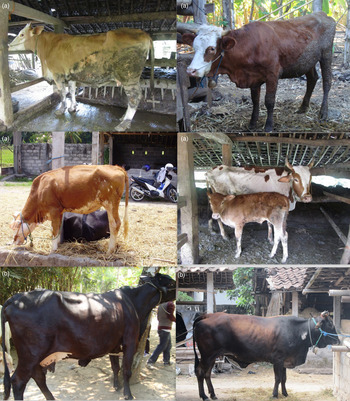
By observing the phenotypic characteristics in the study areas, the cattle were identified as Ongole or crossbred, while the crossbred cattle were Simmental or Limousin crosses. The diversity in phenotypic characteristics of crossbred cattle is presented in Figure 2. There was not sufficient information to distinguish subsequent crossbred generations, since there is no pedigree recording system kept by farmers nor inseminators. Farmers could also not distinguish subsequent crossbred generations; they purchased their animals from the market or middle men without any pedigree information.
Diversity of phenotypic characteristics of crossbred cattle in the study areas. Code ‘A’ is for Simmental cross and ‘B’ is for Limousin cross.

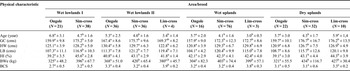
Body sizes of female Ongole and crossbred cattle older than 2.5 years, which most of them were cows, in the four areas are presented in Table 2. Simmental crossbred female cattle in all areas were significantly bigger and higher than female Ongole cattle (P < 0.05). The height and weight estimates for the Limousin crossbred females did not differ from the Simmental crossbreds.
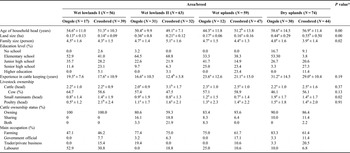
Characteristics of Ongole and crossbred households in the four study areas, established in July–November 2009.

a,bDifferent superscripts indicate significant differences among breeds within areas (P < 0.05).
*P value among areas.
Physical characteristics (Mean ± s.d.) of female Ongole and crossbred cattle with minimum age 2.5 years in four areas in Central Java.

Sim-cross, Simmental cross; Lim-cross, Limousin cross; CG, girth of chest; HW, height at the withers; LB, length of the body; HI, head index, is calculated by dividing length of head from the width of head in percentage; BCS, body condition score, is visual assessment of body tissues (Ferguson et al., 1994 cited by Lassen et al., Reference Lassen, Hansen, Sorensen and Aamand2003). The range is 1–5, where 1 is the lowest and 5 is the highest (Baliarti, Reference Baliarti1999); BWe, body weight estimation.
a,b,cDifferent superscripts indicate significant differences among breeds within the same area (P < 0.05).
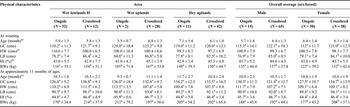
Body sizes of calves at weaning (approximately at 7 months of age) and at approximately 11 months of age in the study areas are presented in Table 3. Weaned crossbred male calves were 16 percent heavier than Ongole male calves, for female calves this figure was 24 percent. These differences were significant (P < 0.05). At 11 months of age crossbred males were only 2 percent heavier than Ongole males, for females this difference was 18 percent (P < 0.05). The number of Ongole calves (n = 1) in Wet lowlands I was not sufficient for testing of differences between breed types.
Physical characteristics (Mean ± s.d.) of progeny at weaning and at about 11 months of age of Ongole and crossbred cows in three study areas in Central Java.

CG, girth of chest; HW, height at the withers; LB, length of the body; HI, head index, is calculated by dividing length of head from the width of head in percentage; BWe, body weight estimation.
a,bDifferent superscripts indicate significant differences among breeds within the same area and in all areas (P < 0.05).
nsnon-significant.
Body condition scores of Ongole cows were lower (P < 0.05) than those of crossbred cows in the Wet lowlands I, indicating that crossbred cows may have been fed better than Ongole cows in this area. Overall, the body condition scores indicated that cows were in a good body condition (2.7–3.9 in the BCS range of 1–5).
Livestock farming systems and motivations of keeping cattle
Table 1 gives household and farm characteristics for the livestock farming systems in the four study areas. The land sizes of the farms in Dry uplands were significantly larger than in the other areas, but most of this land is infertile. Crossbred farmers had significantly more (crop) land than Ongole farmers in the Dry uplands (0.6 versus 0.4 ha), but in the other areas the farms sizes were the same for both farm types. Farmers had on average 21 years’ experience in cattle keeping. The experience in cattle keeping was not different between Ongole and crossbred farms within the areas, except in Wet lowlands II where the crossbred farmers had 4 years less experience in cattle keeping than Ongole farmers. Experience in cattle keeping differed significantly between the areas with the longest experience in keeping cattle in the Dry uplands; farmers in this area were also slightly older (58 years) than in other areas (50 years). However, no differences (P < 0.05) were found in uptake of crossbreeding in relation to experience of cattle keeping. Cattle are the main livestock. Goats, sheep and chickens are of secondary importance. The herd sizes of Ongole (2.0–2.5 head) and crossbred (2.2–3.2 head) farms were the same in the areas, except in Wet lowlands II where crossbred farmers had significantly (P < 0.05) more cattle (3.2) than Ongole farmers (2.0). Education level only seemed to have affected uptake of crossbreeding (P < 0.05) in the Dry uplands (Table 1). On average, more than 50 percent of the cattle were cows. About 10 percent of farmers were sharing cattle (sharing implies the cattle on the farms were owned by other parties; the benefits are shared by mutual agreement); only in Wet lowlands I, no sharing took place (Table 1). There was no difference between Ongole and crossbred farms in the proportion of farmers sharing cattle with owners within the areas. In Wet lowlands I, less than 50 percent of farmers had farming as their main occupation. Many were labourers (53 percent for Ongole farmers and 31 percent for crossbred farmers, since the access to employment in the capital city, Yogyakarta, is near. In the other areas, the percentage of farming as main occupation varied from 61 to 83. However, the percentage distribution between Ongole and crossbred farms was not significantly different within areas (P < 0.05). It could be speculated that the relatively low body condition scores of Ongole cattle in Wet lowlands I may be the result of the fact that many of the farmers working as labourer could pay less attention to their cattle than fulltime farmers.
Most of the Ongole cattle were cows. In the Dry uplands and Wet lowlands II area also a substantial number of Ongole calves were kept. Wet lowlands II is an area with specific Ongole breeding tracts. In Wet lowlands I and Wet uplands, there were very few Ongole calves. This indicates that farmers who were still keeping Ongole cows, in these two areas, had their cows inseminated with exotic semen.
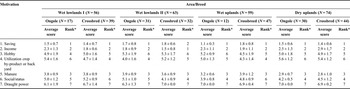
As in other areas in Indonesia, in Central Java cattle keeping serves various objectives. Both Ongole and crossbred farmers reported that capital savings, additional income and manure were the main motivations for keeping cattle (Table 4). Farmers consider security (capital savings) as being able to sell cattle to meet unexpected or large expenditures, such as sending children to school, financing a wedding or circumcision party, or buying a motorcycle. They consider income as the cash they receive relatively regularly from the sale of progeny (weaners). Most farmers considered manure the third important motive for keeping cattle. As with farmers in other areas in Java, farmers in the four study areas depend on livestock manure to fertilize soils. It is also common in Java that farmers sell excess manure to horticulture and ornamental plants farmers, producers of organic fertilizer, or plantations. Draught power was the least important motivation in all areas and for all types of cattle. Nowadays farmers use hand tractors to plough their land.
Farmer's ranking motivations for keeping cattle in four study areas in Central Java.

*Rank = the smallest score of rank (1) means the most important motivation and the highest score of rank (7) means the least important motivation.
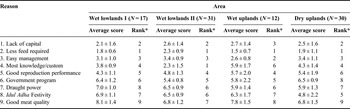
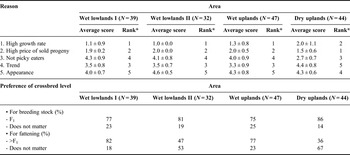
Tables 5 and 6 show the reasons of farmers to choose Ongole or crossbred cattle as their main breeding stock. The most frequent reasons for choosing local Ongole cattle were lack of capital, less feed required, easy management and most knowledge/custom. While the most frequent reasons for choosing crossbreds were big body size and the high prices when progeny were sold. In general, farmers keep only one or two cows. When farmers have enough money to purchase a crossbred animal, they tend to replace an Ongole cow by a crossbred cow. The Simmental crossbred is preferred because of its nice appearance, the shiny red coat and rectangle head shape (Sutresniwati, 2006). Crossbred farmers (75–86 percent) preferred F 1 cows; the preference for specific crossbred generation for young animals was less pronounced (Table 6).
Farmer's reasons to choose Ongole cattle in four study areas in Central Java.

* Rank = the smallest score of rank (1) means the highest priority and the highest score of rank (9) means the lowest priority.
Farmer's reasons to choose crossbred cattle and preferences of crossbred level in four study areas in Central Java.

* Rank = the smallest score of rank (1) means the highest priority and the highest score of rank (5) means the lowest priority.
Feeding
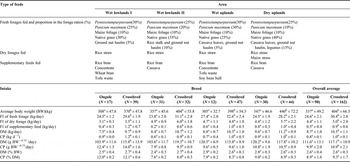
All farms used stall-feeding. The feed types, the fresh feed intakes, and DM and CP intake estimates of Ongole and crossbred cattle are shown in Table 7. In most cases, the forage collected by farmers was a mixture, rather than a single type. The majority of the feeds offered were the locally available forages. The proportion of the forages in a ration varied between the areas, reflecting the different cropping patterns. In the Dry uplands, proportion of native grass in the forage ration was about 40 percent, while in other study areas this was lower (25–30 percent). Cassava leaves, ground nut haulm and legumes were offered more frequently in this area, compared with other areas. The maize foliage in Dry uplands came partly from outside this area. Rice bran was the most common supplementary feed in all study areas. Tofu waste and compound concentrates were supplementary feeds fed in Wet lowlands I and Wet uplands. In Wet lowlands II and Dry uplands, farmers offered cassava to their cattle as supplementary feed. Cassava is more abundant in Dry uplands.
Feeding practices, feed intake (FI), DM and CP intake (in kg/day and g BW−0.75 /day) (Mean ± s.d.) for Ongole and crossbreds cows in four study areas in Central Java.

a,bDifferent superscripts indicate significant differences between breeds within areas (P < 0.05).
Crossbred cattle were fed more (P < 0.05) in terms of DM, on average, 10.5 versus 8.7 kg DM per day for Ongole cattle. Overall, the estimates of DM and CP offered per kg metabolic body weight of crossbred cattle were significantly higher than for Ongole cows. So, in general farmers were able to collect extra forages and buy extra supplementary feed for the crossbred stock. Both Ongole and crossbred cows consumed DM at 2.6 percent of their body weight. Ongole and Crossbred cows consumed CP 8.9 and 9.3 percent of DM, respectively. Feeding guidelines for beef cattle (both Ongole and crossbred) show that DM and CP requirements for maintenance are 2.5–3 percent of body weight (Tillman et al., Reference Tillman, Hartadi, Reksohadiprodjo, Prawirokusumo and Lebdosoekojo1998) and 9.76 percent of DM (NRC, 1996). So, the current feeding levels are in the range of the maintenance requirements.
Reproductive performances
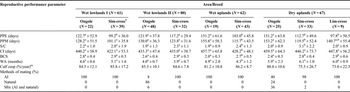
Table 8 presents the reproductive performances of Ongole and crossbred cows in the four study areas. In the Wet and Dry uplands, Simmental and Limousin crossbred cows expressed PPE significantly earlier than Ongole cows. In the other two areas, Simmental and Limousin crossbred cows also expressed PPE earlier than local cows, but these differences were not significant. Farmers usually had their cows inseminated immediately after PPE was expressed. In the Wet and Dry upland areas the S/C of Ongole cows were relatively fewer than those of crossbred cows. In Wet lowlands II and Dry uplands, natural mating was used, in particular for Ongole cows (86 and 24 percent). Ongole cows expressed PPE later than Simmental cross herd mates. This resulted in longer CI in Ongole cows than in Simmental cross cows in the Wet uplands area. Overall, CI of Ongole cows was 448 days and of crossbred cows 436 days. In the end, the estimates for calf crops of Ongole and crossbred cows were the same in all areas: 81–85 percent for Ongole farms and 73–86 percent for crossbred farms. Both Ongole and crossbred cows performed well compared with, e.g. Bali cattle in Bali and Nusa Tenggara Provinces which had an estimated calf crop of 47 percent (Bamualim and Wirahayati, Reference Bamualim, Wirahayati, Entwistle and Lindsay2002; Toilehere, Reference Toilehere, Entwistle and Lindsay2002).
Reproductive performances (Mean ± s.d.) of Ongole and crossbred cows in four study areas in Central Java, over the period January 2010–July 2011.

Sim-cross, Simmental cross; Lim-cross, Limousin cross; PPE, post-partum estrus; PPM, post-partum mating; S/C, services per conception; CI, calving interval; WA, weaning age; BCS, Body condition score, is visual assessment of body tissues (Ferguson et al., 1994 cited by Lassen et al., Reference Lassen, Hansen, Sorensen and Aamand2003). The range is 1–5, where 1 is the lowest and 5 is the highest (Baliarti, Reference Baliarti1999); AI, artificial insemination.
a,bDifferent superscripts indicate significant differences among breeds within the same area (P < 0.05).
nsnon-significant.
About one-third of crossbred farmers complained about repeat breeding (high number of S/C), mostly after the fourth or fifth calving. This is in agreement with the relatively higher S/C of crossbred cows. Purwo (personal communication, 2010) and Budiyanto (Reference Budiyanto2012) suggested that reproductive problems occur, in particular, in F2 and F3 generation cows. Farmers usually decide to sell the cows with these problems to middle men who sell these animals to local butchers as soon as possible, and buy a pregnant cow or heifer. The farmers complained also about silent heat, but this was not directly reflected in our reproduction data. In 2003, Hasbullah (Reference Hasbullah2003) found that 28 percent of Ongole and 38 percent of Simmental cross cows (most likely F2 and F3 cows) had repeat breeding problems.
The farmers reported that they usually sell the ‘good’ calves, as soon as possible after weaning, in order to obtain a high price with very few inputs. The farmers defined ‘good’ or ‘poor’ from body conformation and the visibility of ribs, which is also used to measure BCS. They want to avoid the risk of low growth rates in crossbred calves when they are not able to provide the calves good feed. Good weaned crossbred calves are bought by local traders who sell them to other farmers or commercial feedlot farmers.
Carcass characteristics of Ongole and crossbred cattle
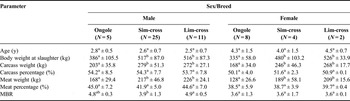
Table 9 presents the sex-specific carcass characteristics of Ongole and crossbred cattle. In the same sex, the ages of Ongole and crossbred cattle which were slaughtered in a slaughterhouse in Yogyakarta Province did not differ. Male cattle were slaughtered at younger ages compared with female cattle.
Quantity of carcass and meat and MBR (Mean ± s.d.) of slaughtered Ongole and crossbred cattle in Yogyakarta Province.

Sim-cross, Simmental cross; Lim-cross, Limousin cross.
a,bDifferent superscripts among breeds within the same sex indicate significant difference (P < 0.05).
At similar ages, in both males and females, the body weight at slaughter and total carcass and meat weights of Ongole cattle were significantly lower (P < 0.05) than those of their crossbred mates. However, carcass and meat percentages did not differ among breeds in the same sex. MBR was significantly higher in male Ongole and Limousin crosses than in Simmental crosses, while the MBR of female cattle was not different among breeds.
On average, the meat weights of crossbred cattle were 1.42 times higher compared to local cattle (Table 9). Local small-scale butchers said that slaughtering crossbred cattle is not always more profitable than slaughtering Ongole cattle. It depends on the condition of the cattle and how accurately they estimated the weight and the price of the cattle. In contrast, the feedlot and slaughterhouse companies prefer to slaughter crossbred cattle, because of their higher body weights which provide economies of scale in slaughtering processes.
Gross margins
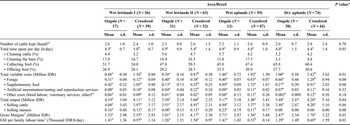
Table 10 shows the financial results of the cattle component of Ongole and crossbred farms over a period of 1.5 years. The biggest expenses of both Ongole and crossbred farmers were forages and supplementary feeds. No significant differences in GM were observed between local and crossbred farms within the same area. The GM of cattle, Ongole or crossbred, in the dry upland area was the lowest of the four areas, since total variable costs were the highest in this area due to higher costs for forages and supplementary feeds. The variation between farms in supplementary feeds used was large, see the large SDs (coefficient of variation 173 percent). Mainly during the dry season, the availability of forages is limited, especially in the Dry uplands area. About 6 years ago farmers in the Dry uplands still preferred local cattle because of the shortage of forages in the dry season (Sutresniwati, 2006). Currently, the infrastructure in this area, as well as in other areas, is improving and gives the farmers easy access to feed resources and cattle markets. Trade in forages that come from outside the local land-use systems, has become big business (Paryadi, personal communication, 2010). In the Dry uplands area, cassava meal is an opportunity to reduce feed costs, since it is abundant in this area. Currently, the demand for cassava meal is increasing to produce bio-ethanol (Suradal, personal communication, 2010). It remains to be seen what effect the reduced access to cassava meal will have on the GM in the Dry uplands area. During the dry season, farmers in the Dry uplands area sell some of their livestock to buy forages and additional feeds. The higher feed costs have negatively affected the GM compared to the wet areas, but the difference in the GM between crossbred and Ongole farms in the Dry uplands is negligible. Overall, GM per h of family labour input was significantly higher for Ongole farms than for crossbred farms (1 319 versus 880 IDR per h d−1).
Inputs, revenues and GM (in Million IDR) 1 of Ongole and crossbred cattle farms in four areas in Central Java for the period of January 2011–July 2012.

1 One US$ = 9 200 IDR.
2 GM (Million IDR) = Total output (Million IDR)−Total variable costs (Million IDR).
3 GM per family labour time, GM per day/total time spent per day (Thousand IDR).
a,bDifferent superscripts indicate significant differences between breeds within an area.
nsnon-significant.
*P value among areas.
Future of crossbreeding
Government started to promote crossbreeding in the 1980s in order to improve the meat production of Ongole cattle and the productivity of smallholder farmers (Deptan, 2003). Only exotic semen was provided; there was no assistance in terms of feeding and breeding management.
In the early years of crossbreeding crossbred animals fetched a much higher price than the meat value, as there was a big demand for crossbred breeding stock (Barwegen, Reference Barwegen and Henley2004; Sutresniwati, 2006). This gave a big boost to crossbreeding. When the importation of frozen meat and live cattle from Australia was high, however, the price of cattle, both local and crossbreds decreased. For example, during 2009–2011, the volume of imported frozen meat was high, and it was distributed to the wet market which depressed the sale price of cattle. Farmers were disappointed that the prices of crossbred cattle decreased more than of local cattle (40 percent vs 25 percent) (Suseno, personal communication, 2011). This was either due to their high price expectation or high initial price paid for crossbred cattle. Crossbreeding is now a routine practice and prices for both crossbred and local cattle are based on body weight estimates, being their actual meat value in the market.
Good fertility of the cows, high survival of calves and good quality weaned calves are very important for the farmers. The productivity of the herds can be expressed by combining the calf crop estimates with the weaning weight estimates. On average the Ongole farms produced 129 kg weaner weight per year, whereas the crossbred farms are more productive from this point of view: 154 kg weaner weight per year. Most farmers said they prefer crossbreds over Ongole, because of bigger body sizes and higher selling prices. Prices of crossbred weaners are in the range of approximately 5.0–7.5 million IDR, whereas Ongole weaners are sold for prices in the range of 3.5–4.5 million IDR. Most farmers do not consider the higher feed requirements of crossbreds (Table 10). The higher selling prices are much more tangible than the economic evaluation in terms of GM. So, crossbreeding will continue.
The crossbreeding of ‘beef’ cattle in smallholder mixed farms in Java confirms the general trend of crossbreeding in dairy type animals by smallholders in many different areas, that it is done rather un-controlled (Wollny, Reference Wollny2003). Systemic crossbreeding seems not possible, as there is no reliable pedigree information available and Simmental semen is used, irrespective of the crossbred generation type of the cows (Widi et al., Reference Widi, Yuwanta, Agus and Pertiwiningrum2008). Farmers in all zones said they do not prefer upgrading to very high levels of Simmental, as they expect poorer growth and less optimal reproductive performances of high levels of upgraded cattle. They are already satisfied with the performance of existing crossbred cattle. This implies that in future Ongole semen has to be used on higher grade crossbred animals. The local government has started a breeding initiative ‘Return to Ongole’. The main aim of this programme is to contribute to maintaining a viable Ongole population. In this programme farmers get a subsidy for every pregnant Ongole cow. This programme is only carried out in the Wet lowlands II and Dry uplands. The Return to Ongole breeding plan was set up in areas with a minimum Ongole productive cow population of 2000 head. The selection goal is growth rate from weaning to one year of age. The best yearling calves are transferred to a Performance Test Station from which the best bulls and cows are selected. This programme has resulted in an increasing demand for Ongole cattle.
In Indonesia meat production has increased from 399.7 tonnes in 2005 to 593.5 tonnes in 2013 (BPS, 2013). In the same period the total number of cattle has increased from 10.6 to 14.2 million (BPS, 2013). Crossbreeding has certainly contributed to the increase in meat production. In Central Java the majority of the cattle are already crossbreds. The productivity of crossbreds in terms of the productivity parameter weaned weight per farm is higher than in Ongole farms.
The assumption in literature that the introduction of more productive breeds will result in keeping fewer animals and so lessening the impact on the environment (Steinfeld et al., Reference Steinfeld, Gerber, Wassenaar, Castel, Rosales and de Haan2006; Marshall, Reference Marshall2014) is not confirmed by the cattle herd sizes in the smallholder mixed farming systems in Central Java. The herds at the farms have always been very small, crossbreeding will not change that situation. Farmers keep a specific number of animals in relation to their limited resources. There is no information of numbers of specific crossbreeding generations and Ongole cattle in Indonesia. Marshall (Reference Marshall2014) concludes that the impact of the introduction of new breed types on indigenous populations should be monitored by regular census. Such information is needed to support informed decision making on future (cross) breeding strategies. In Indonesia, census data on livestock numbers are available, however, unfortunately census data do not distinguish different breed or crossbred generation types.
Limitations of the impact analysis used
Marshall (Reference Marshall2014) suggests that strategic research is needed to assess the impact of different breed types from a range of viewpoints: household level, food and nutrition security at different scales and environmental sustainability. The present analysis of the impact of crossbred animals on smallholder cattle keeping in Central Java considers only farm level developments, such as animal performances, herd sizes, objectives of keeping cattle and financial results. These data helped to understand why crossbred farmers opt for crossbreds. Research at other levels is needed to complete the picture of the impact of crossbreeding. Our farm level data on animal weights and feed intakes might lack in accuracy, as detailed measurements are not possible on large numbers of animals in the field. The GM analysis only included the financial flows on the farms, the additional benefits of cattle in terms of manure use on own crop land and the security function of the cattle are not included. We expect no differences between the farm types in manure use, however the security function of crossbred cattle might be slightly higher than for Ongole, as estimates of this are generally based on financial value of the cattle kept and sold (Udo et al., Reference Udo, Aklilu, Phong, Bosma, Budisatria, Patil, Samdup and Bebe2011). So, crossbred cattle present a higher capital asset value than Ongole cattle.
Conclusions
In Indonesia, crossbreeding has become a common practise over a period of about 30 years. The question whether or not crossbreeding is beneficial for the mixed farming systems in Central Java can be looked at from farmers’ points of view and from national level point of view. The comparisons of households with Ongole and crossbred cattle in different agro-ecological zones in Central Java show that crossbreeding is not changing such farming systems: household and farm characteristics, and herd sizes and structures were not really different between farmers keeping Ongole or crossbred breeding stock. Crossbreeding has also not changed the basic motives of keeping cattle. The main motives for keeping cattle, either Ongole or crossbreds, were the capital asset function (saving), income and manure production. The reasons for choosing either type of breeding stock, however, differed: lack of feed and capital are reasons for not choosing crossbreds, whereas expectations of better growth and better selling prices trigger keeping crossbreds.
In all agro-ecological areas included in this study, the crossbreds reached considerably higher body weights and consequently fetched higher sale prices, but they also required more feed resulting in comparable GM for farmers with crossbred or Ongole breeding stock. So, crossbreeding is not bringing financial gains for the farmers. Nevertheless, in all study areas, farmers prefer Simmental crosses because of their nice appearance, high growth rate and high price of progeny sold compared to Ongole.
At national level crossbreeding is contributing to increased meat production. The amount of weaned weight per farm was 16.2 percent higher on crossbred farms than on Ongole farms. Hence, crossbreeding will continue in Indonesia, since farmers are satisfied with the performances of crossbred cattle, such as their higher body weights and consequently higher market prices across agro-ecological zones. Government bodies continue to promote crossbreeding, however, at the same time conservation of Ongole has started three years ago in its original breeding area and is supported by a structured breeding program. There is no breeding strategy to maintain current crossbred levels. A viable Ongole population is needed to reduce the risk of upgrading to too high levels of Simmental.
Acknowledgements
The first author was supported by a PhD grant from Directorate General of Higher Education, Department of Education, Republic Indonesia. The first author acknowledges the support of Universitas Gadjah Mada and Animal Production Systems Group, Wageningen University, The Netherlands, staff members of Livestock Bureaus in Yogyakarta and Central Java Provinces, and farmers in the four study areas. The first author also would like to thank the undergraduate students for their support and assistance in collecting the data. The comments of an anonymous reviewer were highly appreciated. Last but not least, the first author would like to thank to Dr William Thorpe for his valuable comments.
Statement of interest
The work reported in this manuscript is not being considered for scientific publication elsewhere. The authors declare that there are no conflicts of interest related to this manuscript.