



1. Introduction: child bilingualism and HL competence
Child bilingualism involves a variety of situations, a typical one appearing in the context of immigration, with children exposed to a language in their family, the heritage (HL) or weak language (wL1) (Kupisch, Reference Kupisch2013; Montrul, Reference Montrul2008), and to another language in the larger society, the strong, majority or societal language (sL1). Children who speak the heritage language may develop a competence, which especially in the phonological domain is different from the competence of that same language as the majority language. How different is the competence of a heritage speaker and that of a speaker of the dominant language? And in what areas are they distinct?
1.1. The acquisition of HL phonology
In research on bilingualism there used to be a generalized belief that simultaneous bilinguals, i.e., those bilinguals acquiring two languages from birth, become balanced bilinguals (see e.g., de Houwer, Reference de Houwer, Fletcher and MacWhinney1995; Meisel, Reference Meisel, Hyltenstam and Obler1989, Reference Meisel, Cenoz and Genesee2001, Reference Meisel, Bhatia and Ritchie2004). However, some findings of that research have led to questioning such expectations, as the phonological mastery of the two languages is not necessarily balanced, if one of the languages is only spoken at home (i.e., it is a heritage language), and the other language is the majority or societal language. The result obtained in such situations is that of speakers of a dominant and speakers of a non-dominant or weak language, whose production of the heritage (non-dominant or weak) language may involve some foreign accent. Kupisch, Barton, Hailer, Lein, Stangen and van de Weijer (Reference Kupisch, Barton, Hailer, Lein, Stangen and van de Weijer2014) found a global foreign accent in the weak language of adult German–Italian, Italian–German, German–French, and French–German simultaneous bilinguals, according to the judgment of native speakers of that language.Footnote 1
The assumption that simultaneous bilinguals would be balanced bilinguals was based on the CPH (critical period) or CAH (critical age) hypothesis (see e.g., Birdsong, Reference Birdsong1999; Lenneberg, Reference Lenneberg1967): From birth until a (non-defined) time point, language is acquired natively, in a complete manner; it is an L1. If exposure begins after that (non-defined) age, language is learned non-natively, in an incomplete manner. Especially in phonology, where L2 speech is often non-native-like or accented (Munro & Derwing, Reference Munro and Derwing1995), no special accent is expected characterizing L1, except for a regional accent. Findings in phonology have led to the conclusion that acquisition at an early age “is a necessary although not a sufficient requirement for nativelike or ultimate attainment,” i.e., for developing a complete L1 (Abrahamsson & Hyltenstam, Reference Abrahamsson and Hyltenstam2009, p. 290). Thus, simultaneity is not sufficient as a conditioning for complete, i.e., monolingual-like acquisition.
Although the age at which the CP ends has not been clearly agreed upon (at 3 years? at 5 years? even later on, i.e., at puberty?), we do observe various differences between the 2L1 of a bilingual and the same languages acquired by monolinguals. Thus, the question arises as to whether the acquisition of the HL will develop monolingual-like, as a second language, or as something else, and why. The crucial notion involved in this complex question is interaction between the languages of a bilingual, in the sense of how interaction works and whether it equally affects all linguistic structures.
1.2 A classical view on cross-language interaction types: delay, acceleration and transfer
Probably the best-known classification of cross-language interaction in the bilingual individual is that of Paradis and Genesee (Reference Paradis and Genesee1996), who proposed three manifestations of interaction in the domain of syntax: delay, acceleration and transfer. Since this proposal is quite familiar to scholars working on bilingualism, I only briefly refer to it and mention some recent research on bilingualism, inspired by their classification (see also Kehoe, this volume). According to Paradis and Genesee (Reference Paradis and Genesee1996, pp. 3–4), “delay involves the overall rate of acquisition”, in the sense that acquiring two languages might slow down the bilingual acquisition process. “Acceleration means that a certain property emerges in the grammar earlier than would be the norm in monolingual acquisition.” Finally, “transfer consists of the incorporation of a grammatical property into one language from the other”, and it “is most likely to occur if the child has reached a more advanced level of syntactic complexity in one language than in the other”. An example is given in Gawlitzek-Maiwald and Tracy (Reference Gawlitzek-Maiwald and Tracy1996) of a child who used German functional elements in English utterances, and was thus “pooling resources.”
Paradis and Genesee (Reference Paradis and Genesee1996) bring some syntactic bilingual data to bear, namely productions by three French–English bilinguals at ages 2;0, 2;6, and 3;0 (years;months) growing up in Montreal. The areas of research were finiteness, negation and pronominal subjects. For the children of their study they found no delay, acceleration or transfer. However, recent years have witnessed many studies showing various cases of interaction. Some studies of simultaneous bilingual acquisition have found delay (Flores & Barbosa, Reference Flores and Barbosa2014 on clitic placement in Portuguese heritage speakers) and other studies have found transfer (as e.g., Cuza & Frank, Reference Cuza and Frank2011 on transfer at the syntax-semantics interface; Müller, Reference Müller1998 on transfer being caused by ambiguous input). A case of acceleration is described in Kupisch (Reference Kupisch2007), according to which German–Italian bilingual children produce articles in German earlier than German monolingual children, due to the influence of Italian.
Patuto, Repetto and Müller (Reference Patuto, Repetto, Müller, Rinke and Kupisch2011) deal with delay and acceleration in syntax, delay involving a “linguistically less complex analysis” applied to both languages (Patuto et al., Reference Patuto, Repetto, Müller, Rinke and Kupisch2011, p. 231). Their empirical evidence stems from the simultaneous acquisition of German and Italian, as well as German and Spanish. Both, Italian and Spanish are null-subject languages, and if acquired simultaneously with German (not a null-subject language), the null-subject language undergoes influence from the non-null language. That is, bilingual children produce more pronominal subjects than monolingual Italian or monolingual Spanish children. Patuto et al. (Reference Patuto, Repetto, Müller, Rinke and Kupisch2011) further propose that “acceleration effects are visible in all bilingual children, regardless of language combination.” Their claim is exemplified by the bilingual acquisition of German finite verb placement. According to Clahsen (Reference Clahsen1990), monolingual German children (between 1;10 and 3;6) place finite verbs in a non-target-like clause-final position in 7%–20% of their finite utterances. The bilingual children in Patuto et al.’s study do not produce such a non-target-like behavior. Although acceleration has been shown to occur in bilingual acquisition, the expectation that it will occur in all bilingual situations has no empirical support.
The question posed by Paradis and Genesee (Reference Paradis and Genesee1996) with regard to syntax has also been asked in phonology, namely, are the same types of interaction – delay, acceleration and transfer – also found in phonology? For instance, Fabiano-Smith and Goldstein (Reference Fabiano-Smith and Goldstein2010) deal with interaction between English and Spanish in bilingual children aged 3;0 to 4;0. Results were based on various analyses of consonant inventories, where all three types of interaction (transfer, delay and acceleration) were found, although to different degrees. Transfer was limited to low-level phonetic properties. Delay (renamed “deceleration” in order to avoid negative associations)Footnote 2 appeared in so far as “overall consonant accuracy in Spanish was significantly higher in monolinguals than in bilinguals” (p. 173). They did not find acceleration in the sense of Paradis and Genesee (Reference Paradis and Genesee1996)’s notion, and argue for a modified version of the acceleration hypothesis, which in their view should still be applicable in case bilingual children's productions fall within the typical range of monolinguals. Obviously, such a hypothesis is not able to distinguish acceleration from regular monolingual acquisition.
Further cases of phonological interaction have been reported: e.g., delay in Kehoe (Reference Kehoe2002) on long vowels in German; acceleration in Lleó, Kuchenbrandt, Kehoe and Trujillo (Reference Lleó, Kuchenbrandt, Kehoe, Trujillo and Müller2003) on syllabic coda production in Spanish; transfer in Antoniou, Best, Tyler and Kross (Reference Antoniou, Best, Tyler and Kross2011) on VOT acquisition in English and Greek; phonetic transfer in Olson (Reference Olson2013) on language switching in English and Spanish. Smith and Peterson (Reference Smith and Peterson2012) found transfer of English final voicing of voiced obstruents into German final devoiced obstruents, strengthened by German orthographic representations, as e.g., <Tod> “death” vs. <tot> “dead”, which reflect the underlying voicing contrast in German. Summarizing, delay, acceleration and transfer have repeatedly been found in the phonological component of the grammar.
1.3 Redefining interaction types
Paradis and Genesee (Reference Paradis and Genesee1996)’s three types of interaction are adopted here in phonology, with some important modifications: delay and acceleration should not refer to the overall rate of acquisition, but be limited to the acquisition of a certain category or phenomenon, as compared to monolingual acquisition. Their definition of transfer as “the incorporation of a grammatical property into one language from the other” can be further maintained, but their observation that transfer “is most likely to occur if the child has reached a more advanced level of syntactic complexity in one language than in the other” is doubtful when considered in the light of the present study (see section 5.1).Footnote 3
1.4 Transfer as the strongest exponent of interaction
The various manifestations of interaction have different effects in the process of acquisition. On the one hand, early delay may be overcome; if that is the case, acquisition will take place as for monolinguals. Acceleration constitutes a temporary advantage, which at the end is counterbalanced, too. Thus, these two manifestations of interaction have effects that can be considered temporary, generally without long-lasting consequences. On the other hand, transfer is the clearest exponent of interaction, moving phenomena of one language into the other language, with long-lasting or even remaining effects, which appear in the non-dominant language and may be resistant to change later in life.
1.5 Incomplete Acquisition and Transfer
In the last ten years, one of the questions frequently posed in the domain of heritage language acquisition is whether heritage speakers acquire an incomplete competence of the HL or whether they operate under transfer. According to Rothman (Reference Rothman2007, p. 362), incomplete acquisition refers to “what was available [in the input] but simply not acquired.” The dichotomous perspective that gives rise to this issue is problematic, as these two conditions – incomplete acquisition and transfer – do not exclude each other and thus are not necessarily complementary, but can co-exist. That is, in phonology, one of the languages (often the societal language) exerts its influence onto the other language. The reason for this influence is that some aspect or some part of the HL grammar is missing, i.e., has not been acquired (yet), and transfer fills the gap. The dichotomy is also invalid, because missing knowledge may originate through attrition, too: according to Rothman (Reference Rothman2007, p. 362), attrition is “what was acquired and then lost.” In both cases, acquisition is incomplete at a certain point in time: in one case there may be unfilled gaps and in the other case knowledge might have been there, but for a limited time. Developmental data will be used to distinguish the two conditions.
2. Assimilation processes in Spanish
The present article has as its research focus two distinct phonological domains that differ in Spanish and German: spirantization of Spanish voiced stops to the previous segment, and assimilation of the Place of Articulation (PA) of coda nasals to the PA of a following obstruent. Both phenomena involve variable or complex categories that undergo phonological change or assimilation.Footnote 4
2.1 Spirantization of voiced stops
In Spanish spirantization consists in the alternation between two segments: a voiced stop and the corresponding approximant, both produced with a similar PA, i.e., labial, coronal or dorsal (see the examples in (2) below). Alternation between stops and fricatives (or approximants)Footnote 5 depends on the phonetic context, as shown in (1). There are several analyses of such a phenomenon, most of them taking the voiced stop as the underlying category (lenition), as in Harris (Reference Harris1984b); Martínez Gil (Reference Martínez-Gil, Herschensohn, Mallen and Zagona2001); Mascaró (Reference Mascaró, Aronoff and Oehrle1984, Reference Mascaró1991). Others do the opposite (fortition), namely, they postulate that approximants are the underlying segments, which are strengthened to voiced stops in prosodically strong positions, e.g., utterance initially (see Barlow, Reference Barlow2003; Lozano, Reference Lozano1979). For the purpose of exposition I adhere to the lenition analysis, and will not refer to the fortition analysis anymore.
(1)


The phenomenon described in (1) takes place obligatorily word internally and across words, within the clitic group.Footnote 6 Beyond such constituents, spirantization is not obligatory, although it is often applied up to the level of the intonation phrase (as in examples in (2) below). In traditional structural terms (structural phonology), voiced stops are seen as phonemes with two allophones, an approximant, and a voiced stop. Both are context-dependent, and thus constitute complex segmental categories. In standard generative phonology, spirantization was treated as a phonological process involving allophony. The examples in (2) show that after a vowel the approximant occurs; whereas after a nasal the stop occurs.
In German, there is hardly any spirantization of this type: only in fast and informal registers, there may sporadically be a certain variety – and/or individual-based tendency to spirantize the labial, as e.g., habe “have” produced as ha[b]e or ha[β]e, and the dorsal, as e.g., lege “(I) put” produced as le[ɡ]e or le[ɣ]e (Kohler, Reference Kohler1995, pp. 209–217). Wiese (Reference Wiese1996, pp. 206–207) describes another type of spirantization in German, g-spirantization, interacting with final devoicing, by which /ɡ/ occurs as a palatal fricative if preceded by /i/ and in final position, as e.g., in alternations like Köni[ç] ~ Köni[ɡ]e “king” / “kings” or weni[ç] ~ weni[ɡ]e “a little” (sg.) / “a few” (pl.) in “Modern Standard German”. Such a rule applies in a very limited context, and according to Wiese (Reference Wiese1996, p. 208) “it is not implausible to argue that it is a lexical rule, while final devoicing in German, is post-lexical”.Footnote 7 Spirantization in Spanish is post-lexical, too.
(2)
(3)


2.2 PA assimilation of nasals
Assimilation of the PA of coda nasals to the PA of the following onset obstruent in Spanish is also an obligatory phenomenon at the level of the word, as well as between words, at the level of the clitic group or the phonological phrase. Beyond that level and up to the intonation phrase the phenomenon appears frequently, but it is not obligatory (Harris, Reference Harris1982, Reference Harris, Aronoff and Oehrle1984a).
(4)

The three contrasting minimal pairs in (4) show that Spanish has three nasal phonemes, /m/, /n/ and /ɲ/. However, these phonemes are contrastive categories exclusively in onset position. In case the nasal is in coda position, it is produced with the same PA as the following obstruent, as shown in the examples in (5).
(5)

Structural Phonology based its analysis on the notion of the phoneme, and was confronted with unavoidable inconsistencies, as such an analysis imposed phonemic status to the three nasal segments −/m/, /n/ and /ɲ/− whereas e.g., [ɱ] in un faro [uɱ ˈfaɾo] “a light house” or [ŋ] in un gato [uŋ ˈɡato] “a cat” did not receive phonemic status, because they do not participate in contrasts like (4). Standard Generative Phonology posed as many allophones as PAs of obstruents can follow the nasal, and renounced the notion of the phoneme. Thus, the assimilation rule of Standard Generative Phonology formulated by Harris (Reference Harris1969) makes no distinction between phoneme and allophone, and says that a nasal segment shares the value (+ or −) with respect to the Place of Articulation (PA) features of an obstruent following the nasal, also in case nasal and obstruent are in separate words.
For German it is also generally argued that there are three nasal phonemes, as shown in (6) below, but the assimilation of a coda nasal PA is more restricted than in Spanish. Although assimilation is implemented within words, the most common pronunciation of clitic groups (or phonological phrases) like those in (7) is as presented there: maintaining the coronal place of articulation of /n/ without assimilating it, although some approximation of the PA of /n/ to the PA of the following onset can occasionally be heard especially ‟im schnellen Redetempo” or ‟mit abnehmender Formalität,” i.e., “in fast speech” or “with diminishing formality” (see Kohler, Reference Kohler1995, p. 215, and Wiese, Reference Wiese1996, pp. 218–220). In case of assimilation, the examples in (7) would be pronounced with the bilabial nasal [m] and/or the dorsal nasal [ŋ], respectively, instead of maintaining the coronal [n] in both cases.
(6) German nasal
/m/: rammen “to ram”
/n/: rannen “(they) flowed”
/ŋ/: Rangen “romps”
(7) Lack of assimilation in German
ein Bein [
n bn] “a leg”ein Kuss [
n kʊs] “a kiss”

2.3 Non-linear analysis of spreading phenomena
The last decades of the 20th century witnessed proposals of a great number of phonological constructs, e.g., the syllable, the foot, underspecification, rules of spreading, hierarchies of features, prosodic positions, etc. According to Non-Linear Phonology, target Spanish voiced obstruents do not need to be specified for the feature [continuant], because they get the specification [+cont] or [-cont] through spreading of [cont]. Rule (8) shows that the feature [cont] spreads from the previous segment to the right-hand-side segment, a voiced obstruent (Harris, Reference Harris1984b; Lleó & Rakow, Reference Lleó, Rakow, Cohen, McAlister, Rolstad and MacSwan2005; Mascaró, Reference Mascaró, Aronoff and Oehrle1984, Reference Mascaró1991). Rule (9) also spreads the PA features of consonants, but it does it in the opposite direction, from the consonant on the right to the nasal on the left (Harris, Reference Harris, Aronoff and Oehrle1984a).
(8)
(9)


For instance, the word vino “wine”, if preceded by the nasal consonant of the indefinite article, un “a”, is produced with an initial [-cont] bilabial consonant [b]: [umˈbino]. But if preceded by a vowel, as e.g., compro vino “(I) buy wine” it bears the specification [+cont] of the preceding vowel: [ˈkompɾoˈβino]. Spanish has voiceless fricatives, namely /f/, /θ/ and /x/ in its inventory, but no voiced fricatives or approximants (recall that [β], [ð] and [ɣ] are allophonic variants). However, given the presence of voiced fricatives in the inventory of German, e.g., /v/ vs. /f/, it is plausible to assume that (at least some) voiced obstruents must be specified for the feature [cont], as either [+cont] or [-cont], which makes them non-eligible for the application of spirantization (Lleó & Rakow, Reference Lleó, Rakow, Cohen, McAlister, Rolstad and MacSwan2005, p. 1367).
It has also been proposed for target Spanish that nasals in coda position do not need to be specified for Place of Articulation (PA) – labial [lab], coronal [cor] and dorsal [dor] – which allows them to assimilate to the PA of the following obstruent, i.e., their PA is context-dependent (Harris, Reference Harris, Aronoff and Oehrle1984a, Mascaró, Reference Mascaró1991). In target German, though, coda nasals are arguably specified as lab, cor or dor, which can prevent them from associating to the neighboring PAs. Such proposals are in the right direction, but they do not answer the question: Why would the child's lexicon specify [-cont] for manner and [cor] for place? Since stops are default sounds for manner and coronals are default sounds for place, these features do not need to be specified in the lexicon.
3. Bilingual acquisition of allophonic phenomena
There are only a few studies dealing with the bilingual acquisition of allophonic phenomena, like those just described in sections 2.1 and 2.2.
3.1 Studies of L1 bilingual acquisition: allophony, spirantization and PA assimilation
One of the first studies in the domain of allophony is Zampini (Reference Zampini, Hannahs and Young-Scholten1997), who focused on the L2 acquisition of Spanish spirantization by adult L1 speakers of English. Recently, Fabiano-Smith, Oglivie, Maiefski and Schertz (Reference Fabiano-Smith, Oglivie, Maiefski and Schertz2015) analyzed spirantization in Spanish–English bilingual children and found that “whereas monolingual Spanish children have a good command of spirants, bilinguals showed higher accuracy of the voiced stops as compared to the spirants” (Fabiano-Smith et al., Reference Fabiano-Smith, Oglivie, Maiefski and Schertz2015, p. 1). Similar findings were reported in Lleó and Rakow (Reference Lleó, Rakow, Cohen, McAlister, Rolstad and MacSwan2005) in relation to German--Spanish bilingual children.
Lleó and Rakow (Reference Lleó, Rakow, Mogharbel and Himstedt2006) dealt with the acquisition of allophony, resulting from assimilation of the PA of nasals to following obstruents, by Spanish monolinguals and by German–Spanish bilinguals. They found that the PA assimilation process began later than spirantization. This is understandable because such nasals have the prosodic status of codas, and codas are generally acquired later than onsets. Barlow (Reference Barlow2014) examined interaction in the production of /l/ in English and Spanish: English /l/ has two different allophones, depending on the position in the word, either in the initial onset, where it is mainly coronal, or in the final coda, where it is velarized. Spanish /l/ has only one phone, which is clearer than the English one (F2 is higher). There were three groups of participants: English monolinguals, early bilinguals (Spanish L1, exposed to English before 5 years old) and late bilinguals (Spanish L1, exposed to English after 6 years old). Spanish-to-English influence on /l/ was found for both bilingual groups, and English-to-Spanish influence on /l/ was only found for late bilinguals.
3.2 The present study
Aiming at analyzing the production of complex phenomena of Spanish, like the allophony of spirantization and of PA assimilation of nasals by German–Spanish simultaneous bilingual children, a detailed study of the acquisition of both processes was carried out.
Research questions
The similarities and especially the differences between the phonologies of German and Spanish suggest several research questions pertaining to the acquisition of spirantization and assimilation of nasals: (a) Is the acquisition of a heritage language phonology incomplete? (b) Does transfer occur between the phonologies of simultaneous bilingual children? (c) In case transfer occurs between certain phonological domains, is its occurrence and direction predictable? d) Does markedness of the alternating sounds play a role in transfer? Answers to these questions will be provided on the basis of Spanish bilingual data (see Table 1).
Five participant groups.

Data and participants
The data presented in this article stem from three German–Spanish simultaneous bilingual children (from 1;4 to 3;0) born and growing up in Hamburg (Germany) and from their counterparts, i.e., four ca. 3-year-old Spanish–German simultaneous bilingual children born and growing up in Madrid (Spain). Data from three monolingual Spanish and two monolingual German children between 1;4 and 3;0 years old served as control data. All data belong to projects focused on the acquisition of German and Spanish, especially on the acquisition of phonology by monolingual and bilingual children (see Lleó, Reference Lleó, Schmidt and Wörner2012). The bilingual children (here considered between 1;4 and 3;0 years old) were recorded while engaging in play situations and conversations with a research assistant from the project B3/E3, Prosodic constraints on the phonological and morphological development in bilingual language acquisition, from the Research Center on Multilingualism in Hamburg. Two teams, one Spanish- and one German-speaking team visited the bilingual children in Hamburg every two weeks up to age 3;0, and once a month thereafter. The (German) monolinguals in Hamburg were visited regularly by a German-speaking team, and the Spanish monolinguals in Madrid were visited about once a month by a Spanish-speaking researcher. Finally, the cross-sectional data from Madrid were elicited once or twice by a Spanish-speaking and a German-speaking research assistant, respectively. In general, recorded data were spontaneous or semi-spontaneous conversational data. Children's names have been substituted by alias names for ethical reasons.
Although some German data are considered as well, the focus of the study is on Spanish. In all cases the heritage language was spoken by the mother, who during the first years spent more time with the child, and the societal language was spoken by the father. As far as the variety of the language(s) spoken around the children, in general it was Standard Spanish from the Madrid area and Standard German from Northern Germany (both for monolinguals and bilinguals). One of the bilingual children, Nils, was exposed to the Chilean variety of his mother's Spanish.
We also considered the utterances of a group of fifteen bilingual 7-year-old children, who attended the Spanish complementary school, and were living in North Germany (either in Bremen or in Hamburg).Footnote 9 These children participated in a project that evaluated their competence of the HL Spanish in various areas of phonology and syntax. From the original group of 23 children, a selection was made based on strict criteria, only including in our study children who had been exposed to Spanish and German from birth, whose mother spoke Spanish as L1 and the father German; the children communicated in Spanish with the mother and in German with the father. No other language beside German and Spanish was being regularly used in the family.
With regard to the 7-year-old bilinguals we wanted to be able to compare their individual competence. For this purpose, images and illustrations were used for the elicitation tests, which lasted about half an hour per child. With regard to SES all children were from middle class, with parents who had all received some university education.
Data analysis
After recording the data, all child utterances were phonetically transcribed and the adults’ utterances directed to the interviewed child were orthographically transcribed. All data were entered into EXMARaLDA (see Wörner, Reference Wörner, Schmidt and Wörner2012). Regarding spirantization, percentages of spirants and percentages of voiced stops were calculated out of all putative sounds that should be produced as spirants or as voiced stops by the child (i.e., occurring as targets). Regarding assimilation of PA of coda nasals, the percentages of assimilated nasals out of all obligatorily assimilated ones were calculated as well, in order to be able to compare the two sets of data.
There is some difficulty with regard to counting assimilated nasals, namely, should coronals be counted, in spite of being the default PA (Paradis & Prunet, Reference Paradis and Prunet1991)? The sequence of a coronal nasal followed by a coronal obstruent does not necessarily involve assimilation, since the feature [cor] is considered the default value for PA. Nevertheless, we decided to count coronals, too, in order to be consistent with our general approach to counting, but when presenting the data in the sections devoted to PA assimilation, we focus on labial and dorsal assimilation, and do not refer to coronals.
4. Results
The five groups of children that participated in the study are shown in Table 1: (1) Spanish monolinguals living in Madrid, (2) German monolinguals living in Hamburg, as well as (3) German–Spanish bilinguals living in Hamburg, (4) Spanish–German bilinguals living in Madrid, and (5) 7-years-old German–Spanish bilinguals living in North Germany (Bremen or Hamburg). Table 2 illustrates the percentages of target-like spirantization and Table 3 the percentages of PA assimilation of nasals, produced by the same groups of children. The main purpose of these two tables (2 and 3) is to provide the reader with precise information about the amount of data used for analysis. Recall that ‘sL1’ means “strong first language” and ‘wL1’ means “weak first language”; ‘Sp.’ means “Spanish” and ‘Ge.’ means “German”.
Number and percentages of spirants and stops (tokens) for the first four groups of children, ages 1;4-3;0.

Number and mean percentages of PA assimilated coda nasals from the first four groups of children, ages 1;4-2;7, within words (PW) and beyond word boundaries (PPh).

4.1 Results on spirantization
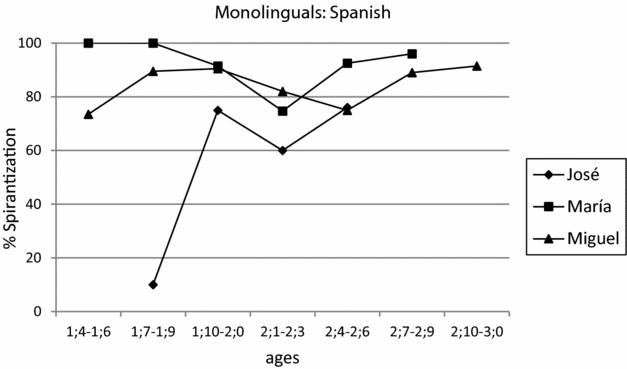
Table 2 presents raw numbers and percentages for all putative sounds that should be produced as spirants or as voiced stops, together with the numbers and percentages produced. Figure 1 and Figure 2 show the data longitudinally, grouped into 3-monthly mean percentages. There are some important differences between groups, which are presented in Figures 3a and 3b individually, for simultaneous bilinguals living in Germany (3a) vs. those living in Spain (3b).
Percentages of target-like spirantization by monolingual Spanish children José, María and Miguel, grouped three-monthly (between 1;4 and 3 years).
Percentages of target-like spirantization in Spanish by bilingual children, Jens, Nils and Simon, (between 1;4 and 3 years).

Percentages of target-like spirantization produced in Spanish by bilingual children from Hamburg (Jens, Nils, Simon) at 3 years.

Percentages of target-like spirantization produced in Spanish by bilingual children from Madrid: Adela (2;5), Elisa (3;1), Nando (3;1).

Spanish monolinguals
Table 2 and Figure 1 show that Spanish monolinguals produce very high percentages of target-like spirants: José 70%, María 90 %, and Miguel 84%. There is one child, José, whose initial values are lower for spirants (70%) and higher for stops (81%) than expected, but his percentages of spirants soon increase. Spanish monolinguals tend to produce, with the exception of José, few stops: José 81%, María 54%, and Miguel 63%. José’s preference for stops continues all along the span of the study, as his percentages of stops are always higher than those of the other children. In general, mean percentages of spirants by the Spanish monolingual children are very high. This is confirmed by looking at Figure 1, which shows the production of spirants from a developmental perspective. The three children follow very similar curves, with very high values. However, all three children show a slight decrease of spirants between 2;1 and 2;3, plausibly due to their being at organizing their phonological system.
When we turn to German we observe that the mean values for spirants are very low (Bernd has a mean of 10%, and Marion 8%). The percentages of voiced stops, though, are at ceiling in German: Bernd 99%, and Marion 100%.
German–Spanish bilinguals from Hamburg
If we now compare the group of Spanish monolinguals to the simultaneous bilingual children living in Hamburg (Table 2 and Figure 2), it is apparent that the bilinguals produce much lower percentages of spirants: Jens 46%, Nils 58%, and Simon 43%. Figure 2 adds the developmental perspective, which shows that at first the percentages of spirants produced by the bilinguals are comparable to those of monolinguals, but very soon they are reduced and become much lower than those of monolinguals. At about 2;0 and especially at 2;6 percentages drastically drop, and they do not increase again in the following months. However, the production of voiced stops in Spanish is very high in this group of bilinguals, with mean percentages of 88% (Jens), 93% (Simon), and a bit lower in the case of Nils (76%). These mean values for voiced stops are higher than those of Spanish monolinguals, as shown in Table 2.
The next step was to compare the degree of spirantization in German by these same bilingual children. It can be stated that there were hardly any spirants in German, with very low mean percentages (Jens 16%, Nils 6% and Simon 5%). On the other hand, their mean percentages of target-like voiced stops in German were at ceiling (Jens 95%, Nils 96% and Simon 96%), resembling the monolingual German values.
Bilinguals from Madrid compared to bilinguals from Hamburg
Having found an important difference between the monolinguals and bilinguals in Spanish, but not in German, we went on to determine the role of the societal language, i.e., we compared the values obtained for the bilingual group living in Hamburg with those of a group of bilinguals growing up in Madrid as their counter-point. Figure 3a shows the percentages of target-like spirantization produced by the bilingual children from Hamburg, Jens, Nils and Simon at age 3, and Figure 3b shows the percentages of assimilation by a group of bilingual children at about the same age (Adela [2;5], Elisa [3;1] and Nando [3;1]) from Madrid.Footnote 10 Whereas the former group has a target-like production in less than 30% of the cases at age 3, the latter group has a target-like production in more than 80% of the cases at that age. Note that the data recorded in Spain are cross-sectional, as we only recorded the children once or twice. Also note that these two figures only report on labial and coronal segments, which were the most frequent spirants. The comparison of target-like spirantization percentages produced by bilinguals from Hamburg with those from Madrid results in very different values.
The Spanish values of those bilinguals living in Spain closely resemble the Spanish monolingual values: Otilia 100%, Nando 84%, Elisa 75%, and a comparably lower value in the case of Adela (53%). The crucial difference between the two groups lies in the fact that the ambient language is a different one: in Spain, Spanish is the strong language; whereas, in Germany, Spanish is the weak language, not supported by the larger society outside of home. Note that the contrast between the Spanish of those bilinguals living in Spain or in Germany is fully visible in the figures showing percentages at a point in time rather than in the tables showing mean percentages for a long span of time (from 1;4 to 3;0).
Results of spirantization for German–Spanish bilinguals at age 7
Regarding the utterances of the bilingual 7-year-old children from North Germany, their data is presented in Table 4. The table shows that some children have high percentages of target-like production of spirants (AL, LG, and SB), but other children (CW, LW, and TR) still have very low percentages. Thus, there is individual variation, but for most children, there is still a long way to go, in order to arrive at a monolingual-like command of spirantization.
Spirantization and PA of nasal assimilation (%) for each of fifteen German-Spanish bilingual 7-year-old children from Bremen (JB, SB, TR, TIK, TOK, PW, EW, ND, AL) or Hamburg (CW, LW, LG, VA, JP, JC), attending the Spanish complementary school.

Summarizing, monolinguals and bilinguals growing up in Spain produce high percentages of spirants, and low percentages of voiced stops. Bilinguals growing up in Germany produce many stops and few spirants at age 3. In the older group (15 children at 7 years of age), there is much individual variation: percentages of spirants vary a lot from child to child.
Statistical evaluation of the spirantization data
These results are quite transparent and clear-cut. However, the number of participants is rather limited in this type of study, given the great effort and cost required by such projects, especially longitudinal ones. With the aim of making findings more robust, the data were put through some statistical tests. Two-paired and one-paired t-tests were conducted on the mean percentages of a selection of the spirantization data.
A two-tailed t-test conducted on the mean percentages of spirants in Spanish at age 3 by monolinguals vs. spirants by the bilinguals from Hamburg revealed that differences between the two groups were significant (p = .02229). One- and two-tailed t-tests conducted on Spanish vs. German voiced stops produced by monolinguals and bilinguals revealed significant differences (two-tailed, p = .01914 and one-tailed, p = .00957). A tendency towards statistical significance was found in the one-tailed t-test conducted on the mean percentages of spirants produced by the Hamburg bilinguals vs. those produced by the Madrid bilinguals (p = .05133).
4.2. Results on the PA assimilation of nasals
Table 3 shows raw data and percentages of assimilated nasals, either in the word domain – marked by “PW” – or in the domain of the phonological or prosodic phrase – marked by “PPh” on the first line of the table, too. The data presented in Figures 4a and 4b have been divided into percentages for labials (black columns) and percentages for dorsals (grey columns).
Percentages of target-like PA assimilation produced in Spanish by bilingual children from Hamburg (age 3;0).

Percentages of target-like PA assimilation produced in Spanish by bilingual children from Madrid (age 3;0).

Spanish of monolinguals
Table 3 shows for the monolingual Spanish children (José and Miguel) that the mean percentages of target-like assimilation of PA of nasals to the following obstruent are very high: the values are between 81% for José and 100% for Miguel in the word domain (PW), and beyond word boundaries (PPh), José produces 92% of assimilation and Miguel 89%.
German–Spanish bilinguals from Hamburg
Figure 4a shows the percentages of assimilation by the three bilingual children from Hamburg (Jens, Nils and Simon) at age 3. Only Jens shows some percentages of assimilation, 40% for labials, and 80% for dorsals.
The other two children, Nils and Simon, did not assimilate any of the nasals, which were produced with coronal PA. Thus, PA assimilation of nasals is rare among the bilinguals from Hamburg. According to Table 3, which shows assimilation in the PW and in the PPh domains separately, beyond word boundaries the two bilingual children from Hamburg had values lower than the monolinguals (Jens 68% and Simon 53%). Although in Figure 4a Jens showed an initial high value for dorsals (80%), this only involved assimilation within words (e.g., cinco [θiŋko] “five” or pongo [poŋɡo] “(I) put”); he did not show any case of assimilation beyond word boundaries. In sum, in the case of Simon and Nils, there was no assimilation at 3;0, as shown in Figure (4a), but there was assimilation in the case of Jens, within the PW domain. If we consider Jens and Simon's mean percentages, along the ages of 1;4 to 2;7, as shown in Table 3, the differences between the PW and the PPh domains are visible. In the word domain, values are higher (Jens 78% and Simon 92%) than in the PPh domain (Jens 68% and Simon 53%).
Spanish–German bilinguals from Madrid
Figure 4b shows the percentages for Spanish bilinguals (Adela, Elisa and Nando) living in Madrid. The values of these bilingual children are similar to those of Spanish monolinguals, also growing up in Madrid (Table 3), in the sense that most of them reach ceiling. This is the case for both children in the PW domain and for Adela in the PPh domain, as well. Nando reaches 61% beyond word boundaries. Summarizing, if we compare Figures 4a and 4b, i.e., the Spanish of bilinguals from Hamburg vs. the Spanish of bilinguals from Madrid at age 3, we discover that the bilinguals living in Spain show high percentages of assimilation, comparable to those of Spanish monolinguals, whereas bilinguals living in Germany incur non-target-like lack of assimilation.
Results of German–Spanish bilinguals at age 7
Table 4 represents the individual values corresponding to the 15 children from Bremen or Hamburg. The values of Table 4 have been split between assimilation of [cont] (spirantization) and assimilation of nasals to PA of obstruents, showing the percentages of target-like labial [m] and of target-like dorsal [ŋ]. In spite of comprising a group of children with very similar conditions (see section 3.2), the differences in assimilation percentages are very large from child to child, and from condition to condition: e.g., compare SB's assimilation percentages (76% and 85%), which is similar across conditions, vs. assimilation in TR (20% and 68%), which shows noticeable differences between spirantization and PA assimilation.
Statistical evaluation of the PA assimilation data
With regard to PA assimilation of nasals, in two cases only the one-tailed test (not the two-tailed one) revealed significant differences: a) The one-tailed test conducted on assimilation in the Spanish of monolingualsFootnote 11 vs. assimilation in the Spanish of bilinguals from Hamburg was significant (p = .03404); b) and the one-tailed test conducted on the assimilation of bilingual Spanish as the majority or societal language (bilinguals from Madrid) vs. bilingual Spanish as the weak or heritage language (bilinguals from Hamburg) yielded significance (p = .02906). Moreover, applying the t-test to Spanish monolinguals vs. the Spanish of bilinguals from Hamburg, if focusing on the PPh, both the two-tailed t-test (p = .00121) and the one-tailed one (p = .00061) turned out to be highly significant.
4.3. Summary of results
Bilinguals in Spain, where Spanish is the sL1, have percentages of target-like production similar to those of monolinguals. Bilinguals in Germany, where Spanish is the wL1, have lower values of target-like production than the monolinguals, and also lower than bilinguals in Spain. Both results clearly support the claim that on the basis of spirantization and PA assimilation of nasals there are significant differences between monolingual Spanish and the Spanish of bilinguals from Hamburg, where Spanish is the HL. These findings are true during development, e.g., at 3 years of age, as well as at age 7. At this later age, values are still low in the case of several bilinguals from Germany, especially with regard to spirantization. Thus, simultaneous bilinguals with Spanish as the HL (growing up in Germany) have the lowest percentages of target-like productions as compared to monolinguals and to other bilinguals living in Spain. However, having incomplete knowledge at 3;0 or at 7;0 does not mean being condemned to keeping incompleteness forever. Later on, the child may acquire missing areas from his/her incomplete grammar. In that case, incompleteness would be reconsidered as delayed acquisition.
5. Discussion
The present study on spirants and PA assimilation of nasals produced in Spanish by German–Spanish bilingual children has shown that bilinguals do not produce many spirants in their weak language beginning at about 2;6 and proceeding through to beyond 7 years old, as spirants are often replaced by stops. Because stops are generally considered less marked than continuants, the question was posed whether replacement may be due to markedness. However, Spanish monolinguals produce many more spirants than voiced stops at a very young age, and Spanish–German bilinguals living in Spain produce quantities of spirants close to those of monolinguals. This might indicate that the frequency and intensity of exposure to certain sounds (here, spirants) has more effect than the unmarkedness of stops. Moreover, wL1 bilinguals go through a short initial stage in which they produce almost as many spirants as the monolinguals (compare figures 1 and 2). And L1 German learners of Spanish L2 go through similar stages of replacement (Zampini, Reference Zampini, Hannahs and Young-Scholten1997). Thus, the development of spirants seems to be due to the interaction of Spanish with German, i.e., transfer, in an environment in which at the age of 3 German becomes the dominant language. At this age children begin to attend a nursery school, and as Cuza and Frank (Reference Cuza and Frank2011, p. 68) put it, “the bilingual child becomes more dominant and comfortable with the majority language as s/he starts to develop new social networks outside the home”.
The results on the assimilation of the PA of nasals poses a similar challenge. Bilinguals living in Germany and thus acquiring Spanish as the wL1 show low percentages of PA assimilation of the coda nasal, and produce coronal [n] instead, especially if the targets of assimilation are separated by a word boundary. But bilinguals living in Spain assimilate the PA of nasals almost as much as monolingual Spanish children. Given the fact that German speakers generally do not assimilate the PA of nasals beyond word boundaries, and that German learners of Spanish L2 do not assimilate them either, the lack of assimilation in the acquisition of a HL may be due to interaction of Spanish with German, i.e., to transfer. Assimilation both in the case of spirants and in the case of PA of nasals in Spanish is mastered earlier by monolinguals than by bilinguals with Spanish as their HL.
Whereas in adult Spanish both assimilation phenomena apply with a frequency of occurrence of ca. 100%, they occur much less often in German, and only under certain lexical conditions. As Wiese (Reference Wiese1996, p. 208) proposes, in German the rules that spirantize certain consonants are lexical rules, which have exceptions, whereas in Spanish such processes are post-lexical and have no exceptions. In the case of PA assimilation of coda nasals, in German the rule is not lexical, but it is rarely applied beyond word boundaries.
5.1 Transfer according to the underlying theory
Table 5 summarizes the characteristics of the data analyzed, according to the various theories that have dealt with them. Both phenomena, non-spirantized voiced stops and non-assimilated coronal nasals, are characterized in a non-unitary way by the structuralist and generative views of transfer (see e.g., Colantoni & Marinescu, Reference Colantoni, Marinescu and Ortega-Llebaria2010; Hualde, Reference Hualde2011; Lewis, Reference Lewis2001, for Spanish).
Transfer phenomena (spirantization and PA assimilation) according to various models of description

structural phonology, with the help of contrastive analysis, formulated the first attempts to account for transfer (Fries, Reference Fries1945; Lado, Reference Lado1957); accordingly, transfer emerges when a phoneme of language A replaces a phoneme of language B, as for example, when a French or a German L2 speaker of Spanish substitutes French or German /ʀ/ for Spanish /r/. Substitution can also occur at the level of allophones, as in Spanish spirantization. The initial interest in the topic came from SLA, with questions like: who transfers and what is transferred? For instance, L1 Spanish learners of L2 English often substitute the Spanish approximant allophone [β] for English plosive [b] after a continuant sound, e.g., a vowel (Lleó & Vogel, Reference Lleó and Vogel2004). However, this analysis does not clarify why such L2 learners of English produce [β] for [b], instead of keeping the pronunciation of the stop [b], since continuants are generally considered more marked than stops (Jakobson, Reference Jakobson1941). This description cannot explain why transfer emerges, as it is not capable of predicting what types of substitutions will take place.
standard generative phonology tried to reach a better understanding of transfer by redefining it on the basis of processes and the rules formalizing them. In this theory, rules are transferred, not segments. Transfer generally leads to the application of a rule of the other language. But here, application is being blocked. If an obstruent is specified with some value for [cont], e.g., [-cont], this will block spirantization. And if a nasal is specified for PA, e.g., as [cor], PA assimilation will be blocked, as well. This analysis is adequate so long as rules have descriptive and explanatory power. But the intention of such rules is not explicit (Kisseberth, Reference Kisseberth1970), and they cannot predict why transfer emerges and what direction substitutions will take.
Summarizing, each approach had some virtue, but none was able to adequately describe Transfer, or to predict the outcome emerging from languages in contact. However, it is not the case that theories were equally (non)-explanatory, as e.g., non-linear phonology is superior to its predecessors. But still, no theory of phonological acquisition was providing the frame from which to account for acquisition, which would be valid from the perspective of bilingualism, as well. In Lleó (forthcoming) an attempt to provide an explanatory theory is undertaken from within optimality theory.
5.2 Bilingual acquisition of phonology with a strong and a weak language
The main question derived from the two sets of data – wL1 (for bilingual Spanish in Germany) and sL1 (for bilingual Spanish in Spain) – asks whether results are due to universal factors or to specific transfer from the other language. Various internal factors have been adduced to account for the child's substitution of certain segments (Lleó & Cortés, Reference Lleó and Cortés2013): frequency (e.g., spirants and approximants are more frequent than stops in Spanish and less frequent in German), additiveness (whether the phenomenon in question also appears in the other language or not), markedness (e.g., stops are unmarked vs. spirants), and complexity (sounds involved in allophony and/or allomorphy are more complex than invariant phones). These internal factors can account for the occurrence of transfer in the acquisition of assimilation processes. It can be claimed that the transfer here described is language driven: it depends upon which language is being acquired by the child as the societal language and which one as the HL.
It is generally assumed that markedness implies incomplete acquisition, because marked phenomena are not acquired or they are acquired later than unmarked ones. Thus, markedness plays a role regarding the result of acquisition. This may be incomplete, and in the case of a bilingual child, the missing information can be filled with information from the other language. This is especially the case if the missing content is more marked or more complex than the corresponding information of the societal language. The developmental data on these phenomena (e.g., Figure 2 for spirantization) should help clarify the relation between incomplete acquisition and transfer. With regard to spirants, we have seen that bilinguals living in Germany have high percentages of continuants at first, but after about 2;6 they mainly produce stops (Figure 2). Regarding nasals, some children do not produce coda nasals until about 2, and German–Spanish bilinguals assimilate the PA of nasals within the word, but beyond word boundaries PA assimilation increases slowly. Thus, we can tentatively assume that the cause of such outcomes is transfer. However, this is a special type of transfer, a sort of empty transfer, consisting in not applying a certain phonological process or rule.
A pending question yet is whether attrition has any role regarding spirantization and/or PA assimilation. This appears to be the case, especially for spirantization, given that during the first months of word production children produce spirants, and the bilinguals cease to produce them at about 2;6. However, this may also mean that children go through a pre-grammatical stage, at which they first reproduce what they hear, without acquiring yet the phonological grammatical mechanisms underlying such phenomena (Montrul, Reference Montrul2004). Recall that Figure 1 showed a light decrease of spirants between 2;1 and 2;3; this may be the point at which all children (including monolinguals) try to figure out how the system works and where the transition between pre-grammatical and grammatical stages takes place. Incomplete acquisition is involved both in attrition and in a pre-grammatical stage, and bilinguals will appeal to transfer, because both conditions have gaps to be filled. Obviously, more research is necessary, for us to be able to better characterize a pre-grammatical stage, attrition and incomplete acquisition.
5.3 Back to the research questions
In section 3.2 we posed some general questions on transfer, which we can now try to answer. (a) Is the acquisition of a heritage language phonology incomplete? Yes, competence of a HL may indeed be incomplete, which is related to how much input the child receives. However, not all domains of a HL phonology may involve incompleteness. Further criteria leading to incompleteness are those adduced by Lleó and Cortés (Reference Lleó and Cortés2013): Domains that are more difficult to acquire, because they are marked, not very frequent and subject to variability (due to allophony and/or allomorphy). Moreover, incompleteness might be temporary. It does not imply that children fail to reach a monolingual-like end state later on, even though with some delay. (b) Does transfer occur between the phonologies of simultaneous bilingual children? Indeed, we have seen that this is the case in relation both to lack of spirantization and lack of assimilation of nasals. But it is a special form of transfer – empty transfer – involving non-implementation of a rule that is absent in the other language of the bilingual. (c) In case transfer appears between certain phonological domains, is its appearance and direction predictable? We have shown that cases of assimilation and thus of form variability are especially vulnerable to transfer, more specifically, to empty transfer. That is, in case there is a difference between the two languages, which involves a process leading to change of form, empty transfer may be implemented, in order to avoid form variability. d) Does markedness of the alternating sounds play a role in transfer? Markedness is one of the causes for transfer, especially if the HL has some marked category, corresponding to the unmarked category in the strong language (Lleó & Cortés, Reference Lleó and Cortés2013).
5.4 Concluding remarks
The simultaneous acquisition of two languages may lead to (temporarily) incomplete acquisition of one of them, which may be the reason for transferring from the other language. Given the differences between bilinguals in Spain and in Germany, amount of input and exposure to the language (as the societal language or as the HL) seems to be what leads to transfer into the wL1. However, the results of the present study involving alternating categories (i.e., allophones and allomorphs) should not be generalized to other phenomena (e.g., acceleration in 2L1 coda acquisition). Age is not a sufficient condition to acquire L1 in a complete fashion, but a necessary condition (Abrahamson & Hyltenstam Reference Abrahamsson and Hyltenstam2009). That is, even children who are exposed to two languages from birth may develop some accentedness, because the languages in question interact with one another in the bilingual context.
The replacement of certain fragments of the Spanish grammar by the German grammar leads to simplification, as allophony and/or allomorphy are avoided. The phenomena considered here imply delay of marked or complex forms, which are yet acquired in an incomplete way, i.e., with less assimilation than forms produced in the strong language. Note that external criteria like age of acquisition (AoA) do not play a role here, because all bilingual children considered in this study were simultaneous bilinguals, exposed to both languages from birth.



