A modified Blalock–Taussig shunt is a surgically created systemic to pulmonary artery connection for neonates and infants with CHD who are in need of a durable and regulated source of pulmonary blood flow. This interposing shunt conduit has to remain patent for up to 4–6 months until the infant is old enough to undergo a primary repair or second-stage palliation. Inter-stage mortality following modified Blalock–Taussig shunt remains high (5–19%) despite aggressive post-operative surveillance and anti-coagulation management.Reference Ahmad, Fatimi and Naqvi 1 – Reference Gedicke, Morgan, Parry, Martin and Tulloh 3 Risk factors leading to death in these patients are not well defined, though shunt thrombosis is considered one of the major contributing factors.
Placement of modified Blalock–Taussig shunt leads to an acute branching angle between the innominate artery and modified Blalock–Taussig shunt that creates shear patterns in the blood flow and platelet activation.Reference Celestin, Guillot, Ross-Ascuitto and Ascuitto 4 Modified Blalock–Taussig shunts are made of an artificially expanded polytetrafluoroethylene material that lacks an endothelial lining, thus triggering direct thrombin generation and thrombin-mediated platelet aggregation upon contact with blood.Reference Adipurnama, Yang, Ciach and Butruk-Raszeja 5 In addition, neonates have an under-developed haemostatic system including coagulation protein, anti-fibrinolytic pathway, and platelet function, which may predispose them to bleeding and/or thrombotic events.Reference Toulon, Berruyer and Brionne-Francois 6 , Reference Del Vecchio, Motta and Romagnoli 7
Currently, unfractionated heparin infusion in the immediate post-operative period (24–72 hours) with concomitant anti-platelet therapy, primarily with acetylsalicylic acid, is used to reduce the risk of shunt thrombosis.Reference Mir, Frank and Journeycake 8 , Reference Agarwal, Firdouse and Brar 9 Although low-dose acetylsalicylic acid has been shown to reduce shunt thrombosis and mortality in infants with modified Blalock–Taussig shunt,Reference Li, Yow and Berezny 10 these rates still remain high and are thought to be related to a high incidence of acetylsalicylic acid resistance (up to 80%) in this population.Reference Emani, Trainor and Zurakowski 11 – Reference Truong, Johnson and Bailly 13 Furthermore, in neonates with good response to acetylsalicylic acid, the anti-platelet effect is inadequate up to 24–48 hours after administration of acetylsalicylic acid, the period during which most of the thrombotic events occur.Reference Mir, Frank and Journeycake 8 , Reference Heistein, Scott and Zellers 12 Administration of a higher dose of acetylsalicylic acid has been shown to overcome acetylsalicylic acid resistance in few adult and paediatric studies.Reference Emani, Trainor and Zurakowski 11 , Reference Lev, Solodky and Harel 14 , Reference Gurbel, Bliden and DiChiara 15
In our centre, we implemented a pragmatic high-dose acetylsalicylic acid protocol to minimise adverse events in infants after modified Blalock-Taussig shunt in July 2013. In this retrospective study, we evaluated the inter-stage effectiveness of high-dose acetylsalicylic acid protocol in reducing shunt-related events compared to standard-dose acetylsalicylic acid following modified Blalock–Taussig shunt. We hypothesised that high-dose acetylsalicylic acid would reduce shunt-related adverse events after modified Blalock–Taussig shunt placement. Furthermore, determination of factors associated with post-operative risk of increased shunt-related events was done.
Materials and methods
After approval from the Institutional Review Board of the University of Tennessee Health Science Center, data were collected retrospectively from a chart review of infants aged ⩽1-year-old who underwent modified Blalock–Taussig shunt palliation from 1 January, 2009, to 31 July, 2017, at Le Bonheur Children’s Hospital. We excluded patients from final analysis if the patient had known thrombophilia or congenital platelet disorder or required extracorporeal life support in the operating room or within 4 hours on arrival to cardiac ICU after modified Blalock–Taussig shunt placement. We implemented the high-dose acetylsalicylic acid protocol in July 2013. The American College of Chest Physicians has established the “standard” paediatric dose of 1–5 mg/kg of acetylsalicylic acid for neonates and infants requiring a modified Blalock–Taussig shunt palliation.Reference Monagle, Chan and Goldenberg 16 We defined high dose as twice the upper standard dose. High-dose acetylsalicylic acid therapy was defined as ⩾8 mg/kg/day and standard dose as ⩽7 mg/kg/day.
Shunt thrombosis was defined as worsening cyanosis and absence of shunt murmur with supportive evidence of partial or complete thrombosis on Doppler echocardiography, conventional angiography, or CT angiography, post-surgical or post-mortem findings, or urgent shunt-related intervention or replacement was performed.
Data collection and management
Data were collected for each patient from the electronic health record, including demographics, cardiac defect, duration of cardiopulmonary bypass if performed, laboratory data, shunt-related interventions or procedures, Doppler echocardiography, angiography, CT angiography, timing and amount of aspirin dosing, timing, duration, and dose of unfractionated heparin, use of other anti-thrombotic medications, amount and timing of blood products transfused, length of mechanical ventilator support, length of stay in ICU, 30-day mortality, inter-stage mortality, and bleeding complications defined as documented gastrointestinal haemorrhage, intracranial haemorrhage, or pulmonary haemorrhage requiring more than 20 cc/kg of red blood cells or platelet transfusion, and cessation of acetylsalicylic acid.
Primary outcome measures were incidence of partial or complete shunt thrombosis, incidence of shunt-related intervention, and inter-stage mortality. Shunt-related adverse events were defined as a composite outcome measure if the patient had inter-stage mortality, shunt thrombosis, or shunt-related intervention before the primary repair, or second-stage palliation.
Statistical analysis
We compared categorical and continuous variables between standard- and high-dose acetylsalicylic acid groups using the χ2-test, Fisher’s exact test, or the Wilcoxon rank-sum test as applicable. To determine the risk factors for shunt thrombosis or shunt-related adverse events, simple logistic regression was performed between those with shunt thrombosis/shunt-related adverse events and without shunt thrombosis/shunt-related adverse events. To establish the final logistic regression model, we performed the backward model selection procedure including main effects of variables with the p-value <0.25 and keeping high-dose aspirin variable in the model. Odds ratios and 95% confidence intervals were calculated using the final multiple logistic regression model. A p-value of <0.05 was considered significant. Analyses were conducted using SAS 9.4 (SAS Institute, Cary, NC, United States of America).
Results
A total of 70 infants underwent modified Blalock–Taussig shunt placement during the study period. Among them, two patients who required extracorporeal life support post-operatively and did not receive acetylsalicylic acid were excluded from the final analyses. The underlying cardiac defects requiring modified Blalock–Taussig shunt included tetralogy of Fallot with pulmonary stenosis/atresia 21(28%), pulmonary atresia with intact ventricular septum 14(21%), tricuspid atresia 11(16%), hypoplastic left heart syndrome±heterotaxy 8(12%), complex double-outlet right ventricle 5(7%), unbalance atrioventricular canal defect 4(6%), and others 5(7%). On the basis of pre-defined acetylsalicylic acid dosing criteria, we identified 34 patients in each group. Though high-dose acetylsalicylic acid protocol was applied since July 2013, we found three patients that received high-dose acetylsalicylic acid before July 2013 and three patients who received standard-dose acetylsalicylic acid after the protocol implementation.
Comparison of demographic, clinical, and laboratory variables
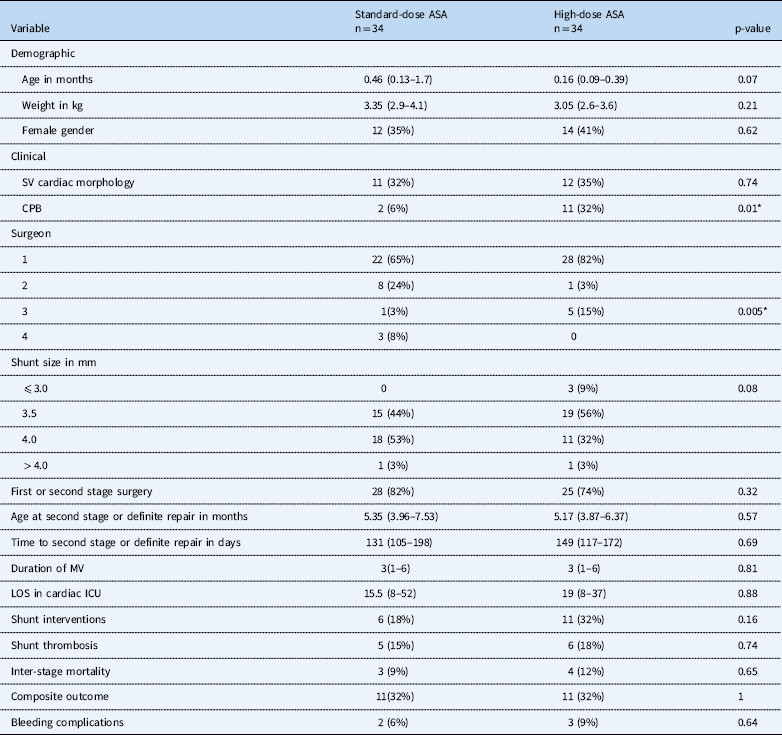
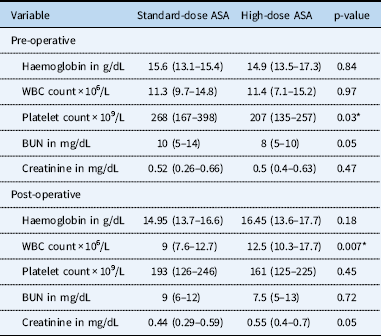
Both groups were similar in demographic and clinical characteristics except increased use of cardiopulmonary bypass –32% in high-dose versus 6% in standard-dose acetylsalicylic acid (p=0.01) – and distribution of operating surgeons among groups –84% in high-dose versus 65% in standard-dose acetylsalicylic acid by surgeon 1 (p=0.005), as shown in Table 1. Similarly, when comparing peri-operative laboratory values, both groups were similar with exception of lower median pre-operative platelet count (207×109/L versus 268×109/L, p=0.03) and higher median post-operative white cell count (12.5×10⁶/L versus 9×10⁶/L, p=0.007) in high-dose versus standard-dose acetylsalicylic acid group, as shown Table 2.
Comparison of demographic and clinical characteristics between standard- and high-acetylsalicylic acid dosing groups.

ASA=acetylsalicylic acid; CPB=cardiopulmonary bypass; MV=mechanical ventilation; SV=single ventricle; LOS=length of stay
* p value <0.05 was considered significant.
Comparison of peri-operative laboratory variables between standard- and high-dose acetylsalicylic acid groups.

ASA=acetylsalicylic acid; BUN=blood urea nitrogen; WBC=white blood cell
* p value <0.05 was considered significant.
Acetylsalicylic acid dosing, use of other anti-thrombotic agents, and blood product transfusion
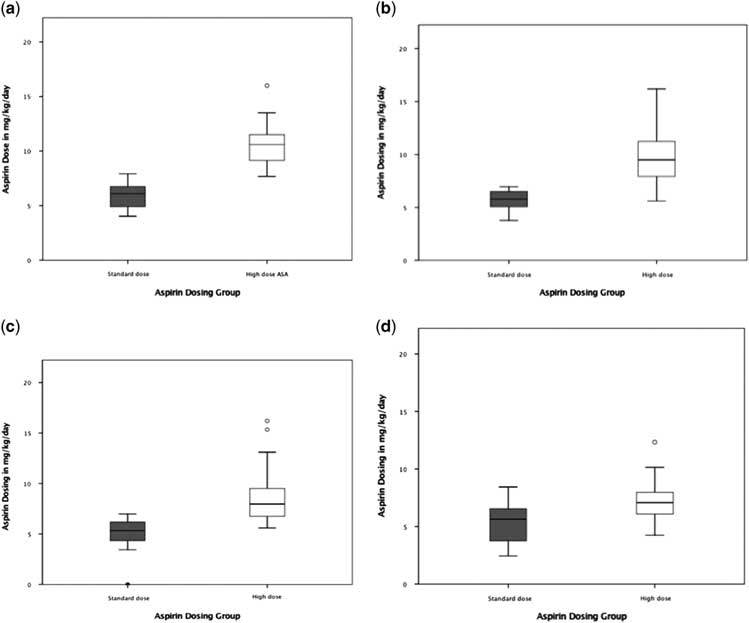
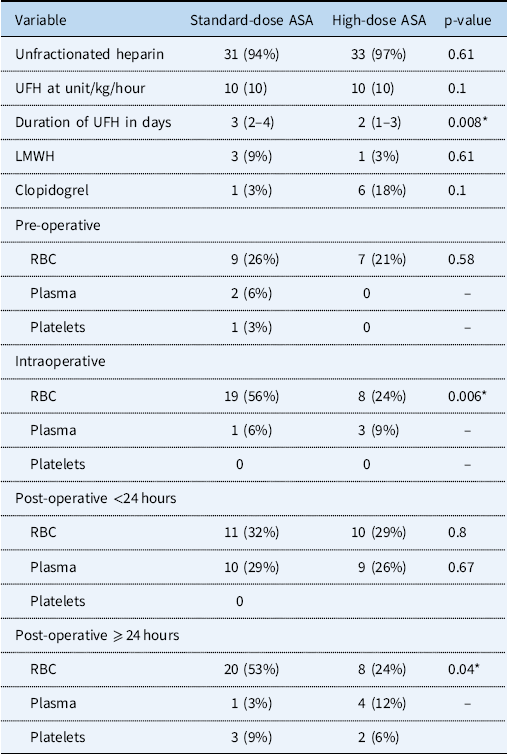
High-dose acetylsalicylic acid group had higher median (interquartile range) dose of acetylsalicylic acid at initiation [10.6 mg/kg/day (9–11.5) versus 6 (5–6.75), p=0.0001], 1–2 months [9.5 (8–11.25) versus 5.8 (5–6.5), p=0.0001], 2–4 months [8 (6.75–9.5) versus 5.3 (4.3–6.3), p=0.0001], and 4–6 months [7 (6–8) versus 5.6 (3.75–6.5), p=0.008] period compared to standard-dose acetylsalicylic acid (Figs 1a–d). Use of other anti-thrombotic agents including unfractionated heparin infusion in the immediate post-operative period, low molecular heparin, and clopidogrel was similar in both groups. However, the duration of unfractionated heparin infusion was longer (3 days versus 2 days, p=0.008) in the standard-dose acetylsalicylic acid group (Table 3). There was more frequent use of red blood cells transfusion in the standard-dose acetylsalicylic acid group during the intraoperative (56 versus 24%, p=0.006) and ⩾24 hours post-operative period (53 versus 24%, p=0.04) compared to the high-dose acetylsalicylic acid group (Table 3).
Comparison of prescribed acetylsalicylic acid dose between standard- and high- acetylsalicylic acid dosing groups. (A) Starting dose of acetylsalicylic acid postoperatively, (B) Postoperative acetylsalicylic acid dosing from 1 to 2-month period, (C) Postoperative acetylsalicylic acid dosing from 2 to 4-month period and (D) Postoperative acetylsalicylic acid dosing from 4 to 6-month period. p value was < 0.01* for all the comparisons.

Comparison of other antithrombotic agents and blood products utilisation between standard- and high- acetylsalicylic acid dosing groups.

ASA=acetylsalicylic acid; UFH=unfractionated heparin; LMWH=low molecular weight heparin; RBC=red blood cells transfusion
* p value <0.05 was considered significant.
Comparison of primary and secondary outcomes
There was no difference in the incidence of shunt thrombosis, shunt-related intervention, inter-stage mortality, and shunt-related adverse events between groups (Table 1). Overall, the median (interquartile range) duration for shunt thrombosis was 21 (2–102) days and the median time to death was 56 (15–135) days after modified Blalock–Taussig shunt with a mortality rate of 10%. The 30-day mortality was 2.8%. Also, the bleeding complication rate of 6% in the standard-dose versus 9% high-dose acetylsalicylic acid group (p=0.64) was similar.
Risk factors for shunt-related adverse events
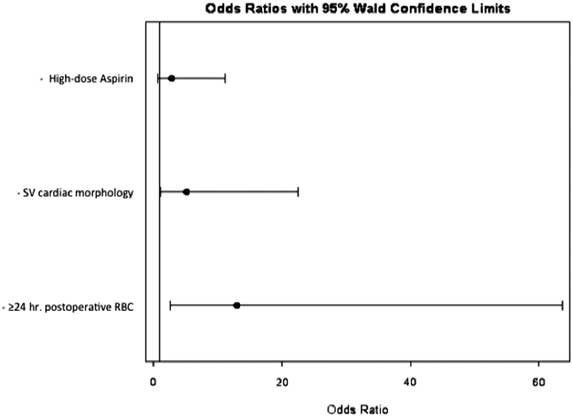
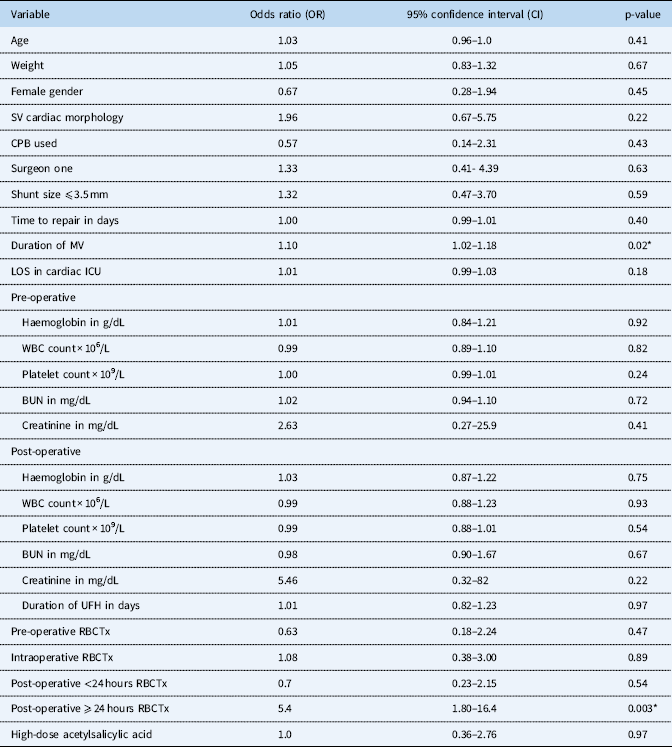
Infants with (n=22) and without (n=46) shunt-related events were similar in age, weight, gender, cardiac defect, cardiopulmonary bypass use, peri-operative haemoglobin level, white cell count and platelet count, and time to primary repair or second-stage palliation. Infants with shunt-related events, however, had longer duration of mechanical ventilation [median (interquartile range) 3 days (1–4) versus 5.5(1–23), p=0.02] and length of stay in ICU [median (interquartile range) 14.5 days (7–25) versus 35.5 (11–56), p=0.02]. Also, a higher proportion of infants with shunt-related events received red blood cells transfusion ⩾24 hours post-operatively (64 versus 30%, p=0.017) compared to infants without shunt-related events. On simple logistic regression analysis, duration of mechanical ventilation support and red blood cells transfusion ⩾24 hours post-operatively was associated with shunt-related adverse events (Table 4). Furthermore, on multiple logistic regression analysis, as illustrated in Figure 2, single-ventricle cardiac defect with odds ratio of 5.2 at confidence interval of 1.2–23.4 (p=0.03) and red blood cells transfusion ⩾24 hours post-operatively with odds ratio 14.9 at confidence interval of 3.12–71 (p=0.0007) were associated with shunt-related adverse events. High-dose acetylsalicylic acid with odds ratio of 2.6 at confidence interval of 0.68–9.9 (p=0.16) (Fig 2) was not associated with decreased shunt-related adverse events on multi-variate regression analysis.
Risk factors associated with shunt-related adverse event on the final multiple logistics regression model. Single ventricular cardiac morphology (OR = 5.2, (95% Cl 1.2–23.4), p=0.03) and RBC transfusion ≥ 24 hours postoperatively (OR = 14.9, (95% Cl 3.12–71, p = 0.0007) were associated with shunt-related adverse events, not high-dose aspirin (OR=2.6 (95% Cl 0.68–9.9), p=0.16). *p<0.05 was considered significant; 1Single ventricle; 2RBC-Red blood cells transfusion. p value was < 0.01* for all the comparisons.

Simple logistic regression analysis to determine variables associated with shunt-related adverse events.

BUN=blood urea nitrogen; CPB=cardiopulmonary bypass; LOS=length of stay; MV=mechanical ventilation; RBCTx=red blood cells transfusion; SV=single ventricle; UFH=unfractionated heparin; WBC=white blood cell
* p value <0.05 was considered significant.
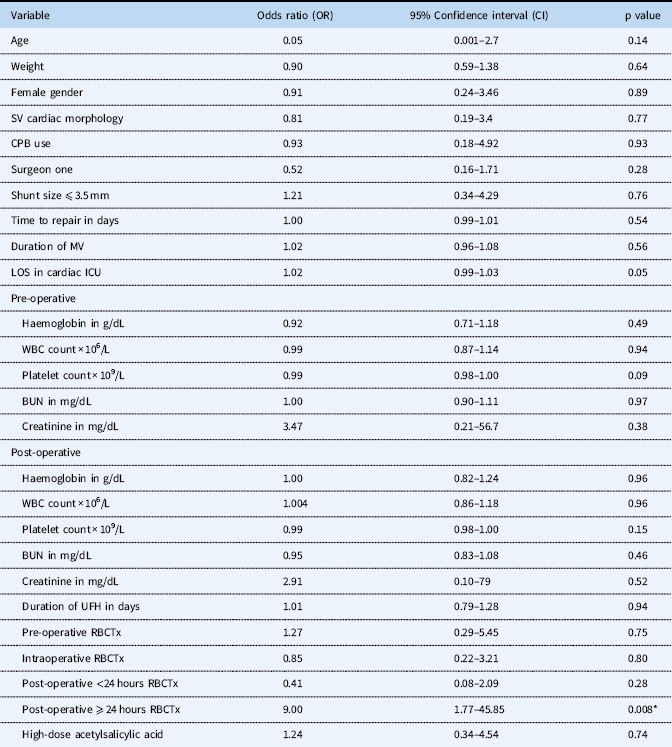
Risk factors for shunt thrombosis included length of stay in ICU and red blood cells transfusion ⩾24 hours post-operatively (Table 5). However, on multiple logistic regression analysis only red blood cells transfusion ⩾24 hours post-operatively with odds ratio of 16 at 95% confidence interval of 2.54–100.5 (p=0.003) was associated with shunt thrombosis. High-dose acetylsalicylic acid was not associated with decrease in shunt thrombosis with odds ratio of 3.69 at confidence interval of 0.75–18.17 (p=0.11). Red blood cells transfusion ⩾24 hours post-operatively was only risk factor associated with shunt-related intervention on simple logistic regression analysis (Supplementary Table S1). On multiple logistic regression analysis, single-ventricle lesion type with odds ratio of 4.64 at confidence interval of 1.15–18.64 (p=0.03), red blood cells transfusion ⩾24 hours post-operatively with odds ratio of 9.68 at 95% confidence interval of 2.13–43.41 (p=0.003), and high-dose acetylsalicylic acid with odds ratio of 4.61 at confidence interval of 1.12–18.9 (p=0.04) were associated with shunt-related intervention. No variable was associated with mortality on simple logistic regression, but the power of this analysis was limited. The odds ratio of the selected variables, such as single-ventricle lesion type with odds ratio of 1.1 at confidence interval of 0.19–6.55 (p=0.91), red blood cells transfusion ⩾24 hours post-operatively with odds ratio of 3.21 at 95% confidence interval of 0.60–17.23 (p=0.17), and high-dose acetylsalicylic acid with odds ratio of 1.92 at confidence interval of 0.36–10.19 (p=0.44) were not associated with mortality.
Simple logistic regression analysis to determine variables associated with shunt thrombosis.

BUN=blood urea nitrogen; CPB=cardiopulmonary bypass; LOS=length of stay; MV=mechanical ventilation; RBCTx=red blood cells transfusion; SV=single ventricle; UFH=unfractionated heparin; WBC=white blood cell
* p value <0.05 was considered significant.
The median (interquartile range) pre-transfusion haematocrit was 38.1% (36.2–40) before red blood cells transfusion ⩾24 hours post-operatively in patients without shunt thrombosis in comparison to those with shunt thrombosis [35.5% (34.2–36.7), p=0.036]. There was no significant difference in the median post-transfusion haematocrits between patients without shunt thrombosis [51% (49.1–52.0] compared to those without [52.3% (43.8–55.0), p=0.522]. However, the median delta change in haematocrit percentage post-transfusion [14.8% (12.5–19.0)] was trended higher among those with shunt thrombosis compared to those without shunt thrombosis [12.5% (9.4–14.6), p=0.076]. Also, the timing of transfusion in relation to modified Blalock–Taussig shunt placement was the median post-operative 18 days (3.75–46.5) in patients with shunt thrombosis compared to those without [3 days (2.5–5.0), p=0.026].
Discussion
This is the first study to report the clinical effectiveness of a high-dose acetylsalicylic acid anti-thrombotic prophylaxis protocol in infants with modified Blalock–Taussig shunt placement. We found high-dose acetylsalicylic acid is not superior to standard-dose acetylsalicylic acid for anti-thrombotic prophylaxis in infants with modified Blalock–Taussig shunt placement within our cohort. Furthermore, post-operative red blood cells transfusion, a potentially modifiable risk factor, was associated with both shunt thrombosis and shunt-related adverse events.
Acetylsalicylic acid is often used as a sole agent to provide anti-thrombotic prophylaxis in infants with modified Blalock–Taussig shunt.Reference Ahmad, Fatimi and Naqvi 1 , Reference Agarwal, Firdouse and Brar 9 However, in a single-centre study, only 13% of infants with single-ventricle lesions palliated with modified Blalock–Taussig shunt or Sano shunt had >50% inhibition on arachidonic acid receptors on thromboelastography-platelet mapping using acetylsalicylic acid doses of 1–5 mg/kg/day.Reference Truong, Johnson and Bailly 13 Furthermore, about 38% of these patients had persistently inadequate inhibition of arachidonic acid receptors (<50% inhibition) after the third acetylsalicylic acid dose post-operatively.Reference Truong, Johnson and Bailly 13 In a similar study, only 20% of infants with single-ventricle lesions palliated with modified Blalock–Taussig shunt or Sano shunt had >50% inhibition of arachidonic acid receptors with acetylsalicylic acid dosing of 5–6 mg/kg/day. These patients with acetylsalicylic acid resistance did not respond to increasing acetylsalicylic acid dose to 8–10 mg/kg/day on the fifth post-operative day.Reference Mir, Frank and Journeycake 8 On the contrary, in a single-centre study of children undergoing high-risk cardiac procedures including modified Blalock–Taussig shunt, a decrease in acetylsalicylic acid resistance was observed with high-dose acetylsalicylic acid.Reference Emani, Trainor and Zurakowski 11
Our study raises a provocative question as to whether acetylsalicylic acid alone even at high dose is optimum anti-thrombotic prophylaxis for infants with modified Blalock–Taussig shunt. There are many postulated mechanisms of acetylsalicylic acid resistance in these patients, including immature coagulation systems and platelets, poor acetylsalicylic acid absorption due to compromised cardiac output, inflammation related to cardiopulmonary bypass, and persistent thrombin-mediated platelet activation on the non-endothelialised shunt surface.Reference Gedicke, Morgan, Parry, Martin and Tulloh 3 , Reference Celestin, Guillot, Ross-Ascuitto and Ascuitto 4 , Reference Cholette, Rubenstein and Alfieris 17 – Reference Straub, Smolich, d’Udekem, Brizard, Peter and Horton 20 As such acetylsalicylic acid alone may not be able to overcome the many thrombotic pathways, particularly in the immediate post-operative period. As seen in our study, the majority of shunt-related events occurred 72 hours post-operatively with a median time of occurrence of 21 (2–102) days, which is similar to other reports.Reference Ahmad, Fatimi and Naqvi 1 – Reference Gedicke, Morgan, Parry, Martin and Tulloh 3
In our cohort, we found that red blood cells transfusion ⩾24 hours post-operatively and single-ventricle cardiac defects were associated with increased shunt-related adverse events. This observation is consistent with previously reported studies.Reference Cholette, Rubenstein and Alfieris 17 , Reference Fenton, Siewers, Rebovich and Pigula 18 , Reference Manlhiot, Brandao and Kwok 21 , Reference Todd Tzanetos, Yu, Hernanz-Schulman, Barr and Brown 22 Single-ventricle lesions cause persistent hypoxia and low cardiac output, leading to low-grade inflammation, hepatic dysfunction, abnormal flow dynamics, endothelial and platelet activation, and increase in erythropoietin release and haemoglobin concentration.Reference Redford, Paidy, Steinbrenner and Nielsen 23 – Reference Haga, Cotes, Till, Minty and Shinebourne 25 All of these factors are postulated to increase the risk of thrombotic events in infants with single-ventricle physiology.
The significant association of post-operative red blood cells transfusion with shunt thrombosis is a very important one. Post-operative red blood cells transfusion is a potentially modifiable risk factor. Red blood cells are often transfused to increase haemoglobin concentration above the normal range to enhance oxygen delivery in these patients. Currently, transfusion thresholds in this population are not well defined but can range between the haematocrit values of 35–45.Reference Cholette, Swartz and Rubenstein 26 , Reference Garcia-Roa, Del Carmen Vicente-Ayuso and Bobes 27 In our cohort, the median pre-transfusion was 35.5% in patients with shunt thrombosis with trend towards higher delta change in haematocrit percent after transfusion. Also, in our cohort the median post-transfusion haematocrit was about 51–52%. Anderson et al reported a median initial post-operative haematocrit of 41% and for every five additional percentage points of haematocrit, an infant’s odds of early shunt occlusion more than doubled (odds ratio, 2.70; p=0.009).Reference Anderson, Blancha and Duchon 28 Sahoo et al showed that haemodilution to a haematocrit of 45% can improve shunt patency in the immediate post-operative period.Reference Sahoo, Chauhan, Sahu, Bisoi and Kiran 29 In a study assessing in-hospital modified Blalock–Taussig shunt thrombosis, post-operative red blood cells transfusion trended to be higher in infants with shunt thrombosis.Reference Guzzetta, Foster, Mruthinti, Kilgore, Miller and Kanter 2
Adverse effects of red blood cells transfusion are not trivial; they can increase blood viscosity, promote thrombin generation by tissue factor bearing microparticles, worsen immune dysregulation, and alter haemodynamic profile due to microcirculation derangements.Reference Garcia-Roa, Del Carmen Vicente-Ayuso and Bobes 27 Most studies assessing risks and benefits of red blood cells transfusion are limited to the peri-operative period in infants with CHDs.Reference Cholette, Swartz and Rubenstein 26 , Reference Manlhiot, McCrindle and Menjak 30 – Reference Dasgupta, Parsons and McClelland 32 The most emerging data suggest that a restrictive red blood cells strategy is equally effective in comparison to liberal red blood cells transfusion in children with CHD.Reference Cholette, Swartz and Rubenstein 26
There are several limitations to this study. The study analyses were exploratory and are only hypotheses generating. Additional prospective data analyses are warranted for further validation of the study results. The high-dose acetylsalicylic acid protocol was implemented clinically without planned evaluation of the protocol compliance and assessment of platelet function. Therefore, we were unable to assess whether high-dose acetylsalicylic acid achieved a significant change in platelet function compared to standard acetylsalicylic acid dose. Also, the patients in the standard acetylsalicylic acid group were from a different time period, which can lead to differences in other aspects of clinical practice between two groups. Five patients in the high-dose acetylsalicylic acid group also received clopidogrel in comparison with one patient in the standard-dose acetylsalicylic acid group. We were unable to account for clopidogrel as a confounder because of small sample size. We were unable to assess if a temporal relationship occurs between the timing of red blood cells transfusion and the shunt-related events.
Despite these limitations, our study provides important information on limited efficacy of a pragmatic high-dose acetylsalicylic acid protocol for inter-stage anti-thrombotic prophylaxis in infants with modified Blalock–Taussig shunt. This has helped us to implement an algorithm based on qualitative platelet function testing to better guide acetylsalicylic acid dosing. Functional platelet testing is now performed on day 1 post-surgery and after three doses in our centre. In our opinion, assessment of clot formation potential by applying more physiological whole-blood qualitative platelet function assays – viscoelastic assays and impedance aggregometry – may be needed to better guide various anti-thrombotic prophylaxis strategies. We also identified post-operative red blood cells transfusion as a potentially modifiable risk factor to decrease shunt thrombosis and shunt-related intervention in this population. There is a need to evaluate the current practice to better ascertain the risks and benefits of post-operative red blood cells transfusion in this population.
Conclusions
High-dose acetylsalicylic acid may not improve anti-thrombotic prophylaxis in infants with modified Blalock–Taussig shunt. Post-operative red blood cells transfusion may be a modifiable risk factor to reduce shunt-related adverse events. Randomised controlled trials are needed to determine appropriate dosing of acetylsalicylic acid and red blood cell transfusion thresholds in infants with modified Blalock–Taussig shunt.
Supplementary material
To view supplementary material for this article, please visit https://doi.org/10.1017/S1047951118002536
Acknowledgements
None.
Financial Support
This work was supported by St Jude Pediatric Research Funds (grant number-R073223585).
Conflicts of Interest
None declared.
Ethical Standards
The authors assert that all procedures contributing to this work comply with the ethical standards of relevant guidelines on human experimentation (USA) and with the Helsinki Declaration of 1975, as revised in 2008, and had been approved by the Institutional Committee of the University of Tennessee Health Science Center, Memphis, USA.