Introduction
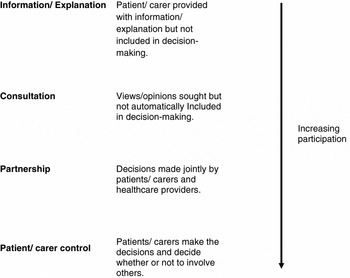
Arnstein's ladder of citizen participation describes participation on an axis from non-participation (patients and carers as passive recipients of treatment/education) to citizen control (citizen power). Applying this model to healthcare the aim would be patient/carer control – it imposes a hierarchy of participation with a rigid dichotomy: either patients have power or professionals have power. Similarly, Hickey and Kipping (Reference Hickey and Kipping1998) saw participation as a continuum from information/explanation to patient control, passing through partnership (Figure 1). Glasby (Reference Glasby and Glasby2007) cites the work of Hoggett (Reference Hoggett1992) in setting out a model which includes the issue of whether participation is enacted as an individual or through collective action, but again the aim is control and the model hierarchical.
Participation continuum (modified from Hickey and Kipping, Reference Hickey and Kipping1998)

These models fail to take account of the expertise of health and social care staff and the importance of the interactions and relationships between patients, carers and health and social care practitioners. Tritter and McCallum (Reference Tritter and McCallum2006) commented on the emphasis on power in participation, stating that it ignores the existence of different forms of knowledge and expertise. They argued that, to reflect the diverse ways in which patients participate, Arnstein's ladder would need to have multiple ladders, some with more rungs than others, and with bridges between the ladders, resulting in a scaffold structure.
Alternatively we could envisage participation as a balance between patient/carer control/power and health care professional control/power. In the early days of the National Health Service (NHS) in the UK, professionals controlled decision-making. There has been a shift towards more patient and carer control, but, if we take seriously the need for flexibility, inclusiveness and respect in participation activities (as described by Restall and Strutt (Reference Restall and Strutt2008) in their “conceptual framework” for participation), then genuine partnership/collaboration becomes the pinnacle of participation, valuing and respecting the contribution made by all parties to the decision. Tritter and McCallum (Reference Tritter and McCallum2006) describe this as:
“not a hierarchy of knowledge . . . but rather a complementarity between forms of knowing . . .”. (Tritter and McCallum, Reference Tritter and McCallum2006, p. 164)
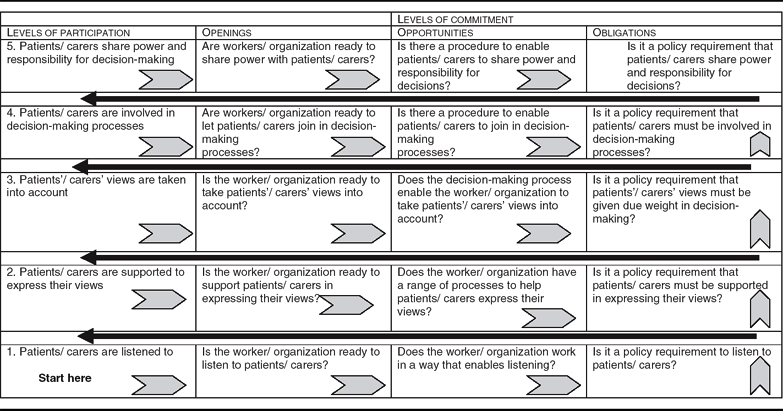
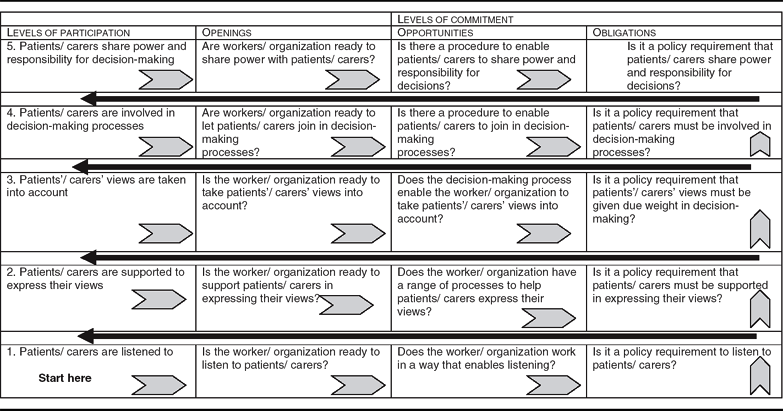
Old age psychiatry can learn from work on participation and models of participation in children's services (Wright et al., Reference Wright, Turner, Clay and Mills2006), which can be extrapolated with modifications to adult settings: these avoid the hierarchical approach. Young children are often excluded from consultations or decision-making by parents and health/social care practitioners making decisions on their behalf (Wright et al., Reference Wright, Turner, Clay and Mills2006). There are interesting parallels with old age psychiatry where adult children/relatives and practitioners may disempower and exclude older adults and make decisions for them. Shier (Reference Shier2001; Reference Shier2006) devised a model with five levels of participation and three stages of commitment (a modified version of this which is applicable to an older adult context is set out in Table 1). At each level of participation an opening may occur (first stage of commitment) and an opportunity might allow this to operate (second stage of commitment). At the third stage of commitment it becomes an obligation, i.e. it is incorporated within the organization as agreed policy/procedure. Shier's model is designed as a planning/assessment tool and to use it one starts at the bottom (indicated in Table 1 by “Start Here”). It is not a hierarchy where higher is necessarily better; instead, Shier argues that different levels of participation are appropriate in different situations. Similarly, Fajerman and Treseder (Reference Fajerman and Treseder1997) incorporated the idea of child- and adult-initiated participation into a circular model, used in younger people's settings. This described five degrees of participation, regarded as five different but equally good practice options applicable to different situations: patient/carer initiated (shared decisions with staff); patient/carer initiated and directed; staff inititated (shared decisions with patients/carers); consulted and informed; assigned but informed.
Shier's model with modifications to make it applicable to an adult context (from Shier, Reference Shier2001; Reference Shier2006)
This paper describes four initiatives drawn from the author's work and discusses them in the context of models of participation. All are set within the context of the NHS but the themes they raise and models of practice are of broader interest and applicability.
Participation example 1: copying letters to patients and carers
In 2009 the British Medical Association (BMA) issued guidance for consultants on best practise for copying letters to patients (BMA, 2009). The guidance states that copying letters to patients is “beneficial on the whole” and that one potential benefit is to maximize the person's understanding of their illness. In a section on potential pitfalls it suggests that it may be inadvisable to copy letters to people with significant cognitive impairment/dementia, and that there might be safeguarding issues which could place a child at risk when information is copied to parents.
There is no doubt that most patients are positive about their experience of receiving copy letters (Lloyd, Reference Lloyd2004; Nandhra et al., Reference Nandhra, Murray, Hymas and Hunt2004; Marzanski et al., Reference Marzanski, Misunuri and Coupe2005; Treloar and Adamis, Reference Treloar and Adamis2005; Mason and Rice, Reference Mason and Rice2008). The position of carers in respect of the practice of copying letters is less clear. Dale et al. (Reference Dale, Tadros, Adams and Deshpande2004) reported that older adults wanted to share information with their carers: 54% of old age psychiatry outpatients said that they would like their carer to receive a copy of the letter about their care. Carers in the same study overwhelmingly wanted to receive a copy letter (95%). Mason and Rice (Reference Mason and Rice2008) also looked at copying letters in an old age psychiatry service in a community mental health team context: they write that the decision to send the letter to the patient or carer was based on discussion with the doctor “and common sense”. If the patient had significant cognitive impairment they had to consent to the letter being sent to their carer; if cognitive decline was advanced, the letter was offered to the carer. The response to letters was positive: they were regarded as useful and clear. They note that all the respondents spoke English as their first language. Treloar and Adamis (Reference Treloar and Adamis2005) also investigated the practice of copying letters to patients and carers in an old age psychiatry outpatient context. They found improved knowledge of medical recommendations amongst patient and carers together with better knowledge of who to contact. They commented on confidentiality: “concerns about confidentiality did not arise.” In old age psychiatry services where patients and carers are seen together letters will hold no surprises for either party.
Sending letters about their care to patients or (with the patient's permission) to their carers is a way of involving patients and/or carers by informing them. If patients or carers are asked for feedback about the experience, the exercise moves from information to consultation on Hickey and Kipping's continuum. However for consultation to have meaning, it needs to feed back into and influence services.
Clark et al. (Reference Clark, Benbow, Moreland, Scott and Jolley2008) describe two older people's mental health projects which involved copying letters, referring to the practice of copying letters to patients as:
“offering transparency and confirming respect for equality in the relationship between patient and clinician.” (Clark et al., Reference Clark, Benbow, Moreland, Scott and Jolley2008, p. 31)
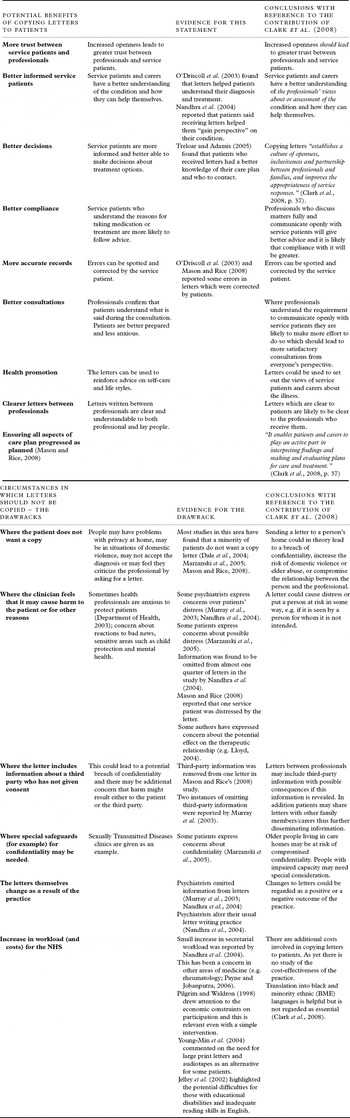
Table 2 lists potential benefits and drawbacks of the practice, taken from the Department of Health's Good Practice Guidelines (Department of Health, 2003) with additions and evidence for them. The benefits and drawbacks are written from the viewpoint of the professional. Clark et al. (Reference Clark, Benbow, Moreland, Scott and Jolley2008) move towards considering the practice of copying letters from the perspective of patients and their families. The column in Table 2 headed “Conclusions” attempts to refocus the benefits and drawbacks from a patient/family perspective. The practice of copying letters can move a health/social care encounter towards partnership with patients and carers: for example, patients or carers who receive copy letters know when they receive their copy that the professionals have received theirs and can then actively pursue any actions or outcomes which should follow.
Potential benefits and drawbacks of copying letters to patients and/or their carers (from Department of Health, 2003)

A simple intervention (in this case, copying letters to patients and/or carers) may be symbolic and more powerful than might have been anticipated. It involves a move away from expert language and secrecy. When the people receiving letters are empowered to use the letters actively to take a lead in their own (or their relative's) care and are also consulted about their experience so that learning is used to inform the development of individual care and of the service itself, the balance of power shifts further. This leaves the BMA (2009) guidance for consultants looking rather patronizing in its assessment of the practice of copying letters, particularly as the initiative outlined by Clark et al. (Reference Clark, Benbow, Moreland, Scott and Jolley2008) included people with cognitive impairment, dementia and other mental health problems of later life. To classify this initiative as a way of informing patients and carers about services/care is to make an assumption that the initiative involves information flow in one direction: when information flows in both directions, the level of participation and power sharing is greater and change may ensue from the interchange.
Participation initiative 2: patient journey mapping
On Hickey and Kipping's continuum (Figure 1) consultation is the next step after information/explanation. Consultation is the act or process of consulting and one definition of “to consult” is “to exchange views”. Exchanging views in itself could be a sterile exercise; the purpose of consultation is to influence and ideally to improve decision-making. Restall and Strutt (Reference Restall and Strutt2008) argue that:
“participation activities which consisted solely of information exchange were, at best, a waste of time and, at worst, exploitation. People did not want to participate for the sake of legitimizing what health planners had already decided, but rather to make a real impact on decisions that improve services.” (Restall and Strutt, Reference Restall and Strutt2008, p. 236)
Crawford et al. (Reference Crawford2002) point out, from the perspective of patients’ participation in planning/developing health care, that participation may be intended to legitimize the decisions of administrators and managers rather than to devolve power. The Social Care Institute for Excellence (SCIE) calls this a “technology of legitimation” which aims only to support the predetermined organization position/plan, rather than to look for ways to improve and develop plans/proposals. Such participation becomes
“exercises to approve of service planning and policy proposals, rather than enabling service patients to be key players or partners in their formulation.” (Carr, Reference Carr2004, p. 17)
Patients and carers can work with health and/or social care professionals to map their journey and review their experiences of care with a view to improving and developing services. An account of some of the work of the West Midlands Older People's Mental Health Collaborative (Doherty et al., Reference Doherty, Benbow, Craig and Smith2009) describes two carers’ journeys with dementia and some of the learning which was derived from mapping them, plus how this led to action points for the organization concerned. The authors comment that the process
“may even have wider benefits in altering the relationship between patients, carers and those professionals working with them . . .” (Doherty et al., Reference Doherty, Benbow, Craig and Smith2009, p. 510)
and may bring about:
“changes in culture for the individuals and services involved.” (ibid, p. 501)
This is an example of sharing power in collaboration, of deriving mutual benefit from the exercise, and of co-creating new ideas in conversation.
One of the main criticisms of this initiative is that no patient or carer journey will be typical or representative. Those patients/carers who volunteer to become involved may be people who have particular reasons to become involved; for example, they may have strong views arising from difficult or unsatisfactory experiences. In employing journeys as a service improvement tool the issue of representativeness is largely irrelevant, since learning will grow out of the collaboration between staff and patients/carers whatever experiences the patients and carers involved describe. It is important, however, that healthcare staff members approach these initiatives with a view to learning from the patients and carers involved, respecting their stories, experiences and ideas, and valuing the time and effort patients and carers are prepared to give. From the perspectives of all those concerned it is necessary that learning from patient journey mapping exercises influences services in order that the time and effort is well spent, particularly as some of the learning points may not fit with how services are operating at the time and may carry costs. If necessary changes to service operations are identified and do not influence the organization, the mapping experience can be frustrating and demoralizing for staff and patients/carers.
The staff members who were involved in the project of Doherty et al. (2008) were working both in management and care. This allowed the project to influence relationships between individual patients, carers and a range of staff members within the organization involved. At the same time, practical benefits were developed with the potential to change practice at the level of families using the service and at the level of organizational policies, procedures and plans. It would have been helpful to get feedback from the patients/carers whose journeys were mapped about how they perceived the exercise and its effects, both on their journeys and on their relationships with professionals and organizations involved: this is an action point for future work. It is important that staff involved in projects like this are in positions where they are able to influence organizational operation in response to learning, and that these initiatives are properly resourced and supported by organizations involved.
Participation example 3: the Consumer Group
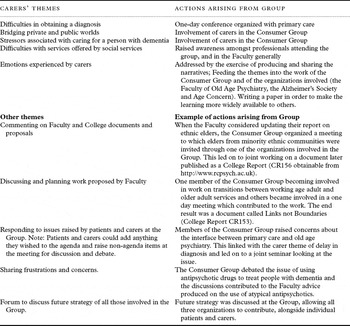
A second initiative which illustrates consultation is the Consumer Group, set up by the Faculty of Old Age Psychiatry, Royal College of Psychiatrists, in partnership with the Alzheimer's Society and Age Concern, to develop the relationship between patients, carers and old age psychiatrists nationally, and to establish a way in which all could work together on matters of mutual interest. The group acted as a forum for collecting and reflecting on written narratives produced by those carers of people with dementia who chose to do so (Benbow et al., Reference Benbow, Ong, Black and Garner2009). As with the patient journey mapping, those patients and carers who became involved in this project cannot be regarded as typical or representative but that does not detract from the experiences they bring. The Consumer Group narratives were subjected to a qualitative thematic analysis and the analysis was presented to the patient/carer forum for discussion and consideration of how the themes could be addressed in the work of the group. This methodology constituted “consultation” between the professionals and carers involved, and actions were developed in partnership. Table 3 sets out the identified themes from the narratives paper and from a related paper written by the same group (Ong et al., Reference Ong, Benbow, Black and Garner2007), together with the ensuing actions. It is evident that, although the Consumer Group was established in response to a professional initiative and with professional interests in mind, it led to actions which were co-created by the interaction between Consumer Group members and the professionals involved:
“[the] patients and carers . . . at times were challenging, refreshingly politically incorrect and unafraid to raise any issue that concerned them . . . the group was valuable in ways that had not been anticipated.” (Ong et al., Reference Ong, Benbow, Black and Garner2007, p. 48)
Themes identified in Consumer Group and ensuing actions, taken from Ong et al. (Reference Ong, Benbow, Black and Garner2007) and Benbow et al. (Reference Benbow, Ong, Black and Garner2009)

Furthermore:
“the group . . .. did not want to work to the faculty's agenda, and instead saw this as their opportunity to get the faculty to take the actions they think are needed.” (Ong et al., Reference Ong, Benbow, Black and Garner2007, p. 48)
The Consumer Group (and the patient journey mapping work) illustrates teaching and learning as collaborative and relational practices (McNamee, Reference McNamee, Anderson and Gehart2007). The members (patients, carers and professionals) all learned from each other and taught one another. That learning was carried into the work of all the organizations involved. Although the Consumer Group work started as an exercise to involve patients and carers in consultation, it allowed patients and carers to exert more control and start to influence the agenda and strategy of the organization they were working with, to the benefit of all concerned. This joint endeavor subverted the expected power structure and the Consumer Group is a process model which is potentially applicable to other settings.
Participation example 4: patients/carers in education
It is apparent from the preceding examples that information giving, consultation and partnership working are not separate discrete entities. Instead, their boundaries merge to form a spectrum of participation. Consultation may be about “ticking boxes” at times, but at its best it carries the underlying assumption that actions will result from that consultation. This introduces the possibility that the people running the consultation will share power with those they consult, so that the outcome is not necessarily that intended by either group but instead a co-construction (or partnership) which grows out of the dialogue between the two. The outcome then becomes not the outcome of one party imposed on another, but a different outcome to which both groups are signed up. This fits well with theories of systemic therapy.
The Consumer Group initiative (Ong et al., Reference Ong, Benbow, Black and Garner2007; Benbow et al., Reference Benbow, Ong, Black and Garner2009) crossed the boundary from consultation to control by giving the patients and carers involved the space to influence the focus and activity of the professionals they were working with.
The work described in Benbow et al. (Reference Benbow, Taylor and Morgan2008), which was taken further in Benbow and Boyce (Reference Benbow and Boyce2008) and Benbow et al. (Reference Benbow, Taylor, Mustafa and Morgan2011), moves from consulting with patients and carers to working in partnership with them. Furthermore, it involves work in developing and delivering education rather than in service provision, management or planning.
Education offers an opportunity to influence the health and social care system by influencing those working within it. Tew et al. (Reference Tew, Gell and Foster2004) describe how the involvement of patients and carers in education at all levels is essential if health and social care professionals are to develop partnership working with the people using their services. They listed a series of areas for involvement: direct delivery of learning and teaching, course/module planning, program management, recruitment and selection of students, practice learning, student assessment, course evaluation and as course participants. The involvement of patients and carers in non-passive roles in the education of health and social care professionals is a relatively recent development. Previously, patients may have been involved as “teaching aids” (Repper and Breeze, Reference Repper and Breeze2007), for example in the bedside teaching of medical students. Wykurz and Kelly (Reference Wykurz and Kelly2002) reviewed the involvement of patients in medical education, describing their active (as opposed to passive) involvement as new. Forrest et al. (Reference Forrest, Risk, Masters and Brown2000) describe drawing on patients’ views to influence design of a pre-registration nursing curriculum. Ikkos (Reference Ikkos2003) describes patients as teachers of interview skills, teaching doctors to understand the “point of view” of “patients” with mental illnesses. Livingston and Cooper (Reference Livingston and Cooper2004) went further: they described patients and carers as active educators in professional training, arguing that their different perspective gives them a unique role in teaching. A project and toolkit to investigate the needs of patients involved in planning and delivering mental health services and education has been reported by Lloyd et al. (Reference Lloyd, Carson and Bleakley2007). Anderson et al. (Reference Anderson, Ford and Thorpe2008) have described involving people with communication needs in developing and delivering education.
Wykurz and Kelly (Reference Wykurz and Kelly2002) acknowledge that they found the emphasis to be on the value (rather than potential negatives) of patients as teachers and state that this might be due to publication bias. Other writers allude to possible negative effects (for example, Walters et al., Reference Walters, Buszewicz, Russell and Humphrey2003). It is likely that the mechanism by which patients and carers are involved is important in ensuring a positive experience for all involved. Indeed, although the involvement of patients and carers has become embedded in education recently, a range of models has been described: one-to-one conversations (Elliott et al., Reference Elliott2005); long-term following of a person living with a dementia (Skog et al., Reference Skog, Grafstrom, Negussie and Winblad2000); working with service patient (or carer) groups (Humphreys, Reference Humphreys2005); involvement in developing, delivering and evaluating education (Barnes et al., Reference Barnes, Carpenter and Bailey2000); workshop-based teaching (Waterson and Morris, Reference Waterson and Morris2005); and a “facilitated dialogue” (Scheyett and Diehl, Reference Scheyett and Diehl2004).
Benbow et al. (Reference Benbow, Taylor and Morgan2008) describe the involvement of patients and carers in teaching an MSc module for health and social care professionals. The stated aim was to give the students a different perspective of assessment and care planning. As with the Consumer Group initiative, this innovation had consequences beyond those expected. Student ratings and feedback were overwhelmingly positive. The work led to a Higher Education Academy funded mini-project (Benbow and Boyce, Reference Benbow and Boyce2008; Benbow et al., Reference Benbow, Taylor, Mustafa and Morgan2011). A dedicated module (“In our Shoes”) was planned and designed in partnership with patients and carers using focus groups, and a recruitment workshop was held at which K. Morgan (co-author and an honorary lecturer at Staffordshire University) spoke about her experience of teaching.
In keeping with the shift in emphasis, Benbow and Boyce (Reference Benbow and Boyce2008) included forewords written by a patient (Morgan, Reference Morgan, Benbow, Boyce, Benbow and Boyce2008, p. 3) and a carer (Hughes, Reference Hughes, Benbow and Boyce2008, p. 4). The project involved patients and carers in the direct delivery of learning and teaching, in module planning, in student assessment and course evaluation.
“Involving patients and carers at all levels of education sends a powerful message to the professionals they train about the value and importance of hearing and attending to the voices of those using their services.” (Benbow and Boyce, Reference Benbow and Boyce2008, p. 6)
One of the concerns expressed about involving patients and/or carers in teaching is that those people who have the confidence and motivation to teach may not be representative of the majority of patients and carers; Repper and Breeze (Reference Repper and Breeze2007) reported that some mental health lecturers had expressed this view. Whilst this may be true in some settings, the authors argue that learning will grow out of the relationships established and the conversations that take place, whether or not people's experiences are regarded as “typical”:
“The teaching team came to the view that the individual material brought by patients and carers, whilst clearly important and influential, is only part of the learning experience and the process of the sessions is equally powerful, i.e. learning from patients and carers, having the opportunity to talk, question and debate with them in an educational environment.” (Benbow and Boyce, Reference Benbow and Boyce2008, p. 13)
The ‘In our Shoes’ project shared power between educators, practitioners, students, patients and carers, and all parties collaborated in the design, delivery and assessment of the module. The project involved a shift in power dynamics, but giving power to patient/carer teachers did not involve the facilitators in sacrificing their own roles and authority as some have feared (Felton and Stickley, Reference Felton and Stickley2004). The project evolved from the interaction between patients, carers, educational staff, practitioners and the third sector. The acknowledgments in Benbow and Boyce (Reference Benbow and Boyce2008, p. 18) credit the Phoenix Centre, the Alzheimer's Society and Approach, a third sector organization led by Boyce who co-authored the report.
Conclusions
Participation is better understood as a spectrum rather than a hierarchy. Patients’ and carers’ voices can be heard in a variety of ways – some of which have been described here – but, in order to participate, irrespective of organizational and health service structure, what patients and carers say must carry the potential to influence and change, and the aim of participation is better conceptualized as partnership/collaboration rather than control/power. Partnership implies similar status, shared power and some equality of influence over agenda, implementation and outcomes. Old age psychiatry services would benefit greatly from a focus on patient and carer participation throughout service delivery, management, planning, and improvement, together with workforce education and training.
Conflict of interest
None.
Acknowledgment
This paper is based on work submitted to Staffordshire University in respect of a PhD by published work (awarded in December 2010). The author wishes to thank all those who offered their support, including Rob Jones, Jim Radcliffe and Paul Kingston