Implications
Capric acid possesses antimicrobial activity against rumen microflora. The addition of capric acid to batch incubations suggests that it holds the potential for decreasing methane production and modifying rumen biohydrogenation towards decreased hydrogenation of linoleic and α-linolenic acids and increased accumulation of hydrogenation intermediates.
Introduction
The emission of greenhouse gases such as carbon dioxide and methane is considered as one of the most important global environmental issues (IPCC (Intergovernment Panel on Climate Change), 2001). Methane emitted from ruminants accounts for approximately 12% gross energy loss to the animal. Therefore, decreasing methane production is desirable for reducing the greenhouse gas emission with improved efficiency of digested energy utilisation (Johnson and Johnson, Reference Johnson and Johnson1995). In this context, the medium chain fatty acids (MCFA) have been suggested as effective dietary fats to suppress ruminal methanogenesis through their antimicrobial activity. Indeed, several studies have reported decreased ruminal methanogenesis when supplementing MCFA such as lauric (C12:0) and myristic acid (C14:0), either in pure forms or in products rich in these fatty acids under in vitro (Dohme et al., Reference Dohme, Machmüller, Wasserfallen and Kreuzer2001; Soliva et al., Reference Soliva, Hindrichsen, Meile, Kreuzer and Machmüller2004a and Reference Soliva, Meile, Hindrichsen, Kreuzer and Machmüller2004b) or in vivo conditions (Blaxter and Czerkawski, Reference Blaxter and Czerkawski1966; Machmüller et al., Reference Machmüller, Ossowski and Kreuzer2000). Dissociation of these MCFA in the bacterial cell has been suggested as the mode of antimicrobial activity. Acids penetrate the lipid membrane of the bacterial cell in the undissociated form. Once inside the cell, acid dissociation due to alkaline pH in the cytoplasm lowers cellular pH, suppresses cytoplasmatic enzymes and nutrient transport systems and uncouples ATP-driven pumps, leading to cell death (Freese et al., Reference Freese, Sheu and Galliers1973).
Another MCFA, capric acid (C10:0), has been reported to possess antimicrobial properties towards gastrointestinal bacteria in pigs (Dierick et al., Reference Dierick, Decuypere, Molly, Van Beek and Vanderbeke2002). These earlier reports of effects on MCFA suggest that it is worthwhile to assess the potential of capric acid as methane inhibitor. Capric acid is preferable from a feed technological point of view, because its lower melting point means that it is a liquid, and hence easier to incorporate uniformly.
The concomitant effects of lower methane production and reduced rumen biohydrogenation have been reported with supplementation of polyunsaturated fatty acid (PUFA)-rich sources such as fish oil and docosahexaenoic acid (DHA)-rich micro-algae (Chow et al., Reference Chow, Fievez, Moloney, Raes, Demeyer and De Smet2004; Boeckaert et al., Reference Boeckaert, Vlaeminck, Mestdagh and Fievez2007; Fievez et al., Reference Fievez, Boeckaert, Vlaeminck, Mestdagh and Demeyer2007). Although, the mechanism of antibacterial effect is different for long chain PUFA as compared to MCFA, a similar dual action of MCFA might be hypothesised. Obviously, methane and biohydrogenation modulators are of interest only when they have little or no effect on short chain fatty acid (SCFA) production.
Therefore, the present study was designed to assess the dose-dependent effects of capric acid (C10:0) on rumen methanogenesis and rumen biohydrogenation of dietary fat sources, rich in linoleic (C18:2n-6) and α-linolenic acid (C18:3n-3) under batch in vitro conditions.
Material and methods
In vitro incubations
Batch incubations were carried out in gas-tight incubation flasks as described by Van Nevel and Demeyer (Reference Van Nevel and Demeyer1996). The rumen liquor for the experiment was collected from two lactating rumen fistulated dairy cattle, fed according to their requirements for milk production and with free access to drinking water. The basal diet fed to the cows comprised (in decreasing order) maize silage, grass silage, sugar beet pulp and soybean meal. This basal diet was supplemented with a balanced dairy concentrate and a protein balancer, according to the animal’s requirement based on its milk yield. The rumen liquor was collected just before the morning feeding, transferred in warm (39°C) insulated flasks and used as the source of inoculum. A 10 ml portion of filtered (through a 1 mm metal sieve) mixed rumen fluid was acidified immediately with phosphoric/formic (10/1, v/v) acid to a final concentration of 2% to prevent fermentation (as the 0 h sample). Filtered rumen inoculum was mixed (1/4, v/v) with a phosphate buffer (per litre distilled water: 28.8 g Na2HPO4·12H2O; 6.1 g NaH2PO4·H2O; 1.4 g NH4Cl, and adjusted to pH 7.0). Standard dairy concentrate (consisting (g/kg product) of rapeseed meal (300), soya hulls (210), maize gluten feed (110), wheat middlings (110), beet molasses (90), wheat (80), toasted soybean meal (61), palm kernel expeller (8) and palm oil (4)) was used as substrate (0.50 g per 50 ml buffered incubation fluid). The incubation flasks were flushed with CO2 before the 24 h incubation was started in a shaking water bath at 39°C.
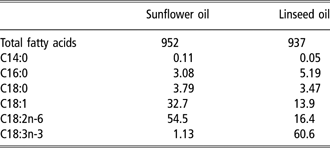
In addition to the dairy concentrate, all the flasks contained linseed and sunflower oils (10 mg each) as C18:2n-6 and C18:3n-3 sources, respectively. The fatty acid compositions of sunflower oil and linseed oil are presented in Table 1. Each run comprised four sets of flasks, one set being a control flask containing dairy concentrate, linseed and sunflower oil, and the other three flasks additionally contained different levels of capric acid (provided by Vitamex Inc., Drongen, Belgium), i.e. 10, 20 and 30 mg, respectively, per 50 ml of buffered incubation fluid. All incubations were carried out in three runs on separate days.
Total amount of fatty acids (g/kg DM) and fatty acid composition (g/100 g FAME) of sunflower oil and linseed oil (from Boeckaert et al., Reference Boeckaert, Vlaeminck, Mestdagh and Fievez2007)
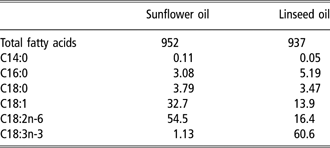
DM = dry matter; FAME = fatty acid methyl ester.
Assessment of rumen fermentation
After 24 h of incubation, the fermentation was stopped by addition of 1 ml of phosphoric/formic acid (10/1, v/v) injected through the gas-tight septum of the incubation flask. One millitre of the gas phase was sampled with a gas-tight syringe and analysed for methane and hydrogen (H2) by gas chromatography (FM, Dual Column GC 700; F&M Scientific Corp., Avondale, PA, USA) as described by Fievez et al. (Reference Fievez, Dohme, Danneels, Raes and Demeyer2003). After sampling for the gas, an aliquot of 0.5 ml was taken from the contents of the flasks and centrifuged (10 min at 22 000 × g; MSE, Amsterdam, Netherlands). The supernatant was used for SCFA analysis by gas chromatography (Fievez et al., Reference Fievez, Dohme, Danneels, Raes and Demeyer2003). The net amount of SCFA produced was calculated as the difference between SCFA in the non-incubated sample (0 h) and the incubated sample. The rest of the contents of the incubation flasks were used for fatty acid extraction and analysis as detailed in the following section.
Fatty acid analysis
The quantification of fatty acids was based on the internal standard, and the conversion of chromatogram peak areas to weight of FA used as a theoretical relative response factor for each FA (Wolff et al., Reference Wolff, Bayard and Fabien1995).
The extraction of fatty acids was carried out by the method of Folch et al. (Reference Folch, Lees and Stanley1957) with modifications as described by Chow et al. (Reference Chow, Fievez, Moloney, Raes, Demeyer and De Smet2004). A 40 ml mixture of chloroform/methanol (C/M, 2/1, v/v) and 10 mg of C19:0 (Sigma, Bornem, Belgium) was added as the internal standard to the fermented contents in the flasks. The contents of the flasks were then left overnight and, on the following day, the whole contents were centrifuged at 1821 × g for 10 min (FirlabO, SV11; Firlabo, Meyzieu, France). The chloroform phase was recovered in a 100 ml volumetric flask. To achieve complete extraction of FA, the washing step with C/M (2/1, v/v) was repeated twice and the chloroform phases were pooled in the volumetric flask. After these three consecutive steps, the extract was washed once with distilled water and the final volume was brought to 100 ml with C/M (2/1, v/v).
To allow assessment of lipolysis, the triacylglycerols (TAGs), free FA (FFA) and polar lipids were separated using thin-layer chromatography (TLC) as described by Dohme et al. (Reference Dohme, Machmüller, Wasserfallen and Kreuzer2003). A 10 ml extract was concentrated by evaporation at 40°C under N2 and the residue was dissolved in 200 μl of chloroform. The mixture was spotted on a glass plate (20 cm × 20 cm) coated with Silica Gel G (Fluka, Bornem, Belgium) and developed with hexane/diethyl ether/acetic acid (70/30/20, v/v/v). The developed plate was sprayed with a 10 g/l solution of 2,7-dichlorofluorescein in 2-propanol and different lipid classes were detected under ultraviolet light. The TAG, FFA and poly-unsaturated fatty acid (PUFA) bands were scraped from the plates into screw-capped glass centrifuge tubes. Fatty acids were then extracted from this silica plate and the extract was used further for methylation.
Methylation of FA was done according to the protocol of Raes et al. (Reference Raes, De Smet and Demeyer2001), with NaOH in methanol (0.5 mol/l) followed by HCl in methanol (1 : 1 v/v). The FA methyl esters (FAME) were extracted twice with 3 and 2 ml of hexane, respectively, and pooled extracts were evaporated to dryness under N2. The residue was dissolved in 1 ml of hexane and analysed by gas chromatography (HP 6890; Hewlett-Packard Co., Brussels, Belgium) on a CP-Sil88 column for FAME (100 m × 250 μm × 0.2 μm; Chrompack, Middelburg, The Netherlands) (Raes et al., Reference Raes, De Smet and Demeyer2001). The gas chromatograph conditions were as follows: injector: 250°C; detector: 280°C, H2 as carrier gas; temperature program: 150°C for 2 min, followed by an increase of 1°C/min to 200°C, then 5°C/min to 215°C. Peaks were identified by comparing the retention times with those of the corresponding standards (Sigma; Nu-Chek Prep., Elysian, MN, USA).
Calculations
Fermented organic matter (FOM) was calculated from the molar productions of acetate (A), propionate (P) and butyrate (B) as (A / 2 + P / 2 + B) * 162. The energy balance (energy gained through SCFA−energy loss through methane) was calculated per gram of substrate and per gram of FOM, using the following combustion energy values for acetate, propionate, butyrate and methane: 874, 1535, 2192 and 899 kJ/mol.
The various steps in disappearance of C18:2n-6 and C18:3n-3 include lipolysis and hydrogenation. The extent of lipolysis and the conversion efficiencies for the different biohydrogenation steps were calculated as detailed by Boeckaert et al. (Reference Boeckaert, Vlaeminck, Mestdagh and Fievez2007). At the time of this analysis, the procedure for separation of C18:1t10 and C18:1t11 was not optimised, therefore the values are reported as sum of both, indicated as C18:1t10 + t11. Apparent biohydrogenation values for C18:2n-6 and C18:3n-3 were calculated based on the proportional loss of these fatty acids after 24 h of in vitro incubation, i.e. 100 × (FA0 h − FA24 h)/FA0 h with FA0 h and FA24 h the amount of C18:2n-6 and C18:3n-3 in the incubation flask (mg/incubation) at the start of incubation and after 24 h.
Statistical analyses
The data obtained for rumen fermentation parameters and biohydrogenation products were statistically evaluated using the general linear model procedure (univariate) according to Yij = μ + Di + Rj + ξij, with Yij as the studied parameter, Di as fixed factor for the dose of capric acid (linear or quadratic), Rj as the effect of experimental run on different days, and ξij as residual error. Linear and quadratic effects of capric acid concentration were evaluated through polynomial contrasts. The values for the studied parameters obtained after 24 h incubation were compared with 0 h values using a Dunnett test. All statistical analyses were performed using SPSS 11.0 (SPSS software for Windows, release 11.0; SPSS, Inc., Chicago, IL, USA).
Results
Rumen fermentation characteristics
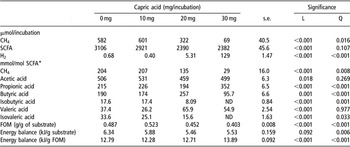
The results for SCFA, methane and hydrogen production are presented in Table 2. A 23% decrease in total net SCFA production (3.1 to 2.4 mmol/incubation flask) was obtained in incubations with 20 and 30 mg of capric acid (Table 2). A 39% increase was observed in the molar proportion of propionate (P < 0.001) accompanied by a slight decrease in acetate at 30 mg capric acid. However, addition of 20 mg capric acid shifted the SCFA pattern towards increased proportions of butyrate (26%) with a reduction in acetate (−9%) and propionate (−9.7%). A complete inhibition of the production of isobutyrate and isovalerate was observed in the presence of 30 mg capric acid (P < 0.001).
Effect of increasing dose of capric acid addition on rumen fermentation parameters after 24 h of in vitro incubation (n = 3)

s.e. = standard error of mean; SCFA = short chain fatty acid; FOM = fermented organic matter; ND = not detectable; L or Q = linear or quadratic effect of capric acid dose.
*Net production of individual fatty acid.
A dose-dependent response for absolute methane production was observed with 20 and 30 mg capric acid. More importantly, a dramatic methane reduction of 33% and 85% was observed when expressed relative to total SCFA production at the 20 and 30 mg inclusions of capric acid (P < 0.001). There was no effect of addition of capric acid at 10 mg on methane production when calculated as the absolute amount nor when expressed relative to SCFA. An accumulation of hydrogen (129 μmol/incubation) was observed at a supplementation level of 30 mg capric acid (P < 0.001).
Odd branched chain fatty acids
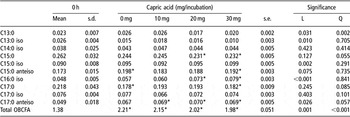
Table 3 presents the changes in the individual Odd branched chain fatty acids (OBCFA) as proportions of total OBCFA. A dose-dependent decrease in total OBCFA was observed with increasing levels of capric acid (P = 0.001). However, the most important shifts represented increased C15:0 anteiso, C16:0 iso and C17:0 anteiso, when compared to the 0 h values. C15:0 and C16:0 iso showed more consistent dose effects compared to other OBCFA.
Effect of increasing dose of capric acid on total odd branched chain fatty acids (OBCFA) (mg/incubation) and proportions of individual OBCFA (g/g) (n = 3)

s.e = standard error of mean; L or Q = linear or quadratic effect of capric acid dose.
*The means are significantly different from 0 h.
Biohydrogenation of PUFA
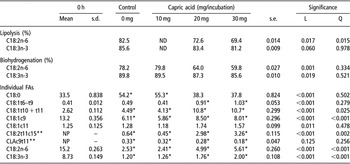
Data on lipolysis, accumulation of different C18 intermediates through biohydrogenation of PUFA sources are presented in Table 4. Lipolysis of TAG of C18:2n-6 and C18:3n-3 showed a linear (or tendency for a linear) effect, which resulted in a linear increase in the amount of C18:2n-6 and C18:3n-3 recovered after 24 h of incubation. As the biohydrogenation values obtained for control and the treatment with 10 mg of capric acid were similar, no lipolysis assessment was done for that treatment.
Effect of increasing dose of capric acid on individual C18 intermediates expressed as % fatty acid methyl ester (FAME), lipolysis and biohydrogenation of C18:2n-6 and C18:3n-3 (n = 3)

FA = fatty acids; s.e = standard error of mean; NP = not present; ND = not determined (as C18:2n-6 and C18:3n-3 biohydrogenation values did not differ significantly compared to control treatment); L or Q = linear or quadratic effect of capric acid dose.
*The means are significantly different from 0 h.
**The means for these FAs are significantly different from 0 h.
An overall 60% conversion of C18:2n-6 to its intermediates was observed in incubations with 30 mg capric acid compared to 78% and 80% conversion for the treatment with 10 mg of capric acid and the control. For C18:3n-3, 86% conversion of the incubated C18:3n-3 to its biohydrogenation intermediates was observed at 30 mg of capric acid. No effect of capric acid was observed for the first hydrogenation step in the C18:2n-6 pathway (c9t11CLA→C18:1t11), as c9t11CLA accumulation was independent of the capric acid dose (Table 4). For C18:3n-3, the first hydrogenation step (C18:3c9t11c15→C18:2t11c15) was assumed to have a 100% conversion efficiency as C18:3c9t11c15 was always below the detection levels. The accumulation of C18:2t11c15 in the incubations with 20 and 30 mg capric acid indicated a lower conversion efficiency of the second hydrogenation step (mainly, C18:2t11c15→C18:1t11). The proportion of C18:0 was observed to be similar for control (0 mg) and at 10 mg of capric acid. However, at higher doses (20 and 30 mg), C18:0 proportions were similar to 0 h values. This lack of stearic acid production at 20 and 30 mg capric acid indicates a lower conversion efficiency of C18:1 fatty acids to C18:0 (17%) and resulted in an accumulation of C18:1t10 + t11 as major intermediary compound.
Discussion
Effect of capric acid on rumen fermentation
The dose-dependent inhibitory effect of capric acid was observed for methane production in terms of both absolute methane measurements and methane expressed relative to SCFA production. In contrast, Dohme et al. (Reference Dohme, Machmüller, Wasserfallen and Kreuzer2001) did not observe any effect of capric acid on ruminal methanogenesis. These contrasting observations might be linked to the interaction between capric acid and the basal substrate. Indeed, in their study, the basal diet consisted of 60% forage. In some preliminary trials, we also did not observe any reduction in methane when hay was used as substrate (data not shown), which indicates that inclusion of roughage in the basal substrate reduces the methane-suppressing effect of capric acid. The addition of sunflower and linseed oil added as PUFA sources was another difference between the current study and the one of Dohme et al. (Reference Dohme, Machmüller, Wasserfallen and Kreuzer2001). PUFA might also affect rumen methanogenesis and fermentation and a confounding effect between capric acid and the PUFA sources cannot be excluded in the current study. Nevertheless, at the PUFA levels used in the current in vitro incubations, no effect on rumen fermentation is expected, as in another study with MCFA we did not observe any negative effect of similar levels of PUFA oils on methane and SCFA production (Panayakaew et al., Reference Panayakaew, Goel, Lourenço, Yuangklang and Fievez2008). The anti-methanogenic activity of other MCFAs has been attributed to their antimicrobial activity. Lauric acid (C12:0) and myristic acid (C14:0) as pure FA have been reported to decrease methane production by 12% when incubated at 30 mg per 50 ml of incubation fluid (Dohme et al., Reference Dohme, Machmüller, Wasserfallen and Kreuzer2001) whereas a 74% reduction in methane was observed when C12:0 was incubated alone (Soliva et al., Reference Soliva, Hindrichsen, Meile, Kreuzer and Machmüller2004a) and it was 96% when incubated in a mixture with C14:0 (C12:0 : C14:0, 2 : 1) (Soliva et al., Reference Soliva, Meile, Hindrichsen, Kreuzer and Machmüller2004b) at 30 mg per 30 ml of incubation fluid. Coconut oil rich in these MCFA was reported to decrease methane by 26% in lambs (Machmüller et al., Reference Machmüller, Ossowski and Kreuzer2000). However, it has often been stated that the anti-methanogenic activity of MCFA is associated with their anti-protozoal activity because a part of rumen methanogens is associated with protozoa (Newbold et al., Reference Newbold, Lassalas and Jouany1995). The anti-protozoal activity of capric acid has been reported when used as either a cyclodextrin-complex (Ajisaka et al., Reference Ajisaka, Mohammed, Hara, Mikuni, Hara, Hashimoto, Kumata, Kanda and Itabashi2002), free, or as a calcium salt (Matsumoto et al., Reference Matsumoto, Kobayashi, Takenaka and Itabashi1991); however, we have not studied the anti-protozoal activity of capric acid.
Our results indicate that higher doses of capric acid shifted the SCFA proportions towards butyrate at the 20 mg supplementation level, and towards propionate at the 30 mg level. Dohme et al. (Reference Dohme, Machmüller, Wasserfallen and Kreuzer2001) observed the shifts in SCFA proportions pattern towards more butyrate and lower propionate at 30 mg per 50 ml of incubation fluid. The varying effects on proportions of SCFA at different concentrations of capric acid were unexpected. However, similar varying effects were observed in a study comparing in vivo experiments with varying doses of DHA-rich micro-algae (Boeckaert et al., Reference Boeckaert, Vlaeminck, Dijkstra, Abdulsudi, Van Nespen, Van Straalen and Fievez2008). The highest dose of capric acid (30 mg) resulted in more propionate, which is well known as a hydrogen sink when hydrogen is not utilised in methane production. However, at the 20 mg capric acid level, butyrate was observed as an alternative hydrogen sink. Macfarlane and Macfarlane (Reference Macfarlane and Macfarlane2003) suggested that the electrons that are not consumed by methane production can be used for the reduction of NADH, which mediated the conversion of acetoacetyl CoA to butyryl CoA and finally to butyrate. In the present study, the decrease in methane production was associated with higher hydrogen production, indicating that capric acid disrupts electron disposal via interspecies H2 transfer towards alternative hydrogen sinks (propionate and butyrate production) and resulted in the accumulation of gaseous hydrogen.
However, these shifts in individual SCFA were accompanied by an overall decrease in total SCFA production of 23% when adding capric acid at 20 and 30 mg. Similarly, a 17% decrease in total SCFA was observed by Dohme et al. (Reference Dohme, Machmüller, Wasserfallen and Kreuzer2001) in their RUSITEC study when capric acid was dosed at 30 mg per 50 ml of incubation fluid. This might suggest that capric acid has little potential as an additive in ruminant production. However, the energy gain values per unit substrate and per unit fermented feed favour capric acid supplementation (Table 2). A difference of 12% was observed in the energy balance per substrate unit between control and capric acid-supplemented treatments (P > 0.05). The higher energy gain per unit of fermented feed in capric acid-supplemented treatments could enhance the productivity of animals, provided that the organic matter that is less fermented through capric acid addition is digested in the small intestine (and eventually the hindgut). Digestion shifts towards fermentation in the lower parts of the digestive tract have been observed before in situations where fats caused reduced rumen digestion (Sutton et al., Reference Sutton, Knight, McAllan and Smith1983). Translation of the current in vitro results to in vivo dose suggestions is challenging. However, based on previous in vitro and in vivo studies using micro-algae (Boeckaert et al., Reference Boeckaert, Vlaeminck, Mestdagh and Fievez2007 and Reference Boeckaert, Vlaeminck, Dijkstra, Abdulsudi, Van Nespen, Van Straalen and Fievez2008), it is clear that extrapolation should not be made on a substrate basis (i.e. 6% of capric acid on a dry matter (DM) basis in the case of the 30 mg supplementation level). Indeed, in the former study with micro-algae, the optimal in vitro supplementation corresponded to 104 g algae/kg substrate (Boeckaert et al., Reference Boeckaert, Vlaeminck, Mestdagh and Fievez2007), whereas in vivo effects have been observed at rates of 9.35 g algae/kg dry matter intake (DMI). We assume that extrapolation rather should be based on a ‘dilution basis’. In case of the micro-algae study, 1.66 g algae/l incubation fluid seemed optimal (Boeckaert et al., Reference Boeckaert, Vlaeminck, Mestdagh and Fievez2007), which corresponds to the daily intake of 195 g algae by dairy cattle, assuming a rumen volume of 100 l (1.95 g/l rumen contents). In a similar approach, the 30 mg in vitro supplementation level would correspond to a daily capric acid intake by dairy cattle of about 60 g or 0.3% on a DM basis (assuming a DMI of 20 kg/day).
The higher dose of capric acid (30 mg) affected the total bacterial population as indicated by a lower total OBCFA content compared to the control and lower capric acid concentrations (10 mg). OBCFA are used as a marker of bacterial growth as these FA are synthesised de novo and incorporated in the bacterial membrane lipids (Vlaeminck et al., Reference Vlaeminck, Dufour, van Vuuren, Cabrita, Dewhurst, Demeyer and Fievez2005). The decrease in total bacterial counts (although not significant) due to antibacterial activity of capric acid was also observed by Dohme et al. (Reference Dohme, Machmüller, Wasserfallen and Kreuzer2001).
Rumen biohydrogenation
The reduced rate of C18:2n-6 and C18:3n-3 biohydrogenation, resulting in higher levels of these FA after 24 h incubation, results in part from a reduced extent of lipolysis of those FA. Lipolysis has been suggested as the rate-limiting step in biohydrogenation process (Chow et al., Reference Chow, Fievez, Raes, Demeyer and De Smet2003). Dosing with 10 mg of capric acid did not influence the biohydrogenation of PUFA as the values were similar to the control. The dose-dependent effect of capric acid on the biohydrogenation of C18:2n-6 and C18:3n-3 was observed particularly at the 20 mg addition level, which suggests that inclusion of capric acid beyond 20 mg did not further affect the biohydrogenation process and the lipase-producing and/or hydrogenating bacteria seem insensitive to this further increase in concentration of capric acid.
The accumulation of C18:2t11c15 and C18:1t10 + t11 at both the higher levels of capric acid indicates an effect on the second step of hydrogenation of C18:2n-6 and second and third steps of hydrogenation of C18:3n-3. Similar effects on the accumulation of biohydrogenation intermediates were observed using PUFA sources such as fish oil and micro-algae (Chow et al., Reference Chow, Fievez, Moloney, Raes, Demeyer and De Smet2004; Boeckaert et al., Reference Boeckaert, Vlaeminck, Mestdagh and Fievez2007), although the antibacterial mechanisms of PUFA are different from those of MCFA. Moreover, a dose-dependent effect of fish oil on the accumulation of CLAc9t11 was reported by Chow et al. (Reference Chow, Fievez, Moloney, Raes, Demeyer and De Smet2004), which was not observed in the current study. The amount of the biohydrogenation end product, C18:0, obtained at 20 and 30 mg capric acid supplementation was similar to the C18:0 present at 0 h, which indicates that the last hydrogenation step converting C18:1t10 + t11 to C18:0 was completely inhibited. The higher butyrate proportions obtained at the 20 mg level of supplementation (Table 2) could have been expected to result in a more complete biohydrogenation, as biohydrogenating bacteria are all butyrate producers (Jenkins et al., Reference Jenkins, Wallace, Moate and Mosley2008). However, we did not observe a more efficient conversion of C18:1t10 + t11 to C18:0 compared to the 30 mg capric acid incubation with reduced butyrate production rates. This confirms that all butyrate producers are not hydrogenating as also stated by Jenkins et al. (Reference Jenkins, Wallace, Moate and Mosley2008).
The fact that there was not total correspondence in the effects of capric acid on rumen methanogenesis and rumen biohydrogenation suggests that there are different mechanisms of action of capric acid on methanogenesis and biohydrogenation, despite there being a common substrate (hydrogen). The mechanism by which capric acid depresses methanogenesis cannot be defined but is likely a combination of reduced feed fermentation, biohydrogenation of unsaturated fatty acids and direct inhibition of methanogens or their precursor suppliers (e.g. formate-forming bacteria).
In summary, capric acid has the potential to inhibit rumen methanogenesis and to decrease the biohydrogenation of C18:2n-6 and C18:3n-3, with accumulation of hydrogenation intermediates, mainly C18:2t11c15 and C18:1t10 + t11. The effect was most evident at the 20 and 30 mg levels of capric acid, which did not differ in terms of rumen biohydrogenation. However, differences in shifts in SCFA proportions have been observed towards increased butyrate at 20 mg and propionate at 30 mg. The lack of C18:0 production, both at 20 and at 30 mg, indicates that C18:0-producing bacteria are more sensitive than the bacteria involved in rumen methanogenesis, which showed a linear dose-dependent effect. The in vivo evaluation of capric acid is suggested for future studies as it is expected that it would reduce the methane and enhance rumen productivity in terms of energy produced per unit of feed digested if digestion in the small and large intestine were enhanced.
Acknowledgements
Katarina Arvidsson gratefully acknowledges the grant received from the SLU fund for internationalisation of postgraduate studies and August T. Larsson Foundation. The authors also acknowledge the financial support from Vitamex, Nutrition Sciences n.v. (Drongen, Belgium) and the EU project (Food-CT-23006-36241, Prosafebeef). The postdoctoral grant of B. Vlaeminck from Fund for Scientific Research-Flanders (FWO, Belgium) is also duly acknowledged.