Introduction: the rise of inter-Asian madrasa networks
In post-handover Hong Kong (after 1997), controversy over the rights of ethnic minorities has become a topic of social concern for the Chinese-dominated government. While the Hong Kong Special Administrative Region government has been branding the city-state as ‘Asia's world city’, there have been many debates about whether post-colonial Hong Kong truly embraces multiculturalism and its racial differences.Footnote 1 Growing academic literature and policy attention have been focused on improving the lives of socially disadvantaged ethnic minority groups of South Asian origin—particularly their education status. Among the widely discussed issues is the failure of the ethnic minority children concerned to integrate into the Chinese-majority classrooms,Footnote 2 and the insufficient support given to them to learn the Chinese language, which has resulted in wider social problems of discrimination against them regarding choice of school as well as educational and employment opportunities.Footnote 3 Most mainstream studies and policy concerns focus on integrating ethnic minorities into daytime public education while largely neglecting the rapid development of private madrasas that are catering to the growing desire for Islamic education. This paper argues that the transnational connection of madrasas from Pakistan (South Asia) with Hong Kong (China) deserves attention in the post-independence era. This is one of the case studies on this special issue which demonstrates the dissemination of religious knowledge across Asia.
Muslims are generally identified as Arabs and people from the Middle East, but in fact, the largest Muslim populations can be found in Asia.Footnote 4 In response to the global Islamic revival, sovereign states face new challenges in dealing with Islamic issues.Footnote 5 The management of Islam has become a paramount issue for many Asian governments and Muslims in Asia play active roles in shaping the future of a global Islamic civilization.Footnote 6 The transnational linkages of the madrasa in the Asian context are becoming more significant,Footnote 7 especially in youth studies, education, child development, inter-ethnic relations, and regional security in Asia. Therefore, the role of the madrasa, which is one of the most important educational, political, and transnational institutions in Islamic history and in the current Muslim world, is one of the key research agendas of global Islamic studies.Footnote 8 Traditionally, the madrasa has been an Islamic institution where Muslims learn the Qur'an and where ulema (the body of learned religious or legal scholars in Islamic sciences) are trained. However, the increasing global attention paid to the madrasa in the post-9/11 era can be attributed to the fact that many policy-makers and security analysts believe that the madrasa plays a major role in recruiting young Muslims for terrorism against the West and indoctrinating them with distorted ideas of extremism.Footnote 9 Beyond security and counter-terrorism measures, the dominant perspectives in North America and Europe of the madrasa as an educational institution for young people are negative. In particular, the curriculum of the madrasa, because of the traditional ulema training it provides, is considered outdated, far from analytical, and a mode of authoritarian teaching. The madrasa is criticized for closing students’ minds by enforcing authoritarianism and for spreading terrorism by brainwashing young people by teaching them anti-Western ideology. In particular, the madrasa is criminalized as a potential breeding site for terrorism throughout South Asia because of its Pakistan-Afghan connection,Footnote 10 which is a major geopolitical focus in the contemporary military campaign against the Taliban and al-Qaeda.Footnote 11 Beyond the hot spots of terrorism in the Middle East and in the West, new findings on madrasa education and its reform in Singapore, Indonesia, India,Footnote 12 and northwestern China have been released.Footnote 13 Discussions of the madrasa in Southeast and East Asia concentrate less on their relation to jihadist studies than those relating to Middle Eastern madrasas.
Instead, scholars focus on the compatibility between modern education and madrasa education, the role of Islamic education in a plural society, the bridging role of the madrasa with a mainstream non-Muslim majority, and issues of gender and discrimination.Footnote 14
Similar patterns are occurring in the growth in madrasas in Hong Kong. The Islamic institution of the madrasa has for centuries been an important place for imparting religious knowledge and shaping the identity of the global Muslim community (umma). Madrasas in Hong Kong are much the same as those in Middle Eastern and Muslim-majority countries where Muslim youth can learn the Qur'an and train as Muslim religious clerics (ulema). Under the current inclusive education policies for ethnic minorities of the Hong Kong government, Muslim students receive modern education in conventional day schools like other Hong Kong students, and then in the evenings, they study the Muslim faith in a madrasa, reciting and memorizing the Qur'an in order to remain faithful to their religious traditions. In an attempt to accommodate the children of ethnic minority populations, the Hong Kong government is integrating students of different ethnicities into the same schools. In the following sections, I will show that ethnic Muslim minorities do not resist learning Chinese, as it is important for their integration and social mobility in Hong Kong; rather, their foremost concern is to find a sacred space for reciting the Qur'an. After over a decade since the handover, Hong Kong primary and secondary schools have experienced a substantial increase in the numbers of Muslim students.
A question that will be examined in this paper is: are there institutions that provide Muslim students with the religious education that allows them to learn the basic tenets of Islam and recite the Qur'an? In the following sections, the paper examines the minority status of Islam in the context of the religious situation in Hong Kong. It then proceeds to trace the triple heritage of Hong Kong Islam and the rising Muslim population, namely Chinese, Pakistani, and Indonesian—the three major diasporic Muslim communities. There are three historical periods in the formation of Muslim identity in Hong Kong—1841 to 1917; 1918 to 1996; and 1997 to present—which map the rise of the three diasporic Muslim communities’ engagement with Hong Kong society. Though Muslims in Hong Kong are a seemingly homogeneous community, mainly following the Sunni tradition with reference to the religious jurisprudence of Hanafi (Chinese) and Shafi'i (Southeast Asia), the community itself has been pluralistically shaped by different diasporic groups (or ‘ethnoscapes’) with different histories and challenges. Uniquely, the trajectory of Islam in Hong Kong has never been dominated by a single ethnic group or a homogeneous cultural tradition. With this historical outlook, through an ethnographic study (comprising interviews and participation observation) as well as documentary analysis of archives, newspaper, and media reports, this paper describes how Islam in Hong Kong and the growing Muslim community, which was misunderstood and largely marginalized by the majority of Chinese people, is gradually being recognized and becoming more widely tolerated. Most importantly, by comparing Chinese and Indonesian Muslims, the paper explains the significance of the mushrooming of the Pakistani-led madrasas (‘housques’) in China's Hong Kong, due to the lack of a site for a mosque in the foreseeable future.
Background: religions in Hong Kong
Before elaborating further, it is important to situate Islam within the religious context of Hong Kong. In general, from the time of British colonial rule to the present post-colonial period, Hong Kong has been viewed as an economic city. Religion, if not an unimportant aspect of mainstream society, is usually placed in the private realm of individual choice and on the margins of Hong Kong's historical and economic development. Religious groups, organized by either Western missionaries or indigenous Chinese charity groups in Hong Kong's civil society, have played a proactive role in providing social services such as poverty relief, medical care, and educational services to those from all walks of life.Footnote 15 During the period of the Sino-British negotiations in the early 1980s and the aftermath of the 4 June crackdown in 1989, the public roles of the Catholic and Protestant churches were also vital in the struggle for democracy in Hong Kong.Footnote 16 Indeed, Buddhism, Confucianism, and Christianity have been the dominant forces in shaping the values of traditional Chinese society and colonial Hong Kong respectively. Nevertheless, religion has never been counted as a primary factor in directing public policy nor as a critical component in the grand narrative of Hong Kong's development. As a result, few studies have been conducted on institutional religions beyond Confucianism and Christianity. Organized religion is inseparable from the making of Hong Kong and modern China, but it has unfortunately been overlooked by most historians.Footnote 17 Though religions were not considered by the Hong Kong public before the colonial era, the contributions of religious groups in social, medical, and educational services can hardly be ignored. In Hong Kong, Confucianism, Buddhism, Taoism, Islam, Protestantism, and Catholicism constitute the major ‘six religions’. After the handover of sovereignty of Hong Kong to the People's Republic of China, representatives of the six religions were given 60 seats in the religious subsector of the total 1,200-member Election Committee that elected the chief executive of Hong Kong Special Administrative Region government in 2012. Ten of the seats in the religious subsector were allocated to the Chinese Muslim Cultural and Fraternal Association.Footnote 18 These religious representatives are solidly recognized as an integral component in the future of Hong Kong.Footnote 19
Buddhism, Taoism, and Confucianism are regarded as local and indigenous faiths in China's Hong Kong. And even though Islam is the oldest foreign faith to have reached Hong Kong (earlier than Protestantism and Catholicism), it is perhaps the most misunderstood and marginalized religion of the six. In Hong Kong, Islam as a religion and Muslims as a social minority have long been ignored by the public. It was not until they became more aware of the existence of the local Muslim community in Hong Kong through the series of global (9/11 terrorist attacks in 2001) and local (Hong Kong SAR government's unprecedented proposal to develop Islamic finance since 2007, and the persistent appeals for greater concern to be shown for Pakistani minorities) events, that Hong Kong society began to pay more attention to the Islamic religion. After the 1997 handover of sovereignty, Islam as a global religious faith and Muslims as a local minority community have, for the first time in local history, are in the public spotlight and on the political agenda.
Although there have been a handful of studies on Christianity and popular local Chinese religions, the subject of religion, especially the minority religions in Chinese-dominated Hong Kong society, remains understudied in mainstream Hong Kong and China studies. Moreover, the dynamic interactions of ethnicity, Islam, and post-1997 Hong Kong society have been neglected. In order to understand the rise of the madrasa and its transnational connections, it is important to trace the origins of Islam in Hong Kong, as the formative period and the recent developments of diverse Muslim traditions in Hong Kong are key to understanding why Pakistani madrasas are flourishing, while the other two Muslim communities (Chinese and Indonesian Muslims) are not.
Growing Muslim minorities: negative stereotypes altered
According to government statistics from the Hong Kong Year Book, there has been a growth trend in the Muslim population in Hong Kong throughout the twentieth century and continuing up to the present. In 2011, the Muslim population in Hong Kong reached 220,000, comprising 3.11 per cent of Hong Kong's population (7.0716 million), whereas the Christian community (Protestants and Roman Catholics), has 843,000 followers, comprising 11.9 per cent of the population.Footnote 21 As media coverage of Islam and the visibility of Muslims increases, public perception has likewise shifted, resulting in the greater inclusion of Muslims by the local community.
Back in 1990, Abu Bakar Ma Wing Cheung, a prominent Muslim teacher in the Islamic Kasim Tuet Memorial College, commented in a television programme that the existence of Islam was unknown to most people in Hong Kong and that local society had a very superficial, if not discriminatory, view of Islam and the Muslim community, knowing little more than that it is a religion that prohibits the eating of pork and allows Muslim men to marry up to four women at the same time. In facing biased views of Islam in mainstream social perception, he claimed that Chinese Muslims had been facing tremendous challenges in keeping to strict Islamic ideals while living in materialistic Hong Kong society.Footnote 22 However, in an interview with the author, he pointed out that 20 years later, a great change has occurred. It would appear that the situation of Muslims in Hong Kong and the social perception towards Islam have drastically and—ironically—changed for the better since 2001:
People have changed greatly over the past 10 years. Hong Kong has developed and regressed. I think that whether past or present, people still don't understand Muslims. However, a lot of people know about it. . . In the past, people just knew Muslims don't eat pork. I'll give you a simple example: I consulted a dentist. The dentist gave me some medicinal liquid, but I had to refuse it saying that ‘I am fasting’, the doctor replied ‘Oh, you are a Muslim.’ It was so easy for him to make the connection that I am a Muslim when I told him about my fasting. Also, a security guard from the building I live in reminds me that fasting is coming soon. In general, I think people know more about Islam although they don't understand it very deeply. At least, they think that Islam is a part of Hong Kong. . . The pressure of being a Muslim is less than before.Footnote 23
In addition to the culture of travel among the people of Hong Kong, which has led many of them to visit Muslim countries, educational reform, which emphasizes liberal studies, has enabled schools to explore Islam. In addition, there has been an injection of Indonesian Muslim domestic workers into many Hong Kong Chinese families, plus the accessibility of more information about Islam through the widespread use of the Internet and the outreach of the Muslim community into the public arena (e.g. Muslim organizations take part in the annual book fair in Hong Kong). Abu Bakar Ma Wing Cheung and Zareenah Ho Sau Yin, a female Chinese Muslim teacher in the Islamic Kasim Tuet Memorial College, similarly found that the prejudice against Islam has been diminishing, though misunderstandings about Islam still exist due to biased media reports linking Islam with terrorism. However, due to the increasing number of Indonesian Muslim migrant workers working in the homes of families in Hong Kong, non-Muslim Chinese citizens are more aware of some of the practices of Islam (e.g. wearing the headscarf). Zareenah Ho Sau Yin points out that society is more tolerant towards these practices compared to when she converted to Islam in the late 1980s, during the period of the Iraq–Iran war:
There were many different misunderstandings [towards Islam] that happened. Such as the media reports on the issue of 9/11 and so on, which generated such a misunderstanding. Of course, Muslims have tried to address the situation, such as the Kowloon Mosque organizing an open day in the hope that citizens can understand more about Islam though open dialogue. What is more, the number of Indonesian domestic helpers has been increasing in Hong Kong. You see, Hong Kong people have accepted those [Indonesian] women wearing Hijab on the street. The phenomenon has become more and more common. Hong Kong citizens do not protest about it. Some of them just ask those people whether they feel hot or not and ask them why they need to wear Hijab. In the past, when I first embraced Islam, outsiders did not accept it—it clearly made them feel uncomfortable and they discriminated against it. But nowadays, I have a different feeling. More people ask me whether I am an Indonesian. Why do I need to wear a headscarf? They inquire with good intentions. They just want to ask why. Situations like this often happen. So I think the situation has improved generally.Footnote 24
Another interview with Hameed Jalal, a spokesperson for the Incorporated Trustees of the Islamic Community Fund of Hong Kong, succinctly describes South Asian Muslims before 1997 as ‘not active’. They did not ‘consider Hong Kong as a place of abode’; most ethnic Muslims from subcontinent backgrounds came to Hong Kong for temporary work and did not bring their wives along. However, after 1997, the year Hong Kong reintegrated with the motherland China, Hong Kong also became an international Asian city accommodating new migrants and their families. Many of these Muslim families chose to stay and bring their wives and children to Hong Kong:
We had an explosion in child population, basically because after 1997 the [Muslim] fathers felt comfortable enough to bring their children here. You know the government policy is friendly toward Muslims and Hong Kong is considered as one of the places in the world where the Muslims as a minority are having the least problems. And we don't have any systematic problems.Footnote 25
In another television interview, which took place in the midst of an unprecedented peaceful demonstration against the 2006 Danish cartoon that was considered to blaspheme the Prophet Muhammad, Mr Sat, a financial broker born into a Chinese Muslim family, said that living a traditional Muslim life in Hong Kong posed no difficulties. Unlike in some Western societies, which can often be hostile towards Islam, he did not even remotely consider that the Hong Kong people he came across thought him a terrorist because of his Islamic faith:
Basically, it comes down to a difference in religion. You can't say ‘Oh, you're Muslim; therefore I think you're a terrorist.’ I don't think that's right. I don't think everybody thinks that, but you still have to look at their actions. See, I'm a Muslim but no one would think I'm a terrorist, right? I consider myself a normal person. . . I would be scared and wouldn't want to let people know about me [Muslim identity]. When people ask me, I let them know. But I wouldn't blurt out that I am Muslim. I wouldn't do that. I was a born Muslim because my parents are Muslims. In Islamic tradition, it is passed on from generation to generation. Your children follow in your footsteps. Footnote 26
It is striking to note that, by the accounts of Muslims themselves, Hong Kong is considered a friendly city where Muslims, as a minority, experience the fewest problems of anywhere in the world. Interestingly, since the handover, their experience has shown that the people of Hong Kong have become more aware of the Islamic faith and are moving towards more inclusiveness of the Muslim community, even as Islamic faith is increasingly focused upon in the global media. A Muslim minority in Hong Kong face comparatively less pressure than Muslims in the West, who are often wrongly labelled as terrorists. Being a Muslim in Hong Kong allows one to be ‘a normal person’ no different from any of the other citizens in the city in contrast to the socio-political context of mainland China, where Muslims and other ethnic groups are officially categorized as minorities in terms of their nationality (minzu).Footnote 27 However, even with the recent acceptance of the Muslim community into Hong Kong society, there are still prevailing obstacles in practising everyday Islamic rituals such as praying five times a day and the learning and reciting of the Qur'an.
Desperately seeking sacred space: ‘housque’ as creative Islamic intuition
In 2011, in a television documentary entitled ‘House of Islam’, which reported on the status of Islam in Hong Kong,Footnote 28 Hameed Jalal praised Hong Kong as one of the top five countries where Muslims are happily accommodated. According to information from the Home Affairs Bureau of the Hong Kong government, the population of Muslims in Hong Kong has grown to 250,000, a threefold increase in the population since the handover in 1997.
However, despite the friendly social environment and the increase in the Muslim population in Hong Kong, this did not translate to an immediate change in the institutional culture of Hong Kong society. While the Buddha's birthday was made a public holiday after 1997, the growing Muslim community has not been granted a public holiday to celebrate any major annual Muslim festival such as Eid Al-Fitr (the fast- breaking celebration at the end of Ramadan) or Eid Al-Adha (the celebration of finishing the pilgrimage at the end of hajj). Although Muslims in Hong Kong have the freedom to practise their religion in the city peacefully and even praise the government for its lack of institutional discrimination, limited resources have created other problems for the community. Recent reports in the South China Morning Post highlight a significant problem confronting the growing Muslim population in Hong Kong—that is, the lack of Islamic facilities, with those currently available being swamped by the explosion in the Muslim population. Many Muslims are desperate for larger and better equipped mosques. Most importantly, Muslim parents consider the scarcity of Islamic educational institutions as a principal factor in their decision to emigrate from Hong Kong to Malaysia, Indonesia or even Singapore. These concerns about their children's education are reflected by two Muslim parents, Kashif Akhtar, a Pakistani who moved to Hong Kong with his family 15 years ago, and Ishaque Sarker, a Bangladeshi who has lived in Hong Kong for 22 years and has a wife and seven-year-old daughter:
We may go to Malaysia or Indonesia, or maybe even Singapore. There is more Islamic culture in those places than in Hong Kong. . . My dream is to have an Islamic school here.Footnote 29
As of 2012, there were only five official mosques in Hong Kong providing religious, social, and cultural services—four in Hong Kong Island and one in Tsim Shau Tsui in the southern part of Kowloon. The Muslim-to-mosque ratio in Hong Kong is untenable. While there is one church for every 700 Christians, one mosque in Hong Kong must accommodate 18,000 Muslims! Obviously, the existing facilities cannot meet the current—let alone future—demand of the growing Muslim population. Singapore, with total population of 5.08 million people in 2010, by contrast, has six full-time madrasas and 27 part-time madrasas to accommodate the needs of the Muslim community in Singapore where 15 per cent of population are Muslims.Footnote 30 These institutions provide religious and Islamic education for students aged seven to 18, as well as teach Arabic language at the primary, secondary, and pre-university level. Comparatively, the Singapore government has provided more institutions and opportunities for Muslims to learn and practise their religion than Hong Kong.
In 2001, the Hong Kong SAR government granted land to the United Muslims Association of Hong Kong to build a mosque and Islamic centre in Sheung Shui. However, even before the project started, this was grossly inadequate since it was to be the only mosque in the New Territories where most of the ethnic Muslims (mainly Pakistani families) reside. In the event, despite the financial support of the kingdom of Saudi Arabia and the Qatar charity of Doha, the pace of the construction was further delayed by the untimely death in 2009 of Mohamed Alli Din, the organizer of the New Territories mosque project, and the subsequent Din family dispute over the construction project.Footnote 31 At present, there is no definite date for the finalization of the construction project.
The booming Muslim population without enough mosques to provide for their spiritual needs has forced some Muslims, like Muhammad Amir Khan of the Madrassa Muhammadia Ghosia, to appeal to the government to grant Muslims further land in Hong Kong's New Territories:
The government should give us some land so we can construct a mosque and community centre, to allow Chinese people to understand what Islam is really about.Footnote 32
As a result of inadequate space for the Muslim community in the New Territories, Zareenah Ho Sau Yin is now appealing for the urgent needs of the growing Muslim population in remote areas of the northern New Territories of Hong Kong to be addressed, particularly the educational needs of the Muslim youth. However, the present Hong Kong education policy of closing schools, due to the declining birth rate of the Chinese population, makes opening an Islamic school for Muslim minorities in the New Territories extremely unlikely. Although there is an annual increase in demand for school places for Muslim students, they have no choice but to study in the Islamic Kasim Tuet Memorial College in Hong Kong Island. Many of the students have to wake up very early to travel to school from their homes in the New Territories. In brief, the Muslim community in Tuen Mun and Yuen Long is quite geographically isolated from many parts of Hong Kong yet many Muslims are obliged to settle in an ethic enclave in northern New Territories, as explained by Zareenah Ho Sau Yin:Footnote 33
We have lots of Muslims staying in Tuen Mun, Tin Shui Wai and Yuen Long. So there is a great demand in that area. . . Some of them wake up around five o'clock and have to get to the school bus before six o'clock. Every day they have to travel two or more hours so it's quite tough for them. . . If they stay in Yuen Long, maybe you can ask them to go to North Point. [However,] they don't know where ‘North Point’ is! There are many non-Chinese in Hong Kong who do not come from the middle or higher classes. We have to give them more support so that they have more chance to go out with other students, like out of Hong Kong. . . The government is talking about cutting schools [because] the number of students is decreasing. So I think it is a bit hard to ask for another [Islamic] school. But of course we really hope that we have another school in those areas to provide school for Muslims or other services to them.
As well as the construction of Islamic schools for Muslim children, another urgent issue for the Muslim community is the need for more mosques, as venues for prayer and to accommodate the faithful. Zoheir Tyebkhan, a former chairman of the Incorporated Trustees of the Islamic Community Fund of Hong Kong who was awarded a medal of honour in 2006 by the Hong Kong SAR government for his dedication to the Muslim community, commented on the lack of physical accommodation:
There is definitely a mosque shortage in Hong Kong. Our mosques are old, small and too inadequate to accommodate our growing Islamic community. . . The government has proposed a couple of locations for building a new mosque recently, but the sites were either not suitable or not big enough for a decent sized center. As of now, we still don't know when a new mosque will be built in the city.Footnote 34
In a news report, Khan Muhammad Malik, the chairman of the Federation of Muslim Association in Hong Kong, estimated that while the Muslim population has grown fivefold in the past five decades, the number of mosques in the city has remained the same. He urged the government to set up community halls for the Muslim population, where they could gather and teach their children:
There are not enough places to pray. There is always a big crowd. The children have nowhere to go. We could teach them better if there were community halls in Hong Kong.Footnote 35
Although Hong Kong is reported as being the most liveable city in the world with an excellent health care system,Footnote 36 uncontrollable price rises in the property market is one of the major factors that have made it unaffordable for many locals to live in the city. In Hong Kong, high-end flats rented by expatriates are the most expensive in the worldFootnote 37 and property prices are so high that homes are ‘barely affordable’ for local Hong Kong residents.Footnote 38
As a result, one special challenge faced by the Muslim community is finding a large enough space for prayer, learning the basics of Islam, and reciting the Qur'an. Impatient with waiting for the government to grant them land on which to build another mosque for prayer or another school for Islamic education and without a hope of building a mosque in Kowloon and the New Territories in the foreseeable future, in recent years, Pakistani Muslim parents have come up with a creative solution to their predicament. They have rented many small flats—known as ‘housques’—and turned them into sacred spaces for the combined purposes of congregational prayer and Qur'anic learning:
The increase in the number of followers and rampaging real estate prices are forcing Muslims to find alternative sites to celebrate their functions. In the absence of bigger spaces, this means having their prayers in a ‘house mosque’—a phenomenon that has become widespread in modern Hong Kong. . . ‘There are so many Muslims in Sham Shui Po, but no mosque,’ says Zaheer. ‘That is why more than 200 people come here to pray every week,’ he explains. ‘The reasons for opening house mosques lie in the difficulty of finding enough sites for worship that would host the large Islamic population of the city.’Footnote 39
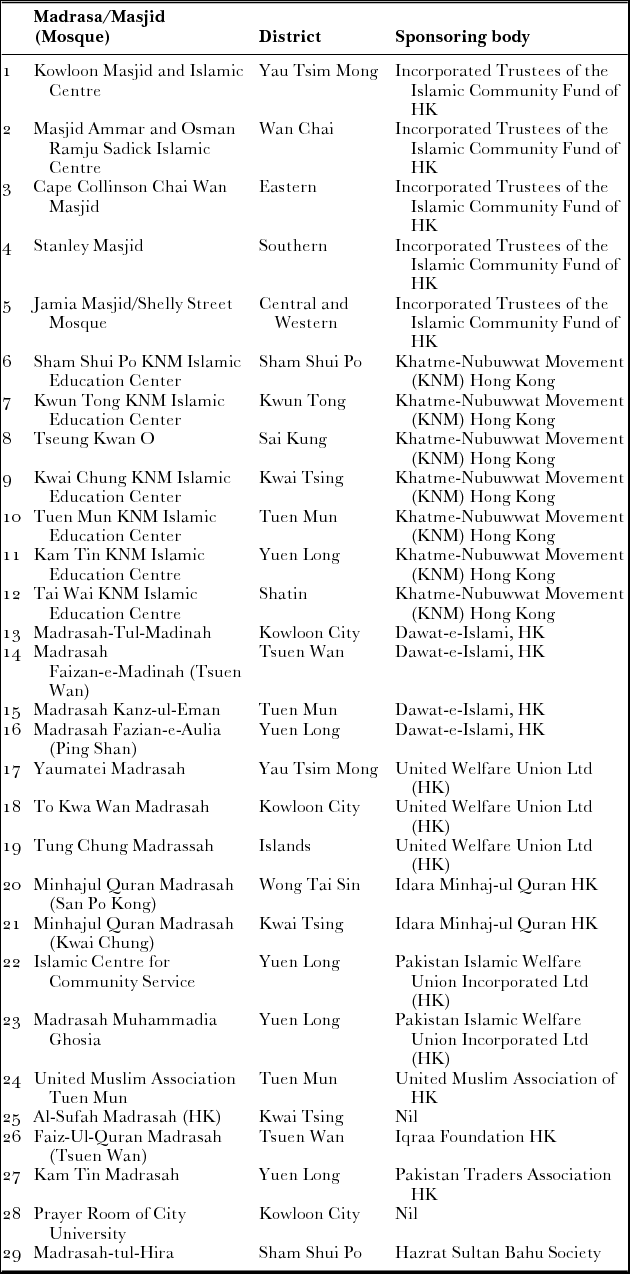
The development of housques in Kowloon and the New Territories has been remarkably fast and they are scattered around many parts of Hong Kong. According to official information from the Islamic Union of Hong Kong, there were already 29 housque-style madrasas in Hong Kong by August 2010 (see Table 2).
Percentage of the population which is Muslim in Hong Kong (1900 to 2012).Footnote 20

List of masjids (mosques)/madrasas in Hong Kong (updated in January 2010).Footnote 41

At a public speech delivered by Haji Ma Fung Wai to a group of secondary school teachers at the Masjid Ammar and Osman Ramju Sadick Islamic Centre at a public seminar on 9 February 2013, the chairperson of the da'wah (call or invite someone to Islam) committee of the Islamic Union of Hong Kong confirmed that all recently established madrasas in the New Territories are, without exception, organized and run by the Pakistani Muslim community. It is noteworthy that apart from the five established mosques also used as madrasas, which are run by the Incorporated Trustees of the Islamic Community Fund of Hong Kong, all newly established housque-style madrasas are mostly managed and financed by Pakistani neighbourhood organizations and offer Qur'anic lessons for children of Muslim families in the northern New Territories. The Incorporated Trustees, which was set up during British colonial rule, has been the highest Islamic authority representing all Muslim organizations and sectarian groups in colonial Hong Kong. Yet the rise of the madrasa networks, which symbolizes the emerging trend of Islamic transnationalism in Hong Kong, fostered by inter-Asian madrasa networks, is beyond their management and supervision.
With the soaring number of Muslims and with the increasing difficulty of finding physical space, Imam Tayaib Qasmi, the sheikh of the Khatme Nubuwat Movement Hong Kong, was one of the first to see the pressing need to accommodate Muslim youth for prayer and reciting the Qur'an:Footnote 40
If there is land like that of the Kowloon Mosque in Tsim Shau Tsui, I don't know whether ten Mosques are enough. . . Now we have too many Muslims, too many Muslim children. . . we worry about the Muslim children. We open some Madrasahs as Qur'anic schools for them to learn the Qur'an and some basic Islam.
My fieldwork observation focuses on madrasas from three different Muslim sponsoring bodies—Minhaj-ul-Quran, Khatme-Nubuwat Movement, and Dawat-e-Islami. They are among the most active and fastest growing madrasa movements with different branches in Hong Kong. My participant observation reveals that after students finish public day school, they go directly to the madrasa and read the Qur'an for between one and two hours a day, usually from four to six o'clock in the afternoon. The motivation of students who attend the madrasa is quite strong. When asked why they come to read the Qur'an, most of them offer that it is an obligation of their religion and that it is also an important book for their home country of Pakistan (although some other South Asian, Chinese, and Filipino Muslim children also attend these classes). The madrasa setting is co-educational but boys and girls are strictly segregated. Teaching in Urdu as a medium of instruction, imams, and Qur'anic teachers are from and trained in Pakistan. Interestingly, ethnic Pakistani students born in Hong Kong are fluent in Cantonese, although they speak Urdu among themselves. However, the Qur'anic teachers, who are trained in Pakistan (e.g. in Lahore), are hafiz (a person who memorizes the Qur'an and can recite it from memory), and who hold a Master's degree in Islamic studies, usually cannot speak Cantonese.
When asked if they have concrete teaching goals for preparing students for the future, Qur'anic teachers said that they aim only to equip Muslim children to recite the whole Qur'an within four to five years and to teach them the Islamic essentials. I interviewed a few Muslim adolescents, some of whom are already hafiz and able to recite the whole Qur'an after years of learning, who plan to seek higher Islamic education in Pakistan and the Middle East in a country like Saudi Arabia. Ideologically speaking, teaching the philosophy of Islam and the Qur'an is strongly connected with the madrasa headquarters in Pakistan. When the Qur'anic teachers and students were asked about the differences between madrasas from the different Muslim sponsoring bodies, students claim that they freely move from one madrasa to another because teachers teach the same content in the same way. There appears to be little ideological divide or sectarian conflict among the Pakistani-led madrasas in Hong Kong at present. However, when asked about the funding source, they all claimed that madrasas in Hong Kong are financially independent from the headquarters in Pakistan; the costs are borne by the local Pakistani Muslim parents themselves and donations from active members and Muslim businessmen in Hong Kong. One of the madrasas I visited faced a monthly rental fee of 11,000 Hong Kong dollars. On average, the monthly tuition fees, which are considered as donations from the parents, range from 200 to 500 Hong Kong dollars.
In contrast to the day school teachers’ encouragement of group discussion and critical questioning, madrasa teachers exercised strict discipline in keeping students on track in reciting the Qur'an. Without a formal curriculum, students start by learning simple Arabic and progress to reciting a portion of the Quran six days a week, and on Fridays attend the Jumu'ah congregation.
In the three New Territories’ madrasas in Kwai Fong, Sham Shui Po, and Yuen Long, an average of 40 to 50 mainly Pakistani students attend each madrasa but hail from different day schools.
This section has explained how the Pakistani Muslim community have dealt with the reality of too few formal mosques and how they have coped with these constraints by transforming rented spaces into ‘housques’. The uniqueness of the rapid expansion of contemporary madrasa networks all over Hong Kong is that the Pakistani Muslim community single-handedly took over their governance.
Triple trajectories: diasporic Muslim communities in Hong Kong
The following section maps the rise of the three main diasporic Muslim communities’ engagement with Hong Kong society and provides a historical overview of three periods and details key moments in the formation of Muslim identity in Hong Kong—1841 to 1917; 1918 to 1996; and 1997 to present. Through this historical overview, an explanation is given as to why the Chinese and Indonesian Muslim communities are seemingly less enthusiastic than Pakistani Muslims in developing madrasas and explores the different paths they have taken to express their Islamic piety and transform their Muslim identity in post-colonial Hong Kong, under the reign of the Chinese government.
From British labourers to ‘local boys’: South Asian Muslims
Often referred to as Moors, Muslims from the subcontinent have a long history of commercial links with South China dating back to the Tang dynasty. Prior to the collapse of the Qing dynasty, the last imperial dynasty of China, Muslims were highly active in Chinese trade and sailed to coastal China in their own ships. Tracing maritime Islam to early nineteenth century Hong Kong, most were employed as Lascars (sailors or soldiers) by the colonial powers to provide protection for the colonial ships against sea pirates in the wider region of the Pearl River Delta in South China. Between the sixteenth to the early twentieth centuries, the rise of the Western imperial powers demanded large populations of labourers from the Indian subcontinent. A typical example was the East Indian companies:Footnote 42 similar to the Portuguese maritime practice of importing Lascars into Macau, the British East India Company sailed into Chinese waters for trade and brought Lascars to Hong Kong; they were recruited from the subcontinent cities of Bombay, Calcutta, Lahore, and Gujarat among others.
There was great demand for Chinese products such as tea in Britain; however, the Chinese had no interest in importing British products. This led to a trade imbalance which resulted in the British East Indian Company trafficking in opium, which was in great demand in China but also highly illegal. The first opium smuggling ship, which inaugurated the gateway for early Muslims to enter Hong Kong through the maritime route, was built by Jardine and Matheson in Calcutta in 1829. China's ban on opium led to the First Opium War (1839–1842), which was an attempt by the British to force China to reverse the law against opium. As an important port for the Western colonial powers to enter South China, more seafarers and garrisons began to settle in Hong Kong in order to serve as police, army, and prison officers for British imperial interests. Largely owing to the defeat of the Qing dynasty in the First Opium War, Hong Kong became a British colony on 29 August 1840. In the convention signed in 1898, Hong Kong was ceded to the British for 99 years.
Though records indicate a temporary Muslim presence in pre-modern Hong Kong, the Muslim community's roots were institutionally established in the period from 1841 to 1880.Footnote 43 Without suitable accommodation, they formed a distinct and close-knit community in Lascar Row, now known as Upper and Lower Lascar Row in today's Sheung Wan on Hong Kong Island. On the 23 September 1850, the colonial government leased land in Shelly Street on Hong Kong Island under the trusteeship of four Muslims—Shalik Moosdeen, Mahomed Arab, Shaik Carther, and Hassan Malay—for the building of the first mosque.Footnote 44
In 1861, Britain formally took possession of the Kowloon Peninsula and Hong Kong was deployed as Britain's military base in the Far East. Consequently, substantial populations of Muslims from Punjab were recruited to serve in the British military forces of Hong Kong. They set up a simple temporary mosque in the Whitfield Barracks in 1896 for the British Indian garrisons (presently the site of Kowloon Park in Tsim Sha Tsui), which was the first mosque in the Kowloon Peninsula.
During the First World War, the population of subcontinental Muslims reached its zenith in Hong Kong history. Apart from those who were there for military purposes, large numbers arrived in Hong Kong for business.
Muslims from the subcontinent also served as a buffer in resolving conflicts between the British colonial government and the Chinese Qing empire. During that time, Chinese families were reluctant to allow their sons to serve as policemen and soldiers for the British colonial empire. As a consequence, the British government deployed South Asian Muslims as Hong Kong policemen and security officers in prisons (e.g. Stanley) making them agents (indirectly) in facilitating colonial rule in China's Hong Kong. The appointment of subcontinental Muslims as colonial agents resulted in the avoidance of any direct confrontations between British soldiers and Chinese subjects. They were therefore important as British agents during Hong Kong's formative period as a colony (1841–1917). This second generation of ‘local boys’ was able to successfully integrate themselves as members of Hong Kong society.Footnote 45
Although the idea of forming a board to govern the diverse ethnic Muslim groups stemmed from before 1850, it was only in 1917 that this idea was realized. The Board of Incorporated Trustees of the Islamic Community Fund of Hong Kong is a broad-based Muslim organization overseeing Muslim activities across the Sunni and Shi‘a groups and two Muslim cemeteries. It is composed of six members (two nominated by the Pakistan Association of Hong Kong, two nominated by the Islamic Union of Hong Kong, and two nominated by Dawoodi Bohra Association of Hong Kong) and one observer nominated by the Indian Muslim Association of Hong Kong. At the time, the Chinese Hui Muslim group was not included in the organization.
At the beginning of the Second World War, Muslims from the subcontinent were relocated by the British government from Hong Kong to other military sites and many of them were sent back home.Footnote 46
It is notable that the Pakistani population in post-colonial Hong Kong rapidly increased from 11,017 in 2001 to 18,042 in 2011.Footnote 47 In contrast to the patterns in age groups of other nationalities, 8,106 Pakistanis (46.98 per cent) are under 19 years old, most of whom are probably in the process of receiving some education. As a result, a primary concern of families who have chosen to stay in post-colonial Hong Kong is passing down their Islamic heritage and family traditions to their children. Imam Tayaib Qasmi explained that there is the urgent need for madrasa education for Muslim students because of the uneven religious education in the existing Ethics and Religious Studies curriculum in Hong Kong secondary schools:
The EDB [Education Bureau] provides education to people in Hong Kong, but when it comes to religious education, they don't want to do anything. Well, as far as Islam is concerned, they are doing nothing. For Christianity, they do something. For Buddhism, they do something. No school teaches [Islam], at least in Hong Kong. Yeah, that is the Hong Kong education curriculum. I mean [the Education Bureau] totally avoids Islamic knowledge. Nothing about Islam is taught there.Footnote 48
Placing the rise of the madrasa within a local social context and history, parents sending their children to recite the Qur'an in madrasas are regarded as upholding family honour, preserving ethnic traditions, and maintaining heritage language proficiency.Footnote 49
From asylum seekers to entrepreneurs: Chinese Hui Muslims
Along with the arrival of South Asian Muslims, Chinese-speaking Muslims—the Hui Muslims from Guangdong, Zhaoqing, Shanghai, Beijing, Nanking, and northwestern China—migrated to Hong Kong. Chinese Hui Muslims were present in Hong Kong long before the Sino-British Nanking Treaty of 1842 at the end of First Opium War.
Though the earliest Chinese Muslims in Hong Kong can be traced back to the arrival of Muslims from Yunnan Province, it is believed that the largest number of Chinese Muslims were scattered around South China in Canton (Guangzhou), Hong Kong, and Macau due to political oppression and social unrest.Footnote 50 This violent unrest was known as the Panthay Rebellion (1856–1873), a separatist movement of the Hui Muslims, led by Du Wenxiu against the Qing empire in Yunnan Province in southwest China, which resulted in a massacre of Hui Muslims by the Han Chinese.Footnote 51 To understand the modern Chinese Muslim presence in Hong Kong, one cannot isolate the history of external invasion and of the internal unrest of mainland China. In the eyes of refugees escaping from the coastal and southern parts of mainland China, Hong Kong was perceived as a lifeboat in their pursuit of survival and security.Footnote 52
Their arrival in large numbers marked the second phase of Islamic history in Hong Kong (1918–1996). This resulted particularly from Chinese Hui Muslims leaving mainland China via the inland route during the Japanese occupation in the Second World War (1937–1945), then during the civil war between the Kuomintang and the Chinese Communist Party (1946–1949), and later during the chaotic Cultural Revolution (1966–1976) after the Chinese Communist Party took power.
Gathering together in Hong Kong as a community with the same Islamic faith, they drafted a motion to set up a Muslim Centre, mainly for Chinese Muslims, in 1918. This coming together to form a significant group was a turning point in the Islamic history of Hong Kong. Since 1918, Chinese Hui Muslims have been recognized as an indispensable part of Hong Kong's Muslim community. In 1929, the Chinese Muslim Fraternal Association was formally registered to represent the interests and voices of the Chinese Hui among the Muslim communities in Hong Kong.
In 1938, another influx of Chinese Muslim refugees from various parts of China, mainly Zhaoqing and Guangdong, again sought refuge in Hong Kong. Even though, as we have seen, Chinese Muslims lived in Hong Kong long before British colonial rule, their low educational attainment and inability to speak English resulted in low salaries and social status which was hardly comparable to the South Asian Muslims who were brought in by the British. They settled mainly in an enclave of ghettoes between Wan Chai and Causeway Bay of Hong Kong Island, as recalled by a Chinese Muslim entrepreneur, Ali Tuet Shui Hong, son of Kasim Tuet Wai Sin:
That is the area from Times Square to Percival Street, the old Hong Kong generation called this area ‘Goose Neck Bridge’. Plenty of Chinese Muslims gathered in the area of Goose Neck Bridge. They were all working class and blue collar, having migrated to Hong Kong before or after the war. Their economic situation was therefore not very good.Footnote 53
During the three years and eight months of the Japanese occupation of Hong Kong (1941–1945), many Hong Kong Muslims sought temporary sanctuary in Macau. However, unlike on former occasions when they decided to return to the mainland after the unrest, they settled back in Hong Kong when the Second World War ended.
In the wake of the Second World War, when British colonial policy led most Muslims from the subcontinent to leave Hong Kong,Footnote 54 the Chinese Hui Muslims became a majority in the Muslim community in Hong Kong. Many who had fled from Japanese-occupied China to Hong Kong settled in a Muslim refugee camp in today's Kam Tin of Yuen Long in the New Territories. In the past, Muslims who had fled from mainland China to Hong Kong had identified themselves as ‘Bandielao’.Footnote 55 This term (‘local man’ in Chinese transliteration) possibly refers to the Hui Muslims’ assimilated Hong Kong identity. Today, they identify themselves as Hui people or simply Muslims. Mainstream Hong Kong society generally call the Chinese-speaking Hui Muslims and ethnic Muslims ‘Hui Jiao Tu’ (people of Hui nationality) and ‘Hui Jiao’ (Islam).Footnote 56
Another important turning point in modern history occurred in 1949 when China showed that it could stand on its own feet and become independent from the Western imperial powers. However, the turmoil resulting from the Japanese occupation, the civil wars between the Communists and the Kuomintang, and later the Communist Party's hostility towards religious faiths during the Cultural Revolution sent many refugees fleeing from mainland China to South China, including Hong Kong. Muslims from Beijing, Nanjing, Shanghai, Guangzhou, and Muslim-majority northwestern China were among the refugees, some of them distinguished imams and Muslim scholars.Footnote 57 Many of those who fled from the mainland to Hong Kong later emigrated to other parts of the world due to the political uncertainty surrounding 1997. However, many Hui Muslims chose Hong Kong as their permanent home. In short, the period from the beginning of British rule to the end of the Second World War marked the exodus of Chinese-speaking Muslims from the mainland who then chose to put down roots in Hong Kong.
The question of the transmission of Muslim traditions to the second generation of Chinese Muslims who were born in Hong Kong has been a fundamental issue for many families since the 1970s. Chinese Muslims felt the need to establish a mosque for daily prayer and Muslim community activities and appealed to the Hong Kong government for assistance. The China Muslim Fraternal Association was founded and established a community centre for Chinese Muslims in Hong Kong.
For many Chinese Muslims, the move to Hong Kong took place at the expense of their Muslim traditions. In his widely quoted article, Hong Kong Chinese Muslim blogger, Lei Amin Kam-ShanFootnote 58 lamented the fact that family histories have resulted in the fading of Muslim familial traditions and observations of past generations of Chinese Hui Muslims in Hong Kong. He ascribes this to Chinese Muslim parents not sending their children to study the Qur'an in madrasas and the exposure of families to the Western lifestyle and their children to education in Christian schools. Though some Chinese Muslim youth still profess the Islamic faith, many of them have lost their Islamic roots and have even converted to other religious faiths. The challenge posed by secularization to the Muslim familial tradition has also been relevant for other Muslim groups such as the South Asian Muslim families. In addition, Chinese Hui Muslims no longer live as a close-knit community in Wan Chai and Causeway Bay, but instead have sought better living conditions and scattered to different parts of Hong Kong.
In 1979 in an official Muslim article chronicling Islam in Hong Kong, Kasim Tuet Wai Sin, who was one of the most prestigious leaders of the Hong Kong Muslim community, documented that there were a total of 30,000 Muslims in Hong Kong who comprised less than one per cent of the total Hong Kong population in the late 1970s. Of these, Chinese Muslims formed the majority of 70 per cent of the entire Muslim population. (The second largest group was the Pakistani Muslims at 5,000 strong, and Muslims from India and Malaya comprised the third largest group, which numbered 2,000.) Many married Chinese women who converted to Islam and their children had British nationality. Other than Muslims from the Sunni tradition, Shi‘a Muslims, numbering around 300, had come to Hong Kong for mercantile purposes more than a century before.Footnote 59 In the midst of the economic boom of Hong Kong society in the early 1970s,Footnote 60 the Muslim community faced a crisis regarding the preservation of Muslim family traditions in Westernized Hong Kong society. By this time, it is important to note, Chinese Hui Muslims had flexibly adapted and integrated themselves into the entrepreneurial culture of Hong Kong. One distinctive example is Kasim Tuet Wai Sin's family: while enjoying career success while advancing China's economic development, he demonstrated Islamic piety through his strong support for Islamic education. In the eyes of Hong Kong society and the Chinese government, Kasim Tuet Wai Sin (1919–1990) was a prominent entrepreneur who played a significant role in the development of Islam in Hong Kong and a pioneer in promoting Chinese Islamic education. His son, Ali Tuet Shui Hong, recalled his entrepreneurial spirit and concern for the Muslim brotherhood:
The foundation of my father's enterprise is a ‘human-oriented’ culture. He first established this company in 1953, and later developed different kinds of businesses. . . I then found out that his duties were to clean the Mandarin Hotel. The Mandarin Hotel was established in the 1960s, I was then a teenager that time. We couldn't go to clean a five-star hotel during office hours as it would affect their business that was why he needed to work from midnight until six in the morning. He packed a large basket of bread, coffee and milk tea with him, and shared it with all his employees during their coffee break at three in the morning. . . nowadays society talks about corporate responsibility—responsibility to employees and society. We not only care about making money, we have to be responsible to our society and the most direct way to do it is to be responsible to our staff. . . Kasim Tuet started primary education back in his times as well. His work allowed the Muslim generation to have their own places to study and to learn the Qur'an at the same time, as mainstream schools did not and still do not include the Qur'an into their syllabus. Nowadays, one of the most remarkable syllabuses offered in the Kasim Tuet Memorial College is the study of Qur'an. Kasim Tuet certainly participated and contributed most in this journey of starting Muslim schools. He was the Chairman when these schools started and the association was the founder of the schools. Hence, not only playing a role in organizing, Kasim Tuet actually participated in managing and running the schools by becoming the director of the school board of these schools, including primary and secondary schools, from the 1970s until he died.Footnote 61
He was affirmed by the Chinese government authority as an ideal model of a Muslim believer in the Chinese discourse of Aiguo Aijiao Footnote 62 (‘love one's country, love one's religion’), balancing patriotism and a Chinese expression of Islamic piety.
To sum up, the challenge for Muslims in Hong Kong after the 1970s was to preserve Islamic traditions through family education and to revive Islamic education through the necessary reinstatement of madrasa learning for Muslim youth.
After 1997, Hong Kong Muslims faced another challenge concerning the territory's political future. Through the deployment of the British colonial empire and the unrest of Chinese politics, Hong Kong became a homeland for subcontinent Muslims and Chinese Hui families. However, the political uncertainty facing Hong Kong in 1997 forced many Muslims to reconsider their place of residence.
From submissive maids to protestors: Indonesian Muslim sisters
In 2008, the majority of the Muslim population comprised 120,000 Indonesians (54.5 per cent) and 30,000 Chinese (13.6 per cent), while the rest were non-Chinese born in Hong Kong.Footnote 63 Since then, Indonesian domestic helpers have become the largest Muslim population over Pakistani and Chinese Muslims, and the largest ethnic community as well as the largest foreign domestic workforce in Hong Kong. The Hong Kong 2011 Population Census revealed that 93.6 per cent of the population of Hong Kong was of Chinese ethnicity, while 6.4 per cent of the total population represented non-Chinese ethnic groups. The two largest non-Chinese ethnic groups in Hong Kong were Indonesians and Filipino, mostly comprising foreign domestic workers, each representing about 1.9 per cent of the population. Of the 220,000 Muslims in Hong Kong, half are Indonesian Muslim women who work as contracted domestic helpers for Hong Kong families. They are a growing community of those who play an indispensable role in the lives of many local families, especially in taking care of children and the elderly.
Interestingly, the deep penetration of Indonesian Muslim domestic workers into Hong Kong families and the visibility of their headscarves have helped Hong Kong people to gradually overcome their xenophobia towards Islamic attire. They are the most distinctive Muslim community in post-handover Hong Kong, which is the third period of Muslim history in Hong Kong (1997–present), and their domestic service has freed up local mothers, allowing them to re-enter the Hong Kong workforce.Footnote 64
However, although Indonesian Muslim domestic helpers are large in number, they are politically weak, of low socio-economic status, and socially marginalized, and the decision to become a domestic worker in Hong Kong is not without cost. Studies show that foreign domestic workers are the most vulnerable group in terms of social welfare, marital problems, and even psychiatric distress. Many Indonesian domestic helpers have less access to social and medical services than the rest of the population,Footnote 65 and even performing prayer is not encouraged without permission from their local employers. Mia Sumiati, the chairperson of Komunitas Migrant Indonesia Hong Kong, points out that Indonesian domestic helpers face two grave challenges.Footnote 66 First, experience of physical abuse is common among workers. There are reports that some are beaten or slapped by their employers, and are told that such punishment was meted out because of the poor quality of their work, although some believe that their employers’ standards are unreasonably high and hence hard to achieve. Second, financial exploitation of these workers has been a conspicuous issue for over a decade and is yet to be resolved. On 1 May 2011, Hong Kong's minimum wage ordinance was implemented and the hourly rate was raised to 28 Hong Kong dollars an hour. Nevertheless, compared to the monthly minimum wage of 4,480 Hong Kong dollars for other workers, domestic staff tend to be paid less than the legal minimum wage of 3,920 Hong Kong dollars, announced by the Hong Kong SAR government on 19 September 2012. In addition, under the guise of providing pre-service job training in things such as Cantonese proficiency and other workplace skills, Indonesian domestic workers are often forced to pay a 21,000 Hong Kong dollars fee to an agency for the cost of housing and training them for employment in Hong Kong. Due to the deduction of fees from their salaries, many Indonesian domestic helpers have fallen into the bondage of debt.
With no support from the Hong Kong government, Indonesian domestic workers demonstrated in front of the Indonesian Consulate at Keswick Street in Causeway Bay, against the agencies’ ongoing financial exploitation in 2008.Footnote 67 But, according to a news report in 2012, many Indonesian domestic workers continue to be helplessly trapped for years by the practices of employment agencies and there is no sign that either the Indonesian or Hong Kong governments will intervene in agencies’ malpractice of overcharging.Footnote 68
In September 2011, domestic workers unprecedentedly won a lawsuit against the Hong Kong government on the right of abode. The High Court concluded that banning domestic workers from applying for Hong Kong citizenship violated the Basic Law. The Court's decision made domestic workers who have been working in Hong Kong for seven years eligible to apply for Hong Kong citizenship.
Even if the Hong Kong government challenges the High Court's decision by appealing to the People's Assembly of China to issue a reinterpretation of the Basic Law against the domestic workers’ right of abode, the growing influence of Indonesian Muslim domestic workers means that they will never again be an ignorable Muslim voice in Hong Kong society. Faced with exploitation by agencies and discrimination by the government, these workers have learned the power of protest in the public realm. Contrary to mainstream perception about Indonesian Muslim domestic workers being more submissive and obedient to authority, they have been organizing demonstrations and taking part in other forms of politicized activism since the large scale anti-World Trade Organization protests in 2005 in Hong Kong.Footnote 69
Similar to Ali Mazrui's argument about how Africa was shaped by tripartite cultural sources from the West, traditional Africa, and Islam,Footnote 70 this section has chronicled and traced the significant events for Muslims in Hong Kong—the arrival of subcontinent Muslims deployed through British imperial interest during the mid-nineteenth century, the settlement and dominance of the Chinese-speaking Muslim refugees before and after the two world wars, and the increasing public visibility of the Indonesian Muslim migrant workers in the twenty-first century. Putting these three Muslim groups into historical perspective, this section argues that Hong Kong has been a meeting point for South Asian Islam from the subcontinent, Sino-Islam from mainland China, and most recently, Southeast Asian Islam from Indonesia. They each have their unique expressions of Islamic piety, with Pakistani Muslim parents in particular mindful of their children's need to attend a madrasa to recite the Qur'an and have accordingly adapted the madrasa in the local form of a housque.
Conclusion: prospects and challenges ahead
Based on a historical review and the archives of the major diasporic Muslim communities in Hong Kong as well as the author's interviews with organizers, teachers, and students of the local madrasas, this paper suggests that South Asian Muslims, in particular the Pakistani Muslim community, has been spearheading and grounding their madrasa networks in China's Hong Kong. Faced with rocketing property market prices, and without institutional discrimination or positive state intervention in the form of land grants to subsidize the building of Islamic facilities, the Pakistani Muslim community has creatively established ‘housques’ to enable the transmission and preservation of Islamic tradition.
While the Chinese Muslim community has integrated well into mainstream entrepreneurial culture, Indonesians are politically weak in Hong Kong society and the Pakistani Muslim community has been viewed as ‘other’ in the post-colonial period. This paper also suggests that the three diasporic Muslim groups express Islamic piety differently. For Pakistani ‘local boys’ and the younger generations who have grown up under Chinese rule, teaching of the Qur'an is essential to preserve their religious and heritage traditions. For Chinese Hui Muslims, successfully integrating into mainstream Hong Kong business culture and expressing loyalty to the sovereign state authenticates the true Chinese piety of ‘love of country, love of religion’. For Indonesian Muslim domestic workers, serving local families, being fluent in Cantonese and earning their remittances are their dual expression of faithful service to their employers and their home country; however, they have also learned to demand their rights and that protest is as important as submission. Accordingly, it is in ethnic factors that an explanation can be found for the multiple manifestations of Islamic piety. In general, Chinese Muslim parents prefer their children to devote themselves to an academic and ‘secular’ education,Footnote 71 while Pakistani Muslim parents emphasize the importance of both secular education and ‘religious’ education. Indonesian Muslim domestic helpers are the most socially disadvantaged group with few social rights. Most importantly, this inter-ethnic difference among the Muslim communities has resulted in growing economic inequality and few prospects for social mobility among Indonesian Muslims.
However, the tradition of madrasa education among the Chinese Muslim community was strongly promoted by some prestigious and reputable Chinese Islamic intellectuals and imams (e.g. Imam Maulvi Ahmed Cheung Kwong-Yee) between the 1930s and 1960s.Footnote 72 But the tradition of Qur'anic learning has sharply declined since the 1980s, as Chinese Hui Muslims have integrated into a secular Western lifestyle without preserving their Islamic heritage.Footnote 73 The Indonesian Muslim domestic workers who are temporary residents in Hong Kong learn the Qur'an individually and collectively, and more recently, through public performance of Islamic music in the parks and strong da'wah activities. Though they are important and deserve further research, these kind of educational and pious activities are restricted to weekends and holidays.
In this sense, this paper suggests that it is only the Pakistani Muslim community who has successfully developed an inter-Asian madrasa network and established physical housques. Due to the lack of space for congregational prayer, opportunities for learning about Islam in public day schools, plus their ethnic identity being singled out in the post-colonial era, Pakistani Muslims have sought to develop their own identity by connecting their religious and ethnic identities through the madrasa network.
Perhaps it is too early to predict whether madrasas will undergo further ‘ghettoization’. In general, madrasas in Hong Kong are tolerated and are not viewed as a breeding ground for terrorism. According to the author's fieldwork observations and interviews with local non-governmental organizations, madrasas also enjoy good neighbourhood relationships with the Chinese community. Although these non-governmental organizations and Chinese schoolteachers reach out to the madrasas to introduce their Chinese and academic tuition programmes, they have scant understanding of the Muslim community's devotion to the Islamic scriptures.
Although there are positive prospects in the development of madrasas in Hong Kong, it is not without challenges. Students, teachers, and parents face two completely different curriculum designs—secular (daytime) and sacred (after-school) teaching—which creates confusion. How can Muslim parents’ high expectations of their children learning the Qur'an and Chinese teachers’ high expectations of academic performance be reconciled? How can day school teachers respect Muslim students’ religious devotion and at the same time insist on the boundaries of secular education? How do students face the different standards of discipline in day school classrooms and the madrasa? Will the new educational reforms which emphasize critical thinking go against the submissive memorization of learning the Qur'an in the madrasa? How do two language groups (Urdu and Chinese) come to understand each other and reconcile what their children are learning? These questions remain to be scrutinized in future research.