Introduction
The concept of reserve emerges to explain possible discrepancies between the degree of brain pathology and revealed clinical impairment in diverse individuals. In this context, Stern (Reference Stern2002) suggests that a higher reserve ameliorates the consequences of brain damage, not only due to structural brain differences (passive or brain reserve models), but also through more efficient and flexible cognitive operations (active or cognitive reserve [CR] model). The passive approach defines reserve as the amount of degeneration that can be accumulated until reaching the threshold of clinical expression, whereas active models are mainly focused on the mechanism (e.g., brain networks or cognitive paradigms) implicated in task processing. Basically, variability in individuals’ CR could be explained by genetic differences or learned experiences such as education and other stimulating activities (Stern, Reference Stern2003), which may have a positive effect on cognitive functions and brain development (Ardila et al., Reference Ardila, Bertolucci, Braga, Castro-Caldas, Judd, Kosmidis and Rosselli2010).
Evidence from epidemiological studies has shown that education, as a CR proxy, is a singular protective factor against dementia (Contador, Bermejo-Pareja, Puertas-Martín, & Benito-Leon, Reference Contador, Bermejo-Pareja, Puertas-Martín and Benito-León2015). Accordingly, persons with subclinical Alzheimer’s disease (AD) have shown an adaptive compensation mechanism in response to brain damage, which delays the clinical manifestations associated with AD (Amieva et al., Reference Amieva, Mokri, Le Goff, Meillon, Jacqmin-Gadda, Foubert-Samier and Dartigues2014). In other words, individuals with higher education require a greater degree of brain pathology to display AD manifestations (Mortimer, Borenstein, Gosche, & Snowdon, Reference Mortimer, Borenstein, Gosche and Snowdon2005). Consequently, after passing the threshold of clinical diagnosis, patients with high educational attainment exhibit more advanced stages of AD pathology (Stern, Alexander, Prohovnik, & Mayeux, Reference Stern, Alexander, Prohovnik and Mayeux1992), leading them to a faster clinical progression (Andel, Vigen, Mack, Clark, & Gatz, Reference Andel, Vigen, Mack, Clark and Gatz2006). In brief, education may be considered a proxy for the brain’s capacity (e.g., synaptic density) to tolerate neuropathology (passive approach) or an indicator of the brain’s ability to compensate for damage using existing or alternative networks (active models).
It has been demonstrated that, regardless of education, participation in stimulating cognitive activities in adulthood may boost reserve, delaying the onset of dementia (Hall et al., Reference Hall, Lipton, Sliwinski, Katz, Derby and Verghese2009). Moreover, Liberati, Raffone, and Olivetti Belardinelli (Reference Liberati, Raffone and Olivetti Belardinelli2012) stress the idea that, even when the brain is affected by neuropathology, CR is not fixed, and engagement in stimulating activities may modify brain processes by recruiting alternative or more efficient networks. However, it is not clear whether engagement in cognitive activities for short-term periods of time is sufficient to impart reserve. In this regard, the evidence about the differential benefits of cognitive intervention programs in AD patients with different educational attainment is very scarce, and the outcomes were not directly planned.
Olazarán et al. (Reference Olazarán, Muñiz, Reisberg, Peña-Casanova, del Ser, Cruz-Jentoft and Sevilla2004) reported that patients with mild cognitive impairment and mild to moderate AD with low educational attainment benefited more than highly educated patients from a cognitive-motor intervention after 6 and 12 months of intervention. Similarly, Breuil et al. (Reference Breuil, De Rotrou, Forette, Tortrat, Ganansia-Ganem, Frambourt and Boller1994) found that educational level correlated negatively with the benefits of a global cognitive stimulation program after 5 weeks of intervention in patients with neurodegenerative dementia (mainly AD). However, the inclusion of patients in advanced clinical stages, in which specific compensatory networks are inactivated due to the accumulation of neuropathology (Desgranges et al., Reference Desgranges, Baron, Lalevée, Giffard, Viader, de La Sayette and Eustache2002), or the application of group intervention, in fact less effective than individual approach (Fernández-Calvo, Contador, Serna, Menezes de Lucena, & Ramos, Reference Fernández-Calvo, Contador, Serna, Menezes de Lucena and Ramos2010), could have limited the benefits of cognitive intervention for individuals with high educational level.
The aim of this retrospective study was to analyze whether educational attainment may influence the benefits obtained from two cognitive intervention programs in persons with mild AD. This research could have implications for the rehabilitation of people with early AD, thereby enabling us to plan different intervention strategies considering variables such as educational attainment or other CR proxies.
Methods
Participants
Eligible subjects were recruited from the Alzheimer’s Association (AFA) of Salamanca (north-eastern Spain). Patients and caregivers came to the AFA asking for information, external services (e.g., home care), or seeking interventions. A total of 75 patients with probable AD according to NINCDS-ADRDA criteria (McKhann et al., Reference McKhann, Drachman, Folstein, Katzman, Price and Stadlan1984) were included in the two original studies (Fernández-Calvo et al., Reference Fernández-Calvo, Contador, Serna, Menezes de Lucena and Ramos2010, Reference Fernández-Calvo, Rodríguez-Pérez, Contador, Rubio-Santorum and Ramos2011). For the present study, the sample was divided into two groups: 45 subjects who received a cognitive intervention program (IG), and 30 subjects who were included in a waiting-list group (WLG). In the IG condition, 15 participants received the Big Brain Academy (BBA) and 30 participants received the Integrated Psychostimulation Program (IPP). As mentioned before, these groups were elaborated from two previous clinical trials focused on individualized cognitive interventions where the eligible subjects were sequentially (Fernández-Calvo et al., Reference Fernández-Calvo, Contador, Serna, Menezes de Lucena and Ramos2010) or randomly (Fernández-Calvo et al., Reference Fernández-Calvo, Rodríguez-Pérez, Contador, Rubio-Santorum and Ramos2011) assigned to either intervention or waiting-list group. All participants in the waiting-list condition had the opportunity to participate in the intervention programs after the studies were completed.
Each participant or their family caregivers signed a written informed consent before participating in the studies, which were approved by the executive board of the entity (AFA Salamanca). All patients were at the mild stage of the disease (MMSE range=18–27) and received treatment with cholinesterase inhibitors (donepezil or rivastigmine). Persons who were illiterate, who had any sensorial or motor deficit that could interfere with the application of the intervention tasks, or who were attending other cognitive intervention programs (e.g., care center or home) were excluded from the study.
Measures
All subjects underwent a standardized assessment (before and after the cognitive intervention program) by a psychologist expert in dementia who was blinded to the study condition. The cognitive subscale of the Alzheimer’s Disease Assessment Scale (ADAS-cog) was the primary outcome measure. This scale is composed of 11 items related to memory, orientation, visuospatial ability, language, and ideational praxis. Higher scores reflect more cognitive impairment (range: 0–70 points). In addition, the Neuropsychiatric Inventory Questionnaire (NPI-Q), the Cornell Scale for Depression in Dementia (CSDD), and the Rapid Disability Rating Scale – Version 2 (RDRS-2) were used to assess behavioral and functional aspects that emerge in patients with dementia. Higher scores depict greater neuropsychiatric symptoms and poorer function, respectively. Education was measured in the first interview with the patients by asking them how many years of formal schooling they had completed. The informal caregiver corroborated this information if any doubt arose. For the study analyses, educational level was stratified according to the median (low<8 years vs. high ≥8 years).
Procedure
The effectiveness of both programs (BBA and IPP) has been individually analyzed, and detailed descriptions of the measures and interventions are available elsewhere (Fernández-Calvo et al., Reference Fernández-Calvo, Contador, Serna, Menezes de Lucena and Ramos2010, Reference Fernández-Calvo, Rodríguez-Pérez, Contador, Rubio-Santorum and Ramos2011). Both programs demonstrated cognitive benefits in mild AD patients compared to the control group. In the present study, we provide post hoc analysis of the influence of education on the response to intervention (i.e., BBA and IPP). The programs were supervised by occupational therapists and/or psychologists specialized in cognitive interventions for patients with dementia. Interventions were administered during 12 weeks at a rate of three 60-min sessions per week (36 sessions in total).
Cognitive Interventions
Briefly, the Big Brain Academy (BBA) is a cognitive training (CT) program based on a playful computerized game. Tasks may be grouped into several domains (perception, memory, calculation, and problem solving), which can be adjusted by level of difficulty (low, intermediate, and high). All patients started at the intermediate level, which was adjusted by the therapist based on the patient’s performance in each session. The main objective of the program is the stimulation of mental abilities and intellectual challenges through the use of the game. During the activities, the professionals provided a systematic reinforcement for the hits, while they tried to avoid frustration by encouraging individuals to continue with the tasks in the case of failure. The implementation of the program was performed by the Wii console connected to an LCD projector, a projection screen (120×90 cm), and Remote Control. The IPP is a classic CT tool for patients with AD composed of six cognitive domains (Tárraga et al., Reference Tárraga, Boada, Modinos, Espinosa, Diego, Morera and Becker2006): (1) reasoning, attention, and concentration; (2) verbal and written language; (3) praxis; (4) gnosis; (5) arithmetic and calculation; (6) association-ordination. Patients completed different standardized exercises adapted to their capacities using a paper-pencil format. At least two domains were stimulated in each work session, and several ludotherapy tasks based on playing games were specifically conducted at the end of the IPP session during 10 min. All BBA or IPP sessions were carried out by a single therapist using an individualized approach with the patient.
Statistical Analyses
Statistical analyses were performed with the Statistical Package for Social Sciences (SPSS) version 22 (IBM®, SPSS Statistics version 22). The descriptive section included the sociodemographic and clinical characteristics (means and standard deviations) of the sample. Considering that ADAS-cog scores (outcome) did not follow a normal distribution at baseline, a nonparametric approach using the Mann-Whitney (MW) test was selected to contrast the existence of significant group differences for continuous variables, while categorical variables were analyzed with chi-square test. Mean change scores (MCSs) in the ADAS-cog were calculated by subtracting pre-intervention (T1) from post-intervention (T2) scores.
As the MCS of ADAS-cog did not follow a normal distribution, the MW test was also used to ascertain the existence of statistical differences in the primary outcome variable between the two study groups. Specific effect sizes (r) for non-normal distributions were computed as r=z/√n, where z is a standardized statistic (with normal distribution) and n is the sample size (Fritz, Morris, & Richler, Reference Fritz, Morris and Richler2012). Spearman’s correlation (rs) was used to examine the association between cognitive scores at baseline and education. The possible influence of demographics, cognitive status, and type of intervention on our results was examined using post hoc analyses stratified by age, sex, MMSE, and type of intervention program.
Results
The sample consisted of 32 males and 43 females. Mean age was 75.63 years (standard deviation [SD]=4.35), and mean educational level 8.05 years (SD=2.78) of formal schooling. Average scores in the clinical scales were as follows: ADAS-cog (T1=23.80±2.42; T2=27.60±4.20), NPI-Q (T1=6.49±2.73; T2=7.36±3.92), CSDD (T1=8.14±2.69; T2=8.33±4.43), and RDRS-2 (T1=29.68±3.65; T2=33.97±4.38). The IG and WLG groups were comparable at T1 in terms of age (U=624.0; p=.57; r=.06), sex (χ²=0.32; p=.56), education (U=628.5; p=.60; r=.06), ADAS-cog (U=639.5; p=.69; r=.05), NPI-Q (U=729.5; p=.55; r=.07), CSDD (U=697.5; p=.80; r=.03), and RDRS-2 (U=626.0; p=.59; r=.07).
The ADAS-cog was significantly lower in the IG than in the WLG at T2 (U=1217.0; p=.001; r=.68)], indicating better cognitive status in the IG, but no differences were found in other measures. The MCS in the ADAS-cog was also significantly lower in the IG compared to the WLG (1.62±3.02 vs. 7.03±3.35; U=1202.50; p<.001; r=.66), indicating that patients in the IG condition benefitted in terms of cognitive symptoms.
Effect of Education on Cognition-Based Interventions
Education was significantly associated with MMSE scores at baseline (rs=.34; p<.001). When the study groups were stratified by education, scores in the ADAS-cog were not significantly different in the higher education (HE) and lower education (LE) groups [(23.96±2.16 vs. 23.59±2.67, respectively), U=639.50, p=.70; r=.06]. Likewise, both education groups were comparable in other measures such as NPI-Q [(6.61±2.81 vs. 6.31±3.07), U=621.00, p=.55, r=.08], CSDD [(8.33±2.88 vs. 7.90±2.83), U=652.50; p=.80; r=.06], and RDRS-2 [(29.93±3.37 vs. 29.31± 3.96), U=626.50; p=.59; r=.01].
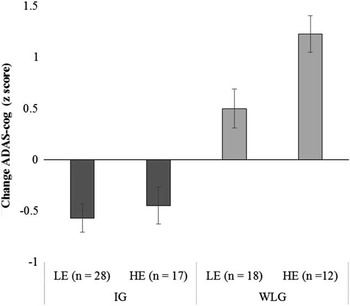
Figure 1 compares the progression of cognitive status of both study groups, stratified by educational level. Regarding the pair-wise comparisons, the MW test revealed significant differences between low and high education groups in the ADAS-cog MCS in the WLG (U=173.00; p<.01; r=.51). Thus, highly educated individuals not receiving cognitive intervention showed an accelerated cognitive decline compared to individuals with lower education. In contrast, no statistical significant differences emerged in the IG when cognitive evolution was compared in low versus high education groups (U=272.00; p=.42; r=.12).
Cognitive decline in study groups, stratified by educational attainment. IG=intervention group; WLG=waiting-list control group; LE-=low education group; HE=high education group; ADAS-cog=Alzheimer’s Disease Assessment Scale-cognitive subscale. Difference between post (T2) and pre-intervention (T1) is represented and line segments represent standard error of the mean. Higher values indicate more cognitive deterioration.

Analyses of Possible Confounders
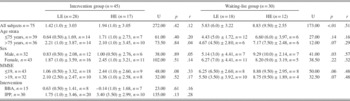
This section includes the analyses of possible factors that may have influenced the MCS (ADAS-cog) in low versus high education groups in both study conditions. As depicted in Table 1, there were no significant differences in the MCS (ADAS-cog) between high versus low education group in the IG condition after stratification by different potential confounders. In the WLG, males with HE showed a faster cognitive decline than those with LE (p=.03; r=.57), while a similar statistical trend was found in patients over 75 years old (p=.07; r=.29).
Change in ADAS-cog stratified by potential confounders

Note: MMSE=Mini-Mental State Examination; ADAS-cog=Alzheimer’s Disease Assessment Scale-cognitive subscale; BBA=Big Brain Academy; IPP=Integrated Psychostimulation Program; U=Mann–Whitney U test; r=effect size for nonparametric data. Figures indicate mean (median)±SD change in the ADAS-cog (i.e., difference between post- [T2] and pre-intervention [T1]) (higher values indicate more cognitive deterioration).
Discussion
In this retrospective analysis, we found evidence of beneficial effects of cognitive interventions in patients with mild AD, regardless of educational attainment. Therapies focused on cognition are widely recognized for people with dementia, although the effectiveness and potential improvements of the diverse approaches in noncognitive domains are not consistently established (Olazarán et al., Reference Olazarán, Reisberg, Clare, Cruz, Peña-Casanova, Del Ser and Muñiz2010). Our results also showed that, when they did not receive any intervention, patients with HE displayed more rapid cognitive deterioration than the LE group, a significantly pronounced effect in males. These findings come to corroborate the results of previous investigations (Andel et al., Reference Andel, Vigen, Mack, Clark and Gatz2006), all supporting the view that, given a similar stage of clinical severity, neuropathology in AD is more advanced in people with higher levels of education (Stern et al., Reference Stern, Alexander, Prohovnik and Mayeux1992). However, it seems particularly interesting that, on the contrary, no significant differences in the progression of cognitive decline were found between high versus low education subgroups in the IG condition, even after post hoc stratification analyses of several potential confounding variables. In brief, higher education is associated with a more rapid cognitive decline in mild AD, but cognitive interventions may help to attenuate this progression.
Previous studies have shown that less educated AD patients achieve a better maintenance of cognitive status after intervention (Breuil et al., Reference Breuil, De Rotrou, Forette, Tortrat, Ganansia-Ganem, Frambourt and Boller1994; Olazarán et al., Reference Olazarán, Muñiz, Reisberg, Peña-Casanova, del Ser, Cruz-Jentoft and Sevilla2004). The discrepancy between results could be explained by several factors. First, both the former studies included patients with dementia at moderate dementia stages, whereas our analysis was focused on mild stages. In this regard, compensatory mechanisms are still working in mild AD stages (Solé-Padullés et al., 2009), but they are less likely to come into play when neuropathology is more advanced, and their efficacy seems diminished (Desgranges et al., Reference Desgranges, Baron, Lalevée, Giffard, Viader, de La Sayette and Eustache2002; Mortimer et al., Reference Mortimer, Borenstein, Gosche and Snowdon2005). Therefore, we could assume that the individuals from our study have more compensatory networks available than the individuals in the Breuil and Olazarán studies.
Second, the heterogeneity of cognitive intervention programs (e.g., content, duration, and number of sessions) can influence intervention outcomes (Choi & Twamley, Reference Choi and Twamley2013), limiting the direct comparison of the findings. In comparison with Breuil’s and Olazaran’s studies, we used an individual cognitive intervention approach, which may have optimized the benefits for highly educated individuals (Fernández-Calvo et al., Reference Fernández-Calvo, Rodríguez-Pérez, Contador, Rubio-Santorum and Ramos2011), particularly for the BBA compared to the IPP. Although higher levels of education would also be associated with greater motivation for success per se (Liu, Bridgeman, & Adler, Reference Liu, Bridgeman and Adler2012), programs based on new technologies and social reinforcement such as BBA may be more familiar and motivating for the HE group compared to the classical IPP paper-pencil tasks. Finally, it should be highlighted that the inverse association between education and benefits of the program in the study of Olazarán et al. (Reference Olazarán, Muñiz, Reisberg, Peña-Casanova, del Ser, Cruz-Jentoft and Sevilla2004) was only detected at the 6- to 12-month follow-up, which is consistent with our findings. Thus, cognitive intervention programs may allow mild AD patients with a higher educational level to maintain more efficient cognitive processing, ameliorating the faster progression of cognitive symptoms during short intervals.
This study has some limitations. First, the retrospective nature of the study limited the number of participants, but the calculated effect size estimates are independent of sample size (Fritz et al., Reference Fritz, Morris and Richler2012). Second, the MCS was assessed in mild AD patients at a relatively short follow-up interval (12 weeks), which limits the generalization of the results over longer periods of intervention. Third, illiterates were excluded, so the conclusions should not be extended to this specific population. In this regard, the education level of the sample was still low, but it is rather similar to the figures obtained in older Spanish adults from a recent population survey (Tola-Arribas et al., Reference Tola-Arribas, Garea, Yugueros, Ortega-Valín, Cerón, Fernández-Malvido and Díaz-Gómez2013). Fourth, the MCS may be biased by the influence of education on baseline ADAS-cog scores, but high versus low education groups did not differ at baseline in this measure. Finally, uncontrolled variables (e.g., literacy, unawareness) could have influenced the results because all participants were not randomized (Contador, Bermejo-Pareja, Del Ser, & Benito-León, Reference Contador, Bermejo-Pareja, Del Ser and Benito-León2015; Fernández-Calvo et al., Reference Fernández-Calvo, Contador, Ramos, Olazarán, Mograbi and Morris2015).
This research confirms that cognition-based intervention programs have beneficial effects on cognition in patients with mild AD. Of interest, AD patients with higher educational attainment showed similar benefits as low educated individuals, suggesting that compensatory mechanisms may be activated through cognitive intervention in persons with mild AD at the studied educational levels, at least during short intervals. Future research should carefully study the effects of education and other CR proxies on cognitive interventions through randomized clinical trials in which CR reserve is previously defined. In particular, it would be interesting to examine the influence of different educational indicators (e.g., years of schooling, literacy, or formal certificates) and how they may play a role in these findings (Contador et al., Reference Contador, Bermejo-Pareja, Del Ser and Benito-León2015). The investigation of different factors that modulate the response to cognitive interventions should help to optimize the efficiency of the existing programs and to inspire new intervention designs.
Acknowledgments
The authors have no conflicts of interest to disclose. We thank the associations of relatives of persons with Alzheimer’s disease and other dementias of Salamanca for their collaboration in the study. The regional government (Junta de Castilla y León) supported this research.