1. Introduction
The widely-acknowledged environmental Kuznets curve (EKC) postulates that as economic development passes a turning point, pollution intensity will decrease, leading to better environmental quality (Grossman and Krueger, Reference Grossman and Krueger1991; Stern, Reference Stern2004). However, few have asked whether pollution-intensive industries develop faster in a time of economic downturn. This question is not practically trivial. Investment in the pollution-intensive industries during the downturn will not vanish when economic prosperity comes back. It will create a prolonged negative impact on the environment. The importance of answering this question is increasing considering that many countries will attempt to fire up their economy in the post-COVID era.
Anecdotal evidence suggests that the answer to the above question might be ‘yes’. China's GDP growth dropped from 14.2 per cent in 2007 to 6.6 per cent in 2018, the weakest since 1990. In the face of this economic downturn, China's environmental regulations got weaker. According to the official documents issued by the Ministry of Ecology and Environment (MEE), the newest regulation on pollution-intensive industries such as cement production changed from shutdown to a staggering peak production during the winter of 2018. Moreover, in the document entitled ‘Action Plan for Comprehensive Treatment of Air Pollution in Autumn and Winter in Jing-Jin-Ji and Surrounding Areas during 2018 October to December’ issued by the MEE, the PM2.5 emissions reduction target declined to 3 per cent, a sharp drop from 15 per cent in the same period of 2017.
Despite its practical importance, there is a shortage of knowledge about the potential environmental impact of an economic downturn. This paper is a modest step to fill this void. We use firm-level panel data from 2005 to 2013 to explore whether negative environmental impact occurred when economic development slowed down. We use the 2008 economic crisis as an exogenous shock and find that pollution-intensive firms grew much faster than non-pollution-intensive firms after the crisis, compared to what we observed before the crisis. The heterogeneity analysis shows that this is more of a phenomenon in regions that received a larger shock or had fewer existing polluting activities. Furthermore, we find that the production of both state-owned enterprises (SOEs) and non-state-owned enterprises (non-SOEs) in pollution-intensive industries grew faster than those in the non-pollution-intensive industries, compared to their relative growth trend before the economic shock; and the production expansion of SOEs is more evident. The production expansion in pollution-intensive industries is likely to lead to a long-term environmental impact since any change of industrial activities has inertia.
This paper adds to two streams of literature. First, it adds to the literature on the environmental Kuznets curve. Since Grossman and Krueger (Reference Grossman and Krueger1991) reported an inverted U-shaped relationship between pollution and income, numerous studies have tested the EKC hypothesis. However, the empirical findings are mixed. Some researchers find evidence supporting the inverted U-shaped relationship between economic growth and pollution (e.g., Panayotou, Reference Panayotou1993; Cole, Reference Cole2004; He and Wang, Reference He and Wang2012; Haider et al., Reference Haider, Bashir and Husnain2020), associated energy intensity (Deichmann et al., Reference Deichmann, Reuter, Vollmer and Zhang2019), and material use (Pothen and Welsch, Reference Pothen and Welsch2019), while others do not (e.g., Vincent, Reference Vincent1997; Perman and Stern, Reference Perman and Stern2003; Akbostancı et al., Reference Akbostancı, Türüt-Aşık and Tunç2009; He and Richard, Reference He and Richard2010).Footnote 1 The empirical results from EKC studies are sensitive to the regression forms and have a weak statistical foundation (Stern, Reference Stern2004). Besides, these studies use data at the level of city, state, and even cross country, and as a result the estimation of the EKC suffers from potential aggregation bias (Xu, Reference Xu2018). More recently, He et al. (Reference He, Xie and Zhang2020) revisited the EKC by investigating how an economic opportunity, i.e., the connection to expressway systems, affects local GDP and environmental quality. They find that the expressway system helps poor counties grow faster in terms of GDP but at the cost of environmental quality, while it retards growth in rich counties.
Similar to He et al. (Reference He, Xie and Zhang2020), this paper takes advantage of an exogenous economic shock to avoid potential methodological pitfalls. Different from He et al. (Reference He, Xie and Zhang2020), which focuses on an exogenous shock of economic opportunity and uses county-level data, we look into the impacts of a negative economic shock on the economy-environment trade-off and further avoid potential aggregation bias by using firm-level panel data. We complement the literature with insights on how pollution-intensive firms’ production behavior would change in response to economic disturbance and find evidence that local governments might sacrifice the environment to achieve economic growth in the face of an economic downturn.
Two other studies have also looked at the impact of an economic shock on the trade-off between the economy and the environment but with different identification strategies. He et al. (Reference He, Pan and Zhang2019) investigate the effect of trade openness on the county-level economy and environment, using reductions in import tariffs as an exogenous economic shock. Bombardini and Li (Reference Bombardini and Li2020) take advantage of export tariff cuts as an exogenous economic shock to estimate the impacts of trade shock on prefecture-level pollution and infant mortality. Our study differs because it uses the 2008 financial crisis as an exogenous shock. We also use data at a finer level to avoid the loss of information in the process of data aggregation. He et al. (Reference He, Pan and Zhang2019) and Bombardini and Li (Reference Bombardini and Li2020) use county-level and prefecture-level data respectively.
Second, this paper contributes to the literature on the influence of an economic crisis. Scholars have investigated the impacts of a sudden economic shock on labor markets (Cho and Newhouse, Reference Cho and Newhouse2011), suicides (Chang et al., Reference Chang, Stuckler, Yip and Gunnell2013), innovation investment (Archibugi et al., Reference Archibugi, Filippetti and Frenz2013), and many others. The study on how economic crisis affects the environment is emerging and no consensus has yet been achieved. The literature has reported rapid growth (Peters et al., Reference Peters, Marland, Le Quéré, Boden, Canadell and Raupach2011), reduction (Castellanos and Boersma, Reference Castellanos and Boersma2012), and V-shaped change (Du and Xie, Reference Du and Xie2017) in pollutants after the 2008–2009 global financial crisis. On the one hand, the stagnation of economic activities has positive effects on environmental quality. On the other hand, the relaxation of environmental regulation has negative impacts on the environment. Governments may sacrifice the environment in exchange for economic recovery, for example, by lowering emission tax (van den Bijgaart and Smulders, Reference van den Bijgaart and Smulders2018). Plants may also decrease pollution reduction efforts when the plant closure rate is high (Bae, Reference Bae2017).
Understanding how corporate production in pollution-intensive and non-pollution-intensive industries has changed in a time of economic downturn is essential to comprehending the mechanism through which economic crisis affects environmental quality. This paper complements the literature by finding that pollution-intensive industries expand more rapidly than non-pollution-intensive industries during the economic downturn, leading to a more polluting economy. This short-term change may have a long-run impact since the accumulated production capacity in the pollution-intensive industry may demonstrate a certain degree of inertia in the future.
The remainder of this paper is organized as follows. Section 2 describes the institutional background. Section 3 introduces the research design. Section 4 provides data and descriptive statistics. Section 5 presents the empirical results. Section 6 concludes the paper.
2. Institutional background
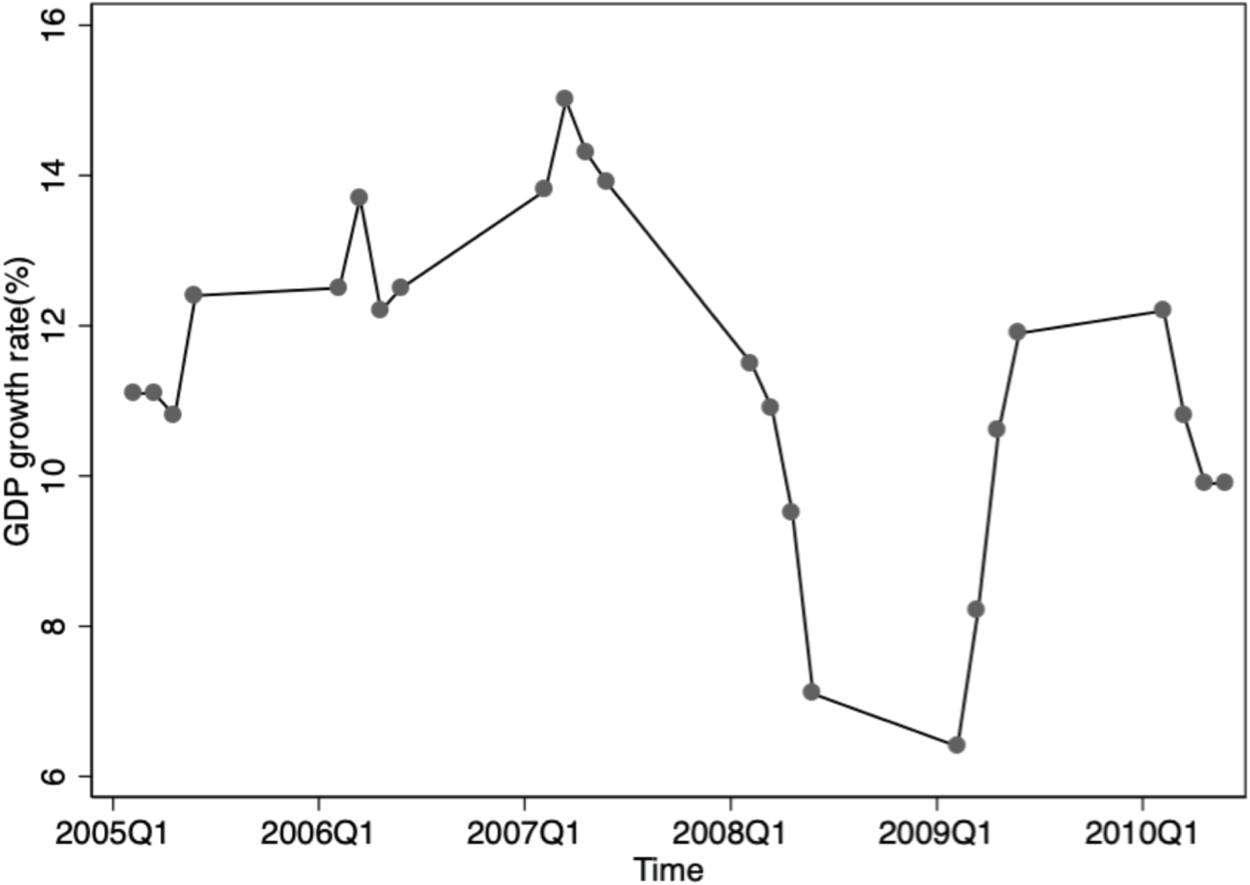
The 2008 financial crisis is considered to be the most serious economic crisis since the Great Depression of the 1930s by many economists. It was triggered by a crisis in the subprime mortgage market in the U.S. in early 2007, and quickly developed into a full-blown global crisis. Figure 1 shows that in the third quarter of 2008, the growth rate in China began to drop. Thus, we consider the year 2008 to be the start year of China's economic recession. In November of 2008, the Chinese central government introduced a four trillion RMB investment plan. With this strong intervention, the overall economy rebounded in the second quarter of 2009, but this recovery did not continue. The GDP growth rate began to decline after reaching a peak in the first quarter of 2010.
Quarterly GDP growth in China: 2005 to 2010.
Source: National Bureau of Statistics

The central task of this paper is to look at whether the relative trend of production growth in pollution-intensive industries versus non-pollution-intensive industries was shifted by the economic downturn. The MEE formulates the rules to address environmental issues and requires local administration to be responsible for the enforcement of the regulations. China has taken stable economic growth as a top priority for fear of large-scale job losses and social instability, which has been well-documented in the literature. Zhou (Reference Zhou2004) argues that local officials in China have strong incentives to compete on the dimension of economic growth because their promotion often hinges on winning this competition. Yang et al. (Reference Yang, Chen and Zhou2008) find that local environmental policies focus more on competing for capital, rather than addressing environmental issues. Given this, we hypothesize that when an economic downturn occurs, the government has a motivation to relax its environmental regulations and enforcement, resulting in faster growth of pollution-intensive industries. For instance, Liu and Raven (Reference Liu and Raven2010: 840) documented, ‘Before the financial crisis, the environmental performance was becoming a criterion for evaluating and selecting government officials, but the financial crisis has brought back the dominance of GDP growth in official thinking.’ As a result, the transition to a cleaner economy has been slowed down.
Anecdotal evidence of the relaxation of environmental enforcement was abundant shortly after the crisis. As early as December 2008, the then Ministry of Environmental Protection (MEP) adopted a ‘green passage’ policy to speed up approval of industrial projects. In 2009, the MEP further shortened the time for the construction project review process from the original five days to two days, and the number of project review meetings was changed from once a month to twice a month (Ministry of Environmental Protection, 2010). Provincial environmental agencies quickly followed suit. Environmental agencies in Yunnan province cut the time limit to review environmental impact assessments from the maximum 60 days to as few as ten days (Southern Weekly, 2009). According to Xiaoqing Wu, the then deputy minister of the MEP, only 14 of 194 environmental impact assessment projects were suspended or rejected by the MEP from November 2008 to February 2009 (People's Daily Online, 2009). That is, the approval rate was more than 90 per cent, much higher than the 70 per cent in 2006 (Southern Weekly, 2009).
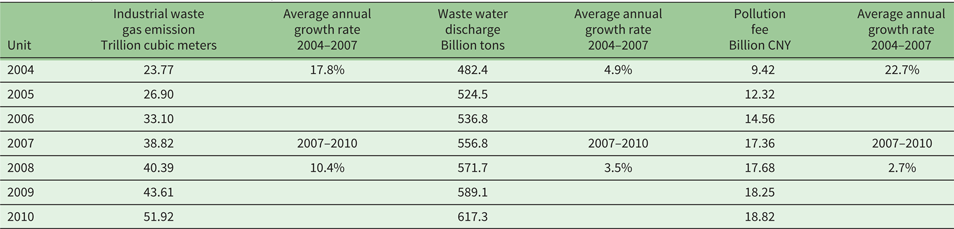
In the four trillion RMB stimulus package announced on March 6, 2009, the ecological and environmental investment dropped sharply from 350 billion yuan to 210 billion yuan, accounting for only 5.3 per cent (Central Government of The People's Republic of China, 2009; Liu and Raven, Reference Liu and Raven2010). An article from the MEP website mentioned, ‘we observe that some local governments tend to pursue quick success and returns for maintaining economic growth… In those areas, traditional pollution-intensive industries, such as steel and cement, are expanding blindly. Some projects start before environmental impact assessments. The phenomenon of illegal sewage discharge still exists’ (Central Government of the People's Republic of China, 2010). Table 1 documents the waste gas emission, wastewater discharge, and pollution fee charges in the years surrounding 2008. It is clear that from the pre-crisis period (2004–2007) to the post-crisis period (2007–2010), the average annual growth rate of pollution fee charge sharply plunged by 88 per cent. In comparison, the decline in the growth rate of industrial waste gas emission and wastewater discharge was only about 42 per cent and 29 per cent respectively.
Waste gas emission, waste water discharge, and pollution fee, 2004–2010

Data Source: China Statistical Yearbook of the Tertiary Industry, China Statistical Yearbook of Environment.
3. Research design
Our main hypothesis is that the negative economic shock in 2008 led to faster development of pollution-intensive industries in China. We further hypothesize that the phenomenon of sacrificing the environment for economic growth is more likely to occur: (i) in areas with a larger economic shock (heterogeneity hypothesis i); (ii) in areas with fewer existing polluting activities (heterogeneity hypothesis ii); and (iii) for SOEs (heterogeneity hypothesis iii). The heterogeneity hypotheses (i) and (iii) are further confirmations of our main hypothesis. For heterogeneity hypothesis (i), with a larger economic shock, the motive of using a clean environment to generate economic income would be stronger and therefore local governments would be more likely to adopt this strategy. Heterogeneity hypothesis (ii) stems from the property of decreasing marginal productivity of production factors. In areas with fewer existing polluting activities, the marginal productivity of pollution would be higher than those with more pollution. Therefore, using a clean environment for higher production is more likely to be an attractive option.
For heterogeneity hypothesis (iii), we test whether SOEs and non-SOEs behave differently in terms of their relative performance in pollution-intensive versus non-pollution-intensive industries. Previous studies find that a firm's ownership structure plays a significant role in determining the enforcement of environmental regulations (Wang and Wheeler, Reference Wang and Wheeler2003) and thus corporate environmental performance (Hering and Poncet, Reference Hering and Poncet2014). Since the key mechanism that drives our hypothesis is the relaxation of environmental regulatory enforcement, and SOEs have been demonstrated to have larger bargaining power with governments than non-SOEs (Wang and Jin, Reference Wang and Jin2007), we would argue that the relatively faster growth of pollution-intensive industries should be more pronounced for SOEs. Studying these three heterogeneity hypotheses also serves as a robustness test of our main findings.
We estimate the impact of the economic shock on corporate production using a difference-in-differences (DiD) strategy. We are aware that the non-pollution-intensive industry is also affected by the economic crisis and cannot serve as a control group in a traditional sense. But for our research purpose, this does not matter since our interest is looking at whether the relative growth trend between the pollution-intensive industries and non-pollution-intensive industries has been shifted by the economic downturn, instead of measuring the economic downturn's net negative shock on pollution-intensive industries.
The baseline model is as follows:

where ${Y_{it}}$ stands for the dependent variables: the natural logarithm of the gross industrial output of firm i at year t; $\; Pos{t_t}$
 is a dummy variable equal to 0 for 2005–2007 and 1 for 2008–2013; ${\rm Pollution}_i$
 is also a dummy variable equal to 1 if firm i belongs to pollution-intensive industries and 0 otherwise; $\; {Z_{it}}$
 is a vector of control variables including several financial and operational indicators of firm i at year t, including total assets, firm age, number of employees, and leverage ratio. Assets and employees are included to measure the size of capital and labor, two important production factors that determine output. We use firm age as a coarse account for the level of technology. Generally, the cost for new technology adoption is lower for younger firms. The leverage ratio is defined as the ratio of the total debt to the total assets, measuring the ability of a company to meet its financial obligations. The financial crisis may affect the output of the firm via tightening funding sources. The term ${u_i}$
 captures firm fixed effects, accounting for firm characteristics that vary across firms but not over time. The term ${\lambda _t}$
 controls factors that shift over time but similarly affect all firms. ${\varepsilon _{it}}$
 is an error term.
The parameter ${\beta _1}$ is our primary interest. This parameter captures whether the relative production growth trend between pollution-intensive industries and non-pollution-intensive industries has been shifted by the 2008 economic crisis, and therefore demonstrates the environmental impact of the economic downturn.
As we discussed, we hypothesize that the phenomenon of sacrificing the environment for economic growth is likely to happen in regions: (i) with a larger economic shock; (ii) with fewer existing polluting activities; and (iii) for SOEs. We run the following regressions to test the hypotheses. For (i), we run model (2):

to see if the economic downturn leads to a more significant production growth among firms in pollution-intensive industries relative to those in non-pollution-intensive industries, in areas that are hurt more through the drop of external demand/export caused by the economic shock.
The key difference between models (1) and (2) is that the latter includes $Expor{t_c}$ , the average ratio of total export to sales value in manufacturing industries at the city level in 2004. Scholars have found that trade shock has impacts on local environmental quality in China, no matter whether in terms of import (He et al., Reference He, Pan and Zhang2019) or export (Bombardini and Li, Reference Bombardini and Li2020). The 2008 economic crisis was triggered by the financial crisis in the U.S. and significantly affected China's exports. It is reasonable to assume that the economic shock should be larger in regions with higher export dependence. The estimated coefficient of ${\beta _1}$
 in model (2) tells whether the environmental impact from the economic downturn is different between areas with a higher dependence on exports and those with lower dependence. Similarly, for (ii), we run the following model to see if the economic downturn leads to faster growth of pollution-intensive industries relative to non-pollution-intensive industries in areas with fewer existing polluting activities:

The variable $Intensit{y_c}$ is the ratio of the outputs from pollution-intensive industries to total output from the manufacturing industries in city c in 2004. A smaller $Intensit{y_c}$
 means a lower contribution to the economy from pollution-intensive industries and thus a cleaner environment before the economic crisis. The estimated coefficient of ${\beta _1}$
 in model (3) tells whether the environmental impact from the economic downturn is different between areas with a larger share of pollution-intensive industries and those with a smaller share.
For (iii), we classify our sample into two groups: SOEs and non-SOEs and redo regressions of model (1) over the two groups separately. To compare the coefficients in separate DiD regression for SOEs and non-SOEs samples, we run the following model:

The estimated coefficient of ${\beta _1}$ in model (4) tells whether the difference in the environmental impact of economic downturn between SOEs and non-SOEs is statistically significant.
For all the equations, we cluster the standard error at two different levels: (1) at the firm level to account for possible serial correlation in the dependent variable; and (2) at the city level since the explanatory variables of export dependence and polluting intensity only vary at that level. The standard errors are significantly larger when clustering at the city level. To be conservative, we report the results from regressions with error terms clustered at the city level.
4. Data and descriptive statistics
We obtain related corporate production and financial data from the annual surveys collected by the National Bureau of Statistics of China (NBS). This is the most comprehensive firm-level dataset in China and has been widely used by researchers such as Brandt et al. (Reference Brandt, Van Biesebroeck and Zhang2012). It covers all the SOEs and other large-scale firms (total sales greater than 5 million CNY before 2011 and 20 million CNY after 2011). In this paper, we construct a balanced panel dataset at the firm level from 2005 to 2013, spanning three years before the start of the recession (2005–2007) and five years during or after the recession (2008–2010, 2012, 2013). We also drop all the firms that have changed their city location during the studied period. We do not include 2011 because several important variables are missing from the 2011 database. We also did regression analyses with the year 2011 included but the variables with missing information dropped. We also did analyses for samples from 2005 to 2010 considering the change in the definition of large-scale firms. All the results stay robust and are available from the authors upon request.
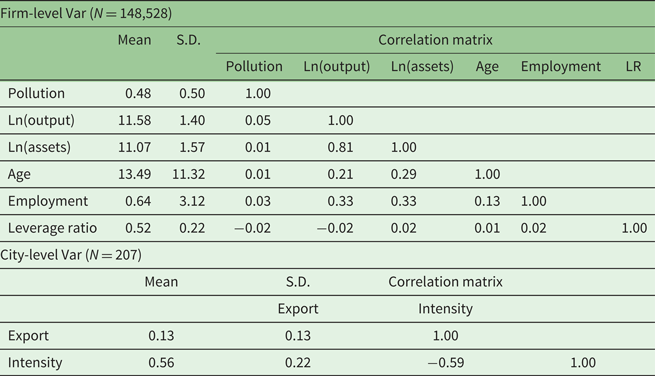
In the heterogeneity analysis, for (i), we use export dependence, i.e., the average ratio of total export to sales value in manufacturing industries at the city level in 2004, to measure the severity of economic shock. The measured export dependence ranges from 0.1 per cent to 70 per cent, providing a decent variation for identification. For (ii), we define polluting intensity as the ratio of output from pollution-intensive industries to the total output from manufacturing industries at the city level. The data was based on the 2004 annual survey collected by NBS.Footnote 2 We define pollution-intensive industries based on the ‘Guideline for Environmental Information Disclosure of Publicly Listed Companies’ issued by MEE in 2010. Accordingly, 16 industries are classified as pollution-intensive industries: thermal power, steel, cement, electrolytic aluminum, coal, metallurgy, chemicals, petrochemicals, building materials, paper, brewing, pharmaceuticals, fermentation, textile, tanning and mining. Other manufacturing industries are treated as non-pollution-intensive industries. Table 2 shows the descriptive statistics of the main variables.
Descriptive statistics of main variables

Source: Manufacturing firm data from the NBS (2005–2010, 2012, 2013).
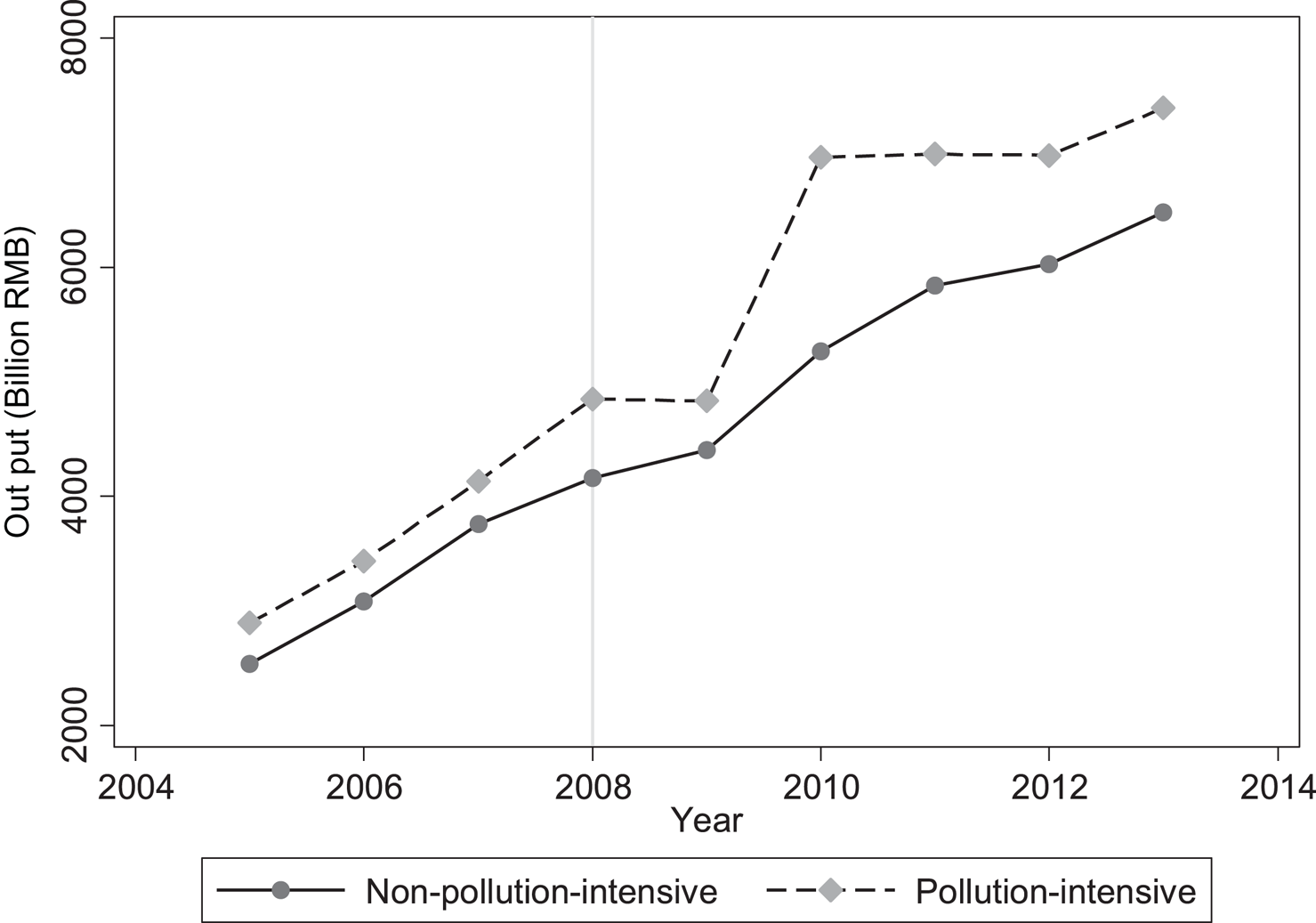
About 48 per cent of our sampled firms belong to pollution-intensive industries. The average city-level export dependence is 0.13 with a variance of 0.13, while the average city-level polluting intensity is 0.56 with a variance of 0.22. The correlation between export dependence and polluting intensity (at city level) is −0.59, showing that cities hosting more pollution-intensive industries rely less on exports. The correlations of the city-level and firm-level variables are also shown in table 2 and show no sign of multicollinearity. Figure 2 shows the time trend of output for pollution-intensive industries and non-pollution-intensive industries. We observe faster growth of pollution-intensive industries relative to non-pollution-intensive industries after the economic crisis. Pollution- and non-pollution-intensive industries have a largely parallel trend before the economic crisis, while pollution-intensive ones achieved a faster growth. The following analysis aims to demonstrate that it is the economic crisis, instead of other potential confounding factors, that leads to this pattern change.
The trend of output for pollution-intensive and non-pollution-intensive industries before and after the financial crisis.

5. Empirical results and analyses
5.1 Primary results
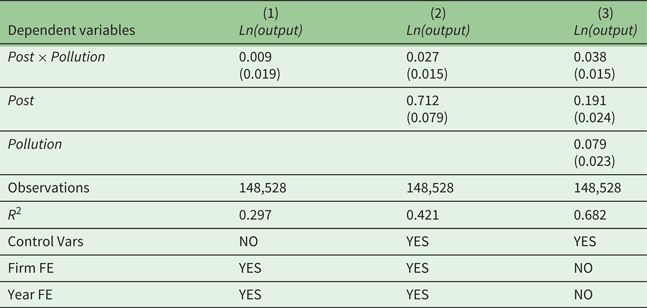
Table 3 shows the regression results from specifications (1) using Ln(output) as the dependent variable. Column (1) reports the estimation of model (1) without control variables and column (2) reports the result from model (1) with the full set of control variables. Column (3) displays the estimation of model (1) without firm fixed effects and year fixed effects.
Impact of economic shock on firms’ outputs

Notes: Standard errors in parentheses are clustered at the city level. The regression results are based on data in the years of 2005–2010, 2012 and 2013. The data in 2011 are excluded since the variable of employment is missing from the 2011 data. The results remain robust if we include the sample in 2011 and drop the variable of employment in the regression analysis.
Most importantly, the estimated coefficient of the interaction term of Postt × Pollutioni in column (2) is 0. 027. This evidences that, compared to the pre-shock period, firms in pollution-intensive industries achieved a much faster growth of outputs than those in non-pollution-intensive industries after the economic shock. The growth rate of firms in pollution-intensive industries is about 3 per cent higher than those in non-pollution-intensive industries, compared to their difference before the economic shock. This 3 per cent is economically significant in magnitude considering that the average growth rate of pollution-intensive industries before the crisis was about 10 per cent. One competing explanation of the relative expansion of pollution-intensive industries is that, given that the growth rate fell during the economic downturn, the pollution-intensive industries are less affected by the economic crisis. Figure 2 shows that this is not the case. In a nutshell, the empirical analyses confirm our main hypothesis, that is, an economic shock leads to a polluting environment. The primary finding is consistent with Peters et al. (Reference Peters, Marland, Le Quéré, Boden, Canadell and Raupach2011) which find that CO2 emissions grew rapidly after the 2008–2009 global financial crisis due to strong emissions growth in emerging economies, a return to emissions growth in developed economies, and an increase in the fossil fuel intensity of the world economy.
5.2 Heterogeneous analyses
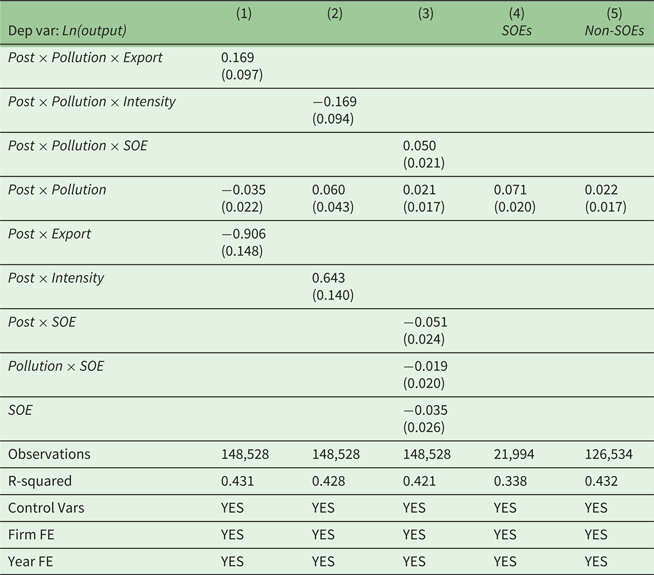
Table 4 presents the results of heterogeneous analyses. Column (1) reports the estimation results from regression model (2), column (2) reports the estimation results from regression model (3), and column (3) reports the estimation results from regression model (4). We are interested in the coefficients of the triple interaction term. In column (1), the estimated coefficient of the triple interaction term of Postt × Pollutioni × Exportp is 0.169, indicating that the faster output growth in pollution-intensive industries (relative to non-pollution-intensive industries) is more of a phenomenon in places with higher dependence on exports. The estimated coefficient of the interaction term of Postt × Pollutioni is not statistically significant, indicating that cities where industrial firms do not engage in exportation would not experience expansion in pollution-intensive industries. Since the areas with a higher dependence on exports experienced a larger shock during the crisis (Amiti and Weinstein, Reference Amiti and Weinstein2011; Eaton et al., Reference Eaton, Kortum, Neiman and Romalis2016), this result shows that the economic shock, instead of other confounding factors, is the reason that shifts the relative growth rate between pollution-intensive and non-pollution-intensive industries away from their pre-shock pattern.
Economic shock on firms’ outputs: heterogeneous analyses

Notes: Control variables include firm size, firm age, number of employees, and leverage ratio. Standard errors in parentheses are clustered at the city level.
This, therefore, provides further supporting evidence for the main hypothesis. In column (2), the coefficient of the triple interaction term of Postt × Pollutioni × Intensityc is −0.169. This shows that the faster relative growth rate in pollution-intensive versus non-pollution-intensive industries is more of a phenomenon in areas with a smaller stock of pollution-intensive industries. Again, this is consistent with the property of decreasing marginal productivity of production factors. In a clean area, the marginal economic benefit from sacrificing environmental quality is higher than in areas that already have significant pollution-intensive industrial activities. Therefore, trading environmental quality for economic growth is a more attractive option for clean regions.
We classify our sample into two groups, SOEs and non-SOEs, and redo regressions of model (1) over the two groups separately. We further compare the coefficients in separate DiD regression for SOEs and non-SOEs samples. The results are shown in columns (3)–(5) in table 4. Column (4) reports the estimation results for the SOEs. The estimated coefficient of the interaction term of Postt × Pollutioni is 0.071 and is statistically significant at the 1 per cent level. Column (5) reports the results for non-SOEs. The estimated coefficient of the interaction term of Postt × Pollutioni is 0.022 but not statistically significant. Looking at the magnitude, the coefficient from the analysis of SOEs is larger than the one from non-SOEs. The three-way interaction term Post × Pollution × SOE in column (3) effectively compares the coefficients in separate DiD regression for SOEs and non-SOEs samples, indicating the difference is statistically significant. We conclude that enterprises in pollution-intensive industries produce more relative to those in non-pollution-intensive industries, deviating from their pre-crisis difference, and the production expansion is mainly driven by SOEs.
5.3 Further tests addressing other concerns
In this section, we run a battery of tests. First, we allow the pollution-intensive and non-pollution-intensive industries to follow a different time trend, both in linear and nonlinear form. Second, we use the years before 2008 as the year of economic crisis to conduct placebo tests. Third, we discuss whether another shock on industrial firms in China, that is, the 2008 new Chinese Labor Contract Law, could explain the fast growth of pollution-intensive industries after 2008. Fourth, we check whether the environmental impact from the economic crisis is a long-term or short-term one. If the economic shock is the reason, the relative growth difference between pollution-intensive and non-pollution-intensive firms should remain after the economic shock due to the inertia in industrial activities.
Controlling for the Time Trend. A concern is that firms in pollution-intensive and non-pollution-intensive industries may follow a different growth pattern due to reasons other than the economic crisis. Although figure 2 suggests that this is not likely the case, to be conservative, we run a test that allows the pollution-intensive and non-pollution-intensive industries to follow a different time trend. Specifically, we control both linear and quadratic time trends and add an interaction term between time trend and the dummy variable of pollution-intensive industries based on model (1) and estimate the following specification:

Additionally, for a more flexible approach, we use the interaction of time dummies for all years (the year 2007 as the base year) with the pollution indicator and explore whether there was any differential development across the period of interest. The specification is an augmented version of model (1) as below:

Instead of a post-treatment dummy, we include a series of ${D_{i,t + k}}$ in the regression. It is a dummy variable that is equal to 1 if firm i belongs to one of the 16 pollution-intensive industries and the shock occurs at year $t + k$
 , and 0 otherwise. We let t = 2,007 and it is omitted from the regression, so the year 2007 serves as the baseline year. The estimated coefficients of ${\beta _{ - 2}},{\beta _{ - 1}},{\beta _1},{\beta _2},{\beta _3},{\beta _4},{\beta _5}$
 tell whether the difference between pollution-intensive and non-pollution-intensive industries in the years of 2005, 2006, 2008, 2009, 2010, 2012 and 2013 is significantly different from the baseline year of 2007, respectively.
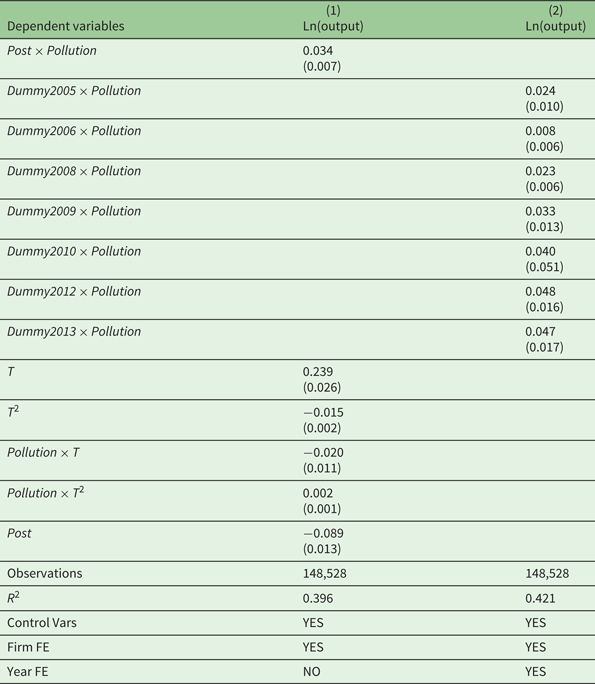
Table 5 displays the results. Column (1) shows the estimation results of model (5) and column (2) shows the results of model (6). It is obvious that the estimated coefficients of the interaction term of $Pos{t_t} \times Pollutio{n_i}$ remain statistically significantly positive. The result in column (1) confirms that firms in pollution-intensive industries grew faster than those in non-pollution-intensive industries after the economic shock, even after controlling for the pre-existing time trends by allowing the trend to be different between pollution-intensive versus non-pollution-intensive industries. The result in column (2) details the development of pollution-intensive industries across the time of interest and also tests the pre-treatment parallel trend between pollution-intensive industries and non-pollution-intensive industries. The growth of pollution-intensive industries relative to the non-pollution-intensive industries is slowing down before the economic crisis. This trend is reversed after the economic crisis. After the crisis, pollution-intensive industries achieve faster growth compared to the non-pollution-intensive industries. This would make the impact of the economic shock on the growth of pollution-intensive industries relative to non-pollution-intensive industries more conservative.
Regression results with time trend controlled

Notes: Control variables include firm size, firm age, number of employees, and leverage ratio, Standard errors in parentheses are clustered at the city level.
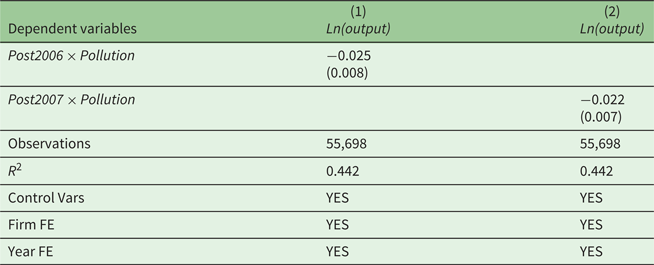
Placebo Test. In this section, we treat the years 2006 or 2007 as the time when the economic downturn occurred and reanalyze the environmental impact of these fake economic crises. In these analyses, we exclude the observations from 2008 to 2013 to avoid the impact of the true economic shock. If our regression results in earlier sections are only a result of pre-existing time trends, we would obtain similar observations when using 2006 or 2007 as the year of shock.
The results are reported in table 6. Column (1) reports the results of using 2006 as the fake economic crisis year and column (2) reports the results of using 2007 as the fake year. It is clear that similar observations – firms in pollution-intensive industries grow faster than those in non-pollution-intensive industries – do not appear in either case. On the contrary, the estimated coefficient of the interaction term of $Pos{t_{2006}} \times Pollutio{n_i}$ is significantly negative, as is the interaction term of $Pos{t_{2007}} \times Pollutio{n_i}$
 . The negative coefficients indicate a trend of a slower growth rate in pollution-intensive industries. Therefore, it must be something that occurred after 2007 that leads to much faster growth of pollution-intensive industries. According to our discussion, the economic downturn in 2008 is the most plausible explanation.
Placebo test: using 2006 or 2007 as the year of shock

Notes: The estimations are based on the sample excluding observations in 2008–2013. Control variables include firm size, firm age, number of employees, and leverage ratio. Standard errors in parentheses are clustered at the city level.
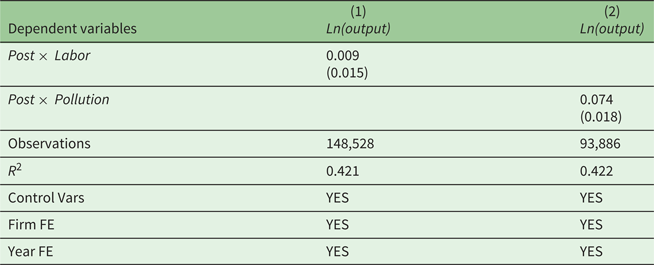
One Competing Explanation. Another event that has significantly affected industrial enterprises is the new Chinese Labor Contract Law, which came into effect on January 1, 2008. This bill provides detailed provisions on the signing, performance, and termination of labor contracts, and so forth, to stabilize labor relations and protect employees’ rights and interests. Considering that this new law may affect firm production through increasing labor costs, our earlier observations may be driven by the new Labor Contract law, instead of the economic downturn, if the labor intensity is significantly different between pollution-intensive industries and non-pollution-intensive industries.
To alleviate this concern, we classify all the industries into more labor-intensive sectors and less labor-intensive sectors based on Yang and Zhang (Reference Yang and Zhang2015). Nineteen industries fall into the category of labor-intensive industries. We include an interaction term of Postt × Labori instead of Postt × Pollutioni in model (1), where Labor = 1 if a firm belongs to one of the 19 labor-intensive industries, and 0 otherwise. If it is the new Chinese Labor Contract law that drives our observed phenomenon, the estimated coefficient on the interaction term of Postt × Labori should demonstrate a statistically significant impact.
Column (1) of table 7 shows that the estimated coefficient of Postt × Labori is 0.009 and is not statistically significant. This provides evidence that our key findings are not confounded by the implementation of the new Chinese Labor Contract law. To further alleviate the concern, we remove the 19 labor-intensive industries from the sample and focus our analyses on the less labor-intensive industries which should not be significantly affected by the new Labor Contract law. Column (2) of table 7 presents the results. The estimated coefficient of the interaction term of Postt × Pollutioni is 0. 074, which is significantly positive at the level of 1 per cent, indicating that in the industries which are not significantly affected by the Labor Contract Law, our main findings remain, that is, the outputs of pollution-intensive firms grow much faster than those of non-pollution-intensive firms as a result of the economic downturn.
Alternative explanation: the new Chinese labor contract law

Notes: The results in column (1) are based on the full sample. The results in column (2) are based on the sample of firms in less labor-intensive industries. Control variables include firm size, firm age, number of employees, and leverage ratio. Standard errors in parentheses are clustered at the city level.
Long-term or Short-term Impact. Figure 1 shows that the 2008 economic crisis was a short downturn, and China's economy recovered quickly in 2009 under the intervention of the government's strong counter-cyclical policies. A natural question is, whether the phenomenon of sacrificing environmental quality in exchange for economic development only showed up in 2008 or continued in the following years.
The results in column (2) of table 5 show that the phenomenon of relatively faster output growth in pollution-intensive industries appears immediately after the crisis in 2008 and continues in the years after. The estimated coefficients of the five interaction terms of 08dummy × Pollutioni, 09dummy × Pollutioni, 10dummy × Pollutioni, 12dummy × Pollutioni and 13dummy × Pollutioni are 0.023, 0.033, 0.04, 0.048 and 0.047 respectively, and almost all are statistically significant at the 1 per cent level. Additionally, we also analyze the change of total asset investment in pollution-intensive industries. We find weak evidence that firms in pollution-intensive industries grow the investment of their assets faster during and after the economic downturn, relative to those in non-pollution-intensive industries (see figure A1 and table A1 in the online appendix). Putting all of these observations together, we conclude that the faster growth of pollution-intensive industries appears during the economic crisis and will likely continue into the following years. This is because any change in industrial activities and economic structure has inertia. Even if environmental regulation could be tightened again when the economy gets better, existing substantial investment in polluting capital may take a much longer time to be depreciated. Of course, in the longer term, we expect the pollution-intensive industries would be constrained from quicker development because a more environment-economy balanced growth must be the norm for the future world.
6. Conclusion
This paper investigates the potential environmental impact of an economic downturn. We find that, compared to the pre-crisis period, pollution-intensive firms tend to produce more compared with non-pollution-intensive firms during and after the economic crisis, and this effect is especially pronounced in the cities with higher export dependence and cities with a lower concentration of pollution-intensive industries. These results are robust to a series of robustness checks. The output of pollution-intensive industries and non-pollution-intensive industries displays a largely parallel trend before the economic crisis. Although the pre-trend appears not to be strictly ‘paralleled’ after controlling for other factors that affect the output, the growth of pollution-intensive industries relative to the non-pollution-intensive industries is slowing down before the economic crisis. This trend is reversed after the economic crisis. After the crisis, pollution-intensive industries achieve faster growth compared to the non-pollution-intensive industries. This would make the impact of the economic shock on the expansion of pollution-intensive industries more conservative.
Speaking to the theory, although the EKC predicts declines in environmental pollution when income grows in the long term, the faster growth of pollution-intensive industries may kick back during an economic downturn. This observation has important policy implications because the growth of pollution-intensive production during the economic crisis signals weaker enforcement of environmental regulations and may have a prolonged impact on environmental protection. During a weak global economy, the trade-off between environmental protection and economic growth, or the trade-off between long-term and short-term benefits, needs to be properly handled. The policy implication of this study is particularly alarming for China, considering that China's economic growth has slowed down and its environmental challenge continues to mount. In his 2020 address, Ganjie Li, the Minister of the MEE of China, warned that the pollution-intensive industries, including crude steel, cement, ethylene, and glass, were growing unexpectedly fast as some local governments countered the weakening economy with relaxing environmental regulations, and this placed more pressure on environmental protection (Li, Reference Li2020). Policymakers also need to keep this lesson in mind when attempting to stimulate the economy in a post-COVID era.
One caveat of this paper is that we cannot directly measure the strength of environmental regulation enforcement and observe how it changed during the financial crisis. For instance, if firms provide goods for which consumption was not largely affected by the financial crisis AND all of these firms happen to belong to pollution-intensive industries, although our results are still valid, our argument of weakening regulation is flawed. We recognize that we cannot fully rule out this possibility, and hope future studies can address this.
Supplementary material
The supplementary material for this article can be found at https://doi.org/10.1017/S1355770X22000195
Acknowledgements
Haitao Yin thanks the financial supports from the National Natural Science Foundation of China (No.71974124,72192833) and the Institute of Eco-Chongming.
Conflict of interest
The authors declare none.