Politicians always campaign in poetry and govern in prose, as Mario Cuomo once said. Obama’s foreign policy began similarly with lofty aims, yet ended modestly. However, one of the puzzles of the Obama administration was the chasm between the soaring rhetoric at its beginning and the prosaic realities of foreign policy at its end. This chasm resulted from the power of narrative and the strategic choices of the president himself. Because the Obama team ultimately accepted the narrative of a War on Terrorism (Krebs Reference Krebs2015), and because the chief executive had a keen sense of strategic tradeoffs, the administration ultimately embraced a doctrine that led to inaction in Syria (Goldberg Reference Goldberg2016).
The modest Obama Doctrine became clear by 2014, when the president famously summed up his foreign policy as mostly “avoiding errors,” hitting singles and doubles, and “every once in a while,” a home run (Obama Reference Obama2014). Baseball fans call this “small ball.” Obama also summed up his policy in a concise maxim: “Don’t do stupid s[tuff]” (Parsons, Hennessey, and Richter Reference Parsons, Hennessey and Richter2014). Such humble and negative aims demonstrated Obama’s strategic vision in practice. Caution became the closest thing to an Obama Doctrine; “Don’t Do Stupid Stuff” was elevated to an overriding imperative.
Obama’s supporters would argue that such an imperative was a wise pendulum swing away from the expansive neoconservative Bush vision that fought a global war on terrorism, used force to impose democracy, and engaged in nation-building in Iraq and Afghanistan (Goldberg Reference Goldberg2016). If the Bush team swung for the fences, the Obama team would play small ball: making contact, getting things in play, running the bases with smart and achievable policy moves. The Obama team had a clear strategy, rooted in a posture of caution, retrenchment, and realism. However, this strategy appeared as a puzzling departure from the lofty rhetoric of Obama’s advisers and the president himself.
THE PUZZLE: FROM LOFTY SPEECHES TO PROSAIC REALITIES
During the 2008 campaign, one observer argued that Obama’s foreign-policy team offered “the most sweeping liberal foreign-policy critique we’ve heard from a serious presidential contender in decades” (Ackerman Reference Ackerman2008). The story clearly reflected input from Obama’s two top foreign-policy advisers during the campaign. Susan Rice, a top adviser to candidate Barack Obama, distinguished Obama’s strategic vision as “forward-looking,” in contrast to rival Hillary Clinton’s vision that was “rooted in the past” (Berman Reference Berman2008). Rice, in turn, wrote the preface to a 2008 report published by the Center for a New American Security, in which she credited the contributors with seeing “opportunities as well as challenges in the deep and unavoidable interconnectedness of our age, the rise of countries on every continent as emerging powers, and the broadening of the global agenda” (Rice Reference Rice, Slaughter, Jentleson, Daalder, Blinken, Brainard and Campbell2008, 3). On this view, the conditions of globalization would require a new, transcendent strategic vision. After ending the wars in Iraq and Afghanistan, attention could shift to global issues such as trade, climate change, nuclear proliferation, and humanitarian intervention.
The nudge toward humanitarian intervention came from Obama’s other high-profile foreign-policy adviser, Samantha Power. In a Pulitzer Prize–winning book, Power advocated for intervention to stop genocide (Power Reference Power2002). In a lesser-noticed book, she also profiled a leading United Nations official and held him up as an example for future leaders (Power Reference Power2008). Based on the presence of both Power and Rice in key positions through campaigning as well as governing, one would guess that Obama’s foreign policy would focus on stopping genocide and promoting humanitarian ideals through multilateral organizations. Instead, puzzlingly, Obama will be known for eschewing grand visions and playing down ideals. Far from stopping the carnage in Syria, the Obama team stayed on the sidelines and elevated “sitting out” to a virtue—even after millions of refugees were displaced.
Far from stopping the carnage in Syria, the Obama team stayed on the sidelines and elevated “sitting out” to a virtue—even after millions of refugees were displaced.
Whereas close observers could detect signs of realism in Obama’s foreign policy (Randall 2008/Reference Randall2009), most early signs pointed to bold transformations. One sign was the Prague speech of April 2009, in which Obama stated an American “commitment to seek the peace and security of a world without nuclear weapons” (Obama Reference Obama2009a). Although stopping well short of declaring an immediate commitment to the abolition of such weapons, it was a bold declaration in that direction. As such, the Prague speech signaled a potential shift away from the long-entrenched system of nuclear deterrence. Advocates of nuclear abolition cheered; the strategic context seemingly favored such bold moves (Karp Reference Karp2012). Obama’s May 2016 visit to Hiroshima, the first ever by a sitting US president, confirmed Prague’s gesture toward a nuclear-free world.
A second early sign came in Obama’s Middle East policy speech in Cairo in June 2009. The speech sought to reset relations with the region by capitalizing on his unusual biography. As the son of a Kenyan and with a middle name of “Hussein” who had studied in an Indonesian madrasa, Obama first affirmed the Muslim and Arab worlds, boldly stating that “Islam is a part of America” (Obama Reference Obama2009b). However, he pivoted to argue that America’s respect for religious freedom showed the US commitment to “recognizing our common humanity” (Obama Reference Obama2009b). In turn, Obama argued, the conditions of globalization required this focus:
For we have learned from recent experience that when a financial system weakens in one country, prosperity is hurt everywhere. When a new flu infects one human being, all are at risk. When one nation pursues a nuclear weapon, the risk of nuclear attack rises for all nations. When violent extremists operate in one stretch of mountains, people are endangered across an ocean. When innocents in Bosnia and Darfur are slaughtered, that is a stain on our collective conscience. That is what it means to share this world in the 21st century. That is the responsibility we have to one another as human beings (Obama Reference Obama2009b).
This was a rhetorical nod toward globalism and humanitarianism by arguing that an interconnected, shared world forces peoples to recognize their common interests. Instead of asserting America’s narrow national interests, the United States would take responsibility for shared global concerns. In the Cairo vision, America was no longer imposing democracy on the Middle East; it was the facilitator of “a world where governments serve their citizens, and the rights of all God’s children are respected…That is the world we seek. But we can only achieve it together” (Obama Reference Obama2009b). Two years later, the Obama team did help to ease Hosni Mubarak out of power in Egypt, and it supported a NATO air campaign in Libya to oust the Qaddafi regime.
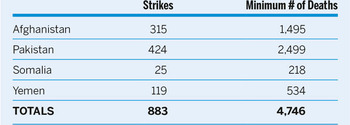
However, the team also stayed on the sidelines when regimes used violent force to suppress popular uprisings in Bahrain, Syria, and Yemen. Apart from isolated airstrikes and cyberwar against the Islamic State (ISIS) (Hennigan Reference Hennigan2016) and Iran (Kaplan Reference Kaplan2016, 203–20; Sanger Reference Sanger2012; Zetter Reference Zetter2014), interventions in the troubled region were minimal. Instead of committing US ground forces, the Obama administration focused on advising, assisting, and training Afghan, Iraqi, and Yemeni forces—with small-scale, occasional assistance from Special Operations forces. Obama also escalated the use of unmanned drones. According to the Bureau of Investigative Journalism, through May 24, 2016, the administration had engaged in nearly 900 drone strikes in Afghanistan, Pakistan, Somalia, and Yemen that killed more than 4,000 people (table 1). The civil war in Syria, however, did not compel American intervention. Despite proclaiming the goal of a nuclear-free world, the administration actually increased nuclear-weapons deployments in Europe (Landler and Cooper Reference Landler and Cooper2016; Sokolsky and Adams Reference Sokolsky and Adams2016) and reduced stockpiles of nuclear warheads “less than any other post–Cold War administration” (Kristensen Reference Kristensen2016). After starting with poetic rhetoric, the Obama years ended with prosaic actions contradicting the rhetoric. How do we explain this gap?
After starting with poetic rhetoric, the Obama years ended with prosaic actions contradicting the rhetoric. How do we explain this gap?
Obama-Era Drone Strikes and Deaths, January 2009–May 24, 2016

Source: Bureau of Investigative Journalism (2016).
EXPLAINING OBAMA’S STRATEGY: CAUTION, RETRENCHMENT, AND REALISM
An administration that started with a transformational agenda ended up trying to Not Do Stupid Stuff. This reflected Obama’s cautious leadership style, a retrenchment policy in light of the domestic–international situation, and a political philosophy of realism. Obama’s small-ball doctrine turned out to be connected to a big-picture, long-term diagnosis of America’s strategic position. It also stemmed from a keen grasp of domestic political rhythms. By meshing the rhythms of the four-year electoral cycle (Quandt Reference Quandt1986) Footnote 1 with demands for a global strategy, Obama pursued two clear foreign-policy goals that also would play well domestically: first, by repudiating the previous administration while simultaneously finishing its agenda and, second, by pivoting to Asia.
Inheriting postwar occupations of eight years in Afghanistan and six years in Iraq, the Obama team was determined above all to get out and avoid future quagmires. Therefore, the president focused intently on winding down the Iraq and Afghanistan wars and declaring victory. Rhetorically, however, the Obama team was forced to accept the narrative of a Global War on Terrorism (Krebs Reference Krebs2015, 34, 157, 269–75). As such, it aggressively prosecuted that war as its first priority. The team simply used what it perceived as “smart” (not stupid) means. Instead of invading countries, it would tap innovative tools. The team would embrace technocratic solutions that required only executive-branch action and that allowed it to achieve two tactical goals simultaneously: lethal action against terrorists, but no American casualties. Hence, drones, cyberwar, and Special Forces were essential tactics.
However, the strategic goal was the same as the Bush administration’s goal: to win the War on Terrorism. With the Taliban, Iraqi insurgents, and bin Laden out of the picture, the way would then be clear for the major goal of the second term, which would be devoted to the Pivot to Asia and a transformation of foreign policy. Simultaneously, the United States would reap economic benefits from the Trans-Pacific Partnership while cultivating alliances with China’s neighbors to balance against a rapidly rising and increasingly assertive Middle Kingdom (Clinton Reference Clinton2011).
Rejecting the Bush team’s attempt to impose American hegemony through unilateral military action to preempt security challenges (Jervis Reference Jervis2003), Obama’s grand strategy was closer to what Layne called “offshore balancing”—that is, selective engagements aimed at balancing against any major powers that try to dominate Eurasia (Layne Reference Layne2006, 159–92). Offshore balancing entailed using naval or air forces to tip the balance only when core national interests were threatened. It also meant that the use of ground troops in places such as Syria was off the table. This was a clear strategic choice, even when pressure grew to intervene in Syria. However, the decision to stay out of Syria was also part of a new tone of presidential leadership—a tone of caution and legal deliberation (Goldberg Reference Goldberg2016).
Caution
The Obama “Don’t Do Stupid Stuff” (DDSS) Doctrine reflected a blend of strategic restraint and careful calculation that was modeled by the president in both demeanor and substance. In terms of demeanor, observers remarked on President Obama’s deliberative and law-professor–like style (Rockman, Waltenburg, and Campbell Reference Rockman, Waltenburg, Campbell, Rockman, Rudalevige and Campbell2012, 343). Law professors have a reputation for being careful analytical thinkers, above the fray. They are not usually known as reckless people. Caution is their watchword. The caution inherent in the DDSS Doctrine seems wise when compared with the slapdash recklessness of the 2003 US invasion of Iraq, specifically the lack of planning for a post-Saddam transition while remaining enmeshed in a war in Afghanistan. Although Obama’s team was accused of weakness, plodding, and dithering, it also lived out the “no-drama Obama” philosophy of leadership. Eschewing gut-driven ground wars, the president was accused by his former defense secretary, Leon Panetta, of “relying on the logic of the law professor rather than the passion of a leader” (Gelb Reference Gelb2014).
Cautious legal reasoning was also a substantive commitment. For instance, the president, when pressed to justify his decision to avoid bombing Syria in September 2013, cited several compelling reasons for nonintervention, thereby overriding several advisers and betting that “the price of direct US action would be higher than the price of inaction” (Goldberg Reference Goldberg2016). This was due, in part, to a lack of congressional and international legal authority to launch a war. In addition, drone policy well may have reflected the chief executive’s stated appreciation for just-war theory (Obama Reference Obama2009c), perhaps even his reading of Augustine and Aquinas and the just-war tradition (Luban Reference Luban2012). To establish command responsibility, Obama was reported to personally approve each drone-strike target (Becker and Shane Reference Becker and Shane2012). It was a policy crafted by lawyers confident in their grasp of substance.
This cautious, judicious leadership style and substance was only reinforced by Obama’s domestic political goals and an international system with “abundant geopolitical slack” (Trubowitz Reference Trubowitz2011, 17–22, 31). Whereas the domestic economy faltered, the external security environment appeared safer.
Thus, legislative achievements including the stimulus package, the Affordable Care Act, and the Dodd–Frank financial-reform bill dominated the policy agenda until late 2015, when the Syrian refugee crisis and a series of coordinated terrorist attacks in Paris shifted the debate toward ISIS and foreign policy.
Domestic Focus and Retrenchment
Above all, Obama’s foreign policies reflected the impact of the global financial crisis, which took most of the his presidency’s first-term policy energy and left little time for major foreign-policy initiatives. Thus, legislative achievements including the stimulus package, the Affordable Care Act, and the Dodd–Frank financial-reform bill dominated the policy agenda until late 2015, when the Syrian refugee crisis and a series of coordinated terrorist attacks in Paris shifted the debate toward ISIS and foreign policy. Until then, domestic policy far outweighed foreign policy as a priority.
Obama always sought to focus attention domestically and reduce attention to foreign affairs. As he stated in one of his weekly radio addresses in May 2012 (right on time for the reelection cycle), “After more than a decade of war, it is time to focus on nation-building here at home” (Obama Reference Obama2012). Obama’s plans to scale back overly ambitious American goals and use less expensive means, to reduce defense spending, and to withdraw military ground forces from some regions epitomized his strategy of retrenchment. Footnote 2 It was a strategy that not only reflected the mood of the electorate shaken by the recession and global financial crisis; it also reflected a global-strategic environment that, with bin Laden’s death, appeared to offer even more “geopolitical slack” than Trubowitz envisioned in describing Obama’s strategy as retrenchment (2011, 145–3). Simply stated, no pressing threats to national security loomed, so the administration could afford to focus on people at home. Bin Laden was dead, so it was time to nation-build internally. This domestic-retrenchment strategy was further reinforced by Obama’s commitment to foreign-policy realism and pragmatism.
State-Centered Realism and Pragmatism over Idealism
In his Nobel Peace Prize acceptance address in late 2009, Obama distanced himself from the ideals of Gandhi and Martin Luther King, Jr. As a national leader, he said, “I cannot be guided by their examples alone. I face the world as it is” (Obama Reference Obama2009c). Like Henry Kissinger, he believed in a foreign policy that advanced national interests as much as moral ideals. In foreign policy, then, Obama was a “realist,” someone who made a so-called realistic assessment of particular national interests and capabilities with less attention to the principles of democracy and human rights that often animate so much of American political rhetoric (Morgenthau and Thompson Reference Morgenthau and Thompson1985, 5).
This same cool realist chose an insular White House team of political and policy professionals who tightly controlled foreign policy, led by the operatives closest to Obama: chief of staff Denis McDonough and foreign-policy speechwriter Ben Rhodes (Rothkopf Reference Rothkopf2014a, 139–47; 2014b, 44–51). More than Susan Rice or Samantha Power, these key foreign-policy players in Obama’s highly centralized foreign-policy process were pragmatists and realists. Physically farther away were the cabinet officials who ran foreign policy but were kept on a short leash. Still, they shared a similar worldview and set of policy preferences. Robert Gates, who stayed on as defense secretary from the Bush administration; Leon Panetta, who was first appointed to head the CIA and later to replace Gates; and Secretary of State Hillary Clinton all reinforced the Obama team’s pragmatic–realistic tilt. These were results-oriented people, not idealists. They and the White House insiders did not think foreign policy was primarily an attempt to assert America’s universal values of freedom. Instead, they wanted to get small stuff done and avoid stupid stuff. They wanted to protect American interests.
Despite accepting the rhetorical framing of a War on Terrorism, which could be construed as an unconventional conflict, the Obama team even approached that war through conventional state-to-state diplomacy. The junior senator from Illinois made a campaign pledge in 2007: “The first step must be getting off the wrong battlefield in Iraq and taking the fight to the terrorists in Afghanistan and Pakistan” (Obama Reference Obama2007). The mention of Pakistan was a sign of things to come. It was also a signal of Obama’s desire to work through established state structures.
With the appointment of Richard Holbrooke (a protégé of Henry Kissinger and a well-known realist) as the State Department’s special representative for Afghanistan and Pakistan, Obama’s team shifted to a coordinated “Af-Pak” model that sought to pressure the Taliban via their sponsors inside Pakistan’s ISI intelligence service, via state-building by the Afghanistan government, and via a crackdown on the opium-poppy smuggling trade. For Holbrooke, the road to peace in Kabul started in Islamabad. It was all a sign of Obama’s state-centered, cautious, strategic realism, which trumped the globalism and humanitarianism of Susan Rice and Samantha Power.
CONCLUSION: AFTER THE RETURN TO REALISM?
By “taking the fight” to an established state, the Obama team, ironically, was returning to realism and turning away from globalism. It was returning to pre–9/11 Bush rhetoric (which was, in turn, a pendulum swing away from the Bill Clinton globalization era). It was returning to the pursuit of the national interest that Condoleezza Rice advocated when she was a foreign-policy adviser to then-candidate George W. Bush. Rice had taken a swipe at Bill Clinton’s globalism by claiming that the ideal Republican approach would be to maintain “a disciplined and consistent foreign policy that separates the important from the trivial” (Rice Reference Rice2000). The Obama team maintained discipline, studiously avoiding ground-force deployments in Syria. It focused coolly on core national interests rather than nebulous global concerns. It was consistent. It had separated the important from the trivial. Intervention in Syria would involve becoming bogged down in the trivial. That would be stupid. It would be the opposite of hitting singles. Therefore, it would violate the Obama DDSS Doctrine. A presidency that started with audacious hopes had ended by avoiding mistakes.