
Introduction
Chirality exists widely in nature at a variety of scale levels from galaxies to atomic nuclei.[Reference Wagnière1] The chiral matter with its size smaller than the microscopic level is typically manifested by circular dichroism. Circular dichroism (CD) is the spectral difference in photoabsorption or photoemission between left- and right-circularly polarized (RCP) light in matter. CD may originate from structural, electronic, or magnetic effects including structural dissymmetry in bulk state[Reference Mukhina, Maslov, Baranov, Fedorov, Orlova, Purcell-Milton, Govan and Gun'ko2] and band splitting or electron spin polarization at the surface.[Reference Okuda and Kimura3] Electronic CD spectrometers have been commonly used in conjunction with biological studies, in that difference in absorption of chiral substances between left-circularly polarized (LCP) and RCP light is measured in the optical and ultraviolet regions. When chiral substances significantly scatter light, circular intensity differential scattering (CIDS) also contributes to the amplitude of CD ellipticity.[Reference Bohren4]
Most of the CD studies in plasmonics are based on CIDS because of the strong scattering intensity of nanostructures obtained in the typical far-field measurement. Although contribution to the far-field intensity is negligible, near-field effects are crucial in nonlinear optical response, plasmon–molecule interaction, hot-electron generation, and conduction-electron dynamics at a metal surface. In the previous study,[Reference Park5] we have experimentally demonstrated that spherical metal nanoparticles dispersed in solution produce CD in the surface plasmon resonances, although geometrical chirality is not present in and near the nanoparticles. We attributed the unexpected CD response to nonlocality or a near-field effect. In particular, spatial variation in the energy transfer from surface plasmons to electrons inside the plasmonic nanoparticle generates longitudinal volume plasmons parallel to the light propagation direction, which their wave has an effect on near-field interference in the surface plasmon excitation. Although it is less known, spatial variation of electric polarization (i.e., spatial dispersion or nonlocality)[Reference Hopfield and Thomas6] in a geometrically achiral crystal may result in elliptical polarization of incident unpolarized light and thus optical activity, which the theoretical inclusion of a longitudinal wave component to the local dielectric function[Reference Shokhovets, Ambacher, Meyer and Gobsch7, Reference Mineev and Yoshioka8] was established a half-century ago.[Reference Agranovich and Ginzburg9] Longitudinal volume plasmons may act as an internal source of an electric force inducing helical charge displacement, leading to optical symmetry-breaking in geometrically isotropic nanoparticles.
Here, we present CD in the interband transition of bound valence-band electrons in TiN nanocubes, Au nanospheres, and Cu nanospheres dispersed in aqueous solution. Although the shapes of these nanoparticles are geometrically achiral, we demonstrate that the nanoparticles produce positive CD signs in the interband transition region. Importantly, the amplitude of CD ellipticity is proportional to the volume of nanoparticles, and thus CD mechanism is ascribed by a field gradient or volume plasmons inside the nanoparticles. Optical right-handedness in the interband transition is attributed to a Lorentz force exerted on the bound electrons. We show that the CD in the optical excitation of both conduction and valence electrons has an electromechanical origin. Prevalent misconceptions regarding chirality and optical activity, which relate to the limitation of the quantum mechanical one-electron mechanism of optical activity in metals, are also discussed. CD in the interband transition provides experimental evidence of inhomogeneous internal fields, and this phenomenon will broadly impact on nonlocal and nonlinear optical studies on nanoparticles.
Electromechanical chirality in achiral nanostructures
Electromechanical chirality is introduced to distinguish it from the well-known geometrical chirality, which the former accounts for the optical activity of isotropic nanostructures. The term “electromechanical” is used to imply that the magnetic moment is minor, and electromechanical chirality reflects anomalous optomechanical phenomena in optical activity. Geometrical chirality is manifested by structural dissymmetry in that two mirror images of the structure are not superimposed each other or a center of symmetry (inversion symmetry) is not present. When unpolarized light interacts with a chiral substance by refraction, reflection, or absorption, it becomes elliptically polarized. Such optical activity is typically described by molecular optical activity. This is based on the quantum mechanical theory of one-electron transition in a molecule. For light-absorbing molecules randomly oriented in solution, the one-electron transition by the electric field of light through chemical bonds is the only electric polarization in the molecules. Whether the electronic dipole transition produces elliptical polarization (and thus rotational strength) depends on the presence of a chiral center in the vicinity of the corresponding charge translation. Such relation between structure and polarization is manifested by allowance of the magnetic dipole transition associated with an imaginary part (Im, −i), making it possible to define the rotational strength (R μm) by using a scalar product of the magnetic dipole transition moment (m) and the electric dipole transition moment (μ) in the transition from a to b state: R μm (a→b) = Im{μ ab·m ba}.[Reference Mason10] The physical implication of m and μ is the rotation and the transverse translation of electric charge, respectively.[Reference Mason10] Although the magnetic dipole transition of a common chiral molecule is negligible, the rotational strength R μm allows the direct relation of optical activity to the geometrical chirality of molecules.
The quantum mechanical model of optical activity is valid for individual molecules where only one-electron transitions determine the polarization state, or for substances where a magnetic dipole transition is of primary importance. Nonetheless, the simplified model of the quantum mechanical optical activity is a local theory. In the solid state, however, the spatial variation of the transverse electric polarization as a function of the wave vector k may exist (i.e., non-locality or spatial dispersion),[Reference Hopfield and Thomas6] and such spatial dispersion effect is known to be crucial in optical activity in a crystal although geometrical chirality is not present.[Reference Shokhovets, Ambacher, Meyer and Gobsch7–Reference Agranovich and Ginzburg9] In other words, the dielectric tensor with spatial dispersion is typically described up to the first-order, i.e., ε ij(ω, k) = ε ij(ω) + iγ ijl(ω)k l, and the first-order term γ ijl vanishes in the presence of a center of symmetry,[Reference Agranovich and Ginzburg9] but it may not vanish under mirror symmetry leading to optical symmetry-breaking. It may be straightforward to decompose the nonlocal electric polarization for a nanostructure into an ordinary transverse field component and a longitudinal or axial field component with respect to the wave vector, and the longitudinal field with time-reversal symmetry broken can result in the same consequence of broken mirror symmetry. Although a dipolar surface plasmon has mirror symmetry, for example, a longitudinal field may break the symmetry. While geometrical chirality is crucial in the far-field measurement for CD of molecules and CIDS of nanostructures, electromechanical chirality is mostly relevant to optical activity in the near-field or the internal field.
CD in dipolar surface plasmons at single nanoparticles
CD signals from isotropic metal nanoparticles in solution were unexpectedly measured. In the previous study,[Reference Park5] we have experimentally demonstrated that the observed CD response is purely due to nonlocal optical effects, which is not related to geometrical chirality such as the irregular shape of quasi-spherical nanoparticles, anisotropic assembly of nanoparticles, and presence of chiral molecules on the surface of nanoparticles. Although such geometrical chirality is commonly considered in anisotropic optical or CD response from nanoparticles, strictly speaking, CD signals arisen by those structural effects are origin-dependent and must sum to zero ellipticity in solution where nanoparticles are randomly oriented.
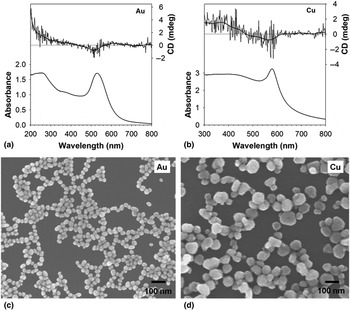
Figure 1 presents natural CD spectra of quasi-spherical Au and Cu nanoparticles measured in solution and corresponding scanning electron microscope (SEM) images. Those nanoparticles were synthesized in this study using citrate for Au and poly(acrylic acid) for Cu (see Supplementary Material). Average diameter is 26 nm for Au and 56 nm for Cu, and dipolar surface plasmons are mainly excited in these sizes of nanoparticles, indicated by the corresponding absorbance band around 500–600 nm. The path length is 1 cm, which is long enough to measure the weak intensity of the plasmonic CD signals. Interestingly, dipolar surface plasmons for Au and Cu exhibit a negative CD sign (i.e., negative rotational strength R < 0 or optical left-handedness) although the CD amplitude is small. Molar ellipticity is about 1011 mdeg·M−1·m−1 for the Au nanoparticles.[Reference Park5] Since the ordinary surface plasmons cannot produce CD signal because of the fact that the electric field vector of the plasmon is aligned with that of incident light, CD spectra implicitly suggest the presence of a longitudinal field component. This is the only way of optical symmetry-breaking in spherical nanoparticles. Faraday rotation of the dipolar surface plasmon is too weak[Reference Wysin, Chikan, Young and Dani11] to generate magneto-optical activity.
Natural circular dichroism of Au and Cu nanoparticles. CD and UV–vis spectra of (a) Au and (b) Cu nanoparticles measured in solution. Path length: 1 cm. Wavelengths of CD and absorbance bands largely coincide in the visible region. Corresponding SEM images are presented in (c) and (d). Average diameter of nanoparticles is (c) 26 nm and (d) 56 nm, respectively.

We can define electromechanical chirality in the surface plasmon resonance considering a longitudinal field component, and a magnetic dipole transition moment will be of secondary importance. The rotational strength of two electric polarizations (R μμ) is defined as follows[Reference Park5]:
 $$R_{{\rm \mu \mu}} = \lambda \cdot \left( {E_{\rm L} \times E_{\rm T}} \right),$$
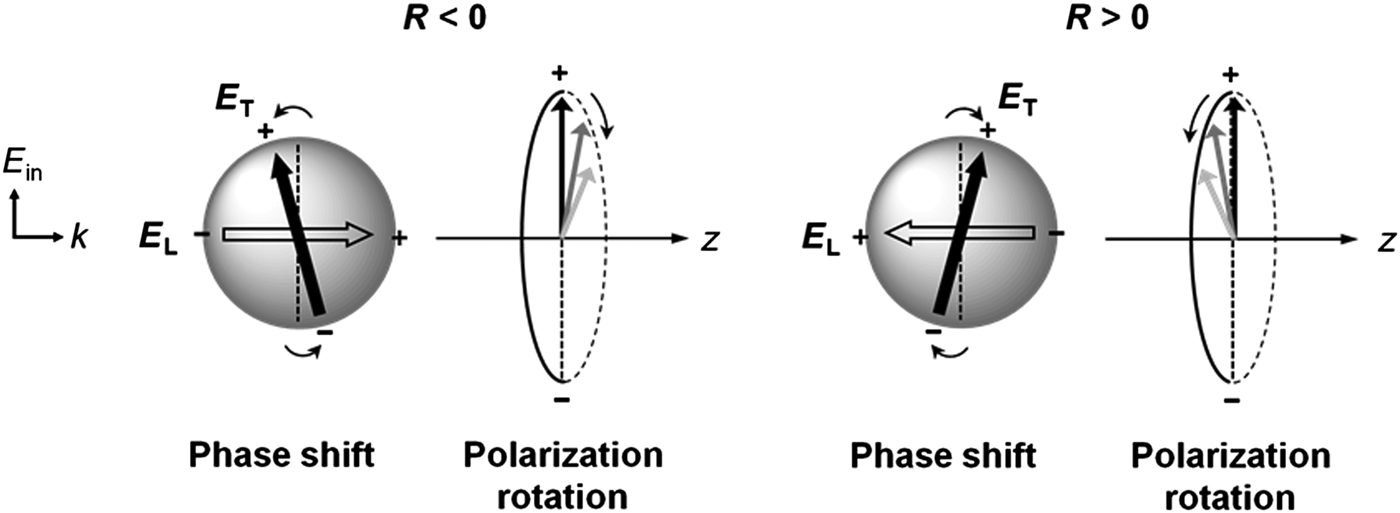
where λ is the coupling vector or the position vector that is not coplanar with the other field vectors, and E L and E T are the electric field vector of the longitudinal field and ordinary transverse field, respectively, as illustrated in Fig. 2. Although the electromagnetic pressure or optical force of surface plasmons likely produces the longitudinal field, it is reasonable to assume that the coupling of longitudinal plasmons to surface plasmons occurs on the surface in the similar excitation energy. This retrospective approach enables for elucidating the effect of the longitudinal field on the handedness of surface plasmons. Polarity sign of the (negative) plasmon and the (positive) jellium background originates from either longitudinal or transverse plasmon excitations in a metal nanoparticle. A phase shift can be described by the cross product E L × E T because of the relation to the orbital angular momentum[Reference Cameron, Götte, Barnett and Yao12] or optical torque, which is the primary origin of optical activity when the strength of the two components of the electric field is substantial. The polarization rotation λ × E L must occur by a magnetic field component. This is similar to the classical two-group electric-dipole mechanism of optical activity, formulated by a scalar triple product, r 21 · (μ 02 × μ 01), where r is the position vector of the charge. Although a magnetic dipole transition is required to involve through the relation m 0t = −iπ(ν 0t/c)(r × μ 0t) for the origin-independent mechanism in molecules (where ν is the transition frequency),[Reference Mason10, Reference Kuhn13] the polarization rotation in surface plasmons may be able to be trivially determined according to the resulting phase shift without considering the direction of a magnetic field. The negative rotational strength and phase-shift of dipolar surface plasmons R < 0 in Fig. 2 is consistent with the experimental observation.[Reference Park5]
Schematic illustration of the rotational strength of a dipolar surface plasmon. E L and E T denote the electric field vector of longitudinal plasmons and ordinary transverse plasmons, respectively. E T is deviated from E in of light upon coupling to E L that is parallel to wave vector k. Sign of rotational strength can be described by orbital angular momentum E L × E T. R < 0 is consistent with the experimentally observed CD sign of a dipolar surface plasmon. Polarization rotation for R < 0 is counter-clockwise when viewed at the light source. R > 0 is hypothetical.

Inhomogeneous longitudinal field[Reference Bekshaev, Angelsky, Hanson and Zenkova14] in the light propagation direction typically results in an optical vortex or orbital angular momentum in geometrically achiral objects including planar metal nanostructures[Reference Vuong, Adam, Brok, Planken and Urbach15–Reference Chimento, Alkemade, 't Hooft and Eliel17] and light-absorbing metal nanospheres.[Reference Wang, Luk'yanchuk, Hong, Lin and Chong18, Reference Alù and Engheta19] Theoretical prediction of non-zero CD response of achiral matter has recently been reported, and this is attributed to longitudinal fields[Reference Quinteiro, Schmidt-Kaler and Schmiegelow20] or optical vortices.[Reference Afanasev, Carlson and Solyanik21] The longitudinal magnetization on a metal nanoparticle may lead to a peripheral circulation of electrons through the nanoparticle surface,[Reference Singh, Moocarme, Edelstein, Punnoose and Vuong22] which is the same effect as the longitudinal electric field on dipolar surface plasmons. However, the longitudinal magnetization cannot explain the opposite polarization rotation of quadrupolar surface plasmons that was experimentally observed.[Reference Park5] The magnetization would result in the identical circulation between dipolar and quadrupolar surface plasmons because of the inverse Faraday effect proposed as the underlying mechanism,[Reference Singh, Moocarme, Edelstein, Punnoose and Vuong22–Reference Hertel and Fähnle24] and thus it would produce the same sign of CD ellipticity, which is not consistent with our experimental observation. Electric fields are more crucial than the magnetization in the CD of surface plasmons.
CD in the interband transitions
Longitudinal volume plasmons have an effect on CD response not only in the surface plasmon excitation but also in the interband transition. Volume plasmons are also excited in the UV region, and their energy is dependent on the mode of spherical standing waves or charge density oscillations inside a nanoparticle.[Reference McMahon, Gray and Schatz25] CD data provide evidence of the excitation of volume plasmons.
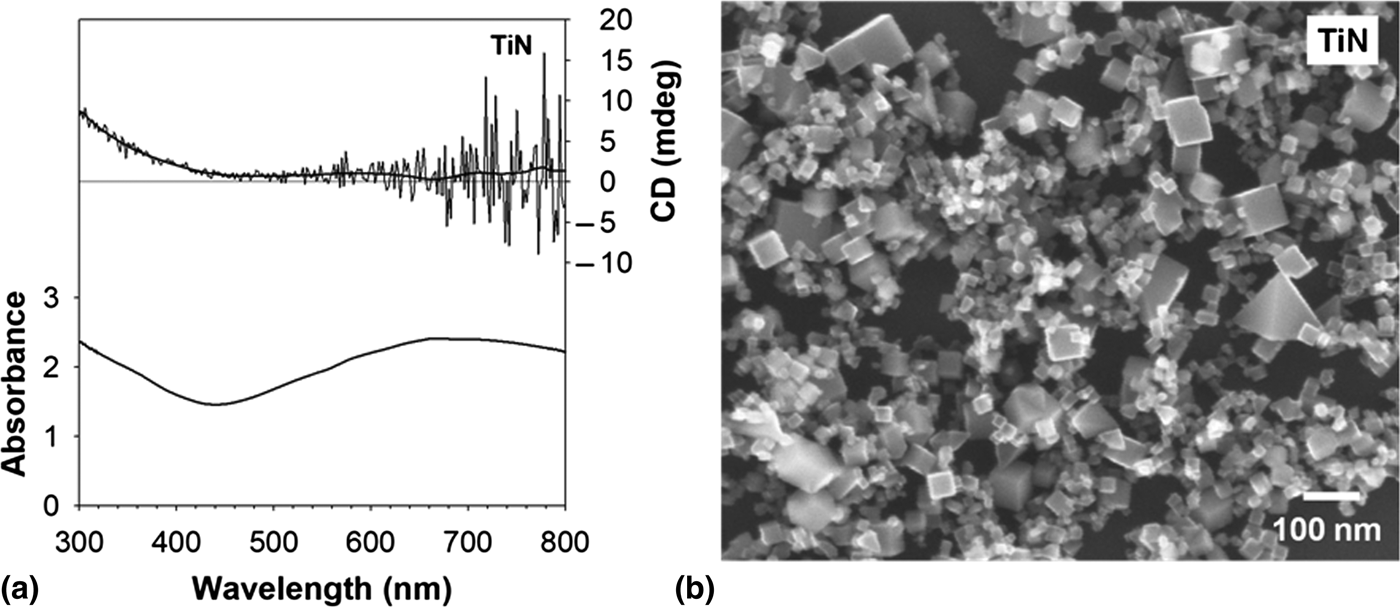
In Figs. 1(a) and 1(b), both Au and Cu nanoparticles exhibit a positive rotational strength in the UV region of interband transitions. CD ellipticity crosses zero around 430 nm for Au and 470 nm for Cu, and because of the spectral interference from the surface plasmons there exists a discrepancy between the zero-crossing wavelength in the CD and the interband transition edge that is 520 nm for Au and 580 nm for Cu. The ellipticity amplitude increases as the wavelength decreases, and this type of a wavelength dependency is an indication of spatial dispersion. In Fig. 3(a), TiN nanocubes with an average edge length of 50 nm exhibit the similar feature of a positive rotational strength in the interband transition as those of Au and Cu nanoparticles. The amplitude of the positive CD becomes distinct from the wavelength of around 450 nm and quadratically increases as wavelength decreases into the UV region. The dielectric function of TiN is similar to that of gold,[Reference Adachi and Takahashi26] but notable ellipticity from surface plasmons in the visible wavelength region is not observed. Based on the observed CD in the interband transitions of the isotropic nanoparticles above, it can be generalized that interband transitions have a positive rotational strength and optical right-handedness.
Natural circular dichroism of TiN nanoparticles in the UV region. (a) CD and UV-vis spectra measured in solution. Path length: 1 cm. CD spectrum shows a positive rotational strength in the interband transition. (b) SEM images. Typical edge length of the TiN nanocubes is 10–100 nm (average 50 nm).

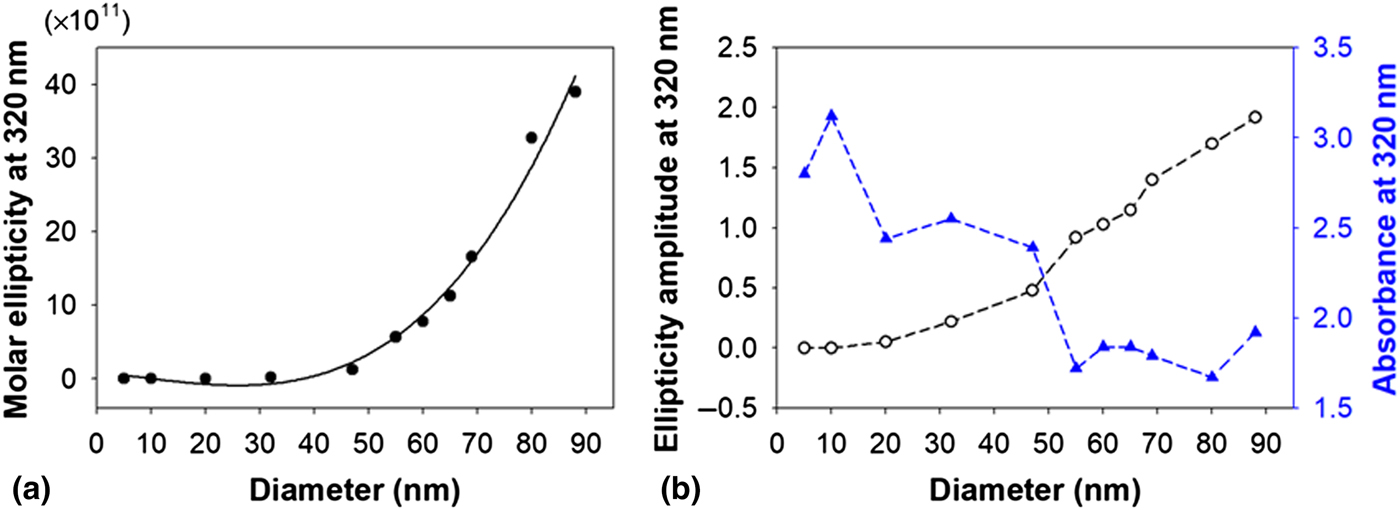
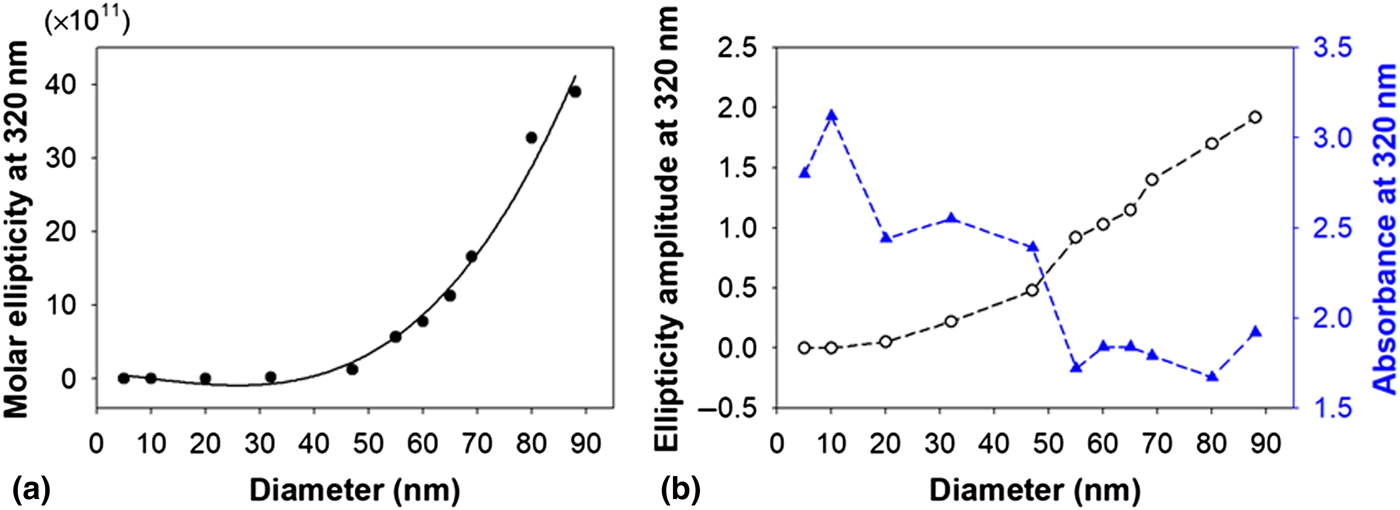
In order to discern whether the positive CD in the interband transition is an effect of surface or volume, we obtained a size-dependent molar ellipticity for varied sizes of Au nanoparticles (see Table S1 in the Supplementary Materials). Figure 4(a) presents the plot of molar ellipticity versus diameter of spherical Au nanoparticles between 5 and 88 nm. The ellipticity values were obtained at a wavelength of 320 nm from CD spectra previously reported.[Reference Park5] The ellipticity amplitude is not proportional to the absorbance [Fig. 4(b)], which enables us to rule out any possibility of artifacts. The plot is best fit to a cubic curve, indicating that the positive rotational strength of the interband transition is primarily due to a volume effect. Therefore, we conclude that a gradient of internal fields generated by the volume plasmons likely leads to the CD in the interband transition.
Molar ellipticity of interband transition of spherical Au nanoparticles determined at a wavelength of 320 nm as function of nanoparticle diameter between 5 and 88 nm. (a) Molar ellipticity (black circle ●, unit: mdeg·M−1·m−1) is best fit to a cubic curve, indicating the rotational strength in the interband transition is volume dependent. Ellipticity amplitude is normalized at the absorbance value of 1.8. Presumably zero ellipticity for nanoparticle diameters of 5 and 10 nm is included. (b) Plot of ellipticity amplitudes as measured (unit: mdeg) and absorbances at the wavelength of 320 nm. No relationship is found between ellipticity amplitude (white circle ○) and absorbance (blue triangle  ) particularly at nanoparticle diameters of 55–88 nm, which verifies that the ellipticity amplitude is not artifact.
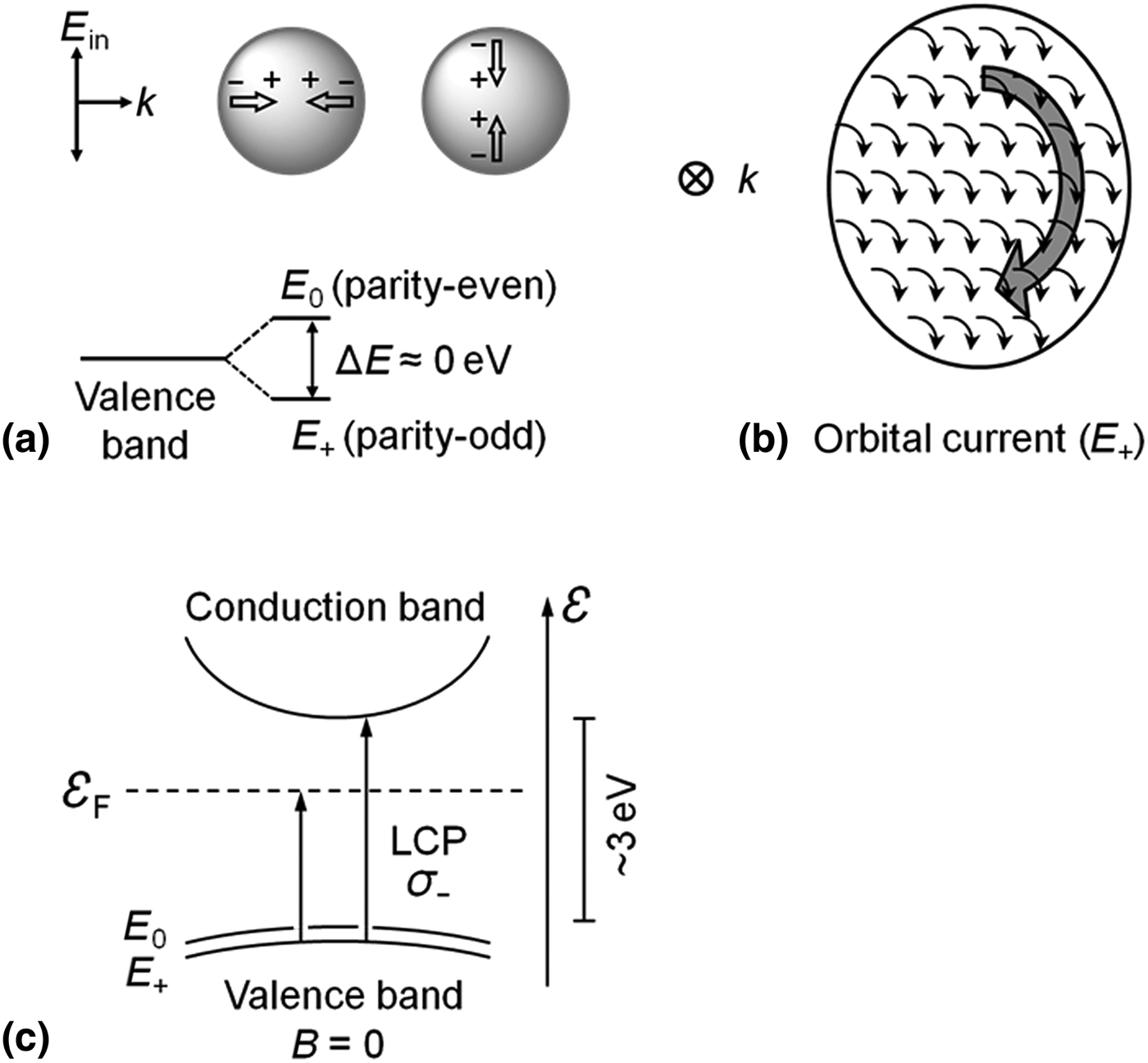
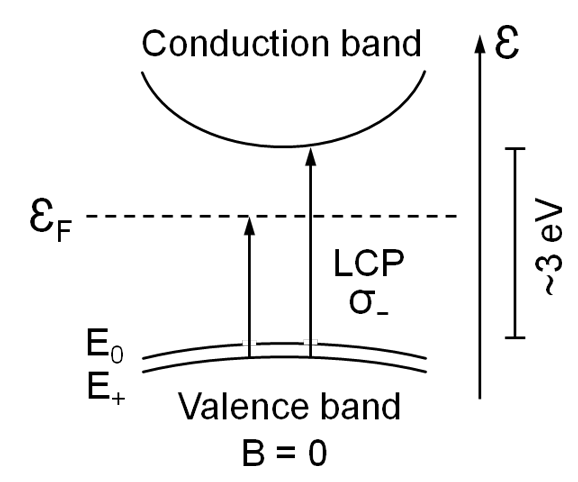
While the role of volume plasmons in inverse Faraday effects of conduction electrons in UV regions has been theoretically investigated,[Reference Gu and Kornev27] inverse Faraday rotation may also play a role in bound electrons of the valence band. Volume plasmons can also be excited in the transverse direction in addition to the longitudinal direction since a local restoring force generally acts on electrons in the bound state. Therefore, the net electric fields are symmetric with respect to the center of a nanoparticle in both longitudinal and transverse directions [Fig. 5(a)]. Although the external magnetic field is not applied (B = 0), a magnetization by the internal field gradient likely generates the Lorentz force, which exerts on bound electrons according to the right-hand rule. This can also be explained in the context of electromechanical chirality. Volume plasmons may transfer their momentum to valence electrons leading to anisotropy in the change of the orbital angular momentum of the electrons through the pressure force or the orbital force f orb = ∇(P·E) + ∇(M·H),[Reference Durach and Noginova28] where the orbital magnetic force ∇(M·H) is responsible for the positive CD sign. During the optical transition, in particular, only some of d-orbitals will be exerted by the magnetic force inside the nanoparticle (i.e., parity-odd) whereas other d-orbitals remain normal (i.e., parity-even) [Fig. 5(a)]. Figure 5(b) illustrates the direction of polarization rotation of valence-band electrons with respect to the wave vector k upon the excitation of volume plasmons, and they a posteriori rotate clockwise viewed at the light source. The d-electron rotation may be related to orbital Hall effects. It was reported that an electric field induces orbital Hall effects on d-orbitals.[Reference Kontani, Tanaka, Hirashima, Yamada and Inoue29] The interorbit transition between different d-orbitals produces an orbital current, and more specifically, the flow of d-orbital angular momentum[Reference Kontani, Tanaka, Hirashima, Yamada and Inoue29] and consequently the effective magnetic field generates the current. In our study, volume plasmons induce the electric field. Contributions from the localized current likely lead to an itinerant current.[Reference van Bree, Silov, Koenraad and Flatté30] Figure 5(c) presents the interband transition with CD selection rule included, and only LCP (σ −) is absorbed by the right-handed valence-band electrons (E +). This is the origin of the positive rotational strength in the interband transition. Hence, CD sign of interband transitions should be material-independent as is consistent with the measured CD ellipticity.
Volume-plasmon-induced circular dichroism in the interband transition. (a) Symmetric volume plasmons excited in both longitudinal and transverse directions generate electric fields and consequently induce a magnetic force. Some valence electrons are exerted by the induced magnetic force or Lorentz force, resulting in valence-band electrons of parity-odd mode. (b) Polarization rotation of valence electrons and resulting orbital currents. Small curved arrows represent a localized current, and the large curved arrow represents an itinerant current. Wave vector points into the plane. (c) Interband transition with CD selection rule included. External magnetic field is not applied in this valence-band splitting (B = 0).

The inhomogeneity of internal fields implicates nonlocal and nonlinear optical responses in nanoparticles, and it may be important in nanoparticle-based optoelectronics. For the view of nanoparticle characterization, the volume-dependent amplitude of CD response in the interband transition can be applied for the measurement of nanoparticle size. The light absorption nature of nanoparticles in the UV region will make such measurement procedure be simple compared to the method of dynamic light scattering.
Conclusion
Unexpected CD of achiral nanoparticles both in the surface plasmon resonance and in the interband transition can be qualitatively explained by considering the longitudinal electric field component (E L) in the light propagation direction. We modify the classical two-group electric-dipole mechanism of optical activity and introduce electromechanical chirality where a magnetic field component is of minor significance. Longitudinal volume plasmons lead to the negative phase-shift of transverse dipolar surface plasmons (E T), and the negative CD sign is interpreted using the orbital angular momentum E L × E T. The longitudinal field E L breaks time-reversal symmetry and mainly determines plasmonic handedness. Volume plasmons also produce CD electromechanically in the interband transition. Positive CD sign is consistently observed in the UV region regardless of the type of metal (nitride): TiN, Au, or Cu. Molar ellipticity obtained at the wavelength of 320 nm for spherical Au nanoparticles is volume-dependent, indicating that CD in the interband transition is the volume effect. During the optical transition, a field gradient generated by the volume plasmons likely induces a magnetic field, and the resulting Lorentz force leads to the positive rotational strength and optical right-handedness of d-band electrons. Orbital Hall effects can be manifested by CD in the interband transition region. We experimentally demonstrated the optical excitation of longitudinal fields in individual metal nanoparticles and the presence of inhomogeneous internal fields (i.e., spatial dispersion or non-locality).
Supplementary material
The supplementary material for this article can be found at https://doi.org/10.1557/mrc.2018.40
Acknowledgment
I thank Björn M. Reinhard for generously allowing to use laboratory equipments; Wonmi Ahn for SEM measurements. CD spectra were obtained using the CD spectrometer at the Chemical Instrumentation Center.