Introduction
In both research and professional discourse, care-giving is generally described as a feminine role and as an experience full of stresses and hardships. Although recent conceptualisations have begun to recognise that caring involves more complex, creative and richer experiences, most studies still tend to focus on the traditional bellwether markers for the burdens of care, like feelings of social isolation, depression or anxiety, and on the most usual and normative care-giving actors – daughters and wives. Only in recent years have the positive aspects of care and the uniqueness of men's experience received particular attention in the care-giving literature. Recent studies of male carers have supported the emergent perspective that they are capable, nurturing and innovative in the role; indeed, their representation has changed from being ‘ineffective or inconsequential’ to ‘capable and competent’ carers (Russell Reference Russell2001). Although the afflictions of caring tend to obscure its gratifications and rewards, several researchers have pointed to outcomes as various as gratification and satisfaction (Archer and MacLean Reference Archer and MacLean1993; Kaye and Applegate Reference Kaye and Applegate1990; Motenko Reference Motenko, Reinharz and Rowles1988), a sense of accomplishment (Harris and Bichler Reference Harris and Bichler1997), a sense of personal growth or purposefulness (Harris Reference Harris1998), and a sense of identity or self-esteem from the caring activities (Fisher Reference Fisher1994; Rose and Bruce Reference Rose, Bruce, Arber and Ginn1995; Davidson, Arber and Ginn Reference Davidson, Arber and Ginn2000). Studies have found that men do find positive meaning in the efforts they make in caring for a dependent relative, although such findings are not yet prominent in either theoretical writing or empirical research on older men carers.
Almost a decade ago, Kramer (Reference Kramer1997a) reviewed 29 studies of the gains experienced by informal carers of older adults, and remarked on the evident inattention to the experience of male carers. Since then, many and diverse studies have extended our knowledge of the positive aspects of care (e.g. Cohen, Colantonio and Vernich Reference Cohen, Colantonio and Vernich2002; Hunt Reference Hunt2003; López, López-Arrieta and Crespo Reference López, López-Arrieta and Crespo2005), but the way such aspects are produced in the men's care-giving role has continued to be overlooked. In a recent critical review of the psychosocial challenges and rewards to men of providing care, Carpenter and Miller (Reference Carpenter, Miller, Kramer and Thompson2002: 114) stated that much of the literature was ‘descriptive in nature, meeting the aim of providing insight into men's caregiving experiences, but provides little in terms of explanation of patterns identified’. An exception was Kramer's (Reference Kramer1997b) cross-sectional quantitative study of the differential predictors of strains and gains among husbands who were caring for wives with dementia, which revealed that positive aspects of caring were reported by those of lower education, who were healthier, had better social networks, or reported greater use of problem-focused coping.
Carpenter and Miller's review, though not focusing explicitly on any specific care-giving situations or dyads, noted that it was far from unusual for men to be caring for older adults and that there was a need to study specific subgroups of carers. Older men who are the primary source of support for older married women with physical and cognitive impairments have been studied using various methodologies, and have identified several of their needs and strains (e.g. Kirsi, Hervonen and Jylhä Reference Kirsi, Hervonen and Jylhä2004; Kramer Reference Kramer2000; Ribeiro and Paúl Reference Ribeiro and Paúl2005, Reference Ribeiro and Paúl2006). Nevertheless, the accumulated knowledge on positive aspects is still limited and mostly refers to dementia-care, which entails particular strains and differs significantly from other caring situations (Paúl and Martín Reference Paúl, Martín and Fernández-Ballesteros2003). This paper explores and analyses the positive aspects of care reported by older men who were caring for dependent spouses. It draws on their descriptions of their own caring experiences, and we have conceptualised positive returns as any kind of positive feeling about the experience. Two different groups of caring situations were compared, in which the cared-for person had either dementia or physical impairments.
Design and methods
The sample
A non-random, purposeful sample was recruited of 53 older Portuguese husbands who were primary care-givers: 27 with wives who had been medically assessed as having some sort of dementia (probable Alzheimer's disease, vascular dementia or both), and 26 whose wives had a physical impairment (e.g. stroke, Parkinson's disease, arthritis and orthopaedic problems). All the care-givers met the following inclusion criteria: they were (i) aged 65 or more years; (ii) living with their wives; and (iii) responsible for most of the assistance needed by the care-receiver, and for at least 50 per cent of the required support in the activities of daily living. They were recruited through a hospital psychogeriatric service at which the spouses were patients, and from several social and health agencies and facilities (e.g. day centres). Recruitment also involved ‘snowballing’ as some study participants were referred by other recruits. The sample included couples living in both rural areas and cities.
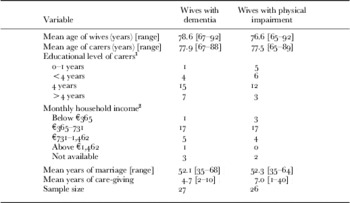
Table 1 shows the main socio-demographic characteristics of the sample by the two sub-groups. The mean age of the care-givers was 78 years (range 65–89), and the mean age of the wives was also 78 years (range 65–92). The average duration of the marriage had been 52 years (range 35–68), and the average length of the caring episode was five years (range 1–15). Most (37 or 70%) of the carers had received no more than elementary education (corresponding to four years' schooling) and all but one were retired; he was employed part-time. Most couples (34) had a monthly household income between €370 and €730, and nearly all had some help from formal services (e.g. meals), or family support, or both.
Characteristics of the sample according to the care-receivers' diagnosis

Notes: 1. Number of years' full-time education. 2. Based upon the Portuguese Minimum National Wage in 2006.
Data collection
The in-depth interviews took place in the couple's home or at the institution that provided formal support, lasted approximately two hours and were audio-recorded and transcribed.Footnote 1 We used an unstructured interview guide to elicit information about individual perceptions of the care-giving role. There were three broad themes. The ‘meaning and difficulties’ of the role were prompted by the questions: How would you define your care-giving role? What does the care-giving experience mean to you? What's the most difficult thing for you to deal with? Thoughts about ‘stress and coping’ were initiated by the questions: What has changed in your life since you started caring for your wife? What helps you to cope with difficult situations/with stress? Reflections on ‘gender issues’ were prompted by the questions: As a man, how is it for you to care for your wife? As a man, how did you come to be caring for your wife? Demographic and clinical information was collected through a brief ‘background facts’ form. A single question on the carer's self-rated health was included: In general, would you say your health is: (1) excellent, (2) very good, (3) fair, (4) poor, or (5) very poor?
Data analysis
The qualitative data for the analysis derived from both the interview transcriptions and the interviewers' field notes. Open coding and content analysis was facilitated by the NUD.IST software.Footnote 2 We read all the transcribed interviews multiple times to identify the emergent themes and sub-themes through coding. To raise reliability, the two authors read, re-read and coded the transcripts independently. Our assignments were compared and discrepancies resolved by discussion. The coded transcripts were repeatedly examined to identify new categories, and this proceeded iteratively with theoretical elaboration. Although some verbatim codes were adopted, by which is meant that the adopted labels used words spoken by one or more interviewees, most were generated by the researchers and interpretative (Strauss and Corbin Reference Strauss and Corbin1990). Explanatory accounts of the identified themes and categories and of the differences between the two sub-groups were drafted, which included exploration of linkages through numerical analysis and the theoretically-driven explanation of the emergent patterns (Ritchie and Lewis Reference Ritchie and Lewis2003).
Findings
Among the 53 interview transcriptions and field notes, 32 reported positive features of the care-giving experience. These were all associated in the husbands' discourses with a sense of commitment and duty. Two major themes were identified: satisfaction and perceived social honour. The subsidiary themes within satisfaction were marital relationship, care work and self protectiveness. The subsidiary themes within perceived social honour were social recognition and wife's appreciation. The husbands who reported positive aspects were more likely to be those caring for wives with dementia (18 of 32), but no major differences were found between the two sub-groups except that this sub-group more often reported satisfaction with providing assurance of the care-receiver's wellbeing. The principal differences between the men who reported positive aspects and those who did not was that the former more frequently reported good pre-morbid marital relationships, presented a higher prevalence of problem-focused coping and the ability to draw broader meanings from their situation. They also reported better self-rated health.
Commitment, duty and the positive benefits
In the research literature, fulfilling one's duty and commitments are among the most frequent reasons given by male care-givers for having positive feelings about caring. According to Milne and Hatzidimitriadou's (2003: 402) review, care-giving provides older husbands with ‘both a role and a vehicle for reciprocity within marriage and an expression of commitment to their wives’. Among our informants, the fulfilment of this implicit responsibility of the marriage vows was explicitly referred to in most of the responses that reported positive feelings. Clear evidence of acting out of love or reciprocity was found in many of their expressions, but satisfaction was most often expressed spontaneously when the men talked about their obligations as husbands. In 24 out of the 32 interviews that mentioned positive aspects, these were found to emerge in the husband's discourse when they described the commitment they felt towards their wives. John, aged 75 years, who had been caring for his wife with Alzheimer's disease for eight years, evinced the linkage between this main motivation and the positive returns:Footnote 3
… and then I started to care for her. I felt I had an obligation and duty to care for her because she's my wife and she deserves it, that's why! And I have satisfaction in doing so. You see, it's not the pleasure of seeing her sick but the pleasure I feel for caring for her. … We've been married 50 years.
Among our informants, the caring role followed long-established marriages (of on average 52 years), and much of the affection displayed through their care derived from past rather than current circumstances and events. Several husbands openly instanced the strong previous marital rapport and its deep emotional rewards, and their perception of the care-giving role as not only a commitment but also a clear opportunity to express love and affection. As McGarry and Arthur (Reference McGarry and Arthur2001) found about older carers, the quality of the relationship before the onset of care-giving is a key prior condition for a husband to be positive about caring for his wife. Fulfilling the marital vows in a good pre-morbid marital relationship was undoubtedly the most common and distinctive correlate of positive feelings about caring.
The expression of positive feelings
The carers expressed a great variety of positive feelings about the care-giving role, from a global sense of ‘feeling good’, to explicit verbalisations of ‘happiness’, ‘contentment’ and ‘pleasure’. These appeared in 30 out of 32 situations and were divided into three closely linked sub-themes: satisfaction with the marital relationship, satisfactions from the care work and self-protectiveness.
Satisfaction with the marital relationship
The most frequently mentioned positive aspect of caring (for 24 of the 32) was the husbands' enjoyment of ‘just being there’ with their wives, keeping them company, while doing their marital duty as husbands who ought to care. Some spontaneously commented on the satisfaction derived from the wife's presence, even when she was passive and the relationship had lost effective companionship (predominantly in dementia situations). Eduardo, a 75-year-old husband who cared for his wife with Alzheimer's disease, sensitively described the satisfaction he felt in just being with his wife and caring for her:
I enjoy being with my wife, yes, yes, yes, yes. I feel very pleased just being there with her. … I know we can no longer talk and do things as we used to do, but I just enjoy being there … and you know what, I feel happy when I wake up and see her [pause]. She usually wakes me up early in the morning and starts talking from dawn. … She asks me to turn her over, you know, because she can't do it by herself, and I feel really good to have her still at my side. And it's almost a paradox – on the one hand I want her to die before me, on the other hand I'm just pleased to wake up and see she's there … it's as simple as that.
Other husbands similarly expressed the satisfaction of keeping their lifelong wife company, and the wish to stay with her for as long as possible. Besides the perceived personal reward, these men believed that the marital relationship was intrinsically rewarding. Choosing deliberately to care and to maintain the relationship through sickness, even when this was arduous, gave them gratification. Caring was a way of avoiding the wife having to move into a residential institution and the couple's separation. Some men described the likely effect on their life if their wife went into a nursing home: they anticipated feelings of loneliness and purposelessness. Thomas, a 69-year-old who cared for his bed-bound wife with vascular dementia, expressed these feelings very well:
When they [our children] go out [after visiting], I stay by myself, right? I stay alone, and once I'm alone … I am not! Whilst being next to her just watching TV or seeing her in her sleep, I know my wife is there, she is in my sight … if she wasn't here, things would be different, very different. … It's like a diet [implying regime], a diet I must stick to. Otherwise I'll lose my mind, start drinking or … lose myself. That's why I enjoy keeping her here, caring for her.
Likewise, 88-year-old Joaquin who cared for his 88-year-old wife with Alzheimer's disease, stated several times that he would ‘rather be like this [caring for my wife] than alone’, which alluded to fears about the future without his wife.
Satisfactions from the care work
Previous research on spousal care-giving has shown that the desire to continue as an independent couple erodes the formerly gendered allocation of tasks (Rose and Bruce Reference Rose, Bruce, Arber and Ginn1995; Calasanti and Bowen Reference Calasanti and Bowen2006). In our study, 11 of the 32 husbands said that they were satisfied with doing care work and that it had a special positive meaning in the couple's relationship. Their definitions of caring included both personal care and household tasks. As the latter had typically been the wife's responsibility, the husbands had had to learn how to do these tasks (e.g. how to cook), which not only promoted the husband's senses of confidence and self-worth, but also increased the couple's closeness and intimacy. The husbands took on the caring responsibilities to affirm the strength of the marital bond and to express gratitude. David, who was 84-years-old, described how he felt about performing the unfamiliar household tasks:
I got happier then! You see, I was already happy enough just to live with her, even though I didn't share such things [household chores], her things, right? After this sad event, this misfortune – let's call it that, a misfortune [referring to the stroke] – getting into those tasks, to be with her more closely, to do what she used to do and having her next to me teaching me how to do those things … that pleases me a lot.
Some of the men expressed feelings of pride along with satisfaction. One such was Oliver, aged 78 years, whose only formal support was daily meals from domiciliary care. He had taken on all the care-giving responsibilities for his wife, and explained:
I feel honoured … washing her clothes, putting them to dry, I feel honoured. … I feel an enormous pleasure in changing her, turning her, providing her with everything she needs, giving her a bath whenever needed. … I feel pleased, with [a sense of] satisfaction. … I feel satisfaction with myself, in the face of God and in the face of all humankind.
Self-protectiveness
A less frequent (by six or 19%) expression of the positive returns was that of self-protectiveness, some form of defence against negative feelings that included the avoidance of grief in the future and of guilt in the present. Oliver explained that by doing care-giving tasks, he would not feel guilty in the future: ‘if I don't do it [care work], I know I will feel guilty, I know. If I don't do this that I'm doing, I know I will have bad conscience’. Thomas, on the other hand, put more emphasis on his current self-evaluation and peace of mind:
I understand that as long as she lives I want [pause and deep breath], I want to keep her and not having any regrets in here [pointing to his head], just as I told you before. … That's why as long as she is here with me, I will care for her.
The affirmation of ‘perceived social honour’
According to Calasanti (Reference Calasanti, Arber, Davidson and Ginn2003), because caring tasks are mostly feminine or gender-neutral, their value increases when they are performed by men. In our study, 13 husbands reported a positive return that derived from others' recognition of their involvement with care work. Providing care brought these husbands the attention and respect of neighbours or secondary carers. We distinguish two forms of this inter-personal recognition, the wife's appreciation and that from third parties that we call social recognition.
Satisfaction from social recognition
The public visibility of the men's work and its social recognition were mentioned as a positive aspect of being a care provider in eight interviews. While acquiring the care-giving role required various adaptations and challenged gendered assumptions (e.g. who cooks), once the husbands provided regular care that gained social recognition, it was a positive gain and reinforced their commitment to caring. Manuel, aged 73 years, who lived with his wife in a small village, was explicit about the value of the social recognition of his daily care routine, which involved activities outside the house such as hanging out the laundry:
Well, my neighbours [the women], they praise me and say that I'm an example, that's what they say. … I don't really know how I am, and I'll be honest with you, I do what I do because I feel good doing it, no more than that … but they go on and tell me that, they tell me they are astonished. … They even say that there are no other men like me.
Alfred, aged 65 years, alluded to the same idea but made comparison with the little help that his wife received from their children:
I must confess I felt disappointed with their [the children's] participation. … Not a single soul came out to help me, to give me a hand. … I didn't want to follow their [the children's] example, you see? So, in a certain way, a little vainly I feel superior, that's true. I know it's hard, because it is, but they [the neighbours] know it as well; they know it as well.
The affirmational significance of such recognition was mentioned in other interviews, usually referring to the comments of female neighbours. Abel, aged 77 years, who had been caring for his wife for nine years, said, ‘I know that they admire what I'm doing, and that's quite nice … it is even good for my health because they cheer me up!’. Bernard, aged 88 years, who had been caring for his wife for six years, imitated his neighbours' voices when relating that, ‘people see me doing things and say “you really are one of those husbands … one of those husbands like all should be!” … Some of them are surprised with all the patience I have … and with the will I have – this thing [drive] I have – for getting all the care work done’.
Satisfaction from the wife's appreciation
Eight husbands also described their wife's recognition of their care and their gratitude. Oliver affectionately described his wife's occasional appreciation of his care:
I've already told you that I need to have a lot of patience, don't I? That sometimes I get nervous and that sometimes she gets hard to deal with … but she has one thing, one simple thing, whatever I tell her, she will always be the same woman who laughs and says, ‘You are too much for me, you are too much for me’.
Other husbands also described their wife's recognition of their caring attention. Horatio, aged 73 years, said, ‘Whenever I do something she goes and gives me a small kiss, and that's it, that's her recognition’. George, who cared for his wife with early-stage Alzheimer's disease, said of his wife, ‘Sometimes when she's lucid, occasionally, she says, “If I didn't have you … if I hadn't you, I wouldn't be alive”. She recognises my care [evidently pleased]’.
Differences between dementia-care and physical-impairment care situations
Among the 32 care-giving husbands who reported positive aspects, 18 were caring for wives with dementia and 14 for wives with physical ailments (corresponding respectively to 67 and 54 per cent of the two sub-groups). In short, the husbands who cared for wives with dementia were more likely to report positive aspects. Beyond this broad comparison, although many and diverse aspects of the husbands' care derived from difficulties and strains specific to particular conditions (e.g. symptom management in dementia situations), there were no major differences in the positive aspects reported by the two groups. Both were motivated by commitment and a sense of duty, and derived similar positive returns from sustaining the marital relationship. In the dementia group, however, one satisfaction was distinctive; it derived from assuring the care-receiver's wellbeing. In this subgroup, the carers placed great importance upon making sure that the spouse had good care. Abel and Mark, who both cared for wives with Alzheimer's disease, explained this very well. Abel said, ‘It's the pleasure I have in caring for her, in seeing that she is well … of providing her with everything I can within my capabilities’. Mark said, ‘I feel pleased whenever I do something that makes her get better. It gives me some relief as well, I say … how can I say it? [pause] I feel happy’.
In the same way that husbands expressed a sense of pride in and gratification from looking after their wives, some felt that no one else would offer the same standard of care. This was often the reason for rejecting any suggestion that the wife should move into an institution, and was most often stated by husbands who were caring for wives with Alzheimer's disease. Seraphim compared his care with what he thought would be provided by nursing-home staff: ‘Then, you see, she forgets a lot and all that [referring to dementia symptoms] and I have a kind of patience that they won't have, they just won't have’. Luis emphasised more that a move into a nursing home would effectively terminate the marriage:
And the reasons [for not considering a nursing home] are these: on one hand, we've always lived together; on the other hand, getting her in such a place is the first step towards tearing us apart. … Because, you know, in there they won't do for her the same things I do. They may even have good professionals and everything else, but they are not their patients [surely meaning not their family]
For several husbands, mention of the positive aspects of care was accompanied by mention of the negative effects of the caring situation on their two lives and the marriage (e.g. social isolation, health problems and decreased marital intimacy) and there was a keen awareness of the balance between the costs and rewards of the situation. We examined the interview transcripts from the dementia-care subgroup for evidence that some positive returns were specific to the care receiver's clinical condition (that is whether they had early, moderate or severe dementia), but none were identified. This finding replicates Kramer's (Reference Kramer1997b), who found that appraisals of gain were equally likely among carers managing different levels of stressors and different challenging symptoms.
The husbands who did not report positive aspects of care
As has been made clear, the great majority of the husbands who evoked positive aspects of the caring role had invested deeply in their marital relationship – the two were closely associated. The connection was confirmed when we analysed the expressions of the 21 husbands who did not report positive aspects, for they were much less likely to describe their previous and current marital relationship as affectionate and life-defining. Both groups shared similar motivations to care (commitment and sense of duty), but the carers who reported satisfaction and perceived social honour invariably said at some point that they acted out of love or to reciprocate their wife's love. Such expressions were scarce among the other group, who took on caring almost without exception through a sense of obligation. Their descriptions of the experience were also less emotive and more often contained expressions of negative or mixed feelings. They were committed to the caring role, as a responsibility acquired through marriage, but did not find it emotionally rewarding or a source of positive feelings. Robert and Patrick clearly articulated this rationalisation of the caring role as a ‘contractual obligation’:
It is a sort of a service, a service that I do naturally because it's rooted in this idea of mine that it is a duty I have for her as she would have for me. We've lived together 54 years [said without emotion] so this is a sacrifice I tranquilly make, in a natural way, because after all it all comes down to this notion I have that I am fulfilling my duty.
She's my wife, I married her and I swore to live with her ‘through bad times and good times, in sickness and in health’ and all that … so, what I promised is what I must keep. … As we got married and made vows to each other, we must keep them; if we don't, then we're no longer being faithful, and I made that promise.
For the husbands who reported positive returns from caring, their investment in the current situation was also an opportunity to begin to organise and assign meaning to their own lives in a changing situation. Caring was perceived as an intrinsic part of the marital role, as an extension of being a husband, but as their wife was ill, it had a new priority in their life. Caring was shaped by the sense of duty and gave an important sense of purpose. The husbands commented that their lives would be purposelessness without their wives and caring activities, and explained how the care-giving tasks required a ‘regime’ or ‘menu of activities’ to which one must stick (cf. Thomas's remarks). Most of these carers organised their day around the wife's needs, and some infused their actions with symbolic meaning (e.g. as in the interpretation of close proximity and intimacy). This involved much more than constructing caring as a ‘job’ or ‘career’, although the common requirements of setting goals, being organised, practising skills, and receiving applause and esteem, were recognised as positive returns; the men instilled their new role with marital and identity significance, seeing the care-giving interactions as a continuation and deepening of their affective involvement, and making sense of the new situation in the larger context of their lives.
For those husbands whose discourses lacked positive reports, such deep personal meanings were rare. They recognised the importance of their caring responsibilities, but did not describe them as a major purpose of their lives. The care-giving role provided a chance to be self-sufficient (as in the other group) but, for example, having to learn new skills did not lead to the same pride in their mastery. They were described rather as skills that they were forced to learn because their wives could not longer do those things for them. Bryan, aged 79 years, whose wife had early-stage Alzheimer's disease, captured this reasoning well: ‘She can no longer cook, and we both need to eat … and there's also the need to carry out the promise I made of caring for her, so it's just a way of combining both things’. Peter, aged 65 years, whose wife was severely impaired after a stroke, echoed these ideas: ‘I do whatever she tells me to do. I know she's no longer able [to do the household tasks], so I am forced to do them myself. I have no one else. … Whatever I do, I do it the best I can and because I must do it’.
As well as these differences in the representation of the marital relationship and the meanings drawn from the care-giving role, two other features distinguished the two groups of carers: those who reported positive returns displayed more problem-focused coping strategies and had better self-rated health. One goal of our study was to determine the types of coping strategies that were being used, and although the stressors associated with care-giving were diverse and elicited several coping responses, a greater use of problem-focused coping (doing something or developing a strategy to accomplish the caring tasks or to resolve the difficulties) emerged as something that differentiated the groups. These were mentioned by 24 (75%) of the men who reported positive returns, but by only eight (38%) of those who did not. Among the latter, the husbands more often rationalised the situation by reference to religion (finding support in spiritual beliefs), or engaged in distraction activities (doing other things explicitly to think less about the stressful situation, such as going to a bar with friends), or sought others' support. These coping strategies were also used by the husbands who reported positive returns but considerably less often. As regards the men's health, among the husbands who found positive returns from caring, 10 (31%) reported their health as ‘good/very good’, 19 (59%) as ‘fair’, and three (9%) as ‘bad/very bad’. The equivalent figures for those who did not find anything positive in caring were five (24%), nine (43%) and seven (33%).Footnote 4
Discussion and conclusions
Limitations and lessons of the study
The study has generated new findings about the positive aspects of male care-giving but the size of the sample and its specificities limit the extent to which they can be generalised to other cohorts and socio-cultural contexts. We were concerned about understanding positive aspects of care in a group of older male carers, and in adopting a specific methodological approach, asked only indirect questions about the positive returns, and relied on the informants' spontaneous expressions (and the interviewer's close attention). We may have missed some positive returns that would emerge if people were specifically asked to describe them. Nonetheless, we believe the informants' expressions provided a valuable and near-comprehensive account of the older male's care-giving experience. They mentioned all the aspects that repeatedly emerge from spontaneous carers' discourses and suggest that male carers want to talk about them. The specifics of the individual care-giving situations transcended the presented findings, but we strongly advocate increased attention to the presence of positive returns in the midst of the undoubtedly burdensome caring experience. Care-giving is a potentially life-changing event in an older man's life, and if a lifecourse approach is used, it should not be conceived through an unduly pessimistic lens (Lewis Reference Lewis1998).
The main findings
The principal aims of the study were to describe the positive returns to older men from caring for dependent wives, to interpret the husbands' expressions of the positive returns, to identify any differences by the care-receiver's condition, and to examine the differences between the husbands who did and did not find positive returns. Most (60%) of the interviewed carers spontaneously expressed at least one positive return from their current care-giving situation. While many different rewards were mentioned, most prominent were those that gave practical expression to a husband's duty, and affirmed their sense of commitment to an enduring and affectionate marital relationship. The personal-care work and rearranged household tasks also gave these men new challenges and a new purpose in life. In these ways, they found positive personal meanings in the caring role which can be interpretable in light of perspectives that draw attention to the dynamics of meaning-making in the course of care-giving (Farran et al. Reference Farran, Keane-Hagerty, Salloway, Kupferer and Wilken1991; Farran Reference Farran1997; Noonan, Tennstedt and Rebelsky Reference Noonan, Tennstedt and Rebelsky1996). Furthermore, our findings support the adult-development process-focused model of late-life adjustment (Settlage et al. Reference Settlage, Curtis, Lozoff, Lozoff, Silberschatz and Simburg1988), which offers promising conceptual tools for thinking about older men, since it ‘makes it possible to reframe pivotal life events as retirement, physical decline, death or disability of a partner … as challenges which, while distressing, are also potentially motivational of new development’ (Applegate Reference Applegate, Kosberg and Kaye1997: 13).
In short, it has been shown that the husbands who found positive returns from caring both found personal meaning and enacted process-focused development in the role. They described a sense of purpose and a sense of mastery in their caring, and some explicitly conceived these qualities within a larger context of creating and discovering meaning in later life. Others have interpreted the positive aspects of caring that men perceive as the construction of a role (in part as a surrogate for paid-work) from which men derive feelings of security, belonging and continuity (Motenko Reference Motenko, Reinharz and Rowles1988), a sense of purpose and accomplishment (Harris and Bichler Reference Harris and Bichler1997), and gratification in mastering the challenges to their personal competence (Kaye and Applegate Reference Kaye and Applegate1990; Bover Reference Bover2004). Kramer (Reference Kramer1997b) found that using problem-focused coping strategies predicted positive gain, and particularly on that association, it has been suggested that problem-focused coping may relate to finding meaning in that it supports feelings of efficacy and situational mastery (Folkman and Moskowitz Reference Folkman and Moskowitz2000).
Our findings suggest that the particular form of the meaning construct that husband carers develop is very important. Two conceptualisations were prominent and distinguished the men who found positive aspects of caring from those who did not: situational constructs (associated with specific coping strategies) and global constructs (that gave a sense of purpose). Both informed and interacted with a search for meaning in one's life (Schwarzer and Knoll Reference Schwarzer, Knoll, Lopez and Snyder2003). Considering that the meaning of care-giving for men is still uncertain and constitutes a research topic to which there has been given little a priori attention (Thompson Reference Thompson, Kramer and Thompson2002), further research about the meanings made of the caring situation as an expression of positive aspects of care would be particularly valuable.
As gender perspectives have been particularly evident in research and writing about care-giving, one of the most interesting findings of this study has been that social recognition or perceived social honour is commonly recognised among men carers as a positive return, and that it partly derives from their adoption of the traditional female nurturing role. When their dedication is recognised, the gender reversal prompts enhanced acknowledgment that for the man positively affirms their role. Bover (Reference Bover2004) revealed this effect in a group of older Spanish male carers, and a comparative study on men's care work in Japan and the United States showed that husbands receive more praise and recognition for the activity than women, because of the perception in both cultures that the work is ‘natural’ for women but not for men (Harris and Long Reference Harris and Long1999). Milne and Hatzidimitriadou (Reference Milne and Hatzidimitriadou2003) also found that men's caring is broadly conceptualised as having greater value and thus deserves more recognition and acclaim because the role is not normative for men. Rose and Bruce (Reference Rose, Bruce, Arber and Ginn1995) argued that being seen as ‘Mr Wonderful’ is intrinsic to the positive aspects of caring.
Most studies, however, have not described the association of recognition with men's own positive feelings about care-giving. We have shown that the men who saw positive returns from caring said that it constituted an important source of self-esteem and self-worth: they not only felt appreciated but found such recognition to be an important source of positive affirmation. Social recognition, that is by third parties, reinforced both the role of the ‘husband’ and of the ‘man’, but it was unclear which of these two social roles were more important (they appeared in the carers' discourses in similar proportions). Furthermore, social recognition came mainly from female neighbours and professionals, and few expressions referred to such attitudes coming from other men in the informants' communities. The matrix of masculinities that contextualise an older male carer's life through care-giving may interact with external praise to prompt a different approach to (and possibly more visible signs of) care-giving and the maintenance of the protective husband role. This is a challenging research topic and more research into these dynamics would make a valuable contribution to the study of the ways in which various masculinities shape the positive aspects of care-giving in later-life, particularly within late-life marriage relationships (Connell Reference Connell1995).
Finally, this study has been one of the first to compare the positive aspects of husbands' caring for physically-disabled and cognitively-impaired wives. No significant differences were found between the two groups (which may be related to the small and convenience samples). Specialised services for Alzheimer's disease patients are not widely available in Portugal (Leuschner Reference Leuschner, Castro-Caldas and Mendonça2005), which restricts the availability of service options and their quality. In this context, the respondents may have derived above-average satisfaction by providing sensitive and intensive individualised care and reassurance. By caring for a wife with dementia, the husband sustains a meaningful marriage and copes with the specific behavioural and psychological symptoms of the disorder (and their fluctuations). In short, the special stresses of dementia care may be balanced by an exceptional sense of accomplishment and of providing a level of care that would not be provided by others.
As others have argued (e.g. Nolan, Grant and Keady Reference Nolan, Grant and Keady1996), understanding the satisfactions of caring is of more than theoretical interest and may provide important lessons for clinical and psychotherapeutic interventions. The positive returns to men are important psychological resources, and must be clearly understood and supported in therapeutic work, to empower the care-givers and facilitate their overall search for positive life meaning. Through the recognition of how older men are enriched by care-giving, professionals may validate in more appropriate ways the carer's positive feelings and support their capacity for continued growth. Some older men choose to care and invest considerable emotional resources in the role (Fisher Reference Fisher, Bornat, Johnson, Pereira, Pilgrim and Williams1997). The rich and rewarding returns call for better understanding without the skewed presumption and perception that the care-giving experience is wholly negative.
Acknowledgments
This paper draws from a research supported by the Foundation for Science and Technology, (FCT), Portugal (Grant SFRH/BD/8819/2002). The authors are grateful to Kate Davidson and Sara Melo for their helpful comments on earlier drafts of this paper.