Introduction
Informal payments for health care services are reported in many countries in Europe, Africa, Asia and South America (Lewis, Reference Lewis2000; Gaal et al., Reference Gaal, Belli, McKee and Szócska2006a; Stepurko et al., Reference Stepurko, Pavlova, Gryga and Groot2010; Cohen, Reference Cohen2011). In a broader context, informal payments are seen as a manifestation of corruption in health care (Vian, Reference Vian2008). Despite its hidden nature, the presence of informal payments can impose threats to the health care sector per se. They can impede efficiency and affect quality of care, jeopardize equality and equity in access to health care services, impose ‘cream-skimming’, affect the solidarity principle of insurance-based health care systems, and even threaten democratic and inclusion values (Thompson and Witter, Reference Thompson and Witter2000; Balabanova and McKee, Reference Balabanova and McKee2002; Ensor, Reference Ensor2004; Allin et al., Reference Allin, Davaki and Mossialos2006; Gaal et al., Reference Gaal, Belli, McKee and Szócska2006a; Vian and Burak, Reference Vian and Burak2006; Lewis, Reference Lewis2007; Cohen, Reference Cohen2011; Mæstad and Mwisongo, Reference Mæstad and Mwisongo2011). Therefore, informal payments are an important health policy issue.
Given the unofficial and often illegal nature of informal payments, they remain unreported, hidden and unregistered (Lewis, Reference Lewis2000). Informal payments are a sensitive and a delicate issue; therefore, it is challenging to estimate the true level of informal payments and their exact burden. Nonetheless, studies from various countries have attempted to measure the scope and scale of informal payments and identified their determinants (Belli et al., Reference Belli, Gotsadze and Shahriari2004; Falkingham, Reference Falkingham2004; Baschieri and Falkingham, Reference Baschieri and Falkingham2006; Gaal et al., Reference Gaal, Evetovits and McKee2006b; Liaropoulos et al., Reference Liaropoulos, Siskou, Kaitelidou, Theodorou and Katostaras2008; Lewis, Reference Lewis2000; Özgen et al., Reference Özgen, Sahin, Belli, Tatar and Berman2010; Tomini and Maarse, Reference Tomini and Maarse2011). Owing to ambiguities in terms of definitions and variations in representation techniques, it is often impossible to make cross-study comparisons of such estimations. However, regardless of these variations, evidence suggests that in some countries informal payments are widespread, representing an important source of health care financing that in some cases accounts for over a half of the national health expenditure (Lewis, Reference Lewis2000; Gaal et al., Reference Gaal, Belli, McKee and Szócska2006a). This fact once again underlines the necessity to account for informal payments. An essential step in doing so would be the official recognition of the existence of informal payments and raising public awareness.
In Russia, the existence of informal payments in the health care sector is documented in different studies (Boikov et al., Reference Boikov, Feeley, Sheiman and Shishkin1997; Feeley et al., Reference Feeley, Sheimann and Shiskin1999; Saratov, Reference Saratov2001; Blam and Kovalev, Reference Blam and Kovalev2003; Shishkin et al., Reference Shishkin, Bogatova, Potapchik, Chernets, Chirikova and Shilova2003; Besstremyannaya, Reference Besstremyannaya2007; Aarva et al., Reference Aarva, Ilchenko, Gorobets and Rogacheva2009; Fotaki, Reference Fotaki2009). In 2002, informal payments constituted almost 56% of total Russian national health expenditure (Lewis, Reference Lewis2007). Taking into account the current underfinancing of the Russian health care system, with the total expenditure on health (5.4% of gross domestic product (GDP) in 2009) being lower than the average for the Europe and Central Asia region (9.8% of GDP in 2009; The World Bank, 2011), informal payments represent an important source that currently bypasses the official channels of health care financing. Despite this, until now, informal payments are neither officially recognised, nor is there a clear policy agenda and response to informal payments. Therefore, a few questions arise: are informal payments still present in the Russian health care sector; if so, what are the present scale and scope of informal payments; who is paying informally, why and how; why are informal payments still present and continue to exit; should the Russian policymakers address this issue and how?
This study aims to elaborate on these questions and underlines the importance of recognising the existence of informal payments in the Russian health care sector. We draw attention to possible implications of informal payments, which can be accounted for when adjusting and choosing the national strategy of further development of the Russian health care sector. Furthermore, our study contributes towards a better understanding of informal payments by providing more insight into the process of informal payments and by describing patterns of paying informally, which has not been done so far.
Background
Almost 20 years of continuous reform efforts did not lead to the Russian health care system's full recovery from the crisis and the sector remains a chronically ill ‘patient’ of its own with a complex multi-morbidity for which a proper cure is yet to be found (Gordeev et al., Reference Gordeev, Pavlova and Groot2011). The Russian government is still in search for optimal health care policies and strategies of further development and has not yet officially recognised the existence of informal payments in any way. Informal payments in the health care sector, which have existed since the Soviet era, have survived, despite numerous reforms, and have adapted to the new realities of modern Russia (Feeley et al., Reference Feeley, Sheimann and Shiskin1999).
The structural reasons that can explain informal payments and are found to be valid for other countries on system's level, and also applicable to the Russian health care sector, include: the lack of accountability, good governance and working regulations, as well as the presence of corruption in the public administration; underfunding of the health care sector; personal avid interest and low salaries of medical staff; incoherence between officially set prices and personnel's perception of their true costs; and the lack of information about the range and quality services users are entitled to (Ensor and Witter, Reference Ensor and Witter2001; Shishkin et al., Reference Shishkin, Bogatova, Potapchik, Chernets, Chirikova and Shilova2003; Belli et al., Reference Belli, Gotsadze and Shahriari2004; Cohen, Reference Cohen2011). Moreover, it is believed that the nature of informal payments in Russia, as one of the ex-Soviet countries, is deeply rooted in the culture of gratitude and gift giving (Lewis, Reference Lewis2000; Thompson and Witter, Reference Thompson and Witter2000; Lewis, Reference Lewis2002).
All previous studies that confirm the presence of informal payments in the Russian health care sector used individual-level data, but sources of data varied by the time of data collection and sample size. For instance, several studies used the all-Russia representative Russia Longitudinal Monitoring Survey of HSE (RLMS-HSE, 2011) data (Boikov et al., Reference Boikov, Feeley, Sheiman and Shishkin1997; Feeley et al., Reference Feeley, Sheimann and Shiskin1999; Blam and Kovalev, Reference Blam and Kovalev2003; Besstremyannaya, Reference Besstremyannaya2007), whereas others were based on region- or city-level data (Saratov, Reference Saratov2001; Aarva et al., Reference Aarva, Ilchenko, Gorobets and Rogacheva2009; Fotaki, Reference Fotaki2009). Nonetheless, these studies provide insight into how the magnitude of the scale and scope of informal payments has changed over the last decade (1997–2006).
In 1997, according to Boikov et al. (Reference Boikov, Feeley, Sheiman and Shishkin1997) and Feeley et al. (Reference Feeley, Sheimann and Shiskin1999), almost 7.4% of Russian households that used health care services paid informally. The magnitude of informal payments was highest for public inpatient hospitals and outpatient clinics (34.4% and 29% of all payments). In private settings, informal payments for similar services were lower – 4.5% and 18.3% of all payments. The share of informal payments for dental services and visits to private practitioners constituted 23.2% and 29% of all payments, respectively. Authors estimate the burden of informal payments made for medical services and drugs as 0.55% of GDP in 1997 (or 0.32% for conservative estimations), with ca. 15.4% of household expenditures on drugs and medical services made informally. In 1999–2000, between 67% and 86% of respondents had to pay for services they were entitled to use free of charge, averaging to 80.9% (Fotaki, Reference Fotaki2009). Such payments included quasi-formal payments officially charged by hospitals, as well as informal payments made to doctors and other health professionals.
In 2000, informal payments for public outpatient services were reported by 5% of the users and by 10% of the users of state hospital services (Blam and Kovalev, Reference Blam and Kovalev2003). Following Saratov (Reference Saratov2001), estimates for the same year and types of services were higher, and constituted 22% for state policlinics and 26% for state hospitals. Altogether, 36.1% of respondents had to pay with money or gifts to obtain medical help. However, one should note that these estimates were based on the responses of all respondents whose relatives had health problems during the year, whereas the RLMS-HSE data are based on responses of actual users of policlinics in the (last 30 days) and hospitals (last three months).
In 2003, users paid unofficially in polyclinics in 5.7–7.0% of cases, for drugs in hospitals in 6.5–11.4% of cases, and for a stay in the hospitals – in 3.2–3.4% of cases, where the two values refer to patients with good and bad health status, respectively (Besstremyannaya, Reference Besstremyannaya2007). In 2006, on average, 14.5% of those who visited health facilities in the past three years paid informally (Aarva et al., Reference Aarva, Ilchenko, Gorobets and Rogacheva2009). Altogether, 8.4% of respondents reported having paid informally for treatment and consultation services; 6.3% for receiving a medical statement or referral to other medical institutions; 5.3% for ensuring privacy and comfort; 3.2% for home visits of doctor/nurse; 2.3% for preventive services and additional medical information; and 1.5% for diagnostic procedures.
To summarize, over the last decade, informal payments were reported in all types of Russian health care settings: inpatient and outpatient, private and public. A significant number of users had to pay for services they were actually entitled to use free of charge. Depending on the type of health care setting and year of the survey, the number of users who paid informally ranged from 3.2% to 36.1%, and the share of informal payments constituted up to 34.4% of all health care payments.
In this paper, we use the RLMS-HSE data collected in 2009. Given the inconsistent financial reforms in the Russian health care system (Gordeev et al., Reference Gordeev, Pavlova and Groot2011), we expect that informal patient payments are still present in Russia. The variation in the results of previously conducted studies also leads us to expect that the process of paying informally is very complex and that there are several patterns of paying informally, which can be described by a combination of several factors. We explore these expectations in our data analysis.
Study data and methods
Data and study sample
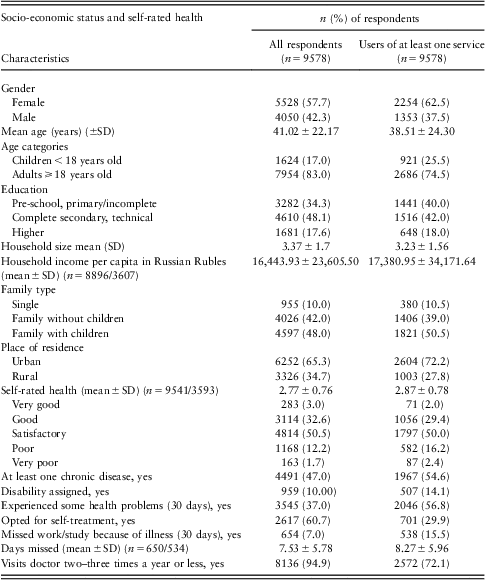
For this study, we use data from the 18th round (2009) of the Russia Longitudinal Monitoring Survey-Higher School of Economics (RLMS-HSE, 2011). The RLMS-HSE survey is carried out by face-to-face interviews, with data for the children's questionnaires obtained from adults in the household. We analyse a nationally representative sample, including adults and children. Overall, 9578 cases of individuals living in 3298 households are available. The 18th round of the RLMS-HSE contains information on the utilisation of health care services (outpatient non-dental, dental, check-up and inpatient), scale and scope of the official and informal payments. In addition, it contains detailed information about the last incidence of paying informally in cash to a medical staff for outpatient non-dental and inpatient health care services (excluding dental services), which were not available in the preceding rounds. About 38% of the total sample used at least one type of health care service in the last three months and we refer to them as ‘health care users’. Socio-economic characteristics of the whole sample and the group of health care users can be found in Table 1A in the Appendix. To compare our findings, we use data from rounds 17 (2007) and 19 (2010) of the RLMS-HSE, which did not include dental services. For 2008, no data about informal payments are available. For the analysis, we aggregate data on hospital stay and materials used for hospitalization into one category – overall hospital stay. Similarly, the total amounts of informal payments for services are summed per user, and informal payments include both hand-to-hand monetary transactions and gift giving. Household income is calculated as the total household income divided by the square root of the number of household residents (Atkinson et al., Reference Atkinson, Rainwater and Smeeding1995).
Definitions: official and informal
In the RLMS-HSE survey, payments for health care services are defined as ‘official’ if a user paid via the cashier's office in accordance with official regulations or in accordance with official prices set up by the medical enterprise. The latter are also known as quasi-formal payments. ‘Informal’ payments include hand-to-hand monetary transactions without any documents and gift giving. Both official and informal payments were given a monetary equivalent by the respondents.
Analytical methods
We use descriptive statistics to analyse the utilisation of health care services and to measure the scale and scope of informal payments. A significant share of health care users reported zero informal payments. Therefore, the related cost data is positively skewed and has an excess of zeroes. We use a two-part model to analyse individual expenditure on informal payments as two independent decisions: a decision to pay informally (probit) and a decision about the amount of informal payment (generalized linear model with gamma distribution and log link function). However, we also expect that zero payments may be caused by selection bias, where both decisions are interdependent. To check for the existence of potential bias in the selection of the respondents, we apply a sample selection model using maximum likelihood (full-information maximum-likelihood). Thus, we present two types of models: (a) two-part model and (b) sample selection model. Owing to differences in methods of estimation, we anticipate possible variations in the resulting models’ estimations. More detailed reviews of two-part and sample selection models are available in studies by Cameron and Trivedi (Reference Cameron and Trivedi2009) and Mihaylova et al. (Reference Mihaylova, Briggs, O'Hagan and Thompson2011), and examples of the models’ use for health care expenditure can be found in studies by Powers et al. (Reference Powers, Meyer, Roebuck and Vaziri2005) and Angulo et al. (Reference Angulo, Barberán, Pilar Egea and Mur2011).
Both descriptive and regression analyses are performed using STATA 12. Whenever regressions per types of service are insignificant, we analyse pooled data for all four services. The patterns of informal payments are assessed by means of cluster analysisFootnote 1 using SPSS 20. We use five characteristics to describe the clusters: who suggested the payment, who determined the amounts of the payment, when was the amount of the payment known, when did the payment occur and what were the reasons for paying informally? We define five common combinations of reasons for paying informally: access and gratitude; quality and gratitude; a combination of access, quality and gratitude; gratitude only; and other reasons. The ‘gratitude only’ group should depict the cases of expression of ‘pure’ gratitude. This separates them from cases when gratitude is expressed in combination with other reasoning, such as gaining access and/or quality, which by default should be provided free of charge.
Main limitations
The limitations in our analysis mainly concern the absence of data regarding other forms of informal payments, such as service-in-exchange, or other non-material contributions (for instance, in the form of informal care, bed linen or food brought to the hospital). Another limitation is the inability to capture so-called ‘quasi-official’ payments. This is because of a lack of objective data that would allow us to check whether users were fully aware of their entitlements and whether they paid for ‘true’ chargeable service and not for services/drugs/materials that should have been provided free of charge. Therefore, our analysis only refers to pure informal payments. The data about the reasons for paying informally were only available for inpatient and outpatient non-dental services. Therefore, the reason for such payment for dental services should be explored further, when such data are available. Lack of similar detailed longitudinal data does not make it possible to examine the relationship between occurred payments and future use of health care services in an attempt to identify ‘bribes for future care’.
Study findings
Current health care utilisation, scale and scope of informal payments
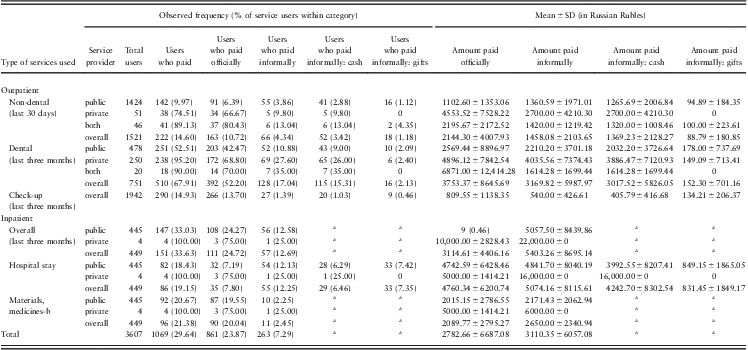
In general, the majority of health care users visit a physician two to three times a year or less. Only few miss their work or study, and sick leave does not exceed on average more than a week (Table A1 in the Appendix). Medical help is mainly sought in state-owned health care facilities (see Table 1).
Payments for health care services by type of service

Notes: 1 USD = 28.80 Russian Rubles (RR) in 2009. Observed frequencies and mean values are calculated for valid responses, using number of service users per type of service and service provider as denominator. The total values of frequencies of payments may vary because of missing answers (lack of response, refusal to respond or respondents did not know the answer).
aFollowing the formulation of the question, payments by cash and presents were estimated together.
bAccounts for purchases in pharmacies inside and outside of the hospital.
Source: Authors’ analysis of data from 2009 RLMS-HSE.
The descriptive statistics in Table 1 show that the utilisation of private health care settings is low (except for dental services) and is combined with visits to the public settings (referred to as ‘both’ in the Table 1). Almost every 10th policlinic user pays for their visit officially. In the last three month-recall period, the highest frequency of official payments is reported by users of dental services (52.2%), followed by payments related to hospitalizations (24.7%). When hospitalized, the vast majority receives materials, medication and dressing materials necessary during hospitalization free of charge (78%), fewer pay partially (17.6%) and few have to pay fully (4%; not presented in the table). Individuals who pay officially in most cases purchase necessary drugs and materials in the pharmacies located outside the hospital (not presented in the table). Overall, users are more prone to pay officially in private health care settings, in particular for outpatient non-dental and dental health services.
Informal payments are reported by 1.4–4.3% of health care users of outpatient non-dental and check-up health care services. This share is higher among those who are hospitalized – ca. 12.7%, with the highest prevalence among users of dental care services (17.0%). On average, among all health care users, informal payments amount to ca. 7.3%. If we exclude dental services, we find that informal payments total to 4.4%, which is comparable with levels reported in 2007 and 2010 (5.7% and 4.3%, respectively), using the same RLMS-HSE survey data (results of our additional analysis). The absolute amounts of informal payments are highest among users of inpatient care and relate to the hospital stay itself. Informal payments for dental care are also high. The lowest rate and monetary value of informal payments are observed for check-up services. In general, health care users pay informally with money and less frequently with gifts, and on average the amounts paid in cash are higher than the estimated value of the gifts given.
Informal payments: who is paying and how much?
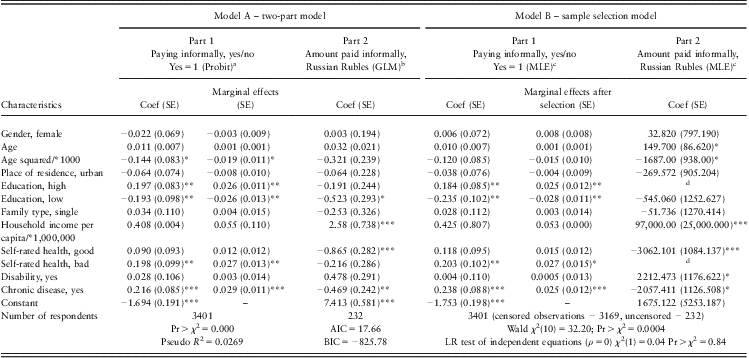
The regression analyses show that the education level of a health care user, the presence of chronic illness and overall self-rated health affect the probability of paying informally (see Table 2). More particularly, having a higher level of education (with the middle level as a reference), or bad self-rated health (as compared with an average health status) or at least one chronic disease increases the probability of paying informally (holding all other variables at zero). Having a low level of education, on the contrary, decreases such probability. A positive association of the amount paid informally is found with the level of the household income per capita. After correction for a sample selection correction, the amount of informal payments is also positively associated with the patients’ age or the presence of disability. A low level of education (with the middle level as a reference), or a good self-rated health (average as a reference) or having at least one chronic sickness are negatively associated with the amounts paid informally. In the sample selection model, however, the association with the low level of education becomes statistically insignificant. Overall, both models identify similar determinants of informal payments. And no difference in the statistical significance of the predictors of the informal payments is observed between the two models at the p = 0.05 significance level.
Informal payments for health care – who pays and how much
Notes: *p < 0.10; **p < 0.05; ***p < 0.01. 1 USD = 28.80 Russian Rubles (RR) in 2009.
aProbit regression.
bGeneralized linear model with gamma distribution and log link function.
cSample selection models are estimated using a full maximum-likelihood estimator; selection variables in Model B (Part 1) appear to affect the likelihood of paying informally and to be censored out of the sample, but models fail to reject  $$$\rho$$$
= 0 and cannot firmly reject the absence of the selection bias.
dVariables used for selection equation, but absent in the outcome equation.
Source: Authors’ analysis of data from 2009 RLMS-HSE.
Informal payments: how does the informal payment occur?
To gain a better understanding on how the informal payments occur in practice, we examine the latest incidents recalled by users of paying informally through hand-to-hand monetary transaction (data are available for outpatient non-dental and inpatient health care settings only).
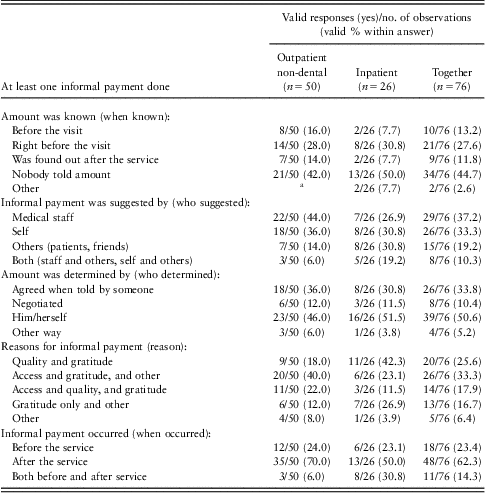
The descriptive statistics in Table 3 show that health care users pay informally both for inpatient and outpatient health care services. For outpatient service, users pay informally more frequently at the request of health staff, whereas users of inpatient services more frequently initiate informal payments themselves or make informal payments, following suggestions from other hospitalized users and/or friends. In both settings, informal payments occur more frequently after the service was provided and the exact amount is either not known before the service or known right before it. In majority of cases, the exact amount of the informal payment is determined by the health care service user, while reasons for such payments vary. For outpatient users, the reasons for paying informally can be ranked as follows (from the most frequent to the least frequent): to gain access, to gain access and more attention or better quality care, to receive better quality care and to express gratitude. For users of inpatient settings, the reasons for informal payments are similar. However, such payments are more typical for receiving more attentive and better quality care, for expressing gratitude payments, gaining access to treatment and a combination of access- and quality-related reasons.
Characteristics of the cash informal payments during the last service use
Notes: The group ‘medical staff’ consists of physicians and other medical personnel; ‘others’ – friends or other patients.
aNot applicable.
Source: Authors’ analysis of data from 2009 RLMS-HSE.
Informal payments: patterns of payments
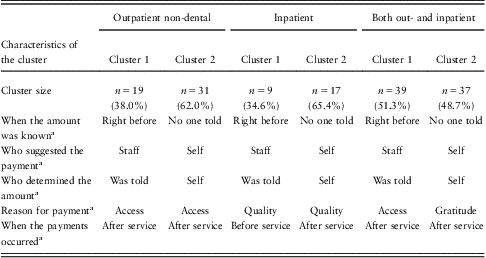
To identify the possible patterns of paying informally, we use the data on the latest incidents of paying informally recalled by the users and apply cluster analysis. As suggested by cluster analysis, each health care setting has two predominant patterns of informal payments, and two more patterns exist when no distinction is made between the types of settings (clusters 1 and 2 in Table 4).
Description of the patterns of the informal payments
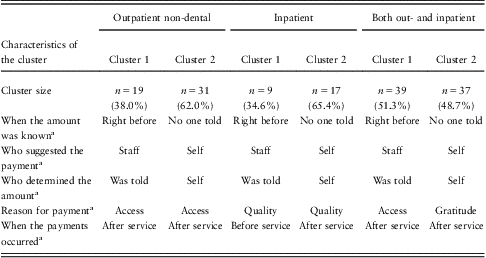
Note: aPredominant characteristics of the cluster.
Source: Authors’ analysis of data from 2009 RLMS-HSE.
The first pattern includes cases where health care users are suggested to pay informally by medical staff. In these cases, the exact amount to be paid informally is told by someone and is known only right before the service. In outpatient settings, users pay after the service is provided, whereas in inpatient settings such payments occur before the service. The second pattern depicts cases where informal payments are initiated by the users of health care services, where the exact amount of the informal payments is not known before the service, and therefore is determined by the users themselves. Both patterns share similar reasons for informal payments – to gain access to the provided service (for outpatient services) or to receive more attentive and better quality care (for inpatient services).
We discover similar patterns when no distinction is made between the types of the health care settings and all cases of paying informally are analysed together. The only difference is found when the decision to pay informally is made by the user, where such payments serve as an expression of gratitude (Table 4; clusters 1 and 2 in Figure A1 in the Appendix). In addition to the most dominant and frequently occurring patterns, we also identify two additional less frequent patterns, when we analyse all cases together (clusters 3 and 4 in Figure A1 in the Appendix). For instance, the third pattern depicts users who decide to pay informally before the service and on their own initiative, in order to gain better quality and more attentive care. Similar to the predominant patterns, users determine the amount of payment by themselves, as the amount of informal payment is unknown. The fourth pattern occurs following the recommendation of friends or other patients to gain access to the service, and users pay informally after the service. In these cases, the amount of informal payment is known before the service, but the exact amount is negotiated with the service provider.
Overview of clusters when cases are analysed together. Source: Authors’ analysis of data from 2009 RLMS-HSE.
In general, the exact amount of the payment depends on the initiator of the informal payment. Users are told how much they should pay, when the payments are requested; users determine the exact amount themselves should they themselves initiate the payment; and the amount was determined in the course of negotiations when paying informally was suggested by relatives, friends or other patients. Overall, informal payments, in order to gain access and as an expression of gratitude, are made after the service is provided. Payments for quality most often occur before the service provision.
The patterns of paying informally reveal how informal payments actually occur in the Russian health care facilities and confirm our expectations. Yet, it is important to mention that these core patterns are not uniquely characterized by attributes, but they rather represent the predominant characteristics within the pattern, which occurred more frequently among respondents. A more detailed overview of all characteristics within patterns and their frequency distribution can be found at Figure A2 in the Appendix.
Characteristics of clusters (distributional counts). Notes: The automatic two-step clustering suggested two main clusters. The Silhouette measure of cohesion and separation was fair. Characteristics of rows as they appear from left to right: when known (before the visit, right before, after the service, nobody told the amount); who suggested to pay (medical staff, self, others, both); who determined (agreed when told by someone, negotiated, self, other way); reason for payment (access, quality, access and quality, gratitude, other); and when the payment occurred (before, after service, both before and after service). The deeper shade of grey depicts the predictor's importance that was determined automatically and used during cluster analysis. * – the fifth bar in the chart “When known” is missing, as the characteristic “other” was not observed in the subgroup of users of out-patient non-dental services.Source: Authors’ analysis of data from 2009 RLMS-HSE.
Discussion
The scale and scope of informal payments in 2009
Our results confirm our expectations that Russian health care users continue to pay informally for all types of health care services, both in public and private settings. Whenever users decide to pay informally, they tend to pay more frequently in cash. Gifts are also used for these purposes, but less frequently, and they have a lower monetary equivalent. We also find that the probability of informal payments and the amount paid are determined by socio-economic characteristics, such as level of education, self-rated health, age, household income, the presence of disability or at least one chronic sickness.
We find that, in 2009, the number of users who paid informally ranged from 1.4% to 17.0%, depending on the type of health care service, averaging to ca. 7.3% among all health care users. These figures are similar to those for the preceding and succeeding years, using the same data (as shown by our additional analysis not reported in this paper). At the same time, it is worthwhile noting that the overall utilisation rate of health care services by the general population is not high (users rely on self-treatment).
The highest incidence of informal payments (17%) was reported by users of dental services. The informal payments for dental services are more frequently observed in private settings (27.6% vs 10.1% in public settings). These findings are interesting, as they indicate that shifting health care provision to a private market alone does not necessarily eradicate informal payments, despite a potentially higher quality of care and market-based prices. There are several possible explanations. For instance, the urge to bypass the official cashiers in dental services could be a result of patients’ desire or need to avoid paying high tariffs. This could hold true whenever patients pay informally lower amounts (directly to medical personnel) than they would otherwise pay officially (via the cashier). By accepting/requesting informal payments, dentists may also increase their own income, as amounts received informally most likely would exceed the official commission (when working on a salary-plus-commission plan). The management of the dental practices could also promote the practice of informal payments to hide the income for the purposes of tax evasion. However, no data are currently available that could be used to test these explanations. Therefore, further research that could explain the reasons behind such payments is needed.
Inpatient service users paid informally more frequently (12.7% of users) than users of outpatient non-dental and check-up health care services (4.3% and 1.4% of users). Inpatient services normally deal with urgent health matters (when pain is acute and less tolerable), as opposed to outpatient non-dental services and check-up services, where care has a more planned or preventive nature. Therefore, a higher incidence of informal payments could be explained by the desire to avoid uncertainty when health risks are high and the time frame for decision making is constrained. Moreover, in such circumstances, patients and relatives could be more willing to pay informally to gain additional assurance that sufficient quality and attentive care would be provided to treat the health problem.
Comparison with previous studies for Russia and other European countries
As shown earlier in the background section, previous studies about the Russian health care sector reported a varying range of estimates of the incidence of informal payments in terms of the numbers of users who paid informally or the shares of informal payments among all payments. Such variations make a cross-study comparison of the overall size of informal payments in Russia if not impossible, then at least troublesome.
One reason for this is the lack of consensus about a universal definition of informal payments, despite previous attempts to formulate one (e.g. Gaal et al., Reference Gaal, Belli, McKee and Szócska2006a; Stepurko et al., Reference Stepurko, Pavlova, Gryga and Groot2010). Depending on the chosen definition, studies capture different spectra of informal payments. For example, besides monetary hand-to-hand transactions and gift giving, informal payments can account for forced informal non-material contributions (e.g. bed linen and food brought from home, informal care). In addition to this, there are quasi-formal payments (e.g. additional purchases of medications and materials that should have been provided free of charge or ‘strongly suggested’ purchases of certain drugs). The second source of differences are variations in sample sizes, region of data collection, data collection techniques (i.e. face-to-face interviews, self-administered questionnaires) and formulations of questions, all of which can lead to different estimation results. However, the main reason for misleading interpretations that makes cross-country comparisons almost impossible is using different data representation techniques. The most common practice is presenting informal payments as a share of all payments and only among those who paid.
However, we suggest reporting the frequency of incidents of informal payments among users of health care services and not among payers for health care services alone. This would give a more relevant and easier-to-interpret picture of the phenomenon for government and health policymakers, and helps to avoid overestimation (the share of informal payments among payers) or underestimation (frequency of informal payments in the total sample) of the true scale and scope of informal payments. An example, based on our study, serves as an illustration and speaks for itself. Reporting informal payments among users gives an estimate of 7.3%. If we present the same results as the share among payers, we obtain figures as high as 24.6%, and if we present them as a share of the total sample we obtain only 2.7%.
When we apply the same scale of representation, we find our results regarding the average level of informal payments, comparable with previously published reports. On the user and household levels, informal payments seem to remain within the 7% range. The only difference we observe is the shift in the incidence of informal payments among services. Unlike our findings for 2009, where the highest share of informal payments was reported for dental and inpatient services, previous studies for Russia reported the highest shares of informal payments among users of inpatient and outpatient non-dental services, followed by dental services.
Compared with other European countries, the level of informal payments in the Russian health sector (4.3% users of outpatient non-dental services and 12.7% of users of inpatient services) seems to be lower. For instance, for the same services in 2010, in Bulgaria informal payments are reported by 9.6% and 19.8% of health care users, respectively; in Hungary, by 20.8% and 44.2%, respectively; in Lithuania by 19.8% and 49.7%; in Poland by 6.7% and 16.4%; in Romania by 28.7% and 49.5%; and in Ukraine by 36.1% and 48.2%, respectively (Stepurko et al., Reference Stepurko, Pavlova, Gryga and Groot2011; Atanasova et al., Reference Atanasova, Pavlova, Moutafova, Rechel and Groot2012; Baji et al., Reference Baji, Pavlova, Gulácsi and Groot2012; Pavlova et al., Reference Pavlova, Tambor, Stepurko, van Merode and Groot2012). At the same time, the determinants of informal payments, found to be significant in our study for Russian health care settings, are similar to those reported for other European countries – education, income and health status (e.g. Balabanova and McKee, Reference Balabanova and McKee2002; Özgen et al., Reference Özgen, Sahin, Belli, Tatar and Berman2010; Tomini and Maarse, Reference Tomini and Maarse2011).
Reasons for informal payments
The scale and scope of informal payments estimated in empirical research can be used to approximate the burden these payments pose on health care users. However, these data are not sufficient to explain why these payments exist and continue to exist over time. As our results confirm, informal patient payments in Russia are complex and can be described by several patterns of paying informally. We elaborate about the reasons for informal payments below.
In line with the recent literature on informal payments that elaborates on the reasons of their existence, develops theories and behavioural models of informal payments (Hirschman, Reference Hirschman1980; Ensor and Witter, Reference Ensor and Witter2001; Ensor, Reference Ensor2004; Gaal and McKee, Reference Gaal and McKee2004; Stepurko et al., Reference Stepurko, Pavlova, Gryga and Groot2010; Cohen, Reference Cohen2011), our results on the patterns of informal patient payments also suggest that on a micro-level (users’ perspective), there are at least three dominating reasons for paying informally in the Russian health care sector. These reasons include: gaining access to the treatment/service (especially in outpatient non-dental settings), receiving care of a better quality (particularly in inpatient settings) and expressing gratitude to the health care professional (in both types of settings). Importantly, these reasons reflect the known problems of the Russian health care sector: the lack of satisfaction with the quality of health care services by users and providers themselves, equity and access problems and limited or no real users’ choice of health care provides (Twigg, Reference Twigg2002; Fotaki, Reference Fotaki2009; Gordeev et al., Reference Gordeev, Pavlova and Groot2011). Therefore, it is unsurprising that Russian health care users have no other option but to search for alternative ways to obtain the health care services that they need and desire, via their social networks or informal payments.
Overall, it seems that informal payments in Russian health care do not only signal about existing problems (indicated above), but are also used as one of the compensation mechanisms developed over time. Such observation is in line with the theory of alternative politics for health care settings (Cohen, Reference Cohen2011), where in a context of poor governance, informal payments are seen as an alternative way for a user to obtain health care services with a quality and in a quantity that they need and desire. The fact that informal payments continue to exist at an almost unchanged 7% level is yet another proof of this observation.
Taking into account revealed patterns of paying informally, the persistent existence of informal payment in Russian health care can also be seen as one of the behavioural reactions described in the ‘INXIT’ theory (Gaal and McKee, Reference Gaal and McKee2004). The theory suggests that when both patient and medical staff are dissatisfied with the declining performance of the health care system, both groups are motivated to change the situation. There are three possible options: leave the organization and satisfy wants elsewhere (EXIT), openly complain using available formal channels (VOICE) or try satisfying wants in the organization using informal channels (INXIT). The application of this theory to the Russian health care system shows that this system is still characterized by a blocked EXIT (not having an ability to leave and seek elsewhere) and a blocked VOICE (lack of complain system). In particular, the real choice between health care providers is still lacking, the alternative market for health care services in terms of private sector is non-existent, the spectrum of private health care sector services is very limited (with the exception of dental services) and an effective system of feedback within health care institutions or via health care insurers, which would have a real impact on the provider, is absent (Gordeev et al., Reference Gordeev, Pavlova and Groot2011).
Conclusions and policy implications
Our results on the scale and scope of informal payments, and the process of paying informally (actors involved, settings, reasons and patterns) provide evidence for policymakers about this phenomenon. Over time, the level of informal payments remained within the range of 7%, and we believe they will continue to exist if no appropriate governmental actions are taken. And as informal payments impose threats and affect equity in access, as well as the overall efficiency and quality of the provided care, at any level of their existence (Thompson and Witter, Reference Thompson and Witter2000; Balabanova and McKee, Reference Balabanova and McKee2002; Ensor, Reference Ensor2004; Allin et al., Reference Allin, Davaki and Mossialos2006; Gaal et al., Reference Gaal, Belli, McKee and Szócska2006a; Vian and Burak, Reference Vian and Burak2006; Lewis, Reference Lewis2007; Cohen, Reference Cohen2011; Mæstad and Mwisongo, Reference Mæstad and Mwisongo2011), a set of proper governmental actions is necessary to eliminate their existence.
We believe that the first crucial step in dealing with informal payments should be their official recognition by the Russian government. A clear policy should be developed and implemented in consultation with the representatives of patients’ safety organizations, insurers, associations of health care providers and medical ethical committees. However, policymakers should not start a ‘witch hunt’ to capture and punish ‘werewolves in white coats’ (Masuk, Reference Masuk2010), which is how medical staff taking informal payments are sometimes being approached by the Russian media. This step can be rather fostered by conducting a nation-wide information campaign to raise awareness about health care users’ rights, health care entitlements and the content of the ongoing health care reforms. Should such strategy be chosen, information campaigns should target both users and health care services providers, as both groups initiate informal payments (as shown by our results).
It is clear that official recognition and information awareness campaigns alone are not sufficient to eradicate informal payments. Tackling informal payments is challenging, as it requires implementing a number of conjugate measures. In general, reforms should address the main reasons why Russian health care users pay informally (i.e. access to health care services and more attentive and better quality care as suggested by our results), and aim at the development of a consumer- and market-oriented health care.
The basic package of health care services (Government of the Russian Federation, 1993) should be revised and exclude unaffordable State guarantees. Leaving fewer but affordable services would free sufficient funding necessary to increase the quality of the remaining services. Next, reforms should give more choice to health care consumers, for example, by creating more favourable conditions for the development of a private sector (e.g. relaxation of taxation). Competition between the public and private organizations in service provision, covered by the system of compulsory social health insurance, could improve cost-efficiency and lead to a significant quality improvement. However, an increase in the volume of services by including private sector providers alone would not eliminate informal payments. As shown in our results, patients pay informally also for services received in private settings.
Users should also have access to accessible and open channels of communication (both with service provider and insurance companies) to provide timely feedback on quality of received services and the possibility to file complaints regarding problems encountered (i.e. access, complications, waiting time and necessity to pay informally). The health consumer empowerment should also be fostered and health care users should take more responsibility over their own health (something Russian citizens are still not used to). The introduction of co-payments for services outside the basic package and higher than standard quality of services via voluntary insurance or direct out-of pocket payments would leave less reasons for informal payments to exist. To tackle the informal payments even further, we suggest that, in principle, all direct financial transactions between the health care user and provider should be eliminated and be channelled solely via the insurer (e.g. via billing at home). Moreover, patients could express their gratitude (another identified reason for paying informally) not by means of presents or informal cash payments to the provider, but staying loyal and choosing the same providers and insurers again.
Some of these proposed measures are possible for implementation as of 2012, as they gained additional legal bases as a result of the recent changes in the Russian legislation, i.e. Federal Law No. 326, 2010 and Federal Law No. 323, 2011 (Government of the Russian Federation, 2010, 2011). However, these legal acts were not specifically accepted with the purpose to eliminate the informal payments. Therefore, we do not expect that they will affect the existence of informal payments in the short run. Nonetheless, considering the recent changes in legislation as bases for further actions, we call on Russian health policymakers to put informal payments on their agenda as soon as possible. Once again, ignoring and avoiding the issue will not make informal payment disappear, as they had proven to be self-sustainable and persisting over the years. We believe that without active governmental measures, addressing informal payments will be doomed to fail.
Acknowledgements
The study is financed by the European Commission under FP7 Theme 8 Socio-economic Sciences and Humanities, Project ASSPRO CEE 2007 (GA no. 217431). The content of the publication is the sole responsibility of the authors and in no way represents the views of the Commission or its services.
Conflicts of interests
The authors declare that they have no competing interests.
Appendix
Respondents’ socio-economic status and health characteristics