

INTRODUCTION
A robust understanding of the Holocene vegetation and climate history of the Tropical Andes (8°N–26°S) is key for understanding long-term ecosystem dynamics (Bush et al., Reference Bush, Silman and Urrego2004; Cárdenas et al., Reference Cárdenas, Gosling, Sherlock, Poole, Pennington and Mothes2011) and variability in large-scale climate systems, such as the El Niño–Southern Oscillation (ENSO) (Moy et al., Reference Moy, Seltzer, Rodbell and Anderson2002; Muñoz et al., Reference Muñoz, Gorin, Parra, Velásquez, Lemus, Monsalve and Jojoa2017) and the Intertropical Convergence Zone (ITCZ) (Muñoz et al., Reference Muñoz, Gorin, Parra, Velásquez, Lemus, Monsalve and Jojoa2017). Fossil pollen have been widely used in the Tropical Andes to reconstruct vegetation and climate history (Liu and Colinvaux, Reference Liu and Colinvaux1985; Bush et al., Reference Bush, Silman and Urrego2004; Hooghiemstra and Van der Hammen, Reference Hooghiemstra and Van der Hammen2004; Cárdenas et al., Reference Cárdenas, Gosling, Sherlock, Poole, Pennington and Mothes2011; Flantua et al., Reference Flantua, Hooghiemstra, Vuille, Behling, Carson, Gosling and Hoyos2016; Schiferl et al., 2018). Such pollen records are especially valuable when they are calibrated to a modern pollen-climate-vegetation dataset. In the Tropical Andes, several calibration studies show that modern pollen rain reflects the surrounding vegetation composition (Weng et al., Reference Weng, Bush and Silman2004; Reese and Liu, Reference Reese and Liu2005) and that compositional changes in modern pollen assemblages closely track altitudinal gradients (Weng et al., Reference Weng, Bush and Silman2004; Moscol-Olivera et al., Reference Moscol-Olivera, Duivenvoorden and Hooghiemstra2009; Urrego et al., Reference Urrego, Silman, Correa-Metrio and Bush2011b). As such, when calibrated locally, pollen assemblages can be used to reconstruct changes in the position of the upper forest line (Niemann et al., Reference Niemann, Brunschön and Behling2010; Groot et al., Reference Groot, Bogotá, Lourens, Hooghiemstra, Vriend, Berrio and Tuenter2011; Urrego et al., Reference Urrego, Niccum, La Drew, Silman and Bush2011a) and, by inference, palaeotemperature (Weng et al., Reference Weng, Bush and Silman2004; Groot et al., Reference Groot, Bogotá, Lourens, Hooghiemstra, Vriend, Berrio and Tuenter2011).
Yet, calibrating modern pollen assemblages to vegetation and climate in the Tropical Andes is challenging. First, differences in plant pollination syndromes (Bush, Reference Bush1995; Moscol-Olivera et al., Reference Moscol-Olivera, Duivenvoorden and Hooghiemstra2009), heterogeneous vegetation (Jantz et al., Reference Jantz, Homeier, León-Yánez, Moscoso and Behling2013), and upslope wind dispersal of pollen (Bush, Reference Bush2000; Weng et al., Reference Weng, Bush and Silman2004; Moscol-Olivera et al., Reference Moscol-Olivera, Duivenvoorden and Hooghiemstra2009; Niemann et al., Reference Niemann, Brunschön and Behling2010; Urrego et al., Reference Urrego, Silman, Correa-Metrio and Bush2011b) result in a biased representation of pollen taxa in the pollen record. For example, upslope wind dispersal leads to overrepresentation of mostly arboreal taxa above the upper forest line (Weng et al., Reference Weng, Bush and Silman2004; Moscol-Olivera et al., Reference Moscol-Olivera, Duivenvoorden and Hooghiemstra2009; Niemann et al., Reference Niemann, Brunschön and Behling2010; Jansen et al., Reference Jansen, De Boer, Cleef, Hooghiemstra, Moscol-Olivera, Tonneijck and Verstraten2013). Second, modern pollen calibration studies in the Tropical Andes are mostly based on pollen rain in moss polsters (Weng et al., Reference Weng, Bush and Silman2004; Moscol-Olivera et al., Reference Moscol-Olivera, Duivenvoorden and Hooghiemstra2009; Urrego et al., Reference Urrego, Silman, Correa-Metrio and Bush2011b; Cárdenas et al., Reference Cárdenas, Gosling, Pennington, Poole, Sherlock and Mothes2014), soil samples (Weng et al., Reference Weng, Bush and Silman2004; Reese and Liu, Reference Reese and Liu2005), or pollen traps (Moscol-Olivera et al., Reference Moscol-Olivera, Duivenvoorden and Hooghiemstra2009; Niemann et al., Reference Niemann, Brunschön and Behling2010; Jantz et al., Reference Jantz, Homeier, León-Yánez, Moscoso and Behling2013;), while reconstructions of past vegetation dynamics are usually based on pollen records from lake sediments (Colinvaux et al., Reference Colinvaux, Bush, Steinitz and Miller1997; Hansen et al., Reference Hansen, Rodbell, Seltzer, León, Young and Abbott2003; Urrego et al., Reference Urrego, Silman and Bush2005; Schiferl et al., Reference Schiferl, Bush, Silman and Urrego2018). Pollen records from lake sediments likely represent temporal and spatial scales different than moss polsters (Gaudreau et al., Reference Gaudreau, Jackson and Webb1989; Fall, Reference Fall1992), but so far no local studies in the Tropical Andes are available to quantify this. Hence, the characterization of modern pollen rain assemblages from lakes is an essential prerequisite for accurate reconstructions. Furthermore, reliable interpretations of fossil pollen records require information on the transport distance of pollen in the landscape to determine the spatial scale of the reconstructed vegetation (Gaudreau et al., Reference Gaudreau, Jackson and Webb1989), and locally and regionally dominant elements of the pollen rain. Yet, knowledge on pollen dispersal and transport distance in South American neotropical landscapes is limited to a few sites (e.g., Bush and Rivera, Reference Bush and Rivera1998; Whitney et al., Reference Whitney, Smallman, Mitchard, Carson, Mayle and Bunting2018) and local studies in the Tropical Andes to quantify first-order estimates of pollen transport distances between plants and lake-surface sediments across different vegetation zones are so far not available.
Here, we analyse the modern pollen rain captured in surface samples from lake sediments and moss polsters in relation to the vegetation along an altitudinal gradient between 3100 and 4200 m above sea level (asl) in the Tropical Andes. The transect covers a temperature gradient of ca. 7°C and the transition from the upper montane forest to the páramo. The aims of our study are (1) to assess to what degree the altitudinal and temperature gradients drive species composition changes in the modern pollen rain in both moss polsters and sediment surface samples from Andean lakes; and (2) to assess qualitative and quantitative relationships between pollen assemblages and its parent plant communities in the Tropical Andes of Ecuador.
STUDY REGION: CAJAS NATIONAL PARK, ECUADOR
Cajas National Park (CNP) in southwest Ecuador provides an ideal location for investigating modern pollen rain across an altitudinal and environmental gradient because of the presence of > 200 lakes across an altitudinal gradient of which several have been used as sites for reconstructions of vegetation and climate history (Colinvaux et al., Reference Colinvaux, Bush, Steinitz and Miller1997; Moy et al., Reference Moy, Seltzer, Rodbell and Anderson2002; Hansen et al., Reference Hansen, Rodbell, Seltzer, León, Young and Abbott2003).
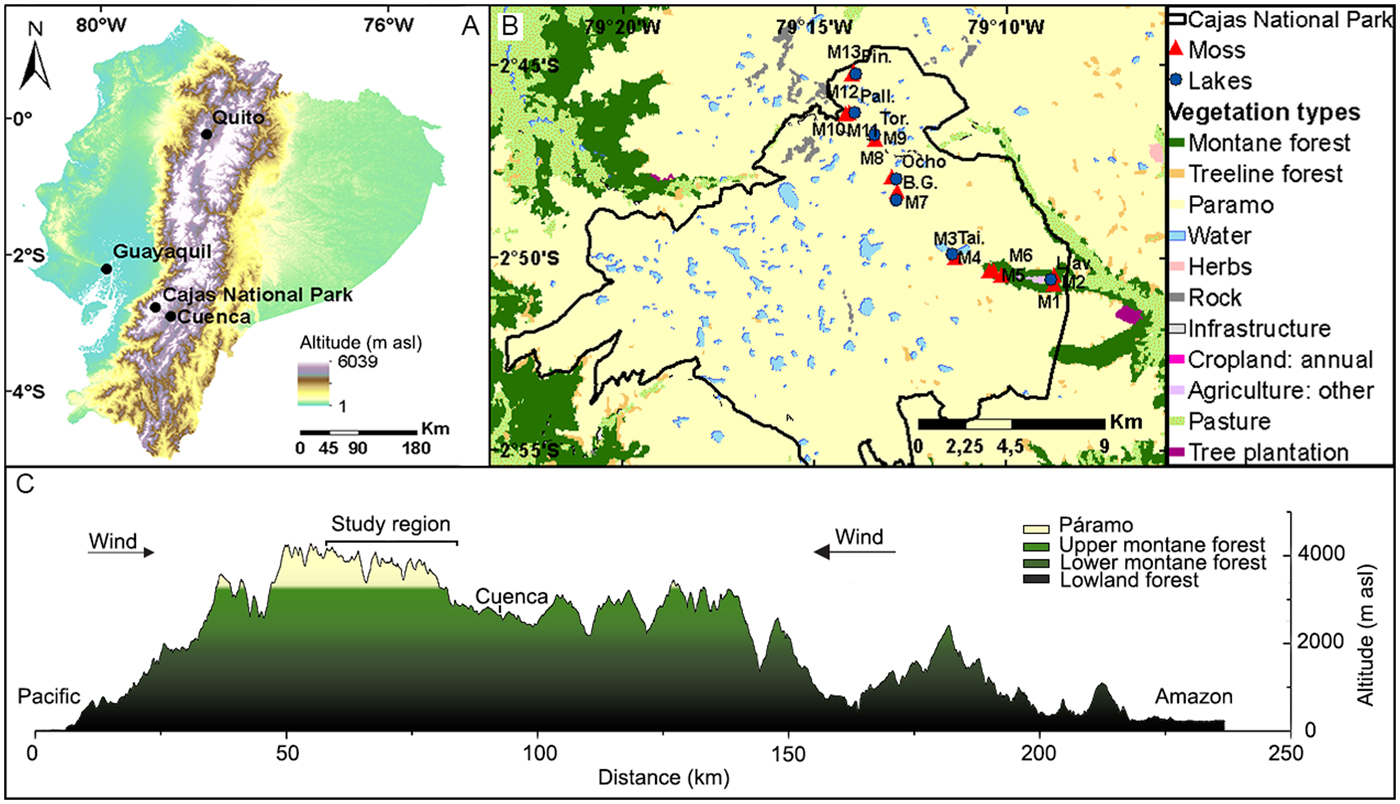
CNP is situated on the western Cordillera of the southern Ecuadorian Andes (2°46'46"S, 79°13'27"W), ca. 25 km west of Cuenca in the province of Azuay, and ca. 300 km south/southwest of Quito (Fig. 1). Elevation in the park ranges from 3100 to 4500 m asl with a plateau at ca. 4000 m asl and several deep valleys and mountain rivers draining to the west and east (Rodbell et al., Reference Rodbell, Bagnato, Nebolini, Seltzer and Abbott2002). The geomorphology of the area has been shaped by glacial expansion and retreat, resulting in an abundance of lakes, valleys, and moraines (Hansen et al., Reference Hansen, Rodbell, Seltzer, León, Young and Abbott2003). The montane forests and páramos in the region are a biodiversity hotspot (Myers et al., Reference Myers, Mittermeier, Mittermeier, da Fonseca and Kent2000), with many endemic species occurring in narrow altitudinal distribution ranges (Gentry, Reference Gentry1992) and the region has been identified as a “priority landscape for biodiversity conservation” (Cuesta et al., Reference Cuesta, Peralvo, Merino-Viteri, Bustamante, Baquero, Freile, Muriel and Torres-Carvajal2017). The vegetation in CNP follows an altitudinal zonation (Fig. 1). The vegetation in the lower reaches of the park (3100–3500 m asl) is a continuous upper montane Andean forest reaching a height of 15–20 m, with multi-stemmed trees, contorted tree growth, and giant shrubs, with epiphytes and lianas covering the trees. Herbaceous flora such as grasses, sedges, and ferns cover the forest floor. Following Bakker et al. (Reference Bakker, Moscol-Olivera and Hooghiemstra2008), we define the upper forest line as the uppermost contour of closed continuous forest. Isolated patches of small dwarf trees (e.g., Polylepis spp.) are not considered upper montane forest. The upper montane forest transitions into grass páramo with small patches of Polylepis spp. forest at 3500 m asl. The grass páramo (i.e., pajonal) at 3500–4000 m asl is dominated by bunch grasses, with scattered herbs and shrubs, such as Puya spp. In the higher reaches of the park (>4000 m asl), the vegetation is mainly characterized by shrub and cushion páramo, where cushion plants dominate and bunch grasses and small shrubs are scattered across the landscape (Hansen et al., Reference Hansen, Rodbell, Seltzer, León, Young and Abbott2003). Anthropogenic impact on the vegetation is minimal, with minor grazing by llamas, and the area has been protected since 1977. In proximity of the park (5 km from study site Laguna Llaviucu) are plantations of Eucalyptus spp. and Pinus spp.
(color online) Study region. (A) Elevation map showing the location of CNP in Southern Ecuador (SRTM data, USGS 2014). (B) Map showing vegetation types in CNP region and sampling locations of this study. (C) Elevation profile across the Ecuadorian Andes (SRTM data, USGS 2014) with the research location, major vegetation types, and wind patterns.

Lapse rate for mean temperature is ca. 6.88°C/km in CNP (Córdova et al., Reference Córdova, Célleri, Shellito, Orellana-Alvear, Abril and Carrillo-Rojas2016) and temperature shows a strong diurnal variation ranging from ca. -1.8 to 17.8°C (Carrillo-Rojas et al., Reference Carrillo-Rojas, Silva, Córdova, Célleri and Bendix2016). Precipitation in the inter-Andean valley, where the city of Cuenca is situated (Fig. 1), is relatively low (800–1500 mm/yr) because the air masses lose most of their moisture on the western and eastern Andean flanks (Vuille et al., Reference Vuille, Bradley and Keimig2000). Spatial variability in rainfall is very high in the region and can differ 25% within distances of <4 km (Buytaert et al., Reference Buytaert, Celleri, Willems, De Bièvre and Wyseure2006). Fogs and rain occur frequently >3000 m asl, with a mean annual precipitation of ≥2000 mm (Hansen et al., Reference Hansen, Rodbell, Seltzer, León, Young and Abbott2003). The western Andean slopes near CNP experience positive precipitation and temperature anomalies during warm El Niño events (Vuille et al., Reference Vuille, Bradley and Keimig2000; Moy et al., Reference Moy, Seltzer, Rodbell and Anderson2002). Prevailing winds are from the east, southeast, or northeast during non-El Niño years (Carrillo-Rojas et al., Reference Carrillo-Rojas, Silva, Córdova, Célleri and Bendix2016) but the area farthest west in CNP could also be influenced by westerly winds from the Pacific (Fig. 1; Hansen et al., Reference Hansen, Rodbell, Seltzer, León, Young and Abbott2003).
METHODS
We use a combination of vegetation surveys, modern pollen assemblages from moss polsters and lake sediments, and a quantitative spatial analysis to characterize the modern pollen rain in CNP along altitudinal and temperature gradients. Temperature data along the altitudinal gradient are based on meteorological stations in CNP and were obtained from Córdova et al. (Reference Córdova, Célleri, Shellito, Orellana-Alvear, Abril and Carrillo-Rojas2016).
Vegetation survey
To assess qualitative and quantitative relationships between pollen assemblages and their parent plant communities, we conducted a vegetation survey in August 2015 along an altitudinal transect from 3100 to 4200 m asl. In total, 13 vegetation relevés (10 × 5 m for forests and 5 × 5 m for páramo) were made in homogeneous vegetation types and located in the vicinity of the lakes studied (Fig. 1). The relevés were arbitrarily chosen following the “stratified random” technique to represent the major vegetation communities in CNP. The vegetation relevés along the transect included upper montane forest, Polylepis spp. stands, grass páramo, and cushion páramo (Fig. 1). For every relevé, a list of vascular plants was recorded along with their percentage cover using the Braun Blanquet method adjusted by Barkman et al. (Reference Barkman, Doing and Segal1964). In forest relevés we identified and counted all trees with a diameter of >1 cm at breast height (defined as 1.3 m above soil level), at species level when possible. All Braun Blanquet data were converted to percentage cover for further analysis by using the mean of the upper and lower limit of the range. For each relevé species richness (i.e., number of taxa) was calculated per standardized plot area (25 m2) and converted to the same taxonomic level as found in the modern pollen rain (adjusted species richness) for comparison. Altitude and slope were measured with a GPS device.
Modern pollen rain
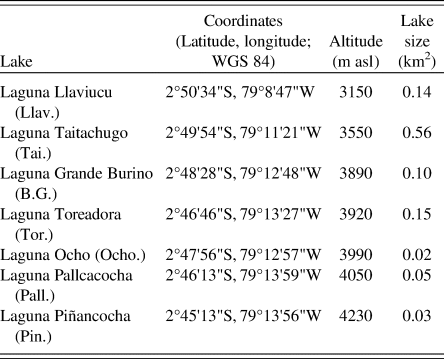
In August 2015, samples for the analysis of modern pollen and spore rain were obtained from 13 moss polsters taken from the centre of each vegetation relevé (Fig. 1) and from sediment surface samples from seven lakes (Table 1) collected with an UWITEC gravity corer. Along the sampled gradient no suitable lakes were found at 3200–3500 and 3600–3800 m asl. To assess variability in pollen rain within a lake we analysed replicates from four of the seven lakes. We expanded our dataset by adding data on pollen rain in sediment surface samples previously collected and analysed by Hansen et al. (Reference Hansen, Rodbell, Seltzer, León, Young and Abbott2003) from four additional lakes (Laguna Pampiada [Pamp], Laguna Chorreas [Chor], Highest Lake [HL], and Upper Lake [UL]) and one additional sample from Laguna Pallcacocha, resulting in a total n = 11 and total replicates n = 5.
Coordinates, altitudes, and estimated sizes of lakes sampled in 2015.

To extract pollen from the moss polsters, approximately 100 cm2 of each moss polster was washed with ethanol (90%). Extracts were centrifuged and decanted. The lake sediment surface samples were freeze-dried and ~0.5 g was used for pollen analyses. Sediment and moss samples were spiked with 4 mL Lycopodium clavatum solution (i.e., ~8339 spores). To remove humic acids, coarse fragments, and to disaggregate the sediments, samples were treated with 10% KOH at 70°C and sieved over 200 µm mesh. Samples were dewatered with 99% acidic acid and acetolysed for 10 minutes at 100°C in a 1:9 mixture of sulphuric acid and acetic anhydride (Faegri and Iversen, Reference Faegri and Iversen1989). The sediment surface samples were floated over sodium polytungstate (density = 2.0) to remove minerals. Residues were mounted in glycerol and analysed to a minimum of 300 pollen grains and spores with a Leica DM2500 light microscope at 400 × magnification. Pollen types were identified to the lowest taxonomic level possible following descriptions by Hooghiemstra (Reference Hooghiemstra1984), and by comparison with the reference collections at the University of Amsterdam and Utrecht University. In routine pollen analysis, pollen grains from the dwarf tree Polylepis spp. cannot be morphologically separated from grains of Acaena spp. (Smit, Reference Smit1978). Van‘t Veer et al. (Reference Van't Veer and Hooghiemstra2000) argued that most pollen grains of the Polylepis spp.-Acaena group reflect Polylepis spp. Following this line of reasoning, we only identified Polylepis spp. in our samples. Species richness in the pollen samples was determined with rarefaction calculations (Birks and Line, Reference Birks and Line1992) to remove the effect caused by variations in the pollen sum amongst samples. The rarefaction method was applied by using the “individual rarefaction” option in the software PAST (version 2.01; Hammer et al., Reference Hammer, Harper and Ryan2001). Pollen percentages for each taxon were calculated relative to the total pollen number found in the specific sample (total pollen sum included all pollen and spore types except aquatic taxa such as Isoëtes spp.). Percentage diagrams were plotted with C2 version 1.7.7 (Juggins, Reference Juggins2007).
Data treatment and spatial analysis
Following previous studies in the Tropical Andes (e.g., Moscol-Olivera et al., Reference Moscol-Olivera, Duivenvoorden and Hooghiemstra2009), the relationship between the vegetation and modern pollen rain in moss and sediment surface samples was determined through the association index (A; Davis, Reference Davis1984). This index is based on presence-absence data and calculations were conducted following Davis (Reference Davis1984). A provides a relative measure for a pollen type in a moss or sediment sample to indicate the presence of the plant in the local vegetation sampled. The values range between 0 and 1, with A = 1 when the pollen type and the plant taxon are both present and A = 0 when the pollen type or the parent plant either are absent or do not co-occur (Davis, Reference Davis1984). The production bias between plant community cover (i.e., upper montane forest or páramo) and the respective pollen types was assessed by comparison of pollen percentages and vegetation cover percentage from the relevé data for both moss and sediment surface samples. Subsequently, a first-order estimate of mean pollen transport distances for Laguna Llaviucu and Laguna Pallcacocha was made, since both lakes have been used as sites for reconstructions of vegetation and climate history (Colinvaux et al., Reference Colinvaux, Bush, Steinitz and Miller1997; Moy et al., Reference Moy, Seltzer, Rodbell and Anderson2002). Laguna Llaviucu is situated within the upper montane forest and Laguna Pallcacocha in the páramo, providing the opportunity to identify the effect of landscape openness on mean pollen transport distance. To identify the spatial range of the regional pollen rain in the lake samples, we used vegetation maps with a land cover classification at 30 m spatial resolution created by the Ministerio del Ambiente Ecuador (2014) in collaboration with the Food and Agriculture Organization of the United Nations. We calculated the land cover percentage in stepwise buffers (1, 5, 10–45 km) around Laguna Pallcacocha and Laguna Llaviucu to make a first-order estimate of the mean pollen transport distance. We compared relative vegetation cover of upper montane forest, páramo, and Polylepis spp. stands with the equivalent units based on the pollen data from both lakes for the stepwise increasing buffers. In addition, the closest recorded stands of important forest elements were compared to the computed vegetation cover. This approach does not consider production biases of individual taxa, but provides a first-order estimate of the main pollen transport distance. All spatial analyses were conducted with ArcGIS software version 10.3.1 (Environmental Systems Research Institute, 2014).
Statistics
Ordination analyses were performed on the pollen data to summarize changes in species composition across the upper montane forest-páramo ecotone and to explore differences in composition between sediment and moss pollen samples. Pollen percentages were log transformed (Šmilauer and Lepš, Reference Šmilauer and Lepš2014), and rare species (<2%) were deleted to minimize their influence on the outcomes. We applied a scaling focus on inter-sample distances, and species scores were centred and divided by their standard deviation. For moss sample nine (M9) we excluded Azorella spp. from the total pollen sum for the ordination analysis. The sample contained an exceptionally high concentration of Azorella spp. with pollen grains in some cases still attached to each other, pointing to the possibility that the moss sample also included Azorella spp. plants and/or flowers. Canonical correspondence analysis (CCA) was performed separately for the lake sediment surface samples and moss polsters, with air temperature (°C) as the only constraining variable (CCAtemp,moss and CCAtemp,sed). To visualize the relationship between temperature at the sampling locations and species composition, temperature measured at each lake sampling location was plotted against its CCA axis 1 score. To test differences in composition between lake sediment surface samples and moss polsters we conducted a CCA analysis (CCAsample) with sample type as the only constraining variable and a permutation test (n = 499) for testing (dis)similarity. All ordination analyses were conducted with Canoco v.5 (ter Braak and Šmilauer, Reference Ter Braak and Šmilauer2012).
RESULTS
Vegetation survey
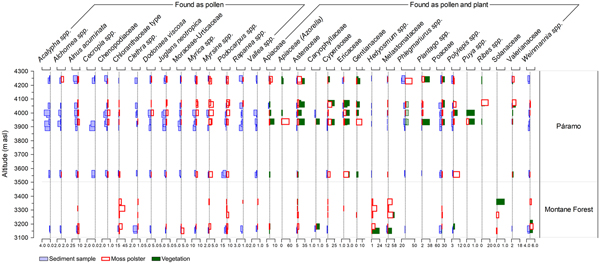
A total of 40 plant families, 72 genera, and 107 species of plants were recorded in the 13 vegetation relevés and adjacent areas in CNP. A selection of the results of the vegetation survey is plotted as percent cover together with the modern pollen rain in Figure 2. The vegetation relevés in the upper montane forest at 3148–3178 m asl are characterized by Hedyosmum sp., Melastomataceae, Poaceae, Oxalis spp., Berberis spp., and Weinmannia spp. In the vegetation relevés in the upper limit of the upper montane forest at 3300 m asl we mostly recorded Melastomataceae, Piperaceae, and some Asteraceae. Above 3500 m asl, the vegetation relevés are characterized by páramo taxa such as Asteraceae (e.g., Baccharis spp., Chuquiraga jussieui, and Loricaria spp.), Cyperaceae (e.g., Isolepis spp.), Plantago spp., Poaceae (e.g., Calamagrostis spp. and Cortaderia spp.), Apiaceae (e.g., Azorella pedunculata), Ericaceae (e.g., Disterigma empetrifolium), Geraniaceae (e.g., Geranium spp.), Hypericaceae (e.g., Hypericum spp.), Grossulariaceae (Ribes spp.), Rosaceae (e.g., Lachemilla spp.), and Valerianaceae (e.g., Valeriana microphylla and Valeriana rigida). The taxa mentioned in brackets above are examples of the most common taxa in the vegetation, pollen morphologically these taxa cannot be identified on this detailed level. Scattered in the páramo are patches of Polylepis spp. forest.
(color online) Diagrams with pollen percentages of total pollen from moss polsters, sediment surface samples, and percentage vegetation cover per standardized plot size (25 m2) as collected in 2015 (10 × exaggeration for Phlegmariurus spp.).

Pollen spectra in moss polsters
In total, 48 pollen taxa (i.e., 44 families, 31 genera, and 3 species) could be identified in the modern pollen rain of all moss and sediment surface samples. Asteraceae, Apiaceae, Cyperaceae, Valerianaceae, and Poaceae are common families in the páramo, but pollen from these taxa are difficult to identify on the species level, reducing the palynological richness. In the moss polsters, 44 taxa were identified with 22 pollen taxa also found in the vegetation relevés, while 18 taxa recorded in the relevés were not represented by pollen grains. On average we found 22 (SD = 4.22) pollen taxa per moss polster.
With increasing elevation, there is a clear sequence in dominance of different pollen taxa (Fig. 2). At the lowermost site, Melastomataceae dominate (41% at 3148 m asl), followed by Chloranthaceae type (unknown parent plant taxa, pollen resemble Chloranthaceae but do not belong to the Hedyosmum genus) in the upper montane forest between 3148 and 3554 m asl, and Polylepis spp. at the upper forest line (3554 m asl). Other common taxa at 3100 m asl, included Alnus acuminata, Weinmannia spp., and Podocarpus spp. Some bisaccate pollen grains could originate from the Pinus spp. plantation outside CNP. In the páramo moss polsters (3933 m asl) Poaceae dominate the pollen spectrum. At the uppermost site (4228 m asl), the moss polsters from the páramo showed a dominance of Asteraceae pollen. Other common taxa are Cyperaceae and Plantago spp.
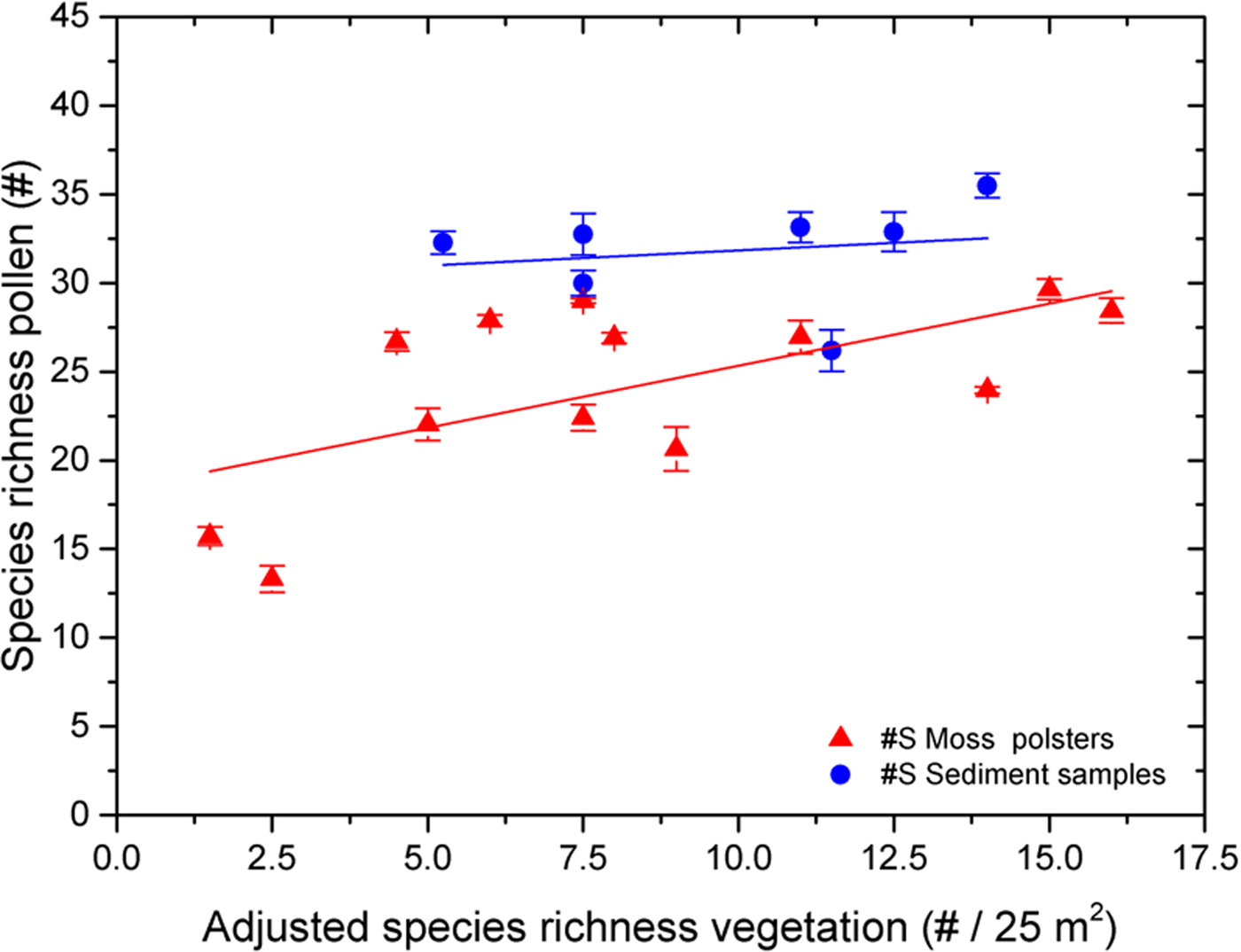
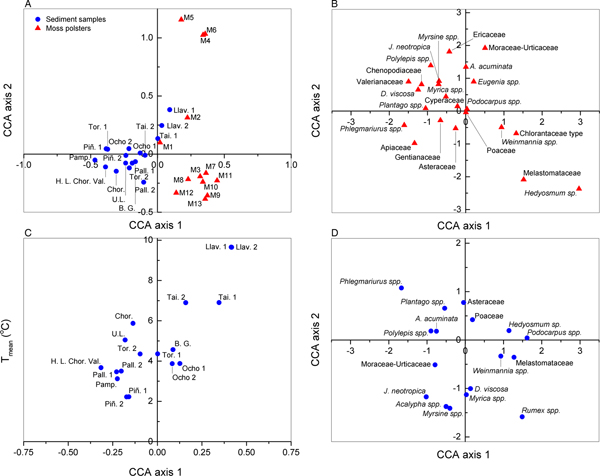
Rarefied pollen taxa richness for moss polsters has a significant positive relation to species richness in the vegetation, adjusted for taxonomical resolution of the palynological analysis (Pearson's r: p = 0.04; Fig. 3). This means that the palynological richness in moss polsters reflects the richness of the local vegetation. The CCAsample, clearly separated the moss polsters and sediment surface samples (p = 0.002), indicating that the pollen assemblage captured by sediment surface samples differs significantly in composition from the pollen assemblages captured by moss polsters (Fig. 4). The CCAtemp,moss reveals clear changes in the composition of the pollen assemblages along the temperature gradient. Axis 1 represents 30.5% of the variability of the dataset (p = 0.004; eigenvalue = 0.18). Upper montane forest taxa such as Melastomataceae, Hedyosmum sp., and Weinmannia spp. have positive scores on Axis 1, and páramo taxa such as Phlegmariurus spp., Apiaceae, Plantago spp., and Valerianaceae have negative scores (Fig. 4).
(color online) Rarefied palynological richness versus species richness recorded in the vegetation relevés.

(color online) Ordination analyses. (A) Canonical correspondence analysis (CCA) performed on percentage data of pollen taxa found in moss polsters and sediment surface samples with sample type as the constraining variable. (B) CCA performed on percentage data of pollen taxa found in moss polsters with temperature as the constraining variable. (C) Temperature values versus the first CCA axis using the pollen percentage data of sediment surface samples. (D) CCA performed on percentage data of pollen taxa found in the sediment surface samples with temperature as the constraining variable.

Pollen spectra in lake-surface sediments
In the sediment surface samples 37 taxa were identified, of which 18 pollen taxa are recorded locally as plant in the relevés. The sediment surface samples contained 28 (SD = 1.93) pollen taxa on average. There is a clear sequence in dominance of different pollen taxa along the altitudinal gradient (Fig. 2). At the lowermost lake, Llaviucu (3150 m asl), pollen from Poaceae (29%) dominate the pollen assemblage, while other frequently found pollen taxa are A. acuminata, Cholaranthaceae pollen type, Hedyosmum sp., Melastomataceae, Myrica spp., Podocarpus spp., and Weinmannia spp. The pollen assemblage from Laguna Taitachugo, situated just above the upper forest line (3550 m asl), is dominated by Poaceae (19–25%). Other common taxa in the sediment record of this lake are Podocarpus spp. and A. acuminata. In the pollen assemblages from the lakes situated within the páramo, A. acuminata pollen become more abundant, reaching a maximum of 19% at 4230 m asl; Poaceae, Asteraceae, and Phlegmariurus spp. are other frequently found pollen types. Rarefied pollen taxa richness is not significantly related to the adjusted species richness in the vegetation, indicating that the sediment surface samples do not capture local vegetation species richness (Pearson's r: p = 0.69; Fig. 3).
The CCAtemp,sed revealed clear changes in the composition of the pollen assemblages along the temperature gradient. Axis 1 represented 14.7% of the variability of the dataset (p = 0.01, eigenvalue = 0.03). Upper montane forest taxa such as Melastomataceae, Podocarpus spp., Hedyosmum sp., and Weinmannia spp. have positive scores on Axis 1, and páramo taxa such as Phlegmariurus spp., Polylepis spp., and Plantago spp. have negative scores (Fig. 4).
Pollen representation
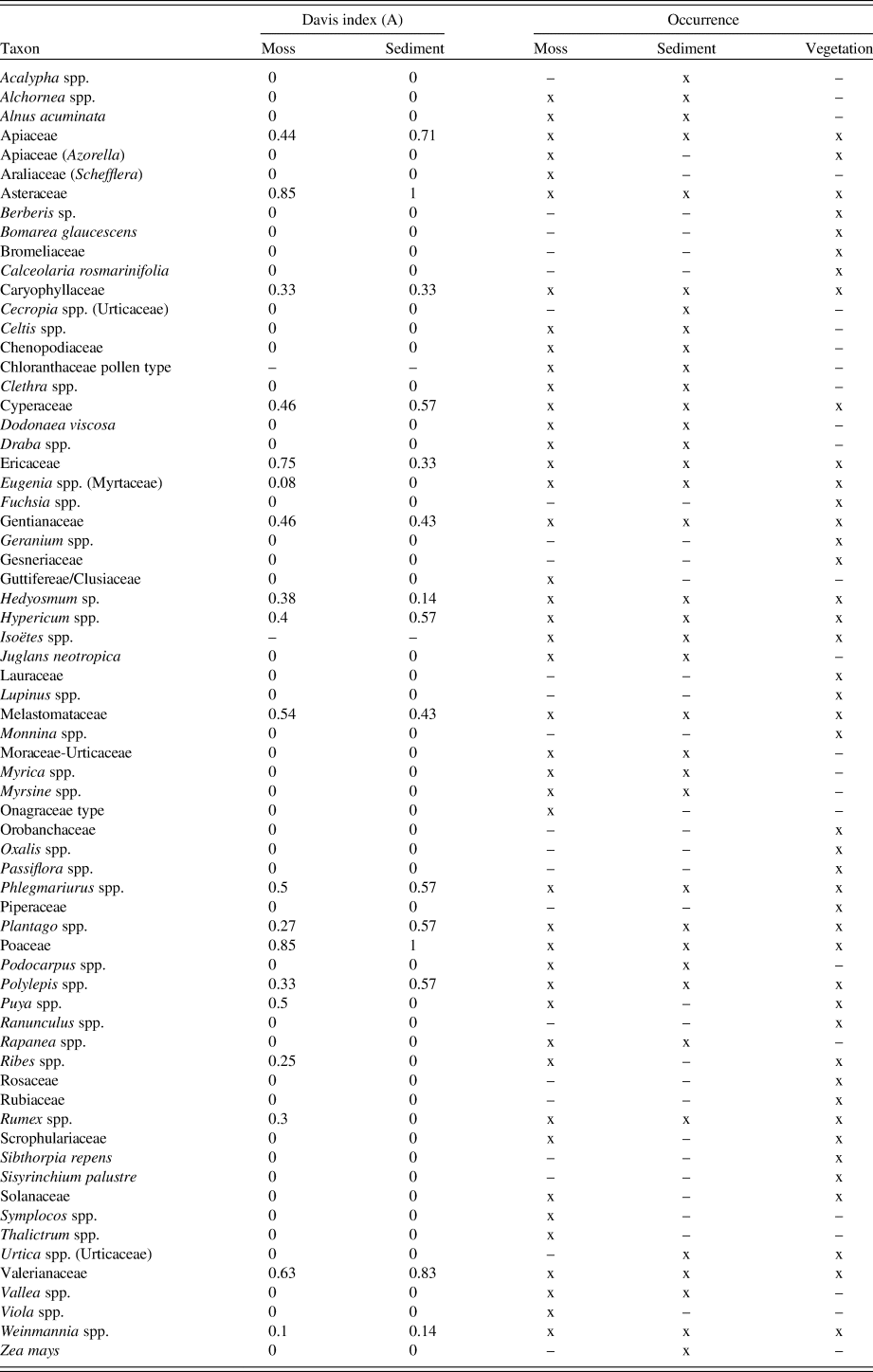
The comparison of the association indexes for the 67 taxa found in the vegetation and modern pollen rain samples are given in Table 2. In the moss polsters 19 taxa showed an A > 0, indicative of pollen taxa with an identified local parent plant in the vegetation relevés. For the sediment surface samples, 14 taxa were found with A > 0. Overall, association indices for a certain taxon are within the same range in moss polsters and sediment surface samples. The vegetation relevés each contained taxa that were not represented in the modern pollen rain in moss and sediments. These silent taxa (A = 0) include Berberis spp., Geranium sp., Oxalis spp., Sibthorpia sp., and Orobanchaceae. The pollen from these taxa is probably absent in the modern pollen rain because they are likely entomophilous or autogamous and consequently have a low pollen productivity or do not disperse their pollen far from the parent plant. Other taxa for which A = 0 are those that were not found in the vegetation relevés but were recorded in the modern pollen rain. These are generally anemophilous upper montane forest species, e.g., A. acuminata, Moraceae, Juglans neotropica, Vallea spp., Rapanea spp., Alchornea spp., Podocarpus spp., and Myrica spp. The highest association indices (~0.7–1) were recorded for Poaceae, Asteraceae, and Ericaceae in the moss polsters, while in the sediment surface samples the highest association indices were found for Poaceae, Asteraceae, Valerianaceae, and Apiaceae. Taxa that are underrepresented in the pollen rain relative to their abundance in the vegetation were Ribes spp., Solanaceae, Caryophyllaceae, Weinmannia spp., and Puya spp. These taxa are underrepresented in the modern pollen rain because of their pollination syndromes, being primarily entomophilous, zoophilous, and/or ornithophilous (Moscol-Olivera et al., Reference Moscol-Olivera, Duivenvoorden and Hooghiemstra2009).
Association indices for taxa found in the vegetation and/or in the modern pollen rain. A = 1 when the pollen type and the plant taxon are both present; A = 0 when either the pollen type or the parent plant is absent.

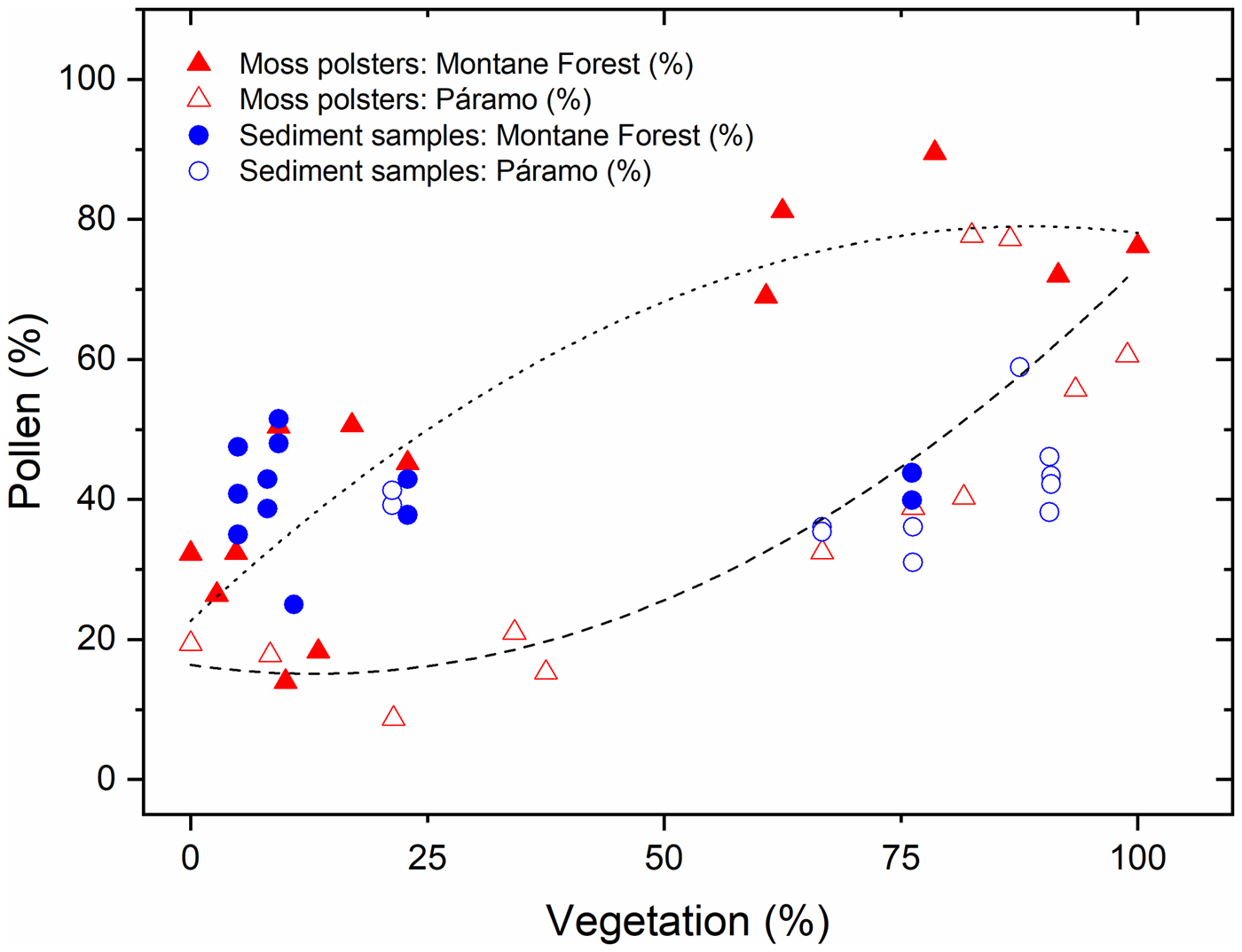
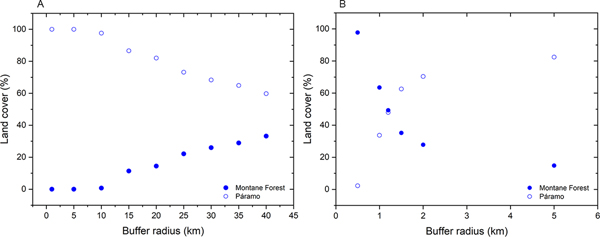
At the vegetation type level (Fig. 5), our results show that in the pollen spectra from moss polsters there is a significant relationship between páramo vegetation cover in the relevée and páramo pollen abundance (Pearson's r: p = <0.001). For the upper montane forest species this relationship is also significant (p = <0.001). For the lake sediment surface samples, we do not observe a correlation between percentage upper montane forest pollen and the upper montane forest cover in the nearest vegetation relevée, or the percentage of páramo pollen and páramo vegetation. The pollen spectra from Laguna Llaviucu and Laguna Pallcacocha show that the montane forest taxa make up 40 and 50%, respectively, of the total pollen sum. Our spatial analysis showed that a 40 and 50% montane forest land cover is reached at a 1.2 km radius around Laguna Llaviucu and a >40 km radius around Laguna Pallcacocha respectively. The first appearance of montane forest in the sensitivity analysis is at ~10 km radius around Laguna Pallcacocha. Therefore, the estimated pollen transport distance for pollen rain in Laguna Llaviucu is 1 to 2 km, while pollen transport distance in Laguna Pallcacocha is between 10 and 40 km (Fig. 6).
(color online) Pollen percentages for upper montane forest and páramo taxa in the modern pollen rain in moss polsters and sediment surface samples in relation to the recorded local vegetation in the relevés.

(color online) Sensitivity analysis of land cover percentages at a certain radius (km) around (A) Laguna Pallcacocha and (B) Laguna Llaviucu.

DISCUSSION
Pollen spectra along a temperature gradient: moss versus sediment
Pollen spectra from the moss polster transect spanning a temperature gradient of ca. 7°C in the western Andean Cordillera in Ecuador show clear differences in the distribution of pollen taxa. Pollen rain of the upper montane forest was characterized by Melastomataceae (41%) and Hedyosmum sp. (10%) reflecting local forest taxa recorded in the vegetation relevés. The position of the modern upper forest line at ~3500 m asl is reflected in the pollen rain of moss polsters by a decrease of upper montane forest taxa Melastomataceae (<41%) and Hedyosmum sp. (<10%) and an increase to above 17% of (dwarf) tree taxa typically growing above the upper forest line (e.g., Polylepis spp.) accompanied with an increase of páramo taxa to above 40% (e.g., Poaceae, Asteraceae, and Phlegmariurus spp.). Melastomataceae can occur above the forest line and reach into the lower páramo (Cleef, Reference Cleef1981; Moscol-Olivera and Cleef, Reference Moscol-Olivera and Cleef2009), making them less suitable for the interpretation of forest line dynamics. A previous study in Podocarpus National Park (PNP), located on the eastern Cordillera of the Ecuadorian Andes approximately 150 km southeast of CNP, showed that the position of the modern upper forest line between 2730–3040 m asl was reflected in the pollen composition, recorded by pollen traps, by upper montane forest pollen taxa levels at 25% (Niemann et al., Reference Niemann, Brunschön and Behling2010), which is considerably lower than the 60% in our study. In the Colombian Andes, at the high plain of Bogotá, the position of the upper forest line is represented by levels of about 40% of arboreal pollen and 20% of Poaceae (Hooghiemstra, Reference Hooghiemstra1984). This difference highlights the need to locally calibrate the upper forest-line pollen signal.
Upper montane forest taxa are overrepresented in the moss polsters above the upper forest line, supporting previous studies on modern pollen rain in the Tropical Andes (Weng et al., Reference Weng, Bush and Silman2004; Moscol-Olivera et al., Reference Moscol-Olivera, Duivenvoorden and Hooghiemstra2009; Urrego et al., Reference Urrego, Silman, Correa-Metrio and Bush2011b). However, this regional pollen distribution signal does not eliminate the effect of temperature in the composition of moss pollen spectra (CCAmoss, temp). The ordination analyses also show that pollen spectra from the upper montane forest at ~3100 m asl/9.7°C (Tmean) are compositionally different from those at higher elevations/lower temperature (e.g., ~4050 m asl/3.5°C Tmean). Previous work in Peru on the Amazonian Andean flank also reported that compositional changes observed in moss pollen spectra along an elevation gradient (420–3570 m asl) were most likely driven by an elevation-driven temperature gradient (Weng et al., Reference Weng, Bush and Silman2004; Urrego et al., Reference Urrego, Silman, Correa-Metrio and Bush2011b). Yet, a direct analysis of the effect of temperature on compositional changes was not made. Here, we show that temperature is indeed a significant driver of compositional changes in pollen spectra of moss polsters.
Composition of pollen assemblages in moss polsters is significantly different from sediment surface samples. For the lake-sediment surface samples, overrepresentation of upper montane forest taxa in the pollen spectra is much more pronounced than in the moss polsters. We show that pollen rain in moss polsters closely tracks the local vegetation, whereas samples from lakes reflect a more regional vegetation cover. For example, A. acuminata reaches a maximum of ~20% in the upper páramo samples, but is entirely absent in the vegetation relevés. A. acuminata does not grow above the upper forest line, demonstrating its high pollen productivity as well as upslope wind-transport of its pollen. This corresponds with observations in the Colombian Andes, where the first 20% of A. acuminata was considered to be mainly a background effect and only a percentage above 20% indicates that A. acuminata occurred in situ (Hooghiemstra, Reference Hooghiemstra1984). Pollination strategies in neotropical tree taxa (mostly anemophilous) contribute to a biased representation of these taxa in lake sediments (Bush and Rivera, Reference Bush and Rivera2001; Moscol-Olivera et al., Reference Moscol-Olivera, Duivenvoorden and Hooghiemstra2009). The relatively open structure of the páramo, combined with upslope wind pollen dispersal (Bush, Reference Bush2000; Weng et al., Reference Weng, Bush and Silman2004; Moscol-Olivera et al., Reference Moscol-Olivera, Duivenvoorden and Hooghiemstra2009; Niemann et al., Reference Niemann, Brunschön and Behling2010; Urrego et al., Reference Urrego, Silman, Correa-Metrio and Bush2011b) and convection (Ledru et al., Reference Ledru, Jomelli, Samaniego, Vuille, Hidalgo, Herrera and Ceron2012) in the Andean mountains most likely further amplifies the relatively high deposition of upper montane forest pollen in the sediment surface samples of lakes in the páramo.
Yet, despite overrepresentation, differences in the distribution of pollen taxa in samples from the lakes along the temperature gradient are observed. Overall, the association indices show that Apiaceae, Asteraceae, Cyperaceae, Hypericum spp., Phlegmariurus spp., Melastomataceae, Plantago spp., Polylepis spp., and Valerianaceae represent mostly local vegetation signals. R values (Davis, Reference Davis1963) or t/p values (Grabrandt, Reference Grabandt1980, Reference Grabandt1985) were not calculated because of the limited dataset of less than 30 paired pollen-rain-vegetation samples (Moscol-Olivera et al., Reference Moscol-Olivera, Duivenvoorden and Hooghiemstra2009), yet our data provide first-order estimates that are greatly needed in this part of the Andes. The ordination analyses show that pollen spectra from the upper montane forest at ~3100 m asl/9.7°C (Tmean) are compositionally different from those at higher elevations/lower temperature (e.g., ~4050 m asl/3.5°C Tmean). Samples from the lake situated in the upper montane forest (Laguna Llaviucu) consistently reflect local forest taxa recorded in the vegetation relevés. With the necessary caution to infer conclusions from a small dataset that does not cover the entire range of the montane forest (<3100 m asl), our results suggest that Podocarpus spp., Hedyosmum sp., and Weinmannia spp., could serve as indicator species for upper forest line dynamics in palaeorecords. Indeed, Weinmannia spp. is a common entomophilous tree in the Andean forest (Moscol-Olivera and Cleef, Reference Moscol-Olivera and Cleef2009) and various studies have reported pollen abundance peaks in samples from the upper montane forest >2800 m asl (Rull, Reference Rull2006; Moscol-Olivera et al., Reference Moscol-Olivera, Duivenvoorden and Hooghiemstra2009; Urrego et al., Reference Urrego, Silman, Correa-Metrio and Bush2011b). Earlier observations in northern Ecuador and the eastern Cordillera of Colombia have shown that pollen signals of Weinmannia spp. give a reliable indication of the presence of local Andean forest (Grabandt, Reference Grabandt1980; Moscol-Olivera et al., Reference Moscol-Olivera, Duivenvoorden and Hooghiemstra2009). Our results extend these observations to the western Cordillera of the southern Ecuadorian Andes. Although previous research indicated that Podocarpus spp. shows a large elevational range in field observations (Groot et al., Reference Groot, Hooghiemstra, Berrio and Giraldo2013), our results suggests that in the CNP Podocarpus spp. is a local signal of montane forest. Pollen spectra from páramo lakes (>3500 m asl/<7°C Tmean) are characterized by páramo taxa such as Phlegmariurus spp. and Plantago spp, while pollen spectra from moss pollsters are also characterized by Apiaceae and Valerianaceae. In northern Ecuador, pollen spectra obtained from moss pollsters and pollen traps indicate that Apiaceae, Poaceae, and Cyperaceae point at the presence of local páramo vegetation (Moscol-Olivera et al., Reference Moscol-Olivera, Duivenvoorden and Hooghiemstra2009).
Previous work in the northern Tropical Andes showed that altitude, and by inference temperature, is the main controlling factor for the composition of pollen assemblages (Rull, Reference Rull2006), allowing the estimation of palaeoaltitudes and palaeotemperatures from pollen records (Hooghiemstra, Reference Hooghiemstra1984; Wille et al., Reference Wille, Hooghiemstra, Behling, van der Borg and Negret2001; Rull, Reference Rull2006; Groot et al., Reference Groot, Bogotá, Lourens, Hooghiemstra, Vriend, Berrio and Tuenter2011). We show that temperature is indeed a driver of compositional changes in pollen spectra in sediment surface samples as has been suggested for other Andean locations (Rull, Reference Rull2006). Our results suggest that compositional changes in the pollen spectra from sediment surface samples can be used as a tool to estimate species optima and consequently to estimate palaeotemperature in the Tropical Andes, although palaeoclimatological reconstructions have pointed at other possible drivers (e.g., pCO2) of floral compositional change (Groot et al., Reference Groot, Bogotá, Lourens, Hooghiemstra, Vriend, Berrio and Tuenter2011).
The palynological richness documented in the moss polsters was significantly correlated to local vegetation richness, supporting earlier work in the Tropical Andes (Weng et al., Reference Weng, Hooghiemstra and Duivenvoorden2007; Jantz et al., Reference Jantz, Homeier, León-Yánez, Moscoso and Behling2013). The palynological richness documented in the moss polsters is reflecting local vegetation diversity (alpha diversity), which is in line with earlier work in the Tropical Andes, showing that palynological richness reflects the richness of the local vegetation (Weng et al., Reference Weng, Hooghiemstra and Duivenvoorden2007; Jantz et al., Reference Jantz, Homeier, León-Yánez, Moscoso and Behling2013). In contrast to moss polsters, our results show that palynological richness in sediment surface samples does not reflect local floral species richness. The relatively higher palynological richness for the sediment surface samples likely reflects diversity from a diverse landscape (beta diversity). Hence, reconstructions of plant diversity in the fossil pollen record should clearly consider the diversity of the local parent plant vegetation (alpha diversity), pollination syndromes of the parent plants, and landscape heterogeneity (beta diversity; Gosling et al., Reference Gosling, Julier, Adu-Bredu, Djagbletey, Fraser, Jardine and Lomax2018).
Pollen transport distance in high-elevation Andean lakes
Our study provides a first-order estimate of pollen transport distance between vegetation and lake sediments from high-elevation Andean lakes in both upper montane forest and páramo settings. Laguna Llaviucu, which is located in the upper montane forest, has a much lower mean pollen transport distance (1–2 km) compared to Laguna Pallcacocha (10–40 km), which is situated in the páramo. Possibly, the closed canopy of the forest combined with weak winds in the trunk space reduced the pollen dispersal distances. Above the upper forest line, the relatively open structure of the páramo combined with upslope pollen dispersal most likely increases the pollen transport distance for high-elevation Andean lakes (Bush, Reference Bush2000; Weng et al., Reference Weng, Bush and Silman2004; Moscol-Olivera et al., Reference Moscol-Olivera, Duivenvoorden and Hooghiemstra2009; Niemann et al., Reference Niemann, Brunschön and Behling2010; Urrego et al., Reference Urrego, Silman, Correa-Metrio and Bush2011b). This means that, based on the vegetation composition buffers, palaeoecological reconstructions based on lake sediments from the upper montane forest represent local vegetation dynamics within a 1–2 km radius around the lake. On the other hand, fossil pollen records from lakes in the páramo of CNP capture a regional signal up to and possibly even above a 40-km radius. The difference in pollen representation between lakes immersed in upper montane forest and lakes immersed in páramo is supported by multiproxy evidence in Jansen et al. (Reference Jansen, De Boer, Cleef, Hooghiemstra, Moscol-Olivera, Tonneijck and Verstraten2013), where the molecular biomarker-signal from a mire in northern Ecuador was used to reconstruct the upslope migration of the upper forest line during the late Holocene. For post-glacial forest development, the study by Jansen et al. (Reference Jansen, De Boer, Cleef, Hooghiemstra, Moscol-Olivera, Tonneijck and Verstraten2013) found a significant lag between pollen (earlier) and biomarkers (later), suggesting that the upslope movement of the forest line happened later in time than would be expected on the basis of pollen alone. Molecular biomarkers are not influenced by aeolian transport and provide a good proxy for in situ vegetation dynamics (Jansen et al., Reference Jansen, De Boer, Cleef, Hooghiemstra, Moscol-Olivera, Tonneijck and Verstraten2013). When compared to the pollen record of the mire in northern Ecuador, the results from Jansen et al. (Reference Jansen, De Boer, Cleef, Hooghiemstra, Moscol-Olivera, Tonneijck and Verstraten2013) show that a pollen record from a site that was always located in the páramo was influenced by upslope aeolian pollen transport while, in pollen records from sites below the upper forest line, upslope aeolian pollen transport does not influence the reconstruction. Therefore, multiproxy analyses can significantly improve local vegetation reconstructions in páramo sites. In the context of quantitative reconstructions of past vegetation using a modelling approach, e.g., the REVEALS model (Sugita, Reference Sugita2007), our results show that conventional theories in pollen-vegetation relationships in non-mountainous areas cannot be directly applied to areas with steep topography and high landscape heterogeneity. Landscape reconstructions models such as REVEALS, however, hold great potential for palaeoecological reconstructions in the Tropical Andes, since such models can correct for biases in pollen percentages caused by differences in pollen productivity and dispersal between taxa (Sugita, Reference Sugita1994; Hellman et al., Reference Hellman, Gaillard, Broström and Sugita2008). Given the overrepresentation of arboreal taxa in the páramo of CNP, Ecuadorian Andes, we suggest that more attention should be paid to developing, testing, and validating models such as REVEALS for regions with steep vegetation and altitudinal gradients such as the Tropical Andes.
CONCLUSION
Pollen spectra from moss polsters and sediment surface samples along an upper-montane-forest-páramo ecotone reflect changes in species composition along a temperature gradient of 7°C (altitudinal gradient: 3100–4200 m asl), despite overrepresentation of upper montane forest taxa in the pollen rain. The pollen rain spectra from moss polsters reflect the local vegetation, while pollen spectra from páramo lake sediments reflect a regional vegetation cover up to 2–40 km distance depending on position within the landscape (upper montane forest or páramo). The ordination analysis show that in the pollen spectra from lakes Weinmannia spp., Podocarpus spp., and Hedyosmum sp. are indicators of local upper montane forest vegetation and could be indicator species for upper forest line dynamics, while Phlegmariurus spp. and Plantago spp. are indicators of local páramo vegetation. Other taxa representative of local vegetation include Asteraceae, Cyperaceae, Hypericum spp., Plantago spp., Polylepis spp., and Valerianaceae. Palynological richness in the moss polsters was significantly related to local vegetation richness (alpha diversity), but this relationship was not found for the sediment surface samples because the pollen rain in sediment surface samples likely reflects diversity from a diverse landscape (beta diversity). Important factors influencing the modern pollen rain, and subsequently the palynological richness, are variations in pollination syndromes, open vegetation structure, and upslope wind pollen dispersal, which consequently contribute to the size of the mean pollen transport distance of high-elevation Andean lakes. Estimated pollen transport distance for a lake situated in the upper montane forest is 1–2 km, while lakes in the páramo capture pollen from a distance of 10–40 km.
ACKNOWLEDGMENTS
We thank Henry Hooghiemstra and Jane Bunting for constructive reviews that improved the manuscript. We thank Hans van Aken, Kees Nooren, Jerry van Dijk, and Alejandra Goldenberg-Vilar for their assistance in conducting and preparing the field campaign. We thank Barbara Hansen for providing additional research data and Ineke Roeling and Crystal McMichael for useful comments on the manuscript. We are grateful to personnel from the Cajas National Park and ETAPA-EP for permitting access to the park. Our thanks also go to the Ministry of Environment of Ecuador (MAE) for providing research and fieldwork permissions (permit number 009_SGA_2015_PNC_BD_VA_Donders). This research was funded by the Earth and Life Science council (ALW) of the Netherlands Organisation of Scientific Research (NWO; grant number 824.14.018).