Language Aptitude and Language Awareness: Polyglot Perspectives
Some years ago, in an article on aptitude effects in near-native second language acquisition (SLA) (Abrahamsson & Hyltenstam, Reference Abrahamsson and Hyltenstam2008), we introduced and described in some detail a second language learner of Swedish who appeared to be exceptional in many ways. Learner 067, as we called her by her participant number in the study, told us that she used no fewer than six languages daily: English, French, Spanish, and Swedish at work, Basque with family members in the Basque Country, and to some extent with her children, and Swedish with her husband and children. She had also learned Italian and Flemish. She was twenty-three years old when she immigrated to Sweden and forty-nine at the time of the study. She said that she was “linguistically observant” and that she “owned tons of grammars and dictionaries.” According to reports from her parents and other older family members, she was a “very talkative” Basque-speaking child who wanted to intervene and participate in all kinds of conversations.
This language user is a polyglot by any definition. As we will see in this article, her high scores on a language aptitude test, the highest among all participants, group her with the polyglot population. She has also developed a high degree of language awareness. In fact, language, especially linguistic structure, is one of her main interests in life. The question, then, is whether it is her aptitude for language learning or her explicit knowledge of the architecture and function of language and her earlier experiences and awareness of language learning that facilitate her acquisition of additional languages. The present article will attempt to disentangle these possible contributions. The presentation is based on a review of published empirical research on polyglots, including my own multiple case study of ten polyglots (Hyltenstam, Reference Hyltenstam, Hyltenstam, Bartning and Fant2018). Additional new results from that study will also be investigated. Before moving into the central issue of language aptitude and language awareness in polyglots, a brief introduction to the current general knowledge base about polyglots is first in order, after which there will be a short section about the notions of language learning and language awareness and their interaction.
Polyglots
Since approximately the turn of the millennium, the term “polyglot,” or “hyperpolyglot,” has increasingly been used in the scientific literature to refer to a group of multilingual individuals who are fluent in a certain minimum number of languages, often six or more. This specified use of the term polyglot contrasts with earlier uses in which the term was applied variously for all nonmonolinguals (i.e., either for both bi- and multilinguals) or as a synonym for multilinguals (i.e., in contrast to bilinguals) (see Hyltenstam, Reference Hyltenstam, Hyltenstam, Bartning and Fant2018). In terms of how polyglots differ from other multilinguals, it has been pointed out that their reason for learning many languages is, to a large extent, a personal inclination, commitment, or desire rather than necessity or convention. Erard (Reference Erard2012) talks about polyglots as making up a “neural tribe” that is socially dispersed. In other words, if seen as a population, polyglots can hypothetically be characterized by their shared neurology rather than by social cohesion; that what they have in common can be thought of as their neural system, not their links to others with similar social norms.
Hudson introduced the term “hyperpolyglot” to avoid the ambiguities of the term polyglot. He proposed that a hyperpolyglot is someone “who can speak six or more languages fluently” (Hudson, Reference Hudson, Rickerson and Hilton2012, p. 14), ending up with the lower criterion of six languages because this would distinguish hyperpolyglots from socially defined multilinguals. Based on information about multilingual speech communities across the world, he established that a conventional use of up to five languages was the upper limit in such cases. Erard (Reference Erard2012), reflecting on internal variation among polyglots, suggested that the term hyperpolyglot is most appropriately applied to individuals who have an active command of minimally eleven languages. The basis for this suggestion is, somewhat vaguely put—that they are extremely rare compared to those who know six to ten languages and, therefore, “represent the true modern extremes of human language learning” (Erard, Reference Erard2012, p. 218). In my view, it can be argued that the simple term polyglot is sufficient and, in itself, adequate for the type of language users we are dealing with, as it comprises the semantic elements that are relevant for a descriptive term, Greek poly- “many” and glotta “tongue,” “language.” Whether a distinction between polyglot and hyperpolyglot is needed is an empirical question that may be resolved in future research.Footnote 1
Research on polyglots is still very scarce. On the other hand, the literature on this category of people is not insignificant; there are many examples of extensive biographical accounts describing language skills or language learning abilities of polyglots, some of which are written by polyglots themselves (e.g., Lomb, Reference Lomb2008; Schwartz, Reference Schwartz2003) or by close family members (e.g., Deneke, Reference Deneke1965; Tyrkova Williams, Reference Tyrkova-Williams1935). Over the last few years, increasing numbers of polyglots share their experiences through blogs, interviews, videos, and other internet-based media. Existing knowledge about this exceptional group of language users, taken from both research reports and other written accounts, has been systematically reviewed and summarized (Erard, Reference Erard2012; Hyltenstam, Reference Hyltenstam and Hyltenstam2016a, Reference Hyltenstam and Hyltenstam2016b, Reference Hyltenstam, Hyltenstam, Bartning and Fant2018).
Based on observations from a review of ninety-four polyglots, Hyltenstam (Reference Hyltenstam and Hyltenstam2016a) suggested a series of typical characteristics of polyglots,Footnote 2 the most significant of which is that polyglots appear to have an extreme fascination with language and a strong motivation, even a drive, to learn languages. Some polyglots seem to attain advanced proficiency levels in a language in a relatively brief period. This accelerated timeframe does not mean, however, that language acquisition is always effortless. On the contrary, many polyglots spend an immense amount of time and energy learning a language. More specifically, polyglots often have a particular interest in linguistic form. In the majority of cases, it seems, polyglots prefer explicit approaches to language learning. However, there are many cases described in the literature where polyglots claim that they learn additional languages primarily naturalistically by engaging in conversation with speakers of those languages (see Erard, Reference Erard2012; Laurén, Reference Laurén2006). Related to their preference for explicit learning, perhaps, many polyglots work in language-related professions, such as professional linguists or interpreters/translators, though not so often as language teachers. A notable fact is that polyglots are overwhelmingly men. Among the ninety-four cases reviewed in Hyltenstam (Reference Hyltenstam and Hyltenstam2016a), only three cases were female. From a survey of polyglots, Erard (Reference Erard2012) reported that, in a group of 157 participants who said they knew more than six languages and claimed that language learning was easier for them than for others, 75% were men.
According to an interpretation of the listed characteristics in terms of constructs related to language acquisition or general/linguistic cognition (Hyltenstam, Reference Hyltenstam, Hyltenstam, Bartning and Fant2018, pp. 173–4), polyglots have:
• a high level of language (learning) aptitude
• high levels of language awareness
• a high degree and a specific type of motivation (drive, grit, etc.)
• a high level of learner autonomy/self-regulation
• high levels of general cognitive functioning
• high levels of general systemizing ability
• highly-developed ability to perceive sensory detail
The combination of outstanding abilities in each of these constructs, especially motivation, aptitude, and self-regulation, may give synergy effects that boost the process of learning additional languages to the exceptional level that can be seen among polyglots (Hyltenstam, Reference Hyltenstam, Hyltenstam, Bartning and Fant2018).
Different brain mapping techniques have explored whether the brains of polyglots are different from those of nonpolyglots, and, if so, whether brain differences are due to innate predisposition or the result of experience. Amunts, Schleicher, and Zilles (Reference Amunts, Schleicher and Zilles2004) examined histological brain sections from one polyglot and eleven nonpolyglot controls from the body donor program of the University of Düsseldorf. Using morphometry and multivariate statistics, they analyzed the cytoarchitecture of Broca's area and the right-hemisphere homolog, as well as one visual area. They found that the polyglot brain had different cell densities and different types of cells in the relevant areas of both hemispheres. There was also a symmetry difference between the polyglot and the other brains. However, no differences were found between the brains in the visual area. The question of whether the particular structure of the polyglot brain was innate/early-emerging or a result of language learning experience could not be answered in this research.
The same is true for a study of functional brain networks by means of an fMRI methodology by Jouravlev, Mineroff, Blank, and Fedorenko (Reference Jouravlev, Mineroff, Blank and Federenko2021). Seventeen polyglots with proficiency in 5–55 languages were compared both to matched controls of seventeen monolinguals and to a larger control group of nonpolyglots. The language task they performed was in their native language. Results showed that the language networks of the left (dominant) hemisphere (LH) had lower activation and were also smaller in the polyglot group than in the controls. This difference was limited to the LH language network, as there was no difference between the groups in terms of the RH language network homolog or with respect to two domain-general networks. The interpretation put forth is that the polyglots need to recruit fewer neural resources for language processing. The authors note that this is different from what has been found for bilingual speakers, who are claimed to have increased activity for in the LH language areas for language processing. This difference, according to Jouravlev et al. (Reference Jouravlev, Mineroff, Blank and Federenko2021), indicates that the more efficient use of neural resources is not a result of knowledge of more than one language. Instead, it may stem either from experience with a large number of languages, from having learned some of these languages after the critical period, or from a special aptitude for language learning.
For the present purposes, the remaining discussion focuses strictly on aptitude and awareness in polyglots, but it is obvious that these constructs may have a relationship to some of the other phenomena that are claimed to be characteristic of polyglots, as in the bullet points on page five.
Aptitude and Language Awareness
There is no doubt that the constructs of language learning aptitude and language awareness (and related notions such as metalinguistic awareness, metalinguistic knowledge) overlap or are related to each other, as has been noted in both past and current accounts (e.g., Jessner, Reference Jessner2006; Roehr, Reference Roehr2007; Roehr-Brackin & Tellier, Reference Roehr-Brackin and Tellier2019; Singleton, Reference Singleton2014, Reference Singleton2017). More specifically, Ranta (Reference Ranta and Robinson2002), assuming it is an innate and relatively stable construct (see below), suggests that aptitude has an impact on how metalinguistic awareness develops. A bidirectional influence has also been suggested (Jessner, Reference Jessner2006).
Aptitude
The notion of language learning aptitude is based on the observation that individuals in any population differ with respect to the rate, ease, and success in their efforts to learn an additional language (foreign, second, or nth language). A fundamental assumption is that language learning aptitude is an innate, relatively fixed talent for language learning (see, for example, Ranta, Reference Ranta and Robinson2002; Skehan, Reference Skehan and Robinson2002). Even if aptitude initially was imagined as a unitary construct or holistic concept (Carroll, Reference Carroll and Diller1981; Li, Reference Li, Wen, Skehan, Biedroń, Li and Sparks2019), from the earliest days of operationalizing language aptitude for the practical purposes of test construction, it was handled as multicomponential. Early theoretical developments of the notion were linked to the practical construction of tests that would be able to predict a person's suitability for engaging in specific language courses. The highly influential Modern Language Aptitude Test (MLAT) (Carroll & Sapon, Reference Carroll and Sapon1959) was built on the assumption that aptitude comprised four subcomponents: phonetic coding ability, associative memory, grammatical sensitivity, and inductive language analytic ability (Carroll, Reference Carroll and Glase1965).
Several language aptitude tests, developed since the Carrollian era, are based on similar assumptions. For example, the five subtests of the Swansea Language Aptitude Test (LAT) are designed to measure phonetic memory, lexical-morphological analytic skills, grammatical inferencing skills, aural memory for unfamiliar sound sequences, and the ability to form sound-symbol associations (Meara et al., Reference Meara, Milton and Lorenzo-Dus2003). The now widespread Llama Language Aptitude Tests (LLAMA), a successor to LAT, has four subtests: vocabulary learning, recognition of previously heard sound sequences, sound-symbol associations, and grammatical inferencing (Meara, Reference Meara2005).
The theoretical development of the notion of aptitude since the 1990s (for recent overviews, see Ameringer et al., Reference Ameringer, Green, Leiser, Turker and Reiterer2018; Li, Reference Li, Wen, Skehan, Biedroń, Li and Sparks2019; Wen, et al., Reference Wen, Biedroń and Skehan2017) is in part detached from the practical needs of aptitude testing. In an analysis of the ingredients of language aptitude, Skehan (Reference Skehan1989) posited that two components proposed by Carroll (Reference Carroll and Glase1965), grammatical sensitivity and inductive language analytic ability, could be combined since evidence of them being different were lacking. He thus arrived at a three-factor model comprising phonemic coding ability, language analytic ability, and memory. In this framework, language analytic ability is related to finding patterns in the L2 input.
While the subcomponents of aptitude are all attached to specifically linguistic material in the earlier testing context and also in the early theoretical discussion, the impressive theoretical development of aptitude that has taken place during the last two or three decades has pursued several different routes. One direction is a concern as to whether specific language abilities, as in the Carrollian model, or rather domain-general learning and processing mechanisms (Linck et al., Reference Linck, Hughes, Campbell, Silbert, Tare, Jackson and Doughty2013; Robinson, Reference Robinson2005) are the basic components, or whether a balance between domain-specific (linguistic) and domain-general processes is a viable option (Skehan, Reference Skehan, Wen, Skehan, Biedroń, Li and Sparks2019). A discussion of language learning as dependent on pattern recognition and pattern sensitivity and their relation to the language analytic ability component of language aptitude (Skehan, Reference Skehan, Wen, Skehan, Biedroń, Li and Sparks2019) is particularly relevant to the interaction of language aptitude and language awareness. Recent theorizing of working memory as language aptitude holds domain-general processes to be basic, although an overarching theoretical account such as the Phonological/Executive model (Wen, Reference Wen, Wen, Skehan, Biedroń, Li and Sparks2019 and earlier) specifies the exact roles for the linguistic components in such a framework.
Research that links aptitude to the critical period hypothesis and ultimate attainment in SLA has brought to the fore a suggestion that aptitude may play a decisive role also in naturalistic language acquisition, and maybe even more so than in formal language learning (Abrahamsson & Hyltenstam, Reference Abrahamsson and Hyltenstam2008; DeKeyser, Reference DeKeyser2000; DeKeyser et al., Reference DeKeyser, Alfi-Shabtay and Ravid2010). This is opposed to the more traditional view that linked aptitude primarily (or even only) to formal language learning. The discussion of distinct aptitudes for implicit and explicit language learning follows up this thread (Granena, Reference Granena, Granena and Long2013a, Reference Granena, Granena and Longb).
The question of aptitude for explicit versus implicit language learning is related to that of the role of aptitude for prepubescent and postpubescent learners. DeKeyser (Reference DeKeyser2000), DeKeyser et al. (Reference DeKeyser, Alfi-Shabtay and Ravid2010), and Abrahamsson and Hyltenstam (Reference Abrahamsson and Hyltenstam2008) found that a high level of language aptitude is a requirement for the achievement of high-level, near-native, ultimate attainment in postpubescent L2 learners, but only the last study also found a correlation between aptitude scores and scores of a language proficiency measure (a grammaticality judgment test) among early learners. In relation to such results, Long (Reference Long2007, p. 73) notes that “both aptitude tests […] and grammaticality judgment (GJ) tests [which are what DeKeyser's and other studies employ] allow the use of metalinguistic abilities to some extent, so in part probably measure the same abilities.” Granena (Reference Granena, Granena and Long2013b) examined correlations between aptitude scores, the total average of the LLAMA subsections, and results on a grammaticality judgment test (GJT). The GJT was given in both auditory and written mode. The hypothesis was that aptitude would correlate better with the written mode than with the auditory mode since the written mode would allow more time to exploit explicit metalinguistic knowledge, which is a causal factor also for high levels of aptitude. The hypothesis was borne out, which was taken as evidence for the aptitude test's reliance on explicit language ability.
The idea that language aptitude is an innate and stable individual trait has been challenged. Indeed, lack of stability has been demonstrated empirically for children before the age of twelve (Suárez & Muñoz, Reference Suárez, Muñoz, Roberts, Pellotti and Bettoni2011). Roehr-Brackin and Tellier (Reference Roehr-Brackin and Tellier2019, p. 1114), based on a review of earlier research, conclude that “[a]ge 11 may be the starting point of relative stability in aptitude.” Studies of language aptitude stability in adults show mixed results. Granena used the LLAMA test in a test-retest methodology with a two-year time interval with twenty participants and found moderate, or moderately strong, correlations that were all statistically significant. She concluded that “aptitude is a fairly stable trait” (Reference Granena, Granena and Long2013a, p. 122). Kormos, in a review of research on this issue, reports stability in some studies but lack of stability in others. The conclusion from the latter type of study is that results in certain components of the aptitude tests can improve over time in response to “previous language-learning experience and knowledge of other languages” (Reference Kormos, Granena and Long2013, p. 146).
Related to the issue of innateness and stability is the question of the relationship between L1 development characteristics and L2 learning skills or L2 ultimate attainment. If individual differences in aptitude are present from the start, these differences would predict differences in both first and second language learning achievement. Skehan has repeatedly pointed to this possibility with reference to the large differences that occur in the rate and quality of child L1 development (e.g., Skehan, Reference Skehan1998). A large research project (Wells, Reference Wells1985) that investigated first language development in 125 children found huge variation in the children's rate of development and ascribed much of the variation to the children's interaction with their caregivers and other environmental factors. Wells’ study, in fact, questioned the socioeconomic explanation for these differences that were prevalent at the time (Bernstein, Reference Bernstein1971). Skehan and Ducroquet (Reference Skehan and Ducroquet1988, referred to in Skehan, Reference Skehan1998) were given the possibility to gather approximately one hundred of Well's original children 10–12 years later for aptitude testing. The earlier language measures were correlated with aptitude test results. Correlations above 0.40 were found between the measures, somewhat higher between “more selective first language measures and aptitude” (Skehan, Reference Skehan1998, p. 195).
A similar perspective governed the development of the Linguistic Coding Difference Hypothesis (Sparks et al., Reference Sparks, Ganschow and Pohlman1989), in which both L1 and L2 learning rely on “basic learning mechanisms” (Sparks et al., Reference Sparks, Patton, Luebbers, Wen, Skehan, Biedroń, Li and Sparks2019). A similar idea, of course, is expressed in Cummins’ Interdependence Hypothesis, according to which L1 and L2 are related to what he calls a common underlying proficiency (Cummins, Reference Cummins1979). Bylund, Abrahamsson, and Hyltenstam (Reference Bylund, Abrahamsson and Hyltenstam2012) investigated levels of proficiency in both languages of thirty bilingual L1 Spanish, L2 Swedish adult speakers living in Sweden. Acquisition of their L2 had started before the age of twelve (M = 6; range 1–11) when they immigrated with their families, and they had continued to use Spanish on a regular basis throughout. They were, on average, 29.3 years old at the time of investigation (age range 19–40). Two control groups, fifteen native speakers of Spanish and fifteen native speakers of Swedish, were included in order to specify native language norms for the two measures of proficiency, GJTs, and cloze tests in Spanish and Swedish. Participants were also given a language aptitude test, the LAT (Meara et al., Reference Meara, Milton and Lorenzo-Dus2003). Other predictor variables than aptitude included in the study were age of onset (AO) of L2 acquisition and degree of L1 daily use. Results showed that the bilingual speakers in most cases had scores either in the nativelike or in the nonnativelike range for both languages. For the GJT, thirteen were nativelike in both languages, and twelve were nonnativelike in both languages; only five were nativelike in one and nonnativelike in the other. For the cloze test, thirteen were nativelike in both languages, and nine were nonnativelike in both languages; eight were nativelike in one and nonnativelike in the other. It was found that aptitude was the only significant predictor for nativelike performance in both the L1 and the L2.
Language Awareness
As for the notion of language awareness, the Association of Language Awareness (ALA) defines it as “explicit knowledge about language, and conscious perception and sensitivity in language learning, language teaching, and language use” (Association of Language Awareness, 2020). The ALA is an organization that formally represents a professional movement that promotes the idea that consciousness about language use and language structure facilitates learning and teaching of both foreign and second languages as well as the development of first languages/mother tongues. The promotion of metalanguage, either by means of formal terminology or informally, in the minds and overt communication of learners and teachers, is integrally involved in the consciousness-raising processes that can assist the learner in perceiving and consolidating what is to be learned (cf., Svalberg, Reference Svalberg2007). The formulation “explicit knowledge about language” included in the ALA definition of language awareness should be understood in the context of ALA's activist agenda of improving language teaching and providing practical support for autonomous language learners.
In Schmidt's Noticing Hypothesis (Reference Schmidt1990, Reference Schmidt, Chan, Chin, Bhatt and Walker2012) for SLA, the notion of awareness is part of a more elaborated theory on cognitive learning processes. It takes its point of departure in the discussion on conscious vs. unconscious learning generally. Schmidt distinguished between consciousness as intention (goal-oriented learning as opposed to learning that takes place without the individual having any specific intention to do so), consciousness as attention (focused attention to specific elements or features in the input), and consciousness as awareness. For awareness, Schmidt makes a distinction between noticing, “the conscious registration of attended specific instances of language,” and understanding, “a higher level of awareness that includes generalizations across instances” (Schmidt, Reference Schmidt, Chan, Chin, Bhatt and Walker2012, p. 31). He goes on to clarify that “[k]nowledge of rules and metalinguistic awareness of all kinds belong to this higher level of awareness” (Schmidt, Reference Schmidt, Chan, Chin, Bhatt and Walker2012, p. 31). The central tenet of Schmidt's theory is that noticing is a necessary condition for SLA and that understanding, the second component of awareness, may facilitate SLA but may not be necessary for it to take place.
It should be underscored that the notion of understanding is a broad one, covering both knowledge of rules that either can or cannot be verbalized by the individual. The term metalinguistic awareness is often used to refer to this latter intuitive form of knowledge, a form of intuitive knowledge that, for example, allows language users to rhyme or identify phonemic elements in a sound sequence (phonological awareness, particularly implicated in literacy skills), enables them to distinguish so-called well-formed from ill-formed utterances (syntactic awareness), or permits them to decide if an utterance is appropriately used in a specific discourse or setting (pragmatic awareness).
It is clear that ALA's notion of language awareness and the notion of awareness in Schmidt's hypothesis have much in common. However, whereas the ALA concept underscores explicit knowledge about language, which can be taken to mean knowledge that can be verbalized either in technical linguistic terminology or informally, awareness in Schmidt's case has two levels: noticing and understanding. The latter includes both intuitive knowledge of linguistic generalizations (i.e., metalinguistic awareness) and knowledge of rules that can be verbalized. Even though both terms, language awareness and metalinguistic awareness, surface in different accounts in the SLA literature, a case can be made for distinguishing between the two according to these differences. The idea of different levels of awareness (Leow, Reference Leow and Chapelle2012) is illuminating in this context. Leow reports that “higher levels of awareness appear to correspond with both higher levels of intake and learning” (Reference Leow and Chapelle2012, p. 4).
The ability to verbalize metalinguistic knowledge, especially in linguistic terminology, but also in less precise terms about language, may be taken to represent higher levels of metalinguistic awareness, or, in ALA's terms, language awareness. Robinson (Reference Robinson1997) reports that learners in an implicit classroom learning condition and who had scored high on the grammatical sensitivity subtest of MLAT were more likely to look for rules and also more able to verbalize rules for the linguistic features to be learned. He also found, in fact, that awareness led to more learning.
Aptitude and Language Awareness in Polyglots
Aptitude
In the literature on polyglots, it is taken almost for granted that polyglots have a high level of language learning aptitude or, as it is more often portrayed, have a specific talent for language learning. Leaving the terminological distinction aside, what is generally assumed is an innate enhanced capacity for foreign language learning—a trait capacity. This assumption, however, is not always accepted by polyglots themselves. As pointed out by Erard (Reference Erard, Wen, Skehan, Biedroń, Li and Sparks2019, pp. 157–158), some polyglots object to being specifically talented and ascribe their achievements rather to the effects of massive effort (for example, Lomb, Reference Lomb2008).
Polyglots’ scores on formal aptitude tests have been reported only in a couple of studies. One of them (Novoa et al., Reference Novoa, Fein, Obler, Obler and Fein1988) is a single case study of a 29-year-old polyglot living in the US, called C. J. He had learned French, German, Spanish, Italian, and Moroccan Arabic to a level where he was perceived as nativelike to native listeners of each language. He had also studied Latin in high school. C. J. was given a series of neuropsychological tests expected to be associated with exceptional language learning aptitude. One of the tests was the Modern Language Aptitude Test (MLAT) (Carroll & Sapon, Reference Carroll and Sapon1959).
C. J.'s results were “at or almost at ceiling” (Novoa et al., Reference Novoa, Fein, Obler, Obler and Fein1988, p. 298) on four of the subtests of MLAT (MLAT I: Number Learning; MLAT II: Phonetic script; MLAT III: Spelling Cues; and MLAT V: Paired Associates). The first three subtests tap phonetic coding ability to various degrees. The MLAT V taps rote learning ability, as does the MLAT I along with inductive learning, but weakly so. His result on MLAT IV, however, “Words in Sentences,” which taps into grammatical sensitivity, was only average, that is, at the fiftieth percentile (see Stansfield & Reed, Reference Stansfield, Reed, Wen, Skehan, Biedroń, Li and Sparks2019, for a detailed analysis of MLAT subtests and what components of aptitude they tap into).
Among the other neuropsychological tests that C. J. was given, some had sections that were thought to have specific relevance for his language learning ability. He scored highly on the WAIS-R Vocabulary test, where he had to define words of increasing difficulty, and similarly on the subtest where he had to immediately recall digit-symbol pairings and also retain them for twenty minutes. In addition, he scored at the ninety-third percentile on a combination of the Shipley-Hartford Abstraction subtest (figuring out relations among a series of numbers, letters, and words and then complete the pattern) and the Shipley-Hartford Vocabulary subtest. He was also given a test of verbal fluency, in which he was required to produce as many words as he could, starting with a certain letter in one minute. His score on this test was in the high-normal range, but a notable fact is that his lists, remarkably, included many low-frequency words (for example, facetious, anorexic, sedentary). On the other side, he had only average scores on tests of semantic abstraction. In tasks requiring abstracting common properties of two words, he tended to give concrete replies and focused on form rather than meaning: “A table and a chair both have legs”; “a poem and a statue both have lines”; “work and play both have four letters” (Novoa et al., Reference Novoa, Fein, Obler, Obler and Fein1988, p. 297). For some proverbs, he gave either a concrete interpretation or missed the point altogether. In summary, C. J.'s verbal memory, his ability to learn new codes, fluency, and vocabulary access were considered outstanding. He excelled in formal aspects of language but had average abilities in semantic and conceptual dimensions.
A second study on polyglots where formal aptitude tests were included among the research instruments is my own multiple case study of ten polyglots (partly reported in Hyltenstam, Reference Hyltenstam, Hyltenstam, Bartning and Fant2018). All ten participants met the selection criteria, which were formulated as an operationalization of the notion of polyglot for this specific study:
A polyglot is a person who, after puberty, acquired/learned at least six new languages, who commands at least six of these languages at an intermediate or advanced level of proficiency (minimally B1 in the Common European Framework of Reference [CEFR]) and who can use them unimpededly in oral interaction. (Reference Hyltenstam, Hyltenstam, Bartning and Fant2018, p. 177)
This operationalization of the notion is thus somewhat more demanding than the definition of polyglot (or hyperpolyglot) proposed by Hudson (Reference Hudson, Rickerson and Hilton2012) mentioned above. Furthermore, it rests on an appreciation of a qualitative difference between first and second language acquisition as well as pre- and postadolescent language acquisition.
Background information on the ten polyglots was as follows. Their age range was 35–68; nine were male, one female; their education was at university level (completed bachelor's, master's, or doctor's degree in nine of the cases; university-level courses in one case); seven out of the ten had language as their profession (trained linguists, interpreters/translators), one was a primary school teacher, one a civil servant, and one a biologist.
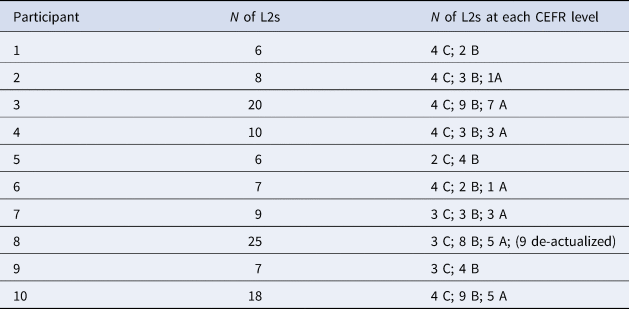
As seen in Table 1, the participants’ number of second or foreign languages, in addition to their first or second languages learned during childhood, ranged between six and twenty-five. The participants all had proficiency level C in 2-4 languages according to the Common European Framework of Reference (CEFR) (Council of Europe, 2001), in addition to 2-9 languages at level B.
The participants’ number of L2s and proficiency level for each L2.

An additional piece of information is that all participants had Swedish as a common language, something that was required by the test instruments and procedures. As it turned out, only one had Swedish as his L1; the other nine had learned Swedish at different ages. The nine participants that were not L1 speakers of Swedish had C-level proficiency in the language. For English, parallel conditions were true; four were L1 speakers of English, the remaining six had C-level proficiency in that language.
The participants were interviewed on one or more occasions. The interviews provided information about general personal background (age, education, profession), motivation, language learning strategies, ages of onset, language selection, language use, and attained proficiency in the individual languages, attitudes, and language awareness.
Participants were formally tested for language learning aptitude by means of the Llama Language Aptitude Tests (LLAMA) (Meara, Reference Meara2005). The LLAMA comprises four subtests: vocabulary learning (LLAMA B), recognition of previously heard sound sequences (LLAMA D), sound-symbol associations (LLAMA E), and grammatical inferencing (LLAMA F). Included in the testing was also a subtest on grammatical inference skills (LAT C) from the predecessor of the LLAMA system, the Swansea Language Aptitude Test (LAT v. 2.0) (Meara et al., Reference Meara, Milton and Lorenzo-Dus2003). The motivation for including two subtests of grammatical inference skills was twofold; first, the hypothesis based on previous observations in the literature that polyglots can be expected to stand out in this area (see above), secondly, the contradictory result in the Novoa et al. (Reference Novoa, Fein, Obler, Obler and Fein1988) study, according to which their participant C. J. had only moderate results on grammatical inferencing.
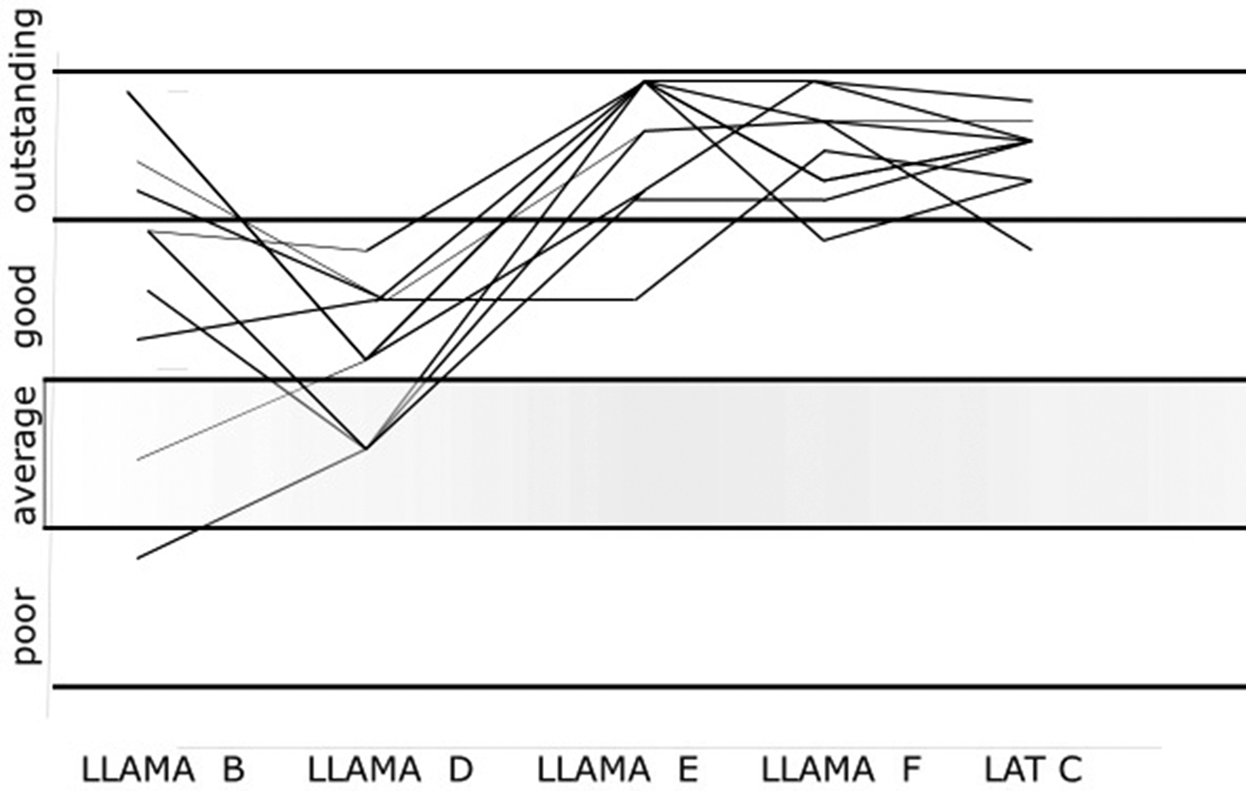
The polyglots’ scores on LLAMA A–F and LAT C are presented in Figure 1. Each participant is represented by one line in the graph. The intention in this figure is not primarily to display the results of each participant but rather to present an overall picture of the achievements of all ten participants. (For details, the reader is referred to Table 4 in Appendix 1.) As evident from the figure, most results are in the “Good” or “Outstanding” range. For any unselected group, one would expect the majority of individual scores in the average range (shaded in the figure). In fact, out of the fifty individual scores (ten participants x five subtests), thirty-one of them fall in the category “Outstanding” and fourteen in the category “Good.” Only four scores fall in the category “Average” and one in the category “Poor.”
Results LLAMA and LAT (Graph based on Table 7.4 in Hyltenstam, Reference Hyltenstam, Hyltenstam, Bartning and Fant2018, p. 185).

With respect to the range “Outstanding,” the LLAMA manual states that “[f]ew people manage to score in this range. Those who do are mostly trained linguists” (Meara, Reference Meara2005, p. 13). The distribution of results in this particular group of language users is distinct from and clearly superior to what can be expected in the typical language user population.
This is corroborated by comparisons with other investigations where the LLAMA and its predecessor, the LAT, have been used (see Table 2). Such comparisons are possible to conduct at the level of total mean scores, which in the present study of polyglots was 74.6 for all ten participants (the highest individual total mean was 88.0). Abrahamsson and Hyltenstam (Reference Abrahamsson and Hyltenstam2008) presented aptitude results based on LAT by highly successful postpubescent second language learners of L2 Swedish (AO = 13-19) with Spanish as their L1 who had achieved near-native levels of ultimate attainment. Their mean score on five subsections of LAT was 64.9, which was significantly higher than for comparable L2 users with lower ages of onset (which was also part of this investigation, a group that arguably represents the typical population). Their total mean was 57.6.Footnote 3 Another comparison can be made between this study and that of Granena (Reference Granena, Granena and Long2013a), who used the four LLAMA subtests in an investigation with 186 participants with three different L1s: Chinese, English, and Spanish. The average score on the test overall was 53.67 (Reference Granena, Granena and Long2013a, p. 117), whereas the corresponding average for the same four subsections in the case of the polyglots was 69.0. These comparisons are summarized in Table 2 for convenience.
Comparisons between studies presenting total mean scores on aptitude tests.

It is also obvious from Figure 1 that results on the different aptitude subsections vary to some extent. A dip can be seen for the majority of polyglots for LLAMA D (recognition of previously heard sound sequences) in relation, in particular, to LLAMA E (sound-symbol associations) and LLAMA F and LAT C (both tapping into grammatical inferencing). For LLAMA D, a small number of scores are as low as what is found in the average range, whereas for the other subsections, all results are either in the “Outstanding” or “Good” ranges. For LLAMA B (vocabulary learning), the scores are highly varied, ranging from “Poor” to “Outstanding.” Exactly why this is so is hard to explain—hypothetically, polyglots should fare well in vocabulary learning—but practical test procedure-related problems cannot be excluded. For example, the participant whose result was in the “Poor” range complained that he was affected by a fairly severe cold, which also prevented him from completing one of the other tests that were included in the battery. LLAMA B is also the first part of the test, and some of the participants said that they felt overwhelmed by abruptly having to focus very attentively on the task.
The dip for LLAMA D is, perhaps, more interesting. In a critical assessment of the LLAMA test, Granena (Reference Granena, Granena and Long2013a) notes that LLAMA D correlates weakly with the other components. She also notes that LLAMA D is the only subcomponent of the test in which no time is given for study—all the other components allow for a few minutes to study the test materials and then proceed to the actual testing. Her interpretation is that LLAMA D “investigates the implicit induction of phonological sequences,” whereas all the other components “call for the use of analytical abilities” (Reference Granena, Granena and Long2013a, p. 123). She hypothesizes that LLAMA D would entail implicit cognitive processes, “an underlying cognitive ability that is relevant for implicit learning” (id.:124). This is corroborated by Bokander and Bylund (Reference Bokander and Bylund2019) in their validation of the LLAMA, where LLAMA D did not correlate with the other subtests. In addition, their measure of response times for LLAMA D was shorter than for the other subtests, contributing to the interpretation that LLAMA D taps automated or implicit processing. Rogers and colleagues (Reference Rogers, Meara, Barnett-Legh, Curry and Davie2017), in their examination of the LLAMA, hypothesized that younger learners (10–11 years old), relying more on implicit learning processes, would outperform adult learners on LLAMA D, but found no support for their hypothesis. They tentatively attribute this result to an artifact of the test rather than to comment on aptitude itself.
This takes us to the question about the construct of language learning aptitude itself. We started by noting that language learning aptitude is a multicomponential construct. One of the components of aptitude is, as we saw, language-analytic ability. In the case of polyglots, and generally, how would language-analytic ability relate to language awareness?
Language awareness
For polyglots in general, language is one of their major personal interests. In contrast to the professional linguist, however, who likewise has a specific interest in the function, architecture, and variability of languages and language structure in general, polyglots, in addition, exhibit a passion for actually learning new languages and mastering them in conversational practice.Footnote 4
In the few empirical studies of polyglots that exist, information about language awareness is typically inferred rather than strictly investigated or demonstrated. Erard (Reference Erard, Wen, Skehan, Biedroń, Li and Sparks2019, p. 160) reports an online attitude survey of polyglots with 390 respondents from around the world: One of the questions was, Do you learn languages more easily than others? Those who replied affirmatively were given a follow-up question, To what do you attribute your ease of learning [languages]? with seven nonexclusive reply options. One reply option, I like languages, was chosen by around 90% of the respondents, which can be compared to around 60% for I am more motivated and around 50% for I have an innate talent. It is impossible to know what meaning individual participants put into the notion of liking languages. However, like Hyltenstam's (Reference Hyltenstam and Hyltenstam2016a) review of the literature found, it can, in many cases, relate to being fond of languages per se, languages as objects, or language as form, but there can also be an overlap with aspects of motivation.
In my own study of ten polyglots, no test for language awareness was administered, but the information gained in different sections of the test battery and from interviews with the participants, among other aspects of their educational and professional backgrounds, suggests that all have a high level of language awareness.
It is necessary to go back to the results of the aptitude testing, starting with information relevant to language awareness obtained in the formal testing displayed above. From Figure 1, it is clear that results on the LLAMA E and F and LAT C, all tapping into explicit language learning abilities, are particularly prominent, with all results except three found in the “Outstanding” category. LLAMA F and LAT C both concern grammatical inferencing skills, implicating language analytic ability. Furthermore, for LLAMA B, which is also claimed to relate to explicit language learning abilities, in this case, vocabulary learning, with its larger spread in results, four still fall within the “Outstanding” category and four within the “Good” category (i.e., the vast majority is also in this case above average). It has been pointed out that language awareness, or metalinguistic awareness, may influence the results on these components.
The participants were also tested for systemizing ability (Hyltenstam, Reference Hyltenstam, Hyltenstam, Bartning and Fant2018; for the notion, see Baron-Cohen, Reference Baron-Cohen2020). In the Likert scale test that was employed, two statements concerned language: When I learn languages, I am fascinated by the grammatical rules of the language, and When I read something, I always notice if it is grammatically correct or not. All ten participants replied that both of these statements describe themselves “entirely correctly.” This is additional information about their awareness and fascination with linguistic form.
Looking at pertinent information from the interviews, eight of the ten polyglots had a university degree in language or theoretical linguistics. Current careers included university professor of language or linguistics (N = 3), conference interpreter (N = 1), and translator (N = 3). Obviously, these activities require a high level of language awareness. Only three had jobs that were not language related.
A section of the interview focused on language learning preferences. All ten claimed a preference for explicit learning strategies. They all regularly consulted grammar books, dictionaries, written text materials, and auditory materials in the process of language learning. Five of the participants explicitly and spontaneously mentioned an interest in linguistic form as a motive for their polyglotism.
The section on language selection in the interviews is interesting from a language awareness perspective. Four out of the ten participants spontaneously said that they had chosen to learn a specific language because of the way it sounded; one even said that he would never learn language X because of how it sounded. This is one indication of the importance of linguistic form, here from an aesthetic point of view.
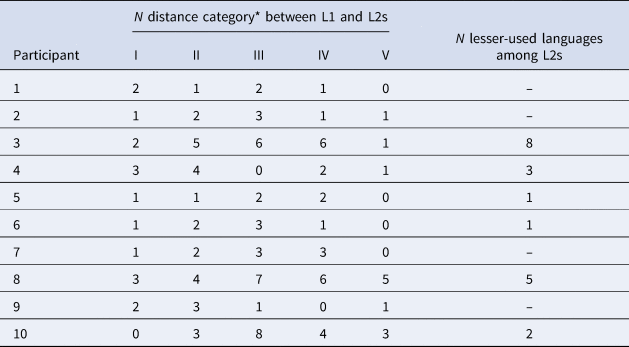
There is, however, more to the question of language selection that points to a specific interest in linguistic form. Table 3 shows a general pattern according to which the participants have included both languages that are close to their L1 and distant from their L1 in their repertoires. The measure used here is based on traditional hierarchical taxonomies of genetic relationships between languages (see Ruhlen, Reference Ruhlen1991), distinguishing family (phylum), branch, and group.Footnote 5 It can be seen from the table that most participants have learned at least one language from the same group as their L1, for example, Danish for an L1 speaker of Swedish. At the same time, most of the participants have also selected one or more languages that are very distant from their L1, for example, Chinese for an L1 speaker of English. Moreover, especially those who have a larger repertoire, often have selected more than one L2 from the same group, for example, both Swedish, Norwegian, and Danish for an L1 speaker of English.
Genetic distance between participants’ L1s and L2s, and number of lesser-used languages in their repertoire.

* Distance categories:
I: Both languages belong to the same group (e. g., Danish and Norwegian, both North Germanic languages)
II: The two languages belong to different groups within the same branch (e. g., Danish and English, one North Germanic and the other West Germanic)
III: The two languages belong to different, but close, branches, in this case, Germanic and Romance (e. g., German and French, one belonging to the Germanic and the other to the Romance branch)
IV: The two languages belong to different and more distant branches (e. g., Swedish and Irish, one belonging to the Germanic and the other to the Celtic branch)
V: The two languages from different families/phylum (e. g., Swedish and Hungarian, one belonging to the Indo-European, the other to the Finno-Ugric family)
It is a notable fact, also shown in Table 3, that more than half of the participants have chosen to learn one or more so-called lesser-used languages. “Lesser-used languages” is another term for the European Council concept of “regional or minority languages.” It refers to “languages that are traditionally used within a given territory of a State by nationals of that State who form a group numerically smaller than the rest of the State's population” (European Charter for Regional or Minority Languages, 1992, Article 1a.i.) This is notable because lesser-used languages are not learned as L2s as frequently as majority languages; due to the unbalance in status and power between speakers of minority and majority languages, there is more often a need, necessity, or desire for minority language speakers to acquire the language of the majority than vice versa. Languages in this category, selected by the participants, included Breton, Catalan, Faroese, Frisian, Friulan, Gallo, Galician, Irish, Luxembourgish, Scots, and Welsh. When asked about the reasons for choosing to learn a language from this category, participants replied in various ways: they were interested in ethnic and cultural heterogeneity in general; they study minority politics and minority education; and they had already learned another closely related language (in the case of Faroese). In particular, though, many were interested in the languages per se, especially the grammatical and phonological architecture of these languages.
Conclusion
As noted in this article, there is an overlap between the constructs of language learning aptitude and language awareness. Language analytic ability, a subcomponent of current conceptualizations of language learning aptitude, and language awareness are tightly linked. The exact extent to which they cover the same underlying mechanisms remains to be decided. There is a case to be made that both of these constructs rely on, or include, what is often called metalinguistic awareness or metalinguistic knowledge (i.e., awareness or knowledge of rules that structure language in the broadest sense). A certain level of metalinguistic awareness does not, in itself, guarantee the ability to verbalize or explain those rules. It is a reasonable assumption that individual differences are linked to metalinguistic awareness. The superior capability of individuals with high levels of language analytic ability/metalinguistic awareness to verbalize linguistic rules (Robinson, Reference Robinson1997) facilitates language awareness. Expressed differently, people with higher aptitude or better language analytic abilities would have an advantage in handling language as an object and to develop an explicit metalanguage, either in terms of conventional linguistic terminology or more informally.
But language analytic ability is just one subcomponent of language learning aptitude, as it interacts with memory and phonetic coding ability, and all these are clearly linked to domain-general cognitive processes. This means that we are still left with underlying linguistic-cognitive constructs, all of which may potentially differ between individuals. The current status of knowledge in the field of aptitude research (Skehan, Reference Skehan, Wen, Skehan, Biedroń, Li and Sparks2019) does not allow us to specify exactly at what cognitive level or in what kind of cognitive-linguistic constructs these individual differences are to be specified. It is therefore reasonable, provisionally at present, to think of a common underlying multicomponent construct, aptitude, that is the basis for these differences. The huge increase in research activities around the notion over the last two decades may, in time, take us closer to a clearer picture. Current neuroanatomical and neurofunctional research achievements, for example, recent achievements in specifying the role of the auditory cortex for the language learning potential (Saito et al., Reference Saito, Kachlicka, Sun and Tierney2020; Seither-Preisler et al., Reference Seither-Preisler, Parncutt and Schneider2014; Turker et al., Reference Turker, Reiterer, Schneider and Seither-Preisler2019), may be a road forward.
Polyglots, as far as we know now, generally have an extremely high level of language learning aptitude and also a highly developed degree of language awareness. In this article, we have documented extreme levels of language learning aptitude as measured by aptitude tests, especially for explicit conditions but also for implicit circumstances. It has been shown that their level of aptitude exceeds all available groups of comparison, certainly when compared to groups representing typical populations, but also to groups selected on criteria of successful second language acquisition. Evidence for high levels of language awareness has been shown more indirectly, but the participants’ results on the subsections of the aptitude tests that tap analytic ability, their preference for explicit learning strategies, and their interest in, and focus on, linguistic form expressed in several ways, suggest an elaborated ability in terms of language awareness.
The fact that language aptitude and language awareness go together is not surprising considering the close links between the two that have been established. As noted in Hyltenstam (Reference Hyltenstam, Hyltenstam, Bartning and Fant2018), for polyglots, there seems to be a synergy of factors, each of which independently enhances language learning, but which together have added value. For example, the high scores on the different LLAMA subsections presented above indicate that polyglots have aptitudes for both explicit and implicit learning conditions. Their high language analytical abilities demonstrated in the “explicit” LLAMA subsections are parallel to their levels of language awareness. Their metalinguistic awareness and knowledge can be thought of as a basis for their ability to verbalize and, in other ways, handle linguistic data to their advantage. Once having developed their language awareness, this further boosts their language acquisition.
It should also be noted that polyglots have an extremely high motivation to learn languages. Together with aptitude and metalinguistic awareness, this means additional synergies. As to the relationship between aptitude and motivation, in a neurocognitive model of competence development, Seither-Preisler et al. (Reference Seither-Preisler, Parncutt and Schneider2014) specified that motivation is subserved basically by the individual's potential profile (including aptitude), but also, of course, by experience. In other words, individuals’ special aptitude abilities motivate them to devote a lot of time and energy to focus on that area of their specific aptitude. The combination of ability and motivation boosts their development further.
Research on polyglots is only in its infancy. Among the most urgent future research questions to deal with is that of individual variation among polyglots. The few individuals that have been formally studied so far may not be representative of the whole group. Is there, for example, a difference between those polyglots who know fewer languages and those who have a wider repertoire, say more than ten, or even more than twenty? As polyglots are exceptional second language learners, future studies of this special category of people have a clear potential to inform theories of second language learning.
Finally, a basic idea in this article is that the study of language learning aptitude and language awareness and their interaction may be promoted by extending the research field to a special group of successful second language learners—polyglots. Focusing on other groups of specific language learners and first and second language users could also develop the field. As expressed by Jouravlev et al., the manifestations of “[l]inguistic aptitude/talent or expertise” can take many forms:
Linguistic aptitude/talent or expertise can manifest in many ways – in line with the multi-componential nature of language comprehension and production – from an exceptionally large vocabulary (e.g., avid readers) to fast and eloquent speech (e.g., orators) to the ability to quickly come up with rhymes (e.g., rappers) or find the precise word or phrase to express an idea (e.g., journalists or novelists), …, to the ability to hear subtle distinctions in foreign speech or imitate foreign words. (Reference Jouravlev, Mineroff, Blank and Federenko2021, p. 9)
This suggestion is not new. Skehan (Reference Skehan1998) discussed the contributions that different categories of learners could make to a theory of aptitude. These categories included exceptional second language learners, both successful and unsuccessful, and exceptional first language learners. Future research may take these suggestions and their promises to systematic empirical practice.
Acknowledgments
I would like to thank two anonymous ARAL reviewers for helpful comments on an earlier draft of this article.
Appendix 1
Table 4 shows total and average scores for each participant, in addition to specifying the raw scores that were the basis for the presentation in Figure 1. As noted by Smeds (Reference Smeds2015, p. 107), the LLAMA manual states that the maximum score on LLAMA D, as in the other subsections, is 100, but it is in fact 75 (cf. Granena 2013, p. 114). (Scores are computed automatically by the LLAMA software.) The manual gives the score range of 15–35 for Average, 40–60 for Good, and then, erroneously, 75–100 for Outstanding. I follow Smeds’ suggestion to use the missing range of 65–75 to cover outstanding scores. In order to make numbers comparable to results from studies where all scores are expressed as 100%, the LLAMA D raw figures were transformed to a percent of the maximum score, 75 (figures in parentheses in Table 4).
Total and average scores for language aptitude. Figures in parenthesis: corrected LLAMA D.